
Last Updated May 5, 2026
Chinese visions of the afterlife are among the most institutionally elaborate in world mythology because they do not imagine death as a simple passage into formless shadow. The realm of the dead is administered, judged, recorded, processed, punished, petitioned, and redirected through systems that resemble government. Underworlds in Chinese religious culture are not merely spaces of terror. They are courts, prisons, offices, registries, jurisdictions, checkpoints, and ritual theaters of moral accounting. Judges weigh deeds. Scribes record conduct. Demon wardens escort souls. Kings preside over trials. Local gods report infractions. Families intervene through offerings, repentance, and merit. The dead do not vanish from order. They enter another order.
This is what makes the Chinese underworld so distinctive. The afterlife becomes one of the clearest mirrors of the Chinese political and ritual imagination: cosmic order continues beyond death in bureaucratic form. Moral life is not treated as an invisible abstraction. It is written into ledgers, summoned into court, presented before officials, punished in staged jurisdictions, and eventually redirected toward rebirth, release, or further correction. The underworld is therefore not only a religious geography. It is a moral administration of the unseen.
Article Map
Chinese Myth, Folklore & Legend
Related Topic
Buddhism & Daoism
Series context: This article is part of the Chinese Myth, Folklore & Legend knowledge series. It should be read alongside What Is Chinese Myth, Folklore & Legend?, The Problem of Sources in Chinese Mythology, Buddhism, Daoism, and the Recasting of Chinese Mythic Worlds, Daoism, Immortality, and the Supernatural Imagination, The Eight Immortals and the Popular Religious Imagination, and Animals, Omens, and Symbolic Creatures in Chinese Folk Imagination. Within that sequence, the underworld matters because it reveals how Chinese civilization imagined not only transcendence, immortality, and paradise, but also judgment, punishment, moral accounting, ghostly vulnerability, and the machinery through which souls are processed after death.
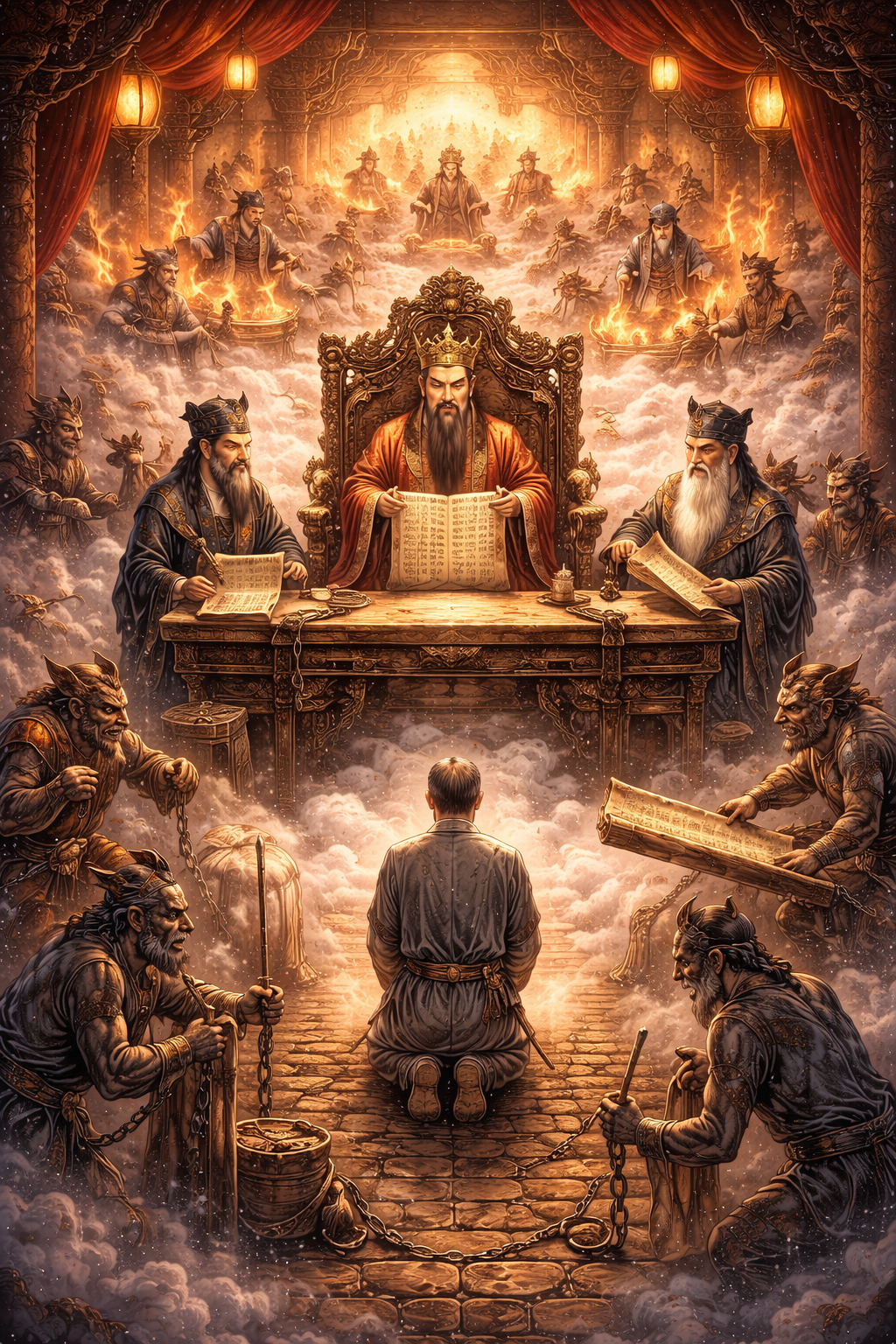
The most recognizable later formulation of this afterlife system is the Ten Kings of Hell, Shiwang 十王. Yet the Chinese underworld did not arise from a single source. It developed through the interaction of Buddhist hell traditions, Daoist cosmology, indigenous ancestral rites, local territorial cults, spirit bureaucracy, karmic morality, and Chinese ideas about official hierarchy, written records, confession, family obligation, and the administration of fate. The result was not a borrowed infernal geography left unchanged, but a distinctively Chinese afterlife in which karmic judgment, bureaucratic procedure, ritual intervention, local cult, and visual pedagogy came together. Chinese underworlds are therefore not only religious landscapes. They are moral institutions.
This article treats the Chinese underworld as a layered mythic-religious construction rather than as one fixed doctrine. Diyu, the “earth prison,” the Ten Kings, Yama, Kṣitigarbha, City Gods, hungry ghosts, ghost festivals, ritual merit, underworld ledgers, infernal punishments, and temple paintings all belong to the broader imagination of postmortem accountability. Their power lies not only in fear, but in structure. The universe remembers. The dead are not beyond relation. The family can still act. The moral world has offices.
What Is Diyu?
Diyu 地獄, often translated as “earth prison,” is the Chinese underworld or hell realm in which souls are judged and punished after death. It is not equivalent to the eternal hell of some Abrahamic traditions. Rather, it is typically imagined as a punitive, corrective, and transitional domain through which souls pass according to karmic burden, moral offense, ritual neglect, social obligation, and the accumulated consequences of life. The underworld is therefore not merely a place of final damnation. It is a system of processing, retribution, correction, and preparation for further rebirth or transition.
This distinction matters because the Chinese afterlife is procedural. Souls do not simply fall into an undifferentiated abyss. They are summoned, escorted, tried, sentenced, punished, recorded, petitioned for, and redirected. The underworld has offices and stages. It possesses internal order. In this respect, diyu belongs to a larger Chinese habit of imagining the cosmos in administratively legible terms. Death does not abolish structure. It intensifies it.
Diyu is also a composite religious idea. Its later forms draw heavily on Buddhist karmic hells, but in China those hells were transformed by Daoist ritual administration, local deity cults, ancestral obligations, and the bureaucratic imagination of Chinese society. The underworld became a place where Buddhist moral causation and Chinese official procedure could reinforce one another. Karma supplied a logic of consequence. Bureaucracy supplied a language of jurisdiction.
As a mythic system, diyu answers several questions at once. Where do the dead go? Who judges them? How are hidden deeds remembered? Can the living help the dead? What becomes of moral debt? How does cosmic justice remain orderly? The Chinese underworld answers by imagining death as entry into a vast institution. Its terror lies not in chaos, but in records.
The Ten Kings and the Judgment of the Dead
The Ten Kings became the most influential later framework for imagining judgment after death. Each king presides over a court or stage within the underworld, where souls are questioned, their deeds are examined, punishments are assigned, and their onward movement is determined. The underworld is thus divided into jurisdictions rather than left as a single undifferentiated infernal mass. The dead pass through authority, and authority is distributed.
This structure is one of the clearest signs of the Chinese transformation of Buddhist hell. The Indian figure Yama and Buddhist karmic retribution are not simply repeated unchanged. They are placed inside a larger Chinese judicial-administrative order. Judgment is staged as court procedure. A soul’s fate is not only announced by abstract moral law. It is processed through hearings, records, offices, officials, and periodic review.
The Ten Kings model became especially influential because it made postmortem morality imaginable through familiar institutional forms. The dead appear before officials as the living might appear before magistrates. Scribes write. Guards stand. Documents circulate. Testimony is heard. Punishment is assigned. Rebirth is determined. Moral reality becomes bureaucratically concrete.
The system also gave ritual life a schedule. In many traditions, memorial rites for the dead are connected to specific postmortem intervals, as the soul moves through stages of judgment. This temporal structure made the underworld socially active. Death did not end the family’s responsibility. It began a period of ritual care in which descendants, monks, priests, or ritual specialists could intervene on behalf of the dead.
Bureaucracy as a Model of the Afterlife
The bureaucratic form of the Chinese underworld is not incidental. It reflects a broader civilizational pattern in which order is imagined through offices, ranks, documents, seals, ledgers, jurisdictions, punishments, and delegated responsibility. Just as the living realm is governed through magistrates, registries, reports, punishments, petitions, and chains of command, so too the dead are subjected to an administered order beyond the grave. The afterlife becomes an extension of government by other means.
This does not make the system spiritually empty. On the contrary, bureaucracy becomes a mythic language through which invisible justice is made concrete. The ledger symbolizes memory. The court symbolizes accountability. The sentence symbolizes the moral intelligibility of suffering. The underworld’s administrative form reassures by terrifying: nothing is forgotten, everything is recorded, and no act disappears simply because life has ended.
In this sense, the Chinese bureaucratic afterlife differs from visions of death as mist, silence, dream, or unstructured shadow. It is not vague. It is documented. Its horror lies in specificity. One is not simply “punished.” One is charged, examined, ranked, punished according to offense, and redirected through a procedure. The underworld is frightening because it knows how to file moral reality.
The bureaucratic model also makes ritual intervention plausible. If the afterlife has offices, then petitions may be submitted. If records exist, they may be amended, appealed, supplemented, or ritually addressed. If the dead are processed through stages, then the living can time offerings and rites to assist them. Bureaucracy does not close the afterlife. It opens it to ritual procedure.
Buddhist Karma and Chinese Administrative Imagination
Buddhism contributed decisively to the elaboration of Chinese hells by supplying rich ideas of karmic consequence, infernal punishments, rebirth, hungry ghosts, moral retribution, and postmortem suffering. Yet these ideas did not remain in China exactly as they had been received. They were translated into a world already accustomed to seeing moral order through official procedure and governmental hierarchy. Karma became legible through courts. Punishment became legible through sentences. Moral causation became legible through records and rulings.
This transformation is fundamental. It explains why the Chinese underworld feels less like an abstract metaphysical zone and more like a grim moral administration. Buddhist notions of retribution fused with Chinese habits of institutional imagination. The unseen world was thereby expanded, but also made more familiar. Hell became bureaucratic because bureaucracy was one of the most powerful symbolic forms through which Chinese civilization imagined order itself.
Buddhist cosmology also introduced broader horizons of rebirth and moral consequence. The dead were not simply ancestors or shades. They could become hungry ghosts, hell beings, animals, humans, gods, or beings moving through cycles of karmic existence. This expanded the moral geography of death beyond the family tomb or local ancestral cult. The dead now belonged to a cosmic circulation shaped by deeds.
At the same time, Chinese ritual culture reshaped Buddhist karma by emphasizing the capacity of the living to assist the dead. Merit-making, offerings, sutra recitation, repentance rites, and memorial ceremonies helped integrate Buddhist moral causation with Chinese family obligation. Karma remained powerful, but it was not imagined as socially isolated. Families could still act.
Daoist Underworlds, Registers, and Spirit Officials
Daoism also shaped the Chinese afterlife by contributing its own celestial and terrestrial administrations, spirit officials, registers, talismans, petitions, and ritual technologies. Daoist ritual did not merely speak of salvation in abstract terms. It frequently worked through written memorials, names, offices, talismanic commands, ritual documents, seals, registers, and communications directed into invisible hierarchies. This administrative imagination could extend downward as well as upward. The dead, like the living, could be entered into systems of registration and adjudication.
In this context, underworlds are not purely punitive spaces but parts of a broader cosmic government. Spirit officials, infernal clerks, city gods, earth gods, and other unseen administrators become thinkable because Daoist cosmology already imagined a universe full of ranked and functioning agencies. The bureaucracy of the afterlife was therefore reinforced by a religious world in which writing, command, names, and registration were sacred technologies.
Daoist ritual also gave the living tools for communicating with unseen authorities. Petitions could be sent; registers could identify the ritual specialist; talismans could command or protect; rites could release, rectify, or transfer. This documentary sacredness is central to the Chinese religious imagination. The underworld may be terrifying, but it is not unreachable. It can be addressed through the right ritual forms.
This Daoist contribution complicates any simple claim that the Chinese underworld is “Buddhist.” Buddhist karmic hells are essential, but the Chinese underworld’s administrative texture depends heavily on Chinese and Daoist models of cosmic office, written authority, and ritual communication. The afterlife is Buddhist in moral causation, but deeply Chinese in procedure.
Yama, the Kings of Hell, and Chinese Transformation
At the heart of many later underworld imaginations stands Yama, the lord or judge of the dead inherited from Indian Buddhist traditions. Yet in China, Yama did not remain a solitary and unchanged infernal ruler. He became one judge among others within a broader system of kingship and adjudication. The underworld was not centralized exclusively in one sovereign presence. It was multiplied into a judicial order.
This multiplication is revealing. Chinese culture did not merely receive a foreign king of death; it bureaucratized him. Judgment became collegial, distributed, and staged through successive courts. The transformation of Yama into a component within the Ten Kings system marks one of the clearest examples of how China reconfigured imported religious forms through its own political imagination.
In visual culture, Yama and the Ten Kings are often shown enthroned like officials or magistrates. Their authority is severe but procedural. They are not chaotic demons. They are judges. The underworld’s terror is therefore not merely monstrous. It is juridical. Souls confront not only pain but evidence, rank, jurisdiction, and ruling.
This transformation also made the afterlife more narratively flexible. Different kings could preside over different stages, sins, or intervals. Different images could show different courts. Different rituals could address different phases of postmortem passage. A single lord of death became a system of judicial administration, and that system could expand across art, temple ritual, storytelling, and family practice.
Kṣitigarbha and the Salvation of Beings in Hell
No account of the Chinese Buddhist underworld is complete without Kṣitigarbha, known in Chinese as Dizang 地藏. Kṣitigarbha became one of the most important Buddhist figures associated with the rescue of beings from hell, the protection of the dead, and the compassionate refusal to abandon the suffering. In Chinese religious imagination, he stands at the threshold between judgment and mercy. The underworld has courts, but it also has a savior.
Kṣitigarbha’s importance lies in the way he changes the emotional meaning of hell. If the Ten Kings make the underworld juridical, Kṣitigarbha makes it salvific. The dead may be judged, but they are not beyond compassion. Hell is terrifying, but not devoid of vows. The bodhisattva’s presence prevents the bureaucratic afterlife from becoming only punishment. It becomes also a field of rescue, repentance, transfer of merit, and hope.
This is especially important in relation to family ritual. The living may dedicate merit, recite scriptures, commission images, sponsor rites, or make offerings for deceased kin. Kṣitigarbha devotion gives such acts a powerful theological frame: the suffering dead can be aided, and compassionate intercession reaches even into the lowest realms. The moral administration of death is not closed to mercy.
Kṣitigarbha also belongs to the visual world of the underworld. Images of Dizang may appear in relation to the Ten Kings, hell scenes, and postmortem rescue. The figure anchors a crucial balance in Chinese Buddhist afterlife imagination: law and compassion, judgment and rescue, karmic consequence and bodhisattva vow.
Punishment, Confession, and Moral Accounting
The punishments of the underworld are among the most memorable features of Chinese religious art and storytelling. Tortures, prisons, mutilations, grinding, dismemberment, freezing, burning, boiling, cutting, and other ordeals are presented not as meaningless cruelty but as morally indexed responses to specific crimes. The infernal body becomes a site where guilt is made visible. Punishment is proportioned, even when symbolically extravagant.
This is important because the underworld also becomes a pedagogical theater. Its punishments teach the living what moral causation looks like when stripped of euphemism. The dead are judged, but the living are instructed. Hell paintings, scrolls, temple murals, sermons, ritual texts, and popular stories show consequences in order to reform behavior before death. The infernal court is therefore not only postmortem. It is didactic for the living community.
Confession and repentance belong to the same moral system. If wrongdoing is recorded, then wrongdoing may also be confessed. If the afterlife has courts, then preparation for judgment matters. Ritual repentance, Buddhist merit-making, Daoist petitions, and family offerings all operate within a universe where moral debts can be acknowledged, addressed, mitigated, or ritually transferred. The afterlife is punitive, but it is also procedural enough to permit intervention.
The ledger is one of the most powerful symbols in this system. It imagines moral life as something that can be written, remembered, and reviewed. In modern terms, one might call this a moral archive. In mythic terms, it means that the cosmos keeps accounts. No hidden cruelty, neglected duty, or secret harm is truly lost.
City Gods, Earth Gods, and Local Afterlife Administration
The Chinese afterlife is not governed only from infernal depths. It is also mediated through local religious figures such as City Gods and Earth Gods, who often function as jurisdictional intermediaries between human communities and the unseen order. These deities protect territories, oversee local moral worlds, and in many traditions play roles in the transition of souls, the punishment of wrongdoing, and the reporting of infractions to higher authorities.
This local dimension matters because it shows that the afterlife was not imagined as distant from ordinary civic life. The dead were tied to place. Judgment had geography. The administration of souls reflected not only cosmic hierarchy but also local jurisdiction. In this way, Chinese afterlife imagination binds the village, the city, the household, the grave, the temple, and the infernal court into one continuous moral landscape.
The City God is especially important because he often resembles a local magistrate in divine form. His temple may function symbolically as an office of moral oversight. He knows the locality. He receives reports. He protects and judges. Through him, the bureaucratic imagination of the underworld becomes local and civic. The unseen order is not merely cosmic; it is municipal.
Earth Gods likewise root the afterlife in territory. The dead remain connected to land, graves, roads, boundaries, and ancestral space. The soul’s journey may lead toward infernal courts, but it begins within local networks of ritual care and territorial belonging. The underworld is immense, yet it is entered through the intimate geography of place.
Filial Piety, Ritual, and the Fate of the Dead
No account of the Chinese underworld can ignore filial piety. The dead are not only judged as individuals; they remain bound to families, descendants, rites, offerings, tablets, tombs, anniversaries, and acts of remembrance. Ritual care for the dead may alleviate suffering, provide resources, improve conditions, generate merit, or express moral continuity between generations. The afterlife is therefore not only juridical. It is relational.
This relational dimension profoundly reshapes infernal imagination. If souls can be aided by descendants, then the boundary between living and dead remains active. The family becomes implicated in the underworld. Memorial rites, offerings, and acts of merit are not peripheral gestures. They are interventions in the postmortem fate of kin. The bureaucracy of the afterlife thus coexists with a ritual economy of care.
Filial piety also made Buddhism more intelligible in China. Buddhist ideas of karma and rebirth could seem to threaten older ancestral frameworks, but Buddhist rites for the dead, merit transfer, and stories of filial rescue helped integrate Buddhism into Chinese family religion. The living could still care for parents and ancestors beyond death. Buddhism did not merely replace ancestor concern; it expanded the ritual technologies through which that concern could be expressed.
The underworld therefore makes family obligation cosmic. A son or daughter’s duty does not end with burial. It may continue through offerings, rituals, merit-making, repentance, and remembrance. In this imagination, love and duty reach into hell itself.
Hungry Ghosts and the Moral Economy of Care
Hungry ghosts occupy an important place in Chinese afterlife imagination because they dramatize a particular form of postmortem suffering: desire without satisfaction, need without nourishment, and social existence without proper ritual care. The hungry ghost is not simply dead. It is deprived. It remains bound to craving, neglect, karmic consequence, or the absence of offerings. This makes hungry ghost traditions central to the moral economy of care between living and dead.
The hungry ghost figure joins Buddhist and Chinese concerns powerfully. From Buddhism come ideas of rebirth, karmic consequence, and ghostly suffering. From Chinese ritual culture come concerns with feeding, family obligation, ancestral rites, and the danger of neglected spirits. The hungry ghost is therefore a figure of both moral failure and ritual need. It asks: who has been left unfed? Whose suffering remains unaddressed? What happens when the dead are not properly cared for?
Ghost festivals and offerings respond to this problem by making nourishment ritual and communal. Food, paper goods, incense, prayers, chants, and merit-making can be directed toward the dead, the abandoned, or the wandering. Such rites do not only comfort families. They also extend care beyond kinship, toward those without descendants or proper ritual support. The hungry ghost thus becomes a figure through which society imagines the ethical danger of abandonment.
This matters for the underworld because it shows that the afterlife is not only judgment from above. It is also need from below. The dead suffer not only because they are guilty, but because they are hungry, forgotten, displaced, or ritually unsupported. Chinese afterlife religion therefore combines justice with feeding, judgment with care, punishment with remembrance.
Mulian and the Drama of Filial Rescue
The story of Mulian rescuing his mother from suffering after death became one of the most important Buddhist narratives in Chinese popular religion. It dramatizes filial piety, karmic punishment, monastic merit, and ritual rescue in one emotionally powerful form. Mulian, a disciple with supernatural vision, sees his mother suffering in a painful postmortem condition and seeks Buddhist means to aid her. The story became central to ritual and festival contexts associated with the dead and hungry ghosts.
Mulian matters because he turns the underworld into a stage for filial action. The dead may suffer because of karma, but the living—or in this case the spiritually accomplished son—can seek help. Buddhist ritual becomes a way to fulfill filial duty. The story therefore helped Buddhism answer one of the strongest Chinese concerns: how can a religion of renunciation serve the family? The Mulian tradition replies that Buddhist practice can rescue parents beyond death.
The narrative also reshapes the emotional texture of hell. Infernal suffering is not only frightening; it is heartbreaking. The sufferer is one’s mother. The underworld court and the hungry ghost realm are not abstractions. They become places where family bonds are tested. The drama of rescue brings together compassion, duty, ritual, and karmic law.
In popular performance, visual culture, and ritual life, Mulian’s story helped make the afterlife socially vivid. It gave families a narrative model for why rites matter and why the dead should not be forgotten. Through Mulian, Buddhist salvation entered the intimate grammar of Chinese kinship.
Visual Culture and the Theater of Hell
The Chinese underworld became especially powerful through visual culture. Temple murals, ritual scrolls, illustrated manuscripts, paintings, popular prints, and sculptural programs made infernal judgment dramatically visible. Hell was shown as a theater of justice in which judges sit enthroned, scribes record offenses, guards drag the condemned, and punishments unfold in terrifying sequence. These images did not merely represent doctrine. They staged it.
Such visual elaboration matters because it turned the invisible into a shared public imagination. Even those who could not read doctrinal texts could see the courts of the dead. The underworld entered collective memory through spectacle. It became morally effective not only because people heard about it, but because they could picture its machinery. Visual hell made moral consequence unforgettable.
The Ten Kings theme was especially suited to painting and scroll sets because each king and court could be represented separately. This made the afterlife serial and processional. Viewers could move visually from one court to another, following the dead through judgment. The structure of the image mirrored the structure of the underworld itself: sequential, official, documented, and severe.
Visual culture also connected hell to ritual use. Paintings or scrolls of underworld courts were not only art objects in the modern sense. They could participate in rites for the dead, temple instruction, moral education, and devotional imagination. The underworld became visible because religious communities needed to see what they feared, addressed, and hoped to transform.
Underworld Ritual and the Living Community
Underworld ritual shows that the Chinese bureaucratic afterlife was not merely a doctrine about the dead. It was a living social practice. Families sponsored rites, monks and Daoist priests performed ceremonies, communities observed festivals, temples displayed judgment scenes, and ritual specialists addressed unseen authorities on behalf of the living and the dead. The afterlife became socially real through repeated acts of care and communication.
Such rituals often addressed multiple needs at once. They could comfort survivors, assist the dead, generate merit, repay karmic debts, feed hungry ghosts, avert misfortune, resolve spiritual pollution, or restore balance between household and unseen world. The dead were not simply absent. They remained participants in social and ritual life.
This is why the bureaucratic model is so durable. An administered afterlife invites administrative ritual. If there are judges, petitions may matter. If there are records, merit may be added. If there are stages, rites may be timed. If there are officials, offerings and documents may be directed. The mythic structure of the afterlife gives ritual action a logic.
Underworld ritual also reveals the ethical breadth of Chinese religious imagination. It is not only about personal salvation or individual punishment. It is about families, communities, neglected dead, wandering ghosts, ancestors, local gods, ritual specialists, and cosmic administrators. Death becomes a communal problem because the dead remain socially connected.
Source History and Interpretive Caution
A careful interpretation of Chinese underworlds must distinguish among several layers: Buddhist infernal traditions, Daoist cosmic administrations, indigenous ancestral and territorial cults, local deity worship, ghost rites, later Ten Kings scriptures, visual programs, temple practice, and popular syncretic religion. The Ten Kings system is especially important, but it should not be mistaken for the sole or earliest form of the Chinese afterlife. Nor should the afterlife be reduced to a purely Buddhist import. Its later Chinese form emerged through translation, adaptation, visual elaboration, ritual practice, and institutional imagination across traditions.
This means that the Chinese underworld is best understood not as a single doctrine but as a composite moral cosmos. Its coherence lies not in one origin but in the successful integration of karmic judgment, official hierarchy, ritual intervention, filial obligation, visual pedagogy, and local religious practice into a single compelling structure of the unseen. It is Buddhist, Daoist, ancestral, civic, and popular at once.
Primary sources must also be handled carefully. The Sutra on the Ten Kings is an indigenous Chinese Buddhist composition rather than an Indian canonical sutra in the narrow sense. Ten Kings paintings and manuscripts are visual and ritual witnesses as much as doctrinal texts. Kṣitigarbha scriptures, Mulian narratives, local City God traditions, Daoist ritual manuals, and popular festival practices each preserve different parts of the afterlife imagination. No single source contains the whole system.
It is also important not to treat infernal punishment imagery as merely sensational. The violence of hell scenes is morally and pedagogically structured. It teaches consequence, invites repentance, supports ritual care, and gives visible form to the idea that harmful action leaves traces. At the same time, one should avoid assuming that all communities understood these images identically. The Chinese underworld changed across period, region, class, sectarian context, ritual use, and visual medium.
Why the Bureaucratic Afterlife Still Matters
The bureaucratic afterlife still matters because it reveals how deeply Chinese civilization linked morality to administration. Justice is not imagined as spontaneous moral balance alone. It is organized, recorded, reviewed, and processed. This gives Chinese infernal imagination a distinctive seriousness: the universe is not careless. It keeps accounts.
It also matters because the underworld shows the breadth of Chinese mythic worlds. China’s religious imagination did not stop at immortals, paradises, sacred mountains, dragons, or auspicious beings. It also built elaborate visions of guilt, punishment, correction, family obligation, ghostly hunger, ritual rescue, and the postmortem state. Underworlds, judges, and infernal bureaucracy remain indispensable because they show how thoroughly the Chinese cosmos was imagined as morally governed on every side of death.
The bureaucratic afterlife matters, too, because it refuses to isolate the dead from the living. Families can act. Communities can feed the hungry ghosts. Ritual specialists can petition unseen authorities. Merit can be dedicated. Confession can matter. The underworld is terrifying, but it is not absolutely closed. Its bureaucracy makes judgment visible; its ritual economy makes mercy actionable.
Finally, this afterlife imagination matters because it shows how Buddhism, Daoism, local religion, family ethics, and visual culture recast one another. The Ten Kings, Yama, Kṣitigarbha, City Gods, hungry ghosts, and underworld ledgers are not isolated motifs. They belong to a vast Chinese moral cosmos in which the dead are judged, remembered, corrected, fed, rescued, and recorded. Death becomes not the end of relation, but its bureaucratic and ritual transformation.
Related Reading
- Chinese Myth, Folklore & Legend
- What Is Chinese Myth, Folklore & Legend?
- The Problem of Sources in Chinese Mythology
- Buddhism, Daoism, and the Recasting of Chinese Mythic Worlds
- Daoism, Immortality, and the Supernatural Imagination
- The Eight Immortals and the Popular Religious Imagination
- Animals, Omens, and Symbolic Creatures in Chinese Folk Imagination
- East Asian Traditions
Primary Sources
- CBETA Online (n.d.) Fo shuo Dizang pusa faxin yinyuan shi wang jing 佛說地藏菩薩發心因緣十王經 / Sūtra on Kṣitigarbha Bodhisattva’s Arousing of the Mind and the Causes and Conditions of the Ten Kings. Available at: https://cbetaonline.dila.edu.tw/zh/X0020
- International Dunhuang Programme / British Library (n.d.) Illustrated manuscript of the Sutra of the Ten Kings, Or.8210/S.3961. Available at: https://idp.bl.uk/collection/2ED6F9800FD74DE08CBB9CB2F8E5D7BD/
- University of Washington Dunhuang Exhibitions (n.d.) “Sutra of the Ten Kings of Hell 佛說十王經.” Available at: https://dunhuang.ds.lib.uw.edu/Dunhuang-Exhibitions/exhibits/show/library-cave-manuscripts/ten-kings
- NTI Reader (n.d.) Dizang pusa benyuan jing 地藏菩薩本願經 / Sūtra of the Great Vows of Kṣitigarbha Bodhisattva, Taishō no. 412. Available at: https://ntireader.org/taisho/t0412.html
- Chinese Text Project (n.d.) Soushen ji 搜神記 / Record of Searching for the Divine. Useful for the broader supernatural archive of spirits, marvels, death, and postmortem imagination in early medieval China. Available at: https://ctext.org/wiki.pl?if=en&res=839038
- Chinese Text Project (n.d.) Taiping guangji 太平廣記. Useful for later encyclopedic collections of spirits, ghosts, Buddhist marvels, Daoist powers, and underworld tales. Available at: https://ctext.org/taiping-guangji
- The Metropolitan Museum of Art (n.d.) “Ten Kings of Hell.” Song dynasty painting from a set illustrating the Ten Kings theme. Available at: https://www.metmuseum.org/art/collection/search/44509
- The British Museum (n.d.) “Painting; 繪畫,” associated with Kṣitigarbha, Daoming, Yama, and the Ten Kings of Hell. Available at: https://www.britishmuseum.org/collection/object/A_1919-0101-0-9
Further Reading
- Encyclopaedia Britannica (n.d.) “Shiwang.” Available at: https://www.britannica.com/topic/Shiwang
- The Metropolitan Museum of Art (n.d.) “Ten Kings of Hell.” Available at: https://www.metmuseum.org/art/collection/search/44509
- Getty Research Institute (n.d.) “Sutra on the Ten Kings.” Available at: https://www.getty.edu/cona/CONAFullSubject.aspx?subid=700008996
- International Dunhuang Programme / British Library (n.d.) Illustrated manuscript of the Sutra of the Ten Kings, Or.8210/S.3961. Available at: https://idp.bl.uk/collection/2ED6F9800FD74DE08CBB9CB2F8E5D7BD/
- University of Washington Dunhuang Exhibitions (n.d.) “Sutra of the Ten Kings of Hell 佛說十王經.” Available at: https://dunhuang.ds.lib.uw.edu/Dunhuang-Exhibitions/exhibits/show/library-cave-manuscripts/ten-kings
- CBETA Online (n.d.) Fo shuo Dizang pusa faxin yinyuan shi wang jing. Available at: https://cbetaonline.dila.edu.tw/zh/X0020
- NTI Reader (n.d.) Sūtra of the Great Vows of Kṣitigarbha Bodhisattva. Available at: https://ntireader.org/taisho/t0412.html
- The British Museum (n.d.) “Painting; 繪畫.” Available at: https://www.britishmuseum.org/collection/object/A_1919-0101-0-9
- Teiser, S.F. (1994) The Scripture on the Ten Kings and the Making of Purgatory in Medieval Chinese Buddhism. Honolulu: University of Hawai‘i Press. Available at: https://archive.org/details/scriptureontenki0000teis
- Teiser, S.F. (1988) The Ghost Festival in Medieval China. Princeton: Princeton University Press.
- Kieschnick, J. (2003) The Impact of Buddhism on Chinese Material Culture. Princeton: Princeton University Press.
- Campany, R.F. (1996) Strange Writing: Anomaly Accounts in Early Medieval China. Albany: State University of New York Press.
- Wolf, A.P. (ed.) (1974) Religion and Ritual in Chinese Society. Stanford: Stanford University Press.
References
- Campany, R.F. (1996) Strange Writing: Anomaly Accounts in Early Medieval China. Albany: State University of New York Press.
- CBETA Online (n.d.) Fo shuo Dizang pusa faxin yinyuan shi wang jing. Available at: https://cbetaonline.dila.edu.tw/zh/X0020
- Chinese Text Project (n.d.) Soushen ji. Available at: https://ctext.org/wiki.pl?if=en&res=839038
- Chinese Text Project (n.d.) Taiping guangji. Available at: https://ctext.org/taiping-guangji
- Encyclopaedia Britannica (n.d.) “Shiwang.” Available at: https://www.britannica.com/topic/Shiwang
- Getty Research Institute (n.d.) “Sutra on the Ten Kings.” Available at: https://www.getty.edu/cona/CONAFullSubject.aspx?subid=700008996
- International Dunhuang Programme / British Library (n.d.) Illustrated manuscript of the Sutra of the Ten Kings, Or.8210/S.3961. Available at: https://idp.bl.uk/collection/2ED6F9800FD74DE08CBB9CB2F8E5D7BD/
- Kieschnick, J. (2003) The Impact of Buddhism on Chinese Material Culture. Princeton: Princeton University Press.
- NTI Reader (n.d.) Sūtra of the Great Vows of Kṣitigarbha Bodhisattva. Available at: https://ntireader.org/taisho/t0412.html
- Teiser, S.F. (1988) The Ghost Festival in Medieval China. Princeton: Princeton University Press.
- Teiser, S.F. (1994) The Scripture on the Ten Kings and the Making of Purgatory in Medieval Chinese Buddhism. Honolulu: University of Hawai‘i Press. Available at: https://archive.org/details/scriptureontenki0000teis
- The British Museum (n.d.) “Painting; 繪畫.” Available at: https://www.britishmuseum.org/collection/object/A_1919-0101-0-9
- The Metropolitan Museum of Art (n.d.) “Ten Kings of Hell.” Available at: https://www.metmuseum.org/art/collection/search/44509
- University of Washington Dunhuang Exhibitions (n.d.) “Sutra of the Ten Kings of Hell 佛說十王經.” Available at: https://dunhuang.ds.lib.uw.edu/Dunhuang-Exhibitions/exhibits/show/library-cave-manuscripts/ten-kings
- Wolf, A.P. (ed.) (1974) Religion and Ritual in Chinese Society. Stanford: Stanford University Press.