
Last Updated June 3, 2026
Futures Wheel and Impact Mapping are practical foresight methods for tracing the consequences of change, connecting those consequences to people and institutions, and translating future-facing insight into strategic action. The Futures Wheel helps practitioners explore first-, second-, and third-order consequences of a trend, event, decision, disruption, technology, policy, or emerging signal. Impact mapping helps connect desired goals to actors, behavioral changes, interventions, deliverables, monitoring indicators, and accountability.
Together, these methods help close a common gap in futures thinking. Many foresight exercises identify trends, scenarios, weak signals, or strategic uncertainties, but they do not always show how consequences cascade across systems or how action should be organized around the people and institutions whose behavior matters. Futures Wheel and Impact Mapping strengthen that bridge. One method expands consequence awareness; the other disciplines strategic translation.
This combination is especially useful for public policy, sustainability transitions, climate adaptation, infrastructure planning, technology governance, public health, education, community resilience, institutional reform, product strategy, and long-term organizational planning. A Futures Wheel can reveal ripple effects that decision-makers might otherwise miss. Impact Mapping can then clarify what outcomes matter, who must act, how behavior must change, and what concrete interventions should be designed, tested, or avoided.
At their deepest level, these methods are not just diagramming tools. They are disciplines of causal imagination. They ask practitioners to think beyond immediate effects, beyond linear planning, beyond isolated interventions, and beyond abstract strategy. They help institutions see how futures propagate through systems and how strategic choices must be grounded in actors, consequences, incentives, relationships, and public value.
Main Library
Publications
Article Map
Futures Thinking
Related Topic
Systems Modeling
Related Topic
Resilience Thinking
Related Topic
Sustainable Development
What Are Futures Wheel and Impact Mapping?
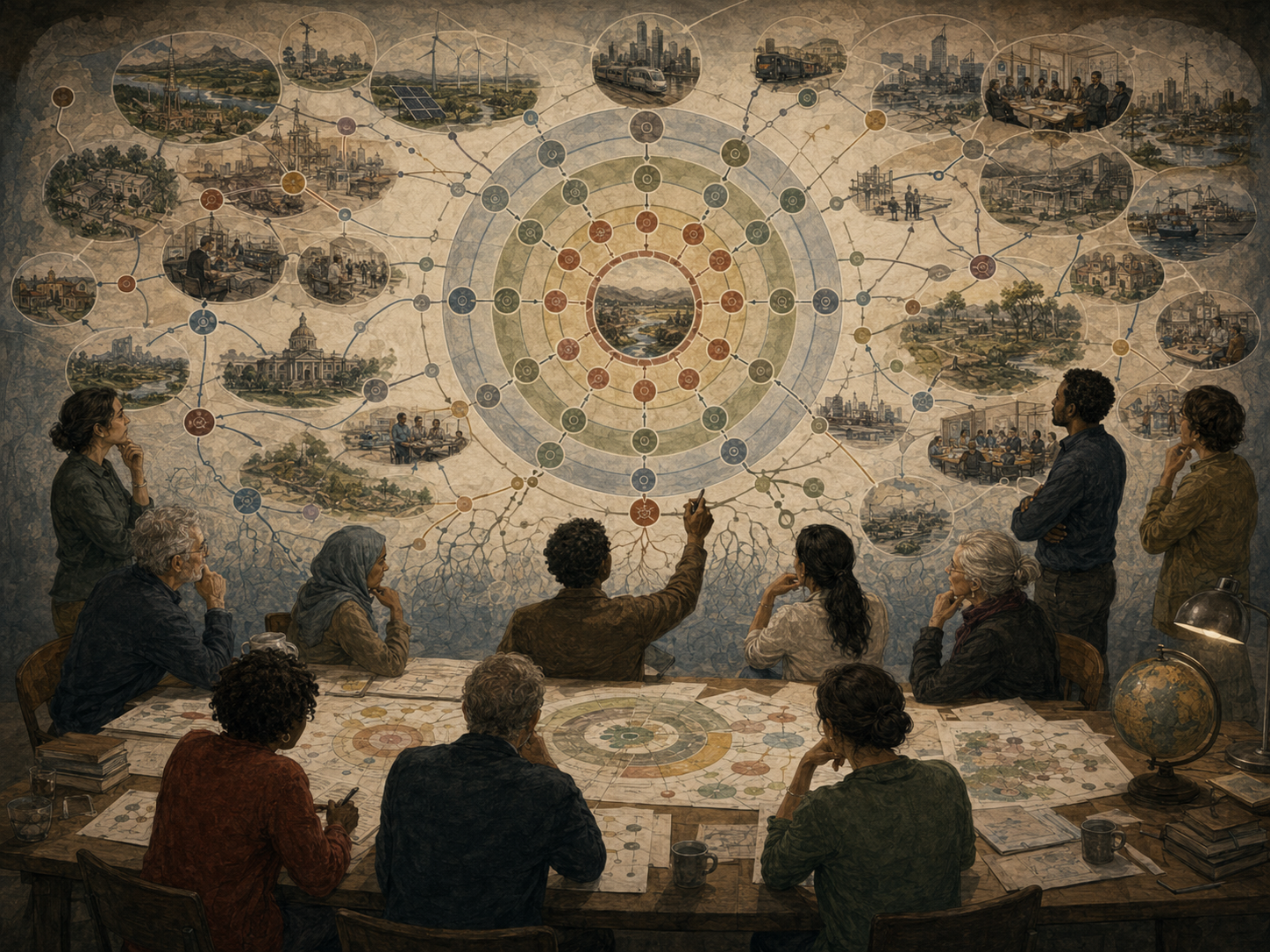
The Futures Wheel is a structured foresight method for mapping the cascading consequences of a change. A central event, trend, signal, decision, or scenario is placed at the center of the analysis. Practitioners then identify direct consequences, indirect consequences, and more distant ripple effects. These consequences are often represented visually as concentric layers radiating outward from the central change.
Impact Mapping is a strategic planning method for connecting goals to actors, desired behavioral changes, interventions, and deliverables. It asks why a goal matters, who can influence the goal, how those actors need to behave differently, and what actions, tools, policies, services, programs, or deliverables might support that change. In futures work, impact mapping helps translate consequences into strategy.
Used separately, each method has value. The Futures Wheel expands consequence awareness. Impact Mapping improves strategic traceability. Used together, they become a powerful foresight workflow: first explore what might happen, then clarify who is affected, who can act, what impacts matter, and which interventions deserve priority.
This pairing is especially useful because futures thinking often produces many possibilities. Without disciplined mapping, possibilities can remain scattered. Without impact logic, strategy can become a list of activities rather than a theory of change. Futures Wheel and Impact Mapping help practitioners move from “what could happen?” to “what should we do, with whom, and toward what impact?”
| Method | Main Question | Primary Output | Strategic Use |
|---|---|---|---|
| Futures Wheel | What consequences might follow from this change? | Map of direct and indirect effects. | Consequence awareness, scenario enrichment, risk identification. |
| Impact Mapping | How do goals connect to actors, behavior, and deliverables? | Goal-actor-impact-deliverable map. | Strategic alignment, intervention design, outcome traceability. |
| Combined Workflow | How do cascading consequences translate into accountable action? | Integrated consequence-to-impact strategy map. | Foresight-informed planning, monitoring, policy, and implementation. |
The Futures Wheel helps expand what decision-makers can see. Impact Mapping helps discipline what decision-makers choose to do.
Why These Methods Matter
Futures Wheel and Impact Mapping matter because many strategies fail at the point where imagination should become action. Institutions may identify a trend but not understand its indirect effects. They may identify a future risk but not understand who will be affected first. They may identify a policy goal but not understand whose behavior must change. They may produce deliverables without connecting them to meaningful impacts.
The Futures Wheel addresses the first failure by widening consequence awareness. It encourages practitioners to move beyond immediate effects and examine ripple effects across systems. A climate adaptation policy, for example, may affect housing, insurance, migration, infrastructure, public health, labor exposure, energy demand, local budgets, community trust, and ecological restoration. A public AI policy may affect procurement, service access, civil rights, worker autonomy, public trust, data governance, appeal rights, and institutional legitimacy.
Impact Mapping addresses the second failure by clarifying strategic logic. It asks what goal is being pursued, who can influence that goal, how their behavior or conditions must change, and what interventions can support that change. This prevents strategy from becoming a disconnected list of reports, dashboards, workshops, tools, pilots, or communication campaigns.
Together, the methods support a more accountable form of foresight. They make consequences visible, actors explicit, impacts traceable, and interventions testable. They also help prevent institutions from confusing activity with progress.
| Common Strategy Failure | How Futures Wheel Helps | How Impact Mapping Helps |
|---|---|---|
| Only immediate effects are considered. | Maps second- and third-order consequences. | Identifies which consequences require strategic response. |
| Actors are treated generically. | Shows who may be affected by cascading effects. | Clarifies whose behavior or capacity must change. |
| Deliverables are mistaken for outcomes. | Reveals whether deliverables address real consequences. | Connects deliverables to intended impacts. |
| Strategy ignores distributional effects. | Surfaces unequal impacts across groups and systems. | Links equity-sensitive impacts to interventions. |
| Foresight remains abstract. | Organizes consequences into visible pathways. | Translates consequences into action logic. |
| Implementation lacks monitoring. | Identifies consequence chains to watch. | Creates indicators tied to goals and impacts. |
These methods matter because they make futures work more consequential: not only more imaginative, but more accountable.
What Is the Futures Wheel?
The Futures Wheel is a visual and analytical method for identifying the direct and indirect consequences of a central change. The central change may be a trend, weak signal, technological development, policy decision, social shift, ecological disturbance, infrastructure failure, public-health risk, institutional reform, or scenario event. The method then asks what consequences follow from that change.
The first ring of the wheel identifies first-order consequences: effects that are most direct and immediate. The second ring identifies second-order consequences: effects that follow from the first-order consequences. The third ring identifies more distant or systemic ripple effects. Some practitioners continue further, but the method is strongest when each layer remains interpretable.
For example, if the central change is “extreme heat events become more frequent,” first-order consequences might include higher cooling demand, health emergencies, outdoor labor risk, school closures, grid stress, and public cooling-center use. Second-order consequences might include higher energy bills, household debt, worker income loss, emergency-room crowding, infrastructure failure, and political pressure for adaptation funding. Third-order consequences might include climate migration, insurance market stress, zoning reform, public-health redesign, housing retrofits, and changed ideas of urban responsibility.
The Futures Wheel is valuable because it prevents single-point thinking. It helps practitioners see that futures unfold through chains of consequence rather than isolated events. It also reveals that consequences can be positive, negative, ambiguous, delayed, unevenly distributed, or dependent on policy response.
| Wheel Element | Meaning | Example |
|---|---|---|
| Central change | The focal event, trend, decision, or signal. | Extreme heat becomes more frequent. |
| First-order consequences | Direct effects of the central change. | Higher cooling demand, health emergencies, grid stress. |
| Second-order consequences | Effects of first-order consequences. | Energy affordability stress, hospital crowding, worker income loss. |
| Third-order consequences | Broader systemic ripple effects. | Housing retrofit policy, climate migration, insurance reform. |
| Cross-links | Interactions among consequences. | Grid stress worsens health risk and affordability pressure. |
| Strategic implications | Risks, opportunities, interventions, and monitoring needs. | Invest in cooling infrastructure, labor protections, and energy resilience. |
The Futures Wheel helps practitioners see consequence cascades before those cascades become crises.
What Is Impact Mapping?
Impact Mapping is a planning method that links strategic goals to actors, desired impacts, and deliverables. It is often summarized through four questions: why, who, how, and what. Why are we pursuing this goal? Who can influence the goal? How do those actors need to behave differently, gain capacity, reduce harm, or change conditions? What should be built, funded, changed, tested, governed, or monitored to support that impact?
In futures thinking, Impact Mapping is especially useful because it prevents foresight from becoming disconnected from implementation. A Futures Wheel may reveal many consequences, but not all consequences can or should become action priorities. Impact Mapping helps determine which impacts matter most, who is involved, and which interventions are traceable to desired outcomes.
For example, if a Futures Wheel shows that extreme heat increases household energy burden, an impact map might define the goal as reducing heat-related vulnerability. Actors may include tenants, landlords, utilities, city agencies, public-health departments, employers, schools, and community organizations. Desired impacts may include safer housing, lower energy burden, more reliable cooling access, reduced worker exposure, and faster emergency response. Deliverables may include retrofit funding, cooling standards, utility protections, labor rules, public-health monitoring, and neighborhood cooling infrastructure.
Impact Mapping is valuable because it distinguishes between outputs and impacts. A dashboard, policy memo, training program, pilot, app, grant, or public campaign is not impact by itself. Impact occurs when conditions, behavior, capacity, risk, access, accountability, or wellbeing changes in the direction of the goal.
| Impact Mapping Question | Purpose | Example |
|---|---|---|
| Why? | Define the strategic goal. | Reduce heat-related vulnerability in exposed neighborhoods. |
| Who? | Identify actors who affect or experience the goal. | Tenants, landlords, utilities, public-health agencies, employers. |
| How? | Clarify desired behavior, capacity, or condition change. | Safer housing, lower energy burden, reduced outdoor labor exposure. |
| What? | Identify interventions or deliverables. | Retrofit grants, cooling standards, utility protections, labor safeguards. |
| How will we know? | Define indicators and learning loops. | Heat illness rates, cooling access, energy-burden measures, response time. |
Impact Mapping forces strategy to answer a hard question: what change, for whom, through which actors, and by what means?
How Futures Wheel and Impact Mapping Work Together
The Futures Wheel and Impact Mapping work together because they answer different but complementary questions. The Futures Wheel asks what consequences may unfold. Impact Mapping asks how strategic action should be organized in response. The first method expands the map of possible effects. The second method focuses the map into goals, actors, impacts, and interventions.
A simple integrated workflow begins with a focal change. Practitioners build a Futures Wheel to identify cascading consequences. They then cluster those consequences into domains such as health, infrastructure, labor, ecology, finance, equity, governance, trust, or technology. Next, they select the most strategically important consequence pathways. Impact Mapping then translates those pathways into goals, actors, desired changes, deliverables, and monitoring indicators.
This integration matters because consequence mapping without action can produce anxiety or abstraction. Action mapping without consequence awareness can produce shallow strategy. Together, they help institutions move from systemic awareness to accountable intervention.
| Integrated Step | Futures Wheel Contribution | Impact Mapping Contribution |
|---|---|---|
| Frame the change | Define the central trend, decision, signal, or scenario. | Clarify the goal or decision context. |
| Map consequences | Identify first-, second-, and third-order effects. | Identify which effects require action. |
| Cluster pathways | Group consequences into domains and cascades. | Connect consequence clusters to outcome areas. |
| Identify actors | Reveal affected groups and institutions. | Map who can influence or experience the desired impact. |
| Define impacts | Clarify what consequences should be prevented, reduced, amplified, or redirected. | Specify behavior, capacity, condition, or accountability changes. |
| Design interventions | Show where intervention could break or redirect cascades. | Identify deliverables, policies, services, tools, or investments. |
| Monitor and learn | Track consequence pathways and early indicators. | Track impact indicators and revise interventions. |
The Futures Wheel widens the lens. Impact Mapping sharpens the action logic.
Core Process of Futures Wheel and Impact Mapping
A combined Futures Wheel and Impact Mapping process should move from focal change to consequence mapping, actor mapping, impact definition, intervention design, and adaptive monitoring. The process works best when it is collaborative, evidence-informed, participatory, and explicit about uncertainty.
1. Frame the Focal Change
Begin by defining the central change. This may be a trend, weak signal, policy proposal, technology, ecological disruption, institutional decision, scenario event, or emerging risk. The focal change should be specific enough to generate meaningful consequences but broad enough to reveal systemic effects.
2. Map First-Order Consequences
Identify the direct effects of the focal change. These are immediate or near-term consequences that follow most clearly from the central change. At this stage, practitioners should avoid judging too quickly. The goal is to generate consequence breadth.
3. Map Second- and Third-Order Consequences
Extend the wheel outward by asking what follows from each first-order consequence. These indirect effects often reveal the most important strategic implications. They show how one change can move through systems, institutions, communities, infrastructure, markets, ecosystems, and public trust.
4. Identify Cross-Links and Feedback
Consequences rarely remain isolated. Some reinforce each other. Some dampen each other. Some create tradeoffs. Some shift risk from one group to another. Mapping cross-links helps transform the wheel from a list of effects into a systems-aware consequence map.
5. Cluster Consequence Pathways
Group related consequences into themes or pathways such as public health, labor, housing, infrastructure, finance, ecology, trust, governance, or equity. Clustering helps identify which cascades are most strategically important and which should feed impact mapping.
6. Define the Impact Goal
Select a priority consequence pathway and define the goal. The goal should be outcome-oriented rather than activity-oriented. It should describe the public, institutional, ecological, social, or strategic condition that should be improved, protected, created, or transformed.
7. Map Actors and Desired Impacts
Identify who affects the goal and who is affected by it. Then clarify how each actor’s behavior, capacity, access, incentives, accountability, risk, or relationship must change. This step translates consequence awareness into actor-specific impact logic.
8. Design Deliverables and Monitoring Indicators
Identify the policies, programs, services, tools, standards, investments, rules, communications, or institutional changes that can support the desired impacts. Define indicators that show whether those interventions are changing conditions rather than merely producing activity.
| Process Step | Guiding Question | Output |
|---|---|---|
| Frame focal change | What change are we analyzing? | Central wheel prompt. |
| Map direct consequences | What happens first? | First-order consequence ring. |
| Map indirect consequences | What follows from those effects? | Second- and third-order consequence rings. |
| Identify cross-links | Which consequences interact? | Feedback and interdependence map. |
| Cluster pathways | Which consequence cascades matter most? | Priority consequence clusters. |
| Define impact goal | What outcome should strategy pursue? | Impact goal statement. |
| Map actors and impacts | Who must change, and how? | Actor-impact map. |
| Design deliverables | What should be built, changed, or funded? | Intervention and monitoring plan. |
The combined process turns future consequences into actor-specific strategy and measurable learning.
First-, Second-, and Third-Order Consequences
The Futures Wheel is built around the idea of consequence cascades. A first-order consequence follows directly from the focal change. A second-order consequence follows from a first-order consequence. A third-order consequence follows from second-order effects and may be more systemic, delayed, distributed, or difficult to anticipate.
This distinction is important because institutions often over-focus on first-order effects. They ask what will happen immediately but not what will happen next. Many serious risks and opportunities emerge in the second and third order. A new technology may first improve efficiency, then reorganize labor, then shift institutional accountability. A climate event may first damage infrastructure, then increase household debt, then alter migration patterns and public trust. A policy reform may first change compliance rules, then alter institutional incentives, then transform public expectations.
Consequences can also vary by direction and value. Some are harms. Some are opportunities. Some are tradeoffs. Some are ambiguous. Some affect one group positively and another negatively. Some create feedback loops that amplify the original change. Others create resistance, adaptation, or compensating behavior.
| Consequence Order | Question | Example: Public AI Deployment |
|---|---|---|
| First order | What happens directly? | Agencies automate parts of eligibility, triage, or case review. |
| Second order | What follows from that direct effect? | Workers rely on automated recommendations; appeal processes become more important. |
| Third order | What broader system effects emerge? | Public trust, due process, labor roles, civil-rights accountability, and procurement standards change. |
| Cross-link | Which effects interact? | Worker deskilling interacts with appeal failures and public distrust. |
| Strategic implication | What should be done? | Create audit capacity, appeal rights, worker training, and accountable procurement rules. |
The deeper value of a Futures Wheel lies in seeing how consequences propagate, combine, and change meaning over time.
Actors, Impacts, and Strategic Behavior Change
Impact Mapping begins once a consequence pathway becomes strategically important. It asks who is involved and what must change. This actor-centered logic is essential because systems do not change only through abstract goals. They change through institutions, communities, workers, agencies, firms, households, professional groups, regulators, funders, educators, utilities, planners, and public bodies acting differently under changed conditions.
Actors may influence the goal directly or indirectly. Some actors make decisions. Some implement. Some are affected. Some resist. Some enable. Some hold knowledge. Some carry costs. Some benefit from the current system. Some are excluded from decisions but exposed to risk. Impact Mapping helps make these roles visible.
Desired impacts are not deliverables. A deliverable is something produced: a policy, dashboard, tool, training, grant, report, standard, or program. An impact is the change the deliverable is meant to support: safer housing, lower exposure, stronger accountability, better access, reduced risk, improved trust, increased capacity, changed incentives, or more legitimate governance.
| Actor Category | Role in Impact Mapping | Example Impact Question |
|---|---|---|
| Decision-makers | Authorize policy, funding, rules, or strategy. | What must they approve, prioritize, or stop doing? |
| Implementers | Carry out programs, services, regulations, or operations. | What capacity, training, authority, or workflow must change? |
| Affected communities | Experience benefits, harms, risks, or exclusions. | What conditions must improve for them? |
| Intermediaries | Connect systems, services, institutions, and people. | What coordination role must they play? |
| Incumbents | Benefit from current arrangements or resist change. | What incentives or accountability mechanisms must shift? |
| Knowledge holders | Provide technical, local, professional, or lived expertise. | What knowledge must shape design and monitoring? |
Impact Mapping makes strategy actor-specific: it asks who must change, what must change for them, and how that change connects to the goal.
Systems Thinking, Feedback, and Interdependence
Futures Wheel and Impact Mapping become stronger when combined with systems thinking. A Futures Wheel can easily become a radial list of consequences. Systems thinking turns it into a map of interdependence. It asks which effects reinforce each other, which create balancing responses, which produce delays, which shift burdens, and which create feedback loops.
For example, extreme heat may increase cooling demand. Higher cooling demand may stress the grid. Grid stress may increase outage risk. Outages may increase health emergencies. Health emergencies may strain hospitals. Hospital strain may reduce trust in public preparedness. Lower trust may weaken compliance with future emergency guidance. This is not a simple chain. It is a feedback-rich public system.
Impact Mapping also benefits from systems thinking. Desired impacts may conflict. A policy that reduces one risk may increase another. A technology that improves efficiency may reduce accountability. A climate adaptation measure may protect property while displacing low-income residents. A dashboard may improve visibility while creating false confidence. Systems thinking helps identify these interactions before implementation.
| Systems Concept | Futures Wheel Use | Impact Mapping Use |
|---|---|---|
| Feedback loops | Identify reinforcing or balancing consequence chains. | Design interventions that interrupt harmful loops or strengthen beneficial ones. |
| Delays | Recognize effects that appear later. | Create monitoring indicators before delayed harms become visible. |
| Tradeoffs | Reveal conflicting consequences. | Make impact priorities explicit and accountable. |
| Burden shifting | Identify where one group absorbs another group’s risk. | Design equity-sensitive interventions and safeguards. |
| Thresholds | Identify points where consequences accelerate. | Define trigger points for adaptive response. |
| Leverage points | Find consequences that influence many other consequences. | Prioritize interventions with systemic effect. |
A Futures Wheel shows the spread of consequences. Systems thinking shows how those consequences interact. Impact Mapping shows how to act on them.
Impact vs Output: Avoiding Activity Without Change
One of the most important contributions of Impact Mapping is the distinction between outputs and impacts. Organizations often produce many outputs: reports, meetings, dashboards, pilots, web pages, trainings, data tools, workshops, policies, memos, grants, roadmaps, or communication campaigns. These outputs may be necessary, but they are not the same as change.
An impact is a meaningful shift in behavior, capacity, condition, risk, access, accountability, legitimacy, wellbeing, or system performance. A dashboard is an output. Faster response to heat emergencies is an impact. A policy memo is an output. Reduced housing exposure is an impact. An AI ethics checklist is an output. Improved due process and appeal capacity are impacts. A resilience plan is an output. Lower community vulnerability is an impact.
This distinction is essential for futures thinking because long-term strategy can become ceremonial. Institutions may hold foresight workshops, publish future scenarios, produce maps, and create recommendations without changing the conditions those exercises reveal. Impact Mapping helps prevent this by requiring every deliverable to connect to an actor and desired change.
| Output | Possible Impact | Accountability Question |
|---|---|---|
| Scenario report | Decision-makers revise investment priorities under uncertainty. | Did the report change a real decision? |
| Risk dashboard | Agencies detect and respond to vulnerability earlier. | Did response time or targeting improve? |
| Training program | Practitioners gain capacity to implement new practices. | Did behavior or performance change? |
| Policy framework | Rules, incentives, rights, or protections improve. | Did the framework alter institutional practice? |
| Public consultation | Affected communities shape priorities and safeguards. | Did participation change the strategy? |
| Pilot project | Evidence supports scaling, revision, or discontinuation. | What was learned, and what changed next? |
Impact Mapping protects futures work from becoming activity without transformation.
Power, Distribution, and Unequal Impacts
Futures Wheel and Impact Mapping must be used with attention to power. Consequences are not distributed evenly. Some groups experience risks earlier, more intensely, or with fewer resources to respond. Some actors benefit from current arrangements. Some actors control decisions while others absorb consequences. Some impacts are visible to institutions, while others remain hidden in households, workplaces, neighborhoods, ecosystems, and informal care systems.
A Futures Wheel that does not ask who experiences each consequence can become abstract. An Impact Map that does not ask who benefits and who bears cost can become technocratic. Serious foresight requires distributional analysis. For every consequence pathway, practitioners should ask who is harmed, who benefits, who decides, who is excluded, who pays, who adapts, and who has the authority to change conditions.
This is especially important in climate adaptation, technology governance, housing, public health, infrastructure, labor transition, education, food systems, and environmental policy. A consequence that appears minor at the aggregate level may be severe for a vulnerable group. An intervention that appears efficient may transfer burdens to workers, tenants, caregivers, disabled people, low-income households, Indigenous communities, or future generations.
| Power Question | Futures Wheel Use | Impact Mapping Use |
|---|---|---|
| Who experiences this consequence first? | Identifies early-exposed groups and weak signals. | Prioritizes affected actors in the impact map. |
| Who benefits from the focal change? | Reveals interests behind consequences. | Clarifies incentives and accountability. |
| Who bears the cost of delay? | Shows unequal time sensitivity. | Defines urgency and safeguards. |
| Who has authority to act? | Identifies institutional leverage points. | Maps decision-makers and implementers. |
| Who is excluded from design? | Reveals blind spots in consequence mapping. | Creates participation and legitimacy requirements. |
| What impacts are hidden? | Surfaces informal, household, labor, ecological, and emotional burdens. | Expands indicators beyond official metrics. |
Impact is never only technical. It is distributed through power, institutions, geography, class, race, gender, disability, labor, ecology, and time.
Applications in Strategy and Policy
Futures Wheel and Impact Mapping can be used across many domains because most future-oriented decisions involve cascading consequences and actor-specific impacts. The methods are practical enough for workshops and structured enough for institutional planning.
| Domain | Futures Wheel Use | Impact Mapping Use |
|---|---|---|
| Climate adaptation | Map cascading effects of heat, flooding, migration, insurance stress, and infrastructure failure. | Connect adaptation goals to agencies, utilities, landlords, employers, and communities. |
| Technology governance | Trace impacts of AI, automation, data systems, and digital public infrastructure. | Link accountability goals to procurement, audits, worker practices, appeals, and public rights. |
| Public health | Map consequences of disease shocks, workforce shortages, misinformation, and climate-health stress. | Connect preparedness goals to hospitals, public agencies, care workers, and communities. |
| Infrastructure planning | Identify ripple effects of grid stress, transit failure, water risk, and maintenance backlogs. | Translate resilience goals into investment, maintenance, governance, and service impacts. |
| Education | Explore consequences of AI, climate risk, labor change, civic fragmentation, and skill shifts. | Connect learning goals to students, teachers, institutions, employers, and public capacity. |
| Organizational strategy | Map consequences of market shifts, technology adoption, workforce change, and institutional risk. | Connect strategy goals to teams, customers, partners, capabilities, and measurable outcomes. |
| Community resilience | Trace cascading effects of shocks across households, services, infrastructure, and trust. | Map local actors, capacities, mutual aid, public services, and resilience outcomes. |
| Sustainability transitions | Explore direct and indirect effects of energy, food, water, transport, and land-use transitions. | Connect transition goals to actors, safeguards, investments, and justice outcomes. |
In each domain, the methods work best when they are not treated as one-time diagrams. They should feed scenario planning, backcasting, strategic foresight, monitoring systems, public participation, and adaptive governance.
Strengths and Limitations
Futures Wheel and Impact Mapping have several strengths. They are visual, practical, collaborative, and accessible. They help groups think beyond immediate effects. They connect foresight to actors and action. They expose assumptions, tradeoffs, blind spots, and potential unintended consequences. They also create a useful bridge between systems thinking and implementation.
But they also have limitations. Futures Wheels can become messy, speculative, or shallow if not facilitated carefully. Impact Maps can become too linear if they ignore systems dynamics. Both methods can reproduce the assumptions of the people in the room. They can also create false confidence if consequence chains are treated as predictions rather than plausible pathways requiring monitoring.
| Strength | Strategic Value |
|---|---|
| Accessible and visual | Helps diverse groups participate in futures thinking. |
| Consequence-oriented | Moves beyond immediate effects to cascading implications. |
| Actor-centered | Connects strategy to people, institutions, and behavior change. |
| Outcome-focused | Distinguishes impact from deliverables and activity. |
| Systems-aware | Can reveal feedback, dependencies, and burden shifting. |
| Actionable | Translates foresight into interventions, indicators, and learning. |
| Limitation | Risk | Corrective Practice |
|---|---|---|
| Speculation without discipline | Consequences become random brainstorming. | Use evidence, scenarios, expert input, and plausibility checks. |
| Overcrowded maps | Too many consequences obscure priorities. | Cluster pathways and rank strategic relevance. |
| Linear action logic | Impact maps ignore feedback and interdependence. | Combine with systems thinking and monitoring triggers. |
| Panel bias | Participants map only what they already see. | Include affected communities and diverse expertise. |
| Output fixation | Deliverables replace real outcomes. | Require measurable impact logic for every deliverable. |
| No follow-through | Workshop results do not affect decisions. | Assign owners, indicators, review cycles, and decision pathways. |
These methods are strongest when treated as structured inquiry, not decorative workshop exercises.
A Practical Workflow
A practical workflow should move from the focal future change to consequence mapping, prioritization, impact logic, intervention design, and monitoring. The workflow below can be adapted for public agencies, universities, civic institutions, nonprofits, strategy teams, sustainability programs, product teams, research groups, and community planning processes.
| Phase | Purpose | Guiding Questions | Outputs |
|---|---|---|---|
| 1. Frame the focal change | Define the change, signal, trend, policy, or scenario. | What future development are we examining? | Focal change statement. |
| 2. Build the Futures Wheel | Identify direct and indirect consequences. | What follows first, second, and third? | Consequence cascade map. |
| 3. Identify affected systems and groups | Clarify where consequences land. | Who experiences, benefits, decides, or bears cost? | Actor and distribution map. |
| 4. Cluster and prioritize consequence pathways | Select strategic pathways for deeper analysis. | Which cascades are most plausible, severe, urgent, or actionable? | Priority consequence pathways. |
| 5. Define impact goals | Translate consequence pathways into desired outcomes. | What condition should improve, be protected, or be transformed? | Goal and impact statements. |
| 6. Map actors and desired changes | Connect goals to behavior, capacity, incentives, and accountability. | Who must act differently, and how? | Actor-impact map. |
| 7. Design interventions and deliverables | Identify what should be created, changed, funded, governed, or tested. | What actions support the desired impacts? | Intervention portfolio. |
| 8. Monitor, learn, and revise | Track consequences and impacts over time. | What indicators show whether strategy is working? | Monitoring plan and review cycle. |
A strong workflow does not stop at insight. It creates a traceable line from future change to consequence cascade, actor behavior, intervention design, and learning.
Mathematical Lens: Cascading Consequences and Impact Pathways
A Futures Wheel can be represented as a consequence graph:
G = (V, E)
\]
Interpretation: \(G\) is a graph, \(V\) is the set of consequence nodes, and \(E\) is the set of relationships between consequences. The central change is the root node, while first-, second-, and third-order consequences expand outward.
The order of a consequence can be represented by its distance from the central change:
O(v_i) = d(v_0, v_i)
\]
Interpretation: \(O(v_i)\) is the order of consequence node \(v_i\), \(v_0\) is the focal change, and \(d(v_0, v_i)\) is the graph distance from the focal change. First-order consequences have distance one, second-order consequences distance two, and so on.
A consequence priority score can combine likelihood, severity, uncertainty, distributional burden, and actionability:
C_i = w_lL_i + w_sS_i + w_uU_i + w_dD_i + w_aA_i
\]
Interpretation: \(C_i\) is the priority score for consequence \(i\), \(L_i\) is likelihood, \(S_i\) is severity, \(U_i\) is uncertainty, \(D_i\) is distributional burden, and \(A_i\) is actionability. The weights should reflect the decision context.
An impact pathway can be represented as a chain from goal to actor, impact, and deliverable:
P = \{G, A, I, D\}
\]
Interpretation: \(P\) is an impact pathway, \(G\) is the goal, \(A\) is the actor set, \(I\) is the desired impact, and \(D\) is the deliverable or intervention. A credible pathway must show how deliverables support impacts through actors.
Output-to-impact traceability can be represented as:
T_j = \frac{I_j}{D_j}
\]
Interpretation: \(T_j\) is a simplified traceability ratio for deliverable \(j\), comparing demonstrated impact \(I_j\) to delivered output \(D_j\). The expression is conceptual, but it highlights a practical question: does the deliverable produce meaningful change, or only activity?
These equations are not predictive models. They clarify the structure of consequence mapping, pathway priority, actor-impact logic, and output-to-impact accountability.
Computational Modeling for Futures Wheel and Impact Mapping
Computational tools can support Futures Wheel and Impact Mapping by organizing consequence nodes, actor relationships, impact pathways, intervention portfolios, monitoring indicators, and learning cycles. They should not replace human judgment, facilitation, stakeholder participation, ethical reasoning, or community knowledge. Their purpose is to make consequence and impact logic more transparent.
A useful computational workflow may include:
- Consequence registers: structured lists of first-, second-, and third-order effects.
- Consequence graph files: node and edge tables showing how consequences connect.
- Priority scoring: comparison of consequence pathways by likelihood, severity, uncertainty, distributional burden, and actionability.
- Actor maps: records of affected groups, decision-makers, implementers, intermediaries, and knowledge holders.
- Impact pathways: goal-actor-impact-deliverable chains.
- Intervention portfolios: candidate actions linked to consequence pathways and actors.
- Monitoring indicators: metrics tied to consequences and desired impacts.
- Learning reports: outputs showing which consequences are strengthening, weakening, or changing.
Computational support should be auditable. It should show how consequence scores were assigned, who participated in mapping, which actors were included, what assumptions shaped the map, and how uncertainty was handled. A model that hides these choices may produce false precision.
The goal is not to automate foresight. The goal is to make consequence reasoning and impact logic structured, traceable, and revisable.
Advanced R Workflow: Consequence Cascades and Impact Profiles
The R workflow below creates a stylized consequence register and impact profile. It scores consequences by likelihood, severity, uncertainty, distributional burden, and actionability, then summarizes priority pathways. It is designed as an evergreen illustration of how Futures Wheel outputs can feed impact mapping.
# ------------------------------------------------------------
# R Workflow: Consequence Cascades and Impact Profiles
# Purpose:
#   Score futures-wheel consequence nodes and connect them
#   to impact priorities for strategic planning.
#
# Optional dependency:
#   install.packages(c("tidyverse"))
# ------------------------------------------------------------

library(tidyverse)

consequences <- tibble(
  node_id = c("C1", "C2", "C3", "C4", "C5", "C6", "C7", "C8"),
  order = c(1, 1, 2, 2, 2, 3, 3, 3),
  consequence = c(
    "Higher cooling demand",
    "Outdoor labor exposure rises",
    "Energy affordability stress",
    "Grid reliability pressure",
    "Heat-related health emergencies",
    "Household debt increases",
    "Public-health system strain",
    "Climate adaptation legitimacy pressure"
  ),
  domain = c(
    "energy",
    "labor",
    "housing_finance",
    "infrastructure",
    "public_health",
    "household_economics",
    "public_health",
    "governance"
  ),
  likelihood = c(0.88, 0.84, 0.76, 0.78, 0.82, 0.66, 0.70, 0.74),
  severity = c(0.72, 0.78, 0.82, 0.86, 0.88, 0.74, 0.80, 0.84),
  uncertainty = c(0.34, 0.38, 0.46, 0.42, 0.36, 0.52, 0.48, 0.44),
  distributional_burden = c(0.70, 0.88, 0.90, 0.76, 0.92, 0.86, 0.82, 0.78),
  actionability = c(0.74, 0.68, 0.72, 0.66, 0.76, 0.58, 0.64, 0.70)
)

consequences <- consequences %>%
  mutate(
    consequence_priority =
      0.22 * likelihood +
      0.26 * severity +
      0.14 * uncertainty +
      0.22 * distributional_burden +
      0.16 * actionability,
    priority_class = case_when(
      consequence_priority >= 0.80 ~ "High-priority cascade",
      consequence_priority >= 0.72 ~ "Monitor and prepare",
      TRUE ~ "Context-dependent priority"
    )
  ) %>%
  arrange(desc(consequence_priority))

impact_paths <- tibble(
  goal = "Reduce heat-related vulnerability in exposed neighborhoods",
  actor = c(
    "City climate office",
    "Public health department",
    "Utilities",
    "Employers",
    "Landlords",
    "Community organizations"
  ),
  desired_impact = c(
    "Coordinate adaptation investments",
    "Detect heat illness earlier",
    "Protect vulnerable households from shutoffs",
    "Reduce outdoor worker exposure",
    "Improve housing cooling safety",
    "Increase trusted local preparedness"
  ),
  deliverable = c(
    "Neighborhood adaptation portfolio",
    "Heat-health monitoring protocol",
    "Utility protection standard",
    "Heat labor safety rule",
    "Cooling retrofit grant",
    "Community cooling network support"
  ),
  traceability_score = c(0.84, 0.78, 0.82, 0.76, 0.80, 0.86)
)

print(consequences)
print(impact_paths)

domain_summary <- consequences %>%
  group_by(domain) %>%
  summarise(
    mean_priority = mean(consequence_priority),
    max_priority = max(consequence_priority),
    consequence_count = n(),
    .groups = "drop"
  ) %>%
  arrange(desc(mean_priority))

ggplot(consequences, aes(x = reorder(consequence, consequence_priority), y = consequence_priority)) +
  geom_col() +
  coord_flip() +
  labs(
    title = "Futures Wheel Consequence Priority Scores",
    x = "Consequence",
    y = "Priority Score"
  ) +
  theme_minimal(base_size = 12)

ggplot(impact_paths, aes(x = reorder(actor, traceability_score), y = traceability_score)) +
  geom_col() +
  coord_flip() +
  labs(
    title = "Impact Mapping Traceability by Actor",
    x = "Actor",
    y = "Traceability Score"
  ) +
  theme_minimal(base_size = 12)

dir.create("outputs", showWarnings = FALSE)

write_csv(consequences, "outputs/futures_wheel_consequence_priorities.csv")
write_csv(domain_summary, "outputs/futures_wheel_domain_summary.csv")
write_csv(impact_paths, "outputs/impact_mapping_actor_paths.csv")
This workflow shows how consequence mapping can be translated into structured impact planning. The point is not to eliminate judgment, but to make consequence prioritization and actor-impact logic visible.
Advanced Python Workflow: Mapping Impact Pathways and Cascading Effects
The Python workflow below builds a small consequence network and impact map. It scores consequences, identifies high-priority pathways, and exports tables for further analysis. It is designed to illustrate how Futures Wheel and Impact Mapping can be represented as connected data structures.
# ------------------------------------------------------------
# Python Workflow: Futures Wheel and Impact Mapping
# Purpose:
#   Build a simple consequence network and actor-impact map
#   for foresight-informed strategic planning.
#
# Optional dependencies:
#   pip install pandas matplotlib
# ------------------------------------------------------------

from pathlib import Path

import pandas as pd
import matplotlib.pyplot as plt

OUTPUT_DIR = Path("outputs")
OUTPUT_DIR.mkdir(exist_ok=True)

consequences = pd.DataFrame([
    {
        "node_id": "C0",
        "parent_id": "",
        "order": 0,
        "consequence": "Extreme heat events become more frequent",
        "domain": "focal_change",
        "likelihood": 1.00,
        "severity": 0.80,
        "uncertainty": 0.30,
        "distributional_burden": 0.80,
        "actionability": 0.70
    },
    {
        "node_id": "C1",
        "parent_id": "C0",
        "order": 1,
        "consequence": "Higher cooling demand",
        "domain": "energy",
        "likelihood": 0.88,
        "severity": 0.72,
        "uncertainty": 0.34,
        "distributional_burden": 0.70,
        "actionability": 0.74
    },
    {
        "node_id": "C2",
        "parent_id": "C0",
        "order": 1,
        "consequence": "Outdoor labor exposure rises",
        "domain": "labor",
        "likelihood": 0.84,
        "severity": 0.78,
        "uncertainty": 0.38,
        "distributional_burden": 0.88,
        "actionability": 0.68
    },
    {
        "node_id": "C3",
        "parent_id": "C1",
        "order": 2,
        "consequence": "Energy affordability stress",
        "domain": "housing_finance",
        "likelihood": 0.76,
        "severity": 0.82,
        "uncertainty": 0.46,
        "distributional_burden": 0.90,
        "actionability": 0.72
    },
    {
        "node_id": "C4",
        "parent_id": "C1",
        "order": 2,
        "consequence": "Grid reliability pressure",
        "domain": "infrastructure",
        "likelihood": 0.78,
        "severity": 0.86,
        "uncertainty": 0.42,
        "distributional_burden": 0.76,
        "actionability": 0.66
    },
    {
        "node_id": "C5",
        "parent_id": "C2",
        "order": 2,
        "consequence": "Heat-related health emergencies",
        "domain": "public_health",
        "likelihood": 0.82,
        "severity": 0.88,
        "uncertainty": 0.36,
        "distributional_burden": 0.92,
        "actionability": 0.76
    },
    {
        "node_id": "C6",
        "parent_id": "C3",
        "order": 3,
        "consequence": "Household debt increases",
        "domain": "household_economics",
        "likelihood": 0.66,
        "severity": 0.74,
        "uncertainty": 0.52,
        "distributional_burden": 0.86,
        "actionability": 0.58
    },
    {
        "node_id": "C7",
        "parent_id": "C5",
        "order": 3,
        "consequence": "Public-health system strain",
        "domain": "public_health",
        "likelihood": 0.70,
        "severity": 0.80,
        "uncertainty": 0.48,
        "distributional_burden": 0.82,
        "actionability": 0.64
    },
    {
        "node_id": "C8",
        "parent_id": "C4",
        "order": 3,
        "consequence": "Climate adaptation legitimacy pressure",
        "domain": "governance",
        "likelihood": 0.74,
        "severity": 0.84,
        "uncertainty": 0.44,
        "distributional_burden": 0.78,
        "actionability": 0.70
    }
])

consequences["priority_score"] = (
    0.22 * consequences["likelihood"]
    + 0.26 * consequences["severity"]
    + 0.14 * consequences["uncertainty"]
    + 0.22 * consequences["distributional_burden"]
    + 0.16 * consequences["actionability"]
)

consequences["priority_class"] = pd.cut(
    consequences["priority_score"],
    bins=[0, 0.72, 0.80, 1.20],
    labels=[
        "Context-dependent priority",
        "Monitor and prepare",
        "High-priority cascade"
    ],
    include_lowest=True
)

impact_map = pd.DataFrame([
    {
        "goal": "Reduce heat-related vulnerability in exposed neighborhoods",
        "actor": "City climate office",
        "desired_impact": "Coordinate adaptation investments",
        "deliverable": "Neighborhood adaptation portfolio",
        "indicator": "adaptation_investment_coverage",
        "traceability_score": 0.84
    },
    {
        "goal": "Reduce heat-related vulnerability in exposed neighborhoods",
        "actor": "Public health department",
        "desired_impact": "Detect heat illness earlier",
        "deliverable": "Heat-health monitoring protocol",
        "indicator": "heat_illness_detection_time",
        "traceability_score": 0.78
    },
    {
        "goal": "Reduce heat-related vulnerability in exposed neighborhoods",
        "actor": "Utilities",
        "desired_impact": "Protect vulnerable households from shutoffs",
        "deliverable": "Utility protection standard",
        "indicator": "cooling_access_protection_rate",
        "traceability_score": 0.82
    },
    {
        "goal": "Reduce heat-related vulnerability in exposed neighborhoods",
        "actor": "Employers",
        "desired_impact": "Reduce outdoor worker exposure",
        "deliverable": "Heat labor safety rule",
        "indicator": "outdoor_worker_exposure_hours",
        "traceability_score": 0.76
    },
    {
        "goal": "Reduce heat-related vulnerability in exposed neighborhoods",
        "actor": "Landlords",
        "desired_impact": "Improve housing cooling safety",
        "deliverable": "Cooling retrofit grant",
        "indicator": "safe_cooling_housing_share",
        "traceability_score": 0.80
    },
    {
        "goal": "Reduce heat-related vulnerability in exposed neighborhoods",
        "actor": "Community organizations",
        "desired_impact": "Increase trusted local preparedness",
        "deliverable": "Community cooling network support",
        "indicator": "trusted_cooling_network_coverage",
        "traceability_score": 0.86
    }
])

domain_summary = (
    consequences
    .groupby("domain", as_index=False)
    .agg(
        mean_priority=("priority_score", "mean"),
        max_priority=("priority_score", "max"),
        consequence_count=("node_id", "count")
    )
    .sort_values("mean_priority", ascending=False)
)

consequences.to_csv(OUTPUT_DIR / "consequence_network.csv", index=False)
domain_summary.to_csv(OUTPUT_DIR / "consequence_domain_summary.csv", index=False)
impact_map.to_csv(OUTPUT_DIR / "impact_mapping_actor_paths.csv", index=False)

print("\nHighest-priority consequences:")
print(
    consequences
    .sort_values("priority_score", ascending=False)
    [["node_id", "order", "consequence", "domain", "priority_score", "priority_class"]]
)

print("\nImpact map:")
print(impact_map[["actor", "desired_impact", "deliverable", "traceability_score"]])

plt.figure(figsize=(10, 6))
ranked = consequences[consequences["order"] > 0].sort_values("priority_score")
plt.barh(ranked["consequence"], ranked["priority_score"])
plt.xlabel("Priority Score")
plt.title("Futures Wheel Consequence Priority Scores")
plt.tight_layout()
plt.savefig(OUTPUT_DIR / "consequence_priority_scores.png", dpi=150)
plt.close()

plt.figure(figsize=(10, 6))
ranked_impact = impact_map.sort_values("traceability_score")
plt.barh(ranked_impact["actor"], ranked_impact["traceability_score"])
plt.xlabel("Traceability Score")
plt.title("Impact Mapping Traceability by Actor")
plt.tight_layout()
plt.savefig(OUTPUT_DIR / "impact_mapping_traceability.png", dpi=150)
plt.close()
This workflow demonstrates the practical bridge between consequence mapping and impact design. The consequence network clarifies what may happen. The impact map clarifies who must act and what change should result.
GitHub Repository
The companion repository for this article contains computational examples for Futures Wheel consequence mapping, impact pathway analysis, actor-impact-deliverable chains, consequence prioritization, monitoring indicators, and foresight-informed strategy translation.
Complete Code Repository
The companion code includes Python, R, Julia, SQL, Rust, Go, C++, Fortran, C, documentation, synthetic datasets, outputs, and notebook placeholders for applied Futures Wheel and impact mapping workflows.
Why This Matters
Futures Wheel and Impact Mapping matter because future-oriented work must do more than imagine possibilities. It must understand consequences, identify affected actors, clarify desired impacts, and connect strategy to accountable action. Without consequence awareness, institutions are surprised by ripple effects. Without impact logic, institutions produce activity without transformation.
The Futures Wheel helps practitioners recognize that change travels through systems. It shows how a technology, policy, signal, trend, or disruption can move through infrastructure, institutions, labor, housing, public health, ecology, finance, trust, and governance. Impact Mapping then asks which of those consequence pathways demand action, who must be involved, and what measurable change should result.
The combined method is especially important for public-interest futures. Consequences are unevenly distributed, and impacts are often claimed without being demonstrated. A serious futures practice must therefore map who benefits, who bears costs, who decides, who is excluded, and whether interventions change real conditions. Futures Wheel and Impact Mapping help make those questions visible.
Together, these methods turn futures thinking into accountable consequence reasoning: a way to see ripple effects, map actors, design interventions, and test whether strategy actually changes the future it claims to serve.
Related Articles
- Futures Thinking
- What Is Futures Thinking?
- Forecasting, Foresight, and Futures Studies
- Futures Literacy and Anticipatory Capacity
- Possible, Plausible, Probable, and Preferable Futures
- Scenario Planning
- Strategic Foresight Methods
- Trend Analysis and Megatrends
- Horizon Scanning
- Weak Signals and Early Indicators
- Backcasting and Strategic Planning
- Delphi Method and Expert Foresight
- Causal Layered Analysis
- Systems Modeling
- Resilience Thinking
Further Reading
- Adzic, G. (2012) Impact Mapping: Making a Big Impact with Software Products and Projects. London: Neuri Consulting.
- Adzic, G. (no date) Impact Mapping. Available at: https://www.impactmapping.org/.
- Glenn, J.C. (1972) ‘Futurizing Teaching vs Futures Course’, Social Science Record, 9(3).
- Glenn, J.C. (2009) ‘The Futures Wheel’, in Glenn, J.C. and Gordon, T.J. (eds) Futures Research Methodology — Version 3.0. Washington, DC: The Millennium Project. Available at: https://www.millennium-project.org/publications/futures-research-methodology-version-3-0-2/.
- Government Office for Science (2024) The Futures Toolkit: Tools for Futures Thinking and Foresight Across UK Government. London: Government Office for Science. Available at: https://www.gov.uk/government/publications/futures-toolkit-for-policy-makers-and-analysts/the-futures-toolkit-html.
- Hines, A. and Bishop, P. (2015) Thinking About the Future: Guidelines for Strategic Foresight. 2nd edn. Houston: Hinesight.
- KnowledgeWorks (2020) Futures Wheel: A Tool for Examining Implications of Change. Available at: https://knowledgeworks.org/resources/futures-thinking-now-futures-wheels/.
- Organisation for Economic Co-operation and Development (OECD) (2021) Strategic Foresight for Better Policies: Building Effective Governance in the Face of Uncertain Futures. Paris: OECD Publishing. Available at: https://www.oecd.org/en/publications/strategic-foresight-for-better-policies_4b5d9ad0-en.html.
- United Nations Development Programme (UNDP) (2018) Foresight Manual: Empowered Futures for the 2030 Agenda. New York: UNDP. Available at: https://www.undp.org/publications/foresight-manual-empowered-futures.
- United Nations Development Programme (UNDP) (no date) The Analytical Approach: Identifying Implications. Available at: https://www.undp.org/future-development/analytical-approach-step-3-identifying-implications.
References
- Adzic, G. (2012) Impact Mapping: Making a Big Impact with Software Products and Projects. London: Neuri Consulting.
- Adzic, G. (no date) Impact Mapping. Available at: https://www.impactmapping.org/.
- Glenn, J.C. (1972) ‘Futurizing Teaching vs Futures Course’, Social Science Record, 9(3).
- Glenn, J.C. (2009) ‘The Futures Wheel’, in Glenn, J.C. and Gordon, T.J. (eds) Futures Research Methodology — Version 3.0. Washington, DC: The Millennium Project. Available at: https://www.millennium-project.org/publications/futures-research-methodology-version-3-0-2/.
- Government Office for Science (2024) The Futures Toolkit: Tools for Futures Thinking and Foresight Across UK Government. London: Government Office for Science. Available at: https://www.gov.uk/government/publications/futures-toolkit-for-policy-makers-and-analysts/the-futures-toolkit-html.
- Government Office for Science (2025) A Brief Guide to Futures Thinking and Foresight. London: Government Office for Science. Available at: https://www.gov.uk/government/publications/futures-thinking-and-foresight-a-brief-guide/a-brief-guide-to-futures-thinking-and-foresight.
- Hines, A. and Bishop, P. (2015) Thinking About the Future: Guidelines for Strategic Foresight. 2nd edn. Houston: Hinesight.
- KnowledgeWorks (2020) Futures Wheel: A Tool for Examining Implications of Change. Available at: https://knowledgeworks.org/resources/futures-thinking-now-futures-wheels/.
- Organisation for Economic Co-operation and Development (OECD) (no date) Strategic Foresight. Available at: https://www.oecd.org/en/about/programmes/strategic-foresight.html.
- Organisation for Economic Co-operation and Development Observatory of Public Sector Innovation (OECD OPSI) (no date) Futures & Foresight. Available at: https://oecd-opsi.org/guide/futures-and-foresight/.
- Organisation for Economic Co-operation and Development (OECD) (2021) Strategic Foresight for Better Policies: Building Effective Governance in the Face of Uncertain Futures. Paris: OECD Publishing. Available at: https://www.oecd.org/en/publications/strategic-foresight-for-better-policies_4b5d9ad0-en.html.
- Organisation for Economic Co-operation and Development (OECD) (2025) Foresight Toolkit for Resilient Public Policy. Paris: OECD Publishing. Available at: https://www.oecd.org/en/publications/foresight-toolkit-for-resilient-public-policy_bcdd9304-en.html.
- Snyder, D.P. (1993) The Futures Wheel: A Strategic Thinking Exercise. Bethesda: The Snyder Family Enterprise.
- United Nations Development Programme (UNDP) (2018) Foresight Manual: Empowered Futures for the 2030 Agenda. New York: UNDP. Available at: https://www.undp.org/publications/foresight-manual-empowered-futures.
- United Nations Development Programme (UNDP) (no date) The Analytical Approach: Identifying Implications. Available at: https://www.undp.org/future-development/analytical-approach-step-3-identifying-implications.
- United Nations Educational, Scientific and Cultural Organization (UNESCO) (no date) Futures Literacy & Foresight. Available at: https://www.unesco.org/en/futures-literacy.
- Voros, J. (2003) ‘A generic foresight process framework’, Foresight, 5(3), pp. 10–21. Available at: https://www.emerald.com/insight/content/doi/10.1108/14636680310698379/full/html.