
Last Updated June 2, 2026
Causal Layered Analysis is a futures-thinking method for examining an issue across multiple depths of meaning: visible events, systemic causes, worldviews, and underlying myths or metaphors. Rather than treating the future as a simple extension of present trends, Causal Layered Analysis asks how today’s problems are framed, what structures produce them, what assumptions make those structures seem normal, and what deeper stories organize collective imagination.
Developed by futurist Sohail Inayatullah, Causal Layered Analysis is often abbreviated as CLA. Its central insight is that many policy, strategy, and social problems cannot be understood only at the surface level. A crisis headline, public concern, institutional failure, or technological disruption may be visible as a “problem,” but the meaning of that problem changes depending on the layer being examined. CLA therefore moves from the most visible layer of public description to deeper layers of causation, worldview, and metaphor.
This makes CLA especially valuable for strategic foresight because futures are not shaped only by data, trends, technologies, policies, or forecasts. They are also shaped by stories, categories, assumptions, fears, hopes, myths, metaphors, and cultural narratives. A society that imagines the future as a race will design different strategies than one that imagines it as stewardship, repair, covenant, resilience, liberation, or ecological responsibility. CLA helps make these deeper images visible.
At its best, Causal Layered Analysis is not merely an interpretive exercise. It is a practical method for reframing futures. By moving through multiple layers of analysis, practitioners can challenge shallow problem definitions, expose hidden assumptions, generate alternative narratives, and imagine different strategic possibilities. It is especially useful when institutions are stuck, debates are polarized, strategies feel superficial, or futures work needs to move beyond trend description into cultural, political, and imaginative transformation.
Main Library
Publications
Article Map
Futures Thinking
Related Topic
Systems Modeling
Related Topic
Resilience Thinking
Related Topic
Sustainable Development
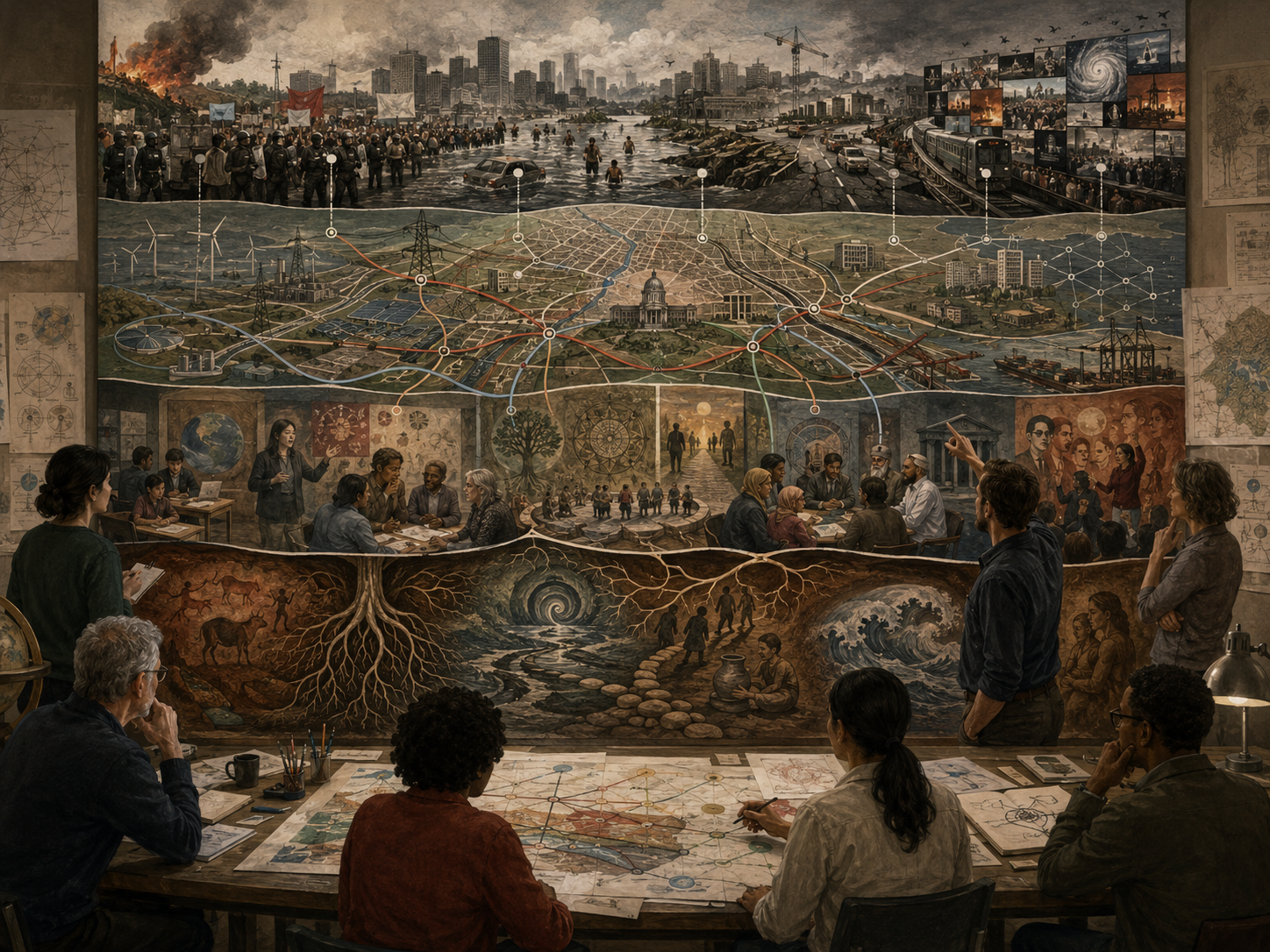
What Is Causal Layered Analysis?
Causal Layered Analysis is a foresight method that examines an issue through four interpretive layers: litany, social causes, worldview or discourse, and myth or metaphor. It is designed to move analysis beyond surface-level description toward deeper structures of meaning. Instead of asking only what is happening, CLA asks how an issue is narrated, what systems produce it, what assumptions frame it, and what deeper cultural story gives it emotional and symbolic force.
The method is especially useful because future-oriented problems are rarely only technical. Climate change is not only an emissions problem. Artificial intelligence is not only a technology problem. Public health is not only a medical-capacity problem. Infrastructure resilience is not only an engineering problem. Food insecurity is not only a supply problem. Each issue has visible symptoms, systemic drivers, institutional rules, cultural assumptions, political narratives, and deep stories about value, progress, risk, responsibility, and human purpose.
CLA helps practitioners move between those layers. At the surface level, an issue may appear as a crisis headline, metric, trend, complaint, or urgent policy problem. At a deeper level, it may involve economics, law, infrastructure, labor, institutional capacity, or governance. Deeper still, it may involve assumptions about markets, growth, technological progress, human nature, national identity, civilization, nature, time, or responsibility. At the deepest level, it may be organized by metaphors such as “the machine,” “the race,” “the battlefield,” “the family,” “the commons,” “the garden,” “the frontier,” or “the failing system.”
By identifying these layers, CLA makes it possible to reframe the future. A problem that is framed as “falling behind in technological competition” may produce one set of strategies. The same problem framed as “building accountable public infrastructure” may produce another. The same problem framed as “repairing trust” or “protecting human dignity” may produce still another. CLA makes those framing choices visible.
| CLA Question | Layer of Analysis | Strategic Purpose |
|---|---|---|
| What is being said is happening? | Litany | Identify visible issues, headlines, metrics, and public claims. |
| What systems produce this issue? | Social and systemic causes | Analyze institutions, economics, policy, infrastructure, and behavior. |
| What assumptions make this seem normal? | Worldview and discourse | Reveal dominant ideologies, categories, and ways of knowing. |
| What story or metaphor organizes meaning? | Myth and metaphor | Surface deeper images, archetypes, fears, hopes, and symbolic frames. |
| How could the future be reframed? | Transformative synthesis | Generate alternative narratives and strategic possibilities. |
CLA is powerful because it treats futures as layered, not flat. It assumes that changing the future requires changing not only policies and strategies, but also the frames through which societies imagine what is possible.
Why Causal Layered Analysis Matters
Causal Layered Analysis matters because many institutions respond to problems only at the level where they first appear. A crisis becomes a headline. A headline becomes a policy response. A policy response becomes a dashboard, target, intervention, or reform package. But if the deeper causes, assumptions, and narratives remain unchanged, the system may reproduce the same problem in a new form.
This is common in public policy, organizational strategy, technology governance, climate adaptation, and sustainability work. Institutions may treat symptoms without changing structures. They may change structures without challenging assumptions. They may challenge assumptions without offering new stories powerful enough to mobilize people. CLA helps reveal where a response is too shallow for the depth of the problem.
For example, a city may treat heat emergencies as a public-safety issue at the litany level. At the systemic level, it may discover housing quality, tree canopy, energy access, public-health staffing, labor exposure, and infrastructure inequality. At the worldview level, it may confront assumptions that adaptation is an emergency-management function rather than a housing, labor, ecological, and justice issue. At the myth level, it may discover a deeper story that treats the city as a growth machine rather than a shared habitat. Different layers produce different interventions.
CLA also matters because it helps futures work avoid shallow novelty. Futures thinking can become dominated by signals, trends, technologies, and scenarios without asking what deeper worldview is being reproduced. A scenario about “smart cities,” for example, may appear innovative while quietly preserving assumptions of surveillance, optimization, consumerism, and technocratic control. CLA asks what future image is being smuggled into the scenario.
| Why CLA Matters | Strategic Value |
|---|---|
| Surface problems often have deeper causes. | Prevents shallow diagnosis and reactive strategy. |
| Institutions reproduce their own assumptions. | Reveals hidden frames that constrain imagination. |
| Policy debates are shaped by narrative. | Shows how language, metaphor, and ideology structure options. |
| Futures are culturally imagined. | Connects strategy to meaning, identity, and social imagination. |
| Transformation requires reframing. | Creates space for alternative futures and deeper change. |
| Marginalized perspectives are often excluded. | Surfaces suppressed stories, counter-narratives, and lived knowledge. |
CLA matters because it asks whether the level of response matches the depth of the problem.
The Four Layers of Causal Layered Analysis
Causal Layered Analysis is usually organized around four layers. Each layer reveals a different kind of meaning. The layers are not rigid compartments; they interact. A metaphor can shape a worldview. A worldview can shape institutions. Institutions can produce surface events. Surface events can reinforce the metaphor. CLA helps practitioners move up and down these layers so that futures work becomes deeper and more reflexive.
1. Litany
The litany layer is the surface level of public description. It includes headlines, statistics, official statements, complaints, slogans, media frames, crisis language, and widely repeated claims. It asks what people say is happening and how the issue appears in everyday discourse.
2. Social and Systemic Causes
The social causes layer examines the structures that produce the visible issue. It includes economics, policy, institutions, infrastructure, demographics, technology, law, labor, ecology, behavior, and governance. It asks what systems, incentives, and constraints generate the surface problem.
3. Worldview and Discourse
The worldview layer examines the assumptions, ideologies, paradigms, categories, and discourses that make certain systems seem natural or inevitable. It asks what way of seeing the world gives legitimacy to the existing structure and what alternative ways of seeing might be possible.
4. Myth and Metaphor
The myth and metaphor layer examines the deepest stories, images, archetypes, emotional patterns, and symbolic frames that organize meaning. It asks what underlying metaphor shapes the issue and what new metaphor might open a different future.
| Layer | Focus | Typical Evidence | Foresight Use |
|---|---|---|---|
| Litany | Visible events, headlines, metrics, and public claims. | News stories, dashboards, speeches, survey results, complaints. | Identify the surface issue and dominant public framing. |
| Social causes | Systems, institutions, structures, policies, and material drivers. | Policy analysis, economic data, infrastructure maps, institutional review. | Diagnose causal structures and intervention points. |
| Worldview | Assumptions, ideologies, paradigms, and categories. | Discourses, professional norms, policy language, institutional narratives. | Reveal what is treated as normal, rational, or inevitable. |
| Myth and metaphor | Deep stories, archetypes, symbols, and organizing images. | Metaphors, cultural narratives, recurring images, moral stories. | Reframe the future at the level of meaning and imagination. |
The four layers help practitioners move from symptom recognition to structural diagnosis, worldview critique, and narrative transformation.
Layer One: Litany
The litany layer is the visible surface of an issue. It includes what is repeated in public conversation: headlines, statistics, crises, slogans, complaints, fears, promises, and simplified problem statements. The litany layer is often emotional and immediate. It is where problems appear urgent, obvious, and self-explanatory.
Examples of litanies include “AI is taking jobs,” “cities are becoming unaffordable,” “young people are losing hope,” “climate disasters are increasing,” “public trust is collapsing,” “health systems are overwhelmed,” or “schools are not preparing people for the future.” These statements may be partly true, but they are incomplete. They describe how the problem appears, not necessarily why it exists.
The litany layer matters because it shapes public attention. What becomes a headline becomes thinkable as a problem. What never reaches the litany may remain invisible. However, strategy that remains at the litany layer often becomes reactive. It responds to symptoms, metrics, or public pressure without examining deeper structures.
In CLA, the litany is not dismissed. It is the starting point. Surface language matters because it reveals what is socially visible and emotionally charged. The task is to listen carefully without assuming that surface framing is sufficient.
| Litany Feature | Description | Strategic Risk |
|---|---|---|
| Headline framing | The issue is presented as an urgent public problem. | Strategy becomes reactive and media-driven. |
| Metric dependence | The issue is reduced to a visible number. | Unmeasured causes and harms are ignored. |
| Crisis language | The issue is framed as emergency or failure. | Short-term response displaces long-term transformation. |
| Slogan logic | The issue is simplified into a memorable phrase. | Complexity is flattened into political branding. |
| Public anxiety | The issue carries emotional force. | Fear can narrow imagination and legitimate shallow solutions. |
The litany layer tells us what society is noticing. It does not yet tell us what society understands.
Layer Two: Social and Systemic Causes
The social and systemic causes layer examines the structures that produce the visible issue. This layer asks what economic, political, institutional, technological, demographic, ecological, legal, cultural, and infrastructural forces generate the litany. It moves from symptom to system.
If the litany says “housing is unaffordable,” the social causes layer asks about wages, zoning, land markets, finance, construction costs, speculative investment, public housing policy, interest rates, infrastructure, segregation, tenant protections, and local governance. If the litany says “AI is disrupting work,” this layer asks about platform business models, labor law, automation incentives, management systems, skill formation, procurement, data ownership, and worker power.
This layer is familiar to policy analysts, economists, systems thinkers, sociologists, planners, organizational strategists, and institutional researchers. It often relies on evidence, causal models, system maps, data, institutional analysis, and governance review. It is essential because many surface problems are reproduced by structures that remain hidden if analysis stops at the litany.
However, the social causes layer is still not the deepest layer. It may explain how systems produce outcomes without asking why those systems are considered legitimate or inevitable. For that, CLA moves to worldview and discourse.
| Systemic Cause Category | What It Examines | Example Question |
|---|---|---|
| Economic structures | Markets, incentives, capital flows, costs, ownership, labor. | Who benefits from the current arrangement? |
| Institutional design | Rules, mandates, budgets, authority, accountability. | Which institutions are responsible, and what can they actually do? |
| Infrastructure | Built systems, digital systems, energy, transport, housing, water. | What material systems lock in current behavior? |
| Law and policy | Regulation, rights, standards, enforcement, administrative capacity. | What legal framework produces or fails to prevent the issue? |
| Technology | Tools, platforms, data systems, automation, standards. | How does technology change power, labor, access, and accountability? |
| Ecology | Environmental constraints, thresholds, exposure, resource flows. | What ecological limits are shaping the problem? |
| Behavior and culture | Habits, norms, expectations, social practices. | How do everyday practices reproduce the system? |
The social causes layer explains why the litany keeps recurring.
Layer Three: Worldview and Discourse
The worldview and discourse layer examines the assumptions that make a system appear normal, rational, inevitable, or desirable. This is where CLA becomes especially powerful. The same social structure can be justified by many different worldviews: market efficiency, national competitiveness, technological progress, modernization, security, consumer choice, managerial control, growth, resilience, innovation, austerity, freedom, or development.
Worldviews shape what counts as evidence, what counts as success, who counts as an expert, what kinds of harm are visible, and what futures appear realistic. A public agency operating from a technocratic worldview may treat public participation as a communication problem. A community justice worldview may treat the same issue as a problem of power, legitimacy, and lived experience. A market worldview may treat housing as an asset class. A social-rights worldview may treat housing as a condition of dignity.
The worldview layer asks what discourse organizes the problem. What language is used? What categories dominate? What is taken for granted? What is considered impossible? Who is centered? Who is treated as an externality? What forms of knowledge are legitimized? Which alternatives are dismissed as naïve, radical, inefficient, or unrealistic?
In futures thinking, this layer is crucial because futures are not only projected; they are framed. A future imagined through growth, competition, and technological acceleration will produce different scenarios than a future imagined through care, ecological limits, justice, public capacity, or intergenerational responsibility.
| Worldview Question | Purpose | Example |
|---|---|---|
| What is assumed to be normal? | Reveal hidden baseline assumptions. | That growth must continue indefinitely. |
| What counts as success? | Identify dominant values and metrics. | Efficiency, speed, GDP, market share, resilience, dignity, justice. |
| Who counts as an expert? | Expose knowledge hierarchies. | Technical experts only, or also communities and practitioners. |
| What is treated as impossible? | Reveal limits of institutional imagination. | Public ownership, degrowth, universal care, reparative policy. |
| What harm is invisible? | Identify excluded burdens. | Care labor, ecological degradation, digital exclusion, displacement. |
| What language dominates? | Analyze discourse and framing. | Innovation, burden, disruption, security, competitiveness, stewardship. |
The worldview layer shows that what appears practical is often what a dominant worldview has already made thinkable.
Layer Four: Myth and Metaphor
The myth and metaphor layer examines the deepest stories, images, archetypes, and symbolic frames that organize how people feel and think about an issue. This layer does not use “myth” to mean falsehood. It uses myth to mean a deep cultural story that gives meaning to social life. Myths and metaphors shape what feels natural, heroic, shameful, dangerous, hopeful, inevitable, or sacred.
Examples include “the economy as machine,” “the nation as fortress,” “technology as savior,” “nature as resource,” “the city as growth engine,” “the future as race,” “society as marketplace,” “the public sector as burden,” “the poor as failure,” “the planet as storehouse,” or “progress as acceleration.” These metaphors are not decorative. They shape strategy.
If climate action is framed through the metaphor of sacrifice, it may generate resistance. If it is framed as repair, stewardship, protection, or renewal, different possibilities emerge. If AI is framed as an arms race, speed dominates. If AI is framed as public infrastructure, accountability becomes central. If education is framed as workforce supply, learning narrows. If education is framed as human formation and civic capacity, its future changes.
This layer is powerful because deep metaphors can persist even when policies change. A system may adopt new language while preserving the old myth. A corporate sustainability plan may speak of resilience while still imagining nature as resource and society as market. A technology strategy may speak of ethics while still imagining the future as conquest. CLA asks whether the metaphor has actually changed.
| Dominant Metaphor | Likely Future Orientation | Possible Reframe |
|---|---|---|
| The future as race | Speed, competition, winners, losers, acceleration. | The future as stewardship, learning, or shared responsibility. |
| Society as machine | Optimization, control, efficiency, technical repair. | Society as ecosystem, commons, or living relationship. |
| Nature as resource | Extraction, management, substitution, depletion. | Nature as kin, home, life-support system, or sacred trust. |
| Technology as savior | Innovation-first solutions and delayed governance. | Technology as tool, public infrastructure, or moral responsibility. |
| The public as customer | Service delivery, satisfaction, market logic. | The public as citizen, participant, co-creator, or rights-bearing community. |
| Crisis as war | Command, urgency, sacrifice, emergency exceptionalism. | Crisis as repair, healing, preparation, or collective care. |
The myth and metaphor layer asks what story the future is living inside.
Reframing Futures Through CLA
The purpose of CLA is not only to analyze the present. It is also to reframe the future. Once the four layers have been identified, practitioners can ask how each layer might be transformed. A new litany may change the public problem statement. A new systemic analysis may reveal different interventions. A new worldview may change what is considered legitimate. A new metaphor may open futures that the old frame suppressed.
Reframing does not mean inventing slogans. It means creating a coherent alternative across layers. A shallow reframe changes surface language while leaving systems, assumptions, and metaphors intact. A deeper reframe changes the problem definition, causal diagnosis, worldview, and symbolic frame together.
For example, the litany “schools are failing to prepare workers for the future” might become “learning systems are not cultivating civic, ecological, ethical, and technical capacity for uncertain futures.” The systemic analysis shifts from skills gaps to inequality, curriculum design, public investment, teacher capacity, digital infrastructure, climate literacy, and civic learning. The worldview shifts from education as labor-market supply to education as human development and democratic resilience. The metaphor shifts from “pipeline” to “living commons of learning.”
This kind of reframing can generate different strategies. Instead of simply updating technical skills, institutions might build futures literacy, systems thinking, public-interest technology education, ecological literacy, civic deliberation, and community-based learning. The future changes because the frame changes.
| CLA Layer | Old Frame | Reframed Future |
|---|---|---|
| Litany | Workers lack future-ready skills. | Societies need learning systems for uncertainty, ethics, and public capacity. |
| Social causes | Curricula are misaligned with labor-market demand. | Education is shaped by inequality, technology, public investment, climate risk, and civic fragmentation. |
| Worldview | Education exists to supply human capital. | Education cultivates human capability, democratic participation, and ecological responsibility. |
| Myth/metaphor | The talent pipeline. | The learning commons. |
| Strategic implication | Update skills programs. | Redesign education as lifelong public capacity for uncertain futures. |
Reframing is the movement from diagnosing how the current future is imagined to creating a different imagination that can support different action.
CLA vs Conventional Policy and Strategy Analysis
Conventional policy and strategy analysis often focuses on visible problems, measurable indicators, causal drivers, stakeholder interests, options, costs, risks, and implementation plans. These are important. CLA does not replace them. Instead, it asks what conventional analysis may miss when it remains within the dominant frame.
Many conventional methods assume that the problem is already properly defined. CLA questions that assumption. It asks how the problem became framed in the first place. It asks who benefits from that framing. It asks what deeper worldview is reproduced by the proposed solution. It asks whether the metaphor organizing the debate is narrowing the future.
This makes CLA especially useful when problems are persistent despite repeated reforms. If the same issue returns again and again, the problem may not be only technical. It may be narrative, institutional, ideological, or mythic. Conventional analysis may improve a failing system without asking whether the system’s underlying story needs to change.
| Conventional Analysis | Causal Layered Analysis |
|---|---|
| Starts from the stated problem. | Questions how the problem is framed. |
| Focuses on causes, evidence, and options. | Examines causes, worldviews, narratives, and metaphors. |
| Seeks policy or strategy recommendations. | Seeks reframing as well as recommendations. |
| Often privileges expert and institutional knowledge. | Can include suppressed narratives and alternative knowledge systems. |
| Works mainly at the systemic layer. | Moves across litany, systems, worldview, and myth. |
| Assumes better solutions follow from better analysis. | Asks whether the imagination of the problem itself must change. |
CLA does not weaken conventional analysis. It deepens it by asking what conventional analysis has been trained not to see.
CLA and Other Futures Thinking Methods
Causal Layered Analysis works well with other futures thinking methods. It can deepen scenario planning by asking what worldview each scenario assumes. It can improve horizon scanning by helping analysts interpret why certain signals are noticed and others ignored. It can enrich weak signal analysis by identifying the metaphors that make some signals appear meaningful and others marginal. It can strengthen backcasting by clarifying the deeper story behind a preferred future.
CLA is especially useful when futures work risks becoming too technical. Forecasts, scenarios, and trend reports can appear neutral while reproducing dominant narratives. CLA asks what stories are embedded in the method. A scenario called “AI acceleration,” “climate breakdown,” “green growth,” or “resilient communities” is not only a future description. It is also a narrative frame.
| Futures Method | How CLA Strengthens It |
|---|---|
| Forecasting | Questions the worldview behind what is projected and measured. |
| Horizon scanning | Explores why certain signals become visible while others remain marginal. |
| Weak signal analysis | Reveals how metaphors and assumptions shape signal interpretation. |
| Trend analysis | Distinguishes visible trends from the deeper narratives that legitimate them. |
| Scenario planning | Identifies the worldview, discourse, and metaphor embedded in each scenario. |
| Backcasting | Clarifies the deeper story behind a preferred future and the present pathway. |
| Delphi Method | Helps interpret expert assumptions, disciplinary frames, and stable disagreement. |
| Futures literacy | Builds capacity to recognize how futures are imagined, narrated, and contested. |
CLA gives futures thinking depth. It asks not only what future is possible, but what story makes that future imaginable.
Power, Narrative, and Whose Future Counts
Causal Layered Analysis is especially important because futures are shaped by power. Dominant institutions often control the litany, define the causal explanation, legitimize the worldview, and circulate the metaphor. They decide what counts as crisis, what counts as evidence, what counts as responsible action, and what futures are considered realistic.
Marginalized communities often experience different futures before dominant institutions recognize them. A policy problem may be framed as “service inefficiency” by administrators but as abandonment by affected communities. A technology may be framed as innovation by firms but as surveillance by workers. A climate policy may be framed as transition by planners but as displacement by residents. CLA helps make these competing layers visible.
This matters because futures work can reproduce inequality if it accepts dominant frames uncritically. A scenario process that includes only elite perspectives may generate elite futures. A strategy process that treats market language as neutral may erase public value. A technology foresight process that frames AI as inevitable may exclude democratic questions about whether, where, and how systems should be deployed.
CLA can foreground counter-narratives. It can ask what stories have been suppressed, what metaphors have been imposed, and what alternative futures become possible when excluded voices define the issue differently. This makes CLA valuable for public-interest foresight, decolonial futures, feminist futures, Indigenous futures, disability justice, ecological ethics, labor futures, and community-led planning.
| Power Question | CLA Layer | Why It Matters |
|---|---|---|
| Who defines the visible problem? | Litany | Public attention is shaped by those with media, institutional, or political power. |
| Whose causal explanation dominates? | Social causes | Different explanations justify different interventions. |
| Whose worldview is treated as common sense? | Worldview | Dominant assumptions determine what appears realistic. |
| Whose metaphor organizes the future? | Myth/metaphor | Deep stories shape emotion, legitimacy, and imagination. |
| Whose future is excluded? | All layers | Excluded narratives often reveal alternative pathways and hidden harms. |
CLA is a method for asking not only what future is being imagined, but who has the power to make that imagination appear natural.
Applications of Causal Layered Analysis
CLA can be used wherever surface problems are connected to deeper systems, assumptions, and narratives. It is useful in public policy, sustainability, climate adaptation, technology governance, education, organizational strategy, public health, community planning, resilience, and institutional reform.
| Domain | CLA Use | Example Question |
|---|---|---|
| Climate adaptation | Move beyond disaster response toward justice, ecology, housing, and public capacity. | What metaphor shapes how the city imagines climate risk? |
| Technology governance | Question narratives of inevitability, disruption, innovation, and control. | Is AI framed as a race, a tool, a public infrastructure, or a moral responsibility? |
| Public health | Reframe health from treatment capacity to prevention, care, trust, and social conditions. | What deeper story defines health system success? |
| Education | Move beyond skills gaps toward human capability, civic formation, and futures literacy. | Is education a pipeline, a marketplace, or a commons? |
| Infrastructure | Connect engineering systems to public value, ecological limits, and social trust. | Is infrastructure imagined as assets, services, lifelines, or shared inheritance? |
| Organizational strategy | Reveal hidden assumptions behind transformation, innovation, and leadership narratives. | What story about change is the organization living inside? |
| Community planning | Surface local narratives, excluded futures, and alternative visions. | Whose future is represented in the plan? |
| Sustainability transitions | Challenge growth, extraction, technological salvation, and shallow resilience narratives. | What metaphor could support repair, sufficiency, and ecological responsibility? |
In each case, CLA helps practitioners avoid shallow solutionism. It does not ask only what intervention should be chosen. It asks what layer of the issue the intervention is addressing.
Strengths and Limitations
Causal Layered Analysis has several strengths. It deepens foresight beyond trend description. It reveals assumptions that conventional analysis may miss. It supports reframing, imagination, and alternative futures. It can include marginalized narratives and expose hidden power. It is especially useful when debates are stuck, strategies feel superficial, or futures work needs to move from prediction toward transformation.
But CLA also has limitations. It requires skilled facilitation. It can become abstract if not connected to practical decisions. It can be misused as a loose metaphor exercise without disciplined analysis. It may be difficult for institutions that prefer measurable, technical, or short-term outputs. It can also be politically uncomfortable because it challenges dominant stories and institutional assumptions.
| Strength | Strategic Value |
|---|---|
| Layered diagnosis | Shows how visible problems connect to systems, worldviews, and metaphors. |
| Reframing power | Generates alternative futures by changing problem definitions. |
| Critical depth | Exposes assumptions, ideology, and power in futures work. |
| Narrative awareness | Recognizes that futures are shaped by stories and symbols. |
| Inclusivity potential | Can surface suppressed narratives and alternative knowledge systems. |
| Transformation orientation | Supports change beyond surface reform. |
| Limitation | Risk | Corrective Practice |
|---|---|---|
| Abstract language | Participants may struggle to connect layers to decisions. | Use concrete examples and decision-linked outputs. |
| Weak facilitation | The process becomes vague or performative. | Use structured prompts, evidence, and clear synthesis. |
| Overemphasis on metaphor | Material causes may be neglected. | Keep systemic analysis strong alongside narrative analysis. |
| Institutional discomfort | Dominant assumptions may resist critique. | Frame CLA as learning, not accusation. |
| No implementation pathway | Reframing does not affect action. | Link CLA to scenarios, backcasting, strategy, and monitoring. |
| Elite reframing | Alternative narratives are generated without affected communities. | Include participatory and marginalized perspectives. |
CLA is strongest when it connects interpretive depth to practical transformation.
A Practical CLA Workflow
A practical CLA workflow should move from issue framing to layered analysis, alternative narratives, reframing, strategic implications, and integration with other foresight methods. It should not stop with interpretation. The goal is to produce deeper futures and more coherent action.
| Phase | Purpose | Guiding Questions | Outputs |
|---|---|---|---|
| 1. Define the focal issue | Clarify the problem, decision context, and time horizon. | What issue or future question are we analyzing? | Focal question, scope, stakeholder map. |
| 2. Map the litany | Identify visible headlines, metrics, claims, and emotions. | What is being said is happening? | Surface issue map. |
| 3. Analyze social causes | Identify systems, structures, institutions, and material drivers. | What produces the visible issue? | Systemic cause map. |
| 4. Identify worldview and discourse | Reveal assumptions, ideologies, categories, and dominant frames. | What worldview makes this system seem normal? | Discourse and assumption map. |
| 5. Surface myth and metaphor | Identify deep stories and symbolic frames. | What metaphor organizes meaning? | Myth/metaphor map. |
| 6. Generate alternative layers | Create new litanies, systems, worldviews, and metaphors. | What alternative future story is possible? | Layered alternative futures. |
| 7. Translate reframing into strategy | Connect alternative frames to actions, policies, scenarios, or pathways. | What changes if this new frame guides action? | Strategic implications, scenario inputs, backcasting targets. |
| 8. Review power and legitimacy | Check whose narratives are included or excluded. | Who defines the future, and who bears its consequences? | Participation, equity, and legitimacy review. |
A practical CLA process should create both insight and usable outputs. These outputs may include reframed problem statements, alternative scenario logics, deeper strategic assumptions, new metaphors for change, policy implications, stakeholder dialogue materials, or backcasting targets.
The workflow succeeds when participants can see not only a different future, but a different way of thinking that makes that future possible.
Mathematical Lens: Layered Interpretation and Reframing
A conceptual way to represent CLA is to treat an issue as a layered interpretive object:
I = \{L, S, W, M\}
\]
Interpretation: \(I\) is the issue under analysis, \(L\) is litany, \(S\) is social and systemic causes, \(W\) is worldview or discourse, and \(M\) is myth or metaphor. CLA assumes that the issue cannot be fully understood by any single layer alone.
A shallow intervention can be represented as action only at the surface layer:
A_{shallow} = f(L)
\]
Interpretation: A shallow action responds primarily to the litany. It may address symptoms, headlines, or metrics without changing the structures and meanings that reproduce the issue.
A deeper transformative intervention must work across layers:
A_{deep} = f(L, S, W, M)
\]
Interpretation: A deeper action responds to surface symptoms, systemic causes, worldviews, and metaphors together. It seeks coherence between diagnosis, structure, meaning, and strategic imagination.
Reframing can be represented as a transformation from one layered configuration to another:
R: \{L_1, S_1, W_1, M_1\} \rightarrow \{L_2, S_2, W_2, M_2\}
\]
Interpretation: \(R\) is the reframing process. It moves an issue from an old layered configuration to a new one, producing different problem definitions, causal explanations, assumptions, metaphors, and futures.
A reframing depth score can be imagined as:
D = w_lL_c + w_sS_c + w_wW_c + w_mM_c
\]
Interpretation: \(D\) is reframing depth, while \(L_c\), \(S_c\), \(W_c\), and \(M_c\) represent the degree of change at each layer. A reframe that changes only surface language has low depth. A reframe that changes systems, worldview, and metaphor has greater transformative potential.
These equations do not reduce CLA to mathematics. They clarify the logic of layered diagnosis, shallow versus deep intervention, and the movement from inherited frames to alternative futures.
Computational Modeling for CLA
Computational tools can support Causal Layered Analysis by helping organize evidence, code themes, compare layer profiles, document metaphors, and track reframing options. They should not replace interpretation, facilitation, narrative judgment, community participation, or ethical reasoning. CLA is not a purely computational method because meaning, metaphor, worldview, and power cannot be fully reduced to data structures.
Still, computational workflows can be useful when CLA is applied to large bodies of text, policy documents, interview transcripts, workshop notes, strategic plans, media narratives, expert responses, or stakeholder submissions. A structured workflow may help identify recurring litanies, systemic causes, discourse frames, metaphors, and alternative narratives.
A useful computational CLA workflow may include:
- Issue registers: structured records of focal issues, time horizons, affected groups, and decision contexts.
- Layer coding: classification of statements as litany, systemic cause, worldview, or myth/metaphor.
- Metaphor registers: documentation of dominant and alternative metaphors.
- Discourse mapping: identification of recurring assumptions, categories, and ideological frames.
- Power audits: analysis of whose narratives dominate and whose are excluded.
- Reframing tables: comparison of old and alternative layered configurations.
- Scenario translation: movement from alternative metaphors to scenario logics.
- Backcasting links: connection between reframed futures and present-day pathways.
Computational CLA should remain transparent. It should show how codes were assigned, which sources were included, who interpreted the metaphors, what assumptions shaped the coding scheme, and where disagreement remained. In serious futures work, computational support should deepen interpretation rather than flatten it.
The goal is not to automate meaning. The goal is to make layered interpretation more organized, traceable, and open to revision.
Advanced R Workflow: Comparing CLA Layer Profiles
The R workflow below creates a stylized CLA layer profile for several public-interest issues. It compares the strength of litany visibility, systemic explanation, worldview challenge, metaphor depth, reframing potential, and power sensitivity. It is designed as an evergreen illustration of how CLA can be made structured without losing interpretive depth.
# ------------------------------------------------------------
# R Workflow: Comparing Causal Layered Analysis Profiles
# Purpose:
#   Build stylized CLA profiles across issues using
#   litany visibility, systemic explanation, worldview challenge,
#   metaphor depth, reframing potential, and power sensitivity.
#
# Optional dependency:
#   install.packages(c("tidyverse"))
# ------------------------------------------------------------

library(tidyverse)

cla_issues <- tibble(
  issue = c(
    "Public AI Accountability",
    "Climate Adaptation and Housing",
    "Care Workforce Resilience",
    "Education for Uncertain Futures",
    "Urban Food-Water-Ecology Stress"
  ),
  litany_visibility = c(0.82, 0.88, 0.74, 0.70, 0.66),
  systemic_explanation = c(0.76, 0.86, 0.82, 0.72, 0.84),
  worldview_challenge = c(0.84, 0.80, 0.78, 0.86, 0.82),
  metaphor_depth = c(0.78, 0.84, 0.76, 0.88, 0.86),
  reframing_potential = c(0.86, 0.82, 0.80, 0.90, 0.84),
  power_sensitivity = c(0.88, 0.90, 0.84, 0.76, 0.86)
)

cla_issues <- cla_issues %>%
  mutate(
    cla_depth_score =
      0.12 * litany_visibility +
      0.20 * systemic_explanation +
      0.22 * worldview_challenge +
      0.20 * metaphor_depth +
      0.16 * reframing_potential +
      0.10 * power_sensitivity,
    cla_class = case_when(
      cla_depth_score >= 0.84 ~ "High-depth reframing opportunity",
      cla_depth_score >= 0.78 ~ "Strong layered analysis candidate",
      TRUE ~ "Moderate CLA candidate"
    )
  ) %>%
  arrange(desc(cla_depth_score))

print(cla_issues)

cla_long <- cla_issues %>%
  pivot_longer(
    cols = c(
      litany_visibility,
      systemic_explanation,
      worldview_challenge,
      metaphor_depth,
      reframing_potential,
      power_sensitivity
    ),
    names_to = "dimension",
    values_to = "value"
  )

ggplot(cla_long, aes(x = dimension, y = value, fill = issue)) +
  geom_col(position = "dodge") +
  labs(
    title = "Causal Layered Analysis Dimensions",
    x = "CLA Dimension",
    y = "Score",
    fill = "Issue"
  ) +
  theme_minimal(base_size = 12) +
  coord_flip()

ggplot(cla_issues, aes(x = reorder(issue, cla_depth_score), y = cla_depth_score)) +
  geom_col() +
  coord_flip() +
  labs(
    title = "CLA Depth Score by Issue",
    x = "Issue",
    y = "CLA Depth Score"
  ) +
  theme_minimal(base_size = 12)

dir.create("outputs", showWarnings = FALSE)

write_csv(cla_issues, "outputs/cla_layer_profiles.csv")
write_csv(cla_long, "outputs/cla_layer_profiles_long.csv")
This workflow does not claim that CLA can be fully quantified. It provides a transparent way to compare which issues may benefit most from deeper layered interpretation and reframing.
Advanced Python Workflow: Simulating Narrative Reframing Across CLA Layers
The Python workflow below simulates how shallow and deep reframing differ across CLA layers. It compares an old frame and a reframed future across litany, systemic causes, worldview, metaphor, and strategic coherence. It is useful for showing why surface language change is not the same as deep transformation.
# ------------------------------------------------------------
# Python Workflow: Simulating Narrative Reframing Across CLA Layers
# Purpose:
#   Compare shallow and deep reframing across litany,
#   systemic causes, worldview, metaphor, and strategic coherence.
#
# Optional dependencies:
#   pip install pandas numpy matplotlib
# ------------------------------------------------------------

from pathlib import Path

import numpy as np
import pandas as pd
import matplotlib.pyplot as plt

OUTPUT_DIR = Path("outputs")
OUTPUT_DIR.mkdir(exist_ok=True)

frames = [
    {
        "frame": "Old Frame: AI as Innovation Race",
        "litany_change": 0.32,
        "systemic_change": 0.28,
        "worldview_change": 0.20,
        "metaphor_change": 0.16,
        "power_awareness": 0.24,
        "strategic_coherence": 0.38
    },
    {
        "frame": "Shallow Reframe: Responsible Innovation",
        "litany_change": 0.64,
        "systemic_change": 0.42,
        "worldview_change": 0.34,
        "metaphor_change": 0.28,
        "power_awareness": 0.36,
        "strategic_coherence": 0.52
    },
    {
        "frame": "Deep Reframe: AI as Public Infrastructure",
        "litany_change": 0.78,
        "systemic_change": 0.82,
        "worldview_change": 0.84,
        "metaphor_change": 0.86,
        "power_awareness": 0.88,
        "strategic_coherence": 0.84
    },
    {
        "frame": "Transformative Reframe: Technology as Civic Trust",
        "litany_change": 0.74,
        "systemic_change": 0.78,
        "worldview_change": 0.90,
        "metaphor_change": 0.92,
        "power_awareness": 0.90,
        "strategic_coherence": 0.88
    }
]

df = pd.DataFrame(frames)

df["reframing_depth"] = (
    0.12 * df["litany_change"] +
    0.20 * df["systemic_change"] +
    0.22 * df["worldview_change"] +
    0.22 * df["metaphor_change"] +
    0.12 * df["power_awareness"] +
    0.12 * df["strategic_coherence"]
)

df["reframing_class"] = np.select(
    [
        df["reframing_depth"] >= 0.82,
        df["reframing_depth"] >= 0.60
    ],
    [
        "Deep transformative reframe",
        "Partial reframe"
    ],
    default="Surface-level frame"
)

print("\nCLA reframing profile:")
print(df[["frame", "reframing_depth", "reframing_class"]])

df.to_csv(OUTPUT_DIR / "cla_reframing_profiles.csv", index=False)

long_df = df.melt(
    id_vars=["frame", "reframing_depth", "reframing_class"],
    value_vars=[
        "litany_change",
        "systemic_change",
        "worldview_change",
        "metaphor_change",
        "power_awareness",
        "strategic_coherence"
    ],
    var_name="dimension",
    value_name="score"
)

long_df.to_csv(OUTPUT_DIR / "cla_reframing_profiles_long.csv", index=False)

plt.figure(figsize=(10, 6))
plt.barh(df["frame"], df["reframing_depth"])
plt.xlabel("Reframing Depth")
plt.title("Causal Layered Analysis Reframing Depth")
plt.tight_layout()
plt.savefig(OUTPUT_DIR / "cla_reframing_depth.png", dpi=150)
plt.close()

plt.figure(figsize=(10, 6))
for frame in df["frame"]:
    subset = long_df[long_df["frame"] == frame]
    plt.plot(
        subset["dimension"],
        subset["score"],
        marker="o",
        linewidth=1.5,
        label=frame
    )

plt.xticks(rotation=30, ha="right")
plt.ylabel("Score")
plt.title("CLA Layer Change by Frame")
plt.legend()
plt.tight_layout()
plt.savefig(OUTPUT_DIR / "cla_layer_change_by_frame.png", dpi=150)
plt.close()
This workflow demonstrates a central CLA lesson: a future can sound new while preserving the old worldview. Deep reframing requires change across layers, not only a new surface vocabulary.
GitHub Repository
The companion repository for this article contains computational examples for Causal Layered Analysis, layer coding, worldview and metaphor mapping, reframing profiles, power-aware narrative analysis, scenario translation, and layered futures interpretation.
Complete Code Repository
The companion code includes Python, R, Julia, SQL, Rust, Go, C++, Fortran, C, documentation, synthetic datasets, outputs, and notebook placeholders for applied Causal Layered Analysis workflows.
Why This Matters
Causal Layered Analysis matters because many futures fail before they begin. They fail not because people lack data, but because the problem has been framed too narrowly. They fail because institutions respond to headlines without changing systems. They fail because systems change without worldview change. They fail because new policies preserve old myths. They fail because dominant narratives make alternative futures appear unrealistic before they can be explored.
CLA gives futures thinking a way to work beneath the surface. It helps practitioners ask what story is organizing the problem, what assumptions make the present seem inevitable, what structures reproduce the visible issue, and what alternative metaphors could open new futures. This is especially important for climate adaptation, technology governance, public health, sustainability transitions, education, infrastructure, and institutional reform.
Its value is also ethical. CLA asks whose stories define the future and whose stories have been excluded. It creates room for marginalized voices, suppressed traditions, community knowledge, and alternative imaginations of justice, repair, dignity, ecology, and public responsibility. In a time of complex uncertainty, the ability to reframe the future is not decorative. It is strategic and moral.
Causal Layered Analysis is a method for seeing the future beneath the future: the deeper systems, assumptions, and stories that determine what societies are able to imagine and build.
Related Articles
- Futures Thinking
- What Is Futures Thinking?
- Forecasting, Foresight, and Futures Studies
- Futures Literacy and Anticipatory Capacity
- Possible, Plausible, Probable, and Preferable Futures
- Scenario Planning
- Strategic Foresight Methods
- Trend Analysis and Megatrends
- Horizon Scanning
- Weak Signals and Early Indicators
- Backcasting and Strategic Planning
- Delphi Method and Expert Foresight
- Systems Modeling
- Resilience Thinking
Further Reading
- Dator, J. (2009) ‘Alternative futures at the Manoa School’, Journal of Futures Studies, 14(2), pp. 1–18.
- Government Office for Science (2024) The Futures Toolkit: Tools for Futures Thinking and Foresight Across UK Government. London: Government Office for Science. Available at: UK Government.
- Inayatullah, S. (1998) ‘Causal layered analysis: Poststructuralism as method’, Futures, 30(8), pp. 815–829. Available at: ScienceDirect.
- Inayatullah, S. (2004) The Causal Layered Analysis Reader: Theory and Case Studies of an Integrative and Transformative Methodology. Taipei: Tamkang University Press.
- Inayatullah, S. (2014) Causal Layered Analysis Defined. Metafuture. Available at: Metafuture.
- Inayatullah, S. and Milojević, I. (eds) (2015) CLA 2.0: Transformative Research in Theory and Practice. Taipei: Tamkang University Press.
- Milojević, I. and Inayatullah, S. (2015) ‘Narrative foresight’, Futures, 73, pp. 151–162.
- Organisation for Economic Co-operation and Development (OECD) (2021) Strategic Foresight for Better Policies: Building Effective Governance in the Face of Uncertain Futures. Paris: OECD Publishing. Available at: OECD.
- Organisation for Economic Co-operation and Development (OECD) (2025) Foresight Toolkit for Resilient Public Policy. Paris: OECD Publishing. Available at: OECD.
- Slaughter, R.A. (2004) Futures Beyond Dystopia: Creating Social Foresight. London: Routledge.
- United Nations Development Programme (UNDP) (2018) Foresight Manual: Empowered Futures for the 2030 Agenda. New York: UNDP. Available at: UNDP.
- Voros, J. (2003) ‘A generic foresight process framework’, Foresight, 5(3), pp. 10–21. Available at: Emerald.
References
- Dator, J. (2009) ‘Alternative futures at the Manoa School’, Journal of Futures Studies, 14(2), pp. 1–18.
- Government Office for Science (2024) The Futures Toolkit: Tools for Futures Thinking and Foresight Across UK Government. London: Government Office for Science. Available at: UK Government.
- Government Office for Science (2025) A Brief Guide to Futures Thinking and Foresight. London: Government Office for Science. Available at: UK Government.
- Inayatullah, S. (1998) ‘Causal layered analysis: Poststructuralism as method’, Futures, 30(8), pp. 815–829. Available at: ScienceDirect.
- Inayatullah, S. (2004) The Causal Layered Analysis Reader: Theory and Case Studies of an Integrative and Transformative Methodology. Taipei: Tamkang University Press.
- Inayatullah, S. (2014) Causal Layered Analysis Defined. Metafuture. Available at: Metafuture.
- Inayatullah, S. and Milojević, I. (eds) (2015) CLA 2.0: Transformative Research in Theory and Practice. Taipei: Tamkang University Press.
- Milojević, I. and Inayatullah, S. (2015) ‘Narrative foresight’, Futures, 73, pp. 151–162.
- Organisation for Economic Co-operation and Development (OECD) (no date) Strategic Foresight. Available at: OECD.
- Organisation for Economic Co-operation and Development Observatory of Public Sector Innovation (OECD OPSI) (no date) Futures & Foresight. Available at: OECD OPSI.
- Organisation for Economic Co-operation and Development (OECD) (2021) Strategic Foresight for Better Policies: Building Effective Governance in the Face of Uncertain Futures. Paris: OECD Publishing. Available at: OECD.
- Organisation for Economic Co-operation and Development (OECD) (2025) Foresight Toolkit for Resilient Public Policy. Paris: OECD Publishing. Available at: OECD.
- Slaughter, R.A. (2004) Futures Beyond Dystopia: Creating Social Foresight. London: Routledge.
- United Nations Development Programme (UNDP) (2018) Foresight Manual: Empowered Futures for the 2030 Agenda. New York: UNDP. Available at: UNDP.
- United Nations Educational, Scientific and Cultural Organization (UNESCO) (no date) Futures Literacy & Foresight. Available at: UNESCO.
- Voros, J. (2003) ‘A generic foresight process framework’, Foresight, 5(3), pp. 10–21. Available at: Emerald.