
Last Updated June 2, 2026
The history of futures thinking is not a simple march from prophecy to prediction to professional foresight. It is a long, contested history of how human beings, institutions, states, religious communities, scientists, planners, corporations, social movements, and marginalized groups have imagined what may come next. Across time, people have used the future to warn, govern, hope, threaten, mobilize, calculate, reform, dominate, resist, and prepare.
Modern futures thinking did not appear from nowhere in the twentieth century. It inherited older traditions of prophecy, utopian writing, religious eschatology, political imagination, technological speculation, military planning, social reform, demography, economic forecasting, systems modeling, and institutional strategy. What changed in the twentieth century was the attempt to make future-oriented thinking more systematic: to treat the future not only as destiny, divine revelation, fantasy, or prediction, but as a field of structured inquiry, public reasoning, scenario exploration, and strategic preparation.
The history of futures thinking is therefore a history of changing relationships between imagination and power. Who gets to imagine the future? Which futures are treated as credible? Which futures are dismissed as unrealistic? How do states, corporations, universities, communities, and international institutions use future-oriented analysis? How have military, colonial, ecological, technological, democratic, and emancipatory traditions shaped the field?
This article traces that history from ancient future imagination to contemporary strategic foresight, futures literacy, anticipatory governance, and responsible long-term decision-making. The goal is not to list famous futurists. It is to understand how futures thinking became a modern discipline, why its history is politically and ethically complicated, and what that history teaches about the future of foresight itself.
Main Library
Publications
Article Map
Futures Thinking
Related Topic
Systems Modeling
Related Topic
Resilience Thinking
Related Topic
Sustainable Development
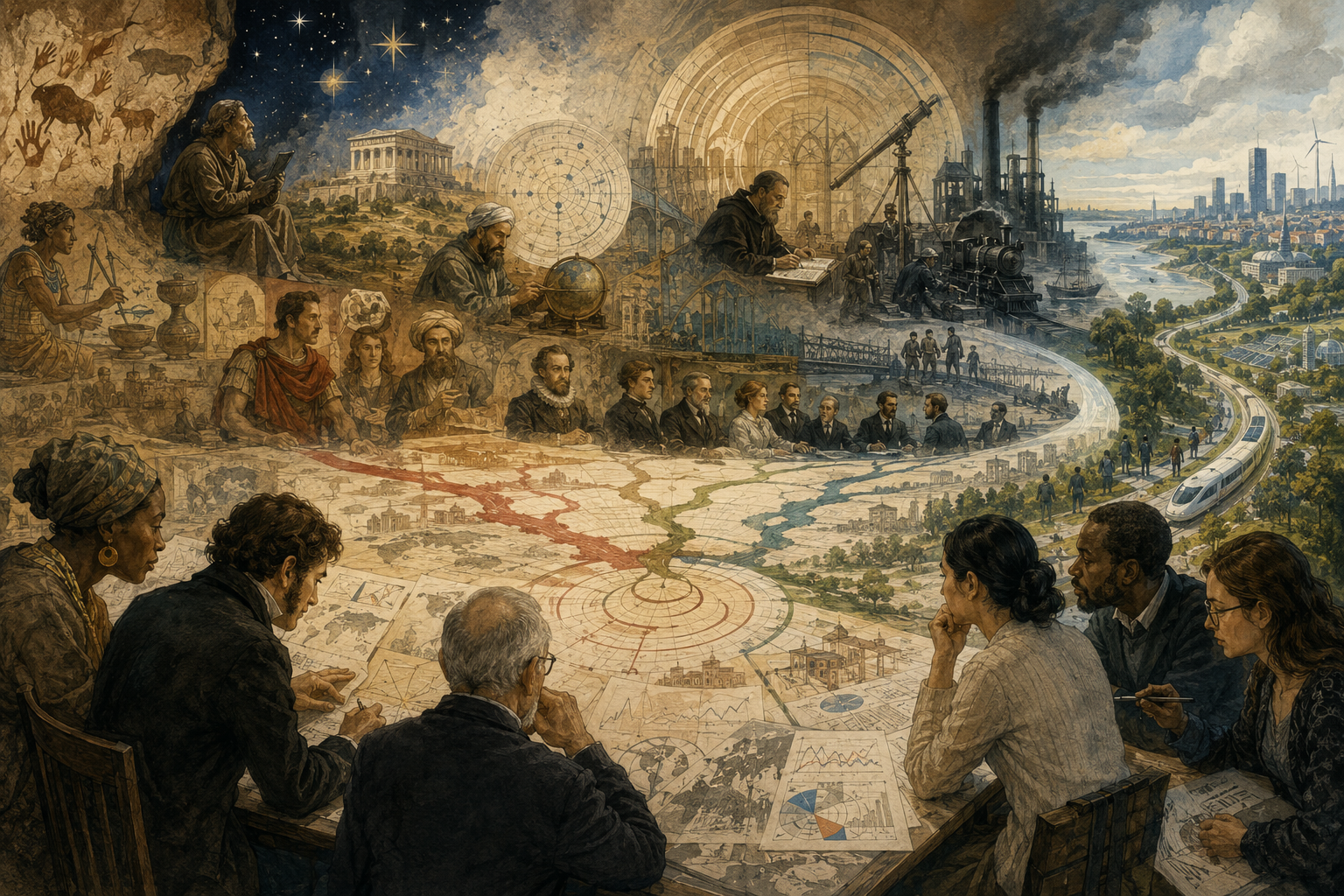
History matters for futures thinking because every futures method carries a memory. Scenario planning carries traces of military strategy, corporate planning, and institutional learning. Futures literacy carries traces of education, social imagination, and public participation. Systems foresight carries traces of cybernetics, system dynamics, ecological modeling, and global development debates. Critical futures studies carries traces of anti-colonial thought, feminism, Indigenous knowledge, postcolonial critique, environmental justice, and democratic theory. To understand futures thinking well, we must understand these inheritances.
Why the History of Futures Thinking Matters
The history of futures thinking matters because every future-oriented method comes from somewhere. Forecasting, scenario planning, horizon scanning, Delphi methods, backcasting, systems modeling, participatory futures, critical futures studies, and anticipatory governance were shaped by particular institutional settings, political concerns, knowledge traditions, and historical crises.
Some parts of the field emerged from military planning, nuclear strategy, and Cold War risk. Some emerged from corporate strategy and the need to prepare for uncertainty in global markets. Some emerged from environmental modeling and concern about ecological limits. Some emerged from education, civic participation, and the belief that societies should learn to use the future more consciously. Some emerged from feminist, decolonial, Indigenous, and justice-oriented critiques of whose futures dominate official imagination.
This history matters because futures thinking can be used for very different purposes. It can support democratic imagination, public preparedness, sustainability, long-term responsibility, and institutional learning. It can also support elite planning, technocratic control, military strategy, corporate advantage, speculative hype, colonial development narratives, and exclusionary visions of progress.
A historical view prevents the field from becoming naïve about itself. Futures thinking is not automatically liberating. It depends on how it is used, who participates, what assumptions are made visible, and whose lives are affected by the futures being imagined. A method that helps one institution prepare may also shift risk onto others. A scenario exercise may widen imagination, but it may also reproduce the worldview of those already powerful enough to define the scenario space.
Historical awareness turns futures thinking from a toolkit into a reflective discipline.
| Historical Question | Why It Matters |
|---|---|
| Who developed this futures method? | Methods carry assumptions from their original institutional settings. |
| What problem was the method designed to solve? | A tool created for military risk may not fit democratic deliberation without adaptation. |
| Who was included or excluded? | Dominant futures often erase marginalized knowledge and experience. |
| What image of progress does the method assume? | Some futures traditions equate progress with growth, technology, control, or modernization. |
| How does the method handle uncertainty? | Some traditions seek prediction; others emphasize plurality, learning, or contestation. |
| What ethical responsibilities does it raise? | Future-oriented work affects present choices, future generations, and vulnerable communities. |
The history of futures thinking is therefore not simply background. It is part of the method itself.
Ancient, Religious, and Cosmological Futures
Long before modern futures studies, human communities developed ways of relating to the future through prophecy, divination, myth, ritual, astronomy, sacred time, political warning, and moral imagination. These traditions did not treat the future as a neutral planning object. They often understood the future as linked to divine order, cosmic cycles, covenant, judgment, moral conduct, ancestral obligation, or collective destiny.
Ancient societies watched the sky, seasons, rivers, harvests, animal behavior, dreams, omens, and political events as signs of what might come. Priests, prophets, astrologers, oracles, sages, and rulers interpreted future possibilities through cosmological systems. These practices were not “futures thinking” in the modern methodological sense, but they reveal a deep human concern: present action is shaped by imagined consequence.
Religious traditions also developed powerful future imaginaries. Apocalyptic traditions warned of judgment, collapse, purification, renewal, or a transformed age. Prophetic traditions often linked the future to justice: oppression, corruption, idolatry, exploitation, or violence would bring consequences unless communities changed. Eschatological traditions gave meaning to suffering by placing present injustice within a larger temporal horizon.
These traditions remain relevant because modern futures thinking still wrestles with many of the same questions: Is the future open or determined? Can warning change what happens? Does imagining catastrophe produce responsibility or paralysis? What obligations do present generations owe to those who come later? How do hope and dread shape collective behavior?
| Older Future Tradition | Core Orientation | Modern Echo |
|---|---|---|
| Prophecy | Warning, judgment, moral consequence. | Climate warnings, public-health warnings, democratic crisis warnings. |
| Divination | Interpreting signs to guide action. | Signal interpretation, early warning systems, horizon scanning. |
| Apocalyptic imagination | Collapse, rupture, judgment, transformation. | Collapse narratives, existential risk, climate catastrophe scenarios. |
| Cyclical cosmology | Repeating patterns of rise, decline, renewal. | Long-wave theories, historical cycles, resilience cycles. |
| Messianic or redemptive futures | Hope for justice, restoration, liberation, or renewal. | Just transition, decolonial futures, liberation futures. |
| Ancestral obligation | Responsibility across generations. | Future generations, stewardship, intergenerational ethics. |
A historical account of futures thinking should not dismiss these older traditions as irrational residues. They show that future imagination has always been tied to ethics, legitimacy, authority, and social order. Modern foresight may use models and methods, but it still depends on values, narratives, warnings, and visions of what matters.
Utopia, Progress, and Modernity
The modern history of futures thinking is deeply connected to the rise of utopian writing, Enlightenment progress narratives, political revolution, industrialization, colonial expansion, and social reform. As European modernity developed, the future increasingly became a site of deliberate transformation rather than only fate, divine judgment, or cyclical repetition.
Utopian writing imagined alternative social orders. Some utopias criticized existing injustice by showing a different arrangement of labor, property, education, governance, gender, religion, or social life. Others reflected the blind spots of their own age, including colonial, patriarchal, racial, or authoritarian assumptions. Utopian imagination widened the possible, but it also revealed the dangers of designing ideal societies without democratic accountability.
Enlightenment and nineteenth-century progress narratives gave the future a directional quality. Science, reason, industry, education, and reform were often imagined as moving humanity toward improvement. This progressive imagination helped inspire abolitionism, democratic reform, public education, socialism, liberalism, public health, and technological innovation. But it also supported colonial modernization narratives, racial hierarchy, extractive development, and the belief that some societies represented the future while others represented the past.
This legacy remains central to futures thinking. Many modern futures still inherit a progress model: more technology, more growth, more efficiency, more control, more modernization. Critical futures studies asks whether these assumptions are always justified. A future can be technologically advanced and socially unjust. It can be efficient and ecologically destructive. It can be modernizing and colonial. It can be visionary for one group and violent for another.
| Modern Future Tradition | Contribution | Critical Risk |
|---|---|---|
| Utopian thought | Imagines alternatives to existing social arrangements. | Can impose ideal designs without pluralism or accountability. |
| Enlightenment progress | Links knowledge, reason, science, and reform to future improvement. | Can become linear, Eurocentric, or overconfident. |
| Revolutionary futures | Treats the future as politically transformable. | Can justify coercion in the name of historical destiny. |
| Industrial futures | Highlights technology, production, infrastructure, and scale. | Can treat growth and mechanization as universal goods. |
| Social reform futures | Connects future possibility to justice, education, health, and rights. | Can underestimate structural power or ecological limits. |
| Colonial modernity | Produces global development narratives and modernization schemes. | Can erase Indigenous, local, and non-Western futures. |
Modern futures thinking inherits both the emancipatory and the dangerous sides of modernity. It can expand freedom, justice, and possibility. It can also reproduce domination when it treats one path of development as the inevitable future for everyone.
Industrial, Technological, and Scientific Futures
The nineteenth and early twentieth centuries transformed future imagination. Industrialization, railways, electricity, telegraphy, steam power, aviation, mass production, urbanization, public health, and scientific discovery made rapid change visible in everyday life. The future became increasingly associated with technology, engineering, planning, and social transformation.
Speculative fiction and early science fiction played an important role. Writers imagined future cities, machines, wars, forms of communication, social organization, travel, automation, and planetary futures. These visions were not merely entertainment. They shaped public imagination about what technology might make possible or dangerous. Scientific romance and science fiction helped societies rehearse futures before they arrived.
At the same time, statistical reasoning, demography, economics, actuarial science, and public administration created more formal methods for estimating future populations, risks, budgets, and social needs. The future became something that could be modeled, planned, insured, financed, and governed. This was a major shift: future imagination moved closer to the institutions of the modern state and market.
Technological futures were often ambivalent. They promised abundance, health, mobility, communication, and liberation from drudgery. They also produced anxieties about war, mechanization, unemployment, urban alienation, ecological damage, surveillance, and dehumanization. This ambivalence remains central to futures thinking today, especially in debates about artificial intelligence, biotechnology, automation, digital platforms, and planetary systems.
The industrial age taught modern societies that the future could be made. It did not teach them how to decide which futures should be made, who should decide, or who would bear the cost.
War, Planning, and the Birth of Modern Foresight
The modern professionalization of futures thinking was strongly shaped by war, state planning, and military strategy. The two world wars, the rise of air power, nuclear weapons, operations research, cybernetics, game theory, systems analysis, and Cold War strategic planning all pushed institutions to think systematically about uncertain future conditions.
Military and defense institutions needed ways to plan under uncertainty. What technologies might adversaries develop? What scenarios could lead to escalation? How should resources be allocated across possible threats? What would happen if deterrence failed? These questions encouraged scenario thinking, simulation, systems analysis, and expert consultation.
This history is ethically complicated. Many tools later used in public policy, corporate strategy, and civic foresight were shaped in contexts of war, deterrence, nuclear planning, and state power. The field inherited valuable analytical disciplines: thinking in alternatives, exploring consequences, modeling complex systems, testing assumptions, and preparing for surprise. It also inherited dangerous tendencies: technocratic abstraction, elite control, secrecy, strategic detachment, and the treatment of human suffering as a variable inside a model.
Herman Kahn is one of the most controversial figures in this history. His work on nuclear strategy and later long-range futures analysis exemplified the Cold War effort to think systematically about extreme scenarios. The phrase “thinking the unthinkable” captures both the analytical ambition and moral danger of this tradition. Futures thinking learned from such work, but it also had to move beyond it.
| War-Planning Legacy | Contribution to Futures Thinking | Ethical Danger |
|---|---|---|
| Operations research | Systematic analysis of complex decisions. | Can reduce human consequences to optimization problems. |
| Scenario analysis | Exploration of alternative future conditions. | Can detach imagination from democratic accountability. |
| Systems analysis | Attention to interdependence, feedback, and consequences. | Can privilege expert control over lived experience. |
| Game theory and deterrence | Strategic reasoning under adversarial uncertainty. | Can normalize dangerous escalation logics. |
| Simulation and modeling | Testing assumptions before events unfold. | Can hide values inside technical models. |
| Strategic warning | Preparation for low-probability, high-impact events. | Can justify secrecy, militarization, or surveillance. |
A serious history of futures thinking must therefore acknowledge that the field did not emerge only from humanistic imagination. It also emerged from institutions of power. This does not discredit futures thinking. It makes ethical reflection necessary.
Postwar Futures Studies and the Cold War Imagination
After the Second World War, futures thinking became more visible as a field of research, planning, and public debate. Nuclear weapons, decolonization, population growth, economic development, space exploration, computers, environmental risk, and global institutions all intensified concern with long-range futures.
The Cold War shaped much of this imagination. The future appeared as a space of ideological competition, technological race, nuclear threat, and geopolitical uncertainty. But postwar futures studies was not only military or strategic. It also included debates about world order, development, democracy, education, automation, urbanization, environment, human rights, and peace.
Several intellectual movements converged. Systems theory and cybernetics offered ways to analyze feedback, control, communication, and complexity. Social scientists explored modernization, planning, and social change. Economists and demographers examined long-term growth and population trends. Technologists imagined automation, computers, space systems, and new forms of production. Peace researchers and global governance thinkers explored alternatives to war and domination.
The term “futurology” is often associated with Ossip K. Flechtheim, who proposed future-oriented inquiry as a systematic field with democratic and humanistic aims. This matters because the early language of futures studies was not only technocratic. It also included a normative desire to make the future a legitimate object of public, scholarly, and democratic thought.
Postwar futures studies therefore developed through tension. One strand emphasized forecasting, planning, technology, and national strategy. Another emphasized alternative futures, human choice, democracy, and social transformation. That tension still shapes the field.
The Institutionalization of Futures Studies
By the late 1960s and 1970s, futures studies became more institutionalized. Journals, professional associations, research centers, consulting practices, university programs, and international networks helped define the field. The journal Futures was launched in 1968 as a forum for the emerging field. The Institute for the Future was founded in 1968 as an independent nonprofit with roots in RAND-related futures research. The World Futures Studies Federation was founded in Paris in 1973 as a global network for futures studies.
This institutionalization was important because it gave the field continuity. Futures thinking became more than scattered speculation or isolated planning. It became a set of debates, methods, publications, organizations, and professional communities.
But institutionalization also created boundaries. Which methods counted as futures studies? Which knowledge traditions were included? Which languages, regions, institutions, and professional backgrounds shaped the field? Whose futures were treated as central? These questions became increasingly important as futures studies became global.
| Institutional Development | Historical Significance |
|---|---|
| Futures journal | Helped create a scholarly forum for future studies and futures research. |
| Institute for the Future | Extended systematic futures research into public-interest, organizational, and strategic domains. |
| World Futures Studies Federation | Created an international network for futures scholars and practitioners. |
| University programs | Made futures studies teachable as a field of inquiry and practice. |
| Consulting and corporate foresight | Spread scenario methods and long-range strategy into business settings. |
| Public-sector foresight units | Integrated foresight into government policy, planning, and risk governance. |
The institutional history of futures thinking is not merely administrative. It shows how the future became a professional object: something to study, teach, model, consult on, govern, and contest.
Systems Thinking, Global Modeling, and Limits to Growth
Systems thinking became one of the most important influences on futures thinking. By the mid-twentieth century, cybernetics, system dynamics, ecology, operations research, and complex systems analysis were changing how scholars and planners understood long-term change. The future was no longer simply a linear projection. It could be shaped by feedback loops, delays, thresholds, resource constraints, nonlinear interactions, and unintended consequences.
The 1972 publication of The Limits to Growth, commissioned by the Club of Rome and produced by an MIT team, became a landmark in global futures debate. It used computer modeling to explore interactions among population, industrial output, food production, pollution, and nonrenewable resources. The importance of the report was not only its specific scenarios. It helped bring systems modeling, ecological constraint, and planetary futures into public debate.
The report also generated controversy. Critics challenged its assumptions, methods, and policy implications. Supporters argued that it revealed the dangers of exponential growth on a finite planet. Whether one agreed with the model or not, The Limits to Growth changed how many people thought about the future: not as endless expansion, but as interaction among human systems and planetary limits.
This systems tradition remains central today. Climate futures, biodiversity futures, infrastructure futures, energy transition, food-water-energy systems, public health, supply chains, and artificial intelligence all require futures thinking that can handle interaction, feedback, and constraint.
| Systems Concept | Historical Importance for Futures Thinking |
|---|---|
| Feedback loops | Future pathways can amplify, stabilize, or destabilize themselves. |
| Delays | Consequences may appear long after decisions are made. |
| Thresholds | Systems may shift suddenly after gradual pressure accumulates. |
| Limits | Growth and development futures must account for ecological and material constraint. |
| Unintended consequences | Policy and technology can produce outcomes not intended by designers. |
| System interaction | Climate, economy, technology, governance, and culture cannot be understood separately. |
Systems thinking changed futures thinking by making the future relational, dynamic, and constrained rather than merely chronological.
Scenario Planning and Corporate Foresight
Scenario planning became one of the most influential modern futures methods. Its roots include military planning, systems analysis, and institutional strategy, but it became especially visible through corporate foresight in the 1970s. Shell’s scenario planning work, associated with Pierre Wack and others, is often cited as a turning point in how organizations used scenarios to challenge assumptions and prepare for uncertainty.
The core insight of scenario planning is that the purpose of a scenario is not to predict the future. It is to change how decision-makers see the present. A strong scenario reveals hidden assumptions, tests strategic options, and helps leaders recognize uncertainty before it becomes crisis. This differs from forecasting, which often estimates a likely trajectory. Scenario planning asks what different contexts could emerge and how strategy would perform within them.
Corporate foresight expanded through energy, technology, finance, logistics, manufacturing, consumer markets, and global strategy. It gave organizations language for uncertainty, disruption, and strategic options. But corporate foresight also raised critical questions. Whose futures were being explored? Were scenarios used to prepare for public responsibility or to protect corporate advantage? Did scenarios include labor, ecological harm, public accountability, and affected communities, or only market position?
The scenario tradition remains valuable, but its history shows that futures methods must be adapted to their ethical context. A method used for corporate strategy may need different participation, transparency, and accountability when used in public policy or community planning.
Alternative, Critical, and Participatory Futures
As futures studies developed, many scholars and practitioners challenged narrow technocratic, forecasting-heavy, or elite planning models. Alternative futures traditions emphasized plurality: the future is not one expected path, but a set of possible, plausible, probable, and preferable futures. Jim Dator and the Manoa School helped develop influential approaches to alternative futures, including the use of generic future patterns such as continuation, collapse, discipline, and transformation.
Critical futures studies asked deeper questions about assumptions, narratives, power, and worldview. Sohail Inayatullah’s causal layered analysis, for example, encouraged futures practitioners to move beyond surface events toward systems, worldviews, and myths or metaphors. This helped shift futures thinking from trend analysis alone toward cultural and interpretive depth.
Participatory futures traditions emphasized that futures should not be defined only by experts, executives, state planners, or consultants. Communities, students, workers, youth, Indigenous peoples, disabled people, migrants, caregivers, frontline public servants, and marginalized groups hold knowledge about the future that formal institutions often miss. Participatory futures practices include public scenario workshops, citizen foresight labs, youth futures processes, community visioning, speculative design, and democratic deliberation.
These traditions changed the field by insisting that the future is contested. A future can be plausible from one standpoint and invisible from another. A preferred future can be liberating for one group and harmful to another. A scenario can look rigorous while excluding the people most affected by it.
Major Historical Traditions in Futures Thinking
The history of futures thinking is best understood as a set of overlapping traditions rather than a single lineage. Each tradition contributes something important, and each carries risks when used without reflection.
1. Prophetic and Warning Traditions
These traditions use the future to warn the present. They appear in religious prophecy, moral critique, environmental warnings, public-health alerts, democratic crisis analysis, and existential risk debates. Their strength is moral urgency. Their risk is fatalism, fear, or authority without accountability.
2. Utopian and Reform Traditions
These traditions imagine alternative social arrangements. They challenge the idea that current institutions are inevitable. Their strength is expanding possibility. Their risk is ideal design detached from pluralism, constraint, or lived experience.
3. Technological and Scientific Futures
These traditions examine how science, technology, infrastructure, and innovation may transform society. Their strength is attention to material change and capability. Their risk is techno-solutionism, social blindness, and the assumption that technical progress equals human progress.
4. Military and Strategic Planning Traditions
These traditions developed scenario analysis, systems thinking, and strategic preparation under uncertainty. Their strength is disciplined attention to risk, surprise, and consequences. Their risk is secrecy, abstraction, militarization, and elite control over future imagination.
5. Systems and Ecological Futures
These traditions analyze feedback, limits, delays, thresholds, resilience, and planetary constraint. Their strength is relational thinking. Their risk is overreliance on models or insufficient attention to politics, culture, and justice.
6. Corporate and Organizational Foresight
These traditions use scenarios and strategic foresight to help organizations prepare for uncertainty. Their strength is practical decision relevance. Their risk is narrowing futures to competitiveness, markets, and institutional self-protection.
7. Critical and Cultural Futures
These traditions examine narratives, worldviews, assumptions, metaphors, ideology, and power. Their strength is interpretive depth. Their risk is abstraction if not connected to decisions, institutions, and material conditions.
8. Participatory and Democratic Futures
These traditions treat future-making as a public and collective process. Their strength is legitimacy, inclusion, and plural knowledge. Their risk is tokenism if participation does not influence decisions, budgets, or institutional accountability.
| Tradition | Key Contribution | Key Risk |
|---|---|---|
| Prophetic and warning | Moral urgency and public warning. | Fear, fatalism, or authority without accountability. |
| Utopian and reform | Imagination of alternatives. | Ideal design detached from power and constraint. |
| Technological and scientific | Attention to innovation and material capability. | Techno-solutionism and social blindness. |
| Military and strategic | Scenario discipline and preparation for uncertainty. | Militarization, secrecy, abstraction. |
| Systems and ecological | Feedback, limits, thresholds, and interdependence. | Model authority without democratic judgment. |
| Corporate and organizational | Decision relevance and strategic testing. | Future-making narrowed to competitive advantage. |
| Critical and cultural | Worldview, narrative, and power analysis. | Interpretive abstraction without implementation. |
| Participatory and democratic | Plural knowledge, legitimacy, and public imagination. | Tokenism without institutional influence. |
These traditions should be combined carefully. The strongest futures practice is historically aware, methodologically disciplined, ethically serious, and open to plural forms of knowledge.
Global South, Indigenous, and Decolonial Futures
One of the most important developments in contemporary futures thinking is the critique of whose futures have historically dominated the field. Many official futures have been shaped by Western states, corporations, military institutions, development agencies, and universities. These institutions often treated modernization, industrial growth, technological control, and market expansion as the natural future.
Global South, Indigenous, and decolonial futures challenge this assumption. They ask how colonial histories shape development futures, climate futures, technology futures, resource futures, and governance futures. They ask why some societies are repeatedly positioned as “behind” while others are imagined as the future. They ask how land, memory, language, kinship, ecology, spirituality, and community survival reshape future imagination.
Indigenous futures often emphasize continuity, relationality, land, ancestors, future generations, ecological responsibility, and sovereignty. These are not merely cultural themes. They challenge modern futures traditions that separate humans from nature, treat land as resource, or define progress through extraction and growth.
Decolonial futures also reveal how foresight can reproduce power. A scenario exercise about “development” may assume that poorer countries should follow the path of wealthier countries. A technology future may assume data extraction from marginalized communities. A climate adaptation future may protect property while displacing the poor. A conservation future may erase Indigenous stewardship. Critical futures thinking asks whether future-oriented work challenges or reinforces these patterns.
The history of futures thinking is incomplete unless it includes the futures that dominant institutions ignored, appropriated, suppressed, or declared impossible.
Public Policy and Anticipatory Governance
In recent decades, futures thinking has become increasingly important in public policy. Governments use foresight to examine long-term risks, emerging technologies, climate change, demographic shifts, public health, infrastructure, economic transition, national security, and institutional resilience. International organizations use strategic foresight to help governments prepare for uncertainty and stress-test policy assumptions.
This public-sector turn marks a major historical development. Futures thinking is no longer only a field of futurists, corporations, or speculative thinkers. It is increasingly part of governance. Public agencies build foresight units, policy labs, horizon scanning systems, scenario processes, early warning systems, and anticipatory governance frameworks.
Anticipatory governance asks how institutions can govern emerging risks and transformations before consequences become irreversible. It connects foresight to policy design, public participation, adaptive regulation, learning cycles, and accountability. This is especially important for climate risk, artificial intelligence, biotechnology, public health, finance, infrastructure, migration, and ecological systems.
But the public-sector use of foresight also raises democratic questions. Is foresight transparent? Are affected communities included? Does it change policy or merely decorate it? Are assumptions documented? Are futures used to justify surveillance, austerity, militarization, or delay? Public foresight must be accountable because it shapes collective decisions.
| Public-Sector Foresight Function | Historical Significance |
|---|---|
| Horizon scanning | Moves government from reactive crisis response toward early detection. |
| Scenario planning | Helps policy teams test assumptions under alternative conditions. |
| Adaptive regulation | Responds to emerging technologies and changing risks. |
| Public participation | Links future-making to democratic legitimacy. |
| Strategic resilience | Tests whether policy remains useful across plausible futures. |
| Anticipatory governance | Builds institutional routines for learning before crisis becomes irreversible. |
The rise of anticipatory governance is one of the clearest signs that futures thinking has moved from speculative inquiry into institutional practice.
Digital, AI, and Data-Driven Futures
The digital age has changed futures thinking again. Data systems, artificial intelligence, machine learning, platform infrastructures, simulation, digital twins, predictive analytics, automated decision systems, and large-scale monitoring have created new forms of future-oriented power.
On one hand, digital tools can support foresight. They can help identify signals, map trends, simulate scenarios, model system interactions, analyze text, track indicators, visualize uncertainty, and support participatory platforms. On the other hand, predictive systems can narrow imagination by treating the future as an extension of data patterns. Automated prediction can reproduce past inequality while appearing objective.
This creates a major historical tension. Futures thinking has long argued that the future is plural, uncertain, and shaped by choice. Predictive analytics often treats the future as calculable from existing data. The danger is that institutions may substitute prediction for foresight, optimization for judgment, and data authority for democratic deliberation.
AI-era futures thinking must therefore distinguish between prediction and anticipation. Prediction estimates likely outcomes. Anticipation asks how futures are imagined, governed, contested, and shaped. AI can support futures thinking, but it should not replace human judgment, ethical reflection, public participation, or historical awareness.
The next history of futures thinking will be shaped by whether digital foresight becomes more democratic, accountable, and plural—or more predictive, automated, and exclusionary.
Historical Timeline of Futures Thinking
The following timeline is not exhaustive. It highlights major historical currents that shaped futures thinking as a field of imagination, analysis, strategy, and governance.
| Period | Development | Significance |
|---|---|---|
| Ancient and classical worlds | Prophecy, divination, omens, cosmology, cyclical time, political warning. | Future imagination linked to authority, morality, cosmic order, and social decision. |
| Religious and medieval traditions | Eschatology, apocalyptic imagination, providence, judgment, renewal. | The future becomes a moral and collective horizon. |
| Early modern period | Utopian writing, political reform, exploration, early modern state planning. | Alternative social orders become imaginable. |
| Enlightenment and nineteenth century | Progress narratives, industrial futures, social reform, technological imagination. | The future becomes associated with reason, science, growth, and transformation. |
| Early twentieth century | Scientific prediction, planning, speculative fiction, demography, social forecasting. | Future-oriented thought becomes more systematic and public. |
| World War II and Cold War | Operations research, systems analysis, game theory, nuclear strategy, scenario thinking. | Modern strategic foresight develops in high-risk institutional settings. |
| 1960s–1970s | Futures studies institutions, journals, IFTF, WFSF, global modeling, environmental futures. | Futures studies becomes an organized field. |
| 1970s–1980s | Scenario planning, corporate foresight, systems modeling, ecological limits, alternative futures. | Futures methods spread across business, policy, and global debate. |
| 1990s–2000s | Globalization, internet futures, participatory foresight, critical futures, foresight in government. | The field becomes more plural, networked, and policy-relevant. |
| 2010s–2020s | Futures literacy, anticipatory governance, AI futures, climate futures, decolonial and participatory futures. | Futures thinking becomes central to resilience, governance, justice, and systemic risk. |
The timeline shows that futures thinking is not one discipline moving in a straight line. It is a layered field shaped by religion, politics, science, war, ecology, technology, business, social movements, and public governance.
Lessons from the History of Futures Thinking
The history of futures thinking offers several lessons for contemporary practice. The first is that the future is never only technical. Even when methods are quantitative, future-oriented work carries assumptions about values, power, time, risk, and responsibility.
The second lesson is that prediction is only one form of future reasoning. Many of the most important futures traditions developed precisely because prediction was insufficient: scenario planning, systems modeling, futures literacy, participatory foresight, and anticipatory governance all respond to uncertainty that cannot be reduced to a single forecast.
The third lesson is that imagination needs discipline. Utopian imagination without pathway can become fantasy. Forecasting without humility can become false certainty. Scenarios without evidence can become theater. Modeling without public accountability can become technocracy. Participation without influence can become tokenism.
The fourth lesson is that futures thinking must be historically and politically aware. Many past futures were built on exclusion: colonial development, technological domination, militarized planning, extractive growth, racial hierarchy, and elite control. Responsible futures work must ask whose futures have been erased and what forms of knowledge have been excluded.
The fifth lesson is that futures thinking becomes most powerful when it links imagination to action. The point is not to admire possible futures from a distance. The point is to improve present judgment, build anticipatory capacity, stress-test strategies, protect vulnerable communities, and make preferable futures more plausible.
| Historical Lesson | Practical Implication |
|---|---|
| The future is politically shaped. | Ask who defines what is plausible, probable, and preferable. |
| Prediction is limited. | Use scenarios, assumptions, signals, and robustness alongside forecasts. |
| Imagination can liberate or dominate. | Include marginalized voices and examine power. |
| Models carry assumptions. | Document variables, exclusions, uncertainties, and values. |
| Participation must matter. | Connect public futures work to decisions, budgets, and accountability. |
| History is a warning system. | Study past futures to avoid repeating blind spots. |
The history of futures thinking teaches humility: every generation imagines futures through the limits of its own time.
Mathematical Lens: Historical Layers, Paradigm Shifts, and Anticipatory Capacity
The history of futures thinking can be represented as layered traditions rather than a single linear sequence. Let the field at time \(t\) be represented as a set of traditions:
F_t = \{T_{1t}, T_{2t}, \dots, T_{nt}\}
\]
Interpretation: \(F_t\) is the futures-thinking field at time \(t\), and each \(T_{it}\) is a tradition such as prophetic warning, utopian reform, military planning, systems modeling, corporate foresight, critical futures, or participatory futures.
Each tradition can be described by methodological, institutional, and ethical dimensions:
T_i = (M_i, I_i, V_i, P_i)
\]
Interpretation: \(M_i\) represents methods, \(I_i\) institutional setting, \(V_i\) value assumptions, and \(P_i\) power relations. A method cannot be understood historically unless all four are examined.
Anticipatory capacity can change when new traditions enter or reshape the field:
AC_t = \sum_{i=1}^{n} w_i C_i
\]
Interpretation: \(AC_t\) is anticipatory capacity at time \(t\), \(C_i\) is the contribution of tradition \(i\), and \(w_i\) is the weight or influence of that tradition in a given institution or society.
A paradigm shift occurs when the relative influence of traditions changes significantly:
\Delta F = F_{t+1} – F_t
\]
Interpretation: \(\Delta F\) represents a shift in the field. For example, the rise of systems modeling, scenario planning, futures literacy, or decolonial futures changes how the future is understood and practiced.
These equations are conceptual, not predictive. They help show that the field changes when methods, institutions, values, and power relations change.
Computational Modeling for Historical Futures Analysis
Computational modeling can help study the history of futures thinking by organizing traditions, institutions, methods, sources, and influence patterns. It should not flatten history into simple metrics, but it can support transparent analysis.
A useful computational workflow might include:
- Tradition mapping: categorizing futures traditions such as prophetic, utopian, military, systems, corporate, critical, and participatory futures.
- Institutional tracking: recording whether methods emerged from states, universities, corporations, civil society, international organizations, or communities.
- Method genealogy: mapping how methods such as Delphi, scenario planning, horizon scanning, causal layered analysis, and futures literacy developed over time.
- Power analysis: documenting who was included, excluded, centered, or marginalized.
- Source timelines: building reproducible lists of major publications, institutions, and methodological turning points.
- Contemporary translation: linking historical lessons to current foresight practice.
History becomes more useful when it is structured enough to compare without being simplified into a single story. A reproducible workflow can help distinguish methods, institutions, values, and ethical risks across historical traditions.
Advanced R Workflow: Mapping Historical Traditions in Futures Thinking
The R workflow below creates a stylized map of historical futures traditions across methodological discipline, institutional power, participatory depth, ethical reflection, and systems orientation. It is designed for teaching and exploratory analysis, not definitive historical measurement.
# ------------------------------------------------------------
# R Workflow: History of Futures Thinking
# Purpose:
#   Compare historical traditions across methodological,
#   institutional, participatory, ethical, and systems dimensions.
#
# Optional dependency:
#   install.packages(c("tidyverse"))
# ------------------------------------------------------------

library(tidyverse)

traditions <- tibble(
  tradition = c(
    "Prophetic and Warning Futures",
    "Utopian and Reform Futures",
    "Technological and Scientific Futures",
    "Military and Strategic Planning",
    "Systems and Ecological Futures",
    "Corporate Scenario Planning",
    "Critical and Cultural Futures",
    "Participatory and Democratic Futures",
    "Decolonial and Indigenous Futures"
  ),
  methodological_discipline = c(0.42, 0.48, 0.74, 0.90, 0.88, 0.82, 0.72, 0.68, 0.70),
  institutional_power = c(0.62, 0.46, 0.70, 0.94, 0.74, 0.86, 0.48, 0.42, 0.36),
  participatory_depth = c(0.38, 0.50, 0.30, 0.20, 0.42, 0.28, 0.62, 0.92, 0.88),
  ethical_reflection = c(0.78, 0.70, 0.48, 0.36, 0.68, 0.44, 0.90, 0.86, 0.94),
  systems_orientation = c(0.44, 0.38, 0.62, 0.76, 0.96, 0.66, 0.58, 0.64, 0.72)
)

weights <- tibble(
  dimension = c(
    "methodological_discipline",
    "participatory_depth",
    "ethical_reflection",
    "systems_orientation"
  ),
  weight = c(0.25, 0.25, 0.25, 0.25)
)

traditions_long <- traditions %>%
  pivot_longer(
    cols = -tradition,
    names_to = "dimension",
    values_to = "score"
  )

capacity_scores <- traditions %>%
  pivot_longer(
    cols = c(
      methodological_discipline,
      participatory_depth,
      ethical_reflection,
      systems_orientation
    ),
    names_to = "dimension",
    values_to = "score"
  ) %>%
  left_join(weights, by = "dimension") %>%
  mutate(weighted_score = score * weight) %>%
  group_by(tradition) %>%
  summarise(
    reflective_foresight_score = sum(weighted_score),
    .groups = "drop"
  ) %>%
  arrange(desc(reflective_foresight_score))

print(capacity_scores)

ggplot(traditions_long, aes(x = tradition, y = score, fill = dimension)) +
  geom_col(position = "dodge") +
  coord_flip() +
  labs(
    title = "Historical Traditions in Futures Thinking",
    x = "Tradition",
    y = "Relative score",
    fill = "Dimension"
  ) +
  theme_minimal(base_size = 12)

ggplot(capacity_scores, aes(x = reorder(tradition, reflective_foresight_score), y = reflective_foresight_score)) +
  geom_col() +
  coord_flip() +
  labs(
    title = "Reflective Foresight Score by Historical Tradition",
    x = "Tradition",
    y = "Weighted score"
  ) +
  theme_minimal(base_size = 12)

dir.create("outputs", showWarnings = FALSE)
write_csv(traditions, "outputs/historical_futures_traditions.csv")
write_csv(traditions_long, "outputs/historical_futures_traditions_long.csv")
write_csv(capacity_scores, "outputs/historical_futures_reflective_scores.csv")
This workflow helps compare historical traditions without pretending that history can be reduced to numbers. The point is to make analytical assumptions visible and support structured discussion.
Advanced Python Workflow: Historical Futures Traditions and Institutional Capacity
The Python workflow below creates a synthetic historical-tradition dataset and scores each tradition across methodological discipline, institutional power, participatory depth, ethical reflection, and systems orientation. It then flags traditions that are analytically powerful but ethically or democratically weak.
# ------------------------------------------------------------
# Python Workflow: The History of Futures Thinking
# Purpose:
#   Compare historical futures traditions and identify strengths,
#   risks, and implications for contemporary foresight practice.
#
# Optional dependencies:
#   pip install pandas numpy matplotlib
# ------------------------------------------------------------

from pathlib import Path

import pandas as pd
import matplotlib.pyplot as plt

OUTPUT_DIR = Path("outputs")
OUTPUT_DIR.mkdir(exist_ok=True)

traditions = pd.DataFrame([
    {
        "tradition": "Prophetic and Warning Futures",
        "methodological_discipline": 0.42,
        "institutional_power": 0.62,
        "participatory_depth": 0.38,
        "ethical_reflection": 0.78,
        "systems_orientation": 0.44
    },
    {
        "tradition": "Utopian and Reform Futures",
        "methodological_discipline": 0.48,
        "institutional_power": 0.46,
        "participatory_depth": 0.50,
        "ethical_reflection": 0.70,
        "systems_orientation": 0.38
    },
    {
        "tradition": "Technological and Scientific Futures",
        "methodological_discipline": 0.74,
        "institutional_power": 0.70,
        "participatory_depth": 0.30,
        "ethical_reflection": 0.48,
        "systems_orientation": 0.62
    },
    {
        "tradition": "Military and Strategic Planning",
        "methodological_discipline": 0.90,
        "institutional_power": 0.94,
        "participatory_depth": 0.20,
        "ethical_reflection": 0.36,
        "systems_orientation": 0.76
    },
    {
        "tradition": "Systems and Ecological Futures",
        "methodological_discipline": 0.88,
        "institutional_power": 0.74,
        "participatory_depth": 0.42,
        "ethical_reflection": 0.68,
        "systems_orientation": 0.96
    },
    {
        "tradition": "Corporate Scenario Planning",
        "methodological_discipline": 0.82,
        "institutional_power": 0.86,
        "participatory_depth": 0.28,
        "ethical_reflection": 0.44,
        "systems_orientation": 0.66
    },
    {
        "tradition": "Critical and Cultural Futures",
        "methodological_discipline": 0.72,
        "institutional_power": 0.48,
        "participatory_depth": 0.62,
        "ethical_reflection": 0.90,
        "systems_orientation": 0.58
    },
    {
        "tradition": "Participatory and Democratic Futures",
        "methodological_discipline": 0.68,
        "institutional_power": 0.42,
        "participatory_depth": 0.92,
        "ethical_reflection": 0.86,
        "systems_orientation": 0.64
    },
    {
        "tradition": "Decolonial and Indigenous Futures",
        "methodological_discipline": 0.70,
        "institutional_power": 0.36,
        "participatory_depth": 0.88,
        "ethical_reflection": 0.94,
        "systems_orientation": 0.72
    }
])

traditions["reflective_foresight_score"] = (
    0.25 * traditions["methodological_discipline"] +
    0.25 * traditions["participatory_depth"] +
    0.25 * traditions["ethical_reflection"] +
    0.25 * traditions["systems_orientation"]
)

traditions["power_risk_score"] = (
    traditions["institutional_power"] *
    (1 - traditions["participatory_depth"]) *
    (1 - traditions["ethical_reflection"])
)

traditions["interpretive_note"] = traditions.apply(
    lambda row:
        "High power risk: strong institutional influence with weak participation or ethics"
        if row["power_risk_score"] >= 0.25
        else "Lower power risk or stronger reflective safeguards",
    axis=1
)

traditions = traditions.sort_values("reflective_foresight_score", ascending=False)

print("\nHistorical futures traditions:")
print(traditions[[
    "tradition",
    "reflective_foresight_score",
    "power_risk_score",
    "interpretive_note"
]])

traditions.to_csv(OUTPUT_DIR / "historical_futures_traditions.csv", index=False)

plt.figure(figsize=(10, 6))
plt.barh(traditions["tradition"], traditions["reflective_foresight_score"])
plt.xlabel("Reflective foresight score")
plt.title("Reflective Foresight by Historical Tradition")
plt.tight_layout()
plt.savefig(OUTPUT_DIR / "reflective_foresight_by_tradition.png", dpi=150)
plt.close()

risk_sorted = traditions.sort_values("power_risk_score", ascending=False)

plt.figure(figsize=(10, 6))
plt.barh(risk_sorted["tradition"], risk_sorted["power_risk_score"])
plt.xlabel("Power risk score")
plt.title("Power Risk in Historical Futures Traditions")
plt.tight_layout()
plt.savefig(OUTPUT_DIR / "power_risk_by_tradition.png", dpi=150)
plt.close()
This workflow supports a historically informed question: which traditions strengthened foresight capacity, and which carried risks of exclusion, technocracy, or institutional dominance?
GitHub Repository
The companion repository for this article contains computational examples for mapping historical futures traditions, comparing institutional origins, scoring methodological strengths and risks, and documenting the development of futures thinking across time.
Complete Code Repository
The companion code includes Python, R, Julia, SQL, Rust, Go, C++, Fortran, C, documentation, synthetic datasets, outputs, and notebook placeholders for applied futures history workflows.
Why This Matters
The history of futures thinking matters because future-oriented work is never outside history. Every method carries assumptions. Every model has boundaries. Every scenario reflects a worldview. Every preferred future raises the question: preferred by whom, for whom, and at what cost?
Studying the history of futures thinking makes the field more honest. It shows that futures methods emerged from war rooms, universities, corporations, environmental debates, social movements, international institutions, religious imagination, utopian writing, systems science, and community struggles. This history is not pure. It is mixed. It includes preparation and domination, creativity and abstraction, public imagination and elite control, ecological warning and technocratic overconfidence.
That mixed history is precisely why futures thinking remains important. In a world shaped by climate instability, artificial intelligence, democratic strain, public-health risk, infrastructure stress, geopolitical uncertainty, and ecological limits, societies need better ways to think ahead. But they need futures thinking that is historically aware, ethically serious, participatory, and grounded in systems reality.
The future will always be imagined from somewhere. The task is to make that somewhere visible, accountable, and open to transformation.
Related Articles
- Futures Thinking
- What Is Futures Thinking?
- Forecasting, Foresight, and Futures Studies
- Futures Literacy and Anticipatory Capacity
- Possible, Plausible, Probable, and Preferable Futures
- Scenario Planning
- Strategic Foresight Methods
- Futures Thinking in Public Policy
- Ethics of Futures Thinking
Further Reading
- Bell, W. (1997) Foundations of Futures Studies: Human Science for a New Era. Volume 1: History, Purposes, and Knowledge. New Brunswick, NJ: Transaction Publishers.
- Dator, J. (2009) ‘Alternative futures at the Manoa School’, Journal of Futures Studies, 14(2), pp. 1–18. Available at: Journal of Futures Studies.
- de Jouvenel, B. (1967) The Art of Conjecture. New York: Basic Books.
- Inayatullah, S. (2008) ‘Six pillars: futures thinking for transforming’, Foresight, 10(1), pp. 4–21. Available at: Emerald.
- Kahn, H. (1960) On Thermonuclear War. Princeton, NJ: Princeton University Press.
- Meadows, D.H., Meadows, D.L., Randers, J. and Behrens, W.W. (1972) The Limits to Growth. New York: Universe Books. Available at: Club of Rome.
- Miller, R. (ed.) (2018) Transforming the Future: Anticipation in the 21st Century. Paris: UNESCO Publishing. Available at: UNESCO.
- Schwartz, P. (1991) The Art of the Long View. New York: Currency Doubleday.
- Slaughter, R.A. (2004) Futures Beyond Dystopia: Creating Social Foresight. London: Routledge.
- Voros, J. (2003) ‘A generic foresight process framework’, Foresight, 5(3), pp. 10–21. Available at: Emerald.
References
- Bell, W. (1997) Foundations of Futures Studies: Human Science for a New Era. Volume 1: History, Purposes, and Knowledge. New Brunswick, NJ: Transaction Publishers.
- Club of Rome (no date) The Limits to Growth. Available at: Club of Rome.
- Dator, J. (2009) ‘Alternative futures at the Manoa School’, Journal of Futures Studies, 14(2), pp. 1–18. Available at: Journal of Futures Studies.
- de Jouvenel, B. (1967) The Art of Conjecture. New York: Basic Books.
- Elsevier (no date) Futures. Available at: ScienceDirect.
- Institute for the Future (no date) About IFTF. Available at: Institute for the Future.
- Inayatullah, S. (2008) ‘Six pillars: futures thinking for transforming’, Foresight, 10(1), pp. 4–21. Available at: Emerald.
- Kahn, H. (1960) On Thermonuclear War. Princeton, NJ: Princeton University Press.
- Miller, R. (ed.) (2018) Transforming the Future: Anticipation in the 21st Century. Paris: UNESCO Publishing. Available at: UNESCO.
- Organisation for Economic Co-operation and Development (OECD) (2025) Strategic Foresight Toolkit for Resilient Public Policy. Available at: OECD.
- Shell (2013) 40 Years of Shell Scenarios. Available at: Shell.
- Slaughter, R.A. (2004) Futures Beyond Dystopia: Creating Social Foresight. London: Routledge.
- United Nations Educational, Scientific and Cultural Organization (UNESCO) (no date) About Futures Literacy. Available at: UNESCO.
- UK Government Office for Science (2025) A Brief Guide to Futures Thinking and Foresight. London: Government Office for Science. Available at: UK Government.
- Voros, J. (2003) ‘A generic foresight process framework’, Foresight, 5(3), pp. 10–21. Available at: Emerald.
- World Futures Studies Federation (no date) History. Available at: World Futures Studies Federation.