
Last Updated June 2, 2026
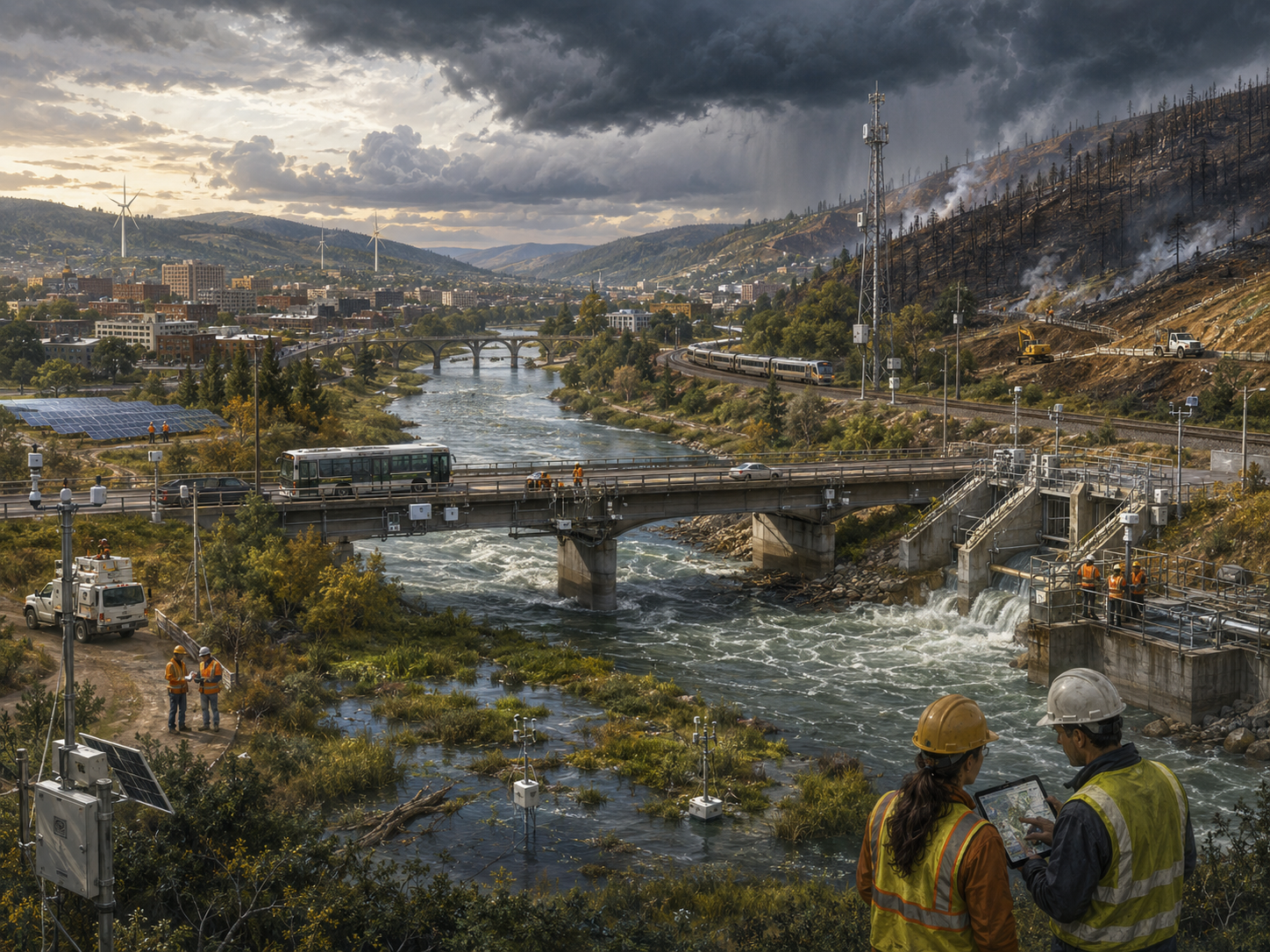
Intelligent infrastructure and resilience refers to the capacity of digitally instrumented, data-enabled, cyber-physical, and institutionally governed infrastructure systems to continue essential functions, detect stress, degrade safely, recover from disruption, adapt to changing conditions, and protect the people and ecosystems that depend on them. It includes energy grids, water systems, transportation networks, telecommunications, buildings, ports, hospitals, environmental monitoring systems, public safety networks, logistics systems, and the digital platforms that increasingly coordinate them.
Infrastructure is no longer only concrete, steel, pipes, wires, roads, pumps, bridges, substations, vehicles, treatment plants, sensors, and control rooms. It is also software, data, algorithms, digital twins, communication networks, cloud services, maintenance records, cybersecurity protocols, vendor contracts, emergency procedures, public institutions, regulatory systems, and community trust. Intelligent infrastructure can improve resilience when it strengthens monitoring, early warning, maintenance, coordination, adaptation, and learning. It can weaken resilience when it creates cyber-physical fragility, vendor lock-in, surveillance, opaque automation, brittle optimization, or digital dependence without fallback capacity.
The central question is not whether infrastructure should become “smart.” Many infrastructures are already becoming connected, automated, sensor-rich, and data-dependent. The deeper question is whether intelligent infrastructure is being designed for resilience, justice, ecological responsibility, repairability, public accountability, and safe failure — or whether intelligence is being added to systems that remain undermaintained, inequitable, brittle, under-governed, and exposed to cascading risk.
This article examines intelligent infrastructure as a resilience challenge. It connects cyber-physical systems, digital twins, predictive maintenance, artificial intelligence, environmental monitoring, climate adaptation, infrastructure interdependence, cybersecurity, public health, energy and water systems, transportation, urban resilience, adaptive governance, and social vulnerability. The central argument is that intelligent infrastructure should not simply optimize performance under normal conditions. It should preserve essential functions under abnormal conditions, expose hidden fragility before failure, support accountable decision-making, and protect communities rather than transferring risk onto them.
What Intelligent Infrastructure and Resilience Means
Intelligent infrastructure is infrastructure that uses sensing, data systems, communication networks, analytics, automation, digital control, modeling, and institutional decision support to monitor conditions, coordinate operations, improve maintenance, and adapt to changing risk. Resilience adds a further requirement: intelligent infrastructure must preserve essential functions under disturbance, recover from failure, learn from stress, and avoid producing unjust or unsafe outcomes.
Intelligent infrastructure can include smart grids, advanced metering, water-quality sensors, flood-monitoring networks, traffic management systems, bridge health sensors, predictive maintenance platforms, digital twins, remote asset monitoring, intelligent transportation systems, environmental monitoring networks, hospital infrastructure dashboards, emergency communication systems, building management systems, industrial control systems, and AI-assisted infrastructure planning tools.
But intelligence is not only technological. Infrastructure becomes resilient when people and institutions can interpret signals, trust warnings, repair assets, allocate resources, govern algorithms, protect privacy, maintain cybersecurity, prioritize vulnerable communities, and revise plans after failure. A sensor that detects risk is not enough if no one has the authority, budget, workforce, or public trust to act on the warning.
| Concept | Meaning | Resilience implication |
|---|---|---|
| Instrumentation | Sensors, meters, telemetry, remote sensing, and monitoring devices | Improves visibility, but only if data are valid, secure, and actionable. |
| Connectivity | Networks that transmit data among assets, operators, agencies, and platforms | Improves coordination, but creates dependency and cyber exposure. |
| Analytics | Models that detect patterns, forecast risk, prioritize maintenance, or compare scenarios | Supports learning, but can hide assumptions or reproduce bias. |
| Automation | Digital systems that adjust operations, alerts, routing, loads, or controls | Improves speed, but can fail dangerously without override and safe fallback. |
| Digital twins | Computational representations of physical systems and their operating conditions | Supports scenario testing, but depends on trustworthy data and governance. |
| Institutional intelligence | Human capacity, public governance, maintenance practice, emergency response, and accountability | Turns technical signals into responsible action. |
Intelligent infrastructure resilience therefore depends on the relationship between physical assets, digital systems, human operators, public institutions, communities, ecosystems, and governance.
Why Intelligent Infrastructure Matters for Resilience
Intelligent infrastructure matters because infrastructure systems are under growing pressure from climate change, aging assets, population shifts, cyber threats, supply-chain disruption, deferred maintenance, urbanization, energy transition, water stress, economic inequality, and rising expectations for continuous digital service. Many infrastructure systems were built for past conditions and are now operating in environments that are more volatile, interconnected, and exposed.
Digital intelligence can help infrastructure systems detect change earlier. Sensors can identify abnormal pressure in water systems, thermal stress in equipment, bridge deterioration, grid instability, traffic disruption, air-quality hazards, flood levels, cyber anomalies, or building performance problems. Analytics can support prioritization when resources are scarce. Digital twins can test failure scenarios. AI tools can help compare maintenance strategies, climate adaptation pathways, and emergency response options.
But intelligent infrastructure also matters because it can increase systemic dependency. When infrastructure becomes more connected, failures can travel through digital pathways as well as physical ones. A cyberattack can affect a water utility. A communications outage can affect emergency response. A cloud service failure can affect transit operations. A software bug can affect grid control. A vendor contract can shape public infrastructure resilience. Digital intelligence adds new capabilities and new failure modes at the same time.
Why intelligent infrastructure is a resilience priority
It reveals hidden stress
Sensing and analytics can detect deterioration, overload, leaks, heat, pressure, vibration, congestion, and anomalous behavior before visible failure.
It supports preventive maintenance
Predictive tools can help prioritize repairs before small defects become service interruption or safety failures.
It improves emergency coordination
Shared situational awareness can help agencies coordinate response across energy, water, transport, health, and communications.
It exposes dependencies
Digital mapping can reveal how infrastructure systems rely on one another and where cascading failure may occur.
It supports climate adaptation
Monitoring and modeling can help infrastructure managers understand heat, flooding, wildfire, drought, sea-level rise, and compound hazards.
It creates new risks
Connected infrastructure can introduce cyber-physical fragility, vendor dependence, data risk, and automation failure.
The resilience value of intelligent infrastructure depends on whether intelligence is used to protect essential functions, reduce vulnerability, and support accountable adaptation rather than merely improve short-term efficiency.
Infrastructure as a Socio-Technical System
Infrastructure is socio-technical because physical assets, digital systems, organizations, laws, workers, financing, land use, communities, ecosystems, and political decisions interact. A bridge is not only a bridge; it is inspection regimes, maintenance budgets, traffic patterns, climate exposure, construction materials, engineering standards, public agencies, contractors, emergency routes, freight networks, and the communities that depend on access. A water system is not only pipes and treatment plants; it is watersheds, public health, energy supply, sensors, operators, household affordability, environmental justice, and trust.
Intelligent infrastructure adds more socio-technical complexity. Sensors generate data. Data require interpretation. Models require validation. Alerts require response. Automation requires oversight. Digital systems require cybersecurity. Vendors require governance. Communities require communication and accountability. Infrastructure resilience therefore cannot be delegated entirely to engineering or software. It requires institutional learning and public responsibility.
This socio-technical view is essential because infrastructure failure rarely harms everyone equally. Power outages are more dangerous for people who rely on medical devices, cooling, elevators, or refrigerated medicine. Flooded transit routes affect workers without cars. Water contamination harms households that cannot afford alternatives. Digital outages harm people without backup access. Intelligent infrastructure must therefore be evaluated by who is protected and who remains exposed.
| Infrastructure layer | Resilience question | Example |
|---|---|---|
| Physical assets | Can assets withstand, degrade safely, and be repaired under stress? | Substations, pumps, bridges, roadways, treatment plants, towers, buildings |
| Digital systems | Can sensing, control, data, and communications remain trustworthy and recoverable? | SCADA systems, cloud platforms, dashboards, sensors, digital twins, AI models |
| Human operators | Can people understand, intervene, repair, override, and learn from the system? | Utility crews, control-room operators, emergency managers, maintenance teams |
| Institutions | Can agencies govern risk, fund maintenance, coordinate response, and revise policy? | Regulators, utilities, public works departments, transit authorities, emergency agencies |
| Communities | Do affected people have access, trust, communication, participation, and protection? | Households, workers, disabled people, renters, rural communities, low-income neighborhoods |
| Ecosystems | Does infrastructure protect or degrade the ecological systems that support resilience? | Watersheds, wetlands, floodplains, urban tree canopy, coastal buffers, biodiversity |
Intelligent infrastructure is resilient only when these layers reinforce one another rather than hiding fragility behind dashboards.
Smart Is Not the Same as Resilient
“Smart” infrastructure is often marketed as efficient, connected, optimized, automated, and data-rich. Those qualities can be useful, but they do not guarantee resilience. A smart system may optimize normal operations while becoming fragile under abnormal conditions. It may reduce redundancy, depend on one vendor, assume continuous connectivity, remove manual procedures, or overtrust automated models. Intelligence can become brittleness when systems are optimized too tightly.
Resilient infrastructure asks a different set of questions. What happens when sensors fail? What happens when communications are interrupted? What happens when a model is wrong? What happens when power is lost? What happens when a vendor platform is unavailable? What happens when operators are overloaded? What happens when the system faces a climate event outside historical experience? What happens to people who lack digital access or political power?
Smart infrastructure becomes resilient infrastructure when it includes redundancy, fallback modes, human override, cybersecurity, maintainability, transparent governance, public communication, equitable access, and ecological adaptation. It is not enough for infrastructure to be intelligent under normal conditions. It must be wise under stress.
| Smart infrastructure emphasis | Resilience concern | Resilience-centered correction |
|---|---|---|
| Efficiency | Optimization may remove slack and redundancy | Protect buffers for essential functions and high-consequence failures. |
| Automation | Automated systems may fail unexpectedly or reduce human skill | Preserve human override, training, manual fallback, and accountability. |
| Connectivity | Network dependence can create cyber and outage exposure | Design segmented, secure, degraded, and offline-capable modes. |
| Data intensity | Data can be incomplete, biased, sensitive, or corrupted | Use validation, governance, privacy, provenance, and field verification. |
| Vendor platforms | Lock-in can reduce public control and migration options | Require portability, interoperability, open standards, and exit planning. |
| Dashboard visibility | Visualization can create false confidence if response capacity is weak | Connect monitoring to maintenance budgets, crews, governance, and action. |
The difference between smart and resilient infrastructure is not the amount of technology. It is whether technology strengthens the system’s ability to protect life, function, fairness, and learning under uncertainty.
Core Components of Intelligent Infrastructure Resilience
Intelligent infrastructure resilience has several recurring components: sensing and monitoring, data governance, digital twins, predictive maintenance, cyber-physical security, redundancy and graceful degradation, human oversight, adaptive governance, equity safeguards, ecological integration, and institutional learning. These components interact. A sensor network without maintenance funding is not resilient. A digital twin without data integrity is not trustworthy. Automation without human override can become dangerous. Cybersecurity without recovery planning is incomplete.
Sensing and Monitoring
Sensing and monitoring provide visibility into asset condition, environmental stress, service performance, demand, safety, and anomalies. Resilience requires that monitoring systems be accurate, secure, maintained, accessible, and tied to response capacity.
Data Governance and Integrity
Infrastructure data must be accurate, timely, protected, interoperable, documented, auditable, and governed. Poor data can misdirect maintenance, emergency response, investment, and public communication.
Digital Twins and Modeling
Digital twins, simulation models, and scenario tools can help test failure modes, climate stress, maintenance options, and cascading risks. They must remain transparent, validated, and connected to real-world operating conditions.
Predictive Maintenance
Predictive maintenance uses condition data, inspection records, and analytics to identify deterioration before failure. It strengthens resilience when warnings lead to timely repair rather than ignored alerts.
Cyber-Physical Security
Connected infrastructure requires cybersecurity across operational technology, industrial control systems, communications, identity, vendors, software, firmware, and recovery procedures. Cyber incidents can become physical service failures.
Redundancy and Graceful Degradation
Resilient infrastructure preserves essential functions when parts fail. This requires backup capacity, alternative routes, manual procedures, islanding, safe defaults, and prioritization of critical services.
Human Oversight and Operational Capacity
Operators, crews, engineers, emergency managers, and public workers remain central. Intelligent systems must support human judgment, training, repair, field verification, and safe intervention.
Public Accountability and Equity
Infrastructure resilience must protect vulnerable users, prevent surveillance harms, ensure accessibility, prioritize environmental justice, and make decisions accountable to affected communities.
| Component | Primary resilience function | Failure if neglected |
|---|---|---|
| Sensing and monitoring | Detects stress, deterioration, hazards, and anomalies | Infrastructure fails before institutions understand the risk. |
| Data governance | Protects integrity, privacy, interoperability, and trust | Decisions are based on corrupted, incomplete, or misused data. |
| Digital twins and modeling | Tests scenarios, dependencies, and adaptation pathways | Planning remains reactive or based on unrealistic assumptions. |
| Predictive maintenance | Prevents failure through earlier repair and prioritization | Deferred maintenance turns into crisis maintenance. |
| Cyber-physical security | Prevents, detects, contains, and recovers from digital attacks on physical systems | Cyber incidents become infrastructure service failures. |
| Redundancy and graceful degradation | Preserves essential functions during disruption | Optimized systems collapse when one dependency fails. |
| Human oversight | Supports interpretation, repair, override, and field judgment | Automation fails without skilled human intervention. |
| Public accountability and equity | Protects vulnerable communities and democratic legitimacy | Intelligence becomes surveillance, exclusion, or unequal protection. |
Intelligent infrastructure resilience is built by aligning technical intelligence with maintenance capacity, public institutions, human judgment, ecological understanding, and justice.
Sensors, Monitoring, and Situational Awareness
Sensors and monitoring systems are often the first visible layer of intelligent infrastructure. They can track pressure, temperature, vibration, traffic flow, water quality, electricity demand, structural strain, air pollution, flood levels, equipment condition, noise, soil moisture, cyber anomalies, building occupancy, and environmental hazards. These data can improve situational awareness when they are accurate, timely, interpretable, and connected to action.
Monitoring can reveal slow variables before they become visible failures. A bridge may show subtle structural changes. A water system may show pressure anomalies before a main break. A grid may show load patterns before overload. A transit system may show maintenance stress before service collapse. A neighborhood may show heat exposure before public health emergencies surge. Intelligent infrastructure can help institutions see stress earlier.
Yet monitoring is not neutral. Some communities are monitored more than others. Some neighborhoods have better sensors, better maintenance, and faster response. Some data are collected without meaningful consent. Some monitoring systems produce alerts that are ignored because agencies lack resources. Situational awareness must therefore be paired with response capacity, rights protection, and equity review.
| Monitoring use | Resilience value | Governance concern |
|---|---|---|
| Structural health monitoring | Detects deterioration in bridges, buildings, tunnels, or roads | Data must lead to inspections, repairs, and transparent safety decisions. |
| Water system monitoring | Detects leaks, pressure changes, contamination, and treatment performance | Alerts must protect public health and be communicated honestly. |
| Grid monitoring | Tracks demand, faults, voltage instability, equipment stress, and outage risk | Optimization must preserve critical services and vulnerable households. |
| Environmental monitoring | Tracks air quality, heat, flooding, wildfire smoke, or ecological conditions | Monitoring must not replace pollution reduction or climate adaptation. |
| Transportation monitoring | Tracks congestion, incidents, transit service, road conditions, and mobility patterns | Data should not become punitive surveillance or exclusionary mobility control. |
| Cyber monitoring | Detects anomalies in operational technology and infrastructure networks | Cyber alerts require trained response, segmentation, and recovery planning. |
Monitoring improves resilience when it shortens the distance between evidence, interpretation, maintenance, response, public communication, and learning.
Digital Twins and Predictive Maintenance
Digital twins are computational representations of physical systems that can be updated with real or simulated data. They may represent a bridge, road network, water system, building, power grid, transit system, port, hospital, watershed, or urban district. In resilience planning, digital twins can help test scenarios, estimate consequences, evaluate maintenance options, and explore how failures may propagate.
Predictive maintenance uses data to anticipate when assets are likely to fail or require repair. Instead of waiting for breakdown or relying only on fixed schedules, agencies can use condition monitoring, inspection histories, environmental exposure, usage patterns, and failure models to prioritize intervention. This can reduce catastrophic failure, improve asset life, lower emergency repair costs, and protect essential services.
However, digital twins and predictive maintenance can fail if the model is inaccurate, data are incomplete, field conditions are ignored, or maintenance budgets are unavailable. A digital twin can create false precision if decision-makers forget it is a representation rather than the system itself. Predictive maintenance can also reproduce inequality if high-value assets receive attention while vulnerable communities remain undermaintained.
Resilience uses of digital twins and predictive maintenance
Failure-mode testing
Explore what happens when assets, routes, pumps, substations, sensors, or communications fail.
Climate stress analysis
Test how heat, flooding, wildfire, drought, storms, or sea-level rise affect service continuity.
Maintenance prioritization
Rank repair needs using condition, consequence, exposure, equity, and critical-function criteria.
Emergency simulation
Compare response pathways under outages, road closures, resource constraints, or compound hazards.
Investment planning
Compare adaptation, redundancy, replacement, repair, and managed retreat options.
Learning after incidents
Compare modeled behavior with actual failure and update assumptions, data, and governance.
Digital twins and predictive maintenance strengthen resilience when they support accountable decisions about repair, adaptation, redundancy, and public protection. They weaken resilience when they become impressive simulations disconnected from real-world capacity.
Cyber-Physical Security and Operational Technology
Intelligent infrastructure depends on operational technology, industrial control systems, sensors, communication networks, remote access tools, cloud platforms, firmware, software updates, identity systems, and vendor maintenance pathways. These connections create cyber-physical risk. A cyber incident can affect water treatment, energy distribution, transit operations, communications, building systems, ports, pipelines, manufacturing, hospitals, or emergency services.
Cyber-physical resilience requires more than traditional information security. It must protect physical processes, safety constraints, manual operations, backup procedures, field crews, control rooms, and public communication. Infrastructure operators need segmentation, access control, monitoring, incident response, tested backups, recovery procedures, vendor governance, asset inventories, and training. They also need to know which services must be preserved when digital systems fail.
Operational technology systems often have long lifecycles. Equipment may remain in service for decades, while cyber threats evolve quickly. Legacy devices may be difficult to patch. Vendors may control specialized systems. Remote access may be necessary for maintenance but risky for security. Resilience requires lifecycle planning, compensating controls, procurement standards, and realistic recovery drills.
| Cyber-physical risk | Infrastructure consequence | Resilience response |
|---|---|---|
| Compromised credentials | Unauthorized access to control systems or dashboards | Use multi-factor authentication, least privilege, access review, and logging. |
| Unsegmented networks | Malware or intrusion spreads across IT and OT environments | Segment critical systems and restrict unnecessary connectivity. |
| Vendor remote access | Supplier compromise becomes infrastructure compromise | Govern vendor access, monitor sessions, and require security obligations. |
| Sensor manipulation | Operators receive false data about physical conditions | Use validation, redundancy, anomaly detection, and field verification. |
| Ransomware | Digital systems become unavailable during critical operations | Maintain tested backups, manual procedures, and incident response plans. |
| Unsafe automation | Automated actions affect physical safety | Use safe defaults, human override, independent safety controls, and engineering review. |
Cybersecurity in intelligent infrastructure is not a separate digital concern. It is part of public safety, service continuity, and infrastructure governance.
Climate Adaptation and Infrastructure Stress
Climate change is one of the most important reasons intelligent infrastructure must be designed for resilience. Heat, flooding, drought, wildfire, sea-level rise, storms, heavy rainfall, freeze-thaw shifts, coastal erosion, smoke, and compound events all stress infrastructure. Systems designed using historical climate assumptions may no longer operate within their original risk envelope.
Intelligent infrastructure can support climate adaptation by monitoring exposure, identifying vulnerable assets, modeling future conditions, prioritizing adaptation investments, supporting early warning, and tracking performance after interventions. Flood sensors, heat maps, grid load forecasting, water-demand models, wildfire detection, urban tree-canopy monitoring, stormwater analytics, and digital twins can all help institutions understand changing risk.
But climate resilience is not only technical adaptation. It involves land use, housing, affordability, public health, insurance, relocation, ecosystem restoration, emergency response, social vulnerability, and justice. Intelligent infrastructure should not become a way to manage climate risk while leaving high-risk development, unequal exposure, or fossil-fuel dependence untouched.
| Climate stressor | Infrastructure impact | Intelligent resilience response |
|---|---|---|
| Extreme heat | Grid stress, pavement damage, rail buckling, equipment overheating, health risk | Heat sensing, load forecasting, cooling priorities, shaded corridors, and public-health integration. |
| Flooding | Road closures, pump failure, contamination, building damage, transit disruption | Flood sensors, drainage modeling, asset exposure maps, and emergency routing. |
| Drought | Water scarcity, hydropower constraints, soil movement, ecological stress | Water-demand analytics, leak detection, watershed monitoring, and allocation planning. |
| Wildfire and smoke | Grid outages, communications disruption, air-quality hazards, evacuation stress | Remote sensing, smoke monitoring, grid hardening analytics, and evacuation modeling. |
| Storms and wind | Power outages, telecommunications failure, road blockage, structural damage | Asset vulnerability mapping, crew pre-positioning, outage prediction, and backup communications. |
| Sea-level rise | Coastal flooding, corrosion, saltwater intrusion, port disruption | Coastal digital twins, adaptation scenarios, managed retreat planning, and ecological buffers. |
Climate-intelligent infrastructure should make adaptation more anticipatory, equitable, and ecologically grounded — not merely more automated.
Cascading Risk and Interdependent Infrastructure
Infrastructure systems are deeply interdependent. Energy systems power water treatment, hospitals, communications, transit, refrigeration, traffic signals, fuel pumps, and data centers. Communications support emergency services, grid control, logistics, banking, public alerts, and remote work. Transportation supports supply chains, emergency response, workforce access, and healthcare. Water supports public health, firefighting, industry, energy production, and ecosystems.
Intelligent infrastructure can help map these dependencies and identify cascade pathways. A digital twin or network model can show how a substation outage affects communications, how a road closure affects ambulance access, how a data-center failure affects public services, or how a flood affects water, transport, and electricity simultaneously. This kind of systems mapping is essential because infrastructure resilience cannot be assessed one asset at a time.
Cascading risk is often nonlinear. A small failure in a critical node can produce large effects if systems are tightly coupled. A communications outage can delay repair crews. A fuel shortage can slow emergency response. A cyberattack can force manual operations. A heat wave can increase power demand while reducing equipment performance. Resilience requires looking for hidden dependencies before they become cascading failures.
Common infrastructure cascade pathways
Energy → Water
Power outages can interrupt pumping, treatment, pressure management, wastewater operations, and water-quality monitoring.
Communications → Emergency response
Network failures can disrupt dispatch, alerts, coordination, field reporting, and public information.
Transportation → Healthcare
Road, transit, or fuel disruption can affect hospital staffing, patient access, ambulance routing, and medical supply delivery.
Cloud services → Public services
Cloud or identity-system failures can interrupt benefits, payments, permitting, records, scheduling, and emergency dashboards.
Cyber incident → Physical operations
Compromised operational technology can affect pumps, controls, sensors, gates, signals, substations, or industrial processes.
Climate event → Multiple systems
Heat, flood, storm, or wildfire can affect energy, roads, health, communications, water, and public safety at the same time.
Intelligent infrastructure resilience requires dependency-aware planning. A system is not resilient if it appears strong only because the dependencies that support it are invisible.
Energy, Water, Transport, and Communications
Energy, water, transportation, and communications are foundational infrastructure systems. Intelligent capabilities can improve each one, but resilience depends on how those capabilities are designed and governed. The goal is not to make every system maximally automated. The goal is to preserve essential functions, protect vulnerable users, and enable adaptation under uncertainty.
In energy systems, intelligent infrastructure includes smart meters, grid sensors, distributed energy resource management, outage prediction, demand response, microgrids, and grid-edge analytics. These tools can improve reliability and flexibility, but they also require cybersecurity, interoperability, and protections for households that cannot easily shift demand.
In water systems, intelligent infrastructure includes leak detection, pressure monitoring, water-quality sensors, remote asset management, flood forecasting, watershed monitoring, and pump optimization. These tools can reduce losses and improve public health, but they must not substitute for investment in pipes, treatment, affordability, and watershed protection.
In transportation, intelligent infrastructure includes traffic management, transit operations, vehicle-to-infrastructure systems, pavement sensors, asset management, logistics routing, and emergency mobility planning. These tools can improve coordination, but they must protect privacy, transit equity, accessibility, and emergency access.
In communications, intelligent infrastructure includes broadband networks, emergency alerts, network monitoring, spectrum management, backup communications, and resilient data routing. Communications resilience is now foundational because most other intelligent systems depend on it.
| Sector | Intelligent infrastructure capability | Resilience priority |
|---|---|---|
| Energy | Grid sensors, demand forecasting, distributed energy coordination, outage prediction | Protect critical loads, cyber-physical safety, affordability, microgrid options, and backup power. |
| Water | Leak detection, pressure monitoring, water-quality sensors, flood analytics | Protect public health, affordability, watershed resilience, emergency supply, and repair capacity. |
| Transportation | Traffic sensing, transit operations, asset monitoring, emergency routing | Protect mobility access, freight continuity, evacuation, accessibility, and transit-dependent users. |
| Communications | Network monitoring, backup communications, emergency alerts, resilient routing | Protect emergency response, public information, remote services, and interdependent infrastructure. |
| Buildings | Building management systems, occupancy sensing, energy analytics, indoor air monitoring | Protect thermal safety, accessibility, indoor air, emergency operation, and occupant override. |
| Public facilities | Facility dashboards, backup power monitoring, security systems, asset management | Protect shelters, schools, hospitals, libraries, community centers, and emergency operations. |
Sector-specific intelligence is useful, but resilience emerges across sectors. Energy, water, transport, communications, buildings, and public facilities must be planned as interdependent systems.
Public Health, Emergency Response, and Critical Services
Intelligent infrastructure supports public health and emergency response when it provides situational awareness, protects critical facilities, improves communications, prioritizes vulnerable populations, and coordinates essential services. Hospitals, clinics, emergency operations centers, shelters, cooling centers, water systems, communications networks, transit routes, and power systems all depend on resilient infrastructure.
During crises, intelligent infrastructure can support outage mapping, ambulance routing, hospital surge planning, shelter location, heat-risk warnings, air-quality alerts, flood evacuation, road clearance, backup power monitoring, and resource allocation. These tools can save lives when they are accurate, trusted, accessible, and linked to response capacity.
However, emergency intelligence can also become exclusionary if it depends on smartphones, broadband, English-only alerts, formal addresses, digital IDs, or administrative records that omit vulnerable people. Resilience requires designing for people who are offline, unhoused, undocumented, disabled, elderly, medically dependent, transit-dependent, linguistically isolated, incarcerated, institutionalized, or distrustful because of prior harm.
Critical-service resilience applications
Backup power monitoring
Track generator status, fuel supply, battery storage, and critical loads at hospitals, shelters, water facilities, and emergency centers.
Emergency routing
Use road, flood, traffic, and incident data to support ambulance, evacuation, repair, and supply routes.
Heat and air-quality alerts
Connect environmental monitoring to cooling centers, public-health messaging, transit access, and outreach.
Service restoration priority
Identify critical facilities, medically vulnerable households, water systems, communication nodes, and access routes.
Multi-agency dashboards
Support shared situational awareness across utilities, emergency management, public health, transportation, and social services.
Inclusive communication
Use multilingual, accessible, low-tech, and trusted channels in addition to digital alerts.
Critical-service resilience is strongest when intelligent infrastructure is designed around human need, not only asset performance.
Equity, Accessibility, and Environmental Justice
Infrastructure resilience is inseparable from justice. Communities do not experience infrastructure equally. Some neighborhoods have more reliable service, better drainage, stronger tree canopy, faster repairs, cleaner water, safer roads, better broadband, stronger transit, and more political influence. Others face aging assets, pollution, flood exposure, heat islands, disinvestment, poor maintenance, unsafe streets, affordability burdens, and slower recovery.
Intelligent infrastructure can help reveal these inequalities, but it can also deepen them. If sensors are placed where wealthier communities already have better infrastructure, data-driven investment may reinforce existing advantage. If predictive maintenance prioritizes assets by economic value alone, vulnerable communities may remain undermaintained. If smart mobility systems require apps and bank accounts, access may narrow. If surveillance is concentrated in marginalized neighborhoods, “resilience” can become control.
Equity-centered intelligent infrastructure asks who benefits, who is monitored, who pays, who is displaced, who is protected, who can contest decisions, and who participates in governance. It also asks whether infrastructure investments reduce vulnerability or simply protect high-value assets while leaving social vulnerability unchanged.
| Justice issue | Infrastructure expression | Resilience response |
|---|---|---|
| Unequal monitoring | Some areas have better sensors, data, and visibility than others | Design monitoring coverage around vulnerability, not only asset value. |
| Unequal maintenance | Repairs and upgrades follow political power or property value | Use equity-weighted maintenance prioritization and public transparency. |
| Digital exclusion | Apps, alerts, payments, or services require broadband, smartphones, or language access | Provide non-digital, multilingual, accessible, and trusted alternatives. |
| Surveillance risk | Sensors and analytics track people more than infrastructure conditions | Use data minimization, purpose limits, public oversight, and rights safeguards. |
| Environmental injustice | Pollution, heat, flooding, and infrastructure burdens concentrate in vulnerable communities | Integrate environmental justice into asset planning and adaptation investment. |
| Displacement risk | Resilience upgrades increase land values and push out residents or small businesses | Pair infrastructure investment with anti-displacement protections and community ownership tools. |
Intelligent infrastructure should not merely make systems more efficient. It should help correct the unequal distribution of risk, repair, protection, and voice.
Governance, Procurement, and Public Accountability
Intelligent infrastructure depends heavily on governance and procurement. Public agencies and utilities often buy sensors, software, cloud systems, analytics platforms, digital twins, cybersecurity services, maintenance systems, and AI tools from vendors. Procurement decisions can shape public infrastructure for decades. If contracts create lock-in, poor data access, weak cybersecurity, unclear ownership, opaque algorithms, or limited interoperability, resilience is weakened.
Governance should define who owns infrastructure data, who can access it, how it can be reused, how systems are audited, how vendors are held accountable, what happens during failure, and how affected communities participate. Intelligent infrastructure systems should have clear public-interest rules before deployment, not only after harm occurs.
Public accountability is especially important when infrastructure intelligence affects essential services. A water-quality dashboard, transit algorithm, grid-control tool, flood model, traffic management system, or emergency alert system can shape public safety. People should know how decisions are made, how errors are corrected, how privacy is protected, and how to contest harmful outcomes.
Governance and procurement questions
Who owns the data?
Do public agencies retain rights to export, audit, preserve, and govern infrastructure data?
Can the system interoperate?
Are open standards, APIs, portability, and documentation required to avoid lock-in?
How is security verified?
Are vendors required to meet cybersecurity, incident response, update, and disclosure obligations?
How are algorithms governed?
Are models documented, validated, monitored, and subject to human oversight and appeal where needed?
What happens during failure?
Are fallback modes, manual procedures, service priorities, and recovery obligations defined?
Who participates?
Are affected communities, workers, operators, and public-interest stakeholders included in design and review?
Procurement is resilience policy. Contracts, standards, data rights, and governance rules determine whether intelligent infrastructure remains publicly accountable or becomes a black box.
Measuring Intelligent Infrastructure Resilience
Measuring intelligent infrastructure resilience requires indicators that capture physical function, digital reliability, cyber-physical security, data trust, human capacity, equity, ecological impact, and governance. Uptime alone is not enough. A system may be online while providing misleading data, excluding users, ignoring vulnerable communities, overloading workers, or depending on fragile vendors.
Useful measures include critical-function availability, restoration time, backup power duration, data validation rates, sensor coverage, false alarm and missed event rates, maintenance backlog, asset condition, cyber incident detection and containment time, manual fallback readiness, vendor portability, interoperability, data ownership, equity-weighted repair priorities, public communication quality, accessibility, and after-action learning.
Measurement should also track whether intelligent infrastructure protects or removes resilience slack. If analytics are used only to cut maintenance crews, reduce inventory, narrow staffing, or eliminate backup capacity, then apparent efficiency may hide rising fragility. Resilience metrics should reveal hidden dependence, delayed repair, worker strain, and unequal exposure.
| Measurement domain | Example indicators | Interpretive caution |
|---|---|---|
| Critical-function continuity | Availability of water, energy, transport, communications, health, and emergency services | Average service levels can hide severe local failure. |
| Recoverability | Restoration time, backup duration, repair time, manual fallback readiness | Recovery speed must be evaluated by community and function, not only systemwide average. |
| Sensor and data reliability | Sensor coverage, data validation, missingness, calibration, lineage, false alarms | More data do not guarantee better decisions. |
| Cyber-physical resilience | Detection time, containment time, segmentation, backup restoration, vendor access controls | Cyber controls must be tested under physical operating constraints. |
| Maintenance capacity | Backlog, asset condition, crew capacity, spare parts, inspection completion | Predictive alerts without repair capacity create known but unresolved risk. |
| Equity and accessibility | Service reliability, repair speed, warning access, exposure, affordability, and accessibility by community | Aggregate resilience can coexist with unequal vulnerability. |
| Governance and accountability | Auditability, vendor portability, incident review, public reporting, corrective-action completion | Governance must produce change, not only documentation. |
| Ecological resilience | Watershed health, heat mitigation, habitat connectivity, emissions, land impact, water use | Infrastructure intelligence should not ignore ecological costs. |
Intelligent infrastructure measurement should make invisible fragility visible before failure becomes public harm.
A Practical Framework for Intelligent Infrastructure Resilience
A practical framework for intelligent infrastructure resilience begins with essential functions, affected communities, physical assets, digital dependencies, climate stressors, cyber-physical risks, governance capacity, and maintenance realities. The framework should not begin with a technology purchase. It should begin with the resilience problem the infrastructure system must solve.
| Step | Question | Output |
|---|---|---|
| Define essential functions | Which services must continue during disruption? | Critical-function inventory for energy, water, transport, communications, health, and public safety. |
| Map physical and digital dependencies | Which assets, sensors, networks, vendors, data systems, and workers are required? | Infrastructure dependency and single-point-of-failure map. |
| Assess climate and hazard exposure | How do heat, flood, fire, drought, storms, and compound hazards affect function? | Hazard exposure and climate adaptation assessment. |
| Evaluate data and monitoring | Are data accurate, timely, representative, secure, interoperable, and actionable? | Data governance, validation, and monitoring coverage review. |
| Analyze cyber-physical risk | How could digital compromise affect physical safety or service continuity? | OT security, segmentation, incident response, and recovery plan. |
| Design graceful degradation | How will essential functions continue when components, networks, models, or vendors fail? | Fallback modes, manual procedures, redundancy, and service-priority rules. |
| Prioritize maintenance and adaptation | Which repairs, upgrades, buffers, and ecological interventions reduce risk most fairly? | Equity-weighted maintenance and adaptation portfolio. |
| Govern vendors and procurement | Do contracts protect public control, portability, security, audit, and accountability? | Procurement requirements and vendor governance framework. |
| Include affected communities | Who experiences risk, exclusion, surveillance, affordability burden, or slow recovery? | Participatory infrastructure resilience review. |
| Institutionalize learning | How will incidents, near misses, and monitoring results change policy and investment? | After-action review, corrective-action tracking, and adaptive governance cycle. |
This framework treats intelligent infrastructure as a public resilience system rather than a technology upgrade. The goal is not simply to collect more data, but to improve the ability to act wisely under uncertainty.
Mathematical Lens: Modeling Intelligent Infrastructure Resilience
Intelligent infrastructure resilience can be modeled as a function of physical robustness, digital intelligence, redundancy, cyber-physical security, maintenance capacity, governance, equity, and ecological adaptation. Let resilience \(R_i\) for infrastructure system \(i\) be represented as:
R_i = w_p P_i + w_d D_i + w_r R_i^{b} + w_c C_i + w_m M_i + w_g G_i + w_e E_i + w_l L_i – w_f F_i
\]
Interpretation: \(P_i\) represents physical robustness, \(D_i\) digital intelligence, \(R_i^{b}\) redundancy and backup capacity, \(C_i\) cyber-physical security, \(M_i\) maintenance capacity, \(G_i\) governance quality, \(E_i\) equity performance, \(L_i\) ecological adaptation, and \(F_i\) hidden fragility.
Infrastructure function under disruption can be modeled dynamically. Let function at time \(t\) be \(S_t\), hazard load be \(H_t\), cyber-digital stress be \(C_t\), maintenance backlog be \(B_t\), redundancy be \(Q_t\), and response capacity be \(A_t\):
S_{t+1} = S_t – \alpha H_t – \beta C_t – \gamma B_t + \delta Q_t + \eta A_t
\]
Interpretation: Infrastructure function declines with hazard load, cyber-digital stress, and backlog, but improves when redundancy and response capacity are strong.
Maintenance backlog can be represented as a slow variable that grows when deterioration and climate stress exceed repair capacity:
B_{t+1} = B_t + \lambda D_t + \kappa H_t – \rho I_t
\]
Interpretation: \(D_t\) is deterioration pressure, \(H_t\) is hazard pressure, and \(I_t\) is maintenance investment. Backlog grows when deterioration and stress exceed repair capacity.
Digital intelligence value can be represented as a combination of monitoring, predictive maintenance, scenario modeling, and coordination:
D_i = aM_i + bP_i^{m} + cS_i^{c} + dK_i
\]
Interpretation: \(M_i\) is monitoring, \(P_i^{m}\) predictive maintenance, \(S_i^{c}\) scenario capacity, and \(K_i\) coordination or shared situational awareness.
Equity-adjusted infrastructure resilience can penalize unequal exposure, slow recovery, surveillance burden, and affordability harm:
R_i^{*} = R_i – \theta X_i – \lambda U_i – \mu V_i
\]
Interpretation: \(X_i\) represents unequal exposure, \(U_i\) unequal recovery or access, and \(V_i\) surveillance or rights burden. Infrastructure is less resilient when protection is unequal.
These equations are simplified. Their value is not prediction alone; it is making assumptions explicit so planners can ask whether intelligent infrastructure is reducing fragility or merely hiding it.
Advanced R Workflow: Comparing Intelligent Infrastructure Resilience Strategies
The R workflow below compares intelligent infrastructure resilience strategies across monitoring, predictive maintenance, cyber-physical security, digital twins, redundancy, climate adaptation, governance, equity, ecological integration, fragility risk, and implementation burden. It is a methodological example using synthetic data.
# Install packages if needed:
# install.packages(c("tidyverse", "scales"))

library(tidyverse)
library(scales)

# -------------------------------------------------------------------
# Example intelligent infrastructure resilience strategies.
# Higher fragility_risk and implementation_burden are worse.
# Values are synthetic and for methodological demonstration only.
# -------------------------------------------------------------------

strategies <- tibble(
  strategy = c(
    "Critical Function and Dependency Mapping",
    "Sensor Monitoring and Early Warning Network",
    "Digital Twin and Scenario Stress Testing",
    "Predictive Maintenance and Asset Renewal",
    "Cyber-Physical Security and Recovery Program",
    "Equity-Centered Climate Adaptation Portfolio",
    "Interoperability and Vendor Portability Strategy"
  ),
  monitoring_value = c(8.4, 9.2, 8.3, 8.5, 8.1, 8.2, 8.0),
  predictive_maintenance = c(7.8, 8.2, 8.5, 9.3, 8.0, 8.1, 7.8),
  cyber_physical_security = c(8.0, 8.0, 8.1, 8.2, 9.4, 8.0, 8.6),
  digital_twin_capacity = c(8.2, 8.0, 9.3, 8.6, 8.0, 8.4, 8.2),
  redundancy_and_fallback = c(8.7, 8.1, 8.3, 8.4, 8.6, 8.5, 8.4),
  climate_adaptation = c(8.1, 8.3, 8.6, 8.4, 8.0, 9.3, 8.0),
  governance_quality = c(8.8, 8.2, 8.5, 8.4, 8.7, 8.9, 8.8),
  equity_performance = c(8.2, 8.0, 8.1, 8.2, 8.0, 9.3, 8.1),
  ecological_integration = c(7.8, 8.1, 8.2, 8.0, 7.8, 9.0, 7.8),
  fragility_risk = c(2.9, 3.1, 3.0, 2.8, 2.7, 2.6, 3.0),
  implementation_burden = c(3.2, 3.5, 3.7, 3.8, 3.7, 3.9, 3.6)
)

# -------------------------------------------------------------------
# Weighted infrastructure resilience value function.
# -------------------------------------------------------------------

score_strategies <- function(data, wm, wp, wc, wd, wr, wa, wg, we, wl, wf, wi) {
  data %>%
    mutate(
      infrastructure_resilience_value =
        wm * monitoring_value +
        wp * predictive_maintenance +
        wc * cyber_physical_security +
        wd * digital_twin_capacity +
        wr * redundancy_and_fallback +
        wa * climate_adaptation +
        wg * governance_quality +
        we * equity_performance +
        wl * ecological_integration -
        wf * fragility_risk -
        wi * implementation_burden,
      governance_gap = pmax(0, 8.5 - governance_quality),
      equity_gap = pmax(0, 8.5 - equity_performance),
      redundancy_gap = pmax(0, 8.5 - redundancy_and_fallback),
      adjusted_value =
        infrastructure_resilience_value -
        0.07 * governance_gap -
        0.08 * equity_gap -
        0.07 * redundancy_gap,
      diagnostic = case_when(
        implementation_burden >= 3.9 ~ "implementation-burden review needed",
        fragility_risk >= 3.1 ~ "hidden-fragility review needed",
        equity_performance < 8.1 ~ "equity-performance review needed",
        governance_quality < 8.3 ~ "governance review needed",
        cyber_physical_security < 8.1 ~ "cyber-physical security review needed",
        TRUE ~ "promising but requires field validation"
      )
    ) %>%
    arrange(desc(adjusted_value))
}

# -------------------------------------------------------------------
# Scenario weights.
# -------------------------------------------------------------------

scenarios <- tribble(
  ~scenario,                ~wm,  ~wp,  ~wc,  ~wd,  ~wr,  ~wa,  ~wg,  ~we,  ~wl,  ~wf,  ~wi,
  "Balanced",               0.10, 0.11, 0.11, 0.10, 0.11, 0.11, 0.12, 0.12, 0.10, 0.04, 0.04,
  "Monitoring-first",       0.30, 0.10, 0.09, 0.10, 0.09, 0.09, 0.09, 0.08, 0.07, 0.04, 0.04,
  "Maintenance-first",      0.09, 0.30, 0.09, 0.10, 0.11, 0.09, 0.09, 0.08, 0.07, 0.04, 0.04,
  "Cyber-physical-first",   0.08, 0.09, 0.30, 0.08, 0.12, 0.08, 0.12, 0.08, 0.06, 0.05, 0.04,
  "Digital-twin-first",     0.09, 0.12, 0.08, 0.30, 0.10, 0.11, 0.09, 0.07, 0.07, 0.04, 0.03,
  "Climate-adaptation",     0.08, 0.10, 0.08, 0.10, 0.11, 0.30, 0.10, 0.12, 0.10, 0.04, 0.03,
  "Equity-first",           0.08, 0.09, 0.08, 0.09, 0.10, 0.14, 0.14, 0.30, 0.10, 0.04, 0.03,
  "Governance-first",       0.08, 0.09, 0.11, 0.08, 0.10, 0.10, 0.30, 0.14, 0.08, 0.04, 0.03,
  "Implementation-aware",   0.10, 0.11, 0.11, 0.10, 0.11, 0.11, 0.12, 0.12, 0.10, 0.03, 0.12
)

# -------------------------------------------------------------------
# Evaluate strategies across scenarios.
# -------------------------------------------------------------------

scenario_results <- scenarios %>%
  rowwise() %>%
  do(
    score_strategies(
      strategies,
      wm = .$wm,
      wp = .$wp,
      wc = .$wc,
      wd = .$wd,
      wr = .$wr,
      wa = .$wa,
      wg = .$wg,
      we = .$we,
      wl = .$wl,
      wf = .$wf,
      wi = .$wi
    ) %>%
      mutate(scenario = .$scenario)
  ) %>%
  ungroup()

ranked_results <- scenario_results %>%
  group_by(scenario) %>%
  arrange(desc(adjusted_value), .by_group = TRUE) %>%
  mutate(rank = row_number()) %>%
  ungroup()

print(ranked_results)

# -------------------------------------------------------------------
# Visualize ranking shifts.
# -------------------------------------------------------------------

ggplot(ranked_results, aes(x = strategy, y = adjusted_value, group = scenario)) +
  geom_point(size = 3) +
  geom_line(aes(color = scenario), linewidth = 1) +
  coord_flip() +
  labs(
    title = "Intelligent Infrastructure Resilience Strategy Value Across Priority Scenarios",
    x = "Strategy",
    y = "Adjusted Infrastructure Resilience Value",
    color = "Scenario"
  ) +
  theme_minimal(base_size = 12)

top_rank_summary <- ranked_results %>%
  filter(rank == 1) %>%
  count(strategy, name = "times_ranked_first") %>%
  arrange(desc(times_ranked_first))

print(top_rank_summary)

write_csv(ranked_results, "intelligent_infrastructure_strategy_rankings.csv")
write_csv(top_rank_summary, "intelligent_infrastructure_top_rank_summary.csv")
This workflow shows why infrastructure intelligence strategy depends on context. A utility facing cyber-physical risk may prioritize security and recovery. A city facing heat and flooding may prioritize climate adaptation and equity. A transit agency with aging assets may prioritize predictive maintenance. A region with many hidden dependencies may need dependency mapping before buying new technology.
Advanced Python Workflow: Simulating Intelligent Infrastructure Under Compound Disruption
The Python workflow below simulates infrastructure function, monitoring value, cyber-physical stress, maintenance backlog, climate stress, governance capacity, equity performance, and resilience score under repeated disruptions. It uses synthetic values to illustrate how intelligent infrastructure can reduce or amplify fragility depending on maintenance, redundancy, cybersecurity, governance, and equity.
# Install packages if needed:
# pip install pandas numpy matplotlib

import numpy as np
import pandas as pd
import matplotlib.pyplot as plt

# ---------------------------------------------------------------------
# Synthetic intelligent infrastructure system profiles.
# Values range from 0 to 1.
# ---------------------------------------------------------------------

systems = pd.DataFrame({
    "system": [
        "Sensor-rich but undermaintained water system",
        "Automated grid with cyber-physical exposure",
        "Digital twin transit network with equity gaps",
        "Climate-adapted distributed infrastructure system",
        "Balanced intelligent infrastructure system"
    ],
    "initial_function": [0.80, 0.84, 0.82, 0.83, 0.87],
    "physical_robustness": [0.54, 0.70, 0.66, 0.78, 0.84],
    "monitoring_value": [0.86, 0.78, 0.82, 0.80, 0.84],
    "predictive_maintenance": [0.58, 0.70, 0.74, 0.78, 0.86],
    "cyber_physical_security": [0.56, 0.48, 0.68, 0.72, 0.86],
    "redundancy": [0.50, 0.62, 0.60, 0.82, 0.84],
    "governance": [0.58, 0.62, 0.60, 0.80, 0.86],
    "equity_performance": [0.54, 0.56, 0.46, 0.82, 0.84],
    "ecological_adaptation": [0.58, 0.60, 0.56, 0.86, 0.82],
    "initial_backlog": [0.74, 0.58, 0.62, 0.38, 0.30],
    "initial_operator_strain": [0.64, 0.60, 0.58, 0.42, 0.34]
})

events = {
    10: {"name": "extreme heat and demand surge", "intensity": 0.66},
    22: {"name": "cyber-physical intrusion attempt", "intensity": 0.76},
    34: {"name": "flooding and transport disruption", "intensity": 0.74},
    48: {"name": "sensor data corruption", "intensity": 0.62},
    62: {"name": "maintenance backlog failure", "intensity": 0.72},
    76: {"name": "communications and cloud outage", "intensity": 0.70},
    88: {"name": "compound infrastructure disruption", "intensity": 0.88}
}

rows = []
n_steps = 96
rng = np.random.default_rng(42)

for _, s in systems.iterrows():
    function = s["initial_function"]
    backlog = s["initial_backlog"]
    operator_strain = s["initial_operator_strain"]
    data_trust = s["monitoring_value"]

    for t in range(n_steps):
        event = events.get(t)
        if event is None:
            event_name = "background infrastructure pressure"
            disturbance = 0.05 + rng.normal(0, 0.01)
            climate_stress = 0.08 + 0.001 * t
            cyber_stress = 0.06
            data_stress = 0.06
            dependency_stress = 0.08
        else:
            event_name = event["name"]
            disturbance = event["intensity"]
            climate_stress = 0.55 + 0.35 * rng.random()
            cyber_stress = 0.45 + 0.40 * rng.random()
            data_stress = 0.40 + 0.35 * rng.random()
            dependency_stress = 0.45 + 0.40 * rng.random()

        disturbance = np.clip(disturbance, 0, 1)

        intelligence_value = (
            0.26 * data_trust
            + 0.24 * s["predictive_maintenance"]
            + 0.18 * s["governance"]
            + 0.16 * s["equity_performance"]
            + 0.16 * s["ecological_adaptation"]
        )

        response_capacity = (
            0.18 * s["physical_robustness"]
            + 0.18 * s["redundancy"]
            + 0.18 * s["cyber_physical_security"]
            + 0.18 * s["governance"]
            + 0.14 * s["predictive_maintenance"]
            + 0.14 * s["equity_performance"]
        )

        fragility_gap = max(
            0,
            disturbance
            + 0.25 * backlog
            + 0.16 * cyber_stress
            + 0.14 * dependency_stress
            - response_capacity
        )

        backlog_growth = 0.020 + 0.035 * climate_stress + 0.025 * disturbance
        maintenance_investment = 0.050 * s["predictive_maintenance"] + 0.030 * s["governance"]
        backlog = np.clip(backlog + backlog_growth - maintenance_investment, 0, 1)

        data_trust = np.clip(
            data_trust
            - 0.12 * data_stress
            - 0.08 * cyber_stress
            + 0.06 * s["governance"]
            + 0.04 * s["cyber_physical_security"],
            0,
            1
        )

        strain_increase = 0.16 * disturbance + 0.14 * fragility_gap + 0.10 * backlog + 0.08 * dependency_stress
        strain_recovery = 0.08 * s["governance"] + 0.06 * s["redundancy"] + 0.04 * s["predictive_maintenance"]
        operator_strain = np.clip(operator_strain + strain_increase - strain_recovery, 0, 1)

        equity_access = np.clip(
            0.42 * s["equity_performance"]
            + 0.20 * s["governance"]
            + 0.18 * s["redundancy"]
            + 0.12 * s["ecological_adaptation"]
            - 0.12 * fragility_gap
            - 0.08 * operator_strain,
            0,
            1
        )

        function = (
            function
            - 0.28 * disturbance
            - 0.17 * fragility_gap
            - 0.12 * backlog
            + 0.17 * response_capacity
            + 0.15 * intelligence_value
            + 0.10 * equity_access
            - 0.10 * operator_strain
        )
        function = np.clip(function, 0, 1)

        resilience_score = np.clip(
            0.18 * function
            + 0.15 * response_capacity
            + 0.14 * intelligence_value
            + 0.12 * data_trust
            + 0.12 * equity_access
            + 0.10 * s["ecological_adaptation"]
            + 0.10 * (1 - backlog)
            + 0.09 * (1 - operator_strain),
            0,
            1
        )

        rows.append({
            "system": s["system"],
            "time": t,
            "event": event_name,
            "disturbance": disturbance,
            "climate_stress": climate_stress,
            "cyber_stress": cyber_stress,
            "dependency_stress": dependency_stress,
            "intelligence_value": intelligence_value,
            "response_capacity": response_capacity,
            "fragility_gap": fragility_gap,
            "maintenance_backlog": backlog,
            "data_trust": data_trust,
            "operator_strain": operator_strain,
            "equity_access": equity_access,
            "function": function,
            "resilience_score": resilience_score
        })

simulation = pd.DataFrame(rows)

summary = (
    simulation
    .groupby("system")
    .agg(
        mean_function=("function", "mean"),
        minimum_function=("function", "min"),
        final_function=("function", "last"),
        final_backlog=("maintenance_backlog", "last"),
        minimum_data_trust=("data_trust", "min"),
        maximum_operator_strain=("operator_strain", "max"),
        mean_equity_access=("equity_access", "mean"),
        mean_fragility_gap=("fragility_gap", "mean"),
        final_resilience_score=("resilience_score", "last")
    )
    .reset_index()
    .sort_values("final_resilience_score", ascending=False)
)

print(summary)

plt.figure(figsize=(10, 6))
for system, subset in simulation.groupby("system"):
    plt.plot(subset["time"], subset["function"], label=system)
plt.xlabel("Time")
plt.ylabel("Infrastructure function")
plt.title("Infrastructure Function Under Compound Disruption")
plt.legend()
plt.tight_layout()
plt.show()

plt.figure(figsize=(10, 6))
for system, subset in simulation.groupby("system"):
    plt.plot(subset["time"], subset["maintenance_backlog"], label=system)
plt.xlabel("Time")
plt.ylabel("Maintenance backlog")
plt.title("Maintenance Backlog as a Slow Resilience Variable")
plt.legend()
plt.tight_layout()
plt.show()

plt.figure(figsize=(10, 6))
for system, subset in simulation.groupby("system"):
    plt.plot(subset["time"], subset["resilience_score"], label=system)
plt.xlabel("Time")
plt.ylabel("Resilience score")
plt.title("Intelligent Infrastructure Resilience Score Over Time")
plt.legend()
plt.tight_layout()
plt.show()

simulation.to_csv("intelligent_infrastructure_resilience_simulation.csv", index=False)
summary.to_csv("intelligent_infrastructure_resilience_summary.csv", index=False)
The simulation illustrates a central point: intelligent infrastructure is not resilient merely because it has sensors, dashboards, or automation. Resilience improves when monitoring, predictive maintenance, cyber-physical security, redundancy, governance, equity, ecological adaptation, and repair capacity work together. Systems with strong data but weak maintenance or weak governance may still fail under compound stress.
GitHub Repository
The companion GitHub repository for this article is designed as an intelligent infrastructure resilience modeling scaffold. It translates monitoring value, predictive maintenance, cyber-physical security, digital twin capacity, redundancy, climate adaptation, governance, equity performance, ecological integration, fragility risk, maintenance backlog, data trust, operator strain, and compound disruption into reproducible workflows for resilience analysis.
Complete Code Repository
Companion code for intelligent infrastructure and resilience, including strategy scoring, monitoring and maintenance diagnostics, cyber-physical stress modeling, digital twin scenario analysis, climate adaptation review, equity-weighted infrastructure prioritization, cascading-risk examples, Monte Carlo uncertainty workflows, responsible-use notes, and multi-language computational examples.
The companion article directory is articles/intelligent-infrastructure-and-resilience/. It is structured to support a professional modeling workflow: Python for simulation and uncertainty analysis; R for strategy comparison and ranking sensitivity; SQL for infrastructure strategies, system profiles, disruption scenarios, indicators, model runs, and outputs; Julia for infrastructure resilience pathway examples; and Rust, Go, C, C++, and Fortran for lightweight diagnostic and simulation utilities.
The modeling objective is to explore how intelligent infrastructure strengthens or weakens resilience depending on monitoring quality, predictive maintenance, cyber-physical security, redundancy, digital twins, climate adaptation, governance, equity, ecological integration, hidden fragility, and implementation burden. The scaffold includes synthetic data, validation notes, responsible-use documentation, generated outputs, and notebook placeholders.
This repository extends the article from conceptual analysis into applied systems modeling. It gives readers a reproducible foundation for examining when intelligent infrastructure supports resilience, when it creates cyber-physical dependency, and how governance and maintenance capacity determine whether intelligence becomes adaptive capacity or brittle control.
Conclusion
Intelligent infrastructure and resilience belong together because infrastructure systems increasingly depend on sensing, software, data, communication networks, automation, analytics, digital twins, AI, and cyber-physical control. These tools can strengthen resilience by revealing hidden stress, improving maintenance, supporting early warning, coordinating response, modeling scenarios, and helping institutions learn before failure becomes catastrophe.
But intelligent infrastructure can also create new fragility. Connected systems can be attacked. Sensors can fail. Data can be corrupted. Vendors can create lock-in. Models can be wrong. Dashboards can create false confidence. Automation can erode human skill. Optimization can remove slack. Surveillance can be justified as safety. Communities can be monitored without being protected. Infrastructure can become “smart” while remaining unjust, underfunded, and brittle.
The resilience challenge is therefore to design intelligent infrastructure for safe failure, public accountability, ecological responsibility, and equitable adaptation. This requires physical robustness, digital integrity, cyber-physical security, redundancy, maintenance capacity, human oversight, open governance, community participation, and climate realism. It also requires resisting the temptation to treat intelligence as a substitute for repair, investment, justice, and public responsibility.
In the broader Resilience Thinking series, intelligent infrastructure and resilience connects technology system resilience, AI and resilience thinking, infrastructure resilience, climate resilience, disaster risk reduction, public health system resilience, energy system resilience, urban resilience, adaptive governance, and social vulnerability. The central lesson is that infrastructure intelligence should serve resilience, not spectacle. A resilient society needs infrastructure that can sense, learn, adapt, and recover — but also infrastructure that remains accountable to people, place, ecology, and the public good when disruption arrives.
Related Articles
- AI and Resilience Thinking
- Technology System Resilience
- Infrastructure Resilience
- Energy System Resilience
- Public Health System Resilience
- Urban Resilience and Adaptation
- Climate Resilience
- Modularity and Cascading Failure
Further Reading
- Cybersecurity and Infrastructure Security Agency (n.d.) Critical Infrastructure Sectors. Available at: https://www.cisa.gov/topics/critical-infrastructure-security-and-resilience/critical-infrastructure-sectors.
- Federal Emergency Management Agency (2021) Building Community Resilience with Nature-Based Solutions. Available at: https://www.fema.gov/emergency-managers/risk-management/nature-based-solutions.
- Intergovernmental Panel on Climate Change (2022) Climate Change 2022: Impacts, Adaptation and Vulnerability. Available at: https://www.ipcc.ch/report/ar6/wg2/.
- National Academies of Sciences, Engineering, and Medicine (2012) Disaster Resilience: A National Imperative. Washington, DC: National Academies Press. Available at: https://doi.org/10.17226/13457.
- National Institute of Standards and Technology (2024) The NIST Cybersecurity Framework 2.0. Available at: https://www.nist.gov/cyberframework.
- National Institute of Standards and Technology (2017) Framework for Cyber-Physical Systems: Volume 1, Overview. Available at: https://doi.org/10.6028/NIST.SP.1500-201.
- United Nations Office for Disaster Risk Reduction (2015) Sendai Framework for Disaster Risk Reduction 2015–2030. Available at: https://www.undrr.org/publication/sendai-framework-disaster-risk-reduction-2015-2030.
- Woods, D.D. (2015) ‘Four concepts for resilience and the implications for the future of resilience engineering’, Reliability Engineering & System Safety, 141, pp. 5–9. Available at: https://doi.org/10.1016/j.ress.2015.03.018.
References
- Cybersecurity and Infrastructure Security Agency (n.d.) Critical Infrastructure Sectors. Available at: https://www.cisa.gov/topics/critical-infrastructure-security-and-resilience/critical-infrastructure-sectors.
- Cybersecurity and Infrastructure Security Agency (n.d.) Cross-Sector Cybersecurity Performance Goals. Available at: https://www.cisa.gov/cross-sector-cybersecurity-performance-goals.
- Federal Emergency Management Agency (2021) Building Community Resilience with Nature-Based Solutions. Available at: https://www.fema.gov/emergency-managers/risk-management/nature-based-solutions.
- Hollnagel, E., Woods, D.D. and Leveson, N. (eds.) (2006) Resilience Engineering: Concepts and Precepts. Aldershot: Ashgate.
- Intergovernmental Panel on Climate Change (2022) Climate Change 2022: Impacts, Adaptation and Vulnerability. Available at: https://www.ipcc.ch/report/ar6/wg2/.
- Leveson, N.G. (2011) Engineering a Safer World: Systems Thinking Applied to Safety. Cambridge, MA: MIT Press. Available at: https://mitpress.mit.edu/9780262533690/engineering-a-safer-world/.
- National Academies of Sciences, Engineering, and Medicine (2012) Disaster Resilience: A National Imperative. Washington, DC: National Academies Press. Available at: https://doi.org/10.17226/13457.
- National Institute of Standards and Technology (2017) Framework for Cyber-Physical Systems: Volume 1, Overview. Available at: https://doi.org/10.6028/NIST.SP.1500-201.
- National Institute of Standards and Technology (2024) The NIST Cybersecurity Framework 2.0. Available at: https://www.nist.gov/cyberframework.
- Rinaldi, S.M., Peerenboom, J.P. and Kelly, T.K. (2001) ‘Identifying, understanding, and analyzing critical infrastructure interdependencies’, IEEE Control Systems Magazine, 21(6), pp. 11–25. Available at: https://doi.org/10.1109/37.969131.
- United Nations Office for Disaster Risk Reduction (2015) Sendai Framework for Disaster Risk Reduction 2015–2030. Available at: https://www.undrr.org/publication/sendai-framework-disaster-risk-reduction-2015-2030.
- Woods, D.D. (2015) ‘Four concepts for resilience and the implications for the future of resilience engineering’, Reliability Engineering & System Safety, 141, pp. 5–9. Available at: https://doi.org/10.1016/j.ress.2015.03.018.