
Last Updated May 20, 2026
Memory is the cognitive system through which experience is encoded, organized, retained, reconstructed, and later brought back into use across time. In cognitive psychology, memory is not treated as a single static faculty or a passive archive of the past. It is understood instead as a dynamic, multi-component, cue-dependent, and constructive system that makes learning possible, stabilizes knowledge, supports reasoning, guides decision making, and gives mental life continuity. Without memory, cognition would collapse into disconnected moments of sensation and response, unable to accumulate structure, knowledge, skill, identity, or history.
Memory occupies a foundational place within cognitive psychology because nearly every higher cognitive process depends on it. Attention shapes what is encoded. Perception provides organized input. Working memory supports active maintenance and manipulation in real time. Decision making, problem solving, mental models, semantic memory, concept formation, and language processing all rely on stored representations that can be reactivated, recombined, and used in new contexts.
For this reason, memory is not simply one domain of cognition among others. It is one of the principal ways cognition acquires duration, structure, and cumulative intelligence. Memory preserves experience, but it also does more than preserve. It allows the mind to compare the present to the past, retrieve patterns that matter, imagine futures, build expertise, maintain identity, and carry knowledge across situations. It is both a record of experience and a system for making experience usable.
Main Library
Publications
Article Map
Cognitive Psychology
Related Topic
Behavioral Economics
Related Topic
Artificial Intelligence Systems
Related Topic
Data Systems & Analytics
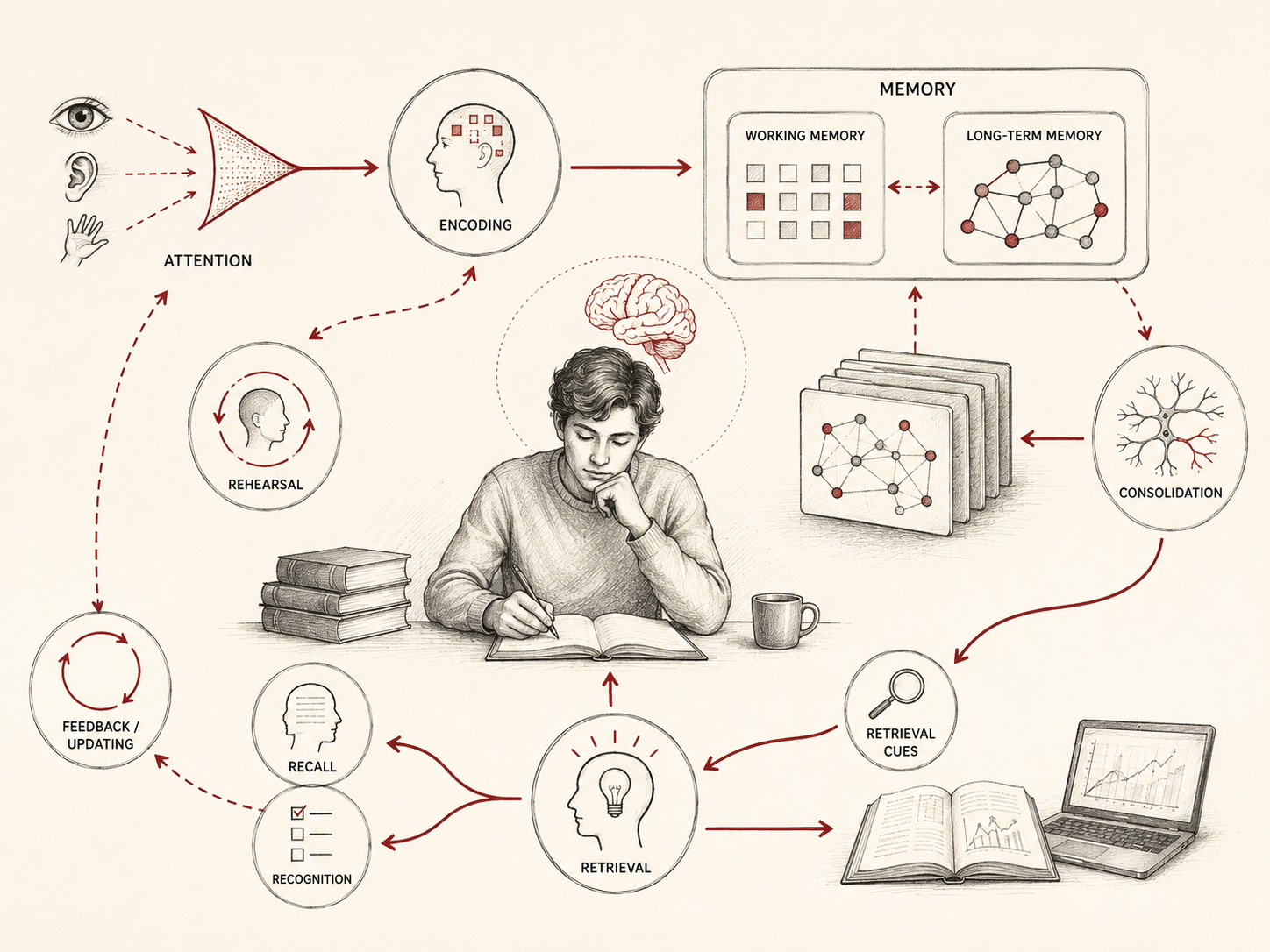
Memory matters because the mind does not merely respond to the present. It carries traces of prior experience, organizes them into usable forms, and retrieves them when current tasks demand meaning, recognition, comparison, explanation, or action. Memory is therefore both psychological and practical: it shapes learning, testimony, identity, clinical care, education, technology design, institutional records, and the way societies preserve or distort the past.
What is memory?
Memory refers to the processes through which information is encoded, maintained, organized, transformed, and later retrieved. That concise definition captures the outline of the system, but only the outline. In cognitive psychology, memory is not merely storage. It is the organized retention and reconstruction of information in forms that can later support recognition, recall, reasoning, learning, planning, skill, language, identity, and self-understanding.
Memory supports a wide range of cognitive functions, including:
- learning new information and integrating it with prior knowledge;
- recognizing objects, places, people, words, and patterns;
- maintaining continuity across time and preserving identity;
- guiding judgment, strategy selection, and decision making;
- supporting language, concepts, and structured knowledge representation;
- building expertise through organized retrieval and practice;
- simulating possible futures from prior experience;
- recovering evidence, testimony, and personal history;
- maintaining cultural, institutional, and scientific knowledge across generations.
For this reason, memory is inseparable from intelligence itself. A mind without memory could register sensation moment by moment, but it could not accumulate concepts, build skills, sustain relationships, reason across time, or learn from consequences. Memory gives cognition temporal depth. It is one of the systems through which the mind becomes more than the present instant.
Memory is also not a single system. Different forms of memory operate across different timescales, modalities, neural systems, and functional demands. Sensory memory preserves brief traces of incoming stimulation. Working memory keeps information active for ongoing tasks. Long-term memory preserves knowledge, events, skills, concepts, and habits across extended periods. Recognition, recall, source monitoring, semantic knowledge, episodic remembering, procedural skill, and priming are all memory-related, but they are not identical processes.
A research-grade account of memory must therefore ask not only whether information was remembered, but what kind of memory was involved, how it was encoded, what cues were available, how much interference existed, how long the delay was, whether retrieval was reconstructive, and whether confidence accurately tracked memory accuracy.
Historical foundations of memory research
Scientific research on memory has a long intellectual history, but one of the decisive early turning points came with the work of Hermann Ebbinghaus, who used controlled materials and quantitative methods to study learning, retention, rehearsal, and forgetting. His work helped establish that memory could be investigated experimentally rather than discussed only through philosophy or introspection.
Ebbinghaus’s forgetting curve made memory measurable by showing that retention changes systematically across time. Although later work complicated simple decay accounts, the broader methodological breakthrough remains important: memory could be studied through carefully designed tasks, delays, repetitions, and measurements of recall.
Another major foundation came from Frederic Bartlett’s work on remembering. Bartlett emphasized that remembering is reconstructive. People do not simply reproduce stored material word for word. They use schemas, expectations, cultural knowledge, and meaning structures to reconstruct what happened. This insight became central to modern research on memory distortion, narrative, testimony, and the social shaping of recollection.
Mid-twentieth-century cognitive psychology expanded the field beyond retention curves and reconstruction. Memory became a central part of information-processing theory. Researchers distinguished sensory memory, short-term memory, working memory, and long-term memory, and later separated episodic, semantic, procedural, implicit, and explicit forms of memory. These distinctions showed that memory is not unitary. It is an architecture of interacting systems.
Clinical and neurological cases also transformed memory research. Amnesia, brain injury, and neuropsychological dissociations revealed that different kinds of memory can be impaired or preserved independently. A person may lose the ability to form new episodic memories while retaining procedural skills. Another may struggle with explicit recall while showing preserved priming or habit learning. These patterns made it impossible to treat memory as a single undifferentiated faculty.
Contemporary memory research now integrates cognitive psychology, neuroscience, education, computational modeling, philosophy, law, human-computer interaction, and artificial intelligence. The field studies not only how information is stored, but how it is organized, cued, reconstructed, distorted, strengthened, retrieved, and used.
Core processes of memory
Memory is often described through three major processes:
- Encoding — transforming information into a form that can be represented within the cognitive system.
- Storage — maintaining information across time.
- Retrieval — accessing stored information when needed.
These processes are analytically distinct but functionally interdependent. Encoding quality influences later retrievability. Storage is not simply passive maintenance but may involve consolidation, integration, reorganization, and transformation. Retrieval is not merely the reading out of a fixed record; it often reconstructs remembered material in light of cues, context, current goals, later knowledge, and social expectations.
Encoding depends strongly on attention. Information that is not attended may leave only weak or fleeting traces. But attention is not enough by itself. Encoding also depends on depth of processing, emotional salience, prior knowledge, distinctiveness, meaning, repetition, retrieval demands, and how new material is connected to existing memory structures.
Storage depends on time, consolidation, interference, and reactivation. A memory trace does not remain isolated and unchanged. It may be strengthened by rehearsal, transformed by later knowledge, disrupted by competing material, or stabilized through sleep and systems-level consolidation.
Retrieval depends on cue quality, context, memory strength, interference, strategy, and confidence. A memory can be present but difficult to access if the right cue is missing. Conversely, a strong cue can produce recognition or recall even when the person was not deliberately searching for the memory.
For that reason, memory cannot be understood as if it were a literal container. It is better understood as a dynamic system whose performance depends on processing conditions, representational structure, cue availability, interference, and the relation between encoding and retrieval.
Formalizing memory: encoding, retention, retrieval, and recognition
Some of the central dynamics of memory can be expressed formally. A simple way to represent memory strength over time is with a retention function. Let \(m(t)\) be accessibility at time \(t\). A basic exponential forgetting model is:
m(t)=m_0e^{-\lambda t}
\]
Interpretation: Memory accessibility \(m(t)\) declines from initial strength \(m_0\) at a rate governed by \(\lambda\) as delay \(t\) increases.
This is not a complete theory of forgetting, but it captures the intuition that accessibility often declines over time when information is not revisited, reactivated, or supported by strong retrieval cues.
Some forgetting patterns are better approximated with a power-law function, where forgetting slows across time:
m(t)=a(t+b)^{-c}
\]
Interpretation: Power-law retention models allow memory to decline rapidly at first and more slowly later.
Retrieval can also be framed probabilistically. Let the probability of successful retrieval depend on memory strength \(m\), cue quality \(c\), and interference \(I\):
Pr(\text{retrieval})=\frac{1}{1+e^{-(\beta_0+\beta_1m+\beta_2c-\beta_3I)}}
\]
Interpretation: Retrieval becomes more likely when memory strength and cue quality increase, and less likely when interference increases.
Spacing and retrieval practice can be represented in simplified update form. If memory strength after study opportunity \(k\) is \(m_k\), and successful retrieval provides a strengthening increment \(\Delta_k\), then:
m_{k+1}=m_k+\Delta_k
\]
Interpretation: Retrieval practice can strengthen later accessibility by adding to memory strength after successful, effortful retrieval.
Recognition memory can be analyzed using signal-detection theory. In an old/new recognition task, the hit rate and false-alarm rate can be used to estimate sensitivity:
d’=z(H)-z(F)
\]
Interpretation: Sensitivity \(d’\) is the standardized distance between the hit rate \(H\) and false-alarm rate \(F\), separating memory strength from response bias.
Response criterion can be estimated as:
c=-\frac{1}{2}\left[z(H)+z(F)\right]
\]
Interpretation: Criterion \(c\) estimates whether a participant tends to respond “old” liberally or conservatively.
These formalizations make memory research more precise. They distinguish retention from retrieval, accuracy from confidence, sensitivity from bias, and storage from cue-dependent access. They also support reproducible computational workflows for memory experiments.
Architectures of memory
One of the most influential early frameworks was the multi-store model associated with Atkinson and Shiffrin, which distinguished among:
- Sensory memory — brief preservation of incoming sensory information.
- Short-term memory — limited-capacity temporary maintenance.
- Long-term memory — more durable retention across extended time periods.
Although contemporary research has moved beyond strict linear store models, this framework remains historically important because it clarified that memory is not unitary. Different systems and timescales support different functions. Sensory memory preserves transient input long enough for selection. Short-term and working-memory processes support active use. Long-term systems support knowledge, experience, skill, and conceptual structure.
Current research more often treats memory architecture as interactive rather than strictly sequential. Information moves across systems, is transformed by task demands, and becomes integrated with existing representations. A remembered event may involve perceptual traces, semantic knowledge, spatial context, emotional tone, narrative interpretation, and source information. A learned skill may depend on procedural systems, feedback, attention, and repeated practice.
Memory architecture is therefore not a simple pipeline. It is a network of interacting systems that support different forms of retention and use. Some memory is brief and sensory. Some is active and controlled. Some is explicit and consciously reportable. Some is implicit and expressed through behavior. Some is personal and episodic. Some is semantic and conceptual. Some is procedural and embodied in skill.
This architecture matters because different tasks fail for different reasons. A person may fail to encode information, lose access over time, confuse sources, misrecognize a lure, retrieve a related but incorrect memory, or act on implicit learning they cannot verbalize. Each failure has different cognitive implications.
Sensory memory
Sensory memory refers to the brief preservation of incoming sensory information after stimulation ends. It allows the cognitive system to retain a transient trace of visual, auditory, tactile, or other sensory input long enough for attention and perception to select what matters.
Iconic memory preserves visual information for a very short time. Echoic memory preserves auditory information slightly longer, allowing speech and sound sequences to be integrated across time. These sensory traces are not durable memories in the ordinary sense, but they are essential for perception. Without them, experience would fragment into isolated instants.
Sensory memory supports:
- visual continuity across eye movements;
- speech perception across brief acoustic intervals;
- selection of relevant input after rapid presentation;
- integration of sensory patterns into coherent percepts;
- the transition from raw sensation to attended information.
Sensory memory is therefore a bridge between perception and later memory systems. It does not preserve experience for long, but it gives attention enough time to select, organize, and transfer information into more durable or active systems.
Working memory
Working memory refers to the system responsible for temporarily maintaining and manipulating information during ongoing tasks. It is central to reasoning, language comprehension, problem solving, and decision making because it allows information to remain available in an active and usable form.
Alan Baddeley’s influential framework proposed several interacting components:
- Phonological loop — temporary maintenance of verbal and auditory information.
- Visuospatial sketchpad — temporary maintenance of visual and spatial information.
- Central executive — control, coordination, and selective allocation of attention.
- Episodic buffer — integration across modalities and long-term knowledge.
Working memory matters because it functions as one of the major bottlenecks of cognition. Its limited capacity constrains how much information can be manipulated at once. This has implications for cognitive load, learning design, complex analysis, decision making, and performance in information-rich environments.
Working memory also shows why memory cannot be understood as storage alone. In real cognition, information must be held, transformed, updated, compared, and protected from distraction. Working memory is the system that makes stored and incoming information operational.
Long-term memory
Long-term memory stores information across extended periods, from minutes and days to decades and entire lifetimes. It includes multiple forms of memory, often divided into explicit and implicit systems.
Explicit memory, also called declarative memory, refers to consciously accessible memory for facts and events. It includes:
- Episodic memory — memory for personally experienced events embedded in time and place.
- Semantic memory — general knowledge about the world, including concepts, facts, categories, and meanings.
Implicit memory, also called nondeclarative memory, includes forms of learning that influence behavior without necessarily depending on conscious recall. These include procedural memory, priming, conditioning, habits, and certain forms of skill learning.
This distinction matters because it shows that not all memory is conscious, verbal, or introspectively available. Minds retain more than they can explicitly report. A person may not remember when they learned a skill but may still perform it. A word may feel familiar because of priming even when the person cannot identify the prior exposure. A concept may guide reasoning without appearing as a discrete remembered episode.
Long-term memory is therefore not a warehouse of isolated facts. It is a structured system of knowledge, experience, association, schema, skill, and meaning that supports ongoing cognition.
Episodic and semantic memory
The distinction between episodic and semantic memory is one of the most important in modern memory research. Episodic memory concerns personally experienced events. It includes the sense of having lived through something, often with contextual details such as time, place, emotion, sequence, and perspective.
Semantic memory concerns general knowledge. It includes facts, meanings, categories, concepts, word knowledge, historical information, scientific knowledge, and abstract relations. A person may know that Paris is the capital of France without remembering when they first learned it. That knowledge is semantic rather than episodic.
Episodic and semantic memory interact constantly. Personal experiences can become generalized into semantic knowledge. Semantic knowledge helps organize episodic recall by providing schemas and interpretive frames. A person remembering a classroom, a diagnosis, a journey, or a conversation uses both event-specific traces and general knowledge about what such situations usually involve.
This distinction also matters for identity. Episodic memory supports autobiographical continuity. Semantic memory supports stable knowledge about oneself and the world. Together, they allow people to remember both what happened and what it means.
The conceptual side of long-term knowledge is developed further in semantic memory, concept formation, and language processing.
Implicit, procedural, and nondeclarative memory
Implicit memory refers to memory expressed through performance rather than conscious recollection. It can influence behavior even when a person cannot explicitly recall the relevant prior experience.
Forms of implicit or nondeclarative memory include:
- Procedural memory — memory for skills, habits, and action sequences.
- Priming — changed response to a stimulus because of prior exposure.
- Conditioning — learned associations between stimuli and responses.
- Habit learning — repeated behavior patterns shaped by reinforcement and context.
- Perceptual learning — improved discrimination or recognition through experience.
Procedural memory is especially important for skill acquisition. Typing, playing an instrument, driving, reading notation, using a tool, or performing a practiced routine often depends on memory systems that do not require conscious step-by-step recall. Expertise frequently depends on this kind of proceduralization, where once-effortful operations become fluent and automatic.
Implicit memory also matters for bias and decision making. Prior exposure can shape familiarity, fluency, preference, and perceived truth without conscious awareness. This is one reason memory research connects to heuristics, cognitive biases, and social cognition.
A complete account of memory must therefore include not only what people can report, but what prior experience makes them more likely to perceive, prefer, recognize, trust, or do.
Encoding, consolidation, and retrieval
Encoding quality is one of the strongest determinants of later memory performance. Craik and Lockhart’s levels-of-processing framework argued that deeper and more meaningful processing tends to produce stronger memory than shallow or surface-level processing. That remains influential because it highlights that memory depends not only on repetition, but on how information is interpreted and related to what is already known.
Encoding is strengthened by:
- attention to relevant features;
- semantic processing;
- elaboration and explanation;
- self-reference where appropriate;
- distinctiveness;
- organization into meaningful categories;
- connection to prior knowledge;
- generation of examples;
- visual, verbal, or multimodal representation;
- emotional salience when it supports rather than distorts encoding.
Retrieval is also highly context-sensitive. Encoding specificity theory proposes that retrieval is more successful when retrieval cues overlap with the original encoding context. Memory therefore depends not simply on what was stored, but on how cues reactivate the relevant representation.
Consolidation refers to the stabilization and reorganization of memory over time. It may involve rehearsal, sleep, neural replay, and systems-level integration. Memory is therefore not fixed at the moment of encoding. It continues to be shaped after learning occurs.
Retrieval itself can also change memory. Successful recall may strengthen later accessibility, while retrieval under misleading cues may introduce distortion. Memory is dynamic not only when it is formed, but when it is used.
Forgetting, interference, and retrieval failure
Forgetting is not merely a breakdown of the system. In many contexts, it is a normal and even functional property of memory. A cognitive system that retained everything with equal accessibility would become cluttered, inefficient, and unable to prioritize what matters.
Several mechanisms contribute to forgetting:
- Decay — weakening of accessibility across time.
- Interference — competition from other memories.
- Retrieval failure — inability to access information despite its persistence.
- Context change — mismatch between encoding and retrieval conditions.
- Source confusion — inability to identify where information came from.
- Motivated avoidance — strategic or affective disengagement from certain memories.
- Adaptive pruning — reduced access to details no longer useful for behavior.
Interference is especially important because it shows that forgetting often reflects competition rather than disappearance. New learning can obscure older information, and older information can intrude on later retrieval. Proactive interference occurs when prior learning disrupts later learning. Retroactive interference occurs when later learning disrupts access to earlier learning.
Retrieval failure also shows why memory strength and retrieval conditions must be separated. A person may have learned something, yet fail to retrieve it because the cue is poor, the context has changed, or competing traces are stronger. Conversely, a strong cue can make a seemingly forgotten memory accessible again.
These issues connect directly to education, testimony, diagnosis, interface design, institutional learning, and AI-supported retrieval, where failure to retrieve the right information at the right time may matter more than overall storage capacity.
Constructive and reconstructive memory
One of the most important findings in modern memory research is that memory is constructive and reconstructive rather than purely reproductive. People do not simply replay exact recordings of the past. They reconstruct remembered events using stored traces, schemas, expectations, later information, cultural knowledge, emotional meaning, and present interpretive goals.
This insight is especially associated with Frederic Bartlett and later work by researchers such as Elizabeth Loftus and Daniel Schacter. Bartlett emphasized the role of schemas and meaning in recall. Loftus’s work on misinformation showed that recollection can be altered by suggestion, question wording, and post-event information. Schacter’s work emphasized that memory’s constructive nature is tied not only to error, but also to imagination, simulation, and future-oriented cognition.
Constructive memory is not only a source of distortion. It is also part of what makes memory adaptive. Because memory is organized around meaning rather than literal duplication, it supports abstraction, generalization, planning, and future simulation. The same features that make memory fallible also make it flexible.
Memory errors can arise when:
- schemas fill in missing details;
- post-event information is integrated into recollection;
- similar events are blended;
- source information is lost;
- emotional salience shifts attention;
- expectations shape interpretation;
- social pressure alters reporting;
- repeated retrieval strengthens a distorted version.
This makes memory epistemically powerful but also fragile. Remembering is often accurate enough to support life, learning, and identity. But it is not infallible, and institutions should not treat it as if it were a perfect recording.
Misinformation, source monitoring, and testimony
Misinformation research shows that memory can be altered by misleading information encountered after an event. This is especially important in legal, journalistic, clinical, educational, and institutional settings where recollection may be shaped by questions, narratives, media exposure, social pressure, or official records.
The misinformation effect does not mean that memory is useless. It means that memory is sensitive to context and suggestion. A person may remember the core of an event while misremembering details. They may incorporate a suggested object, location, cause, or sequence into later recall. They may become confident in a memory that has been shaped by post-event information.
Source monitoring refers to the ability to identify where information came from. Did I see it? Did someone tell me? Did I infer it? Did I read it later? Did an AI system summarize it? Did I imagine it? Source monitoring is crucial because memory for content can sometimes outlast memory for source.
In testimony and investigation, this has major consequences. Poorly framed questions, repeated interviews, suggestive prompts, public narratives, or exposure to others’ accounts can alter later recall. Good practice should therefore avoid leading questions, preserve original statements, separate witnesses where appropriate, document uncertainty, and distinguish confidence from accuracy.
In AI-supported environments, source monitoring becomes even more important. If a system summarizes, rewrites, or generates information, users may later remember the content without remembering whether it came from a primary source, a model output, an inference, or their own prior knowledge. Memory research therefore has direct relevance for AI provenance, citation design, and knowledge integrity.
Memory, learning, and expertise
Memory is indispensable for learning. Learning depends on encoding new information, integrating it with prior knowledge, and retrieving it in ways that support transfer and adaptation. Without memory, there can be no cumulative improvement.
Several findings are especially important for education and skill development:
- Retrieval practice — actively bringing information to mind can strengthen later retention.
- Spacing — distributing practice across time often improves durable learning.
- Interleaving — mixing related problem types can improve discrimination and transfer.
- Elaboration — explaining meaning and connections strengthens encoding.
- Generation — producing an answer can improve later memory compared with passive exposure.
- Feedback — corrective information helps refine memory and reduce error.
- Chunking — organizing information into meaningful units reduces cognitive load.
Memory also underlies skill acquisition and expertise. Experts do not merely know more facts than novices. They often possess better organized knowledge structures, richer retrieval cues, more efficient pattern recognition, and more useful schemas. This is why expertise depends not just on storage, but on the architecture of stored representations.
For the same reason, memory is central to analogical reasoning and knowledge transfer, where prior experience must be retrieved and mapped onto new problems. In this sense, memory is not only about retaining the past. It is about reusing prior structure in novel situations.
Educational design should therefore treat memory as active, not passive. Durable learning requires meaningful encoding, retrieval opportunities, spacing, feedback, and transfer. Simply presenting information is not enough if learners are not supported in organizing, retrieving, and applying it.
Neuroscience of memory
Neuroscience research has shown that memory depends on distributed systems rather than a single storage site. The hippocampus plays a major role in the formation of new episodic memories and the binding of relational information. The prefrontal cortex contributes to working memory, strategic retrieval, source monitoring, and executive organization. Semantic knowledge is distributed across cortical systems. Procedural learning depends on partially distinct networks involving structures such as the basal ganglia and cerebellum.
Cases of amnesia have been especially important in revealing these distinctions. Damage to the hippocampus and medial temporal lobe structures can impair the formation of new episodic memories while leaving older knowledge or certain procedural skills relatively intact. Such cases show that memory is not unitary even at the neural level.
Current neuroimaging work further suggests that remembering involves reactivation across large-scale networks and that retrieval itself is an active and constructive process. When a person remembers an event, the brain does not simply open a stored file. It reassembles information distributed across perceptual, spatial, emotional, semantic, and contextual systems.
Sleep and consolidation research also show that memory continues to change after initial encoding. Neural replay, systems consolidation, and reactivation can help stabilize and reorganize memory. This is one reason learning cannot be reduced to exposure alone. Memory depends on what happens after exposure as well.
The neuroscience of memory therefore reinforces the central psychological point: memory is active, distributed, reconstructive, and functionally diverse.
Memory, technology, and artificial intelligence systems
Digital systems increasingly act as external memory supports. Search engines, note systems, calendars, archives, databases, recommender systems, knowledge graphs, and AI assistants all affect how people encode, retrieve, verify, and organize information.
Technology can support memory by:
- preserving records across time;
- making retrieval cues searchable;
- reducing working-memory burden;
- organizing information into structured knowledge systems;
- supporting spaced repetition and retrieval practice;
- linking evidence to source context;
- preserving provenance and version history;
- helping users retrieve relevant material at the point of need.
But technology can also weaken or distort memory practices. Search may reduce the incentive to encode deeply. AI summaries may obscure source context. Recommendation systems may repeatedly expose users to a narrow set of associations. Autocomplete and generative systems may introduce fluent misinformation. External records may preserve data while losing context, meaning, or accountability.
In human-AI interaction, memory research raises several design questions:
- Does the system preserve source provenance?
- Does it distinguish primary evidence from generated interpretation?
- Does it support retrieval practice or only passive exposure?
- Does it reduce cognitive load without reducing understanding?
- Does it help users remember uncertainty?
- Does it create source confusion between human memory and machine output?
- Does it make later verification possible?
AI systems should therefore be designed not only as information generators, but as memory environments. They should help users encode, organize, retrieve, verify, and contextualize information rather than merely produce fluent output.
Memory, institutions, and historical power
Memory is not only individual. Institutions also remember. They create records, archives, categories, reports, curricula, legal transcripts, databases, and public histories. These institutional memory systems determine what is preserved, what is forgotten, whose testimony is credible, whose suffering is documented, and whose experience becomes part of official knowledge.
Institutional memory can support accountability, continuity, justice, and learning. It can also conceal harm, erase marginalized communities, distort histories, or preserve administrative categories that reproduce unequal power.
Institutional memory failures include:
- records that omit marginalized voices;
- archives organized around dominant institutions rather than affected communities;
- legal systems that discount certain kinds of testimony;
- medical records that underdocument pain or symptoms in marginalized patients;
- educational curricula that erase colonial, racial, gendered, or labor histories;
- data systems that preserve outputs without preserving context;
- AI systems trained on historical records that encode prior exclusions.
A serious account of memory should therefore include power. What societies remember is not simply what happened. It is what was recorded, preserved, classified, translated, taught, authorized, and made retrievable. Forgetting can be accidental, but it can also be institutional.
Memory research helps clarify why records, sources, testimony, provenance, and archival design matter. A just memory system must preserve context, allow contestation, protect marginalized testimony, and resist turning historically unequal records into unquestioned truth.
R code for memory data
The following R workflow illustrates analyses relevant to memory experiments, including recall accuracy, recognition memory, signal detection, forgetting across delays, retrieval-practice effects, misinformation, source memory, response time, and learning transfer.
# Install packages if needed:
# pak::pak(c("tidyverse", "lme4", "lmerTest", "emmeans", "broom.mixed"))

library(tidyverse)
library(lme4)
library(lmerTest)
library(emmeans)
library(broom.mixed)

# Expected columns:
# participant, condition, domain, trial, item_id, memory_system,
# study_type, encoding_depth, retrieval_practice, spacing_interval,
# delay, retention_strength, cue_quality, interference,
# consolidation_support, source_context, misinformation_exposure,
# old_item, response_old, source_correct, correct, recall_accuracy,
# recognition_confidence, retrieval_fluency, response_time_ms,
# learning_transfer, forgetting_rate

dat <- read_csv("memory_trials.csv") %>%
  mutate(
    participant = factor(participant),
    condition = factor(condition),
    domain = factor(domain),
    item_id = factor(item_id),
    memory_system = factor(memory_system),
    study_type = factor(study_type),
    retrieval_practice = as.integer(retrieval_practice),
    misinformation_exposure = as.integer(misinformation_exposure),
    old_item = as.integer(old_item),
    response_old = as.integer(response_old),
    source_correct = as.integer(source_correct),
    correct = as.integer(correct),
    log_rt = log(response_time_ms)
  )

# -----------------------------
# 1. Signal-detection metrics
# -----------------------------

sdt <- dat %>%
  group_by(participant, condition) %>%
  summarise(
    hits = sum(old_item == 1 & response_old == 1, na.rm = TRUE),
    misses = sum(old_item == 1 & response_old == 0, na.rm = TRUE),
    false_alarms = sum(old_item == 0 & response_old == 1, na.rm = TRUE),
    correct_rejections = sum(old_item == 0 & response_old == 0, na.rm = TRUE),
    .groups = "drop"
  ) %>%
  mutate(
    hit_rate = (hits + 0.5) / (hits + misses + 1),
    false_alarm_rate = (false_alarms + 0.5) / (false_alarms + correct_rejections + 1),
    dprime = qnorm(hit_rate) - qnorm(false_alarm_rate),
    criterion = -0.5 * (qnorm(hit_rate) + qnorm(false_alarm_rate))
  )

print(sdt)

# -----------------------------
# 2. Condition summary
# -----------------------------

condition_summary <- dat %>%
  group_by(condition) %>%
  summarise(
    n_trials = n(),
    participants = n_distinct(participant),
    correct_rate = mean(correct, na.rm = TRUE),
    mean_recall_accuracy = mean(recall_accuracy, na.rm = TRUE),
    old_response_rate = mean(response_old, na.rm = TRUE),
    source_correct_rate = mean(source_correct, na.rm = TRUE),
    mean_confidence = mean(recognition_confidence, na.rm = TRUE),
    mean_fluency = mean(retrieval_fluency, na.rm = TRUE),
    mean_response_time_ms = mean(response_time_ms, na.rm = TRUE),
    mean_transfer = mean(learning_transfer, na.rm = TRUE),
    mean_retention_strength = mean(retention_strength, na.rm = TRUE),
    mean_forgetting_rate = mean(forgetting_rate, na.rm = TRUE),
    .groups = "drop"
  )

print(condition_summary)

# -----------------------------
# 3. Correct-memory model
# -----------------------------

correct_model <- glmer(
  correct ~
    condition +
    domain +
    memory_system +
    study_type +
    encoding_depth +
    retrieval_practice +
    spacing_interval +
    delay +
    retention_strength +
    cue_quality +
    interference +
    consolidation_support +
    source_context +
    misinformation_exposure +
    (1 + delay | participant) +
    (1 | item_id),
  data = dat,
  family = binomial(),
  control = glmerControl(optimizer = "bobyqa")
)

summary(correct_model)
emmeans(correct_model, ~ condition, type = "response")

# -----------------------------
# 4. Recall-accuracy model
# -----------------------------

recall_model <- lmer(
  recall_accuracy ~
    condition +
    study_type +
    encoding_depth +
    retrieval_practice +
    spacing_interval +
    delay +
    retention_strength +
    cue_quality +
    interference +
    consolidation_support +
    misinformation_exposure +
    (1 + delay | participant) +
    (1 | item_id),
  data = dat,
  REML = FALSE
)

summary(recall_model)

# -----------------------------
# 5. Source-memory model
# -----------------------------

source_model <- glmer(
  source_correct ~
    condition +
    domain +
    old_item +
    response_old +
    encoding_depth +
    source_context +
    interference +
    misinformation_exposure +
    recognition_confidence +
    (1 | participant) +
    (1 | item_id),
  data = dat,
  family = binomial(),
  control = glmerControl(optimizer = "bobyqa")
)

summary(source_model)

# -----------------------------
# 6. Old-response recognition model
# -----------------------------

old_response_model <- glmer(
  response_old ~
    condition +
    old_item +
    retention_strength +
    cue_quality +
    interference +
    retrieval_fluency +
    misinformation_exposure +
    recognition_confidence +
    (1 | participant) +
    (1 | item_id),
  data = dat,
  family = binomial(),
  control = glmerControl(optimizer = "bobyqa")
)

summary(old_response_model)

# -----------------------------
# 7. Response-time model
# -----------------------------

rt_model <- lmer(
  log_rt ~
    condition +
    delay +
    retrieval_practice +
    retention_strength +
    cue_quality +
    interference +
    retrieval_fluency +
    correct +
    recognition_confidence +
    (1 + delay | participant) +
    (1 | item_id),
  data = dat,
  REML = FALSE
)

summary(rt_model)

# -----------------------------
# 8. Forgetting curve
# -----------------------------

delay_summary <- dat %>%
  group_by(condition, delay) %>%
  summarise(
    correct_rate = mean(correct, na.rm = TRUE),
    mean_retention_strength = mean(retention_strength, na.rm = TRUE),
    .groups = "drop"
  )

ggplot(delay_summary, aes(x = delay, y = correct_rate, color = condition)) +
  geom_point(alpha = 0.8) +
  geom_line(alpha = 0.7) +
  labs(
    title = "Memory retention across delay",
    x = "Delay",
    y = "Correct response rate"
  ) +
  theme_minimal()
This workflow can be adapted for free recall, cued recall, recognition memory, source monitoring, retrieval practice, spacing, misinformation experiments, confidence calibration, educational retention studies, testimony research, and human-AI memory-support evaluation. Researchers should model participant and item effects whenever possible because memory performance varies across people, materials, contexts, and retrieval demands.
Python code for memory data
The Python examples below parallel the R workflow and are useful for recognition memory, retention curves, source memory, misinformation effects, confidence analysis, response-time modeling, and retrieval-practice experiments.
import numpy as np
import pandas as pd
from scipy.stats import norm
import statsmodels.formula.api as smf
import statsmodels.api as sm
import matplotlib.pyplot as plt

# Expected columns:
# participant, condition, domain, trial, item_id, memory_system,
# study_type, encoding_depth, retrieval_practice, spacing_interval,
# delay, retention_strength, cue_quality, interference,
# consolidation_support, source_context, misinformation_exposure,
# old_item, response_old, source_correct, correct, recall_accuracy,
# recognition_confidence, retrieval_fluency, response_time_ms,
# learning_transfer, forgetting_rate

df = pd.read_csv("memory_trials.csv")

categorical_cols = [
    "participant", "condition", "domain", "item_id",
    "memory_system", "study_type"
]

for col in categorical_cols:
    df[col] = df[col].astype("category")

df["retrieval_practice"] = df["retrieval_practice"].astype(int)
df["misinformation_exposure"] = df["misinformation_exposure"].astype(int)
df["old_item"] = df["old_item"].astype(int)
df["response_old"] = df["response_old"].astype(int)
df["source_correct"] = df["source_correct"].astype(int)
df["correct"] = df["correct"].astype(int)
df["log_rt"] = np.log(df["response_time_ms"])

# -----------------------------
# 1. Signal-detection metrics
# -----------------------------

def hautus_rate(k, n):
    return (k + 0.5) / (n + 1)

rows = []

for (participant, condition), g in df.groupby(["participant", "condition"], observed=True):
    hits = ((g["old_item"] == 1) & (g["response_old"] == 1)).sum()
    misses = ((g["old_item"] == 1) & (g["response_old"] == 0)).sum()
    false_alarms = ((g["old_item"] == 0) & (g["response_old"] == 1)).sum()
    correct_rejections = ((g["old_item"] == 0) & (g["response_old"] == 0)).sum()

    hit_rate = hautus_rate(hits, hits + misses)
    false_alarm_rate = hautus_rate(false_alarms, false_alarms + correct_rejections)

    rows.append({
        "participant": participant,
        "condition": condition,
        "hits": hits,
        "misses": misses,
        "false_alarms": false_alarms,
        "correct_rejections": correct_rejections,
        "hit_rate": hit_rate,
        "false_alarm_rate": false_alarm_rate,
        "dprime": norm.ppf(hit_rate) - norm.ppf(false_alarm_rate),
        "criterion": -0.5 * (norm.ppf(hit_rate) + norm.ppf(false_alarm_rate)),
    })

sdt = pd.DataFrame(rows)
print(sdt.groupby("condition", observed=True)[["dprime", "criterion"]].agg(["mean", "std"]))

# -----------------------------
# 2. Condition summary
# -----------------------------

condition_summary = (
    df.groupby("condition", observed=True)
    .agg(
        n_trials=("correct", "size"),
        participants=("participant", "nunique"),
        correct_rate=("correct", "mean"),
        mean_recall_accuracy=("recall_accuracy", "mean"),
        old_response_rate=("response_old", "mean"),
        source_correct_rate=("source_correct", "mean"),
        mean_confidence=("recognition_confidence", "mean"),
        mean_fluency=("retrieval_fluency", "mean"),
        mean_response_time_ms=("response_time_ms", "mean"),
        mean_transfer=("learning_transfer", "mean"),
        mean_retention_strength=("retention_strength", "mean"),
        mean_forgetting_rate=("forgetting_rate", "mean"),
    )
    .reset_index()
)

print(condition_summary)

# -----------------------------
# 3. Correct-memory model
# -----------------------------

correct_model = smf.glm(
    "correct ~ condition + domain + memory_system + study_type "
    "+ encoding_depth + retrieval_practice + spacing_interval "
    "+ delay + retention_strength + cue_quality + interference "
    "+ consolidation_support + source_context + misinformation_exposure",
    data=df,
    family=sm.families.Binomial(),
)

correct_result = correct_model.fit(
    cov_type="cluster",
    cov_kwds={"groups": df["participant"]},
)

print(correct_result.summary())

# -----------------------------
# 4. Recall-accuracy model
# -----------------------------

recall_model = smf.ols(
    "recall_accuracy ~ condition + study_type + encoding_depth "
    "+ retrieval_practice + spacing_interval + delay "
    "+ retention_strength + cue_quality + interference "
    "+ consolidation_support + misinformation_exposure",
    data=df,
)

recall_result = recall_model.fit(
    cov_type="cluster",
    cov_kwds={"groups": df["participant"]},
)

print(recall_result.summary())

# -----------------------------
# 5. Source-memory model
# -----------------------------

source_model = smf.glm(
    "source_correct ~ condition + domain + old_item + response_old "
    "+ encoding_depth + source_context + interference "
    "+ misinformation_exposure + recognition_confidence",
    data=df,
    family=sm.families.Binomial(),
)

source_result = source_model.fit(
    cov_type="cluster",
    cov_kwds={"groups": df["participant"]},
)

print(source_result.summary())

# -----------------------------
# 6. Old-response recognition model
# -----------------------------

old_response_model = smf.glm(
    "response_old ~ condition + old_item + retention_strength "
    "+ cue_quality + interference + retrieval_fluency "
    "+ misinformation_exposure + recognition_confidence",
    data=df,
    family=sm.families.Binomial(),
)

old_response_result = old_response_model.fit(
    cov_type="cluster",
    cov_kwds={"groups": df["participant"]},
)

print(old_response_result.summary())

# -----------------------------
# 7. Response-time model
# -----------------------------

rt_model = smf.ols(
    "log_rt ~ condition + delay + retrieval_practice "
    "+ retention_strength + cue_quality + interference "
    "+ retrieval_fluency + correct + recognition_confidence",
    data=df,
)

rt_result = rt_model.fit(
    cov_type="cluster",
    cov_kwds={"groups": df["participant"]},
)

print(rt_result.summary())

# -----------------------------
# 8. Forgetting curve
# -----------------------------

delay_summary = (
    df.groupby(["condition", "delay"], observed=True)
    .agg(
        correct_rate=("correct", "mean"),
        mean_retention_strength=("retention_strength", "mean"),
    )
    .reset_index()
)

fig, ax = plt.subplots(figsize=(8, 5))

for condition, group in delay_summary.groupby("condition", observed=True):
    ax.plot(group["delay"], group["correct_rate"], marker="o", label=str(condition))

ax.set_xlabel("Delay")
ax.set_ylabel("Correct response rate")
ax.set_title("Memory retention across delay")
ax.legend(title="Condition")
plt.tight_layout()
plt.show()

# -----------------------------
# 9. Export summaries
# -----------------------------

condition_summary.to_csv("memory_condition_summary.csv", index=False)
sdt.to_csv("memory_signal_detection_summary.csv", index=False)
The Python workflow is intentionally transparent and extensible. It can be expanded with Bayesian hierarchical models, power-law forgetting curves, item-response models, confidence-calibration curves, Brier scores, source-monitoring models, misinformation-effect estimates, semantic similarity features, vector-space memory cues, educational transfer analyses, and human-AI provenance studies.
GitHub Repository
The companion repository provides reusable code and research scaffolding for studying memory in cognitive psychology, including workflows for encoding, retention, forgetting, retrieval cues, recognition memory, signal detection, interference, misinformation, source monitoring, retrieval practice, spacing, consolidation, confidence, response time, learning transfer, and AI-supported memory systems.
Complete Code Repository
Access the full companion repository for this article, including reproducible analysis materials and multi-language code workflows for memory research.
Applications of memory research
Memory research has broad practical implications. In education, it supports strategies such as spaced repetition, interleaving, retrieval practice, elaboration, generation, feedback, and meaningful encoding. These strategies matter because durable learning depends not only on exposure, but on how information is encoded, retrieved, strengthened, and transferred.
In medicine and clinical care, memory research informs diagnosis and intervention in dementia, traumatic brain injury, amnesia, developmental conditions, psychiatric disorders, aging, and rehabilitation. It also helps clinicians understand the difference between memory loss, retrieval difficulty, attention failure, source confusion, and confidence distortion.
In law, memory research shapes how testimony and recollection are evaluated. It warns against treating confidence as a simple proxy for accuracy, highlights the risks of suggestive questioning, and explains how source monitoring and misinformation can affect recollection.
In interface design and human factors, memory research supports systems that reduce unnecessary recall demands, preserve context, provide cues, support recognition over recall where appropriate, and make complex tasks easier to resume after interruption.
In artificial intelligence and data systems, memory research informs retrieval systems, source provenance, knowledge organization, context management, and the design of systems that work with rather than against human memory constraints.
These applications show that memory research is not merely theoretical. It helps explain how learning environments should be designed, how information systems can support human cognition, and how institutions should handle evidence, error, recollection, and historical recordkeeping.
Conclusion
Memory is one of the foundational systems of cognition because it allows information to persist beyond the moment of experience. Through encoding, storage, consolidation, reconstruction, and retrieval, the mind transforms transient events into structured representations that support learning, identity, judgment, language, expertise, and action.
Cognitive psychology shows that memory is not a passive recording device but a dynamic, constructive, cue-dependent, and functionally specialized system. It is shaped by attention, interpretation, context, retrieval demands, interference, and later knowledge. Understanding memory therefore helps explain how minds accumulate knowledge, preserve continuity, and become capable of cumulative thought.
Memory also has institutional and ethical significance. What individuals and societies remember depends on cues, records, testimony, archives, power, and source preservation. Recollection can support truth and justice, but it can also be distorted, manipulated, erased, or made inaccessible. Memory research therefore matters not only for psychology, but for education, law, medicine, technology, historical accountability, and the design of knowledge systems.
As research continues to integrate cognitive psychology with neuroscience, education, computational modeling, and artificial intelligence, memory remains one of the most important pathways for understanding not only what the mind preserves, but how the mind becomes capable of building on what it once encountered.
Related articles
- Cognitive Psychology
- Sensory Memory in Cognitive Psychology
- Working Memory in Cognitive Psychology
- Semantic Memory in Cognitive Psychology
- Cognitive Learning Processes
- Skill Acquisition and Expertise Development
- Analogical Reasoning and Knowledge Transfer
- Language Processing in Cognitive Psychology
- Mental Models in Cognitive Psychology
- Attention in Cognitive Psychology
Further reading
- American Psychological Association (n.d.) Memory. APA Dictionary of Psychology. Available at: https://dictionary.apa.org/memory.
- American Psychological Association (n.d.) Constructive memory. APA Dictionary of Psychology. Available at: https://dictionary.apa.org/constructive-memory.
- American Psychological Association (n.d.) Reconstructive memory. APA Dictionary of Psychology. Available at: https://dictionary.apa.org/reconstructive-memory.
- Atkinson, R.C. and Shiffrin, R.M. (1968) ‘Human memory: A proposed system and its control processes’, in Spence, K.W. and Spence, J.T. (eds.) The Psychology of Learning and Motivation. New York: Academic Press, pp. 89–195.
- Baddeley, A. (2012) ‘Working memory: Theories, models, and controversies’, Annual Review of Psychology, 63, pp. 1–29. PubMed record available at: https://pubmed.ncbi.nlm.nih.gov/21961947/.
- Baddeley, A.D. and Hitch, G.J. (1974) ‘Working memory’, in Bower, G.H. (ed.) The Psychology of Learning and Motivation. New York: Academic Press, pp. 47–89.
- Bartlett, F.C. (1932) Remembering: A Study in Experimental and Social Psychology. Cambridge: Cambridge University Press.
- Craik, F.I.M. and Lockhart, R.S. (1972) ‘Levels of processing: A framework for memory research’, Journal of Verbal Learning and Verbal Behavior, 11(6), pp. 671–684.
- Ebbinghaus, H. (1885/1913) Memory: A Contribution to Experimental Psychology. Translated by H.A. Ruger and C.E. Bussenius. New York: Teachers College, Columbia University.
- Loftus, E.F. (2005) ‘Planting misinformation in the human mind: A 30-year investigation of the malleability of memory’, Learning & Memory, 12(4), pp. 361–366. Available at: https://learnmem.cshlp.org/content/12/4/361.
- Michaelian, K. and Sutton, J. (2017) ‘Memory’, Stanford Encyclopedia of Philosophy. Available at: https://plato.stanford.edu/entries/memory/.
- Roediger, H.L. III and Karpicke, J.D. (2006) ‘Test-enhanced learning: Taking memory tests improves long-term retention’, Psychological Science, 17(3), pp. 249–255. PubMed record available at: https://pubmed.ncbi.nlm.nih.gov/16507066/.
- Roediger, H.L. III and Karpicke, J.D. (2006) ‘The power of testing memory: Basic research and implications for educational practice’, Perspectives on Psychological Science, 1(3), pp. 181–210. PubMed record available at: https://pubmed.ncbi.nlm.nih.gov/26151629/.
- Schacter, D.L. (2001) The Seven Sins of Memory: How the Mind Forgets and Remembers. Boston, MA: Houghton Mifflin.
- Schacter, D.L. (2012) ‘Constructive memory: Past and future’, Dialogues in Clinical Neuroscience, 14(1), pp. 7–18. Available at: https://pmc.ncbi.nlm.nih.gov/articles/PMC3341652/.
- Tulving, E. (1972) ‘Episodic and semantic memory’, in Tulving, E. and Donaldson, W. (eds.) Organization of Memory. New York: Academic Press, pp. 381–403.
References
- American Psychological Association (n.d.) Memory. APA Dictionary of Psychology. Available at: https://dictionary.apa.org/memory.
- American Psychological Association (n.d.) Constructive memory. APA Dictionary of Psychology. Available at: https://dictionary.apa.org/constructive-memory.
- American Psychological Association (n.d.) Reconstructive memory. APA Dictionary of Psychology. Available at: https://dictionary.apa.org/reconstructive-memory.
- Atkinson, R.C. and Shiffrin, R.M. (1968) ‘Human memory: A proposed system and its control processes’, in Spence, K.W. and Spence, J.T. (eds.) The Psychology of Learning and Motivation. New York: Academic Press, pp. 89–195.
- Baddeley, A. (2012) ‘Working memory: Theories, models, and controversies’, Annual Review of Psychology, 63, pp. 1–29. PubMed record available at: https://pubmed.ncbi.nlm.nih.gov/21961947/.
- Baddeley, A.D. and Hitch, G.J. (1974) ‘Working memory’, in Bower, G.H. (ed.) The Psychology of Learning and Motivation. New York: Academic Press, pp. 47–89.
- Bartlett, F.C. (1932) Remembering: A Study in Experimental and Social Psychology. Cambridge: Cambridge University Press.
- Craik, F.I.M. and Lockhart, R.S. (1972) ‘Levels of processing: A framework for memory research’, Journal of Verbal Learning and Verbal Behavior, 11(6), pp. 671–684.
- Ebbinghaus, H. (1885/1913) Memory: A Contribution to Experimental Psychology. Translated by H.A. Ruger and C.E. Bussenius. New York: Teachers College, Columbia University.
- Loftus, E.F. (2005) ‘Planting misinformation in the human mind: A 30-year investigation of the malleability of memory’, Learning & Memory, 12(4), pp. 361–366. Available at: https://learnmem.cshlp.org/content/12/4/361.
- Michaelian, K. and Sutton, J. (2017) ‘Memory’, Stanford Encyclopedia of Philosophy. Available at: https://plato.stanford.edu/entries/memory/.
- Roediger, H.L. III and Karpicke, J.D. (2006) ‘Test-enhanced learning: Taking memory tests improves long-term retention’, Psychological Science, 17(3), pp. 249–255. PubMed record available at: https://pubmed.ncbi.nlm.nih.gov/16507066/.
- Roediger, H.L. III and Karpicke, J.D. (2006) ‘The power of testing memory: Basic research and implications for educational practice’, Perspectives on Psychological Science, 1(3), pp. 181–210. PubMed record available at: https://pubmed.ncbi.nlm.nih.gov/26151629/.
- Schacter, D.L. (2001) The Seven Sins of Memory: How the Mind Forgets and Remembers. Boston, MA: Houghton Mifflin.
- Schacter, D.L. (2012) ‘Constructive memory: Past and future’, Dialogues in Clinical Neuroscience, 14(1), pp. 7–18. Available at: https://pmc.ncbi.nlm.nih.gov/articles/PMC3341652/.
- Tulving, E. (1972) ‘Episodic and semantic memory’, in Tulving, E. and Donaldson, W. (eds.) Organization of Memory. New York: Academic Press, pp. 381–403.