
Last Updated May 20, 2026
Cognitive learning refers to the processes through which the mind acquires, organizes, stores, retrieves, revises, and applies knowledge. In cognitive psychology, learning is not treated as the simple accumulation of information. It is understood instead as the active construction and refinement of internal representations that support understanding, reasoning, transfer, problem solving, and adaptive behavior.
From a cognitive perspective, learning transforms experience into structured knowledge. That transformation depends on the interaction of several systems, including attention, memory, working memory, semantic memory, concept formation, and metacognition. Through these systems, individuals encode information, integrate it with what they already know, test it through retrieval and use, and refine the knowledge structures that guide future judgment and action.
Cognitive learning therefore extends beyond memorization. It includes the formation of schemas, the strengthening of retrieval routes, the development of mental models, the correction of misconceptions, the management of cognitive load, and the gradual ability to apply knowledge flexibly across contexts. Durable learning is not merely information that has been encountered. It is knowledge that has been organized well enough to be retrieved, interpreted, transferred, and used.
Main Library
Publications
Article Map
Cognitive Psychology
Related Topic
Behavioral Economics
Related Topic
Artificial Intelligence Systems
Related Topic
Data Systems & Analytics
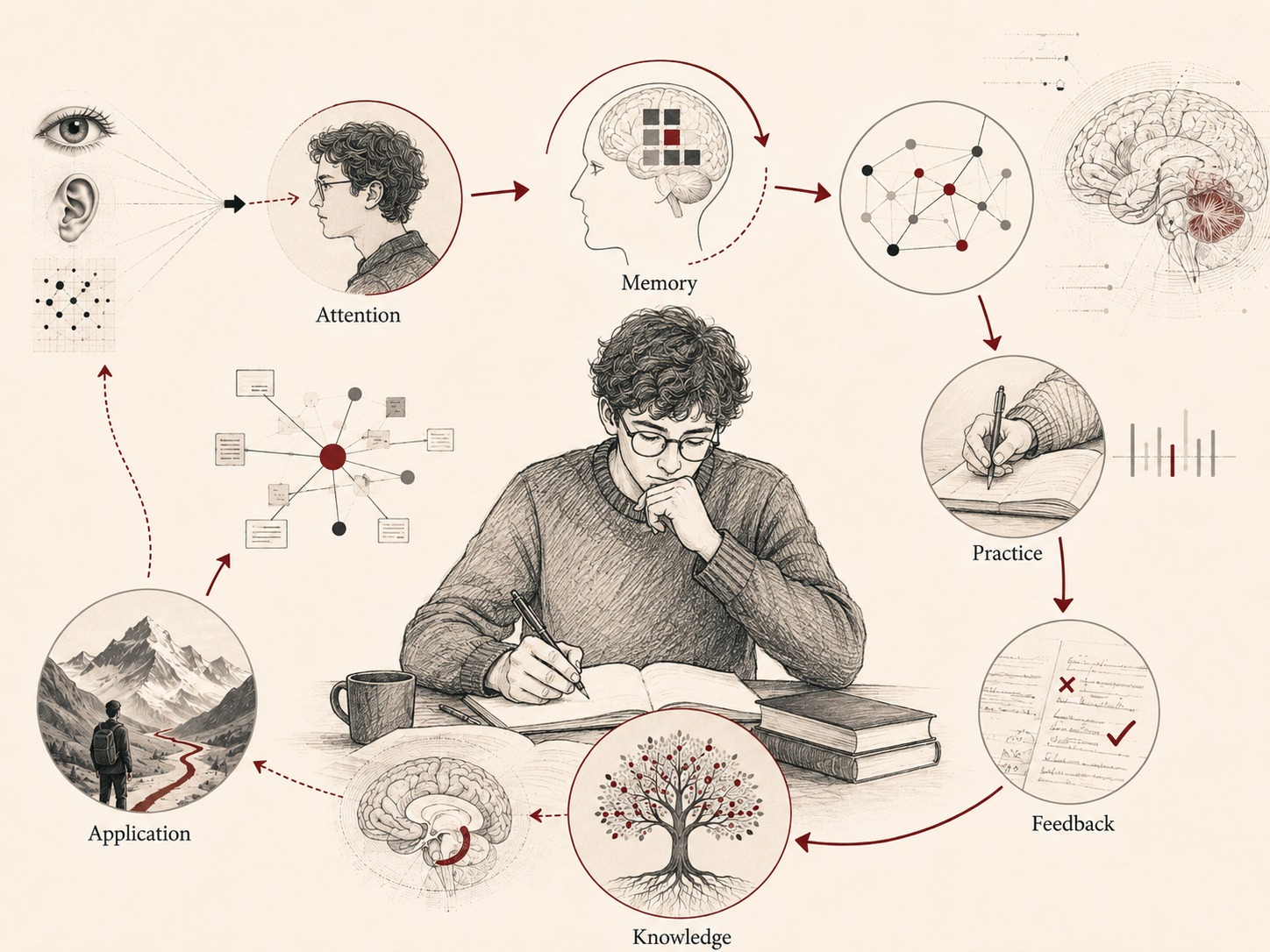
The broader importance of cognitive learning is that it explains how minds become capable of cumulative knowledge. Human beings do not simply react to immediate experience. They build internal structures that allow past experience to shape future interpretation. They learn categories, principles, strategies, procedures, explanations, and models. They also revise those structures when evidence, feedback, or failure shows that the existing representation is inadequate.
The nature of cognitive learning
Cognitive learning emphasizes how knowledge is structured within the mind. Rather than treating learning as passive absorption, cognitive theories emphasize active processes through which individuals organize, interpret, test, and revise information. Learning is not only exposure to material; it is the transformation of that material into usable knowledge.
These processes include:
- Attention, which selects information for deeper processing.
- Encoding, which transforms input into meaningful representations.
- Storage, which stabilizes information across memory systems.
- Retrieval, which makes stored knowledge available for later use.
- Integration, which connects new information to existing knowledge structures.
- Schema formation, which organizes related knowledge into structured patterns.
- Transfer, which applies knowledge to new contexts and problems.
- Metacognitive regulation, which monitors understanding and adjusts learning strategies.
Through these processes, individuals build increasingly organized representations of the world. A learner does not merely record isolated facts. The learner relates new material to prior knowledge, distinguishes relevant from irrelevant features, recognizes patterns, identifies contradictions, and gradually develops more powerful ways of interpreting experience.
This is why cognitive learning is closely tied to understanding rather than rote retention alone. Rote memorization may preserve information temporarily, but understanding requires structure. A learner who understands can explain, connect, apply, revise, and transfer knowledge. A learner who only memorizes may reproduce information without being able to use it.
Cognitive learning therefore treats knowledge as active and structured. The mind is not a container into which information is poured. It is an interpretive system that builds, tests, and reorganizes meaning.
Learning and memory systems
Memory systems play a central role in cognitive learning. Information must be encoded and stabilized before it can guide later behavior, reasoning, or decision making. A common distinction identifies several interacting forms of memory:
- Sensory memory, which briefly retains incoming perceptual input.
- Working memory, which actively maintains and manipulates information during ongoing cognition.
- Long-term memory, which stores knowledge across extended periods.
- Semantic memory, which organizes general knowledge, meanings, concepts, and relations.
- Procedural memory, which supports learned skills and routines.
The interaction among these systems determines how effectively information is learned. Working memory functions as the immediate workspace for processing and integrating new material, while long-term memory provides the structured knowledge that makes new learning easier or harder. Prior knowledge can reduce cognitive burden because familiar structures help organize new information. But prior knowledge can also interfere when it is incomplete, misleading, or rigid.
Learning depends heavily on retrieval. Knowledge that cannot be retrieved when needed remains fragile. This is why active recall, explanation, testing, and application are often stronger learning activities than passive review. Retrieval does not merely measure learning; it can strengthen learning by making knowledge more accessible and by revealing where understanding remains weak.
Memory also shapes transfer. If knowledge is encoded only in the surface form in which it was learned, it may not be available in a new situation. If it is encoded in relation to deeper structure, principles, and patterns, it becomes more flexible. Durable learning therefore depends on both storage and organization.
These dynamics are explored more directly in memory, working memory, and semantic memory.
Schema formation and knowledge structures
A central concept in cognitive learning theory is the formation of schemas: structured representations of knowledge that organize information into meaningful patterns. Schemas allow individuals to interpret new material more efficiently by relating it to prior knowledge rather than treating every new case as entirely novel.
When learning a new concept, people rarely begin from nothing. They fit new information into existing structures, modify those structures, or replace them when prediction and understanding fail. This is one reason learning can be both powerful and difficult. Prior knowledge supports rapid comprehension, but it can also produce misunderstanding when an older schema is incomplete, rigid, or wrong.
Schemas help learning because they:
- reduce the amount of information that must be processed separately;
- organize details into larger meaningful units;
- guide attention toward relevant features;
- support prediction and inference;
- make retrieval more efficient;
- allow new examples to be interpreted as part of a larger pattern;
- support transfer across related tasks.
For example, a student learning ecology may initially memorize isolated terms such as species, habitat, population, niche, feedback, and disturbance. Over time, those terms can become part of a more organized schema of ecological systems. The learner can then reason about unfamiliar cases because the schema links concepts into a usable structure.
Schema formation connects closely to mental models, since both involve structured internal representations that support reasoning, prediction, and transfer. The difference is that schemas often refer to organized knowledge patterns, while mental models emphasize structured representations of how systems, situations, or processes work.
In cognitive learning, the goal is not merely to add more information. It is to develop better structures for using information.
Formalizing cognitive learning: encoding, integration, and transfer
Some of the central dynamics of cognitive learning can be expressed formally. Let the current knowledge state at time \(t\) be \(K_t\), and let new input be \(X_t\). A simple learning update can be represented as:
K_{t+1}=K_t+\alpha f(X_t,K_t)
\]
Interpretation: Knowledge at the next time step depends on the current knowledge state, a learning-rate parameter \(\alpha\), and the degree to which new input can be interpreted in relation to existing knowledge.
This captures a core idea of cognitive learning: information is not simply added to the mind unchanged. It is interpreted through what is already known. The same input may produce different learning outcomes depending on prior knowledge, attention, motivation, working-memory load, feedback, and context.
Working-memory constraint can also be expressed as:
\sum_{i=1}^{n} a_i \leq C
\]
Interpretation: The total allocation of working-memory resources \(a_i\) across task elements must remain within available capacity \(C\). When the demand exceeds capacity, learning becomes less efficient.
Transfer can be represented as the ability to apply knowledge from one context to another. If \(K_A\) is knowledge acquired in context \(A\), and task performance in context \(B\) depends on structural overlap \(S(A,B)\), then a simple transfer relation can be written as:
T_{A \to B} \propto K_A \cdot S(A,B)
\]
Interpretation: Transfer from context \(A\) to context \(B\) depends not only on how much knowledge was learned, but on whether the learner recognizes the structural relation between contexts.
Learning gain can be represented as the difference between post-learning and pre-learning performance:
G = P_{\text{post}} – P_{\text{pre}}
\]
Interpretation: Learning gain \(G\) measures improvement from baseline performance to later performance after instruction, practice, retrieval, feedback, or application.
Retention loss can be represented as:
R_{\text{loss}} = P_{\text{post}} – P_{\text{delayed}}
\]
Interpretation: Retention loss measures how much performance declines between immediate post-learning assessment and delayed assessment.
These simplified models do not capture the full complexity of learning, but they make several important features visible: learning depends on integration, capacity, retention, feedback, and transfer rather than exposure alone.
Cognitive load and learning efficiency
Learning is constrained by the limited capacity of working memory. Cognitive load theory explains how the structure of information affects learning efficiency by influencing how much mental effort is required to process new material. When instructional design overwhelms working memory, learners may spend their limited resources managing complexity rather than building useful schemas.
Three forms of cognitive load are commonly distinguished:
- Intrinsic load — the inherent complexity of the material and the number of interacting elements that must be understood.
- Extraneous load — unnecessary effort introduced by poor design, confusing presentation, irrelevant information, or badly sequenced instruction.
- Germane load — mental effort devoted to understanding, schema formation, integration, and productive learning.
Effective learning environments reduce extraneous load while supporting productive processing. This does not mean making learning easy in a shallow sense. Some difficulty is necessary for durable learning. The goal is not to eliminate effort, but to make effort useful.
For example, a worked example may reduce extraneous load for a novice by showing how steps fit together. Retrieval practice may increase short-term effort but improve long-term retention. Interleaving may feel harder than blocked practice but support discrimination and transfer. A well-designed learning environment manages load so that learners struggle with the right problem rather than with avoidable confusion.
Cognitive load therefore connects learning science to design. The structure of materials, interfaces, examples, explanations, assessments, and feedback can either support or obstruct learning.
Learning, attention, and information processing
Attention plays a decisive role in determining what is learned. Because cognition cannot process all incoming stimuli equally, attentional mechanisms select which information becomes available for deeper encoding. Before information can be stored, integrated, or transferred, it usually must first be noticed and stabilized within working memory.
Learning environments compete with distraction, prior expectations, emotional salience, novelty, fatigue, and task demands. Learners may look at material without attending to the features that matter. They may focus on surface details while missing deep structure. They may attend to familiar cues even when unfamiliar cues are more relevant.
Attention supports learning by:
- selecting relevant information;
- maintaining focus long enough for encoding;
- binding features into meaningful units;
- supporting comparison across examples;
- helping detect mismatch between expectation and evidence;
- allowing feedback to be processed rather than ignored.
Information that receives focused attention is more likely to be encoded and later retrievable. Information that remains unattended is less likely to become part of durable knowledge. This makes learning inseparable from selective processing.
These processes connect cognitive learning directly to attention, where the mechanisms of selection, filtering, divided attention, and control are examined more fully.
Retrieval, spacing, feedback, and durable learning
Durable learning depends on more than initial encoding. Knowledge must be retrievable when needed, and retrieval improves when learners practice accessing information rather than only re-exposing themselves to it. This is one reason retrieval practice is so important: it strengthens access routes and reveals what the learner can actually produce from memory.
Spacing also matters. Learning episodes distributed across time often produce stronger long-term retention than massed practice. Spacing creates opportunities for forgetting and reconstruction, which can make later retrieval more effortful but more durable.
Feedback helps learners correct errors and refine representations. Feedback is most useful when it is specific, timely, interpretable, and connected to the learner’s current understanding. General praise or failure signals may be less useful than feedback that explains what was misunderstood, why it matters, and what should be changed.
Several learning principles follow:
- Retrieval practice strengthens access and reveals gaps.
- Spacing supports long-term retention.
- Interleaving helps learners discriminate among problem types.
- Worked examples can reduce unnecessary load for novices.
- Feedback improves learning when it supports correction.
- Explanation and elaboration deepen encoding.
- Transfer tasks reveal whether learning is flexible.
These principles show that effective learning is not simply about spending more time. It is about structuring time, retrieval, feedback, and practice in ways that build durable knowledge.
Transfer of learning and knowledge application
One of the defining features of cognitive learning is the capacity for transfer. Learning is not complete when information can be repeated in the same form in which it was presented. It becomes more meaningful when knowledge can be applied to new situations, tasks, and problems.
Transfer depends on the flexibility of underlying knowledge structures. When learners understand deep relations rather than only surface features, they are more likely to recognize structural similarities across contexts and apply what they know appropriately.
Transfer can be difficult because surface features often dominate attention. A student may solve a problem when it looks like the worked example but fail when the same principle appears in a new context. A professional may know a procedure but struggle when the situation changes. A reader may understand an argument in one field but fail to recognize a parallel structure in another.
Learning for transfer requires:
- varied examples;
- explicit comparison across cases;
- attention to deep structure;
- practice applying knowledge under changed conditions;
- feedback on why a principle does or does not apply;
- opportunities to explain reasoning;
- metacognitive reflection on strategy and context.
Transfer is central to problem solving, innovation, expertise, and interdisciplinary reasoning. It is one of the clearest signs that learning has become conceptual rather than merely verbal or procedural.
Misconceptions, conceptual change, and prior knowledge
Prior knowledge is one of the strongest influences on new learning. It helps learners interpret new information, organize details, and reduce cognitive load. But prior knowledge can also create resistance when existing schemas are incomplete, inaccurate, or too rigid.
Misconceptions are not simply missing facts. They are often organized interpretations that make sense from the learner’s current point of view. This is why correcting misconceptions can be difficult. Adding correct information may not be enough if the learner’s underlying structure remains unchanged.
Conceptual change often requires:
- making existing assumptions visible;
- showing where current explanations fail;
- providing a better explanatory structure;
- connecting new concepts to prior knowledge carefully;
- using examples and counterexamples;
- supporting reflection and feedback;
- allowing learners to reconstruct the concept, not merely memorize a correction.
This is especially important in science, mathematics, history, ethics, economics, sustainability, governance, and public reasoning, where intuitive ideas may conflict with more accurate models. Learning requires not only acquiring new facts but reorganizing the frame through which facts are interpreted.
Conceptual change connects cognitive learning to concept formation, mental models, and metacognition. Learners must change what they know and how they know it.
Cognitive learning and expertise
Expertise emerges through the gradual refinement of knowledge structures and internal representations. As individuals gain experience, they develop more efficient ways of organizing, retrieving, and applying information. Expertise is therefore one of the long-term outcomes of cognitive learning.
Experts often differ from novices in several related ways:
- they recognize meaningful patterns more quickly;
- they rely on structured knowledge rather than disconnected facts;
- they encode information more selectively and efficiently;
- they use domain-specific schemas to reduce search;
- they detect anomalies earlier;
- they apply knowledge more flexibly across contexts;
- they can often explain why a solution works, not only execute it.
These differences reflect the cumulative effects of cognitive learning over time. Expertise is not simply the accumulation of more information. It is the reorganization of information into more powerful and more usable structures.
This connection is explored more fully in skill acquisition and expertise development, where learning becomes performance through practice, feedback, pattern recognition, and adaptive application.
From a cognitive-learning perspective, expertise develops when knowledge becomes organized enough to support perception, reasoning, decision making, and action under real conditions.
Metacognition and self-regulated learning
Metacognition is central to cognitive learning because learners must monitor whether they understand, whether their strategies are working, and whether their confidence is justified. Without metacognition, learners may confuse familiarity with mastery, fluency with retention, or recognition with transferable understanding.
Self-regulated learners plan, monitor, evaluate, and adjust. They do not simply expose themselves to material. They ask whether they can retrieve it, explain it, apply it, and connect it to other knowledge. They use feedback to change strategy rather than treating feedback as a personal judgment.
Metacognitive learning questions include:
- What do I already know?
- What remains unclear?
- Can I explain this without looking?
- Can I apply it to a new case?
- What errors keep recurring?
- Is my study strategy producing durable learning?
- What feedback should change my next step?
Metacognition also supports transfer. A learner who monitors the conditions under which knowledge applies is more likely to notice when a familiar strategy does not fit a new problem. This makes learning more flexible and less tied to surface similarity.
In this sense, metacognition is not separate from learning. It is part of what allows learning to become strategic, durable, and self-corrective.
Learning environments, access, and institutional design
Cognitive learning is often discussed as an individual process, but learning is shaped by environments. Instructional design, language access, feedback quality, disability support, time, safety, cultural relevance, technology, assessment, and institutional expectations all affect whether learners can build durable knowledge.
This matters because learning differences are too often framed as individual deficits while environmental barriers remain invisible. A learner may struggle not because they lack ability, but because the material is poorly organized, feedback is vague, time is insufficient, examples are culturally narrow, cognitive load is excessive, or the institution punishes error rather than treating it as part of learning.
Institutions shape learning by determining:
- who receives high-quality instruction;
- what prior knowledge is assumed;
- which languages and examples are treated as legitimate;
- how feedback is delivered;
- how much time is available for practice;
- whether mistakes are treated as learning opportunities;
- whether accessibility is built into learning environments;
- whose knowledge is recognized as expertise.
A serious account of cognitive learning must therefore include both mental processes and institutional conditions. Learning happens in minds, but minds learn within environments.
Good learning design does not merely transmit information. It builds conditions under which attention, memory, retrieval, feedback, schema formation, and transfer can actually work.
Cognitive learning and artificial intelligence systems
Artificial intelligence systems are increasingly involved in learning environments. They can generate explanations, provide examples, offer feedback, support tutoring, summarize material, simulate practice, and adapt instruction. These systems raise an important cognitive-learning question: do they produce durable understanding, or do they merely make immediate performance easier?
AI can support cognitive learning when it:
- helps learners retrieve rather than only reread;
- gives specific, actionable feedback;
- adapts examples to prior knowledge;
- supports explanation and reflection;
- reduces unnecessary cognitive load;
- provides varied transfer tasks;
- makes uncertainty and sources visible;
- encourages learners to check understanding.
AI can weaken cognitive learning when it produces fluent answers that learners do not understand, replaces practice with passive copying, hides uncertainty, inflates confidence, or prevents productive struggle. A tool that makes output easier may not make learning stronger.
Human-AI learning systems should therefore be evaluated by their effects on retention, transfer, explanation quality, metacognition, and adaptive application — not only by speed or satisfaction. The central question is whether the learner becomes more capable.
AI also provides a useful comparison point for cognitive learning research. Machine-learning systems build representations from data, feedback, and optimization. Human learning is different because it involves meaning, intention, prior knowledge, embodiment, culture, and social context. But both confront the problem of building generalizable structure from experience.
Cognitive learning in contemporary research
Modern research on cognitive learning integrates cognitive psychology, educational psychology, neuroscience, learning sciences, instructional design, human-computer interaction, and computational modeling. It examines how people encode information, manage working-memory limits, build schemas, retrieve knowledge, use feedback, transfer learning, and revise misconceptions.
Research on learning and memory continues to show that durable learning depends on more than exposure. Retrieval, spacing, feedback, elaboration, and transfer practice matter because they change how knowledge is organized and accessed. Research on cognitive load continues to influence instructional design by showing how working-memory constraints shape learning efficiency.
Formal and computational approaches add another perspective by asking how agents infer, update, generalize, and revise knowledge from observations. These models do not replace psychological explanation, but they help clarify the structure of learning as an adaptive process.
Contemporary cognitive learning research also intersects with AI, especially where adaptive tutoring systems, learning analytics, automated feedback, and human-AI collaboration are used to support education and training. These systems make it increasingly important to distinguish immediate task completion from durable learning.
Across these traditions, the central insight remains stable: learning is not merely acquiring information. It is the construction of usable knowledge structures that support understanding, retention, transfer, and action.
R code for cognitive learning data
The following R workflow illustrates analyses relevant to cognitive learning, including learning curves, retrieval practice, cognitive load, prior knowledge, schema strength, comprehension, transfer, retention, learning gain, and adaptive application.
# Install packages if needed:
# pak::pak(c("tidyverse", "lme4", "lmerTest", "emmeans", "broom.mixed"))

library(tidyverse)
library(lme4)
library(lmerTest)
library(emmeans)
library(broom.mixed)

# Expected columns:
# participant, condition, domain, session, item_id,
# prior_knowledge, attention_score, encoding_quality,
# working_memory_load, schema_strength, retrieval_practice,
# feedback_quality, cognitive_load, comprehension_score,
# accuracy, transfer_score, retention_score, response_time_ms,
# learning_gain, adaptive_application

dat <- read_csv("cognitive_learning_trials.csv") %>%
  mutate(
    participant = factor(participant),
    condition = factor(condition),
    domain = factor(domain),
    item_id = factor(item_id),
    retrieval_practice = as.integer(retrieval_practice),
    log_response_time = log(response_time_ms)
  )

# -----------------------------
# 1. Learning curve
# -----------------------------

learning_curve <- dat %>%
  group_by(condition, session) %>%
  summarise(
    mean_accuracy = mean(accuracy, na.rm = TRUE),
    mean_comprehension = mean(comprehension_score, na.rm = TRUE),
    mean_transfer = mean(transfer_score, na.rm = TRUE),
    mean_retention = mean(retention_score, na.rm = TRUE),
    mean_cognitive_load = mean(cognitive_load, na.rm = TRUE),
    .groups = "drop"
  )

ggplot(learning_curve, aes(x = session, y = mean_accuracy, color = condition)) +
  geom_point() +
  geom_line() +
  labs(
    title = "Cognitive learning performance across sessions",
    x = "Learning session",
    y = "Mean accuracy"
  ) +
  theme_minimal()

# -----------------------------
# 2. Comprehension model
# -----------------------------

comprehension_model <- lmer(
  comprehension_score ~
    session * condition +
    domain +
    prior_knowledge +
    attention_score +
    encoding_quality +
    working_memory_load +
    schema_strength +
    retrieval_practice +
    feedback_quality +
    cognitive_load +
    (1 + session | participant) +
    (1 | item_id),
  data = dat,
  REML = FALSE
)

summary(comprehension_model)
emmeans(comprehension_model, ~ condition)

# -----------------------------
# 3. Accuracy model
# -----------------------------

accuracy_model <- lmer(
  accuracy ~
    session * condition +
    domain +
    prior_knowledge +
    attention_score +
    encoding_quality +
    schema_strength +
    retrieval_practice +
    feedback_quality +
    cognitive_load +
    (1 + session | participant) +
    (1 | item_id),
  data = dat,
  REML = FALSE
)

summary(accuracy_model)

# -----------------------------
# 4. Transfer model
# -----------------------------

transfer_model <- lmer(
  transfer_score ~
    session * condition +
    domain +
    prior_knowledge +
    schema_strength +
    retrieval_practice +
    feedback_quality +
    comprehension_score +
    cognitive_load +
    (1 + session | participant) +
    (1 | item_id),
  data = dat,
  REML = FALSE
)

summary(transfer_model)
emmeans(transfer_model, ~ condition)

# -----------------------------
# 5. Retention model
# -----------------------------

retention_model <- lmer(
  retention_score ~
    session * condition +
    domain +
    retrieval_practice +
    feedback_quality +
    schema_strength +
    comprehension_score +
    cognitive_load +
    (1 + session | participant) +
    (1 | item_id),
  data = dat,
  REML = FALSE
)

summary(retention_model)

# -----------------------------
# 6. Response-time model
# -----------------------------

rt_model <- lmer(
  log_response_time ~
    session * condition +
    domain +
    comprehension_score +
    schema_strength +
    cognitive_load +
    working_memory_load +
    accuracy +
    (1 + session | participant) +
    (1 | item_id),
  data = dat,
  REML = FALSE
)

summary(rt_model)

# -----------------------------
# 7. Adaptive-application model
# -----------------------------

adaptive_model <- lmer(
  adaptive_application ~
    session +
    condition +
    domain +
    schema_strength +
    transfer_score +
    feedback_quality +
    retrieval_practice +
    cognitive_load +
    (1 | participant) +
    (1 | item_id),
  data = dat,
  REML = FALSE
)

summary(adaptive_model)

# -----------------------------
# 8. Export model coefficients
# -----------------------------

model_coefficients <- bind_rows(
  tidy(comprehension_model, effects = "fixed", conf.int = TRUE) %>%
    mutate(model = "comprehension"),
  tidy(accuracy_model, effects = "fixed", conf.int = TRUE) %>%
    mutate(model = "accuracy"),
  tidy(transfer_model, effects = "fixed", conf.int = TRUE) %>%
    mutate(model = "transfer"),
  tidy(retention_model, effects = "fixed", conf.int = TRUE) %>%
    mutate(model = "retention"),
  tidy(rt_model, effects = "fixed", conf.int = TRUE) %>%
    mutate(model = "response_time"),
  tidy(adaptive_model, effects = "fixed", conf.int = TRUE) %>%
    mutate(model = "adaptive_application")
)

write_csv(model_coefficients, "cognitive_learning_model_coefficients.csv")
This workflow can be adapted for retrieval-practice experiments, worked-example studies, spacing and interleaving designs, cognitive-load studies, transfer tasks, retention assessments, adaptive tutoring systems, and human-AI learning-support research. Researchers should model participant and item effects whenever possible because learning outcomes vary across learners, tasks, prior knowledge, domains, feedback conditions, and instructional designs.
Python code for cognitive learning data
The Python examples below parallel the R workflow and are useful for learning trajectories, instructional comparisons, retrieval-practice studies, transfer research, retention modeling, and cognitive-load analysis.
import numpy as np
import pandas as pd
import statsmodels.formula.api as smf
import matplotlib.pyplot as plt

# Expected columns:
# participant, condition, domain, session, item_id,
# prior_knowledge, attention_score, encoding_quality,
# working_memory_load, schema_strength, retrieval_practice,
# feedback_quality, cognitive_load, comprehension_score,
# accuracy, transfer_score, retention_score, response_time_ms,
# learning_gain, adaptive_application

df = pd.read_csv("cognitive_learning_trials.csv")

categorical_cols = ["participant", "condition", "domain", "item_id"]
for col in categorical_cols:
    df[col] = df[col].astype("category")

df["retrieval_practice"] = df["retrieval_practice"].astype(int)
df["log_response_time"] = np.log(df["response_time_ms"])

# -----------------------------
# 1. Learning curve
# -----------------------------

learning_curve = (
    df.groupby(["condition", "session"], observed=True)
    .agg(
        mean_accuracy=("accuracy", "mean"),
        mean_comprehension=("comprehension_score", "mean"),
        mean_transfer=("transfer_score", "mean"),
        mean_retention=("retention_score", "mean"),
        mean_cognitive_load=("cognitive_load", "mean"),
    )
    .reset_index()
)

fig, ax = plt.subplots(figsize=(8, 5))

for condition, group in learning_curve.groupby("condition", observed=True):
    ax.plot(group["session"], group["mean_accuracy"], marker="o", label=str(condition))

ax.set_xlabel("Learning session")
ax.set_ylabel("Mean accuracy")
ax.set_title("Cognitive learning performance across sessions")
ax.legend(title="Condition")
plt.tight_layout()
plt.show()

# -----------------------------
# 2. Comprehension model
# -----------------------------

comprehension_model = smf.ols(
    "comprehension_score ~ session * condition + domain "
    "+ prior_knowledge + attention_score + encoding_quality "
    "+ working_memory_load + schema_strength + retrieval_practice "
    "+ feedback_quality + cognitive_load",
    data=df,
)

comprehension_result = comprehension_model.fit(
    cov_type="cluster",
    cov_kwds={"groups": df["participant"]},
)

print(comprehension_result.summary())

# -----------------------------
# 3. Accuracy model
# -----------------------------

accuracy_model = smf.ols(
    "accuracy ~ session * condition + domain "
    "+ prior_knowledge + attention_score + encoding_quality "
    "+ schema_strength + retrieval_practice + feedback_quality "
    "+ cognitive_load",
    data=df,
)

accuracy_result = accuracy_model.fit(
    cov_type="cluster",
    cov_kwds={"groups": df["participant"]},
)

print(accuracy_result.summary())

# -----------------------------
# 4. Transfer model
# -----------------------------

transfer_model = smf.ols(
    "transfer_score ~ session * condition + domain "
    "+ prior_knowledge + schema_strength + retrieval_practice "
    "+ feedback_quality + comprehension_score + cognitive_load",
    data=df,
)

transfer_result = transfer_model.fit(
    cov_type="cluster",
    cov_kwds={"groups": df["participant"]},
)

print(transfer_result.summary())

# -----------------------------
# 5. Retention model
# -----------------------------

retention_model = smf.ols(
    "retention_score ~ session * condition + domain "
    "+ retrieval_practice + feedback_quality + schema_strength "
    "+ comprehension_score + cognitive_load",
    data=df,
)

retention_result = retention_model.fit(
    cov_type="cluster",
    cov_kwds={"groups": df["participant"]},
)

print(retention_result.summary())

# -----------------------------
# 6. Learning-gain model
# -----------------------------

gain_model = smf.ols(
    "learning_gain ~ session * condition + domain "
    "+ prior_knowledge + attention_score + encoding_quality "
    "+ retrieval_practice + feedback_quality + cognitive_load",
    data=df,
)

gain_result = gain_model.fit(
    cov_type="cluster",
    cov_kwds={"groups": df["participant"]},
)

print(gain_result.summary())

# -----------------------------
# 7. Response-time model
# -----------------------------

response_time_model = smf.ols(
    "log_response_time ~ session * condition + domain "
    "+ comprehension_score + schema_strength + cognitive_load "
    "+ working_memory_load + accuracy",
    data=df,
)

response_time_result = response_time_model.fit(
    cov_type="cluster",
    cov_kwds={"groups": df["participant"]},
)

print(response_time_result.summary())

# -----------------------------
# 8. Export summaries
# -----------------------------

condition_summary = (
    df.groupby("condition", observed=True)
    .agg(
        n_trials=("accuracy", "size"),
        mean_accuracy=("accuracy", "mean"),
        mean_comprehension=("comprehension_score", "mean"),
        mean_transfer=("transfer_score", "mean"),
        mean_retention=("retention_score", "mean"),
        mean_cognitive_load=("cognitive_load", "mean"),
        mean_learning_gain=("learning_gain", "mean"),
    )
    .reset_index()
)

condition_summary.to_csv("cognitive_learning_condition_summary.csv", index=False)
The Python workflow is intentionally transparent and extensible. It can be expanded with hierarchical Bayesian learning models, nonlinear learning curves, forgetting functions, item-response models, cognitive-load diagnostics, retrieval-practice effect estimates, spacing and interleaving comparisons, adaptive tutoring logs, and human-AI learning-support evaluation.
GitHub Repository
The companion repository provides reusable code and research scaffolding for studying cognitive learning processes, including workflows for attention, encoding, working-memory load, prior knowledge, schema formation, retrieval practice, feedback quality, cognitive load, comprehension, transfer, retention, learning gain, response time, and adaptive application.
Complete Code Repository
Access the full companion repository for this article, including reproducible analysis materials and multi-language code workflows for cognitive-learning research.
Applications of cognitive learning research
Cognitive learning research has wide applications across education, training, interface design, public communication, professional development, human-computer interaction, artificial intelligence, workplace learning, and knowledge work. It helps explain why some instructional formats support durable understanding while others produce only short-term familiarity.
In education, cognitive learning research supports instructional designs that build schemas, manage load, use retrieval practice, space learning over time, provide feedback, and promote transfer. In professional training, it helps structure simulation, coaching, practice, and assessment. In interface design, it helps reduce unnecessary cognitive burden and support users as they build procedural and conceptual competence.
In public communication, cognitive learning research matters because information alone rarely changes understanding. People need structure, context, examples, comparison, feedback, and opportunities to apply ideas. This is especially important in science communication, health communication, legal communication, civic education, and sustainability education.
In artificial intelligence systems, cognitive learning research helps distinguish tools that support learning from tools that merely produce answers. A system that helps users retrieve, explain, test, and transfer knowledge can strengthen learning. A system that bypasses practice may weaken it.
These applications matter because learning is not only about exposure. It is about how experience is represented, organized, retained, and later used. Cognitive learning therefore remains one of the most important frameworks for understanding how minds become capable of cumulative knowledge.
Conclusion
Cognitive learning refers to the processes through which the mind acquires, organizes, stores, retrieves, revises, and applies knowledge. It is not a passive accumulation of facts, but an active reorganization of experience into structures that support understanding, transfer, and action.
Cognitive psychology shows that learning depends on the interaction of attention, working memory, long-term memory, schema formation, retrieval, feedback, cognitive load, and metacognition. Understanding these processes helps explain how people move from exposure to comprehension, from comprehension to application, and from repeated application to expertise.
The central lesson is that learning becomes powerful when knowledge is organized for use. Information becomes learning when it can be retrieved, connected, tested, adapted, and transferred into new situations.
Related articles
- Cognitive Psychology
- Memory in Cognitive Psychology
- Working Memory in Cognitive Psychology
- Attention in Cognitive Psychology
- Semantic Memory in Cognitive Psychology
- Concept Formation in Cognitive Psychology
- Mental Models in Cognitive Psychology
- Metacognition: Thinking About Thinking
- Skill Acquisition and Expertise Development
Further reading
- American Psychological Association (n.d.) Learning and memory. Available at: https://www.apa.org/topics/learning-memory.
- American Psychological Association (n.d.) Cognition and the brain. Available at: https://www.apa.org/topics/cognition-brain.
- Anderson, J.R. (2015) Cognitive Psychology and Its Implications. 8th edn. New York: Worth Publishers. Publisher page available at: https://www.macmillanlearning.com/college/us/product/Cognitive-Psychology-and-Its-Implications/p/1319067115.
- Dunlosky, J. et al. (2013) ‘Improving students’ learning with effective learning techniques: Promising directions from cognitive and educational psychology’, Psychological Science in the Public Interest, 14(1), pp. 4–58. Available at: https://journals.sagepub.com/doi/10.1177/1529100612453266.
- Schulte, O. (2022) ‘Formal learning theory’, Stanford Encyclopedia of Philosophy. Available at: https://plato.stanford.edu/entries/learning-formal/.
- Sweller, J. (1988) ‘Cognitive load during problem solving: Effects on learning’, Cognitive Science, 12(2), pp. 257–285. Available at: https://www.sciencedirect.com/science/article/pii/0364021388900237.
References
- American Psychological Association (n.d.) Cognition and the brain. Available at: https://www.apa.org/topics/cognition-brain.
- American Psychological Association (n.d.) Learning and memory. Available at: https://www.apa.org/topics/learning-memory.
- Anderson, J.R. (2015) Cognitive Psychology and Its Implications. 8th edn. New York: Worth Publishers. Publisher page available at: https://www.macmillanlearning.com/college/us/product/Cognitive-Psychology-and-Its-Implications/p/1319067115.
- Dunlosky, J., Rawson, K.A., Marsh, E.J., Nathan, M.J. and Willingham, D.T. (2013) ‘Improving students’ learning with effective learning techniques: Promising directions from cognitive and educational psychology’, Psychological Science in the Public Interest, 14(1), pp. 4–58. Available at: https://journals.sagepub.com/doi/10.1177/1529100612453266.
- Schulte, O. (2022) ‘Formal learning theory’, Stanford Encyclopedia of Philosophy. Available at: https://plato.stanford.edu/entries/learning-formal/.
- Sweller, J. (1988) ‘Cognitive load during problem solving: Effects on learning’, Cognitive Science, 12(2), pp. 257–285. Available at: https://www.sciencedirect.com/science/article/pii/0364021388900237.