
Last Updated May 20, 2026
Skill acquisition and expertise development refer to the processes through which knowledge is transformed into high-level performance. While cognitive learning concerns how information is acquired and structured, skill acquisition concerns how knowledge becomes action: practiced, corrected, stabilized, accelerated, transferred, and adapted until performance becomes more efficient, accurate, flexible, and resilient under real task conditions.
In cognitive psychology, expertise is not simply the possession of more information. It is the development of highly organized knowledge structures, perceptual routines, strategy repertoires, feedback loops, and processing patterns that support rapid perception, efficient decision making, adaptive problem solving, and skilled action. A novice may know rules. An expert often sees structure.
Skill acquisition therefore marks a transition from effortful, conscious processing to increasingly integrated and partially automatic performance. That transition depends on sustained interaction among memory, working memory, attention, metacognition, feedback, practice design, and the learning processes described in cognitive learning. As performance improves, the mind no longer needs to treat every step as a new problem. It begins to rely on structured patterns, chunked representations, and more efficient routines.
Main Library
Publications
Article Map
Cognitive Psychology
Related Topic
Behavioral Economics
Related Topic
Artificial Intelligence Systems
Related Topic
Data Systems & Analytics
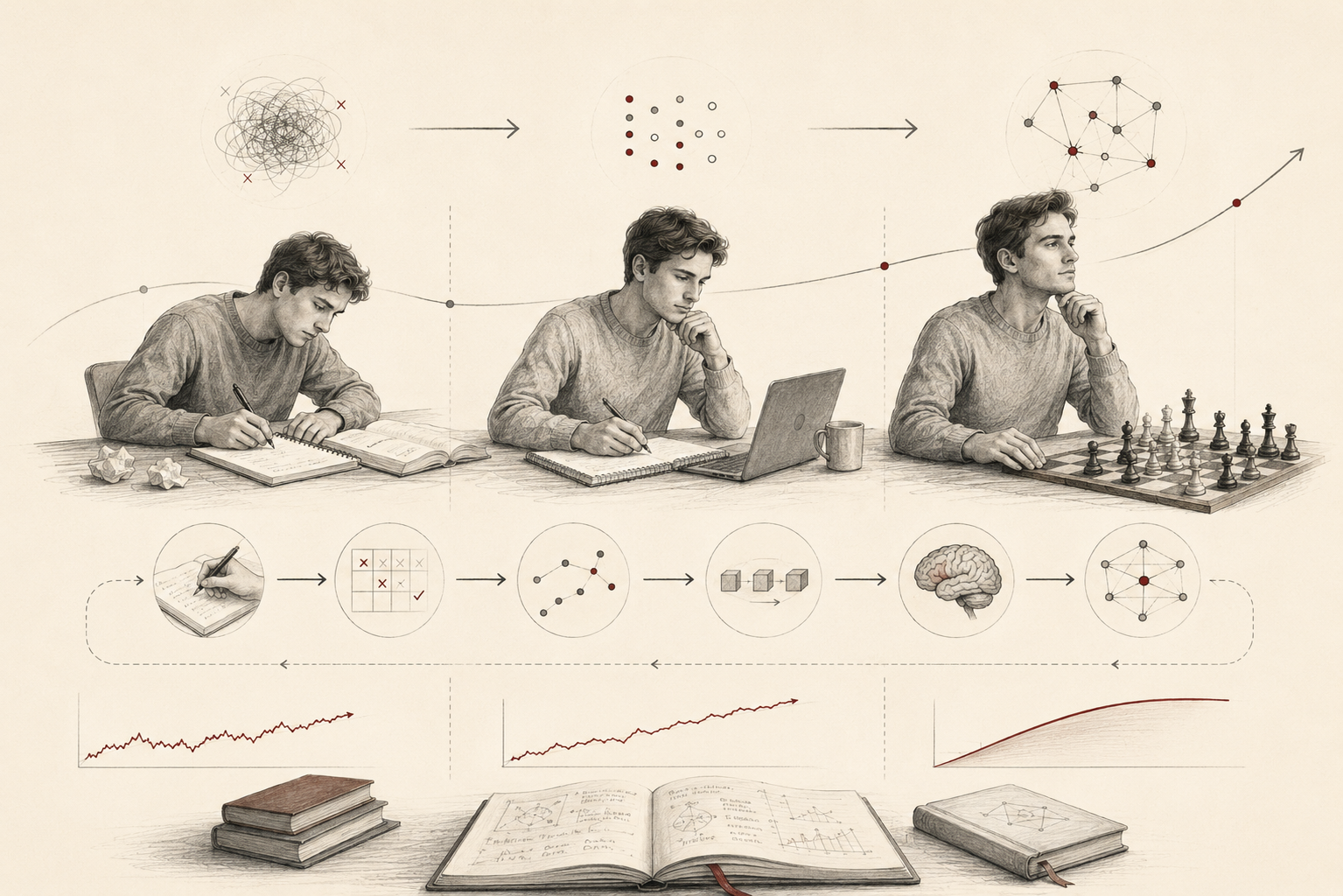
This transformation is one of the central topics in cognitive science, education, human performance, training design, and expertise research because it helps explain how novices become competent, how competence becomes fluency, and how fluency sometimes becomes expertise. It also helps explain why skill is rarely a matter of information alone. What matters is how knowledge is organized, practiced, evaluated, corrected, and made available for action under real conditions of time, pressure, uncertainty, and change.
The nature of skill acquisition
Skill acquisition involves the gradual transformation of knowledge into performance. Early in learning, individuals often rely heavily on explicit rules, conscious monitoring, verbal instructions, worked examples, and working memory. Performance is slow, effortful, and vulnerable to error because each step must be actively managed.
With practice, however, the structure of performance changes. Actions become more coordinated, patterns become easier to recognize, errors become more diagnostic, and decisions can be made with less conscious effort. This does not mean cognition disappears. It means cognition becomes more efficient. Processes that once required active control can become faster, more stable, and more deeply integrated into larger routines.
Skill acquisition is therefore best understood as a reorganization of cognitive processing rather than the simple repetition of behavior. Learning changes the architecture of performance itself. Knowledge becomes easier to retrieve, procedures become more coordinated, perceptual cues become more meaningful, and attention can shift from low-level execution to higher-level monitoring, strategy, and adaptation.
This distinction matters because a person can possess information without being skilled. Someone may know the rules of chess without seeing a position well. A student may know a formula without knowing when to use it. A clinician may know diagnostic categories without yet recognizing subtle patterns in practice. A programmer may know syntax without being able to design robust systems. Skill acquisition explains how knowledge becomes usable under task demands.
Skill also develops in relation to context. A skill is not merely something inside the individual. It is shaped by task structure, tools, instruction, feedback, social norms, practice opportunities, assessment conditions, and the environment in which performance is expected. Expertise is therefore cognitive, embodied, social, and institutional at the same time.
Stages of skill acquisition
Research on skill acquisition often describes development as progressing through stages. One influential framework identifies three broad phases: cognitive, associative, and autonomous. These stages are useful not because every skill unfolds in exactly the same way, but because they capture a recurring pattern in human performance: explicit control tends to give way to more integrated execution over time.
- Cognitive stage — the learner acquires rules, instructions, vocabulary, procedures, and basic task representations.
- Associative stage — performance becomes more consistent as errors are reduced, feedback is incorporated, and relations among actions become stronger.
- Autonomous stage — the skill becomes relatively automatic and requires less conscious attention during routine execution.
During the cognitive stage, performance is often slow because the learner is still trying to understand what to do and in what order. The task may feel fragmented. Each step competes for working-memory resources. Errors are common, and feedback may be difficult to interpret because the learner does not yet know which cues matter.
During the associative stage, performance becomes more stable. The learner begins to connect cues with actions, actions with outcomes, and errors with corrections. Feedback becomes more meaningful because the learner has enough structure to use it. Repetition begins to refine timing, sequence, discrimination, and response selection.
During the autonomous stage, the skill can often be executed with far less working-memory demand, allowing attention to shift toward higher-level strategy, adaptation, monitoring, or environmental change. This is why skilled performance can look effortless from the outside. Much of the visible fluency rests on prior cognitive organization.
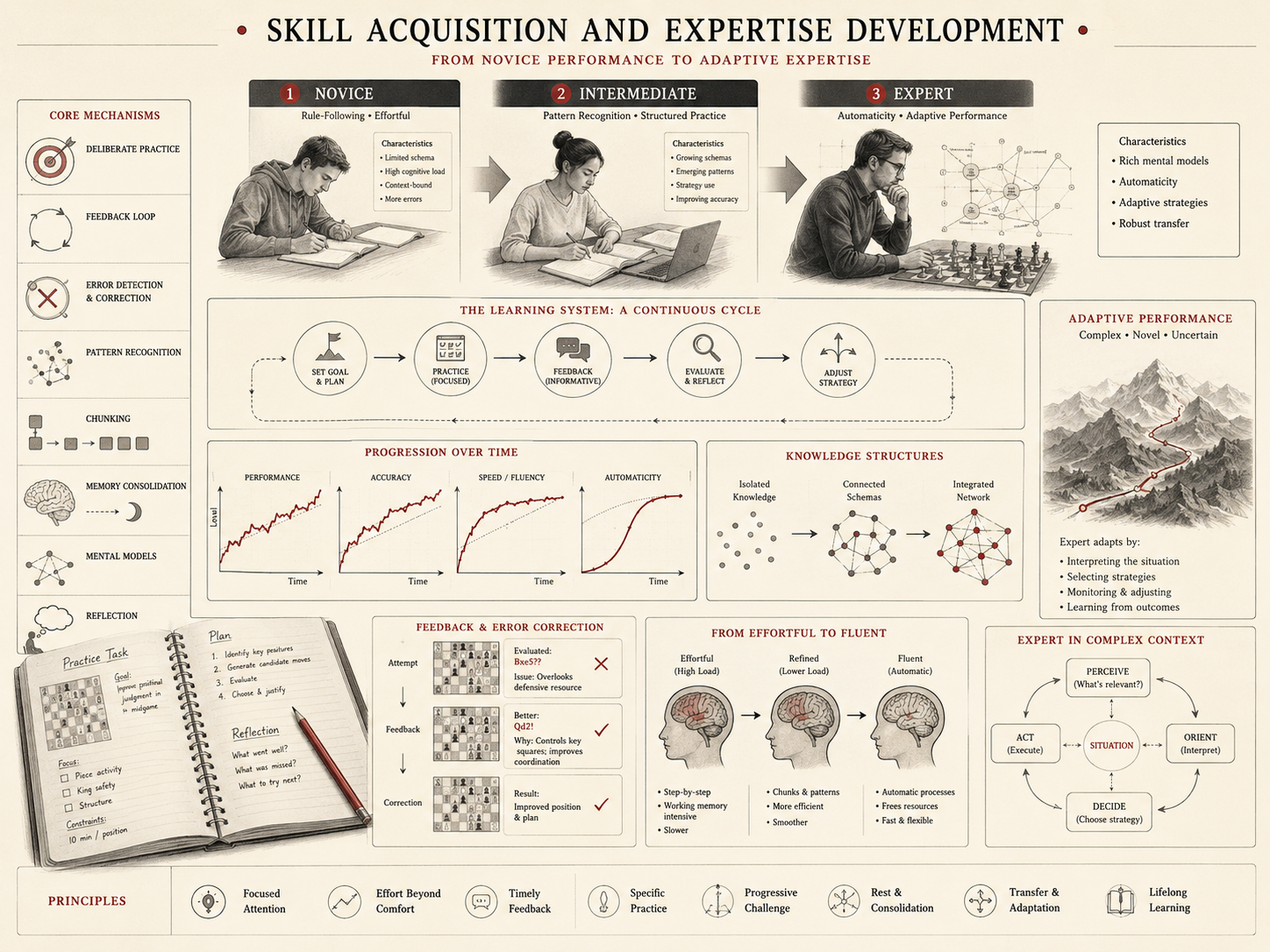
Other stage models, including the Dreyfus model, emphasize movement from rule-based novice performance toward more contextual, intuitive, and adaptive forms of expertise. These frameworks differ in detail, but they share a common insight: expertise changes how the performer perceives the task. The expert does not simply apply more rules. The expert often sees a different structure.
Formalizing skill acquisition: performance, practice, and error reduction
Skill acquisition can be represented formally as a process in which performance improves as practice accumulates, feedback becomes usable, and error is reduced. Let performance level at practice instance \(t\) be \(P_t\). A simple learning update can be written as:
P_{t+1} = P_t + \alpha(L_t – E_t)
\]
Interpretation: Performance at the next practice instance depends on current performance \(P_t\), learning gain \(L_t\), remaining error or inefficiency \(E_t\), and a learning-rate parameter \(\alpha\).
This captures a basic point: learning is not just repetition. Improvement depends on how practice interacts with remaining error. Repeating an already comfortable action may stabilize routine performance, but difficult improvement requires practice that exposes error, supports correction, and strengthens better patterns.
Error reduction can be expressed in simplified decay form:
E_t = E_0e^{-\lambda t}
\]
Interpretation: Error \(E_t\) declines from initial error \(E_0\) as practice accumulates, with \(\lambda\) representing the rate of improvement.
Many learning curves show rapid early gains followed by slower improvement. A related performance curve can be expressed as:
P_t = P_{\max} – A e^{-\lambda t}
\]
Interpretation: Performance approaches an upper limit \(P_{\max}\), while the remaining gap \(A\) shrinks with practice.
Response time often declines with practice. A simplified power-law relation can be written as:
RT_t = a t^{-b} + c
\]
Interpretation: Response time \(RT_t\) declines as practice \(t\) increases, approaching an asymptotic lower bound \(c\).
One can also describe the transition from controlled to more automatic performance as a redistribution of cognitive cost:
C_t = C_w + C_s
\]
Interpretation: Total task cost \(C_t\) can be separated into working-memory demand \(C_w\) and stable skill-execution cost \(C_s\). As expertise develops, \(C_w\) often decreases because less conscious control is required.
These formalizations are simplified, but they help make skill acquisition measurable. Researchers can study learning curves, error rates, response-time changes, feedback effects, transfer performance, and automaticity rather than treating expertise as a vague label.
The role of practice and feedback
Practice is essential for skill acquisition, but not all practice produces expertise. Repetition alone may stabilize habits, including poor habits. Expertise usually depends on practice that is structured, specific, challenging, and informed by feedback.
Practice helps because it gives the learner repeated opportunities to link perception, action, error, correction, and outcome. Over time, these links become more stable. The learner discovers which cues are relevant, which steps can be combined, which errors recur, and which strategies work under different conditions.
Feedback is especially important because it allows the learner to refine internal representations, detect mismatch between intended and actual performance, and revise strategy accordingly. Without feedback, repeated effort may create fluency without accuracy. A learner may become faster at doing the wrong thing.
Effective feedback is usually:
- timely, arriving close enough to performance to be useful;
- specific, identifying what improved or failed;
- interpretable, understandable at the learner’s current level;
- actionable, pointing toward what can be changed next;
- calibrated, challenging the learner without overwhelming them;
- connected to goals, showing how local correction supports larger performance.
This process connects closely to mental models. Improving performance often requires improving the internal representation that guides action. Feedback is most useful when it helps the learner see the task differently, not merely when it reports success or failure.
Practice and feedback therefore work together. Practice generates experience; feedback gives experience direction.
Deliberate practice and its limits
The deliberate-practice tradition emphasizes that expert performance depends on sustained, effortful, goal-directed practice designed to improve specific aspects of performance. Deliberate practice is not simply time on task. It is structured work on weaknesses, often guided by teachers, coaches, mentors, metrics, or feedback systems.
Deliberate practice typically includes:
- clear performance goals;
- focused repetition of specific components;
- tasks just beyond current comfort;
- timely and informative feedback;
- reflection on error;
- revision of strategy;
- sustained effort over long periods;
- progressive difficulty as competence grows.
This tradition remains important because it challenges the idea that expertise is simply talent or passive experience. It foregrounds the quality of training and the structure of improvement. Someone may accumulate years of routine activity without developing expertise if the activity does not expose error, require adjustment, or push performance beyond established habits.
At the same time, contemporary research has also challenged overly simple versions of deliberate-practice theory. Meta-analytic work suggests that deliberate practice explains meaningful but incomplete variance in performance across domains. Practice matters, but it is not the only factor. Cognitive ability, age of start, access to coaching, motivation, health, social support, opportunity, task ecology, institutional selection, and domain constraints also shape outcomes.
The strongest interpretation is therefore balanced: deliberate practice is one of the most important mechanisms of expertise development, but expertise cannot be reduced to practice hours alone. Skill acquisition is a system, not a stopwatch.
Memory and knowledge organization
Expertise is supported by highly structured knowledge in long-term memory. Experts do not merely know more facts than novices. They organize information into meaningful patterns, allowing them to recognize relevant features quickly and retrieve appropriate responses with less effort.
This organization reduces the burden placed on working memory. Instead of processing each element in isolation, experts rely on chunked representations that encode complex information efficiently. A chess expert sees structured positions rather than scattered pieces. A clinician sees diagnostic patterns rather than isolated symptoms. An engineer sees system constraints rather than disconnected parts. A musician hears harmonic movement rather than unrelated notes.
What looks effortless from the outside is often the result of deep structure built slowly through repeated exposure, retrieval, feedback, and refinement. Experts can sometimes respond quickly not because they are skipping cognition, but because much of the relevant cognitive structure has already been organized.
This is why skill acquisition is closely tied to memory and cognitive load. As knowledge becomes better organized, less effort is needed to coordinate performance in real time. Reduced cognitive load can then free attention for higher-level monitoring, adaptation, communication, or strategic choice.
Memory organization also explains why expert performance is domain-specific. Expertise depends on knowledge structures built within a domain. A person may be expert in surgery but not chess, music but not law, programming but not medicine. The structure matters, and the structure is learned.
Pattern recognition and expertise
One of the defining features of expertise is rapid pattern recognition. Experts in domains such as chess, medicine, engineering, music, law, sports, aviation, and emergency response often notice meaningful structures that novices miss or process only slowly.
This ability reflects accumulated domain-specific knowledge. Through repeated experience, experts develop representations that allow them to interpret complex information quickly and often with less overt deliberation. Pattern recognition reduces the need for exhaustive analytical comparison, enabling faster and often more accurate decisions in familiar domains.
What matters here is not speed alone, but the structured basis of that speed. Expert intuition is not magic. It is usually the expression of prior learning that has become deeply organized and rapidly accessible. A pattern is not merely seen; it is recognized as meaningful because the expert has learned what it tends to imply.
However, expert pattern recognition has limits. It works best in environments where cues are valid, feedback is reliable, and repeated experience has allowed meaningful learning. In noisy, deceptive, politicized, or rapidly changing environments, familiar patterns may mislead. What feels like intuition may be overfitting to the past.
For that reason, expertise requires both recognition and reflection. Experts must know when pattern recognition is reliable and when the situation demands slower analysis, consultation, testing, or reframing.
Skill acquisition and problem solving
As expertise develops, individuals often become more effective problem solvers. Instead of relying primarily on general-purpose strategies, they use domain-specific knowledge structures to identify more efficient solution paths.
This reflects a shift from solving every problem from the ground up toward recognizing classes of problems and bringing relevant structures to bear. Engineers, clinicians, analysts, programmers, scientists, musicians, athletes, and craftspeople often reason in this way. Their performance depends not only on abstract intelligence, but on the quality and accessibility of the representations they have built within a domain.
Expert problem solving often differs from novice problem solving in several ways:
- Experts identify deep structure rather than only surface features.
- Experts retrieve relevant schemas faster.
- Experts notice constraints and anomalies earlier.
- Experts have richer repertoires of strategies.
- Experts use feedback more selectively.
- Experts can often predict likely failure points.
- Experts are better at deciding when routine procedures are insufficient.
Novices often focus on visible features or recently learned rules. Experts can often classify a problem by underlying structure. This allows them to reduce search, avoid irrelevant paths, and allocate attention to the parts of the problem that are most likely to matter.
These processes connect directly to broader research on reasoning, mental models, and problem solving, where the interaction between knowledge and strategy is especially important.
Expertise and cognitive efficiency
Expert performance is typically marked by greater efficiency. Experts often process information more quickly, make fewer avoidable errors, and allocate cognitive resources more effectively than novices. This efficiency results from the integration of knowledge structures, partially automated routines, and refined internal models.
Efficiency can appear in several ways:
- faster recognition of relevant cues;
- lower working-memory demand for routine components;
- fewer unnecessary actions;
- better error detection;
- more efficient search through possible solutions;
- more selective use of attention;
- faster recovery from small disruptions;
- better coordination between perception and action.
Importantly, efficiency is not the same as mindlessness. In well-learned routines, some components may become automatic. But high-level expertise often involves knowing when to interrupt automaticity. The expert can rely on routine when the situation is stable, but must re-engage reflective control when the situation changes.
This distinction is especially important in high-stakes domains. A clinician, pilot, engineer, lawyer, or emergency responder may need automatic fluency for routine operations and reflective flexibility for anomalies. Expertise is strongest when automaticity and judgment are integrated rather than opposed.
For that reason, expertise should be understood not as a generic trait but as the outcome of domain-bound cognitive development. It is efficient because it is structured, and it is powerful because that structure can be adapted.
Adaptive expertise and transfer
Routine expertise allows skilled performance in familiar conditions. Adaptive expertise allows skilled performance when conditions change. This distinction is essential because many real-world domains require transfer, interpretation, and adjustment rather than repetition alone.
A person with routine expertise may perform familiar procedures efficiently but struggle when a new context violates expectation. A person with adaptive expertise can recognize when a familiar procedure no longer fits and can modify strategy accordingly. Adaptive expertise therefore depends on deeper conceptual understanding, flexible mental models, reflective monitoring, and exposure to varied cases.
Transfer is a key test of skill acquisition. If learning remains tied to the original practice conditions, then performance may not generalize. A student may solve familiar textbook problems but fail on novel applications. A trainee may perform well in simulation but struggle in the field. A professional may master routine cases but fail when the case crosses boundaries.
Training for transfer often requires:
- varied examples;
- boundary cases;
- explanation, not only repetition;
- feedback on underlying principles;
- practice under changing constraints;
- comparison across cases;
- reflection on when a strategy does and does not apply.
Adaptive expertise matters because the world does not remain still for experts. Skill must be stable enough to support performance and flexible enough to survive change.
Metacognition, reflection, and self-correction
Skill acquisition depends not only on practice and feedback, but also on metacognition. Learners must monitor performance, judge whether a strategy is working, detect error, interpret feedback, and decide what to change next.
This is especially important because practice can produce illusions of competence. Familiar tasks can feel mastered before they are transferable. Smooth repetition can hide weak understanding. Confidence can rise faster than accuracy. Metacognition helps interrupt these illusions by asking whether performance is actually improving and whether the skill can survive changed conditions.
Metacognitive skill supports expertise by helping learners ask:
- What exactly is improving?
- What errors keep recurring?
- What feedback am I ignoring?
- Can I perform this under pressure?
- Can I transfer this to a new case?
- Am I practicing what matters or only what feels comfortable?
- Has my confidence become better calibrated to my performance?
Experts also need metacognition. They must know when routine recognition is reliable and when a situation demands slower analysis. They must distinguish genuine pattern recognition from premature closure. They must preserve the capacity to learn after becoming skilled.
Expertise without reflection can become rigidity. Skill acquisition is strongest when feedback, practice, and metacognition work together.
Training environments, access, and institutional conditions
Skill acquisition is often described as an individual process, but expertise develops within environments. Access to coaching, tools, time, feedback, psychological safety, high-quality instruction, practice opportunities, and material support shapes who gets to develop skill and whose expertise is recognized.
This matters because expertise is not distributed only by effort or ability. It is also distributed by opportunity. Some learners receive structured feedback, mentorship, and safe conditions for error correction. Others are left with vague criticism, unstable resources, overloaded schedules, or punitive environments that make learning harder.
Institutions shape skill acquisition by determining:
- who receives training;
- which skills are valued;
- what counts as evidence of expertise;
- who is allowed to make mistakes while learning;
- who receives useful feedback;
- whose performance is evaluated generously or harshly;
- which forms of knowledge are treated as legitimate.
A serious account of expertise must therefore include power, access, and recognition. Many forms of skill are marginalized because they are associated with undervalued labor, communities, languages, crafts, care work, or non-elite institutions. Expertise is not only a cognitive achievement. It is also a social category that institutions can recognize or deny.
Training systems should therefore be evaluated not only by whether they produce high performers, but by whether they create fair, humane, and accessible pathways for skill development.
Skill acquisition and artificial intelligence systems
Artificial intelligence creates new contexts for skill acquisition. AI systems can support learning by providing examples, feedback, simulation, tutoring, coding assistance, diagnostic prompts, and performance summaries. They can also weaken skill acquisition if they encourage passive dependence, hide errors, remove productive struggle, or allow users to bypass the practice needed to build internal competence.
The central issue is not whether AI makes a task faster. The deeper question is whether AI helps the learner build durable skill. A tool that produces an answer may improve immediate output but reduce learning if the user never practices the underlying process. A tool that gives targeted feedback, asks good questions, exposes reasoning, and supports transfer may strengthen skill development.
Human-AI skill development should therefore be evaluated through questions such as:
- Does the tool improve durable performance or only immediate output?
- Does the learner understand the process better after using it?
- Does it provide feedback that supports correction?
- Does it preserve opportunities for retrieval, explanation, and transfer?
- Does it calibrate confidence or inflate it?
- Does it make expertise more accessible or concentrate it further?
AI also provides useful analogies for cognitive psychology. Machine-learning systems improve through exposure, feedback, optimization, and representation learning. Human skill acquisition is not the same process, but both biological and artificial systems face the problem of improving performance through interaction with tasks and environments.
The future of skill acquisition will likely depend on whether AI is designed as a substitute for learning or as an infrastructure for deeper practice, feedback, and adaptive expertise.
Skill acquisition in contemporary research
Modern research on skill acquisition integrates cognitive psychology, neuroscience, educational theory, expertise research, human factors, sports science, medical education, artificial intelligence, and workplace learning. Anderson’s classic work on cognitive skill acquisition remains important because it framed the transition from declarative knowledge to procedural performance in explicit theoretical terms.
Research on expertise also continues to draw on the deliberate-practice tradition associated with Ericsson and colleagues, while also incorporating later debates about how much variance in expert performance deliberate practice alone can explain. The broader significance remains clear: skill is shaped by sustained practice, feedback, and structured refinement rather than passive exposure alone.
Contemporary research also examines expert-novice differences, transfer, retention, perceptual learning, cognitive load, learning analytics, simulation training, adaptive tutoring systems, and AI-supported feedback. The field increasingly recognizes that expertise is multidimensional. It includes knowledge organization, perception, action, monitoring, flexibility, motivation, environmental support, and institutional opportunity.
In artificial intelligence, analogous ideas appear in reinforcement learning, representation learning, feedback-based optimization, and pattern-based performance improvement. The analogy is imperfect, but useful because both human and artificial systems confront the problem of improving performance through repeated interaction with tasks, environments, feedback, and constraints.
The strongest contemporary view is therefore systemic: expertise develops through practice, but practice works through feedback, representation, motivation, cognition, social support, and opportunity.
R code for skill acquisition data
The following R workflow illustrates analyses relevant to skill acquisition and expertise, including learning curves, error reduction, feedback effects, deliberate-practice quality, transfer, automaticity, retention, and novice-expert differences.
# Install packages if needed:
# pak::pak(c("tidyverse", "lme4", "lmerTest", "emmeans", "broom.mixed"))

library(tidyverse)
library(lme4)
library(lmerTest)
library(emmeans)
library(broom.mixed)

# Expected columns:
# participant, expertise_level, condition, domain, session, task_id,
# practice_hours, deliberate_practice_quality, feedback_quality,
# task_difficulty, cognitive_load, working_memory_demand,
# chunking_score, pattern_recognition_score, strategy_quality,
# transfer_score, adaptive_flexibility, accuracy, error_rate,
# response_time_ms, automaticity_score, retention_score

dat <- read_csv("skill_acquisition_trials.csv") %>%
  mutate(
    participant = factor(participant),
    expertise_level = factor(
      expertise_level,
      levels = c("novice", "intermediate", "advanced", "expert")
    ),
    condition = factor(condition),
    domain = factor(domain),
    task_id = factor(task_id),
    log_response_time = log(response_time_ms)
  )

# -----------------------------
# 1. Learning curve
# -----------------------------

learning_curve <- dat %>%
  group_by(expertise_level, session) %>%
  summarise(
    mean_accuracy = mean(accuracy, na.rm = TRUE),
    mean_error_rate = mean(error_rate, na.rm = TRUE),
    mean_response_time_ms = mean(response_time_ms, na.rm = TRUE),
    mean_automaticity = mean(automaticity_score, na.rm = TRUE),
    .groups = "drop"
  )

ggplot(learning_curve, aes(x = session, y = mean_accuracy, color = expertise_level)) +
  geom_point() +
  geom_line() +
  labs(
    title = "Skill acquisition across practice sessions",
    x = "Practice session",
    y = "Mean accuracy"
  ) +
  theme_minimal()

# -----------------------------
# 2. Accuracy growth model
# -----------------------------

accuracy_model <- lmer(
  accuracy ~
    session * expertise_level +
    condition +
    domain +
    deliberate_practice_quality +
    feedback_quality +
    task_difficulty +
    chunking_score +
    pattern_recognition_score +
    strategy_quality +
    cognitive_load +
    (1 + session | participant) +
    (1 | task_id),
  data = dat,
  REML = FALSE
)

summary(accuracy_model)
emmeans(accuracy_model, ~ expertise_level)

# -----------------------------
# 3. Error reduction model
# -----------------------------

error_model <- lmer(
  error_rate ~
    session * expertise_level +
    condition +
    domain +
    deliberate_practice_quality +
    feedback_quality +
    task_difficulty +
    cognitive_load +
    (1 + session | participant) +
    (1 | task_id),
  data = dat,
  REML = FALSE
)

summary(error_model)

# -----------------------------
# 4. Response-time model
# -----------------------------

rt_model <- lmer(
  log_response_time ~
    session * expertise_level +
    condition +
    domain +
    accuracy +
    task_difficulty +
    cognitive_load +
    working_memory_demand +
    chunking_score +
    pattern_recognition_score +
    (1 + session | participant) +
    (1 | task_id),
  data = dat,
  REML = FALSE
)

summary(rt_model)

# -----------------------------
# 5. Transfer model
# -----------------------------

transfer_model <- lmer(
  transfer_score ~
    session +
    expertise_level +
    condition +
    domain +
    deliberate_practice_quality +
    feedback_quality +
    strategy_quality +
    pattern_recognition_score +
    adaptive_flexibility +
    accuracy +
    (1 | participant) +
    (1 | task_id),
  data = dat,
  REML = FALSE
)

summary(transfer_model)
emmeans(transfer_model, ~ condition)

# -----------------------------
# 6. Automaticity model
# -----------------------------

automaticity_model <- lmer(
  automaticity_score ~
    session +
    expertise_level +
    condition +
    accuracy +
    chunking_score +
    pattern_recognition_score +
    cognitive_load +
    working_memory_demand +
    (1 | participant) +
    (1 | task_id),
  data = dat,
  REML = FALSE
)

summary(automaticity_model)

# -----------------------------
# 7. Retention model
# -----------------------------

retention_model <- lmer(
  retention_score ~
    session +
    expertise_level +
    condition +
    deliberate_practice_quality +
    feedback_quality +
    chunking_score +
    accuracy +
    cognitive_load +
    (1 | participant) +
    (1 | task_id),
  data = dat,
  REML = FALSE
)

summary(retention_model)

# -----------------------------
# 8. Export model coefficients
# -----------------------------

model_coefficients <- bind_rows(
  tidy(accuracy_model, effects = "fixed", conf.int = TRUE) %>%
    mutate(model = "accuracy"),
  tidy(error_model, effects = "fixed", conf.int = TRUE) %>%
    mutate(model = "error"),
  tidy(rt_model, effects = "fixed", conf.int = TRUE) %>%
    mutate(model = "response_time"),
  tidy(transfer_model, effects = "fixed", conf.int = TRUE) %>%
    mutate(model = "transfer"),
  tidy(automaticity_model, effects = "fixed", conf.int = TRUE) %>%
    mutate(model = "automaticity"),
  tidy(retention_model, effects = "fixed", conf.int = TRUE) %>%
    mutate(model = "retention")
)

write_csv(model_coefficients, "skill_acquisition_model_coefficients.csv")
This workflow can be adapted for longitudinal learning-curve studies, deliberate-practice interventions, novice-expert comparisons, transfer tasks, retention studies, simulation-based training, medical education, engineering education, sports training, music performance, HCI skill learning, and human-AI coaching systems. Researchers should model participant and task effects whenever possible because learning trajectories vary across people, domains, tasks, feedback systems, and practice conditions.
Python code for skill acquisition data
The Python examples below parallel the R workflow and are useful for learning trajectories, deliberate-practice studies, novice-expert comparisons, transfer research, retention modeling, and automaticity analysis.
import numpy as np
import pandas as pd
import statsmodels.formula.api as smf
import matplotlib.pyplot as plt

# Expected columns:
# participant, expertise_level, condition, domain, session, task_id,
# practice_hours, deliberate_practice_quality, feedback_quality,
# task_difficulty, cognitive_load, working_memory_demand,
# chunking_score, pattern_recognition_score, strategy_quality,
# transfer_score, adaptive_flexibility, accuracy, error_rate,
# response_time_ms, automaticity_score, retention_score

df = pd.read_csv("skill_acquisition_trials.csv")

categorical_cols = [
    "participant",
    "expertise_level",
    "condition",
    "domain",
    "task_id"
]

for col in categorical_cols:
    df[col] = df[col].astype("category")

df["log_response_time"] = np.log(df["response_time_ms"])

# -----------------------------
# 1. Learning curve
# -----------------------------

learning_curve = (
    df.groupby(["expertise_level", "session"], observed=True)
    .agg(
        mean_accuracy=("accuracy", "mean"),
        mean_error_rate=("error_rate", "mean"),
        mean_response_time_ms=("response_time_ms", "mean"),
        mean_automaticity=("automaticity_score", "mean"),
    )
    .reset_index()
)

fig, ax = plt.subplots(figsize=(8, 5))

for level, group in learning_curve.groupby("expertise_level", observed=True):
    ax.plot(group["session"], group["mean_accuracy"], marker="o", label=str(level))

ax.set_xlabel("Practice session")
ax.set_ylabel("Mean accuracy")
ax.set_title("Skill acquisition across practice sessions")
ax.legend(title="Expertise level")
plt.tight_layout()
plt.show()

# -----------------------------
# 2. Accuracy growth model
# -----------------------------

accuracy_model = smf.ols(
    "accuracy ~ session * expertise_level + condition + domain "
    "+ deliberate_practice_quality + feedback_quality + task_difficulty "
    "+ chunking_score + pattern_recognition_score + strategy_quality "
    "+ cognitive_load",
    data=df,
)

accuracy_result = accuracy_model.fit(
    cov_type="cluster",
    cov_kwds={"groups": df["participant"]},
)

print(accuracy_result.summary())

# -----------------------------
# 3. Error reduction model
# -----------------------------

error_model = smf.ols(
    "error_rate ~ session * expertise_level + condition + domain "
    "+ deliberate_practice_quality + feedback_quality + task_difficulty "
    "+ cognitive_load",
    data=df,
)

error_result = error_model.fit(
    cov_type="cluster",
    cov_kwds={"groups": df["participant"]},
)

print(error_result.summary())

# -----------------------------
# 4. Response-time model
# -----------------------------

response_time_model = smf.ols(
    "log_response_time ~ session * expertise_level + condition + domain "
    "+ accuracy + task_difficulty + cognitive_load + working_memory_demand "
    "+ chunking_score + pattern_recognition_score",
    data=df,
)

response_time_result = response_time_model.fit(
    cov_type="cluster",
    cov_kwds={"groups": df["participant"]},
)

print(response_time_result.summary())

# -----------------------------
# 5. Transfer model
# -----------------------------

transfer_model = smf.ols(
    "transfer_score ~ session + expertise_level + condition + domain "
    "+ deliberate_practice_quality + feedback_quality + strategy_quality "
    "+ pattern_recognition_score + adaptive_flexibility + accuracy",
    data=df,
)

transfer_result = transfer_model.fit(
    cov_type="cluster",
    cov_kwds={"groups": df["participant"]},
)

print(transfer_result.summary())

# -----------------------------
# 6. Automaticity model
# -----------------------------

automaticity_model = smf.ols(
    "automaticity_score ~ session + expertise_level + condition "
    "+ accuracy + chunking_score + pattern_recognition_score "
    "+ cognitive_load + working_memory_demand",
    data=df,
)

automaticity_result = automaticity_model.fit(
    cov_type="cluster",
    cov_kwds={"groups": df["participant"]},
)

print(automaticity_result.summary())

# -----------------------------
# 7. Retention model
# -----------------------------

retention_model = smf.ols(
    "retention_score ~ session + expertise_level + condition "
    "+ deliberate_practice_quality + feedback_quality + chunking_score "
    "+ accuracy + cognitive_load",
    data=df,
)

retention_result = retention_model.fit(
    cov_type="cluster",
    cov_kwds={"groups": df["participant"]},
)

print(retention_result.summary())

# -----------------------------
# 8. Export summaries
# -----------------------------

condition_summary = (
    df.groupby("condition", observed=True)
    .agg(
        n_trials=("accuracy", "size"),
        mean_accuracy=("accuracy", "mean"),
        mean_error_rate=("error_rate", "mean"),
        mean_response_time_ms=("response_time_ms", "mean"),
        mean_transfer=("transfer_score", "mean"),
        mean_automaticity=("automaticity_score", "mean"),
        mean_retention=("retention_score", "mean"),
    )
    .reset_index()
)

condition_summary.to_csv("skill_acquisition_condition_summary.csv", index=False)
The Python workflow is intentionally transparent and extensible. It can be expanded with nonlinear learning-curve models, Bayesian hierarchical models, power-law practice curves, drift-diffusion models, retention-delay functions, adaptive tutoring logs, simulation-training data, human-AI feedback systems, or dashboards for tracking practice quality and transfer.
GitHub Repository
The companion repository provides reusable code and research scaffolding for studying skill acquisition and expertise development in cognitive psychology, including workflows for learning curves, deliberate practice, feedback quality, error reduction, cognitive load, response time, automaticity, transfer, retention, adaptive expertise, and novice-expert differences.
Complete Code Repository
Access the full companion repository for this article, including reproducible analysis materials and multi-language code workflows for skill-acquisition and expertise-development research.
Applications of skill acquisition research
Skill-acquisition research matters across education, professional training, sports, music, medicine, engineering, law, aviation, emergency response, human-computer interaction, workplace learning, and artificial intelligence. It helps explain how practice should be structured, why feedback matters, how errors become informative, and how experts differ from novices not only in what they know but in how they perceive, organize, and act on information.
In education, skill-acquisition research helps design practice that moves beyond passive exposure. Students need examples, retrieval, correction, feedback, transfer tasks, and opportunities to explain why a procedure works. In professional training, it helps distinguish routine competence from adaptive expertise. In medicine, aviation, engineering, and emergency response, it supports simulation, debriefing, and scenario-based practice.
In human-computer interaction, skill acquisition matters because interface design can either support learning or hide it. A well-designed interface can scaffold novices while allowing experts to build efficient routines. A poorly designed interface can increase cognitive load, interrupt feedback, and prevent skill from stabilizing.
In AI-supported work, skill acquisition raises a central design question: does the system merely produce outputs, or does it help users become more capable? A tool that gives answers may improve speed while weakening internal competence. A tool that gives targeted feedback, supports reflection, and preserves practice may improve both performance and learning.
These applications matter because performance is rarely improved by knowledge alone. What matters is whether knowledge can be stabilized, retrieved, refined, transferred, and converted into reliable action under real conditions.
Conclusion
Skill acquisition and expertise development describe the processes through which knowledge becomes performance. Through practice, feedback, memory organization, metacognitive reflection, and repeated refinement, effortful and explicit processing can become more efficient, integrated, flexible, and adaptable.
Cognitive psychology shows that expertise is not simply more information or greater effort. It is the development of structured knowledge, rapid pattern recognition, calibrated judgment, efficient control, and adaptive performance within a domain. Understanding skill acquisition therefore helps explain how minds move from novice effort to expert fluency.
The central lesson is that skill is built, not merely possessed. Expertise emerges when knowledge is organized through practice, corrected through feedback, stabilized through memory, sharpened through pattern recognition, and kept flexible through reflection and transfer.
Related articles
- Cognitive Psychology
- Cognitive Learning Processes
- Metacognition: Thinking About Thinking
- Memory in Cognitive Psychology
- Working Memory in Cognitive Psychology
- Cognitive Load and Information Processing
- Problem Solving in Cognitive Psychology
- Decision Making in Cognitive Psychology
- Mental Models in Cognitive Psychology
Further reading
- Anderson, J.R. (1982) ‘Acquisition of cognitive skill’, Psychological Review, 89(4), pp. 369–406. Record available at: https://eric.ed.gov/?id=EJ270567.
- Chi, M.T.H., Glaser, R. and Farr, M.J. (eds.) (1988) The Nature of Expertise. New York: Psychology Press. Available at: https://www.taylorfrancis.com/books/edit/10.4324/9781315799681/nature-expertise-michelene-chi-robert-glaser-marshall-farr.
- Dreyfus, S.E. (2004) ‘The five-stage model of adult skill acquisition’, Bulletin of Science, Technology & Society, 24(3), pp. 177–181. Available at: https://www.bumc.bu.edu/facdev-medicine/files/2012/03/Dreyfus-skill-level.pdf.
- Ericsson, K.A. (2008) ‘Deliberate practice and acquisition of expert performance: A general overview’, Academic Emergency Medicine, 15(11), pp. 988–994. Available at: https://pubmed.ncbi.nlm.nih.gov/18778378/.
- Ericsson, K.A., Krampe, R.T. and Tesch-Römer, C. (1993) ‘The role of deliberate practice in the acquisition of expert performance’, Psychological Review, 100(3), pp. 363–406. DOI: https://doi.org/10.1037/0033-295X.100.3.363.
- Macnamara, B.N., Hambrick, D.Z. and Oswald, F.L. (2014) ‘Deliberate practice and performance in music, games, sports, education, and professions: A meta-analysis’, Psychological Science, 25(8), pp. 1608–1618. Available at: https://pubmed.ncbi.nlm.nih.gov/24986855/.
- Pavese, C. (2021) ‘Knowledge how’, Stanford Encyclopedia of Philosophy. Available at: https://plato.stanford.edu/entries/knowledge-how/.
References
- Anderson, J.R. (1982) ‘Acquisition of cognitive skill’, Psychological Review, 89(4), pp. 369–406. Record available at: https://eric.ed.gov/?id=EJ270567.
- Chi, M.T.H., Glaser, R. and Farr, M.J. (eds.) (1988) The Nature of Expertise. New York: Psychology Press. Available at: https://www.taylorfrancis.com/books/edit/10.4324/9781315799681/nature-expertise-michelene-chi-robert-glaser-marshall-farr.
- Dreyfus, S.E. (2004) ‘The five-stage model of adult skill acquisition’, Bulletin of Science, Technology & Society, 24(3), pp. 177–181. Available at: https://www.bumc.bu.edu/facdev-medicine/files/2012/03/Dreyfus-skill-level.pdf.
- Ericsson, K.A. (2008) ‘Deliberate practice and acquisition of expert performance: A general overview’, Academic Emergency Medicine, 15(11), pp. 988–994. Available at: https://pubmed.ncbi.nlm.nih.gov/18778378/.
- Ericsson, K.A., Krampe, R.T. and Tesch-Römer, C. (1993) ‘The role of deliberate practice in the acquisition of expert performance’, Psychological Review, 100(3), pp. 363–406. DOI: https://doi.org/10.1037/0033-295X.100.3.363.
- Macnamara, B.N., Hambrick, D.Z. and Oswald, F.L. (2014) ‘Deliberate practice and performance in music, games, sports, education, and professions: A meta-analysis’, Psychological Science, 25(8), pp. 1608–1618. Available at: https://pubmed.ncbi.nlm.nih.gov/24986855/.
- Pavese, C. (2021) ‘Knowledge how’, Stanford Encyclopedia of Philosophy. Available at: https://plato.stanford.edu/entries/knowledge-how/.