
Last Updated May 20, 2026
Working memory is the limited-capacity cognitive system that temporarily maintains, updates, protects, and manipulates information during ongoing thought. Unlike long-term memory, which preserves knowledge across extended time, working memory operates as an active workspace for reasoning, comprehension, learning, problem solving, decision making, language processing, planning, and goal-directed behavior. It is one of the central mechanisms through which information becomes usable in real time.
Working memory sits at the intersection of multiple cognitive systems. It draws on perception, is shaped by attention, and coordinates with memory to retrieve, maintain, and manipulate knowledge. It also plays a central role in problem solving, decision making, language processing, cognitive load, and learning. For this reason, working memory is not simply a temporary buffer. It is one of the operational centers of cognition, where information becomes structured, coordinated, and actionable.
Its limits matter just as much as its power. Working memory is a system of constraint as well as capability. Because only a small amount of information can be actively maintained at once, working memory helps define the boundaries of human reasoning, learning, performance, comprehension, and judgment. Those limits are not incidental flaws. They are part of what gives cognition its structure.
Main Library
Publications
Article Map
Cognitive Psychology
Related Topic
Behavioral Economics
Related Topic
Artificial Intelligence Systems
Related Topic
Data Systems & Analytics
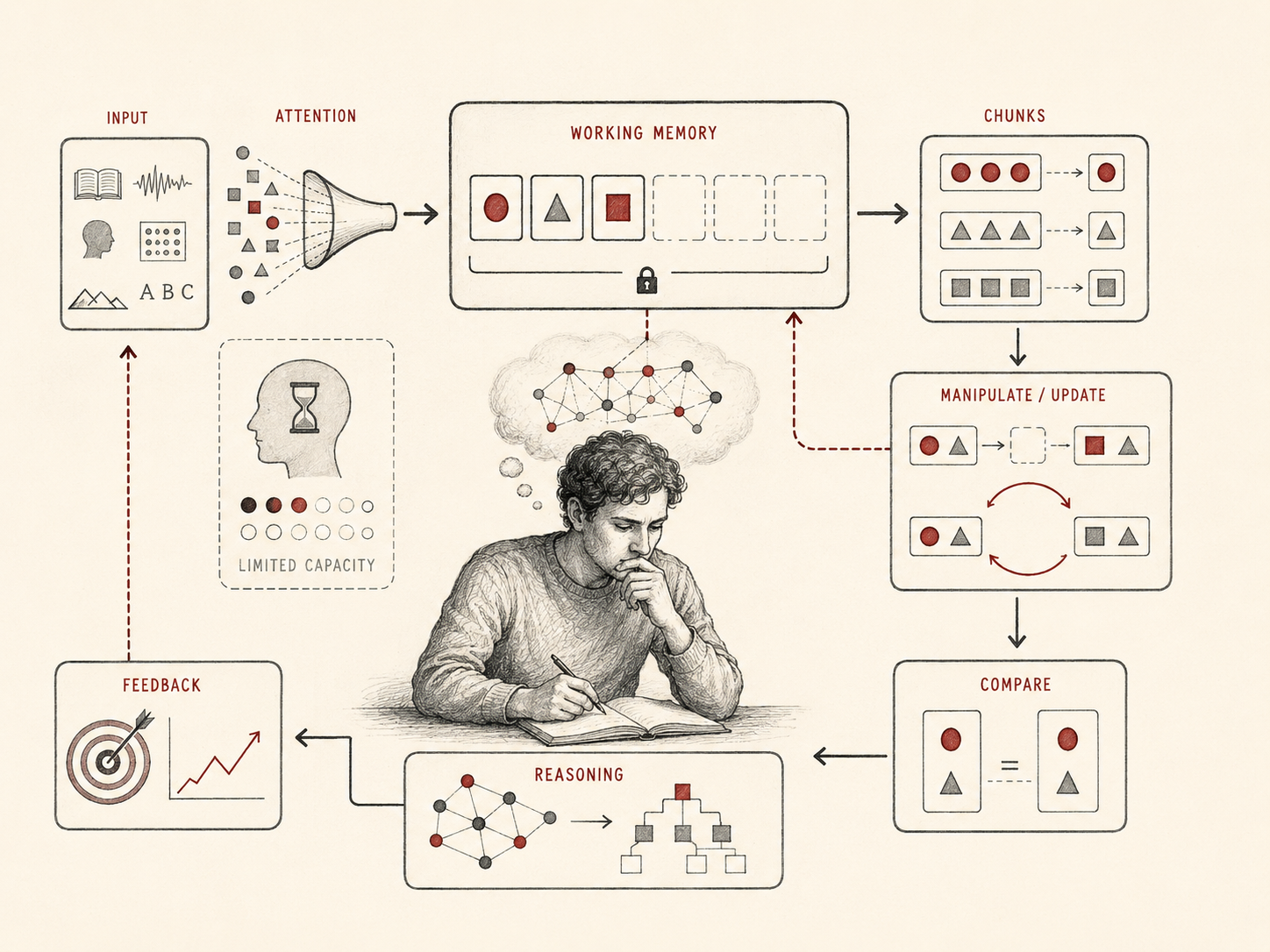
Working memory matters because nearly every complex act of cognition depends on the temporary availability of information that is not simply present in the environment. Solving a problem, understanding a sentence, comparing alternatives, following instructions, calculating a result, navigating an interface, or deciding under uncertainty all require information to remain active long enough to be used. When working memory is overloaded, thought becomes fragmented, errors increase, and performance deteriorates.
What is working memory?
Working memory refers to the system that temporarily maintains and actively manipulates information required for ongoing cognitive tasks. Unlike passive storage systems, working memory is inherently dynamic. It allows information to be updated, transformed, integrated, protected from distraction, and coordinated in real time.
Examples include:
- holding intermediate results while solving mathematical problems;
- maintaining earlier parts of a sentence during comprehension;
- mentally rotating objects or tracking spatial relations;
- planning multi-step actions under uncertainty;
- keeping task goals active while resisting distraction;
- comparing competing explanations during problem solving;
- holding instructions in mind while performing a task;
- tracking multiple variables in a decision environment;
- using feedback to adjust ongoing behavior.
Because working memory supports these operations, it is often described as the workspace of the mind. It is where perception becomes usable structure, where memory becomes immediately available, and where reasoning unfolds under conditions of limited capacity.
Working memory is closely related to short-term memory, but the two should not be treated as identical. Short-term memory emphasizes temporary storage. Working memory emphasizes temporary storage plus active control, manipulation, updating, and task relevance. A person may temporarily retain a phone number, but working memory becomes more fully engaged when that number must be reorganized, compared, used in a calculation, or integrated with another goal.
This distinction matters because many complex cognitive tasks require more than holding information. They require selecting what matters, transforming it, suppressing distraction, coordinating multiple representations, and updating the current mental state as the task changes.
Historical development of working memory theory
Early cognitive models often treated short-term memory as a relatively passive storage system. That framework helped clarify some features of temporary retention, but it could not adequately explain more complex activities such as reasoning, language comprehension, planning, mental arithmetic, and problem solving.
In 1974, Alan Baddeley and Graham Hitch introduced the working-memory model, which reconceptualized temporary memory as an active, multi-component system. This was a major shift. It suggested that short-term retention is not only about storing information for a few seconds, but about coordinating information during active thought.
The importance of this shift was theoretical and methodological. It allowed researchers to ask how temporary memory supports actual cognitive performance. Instead of asking only how many items could be held for a short period, researchers could ask how verbal rehearsal, visuospatial representation, attentional control, dual-task interference, and long-term knowledge contribute to ongoing cognition.
Later refinements, including Baddeley’s addition of the episodic buffer, expanded the model beyond simple maintenance and emphasized integration across modalities and long-term knowledge. Other traditions, including Cowan’s embedded-processes account and Oberauer’s work on attention and working memory, have further refined the field by emphasizing capacity, activated long-term memory, focus of attention, and control over access to information.
The history of working-memory theory is therefore not a simple replacement of one model by another. It is an ongoing effort to explain how temporary accessibility, attentional priority, modality-specific maintenance, executive control, and long-term knowledge interact in real cognition.
The Baddeley and Hitch model
The best-known model of working memory proposes several interacting components:
- Central executive — allocates attention and coordinates cognitive operations.
- Phonological loop — maintains verbal and auditory information.
- Visuospatial sketchpad — maintains visual and spatial representations.
- Episodic buffer — integrates information across domains and links working memory with long-term memory.
The central executive is especially important because it functions as a control system. It helps determine what information is prioritized, how resources are allocated, how competing demands are managed, and how task goals remain active. In that sense, working memory is closely tied to executive function and cognitive control.
The phonological loop supports the temporary maintenance of verbal and auditory information, often through rehearsal. It helps explain why speech-based materials can be briefly retained and why verbal similarity or articulatory suppression can disrupt performance.
The visuospatial sketchpad supports the temporary maintenance of visual and spatial information. It is important for mental imagery, spatial navigation, visual comparison, object rotation, diagram use, and interface interpretation.
The episodic buffer extends the model by allowing multimodal integration. It helps explain how information from perception, language, spatial representation, and long-term memory can be bound into coherent episodes or structured scenes.
What makes this model enduring is not just its vocabulary, but its broader claim: temporary memory is active, differentiated, and tightly bound to attention and control rather than reducible to simple short-term storage.
Core components and functional roles
Working memory performs several functional roles that cut across models. These roles help explain why the system is central to cognition even when researchers disagree about exact architecture.
- Maintenance — keeping information temporarily available.
- Updating — replacing old information with new task-relevant information.
- Manipulation — transforming or reorganizing maintained information.
- Binding — linking features, objects, words, places, or concepts.
- Prioritization — giving some representations higher attentional status.
- Protection — resisting distraction and interference.
- Retrieval coordination — making relevant long-term knowledge usable in the present task.
- Goal maintenance — keeping task instructions and intentions active.
These functions are not always separable in practice. A person solving a math problem must maintain intermediate values, update the current step, suppress irrelevant numbers, retrieve procedures, and keep the goal active. A person reading a complex sentence must maintain earlier clauses, integrate new words, resolve references, and revise interpretation as meaning unfolds.
This is why working memory is often difficult to measure cleanly. A task that appears to measure storage may also measure attention, processing speed, rehearsal, chunking, inhibition, or long-term knowledge. Research-grade analysis should therefore distinguish among storage demand, processing demand, updating demand, interference, and attentional control whenever possible.
Formalizing working memory: capacity, updating, and control
Some of the main dynamics of working memory can be expressed formally. At a basic level, working memory can be represented as a limited-capacity system in which active allocations must remain within a finite bound:
\sum_{i=1}^{n}a_i\leq C
\]
Interpretation: The total allocation of working-memory resources \(a_i\) across items or processes cannot exceed total available capacity \(C\).
This simple inequality captures one of the most important facts about working memory: not all active information can be equally maintained at once.
Overload can be represented as the amount by which task demand exceeds capacity:
O=\max(0,L-C)
\]
Interpretation: Overload \(O\) occurs when memory load \(L\) exceeds capacity \(C\).
Updating can be modeled in gated form:
W_t=g_t\odot X_t+(1-g_t)\odot W_{t-1}
\]
Interpretation: The current working-memory state \(W_t\) depends on incoming information \(X_t\), the previous state \(W_{t-1}\), and an update gate \(g_t\).
This expression formalizes the double demand placed on working memory: it must remain open enough to incorporate relevant information, yet stable enough to resist distraction and interference.
Performance on working-memory tasks can also be modeled probabilistically:
Pr(\text{correct})=\frac{1}{1+e^{-(\beta_0+\beta_1C-\beta_2L-\beta_3I+\beta_4A)}}
\]
Interpretation: Probability of correct performance rises with capacity \(C\) and attentional control \(A\), but declines with load \(L\) and interference \(I\).
Response time can be modeled as increasing with load, updating, interference, and cognitive burden:
\log(RT)=\beta_0+\beta_1L+\beta_2U+\beta_3I+\beta_4CL
\]
Interpretation: Response time tends to increase as memory load \(L\), updating demand \(U\), interference \(I\), and cognitive load \(CL\) increase.
These formal expressions are intentionally simplified. Their value is not that they capture every detail of working-memory theory. Their value is that they make explicit the relationships among capacity, load, updating, control, interference, and performance.
Working memory capacity and cognitive constraint
Working memory is characterized by severe capacity limitations. Earlier discussions often drew on Miller’s “magical number seven,” but later work suggested that the effective capacity of working memory under many conditions may be closer to about four structured units or chunks. The exact number is less important than the broader point: capacity is small, and cognition must continually manage that scarcity.
These limitations are not trivial. They shape how thought itself unfolds. When task demands exceed working-memory capacity, performance deteriorates, errors increase, distraction becomes harder to resist, and reasoning becomes less efficient.
Working memory capacity acts as a bottleneck for:
- complex reasoning;
- multi-step problem solving;
- language comprehension;
- mathematical calculation;
- learning under high information load;
- decision making under uncertainty;
- planning under time pressure;
- interface navigation;
- following instructions;
- monitoring multiple goals.
This also helps explain why expertise matters. Experts often restructure information into more efficient patterns, reducing the burden placed on working memory by organizing material into meaningful chunks and retrieval-ready structures. A chess master, clinician, engineer, musician, or mathematician may appear to hold more information in mind, but part of that advantage comes from better organization and long-term knowledge structures, not simply a larger raw storage container.
Capacity is therefore both a cognitive limit and a design challenge. Systems that overload working memory make error more likely. Systems that support chunking, sequence information carefully, reduce unnecessary distraction, and preserve context can improve performance without changing the person’s underlying capacity.
Working memory and attention
Working memory and attention are deeply interconnected. Attention helps determine what enters working memory, while working memory maintains the information needed to guide attentional selection. The relationship is reciprocal rather than one-way.
During goal-directed behavior, working memory helps keep task-relevant representations active. Those active representations can then bias attention toward relevant stimuli and away from distraction. In this way, working memory helps maintain cognitive direction across time rather than allowing thought to be governed entirely by whatever is most immediately salient.
Working memory also supports internal attention. A person can selectively attend not only to external objects but also to internal representations: a remembered number, a spatial location, a mental image, a sentence fragment, a future goal, or a possible action. This internal attention allows cognition to prioritize what is currently most useful for behavior.
This relationship places working memory near the center of executive control. It links perception, action, and reasoning into a coordinated system, and it helps explain why failures of working memory often look like failures of focus, planning, or mental organization.
Attention and working memory are not identical, however. Attention can select information that is not actively maintained, and working memory can store information that is not currently at the center of attention. A rigorous account must therefore study how selection, maintenance, prioritization, and control interact across time.
Executive control, updating, and interference
Working memory depends on executive control because temporary maintenance must be managed. Relevant information must be protected, irrelevant information must be suppressed, old information must be removed, and new information must be admitted when the task changes.
Three executive demands are especially important:
- Updating — replacing outdated information with new information.
- Inhibition — preventing irrelevant information from controlling thought or action.
- Shifting — moving flexibly between task goals, representations, or rules.
Updating is central to n-back tasks, running span tasks, mental arithmetic, language comprehension, and real-world monitoring. If updating is too weak, irrelevant or outdated information remains active. If updating is too aggressive, useful information is lost too quickly.
Interference is a major source of working-memory failure. Interference can be verbal, visual, spatial, semantic, proactive, retroactive, or task-based. A person may remember the wrong item, confuse similar words, lose track of spatial order, or allow an earlier rule to intrude on a current task.
Working memory therefore requires a balance between stability and flexibility. Stable maintenance protects task-relevant information from distraction. Flexible updating allows new information to enter. Much of intelligent behavior depends on managing this tension.
Working memory, learning, and cognitive load
Working memory plays a crucial role in learning. New information must pass through working memory before it can be integrated into longer-term knowledge. But because working memory is limited, learning can fail when too much must be processed at once.
Cognitive load theory distinguishes among:
- Intrinsic load — the inherent complexity of the material.
- Extraneous load — unnecessary processing demands imposed by poor presentation or design.
- Germane load — effort directed toward meaningful organization and learning.
This distinction matters because instructional success depends not simply on adding information, but on managing the demands placed on working memory. A lesson, interface, training module, technical manual, or AI tool can fail not because the user lacks intelligence, but because the design imposes unnecessary load.
Techniques that support learning include:
- chunking information into meaningful units;
- sequencing complexity gradually;
- using worked examples before independent practice;
- reducing split attention between separated sources;
- removing irrelevant visual or verbal clutter;
- aligning diagrams with explanations;
- scaffolding difficult tasks;
- using retrieval practice after initial understanding;
- allowing rehearsal and reflection;
- making task goals explicit.
Working memory is therefore central not only to cognition in the abstract, but to education, training, documentation, knowledge transfer, interface design, and public communication in practice.
Working memory and language processing
Language processing depends heavily on working memory. To understand a sentence, a listener or reader must maintain earlier words, update interpretation as new words arrive, resolve references, integrate syntax and meaning, and connect current input with prior knowledge.
Working memory is especially important when sentences are long, syntactically complex, ambiguous, or information-dense. A person may need to maintain a subject while processing embedded clauses, track pronoun references, compare alternatives, or revise interpretation when later information changes the meaning of earlier material.
Language tasks place different demands on working memory:
- Phonological maintenance supports verbal rehearsal and temporary sound-based storage.
- Semantic integration links incoming words with meaning and prior knowledge.
- Syntactic processing maintains relations among sentence elements.
- Discourse tracking maintains context across sentences or turns.
- Ambiguity resolution requires temporary maintenance of competing interpretations.
This has practical implications for writing, teaching, translation, accessibility, legal communication, medical instructions, and interface copy. Dense or poorly structured language can overload working memory. Clear sequencing, shorter clauses, meaningful headings, and explicit reference points can reduce unnecessary burden while preserving complexity.
Working memory does not make language possible by itself, but it helps keep linguistic structure available long enough for meaning to be built.
Working memory and decision making
Decision making requires working memory because alternatives, probabilities, consequences, goals, constraints, and trade-offs must be represented together. A decision can fail when too many variables must be compared at once or when cognitive load prevents relevant information from remaining active.
Working memory supports decision making by helping people:
- hold multiple options in mind;
- compare benefits and costs;
- maintain task goals;
- track uncertainty;
- resist misleading distractions;
- integrate new evidence;
- simulate consequences;
- remember constraints;
- avoid premature closure.
When working memory is overloaded, people may rely more heavily on heuristics, defaults, familiar options, emotional salience, or the first available anchor. This does not mean heuristics are always bad. It means that working-memory constraints help determine when simplified strategies become more likely.
This is especially important in high-stakes decision environments. Medical choices, legal decisions, financial planning, public-benefit forms, workplace safety, and AI-assisted decisions often require people to process complex information under pressure. If the environment overloads working memory, errors may be predictable rather than exceptional.
Good decision design should therefore reduce extraneous working-memory burden. It should present information in structured form, preserve context, clarify trade-offs, make uncertainty visible, and support review before commitment.
Individual differences and measurement
Working-memory capacity is often studied as an individual-differences construct. People vary in their ability to maintain, update, and control task-relevant information. These differences are associated with reasoning, comprehension, learning, attention control, and fluid intelligence, although working-memory capacity should not be treated as identical to intelligence.
Common working-memory measures include:
- Simple span tasks — recalling sequences such as digits, words, or locations.
- Complex span tasks — maintaining information while performing another processing task.
- Operation span — remembering items while solving math operations.
- Reading span — remembering items while processing sentences.
- Spatial span — maintaining spatial sequences or locations.
- N-back tasks — updating and recognizing items from \(n\) steps earlier.
- Change-detection tasks — detecting changes in visual arrays.
- Running span tasks — updating memory for the most recent items in a sequence.
Measurement is complicated because different tasks draw on different mixtures of storage, updating, attention control, processing speed, modality, strategy, and long-term knowledge. A person may perform well on verbal span but less well on spatial updating, or show strong recall under low interference but struggle under dual-task conditions.
Research-grade measurement should therefore avoid treating a single score as a complete representation of working memory. It should examine task structure, modality, reliability, validity, response time, strategy, and the broader cognitive demands embedded in the measure.
Neuroscience of working memory
Research in neuroscience suggests that working memory depends on distributed neural systems rather than a single isolated site. The prefrontal cortex plays an important role in maintaining task-relevant information and supporting control, while the parietal cortex contributes to attentional and spatial aspects of temporary maintenance. Modality-specific regions also participate when the maintained information is verbal, visual, auditory, spatial, or semantic.
This distributed picture supports a broader point: working memory is not a static storage box inside the brain. It is an active pattern of coordination across systems that support attention, maintenance, updating, prioritization, and task control.
Current work increasingly treats working memory as closely related to the flexible prioritization of information needed for behavior, rather than as a fixed container of items. Some information may be in the focus of attention, some may remain active but unattended, and some may be retrievable from long-term memory when cues become available.
Neuroscience also complicates simplistic distinctions between storage and control. Maintaining information often requires active control, and control depends on the ability to keep goals and rules available. Working memory is therefore both a representational system and a control system.
Working memory, interfaces, and AI systems
Working-memory research has direct implications for technology design. Interfaces can support users by reducing unnecessary memory demands, or they can overload users by scattering information, hiding state, requiring repeated recall, or forcing users to integrate too many elements at once.
Interface problems that increase working-memory burden include:
- forcing users to remember information from previous screens;
- separating labels from values;
- hiding system status;
- using inconsistent terminology;
- requiring multi-step actions without progress cues;
- displaying too many competing options;
- interrupting users during complex tasks;
- using dense instructions without examples;
- presenting AI output without source context or uncertainty.
AI systems can reduce working-memory load by summarizing information, preserving context, retrieving relevant evidence, structuring comparisons, and helping users track alternatives. But AI can also relocate burden. A fluent answer may require verification, source checking, uncertainty evaluation, and error detection. The user may not need to generate information from scratch, but they may need to audit it.
For this reason, human-AI design should measure verification burden, not only task completion time. A tool that appears to reduce working-memory demands may increase hidden cognitive burden if it requires users to reconstruct evidence, identify hallucinations, or detect missing context.
Good AI and interface design should support working memory by making state visible, preserving context, chunking information, clarifying uncertainty, reducing unnecessary switching, and making verification cognitively manageable.
Working memory, accessibility, and institutional design
Working-memory limits are human limits. They should not be treated as individual weakness. Schools, workplaces, medical systems, legal systems, public agencies, financial platforms, and digital services all create environments that either respect or overload those limits.
This matters for accessibility and justice. People dealing with stress, poverty, trauma, illness, disability, language barriers, sleep deprivation, caregiving burdens, or administrative complexity may face greater working-memory demands before the task even begins. A form, policy, interface, or instruction set that seems manageable to a designer may be punishing in context.
Institutional overload can appear when systems require people to:
- remember many deadlines and documents;
- interpret dense legal or medical language;
- navigate fragmented portals;
- repeat information across offices;
- track eligibility rules without support;
- compare complex financial or insurance options;
- respond quickly under threat of penalty;
- understand automated decisions without explanation.
Working-memory research therefore has moral and civic significance. It shows why “clear information” is not enough if the structure of the task exceeds what people can realistically maintain and manipulate. Responsible design should reduce unnecessary load, support comprehension, sequence complexity, provide reminders, preserve context, and allow review.
A humane institution does not merely provide options. It makes those options cognitively navigable.
R code for working-memory data
The following R workflow illustrates analyses relevant to working-memory experiments, including span accuracy, updating performance, response time, load effects, interference, attentional control, cognitive load, capacity estimates, and support conditions.
# Install packages if needed:
# pak::pak(c("tidyverse", "lme4", "lmerTest", "emmeans", "broom.mixed"))

library(tidyverse)
library(lme4)
library(lmerTest)
library(emmeans)
library(broom.mixed)

# Expected columns:
# participant, condition, domain, trial, task_type, modality,
# load, serial_position, distractor_level, interference,
# attentional_control, updating_demand, storage_demand,
# processing_demand, chunking_support, rehearsal_opportunity,
# cognitive_load, span_score, updating_score, capacity_estimate,
# overload_probability, dual_task_cost, correct, accuracy,
# response_time_ms, confidence, learning_support, interface_complexity

dat <- read_csv("working_memory_trials.csv") %>%
  mutate(
    participant = factor(participant),
    condition = factor(condition),
    domain = factor(domain),
    task_type = factor(task_type),
    modality = factor(modality),
    correct = as.integer(correct),
    log_rt = log(response_time_ms)
  )

# -----------------------------
# 1. Condition summary
# -----------------------------

condition_summary <- dat %>%
  group_by(condition) %>%
  summarise(
    n_trials = n(),
    participants = n_distinct(participant),
    mean_load = mean(load, na.rm = TRUE),
    correct_rate = mean(correct, na.rm = TRUE),
    mean_accuracy = mean(accuracy, na.rm = TRUE),
    mean_response_time_ms = mean(response_time_ms, na.rm = TRUE),
    mean_span_score = mean(span_score, na.rm = TRUE),
    mean_updating_score = mean(updating_score, na.rm = TRUE),
    mean_capacity_estimate = mean(capacity_estimate, na.rm = TRUE),
    mean_overload_probability = mean(overload_probability, na.rm = TRUE),
    mean_dual_task_cost = mean(dual_task_cost, na.rm = TRUE),
    mean_cognitive_load = mean(cognitive_load, na.rm = TRUE),
    mean_confidence = mean(confidence, na.rm = TRUE),
    .groups = "drop"
  )

print(condition_summary)

# -----------------------------
# 2. Accuracy model
# -----------------------------

accuracy_model <- glmer(
  correct ~
    condition +
    task_type +
    modality +
    load +
    serial_position +
    distractor_level +
    interference +
    attentional_control +
    updating_demand +
    storage_demand +
    processing_demand +
    chunking_support +
    rehearsal_opportunity +
    cognitive_load +
    learning_support +
    interface_complexity +
    (1 + load | participant),
  data = dat,
  family = binomial(),
  control = glmerControl(optimizer = "bobyqa")
)

summary(accuracy_model)
emmeans(accuracy_model, ~ condition, type = "response")

# -----------------------------
# 3. Capacity-estimate model
# -----------------------------

capacity_model <- lmer(
  capacity_estimate ~
    condition +
    task_type +
    modality +
    load +
    interference +
    attentional_control +
    chunking_support +
    rehearsal_opportunity +
    cognitive_load +
    learning_support +
    interface_complexity +
    (1 + load | participant),
  data = dat,
  REML = FALSE
)

summary(capacity_model)

# -----------------------------
# 4. Updating-score model
# -----------------------------

updating_model <- lmer(
  updating_score ~
    condition +
    task_type +
    modality +
    load +
    updating_demand +
    attentional_control +
    interference +
    cognitive_load +
    chunking_support +
    rehearsal_opportunity +
    (1 + load | participant),
  data = dat,
  REML = FALSE
)

summary(updating_model)

# -----------------------------
# 5. Overload-probability model
# -----------------------------

overload_model <- lmer(
  overload_probability ~
    condition +
    task_type +
    load +
    capacity_estimate +
    interference +
    cognitive_load +
    attentional_control +
    learning_support +
    interface_complexity +
    (1 + load | participant),
  data = dat,
  REML = FALSE
)

summary(overload_model)

# -----------------------------
# 6. Response-time model
# -----------------------------

rt_model <- lmer(
  log_rt ~
    condition +
    task_type +
    modality +
    load +
    updating_demand +
    processing_demand +
    interference +
    cognitive_load +
    attentional_control +
    correct +
    confidence +
    (1 + load | participant),
  data = dat,
  REML = FALSE
)

summary(rt_model)

# -----------------------------
# 7. Confidence model
# -----------------------------

confidence_model <- lmer(
  confidence ~
    condition +
    task_type +
    modality +
    accuracy +
    capacity_estimate +
    overload_probability +
    cognitive_load +
    attentional_control +
    interference +
    learning_support +
    (1 + load | participant),
  data = dat,
  REML = FALSE
)

summary(confidence_model)

# -----------------------------
# 8. Visualization
# -----------------------------

ggplot(dat, aes(x = load, y = accuracy, color = condition)) +
  geom_point(alpha = 0.25) +
  geom_smooth(method = "glm", method.args = list(family = "binomial"), se = FALSE) +
  labs(
    title = "Working-memory accuracy across load",
    x = "Memory load",
    y = "Accuracy"
  ) +
  theme_minimal()
This workflow can be adapted for simple span, complex span, operation span, reading span, spatial span, n-back, serial recall, change detection, dual-task experiments, learning studies, interface-complexity experiments, and human-AI support studies. Researchers should model participant effects whenever possible because working-memory performance varies across individuals, tasks, modalities, strategies, and environments.
Python code for working-memory data
The Python examples below parallel the R workflow and are useful for load manipulations, span tasks, updating paradigms, interference studies, cognitive-load research, and interface-support experiments.
import numpy as np
import pandas as pd
import statsmodels.formula.api as smf
import statsmodels.api as sm
import matplotlib.pyplot as plt

# Expected columns:
# participant, condition, domain, trial, task_type, modality,
# load, serial_position, distractor_level, interference,
# attentional_control, updating_demand, storage_demand,
# processing_demand, chunking_support, rehearsal_opportunity,
# cognitive_load, span_score, updating_score, capacity_estimate,
# overload_probability, dual_task_cost, correct, accuracy,
# response_time_ms, confidence, learning_support, interface_complexity

df = pd.read_csv("working_memory_trials.csv")

categorical_cols = [
    "participant", "condition", "domain", "task_type", "modality"
]

for col in categorical_cols:
    df[col] = df[col].astype("category")

df["correct"] = df["correct"].astype(int)
df["log_rt"] = np.log(df["response_time_ms"])

# -----------------------------
# 1. Condition summary
# -----------------------------

condition_summary = (
    df.groupby("condition", observed=True)
    .agg(
        n_trials=("correct", "size"),
        participants=("participant", "nunique"),
        mean_load=("load", "mean"),
        correct_rate=("correct", "mean"),
        mean_accuracy=("accuracy", "mean"),
        mean_response_time_ms=("response_time_ms", "mean"),
        mean_span_score=("span_score", "mean"),
        mean_updating_score=("updating_score", "mean"),
        mean_capacity_estimate=("capacity_estimate", "mean"),
        mean_overload_probability=("overload_probability", "mean"),
        mean_dual_task_cost=("dual_task_cost", "mean"),
        mean_cognitive_load=("cognitive_load", "mean"),
        mean_confidence=("confidence", "mean"),
    )
    .reset_index()
)

print(condition_summary)

# -----------------------------
# 2. Accuracy model
# -----------------------------

accuracy_model = smf.glm(
    "correct ~ condition + task_type + modality + load "
    "+ serial_position + distractor_level + interference "
    "+ attentional_control + updating_demand + storage_demand "
    "+ processing_demand + chunking_support + rehearsal_opportunity "
    "+ cognitive_load + learning_support + interface_complexity",
    data=df,
    family=sm.families.Binomial(),
)

accuracy_result = accuracy_model.fit(
    cov_type="cluster",
    cov_kwds={"groups": df["participant"]},
)

print(accuracy_result.summary())

# -----------------------------
# 3. Capacity-estimate model
# -----------------------------

capacity_model = smf.ols(
    "capacity_estimate ~ condition + task_type + modality + load "
    "+ interference + attentional_control + chunking_support "
    "+ rehearsal_opportunity + cognitive_load + learning_support "
    "+ interface_complexity",
    data=df,
)

capacity_result = capacity_model.fit(
    cov_type="cluster",
    cov_kwds={"groups": df["participant"]},
)

print(capacity_result.summary())

# -----------------------------
# 4. Updating-score model
# -----------------------------

updating_model = smf.ols(
    "updating_score ~ condition + task_type + modality + load "
    "+ updating_demand + attentional_control + interference "
    "+ cognitive_load + chunking_support + rehearsal_opportunity",
    data=df,
)

updating_result = updating_model.fit(
    cov_type="cluster",
    cov_kwds={"groups": df["participant"]},
)

print(updating_result.summary())

# -----------------------------
# 5. Overload-probability model
# -----------------------------

overload_model = smf.ols(
    "overload_probability ~ condition + task_type + load "
    "+ capacity_estimate + interference + cognitive_load "
    "+ attentional_control + learning_support + interface_complexity",
    data=df,
)

overload_result = overload_model.fit(
    cov_type="cluster",
    cov_kwds={"groups": df["participant"]},
)

print(overload_result.summary())

# -----------------------------
# 6. Response-time model
# -----------------------------

rt_model = smf.ols(
    "log_rt ~ condition + task_type + modality + load "
    "+ updating_demand + processing_demand + interference "
    "+ cognitive_load + attentional_control + correct + confidence",
    data=df,
)

rt_result = rt_model.fit(
    cov_type="cluster",
    cov_kwds={"groups": df["participant"]},
)

print(rt_result.summary())

# -----------------------------
# 7. Confidence model
# -----------------------------

confidence_model = smf.ols(
    "confidence ~ condition + task_type + modality + accuracy "
    "+ capacity_estimate + overload_probability + cognitive_load "
    "+ attentional_control + interference + learning_support",
    data=df,
)

confidence_result = confidence_model.fit(
    cov_type="cluster",
    cov_kwds={"groups": df["participant"]},
)

print(confidence_result.summary())

# -----------------------------
# 8. Visualization
# -----------------------------

fig, ax = plt.subplots(figsize=(8, 5))

for condition, group in df.groupby("condition", observed=True):
    load_profile = (
        group.groupby("load", observed=True)["accuracy"]
        .mean()
        .reset_index()
    )
    ax.plot(load_profile["load"], load_profile["accuracy"], marker="o", label=str(condition))

ax.set_xlabel("Memory load")
ax.set_ylabel("Accuracy")
ax.set_title("Working-memory accuracy across load")
ax.legend(title="Condition")
plt.tight_layout()
plt.show()

# -----------------------------
# 9. Export summaries
# -----------------------------

condition_summary.to_csv("working_memory_condition_summary.csv", index=False)
The Python workflow is intentionally transparent and extensible. It can be expanded with Bayesian hierarchical models, latent-variable models of working-memory capacity, serial-position curves, change-detection \(K\) estimates, response-time distribution models, n-back signal-detection measures, dual-task cost models, cognitive-load experiments, eye-tracking, educational intervention studies, and human-AI interface-support evaluations.
GitHub Repository
The companion repository provides reusable code and research scaffolding for studying working memory in cognitive psychology, including workflows for span tasks, updating, load effects, interference, attentional control, cognitive load, response time, capacity estimates, overload probability, dual-task cost, interface complexity, learning support, and AI-supported cognition.
Complete Code Repository
Access the full companion repository for this article, including reproducible analysis materials and multi-language code workflows for working-memory research.
Applications of working-memory research
Working-memory research has broad practical applications. In education, it informs instructional design, sequencing, scaffolding, multimedia learning, mathematical instruction, reading comprehension, note-taking, and the management of cognitive load. In clinical psychology and neuropsychology, working-memory limitations are relevant to ADHD, learning difficulties, traumatic brain injury, aging, executive-function impairments, and many psychiatric and neurological conditions.
In organizational and technological settings, working-memory research helps shape interface design, task design, safety procedures, decision-support systems, training materials, dashboards, technical documentation, and operational workflows. Systems that require users to remember too much across screens, tabs, instructions, or interruptions increase the likelihood of error.
In language and communication, working-memory research supports clearer writing, more accessible instructions, better legal and medical communication, and more effective public information design. In artificial intelligence and computational modeling, working-memory concepts influence how systems manage temporary context, sequential dependencies, active information, and task-relevant state during ongoing processing.
The analogy between biological working memory and artificial context systems is not exact, but the comparison remains useful because both biological and artificial systems confront problems of temporary maintenance under constraint. The practical lesson is clear: intelligent systems, human or artificial, require mechanisms for selecting, maintaining, updating, and using relevant information without being overwhelmed.
Conclusion
Working memory is one of the central systems that allows the mind to operate on information in real time. By maintaining, updating, protecting, and manipulating representations, it makes it possible to reason, plan, comprehend, learn, decide, and act in complex environments.
Cognitive psychology shows that working memory is both powerful and limited. Its flexibility supports intelligent behavior, but its constraints define the boundaries within which that behavior must unfold. Understanding working memory therefore provides insight into how information is selected, coordinated, and used under conditions of scarcity.
Working memory also shows why cognition cannot be separated from design. Learning materials, interfaces, institutions, and AI systems can either respect working-memory limits or overload them. When systems are poorly structured, failure may be misattributed to the user rather than to the environment that made the task unnecessarily difficult.
As research continues to integrate cognitive psychology, neuroscience, education, human factors, and computational modeling, working memory remains one of the most important concepts for understanding how minds function as active systems rather than passive storage devices.
Related articles
- Cognitive Psychology
- Attention in Cognitive Psychology
- Memory in Cognitive Psychology
- Cognitive Load and Information Processing
- Cognitive Learning Processes
- Language Processing in Cognitive Psychology
- Problem Solving in Cognitive Psychology
- Decision Making in Cognitive Psychology
- Human-Computer Interaction in Cognitive Psychology
Further reading
- American Psychological Association (n.d.) Working memory. APA Dictionary of Psychology. Available at: https://dictionary.apa.org/working-memory.
- American Psychological Association (n.d.) Central executive. APA Dictionary of Psychology. Available at: https://dictionary.apa.org/central-executive.
- American Psychological Association (n.d.) Phonological loop. APA Dictionary of Psychology. Available at: https://dictionary.apa.org/phonological-loop.
- American Psychological Association (n.d.) Visuospatial sketchpad. APA Dictionary of Psychology. Available at: https://dictionary.apa.org/visuospatial-sketchpad.
- American Psychological Association (n.d.) Episodic buffer. APA Dictionary of Psychology. Available at: https://dictionary.apa.org/episodic-buffer.
- Baddeley, A. (2012) ‘Working memory: Theories, models, and controversies’, Annual Review of Psychology, 63, pp. 1–29. Available at: https://www.annualreviews.org/content/journals/10.1146/annurev-psych-120710-100422.
- Baddeley, A.D. and Hitch, G.J. (1974) ‘Working memory’, in Bower, G.H. (ed.) The Psychology of Learning and Motivation. New York: Academic Press, pp. 47–89.
- Conway, A.R.A., Kane, M.J. and Engle, R.W. (2003) ‘Working memory capacity and its relation to general intelligence’, Trends in Cognitive Sciences, 7(12), pp. 547–552. PubMed record available at: https://pubmed.ncbi.nlm.nih.gov/14643371/.
- Cowan, N. (2010) ‘The magical mystery four: How is working memory capacity limited, and why?’, Current Directions in Psychological Science, 19(1), pp. 51–57. Available at: https://pmc.ncbi.nlm.nih.gov/articles/PMC2864034/.
- Miller, G.A. (1956) ‘The magical number seven, plus or minus two: Some limits on our capacity for processing information’, Psychological Review, 63(2), pp. 81–97.
- Oberauer, K. (2019) ‘Working memory and attention — A conceptual analysis and review’, Journal of Cognition, 2(1), 36. Available at: https://pmc.ncbi.nlm.nih.gov/articles/PMC6688548/.
- Sweller, J. (1988) ‘Cognitive load during problem solving: Effects on learning’, Cognitive Science, 12(2), pp. 257–285.
- van Ede, F. and Nobre, A.C. (2023) ‘Turning attention inside out: How working memory serves behavior’, Annual Review of Psychology, 74, pp. 137–165. Available at: https://www.annualreviews.org/doi/10.1146/annurev-psych-021422-041757.
- Wilhelm, O., Hildebrandt, A. and Oberauer, K. (2013) ‘What is working memory capacity, and how can we measure it?’, Frontiers in Psychology, 4, 433. Available at: https://pmc.ncbi.nlm.nih.gov/articles/PMC3721021/.
References
- American Psychological Association (n.d.) Working memory. APA Dictionary of Psychology. Available at: https://dictionary.apa.org/working-memory.
- American Psychological Association (n.d.) Central executive. APA Dictionary of Psychology. Available at: https://dictionary.apa.org/central-executive.
- American Psychological Association (n.d.) Phonological loop. APA Dictionary of Psychology. Available at: https://dictionary.apa.org/phonological-loop.
- American Psychological Association (n.d.) Visuospatial sketchpad. APA Dictionary of Psychology. Available at: https://dictionary.apa.org/visuospatial-sketchpad.
- American Psychological Association (n.d.) Episodic buffer. APA Dictionary of Psychology. Available at: https://dictionary.apa.org/episodic-buffer.
- Baddeley, A. (2012) ‘Working memory: Theories, models, and controversies’, Annual Review of Psychology, 63, pp. 1–29. Available at: https://www.annualreviews.org/content/journals/10.1146/annurev-psych-120710-100422.
- Baddeley, A.D. and Hitch, G.J. (1974) ‘Working memory’, in Bower, G.H. (ed.) The Psychology of Learning and Motivation. New York: Academic Press, pp. 47–89.
- Conway, A.R.A., Kane, M.J. and Engle, R.W. (2003) ‘Working memory capacity and its relation to general intelligence’, Trends in Cognitive Sciences, 7(12), pp. 547–552. PubMed record available at: https://pubmed.ncbi.nlm.nih.gov/14643371/.
- Cowan, N. (2010) ‘The magical mystery four: How is working memory capacity limited, and why?’, Current Directions in Psychological Science, 19(1), pp. 51–57. Available at: https://pmc.ncbi.nlm.nih.gov/articles/PMC2864034/.
- Miller, G.A. (1956) ‘The magical number seven, plus or minus two: Some limits on our capacity for processing information’, Psychological Review, 63(2), pp. 81–97.
- Oberauer, K. (2019) ‘Working memory and attention — A conceptual analysis and review’, Journal of Cognition, 2(1), 36. Available at: https://pmc.ncbi.nlm.nih.gov/articles/PMC6688548/.
- Sweller, J. (1988) ‘Cognitive load during problem solving: Effects on learning’, Cognitive Science, 12(2), pp. 257–285.
- van Ede, F. and Nobre, A.C. (2023) ‘Turning attention inside out: How working memory serves behavior’, Annual Review of Psychology, 74, pp. 137–165. Available at: https://www.annualreviews.org/doi/10.1146/annurev-psych-021422-041757.
- Wilhelm, O., Hildebrandt, A. and Oberauer, K. (2013) ‘What is working memory capacity, and how can we measure it?’, Frontiers in Psychology, 4, 433. Available at: https://pmc.ncbi.nlm.nih.gov/articles/PMC3721021/.