
Last Updated May 28, 2026
Chemistry gives human beings extraordinary power over matter. It can synthesize medicines, fertilizers, polymers, batteries, catalysts, disinfectants, fuels, semiconductors, coatings, dyes, refrigerants, pesticides, sensors, energetic materials, and advanced materials that transform civilization. It can purify water, preserve food, treat disease, increase crop yields, store energy, transmit information, and make modern infrastructure possible. But the same molecular power can also create toxicity, pollution, exposure, persistence, environmental injustice, dual-use risk, chemical weapons, unsafe workplaces, waste burdens, and harms that last across generations.
The central thesis of chemical ethics is that chemistry is never only a technical science of substances and reactions. It is also a public power. Molecules move through bodies, workplaces, ecosystems, markets, supply chains, waste streams, homes, soil, water, air, and political systems. The ethical question is therefore not simply whether a chemical can be made, but whether it should be made, how it should be governed, who benefits, who bears risk, who is exposed, who decides what counts as acceptable harm, and what obligations follow when molecular knowledge becomes social force.
Chemical ethics is not a rejection of chemistry. It is chemistry taking its own power seriously. A field capable of transforming the material conditions of life must also develop disciplines of precaution, transparency, public accountability, worker protection, environmental justice, product stewardship, and responsible innovation. The moral challenge is not to weaken chemistry, but to make chemical knowledge worthy of the worlds it helps create.
Main Library
Publications
Article Map
Chemistry
Related Topic
Environmental Science
Related Topic
Risk & Resilience
Related Topic
Global Governance
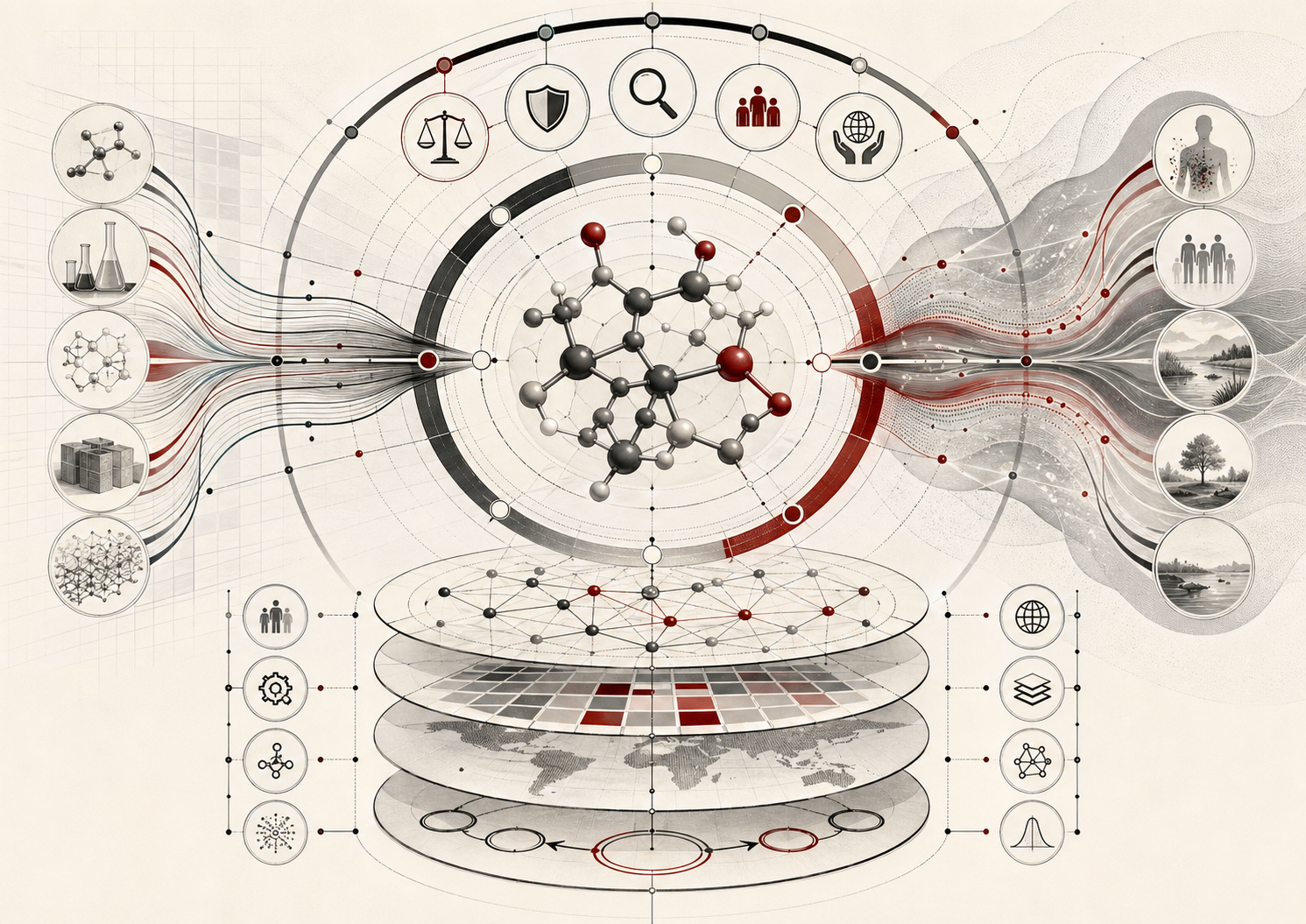
What Chemical Ethics Studies
Chemical ethics studies the responsibilities created by chemical knowledge, chemical production, chemical exposure, chemical innovation, and chemical governance. It asks how chemists, companies, regulators, governments, laboratories, universities, journals, investors, communities, and publics should act when molecular design affects health, safety, environment, security, labor, law, and justice.
The field includes many overlapping questions. How should uncertain chemical risks be governed? When should precaution guide action? What evidence is required before a substance is placed into widespread use? How should chemical data be disclosed? How should workers be protected? How should communities be informed? How should persistent chemicals be controlled? How should dual-use research be handled? How should chemicals with major social benefits but serious hazards be evaluated? How should society prevent chemical weapons, toxic pollution, and irresponsible substitution?
Chemical ethics also asks who counts as a participant in chemical decision-making. The affected public is not limited to chemists, regulators, and corporate product teams. It includes workers, fence-line communities, patients, farmers, consumers, Indigenous peoples, waste handlers, children, future generations, and ecosystems that cannot speak in regulatory hearings but may still bear the consequences of chemical decisions.
Chemical ethics is therefore not an optional supplement to “real chemistry.” It is part of what makes chemistry socially responsible. A science powerful enough to transform matter is powerful enough to require moral discipline.
Molecular Power and Human Responsibility
Molecular power is the capacity to design, synthesize, transform, distribute, and govern substances that alter the material conditions of life. This power can be therapeutic, agricultural, industrial, informational, energetic, military, environmental, or infrastructural. It can save lives through medicines, vaccines, disinfectants, anesthetics, and sanitation. It can support food systems through fertilizers, soil amendments, and crop protection. It can enable renewable energy through batteries, catalysts, photovoltaics, membranes, electrolyzers, and advanced materials. It can also contaminate water, poison workers, persist in ecosystems, intensify inequality, and produce weapons.
The ethical challenge is that chemical power is rarely contained within the laboratory. A molecule may be designed in one place, manufactured in another, incorporated into a product somewhere else, used globally, transformed during use, degraded into byproducts, recovered in waste systems, transported across borders, and detected years later in air, water, soil, organisms, or human tissue. Chemical agency becomes distributed across systems.
Responsibility must therefore travel with the molecule. It must extend from discovery to design, scale-up, marketing, transport, use, misuse, exposure, recovery, disposal, and remediation. A narrow view of responsibility that ends at publication, patenting, regulatory submission, sale, or disposal is inadequate for a science whose products move through living and institutional systems.
For researchers and scientists, this means that molecular design is never only a question of yield, selectivity, stability, cost, novelty, or performance. It is also a question of fate. Where will this substance go? What will it become? Who will handle it? What will happen during failure? What will happen at scale? What will happen when the idealized use case becomes the real-world use case?
Benefit, Harm, and the Ambivalence of Chemical Innovation
Chemical innovation is ethically ambivalent because the same capacity to transform matter can produce both benefit and harm. Medicines can heal but also create access problems, side effects, waste streams, antimicrobial resistance, manufacturing exposure, or environmental residues. Fertilizers can support food security but also contribute to eutrophication and nitrous oxide emissions. Polymers can enable medical devices, insulation, packaging, and lightweight transport but also create persistent waste, additive exposure, microplastic contamination, and difficult end-of-life burdens. Pesticides can protect crops but also affect ecosystems, farmworkers, pollinators, water systems, and non-target species.
Ethical chemical judgment therefore cannot rely on simple categories such as natural versus synthetic, safe versus dangerous, innovation versus regulation, or technological progress versus environmental protection. A chemical’s social meaning depends on function, hazard, exposure, persistence, mobility, necessity, alternatives, benefit distribution, governance quality, transparency, and end-of-life fate.
Researchers should therefore distinguish between technical success and responsible success. A technically successful compound may be high-performing, low-cost, scalable, stable, and commercially attractive while still creating unacceptable exposure, persistence, disposal, labor, or justice concerns. Conversely, a responsible chemical innovation may require slightly lower performance or higher near-term cost in exchange for lower hazard, better degradability, safer production, easier recovery, or reduced cumulative burden.
The ethical task is not to stop chemistry. It is to govern chemical power so that benefits are real, risks are minimized, harms are not hidden, and vulnerable people are not treated as acceptable sacrifice zones.
Risk, Exposure, Toxicology, and Governance
Chemical risk depends on hazard and exposure, but real-world risk is more complex than a simple two-part equation. A substance may have intrinsic toxicity, but harm depends on dose, route, timing, frequency, duration, life stage, susceptibility, mixture effects, environmental fate, transformation products, bioavailability, metabolism, and biological response. Toxicology, exposure science, epidemiology, environmental chemistry, analytical chemistry, occupational hygiene, and risk assessment help societies evaluate these conditions.
Risk governance goes beyond risk calculation. It includes who defines the question, what evidence counts, how uncertainty is handled, who participates in decision-making, how vulnerable populations are considered, what alternatives are evaluated, how cumulative exposure is addressed, and what happens after harm is discovered. Governance also includes monitoring, labeling, workplace controls, restrictions, substitution plans, remediation, compensation, and public communication.
A chemical governance system that evaluates substances one by one, ignores mixtures, underestimates vulnerable groups, fails to require data, or delays action until harm is widespread may be technically elaborate but ethically weak. Good governance must be scientifically rigorous and socially accountable.
For scientists, this creates an important methodological obligation: risk should not be reduced to a single number without documenting assumptions. Hazard classification, exposure modeling, dose-response evidence, uncertainty factors, vulnerable populations, analytical detection limits, and data gaps should remain visible. A risk score that hides its assumptions can become a tool of false certainty.
Precaution, Evidence, and Uncertainty
Chemistry often operates under uncertainty. A new substance may not have complete toxicological data. Long-term persistence may be unknown. Transformation products may be poorly characterized. Low-dose effects may be difficult to detect. Mixture effects may be uncertain. Epidemiological signals may appear only after widespread exposure. Waiting for perfect certainty can become a way of permitting avoidable harm.
Precaution does not mean abandoning evidence. It means acting responsibly when evidence is incomplete but plausible harm is serious, persistent, widespread, irreversible, or unequally distributed. It asks whether safer alternatives exist, whether exposure can be reduced, whether use is essential, whether data gaps can be closed, and whether the burden of uncertainty has been shifted onto the public.
The ethical problem is not uncertainty itself. Uncertainty is part of science. The problem is using uncertainty selectively: demanding impossible proof from exposed communities while allowing weak evidence of safety to justify continued use. Responsible chemical governance should distinguish uncertainty that invites further research from uncertainty that demands exposure reduction.
Precaution is especially important for persistent, mobile, bioaccumulative, endocrine-active, neurotoxic, carcinogenic, mutagenic, reproductive, immunotoxic, or ecotoxic substances, as well as chemicals used at large scale or in products that lead to diffuse exposure. The greater the potential for irreversible or hard-to-reverse harm, the stronger the ethical case for early controls, alternatives assessment, and transparent public review.
Chemical Weapons, Dual Use, and Prohibited Uses
Chemistry’s most explicit ethical boundary appears in the prohibition of chemical weapons. The Chemical Weapons Convention prohibits the development, production, acquisition, stockpiling, retention, transfer, and use of chemical weapons by States Parties. This is an international recognition that some applications of chemistry violate fundamental humanitarian norms.
Dual-use risk is broader than chemical weapons alone. Knowledge, equipment, precursors, synthesis methods, aerosol technologies, analytical methods, toxicological data, and process capabilities can have legitimate peaceful uses while also being misused. Ethical governance must therefore distinguish open scientific exchange from irresponsible dissemination of enabling details for harm.
Responsible chemistry should support medicine, agriculture, public health, materials, environmental protection, and peaceful industry while refusing weaponization, coercive exposure, unlawful use, and reckless dual-use conduct. Molecular power requires boundaries.
This article discusses dual-use responsibility only at the level of ethics, governance, and institutional norms. It does not provide operational guidance for harmful chemical activity. The relevant ethical principle is clear: chemical knowledge should be organized toward healing, protection, sustainability, accountability, and peace, not toward deliberate poisoning, terror, coercion, or unlawful harm.
Environmental Justice and Unequal Chemical Burdens
Chemical exposure is not evenly distributed. Industrial corridors, refineries, landfills, incinerators, pesticide-intensive agricultural regions, waste-transfer sites, mining areas, contaminated water systems, informal recycling operations, and polluted housing environments often affect communities with less political and economic power. Workers and communities may carry risks created by products consumed elsewhere.
Environmental justice asks who is exposed, who benefits, who decides, who is believed, who is compensated, and who is protected. It challenges governance systems that treat average risk as sufficient while ignoring cumulative burden, historical inequity, local knowledge, and vulnerable populations.
Chemical ethics must therefore include place. A molecule is not ethically neutral when its production, disposal, or exposure pathway concentrates harm in specific communities. Risk assessment that averages exposure across a broad population can obscure neighborhoods, workers, families, and ecosystems that experience disproportionate harm.
For researchers, environmental justice requires better study design. Sampling plans should not erase hot spots. Exposure models should consider cumulative and co-occurring stressors. Community knowledge should be treated as evidence-generating, not merely anecdotal. Data should be returned to affected communities in usable form. Governance should not ask exposed people to prove harm while institutions delay action.
Workers, Laboratories, Plants, and Process Safety
Chemical ethics begins where chemical work occurs. Laboratory researchers, technicians, plant operators, maintenance crews, waste handlers, transport workers, emergency responders, agricultural workers, cleaning staff, and recycling workers often face exposure long before the public sees a finished product. Worker safety is not peripheral to chemistry. It is a measure of whether chemical knowledge is being practiced responsibly.
Process safety is also ethical. Runaway reactions, fires, explosions, leaks, releases, pressure failures, incompatible storage, poor ventilation, inadequate monitoring, weak maintenance, fatigue, poor training, and production pressure are not merely technical failures. They are failures of governance, design, culture, and accountability.
A chemical system that relies on workers absorbing preventable risk has not met the standard of responsible chemistry. Ethical laboratories and plants require hazard assessment, substitution where possible, engineering controls, ventilation, exposure monitoring, personal protective equipment, training, incident reporting, emergency planning, and a culture where workers can raise safety concerns without retaliation.
Researchers should also recognize the difference between laboratory scale and industrial scale. A reaction that is manageable in a fume hood may behave differently during scale-up. Heat transfer, mixing, pressure, impurity profiles, waste volumes, solvent recovery, containment, and emergency response can change the ethical profile of a process. Responsible chemistry must treat scale-up as a safety and justice problem, not only an engineering optimization problem.
Transparency, Data, and Public Trust
Chemical governance depends on information. Without disclosure, monitoring, toxicological data, exposure data, environmental measurements, safety data, ingredient transparency, and independent review, public trust is weak. Trade secrecy and proprietary claims may have legitimate roles, but secrecy becomes ethically dangerous when it prevents assessment of health and environmental risk.
Transparency does not mean overwhelming the public with unreadable data. It means providing meaningful, accessible, accurate, and timely information about chemicals, hazards, exposures, uncertainties, and alternatives. It also means acknowledging what is not known.
Trust is not produced by reassurance. It is earned through evidence, accountability, responsiveness, and the willingness to act before harm becomes undeniable. Public communication that insists a substance is “safe” without explaining exposure conditions, uncertainty, data gaps, or vulnerable populations can undermine trust even when the speaker intends to reassure.
For scientists, transparency also means reproducibility. Analytical methods, detection limits, calibration procedures, sampling design, uncertainty estimates, model assumptions, and data exclusions should be documented. Public decisions about chemical safety should not depend on opaque evidence pipelines that affected communities cannot inspect.
Product Stewardship and Life-Cycle Accountability
Product stewardship means responsibility for a chemical product across its life cycle: design, raw material sourcing, manufacturing, transport, use, misuse, exposure, degradation, recycling, disposal, and remediation. It rejects the idea that responsibility ends at sale.
Life-cycle accountability asks whether a chemical is necessary, whether safer alternatives exist, whether exposure is controlled, whether users understand risks, whether waste systems can handle the product, whether degradation products are safe, whether materials can be recovered, and whether the producer has obligations when harm emerges.
Chemistry becomes ethically mature when it designs products with their futures in mind. This requires anticipating ordinary use, foreseeable misuse, maintenance practices, disposal patterns, informal recovery, environmental release, and end-of-life infrastructure. A product that works well only under idealized use conditions may fail ethically when placed into real-world systems.
Stewardship is especially important for products that distribute chemicals widely: consumer products, coatings, textiles, packaging, agricultural inputs, building materials, electronics, medical devices, batteries, and treated materials. These products can create diffuse exposure pathways that are difficult to monitor after release into commerce.
Green Chemistry as Ethical Design
Green chemistry is one of chemistry’s strongest ethical frameworks because it moves responsibility upstream. Rather than asking only how to control hazardous substances after they exist, green chemistry asks how to design safer molecules, cleaner reactions, lower-waste processes, more efficient transformations, safer solvents, renewable feedstocks, degradable products, and real-time monitoring.
This is ethics through design. It treats waste prevention, toxicity reduction, energy efficiency, catalysis, accident prevention, and degradation design as chemical responsibilities, not public-relations claims. It asks chemists to reduce harm through molecular imagination.
Green chemistry does not eliminate the need for regulation. It complements regulation by making safer design possible before governance must respond to harm. A regulatory system can restrict hazardous substances, but green chemistry can help create alternatives that make safer substitution technically and economically possible.
For researchers, green chemistry should be treated as a scientific design constraint rather than a decorative sustainability label. Atom economy, solvent choice, feedstock origin, reaction conditions, catalyst recovery, toxicity, degradability, process safety, waste profiles, and life-cycle impacts should be considered early enough to influence molecular and process design.
Circular Chemistry and the Governance of Waste
Circular chemistry extends ethical responsibility into material futures. Waste is not only a disposal problem. It is a record of design. Materials that cannot be repaired, separated, recovered, recycled, detoxified, or safely degraded often become burdens for waste workers, communities, ecosystems, and future generations.
Circularity must also be governed ethically. A circular system that recycles toxic additives into new products, exports hazardous waste, exposes informal workers, or disguises disposal as recovery is not responsible. Safe circularity requires chemical identity, traceability, contamination control, worker protection, and evidence-based end-use decisions.
The ethics of circular chemistry is the ethics of not abandoning matter after profit has been extracted from it. A circular system should not merely keep materials moving. It should keep materials moving safely, transparently, and justly.
Researchers and engineers should therefore distinguish between circularity by mass and circularity by quality. High recycling rates can still be harmful if hazardous constituents are retained, concentrated, or redistributed. Responsible circular chemistry requires knowing what is in a material, how it changes during processing, where it goes next, and whether the next use creates new exposure risks.
Regulation, International Governance, and Institutional Limits
Chemical governance is institutional as well as scientific. Regulatory systems such as TSCA in the United States and REACH in the European Union structure how chemical substances are registered, evaluated, restricted, authorized, or managed. International frameworks address chemical safety, hazardous pesticides, waste, trade, occupational exposure, public health, and chemical weapons prohibition.
Institutions matter because individual ethical intention is not enough. Markets can reward speed, secrecy, and externalized cost. Regulations can require data, restrict hazardous uses, protect workers, standardize labeling, manage risk, and create accountability. International agreements can prohibit uses that no responsible society should accept.
But institutions also have limits. Regulation can be slow, under-resourced, politically constrained, fragmented, reactive, or shaped by incomplete data. Chemical markets move across borders, while regulatory systems often remain national or regional. A substance restricted in one jurisdiction may continue to be produced, exported, used, or disposed elsewhere.
Ethical chemistry therefore requires stronger institutions and professional responsibility within them. Scientists should not treat legal compliance as the outer limit of responsibility. Compliance is a floor. Responsible chemistry asks whether a substance, process, or product is justified even when it is technically legal.
Public Communication and the Ethics of Chemical Language
Chemistry suffers from both chemophobia and chemical complacency. Some public communication treats all chemicals as frightening. Other communication dismisses public concern as ignorance. Both are failures. Ethical communication should neither exaggerate nor minimize risk. It should explain hazard, exposure, uncertainty, benefit, alternatives, and governance in language people can use.
Terms such as “safe,” “non-toxic,” “green,” “natural,” “biodegradable,” “recyclable,” and “sustainable” require precision. Without evidence and boundaries, they become misleading. A chemical may be safe under one use condition and unsafe under another. A biodegradable material may degrade only in specific facilities. A natural substance may be toxic. A synthetic substance may be essential and well governed.
The ethics of chemical language is the ethics of not using scientific authority to confuse, manipulate, or reassure without evidence. Scientists, companies, agencies, and journalists should communicate chemical risk with enough precision to support public judgment.
Good chemical communication should distinguish hazard from risk, acute from chronic exposure, individual exposure from population exposure, reversible effects from irreversible harm, analytical detection from toxicological significance, and uncertainty from ignorance. It should also recognize that public distrust is often not irrational. It can be a rational response to histories of secrecy, contamination, discrimination, and delayed accountability.
Research Integrity, Laboratory Culture, and Professional Responsibility
Chemical ethics also includes the internal responsibilities of scientific practice. Research integrity matters because chemical evidence can influence regulation, medicine, manufacturing, environmental cleanup, litigation, and public trust. Fabricated data, selective reporting, undisclosed conflicts of interest, weak documentation, irreproducible methods, and misleading claims can have consequences far beyond the laboratory.
Responsible chemical research requires accurate records, reproducible methods, careful uncertainty reporting, honest authorship, transparent funding disclosure, conflict-of-interest management, and respect for safety protocols. It also requires humility about the limits of one’s own data. A narrow study should not be presented as a complete safety assessment. A screening assay should not be treated as definitive evidence. A model should not be allowed to outrun its assumptions.
Laboratory culture is part of ethics. Students, technicians, postdoctoral researchers, and early-career scientists should not be pressured to take unsafe shortcuts, hide failed experiments, exaggerate results, ignore waste handling, or remain silent about hazards. A responsible chemistry culture treats safety, integrity, and public responsibility as central scientific practices.
Professional responsibility also extends to peer review, publication, patenting, consulting, and expert testimony. Chemical expertise should clarify evidence rather than launder institutional interests. When chemists speak with authority, they carry obligations to accuracy, context, and the public consequences of scientific claims.
Mathematical Lens: Risk, Benefit, Justice, and Governance Scores
Mathematical models can make assumptions visible, but they cannot settle ethical questions by themselves. In chemical ethics, simplified scoring systems can help organize screening, compare alternatives, prioritize data gaps, and identify governance weaknesses. They should be used as decision-support tools, not as substitutes for toxicology, law, democratic deliberation, or professional judgment.
A simplified risk score can be represented as:
R = H \times E \times V
\]
Interpretation: \(R\) is a simplified risk score, \(H\) is hazard, \(E\) is exposure potential, and \(V\) is vulnerability. This is not a full risk assessment; it is a transparent screening relation.
This simplified form shows why hazard alone is not enough. A highly hazardous substance may pose limited risk under tightly controlled conditions, while a moderately hazardous substance may create serious public-health concern if exposure is widespread, chronic, or concentrated among vulnerable populations.
A governance gap can be represented conceptually as:
G_g = R(1 – G_s)
\]
Interpretation: \(G_g\) is the governance gap, \(R\) is risk, and \(G_s\) is governance strength. Higher risk combined with weaker governance produces a larger gap.
A justice-weighted risk score can be represented as:
R_j = R(1 + I)
\]
Interpretation: \(R_j\) is justice-weighted risk and \(I\) is an inequality or disproportionate-burden factor. The purpose is to keep unequal exposure from disappearing inside average-risk calculations.
A simplified responsible-innovation score can be represented as:
S = w_1B + w_2G_s + w_3T + w_4A – w_5R_j – w_6D
\]
Interpretation: \(S\) is a screening score, \(B\) is social benefit, \(G_s\) is governance strength, \(T\) is transparency, \(A\) is availability of safer alternatives, \(R_j\) is justice-weighted risk, \(D\) is dual-use concern, and \(w_i\) are weights. The score should never replace ethical deliberation; it can only make assumptions visible.
The most important part of such a model is not the final number. It is the audit trail: the evidence used, the uncertainty assigned, the population considered, the weights chosen, and the decision rules applied. A transparent model can support accountability. An opaque model can conceal it.
Computational Workflows for Chemical Governance
Computational workflows can help make chemical governance more transparent. A responsible workflow might track chemical domain, intended benefit, hazard, exposure potential, persistence, mobility, bioaccumulation, reversibility, vulnerable populations, inequality burden, worker exposure, dual-use concern, monitoring availability, transparency, data completeness, alternatives, product stewardship, and governance strength.
Useful workflows include risk-priority screening, data-gap mapping, alternative-assessment comparison, product-stewardship tracking, environmental-justice weighting, worker-exposure review, persistence and mobility triage, dual-use flagging, transparency scoring, and governance-gap analysis. Advanced workflows can integrate toxicology data, environmental monitoring, supply-chain records, material-flow analysis, regulatory status, and evidence provenance.
For researchers, the most useful computational governance systems are not necessarily the most complex. A transparent spreadsheet, reproducible notebook, or small database can be more accountable than a sophisticated black-box model. The key requirements are documented assumptions, traceable evidence, versioned data, clear uncertainty flags, and a workflow that can be inspected by reviewers, regulators, collaborators, or affected communities.
The code examples below are synthetic and educational. They are not regulatory, legal, toxicological, security, safety, or product-approval tools. Their purpose is to make ethical reasoning about chemical governance visible, auditable, and reproducible.
Python Example: Molecular Power Governance Screening
This Python example creates a small screening workflow for chemical governance. The example is intentionally simple: it calculates risk, justice-weighted risk, governance gaps, and responsible-innovation scores from transparent inputs. In a real research setting, each input would need evidence, uncertainty bounds, provenance, expert review, and appropriate domain validation.
from dataclasses import dataclass
from typing import Dict


@dataclass
class ChemicalGovernanceRecord:
    """Synthetic educational record for chemical governance screening.

    This is not a regulatory, toxicological, legal, safety, or product-
    approval model. It is a transparent decision-support demonstration.
    """

    name: str
    domain: str
    benefit: float
    hazard: float
    exposure: float
    vulnerability: float
    inequality_factor: float
    governance_strength: float
    transparency: float
    safer_alternatives: float
    dual_use_concern: float
    data_completeness: float


def clamp(value: float) -> float:
    """Constrain values to the interval [0, 1]."""
    return max(0.0, min(1.0, value))


def chemical_risk(hazard: float, exposure: float, vulnerability: float) -> float:
    """Simplified educational risk score."""
    return clamp(hazard) * clamp(exposure) * clamp(vulnerability)


def justice_weighted_risk(risk: float, inequality_factor: float) -> float:
    """Increase risk score when burdens are unequally distributed."""
    return risk * (1.0 + clamp(inequality_factor))


def governance_gap(risk: float, governance_strength: float) -> float:
    """Higher values suggest more risk with weaker governance."""
    return risk * (1.0 - clamp(governance_strength))


def responsible_innovation_score(record: ChemicalGovernanceRecord) -> Dict[str, float]:
    """Compute transparent educational governance indicators."""

    risk = chemical_risk(record.hazard, record.exposure, record.vulnerability)
    justice_risk = justice_weighted_risk(risk, record.inequality_factor)
    gap = governance_gap(risk, record.governance_strength)

    score = (
        0.25 * clamp(record.benefit)
        + 0.20 * clamp(record.governance_strength)
        + 0.15 * clamp(record.transparency)
        + 0.15 * clamp(record.safer_alternatives)
        + 0.10 * clamp(record.data_completeness)
        - 0.10 * justice_risk
        - 0.05 * clamp(record.dual_use_concern)
    )

    return {
        "risk": round(risk, 4),
        "justice_weighted_risk": round(justice_risk, 4),
        "governance_gap": round(gap, 4),
        "responsible_innovation_score": round(score, 4),
    }


record = ChemicalGovernanceRecord(
    name="synthetic_example_substance",
    domain="industrial_material",
    benefit=0.70,
    hazard=0.60,
    exposure=0.55,
    vulnerability=0.75,
    inequality_factor=0.40,
    governance_strength=0.58,
    transparency=0.52,
    safer_alternatives=0.62,
    dual_use_concern=0.10,
    data_completeness=0.68,
)

results = responsible_innovation_score(record)

print(record)
print(results)
The model is deliberately modest. Its value is not prediction. Its value is transparency. It forces the analyst to state whether a chemical has evidence of benefit, hazard, exposure potential, vulnerable-population concern, governance strength, transparency, safer alternatives, data completeness, and dual-use concern.
R Example: Governance Summary by Chemical Domain
This R example groups synthetic chemical-governance records by domain. It can be adapted for exploratory analysis of research portfolios, product categories, policy priorities, or stewardship programs, provided the underlying data are carefully validated and ethically interpreted.
domain <- c(
  "medicine",
  "agriculture",
  "industrial_material",
  "consumer_product",
  "environmental_remediation"
)

benefit <- c(0.90, 0.75, 0.65, 0.50, 0.80)
hazard <- c(0.35, 0.60, 0.55, 0.45, 0.40)
exposure <- c(0.40, 0.70, 0.55, 0.65, 0.50)
vulnerability <- c(0.50, 0.80, 0.70, 0.75, 0.65)
inequality_factor <- c(0.20, 0.50, 0.40, 0.35, 0.45)
governance <- c(0.78, 0.55, 0.58, 0.42, 0.62)
transparency <- c(0.72, 0.48, 0.50, 0.38, 0.57)
alternatives <- c(0.60, 0.52, 0.50, 0.47, 0.66)
data_completeness <- c(0.82, 0.60, 0.64, 0.46, 0.70)

data <- data.frame(
  domain,
  benefit,
  hazard,
  exposure,
  vulnerability,
  inequality_factor,
  governance,
  transparency,
  alternatives,
  data_completeness
)

data$risk <- with(data, hazard * exposure * vulnerability)
data$justice_weighted_risk <- with(data, risk * (1 + inequality_factor))
data$governance_gap <- with(data, risk * (1 - governance))

data$responsible_score <- with(
  data,
  0.25 * benefit +
    0.20 * governance +
    0.15 * transparency +
    0.15 * alternatives +
    0.10 * data_completeness -
    0.15 * justice_weighted_risk
)

summary <- aggregate(
  cbind(
    benefit,
    risk,
    justice_weighted_risk,
    governance_gap,
    responsible_score
  ) ~ domain,
  data = data,
  FUN = mean
)

summary <- summary[order(summary$responsible_score, decreasing = TRUE), ]

print(summary)
For research use, this type of workflow should be paired with sensitivity analysis. If a small change in weights reverses the ranking, the score should not be treated as stable. If a chemical has high uncertainty, missing toxicology, weak exposure data, or severe justice concerns, the governance response should prioritize investigation and exposure reduction rather than numerical comfort.
SQL Example: Chemical Governance Evidence Register
Governance workflows become more useful when evidence is traceable. A simple evidence register can record the source, type, confidence, and date of evidence used in risk, stewardship, and transparency decisions. The example below sketches a minimal schema for educational use.
CREATE TABLE chemical_governance_record (
    record_id INTEGER PRIMARY KEY,
    chemical_name TEXT NOT NULL,
    domain TEXT NOT NULL,
    intended_use TEXT,
    benefit_score REAL CHECK (benefit_score BETWEEN 0 AND 1),
    hazard_score REAL CHECK (hazard_score BETWEEN 0 AND 1),
    exposure_score REAL CHECK (exposure_score BETWEEN 0 AND 1),
    vulnerability_score REAL CHECK (vulnerability_score BETWEEN 0 AND 1),
    inequality_factor REAL CHECK (inequality_factor BETWEEN 0 AND 1),
    governance_strength REAL CHECK (governance_strength BETWEEN 0 AND 1),
    transparency_score REAL CHECK (transparency_score BETWEEN 0 AND 1),
    safer_alternatives_score REAL CHECK (safer_alternatives_score BETWEEN 0 AND 1),
    dual_use_concern REAL CHECK (dual_use_concern BETWEEN 0 AND 1),
    data_completeness REAL CHECK (data_completeness BETWEEN 0 AND 1),
    notes TEXT
);

CREATE TABLE evidence_source (
    evidence_id INTEGER PRIMARY KEY,
    record_id INTEGER NOT NULL,
    evidence_type TEXT NOT NULL,
    citation TEXT NOT NULL,
    evidence_date TEXT,
    confidence_score REAL CHECK (confidence_score BETWEEN 0 AND 1),
    uncertainty_notes TEXT,
    FOREIGN KEY (record_id) REFERENCES chemical_governance_record(record_id)
);

SELECT
    chemical_name,
    domain,
    ROUND(hazard_score * exposure_score * vulnerability_score, 3) AS risk_score,
    ROUND(
        hazard_score * exposure_score * vulnerability_score * (1 + inequality_factor),
        3
    ) AS justice_weighted_risk,
    ROUND(
        hazard_score * exposure_score * vulnerability_score * (1 - governance_strength),
        3
    ) AS governance_gap
FROM chemical_governance_record
ORDER BY governance_gap DESC;
The purpose of the register is not to turn ethics into database administration. It is to prevent evidence from becoming invisible. Every risk claim, benefit claim, governance claim, and uncertainty claim should be traceable to a source, method, date, and confidence level.
GitHub Repository
The companion code repository for this article can support reproducible examples for chemical governance screening, justice-weighted risk, data-gap analysis, transparency scoring, evidence registers, and synthetic stewardship workflows.
Complete Code Repository
The full code distribution for this article, including molecular-power scoring, governance-gap analysis, justice-weighted risk, transparency scoring, stewardship indicators, SQL provenance, and full-stack computational examples, is available on GitHub.
Limits, Ethics, and Responsible Use
Ethical scoring systems can clarify assumptions, but they can also oversimplify moral judgment. A numerical score cannot decide what society owes to exposed communities, workers, future generations, or ecosystems. It cannot replace toxicology, law, democratic deliberation, chemical expertise, community participation, or international humanitarian norms. It can only support transparent reasoning.
The computational examples associated with this article are synthetic and educational. They do not determine regulatory compliance, assign legal responsibility, validate chemical safety, perform toxicological assessment, evaluate real exposure, authorize chemical use, assess security threats, guide weapons-related activity, or substitute for professional legal, regulatory, environmental, occupational, toxicological, or ethics review.
Responsible governance of molecular power requires more than data. It requires humility, precaution, transparency, accountability, and the willingness to redesign systems before harm becomes normal. It also requires attention to power: who gets to define acceptable risk, who receives protection, who is asked to wait, and who is expected to live with uncertainty.
For researchers and scientists, the ethical standard is not perfection. It is disciplined responsibility: clear evidence, visible uncertainty, safer design, honest communication, worker protection, public accountability, and refusal to let technical success excuse preventable harm.
Conclusion
Chemistry gives society molecular power. That power has built medicine, agriculture, sanitation, infrastructure, electronics, energy systems, and materials that shape everyday life. But it has also produced pollution, exposure, persistent substances, weapons, unsafe workplaces, and unequal burdens. The ethical meaning of chemistry lies in how this power is governed.
Good chemistry is not only effective chemistry. It is responsible chemistry. It designs safer molecules, prevents waste, protects workers, respects communities, communicates honestly, shares data, limits dual-use harm, and accepts accountability across the chemical life cycle.
Chemistry becomes fully human when it recognizes that the power to transform matter is inseparable from the obligation to govern transformation with justice and care. The discipline’s future depends not only on what chemists can make, but on whether chemical knowledge can be practiced with enough wisdom to protect the worlds it changes.
Related articles
- Green Chemistry, Responsibility, and Sustainable Transformation
- Circular Chemistry, Waste, and Material Futures
- Toxicology, Exposure, and Chemical Risk
- Environmental Chemistry and the Chemical Conditions of Habitability
- Industrial Chemistry and Chemical Production
- Medicinal Chemistry and Drug Discovery
- Analytical Chemistry and the Identification of Matter
- Chemistry, Classification, and the Human Understanding of Matter
Further reading
- Anastas, P.T. and Warner, J.C. (1998) Green Chemistry: Theory and Practice. Oxford: Oxford University Press.
- Carson, R. (1962) Silent Spring. Boston: Houghton Mifflin.
- National Research Council (1983) Risk Assessment in the Federal Government: Managing the Process. Washington, DC: National Academies Press. Available at: https://nap.nationalacademies.org/catalog/366/risk-assessment-in-the-federal-government-managing-the-process
- Resnik, D.B. (1998) The Ethics of Science: An Introduction. London: Routledge.
- Schummer, J. and Børsen, T. (eds.) (2021) Ethics of Chemistry: From Poison Gas to Climate Engineering. Singapore: World Scientific.
- United Nations Environment Programme (2019) Global Chemicals Outlook II: From Legacies to Innovative Solutions. Available at: https://www.unep.org/resources/report/global-chemicals-outlook-ii-legacies-innovative-solutions
References
- American Chemical Society (2019) The Chemical Professional’s Code of Conduct. Available at: https://www.acs.org/about/governance/committees/ethics/the-chemical-professionals-code-of-conduct.html
- European Commission (n.d.) REACH Regulation. Available at: https://environment.ec.europa.eu/topics/chemicals/reach-regulation_en
- European Chemicals Agency (n.d.) Understanding REACH. Available at: https://echa.europa.eu/regulations/reach/understanding-reach
- International Labour Organization (n.d.) Chemical Safety and the Environment. Available at: https://www.ilo.org/topics/chemical-safety-and-environment
- Organisation for Economic Co-operation and Development (n.d.) Risk Management, Risk Reduction and Sustainable Chemistry. Available at: https://www.oecd.org/en/topics/risk-management-risk-reduction-and-sustainable-chemistry.html
- Organisation for the Prohibition of Chemical Weapons (n.d.) Chemical Weapons Convention. Available at: https://www.opcw.org/chemical-weapons-convention
- Organisation for the Prohibition of Chemical Weapons (2020) Convention on the Prohibition of the Development, Production, Stockpiling and Use of Chemical Weapons and on Their Destruction. Available at: https://www.opcw.org/chemical-weapons-convention/download-convention
- United Nations Environment Programme (n.d.) Global Framework on Chemicals. Available at: https://www.unep.org/global-framework-chemicals
- United Nations Environment Programme (n.d.) Text of the Global Framework on Chemicals. Available at: https://www.unep.org/global-framework-chemicals/framework/text-global-framework-chemicals
- U.S. Environmental Protection Agency (n.d.) Assessing and Managing Chemicals under TSCA. Available at: https://www.epa.gov/assessing-and-managing-chemicals-under-tsca
- U.S. Environmental Protection Agency (n.d.) Risk Evaluations for Existing Chemicals under TSCA. Available at: https://www.epa.gov/assessing-and-managing-chemicals-under-tsca/risk-evaluations-existing-chemicals-under-tsca
- U.S. Environmental Protection Agency (n.d.) Risk Management for Existing Chemicals under TSCA. Available at: https://www.epa.gov/assessing-and-managing-chemicals-under-tsca/risk-management-existing-chemicals-under-tsca
- U.S. Environmental Protection Agency (n.d.) Pollution Prevention and Green Chemistry. Available at: https://www.epa.gov/greenchemistry
- World Health Organization (n.d.) Chemical Safety. Available at: https://www.who.int/health-topics/chemical-safety
- World Health Organization (n.d.) 10 Chemicals of Public Health Concern. Available at: https://www.who.int/news-room/photo-story/detail/10-chemicals-of-public-health-concern