
Last Updated May 28, 2026
Geochemistry studies Earth as a chemical archive. Rocks, minerals, sediments, waters, gases, isotopes, ores, soils, magmas, fluids, fossils, and planetary materials preserve evidence of how Earth formed, differentiated, cooled, oxidized, weathered, cycled carbon, built continents, generated oceans, sustained life, and recorded environmental change across deep time. It is chemistry extended into planetary history.
The central thesis of geochemistry is that Earth’s history is chemically legible. The distribution of elements, isotopes, minerals, oxidation states, trace metals, rare earth elements, volatile compounds, salts, carbonates, sulfides, silicates, and organic residues allows scientists to reconstruct processes that cannot be directly observed. Geochemistry reads the planet through material evidence: a zircon crystal can preserve crustal memory, a carbonate can record ocean conditions, an iron formation can signal redox change, a basalt can reveal mantle melting, and an isotope ratio can constrain time, temperature, source, or pathway.
Geochemistry is therefore both a measurement science and an interpretive science. It measures the chemistry of Earth materials, but its deeper purpose is to understand process, time, environment, and transformation. The field connects atomic-scale substitutions inside minerals to continental growth, ocean chemistry, atmospheric evolution, climate regulation, ore formation, habitability, and environmental risk. It asks how matter remembers history.
Main Library
Publications
Article Map
Chemistry
Related Topic
Earth Science
Related Topic
Environmental Science
Related Topic
Physics
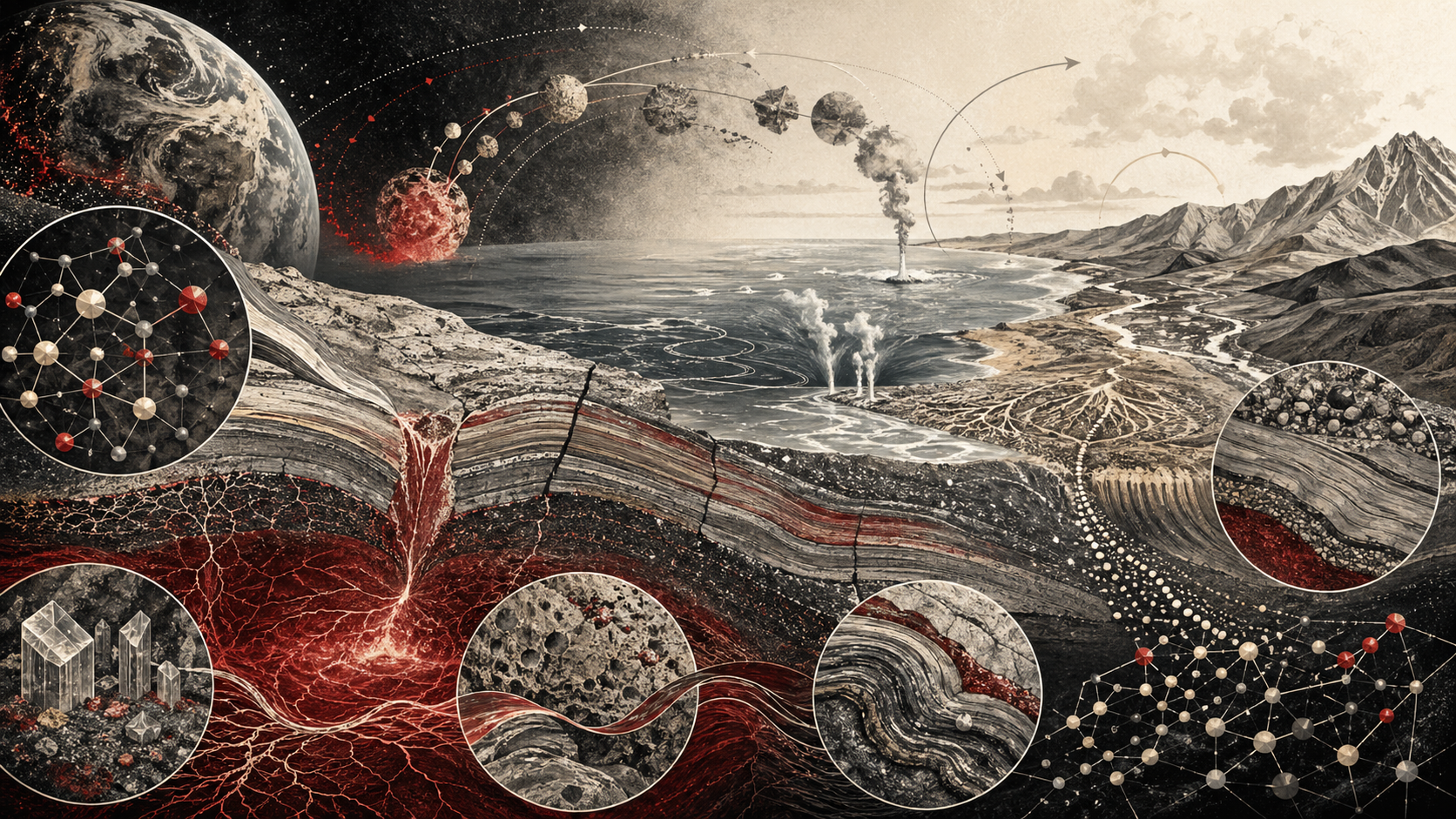
Earth as a Chemical Archive
Earth’s history is not preserved only in fossils, landscapes, or stratigraphic layers. It is preserved chemically. The planet’s materials record the conditions under which they formed, transformed, reacted, dissolved, crystallized, melted, metamorphosed, oxidized, reduced, buried, exhumed, or were transported. Geochemistry uses this record to reconstruct processes spanning scales from atomic substitutions inside minerals to global cycles operating over billions of years.
A geochemical sample can contain many kinds of information. Major elements reveal broad mineral composition. Trace elements reveal source, melting, crystallization, fluid interaction, and environmental conditions. Isotopes reveal age, temperature, biological cycling, redox state, provenance, fluid sources, and reaction pathways. Mineral assemblages reveal pressure, temperature, oxygen fugacity, water activity, and chemical environment. Sedimentary chemistry reveals weathering, erosion, ocean composition, productivity, oxygenation, and diagenesis.
Geochemistry is therefore both analytical and historical. It measures the chemical composition of materials, but its deeper purpose is interpretation. A basalt is not merely a rock with certain percentages of silicon, magnesium, iron, calcium, sodium, aluminum, and titanium. It is a record of mantle composition, melting conditions, tectonic setting, crystallization, alteration, and possible interaction with water or crust. A limestone is not merely calcium carbonate. It may preserve seawater chemistry, biological activity, carbon cycling, diagenesis, and climate context.
This is why geochemistry is foundational for understanding Earth-system habitability. The atmosphere, oceans, soils, sediments, crust, mantle, and biosphere are chemically coupled. Their present state is the result of long chemical history: accretion, core formation, mantle differentiation, volcanism, weathering, ocean formation, atmospheric evolution, oxygenation, biological innovation, burial, uplift, erosion, and human alteration.
For researchers and scientists, geochemistry is strongest when chemistry is interpreted with context. A number alone rarely tells Earth’s history. A number tied to mineralogy, petrography, stratigraphy, field relationships, analytical uncertainty, and geological process can become evidence.
Elements, Minerals, and Planetary Differentiation
The chemical history of Earth begins with element distribution. Planetary materials are not chemically uniform. During Earth’s formation, gravity, heat, melting, metal-silicate separation, and volatile loss helped differentiate the planet into core, mantle, crust, ocean, and atmosphere. Iron and nickel became concentrated in the metallic core. Silicate minerals dominated the mantle and crust. Volatile compounds contributed to atmosphere and hydrosphere. Elements were partitioned according to size, charge, volatility, density, bonding behavior, oxidation state, and affinity for metal, silicate, sulfide, fluid, or gas phases.
Geochemists often group elements by geochemical behavior. Lithophile elements tend to associate with silicate and oxide phases. Siderophile elements tend to associate with metallic iron. Chalcophile elements tend to associate with sulfide phases. Atmophile elements are volatile and tend to reside in atmospheres or gases. These categories are simplifications, but they help explain why certain elements are concentrated in particular planetary reservoirs.
Minerals are the structured chemical phases that make Earth readable. A mineral’s composition and crystal structure determine what elements it can host, how it reacts with fluids, how it records pressure and temperature, how it alters during weathering, and how it preserves isotopic signatures. Quartz, feldspar, olivine, pyroxene, amphibole, mica, calcite, dolomite, magnetite, hematite, pyrite, clay minerals, zircon, apatite, monazite, garnet, and many other minerals function as chemical witnesses.
Planetary differentiation also created chemical gradients that continue to drive geological activity. The mantle partially melts to form magma. Magma differentiates as minerals crystallize. Fluids mobilize elements through rocks. Weathering transfers elements from continents to rivers and oceans. Subduction returns materials to the mantle. Volcanism returns gases and elements to the surface. Earth is chemically differentiated, but it is not chemically static.
For researchers, planetary differentiation is not only a story of early Earth. It is a framework for interpreting present-day chemical reservoirs. Mantle, crust, ocean, atmosphere, sediments, and biosphere differ chemically because elements have moved among reservoirs through melting, crystallization, degassing, weathering, burial, metamorphism, and biological mediation.
Rocks as Chemical Records
Rocks are mixtures of minerals, glass, pores, fluids, and sometimes organic matter. Their chemistry records formation and transformation. Igneous rocks reveal melting, crystallization, magma mixing, fractional crystallization, assimilation, and tectonic setting. Sedimentary rocks reveal weathering, transport, deposition, ocean chemistry, biological production, diagenesis, and erosion of source terrains. Metamorphic rocks reveal pressure-temperature histories, fluid-rock interaction, deformation, and mineral reactions.
Igneous geochemistry often uses major oxides such as SiO2, Al2O3, FeO, MgO, CaO, Na2O, K2O, TiO2, MnO, and P2O5. These help classify rocks and infer crystallization or melting trends. Trace elements such as rare earth elements, zirconium, niobium, yttrium, strontium, rubidium, barium, thorium, uranium, nickel, chromium, cobalt, and vanadium can reveal mantle source characteristics, crustal contamination, fluid mobility, and tectonic processes.
Sedimentary geochemistry uses element ratios, isotopes, mineralogy, and organic matter to reconstruct source and environment. Chemical weathering indices can estimate the degree to which feldspars and mafic minerals have been altered to clays and oxides. Carbonates can preserve carbon and oxygen isotope signals. Shales can preserve redox-sensitive metals, organic carbon, sulfur isotopes, and detrital provenance. Evaporites preserve salinity and basin chemistry. Iron formations preserve information about ancient ocean redox conditions.
Metamorphic geochemistry interprets how rocks change under pressure, temperature, and fluid conditions. Minerals form, break down, exchange elements, and record equilibrium or disequilibrium. Garnet zoning, zircon rims, monazite ages, fluid inclusions, and stable isotope shifts can preserve stages of metamorphic history. Metamorphism is therefore not only physical transformation; it is chemical reorganization under changing thermodynamic conditions.
Rocks also record overprinting. A primary igneous signature may be modified by hydrothermal alteration. A sedimentary signal may be altered by diagenesis. A metamorphic mineral may preserve older cores and younger rims. Geochemical interpretation requires asking which signal is primary, which is altered, which is inherited, and which belongs to a later event.
Isotopes and Deep Time
Isotopes are atoms of the same element with different numbers of neutrons. Because isotopes of an element have nearly identical chemical behavior but different masses or nuclear properties, they can preserve information about sources, reactions, temperatures, ages, and biological processes. Isotope geochemistry is one of the most powerful tools for reconstructing Earth history.
Stable isotopes do not decay radioactively over geological time. Their ratios can shift through fractionation, which occurs when physical, chemical, or biological processes preferentially partition isotopes. Carbon isotopes can record organic carbon burial, carbonate chemistry, methane cycling, and biological productivity. Oxygen isotopes can record temperature, ice volume, water-rock interaction, and fluid sources. Sulfur isotopes can record microbial sulfate reduction, sulfide oxidation, atmospheric chemistry, and redox conditions. Strontium isotopes can reflect weathering sources and seawater evolution.
Radiogenic isotopes are produced by radioactive decay. They can be used as clocks and tracers. Uranium-lead dating of zircon can constrain crystallization ages. Potassium-argon and argon-argon dating can constrain volcanic and metamorphic histories. Rubidium-strontium, samarium-neodymium, lutetium-hafnium, rhenium-osmium, and other systems can reveal ages, sources, mantle differentiation, crustal residence, and planetary evolution.
Isotope ratios are often written relative to standards or as delta values. For a stable isotope system, delta notation may be written as:
\delta X = \left(\frac{R_{\mathrm{sample}}}{R_{\mathrm{standard}}} – 1\right) \times 1000
\]
Interpretation: \(R\) is an isotope ratio, such as \(^{13}C/^{12}C\), \(^{18}O/^{16}O\), or \(^{34}S/^{32}S\). Delta notation expresses small isotope differences relative to a standard, usually in per mil.
Isotopic interpretation requires care. Fractionation can be temperature-dependent, biologically mediated, fluid-controlled, or altered after deposition. A carbonate oxygen isotope value may reflect temperature, seawater composition, diagenesis, or fluid interaction. A carbon isotope shift may reflect productivity, carbon burial, methane cycling, or basin restriction. Strong isotope geochemistry depends on independent evidence and geological context.
Radiometric Dating and Chemical Clocks
Radiometric dating uses radioactive decay to estimate the age of rocks, minerals, fossils, or geological events. A radioactive parent isotope decays into a daughter isotope at a rate described by a decay constant. If the system remained closed and the initial daughter component can be constrained, the parent-daughter ratio can be used to calculate time.
The basic decay law is:
N(t) = N_0 e^{-\lambda t}
\]
Interpretation: \(N(t)\) is the remaining parent isotope after time \(t\), \(N_0\) is the initial parent amount, and \(\lambda\) is the decay constant.
For a parent-daughter system with no initial daughter, age can be estimated as:
t = \frac{1}{\lambda}\ln\left(1 + \frac{D}{P}\right)
\]
Interpretation: \(D\) is radiogenic daughter, \(P\) is remaining parent, and \(\lambda\) is the decay constant. This simplified relation assumes no initial daughter and closed-system behavior.
Real geochronology is more sophisticated because systems may contain initial daughter isotopes, experience lead loss, incorporate inherited cores, undergo metamorphic resetting, or violate closed-system assumptions. Mineral closure temperature, diffusion, zoning, alteration, and analytical domain matter. A date may represent crystallization, cooling, metamorphism, fluid alteration, detrital inheritance, or mixed age domains depending on the mineral system and geological context.
Different isotope systems are useful for different materials and time scales. Zircon is especially important because it can incorporate uranium while excluding much initial lead, resist weathering, survive metamorphism, and preserve growth zones. Carbon-14 is useful for much younger organic materials, not for most deep-time geological events. Argon systems can date volcanic and metamorphic processes. Re-Os systems can date sulfides and organic-rich sediments. No single isotopic clock applies to all questions.
Radiometric dating demonstrates that geochemistry is not merely composition. It is time encoded in atomic nuclei, minerals, and geological systems. The chemical history of Earth is therefore anchored by nuclear physics, mineral chemistry, analytical precision, and geological interpretation.
Weathering, Sediments, and Crustal Recycling
Weathering is the chemical and physical breakdown of rocks at Earth’s surface. It connects the solid Earth to soils, rivers, oceans, atmosphere, climate, and life. Chemical weathering dissolves minerals, releases ions, forms clay minerals, consumes acids, transfers material to rivers and oceans, and participates in long-term climate regulation. Physical weathering increases surface area and exposes fresh minerals to chemical attack.
Silicate weathering is especially important because it can consume carbon dioxide through reactions involving carbonic acid, minerals, dissolved ions, and carbonate burial. Over long time scales, this carbon-silicate cycle acts as a stabilizing feedback between climate, weathering, ocean chemistry, and volcanic degassing. Warmer and wetter conditions can enhance weathering, which can increase carbon dioxide consumption, although real systems are influenced by tectonics, land plants, erosion, lithology, hydrology, and biological activity.
Weathering also produces sediments. Sediments are not simply broken rock. They are chemical products of landscape evolution. Clay minerals, iron oxides, dissolved loads, carbonates, evaporites, organic matter, and detrital grains carry signals of parent rock, climate, relief, vegetation, transport, and diagenesis. Sedimentary basins accumulate these signals over time, creating archives of Earth-surface chemistry.
Crustal recycling closes the loop. Sediments may be buried, lithified, metamorphosed, melted, uplifted, eroded, or subducted. Elements move through weathering, sedimentation, burial, metamorphism, magmatism, volcanism, and exposure. Geochemistry traces these pathways through element ratios, isotopes, mineral inclusions, and mass balance.
For researchers, weathering interpretation requires separating climate signals from lithology, grain-size sorting, sediment recycling, diagenesis, and source-rock variation. A weathering index is useful only when its assumptions are visible and mineralogical context is known.
Redox History and the Rise of Oxygen
Earth’s chemical history is also a redox history. Redox chemistry controls the oxidation state of elements, the solubility of metals, the composition of the atmosphere and ocean, the availability of energy for metabolism, and the kinds of life that can thrive. Early Earth had very different atmospheric and oceanic chemistry from the modern planet. Oxygen was limited for much of Earth history, and the rise of oxygen transformed surface environments.
The Great Oxidation Event marks a major transition in Earth’s surface chemistry, when atmospheric oxygen increased enough to leave a durable geochemical signature. This transition affected iron, sulfur, carbon, nitrogen, trace metals, atmospheric chemistry, ocean chemistry, and biological evolution. Oxygenic photosynthesis, organic carbon burial, volcanic gases, oxidative weathering, hydrogen escape, and feedbacks among life and environment all contributed to the long oxygenation story.
Geochemical evidence for redox change includes banded iron formations, sulfur isotope anomalies, redox-sensitive trace metals, iron speciation, uranium and molybdenum behavior, organic carbon burial, paleosols, and sedimentary mineral assemblages. These proxies are not simple switches. They require interpretation because local environments can differ from global conditions, and sediments can be altered after deposition.
Oxygenation was not a single instantaneous event. Earth’s oxygen history involved low-oxygen states, local oxygen oases, atmospheric transitions, ocean oxygenation, anoxic basins, euxinic conditions, and later oxygen increases associated with biological and tectonic change. Geochemistry makes this complex history visible through chemical proxies preserved in rocks.
Redox geochemistry also matters today. Oxygen minimum zones, anoxic sediments, acid mine drainage, methane cycling, nitrogen loss, metal mobility, and contaminated groundwater all depend on redox conditions. The same principles that help reconstruct ancient oxygenation also help interpret modern environmental chemistry.
The Carbon-Silicate Cycle and Climate Regulation
The carbon-silicate cycle links atmospheric carbon dioxide, climate, weathering, rivers, oceans, carbonate formation, burial, subduction, metamorphism, and volcanic degassing. It is one of the most important long-term chemical feedbacks in Earth history. Carbon dioxide dissolves in water to form carbonic acid, which reacts with silicate minerals. Weathering products are transported to the ocean, where carbonate minerals can form and be buried. Tectonics can return carbon to the mantle and atmosphere over geological time.
A simplified weathering reaction involving calcium silicate can be represented as:
CaSiO_3 + CO_2 \rightarrow CaCO_3 + SiO_2
\]
Interpretation: This simplified reaction compresses many steps, but it illustrates the long-term coupling between silicate weathering and carbonate burial.
In real systems, reactions involve carbonic acid, bicarbonate, calcium, magnesium, clay minerals, dissolved silica, biological mediation, ocean alkalinity, and sedimentary processes. Weathering rates depend on temperature, precipitation, runoff, vegetation, soil respiration, erosion, lithology, relief, exposure of fresh minerals, and hydrologic flow paths.
Carbonate chemistry also records climate and ocean history. Carbonates can preserve carbon and oxygen isotope signatures, trace element ratios, strontium isotopes, clumped isotopes, boron isotopes, and mineralogical shifts between calcite and aragonite seas. Ocean pH, alkalinity, dissolved inorganic carbon, temperature, biological calcification, and burial all influence carbonate records.
Human carbon emissions are perturbing the carbon cycle on a much shorter time scale than many geological processes. Geochemistry helps distinguish long-term Earth-system feedbacks from rapid anthropogenic forcing. Over deep time, weathering and burial can regulate carbon dioxide, but these processes operate too slowly to neutralize rapid modern emissions on human policy time scales.
Hydrothermal Systems and Ocean Chemistry
Hydrothermal systems occur where water circulates through hot rock, reacts chemically, and returns to the surface or ocean. At mid-ocean ridges, seawater enters fractured crust, heats, reacts with basalt, loses magnesium, gains metals and reduced species, and emerges through hydrothermal vents. On continents, geothermal systems, volcanic terrains, ore-forming fluids, and metamorphic fluids also create hydrothermal chemical environments.
Hydrothermal chemistry is important because it transfers heat and elements between the solid Earth and hydrosphere. It can mobilize iron, manganese, copper, zinc, sulfur, silica, lithium, rare elements, and other species. It can create mineral deposits, support chemosynthetic ecosystems, alter ocean chemistry, and provide analogs for early Earth environments and potential extraterrestrial habitats.
Water-rock interaction depends on temperature, pressure, pH, redox state, fluid composition, mineralogy, permeability, reaction time, and phase separation. Hot acidic fluids behave differently from neutral chloride-rich fluids. Oxidizing fluids transport different species than reducing fluids. Sulfide precipitation can create ore deposits when metal-bearing fluids encounter sulfur, cooling, pressure changes, mixing, or redox shifts.
Hydrothermal systems illustrate a broader geochemical principle: fluids are powerful agents of planetary change. Water and other fluids dissolve, transport, precipitate, oxidize, reduce, hydrate, dehydrate, melt, and recrystallize Earth materials. Much of Earth’s chemical history is a history of fluid-rock interaction.
For researchers, hydrothermal interpretation requires coupling chemistry with permeability, heat flow, pressure, phase behavior, mineral saturation, fluid inclusions, isotopes, and reaction kinetics. A hydrothermal fluid is not merely a solution. It is a moving reaction system.
Ore Deposits and Critical Elements
Ore deposits are geochemical concentrations of elements that become economically, technologically, or strategically important. They form through processes that concentrate elements far above average crustal abundance. Magmatic differentiation, hydrothermal transport, sedimentary precipitation, weathering, evaporation, metamorphism, biological activity, and redox gradients can all contribute to ore formation.
Modern energy, electronics, infrastructure, agriculture, and manufacturing depend on geochemically concentrated materials. Copper, lithium, cobalt, nickel, rare earth elements, graphite, uranium, phosphate, platinum-group elements, iron, aluminum, manganese, zinc, and many other materials are tied to geological processes. Understanding where they occur and how they form is a geochemical problem as well as an economic and political one.
Critical-element geochemistry must be connected to environmental chemistry. Mining and processing can disturb sulfide minerals, produce acid mine drainage, mobilize metals, alter water chemistry, generate tailings, and affect communities. The same chemistry that concentrates useful elements can create exposure and contamination risks when extraction is poorly governed.
Geochemistry therefore sits at the intersection of planetary history, technology, sustainability, and justice. It explains how valuable elements became concentrated, but it also helps evaluate the environmental consequences of using them. A responsible mineral future requires both geochemical understanding and public accountability.
For researchers, ore interpretation should distinguish resource concentration from extraction legitimacy. A deposit may be geologically important, economically valuable, and environmentally risky at the same time. Geochemistry can characterize the system, but governance determines whether extraction protects water, land, workers, communities, and future generations.
Geochemical Proxies and Environmental Reconstruction
A geochemical proxy is a measurable chemical feature used to infer a past condition that cannot be observed directly. Proxies include isotope ratios, element ratios, trace-metal enrichments, mineral assemblages, biomarkers, fluid inclusions, rare earth element patterns, carbonate chemistry indicators, redox-sensitive metals, and weathering indices. They allow scientists to reconstruct ancient temperatures, oxygen levels, ocean chemistry, biological productivity, weathering intensity, fluid sources, and tectonic settings.
Proxies are powerful because they turn preserved matter into environmental evidence. Oxygen isotopes in carbonates can indicate temperature or water composition. Carbon isotopes can reflect carbon cycling and organic burial. Strontium isotopes in marine carbonates can track continental weathering and seawater evolution. Iron speciation and trace metals can suggest redox conditions. Rare earth element patterns can indicate source, fractionation, or hydrothermal influence.
But proxies are not direct windows into the past. They are interpretations. The same proxy signal may have multiple causes. Diagenesis can alter primary signatures. Local conditions can differ from global conditions. Biological activity, fluid flow, sediment mixing, and metamorphism can modify records. Proxy interpretation is strongest when multiple independent lines of evidence converge.
For researchers, responsible proxy use requires explicit assumptions. What does the proxy measure? What processes can change it? What are the preservation conditions? What alternative explanations exist? What independent evidence supports the interpretation? A proxy becomes scientifically powerful when it is treated as evidence with uncertainty, not as a direct translation machine.
Geochemistry and Habitability
Geochemistry explains why Earth became and remained habitable. The formation of a differentiated planet created core, mantle, crust, atmosphere, and ocean reservoirs. Volcanic degassing supplied gases. Weathering altered atmosphere and ocean chemistry. Plate tectonics recycled carbon and nutrients. Hydrothermal systems exchanged heat and elements between crust and ocean. Redox evolution transformed the atmosphere and biosphere. Mineral surfaces may have supported prebiotic chemistry. Nutrient cycles sustained life.
Habitability depends on geochemical boundary conditions. Liquid water requires pressure, temperature, and atmospheric context. Oceans require solute balance and buffering. Life requires bioessential elements such as carbon, hydrogen, nitrogen, oxygen, phosphorus, sulfur, iron, magnesium, calcium, potassium, sodium, and trace metals. Climate stability depends partly on carbon cycling, weathering, volcanic degassing, and ocean chemistry. Oxygen availability depends on photosynthesis, burial, redox sinks, and atmospheric escape.
Geochemistry also frames planetary comparison. Mars, Venus, icy moons, meteorites, and exoplanets can be studied through chemical composition, mineralogy, isotopes, volatiles, surface alteration, and redox state. Earth’s chemical history becomes a reference case for asking how planets become habitable, lose habitability, or preserve evidence of life.
The habitability question also requires humility. Earth is not a simple template that can be applied everywhere. A planet’s habitability depends on stellar environment, volatile inventory, tectonic regime, atmosphere, ocean stability, redox state, nutrient cycling, surface conditions, and time. Geochemistry provides evidence, not certainty. It allows scientists to compare worlds through material traces.
Measurement, Instrumentation, and Geochemical Evidence
Geochemistry depends on careful measurement. Major elements may be measured by X-ray fluorescence, inductively coupled plasma optical emission spectrometry, electron microprobe, or wet chemical methods. Trace elements may be measured by inductively coupled plasma mass spectrometry, laser ablation ICP-MS, neutron activation analysis, or other methods. Isotope ratios may be measured by thermal ionization mass spectrometry, multicollector ICP-MS, isotope-ratio mass spectrometry, accelerator mass spectrometry, or noble gas mass spectrometry.
Mineralogy is equally important. X-ray diffraction, Raman spectroscopy, infrared spectroscopy, electron microscopy, microprobe analysis, cathodoluminescence, and scanning methods help identify mineral phases, zoning, inclusions, alteration, and textures. Without mineral context, bulk chemistry can be misleading. The same element concentration can have different meaning depending on whether it resides in zircon, clay, sulfide, carbonate, oxide, organic matter, or fluid inclusions.
Geochemical data quality requires reference materials, blanks, duplicates, calibration, drift correction, matrix matching, detection limits, uncertainty estimates, sample preparation documentation, contamination control, and method transparency. A trace element result may depend on digestion method. An isotope result may depend on standard normalization. A weathering index may depend on oxide conversion and calcium correction. A date may depend on mineral domain, concordance, closure temperature, and geological interpretation.
Geochemical evidence is strongest when chemistry, mineralogy, field relationships, stratigraphy, petrography, geochronology, and uncertainty are interpreted together. A number alone rarely tells Earth’s history. A number in geological context can become a planetary archive.
For modern data systems, provenance is essential. A geochemical record should preserve sample location, collection method, lithology, stratigraphic context, preparation method, analytical method, instrument, calibration, standards, uncertainty, detection limits, quality flags, and interpretation notes. Data without provenance may be reusable only in a weak sense; data with provenance become scientific infrastructure.
Mathematical Lens: Ratios, Decay, Weathering, and Mass Balance
Geochemistry is deeply quantitative. Element concentrations, isotope ratios, decay constants, partition coefficients, weathering indices, mass balances, and mixing models allow chemical measurements to become historical inference.
A simple element ratio can be written as:
R_{A/B} = \frac{C_A}{C_B}
\]
Interpretation: \(C_A\) and \(C_B\) are concentrations of two elements or oxides. Ratios can help compare samples, but both numerator and denominator may vary for geologically meaningful reasons.
For isotope delta notation:
\delta X = \left(\frac{R_{\mathrm{sample}}}{R_{\mathrm{standard}}} – 1\right) \times 1000
\]
Interpretation: \(R\) is an isotope ratio and \(\delta X\) is usually expressed in per mil. This notation is widely used for stable isotope systems such as carbon, oxygen, hydrogen, sulfur, and nitrogen.
Radioactive decay follows:
N(t) = N_0e^{-\lambda t}
\]
Interpretation: \(N(t)\) is remaining parent isotope, \(N_0\) is initial parent isotope, and \(\lambda\) is the decay constant.
A simple parent-daughter age relation is:
t = \frac{1}{\lambda}\ln\left(1+\frac{D}{P}\right)
\]
Interpretation: \(D\) is radiogenic daughter, \(P\) is remaining parent, and \(\lambda\) is the decay constant. This simplified form assumes no initial daughter and closed-system behavior.
The Chemical Index of Alteration, often used for silicate weathering interpretation, can be written as:
CIA = 100 \times \frac{Al_2O_3}{Al_2O_3 + CaO^* + Na_2O + K_2O}
\]
Interpretation: Oxide quantities are commonly expressed in molar proportions and \(CaO^*\) represents calcium in silicate minerals rather than carbonates or phosphates. Higher values often indicate stronger chemical weathering, but interpretation depends on parent material, sorting, potassium metasomatism, calcium correction, and sedimentary recycling.
A simple two-component mixing model can be written as:
C_{\mathrm{mix}} = fC_1 + (1-f)C_2
\]
Interpretation: \(f\) is the fraction from source 1, \(C_1\) and \(C_2\) are endmember concentrations, and \(C_{\mathrm{mix}}\) is the mixed concentration. Isotope mixing requires careful concentration weighting.
A geochemical mass balance can be written generally as:
\mathrm{Inputs} – \mathrm{Outputs} = \Delta \mathrm{Storage}
\]
Interpretation: Applied to carbon, nitrogen, sulfur, metals, sediments, or dissolved ions, mass balance links geochemistry to Earth-system accounting. The challenge is defining boundaries, time scales, reservoirs, fluxes, and uncertainty.
These equations are useful because they make assumptions visible. They do not interpret themselves. A ratio, index, date, or mass balance becomes geochemical evidence only when combined with sample context, analytical uncertainty, mineralogy, and geological reasoning.
Computational Workflows for Geochemical Interpretation
Computational geochemistry can make interpretation more transparent and reproducible. A workflow can track sample metadata, lithology, location, stratigraphic context, major oxides, trace elements, isotope ratios, mineralogy, analytical method, standards, uncertainty, weathering indices, element ratios, radiometric-age calculations, redox proxies, and quality-control flags.
Useful workflows include rock classification, weathering index calculation, rare earth element normalization, isotope delta conversion, parent-daughter age screening, provenance analysis, redox proxy comparison, mass-balance modeling, geochemical mixing models, quality-control review, and data provenance tracking. More advanced workflows may integrate geospatial analysis, stratigraphic databases, petrographic images, mineral chemistry, thermodynamic modeling, reactive transport, Bayesian geochronology, and machine learning for pattern detection.
For researchers, computational geochemistry should preserve units and assumptions. Oxide weight percent is not the same as molar proportion. A simplified CIA calculation is not the same as a corrected silicate-weathering index. A radiometric age equation is not a full geochronological interpretation. A machine-learning classifier is not a substitute for mineralogical and field context. The workflow should make these differences visible.
The examples below use synthetic data and simplified calculations. They are not substitutes for professional geochemical interpretation, certified laboratory workflows, geochronology, field geology, resource assessment, or environmental risk assessment. Their purpose is to show how geochemical reasoning can be structured, audited, and communicated responsibly.
Python Example: Weathering Index and Radiometric Age
The following Python example uses synthetic geochemical data to calculate a simplified Chemical Index of Alteration and a simplified parent-daughter radiometric age. The workflow is educational. It does not replace professional geochemical interpretation, laboratory standards, geochronology, or field context.
from dataclasses import dataclass
from typing import Dict, List
import math


@dataclass
class RockSample:
    """Synthetic educational geochemical sample.

    Oxide values are illustrative weight percentages. This simplified example
    does not replace molar conversion, CaO* correction, certified laboratory
    methods, petrography, field context, or professional interpretation.
    """

    sample_id: str
    rock_type: str
    sio2_wt_pct: float
    al2o3_wt_pct: float
    cao_wt_pct: float
    na2o_wt_pct: float
    k2o_wt_pct: float


def simplified_cia(sample: RockSample) -> float:
    """Calculate simplified CIA using oxide weight percentages."""
    denominator = (
        sample.al2o3_wt_pct
        + sample.cao_wt_pct
        + sample.na2o_wt_pct
        + sample.k2o_wt_pct
    )

    if denominator <= 0:
        return 0.0

    return 100.0 * sample.al2o3_wt_pct / denominator


def weathering_screen(cia_value: float) -> str:
    """Return a simplified weathering screen label."""
    if cia_value > 80:
        return "strong_weathering_screen"
    if cia_value > 65:
        return "moderate_weathering_screen"
    return "low_weathering_screen"


def parent_daughter_age_years(
    parent: float,
    radiogenic_daughter: float,
    decay_constant_per_year: float
) -> float:
    """Simplified parent-daughter age calculation.

    Assumes no initial daughter and closed-system behavior.
    """
    if parent <= 0 or decay_constant_per_year <= 0:
        return 0.0

    return (1.0 / decay_constant_per_year) * math.log(
        1.0 + radiogenic_daughter / parent
    )


samples: List[RockSample] = [
    RockSample("GEO-001", "basalt", 49.2, 15.4, 10.5, 2.9, 0.8),
    RockSample("GEO-002", "granite", 72.5, 14.1, 1.8, 3.6, 4.8),
    RockSample("GEO-003", "shale", 61.0, 18.2, 1.2, 1.1, 3.4),
    RockSample("GEO-004", "weathered_saprolite", 54.0, 25.5, 0.8, 0.3, 1.2),
]

for sample in samples:
    cia = simplified_cia(sample)
    print({
        "sample_id": sample.sample_id,
        "rock_type": sample.rock_type,
        "CIA_simplified": round(cia, 2),
        "weathering_screen": weathering_screen(cia),
    })

parent = 1.00
radiogenic_daughter = 0.35
decay_constant_per_year = 1.55125e-10

age_years = parent_daughter_age_years(
    parent,
    radiogenic_daughter,
    decay_constant_per_year
)

print({
    "simplified_radiometric_age_Ma": round(age_years / 1e6, 1),
    "important_limit": (
        "This omits initial daughter correction, discordance, closure behavior, "
        "mineral-domain interpretation, and analytical uncertainty."
    ),
})
The CIA calculation above is intentionally simplified. A more rigorous workflow would convert oxide weight percentages to molar proportions, correct calcium for non-silicate phases, evaluate parent composition, inspect mineralogy, and account for diagenesis and sediment sorting. Likewise, the radiometric dating example omits initial daughter correction, discordance, mineral closure, analytical uncertainty, and geological context.
R Example: Geochemical Screening and Rock-Type Summary
The following R example summarizes synthetic geochemical samples by rock type and calculates a simplified weathering index. It uses base R for portability.
sample_id <- c("GEO-001", "GEO-002", "GEO-003", "GEO-004")
rock_type <- c("basalt", "granite", "shale", "weathered_saprolite")
SiO2_wt_pct <- c(49.2, 72.5, 61.0, 54.0)
Al2O3_wt_pct <- c(15.4, 14.1, 18.2, 25.5)
CaO_wt_pct <- c(10.5, 1.8, 1.2, 0.8)
Na2O_wt_pct <- c(2.9, 3.6, 1.1, 0.3)
K2O_wt_pct <- c(0.8, 4.8, 3.4, 1.2)
Rb_ppm <- c(12, 165, 110, 45)
Sr_ppm <- c(420, 190, 160, 85)
Zr_ppm <- c(95, 240, 180, 120)

rocks <- data.frame(
  sample_id,
  rock_type,
  SiO2_wt_pct,
  Al2O3_wt_pct,
  CaO_wt_pct,
  Na2O_wt_pct,
  K2O_wt_pct,
  Rb_ppm,
  Sr_ppm,
  Zr_ppm
)

rocks$CIA_simplified <- 100 * rocks$Al2O3_wt_pct /
  (
    rocks$Al2O3_wt_pct +
      rocks$CaO_wt_pct +
      rocks$Na2O_wt_pct +
      rocks$K2O_wt_pct
  )

rocks$weathering_screen <- ifelse(
  rocks$CIA_simplified > 80,
  "strong_weathering_screen",
  ifelse(
    rocks$CIA_simplified > 65,
    "moderate_weathering_screen",
    "low_weathering_screen"
  )
)

rocks$Rb_Sr_ratio <- rocks$Rb_ppm / rocks$Sr_ppm

summary_by_type <- aggregate(
  cbind(SiO2_wt_pct, CIA_simplified, Rb_Sr_ratio, Zr_ppm) ~ rock_type,
  data = rocks,
  FUN = mean
)

summary_by_type <- summary_by_type[order(summary_by_type$CIA_simplified, decreasing = TRUE), ]

print(rocks)
print(summary_by_type)
In a full geochemistry workflow, this analysis would include uncertainty, detection limits, certified reference materials, blank correction, normalization, molar conversion, mineralogical context, spatial metadata, stratigraphic position, and visualization. The example shows the basic movement from chemical composition to interpretive geochemical indicators.
SQL Example: Geochemical Evidence Register
Geochemical interpretation becomes more reliable when measurements, methods, samples, standards, and uncertainty are traceable. A simple evidence register can preserve sample context, analytical results, calculation assumptions, and interpretive notes.
CREATE TABLE geochemical_sample (
    sample_id TEXT PRIMARY KEY,
    sample_name TEXT,
    rock_type TEXT,
    latitude REAL,
    longitude REAL,
    stratigraphic_unit TEXT,
    collection_date TEXT,
    field_context TEXT,
    alteration_notes TEXT,
    uncertainty_notes TEXT
);

CREATE TABLE major_oxide_analysis (
    analysis_id INTEGER PRIMARY KEY,
    sample_id TEXT NOT NULL,
    method TEXT,
    SiO2_wt_pct REAL CHECK (SiO2_wt_pct >= 0),
    Al2O3_wt_pct REAL CHECK (Al2O3_wt_pct >= 0),
    FeO_wt_pct REAL CHECK (FeO_wt_pct >= 0),
    MgO_wt_pct REAL CHECK (MgO_wt_pct >= 0),
    CaO_wt_pct REAL CHECK (CaO_wt_pct >= 0),
    Na2O_wt_pct REAL CHECK (Na2O_wt_pct >= 0),
    K2O_wt_pct REAL CHECK (K2O_wt_pct >= 0),
    TiO2_wt_pct REAL CHECK (TiO2_wt_pct >= 0),
    quality_flag TEXT,
    FOREIGN KEY (sample_id) REFERENCES geochemical_sample(sample_id)
);

CREATE TABLE isotope_analysis (
    isotope_analysis_id INTEGER PRIMARY KEY,
    sample_id TEXT NOT NULL,
    isotope_system TEXT,
    ratio_name TEXT,
    ratio_value REAL,
    standard_name TEXT,
    delta_value_permil REAL,
    method TEXT,
    uncertainty_2sigma REAL,
    interpretation_notes TEXT,
    FOREIGN KEY (sample_id) REFERENCES geochemical_sample(sample_id)
);

CREATE TABLE geochemical_interpretation (
    interpretation_id INTEGER PRIMARY KEY,
    sample_id TEXT NOT NULL,
    indicator_name TEXT,
    indicator_value REAL,
    calculation_notes TEXT,
    confidence_score REAL CHECK (confidence_score BETWEEN 0 AND 1),
    review_status TEXT,
    FOREIGN KEY (sample_id) REFERENCES geochemical_sample(sample_id)
);

SELECT
    g.sample_id,
    g.rock_type,
    m.method,
    ROUND(
        100.0 * m.Al2O3_wt_pct /
        NULLIF(
            m.Al2O3_wt_pct + m.CaO_wt_pct + m.Na2O_wt_pct + m.K2O_wt_pct,
            0
        ),
        2
    ) AS CIA_simplified,
    m.quality_flag,
    g.alteration_notes
FROM geochemical_sample g
JOIN major_oxide_analysis m
    ON g.sample_id = m.sample_id
ORDER BY CIA_simplified DESC;
The purpose of this register is to keep geochemical interpretation attached to evidence. A weathering index, isotope value, trace-element ratio, or radiometric date should not be detached from sample context, analytical method, uncertainty, quality control, and geological interpretation.
GitHub Repository
The companion repository for this article can support reproducible workflows for geochemical screening, weathering indices, isotope notation, parent-daughter age calculations, element-ratio analysis, sample provenance, SQL evidence registers, and responsible geochemical interpretation.
Complete Code Repository
The full code distribution for this article, including selected geochemistry examples, expanded computational workflows, reproducible data structures, provenance documentation, weathering-index calculations, isotope-ratio examples, SQL evidence registers, and scientific-computing scaffolding, is available on GitHub.
Limits, Uncertainty, and Responsible Interpretation
Geochemical interpretation is powerful but uncertain. Rocks can be altered after formation. Minerals can be reset by heat or fluids. Isotope systems can be disturbed. Sediments can mix sources. Weathering can change composition. Diagenesis can modify primary signals. Analytical methods can introduce bias. Standards can differ. Samples may not represent the system they are used to infer.
Deep-time interpretation is especially challenging because evidence is incomplete. Old rocks are rare, metamorphosed, deformed, altered, or destroyed by plate tectonics. Ancient atmosphere and ocean chemistry must be inferred indirectly from proxies. A single proxy may have multiple interpretations. Strong conclusions often require convergence among independent lines of evidence.
Good geochemistry therefore emphasizes context and uncertainty. It asks whether a sample is primary or altered, whether the system remained closed, whether the proxy is specific, whether multiple explanations are possible, whether analytical uncertainty is quantified, and whether field relationships support the chemical interpretation. Geochemistry is not the extraction of truth from numbers alone. It is disciplined inference from chemically measured materials in geological context.
The computational examples associated with this article are synthetic and educational. They do not perform certified geochemical analysis, determine resource value, assess environmental safety, validate geochronological ages, replace field geology, or substitute for professional geochemical interpretation. They are designed to show how geochemical reasoning can be structured, audited, and communicated responsibly.
Responsible geochemistry also requires attention to social consequence. Geochemical knowledge informs mineral extraction, groundwater protection, environmental remediation, climate reconstruction, planetary exploration, and public policy. The field’s power should therefore be used with transparency, humility, and accountability to affected communities and environments.
Conclusion
Geochemistry reveals Earth as a chemical history written in matter. Elements, isotopes, minerals, rocks, sediments, fluids, gases, and ores preserve evidence of planetary formation, crustal evolution, ocean chemistry, atmospheric change, biological innovation, climate regulation, and resource concentration. Through geochemistry, chemistry becomes a historical science of the planet.
The field’s importance lies in its ability to connect atomic-scale evidence to Earth-scale change. A zircon crystal can constrain crustal age. A sulfur isotope anomaly can reveal atmospheric chemistry. A carbonate isotope value can record ocean conditions. A rare earth element pattern can reveal source and differentiation. A weathering index can trace landscape alteration. A radiogenic isotope system can measure time. A hydrothermal mineral deposit can record fluid movement and chemical concentration.
Geochemistry is therefore essential to any serious understanding of Earth-system chemistry. It links the deep interior to surface habitability, the ancient atmosphere to biological evolution, the carbon cycle to climate, mineral resources to technology, and environmental risk to geological process. The chemical history of Earth is not background. It is the material foundation on which life, climate, water, land, and civilization depend.
Related articles
- Environmental Chemistry and the Chemical Conditions of Habitability
- Atmospheric Chemistry and Climate Processes
- Water Chemistry and Environmental Monitoring
- Soil Chemistry, Nutrient Cycles, and Land Systems
- Ocean Chemistry and the Carbonate System
- Oxidation, Reduction, and Electron Transfer
- Analytical Chemistry and the Identification of Matter
- Spectroscopy and the Measurement of Molecular Structure
- Mass Spectrometry and Molecular Detection
- Reaction Networks and Chemical Systems Modeling
- Astrochemistry and the Molecular Universe
Further reading
- Albarède, F. (2009) Geochemistry: An Introduction. 2nd edn. Cambridge: Cambridge University Press.
- Faure, G. and Mensing, T.M. (2005) Isotopes: Principles and Applications. 3rd edn. Hoboken, NJ: Wiley.
- Holland, H.D. and Turekian, K.K. (eds.) (2014) Treatise on Geochemistry. 2nd edn. Amsterdam: Elsevier.
- Rollinson, H.R. (1993) Using Geochemical Data: Evaluation, Presentation, Interpretation. London: Longman.
- White, W.M. (2013) Geochemistry. Chichester: Wiley-Blackwell.
- National Research Council (2001) Basic Research Opportunities in Earth Science. Washington, DC: National Academies Press. Available at: https://nap.nationalacademies.org/catalog/9981/basic-research-opportunities-in-earth-science
References
- International Union of Pure and Applied Chemistry (n.d.) Compendium of Chemical Terminology, the Gold Book. Available at: https://goldbook.iupac.org/
- International Union of Pure and Applied Chemistry (n.d.) Periodic Table of the Isotopes. Available at: https://iupac.org/isotopes-matter/
- International Union of Pure and Applied Chemistry (n.d.) Periodic Table of the Elements. Available at: https://iupac.org/what-we-do/periodic-table-of-elements/
- NASA Astrobiology (n.d.) Earth’s Early Atmosphere: An Update. Available at: https://astrobiology.nasa.gov/news/earths-early-atmosphere-an-update/
- NASA Astrobiology (n.d.) Clues to Oxygen on Earth before the Great Oxidation Event. Available at: https://astrobiology.nasa.gov/news/clues-to-oxygen-on-earth-before-the-great-oxidation-event/
- NASA Astrobiology (2019) Clues to the Early Rise of Oxygen on Earth Found in Ancient Rocks. Available at: https://astrobiology.nasa.gov/nai/articles/2019/3/5/clues-of-earths-early-rise-of-oxygen/index.html
- National Institute of Standards and Technology (n.d.) NIST Chemistry WebBook. Available at: https://webbook.nist.gov/chemistry/
- National Oceanic and Atmospheric Administration (n.d.) What Is Ocean Acidification? Available at: https://oceanservice.noaa.gov/facts/acidification.html
- National Oceanic and Atmospheric Administration (n.d.) Ocean Carbon & Biogeochemistry. Available at: https://globalocean.noaa.gov/the-ocean/ocean-carbon-biogeochemistry/
- United States Geological Survey (n.d.) Geochemistry. Available at: https://www.usgs.gov/centers/gggsc/science/geochemistry
- United States Geological Survey (n.d.) National Geochemical Database. Available at: https://www.usgs.gov/centers/gggsc/science/national-geochemical-database
- United States Geological Survey (n.d.) Geochemical Data Portal for Rock, Sediment, Soil, and Mineral Samples in the United States and Territories. Available at: https://www.usgs.gov/tools/geochemical-data-portal-rock-sediment-soil-and-mineral-samples-united-states-and-territories
- United States Geological Survey (2023) Geochemical Data for Rock, Sediment, Soil, and Mineral Samples in the United States and Territories, 1962–2023. Available at: https://www.usgs.gov/data/geochemical-data-rock-sediment-soil-and-mineral-samples-united-states-and-territories-1962