
Last Updated May 28, 2026
Water chemistry studies the dissolved, suspended, particulate, biological, and reactive composition of water. It explains why water is not simply a transparent medium but a chemically structured environment that carries minerals, nutrients, gases, metals, organic compounds, acids, bases, particles, microorganisms, and anthropogenic contaminants through rivers, lakes, reservoirs, wetlands, groundwater, drinking-water systems, wastewater systems, estuaries, and oceans.
The central thesis of water chemistry is that water quality is a chemically measurable condition of habitability. Safe drinking water, healthy aquatic ecosystems, productive agriculture, resilient infrastructure, functioning sanitation systems, and sustainable development all depend on the chemical state of water. That state is not captured by one number. It emerges from pH, alkalinity, hardness, salinity, conductivity, dissolved oxygen, temperature, turbidity, nutrients, trace metals, organic contaminants, disinfectants, disinfection byproducts, dissolved organic matter, microbial indicators, redox conditions, and the physical movement of water through landscapes and infrastructure.
Water chemistry is therefore both a laboratory science and a public evidence system. It connects molecules to watersheds, treatment plants to household taps, aquifers to agriculture, wastewater to ecological risk, storm events to pollutant loads, and monitoring data to governance. To understand water chemically is to understand one of the most important ways societies detect harm, protect health, restore ecosystems, and hold institutions accountable.
Main Library
Publications
Article Map
Chemistry
Related Topic
Environmental Science
Related Topic
Earth Science
Related Topic
Public Health
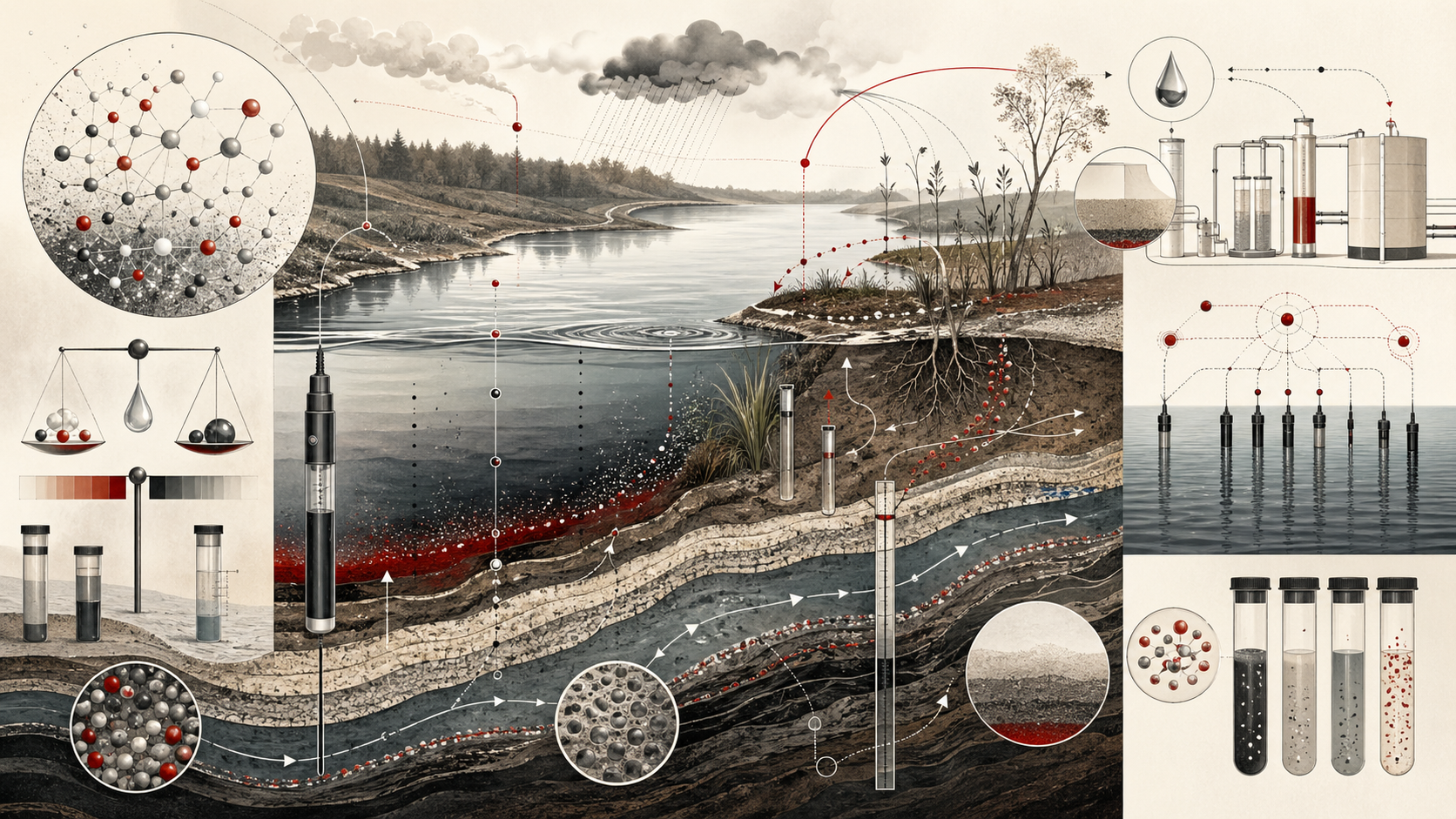
Water as a Chemical System
Water is chemically unusual and environmentally decisive. Its polarity, hydrogen bonding, high heat capacity, density behavior, solvent properties, acid-base reactivity, and ability to transport ions and molecules make it central to Earth’s biogeochemical cycles. In environmental systems, water dissolves minerals, exchanges gases with the atmosphere, transports nutrients, mobilizes contaminants, supports microbial metabolism, buffers or amplifies acidity, carries suspended sediment, and links terrestrial, aquatic, atmospheric, and biological processes.
Water chemistry must therefore be understood as a system of interactions. Rainwater reacts with atmospheric carbon dioxide, aerosols, dust, and pollutants. Surface water reacts with soils, bedrock, organic matter, sediments, sunlight, and living organisms. Groundwater reflects mineral dissolution, residence time, redox state, ion exchange, and contamination history. Drinking-water chemistry is shaped by source water, treatment, disinfectants, distribution pipes, corrosion control, storage, and premise plumbing. Wastewater chemistry reflects households, industry, pharmaceuticals, nutrients, pathogens, organic matter, metals, and treatment processes.
Because water moves, its chemistry is also a record of landscape processes. A river sample may carry signals of geology, agriculture, wastewater, urban runoff, atmospheric deposition, groundwater inflow, erosion, vegetation, temperature, and seasonal hydrology. Water monitoring is therefore not only a way to measure water. It is a way to read the chemical consequences of land use, infrastructure, climate, and ecological change.
Water is also a boundary medium. It sits between atmosphere and soil, between rivers and groundwater, between treatment plants and homes, between farms and downstream estuaries, between wastewater systems and receiving waters, between climate change and public health. Chemical evidence in water often reveals interactions that are otherwise invisible.
For researchers and scientists, water chemistry requires attention to both composition and context. A concentration value may mean very different things depending on flow, temperature, pH, hardness, dissolved organic carbon, redox state, salinity, particle load, exposure route, and regulatory or ecological endpoint. The chemistry is measurable, but the meaning is system-dependent.
Why Water Monitoring Matters
Environmental monitoring makes water chemistry visible. Without monitoring, chemical change often remains hidden until it appears as illness, fish kills, algal blooms, corrosion, taste and odor problems, ecosystem impairment, groundwater contamination, infrastructure failure, or loss of trust in public systems. Monitoring provides the evidence needed to detect problems, evaluate trends, protect drinking water, manage watersheds, assess restoration, regulate discharges, understand exposure, and support public accountability.
Water monitoring serves several distinct purposes. Baseline characterization establishes the expected chemical condition of a water body, aquifer, watershed, or treatment system. Trend detection determines whether concentrations are improving, worsening, or stable over time. Source identification distinguishes natural background chemistry from agricultural, industrial, urban, wastewater, mining, or atmospheric sources. Compliance assessment compares measured values with legal standards, permit limits, criteria, or treatment requirements.
Monitoring also supports public-health protection by identifying drinking-water contaminants, microbial risks, disinfection byproducts, lead and copper corrosion risks, nitrate exposure, or chemical mixtures. It supports ecological assessment by evaluating dissolved oxygen, pH, nutrients, temperature, salinity, toxic chemicals, sediment, and biological stressors. It supports restoration evaluation by measuring whether management actions reduce pollutant loads or improve chemical conditions. It supports early warning by detecting contamination events, harmful algal bloom conditions, salinity intrusion, treatment failure, or changing source-water chemistry.
Monitoring is therefore not merely data collection. It is a scientific design problem. A useful monitoring program must align sampling locations, frequency, analytes, methods, detection limits, quality assurance, data systems, and interpretation with the decision being made. A monitoring network designed for annual trend detection may miss storm pulses. A drinking-water compliance sample may not represent ecological exposure. A sensor network may capture high-frequency patterns but miss low-level trace organic contaminants. The design must fit the question.
Water monitoring is also a trust system. When communities question water safety, when downstream residents experience pollution, when utilities report compliance, when restoration projects claim success, or when regulators evaluate permits, chemistry becomes public evidence. That evidence must be transparent enough to be examined and rigorous enough to support action.
Core Water-Quality Parameters
Water quality is multidimensional. A clear water sample may contain dissolved nitrate, arsenic, PFAS, or microbial contaminants. A turbid stream may be chemically safe for some uses but ecologically stressed by sediment. A groundwater sample may be free of pathogens but high in dissolved minerals, fluoride, arsenic, nitrate, or salinity. A treated water sample may meet microbial goals while raising corrosion or disinfection byproduct concerns.
Core water-quality parameters include temperature, pH, alkalinity, hardness, specific conductance, total dissolved solids, turbidity, dissolved oxygen, nutrients, major ions, trace metals, organic contaminants, microbial indicators, dissolved organic matter, and redox-sensitive species. Each parameter reveals a different part of the system. Temperature controls reaction rates, gas solubility, biological metabolism, stratification, and dissolved oxygen dynamics. pH influences corrosion, toxicity, metal solubility, ammonia speciation, carbonate chemistry, and aquatic life. Alkalinity measures acid-neutralizing capacity. Hardness reflects calcium and magnesium concentration and affects scaling, corrosion, and some toxicity interpretations.
Specific conductance reflects the ability of water to conduct electrical current and is often used as a proxy for dissolved ionic content. Total dissolved solids represent dissolved inorganic and organic substances remaining after filtration and drying under defined conditions. Turbidity measures light scattering by suspended particles and can signal sediment, runoff, microbial risk, or treatment challenges. Dissolved oxygen indicates oxygen available for aquatic organisms and reflects photosynthesis, respiration, reaeration, temperature, organic loading, and stratification.
Nutrients, especially nitrogen and phosphorus species, can drive eutrophication when excessive. Major ions such as calcium, magnesium, sodium, potassium, chloride, sulfate, bicarbonate, and carbonate reveal geology, salinity, wastewater influence, road-salt input, irrigation return flow, and treatment interactions. Trace metals such as lead, arsenic, cadmium, mercury, chromium, copper, and zinc require interpretation through speciation, hardness, pH, redox, dissolved organic matter, and exposure route. Organic contaminants require method-specific detection because concentrations can be low and mixtures complex.
These parameters are not independent. pH affects metal solubility. Temperature affects dissolved oxygen. Organic matter affects disinfection byproducts. Conductivity may rise with salinity, road salt, wastewater, irrigation return flow, or mineral dissolution. Nutrients can increase algal production, which alters pH and dissolved oxygen. Turbidity can carry particle-bound phosphorus, metals, and pathogens. Water chemistry is a network of coupled indicators.
For researchers, the practical lesson is to avoid single-number water quality. A water body cannot be understood from pH alone, nitrate alone, conductivity alone, or dissolved oxygen alone. Each variable must be interpreted as part of a chemical, biological, hydrologic, and infrastructural system.
pH, Alkalinity, Hardness, and Buffering
pH is among the most important and most misunderstood water-quality parameters. It is not a direct measure of acidity in the everyday sense, but a logarithmic expression of hydrogen ion activity. Small numerical changes in pH can represent large changes in hydrogen ion activity. A shift from pH 7 to pH 6 is a tenfold increase in hydrogen ion activity under idealized interpretation; a shift from pH 7 to pH 5 is approximately a hundredfold increase.
Alkalinity is different from pH. It measures water’s capacity to neutralize acid. A lake with moderate pH but low alkalinity may be vulnerable to acid inputs because it lacks buffering capacity. A groundwater system with high alkalinity may resist pH swings but may also carry high bicarbonate, carbonate, calcium, or magnesium concentrations. Alkalinity is essential for understanding acid deposition, mine drainage, concrete interactions, corrosion control, carbonate equilibria, and aquatic ecosystem resilience.
Hardness is often dominated by calcium and magnesium. It affects domestic water use, scaling, industrial processes, and some toxicological interpretations. For several metals, toxicity to aquatic organisms depends partly on hardness because calcium and magnesium compete with metals at biological uptake sites. Hardness also connects water chemistry to geology: limestone, dolomite, gypsum, and other minerals leave recognizable signatures in natural water.
Buffering systems are central to water chemistry. Carbon dioxide dissolves in water, forms carbonic acid, dissociates into bicarbonate and carbonate, and interacts with minerals and biological processes. This carbonate system is especially important in lakes, rivers, groundwater, drinking-water treatment, corrosion control, and oceans. Water chemistry often turns on the relationship between pH, alkalinity, dissolved inorganic carbon, calcium carbonate saturation, and gas exchange with the atmosphere.
In engineered systems, pH, alkalinity, and hardness also shape infrastructure risk. Low alkalinity and low pH can increase corrosion potential in some contexts. High hardness and carbonate saturation can promote scaling. Corrosion control in drinking-water systems depends on source-water chemistry, disinfectant strategy, pipe materials, orthophosphate use where applicable, alkalinity, pH, dissolved inorganic carbon, chloride-to-sulfate relationships, and distribution-system operation. Water chemistry is therefore not only environmental; it is infrastructural.
Dissolved Oxygen, Redox, and Aquatic Life
Dissolved oxygen is a direct chemical constraint on aquatic life. Fish, invertebrates, microbes, and many biogeochemical processes depend on oxygen availability. Dissolved oxygen enters water through atmospheric exchange and photosynthesis, and it is consumed by respiration, decomposition, nitrification, chemical oxidation, and sediment oxygen demand. Its concentration depends on temperature, pressure, salinity, turbulence, flow, stratification, organic loading, and biological productivity.
Warm water holds less oxygen than cold water. Stagnant or stratified water can become oxygen-depleted at depth. Organic pollution can increase microbial oxygen demand, leading to hypoxia. Eutrophication can produce high daytime oxygen through photosynthesis but low nighttime oxygen through respiration. When oxygen declines, redox conditions can shift, altering nitrogen, iron, manganese, sulfur, phosphorus, and metal chemistry.
Redox chemistry determines which species dominate under different oxygen conditions. In oxygenated water, iron may precipitate as iron oxides, manganese may oxidize, and organic matter may degrade through aerobic pathways. Under low-oxygen or anoxic conditions, nitrate, manganese oxides, iron oxides, sulfate, and carbon dioxide may become alternative electron acceptors in microbial metabolism. These shifts can mobilize phosphorus from sediments, release metals, produce sulfide, generate methane, or alter contaminant degradation pathways.
Water monitoring should therefore treat dissolved oxygen not merely as an ecological parameter but as a chemical state variable. It indicates whether the system is oxidizing or moving toward reducing conditions, and it helps explain nutrient cycling, metal mobility, odor, corrosion, habitat quality, and greenhouse gas production.
For researchers, dissolved oxygen interpretation should include diel cycles, depth profiles, temperature, flow, stratification, chlorophyll, biochemical oxygen demand, sediment oxygen demand, and organic matter. A single daytime dissolved oxygen value may miss nighttime oxygen stress. A surface measurement may miss bottom-water hypoxia. Oxygen is dynamic, and monitoring design must match that dynamism.
Nutrients, Eutrophication, and Biogeochemical Cycles
Nitrogen and phosphorus are necessary for aquatic ecosystems, but excess nutrient loading can degrade water quality. Nutrient enrichment can stimulate algal growth, harmful algal blooms, aquatic plant overgrowth, turbidity, taste and odor problems, toxin production, oxygen depletion, biodiversity loss, and downstream hypoxia. Nutrient pollution is chemically complex because nitrogen and phosphorus occur in multiple forms, each with different mobility, biological availability, and transformation pathways.
Nitrogen may appear as nitrate, nitrite, ammonium, dissolved organic nitrogen, particulate organic nitrogen, or nitrogen gas. Nitrate is mobile in groundwater and surface water. Ammonium can sorb to particles and can be toxic in its un-ionized ammonia form, which increases with higher pH and temperature. Nitrite is often an intermediate in nitrification and denitrification. Organic nitrogen may become available through mineralization.
Phosphorus may appear as orthophosphate, dissolved organic phosphorus, particulate phosphorus, mineral-bound phosphorus, or sediment-associated phosphorus. In many freshwater systems, phosphorus is a limiting nutrient, so small increases in bioavailable phosphorus can have large ecological consequences. Phosphorus can bind to iron oxides under oxygenated conditions and be released under reducing conditions, creating internal loading from sediments even after external inputs are reduced.
Nutrient monitoring must therefore distinguish concentration from load. Concentration measures how much nutrient is present per volume of water. Load measures the total mass transported over time. A small stream with high concentration may carry less total nutrient mass than a large river with moderate concentration. Watershed management often requires load estimates because downstream eutrophication depends on total delivered mass as well as concentration, timing, hydrology, and ecological sensitivity.
For researchers, nutrient data should preserve chemical form. Nitrate as nitrogen is not the same reporting basis as nitrate as nitrate. Orthophosphate as phosphorus differs from phosphate as phosphate. Total phosphorus differs from dissolved reactive phosphorus. These distinctions matter for comparability, modeling, regulatory interpretation, and ecological meaning.
Metals, Organics, and Emerging Contaminants
Water can carry contaminants from natural geology, industrial activity, mining, agriculture, wastewater, landfills, urban runoff, atmospheric deposition, products, pipes, and treatment processes. Trace metals such as arsenic, lead, cadmium, mercury, chromium, copper, nickel, and zinc may be present through natural mineral dissolution or human sources. Their toxicity and mobility depend on speciation, pH, redox state, complexation, hardness, dissolved organic matter, suspended particles, and biological uptake.
Organic contaminants include solvents, pesticides, hydrocarbons, plasticizers, pharmaceuticals, personal-care products, industrial chemicals, flame retardants, surfactants, disinfection byproducts, and transformation products. Some degrade rapidly. Others persist, partition into sediments, bioaccumulate, or form more toxic products. Monitoring organic contaminants requires careful method selection because concentrations may be low, mixtures complex, and matrix interferences significant.
Emerging contaminants are not always newly created chemicals. Many are newly detected, newly prioritized, newly regulated, or newly understood. PFAS, pharmaceuticals, microplastics, algal toxins, endocrine-active compounds, transformation products, and tire-wear chemicals illustrate the challenge of monitoring substances whose environmental behavior, toxicology, analytical methods, and regulatory status may evolve over time.
Water chemistry must also account for infrastructure. Lead and copper in drinking water can arise from corrosion of plumbing materials. Disinfection byproducts form when disinfectants react with natural organic matter or other precursors. Nitrification can occur in distribution systems. Pipe scales can accumulate and release metals. Thus, water quality at the tap may differ from water quality at the treatment plant. Monitoring must follow water through the full system from source to point of use.
For researchers, contaminant interpretation must distinguish total, dissolved, particulate, bioavailable, and operationally defined fractions. A filtered metal concentration can tell a different story than an unfiltered concentration. A contaminant associated with sediment may pose benthic or resuspension risk even when dissolved concentration is low. A low-level detection may matter if the compound is persistent, bioaccumulative, toxic, widespread, or difficult to treat. Chemical form and exposure pathway are as important as chemical identity.
Groundwater Chemistry and Aquifer Evidence
Groundwater chemistry reflects water moving through geologic materials over time. As recharge water infiltrates soil and rock, it reacts with minerals, exchanges ions, changes pH and alkalinity, consumes or gains dissolved gases, and may encounter natural or anthropogenic contaminants. Groundwater is often less visually dynamic than rivers, but chemically it can preserve long histories of recharge, residence time, mineral dissolution, redox change, land use, and contamination.
Major-ion chemistry can reveal groundwater evolution. Calcium-bicarbonate waters may reflect carbonate dissolution. Sodium-chloride waters may reflect salinity, road salt, seawater intrusion, brines, or water-rock interaction. Sulfate may reflect gypsum dissolution, mine drainage, oxidation of sulfides, or wastewater influence. Nitrate may indicate agricultural, septic, wastewater, or atmospheric sources depending on setting and isotopic evidence.
Redox conditions are especially important in aquifers. Oxygenated groundwater behaves differently from reducing groundwater. Under reducing conditions, nitrate may disappear through denitrification, iron and manganese may dissolve, sulfate may reduce to sulfide, and arsenic may become more mobile in some settings. Groundwater with no nitrate is not automatically unaffected by human activity; nitrate may have been transformed under reducing conditions. Interpretation requires redox context.
Groundwater monitoring also raises spatial challenges. A monitoring well samples a particular screened interval, not an entire aquifer. Contaminant plumes may be vertically stratified. Pumping can change flow direction. Private wells may tap different depths and formations than public supply wells. Groundwater chemistry therefore requires hydrogeologic context: well construction, screened interval, aquifer material, recharge area, pumping history, and flow path.
For public health, groundwater chemistry matters because many communities rely on wells. Nitrate, arsenic, fluoride, uranium, manganese, salinity, solvents, petroleum hydrocarbons, pesticides, PFAS, and microbial contamination can all affect groundwater under certain conditions. Monitoring and interpretation must be specific to the aquifer, the well, and the exposure route.
Drinking-Water Chemistry and Infrastructure
Drinking-water chemistry begins with source water but does not end there. Treatment, storage, distribution, household plumbing, disinfectant residual, pipe materials, stagnation time, temperature, corrosion control, and premise plumbing can change water chemistry before water reaches a tap. A treated-water sample leaving a plant may not represent water after hours in a lead service line, copper pipe, galvanized pipe, storage tank, or building plumbing system.
Treatment processes are chemical processes. Coagulation changes particle and organic matter behavior. Filtration removes suspended material. Disinfection inactivates pathogens but can form byproducts. Softening changes hardness and carbonate chemistry. pH adjustment affects corrosion and scaling. Activated carbon removes some organic compounds. Ion exchange can remove selected ions. Membrane processes separate dissolved constituents. Advanced oxidation can transform contaminants. Each treatment option changes the chemical system in ways that must be monitored.
Corrosion control is one of the clearest examples of water chemistry as public infrastructure. Lead, copper, iron, and other materials can enter water through reactions between water and pipes. Corrosion depends on pH, alkalinity, dissolved inorganic carbon, chloride, sulfate, disinfectant, orthophosphate where used, stagnation, temperature, flow, pipe age, pipe scale, and changes in source water or treatment. Small changes in chemistry can destabilize scales or alter metal release.
Disinfection byproducts illustrate another tradeoff. Disinfectants are essential for microbial safety, but they can react with natural organic matter, bromide, iodide, or other precursors to form regulated and unregulated byproducts. Source-water protection, organic matter removal, disinfectant choice, contact time, pH, temperature, and distribution-system management all affect byproduct formation.
For researchers and utilities, the central challenge is system thinking. Drinking-water safety depends not only on meeting standards at one location, but on maintaining microbial protection, chemical stability, corrosion control, and distribution-system integrity across time and space. Water chemistry at the point of use is the result of the full treatment and delivery chain.
Wastewater, Stormwater, and Water Reuse Chemistry
Wastewater chemistry reflects human activity. Municipal wastewater contains organic matter, nutrients, pathogens, salts, pharmaceuticals, personal-care products, household chemicals, industrial discharges, metals, microplastics, and transformation products. Wastewater treatment reduces many risks, but treated effluent remains chemically meaningful because nutrients, organic matter, salts, trace contaminants, and disinfection byproducts may still affect receiving waters or reuse applications.
Biochemical oxygen demand and chemical oxygen demand are common aggregate indicators of oxygen-consuming material. Nutrient removal targets nitrogen and phosphorus. Disinfection targets pathogens. Advanced treatment may address micropollutants, salinity, or reuse requirements. Sludge and biosolids management introduces another chemical pathway involving metals, nutrients, organic contaminants, pathogens, and land application decisions.
Stormwater chemistry differs from wastewater because it is event-driven. Rainfall and snowmelt mobilize road salts, metals, hydrocarbons, tire-wear particles, nutrients, sediment, pesticides, bacteria, and trash from impervious surfaces, lawns, construction sites, roads, roofs, and industrial areas. The first flush of a storm may carry high concentrations. Event timing, rainfall intensity, antecedent dry period, land cover, drainage design, and season all affect stormwater chemistry.
Water reuse adds another layer of chemical interpretation. Reclaimed water may be used for irrigation, industrial cooling, groundwater recharge, environmental flows, or potable reuse depending on treatment level and regulation. Reuse chemistry must consider salts, nutrients, trace organics, pathogens, disinfection byproducts, treatment residuals, soil interactions, crop uptake, aquifer reactions, and public trust.
For researchers, wastewater and stormwater demonstrate why water chemistry must track both concentration and load. A high concentration during a short storm pulse can deliver an important mass of pollutant. A low concentration in a large effluent flow can produce a substantial load over time. Monitoring design must capture the hydrologic and operational patterns that control transport.
Sampling Design and Monitoring Networks
Water monitoring begins before a sample is collected. The first question is not which instrument to use, but what decision the data must support. A watershed nutrient study, a drinking-water compliance program, a groundwater plume investigation, a stormwater assessment, a harmful algal bloom early-warning program, and a restoration project each require different sampling designs.
Important design choices include spatial design, temporal design, hydrologic context, analyte selection, sample handling, quality assurance, and data architecture. Spatial design may include upstream and downstream stations, tributaries, wells, depth profiles, treatment points, distribution-system locations, stormwater outfalls, or reference sites. Temporal design may include continuous monitoring, grab sampling, storm-event sampling, seasonal sampling, annual trend sampling, or targeted sampling during high-risk conditions.
Hydrologic context is essential. Baseflow, stormflow, snowmelt, drought, flood, stratification, tidal exchange, groundwater recharge, reservoir turnover, and water withdrawals can all change interpretation. Analyte selection must match the problem: field parameters, nutrients, metals, organic contaminants, microbial indicators, major ions, isotopes, or emerging contaminants. Sample handling must specify filtration, preservation, container type, holding time, temperature control, chain of custody, and field blanks.
Continuous sensors can measure temperature, conductivity, pH, dissolved oxygen, turbidity, nitrate, chlorophyll, fluorescent dissolved organic matter, and other parameters at high temporal resolution. Laboratory analysis can provide more specific and sensitive measurements for metals, organics, nutrients, isotopes, and microbial indicators. Remote sensing can support turbidity, chlorophyll, algal blooms, temperature, and surface-water extent. The strongest monitoring programs combine field sensors, laboratory analysis, hydrologic measurements, remote observations, and well-structured data systems.
Sampling design also determines what cannot be concluded. A quarterly monitoring program cannot reliably characterize storm-driven nutrient pulses. A surface grab sample cannot characterize a stratified lake. A finished-water sample cannot fully characterize household tap exposure. A single well cannot define a groundwater plume. Good monitoring explains its limits as clearly as its findings.
Data Quality and Chemical Evidence
Water-quality evidence is only as strong as its sampling and data quality. A nitrate result without date, site, flow, method, unit, detection limit, and sample type cannot support strong interpretation. A metal result may differ depending on whether the sample was filtered or unfiltered. A phosphorus result may represent dissolved orthophosphate, total phosphorus, particulate phosphorus, or another operational fraction. A microbial result may depend on holding time, temperature, method, and sample contamination. A pH result can change after sampling if not measured correctly.
Quality assurance and quality control should therefore be designed into monitoring rather than added afterward. Field blanks help detect contamination. Duplicates estimate sampling and analytical variability. Matrix spikes test recovery in the sample matrix. Calibration checks detect instrument drift. Certified reference materials support traceability. Detection limits and reporting limits prevent false precision. Data qualifiers preserve information about uncertainty, estimated values, nondetects, holding-time issues, or method limitations.
Units are a frequent source of error. Nitrate may be reported as nitrate or as nitrogen. Phosphate may be reported as phosphate or as phosphorus. Metals may be reported in mg/L or µg/L. Conductivity may be reported in µS/cm or mS/cm. Turbidity may be reported in nephelometric turbidity units under method-specific conditions. A monitoring database must preserve units explicitly and avoid merging incomparable quantities.
Good water chemistry is therefore not only laboratory chemistry. It is field design, data management, analytical traceability, hydrologic context, uncertainty interpretation, and public communication. A dataset can look precise while being scientifically weak if method metadata, detection limits, sample type, or hydrologic conditions are missing.
For researchers, nondetects require special care. A nondetect does not mean zero. It means the analyte was not detected above a method-specific threshold under the conditions sampled. Trend analysis, exposure assessment, and regulatory interpretation must handle censored values explicitly rather than treating them casually as zero or as the detection limit without justification.
Water Chemistry and Environmental Governance
Water chemistry is inseparable from governance because water is both a chemical system and a public necessity. Drinking-water regulation, wastewater permits, ambient water-quality criteria, watershed restoration, groundwater protection, stormwater management, industrial discharge control, agricultural nutrient reduction, and sanitation policy all depend on chemical monitoring.
Different governance contexts use different comparison values. Drinking-water standards focus on human health and public water systems. Aquatic-life criteria focus on ecological protection. Recreational-water monitoring often uses microbial indicators. Industrial permits may limit specific pollutants or aggregate measures such as biochemical oxygen demand, total suspended solids, pH, or nutrients. Groundwater programs may use maximum contaminant levels, cleanup levels, background values, or risk-based screening levels. International monitoring frameworks may track safely managed drinking water, wastewater treatment, ambient water quality, water-use efficiency, and ecosystem change.
This diversity is necessary, but it creates interpretive risk. A value that is acceptable for one use may be unacceptable for another. A drinking-water benchmark is not automatically an aquatic-life criterion. A total concentration may not be comparable to a dissolved criterion. A single grab sample may not represent chronic exposure. A monitoring result may be legally significant only when collected under specified procedures, averaging periods, and methods.
Water chemistry therefore supports governance best when it is explicit about purpose. The same measurement can inform public health, ecosystem protection, infrastructure management, agricultural practice, industrial accountability, or climate adaptation, but the interpretation must match the decision.
Governance also requires attention to unequal burdens. Communities may face contaminated drinking water, aging infrastructure, unaffordable treatment, industrial discharge, agricultural runoff, mining legacies, flood-driven contamination, or inadequate sanitation. Water chemistry can document these conditions, but ethical governance requires that evidence lead to protection, remediation, transparency, and public participation.
Mathematical Lens: Concentration, Loads, Speciation, and Oxygen Demand
The most basic water-quality quantity is concentration:
C = \frac{m}{V}
\]
Interpretation: \(C\) is concentration, \(m\) is mass of substance, and \(V\) is volume of water. Concentrations may be expressed as mg/L, µg/L, ng/L, mol/L, or other units depending on analyte and context.
For flowing water, chemical load is often more important than concentration alone:
L = C Q
\]
Interpretation: \(L\) is mass flux or load, \(C\) is concentration, and \(Q\) is discharge. Load connects chemistry to hydrology by estimating how much mass moves through a system over time.
When \(C\) is in mg/L and \(Q\) is in L/s, daily load in kg/day can be calculated as:
L_{\mathrm{kg/day}} = C_{\mathrm{mg/L}}Q_{\mathrm{L/s}} \times 0.0864
\]
Interpretation: The conversion factor follows from 86,400 seconds per day and 1,000,000 milligrams per kilogram.
pH is defined as:
pH = -\log_{10}(a_{\mathrm{H}^+})
\]
Interpretation: \(a_{\mathrm{H}^+}\) is the activity of hydrogen ions. In simplified educational contexts, concentration may be used as an approximation, but rigorous water chemistry uses activity because ionic strength affects chemical behavior.
For a weak acid \(HA\), the Henderson-Hasselbalch relationship is:
pH = pK_a + \log_{10}\left(\frac{[A^-]}{[HA]}\right)
\]
Interpretation: This relationship matters for ammonia, carbonate species, organic acids, metals, and many contaminants whose charge state depends on pH.
Dissolved oxygen dynamics can be represented by a simplified mass balance:
\frac{dO}{dt} = R_a + P – R – SOD – BOD
\]
Interpretation: \(O\) is dissolved oxygen, \(R_a\) is reaeration from the atmosphere, \(P\) is photosynthetic oxygen production, \(R\) is biological respiration, \(SOD\) is sediment oxygen demand, and \(BOD\) is biochemical oxygen demand from degradable organic matter.
A simple benchmark screening ratio can be written as:
R = \frac{C}{B}
\]
Interpretation: \(C\) is measured concentration and \(B\) is a relevant benchmark, criterion, guideline, reference value, or standard. \(R > 1\) indicates an exceedance of the selected comparison value, but not by itself a complete legal, health, or ecological determination.
These equations are intentionally simple, but they show the logic of water chemistry: measured concentration becomes load when combined with flow, chemical form depends on pH and speciation, and ecological stress emerges from mass balances, not isolated values.
Computational Workflows for Water Chemistry
Computational water chemistry can make monitoring interpretation more transparent and reproducible. A workflow can track site, medium, date, depth, flow, analyte, concentration, unit, fraction, method, detection limit, benchmark, quality flag, hydrologic condition, load estimate, exceedance status, and interpretation notes. This is essential because water-quality conclusions often depend on details that are easy to lose in spreadsheets.
Useful workflows include benchmark screening, nutrient-load estimation, storm-event load calculation, dissolved oxygen trend analysis, pH and alkalinity review, groundwater plume tracking, major-ion balance, salinity screening, contaminant exceedance summaries, nondetect handling, data-quality flagging, sensor drift review, and monitoring-network dashboards. Advanced workflows may integrate continuous sensors, laboratory data, hydrologic models, watershed models, remote sensing, geospatial analysis, Bayesian trend detection, and automated QA/QC systems.
For researchers, computational workflows should preserve units and chemical basis. Nitrate as nitrogen should not be merged with nitrate as nitrate without conversion. Dissolved metals should not be merged with total recoverable metals unless the question supports that comparison. A benchmark based on chronic exposure should not be applied to a single event without interpretation. A load calculation without flow uncertainty can look more precise than it is.
The examples below use synthetic data and illustrative benchmarks. They do not determine regulatory compliance, diagnose health risk, establish ecological impairment, or replace professional water-quality interpretation. They demonstrate how water chemistry reasoning can be structured, audited, and communicated responsibly.
Python Example: Water-Quality Screening and Nutrient Loads
The following Python example screens synthetic water-quality observations against illustrative benchmarks and estimates daily nutrient loads from concentration and flow. It is educational and should not be used as a regulatory determination.
from dataclasses import dataclass
from typing import Dict, List


@dataclass
class WaterQualityObservation:
    """Synthetic educational water-quality observation.

    Benchmarks are illustrative and must not be treated as legal standards,
    health-based determinations, ecological criteria, or compliance thresholds.
    """

    site: str
    medium: str
    analyte: str
    concentration: float
    unit: str
    benchmark: float
    flow_l_s: float


def ratio_to_benchmark(observation: WaterQualityObservation) -> float:
    """Calculate concentration-to-benchmark screening ratio."""
    if observation.benchmark <= 0:
        return 0.0

    return observation.concentration / observation.benchmark


def screening_flag(observation: WaterQualityObservation) -> str:
    """Return a simplified benchmark-screening label."""
    if ratio_to_benchmark(observation) > 1:
        return "exceeds illustrative benchmark"
    return "below illustrative benchmark"


def nutrient_load_kg_day(observation: WaterQualityObservation) -> float:
    """Estimate kg/day for nutrients reported in mg/L and flow in L/s."""
    nutrient_analytes = {"nitrate_as_N", "phosphate_as_P"}

    if observation.analyte not in nutrient_analytes:
        return 0.0

    if observation.unit != "mg/L":
        return 0.0

    return observation.concentration * observation.flow_l_s * 0.0864


def summarize_observation(observation: WaterQualityObservation) -> Dict[str, object]:
    """Return a transparent water-quality screening summary."""
    return {
        "site": observation.site,
        "medium": observation.medium,
        "analyte": observation.analyte,
        "concentration": observation.concentration,
        "unit": observation.unit,
        "ratio_to_benchmark": round(ratio_to_benchmark(observation), 3),
        "screening_flag": screening_flag(observation),
        "nutrient_load_kg_day": round(nutrient_load_kg_day(observation), 3),
    }


observations: List[WaterQualityObservation] = [
    WaterQualityObservation("River-A", "surface_water", "nitrate_as_N", 7.8, "mg/L", 10.0, 820),
    WaterQualityObservation("River-A", "surface_water", "phosphate_as_P", 0.18, "mg/L", 0.10, 820),
    WaterQualityObservation("Lake-B", "lake", "dissolved_oxygen", 5.6, "mg/L", 5.0, 0),
    WaterQualityObservation("Groundwater-C", "groundwater", "arsenic", 12.0, "ug/L", 10.0, 5),
    WaterQualityObservation("Urban-D", "stormwater", "turbidity", 38.0, "NTU", 25.0, 210),
    WaterQualityObservation("Urban-D", "stormwater", "lead", 18.0, "ug/L", 15.0, 210),
]

for observation in observations:
    print(summarize_observation(observation))


ph_values = {
    "River-A": 7.4,
    "Lake-B": 8.6,
    "Mine-Influenced-E": 5.2,
}

for site, ph in ph_values.items():
    flag = (
        "outside illustrative aquatic range"
        if ph < 6.5 or ph > 9.0
        else "within illustrative aquatic range"
    )

    print({
        "site": site,
        "pH": ph,
        "pH_flag": flag,
    })
This workflow demonstrates three habits that matter in water monitoring. First, every screening comparison depends on the benchmark selected. Second, concentration and load answer different questions. Third, field parameters such as pH and flow are not supporting details; they are part of the chemistry.
R Example: Monitoring Summaries and Exceedance Counts
The following R example summarizes synthetic water-quality monitoring results by medium and analyte. It uses base R for portability.
site <- c("River-A", "River-A", "Lake-B", "Groundwater-C", "Urban-D", "Urban-D")
medium <- c("surface_water", "surface_water", "lake", "groundwater", "stormwater", "stormwater")
analyte <- c("nitrate_as_N", "phosphate_as_P", "dissolved_oxygen", "arsenic", "turbidity", "lead")
concentration <- c(7.8, 0.18, 5.6, 12.0, 38.0, 18.0)
unit <- c("mg/L", "mg/L", "mg/L", "ug/L", "NTU", "ug/L")
benchmark <- c(10.0, 0.10, 5.0, 10.0, 25.0, 15.0)
flow_L_s <- c(820, 820, 0, 5, 210, 210)

water <- data.frame(
  site,
  medium,
  analyte,
  concentration,
  unit,
  benchmark,
  flow_L_s
)

water$ratio_to_benchmark <- water$concentration / water$benchmark

water$screening_flag <- ifelse(
  water$ratio_to_benchmark > 1,
  "exceeds illustrative benchmark",
  "below illustrative benchmark"
)

water$load_kg_day <- 0

nutrient_rows <- water$analyte %in% c("nitrate_as_N", "phosphate_as_P")

water$load_kg_day[nutrient_rows] <-
  water$concentration[nutrient_rows] *
  water$flow_L_s[nutrient_rows] *
  0.0864

screening_counts <- as.data.frame(table(water$medium, water$screening_flag))
names(screening_counts) <- c("medium", "screening_flag", "count")

nutrient_loads <- water[nutrient_rows, c("site", "analyte", "load_kg_day")]

medium_summary <- aggregate(
  ratio_to_benchmark ~ medium,
  data = water,
  FUN = mean
)

medium_summary <- medium_summary[order(medium_summary$ratio_to_benchmark, decreasing = TRUE), ]

print(water)
print(screening_counts)
print(nutrient_loads)
print(medium_summary)
In a production monitoring program, this workflow would be extended with time stamps, coordinates, hydrologic conditions, laboratory methods, detection limits, censored-data logic, replicate analysis, trend models, spatial joins, QA/QC qualifiers, and links to source-water or watershed data.
SQL Example: Water Chemistry Evidence Register
Water chemistry interpretation becomes more reliable when monitoring observations, laboratory methods, units, detection limits, quality flags, and comparison values are traceable. A simple evidence register can preserve the context needed to interpret water-quality results responsibly.
CREATE TABLE monitoring_site (
    site_id TEXT PRIMARY KEY,
    site_name TEXT NOT NULL,
    medium TEXT,
    latitude REAL,
    longitude REAL,
    watershed TEXT,
    aquifer TEXT,
    site_description TEXT,
    land_use_context TEXT
);

CREATE TABLE water_quality_observation (
    observation_id INTEGER PRIMARY KEY,
    site_id TEXT NOT NULL,
    sample_datetime TEXT,
    sample_type TEXT,
    hydrologic_condition TEXT,
    depth_m REAL CHECK (depth_m >= 0),
    analyte TEXT NOT NULL,
    fraction TEXT,
    concentration REAL,
    unit TEXT NOT NULL,
    detection_limit REAL,
    reporting_limit REAL,
    method_code TEXT,
    laboratory_name TEXT,
    quality_flag TEXT,
    qualifier_notes TEXT,
    FOREIGN KEY (site_id) REFERENCES monitoring_site(site_id)
);

CREATE TABLE benchmark_reference (
    benchmark_id INTEGER PRIMARY KEY,
    analyte TEXT NOT NULL,
    medium TEXT,
    benchmark_value REAL NOT NULL,
    unit TEXT NOT NULL,
    benchmark_name TEXT,
    benchmark_basis TEXT,
    averaging_period TEXT,
    source_reference TEXT
);

CREATE TABLE flow_measurement (
    flow_id INTEGER PRIMARY KEY,
    site_id TEXT NOT NULL,
    measurement_datetime TEXT,
    discharge_l_s REAL CHECK (discharge_l_s >= 0),
    method_code TEXT,
    quality_flag TEXT,
    FOREIGN KEY (site_id) REFERENCES monitoring_site(site_id)
);

SELECT
    s.site_name,
    o.sample_datetime,
    o.medium,
    o.analyte,
    o.fraction,
    o.concentration,
    o.unit,
    b.benchmark_value,
    b.benchmark_name,
    ROUND(o.concentration / NULLIF(b.benchmark_value, 0), 3) AS ratio_to_benchmark,
    CASE
        WHEN o.concentration > b.benchmark_value THEN 'exceeds selected benchmark'
        ELSE 'below selected benchmark'
    END AS screening_result,
    o.quality_flag
FROM water_quality_observation o
JOIN monitoring_site s
    ON o.site_id = s.site_id
JOIN benchmark_reference b
    ON o.analyte = b.analyte
    AND o.unit = b.unit
ORDER BY s.site_name, o.sample_datetime, o.analyte;
The purpose of this register is to keep water-quality interpretation attached to evidence. A nitrate result should preserve whether it is reported as nitrate or nitrogen. A metal result should preserve whether it is filtered or unfiltered. A benchmark comparison should preserve the selected benchmark and averaging period. A monitoring result should never be detached from method, unit, detection limit, quality flag, medium, and decision context.
GitHub Repository
The companion repository for this article can support reproducible workflows for water-quality screening, nutrient-load calculations, benchmark comparisons, pH and dissolved oxygen review, groundwater and surface-water monitoring summaries, QA/QC flags, SQL provenance, and responsible water-chemistry interpretation.
Complete Code Repository
The full code distribution for this article, including selected water chemistry examples, expanded computational workflows, reproducible data structures, provenance documentation, nutrient-load calculations, benchmark-screening examples, SQL evidence registers, and scientific-computing scaffolding, is available on GitHub.
Limits, Uncertainty, and Responsible Interpretation
Water monitoring has limits. Sampling may miss storm pulses, seasonal events, groundwater heterogeneity, stratified lake layers, intermittent discharges, or short-lived contamination. Detection limits may be too high for emerging contaminants. Sensors can drift or foul. Laboratory methods may measure operational fractions rather than absolute chemical forms. Benchmarks may not account for mixtures, sensitive populations, local ecology, climate stress, or cumulative exposure.
There is also a difference between absence of evidence and evidence of absence. A nondetect does not prove that a contaminant is absent. It means the contaminant was not detected above a method-specific threshold under the conditions sampled. Likewise, a benchmark exceedance does not automatically prove harm. It signals that additional interpretation, investigation, or action may be warranted.
Uncertainty should not be hidden. Good water chemistry reports what was measured, how it was measured, what the detection limits were, what was not measured, what assumptions were made, and how confidently the result can be used. Transparency is especially important when monitoring results affect public trust, environmental justice, land use, health decisions, or infrastructure investment.
The computational examples associated with this article are synthetic and educational. They do not determine regulatory compliance, diagnose health risk, establish ecological impairment, validate drinking-water safety, replace laboratory analysis, or substitute for professional water-quality, toxicological, engineering, hydrological, legal, or public-health review. They are designed to show how water-chemistry reasoning can be structured and audited.
Responsible interpretation must also recognize unequal water burdens. Some communities face aging pipes, private-well vulnerability, industrial discharges, agricultural runoff, inadequate wastewater treatment, flood contamination, or limited monitoring capacity. Water chemistry should support protection and accountability, not only technical reporting.
Conclusion
Water chemistry and environmental monitoring show how chemical evidence becomes a foundation for habitability. Water quality depends on pH, alkalinity, hardness, dissolved oxygen, nutrients, metals, organics, microbial indicators, particles, temperature, redox state, flow, and infrastructure. These variables determine whether water can sustain ecosystems, protect public health, support agriculture, supply cities, absorb waste, and remain resilient under environmental change.
The science is powerful because it connects molecular conditions to social consequences. Nitrate in groundwater becomes a drinking-water concern. Phosphorus in runoff becomes eutrophication. Low dissolved oxygen becomes habitat stress. Lead corrosion becomes household exposure. Organic contaminants become treatment and monitoring challenges. Conductivity becomes a signal of salinity, wastewater, road salt, or geologic interaction. A water sample becomes evidence of an entire system.
Water chemistry therefore occupies a central position in environmental science. It translates the movement of matter through watersheds, aquifers, treatment systems, and ecosystems into measurable evidence. When designed well, environmental monitoring allows societies to detect chemical change, protect vulnerable communities, restore degraded systems, and govern water as a shared life-support condition.
Related articles
- Environmental Chemistry and the Chemical Conditions of Habitability
- Atmospheric Chemistry and Climate Processes
- Soil Chemistry, Nutrient Cycles, and Land Systems
- Ocean Chemistry and the Carbonate System
- Geochemistry and the Chemical History of Earth
- Measurement, Quantification, and the Experimental Basis of Chemistry
- Chemical Metrology, Standards, and Reference Materials
- Acids, Bases, and Proton Transfer
- Equilibrium and the Dynamics of Reversible Systems
- Analytical Chemistry and the Identification of Matter
- Laboratory Automation, Chemical Data, and Instrument Workflows
Further reading
- American Public Health Association, American Water Works Association and Water Environment Federation (2023) Standard Methods for the Examination of Water and Wastewater. 24th edn. Washington, DC: APHA.
- Hem, J.D. (1985) Study and Interpretation of the Chemical Characteristics of Natural Water. 3rd edn. U.S. Geological Survey Water-Supply Paper 2254. Available at: https://pubs.usgs.gov/wsp/wsp2254/
- Manahan, S.E. (2017) Environmental Chemistry. 10th edn. Boca Raton: CRC Press.
- Morel, F.M.M. and Hering, J.G. (1993) Principles and Applications of Aquatic Chemistry. New York: Wiley.
- Stumm, W. and Morgan, J.J. (1996) Aquatic Chemistry: Chemical Equilibria and Rates in Natural Waters. 3rd edn. New York: Wiley.
- World Health Organization (2022) Guidelines for Drinking-Water Quality. 4th edn., incorporating the 1st and 2nd addenda. Geneva: WHO. Available at: https://www.who.int/publications/i/item/9789240045064
References
- International Union of Pure and Applied Chemistry (n.d.) Compendium of Chemical Terminology, the Gold Book. Available at: https://publications.iupac.org/compendium/
- National Institute of Standards and Technology (n.d.) NIST Chemistry WebBook. Available at: https://webbook.nist.gov/chemistry/
- SDG 6 Data (n.d.) Sustainable Development Goal 6 on Water and Sanitation. Available at: https://sdg6data.org/en
- UN-Water (n.d.) SDG 6 Monitoring. Available at: https://www.unwater.org/publications/sdg-6-monitoring
- United States Environmental Protection Agency (n.d.) Drinking Water Regulations. Available at: https://www.epa.gov/dwreginfo/drinking-water-regulations
- United States Environmental Protection Agency (n.d.) National Primary Drinking Water Regulations. Available at: https://www.epa.gov/ground-water-and-drinking-water/national-primary-drinking-water-regulations
- United States Environmental Protection Agency (n.d.) Water Quality Standards Handbook. Available at: https://www.epa.gov/wqs-tech/water-quality-standards-handbook
- United States Environmental Protection Agency (n.d.) National Recommended Aquatic Life Criteria Table. Available at: https://www.epa.gov/wqc/national-recommended-water-quality-criteria-aquatic-life-criteria-table
- United States Environmental Protection Agency (n.d.) Nutrient Pollution. Available at: https://www.epa.gov/nutrientpollution
- United States Geological Survey (n.d.) National Water Quality Program. Available at: https://www.usgs.gov/programs/national-water-quality-program
- United States Geological Survey (n.d.) Water Quality. Available at: https://www.usgs.gov/water-science-school/water-quality
- United States Geological Survey (n.d.) pH and Water. Available at: https://www.usgs.gov/water-science-school/science/ph-and-water
- United States Geological Survey (n.d.) Dissolved Oxygen and Water. Available at: https://www.usgs.gov/water-science-school/science/dissolved-oxygen-and-water
- United States Geological Survey (n.d.) Alkalinity and Water. Available at: https://www.usgs.gov/water-science-school/science/alkalinity-and-water
- World Health Organization (n.d.) Drinking-Water Quality Guidelines. Available at: https://www.who.int/teams/environment-climate-change-and-health/water-sanitation-and-health/water-safety-and-quality/drinking-water-quality-guidelines