
Last Updated May 28, 2026
Laboratory automation is changing chemistry from a discipline organized around isolated instruments and manual records into a discipline increasingly organized around connected workflows, structured data, metadata, software interfaces, scheduling systems, robotic sample handling, instrument methods, quality-control rules, and reproducible computational pipelines. Automation does not remove chemistry from the laboratory. It changes how chemical operations are coordinated, documented, validated, and interpreted.
The central thesis of this article is that automated chemistry is not defined by robots alone. It is defined by the disciplined relationship among samples, instruments, methods, metadata, data standards, software systems, uncertainty, human oversight, and auditability. A laboratory workflow becomes scientifically trustworthy not because it is fast, but because every sample, file, transformation, quality-control decision, and reported result can be traced, interpreted, reviewed, and reproduced.
Laboratory automation is therefore a chemical knowledge system. Samples move through instruments, instruments produce files, files become data tables, data tables become interpreted results, and results enter decisions about compounds, materials, reactions, environments, products, safety, quality, and regulation. Automation is valuable when it strengthens the chain of evidence. It is dangerous when it produces more data than the laboratory can understand, verify, or govern.
Main Library
Publications
Article Map
Chemistry
Related Topic
Data Systems & Analytics
Related Topic
Artificial Intelligence Systems
Related Topic
Embedded & Edge Systems
Why Laboratory Automation Matters in Chemistry
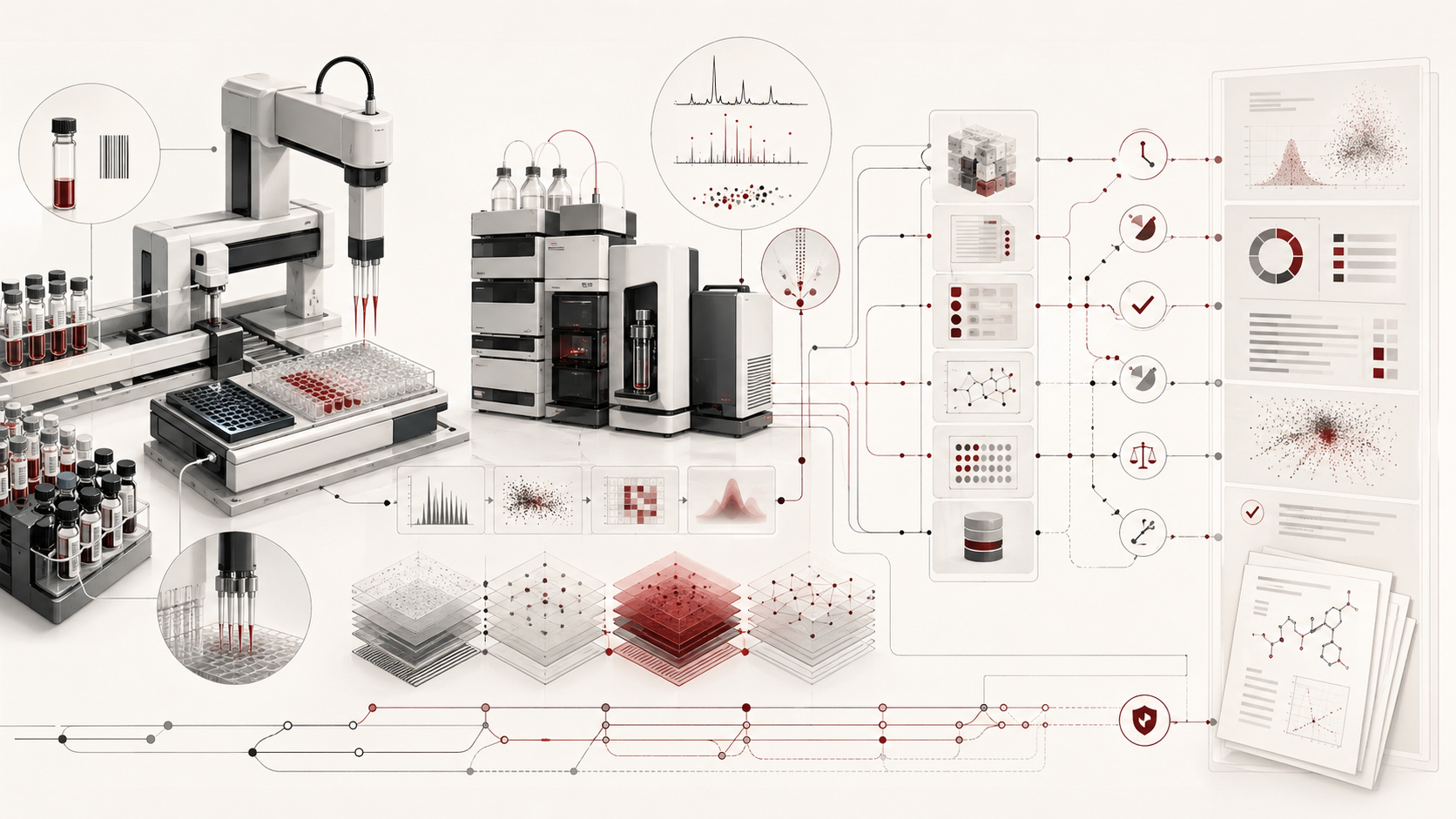
Chemical laboratories increasingly depend on systems that do more than collect measurements. Modern laboratories schedule sample queues, move plates, control pumps, trigger injections, operate balances, read barcodes, transfer liquids, apply instrument methods, capture environmental conditions, run calibration checks, process raw data, flag quality-control failures, generate reports, and archive results. Laboratory automation matters because chemical evidence is now often produced by linked systems rather than by a single person operating a single instrument in isolation.
This shift is especially important in analytical chemistry, pharmaceutical development, materials science, environmental monitoring, synthetic chemistry, biological chemistry, toxicology, quality control, and high-throughput experimentation. A chromatography result may depend on autosampler sequence, column history, mobile-phase composition, detector method, integration settings, calibration standards, internal standards, and the instrument software version. A mass spectrometry result may depend on ion-source parameters, mass calibration, acquisition method, data conversion, library search settings, and blank subtraction. A robotic synthesis campaign may depend on liquid-handler calibration, reagent identity, deck layout, temperature control, reaction time, and downstream assay logic.
Automation therefore expands the chemical record. It is not enough to know the final number or spectrum. A laboratory must know how the sample moved, what method controlled the instrument, what files were generated, what transformations were applied, what quality controls passed or failed, and what human decisions changed the workflow.
The scientific value of automation is not merely throughput. It is repeatability, traceability, standardization, error detection, data completeness, instrument utilization, and the ability to reconstruct what happened. A laboratory that runs thousands of samples but cannot connect raw files to sample identities has not improved chemical knowledge. It has accelerated uncertainty.
For researchers and scientists, the central question is not whether a workflow is automated. The question is whether automation preserves the chemical meaning of samples, measurements, methods, uncertainty, and interpretation. Automation should make the laboratory more intelligible, not more opaque.
From Instruments to Workflows
An instrument produces data. A workflow produces evidence. This distinction is crucial. A single instrument run may generate a chromatogram, spectrum, voltammogram, thermal trace, microscope image, diffraction pattern, calibration file, or sensor record. A workflow connects that instrument output to sample identity, preparation history, method parameters, operator actions, reference standards, blanks, quality controls, data processing, interpretation, and reporting.
In a manual laboratory, many of these relationships are held in notebooks, spreadsheets, file names, instrument methods, email threads, memory, or local conventions. In an automated laboratory, those relationships must be encoded more explicitly. Samples need identifiers. Instruments need states. Methods need versions. Runs need timestamps. Data files need provenance. Results need links to raw data. Quality rules need thresholds. Exceptions need documented resolution.
Typical automated laboratory workflows include:
- sample registration and barcode assignment;
- plate, rack, vial, or well layout generation;
- liquid-handling instructions and reagent tracking;
- instrument method selection and scheduling;
- autosampler sequence creation;
- calibration-standard, blank, replicate, and QC placement;
- run execution and instrument monitoring;
- raw data capture, checksum generation, and archival;
- file conversion and data normalization;
- data processing, integration, fitting, or feature extraction;
- quality-control evaluation and exception routing;
- result approval, reporting, and long-term preservation.
Automation is strongest when these steps are not merely connected technically but connected scientifically. The workflow must preserve the chemical meaning of the sample, the measurement, and the result. A robotic system that moves samples without preserving sample identity is not scientifically strong automation. A data pipeline that produces results without preserving raw data and processing history is not trustworthy automation.
Workflow thinking also changes laboratory design. Instruments are no longer isolated endpoints. They become nodes in an evidence network. A balance can feed weighing records into sample preparation. A liquid handler can generate transfer logs. A chromatograph can generate raw and processed outputs. A LIMS can connect the result to project context. A report can link back to all underlying files. The laboratory becomes a data-producing system whose scientific value depends on traceability.
Chemical Data as Evidence
Chemical data are not self-sufficient. A value such as \(0.184\), a peak area of \(10550\), a retention time of \(2.88\) minutes, a mass-to-charge feature at \(195.0878\), a pH of \(7.31\), a conductivity of \(1.4\ \mathrm{mS/cm}\), or an absorbance at \(520\ \mathrm{nm}\) becomes meaningful only when linked to method, unit, sample, calibration, uncertainty, quality status, and interpretation.
For example, a data file may contain a detector trace, but the file alone may not reveal whether the sample was a blank, calibration standard, quality control, unknown, replicate, failed injection, carryover check, or system suitability test. A result table may contain concentrations, but without calibration range, dilution factors, integration settings, and QC status, the values may be impossible to audit. A high-throughput synthesis platform may record product yields, but without reagent lot numbers, solvent identity, plate position, temperature, and reaction time, the yield data may be difficult to reproduce.
A chemically meaningful data system should preserve at least four layers:
- Raw data: original instrument output or the closest recoverable form.
- Processed data: transformed, integrated, filtered, normalized, fitted, or interpreted data.
- Metadata: sample identity, method parameters, units, instrument state, operator, environment, timestamps, and software versions.
- Interpretation: the chemical conclusion, confidence level, quality status, limitations, and decision context.
When those layers remain linked, automated laboratories can support reproducibility, auditability, cross-instrument comparison, method transfer, and long-term reuse. When those layers are separated, automation can produce data faster than the laboratory can understand or trust.
Evidence also requires uncertainty. Automated results should not appear more certain merely because they are machine-generated. Instrument drift, integration settings, calibration quality, carryover, sample degradation, data conversion, and software rules can all affect results. A strong automated workflow preserves confidence intervals, QC flags, limits of detection, limits of quantification, calibration residuals, replicate variability, and exception history where relevant.
For researchers, chemical data should be treated as a traceable argument. The final reported value is the conclusion. The raw files, metadata, methods, QC checks, processing steps, and approvals are the evidence that supports it.
Automation Architecture: Devices, Methods, Samples, and Systems
A laboratory automation architecture usually includes both physical and digital components. Physical components include balances, liquid handlers, pumps, valves, autosamplers, incubators, reactors, plate readers, chromatographs, mass spectrometers, spectrometers, electrochemical analyzers, robotic arms, storage systems, sensors, and sample-preparation modules. Digital components include laboratory information management systems, electronic laboratory notebooks, scientific data management systems, instrument-control software, scheduling tools, databases, data lakes, message brokers, workflow engines, and analysis scripts.
The architecture matters because each connection introduces both capability and risk. A barcode scanner can reduce transcription error, but only if labels are durable and mapped correctly. A liquid handler can improve throughput, but only if deck layouts, pipette calibration, liquid-class settings, tip usage, and liquid behavior are controlled. A scheduler can coordinate instruments, but only if it understands instrument availability, maintenance, method compatibility, and sample stability. A data pipeline can process results automatically, but only if the transformation rules are versioned and validated.
The strongest automation architectures usually distinguish among several kinds of identifiers:
- Sample identifiers: what material was measured or transformed.
- Container identifiers: where the sample physically resided.
- Instrument identifiers: which device generated or transformed data.
- Method identifiers: which protocol, instrument method, or computational workflow was used.
- Run identifiers: which execution event produced a file or result.
- File identifiers: which raw and processed data artifacts were generated.
- Result identifiers: which approved values or interpretations entered reports.
These identifiers are not bureaucratic details. They are the backbone of chemical traceability. Without them, automation can produce files that are technically valid but scientifically disconnected.
Architecture also determines whether automation can scale. A laboratory may begin with local scripts and spreadsheets, but as workflows become more consequential, they require persistent identifiers, schema discipline, access control, data validation, audit trails, backups, disaster recovery, and documented change management. A fragile automation pipeline can become a single point of failure.
For researchers and laboratory leaders, the architectural question should be: Can the laboratory reconstruct the full pathway from sample receipt to reported result, including every instrument, method, file, transformation, QC event, exception, and approval? If not, automation has not yet become a reliable evidence system.
Sample Identity, Containers, Barcodes, and Chain of Custody
Sample identity is one of the most important parts of automated chemistry. A measurement is only useful if it is connected to the correct sample. Automation can reduce manual transcription, but it can also create large-scale sample identity errors if barcode mapping, plate layout, container tracking, or data import logic is wrong.
Strong automated laboratories distinguish between sample identity and container identity. A sample is the material being studied. A container is the physical object holding it: vial, tube, well, plate, cartridge, bottle, reactor, or chip. A sample may move through multiple containers. A container may hold aliquots, dilutions, extracts, reaction mixtures, or derivatives. Treating sample and container as the same thing can obscure preparation history.
Chain of custody matters whenever samples influence safety, compliance, public health, environmental assessment, product release, forensic interpretation, clinical research, or regulated reporting. Chain of custody includes who received the sample, when it was received, how it was stored, how it was aliquoted, who handled it, which methods were applied, where the raw files reside, and who approved the result.
Automated systems should track:
- sample source, matrix, collection date, and storage condition;
- container type, barcode, physical location, and volume;
- aliquot, dilution, extraction, digestion, derivatization, or reaction history;
- freeze-thaw cycles, holding time, temperature excursions, and stability limits;
- plate position, rack position, vial position, and transfer history;
- failed transfers, manual corrections, discarded aliquots, and re-runs.
For researchers, sample tracking is not merely administrative. It is chemical context. A degraded sample, evaporated solvent, mislabeled well, cross-contaminated vial, or incorrectly diluted aliquot can invalidate otherwise well-executed instrumental analysis. Automation must protect sample meaning before it can protect result meaning.
Instrument Methods, Software Versions, and Method Control
Instrument methods define how automated measurements are performed. A chromatographic method may specify gradient, flow rate, column temperature, injection volume, detector wavelength, solvent composition, and integration rules. A mass spectrometry method may specify source conditions, scan range, collision energy, calibration, acquisition mode, lock mass, and data-dependent logic. A plate-reader method may specify wavelength, shaking, temperature, timing, path length correction, and blank subtraction.
In automated laboratories, method control is essential because small method changes can alter results. A different integration parameter can change peak area. A different gradient can shift retention time. A different mass tolerance can change compound identification. A different detector gain can saturate signals. A software update can change file formats or processing defaults.
Method control should include method versioning, change history, approval status, compatibility rules, validation status, and links to the samples and runs that used each method. A result should not simply say “LC method.” It should identify the exact method version and processing workflow used to generate the reported value.
Software versioning is equally important. Instrument-control software, data-processing software, laboratory middleware, scripts, packages, container images, database schemas, and reporting templates can all affect outputs. A laboratory that cannot identify which software version processed a result may not be able to reproduce or audit that result later.
For researchers, method control is the bridge between reproducibility and automation. Automated repetition is not the same as scientific reproducibility. Reproducibility requires knowing exactly what was repeated.
Metadata, Provenance, and Data Standards
Automation depends on metadata. Metadata explain what a data object is, how it was created, what it measures, what units it uses, what method generated it, what instrument produced it, and how it can be interpreted. Provenance explains the history of a data object: where it came from, which transformations were applied, what parameters were used, which files were inputs, and which outputs were derived.
Several standards and frameworks address laboratory data and automation. FAIR principles emphasize that scientific data should be findable, accessible, interoperable, and reusable, with machine-actionable metadata. SiLA provides open communication standards for laboratory automation and device integration. AnIML is designed as an analytical chemistry data and metadata format. The Allotrope framework aims to structure analytical instrument data and metadata in vendor-neutral forms. JCAMP-DX provides an IUPAC spectral-data exchange format family. NIST’s research-data resources emphasize metadata, data architecture, and repeatable data-processing pipelines.
These standards do not eliminate the need for laboratory judgment. They provide shared structures that make data easier to exchange, audit, preserve, and analyze. A standard file format can help, but it cannot repair a mislabeled sample, an invalid method, a missing calibration, or an undocumented manual correction.
Good laboratory metadata should include:
- sample identity, source, preparation, matrix, and storage conditions;
- instrument identity, configuration, maintenance state, calibration state, and method file;
- operator, timestamp, laboratory location, temperature, humidity, and relevant environmental conditions;
- reagent lots, standard certificates, consumables, columns, electrodes, plates, vials, and solvents;
- raw file names, checksums, data format, software version, and processing parameters;
- quality-control status, exception flags, approval history, and audit-trail entries.
Provenance also supports reuse. A dataset collected for one project may become useful later for method development, meta-analysis, model training, instrument comparison, or regulatory review. Without metadata, old laboratory data often become unusable. Automation should therefore preserve not only immediate reporting needs but future interpretability.
For researchers, metadata are not overhead. They are the memory of the experiment. Without them, chemical data lose their scientific context.
Quality Control, Validation, and Audit Trails
Automation can improve consistency, but it can also make errors systematic. A mistaken deck layout can affect every sample in a plate. A bad calibration file can propagate across hundreds of results. A misconfigured integration method can bias every chromatographic peak. A failed barcode mapping can silently swap sample identities. For this reason, automated laboratories need strong quality-control logic and audit trails.
Quality-control elements may include blanks, calibration standards, continuing calibration checks, system suitability tests, internal standards, replicate measurements, control samples, reference materials, spike recovery, drift checks, carryover checks, environmental monitors, instrument health checks, and automated exception flags. The exact requirements depend on context. A teaching laboratory, discovery laboratory, regulated pharmaceutical laboratory, environmental compliance laboratory, forensic laboratory, and clinical laboratory do not require the same evidence standard.
Audit trails should record not only successful operations but also exceptions, interruptions, retries, failed runs, manual overrides, reprocessing events, rejected results, and approval decisions. In automated chemistry, the path not taken can matter as much as the final path. A result that was reprocessed after a failed QC flag should not appear identical to a result that passed the first time.
Validation also differs by use case. A research prototype may require reproducibility and transparent documentation. A regulated workflow may require formal validation, change control, access controls, audit trails, electronic signatures, and documented data integrity. A machine-learning-driven experiment planner may require model validation, drift monitoring, and safeguards against optimizing artifacts.
For researchers, QC should not be treated as a final gate added after automation. It should be built into the workflow: before the run, during the run, after the run, during processing, before reporting, and during archival review. Quality is a workflow property.
Data Pipelines, File Conversion, and Result Interpretation
Automated laboratories often depend on data pipelines that transform raw files into tables, plots, models, reports, and decisions. These pipelines may parse vendor files, convert data formats, extract chromatographic peaks, deconvolute spectra, fit calibration curves, normalize signals, subtract blanks, detect outliers, assign compound identities, calculate concentrations, generate QC flags, and export final results.
Data pipelines can improve consistency, but they must be treated as scientific methods. A pipeline that changes peak integration, baseline correction, smoothing, mass tolerance, spectral library matching, calibration weighting, or outlier handling can change the chemical conclusion. Scripts and workflows should therefore be versioned, tested, documented, reviewed, and linked to output data.
File conversion is especially important. Converting proprietary instrument files into open formats can support reuse and analysis, but conversion can also lose metadata if not handled carefully. A converted file should preserve essential acquisition parameters, instrument identity, timestamps, units, method version, sample identity, and raw signal integrity. Checksums and file manifests can help confirm that expected files were generated and preserved.
Result interpretation should preserve the difference between detected signal, processed feature, identified compound, quantified concentration, and approved result. These are different evidence levels. A mass feature is not automatically a compound identity. A chromatographic peak is not automatically a concentration. A concentration is not automatically a reportable value unless calibration, QC, dilution, and review conditions are satisfied.
For researchers, a data pipeline should be auditable from output back to input. Every reported result should be traceable to raw data, processing code or software settings, method version, calibration, QC status, and human or automated approval.
Automation, Machine Learning, and Closed-Loop Chemistry
Laboratory automation increasingly connects with machine learning, design of experiments, Bayesian optimization, active learning, automated synthesis, high-throughput screening, robotic characterization, and closed-loop discovery. In a closed-loop chemistry workflow, software proposes experiments, automation executes them, instruments measure outcomes, computational systems update models, and the next experiment is selected based on prior results.
This creates powerful opportunities. Chemical synthesis can explore reaction conditions more systematically. Materials discovery can search composition spaces more efficiently. Analytical methods can optimize gradients, temperatures, solvent mixtures, detector settings, and sample-preparation conditions. Biological and chemical assays can evaluate large libraries of conditions or compounds. Environmental sensor networks can trigger adaptive sampling.
However, closed-loop systems increase the importance of metadata and quality control. A machine-learning model trained on mislabeled, incomplete, biased, or poorly calibrated laboratory data can optimize toward artifacts. Automated decision systems can amplify subtle instrument drift or plate-position effects. Experimental recommendations may become difficult to interpret if the workflow does not preserve why each experiment was chosen.
AI-enabled laboratory automation therefore requires rigorous data governance. The system should preserve input data, model version, selection criteria, experimental plan, instrument method, run outcome, failed runs, and all transformations between measurement and decision.
Closed-loop chemistry also requires human accountability. Optimization algorithms can propose experiments, but scientists must define the objective, constraints, safety boundaries, stopping criteria, and acceptable evidence. A closed-loop system that maximizes yield while ignoring impurity formation, solvent burden, reagent hazards, or reproducibility is not a responsible chemical system.
For researchers, the strongest AI-enabled laboratories will not simply automate decisions. They will make decisions more inspectable by preserving data lineage, model assumptions, uncertainty, failed experiments, and the rationale for each experimental step.
Failure Modes in Automated Chemical Laboratories
Laboratory automation can fail in ways that are difficult to see from final results alone. Automation can reduce some manual errors while creating new systematic ones. A human may make a one-off transcription error; a misconfigured automated mapping can mislabel an entire batch. A single failed tip pickup can create a pattern of missing liquid transfers. A silent software integration failure can disconnect results from raw files.
Common failure modes include:
- Sample identity errors: barcode mismatch, plate-position error, vial swap, incorrect sample registration, or aliquot confusion.
- Method mismatch: wrong instrument method, outdated method version, incompatible column, invalid detector setting, or incorrect calibration file.
- File-provenance errors: raw files not linked to samples, overwritten files, missing checksums, ambiguous file names, or incomplete file transfers.
- Liquid-handling errors: clogged tips, incorrect liquid class, evaporation, bubble formation, dead volume, splashing, viscosity mismatch, or carryover.
- Instrument-state errors: column degradation, mass calibration drift, lamp aging, electrode fouling, pump instability, detector saturation, or autosampler malfunction.
- Software integration errors: failed API calls, partial data transfers, time-zone mismatch, schema mismatch, unit mismatch, or silent truncation.
- Processing errors: incorrect baseline correction, failed peak integration, invalid calibration, inappropriate smoothing, wrong library match, or unreviewed automated reprocessing.
- Quality-system errors: missing audit trails, insufficient exception handling, unclear approval responsibility, and inadequate change control.
The solution is not to reject automation. The solution is to design automated workflows so that failures are observable, recoverable, and auditable. Automated chemistry should make error detection easier, not merely make production faster.
Failure-mode analysis should be part of automation design. Laboratories should test edge cases: missing files, failed transfers, bad QC results, invalid methods, duplicated sample IDs, mismatched units, interrupted runs, partial plate transfers, manual overrides, and software downtime. A workflow that works only when everything goes perfectly is not robust automation.
Cybersecurity, Data Integrity, and Operational Resilience
Automated laboratories are digital infrastructure. They depend on networks, databases, user accounts, instrument computers, file shares, cloud systems, APIs, vendor software, local scripts, and scheduled services. This makes cybersecurity and data integrity part of laboratory science, not only information technology.
Data integrity requires that records are attributable, legible, contemporaneous, original or traceable to original records, accurate, complete, consistent, enduring, and available. Automated systems should support user authentication, role-based access, audit trails, secure timestamps, file integrity checks, backups, disaster recovery, and documented data-retention policies.
Operational resilience matters because laboratory automation can create dependencies. If the scheduler fails, samples may sit too long. If the network share is unavailable, raw files may not transfer. If an instrument computer updates unexpectedly, methods may change or drivers may fail. If a database schema changes, processing scripts may break. Resilience requires monitoring, alerts, fallback procedures, backups, and tested recovery plans.
Cybersecurity also affects scientific trust. Unauthorized changes to methods, results, sample metadata, or processing scripts can invalidate evidence. Ransomware, account compromise, misconfigured permissions, and insecure integrations can threaten laboratory continuity and data reliability. Automated chemical laboratories must therefore treat access control and change management as part of evidence protection.
For researchers and laboratory managers, the practical goal is not perfect security in the abstract. It is a defensible system where data, methods, identities, and results are protected well enough for the consequences of the work.
Human Oversight, Scientific Judgment, and Accountability
Automation changes the role of laboratory scientists. It can reduce repetitive manual work, increase throughput, standardize operations, and improve traceability. But it does not eliminate scientific judgment. Humans still define the research question, choose methods, set QC thresholds, interpret exceptions, validate workflows, investigate anomalies, approve results, and decide whether evidence is sufficient for a claim.
Human oversight is especially important when automated systems produce warnings, ambiguous results, outliers, unexpected peaks, failed calibrations, low recoveries, inconsistent replicates, missing metadata, or results outside the validated range. A workflow should not hide these events. It should route them to review with enough context for a scientist to make an informed decision.
Accountability also means knowing who approved methods, changed scripts, overrode QC flags, reprocessed data, accepted exceptions, or released results. The goal is not to punish scientists for judgment calls. The goal is to make consequential decisions visible and reviewable.
Training is part of oversight. Scientists using automation should understand the chemical method, the instrument, the software workflow, the data pipeline, and the limitations of automated outputs. A user who can operate a robotic platform but cannot interpret its failure modes is not fully prepared to rely on its results.
For researchers, automation should be treated as an extension of scientific practice. It should support judgment, not replace it with hidden defaults.
Responsible Use of Automated Laboratory Evidence
Automated laboratory evidence can influence pharmaceutical release, environmental monitoring, public health, forensic interpretation, food safety, clinical research, industrial quality, materials development, and chemical-risk assessment. Responsible use requires a clear distinction between prototype automation, research automation, validated analytical workflows, and regulated laboratory systems.
Responsible laboratory automation includes:
- preserving raw data and processing histories;
- using stable sample identifiers and container identifiers;
- versioning instrument methods, scripts, and workflow definitions;
- recording metadata required for interpretation and reuse;
- testing data pipelines with known standards and failure cases;
- maintaining audit trails for manual overrides and reprocessing;
- validating automated decisions before using them in high-consequence settings;
- keeping human accountability visible when automation produces or approves results.
Responsible use also requires resisting automation bias. A result is not correct because it was generated automatically. A flag is not sufficient because it was generated by software. A model recommendation is not valid because it came from an optimization routine. Automated evidence must remain open to chemical reasoning, method review, and independent verification.
The ethical value of laboratory automation is not speed alone. It is the possibility of more transparent, repeatable, and accountable chemical measurement. Automation becomes scientifically trustworthy when it strengthens traceability rather than replacing it with hidden software behavior.
Mathematical Lens: Throughput, Completeness, Drift, and Workflow Reliability
Laboratory automation can be evaluated quantitatively. Throughput, run completion, error rates, data completeness, turnaround time, drift, and quality-control failure rates can all be measured. Let \(N_{\mathrm{scheduled}}\) represent the number of scheduled runs and \(N_{\mathrm{completed}}\) represent the number of successfully completed runs. A simple completion fraction is:
f_{\mathrm{complete}} = \frac{N_{\mathrm{completed}}}{N_{\mathrm{scheduled}}}
\]
Interpretation: Completion fraction measures how much of the planned workflow finished successfully. It should be interpreted alongside QC status, missing metadata, and exception history.
If \(N_{\mathrm{failed}}\) runs fail due to instrument, sample, method, or data-transfer errors, a simple failure fraction is:
f_{\mathrm{failed}} = \frac{N_{\mathrm{failed}}}{N_{\mathrm{scheduled}}}
\]
Interpretation: Failure fraction measures unsuccessful workflow execution. A low failure fraction is useful only if failures are defined consistently and not hidden by undocumented reruns.
Data completeness can be expressed as the fraction of required metadata fields that are present:
C_{\mathrm{metadata}} = \frac{N_{\mathrm{present}}}{N_{\mathrm{required}}}
\]
Interpretation: \(N_{\mathrm{present}}\) is the number of required fields populated and \(N_{\mathrm{required}}\) is the total number of required metadata fields. This metric does not guarantee correctness, but it helps detect missing context.
Turnaround time for a sample can be written as:
T_{\mathrm{turnaround}} = t_{\mathrm{reported}} – t_{\mathrm{received}}
\]
Interpretation: \(t_{\mathrm{received}}\) is the time a sample enters the workflow and \(t_{\mathrm{reported}}\) is the time its result is reported. Faster turnaround is valuable only when quality and traceability are preserved.
Instrument utilization can be represented as:
U = \frac{T_{\mathrm{active}}}{T_{\mathrm{available}}}
\]
Interpretation: \(U\) is utilization, \(T_{\mathrm{active}}\) is active instrument run time, and \(T_{\mathrm{available}}\) is available time. High utilization may be efficient, but it can also reduce maintenance windows and increase failure risk if poorly managed.
Instrument drift can be modeled by fitting a quality-control response \(y_i\) over run order or time:
y_i = \beta_0 + \beta_1 t_i + e_i
\]
Interpretation: \(\beta_1\) estimates drift per unit time or run order. A nonzero drift slope may indicate instrument instability, reagent degradation, column aging, electrode fouling, temperature effects, or other systematic changes.
A simple workflow reliability score can combine completion, QC pass rate, and metadata completeness:
R_{\mathrm{workflow}} = f_{\mathrm{complete}} \times f_{\mathrm{QC\ pass}} \times C_{\mathrm{metadata}}
\]
Interpretation: This simplified score penalizes incomplete runs, QC failures, and missing metadata. Real laboratories should adapt reliability metrics to the scientific and regulatory consequences of the workflow.
These equations make a central point: a high-throughput system is not necessarily a reliable system if turnaround time improves while failure rates, reprocessing events, drift, or metadata gaps increase. Automated workflows should measure not only speed but stability, completeness, and evidentiary quality.
Computational Workflows for Laboratory Automation
Computational workflows can make laboratory automation more transparent. A workflow can track run IDs, sample IDs, container IDs, instrument IDs, method versions, scheduled times, completed times, raw files, processed files, QC statuses, exception flags, metadata completeness, turnaround time, drift metrics, and review queues. It can also preserve assumptions behind automated decisions.
Useful workflows include run-manifest auditing, sample-file reconciliation, metadata completeness checks, QC drift analysis, instrument utilization summaries, failure-mode dashboards, reprocessing history reviews, method-version comparison, calibration record checks, LIMS-to-instrument reconciliation, and result-approval queues. More advanced workflows may integrate laboratory middleware, instrument APIs, robotics logs, electronic laboratory notebooks, database schemas, message brokers, workflow engines, and machine-learning experiment planners.
For researchers, computational workflows should preserve distinction among operational metrics and scientific metrics. A completed run is not necessarily a valid result. A valid result is not necessarily an approved result. An approved result may still carry limitations. Workflow analytics should therefore include run completion, QC status, metadata completeness, exceptions, uncertainty, and human review.
The examples below use synthetic data. They do not validate laboratory systems, certify regulatory compliance, approve chemical results, or replace professional quality systems. They demonstrate how laboratory automation reasoning can be structured, audited, and communicated responsibly.
Python Example: Instrument Run Manifests and Data-Completeness Checks
The following Python example uses synthetic educational laboratory data to audit an automated instrument workflow. It checks run completion, required metadata completeness, quality-control status, turnaround time, and missing data artifacts. In a real laboratory, this logic would connect to LIMS records, instrument files, sample-tracking systems, and validated data pipelines.
from pathlib import Path
from typing import Dict, List
import json

import pandas as pd


# Synthetic laboratory automation workflow audit.
# Educational example only; not for regulated laboratory reporting,
# validated quality systems, or release decisions.


def audit_instrument_runs(runs: pd.DataFrame, required_fields: List[str]) -> pd.DataFrame:
    """Audit instrument runs for completion, metadata, QC, and review status."""

    audited = runs.copy()

    audited["scheduled_time"] = pd.to_datetime(audited["scheduled_time"])
    audited["completed_time"] = pd.to_datetime(audited["completed_time"])

    audited["required_fields_present"] = audited[required_fields].notna().sum(axis=1)
    audited["required_fields_total"] = len(required_fields)
    audited["metadata_completeness"] = (
        audited["required_fields_present"] / audited["required_fields_total"]
    )

    audited["run_completed"] = audited["completed_time"].notna()
    audited["raw_file_present"] = audited["raw_file"].notna()
    audited["processed_file_present"] = audited["processed_file"].notna()

    audited["turnaround_min"] = (
        audited["completed_time"] - audited["scheduled_time"]
    ).dt.total_seconds() / 60.0

    audited["review_required"] = (
        ~audited["run_completed"]
        | ~audited["raw_file_present"]
        | ~audited["processed_file_present"]
        | (audited["metadata_completeness"] < 1.0)
        | (audited["qc_status"] != "pass")
        | audited["exception_flag"]
    )

    return audited


runs = pd.DataFrame({
    "run_id": ["run_001", "run_002", "run_003", "run_004", "run_005", "run_006"],
    "sample_id": ["blank", "std_01", "qc_01", "sample_A", "sample_B", "sample_C"],
    "container_id": ["vial_A01", "vial_A02", "vial_A03", "vial_A04", "vial_A05", "vial_A06"],
    "instrument_id": ["lc_uv_01"] * 6,
    "method_id": ["lc_assay_v3"] * 6,
    "method_version": ["3.2.1"] * 6,
    "scheduled_time": [
        "2026-04-29 08:00",
        "2026-04-29 08:15",
        "2026-04-29 08:30",
        "2026-04-29 08:45",
        "2026-04-29 09:00",
        "2026-04-29 09:15",
    ],
    "completed_time": [
        "2026-04-29 08:12",
        "2026-04-29 08:28",
        "2026-04-29 08:43",
        "2026-04-29 08:59",
        "2026-04-29 09:16",
        None,
    ],
    "raw_file": [
        "run_001.raw",
        "run_002.raw",
        "run_003.raw",
        "run_004.raw",
        "run_005.raw",
        None,
    ],
    "processed_file": [
        "run_001_results.csv",
        "run_002_results.csv",
        "run_003_results.csv",
        "run_004_results.csv",
        "run_005_results.csv",
        None,
    ],
    "qc_status": ["pass", "pass", "pass", "pass", "warning", "failed"],
    "exception_flag": [False, False, False, False, True, True],
})

required_fields = [
    "run_id",
    "sample_id",
    "container_id",
    "instrument_id",
    "method_id",
    "method_version",
    "scheduled_time",
    "completed_time",
    "raw_file",
    "processed_file",
    "qc_status",
]

audited_runs = audit_instrument_runs(runs, required_fields)

scheduled_count = len(audited_runs)
completed_count = int(audited_runs["run_completed"].sum())
failed_count = int((audited_runs["qc_status"] == "failed").sum())
warning_count = int((audited_runs["qc_status"] == "warning").sum())

completion_fraction = completed_count / scheduled_count
failure_fraction = failed_count / scheduled_count
qc_pass_fraction = float((audited_runs["qc_status"] == "pass").mean())
mean_metadata_completeness = float(audited_runs["metadata_completeness"].mean())

review_table = audited_runs.loc[
    audited_runs["review_required"],
    [
        "run_id",
        "sample_id",
        "container_id",
        "qc_status",
        "metadata_completeness",
        "raw_file",
        "processed_file",
        "turnaround_min",
    ],
]

output_dir = Path("outputs")
output_dir.mkdir(exist_ok=True)

audited_runs.to_csv(output_dir / "automation_run_audit.csv", index=False)
review_table.to_csv(output_dir / "automation_review_queue.csv", index=False)

manifest: Dict[str, object] = {
    "workflow": "synthetic_laboratory_automation_audit",
    "scheduled_count": scheduled_count,
    "completed_count": completed_count,
    "failed_count": failed_count,
    "warning_count": warning_count,
    "completion_fraction": completion_fraction,
    "failure_fraction": failure_fraction,
    "qc_pass_fraction": qc_pass_fraction,
    "mean_metadata_completeness": mean_metadata_completeness,
    "mean_turnaround_min": float(audited_runs["turnaround_min"].mean()),
    "review_required_count": int(audited_runs["review_required"].sum()),
    "responsible_use": [
        "Synthetic educational data only.",
        "Real automated laboratories require validated LIMS, audit trails, instrument controls, quality systems, and documented exception handling.",
    ],
}

with (output_dir / "automation_manifest.json").open("w", encoding="utf-8") as file:
    json.dump(manifest, file, indent=2)

print(review_table)
print("Completion fraction:", completion_fraction)
print("Failure fraction:", failure_fraction)
print("Mean metadata completeness:", mean_metadata_completeness)
This workflow illustrates a general principle: automation should not be evaluated only by the number of runs completed. It should also be evaluated by completeness, quality status, exceptions, turnaround time, and the ability to reconstruct what happened.
R Example: Run-Time, QC Drift, and Instrument Utilization
The following R example uses synthetic instrument-run and quality-control data to summarize instrument utilization and QC drift. It models a common automation question: is the system producing results consistently over time, or are warning signs accumulating across the run sequence?
# Synthetic laboratory automation statistics workflow.
# Educational example only; not for regulated laboratory reporting.

runs <- data.frame(
  run_id = paste0("run_", sprintf("%03d", 1:10)),
  sample_type = c(
    "blank", "standard", "qc", "unknown", "unknown",
    "qc", "unknown", "unknown", "qc", "unknown"
  ),
  instrument_id = rep("lc_uv_01", 10),
  run_order = 1:10,
  runtime_min = c(12.1, 12.3, 12.2, 12.4, 12.6, 12.5, 12.7, 12.9, 13.1, 13.2),
  qc_response = c(NA, NA, 1.002, NA, NA, 0.991, NA, NA, 0.975, NA),
  qc_status = c(
    "pass", "pass", "pass", "pass", "pass",
    "pass", "pass", "warning", "warning", "pass"
  )
)

utilization_summary <- data.frame(
  instrument_id = "lc_uv_01",
  run_count = nrow(runs),
  total_runtime_min = sum(runs$runtime_min),
  mean_runtime_min = mean(runs$runtime_min),
  warning_count = sum(runs$qc_status == "warning"),
  pass_count = sum(runs$qc_status == "pass")
)

qc_runs <- runs[!is.na(runs$qc_response), ]

drift_model <- lm(qc_response ~ run_order, data = qc_runs)

drift_summary <- data.frame(
  qc_run_count = nrow(qc_runs),
  drift_slope_per_run = coef(drift_model)[2],
  first_qc_response = qc_runs$qc_response[1],
  last_qc_response = qc_runs$qc_response[nrow(qc_runs)],
  percent_change = 100 * (
    qc_runs$qc_response[nrow(qc_runs)] - qc_runs$qc_response[1]
  ) / qc_runs$qc_response[1]
)

runs$review_required <- runs$qc_status != "pass"

dir.create("outputs", showWarnings = FALSE)

write.csv(
  utilization_summary,
  file = "outputs/instrument_utilization_summary.csv",
  row.names = FALSE
)

write.csv(
  drift_summary,
  file = "outputs/qc_drift_summary.csv",
  row.names = FALSE
)

write.csv(
  runs,
  file = "outputs/automation_run_status.csv",
  row.names = FALSE
)

sink("outputs/laboratory_automation_report.txt")
cat("Synthetic Laboratory Automation Report\n")
cat("=====================================\n\n")
cat("Instrument utilization:\n")
print(utilization_summary)
cat("\nQC drift model:\n")
print(summary(drift_model))
cat("\nQC drift summary:\n")
print(drift_summary)
cat("\nRuns requiring review:\n")
print(runs[runs$review_required, c("run_id", "sample_type", "qc_status", "run_order")])
cat("\nResponsible-use note:\n")
cat("Synthetic educational data only. Real automation workflows require validated audit trails, instrument methods, sample tracking, quality systems, and documented exception handling.\n")
sink()

print(utilization_summary)
print(drift_summary)
Even this small example shows why automation analytics should include both operational and scientific metrics. Instrument utilization matters, but so do QC drift, warnings, failed runs, metadata gaps, and exception history.
SQL Example: Laboratory Automation Evidence Register
Laboratory automation interpretation becomes more reliable when samples, containers, methods, runs, files, QC checks, exceptions, and result approvals are traceable. A simple evidence register can preserve the context needed to audit automated chemical workflows.
CREATE TABLE laboratory_sample (
    sample_id TEXT PRIMARY KEY,
    sample_name TEXT NOT NULL,
    sample_type TEXT,
    matrix_description TEXT,
    received_datetime TEXT,
    storage_condition TEXT,
    chain_of_custody_notes TEXT
);

CREATE TABLE sample_container (
    container_id TEXT PRIMARY KEY,
    sample_id TEXT NOT NULL,
    container_type TEXT,
    barcode TEXT UNIQUE,
    physical_location TEXT,
    volume_ul REAL CHECK (volume_ul >= 0),
    container_status TEXT,
    FOREIGN KEY (sample_id) REFERENCES laboratory_sample(sample_id)
);

CREATE TABLE instrument_method (
    method_id TEXT PRIMARY KEY,
    method_name TEXT NOT NULL,
    method_version TEXT NOT NULL,
    instrument_family TEXT,
    validation_status TEXT,
    method_file_uri TEXT,
    approved_datetime TEXT,
    change_control_notes TEXT
);

CREATE TABLE instrument_run (
    run_id TEXT PRIMARY KEY,
    sample_id TEXT NOT NULL,
    container_id TEXT NOT NULL,
    instrument_id TEXT NOT NULL,
    method_id TEXT NOT NULL,
    scheduled_time TEXT,
    completed_time TEXT,
    run_status TEXT,
    operator_or_scheduler TEXT,
    exception_flag INTEGER CHECK (exception_flag IN (0, 1)),
    exception_notes TEXT,
    FOREIGN KEY (sample_id) REFERENCES laboratory_sample(sample_id),
    FOREIGN KEY (container_id) REFERENCES sample_container(container_id),
    FOREIGN KEY (method_id) REFERENCES instrument_method(method_id)
);

CREATE TABLE data_artifact (
    artifact_id TEXT PRIMARY KEY,
    run_id TEXT NOT NULL,
    artifact_type TEXT,
    file_uri TEXT,
    file_checksum TEXT,
    software_name TEXT,
    software_version TEXT,
    processing_parameters TEXT,
    created_datetime TEXT,
    FOREIGN KEY (run_id) REFERENCES instrument_run(run_id)
);

CREATE TABLE quality_control_result (
    qc_id INTEGER PRIMARY KEY,
    run_id TEXT NOT NULL,
    qc_type TEXT,
    qc_status TEXT,
    measured_value REAL,
    expected_value REAL,
    acceptance_min REAL,
    acceptance_max REAL,
    qc_notes TEXT,
    FOREIGN KEY (run_id) REFERENCES instrument_run(run_id)
);

CREATE TABLE result_approval (
    approval_id INTEGER PRIMARY KEY,
    run_id TEXT NOT NULL,
    result_name TEXT,
    result_value REAL,
    result_unit TEXT,
    approval_status TEXT,
    approved_by TEXT,
    approved_datetime TEXT,
    limitation_notes TEXT,
    FOREIGN KEY (run_id) REFERENCES instrument_run(run_id)
);

SELECT
    r.run_id,
    r.sample_id,
    r.container_id,
    r.instrument_id,
    r.method_id,
    m.method_version,
    r.run_status,
    q.qc_status,
    a.artifact_type,
    a.file_uri,
    r.exception_flag,
    CASE
        WHEN r.run_status != 'completed'
            THEN 'run completion review required'
        WHEN q.qc_status != 'pass'
            THEN 'quality control review required'
        WHEN a.file_uri IS NULL
            THEN 'data artifact review required'
        WHEN r.exception_flag = 1
            THEN 'exception review required'
        ELSE 'standard review'
    END AS automation_review_status
FROM instrument_run r
JOIN instrument_method m
    ON r.method_id = m.method_id
LEFT JOIN quality_control_result q
    ON r.run_id = q.run_id
LEFT JOIN data_artifact a
    ON r.run_id = a.run_id
ORDER BY automation_review_status, r.run_id;
The purpose of this register is to keep automated laboratory interpretation attached to evidence. A run should preserve sample identity, container identity, method version, instrument identity, file artifacts, QC status, exceptions, and approval history. Laboratory automation data become stronger when provenance is part of the record.
GitHub Repository
The companion repository for this article can support reproducible workflows for run-manifest auditing, metadata completeness checks, QC drift analysis, instrument utilization summaries, review queues, SQL evidence registers, and responsible laboratory automation interpretation.
Complete Code Repository
The full code distribution for this article, including selected laboratory automation examples, expanded computational workflows, reproducible data structures, provenance documentation, run-audit scripts, QC drift summaries, SQL evidence registers, and scientific-computing scaffolding, is available on GitHub.
Limits, Uncertainty, and Responsible Interpretation
Laboratory automation is easy to overstate because automated systems can appear objective, precise, and complete even when they contain hidden assumptions. A result generated by an instrument and processed by software is still shaped by sample handling, method selection, calibration, integration settings, metadata completeness, file conversion, QC rules, and human decisions.
Automation also does not eliminate uncertainty. Instrument drift, reagent degradation, evaporation, carryover, adsorption to surfaces, calibration error, sample instability, environmental variation, software defaults, data-format loss, and human overrides can all affect results. Automated outputs should therefore preserve uncertainty, QC status, and limitations rather than presenting results as context-free numbers.
Laboratory data standards and automation frameworks are useful but incomplete. A standard file format can improve interoperability, but it does not guarantee sample correctness, method validity, or interpretive quality. A LIMS can track data, but it can also preserve incorrect data if workflows are poorly designed. A robot can execute transfers, but it cannot determine whether the scientific design is appropriate unless the system has been built and validated for that purpose.
AI-enabled automation requires additional caution. Machine-learning models can optimize artifacts, reproduce bias, overfit sparse data, or recommend experiments outside safe or meaningful domains. Closed-loop systems can accelerate discovery, but they can also accelerate error when metadata, QC, and human review are weak.
The computational examples associated with this article are synthetic and educational. They do not validate laboratory systems, certify regulatory compliance, approve chemical results, determine clinical, environmental, forensic, or pharmaceutical acceptability, or replace professional laboratory quality management. They are designed to show how laboratory automation reasoning can be structured and audited.
Responsible interpretation should avoid both automation hype and automation rejection. Automated laboratories can improve chemistry when they make evidence more traceable, complete, repeatable, and reviewable. They undermine chemistry when they hide sample history, method changes, file transformations, QC failures, or human decisions behind seamless interfaces.
Conclusion
Laboratory automation shows that chemical knowledge is not produced by instruments alone. It is produced by workflows that connect samples, containers, methods, instruments, raw files, processed data, metadata, quality controls, audit trails, and scientific interpretation. Automation changes chemistry by making these relationships more explicit, more machine-actionable, and more dependent on disciplined data infrastructure.
The field’s central lesson is that speed is not the same as trust. A laboratory can process more samples while losing interpretability if sample identities, method versions, raw files, QC events, and processing histories are not preserved. Conversely, well-designed automation can make chemical measurement more reproducible, more transparent, more scalable, and more accountable.
For chemistry as a discipline, laboratory automation is important because it connects experimental practice to data systems. It links analytical chemistry, chemical metrology, instrumentation, robotics, software engineering, metadata, quality systems, and computational workflows into one evidence chain. That chain must remain scientifically legible.
A mature automated laboratory does not ask only, “How many samples can we run?” It asks: Can we reconstruct what happened? Can we trust the result? Can we identify failures? Can we preserve uncertainty? Can we explain automated decisions? Can we keep human accountability visible? The future of automated chemistry depends on answering those questions well.
Related articles
- What Is Chemistry?
- Measurement, Quantification, and the Experimental Basis of Chemistry
- Chemical Metrology, Standards, and Reference Materials
- Computational Notebooks and Reproducible Chemical Research
- Spectroscopy and the Measurement of Molecular Structure
- Chromatography, Separation Science, and Chemical Identification
- Mass Spectrometry and Molecular Detection
- Electroanalytical Chemistry and Chemical Sensors
- Computational Chemistry and Molecular Modeling
- Materials Chemistry and the Design of Function
Further reading
- Allotrope Foundation (n.d.) Allotrope Data Standard. Available at: https://www.allotrope.org/
- Allotrope Foundation (n.d.) Allotrope Simple Model. Available at: https://www.allotrope.org/asm
- AnIML (n.d.) Analytical Information Markup Language. Available at: https://www.animl.org/
- International Union of Pure and Applied Chemistry (n.d.) JCAMP-DX. Available at: https://iupac.org/what-we-do/digital-standards/jcamp-dx/
- International Union of Pure and Applied Chemistry (2023) Compendium of Terminology in Analytical Chemistry. Available at: https://iupac.org/compendium-of-terminology-in-analytical-chemistry-2023/
- National Institute of Standards and Technology (n.d.) LabCAS: Data Driven Science Architecture and Resource. Available at: https://www.nist.gov/programs-projects/nist-labcas-data-driven-science-architecture-and-resource
- National Institute of Standards and Technology (2024) Research Data Framework. Available at: https://nvlpubs.nist.gov/nistpubs/SpecialPublications/1500-18/NIST.SP.1500-18r2.html
- SiLA (n.d.) SiLA Standard. Available at: https://sila-standard.com/
- Wilkinson, M.D. et al. (2016) ‘The FAIR Guiding Principles for scientific data management and stewardship’, Scientific Data, 3, 160018. Available at: https://www.nature.com/articles/sdata201618
References
- Allotrope Foundation (n.d.) Allotrope Framework. Available at: https://www.allotrope.org/allotrope-framework
- Allotrope Foundation (n.d.) Allotrope Simple Model. Available at: https://www.allotrope.org/asm
- AnIML (n.d.) Analytical Information Markup Language. Available at: https://www.animl.org/
- AnIML (n.d.) Overview. Available at: https://www.animl.org/overview
- International Union of Pure and Applied Chemistry (2023) Compendium of Terminology in Analytical Chemistry. Available at: https://iupac.org/compendium-of-terminology-in-analytical-chemistry-2023/
- International Union of Pure and Applied Chemistry (n.d.) JCAMP-DX. Available at: https://iupac.org/what-we-do/digital-standards/jcamp-dx/
- Juchli, D. (2022) ‘SiLA 2: The Next Generation Lab Automation Standard’, SLAS Technology. Available at: https://pubmed.ncbi.nlm.nih.gov/35639108/
- National Institute of Standards and Technology (n.d.) LabCAS: Data Driven Science Architecture and Resource. Available at: https://www.nist.gov/programs-projects/nist-labcas-data-driven-science-architecture-and-resource
- National Institute of Standards and Technology (2024) Research Data Framework. Available at: https://nvlpubs.nist.gov/nistpubs/SpecialPublications/1500-18/NIST.SP.1500-18r2.html
- National Institute of Standards and Technology (2023) A Roadmap for LIMS at NIST Material Measurement Laboratory. Available at: https://tsapps.nist.gov/publication/get_pdf.cfm?pub_id=934610
- SiLA (n.d.) SiLA Standard. Available at: https://sila-standard.com/
- SiLA (n.d.) Standards. Available at: https://sila-standard.com/standards/
- Wilkinson, M.D., Dumontier, M., Aalbersberg, I.J. et al. (2016) ‘The FAIR Guiding Principles for scientific data management and stewardship’, Scientific Data, 3, 160018. Available at: https://www.nature.com/articles/sdata201618