
Last Updated May 28, 2026
Chemistry became a modern science when matter became measurable. Observation, transformation, and classification were always central to chemical practice, but modern chemistry required something more demanding: the ability to quantify substances, control experiments, compare results, estimate uncertainty, calibrate instruments, reproduce measurements, and account for matter through disciplined experimental evidence.
The central thesis of this article is that measurement is not a secondary technique added after chemical theory. It is one of chemistry’s foundations. A chemical claim becomes scientifically reliable only when substances can be weighed, volumes can be measured, concentrations can be prepared, reactions can be balanced, purity can be assessed, standards can be used, uncertainty can be reported, and laboratory records can be audited.
To measure chemically is not merely to assign numbers. It is to define what is being measured, prepare the system, control the conditions, select instruments, calibrate response, estimate uncertainty, and interpret results through chemical theory. Chemistry’s authority depends on its ability to turn material change into accountable evidence.
Main Library
Publications
Article Map
Chemistry
Related Topic
Data Systems & Analytics
Related Topic
Mathematical Modeling
Related Topic
Risk & Resilience
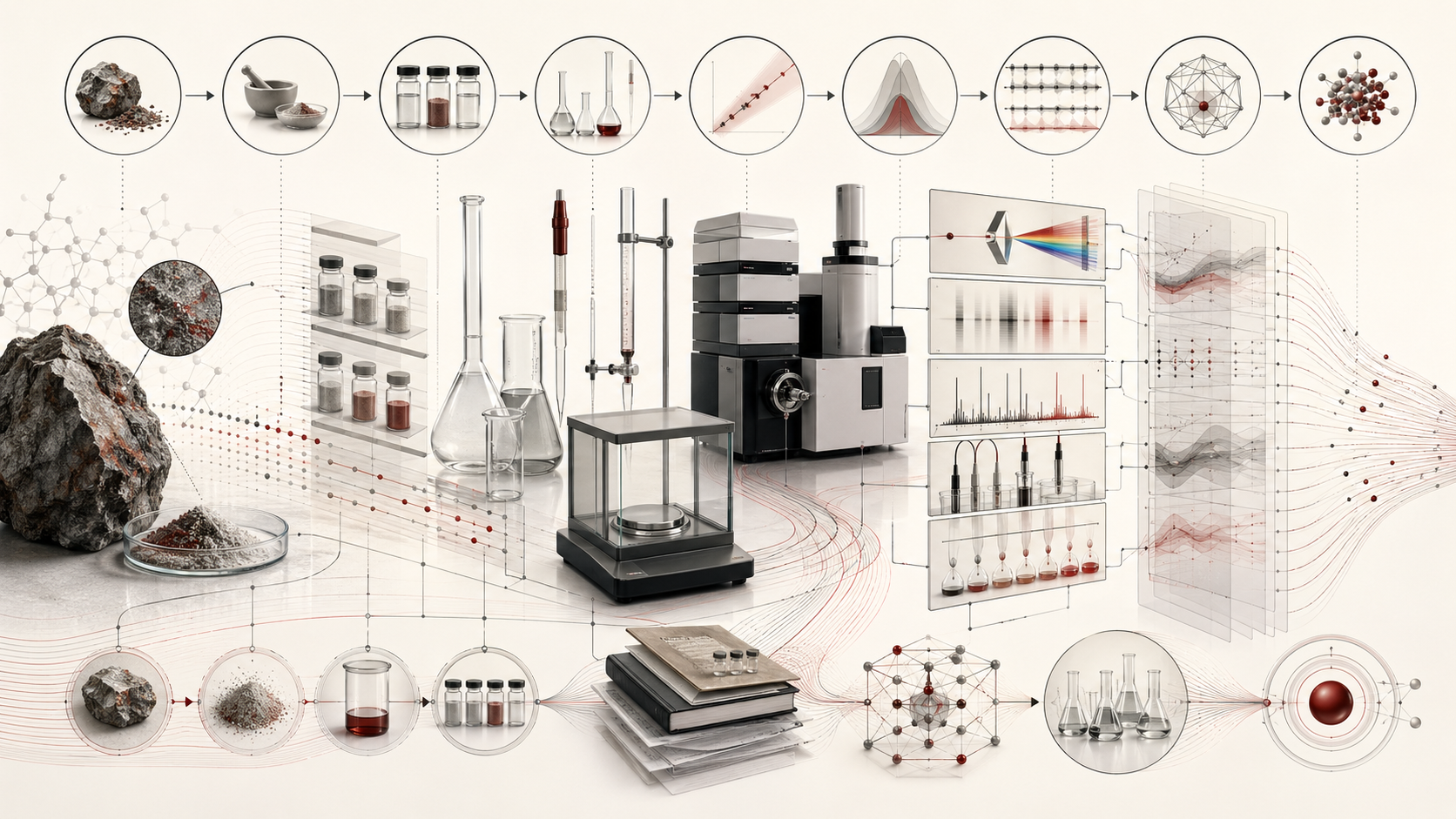
Why Measurement Matters in Chemistry
Measurement matters in chemistry because chemical knowledge depends on evidence that can be compared, repeated, and trusted. A color change may suggest that a reaction occurred. A precipitate may indicate that a new substance formed. A flame may show combustion. An odor may reveal volatility. But none of these observations alone is sufficient for modern chemical knowledge. Chemistry requires quantities: mass, volume, concentration, purity, yield, absorbance, retention time, potential, current, pressure, temperature, pH, uncertainty, and composition.
The act of measuring changes what chemistry can claim. It allows a chemist to distinguish appearance from amount, reaction from contamination, signal from noise, pattern from error, and conclusion from speculation. Measurement makes it possible to compare one laboratory with another, one experiment with a prior result, one sample with a standard, and one claim with an independent test.
Measurement also makes chemistry accountable. If a reaction produces a product, the yield can be calculated. If a solution is prepared, its concentration can be stated. If a contaminant is detected, its amount can be estimated. If an instrument gives a response, calibration can connect that response to concentration. If uncertainty is present, it can be quantified rather than hidden.
Chemistry is therefore not only a science of substances. It is a science of measured substances under controlled conditions. It studies matter by making matter accountable to units, standards, records, and reproducible procedures.
This is why measurement belongs near the foundation of chemistry. It is the bridge between material transformation and scientific evidence.
From Qualitative Observation to Quantitative Science
Early chemical practice included rich qualitative observation. Practitioners described colors, odors, textures, precipitates, fumes, residues, flames, crystals, tastes, and transformations. Such observations were useful, and they remain important in the laboratory. A chemist still notices color, turbidity, heat, bubbling, crystallization, phase separation, or unexpected odor as part of experimental awareness.
But modern chemistry required a transition from qualitative observation to quantitative inquiry. The balance, the burette, the pipette, the thermometer, the gas jar, the manometer, the spectrometer, the chromatograph, and the mass spectrometer all made chemical claims more precise. The question became not only “What happened?” but “How much happened, under what conditions, with what uncertainty, and according to which method?”
This transition was central to the Chemical Revolution. Conservation of mass, oxygen theory, gas chemistry, and systematic reaction accounting required quantitative evidence. Later developments in stoichiometry, atomic theory, electrochemistry, thermodynamics, kinetics, analytical chemistry, and molecular spectroscopy deepened the same movement: chemistry became a science in which material change could be measured.
Quantification does not eliminate judgment. It disciplines judgment. It forces assumptions into the open: sample size, calibration method, units, error sources, detection limits, reagent purity, temperature, pressure, reaction conditions, and instrumental limits. A number in chemistry is meaningful only when its conditions of production are known.
Qualitative observation remains essential because it can reveal phenomena that numbers alone may miss. But modern chemical knowledge requires qualitative awareness to be joined to quantitative accountability. The laboratory eye and the calibrated instrument belong together.
Mass, Volume, and the Foundations of Chemical Accounting
Mass and volume are among the most basic quantities in chemistry. Mass allows chemists to account for matter. Volume allows chemists to prepare solutions, collect gases, deliver reagents, and relate amount to space. Together, mass and volume form the foundation of much laboratory calculation.
A balance is more than a weighing device. It is an instrument of chemical accountability. When a substance is weighed, the chemist creates a quantitative basis for reaction, yield, concentration, purity, or composition. Mass connects directly to conservation: in a properly defined closed system, matter is not lost; it is transformed.
Volume matters especially in solution chemistry. Volumetric flasks, pipettes, burettes, graduated cylinders, syringes, gas collection systems, and automated liquid handlers all support controlled delivery or measurement of volume. But volume is sensitive to technique and conditions. Meniscus reading, calibration, temperature, glassware class, evaporation, transfer loss, wetting behavior, and contamination can all affect a result.
Mass and volume also work together through density:
\rho = \frac{m}{V}
\]
Interpretation: Density \(\rho\) relates mass \(m\) to volume \(V\), supporting identification, conversion, and characterization of substances and mixtures.
Density can help identify substances, check purity, convert between mass and volume, or characterize mixtures. In industrial chemistry, environmental sampling, pharmaceutical formulation, and materials testing, density can be part of quality control and specification.
Chemical accounting begins with these basic quantities because reactions must be connected to material amounts. Without mass and volume, chemistry cannot become stoichiometric, analytical, or reproducible.
Amount of Substance and the Mole
The mole is one of the central concepts in quantitative chemistry. It connects the microscopic world of atoms, molecules, ions, and formula units to the measurable world of grams, liters, and laboratory samples.
Amount of substance is calculated as:
n = \frac{m}{M}
\]
Interpretation: Amount of substance \(n\) equals sample mass \(m\) divided by molar mass \(M\).
The mole matters because chemical reactions occur according to ratios among particles, not simply among grams. A balanced chemical equation gives relationships among amounts of substances. For example:
2H_2 + O_2 \rightarrow 2H_2O
\]
Interpretation: Two moles of hydrogen gas react with one mole of oxygen gas to form two moles of water under idealized stoichiometric interpretation.
The equation is not merely symbolic. It encodes quantitative relationships. If a chemist begins with a known amount of hydrogen, the balanced equation determines how much oxygen is required and how much water can form in theory.
The mole therefore makes chemistry scalable. It allows chemists to translate between the invisible number of particles and the visible amount of substance in a laboratory vessel. This translation supports synthesis, titration, formulation, environmental analysis, pharmaceutical dosing, food chemistry, materials preparation, and industrial process chemistry.
The mole also shows why chemistry depends on standards and definitions. The ability to compare chemical quantities requires a shared system of units. Quantitative chemistry is possible only because chemists agree on how quantities are defined, measured, and reported.
Concentration, Solutions, and Chemical Preparation
Many chemical measurements involve solutions. A solution is a homogeneous mixture in which solutes are dispersed in a solvent. Concentration expresses how much solute is present in a given amount of solution.
Molar concentration is commonly expressed as:
C = \frac{n}{V}
\]
Interpretation: Molar concentration \(C\) equals amount of solute \(n\) divided by solution volume \(V\).
Preparing a solution is an experimental act, not merely a calculation. A chemist must select a substance, weigh it, transfer it, dissolve it, dilute it to volume, mix it thoroughly, label it, and record the preparation. Each step can introduce uncertainty or error. Hygroscopic materials can absorb water. Volumetric flasks must be filled carefully. Solids can remain on weighing paper or inside a transfer funnel. The solvent itself may contain impurities.
Dilution is another foundational operation:
C_1V_1 = C_2V_2
\]
Interpretation: The amount of solute is conserved during ideal dilution, relating initial and final concentration-volume products.
This equation assumes ideal mixing, careful volume control, and no solute loss. In real laboratories, dilution quality depends on pipette calibration, volumetric glassware tolerance, mixing, temperature, contamination control, and analyst technique.
Concentration is central to chemistry because chemical behavior often depends on amount per volume: reaction rates, equilibrium position, absorbance, toxicity, pH, conductivity, ionic strength, solubility, and biological response all depend on concentration. To know chemistry, one must know not only what is present, but how much is present and how that amount was prepared.
Stoichiometry and the Discipline of Conservation
Stoichiometry is the quantitative language of chemical reaction. It uses balanced equations to relate reactants and products according to conservation of atoms and charge.
For a general reaction:
aA + bB \rightarrow cC + dD
\]
Interpretation: Stoichiometric coefficients \(a\), \(b\), \(c\), and \(d\) express quantitative relationships among reactants and products.
The ratios of amounts are:
\frac{n_A}{a} = \frac{n_B}{b} = \frac{n_C}{c} = \frac{n_D}{d}
\]
Interpretation: Amounts of substances relate through the coefficients of a balanced chemical equation.
Stoichiometry disciplines chemical reasoning. It prevents the chemist from treating reactions as vague transformations. It asks whether the equation is balanced, which reactant is limiting, how much product is theoretically possible, how much product was actually obtained, and where the rest of the matter went.
Percent yield is one common expression of this accounting:
\mathrm{Percent\ yield} =
\frac{\mathrm{actual\ yield}}{\mathrm{theoretical\ yield}}
\times 100
\]
Interpretation: Percent yield compares observed product amount with the maximum product predicted by stoichiometry.
A yield below 100 percent may reflect incomplete reaction, side reactions, purification loss, equilibrium limitation, measurement error, product instability, or experimental technique. A yield above 100 percent usually signals impurity, solvent retention, weighing error, contamination, or incorrect assumptions.
Stoichiometry is therefore not just arithmetic. It is a discipline of conservation and accountability. It asks chemistry to account for matter.
Calibration and Instrument Response
Modern chemistry relies heavily on instruments. Spectrometers, chromatographs, electrochemical sensors, mass spectrometers, pH meters, balances, thermometers, and automated analyzers do not directly produce chemical truth. They produce signals. Calibration connects those signals to known quantities.
A simple calibration curve relates instrument response to concentration. In many introductory cases, the relationship is modeled as:
y = mx + b
\]
Interpretation: Instrument response \(y\) is modeled as a linear function of concentration \(x\), with slope \(m\) and intercept \(b\).
An unknown concentration can be estimated from the measured response:
x = \frac{y-b}{m}
\]
Interpretation: The equation estimates concentration from response only when the calibration model is valid for the sample and range.
Calibration is central because instruments can drift, respond nonlinearly, saturate, produce background signals, or differ from one another. A measured absorbance, current, peak area, retention time, or mass-to-charge signal must be interpreted in relation to standards, blanks, quality controls, and method validation.
Good calibration asks several questions:
- Were standards prepared correctly?
- Does the calibration range cover the unknown samples?
- Is the response linear or nonlinear?
- Was a blank measured?
- Were replicate standards used?
- Is the instrument stable?
- What uncertainty applies to the estimated concentration?
- Are there matrix effects or interferences?
- Were residuals inspected?
- Is the calibration model fit for the intended purpose?
Calibration turns instrument output into chemical evidence. Without calibration, a signal is only a signal. With calibration, a signal becomes a measured quantity with stated assumptions and uncertainty.
Uncertainty, Precision, Accuracy, and Traceability
Measurement in chemistry always involves uncertainty. This does not mean measurement is unreliable. It means that serious measurement recognizes its limits. A reported value is stronger when it includes an estimate of uncertainty, because it acknowledges the range within which the measured quantity is reasonably believed to lie.
Precision refers to the closeness of repeated measurements to one another. Accuracy refers more broadly to closeness to a true or accepted value, though modern metrology treats accuracy with care because the true value is often not directly knowable. Trueness refers to closeness of the average result to a reference value. Uncertainty characterizes the dispersion of values that could reasonably be attributed to the measurand.
A measurement result is therefore not simply:
x
\]
Interpretation: A bare number is incomplete when uncertainty, unit, method, and context matter.
but more responsibly:
x \pm U
\]
Interpretation: \(U\) represents an uncertainty measure, often expanded uncertainty, depending on context.
Traceability is also essential. A measurement is more trustworthy when it can be related through an unbroken chain of comparisons to recognized standards, with uncertainties stated at each stage. Traceability allows results from different laboratories, instruments, and countries to be compared.
In chemistry, uncertainty can arise from many sources:
- balance calibration;
- volumetric glassware tolerances;
- temperature variation;
- sample heterogeneity;
- reagent purity;
- instrument drift;
- matrix effects;
- blank correction;
- operator technique;
- calibration model selection;
- statistical variability;
- software processing choices.
Uncertainty is not an embarrassment. It is part of scientific honesty. Chemistry becomes more reliable when uncertainty is measured, reported, and used in interpretation.
Standards, Reference Materials, and Comparability
Chemistry depends on comparability. A concentration measured in one laboratory should be meaningfully comparable to a concentration measured elsewhere, provided both use validated methods and traceable standards. This is why standards and reference materials are so important.
A standard solution may be used to calibrate an instrument or verify a method. A certified reference material may provide a known composition with an uncertainty statement. A standard operating procedure may define how a method should be performed. A reference database may provide thermodynamic, spectral, or chemical property data.
Reference materials are especially important in analytical chemistry because they allow laboratories to test whether their measurements are accurate enough for the intended purpose. Environmental monitoring, pharmaceutical quality control, food safety, forensic chemistry, water testing, industrial manufacturing, and clinical chemistry all depend on trustworthy reference systems.
Standards also make chemistry social. A measurement is not only a private act in a laboratory. It is part of a larger infrastructure of units, methods, comparisons, certificates, databases, quality systems, and institutions. Chemistry’s reliability depends on this infrastructure.
The modern chemical laboratory is therefore not only a place of experiment. It is a node in a global measurement system. Its results become authoritative only when they can travel beyond the bench and remain intelligible to other laboratories, regulators, researchers, and public decision-makers.
Experimental Design and Controlled Chemical Inquiry
Measurement alone is not enough. Chemistry also depends on experimental design. A well-designed experiment asks a clear question, controls relevant variables, uses appropriate comparisons, records conditions, and produces interpretable evidence.
Chemical experiments often require attention to:
- temperature and pressure;
- reaction time;
- concentration and stoichiometric ratio;
- solvent and pH;
- purity of reagents;
- order of addition;
- mixing and stirring;
- light exposure;
- atmosphere and moisture;
- surface area;
- instrument calibration;
- replication and controls.
Controls are essential because chemical systems are sensitive to hidden variables. A blank can reveal contamination or background signal. A standard can test instrument response. A replicate can show variability. A control reaction can test whether an observed effect depends on a specific reagent, catalyst, condition, or mechanism.
Experimental design also matters for safety. Chemical experiments involve hazards: toxicity, flammability, pressure, corrosivity, reactivity, thermal risk, biological risk, environmental release, and waste. A good experiment is not merely informative. It is designed with safety, containment, and responsible disposal in mind.
Modern chemistry therefore depends on both epistemic control and material control: the control of knowledge and the control of hazardous matter. The best experiments do not merely produce results; they make those results interpretable.
Laboratory Records, Data, and Reproducibility
A chemical measurement is only as useful as its record. Laboratory notebooks, instrument logs, sample identifiers, calibration records, reagent lot numbers, method files, raw data, processed data, scripts, metadata, and provenance records are all part of chemical evidence.
Reproducibility requires that another competent person can understand how a result was produced. This does not always mean every result will be exactly identical. Chemical systems may vary, instruments may differ, and samples may be heterogeneous. But a reproducible workflow should preserve enough information to evaluate, repeat, audit, or challenge the result.
A strong chemistry record includes:
- sample identity and source;
- preparation method;
- mass, volume, and concentration calculations;
- instrument settings;
- calibration data;
- standards and reference materials;
- environmental conditions;
- raw data files;
- data-processing steps;
- software and code versions;
- uncertainty estimates;
- deviations and anomalies;
- waste and safety notes where relevant.
Computational notebooks, SQL databases, version control, and open code can strengthen chemical reproducibility when used responsibly. They make calculations inspectable, preserve data transformations, and reduce hidden manual steps. But they do not replace chemical judgment. A reproducible notebook is only useful if the underlying experiment, data, metadata, and assumptions are valid.
Chemical records are not paperwork after the science. They are part of the science. They preserve the path from material action to scientific claim.
Measurement in Modern Analytical Chemistry
Analytical chemistry is the branch of chemistry most directly concerned with chemical measurement. It asks what is present, how much is present, where it is located, how it changes, and how confidently it can be known.
Modern analytical chemistry includes many methods:
- Spectroscopy: measuring interaction between matter and electromagnetic radiation.
- Chromatography: separating mixtures into components.
- Mass spectrometry: identifying ions by mass-to-charge ratio.
- Electroanalysis: measuring chemical systems through potential, current, and charge transfer.
- Titration: determining concentration through controlled reaction with a standard.
- Gravimetry: determining amount through mass measurement.
- Thermal analysis: measuring physical and chemical changes as temperature varies.
- Sensor systems: detecting chemical species through selective response.
Analytical chemistry is not just instrument use. It includes sampling, method selection, validation, calibration, matrix effects, uncertainty, detection limits, quantitation limits, quality control, and interpretation. It must ask whether a sample represents the system being studied, whether the method is appropriate, whether interferences exist, whether the result is fit for purpose, and whether the conclusion is justified.
This is especially important in environmental chemistry, food safety, pharmaceuticals, toxicology, water quality, public health, and forensic science. In those settings, chemical measurement can shape regulation, treatment, liability, public trust, and human safety. A number can carry social consequence.
Modern analytical chemistry therefore sits at the intersection of instrumentation, chemistry, statistics, metrology, ethics, and decision-making. It is one of the places where chemical measurement most visibly becomes public evidence.
Measurement as Chemical Epistemology
Measurement is not only a technique in chemistry. It is part of chemistry’s epistemology: its way of knowing.
Chemistry studies entities that are often invisible to direct perception. Atoms, ions, molecules, contaminants, intermediates, radicals, reaction pathways, impurities, and trace elements may not be directly visible. They become knowable through instruments, models, standards, and measured effects. A spectrum, chromatogram, mass peak, titration endpoint, calibration slope, or pH reading is not the substance itself. It is evidence interpreted through chemical theory and measurement practice.
This is why chemical knowledge requires trust in instruments, but not blind trust. Instruments must be calibrated. Methods must be validated. Data must be inspected. Interferences must be considered. Uncertainty must be reported. Chemical claims must remain accountable to evidence.
Measurement also shapes what chemists notice. A discipline organized around mass balance sees matter differently from one organized around sensory description. A discipline organized around spectra sees molecular structure differently from one organized around color and odor. A discipline organized around trace analysis sees pollutants, metabolites, and impurities that earlier chemistry could not detect.
To measure chemically is therefore to change the visible world. Measurement expands perception through disciplined instrumentation. It makes hidden chemical realities available to scientific reasoning, but only when the path from signal to claim remains visible.
Digital Measurement Systems and Computational Provenance
Contemporary chemical measurement increasingly depends on digital infrastructure. Instruments generate raw files. Laboratory information systems track samples. Spreadsheets perform calculations. Scripts process signals. Databases store calibration records. Dashboards summarize quality control. Computational notebooks combine code, text, and outputs. Version control can preserve changes over time.
This digital layer can strengthen chemistry when it preserves provenance. It can also weaken chemistry when it hides processing choices, separates results from raw data, or creates unreviewed automation. A chemical result produced through software still requires the same discipline as a bench measurement: defined measurand, known method, calibrated response, documented standards, uncertainty, review, and traceability.
Computational provenance should preserve:
- raw data and processed data links;
- instrument method files;
- calibration curve records;
- blank correction and dilution correction steps;
- integration or peak-picking settings;
- scripts and package versions;
- unit conversions and formula assumptions;
- quality-control flags;
- audit logs and review status;
- uncertainty calculations and reporting rules.
As chemistry becomes more automated, measurement literacy becomes more important, not less. Automation can reduce manual error, but it can also scale poorly documented assumptions. The question is not whether a workflow is digital. The question is whether it is scientifically auditable.
Digital measurement systems should extend the discipline of chemical measurement into data systems. They should make evidence easier to inspect, not harder to question.
Mathematical Lens: Measurement and Quantification
Measurement and quantification in chemistry rely on several mathematical ideas. Density is:
\rho = \frac{m}{V}
\]
Interpretation: Density relates mass to volume and supports identification, conversion, and material characterization.
Amount of substance is:
n = \frac{m}{M}
\]
Interpretation: Amount of substance connects laboratory mass to mole-based chemical relationships.
Molar concentration is:
C = \frac{n}{V}
\]
Interpretation: Concentration expresses amount of solute per volume of solution.
Dilution is:
C_1V_1 = C_2V_2
\]
Interpretation: Ideal dilution conserves solute amount across initial and final concentration-volume products.
The mean of replicate measurements is:
\bar{x} = \frac{1}{n}\sum_{i=1}^{n}x_i
\]
Interpretation: The mean summarizes the central value of repeated measurements.
Sample standard deviation is:
s =
\sqrt{
\frac{\sum_{i=1}^{n}(x_i-\bar{x})^2}{n-1}
}
\]
Interpretation: Sample standard deviation estimates dispersion among replicate measurements.
Relative standard deviation is:
RSD = \frac{s}{\bar{x}}\times 100
\]
Interpretation: Relative standard deviation expresses precision as a percentage of the mean.
Linear calibration is:
y = mx + b
\]
Interpretation: Instrument response can be modeled as a function of concentration when the calibration relationship is valid.
The Beer-Lambert law is:
A = \varepsilon lc
\]
Interpretation: Absorbance \(A\) depends on molar absorptivity \(\varepsilon\), path length \(l\), and concentration \(c\) under appropriate conditions.
Expanded uncertainty is:
U = ku_c
\]
Interpretation: Expanded uncertainty \(U\) equals coverage factor \(k\) multiplied by combined standard uncertainty \(u_c\).
These formulas show why chemistry is quantitative. Chemical evidence depends on counting, weighing, measuring, calibrating, averaging, comparing, and estimating uncertainty. The formulas are not detached abstractions; they are tools for making matter accountable.
Computational Workflows for Measurement and Quantification
Computational workflows can make measurement and quantification more transparent. A workflow can track mass, molar mass, amount of substance, volume, concentration, dilution, calibration, replicate statistics, uncertainty, quality-control flags, laboratory records, and provenance.
Useful workflows include solution-preparation calculators, dilution planners, calibration models, replicate-measurement summaries, Beer-Lambert calculations, uncertainty budgets, stoichiometric yield tables, instrument-response records, laboratory-data registers, and SQL evidence systems.
For researchers and laboratory teams, measurement workflows should preserve four distinctions:
- Observation versus measurement: sensory evidence can suggest change, but quantitative claims require controlled measurement.
- Signal versus concentration: instrument response becomes chemical quantity only through calibration and validation.
- Precision versus accuracy: repeated agreement does not guarantee closeness to a reference value.
- Digital output versus evidence: a computed result is trustworthy only when data, code, units, assumptions, and review are preserved.
The examples below use synthetic educational data. They do not validate real laboratory methods, certify analytical results, approve environmental compliance, establish pharmaceutical quality, or replace professional chemical review. They demonstrate how measurement and quantification can be structured, audited, and communicated responsibly.
Python Example: Mass, Moles, Concentration, Calibration, and Provenance
The following Python example uses synthetic educational data. It calculates mass-to-mole conversion, concentration, dilution planning, a simple calibration curve, estimated unknown concentration, replicate precision, and provenance outputs. In real workflows, calibration range, uncertainty, method validation, and data provenance must be documented.
from pathlib import Path
import json
import platform
import sys

import numpy as np
import pandas as pd


# Synthetic measurement and quantification workflow.
# Educational example only; not for laboratory certification,
# environmental compliance, clinical decisions, pharmaceutical quality,
# or professional chemical review.


def require_columns(data: pd.DataFrame, required: list[str], table_name: str) -> None:
    """Raise an error if required columns are missing."""
    missing = [column for column in required if column not in data.columns]
    if missing:
        raise ValueError(f"{table_name} is missing required columns: {missing}")


samples = pd.DataFrame(
    {
        "sample": ["sodium_chloride", "glucose", "copper_sulfate_pentahydrate"],
        "mass_g": [5.844, 9.000, 2.495],
        "molar_mass_g_mol": [58.44, 180.156, 249.685],
        "volume_l": [0.500, 0.250, 0.100],
    }
)

require_columns(
    samples,
    ["sample", "mass_g", "molar_mass_g_mol", "volume_l"],
    "samples",
)

samples["amount_mol"] = samples["mass_g"] / samples["molar_mass_g_mol"]
samples["concentration_mol_l"] = samples["amount_mol"] / samples["volume_l"]

dilutions = pd.DataFrame(
    {
        "solution": ["A", "B", "C"],
        "stock_concentration_mol_l": [1.0, 0.5, 2.0],
        "target_concentration_mol_l": [0.10, 0.05, 0.25],
        "final_volume_ml": [100.0, 250.0, 50.0],
    }
)

dilutions["stock_volume_ml"] = (
    dilutions["target_concentration_mol_l"] * dilutions["final_volume_ml"]
) / dilutions["stock_concentration_mol_l"]

calibration = pd.DataFrame(
    {
        "standard_id": ["STD_0", "STD_1", "STD_2", "STD_3", "STD_4", "STD_5"],
        "concentration_mol_l": [0.00, 0.02, 0.04, 0.06, 0.08, 0.10],
        "instrument_response": [0.003, 0.118, 0.231, 0.351, 0.462, 0.579],
    }
)

require_columns(
    calibration,
    ["concentration_mol_l", "instrument_response"],
    "calibration",
)

slope, intercept = np.polyfit(
    calibration["concentration_mol_l"],
    calibration["instrument_response"],
    deg=1,
)

predicted_response = slope * calibration["concentration_mol_l"] + intercept
residuals = calibration["instrument_response"] - predicted_response

r_squared = 1.0 - (
    np.sum(residuals**2)
    / np.sum(
        (
            calibration["instrument_response"]
            - calibration["instrument_response"].mean()
        ) ** 2
    )
)

unknown_response = 0.405
estimated_concentration = (unknown_response - intercept) / slope

calibration_summary = pd.DataFrame(
    [
        {
            "model": "instrument_response = slope * concentration + intercept",
            "slope": slope,
            "intercept": intercept,
            "r_squared": r_squared,
            "unknown_response": unknown_response,
            "estimated_unknown_concentration_mol_l": estimated_concentration,
            "calibration_range_low_mol_l": calibration["concentration_mol_l"].min(),
            "calibration_range_high_mol_l": calibration["concentration_mol_l"].max(),
            "range_note": "unknown estimate assumes the sample lies within the validated calibration range",
        }
    ]
)

replicates = pd.DataFrame(
    {
        "replicate": [1, 2, 3, 4, 5, 6],
        "measured_mass_g": [1.0032, 1.0028, 1.0035, 1.0030, 1.0029, 1.0034],
    }
)

mean_mass = float(replicates["measured_mass_g"].mean())
sample_sd = float(replicates["measured_mass_g"].std(ddof=1))
rsd_percent = 100.0 * sample_sd / mean_mass

replicate_summary = pd.DataFrame(
    [
        {
            "replicate_count": len(replicates),
            "mean_mass_g": mean_mass,
            "sample_standard_deviation_g": sample_sd,
            "relative_standard_deviation_percent": rsd_percent,
        }
    ]
)

measurement_review = pd.DataFrame(
    [
        {
            "review_item": "mass_to_moles",
            "status": "educational",
            "note": "molar masses are simplified example values",
        },
        {
            "review_item": "dilution",
            "status": "idealized",
            "note": "assumes ideal mixing and no transfer loss",
        },
        {
            "review_item": "calibration",
            "status": "synthetic_linear_model",
            "note": "real calibration requires residual review, uncertainty, and valid range",
        },
        {
            "review_item": "replicate_precision",
            "status": "precision_only",
            "note": "precision does not establish trueness or accuracy",
        },
    ]
)

output_dir = Path("outputs")
output_dir.mkdir(exist_ok=True)

samples.to_csv(output_dir / "synthetic_mass_moles_concentration.csv", index=False)
dilutions.to_csv(output_dir / "synthetic_dilution_planning.csv", index=False)
calibration.to_csv(output_dir / "synthetic_calibration_data.csv", index=False)
calibration_summary.to_csv(output_dir / "synthetic_calibration_summary.csv", index=False)
replicates.to_csv(output_dir / "synthetic_replicate_measurements.csv", index=False)
replicate_summary.to_csv(output_dir / "synthetic_replicate_summary.csv", index=False)
measurement_review.to_csv(output_dir / "synthetic_measurement_review_notes.csv", index=False)

manifest = {
    "workflow": "synthetic_measurement_quantification_workflow",
    "data_type": "synthetic educational chemical measurement records",
    "equations": [
        "n = m / M",
        "C = n / V",
        "C1 * V1 = C2 * V2",
        "linear calibration: y = m*x + b",
        "unknown concentration: x = (y - b) / m",
        "mean = sum(x_i) / n",
        "sample standard deviation = sqrt(sum((x_i - mean)^2)/(n-1))",
        "RSD percent = sample_sd / mean * 100",
    ],
    "cautions": [
        "Synthetic educational data only.",
        "Not suitable for certified laboratory reporting.",
        "Calibration estimates require validated range and uncertainty.",
        "Precision does not establish trueness.",
        "Real measurements require traceability, metadata, and review.",
    ],
    "python_version": sys.version,
    "platform": platform.platform(),
    "numpy_version": np.__version__,
    "pandas_version": pd.__version__,
    "output_files": [
        "outputs/synthetic_mass_moles_concentration.csv",
        "outputs/synthetic_dilution_planning.csv",
        "outputs/synthetic_calibration_data.csv",
        "outputs/synthetic_calibration_summary.csv",
        "outputs/synthetic_replicate_measurements.csv",
        "outputs/synthetic_replicate_summary.csv",
        "outputs/synthetic_measurement_review_notes.csv",
        "outputs/measurement_quantification_manifest.json",
    ],
}

with (output_dir / "measurement_quantification_manifest.json").open(
    "w",
    encoding="utf-8"
) as file:
    json.dump(manifest, file, indent=2)

print("Mass, moles, and concentration")
print("------------------------------")
print(samples.round(6).to_string(index=False))

print("\nDilution planning")
print("-----------------")
print(dilutions.round(6).to_string(index=False))

print("\nCalibration summary")
print("-------------------")
print(calibration_summary.round(6).to_string(index=False))

print("\nReplicate summary")
print("-----------------")
print(replicate_summary.round(8).to_string(index=False))

print("\nMeasurement review notes")
print("------------------------")
print(measurement_review.to_string(index=False))
This workflow demonstrates measurement evidence discipline rather than certified analysis. It separates mass-to-mole calculations, concentration, dilution planning, calibration, replicate precision, review notes, and provenance. A real workflow would add validated methods, raw data, uncertainty budgets, traceability chains, instrument records, and independent review.
R Example: Replicate Measurements, Dilution Planning, and Precision Review
The following R example uses synthetic educational data to summarize replicate measurements, calculate relative standard deviation, plan dilutions, and organize quality-review notes. In real workflows, measurement uncertainty, calibration status, reference materials, and traceability should be documented.
# Synthetic measurement and quantification scaffold.
# Educational example only; not for laboratory certification,
# environmental compliance, clinical decisions, pharmaceutical quality,
# or professional chemical review.

measurements <- data.frame(
  replicate = 1:6,
  measured_mass_g = c(1.0032, 1.0028, 1.0035, 1.0030, 1.0029, 1.0034)
)

mean_mass <- mean(measurements$measured_mass_g)
sd_mass <- sd(measurements$measured_mass_g)
rsd_percent <- 100 * sd_mass / mean_mass

replicate_summary <- data.frame(
  replicate_count = nrow(measurements),
  mean_mass_g = mean_mass,
  sample_standard_deviation_g = sd_mass,
  relative_standard_deviation_percent = rsd_percent
)

dilutions <- data.frame(
  solution = c("A", "B", "C"),
  stock_concentration_mol_l = c(1.0, 0.5, 2.0),
  target_concentration_mol_l = c(0.10, 0.05, 0.25),
  final_volume_ml = c(100, 250, 50)
)

dilutions$stock_volume_ml <- with(
  dilutions,
  (target_concentration_mol_l * final_volume_ml) /
    stock_concentration_mol_l
)

calibration <- data.frame(
  concentration_mol_l = c(0.00, 0.02, 0.04, 0.06, 0.08, 0.10),
  instrument_response = c(0.003, 0.118, 0.231, 0.351, 0.462, 0.579)
)

calibration_model <- lm(
  instrument_response ~ concentration_mol_l,
  data = calibration
)

unknown_response <- 0.405

estimated_concentration <-
  (unknown_response - coef(calibration_model)[["(Intercept)"]]) /
  coef(calibration_model)[["concentration_mol_l"]]

calibration_summary <- data.frame(
  slope = coef(calibration_model)[["concentration_mol_l"]],
  intercept = coef(calibration_model)[["(Intercept)"]],
  r_squared = summary(calibration_model)$r.squared,
  unknown_response = unknown_response,
  estimated_concentration_mol_l = estimated_concentration
)

quality_review <- data.frame(
  review_item = c(
    "replicate_precision",
    "dilution_planning",
    "linear_calibration",
    "unknown_estimate",
    "recordkeeping"
  ),
  status = c(
    "precision summary only",
    "idealized dilution equation",
    "synthetic model",
    "requires range validation",
    "metadata required"
  ),
  note = c(
    "precision does not establish trueness",
    "real dilution requires calibrated glassware and transfer control",
    "real calibration requires residual and uncertainty review",
    "unknown response should fall within validated calibration range",
    "sample, method, instrument, and analyst/workflow records should be preserved"
  )
)

dir.create("outputs", showWarnings = FALSE)

write.csv(
  measurements,
  file = "outputs/r_replicate_measurements.csv",
  row.names = FALSE
)

write.csv(
  replicate_summary,
  file = "outputs/r_replicate_summary.csv",
  row.names = FALSE
)

write.csv(
  dilutions,
  file = "outputs/r_dilution_planning.csv",
  row.names = FALSE
)

write.csv(
  calibration,
  file = "outputs/r_calibration_data.csv",
  row.names = FALSE
)

write.csv(
  calibration_summary,
  file = "outputs/r_calibration_summary.csv",
  row.names = FALSE
)

write.csv(
  quality_review,
  file = "outputs/r_measurement_quality_review.csv",
  row.names = FALSE
)

sink("outputs/r_measurement_quantification_report.txt")
cat("Synthetic Measurement and Quantification Report\n")
cat("===============================================\n\n")
cat("Replicate measurements:\n")
print(measurements)
cat("\nReplicate summary:\n")
print(replicate_summary)
cat("\nDilution planning:\n")
print(dilutions)
cat("\nCalibration model:\n")
print(summary(calibration_model))
cat("\nCalibration summary:\n")
print(calibration_summary)
cat("\nQuality review:\n")
print(quality_review)
cat("\nResponsible-use note:\n")
cat("Synthetic educational data only. Real chemical measurement workflows require validated methods, uncertainty, traceability, and review.\n")
sink()

print(measurements)
print(replicate_summary)
print(dilutions)
print(calibration_summary)
print(quality_review)
This scaffold shows how R can support replicate measurement review, dilution planning, calibration summaries, and quality notes. The central issue is not the language but the evidence chain. Measurement outputs should remain connected to units, methods, calibration, standards, uncertainty, and provenance.
SQL Example: Chemical Measurement Evidence Register
Chemical measurement becomes more reliable when samples, methods, balances, volumes, standards, calibrations, measurements, uncertainty estimates, data files, and interpretation claims are traceable. A simple evidence register can preserve the context needed to audit measurement and quantification workflows.
CREATE TABLE measurement_sample (
    sample_id TEXT PRIMARY KEY,
    sample_name TEXT NOT NULL,
    sample_type TEXT,
    matrix_description TEXT,
    collection_datetime TEXT,
    preparation_description TEXT,
    storage_condition TEXT,
    sample_review_status TEXT,
    notes TEXT
);

CREATE TABLE measurement_method (
    method_id TEXT PRIMARY KEY,
    method_name TEXT NOT NULL,
    method_version TEXT,
    measurement_principle TEXT,
    instrument_platform TEXT,
    preparation_steps TEXT,
    valid_range_description TEXT,
    method_source_uri TEXT,
    method_review_status TEXT
);

CREATE TABLE quantity_definition (
    quantity_id TEXT PRIMARY KEY,
    quantity_name TEXT NOT NULL,
    symbol TEXT,
    unit TEXT,
    definition_description TEXT,
    reporting_basis TEXT,
    quantity_review_status TEXT
);

CREATE TABLE mass_volume_record (
    mass_volume_id TEXT PRIMARY KEY,
    sample_id TEXT NOT NULL,
    mass_value REAL,
    mass_unit TEXT,
    balance_id TEXT,
    balance_calibration_uri TEXT,
    volume_value REAL,
    volume_unit TEXT,
    volume_device TEXT,
    volume_calibration_uri TEXT,
    temperature_c REAL,
    mass_volume_review_status TEXT,
    FOREIGN KEY (sample_id) REFERENCES measurement_sample(sample_id)
);

CREATE TABLE solution_preparation_record (
    solution_id TEXT PRIMARY KEY,
    sample_id TEXT NOT NULL,
    solute_description TEXT,
    solvent_description TEXT,
    mass_value REAL,
    mass_unit TEXT,
    molar_mass_value REAL,
    molar_mass_unit TEXT,
    amount_mol REAL,
    final_volume_value REAL,
    final_volume_unit TEXT,
    concentration_value REAL,
    concentration_unit TEXT,
    preparation_review_status TEXT,
    FOREIGN KEY (sample_id) REFERENCES measurement_sample(sample_id)
);

CREATE TABLE calibration_record (
    calibration_id TEXT PRIMARY KEY,
    method_id TEXT NOT NULL,
    quantity_id TEXT NOT NULL,
    calibration_datetime TEXT,
    standard_description TEXT,
    calibration_range_low REAL,
    calibration_range_high REAL,
    concentration_unit TEXT,
    slope REAL,
    intercept REAL,
    r_squared REAL,
    residual_review_description TEXT,
    calibration_review_status TEXT,
    FOREIGN KEY (method_id) REFERENCES measurement_method(method_id),
    FOREIGN KEY (quantity_id) REFERENCES quantity_definition(quantity_id)
);

CREATE TABLE measurement_result (
    result_id TEXT PRIMARY KEY,
    sample_id TEXT NOT NULL,
    method_id TEXT NOT NULL,
    quantity_id TEXT NOT NULL,
    calibration_id TEXT,
    measured_value REAL,
    measured_unit TEXT,
    expanded_uncertainty REAL,
    coverage_factor REAL,
    result_datetime TEXT,
    analyst_or_workflow_id TEXT,
    result_review_status TEXT,
    FOREIGN KEY (sample_id) REFERENCES measurement_sample(sample_id),
    FOREIGN KEY (method_id) REFERENCES measurement_method(method_id),
    FOREIGN KEY (quantity_id) REFERENCES quantity_definition(quantity_id),
    FOREIGN KEY (calibration_id) REFERENCES calibration_record(calibration_id)
);

CREATE TABLE replicate_measurement (
    replicate_id TEXT PRIMARY KEY,
    result_id TEXT NOT NULL,
    replicate_number INTEGER,
    replicate_value REAL,
    replicate_unit TEXT,
    replicate_review_status TEXT,
    FOREIGN KEY (result_id) REFERENCES measurement_result(result_id)
);

CREATE TABLE uncertainty_record (
    uncertainty_id TEXT PRIMARY KEY,
    result_id TEXT NOT NULL,
    component_name TEXT,
    standard_uncertainty REAL,
    uncertainty_unit TEXT,
    distribution_assumption TEXT,
    sensitivity_coefficient REAL,
    independence_assumption TEXT,
    uncertainty_review_status TEXT,
    FOREIGN KEY (result_id) REFERENCES measurement_result(result_id)
);

CREATE TABLE reference_standard_record (
    reference_id TEXT PRIMARY KEY,
    standard_name TEXT NOT NULL,
    standard_type TEXT,
    producer TEXT,
    lot_number TEXT,
    certificate_uri TEXT,
    certified_value REAL,
    certified_unit TEXT,
    certified_uncertainty REAL,
    intended_use TEXT,
    reference_review_status TEXT
);

CREATE TABLE quality_control_record (
    qc_id TEXT PRIMARY KEY,
    result_id TEXT,
    qc_type TEXT,
    qc_material TEXT,
    observed_value REAL,
    expected_value REAL,
    acceptance_low REAL,
    acceptance_high REAL,
    unit TEXT,
    qc_pass_fail TEXT,
    qc_review_status TEXT,
    FOREIGN KEY (result_id) REFERENCES measurement_result(result_id)
);

CREATE TABLE measurement_data_provenance (
    provenance_id TEXT PRIMARY KEY,
    result_id TEXT NOT NULL,
    raw_data_uri TEXT,
    processed_data_uri TEXT,
    calculation_script_uri TEXT,
    software_name TEXT,
    software_version TEXT,
    instrument_method_uri TEXT,
    audit_log_uri TEXT,
    provenance_review_status TEXT,
    FOREIGN KEY (result_id) REFERENCES measurement_result(result_id)
);

CREATE TABLE measurement_interpretation_claim (
    claim_id TEXT PRIMARY KEY,
    result_id TEXT NOT NULL,
    claim_text TEXT,
    claim_type TEXT,
    confidence_level TEXT,
    limitation_notes TEXT,
    review_status TEXT,
    FOREIGN KEY (result_id) REFERENCES measurement_result(result_id)
);

SELECT
    sample.sample_id,
    sample.sample_name,
    sample.matrix_description,
    method.method_name,
    method.method_version,
    quantity.quantity_name,
    quantity.unit AS quantity_unit,
    mv.mass_value,
    mv.mass_unit,
    mv.volume_value,
    mv.volume_unit,
    prep.amount_mol,
    prep.concentration_value,
    prep.concentration_unit,
    cal.slope,
    cal.intercept,
    cal.r_squared,
    result.measured_value,
    result.measured_unit,
    result.expanded_uncertainty,
    replicate.replicate_number,
    replicate.replicate_value,
    uncertainty.component_name,
    uncertainty.standard_uncertainty,
    ref.standard_name,
    ref.certificate_uri,
    qc.qc_type,
    qc.qc_pass_fail,
    prov.raw_data_uri,
    prov.calculation_script_uri,
    claim.claim_type,
    claim.confidence_level,
    CASE
        WHEN sample.sample_review_status IS NOT NULL
             AND sample.sample_review_status != 'pass'
            THEN 'sample review required'
        WHEN method.method_review_status IS NOT NULL
             AND method.method_review_status != 'pass'
            THEN 'method review required'
        WHEN quantity.quantity_review_status IS NOT NULL
             AND quantity.quantity_review_status != 'pass'
            THEN 'quantity definition review required'
        WHEN mv.mass_volume_review_status IS NOT NULL
             AND mv.mass_volume_review_status != 'pass'
            THEN 'mass or volume review required'
        WHEN prep.preparation_review_status IS NOT NULL
             AND prep.preparation_review_status != 'pass'
            THEN 'solution preparation review required'
        WHEN cal.calibration_review_status IS NOT NULL
             AND cal.calibration_review_status != 'pass'
            THEN 'calibration review required'
        WHEN result.result_review_status IS NOT NULL
             AND result.result_review_status != 'pass'
            THEN 'measurement result review required'
        WHEN replicate.replicate_review_status IS NOT NULL
             AND replicate.replicate_review_status != 'pass'
            THEN 'replicate review required'
        WHEN uncertainty.uncertainty_review_status IS NOT NULL
             AND uncertainty.uncertainty_review_status != 'pass'
            THEN 'uncertainty review required'
        WHEN ref.reference_review_status IS NOT NULL
             AND ref.reference_review_status != 'pass'
            THEN 'reference standard review required'
        WHEN qc.qc_review_status IS NOT NULL
             AND qc.qc_review_status != 'pass'
            THEN 'quality-control review required'
        WHEN prov.provenance_review_status IS NOT NULL
             AND prov.provenance_review_status != 'pass'
            THEN 'data provenance review required'
        WHEN claim.review_status IS NOT NULL
             AND claim.review_status != 'reviewed'
            THEN 'interpretation claim review required'
        ELSE 'standard review'
    END AS measurement_review_status
FROM measurement_result result
LEFT JOIN measurement_sample sample
    ON result.sample_id = sample.sample_id
LEFT JOIN measurement_method method
    ON result.method_id = method.method_id
LEFT JOIN quantity_definition quantity
    ON result.quantity_id = quantity.quantity_id
LEFT JOIN mass_volume_record mv
    ON sample.sample_id = mv.sample_id
LEFT JOIN solution_preparation_record prep
    ON sample.sample_id = prep.sample_id
LEFT JOIN calibration_record cal
    ON result.calibration_id = cal.calibration_id
LEFT JOIN replicate_measurement replicate
    ON result.result_id = replicate.result_id
LEFT JOIN uncertainty_record uncertainty
    ON result.result_id = uncertainty.result_id
LEFT JOIN quality_control_record qc
    ON result.result_id = qc.result_id
LEFT JOIN reference_standard_record ref
    ON ref.reference_review_status IS NOT NULL
LEFT JOIN measurement_data_provenance prov
    ON result.result_id = prov.result_id
LEFT JOIN measurement_interpretation_claim claim
    ON result.result_id = claim.result_id
ORDER BY measurement_review_status, sample.sample_id, quantity.quantity_name, result.result_datetime;
The purpose of this register is to keep chemical measurement attached to evidence. A measurement result should preserve sample identity, quantity definition, method version, mass and volume records, solution preparation, calibration model, replicate measurements, uncertainty components, standards, quality-control results, raw data, processing scripts, software versions, and interpretation review. Measurement becomes stronger when its evidence trail is structured.
GitHub Repository
The companion repository for this article can support reproducible workflows for mass-volume-concentration calculations, dilution planning, calibration curves, replicate precision, Beer-Lambert calculations, uncertainty reporting, quality-control review, SQL evidence registers, provenance documentation, and responsible chemical measurement interpretation.
Complete Code Repository
The full code distribution for this article, including selected measurement and quantification examples, expanded computational workflows, reproducible data structures, provenance documentation, concentration and dilution scaffolds, calibration and replicate analysis, SQL evidence registers, and scientific-computing infrastructure, is available on GitHub.
Limits, Uncertainty, and Responsible Interpretation
Measurement and quantification are powerful, but they are not self-interpreting. A balance reading does not guarantee purity. A volume reading does not guarantee correct transfer. A calibration curve does not guarantee a valid unknown result. A precise replicate series does not guarantee accuracy. A digital output does not guarantee a trustworthy conclusion.
Uncertainty enters chemical measurement at many levels: sample collection, storage, preparation, mass measurement, volume delivery, reagent purity, calibration standards, instrument response, blank correction, matrix effects, analyst technique, method choice, software processing, and interpretation.
Precision and accuracy must be distinguished carefully. A set of repeated measurements can be tightly clustered but biased. A single result can appear plausible but lack traceability. A calibration can show a high \(R^2\) while still being inappropriate outside its range. A measurement can be mathematically correct but chemically meaningless if the measurand is poorly defined.
Reference materials and standards also have limits. They must be fit for purpose. A standard prepared in clean solvent may not represent a complex environmental or biological matrix. A certified value may apply only under specific conditions. A method may be valid for total concentration but not chemical speciation.
Digital measurement systems add additional risks. Spreadsheets can hide formula errors. Scripts can use outdated assumptions. Instrument software can change integration rules. Databases can separate results from raw files. Automation can make poor practice faster.
The computational examples associated with this article are synthetic and educational. They do not validate real laboratory methods, certify analytical results, approve environmental compliance, establish pharmaceutical quality, or replace professional chemical review. They are designed to show how measurement and quantification can be structured and audited.
Responsible chemical measurement should match claim strength to evidence. A strong measurement claim should specify measurand, matrix, method, unit, calibration, standards, uncertainty, quality-control status, provenance, and decision context whenever possible.
Conclusion
Measurement made chemistry modern. It transformed chemical practice from observation and manipulation into a quantitative science of matter, reaction, composition, and evidence. Balances, volumetric glassware, standards, calibration, uncertainty analysis, and reproducible records gave chemistry the ability to account for substances and transformations with precision.
To measure chemically is to define a question, prepare a sample, control conditions, use instruments, compare against standards, estimate uncertainty, and interpret the result through chemical theory. Measurement is therefore not a mechanical afterthought. It is one of chemistry’s deepest intellectual practices.
Measurement, quantification, and experimental discipline matter now because modern societies depend on chemical evidence. Drinking-water safety, air-quality monitoring, pharmaceutical quality, food testing, forensic analysis, environmental regulation, climate chemistry, industrial production, toxicology, materials certification, and medical diagnostics all require trustworthy chemical measurement.
The future of chemistry will be increasingly computational and instrument-rich, but its foundation remains the same: chemical claims must be measured carefully, recorded transparently, and interpreted responsibly.
Chemistry becomes trustworthy when matter becomes accountable. Measurement is the discipline that makes that accountability possible.
Related articles
- What Is Chemistry?
- The Chemical Revolution and the Rise of Modern Chemistry
- Chemical Metrology, Standards, and Reference Materials
- Mathematics for Chemistry and Molecular Systems
- Stoichiometry and the Quantitative Language of Reactions
- Analytical Chemistry and the Identification of Matter
- Laboratory Automation, Chemical Data, and Instrument Workflows
- Computational Chemistry and Molecular Modeling
- Chemical Thermodynamics and Energetics
- Chemical Kinetics and Reaction Mechanisms
- Data Systems & Analytics
Further reading
- BIPM (n.d.) JCGM Publications: Guides in Metrology. Available at: https://www.bipm.org/en/committees/jc/jcgm/publications
- BIPM (2012) JCGM 200:2012 International Vocabulary of Metrology — Basic and General Concepts and Associated Terms. Available at: https://www.bipm.org/documents/20126/2071204/JCGM_200_2012.pdf
- BIPM (2019) The International System of Units (SI Brochure). 9th edn. Available at: https://www.bipm.org/en/publications/si-brochure
- BIPM (2023) JCGM GUM-1:2023: Guide to the Expression of Uncertainty in Measurement — Part 1: Introduction. Available at: https://www.bipm.org/en/doi/10.59161/jcgmgum-1-2023
- Harris, D.C. (2020) Quantitative Chemical Analysis. 10th edn. New York: W.H. Freeman. Available at: https://www.macmillanlearning.com/college/us/product/Quantitative-Chemical-Analysis/p/1319164302
- International Union of Pure and Applied Chemistry (n.d.) Compendium of Chemical Terminology: The Gold Book. Available at: https://goldbook.iupac.org/
- National Institute of Standards and Technology (n.d.) Standard Reference Materials. Available at: https://www.nist.gov/srm
- National Institute of Standards and Technology (n.d.) NIST Chemistry WebBook. Available at: https://webbook.nist.gov/chemistry/
- Skoog, D.A., West, D.M., Holler, F.J. and Crouch, S.R. (2014) Fundamentals of Analytical Chemistry. 9th edn. Belmont, CA: Brooks/Cole. Available at: https://www.cengage.com/c/fundamentals-of-analytical-chemistry-9e-skoog/
References
- American Chemical Society (n.d.) Principles of Analytical Chemistry. Available at: https://learning.acs.org/course/index.php?categoryid=82
- BIPM (n.d.) JCGM Publications: Guides in Metrology. Available at: https://www.bipm.org/en/committees/jc/jcgm/publications
- BIPM (2012) JCGM 200:2012 International Vocabulary of Metrology — Basic and General Concepts and Associated Terms. Available at: https://www.bipm.org/documents/20126/2071204/JCGM_200_2012.pdf
- BIPM (2019) The International System of Units (SI Brochure). 9th edn. Available at: https://www.bipm.org/en/publications/si-brochure
- BIPM (2023) JCGM GUM-1:2023: Guide to the Expression of Uncertainty in Measurement — Part 1: Introduction. Available at: https://www.bipm.org/en/doi/10.59161/jcgmgum-1-2023
- Harris, D.C. (2020) Quantitative Chemical Analysis. 10th edn. New York: W.H. Freeman. Available at: https://www.macmillanlearning.com/college/us/product/Quantitative-Chemical-Analysis/p/1319164302
- International Union of Pure and Applied Chemistry (2007) Quality Assurance in Analytical Chemistry. Chemistry International, 29(3). Available at: https://publications.iupac.org/ci/2007/2903/may07.pdf
- International Union of Pure and Applied Chemistry (n.d.) Compendium of Chemical Terminology: Amount Concentration. Available at: https://goldbook.iupac.org/terms/view/A00295
- International Union of Pure and Applied Chemistry (n.d.) Compendium of Chemical Terminology: The Gold Book. Available at: https://goldbook.iupac.org/
- National Institute of Standards and Technology (n.d.) Chemical Sciences Division. Available at: https://www.nist.gov/mml/csd
- National Institute of Standards and Technology (n.d.) NIST Chemistry WebBook. Available at: https://webbook.nist.gov/chemistry/
- National Institute of Standards and Technology (n.d.) Standard Reference Materials. Available at: https://www.nist.gov/srm
- National Institute of Standards and Technology (2021) Metrological Traceability Frequently Asked Questions and NIST Policy. Available at: https://tsapps.nist.gov/publication/get_pdf.cfm?pub_id=932360
- Skoog, D.A., West, D.M., Holler, F.J. and Crouch, S.R. (2014) Fundamentals of Analytical Chemistry. 9th edn. Belmont, CA: Brooks/Cole. Available at: https://www.cengage.com/c/fundamentals-of-analytical-chemistry-9e-skoog/