
Last Updated May 28, 2026
R for biostatistics, ecology, and genomics gives life scientists a unified computational language for statistical inference, ecological community analysis, high-throughput biological data, reproducible visualization, and transparent scientific reporting. Biological research increasingly depends on data that are multilevel, variable, structured, and uncertain: experimental responses nested within batches, species counts nested within sites, repeated measures nested within organisms, sequence counts nested within libraries, and gene-level measurements linked to metadata, annotation, normalization, and statistical design.
This article introduces R as a practical and rigorous environment for three major areas of life-science computation: biostatistics, ecology, and genomics. It explains how R supports experimental analysis, regression, generalized linear models, mixed-effects reasoning, survival analysis, ecological diversity, community composition, ordination, count normalization, differential-expression scaffolds, metadata validation, visualization, and reproducible reporting. The goal is not to treat R as a collection of isolated packages, but as a scientific workflow system for making biological inference inspectable.
Main Library
Publications
Article Map
Biology
Related Topic
Mathematical Modeling
Related Topic
Environmental Science
Related Topic
Chemistry
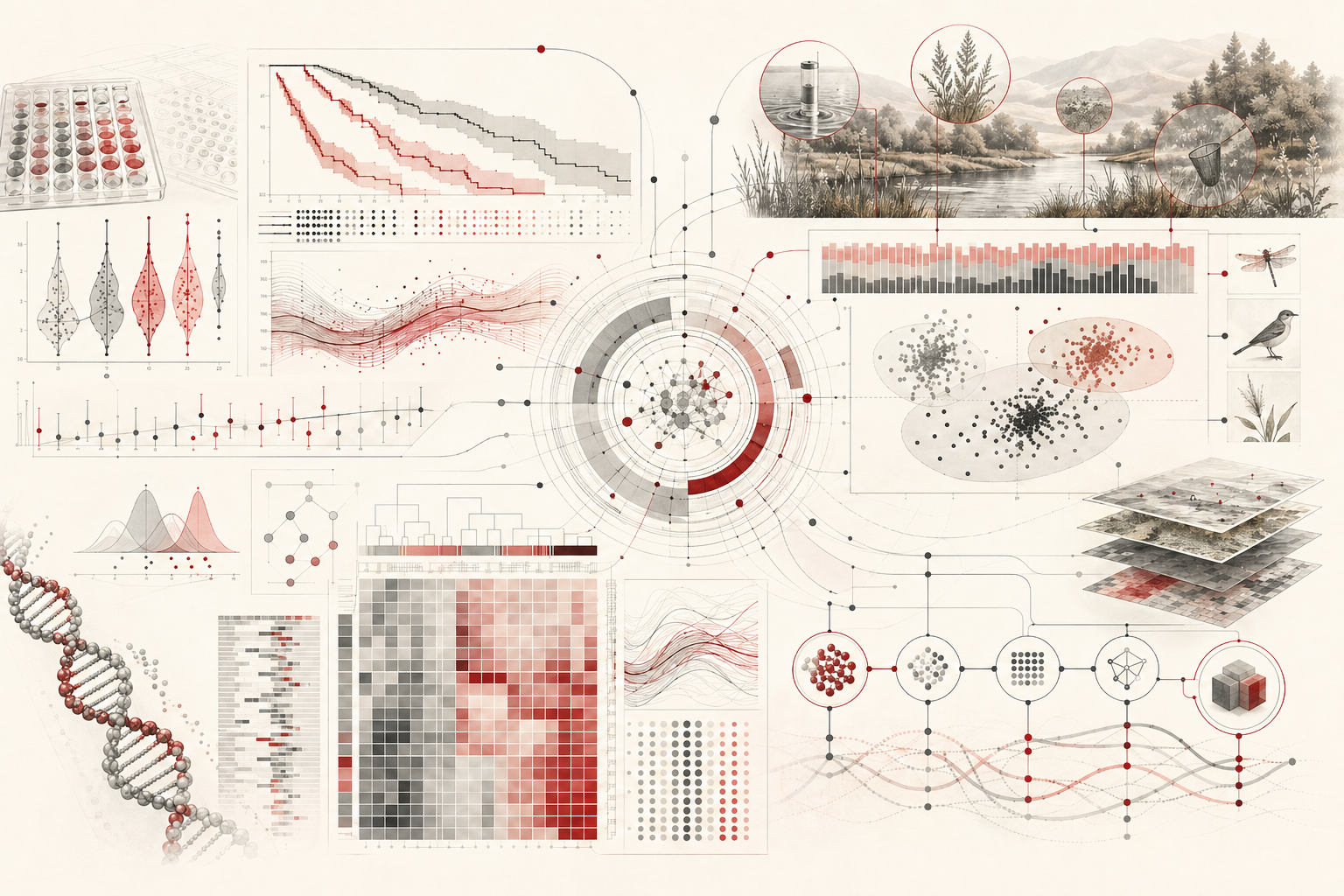
The article is written for biologists, ecologists, marine biologists, biomedical researchers, laboratory scientists, genomics researchers, computational biologists, statisticians, biotechnology teams, environmental scientists, and engineers who need reproducible analytical workflows. It emphasizes study design, units, metadata, replication, batch effects, uncertainty, model assumptions, visualization, and interpretation across biological scales.
The article also extends the discussion into reproducible computational practice through R-first workflows, biostatistical summaries, linear and generalized models, ecological diversity indices, ordination scaffolds, genomics count normalization, log fold change, metadata-integrated analysis, quality-control summaries, SQL-backed provenance, Python validation helpers, and a linked full-stack GitHub repository containing R, Python, Julia, Fortran, Rust, Go, C, C++, SQL, notebooks, data files, validation notes, and reproducibility documentation.
Why R is central to life-science analysis
R is central to life-science analysis because biology is deeply statistical. Biological observations vary across organisms, tissues, sites, cells, genes, populations, instruments, batches, observers, seasons, and experimental conditions. The scientist’s task is not simply to calculate averages, but to understand variation, uncertainty, structure, evidence, and biological meaning. R was designed for statistical computing and graphics, making it unusually well suited to this task.
The strength of R is not only that it can run statistical tests. Its deeper value is that it allows data, metadata, assumptions, models, plots, and reports to live together in a reproducible workflow. A biostatistical model can be connected to the exact dataset that produced it. An ecological diversity table can be regenerated from raw species counts. A genomics count matrix can be linked to sample metadata and normalization decisions. A plot can be rebuilt whenever data or code change.
This is especially important in biology because analytical mistakes often arise at the boundaries between data and context: confusing technical and biological replicates, ignoring batch structure, dropping failed samples without documentation, mislabeling treatment groups, normalizing count data incorrectly, overinterpreting ordination, or treating exploratory plots as confirmatory evidence.
R helps reduce these risks when it is used as a transparent scientific workflow rather than as a black-box statistics engine.
Biostatistics, experimental data, and inference
Biostatistics connects biological questions to statistical design and inference. In R, this connection often begins with a data frame containing sample identifiers, treatment groups, response variables, batch identifiers, biological covariates, quality-control flags, and measurement units. From there, the analyst can summarize data, visualize distributions, estimate effects, fit models, test assumptions, and communicate uncertainty.
A basic experimental workflow might compare a biological response between control and treated groups. But even a simple comparison requires careful interpretation. Are the observations independent? Are they biological replicates or repeated measurements from the same organism? Were samples randomized across batches? Are there missing values? Are measurement units consistent? Is the response approximately continuous, binary, count-based, proportional, censored, or time-to-event?
R provides tools for each of these cases, but the biological structure must determine the model. Continuous assay values may be analyzed with linear models. Count responses may require Poisson or negative-binomial thinking. Binary outcomes may require logistic regression. Repeated measures may require mixed-effects models. Survival outcomes may require time-to-event models. High-throughput count data may require specialized genomics methods.
Biostatistics in R is therefore not a menu of tests. It is a disciplined process of matching biological design, measurement scale, uncertainty, and statistical model.
Linear models, generalized models, and biological response
Linear models are foundational for biological analysis because they estimate how a response changes with predictors. In R, the formula interface makes this especially readable. A model such as response ~ treatment + batch expresses a scientific idea: biological response is being modeled as a function of treatment while accounting for batch structure.
Generalized linear models extend this logic to non-normal outcomes. Binary outcomes can be modeled with logistic regression. Counts can be modeled with Poisson regression, although overdispersion often requires additional care. Proportions, rates, and bounded responses require careful interpretation. R makes model fitting accessible, but accessibility should not be mistaken for adequacy.
The core biological question should always remain visible. Is the treatment effect biologically meaningful? Is the estimated effect large enough to matter? Are confidence intervals wide? Does the model match the data-generating process? Are residuals structured? Are there influential observations? Are batch and sampling effects being hidden?
R’s model objects are useful because they can be inspected, summarized, visualized, compared, and documented. The model is not just a final result. It is part of an analytical record.
Mixed-effects models and biological hierarchy
Biological data are often hierarchical. Cells are nested within images, images within samples, samples within organisms, organisms within sites, sites within regions, and measurements within batches. Ignoring this hierarchy can exaggerate sample size and produce misleading inference.
Mixed-effects models help represent hierarchical structure by including fixed effects and random effects. Fixed effects estimate systematic relationships of interest, such as treatment or temperature. Random effects represent grouping structure, such as site, subject, batch, plate, observer, or family. In R, packages such as lme4 are widely used for linear and generalized mixed-effects models.
For example, a researcher may study plant growth across treatments with repeated plots nested within sites. A simple model that treats every plant as fully independent may underestimate uncertainty. A mixed model can account for site-level variability. Similarly, a biomedical study may measure multiple cells from the same donor; treating each cell as an independent biological replicate would be pseudoreplication.
Mixed-effects models are powerful, but they require judgment. Random-effects structure should reflect study design, not just model convenience. Small numbers of groups can make variance estimates unstable. Complex models can fail to converge. Model outputs should be interpreted in biological context.
Survival, time-to-event data, and clinical biology
Survival analysis is used when the outcome is time until an event. The event may be death, disease progression, relapse, recovery, germination, failure, colonization, extinction, infection, or another biological endpoint. The defining feature is censoring: for some observations, the event has not occurred by the end of observation, or the exact event time is unknown.
R’s survival-analysis ecosystem supports Kaplan-Meier curves, log-rank comparisons, Cox proportional hazards models, and parametric survival models. These methods are important in biomedical research, ecology, toxicology, pharmacology, epidemiology, conservation biology, and experimental biology.
Time-to-event analysis is not simply a different kind of regression. It requires careful attention to censoring, follow-up time, event definitions, competing risks, proportional hazards assumptions, and study design. A survival curve is a biological trajectory under observation constraints.
R helps because survival objects, models, plots, and diagnostics can be generated reproducibly. But the biological meaning of an event and the validity of censoring assumptions must be established before the model is trusted.
Ecology, community data, and biodiversity
Ecological data often differ from laboratory data. They may involve sites, transects, quadrats, species counts, environmental gradients, repeated surveys, detection issues, seasonal variation, spatial structure, and uneven sampling effort. R is widely used in ecology because it can handle tables, matrices, models, maps, ordination, visualization, and reproducible reporting in a single environment.
Community ecology often begins with a species-by-site matrix. Rows may represent sites or samples. Columns may represent species or taxa. Values may represent abundance, cover, biomass, occurrence, read counts, or another ecological measure. From this matrix, researchers can compute richness, diversity, evenness, dissimilarity, ordination, and community-level summaries.
But ecological data require caution. Absence may mean non-detection rather than true absence. Counts depend on effort. Rare species can strongly affect metrics. Community composition can be shaped by habitat, disturbance, sampling scale, season, dispersal, and historical contingency. Statistical workflows must therefore remain tied to field methods and ecological theory.
R supports ecological analysis not because it makes ecology simple, but because it helps make ecological complexity analyzable and reproducible.
Ordination and community structure
Ordination methods help visualize high-dimensional ecological or biological data in lower-dimensional space. In community ecology, ordination can reveal similarity among sites, gradients in species composition, clustering by habitat, or shifts after disturbance. Methods such as principal components analysis, correspondence analysis, nonmetric multidimensional scaling, and principal coordinates analysis are often used depending on data type and dissimilarity measure.
R workflows can compute distance or dissimilarity matrices, run ordination, visualize site scores, overlay metadata, and inspect ecological gradients. Packages such as vegan are especially important in community ecology because they provide ordination, diversity, and dissimilarity tools.
Ordination should be interpreted carefully. The axes are mathematical summaries, not necessarily direct ecological causes. Clusters may depend on transformation, distance measure, scaling, and rare taxa. A visually striking separation may still require formal testing and ecological explanation. Ordination is a tool for exploration and interpretation, not a substitute for study design or causal evidence.
A good R ordination workflow documents the matrix, transformation, distance metric, method, metadata, and interpretation.
Genomics, count data, and Bioconductor thinking
Genomics data often come as structured count matrices: genes by samples, features by libraries, genomic ranges by conditions, or taxa by sequencing run. These data are high-dimensional, noisy, batch-sensitive, and deeply dependent on metadata. R is central in genomics because Bioconductor provides specialized infrastructure for precise and repeatable biological data analysis.
A genomics workflow usually begins with a count matrix and sample metadata. The count matrix alone is not enough. The analyst needs sample identifiers, conditions, batches, sequencing depth, library preparation information, organism, tissue, time point, replicate structure, and quality-control information. A count value without metadata cannot support meaningful biological inference.
Count data also require specialized thinking. Raw counts are influenced by library size. Low-count features may be noisy. Variance often depends on the mean. Batch effects can dominate biological differences. Differential-expression workflows therefore require normalization, dispersion estimation, statistical modeling, multiple-testing correction, and careful interpretation.
Bioconductor packages such as DESeq2 formalize many of these requirements for RNA-seq and related count-data analysis. Even when teaching with simplified examples, R workflows should preserve the conceptual structure: counts, metadata, design, normalization, model, uncertainty, and biological interpretation.
Normalization, batch effects, and metadata
Normalization is essential when measurements are affected by technical scale. In genomics, samples with larger sequencing libraries produce more reads. In ecology, sites sampled with greater effort may produce more observations. In assays, instrument drift or batch effects may shift measured values. Normalization attempts to make comparisons more meaningful, but it is never neutral. It encodes assumptions.
Batch effects are especially important in biological data. If all control samples were processed in one batch and all treated samples in another, technical and biological differences become confounded. R can model batch effects, visualize them, and include batch variables in design formulas, but it cannot rescue a fundamentally confounded design without assumptions.
Metadata are the defense against silent error. Every sample should be connected to its biological source, treatment, batch, instrument, protocol, time point, and quality-control status. In R, metadata should be imported as data, validated, joined deliberately, and used in analysis rather than left in separate notes.
Good R analysis begins with data structure, not with a model.
Visualization across biostatistics, ecology, and genomics
Visualization is central across biostatistics, ecology, and genomics because each field requires pattern recognition under uncertainty. Biostatistical plots show distributions, group differences, residuals, model predictions, effect sizes, confidence intervals, and survival curves. Ecological plots show abundance, richness, gradients, ordination, maps, and community composition. Genomics plots show count distributions, sample clustering, library size, log fold change, expression patterns, heatmaps, and quality-control diagnostics.
R’s visualization ecosystem, especially ggplot2, allows scientists to build these figures from code. This matters because figures are part of scientific evidence. A plot should not be manually reconstructed after analysis. It should be reproducible from data and scripts.
Effective biological visualization should avoid hiding variation. Individual observations should be visible when possible. Axes should include units. Group summaries should be paired with uncertainty. Transformations should be documented. Color should support interpretation rather than decoration. Heatmaps and ordinations should include metadata context.
A well-built R figure is not just a graphic. It is a reproducible argument about biological evidence.
Reproducible project architecture
A reliable R project should be organized so that another researcher can understand how data become results. A simple structure may include folders for data, R scripts, SQL schemas, documentation, outputs, figures, tables, and notebooks. The project should include a README, data dictionary, provenance notes, validation checks, and session information.
Biostatistics, ecology, and genomics each add specific requirements. Biostatistical projects need design documentation, response definitions, covariates, exclusion criteria, model assumptions, and effect-size interpretation. Ecological projects need site metadata, sampling effort, species definitions, date, observer, environmental variables, and detection considerations. Genomics projects need count matrices, sample metadata, feature annotations, library information, design formulas, normalization choices, and multiple-testing procedures.
Reproducibility is not the same as complexity. A project can be simple and still reproducible if it clearly records inputs, code, outputs, assumptions, and dependencies. The goal is to make the analysis inspectable.
Mathematical lens: biostatistics, ecology, and genomics
Several mathematical ideas connect R workflows across biostatistics, ecology, and genomics. These expressions do not replace study design, ecological interpretation, laboratory evidence, genomics best practice, or statistical diagnostics. They help clarify how models, diversity, dissimilarity, count normalization, fold change, and false discovery control can be represented formally.
Linear model
y_i=\beta_0+\beta_1x_i+\epsilon_i
\]
Interpretation: A linear model estimates how a continuous biological response changes with predictors. The residual term \(\epsilon_i\) represents variation not explained by the model.
Logistic regression
\log\left(\frac{p_i}{1-p_i}\right)=\beta_0+\beta_1x_i
\]
Interpretation: Logistic regression models binary biological outcomes such as presence/absence, survival/failure, infection/no infection, or response/nonresponse.
Poisson count model
Y_i \sim \text{Poisson}(\lambda_i)
\]
Interpretation: A Poisson model represents count data under assumptions about the mean and variance. Biological counts often require overdispersion checks or alternative count models.
\log(\lambda_i)=\beta_0+\beta_1x_i
\]
Interpretation: The log link connects expected count \(\lambda_i\) to predictors. This structure is common in generalized linear modeling for count responses.
Mixed-effects model
y_{ij}=\beta_0+\beta_1x_{ij}+u_j+\epsilon_{ij}
\]
Interpretation: A mixed-effects model includes group-level variation \(u_j\), such as site, subject, batch, donor, plate, or observer. This helps represent biological hierarchy and repeated structure.
Shannon diversity
H’=-\sum_{i=1}^{S}p_i\log(p_i)
\]
Interpretation: Shannon diversity summarizes richness and relative abundance in ecological communities. It is sensitive to both the number of taxa and their evenness.
Bray-Curtis dissimilarity
BC_{ij}=1-\frac{2\sum_k \min(x_{ik},x_{jk})}{\sum_k x_{ik}+\sum_k x_{jk}}
\]
Interpretation: Bray-Curtis dissimilarity compares community composition between samples. Interpretation depends on abundance scale, sampling effort, transformation, and ecological context.
Counts per million
CPM_{gs}=\frac{c_{gs}}{\sum_g c_{gs}}\times 10^6
\]
Interpretation: Counts per million normalize gene or feature counts by library size. CPM is useful for summaries, but formal genomics inference usually requires more specialized normalization and modeling.
Log fold change
LFC_g=\log_2\left(\frac{\bar{x}_{g,\text{treated}}+\alpha}{\bar{x}_{g,\text{control}}+\alpha}\right)
\]
Interpretation: Log fold change summarizes relative change in a gene or feature between conditions. The pseudocount \(\alpha\) prevents division by zero but also affects small-count interpretation.
False discovery rate
FDR=\mathbb{E}\left[\frac{V}{R}\right]
\]
Interpretation: False discovery rate is the expected proportion of false discoveries among rejected hypotheses. It is central when genomics or high-throughput biology tests many features at once.
R workflows
The following examples are compact article-level workflows. The full GitHub repository expands them into richer R-first implementations with SQL provenance, cross-language validation, ecological and genomics scaffolds, and reproducible project documentation.
R example: biostatistical model with batch adjustment
# Biostatistical model with batch adjustment.
#
# Example uses:
# assay response, biomarker measurement, physiological value,
# experimental endpoint, or laboratory-derived quantitative response.

measurements <- data.frame(
  sample_id = paste0("sample_", sprintf("%02d", 1:12)),
  treatment = rep(c("control", "treated"), each = 6),
  batch = rep(c("batch_1", "batch_2", "batch_3"), each = 4),
  response = c(10.2, 10.5, 10.1, 10.4, 10.3, 10.6,
               12.1, 12.4, 11.9, 12.8, 12.0, 12.5)
)

model <- lm(response ~ treatment + batch, data = measurements)

print(summary(model))

effect_table <- data.frame(
  term = names(coef(model)),
  estimate = coef(model)
)

print(effect_table)
R example: logistic regression for binary biological response
# Logistic regression for a binary biological response.
#
# Example uses:
# survival/failure, germination/non-germination,
# infection/no infection, presence/absence, or response/nonresponse.

binary_data <- data.frame(
  subject_id = paste0("subject_", sprintf("%02d", 1:20)),
  dose = rep(c(0, 1, 3, 10), each = 5),
  response = c(
    0, 0, 0, 1, 0,
    0, 1, 0, 1, 0,
    1, 1, 0, 1, 1,
    1, 1, 1, 1, 1
  )
)

model <- glm(response ~ dose, data = binary_data, family = binomial())

prediction_grid <- data.frame(
  dose = c(0, 1, 3, 10)
)

prediction_grid$predicted_probability <- predict(
  model,
  newdata = prediction_grid,
  type = "response"
)

print(summary(model))
print(round(prediction_grid, 4))
R example: ecological diversity and Bray-Curtis dissimilarity
# Ecological diversity and Bray-Curtis dissimilarity.
#
# Example uses:
# species counts, microbial community tables,
# restoration monitoring, marine transects, or biodiversity surveys.

community_matrix <- matrix(
  c(
    18, 7, 3, 0,
    10, 11, 9, 4,
    21, 2, 1, 0
  ),
  nrow = 3,
  byrow = TRUE
)

rownames(community_matrix) <- c("reef_A", "reef_B", "reef_C")
colnames(community_matrix) <- c("sp_1", "sp_2", "sp_3", "sp_4")

shannon_diversity <- function(counts) {
  positive_counts <- counts[counts > 0]
  proportions <- positive_counts / sum(positive_counts)
  -sum(proportions * log(proportions))
}

bray_curtis <- function(x, y) {
  1 - (2 * sum(pmin(x, y)) / (sum(x) + sum(y)))
}

diversity_table <- data.frame(
  site = rownames(community_matrix),
  total_abundance = rowSums(community_matrix),
  richness = apply(community_matrix, 1, function(x) sum(x > 0)),
  shannon = apply(community_matrix, 1, shannon_diversity)
)

distance_matrix <- outer(
  1:nrow(community_matrix),
  1:nrow(community_matrix),
  Vectorize(function(i, j) bray_curtis(community_matrix[i, ], community_matrix[j, ]))
)

rownames(distance_matrix) <- rownames(community_matrix)
colnames(distance_matrix) <- rownames(community_matrix)

print(round(diversity_table, 4))
print(round(distance_matrix, 4))
R example: ordination scaffold with principal coordinates
# Ordination scaffold using principal coordinates analysis.
#
# This example uses a simple Bray-Curtis matrix from community data.
# For production ecology workflows, packages such as vegan provide
# more complete and specialized methods.

community_matrix <- matrix(
  c(
    18, 7, 3, 0,
    10, 11, 9, 4,
    21, 2, 1, 0,
    7, 13, 10, 8
  ),
  nrow = 4,
  byrow = TRUE
)

rownames(community_matrix) <- c("reef_A", "reef_B", "reef_C", "reef_D")

bray_curtis <- function(x, y) {
  1 - (2 * sum(pmin(x, y)) / (sum(x) + sum(y)))
}

distance_matrix <- outer(
  1:nrow(community_matrix),
  1:nrow(community_matrix),
  Vectorize(function(i, j) bray_curtis(community_matrix[i, ], community_matrix[j, ]))
)

ordination <- cmdscale(as.dist(distance_matrix), k = 2)

ordination_table <- data.frame(
  site = rownames(community_matrix),
  axis_1 = ordination[, 1],
  axis_2 = ordination[, 2]
)

print(round(ordination_table, 4))
R example: genomics count normalization and log fold change
# Genomics count normalization and log fold change scaffold.
#
# This is a teaching scaffold, not a substitute for DESeq2, edgeR,
# limma-voom, or a validated Bioconductor workflow.

counts <- matrix(
  c(
    120, 130, 125, 300, 310, 290,
    500, 520, 510, 530, 540, 550,
    20, 25, 22, 80, 90, 85,
    900, 870, 910, 860, 855, 880
  ),
  nrow = 4,
  byrow = TRUE
)

rownames(counts) <- c("gene_A", "gene_B", "gene_C", "gene_D")
colnames(counts) <- paste0("sample_", 1:6)

metadata <- data.frame(
  sample_id = colnames(counts),
  condition = rep(c("control", "treated"), each = 3)
)

library_sizes <- colSums(counts)

cpm <- t(t(counts) / library_sizes) * 1e6

control_samples <- metadata$sample_id[metadata$condition == "control"]
treated_samples <- metadata$sample_id[metadata$condition == "treated"]

pseudocount <- 1

log_fold_change <- log2(
  (rowMeans(cpm[, treated_samples]) + pseudocount) /
  (rowMeans(cpm[, control_samples]) + pseudocount)
)

genomics_summary <- data.frame(
  gene = rownames(counts),
  mean_cpm_control = rowMeans(cpm[, control_samples]),
  mean_cpm_treated = rowMeans(cpm[, treated_samples]),
  log2_fold_change = log_fold_change
)

print(round(genomics_summary, 4))
R example: visualization across domains
# Visualization across biostatistics, ecology, and genomics.
#
# This example uses ggplot2 when available and falls back to base R.

if (requireNamespace("ggplot2", quietly = TRUE)) {
  library(ggplot2)

  assay_data <- data.frame(
    treatment = rep(c("control", "treated"), each = 6),
    response = c(10.2, 10.5, 10.1, 10.4, 10.3, 10.6,
                 12.1, 12.4, 11.9, 12.8, 12.0, 12.5)
  )

  plot_obj <- ggplot(assay_data, aes(x = treatment, y = response)) +
    geom_boxplot(outlier.shape = NA, width = 0.5) +
    geom_jitter(width = 0.08, height = 0, alpha = 0.8) +
    labs(
      title = "Biological response by treatment",
      x = "Treatment",
      y = "Response"
    ) +
    theme_minimal(base_size = 12)

  print(plot_obj)
} else {
  assay_data <- data.frame(
    treatment = rep(c("control", "treated"), each = 6),
    response = c(10.2, 10.5, 10.1, 10.4, 10.3, 10.6,
                 12.1, 12.4, 11.9, 12.8, 12.0, 12.5)
  )

  boxplot(
    response ~ treatment,
    data = assay_data,
    main = "Biological response by treatment",
    xlab = "Treatment",
    ylab = "Response"
  )
}GitHub repository
The article body includes compact R examples so the scientific argument remains readable. The full repository expands those examples into a rigorous R-first workflow for biostatistics, ecology, and genomics, including linear and generalized models, mixed-model scaffolds, survival-analysis examples, ecological diversity and ordination, Bray-Curtis dissimilarity, genomics count normalization, log fold change, metadata validation, ggplot2-ready visualization scripts, SQL provenance structures, cross-language validation helpers, and full-stack scientific-computing examples across R, Python, Julia, Fortran, Rust, Go, C, C++, SQL, and notebooks.
The full code distribution for this article, including selected article examples, expanded computational workflows, reproducible data structures, provenance documentation, validation notes, and full-stack scientific-computing scaffolding, is available on GitHub.
Limits, responsible use, and common pitfalls
R is powerful, but it does not make weak biological designs strong. A sophisticated model cannot recover information that was never collected. A beautiful ordination cannot prove causation. A count-normalization scaffold cannot replace a validated genomics workflow. A p-value cannot compensate for confounding, pseudoreplication, missing metadata, or poor sampling design.
Common pitfalls include treating technical replicates as independent biological replicates, ignoring nested structure, fitting mixed models with too few groups, using Poisson models without checking overdispersion, interpreting exploratory ecological ordination as confirmatory proof, comparing raw genomics counts across unequal library sizes, failing to correct for multiple testing, and allowing batch effects to masquerade as biological differences.
Another pitfall is using packages without understanding assumptions. R packages make advanced methods accessible, but they do not eliminate the need for biological, statistical, and computational judgment. Analysts should document why a model was chosen, what assumptions it requires, how diagnostics were checked, and what limitations remain.
Responsible R-based biology requires transparency, validation, and humility. The goal is not to make the analysis look sophisticated. The goal is to make biological evidence stronger.
Why R-based integrative biology matters
R-based integrative biology matters because modern life science crosses boundaries. A biomedical researcher may need biostatistics, visualization, and genomics. An ecologist may need community analysis, mixed models, spatial metadata, and reproducible reports. A microbiome researcher may need ecological diversity, count normalization, compositional caution, and metadata-aware modeling. A computational biologist may need to connect high-throughput data to experimental design.
R provides a common language across these domains. It allows a project to move from data validation to modeling, from modeling to visualization, from visualization to reporting, and from reporting to reproducible reuse. It also supports a culture of inspectable science: code can be read, scripts can be rerun, outputs can be regenerated, and assumptions can be challenged.
The deeper value is not convenience. It is scientific continuity. R helps preserve the chain from biological measurement to statistical inference to ecological or genomic interpretation.
Conclusion
R for biostatistics, ecology, and genomics gives life scientists a rigorous computational environment for working with biological variation, structured data, high-dimensional measurements, ecological communities, experimental designs, and reproducible inference. It connects statistical modeling, biodiversity analysis, genomics workflows, visualization, metadata, quality control, and reporting into a single analytical ecosystem.
Biostatistics uses R to estimate effects, model uncertainty, and connect experimental design to inference. Ecology uses R to summarize diversity, compare communities, visualize gradients, and analyze interaction with environment. Genomics uses R and Bioconductor thinking to preserve the relationship between count matrices, metadata, normalization, model design, and biological interpretation.
Used responsibly, R does not merely analyze biological data. It strengthens the evidence chain that makes biological claims understandable, reproducible, and scientifically trustworthy.
Related articles
- Biology
- R for Biological Data Analysis and Visualization
- Python for Simulation, Bioinformatics, and Scientific Workflows
- Data, Measurement, and Reproducibility in the Life Sciences
- Statistics, Uncertainty, and Measurement in Biology
- Biostatistics and Experimental Design in Biology
- Probability, Variation, and Biological Inference
- Mathematical Biology and the Logic of Living Systems
- Networks, Systems, and Biological Complexity
- Genomics and the Expansion of Biological Knowledge
- Ecology and the Interdependence of Life
- Observation, Experiment, and the Methods of Biological Inquiry
Further reading
- R Core Team (n.d.) The R Project for Statistical Computing. Available at: https://www.r-project.org/
- Bioconductor (n.d.) Open Source Software for Bioinformatics. Available at: https://www.bioconductor.org/
- Love, M.I. et al. (n.d.) DESeq2: Differential Gene Expression Analysis Based on the Negative Binomial Distribution. Available at: https://bioconductor.org/packages/release/bioc/html/DESeq2.html
- Oksanen, J. et al. (2026) vegan: Community Ecology Package. Available at: https://cran.r-project.org/package=vegan
- Bates, D. et al. (2026) lme4: Linear Mixed-Effects Models Using Eigen and S4. Available at: https://cran.r-project.org/package=lme4
- Therneau, T.M. (2026) survival: Survival Analysis. Available at: https://cran.r-project.org/package=survival
- Wickham, H. et al. (n.d.) ggplot2: Create Elegant Data Visualisations Using the Grammar of Graphics. Available at: https://ggplot2.tidyverse.org/
- Wickham, H., Çetinkaya-Rundel, M. and Grolemund, G. (2023) R for Data Science. 2nd edn. Available at: https://r4ds.hadley.nz/
- Quarto (n.d.) Open-Source Scientific and Technical Publishing System. Available at: https://quarto.org/
- Gentleman, R.C. et al. (2004) ‘Bioconductor: open software development for computational biology and bioinformatics’, Genome Biology. Available at: https://pmc.ncbi.nlm.nih.gov/articles/PMC545600/
References
- Bates, D. et al. (2026) lme4: Linear Mixed-Effects Models Using Eigen and S4. Available at: https://cran.r-project.org/package=lme4
- Bioconductor (n.d.) Open Source Software for Bioinformatics. Available at: https://www.bioconductor.org/
- Gentleman, R.C. et al. (2004) ‘Bioconductor: open software development for computational biology and bioinformatics’, Genome Biology. Available at: https://pmc.ncbi.nlm.nih.gov/articles/PMC545600/
- Love, M.I. et al. (n.d.) DESeq2: Differential Gene Expression Analysis Based on the Negative Binomial Distribution. Available at: https://bioconductor.org/packages/release/bioc/html/DESeq2.html
- Oksanen, J. et al. (2026) vegan: Community Ecology Package. Available at: https://cran.r-project.org/package=vegan
- Quarto (n.d.) Open-Source Scientific and Technical Publishing System. Available at: https://quarto.org/
- R Core Team (n.d.) The R Project for Statistical Computing. Available at: https://www.r-project.org/
- Therneau, T.M. (2026) survival: Survival Analysis. Available at: https://cran.r-project.org/package=survival
- Wickham, H. et al. (n.d.) ggplot2: Create Elegant Data Visualisations Using the Grammar of Graphics. Available at: https://ggplot2.tidyverse.org/
- Wickham, H., Çetinkaya-Rundel, M. and Grolemund, G. (2023) R for Data Science. 2nd edn. Available at: https://r4ds.hadley.nz/