
Last Updated May 28, 2026
Biostatistics and experimental design in biology examine how biological questions are turned into reliable evidence through planned comparisons, defined experimental units, replication, randomization, blocking, blinding, sample-size reasoning, effect-size estimation, uncertainty quantification, and reproducible statistical analysis. Biology is not a science of identical objects. Cells, organisms, tissues, populations, ecosystems, genomes, assays, and environmental measurements vary across time, space, lineage, treatment, and context. Good experimental design gives that variation a structure so that biological inference can be made responsibly.
This article introduces biostatistics as a design-centered discipline for biological research. It explains why statistical analysis should not be postponed until after data are collected, why the experimental unit must be defined before analysis, why biological replication is not the same as technical replication, and why randomization, blocking, blinding, and preregistered analysis plans can protect biological inference from bias. It also shows how power analysis, effect size, confidence intervals, mixed-effects reasoning, factorial designs, and design-of-experiments logic help biologists and engineers extract more reliable knowledge from finite resources.
Main Library
Publications
Article Map
Biology
Related Topic
Mathematical Modeling
Related Topic
Environmental Science
Related Topic
Chemistry
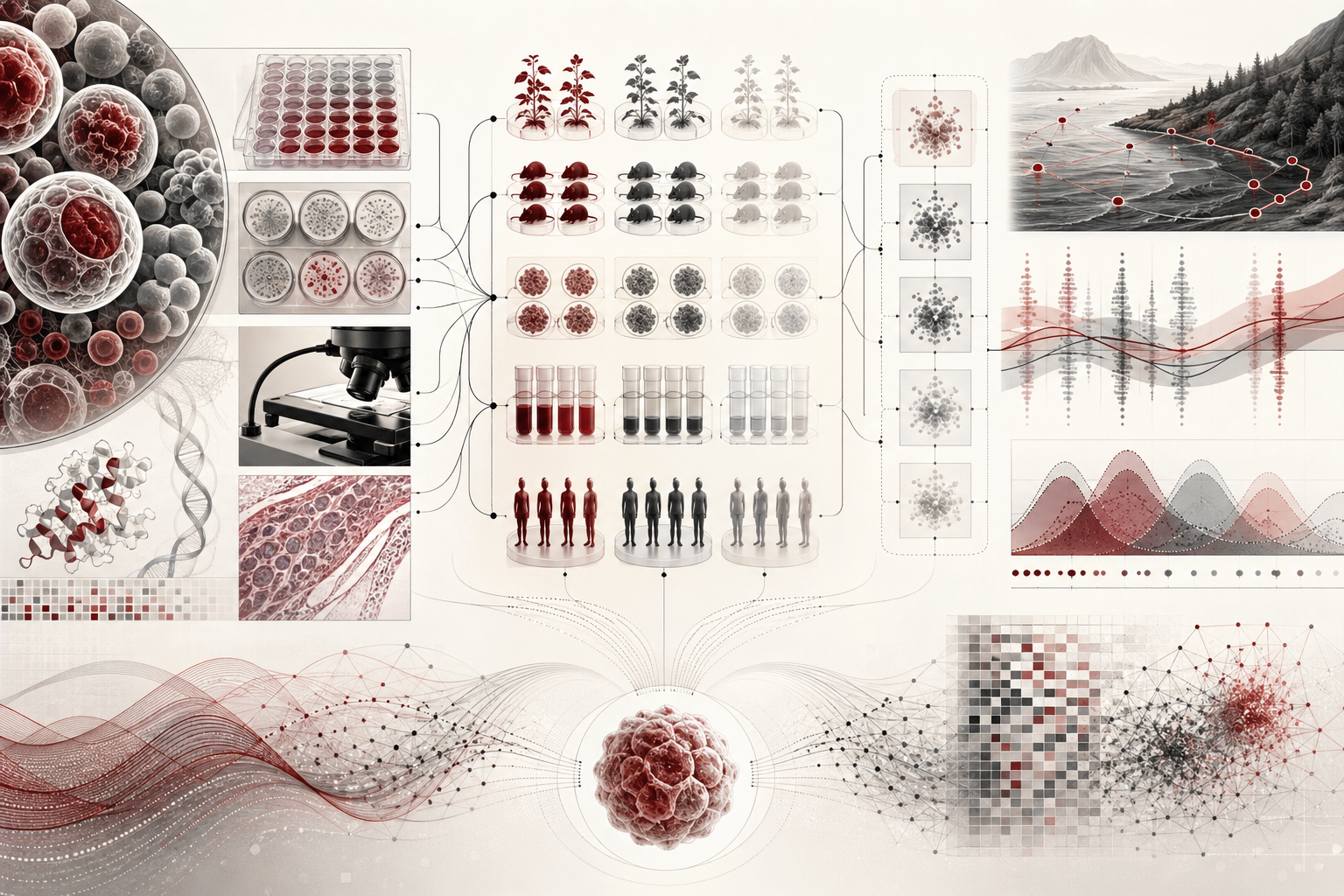
The article is written for biologists, ecologists, marine biologists, biomedical researchers, biotechnology scientists, computational biologists, epidemiologists, environmental scientists, engineers, laboratory scientists, statisticians, and scientific readers who need a rigorous but usable framework for planning, analyzing, and interpreting biological experiments. It treats biostatistics not as a formula library but as a way of aligning biological questions, experimental design, measurement, variation, and inference.
The article also extends the discussion into reproducible computational practice through power simulation, randomized allocation, blocked designs, factorial experiments, two-group comparisons, ANOVA scaffolds, mixed-effects data structures, bootstrap uncertainty, permutation testing, assay-design simulation, R workflows, Python workflows, SQL provenance structures, and a linked full-stack GitHub repository containing Python, R, Julia, Fortran, Rust, Go, C, C++, SQL, notebooks, data files, validation notes, and reproducibility documentation.
Why biostatistics belongs before data collection
Biostatistics belongs before data collection because experimental design determines what can be inferred from data. A beautifully analyzed dataset cannot fully repair a poorly designed experiment. If the wrong experimental unit was chosen, if samples were not independent, if treatment allocation was biased, if batch effects were confounded with treatment, if sample size was too small to detect a biologically meaningful effect, or if the analysis model does not match the design, statistical output may look precise while biological inference remains weak.
Biology often deals with finite resources: limited animals, limited patients, limited samples, limited sequencing depth, limited field seasons, limited laboratory time, limited budget, and limited ecological access. Biostatistics helps allocate those resources intelligently. It asks how many experimental units are needed, how treatments should be assigned, how known sources of variation should be blocked, how measurements should be repeated, which outcomes are primary, and how uncertainty will be quantified.
This design-first view is especially important because biological systems are variable. A treatment effect may be hidden by batch variation. A genotype effect may depend on sex, age, temperature, microbiome, diet, time, population structure, or environmental condition. A field experiment may be shaped by site heterogeneity. A biomedical assay may be influenced by plate, operator, reagent lot, extraction method, or instrument drift. Biostatistical design anticipates such variation rather than pretending it does not exist.
The central lesson is simple: data quality begins before data exist. Strong design makes later inference possible.
From biological question to experimental design
Every good biological experiment begins with a biological question. The question may ask whether a treatment changes a phenotype, whether a gene affects development, whether a pollutant alters microbial composition, whether warming changes survival, whether a drug reduces viral load, whether a conservation intervention improves recruitment, or whether a synthetic circuit produces stable expression. Experimental design translates that question into an evidentiary structure.
This translation requires several decisions. What is the hypothesis? What is the primary outcome? What is the experimental unit? What are the comparison groups? What are the control conditions? What factors may confound interpretation? What variables should be measured? What sources of variation should be blocked? What sample size is needed? What analysis will be used? What would count as evidence against the hypothesis? What assumptions must hold?
Biological experiments become weak when these decisions remain implicit. For example, a study may compare treated and untreated cells, but if all treated cells are processed on one plate and all control cells on another, treatment is confounded with plate. A field experiment may compare restored and unrestored sites, but if the sites differ in soil, hydrology, or prior disturbance, the effect may not be attributable to restoration. A clinical biomarker study may compare disease and control groups, but if age, sex, or sampling time differ systematically, inference becomes fragile.
Experimental design is therefore a form of causal architecture. It creates the conditions under which observed differences can be interpreted as evidence about the biological question rather than artifacts of sampling, confounding, or measurement process.
The experimental unit
The experimental unit is the smallest unit independently assigned to a treatment or condition. It is one of the most important concepts in experimental biology because it determines the correct sample size for inference. The experimental unit might be an animal, patient, plant, culture flask, field plot, tank, reef, cage, colony, microcosm, bioreactor, tissue sample, or biological replicate. It is not automatically the number of measurements in the dataset.
Confusing measurements with experimental units is a common source of pseudoreplication. Suppose a researcher applies one treatment to a single tank and another treatment to a second tank, then measures 100 fish in each tank. The experimental unit is the tank, not the fish, because treatment was assigned at the tank level. Treating the 100 fish as independent treatment replicates would overstate evidence. Similarly, if cells are measured within wells and wells are nested within plates, the analysis must respect the nested design.
The same issue appears in imaging, sequencing, field ecology, animal research, and biomedical experiments. Thousands of cells from one animal are not equivalent to thousands of animals. Thousands of reads from one sample are not equivalent to thousands of independent biological samples. Multiple leaves from one plant are not equivalent to multiple plants. Multiple measurements from one site are not equivalent to multiple sites.
Defining the experimental unit before the experiment protects the validity of the study. It clarifies what is independent, what is repeated, what is nested, and what level supports inference.
Biological, technical, and experimental replication
Replication is essential, but not all replication has the same meaning. Technical replicates estimate variation introduced by the measurement process. Biological replicates estimate variation among independent biological units. Experimental replication tests whether a finding can be reproduced across independent experiments, conditions, laboratories, field seasons, or study populations.
Technical replicates are valuable. They show whether an assay, instrument, imaging method, sequencing workflow, or measurement protocol is precise. Repeated qPCR wells, replicate instrument readings, repeated microscopy measurements, or duplicate assay wells can reveal technical noise. But technical replicates usually cannot support biological generalization by themselves.
Biological replicates are necessary when the inference concerns living units. If a study asks whether a treatment affects organisms, the independent organisms matter. If it asks whether a restoration method improves sites, independent sites matter. If it asks whether a genetic perturbation affects cellular state across biological variability, independent cultures, donors, animals, or experiments may matter. The level of biological replication must match the claim.
Experimental replication is broader. A result may be convincing in one laboratory under one protocol but less stable across conditions. Repeated independent experiments help assess robustness. In high-stakes biology—medicine, public health, biotechnology, environmental monitoring, conservation, and regulatory science—replication is not redundancy. It is part of the evidence structure.
Randomization, blocking, and blinding
Randomization protects experiments from systematic allocation bias. If treatments are assigned in a predictable or convenient way, hidden differences among experimental units may align with treatment. Randomization distributes known and unknown sources of variation more fairly across groups, making comparisons more credible.
Blocking improves design when a known source of variation is important. For example, animals may differ by litter, batch, sex, age, cage, room, or time. Field plots may differ by site, slope, soil, or hydrology. Plates may differ by position, reagent lot, or processing date. Blocking ensures that comparisons are made within structured groups, reducing avoidable noise and improving precision.
Blinding protects measurement and analysis from expectation bias. If the observer knows which samples are treated, disease-positive, restored, stressed, or genetically modified, unconscious bias can influence scoring, image thresholding, behavioral classification, tissue assessment, or data exclusion. Blinding is especially important when outcomes require judgment, but it can also matter in data processing and analysis decisions.
Randomization, blocking, and blinding do not guarantee truth. They reduce avoidable sources of bias. Their value is greatest when they are planned before data collection and documented clearly enough for others to evaluate the study.
Controls, comparisons, and confounding
Biological experiments depend on comparison. A treatment effect is meaningful only relative to an appropriate control or reference condition. Controls may include untreated controls, vehicle controls, sham controls, negative controls, positive controls, baseline measurements, reference standards, wild-type strains, mock infections, blank samples, spike-ins, or environmental reference sites.
A control must isolate the difference of interest. If the treated group receives a solvent and the control group does not, treatment is confounded with solvent exposure. If one group is processed on Monday and another on Friday, treatment may be confounded with time. If case samples come from one clinic and controls from another, disease status may be confounded with site. If experimental groups differ systematically before treatment, inference becomes difficult.
Confounding occurs when an unaccounted variable is associated with both the treatment and the outcome. Biological systems are full of potential confounders: age, sex, genotype, batch, site, season, temperature, diet, microbiome, ancestry, operator, sample handling, sequencing depth, field method, and environmental condition. Good design identifies likely confounders and either controls, balances, randomizes, blocks, measures, or models them.
A strong experiment is not one that eliminates all complexity. It is one that makes the comparison interpretable.
Sample size, effect size, and power
Sample size determines how much information an experiment can provide. Too few experimental units may fail to detect biologically important effects. Too many may waste animals, resources, time, or patient participation. Sample-size planning is therefore both scientific and ethical.
Power is the probability that a study will detect an effect of a specified size under specified assumptions. Power depends on sample size, effect size, variation, significance threshold, design structure, and statistical model. It is not a universal property of a study; it is tied to a specific hypothesis and assumed effect.
Effect size matters because statistical significance alone is not enough. A tiny difference can become statistically significant in a large dataset while being biologically trivial. A biologically meaningful effect may fail to reach significance in a small or noisy experiment. Experimental design should therefore ask: what effect size would matter biologically, clinically, ecologically, or operationally?
Power analysis also forces clarity. It requires researchers to estimate variation, define the primary outcome, choose a comparison, specify a decision threshold, and decide what magnitude of effect is worth detecting. These decisions improve study design even when the exact numerical power estimate is uncertain.
Factorial designs and biological interactions
Many biological questions involve more than one factor. A researcher may want to know how temperature and nutrient level affect microbial growth, how genotype and treatment affect development, how sex and drug dose affect response, how light and salinity affect algae, or how restoration method and grazing pressure affect plant recruitment. Factorial designs allow multiple factors to be studied together.
The value of factorial design is that it can reveal interactions. An interaction occurs when the effect of one factor depends on the level of another factor. A drug may work differently in males and females. A genotype may matter only under stress. A pollutant may be more harmful at higher temperatures. A microbial strain may respond to nutrients differently depending on oxygen. Interactions are biologically important because living systems are conditional.
A simple two-factor experiment can estimate the main effect of factor A, the main effect of factor B, and the interaction between A and B. This is often more informative than running separate one-factor experiments because separate experiments may miss interaction structure.
For engineers and biotechnology researchers, factorial and fractional-factorial designs are especially useful in process optimization, assay development, fermentation, media design, biosensor testing, and high-throughput screening. They allow researchers to learn efficiently from structured variation rather than changing one variable at a time.
Nested, repeated, and hierarchical designs
Biological data are often nested. Cells are nested within wells, wells within plates, plates within batches, samples within animals, animals within litters, plots within sites, sites within regions, and repeated measurements within individuals. These structures violate the assumption that every observation is independent.
Repeated-measures designs occur when the same unit is measured over time or under multiple conditions. These designs can be powerful because each unit can serve partly as its own reference, but the analysis must account for correlation among repeated observations. Treating repeated measurements as independent can inflate evidence.
Hierarchical designs require models that reflect the structure of the data. Mixed-effects models, hierarchical Bayesian models, generalized estimating equations, repeated-measures ANOVA, and nested ANOVA are examples of approaches that can account for dependency when used appropriately. The specific method depends on the outcome, design, distribution, and question.
The practical lesson is that the data table should reflect the experiment. Columns should record biological unit, technical replicate, batch, plate, site, time, treatment, block, operator, and other relevant metadata. Without that structure, even advanced models cannot reconstruct the design reliably.
Ecological, marine, and environmental experiments
Ecological, marine, and environmental experiments face special design challenges because field systems are open, heterogeneous, spatially structured, and often difficult to control. Experimental units may be plots, streams, reefs, tanks, transects, mesocosms, watersheds, islands, tide pools, or restoration sites. Environmental gradients, seasonality, dispersal, weather, disturbance, and detection probability can shape outcomes.
Blocking is especially valuable in ecological work because sites differ. A restoration experiment may block by landscape position. A marine experiment may block by depth or reef zone. A freshwater experiment may block by stream reach. A plant experiment may block by soil type or moisture regime. Blocking helps compare treatments within more similar contexts.
Replication is often difficult because field sites are limited. But the logic of independence remains. Measuring many organisms within one site does not create many independent sites. Repeated samples within a plot do not replace plot-level replication. Ecological inference depends on matching the analysis to the level at which treatments or conditions vary.
Environmental experiments also require careful attention to observational data. Not every ecological study is experimentally manipulated. Many are observational, quasi-experimental, or model-based. In those cases, design still matters: sampling frame, covariate measurement, detection probability, temporal frequency, spatial autocorrelation, and confounding must be considered explicitly.
Medical, biomedical, and biotechnology experiments
Medical, biomedical, and biotechnology experiments require strong design because their conclusions can influence health, treatment, product development, safety, and regulation. In biomedical research, design choices include randomization, blinding, inclusion and exclusion criteria, endpoint definition, dose selection, control condition, stratification, batch allocation, sex as a biological variable, and statistical analysis plan.
Clinical trials have especially formal design standards because human outcomes are consequential. Randomization helps protect against allocation bias. Blinding reduces expectation effects. Prespecified endpoints reduce selective interpretation. CONSORT-style reporting helps readers evaluate how the trial was designed, conducted, analyzed, and interpreted.
Laboratory biomedical studies also require rigor. Cell lines must be authenticated. Reagents should be validated. Biological variables should be recorded. Batch effects should be managed. Plate layouts should avoid confounding. Technical replicates should not substitute for independent biological replicates. Animal studies should define allocation, sample size, blinding, exclusions, and outcome measures clearly.
Biotechnology experiments add another design challenge: optimization under constraint. Media composition, temperature, pH, oxygen, induction timing, substrate concentration, strain, reagent lot, and reactor condition may interact. Design-of-experiments methods can help identify main effects and interactions more efficiently than one-factor-at-a-time testing.
Computational biology and high-throughput design
Computational biology and high-throughput experiments make design more important, not less. Sequencing, imaging, single-cell assays, proteomics, metabolomics, CRISPR screens, environmental sensors, and automated platforms can generate enormous data volume. But large data volume does not automatically produce strong inference.
High-throughput studies are vulnerable to batch effects, library preparation effects, sequencing depth differences, plate position effects, cell-cycle confounding, donor effects, site effects, and multiple testing. A poorly randomized plate layout can create thousands of measurements that reflect layout artifact rather than biology. A sequencing experiment that confounds treatment with batch may be impossible to interpret cleanly.
Design principles scale into computational biology. Samples should be randomized across batches. Blocking variables should be recorded. Controls and spike-ins may be needed. Metadata should be complete. Biological replicates should represent the intended inference population. Analysis workflows should be versioned, documented, and reproducible. Multiple testing should be handled explicitly.
In high-dimensional biology, the design matrix is as important as the data matrix. Without a strong design matrix, sophisticated algorithms may simply learn confounding structure.
Mathematical lens: design and inference
Several mathematical ideas are foundational for biostatistics and experimental design. These expressions do not replace biological judgment, ethical review, field knowledge, laboratory discipline, or statistical diagnostics. They help clarify how comparisons, uncertainty, power, blocking, factorial structure, and hierarchy can be represented formally.
Two-group effect size
d=\frac{\bar{x}_1-\bar{x}_0}{s_p}
\]
Interpretation: Standardized mean difference compares treatment and control means relative to pooled variation. It is useful for planning and interpretation, but biological importance still depends on context.
Pooled standard deviation
s_p=\sqrt{\frac{(n_1-1)s_1^2+(n_0-1)s_0^2}{n_1+n_0-2}}
\]
Interpretation: Pooled standard deviation combines two group variances under equal-variance assumptions. It should be used only when those assumptions are reasonable for the design and data.
Standard error of a difference in means
SE_{\Delta}=\sqrt{\frac{s_1^2}{n_1}+\frac{s_0^2}{n_0}}
\]
Interpretation: The standard error summarizes uncertainty in the estimated difference between two independent group means. It does not summarize the full range of biological variation.
Confidence interval for a mean difference
(\bar{x}_1-\bar{x}_0)\pm t_{\alpha/2,df}SE_{\Delta}
\]
Interpretation: A confidence interval gives an uncertainty range for the estimated mean difference under model assumptions. It should be interpreted alongside effect size and biological meaning.
Power approximation
n \approx \frac{2(z_{1-\alpha/2}+z_{1-\beta})^2}{d^2}
\]
Interpretation: This balanced-design approximation estimates sample size per group for a two-sample comparison using standardized effect size \(d\), Type I error threshold \(\alpha\), and power \(1-\beta\). Real studies often require design-specific power analysis.
Two-factor model
y_{ijk}=\mu+\alpha_i+\beta_j+(\alpha\beta)_{ij}+\epsilon_{ijk}
\]
Interpretation: A two-factor model represents main effects for factors A and B plus their interaction. This is useful when biological response depends on combinations of conditions.
Blocked design model
y_{ij}=\mu+\tau_i+b_j+\epsilon_{ij}
\]
Interpretation: A blocked design separates treatment effect \(\tau_i\) from block effect \(b_j\), helping account for known sources of structured variation such as site, batch, plate, or sampling day.
Mixed-effects design scaffold
y_{ijk}=\mu+\tau_i+u_j+\epsilon_{ijk}
\]
Interpretation: A mixed-effects scaffold includes a treatment effect and a group-level random effect \(u_j\), such as biological unit, batch, site, animal, donor, plate, or another grouping factor.
R and Python workflows
The following examples are compact article-level workflows. The full GitHub repository expands them into richer multi-language implementations with SQL provenance, validation notes, randomized allocation, design simulations, effect-size workflows, blocked models, factorial scaffolds, and reproducible experimental-design documentation.
R example: two-group effect size and confidence interval
# Two-group biological comparison.
#
# Example: control vs treatment assay response,
# wild type vs mutant phenotype, restored vs unrestored sites,
# or baseline vs intervention measurement.

control <- c(10.2, 11.1, 9.8, 10.5, 10.9, 11.0, 9.9, 10.4)
treated <- c(12.1, 11.7, 12.4, 11.9, 12.0, 12.6, 11.8, 12.3)

n0 <- length(control)
n1 <- length(treated)

mean0 <- mean(control)
mean1 <- mean(treated)

sd0 <- sd(control)
sd1 <- sd(treated)

pooled_sd <- sqrt(((n0 - 1) * sd0^2 + (n1 - 1) * sd1^2) / (n0 + n1 - 2))

effect_size_d <- (mean1 - mean0) / pooled_sd

se_difference <- sqrt(sd0^2 / n0 + sd1^2 / n1)

df <- n0 + n1 - 2
t_crit <- qt(0.975, df = df)

difference <- mean1 - mean0

summary_df <- data.frame(
  control_mean = mean0,
  treated_mean = mean1,
  mean_difference = difference,
  pooled_sd = pooled_sd,
  effect_size_d = effect_size_d,
  ci_lower = difference - t_crit * se_difference,
  ci_upper = difference + t_crit * se_difference
)

print(round(summary_df, 4))
R example: blocking in an experimental design
# Simple blocked design analysis.
#
# Example: treatment tested across batches, plates, litters,
# field sites, tanks, reefs, or sampling days.

design_df <- data.frame(
  block = rep(paste0("block_", 1:6), each = 2),
  treatment = rep(c("control", "treated"), times = 6),
  response = c(
    10.1, 11.8,
    9.9, 11.5,
    10.6, 12.2,
    10.4, 12.0,
    9.7, 11.1,
    10.2, 11.9
  )
)

fit <- lm(response ~ treatment + block, data = design_df)

print(anova(fit))
print(round(coef(summary(fit)), 4))
Python example: randomized allocation with blocks
import numpy as np
import pandas as pd

rng = np.random.default_rng(42)

blocks = [f"batch_{i:02d}" for i in range(1, 7)]
treatments = ["control", "low_dose", "high_dose"]

rows = []

for block in blocks:
    units = [f"{block}_unit_{j:02d}" for j in range(1, 10)]
    assignments = np.repeat(treatments, repeats=3)
    rng.shuffle(assignments)

    for unit, treatment in zip(units, assignments):
        rows.append(
            {
                "block": block,
                "experimental_unit": unit,
                "treatment": treatment,
            }
        )

allocation = pd.DataFrame(rows)

print(allocation.to_string(index=False))
Python example: power simulation for a two-group biological experiment
import numpy as np
import pandas as pd

rng = np.random.default_rng(123)

def simulate_power(sample_size, effect_size, sigma, n_sim=5000):
    """Approximate power for a balanced two-group design using a z threshold."""
    significant = 0

    for _ in range(n_sim):
        control = rng.normal(loc=0.0, scale=sigma, size=sample_size)
        treated = rng.normal(loc=effect_size, scale=sigma, size=sample_size)

        difference = treated.mean() - control.mean()
        se = np.sqrt(control.var(ddof=1) / sample_size + treated.var(ddof=1) / sample_size)

        if se > 0 and abs(difference / se) > 1.96:
            significant += 1

    return significant / n_sim

rows = []

for n in [5, 10, 20, 40, 80]:
    rows.append(
        {
            "sample_size_per_group": n,
            "estimated_power": simulate_power(
                sample_size=n,
                effect_size=1.0,
                sigma=1.5,
            ),
        }
    )

power_df = pd.DataFrame(rows)

print(power_df.round(4).to_string(index=False))
Python example: factorial design with interaction
import itertools
import pandas as pd

factor_a = ["ambient_temperature", "high_temperature"]
factor_b = ["low_nutrient", "high_nutrient"]
replicates = range(1, 5)

rows = []

for a, b, replicate in itertools.product(factor_a, factor_b, replicates):
    rows.append(
        {
            "temperature": a,
            "nutrient": b,
            "replicate": replicate,
            "experimental_unit": f"{a}_{b}_rep_{replicate}",
        }
    )

design = pd.DataFrame(rows)

print(design.to_string(index=False))GitHub repository
The article body includes compact R and Python examples so the scientific argument remains readable. The full repository expands those examples into a rigorous biostatistics and experimental-design workflow, including randomized allocation, blocked designs, two-group comparisons, effect-size estimation, power simulation, factorial design scaffolds, ANOVA-style summaries, mixed-effects data structures, bootstrap uncertainty, permutation testing, assay-design simulation, SQL provenance structures, validation notes, reproducible data files, and full-stack scientific-computing examples across Python, R, Julia, Fortran, Rust, Go, C, C++, SQL, and notebooks.
The full code distribution for this article, including selected article examples, expanded computational workflows, reproducible data structures, provenance documentation, validation notes, and full-stack scientific-computing scaffolding, is available on GitHub.
Limits, ethics, and responsible design
Biostatistics can improve biological inference, but it cannot rescue every design flaw. A randomized analysis cannot fix nonrandom sample collection. A p-value cannot repair confounding. A large dataset cannot compensate for biased measurement. A complex model cannot make non-independent observations independent. A power calculation cannot guarantee biological truth if its assumptions are unrealistic.
Responsible design also has ethical dimensions. Underpowered animal studies may waste animals without producing reliable knowledge. Poorly designed clinical studies may expose participants to risk without adequate evidentiary return. Environmental studies with weak design may mislead conservation or regulatory decisions. Biotechnology experiments with poor controls may create false confidence in safety, performance, or robustness.
Ethical design therefore means more than compliance. It means matching the study to the importance of the question, using resources efficiently, documenting assumptions, reporting limitations, preserving data provenance, and communicating uncertainty honestly.
Why biostatistical design matters
Biostatistical design matters because biological claims often influence action. A treatment may advance to further testing. A conservation intervention may be funded. A diagnostic marker may be adopted. A biotechnology process may be scaled. A gene may be prioritized for functional study. A public-health intervention may be recommended. These decisions require evidence that is not only statistically analyzed but properly designed.
It also matters because biology is increasingly data-rich. Sequencing, imaging, sensors, high-throughput screens, automated laboratories, ecological monitoring, and clinical data systems can generate enormous datasets. But data volume does not replace design. Without proper controls, randomization, replication, blocking, metadata, and uncertainty quantification, high-dimensional biological data can amplify bias rather than reduce it.
Finally, biostatistical design matters because it supports trust. A well-designed experiment is easier to interpret, reproduce, critique, and build upon. It clarifies what was tested, how it was tested, and what the evidence can support.
Conclusion
Biostatistics and experimental design are foundational to modern biology because living systems are variable, measurements are imperfect, and resources are finite. Good design makes biological inference possible by defining experimental units, structuring comparisons, reducing bias, balancing known variation, estimating uncertainty, and aligning analysis with the biological question.
The strongest biological studies are not those with the most data, but those with designs that make their evidence interpretable. Randomization, blocking, blinding, controls, replication, sample-size reasoning, effect-size estimation, and appropriate statistical modeling are not technical formalities. They are the architecture of reliable biological knowledge.
To practice biology rigorously is to design before measuring, measure before claiming, and interpret with uncertainty in view.
Related articles
- Biology
- What Is Biology? Life, Evolution, and Living Systems
- Mathematical Biology and the Logic of Living Systems
- Probability, Variation, and Biological Inference
- Statistics, Uncertainty, and Measurement in Biology
- Observation, Experiment, and the Methods of Biological Inquiry
- Population Dynamics and Ecological Modeling
- Population Genetics and the Mathematics of Inheritance
- Systems Biology and the Logic of Biological Integration
- Genomics and the Expansion of Biological Knowledge
- Conservation Biology and the Protection of Life
Further reading
- NIH (2024) ‘Enhancing Reproducibility through Rigor and Transparency’. Available at: https://grants.nih.gov/policy-and-compliance/policy-topics/reproducibility
- NIH (2024) ‘Guidance: Rigor and Reproducibility in Grant Applications’. Available at: https://grants.nih.gov/policy-and-compliance/policy-topics/reproducibility/guidance
- ARRIVE Guidelines (2020) The ARRIVE Guidelines 2.0. Available at: https://arriveguidelines.org/arrive-guidelines
- Schulz, K.F., Altman, D.G. and Moher, D. (2010) ‘CONSORT 2010 Statement: updated guidelines for reporting parallel group randomised trials’, BMC Medicine, 8, 18. Available at: https://pmc.ncbi.nlm.nih.gov/articles/PMC2857832/
- Nature Methods (2017) ‘Statistics for Biologists’. Available at: https://www.nature.com/collections/qghhqm
- Nature Methods (2017) ‘Points of Significance’. Available at: https://www.nature.com/collections/qghhqm/pointsofsignificance
- Wagner, M.R. et al. (2025) ‘How thoughtful experimental design can empower biological discovery’, Nature Communications. Available at: https://www.nature.com/articles/s41467-025-62616-x
- Holmes, S. and Huber, W. (2019) Modern Statistics for Modern Biology. Cambridge: Cambridge University Press. Available at: https://www.huber.embl.de/msmb/
- Fay, D.S. and Gerow, K. (2013) ‘A biologist’s guide to statistical thinking and analysis’, WormBook. Available at: https://www.ncbi.nlm.nih.gov/books/NBK153593/
- Quinn, G.P. and Keough, M.J. (2002) Experimental Design and Data Analysis for Biologists. Cambridge: Cambridge University Press.
References
- ARRIVE Guidelines (2020) The ARRIVE Guidelines 2.0. Available at: https://arriveguidelines.org/arrive-guidelines
- Fay, D.S. and Gerow, K. (2013) ‘A biologist’s guide to statistical thinking and analysis’, WormBook. Available at: https://www.ncbi.nlm.nih.gov/books/NBK153593/
- Holmes, S. and Huber, W. (2019) Modern Statistics for Modern Biology. Cambridge: Cambridge University Press. Available at: https://www.huber.embl.de/msmb/
- Nature Methods (2017) ‘Points of Significance’. Available at: https://www.nature.com/collections/qghhqm/pointsofsignificance
- Nature Methods (2017) ‘Statistics for Biologists’. Available at: https://www.nature.com/collections/qghhqm
- NIH (2024) ‘Enhancing Reproducibility through Rigor and Transparency’. Available at: https://grants.nih.gov/policy-and-compliance/policy-topics/reproducibility
- NIH (2024) ‘Guidance: Rigor and Reproducibility in Grant Applications’. Available at: https://grants.nih.gov/policy-and-compliance/policy-topics/reproducibility/guidance
- Quinn, G.P. and Keough, M.J. (2002) Experimental Design and Data Analysis for Biologists. Cambridge: Cambridge University Press.
- Schulz, K.F., Altman, D.G. and Moher, D. (2010) ‘CONSORT 2010 Statement: updated guidelines for reporting parallel group randomised trials’, BMC Medicine, 8, 18. Available at: https://pmc.ncbi.nlm.nih.gov/articles/PMC2857832/
- Wagner, M.R. et al. (2025) ‘How thoughtful experimental design can empower biological discovery’, Nature Communications. Available at: https://www.nature.com/articles/s41467-025-62616-x