
Last Updated May 3, 2026
British Literature and Cultural Memory explores the literary traditions through which Britain has remembered kingship, empire, class, faith, industrial transformation, domestic life, war, landscape, language, and the changing moral worlds of modernity. Across poetry, drama, the novel, essay, satire, life writing, political prose, children’s literature, public criticism, and modern media adaptation, British literature has served as a major archive of cultural self-understanding. It preserves both the continuity of inherited forms and the fractures produced by religious conflict, social inequality, imperial expansion, industrial capitalism, gender hierarchy, regional difference, migration, decolonization, and historical change. It is a tradition in which literary form has often carried the memory of institutions, landscapes, customs, crises, manners, moral sensibilities, and public myths that shaped British life across centuries.
This category approaches British literature not as a seamless national inheritance, but as a field of layered, contested, and repeatedly reconstructed memory. “British” is itself a historically unstable and politically charged term, gathering England, Scotland, Wales, and Ireland into shifting relations of union, domination, resistance, hierarchy, and incorporation. It also names a global formation shaped by empire, colonial education, migration, publishing networks, and the worldwide circulation of English. The literary archive attached to this formation therefore preserves not one settled identity but a long history of monarchy and parliament, established church and dissent, provincial life and metropolitan command, imperial confidence and post-imperial unsettlement. British literature has often been one of the principal places where these contradictions were narrated, refined, criticized, institutionalized, and taught into public memory.
Current Space
Literature & Cultural Memory
Current Topic
British Literature
British literature is also a tradition of historical succession and recurrent self-revision. Medieval inheritances are rewritten through Reformation conflict; aristocratic and monarchical memory is transformed by revolution and restoration; Romanticism reimagines landscape, feeling, and nation against industrial and imperial pressures; Victorian literature turns the novel into a central archive of class society, domestic order, imperial expansion, and moral anxiety; modernism registers the fracture of inherited coherence under urban modernity, war, and civilizational strain; postwar and post-imperial writing confront decline, migration, decolonization, institutional exhaustion, and the return of colonial history into Britain itself. British literature remembers not by preserving one stable tradition, but by repeatedly reordering the past under new conditions.
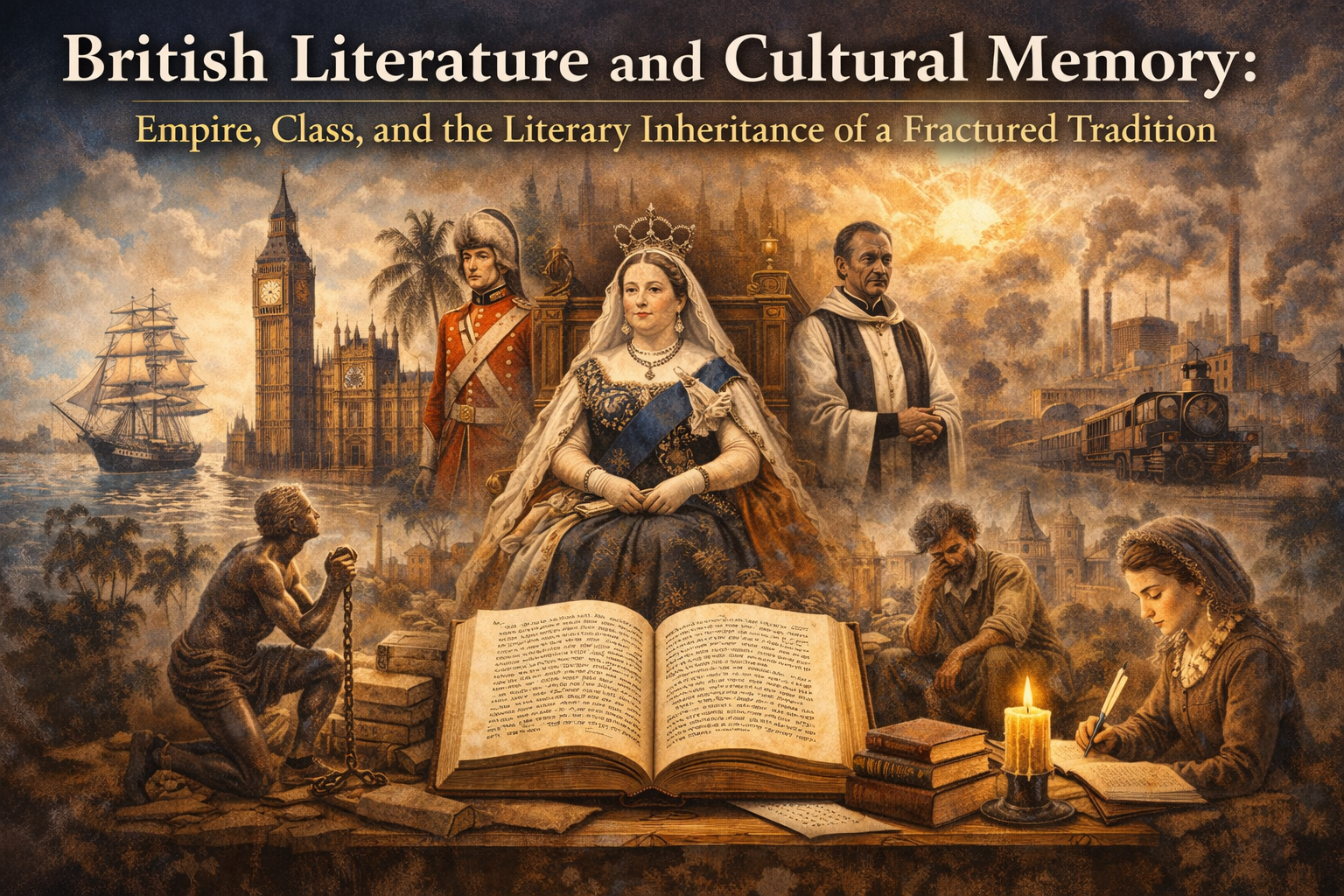
This category therefore examines British literary traditions from their early foundations through the medieval, early modern, Romantic, Victorian, modernist, postwar, and postcolonial periods. It considers how literature has mediated relations between nation and empire, metropolis and periphery, class order and social critique, public duty and private feeling, English dominance and archipelagic plurality, local inheritance and global circulation. It explores how writers preserved and contested cultural memory through epic and ballad, lyric and essay, drama and satire, the realist novel and modernist experiment, and how literary works became sites for reflecting on industrialization, colonialism, gender, education, war, nostalgia, moral authority, and the burdens of historical inheritance.
It also considers the relationship between British literary culture and the institutions of canon formation, schooling, publishing, criticism, broadcasting, public discourse, and global curricula through which literature has been repeatedly reproduced as cultural authority. British literature has never been only a body of texts. It has also been a system of education, taste, prestige, aspiration, exclusion, and memory. Its works have been read as moral instruction, national inheritance, imperial culture, class training, aesthetic achievement, and political critique. The category therefore studies literary tradition not only as artistic expression, but as an institutional structure through which cultural power is organized and contested.
British Literature and Cultural Memory is therefore concerned with literature as a record of both continuity and contradiction. It studies how British literary traditions have helped shape collective memory while also exposing the fractures within that memory: the silences of empire, the injuries of class, the ambiguities of moral authority, the instability of “Britain” itself, the violence concealed within refinement, and the costs of national self-mythology. By linking literary expression to political history, religious life, social order, imperial power, regional difference, media institutions, and the evolution of cultural identity, this category illuminates one of the most globally consequential literary traditions in modern history.
Why This Field Matters
British literature matters because it has been one of the principal means through which a historically powerful society imagined, narrated, justified, criticized, and revised itself. It preserves the symbolic life of monarchy, the moral rhetoric of Protestant seriousness, the habits of class society, the speech of empire, the transformation of domestic life, the violence of industrial change, the memory of war, and the recurring tension between continuity and disruption. Few literary traditions have so deeply shaped both a national self-image and a global literary inheritance.
It also matters because this archive is never settled. British literature does not merely transmit continuity; it repeatedly exposes fracture. Beneath the language of civility, order, refinement, inheritance, and public responsibility lie religious struggle, class injury, imperial violence, institutional exclusion, and the unstable relation between center and margin. British literature is therefore one of the great traditions in which cultural memory appears as both achievement and argument, inheritance and revision, authority and exposure.
The field also matters because British literature has helped define what literary culture itself means in many modern institutions. Through schools, universities, colonial curricula, public libraries, anthologies, publishing houses, review culture, radio, television adaptation, and global English-language education, British literary works became more than works of art. They became objects of formation. They taught forms of speech, manners of judgment, ideas of moral seriousness, assumptions about civilization, and models of national and imperial identity. To study this tradition is therefore to study not only literature as expression, but literature as cultural infrastructure.
At its strongest, this field reveals how literary memory can be both powerful and morally compromised. British literature preserves astonishing works of imagination, ethical depth, formal innovation, and human perception. It also carries the marks of empire, exclusion, hierarchy, racialization, class discipline, and cultural self-mythology. A serious account must hold both truths together. The tradition cannot be reduced to domination, but it cannot be responsibly separated from the histories of power through which it circulated.
Britishness, Englishness, and the Problem of the Name
A serious category on British literature must begin by clarifying that “British” is not a self-evident literary identity. It is a political and cultural formation produced through union, conquest, incorporation, rivalry, negotiation, and uneven hierarchy. The literary field attached to it often passes under British authority while remaining dominated by English institutions, English educational norms, English publishing networks, and English metropolitan centrality. The name “British” therefore often contains an internal imbalance that literature both reflects and contests.
This matters because cultural memory in the British archive is never only national in the simple sense. It is archipelagic, asymmetrical, and historically disputed. Literature becomes one of the key places where Britishness is asserted, complicated, regionalized, resisted, or dissolved back into older and rival identities. A strongest account of the field must therefore treat the category name itself as a problem of memory and power.
Englishness, in particular, often operates as both a dominant center and a disguised norm. It may present itself as national inheritance while appearing as “British” in institutional contexts. Yet Scotland, Wales, Ireland, and the wider imperial and postcolonial world continually interrupt this assumed center. Scottish Enlightenment prose, Welsh poetic and religious traditions, Irish literature in relation to British rule, Caribbean and South Asian British writing, and regional English literatures all reveal that the category is plural, contested, and historically charged.
For this reason, British Literature and Cultural Memory should not be treated as a closed national container. It is better understood as a field of relation: English, Scottish, Welsh, Irish-in-relation, imperial, post-imperial, migrant, diasporic, metropolitan, provincial, and global. Its memory is powerful precisely because it is unstable. The name “British” gathers a tradition, but it also exposes the historical forces that made such gathering possible.
Historical Succession and the Reordering of Inheritance
British literature remembers through successive reorderings of inheritance. Medieval religious and courtly forms are transformed by Reformation conflict and the pressures of nation-state formation. Seventeenth-century writing absorbs civil war, revolution, and restoration into competing models of authority and conscience. Romantic literature reimagines selfhood, landscape, and historical feeling against industrial, imperial, and revolutionary change. Victorian literature turns the novel into an archive of class, domesticity, empire, and moral seriousness. Modernism registers the fracture of inherited coherence under war, urban modernity, and imperial strain. Postwar and post-imperial writing revisits the archive under conditions of decline, migration, decolonization, and institutional uncertainty.
This temporal movement matters because British literature does not preserve one memory-world unchanged. It repeatedly recasts its own past, carrying forward old forms while subjecting them to new moral and historical pressure. The tradition’s continuity is therefore dynamic, made of revision, anxiety, and reinterpretation rather than simple endurance.
Every major period in the archive inherits a problem from the one before it. The medieval and early modern worlds leave behind questions of faith, sovereignty, language, and authority. The seventeenth century bequeaths memories of revolution, religious division, political experiment, and restored hierarchy. The eighteenth century consolidates print culture, satire, politeness, imperial commerce, and the rise of public criticism. Romanticism responds to revolution, industrial transformation, landscape loss, and the moral authority of imagination. Victorian literature turns social complexity into narrative form. Modernism exposes the exhaustion of inherited coherence. Postcolonial writing asks what the tradition concealed in order to present itself as universal.
The result is a tradition that must be read historically and structurally. British literature does not simply move from past to present. It repeatedly stages arguments over what the past means, who is authorized to inherit it, and what forms of writing can carry that inheritance into new conditions.
Island, Archipelago, and Landscape Memory
British literature is profoundly geographical. Coasts, islands, seas, moors, fields, industrial towns, ports, villages, estates, borderlands, colonial routes, and imperial oceans all function as memory-bearing landscapes. The island often appears as a symbol of continuity, separation, vulnerability, exceptionalism, and imperial outwardness; the archipelago as a more complex and internally divided formation. Rural landscapes may preserve nostalgia, hierarchy, labor, enclosure, ecological relation, or seasonal continuity; urban and industrial spaces may record speed, crowding, degradation, aspiration, and change.
This geographical density matters because British literature repeatedly ties memory to place. Landscapes are not merely scenic settings. They are repositories of class, custom, nation, labor, enclosure, pastoral longing, ecological imagination, and historical myth. The literary archive remembers Britain spatially as well as institutionally.
Landscape in this tradition often carries moral pressure. The country house may appear as elegance, order, inheritance, and hospitality, but it may also depend on rent, colonial wealth, gender discipline, and servant labor. The village may seem intimate and continuous, but it may also conceal surveillance, conformity, poverty, and exclusion. The city may promise opportunity and circulation, but it may also expose anonymity, exploitation, and moral fragmentation. The sea may symbolize adventure and commerce, but also conquest, slavery, naval power, migration, and imperial reach.
British literary memory is therefore never only terrestrial. It is maritime, imperial, regional, ecological, and infrastructural. Its landscapes hold beauty and violence together, often in the same image.
Monarchy, Law, and Constitutional Imagination
One of the central memory structures of British literature is the long intertwining of monarchy, law, political continuity, and constitutional self-understanding. Kingship, succession, legitimacy, parliament, duty, sovereignty, rebellion, trial, imprisonment, public order, and civil conflict appear again and again as literary concerns. Drama, epic, satire, political prose, historiography, biography, and the historical novel all help shape the cultural memory of rule and governance.
Yet British literature rarely treats these institutions as simple sources of stability. It often stages their fragility, theatricality, compromise, or moral ambiguity. The memory of constitutional order is therefore inseparable from anxiety about usurpation, corruption, civil war, faction, tyranny, and the gap between public legitimacy and private virtue. Literature becomes one of the chief places where institutional continuity is both preserved and questioned.
Shakespeare’s histories and tragedies, Milton’s epic and political prose, Restoration drama, eighteenth-century satire, Romantic responses to revolution, Victorian historical fiction, and modern constitutional memory all reveal the literary life of authority. British literature repeatedly asks what makes rule legitimate, what happens when public office is severed from moral responsibility, and whether law can contain violence without reproducing it.
This gives the archive a distinctive institutional density. British political identity has often narrated itself through continuity, balance, moderation, precedent, and law. Literature both sustains and unsettles that self-image by showing the passions, exclusions, theatrical performances, and historical violence that constitutional memory can obscure.
Religion, Dissent, and Secular Afterlives
British literature is deeply marked by religion, not only in explicitly devotional or theological writing, but in tone, ethical vocabulary, form, and social imagination. Catholic-Protestant conflict, Anglican moral culture, Puritan seriousness, dissenting traditions, evangelical intensity, skepticism, secularization, and spiritual uncertainty all shape the archive. Even where belief weakens, the language of conscience, duty, providence, vocation, discipline, sin, redemption, and moral struggle often remains.
This means that religion in British literature is not merely a topic. It is a changing structure of feeling. Faith may appear as authority, inward conflict, public discipline, cultural residue, metaphysical absence, or moral afterimage. British literature remembers religion most powerfully when it shows how belief survives even where certainty does not.
The Reformation and its afterlives are especially important. They reshape language, literacy, scripture, authority, inwardness, political allegiance, and national identity. The King James Bible, Anglican liturgy, dissenting sermon culture, Puritan autobiography, devotional lyric, and later evangelical reform all become part of the literary atmosphere. British prose and poetry repeatedly inherit religious habits of seriousness even when they turn toward skepticism, irony, social criticism, or secular moral thought.
Religion also intersects with class, empire, and dissent. Missionary discourse, abolitionist rhetoric, evangelical reform, anti-Catholic suspicion, nonconformist education, Irish Catholic memory, and secular socialist critique all reveal that faith in British literature is not simply private belief. It is institution, conflict, discipline, consolation, identity, and contested public language.
Class Order, Speech, and Social Memory
British literature is one of the great archives of class. It preserves hierarchies of education, taste, property, labor, speech, aspiration, embarrassment, exclusion, and mobility with extraordinary detail. Class in British writing is not only represented as subject matter; it is often embedded in form, accent, narration, genre, and imagined readership. The way a character speaks, the way a narrator judges, the way sympathy is distributed across a social field all may carry class memory.
This gives the tradition much of its social force. British literature remembers the country house and the factory, the drawing room and the alley, the gentleman and the clerk, the servant and the schoolboy, the landlord and the laborer, the colonial administrator and the urban poor. It is one of the chief places where the moral and psychological life of stratified society becomes legible.
The British novel is especially important here because it can hold many social positions inside one narrative field. Austen’s drawing rooms, Dickens’s courts and streets, Eliot’s provincial communities, Gaskell’s industrial towns, Hardy’s rural worlds, Forster’s houses, Woolf’s salons and streets, and postwar working-class writing all preserve class as lived relation rather than abstract category. Class appears as voice, posture, shame, aspiration, dependency, resentment, refinement, and inherited possibility.
Class memory also reveals the violence hidden inside manners. Politeness, taste, education, and restraint can function as ethical ideals, but they can also become instruments of exclusion. British literature is unusually attentive to this double quality. It shows how culture can refine perception while reproducing hierarchy.
Education, Formation, and the Making of Cultural Authority
Education occupies a special place in British cultural memory because it links moral aspiration, class reproduction, literary authority, and national self-understanding. Schools, universities, tutorial systems, examinations, reading habits, public-school codes, classical education, and ideals of cultivation recur in British literature not only as settings but as mechanisms of formation. To be educated in the British tradition has often meant to be shaped by literature, and to be shaped by literature has often meant to be inserted into a social hierarchy of speech, discipline, and cultural legitimacy.
This makes education central to the archive. British literature repeatedly asks who is trained, who is excluded, who is refined, who is disciplined, and what forms of personhood literary culture helps produce. Schooling is therefore not merely institutional background. It is one of the principal ways culture reproduces itself through literature.
The educational life of British literature is also global. Through empire, missionary schooling, colonial administration, and later university curricula, British literary works were exported as models of language, moral cultivation, taste, and civilization. This gave the canon immense reach, but also embedded it in unequal relations of power. Literature taught style and judgment, but it also taught hierarchy, Anglocentrism, and the prestige of metropolitan culture.
A serious account of British literature must therefore read education as both intellectual formation and social sorting. The archive preserves the promise of literary cultivation while exposing the exclusions through which cultivation became authority.
Empire, Colonialism, and the Global British Imagination
Empire is not a peripheral subject in British literature. It is one of the constitutive conditions of the tradition’s modern development and global reach. Imperial wealth, colonial travel, racial hierarchy, extraction, mission, violence, trade, mobility, naval power, plantation economies, administrative rule, and the English language all enter the literary archive directly or indirectly. Empire helps shape what Britain imagines itself to be, what it excludes from self-recognition, and how its literature circulates worldwide.
This makes empire central to cultural memory in the British case. Literature preserves imperial self-mythology, but also the fractures within it: the silences of colonial violence, the moral contradictions of liberal empire, the relation between domestic order and overseas domination, and the eventual crisis of post-imperial identity. British literature often remembers empire by both displaying and disavowing it, which is why the archive must be read for overt representation and structural absence alike.
Empire often enters British literature obliquely. A family fortune, a colonial posting, an imported object, a naval career, a missionary project, a school curriculum, a plantation inheritance, a racial stereotype, or a distant war may shape the conditions of a plot without becoming its declared subject. This indirectness is itself part of imperial memory. It shows how empire could be everywhere in the material structure of British life while remaining peripheral in polite self-description.
Postcolonial and migrant literatures transform this field by returning suppressed histories to the center of interpretation. They reveal that the British archive cannot be understood without the colonized, enslaved, displaced, racialized, and migrant subjects who were often made background to its self-image. Empire cannot be a footnote because it helped make the modern tradition possible.
London, Metropolis, and Modernity
London is one of the great memory machines of British literature. It concentrates wealth, administration, class difference, imperial circulation, publishing, anonymity, reform, poverty, spectacle, and cultural authority in a single urban form. The metropolis often functions as the symbolic center of Britain’s literary self-understanding, even as literature repeatedly shows that this center is unstable, crowded, exploitative, and morally divided.
The city matters because it changes literary perception. Crowds, speed, anonymity, commerce, bureaucracy, slum life, journalism, theatricality, policing, surveillance, transport, advertising, and modern estrangement all reshape form and subject. British cultural memory becomes increasingly metropolitan, even when it nostalgically returns to village or pastoral worlds. London is thus both archive and disturbance: a place that preserves national centrality while exposing social fracture.
Dickens gives London one of its great nineteenth-century literary forms: fog, law, debt, bureaucracy, charity, childhood vulnerability, social grotesque, and moral outrage all become urban texture. Later writers turn the city into a field of consciousness, migration, imperial return, queer life, racialized experience, and postwar reinvention. London becomes not only capital but palimpsest: Roman, medieval, imperial, industrial, modernist, postcolonial, financial, and diasporic at once.
The metropolis also reveals the limits of national memory. London is never only English or British. It is imperial, global, multilingual, unequal, and constantly remade by those who arrive from elsewhere. In that sense, London is where British literary memory most visibly becomes world memory.
Household, Domesticity, and Private Moral Worlds
British literature is also one of the central places where domestic life becomes culturally legible. The household, the marriage plot, the inheritance dispute, the nursery, the schoolroom, the dinner table, the country estate, the private conscience, and the moral life of affection all enter literature as key sites of memory. Domesticity in British writing often appears not as private refuge alone, but as a structure tied to gender, class, discipline, respectability, property, and imperial background.
This gives the tradition one of its deepest tensions: public duty and private feeling remain in constant negotiation. The home may preserve ethical seriousness, emotional refinement, and continuity, but it may also conceal inequality, repression, dependence, and the burdens of social expectation. British literature repeatedly remembers the nation through the household and questions the household through the nation.
The marriage plot, in particular, becomes a major structure for narrating social order. It links affection to property, gender to inheritance, desire to respectability, and individual happiness to the reproduction of class. The domestic novel can therefore appear intimate while carrying immense social meaning. Austen, the Brontës, Dickens, Eliot, Gaskell, Hardy, Forster, Woolf, and later writers repeatedly use domestic life to reveal the moral architecture of society.
Domesticity also has imperial and economic shadows. The comfort of the household may depend on colonial commodities, servant labor, inherited wealth, or industrial production. The private interior is therefore never wholly private. It is one of the places where British literature makes visible the connection between intimacy and structure.
Rural Life, Province, and Nostalgic Memory
British literature repeatedly returns to the countryside, the village, the province, and the small town as memory spaces in which national change can be judged from another scale. These are not merely scenic alternatives to the city. They are moral and historical counterworlds in which labor, custom, continuity, loss, ecological relation, and nostalgia become especially legible. Rural and provincial life may be idealized as repositories of order, but literature also shows their exclusions, rigidities, dependencies, and buried violence.
Nostalgia is therefore one of the major memory forms in this archive. British literature remembers through longing for lost cohesion, lost hierarchy, lost faith, lost landscape, lost civility, lost empire, or imagined social wholeness. Yet that nostalgia is often unstable, exposing how memory can preserve and distort at the same time. The rural past in British writing is frequently both refuge and fiction.
Wordsworth’s landscapes, Austen’s villages, Eliot’s provinces, Hardy’s Wessex, Gaskell’s industrial-rural contrasts, Forster’s houses and fields, and later ecological writing all reveal that place is a form of moral memory. The countryside can serve as a critique of industrial modernity, but it can also become a screen for class hierarchy and dispossession. The province can preserve particularity against metropolitan abstraction, but it can also reproduce narrowness, surveillance, and exclusion.
This makes rural and provincial writing central rather than secondary. It reveals how British literature remembers social change through scale: parish, household, estate, village, town, county, nation, empire, and world.
Genre as Memory System
One of the most important ways British literature preserves cultural memory is through genre. Different forms remember differently. Epic carries national-historical aspiration and political inheritance. Ballad preserves vernacular and popular memory. Lyric condenses inward life, moral atmosphere, grief, devotion, and landscape feeling. Drama stages public conflict and institutional tension. Essay preserves habits of reflection, criticism, wit, and cultural judgment. Satire records hypocrisy, social performance, and the language of power. The novel becomes one of the great forms for remembering social totality, class relation, domestic order, and historical change. Modernist experiment registers fracture, aftermath, and altered consciousness.
A strongest-sense pillar must therefore treat genre not merely as classification but as memory structure. British literature does not remember one thing in one way. It distributes memory through formal systems that preserve different scales of experience and different relations between individual life, public order, and historical change.
Genre also governs what can be seen. Satire notices hypocrisy and public distortion. Elegy remembers loss. Gothic fiction makes buried violence return as atmosphere. The social novel maps institutions. The lyric preserves intensity. The essay turns reflection into public style. Children’s literature transmits moral imagination across generations. Modernism makes fractured consciousness formally legible. Postcolonial rewriting reveals the archive’s suppressed premises by changing the form of inheritance itself.
To read British literature through genre is therefore to read how memory is shaped by form. What a culture remembers depends partly on the literary structures through which remembrance becomes possible.
The British Novel and Social Totality
If one form became especially central to the memory of British modernity, it is the novel. The British novel repeatedly functions as a social memory machine: absorbing class relations, domesticity, moral education, provincial life, metropolitan pressure, imperial background, gender discipline, legal institutions, economic transformation, and public morality into large narrative fields. It gives readers a way to imagine society as connected, stratified, historical, and morally consequential.
This centrality matters because the novel becomes one of the main places where Britain narrates itself to itself. It preserves not only plots and characters, but the felt totality of a social world: how institutions touch the household, how class touches desire, how empire enters domestic comfort, how education shapes aspiration, how law affects ordinary life, how modernity changes the tempo of experience. The British novel is one of the major formal engines of cultural memory.
The novel’s power lies in its capacity to connect scale. It can move from a conversation to an institution, from a marriage to a property system, from a child’s suffering to the failures of law, from a provincial town to national transformation, from a house to an empire. British fiction repeatedly uses narrative to show that private life is never isolated from social structure.
For this reason, the novel is not merely one genre among others in this category. It is one of the central forms through which British literature made society imaginable as a moral field.
Industrialization, Time, and Perceptual Change
Industrialization in British literature is not merely a topic. It is a perceptual revolution. It changes time, labor, rhythm, crowding, environment, mobility, class visibility, urban experience, ecological relation, and the scale at which social suffering becomes thinkable. Literature registers this transformation not only by depicting factories, smoke, railways, mines, mills, poverty, and slums, but by altering narrative pace, sensory atmosphere, moral attention, and the relation between individual life and systemic force.
This makes industrial modernity central to cultural memory. British literature remembers not only that industrialization occurred, but what it felt like to live through its acceleration, dislocations, disciplines, and new forms of misery and possibility. It is one of the principal archives through which industrial change becomes emotionally and morally legible.
The industrial archive also connects Britain’s internal transformations to global systems. Coal, cotton, shipping, finance, colonial commodities, technological acceleration, and urban labor link domestic modernity to imperial and capitalist networks. Literary depictions of industrial towns and working lives therefore cannot be separated from wider histories of extraction, trade, environment, and class formation.
Industrialization also transforms time itself. Factory time, railway time, publishing time, bureaucratic time, and imperial time all reorganize perception. British literature registers this shift as acceleration, fatigue, anxiety, productivity, alienation, and nostalgia for slower or more organic rhythms of life.
War, Sacrifice, and National Fracture
War is one of the major archives within British literature. Civil war, dynastic conflict, Napoleonic struggle, imperial warfare, World War I, World War II, colonial conflict, and postwar decline all leave deep marks on literary memory. War is often the moment when institutions, ideals, sacrifice, and national myth encounter the irreducible reality of death, devastation, and moral ambiguity.
This makes British literature an important record not only of martial rhetoric but of fracture. Heroism, mourning, comradeship, waste, endurance, propaganda, trauma, disillusionment, and postwar exhaustion all enter the archive. Literary memory repeatedly returns to war because war tests what a nation claims to value and reveals what those claims cost.
The literature of World War I is especially decisive because it exposes the collapse of inherited languages of honor, duty, sacrifice, and patriotic elevation. The poetry and prose of war bring official rhetoric into contact with mud, bodies, fear, grief, and bureaucratic violence. World War II produces different but equally powerful structures of memory: endurance, bombing, evacuation, moral seriousness, resistance, and postwar reconstruction.
War also reveals the unequal distribution of sacrifice. Class, gender, colony, race, and region all shape who fights, who mourns, who is commemorated, and who disappears from public memory. British literature therefore preserves war as both national myth and national wound.
Refinement, Violence, and the Moral Contradictions of Culture
One of the deepest tensions in British cultural memory is the coexistence of refinement and violence. Literature associated with manners, moral seriousness, formal polish, criticism, restraint, education, and institutional continuity develops within a society also shaped by empire, class brutality, colonial domination, industrial misery, imprisonment, military coercion, racial hierarchy, and disciplinary control. British literature preserves this contradiction with unusual force, sometimes by disguising it, sometimes by exposing it, sometimes by allowing refinement itself to become one of the masks of power.
This tension matters because it helps explain the moral complexity of the archive. Civility is not innocence. Taste is not justice. Literary authority may refine perception while remaining entangled with exclusion and domination. British cultural memory is powerful partly because its highest forms of self-description stand so near the realities they cannot fully contain.
The contradiction appears in many forms: elegant country houses supported by colonial or industrial wealth; polite conversation structured by class exclusion; moral education tied to imperial hierarchy; liberal rhetoric coexisting with racial violence; domestic gentility dependent on servant labor; parliamentary legitimacy accompanied by coercive rule abroad. Literature is one of the places where these contradictions become visible because literary form can preserve surface and underside at once.
A scholarly account of British literature must therefore avoid both nostalgic celebration and reductive dismissal. The task is to read refinement historically: to understand its aesthetic power, ethical aspiration, social function, and entanglement with violence.
Institutions, Canon, and the Making of Literary Authority
British literature is unusually shaped by institutions of reproduction and authority. Schools, examinations, anthologies, reviews, circulating libraries, universities, publishing houses, criticism, public lectures, broadcasting, and cultural journalism have all helped determine what is read, remembered, admired, and transmitted. The canon in this tradition is not accidental. It is organized, taught, repeated, and contested through institutions.
This matters because British cultural memory is inseparable from literary authority. Literature becomes part of public identity not only because of artistic power, but because institutions sustain its presence. At the same time, those same institutions shape exclusion: whose language counts, which traditions are elevated, what kinds of moral and national life become culturally central, and which voices remain marginal or revisionary. Canon formation is therefore itself one of the category’s major subjects.
The British canon was made through many overlapping processes: print capitalism, class education, imperial schooling, university syllabi, public criticism, anthologies, libraries, periodicals, and later broadcast culture. These processes gave extraordinary durability to certain authors and genres while narrowing the field of recognized literary value. They also helped make British literature one of the major global exports of English-language cultural authority.
Canon formation should therefore be studied as a memory system. It preserves, ranks, excludes, repeats, and naturalizes. It also becomes a site of struggle as feminist, working-class, regional, Black British, postcolonial, and decolonial scholarship revise what the tradition is understood to contain.
Dissent, Radicalism, and Countermemory
British literature does not speak only in the voice of the state, the church, the school, or the canon. It also carries a long countertradition of dissent, satire, radicalism, labor protest, nonconformity, republican memory, anti-institutional suspicion, feminist critique, abolitionist writing, anti-imperial argument, and democratic pressure. These voices do not merely correct official memory from the outside; they are part of the literary field’s internal constitution.
This countermemory is essential because it reveals that British literature has always been more than a record of power. It is also an archive of resistance to power: moral, religious, political, regional, social, and formal. The tradition remembers not only what institutions say Britain is, but what dissenting voices insist Britain has concealed, denied, or failed to become.
Dissent may appear as sermon, pamphlet, satire, lyric, novel, manifesto, autobiography, working-class memoir, abolitionist narrative, socialist fiction, feminist essay, postcolonial rewriting, or experimental form. Its importance lies not only in its subject matter but in its challenge to authorized language. Countermemory often begins by refusing the terms through which official memory presents itself as natural.
For that reason, dissent is not a side category. It is one of the engines of British literary development. The tradition changes because its margins speak back to its centers.
Regional Voices, Marginal Traditions, and Revisionary Memory
No serious account of British literature can remain confined to metropolitan or canonical continuity alone. The archive includes Scottish, Welsh, Irish-in-British-relation, provincial, working-class, women’s, colonial, migrant, Black British, South Asian British, Caribbean British, and postcolonial voices that revise, unsettle, or expose the limits of official memory. These traditions do not merely supplement the canon. They reveal its partiality.
This revisionary pressure is central to cultural memory in the British case. Literature becomes one of the places where dominant narratives are challenged by regional speech, local histories, laboring perspectives, imperial return, feminist critique, racialized experience, and postcolonial reckoning. The category must therefore preserve not only Britain’s literary self-image, but the literatures that question how that self-image was made.
Regional and marginal traditions often change the scale of literary interpretation. They draw attention to dialect, oral memory, local ecology, religious minority, border history, industrial labor, colonial migration, and forms of belonging not captured by metropolitan Englishness. They also reveal that British literature has often depended on voices it later marginalized.
Revisionary memory is not an attack on literary tradition. It is one of the ways tradition becomes more truthful. By restoring suppressed voices and contested histories, the field becomes broader, deeper, and more intellectually honest.
Modernism, Decline, and Post-Imperial Reckoning
Modernism marks one of the great transformations of British literary memory. Industrial life, metropolitan speed, imperial crisis, world war, social fragmentation, mass media, altered gender roles, secular uncertainty, and changed perception all put older narrative and moral forms under strain. Modernist writing often responds through fragmentation, interiority, temporal dislocation, formal experimentation, mythic method, and fractured point of view. It registers a culture no longer able to trust inherited coherence without qualification.
The post-imperial moment deepens this instability. As imperial authority weakens, literature increasingly becomes a site of reckoning with decline, displacement, memory loss, institutional exhaustion, and the moral afterlife of empire. British writing in the twentieth century and after preserves not only the confidence of a world power, but the consciousness of its diminution. Decline itself becomes one of the archive’s enduring memory structures.
This does not mean modern British literature is only elegiac. It is also formally inventive, cosmopolitan, migratory, experimental, and self-critical. Modernism and postwar writing create new ways of representing consciousness, city life, gender, sexuality, class, race, memory, and historical fracture. The decline of imperial confidence opens the archive to new voices and new forms of reckoning.
Post-imperial literature therefore asks a difficult question: what happens to a literary tradition when the political and moral order that sustained its authority becomes historically suspect? The answer is not collapse alone, but transformation.
Migration, Return, and the Rewriting of Britain
Empire does not remain overseas in the literary archive. It returns to Britain through migration, decolonization, revision, linguistic change, hybrid identity, race politics, city life, family memory, and the rewriting of what “British” can mean. Postcolonial and migrant writing transform the field by making visible that the center was never self-contained. The histories Britain projected outward re-enter the nation through language, family, neighborhood, school, archive, and critique.
This return matters because it changes British cultural memory from within. Literature becomes a site where the imagined coherence of national tradition is unsettled by the presence of those once positioned as peripheral to it. Britain is rewritten not as closed inheritance, but as a historically entangled and continually contested formation.
Migrant and postcolonial writers do not simply add diversity to an existing canon. They alter the grammar of the field. They ask who Britain was built by, who was represented as outside it, who learned its language under coercive conditions, who inherited its institutions, and who has the authority to narrate its future. The English language itself becomes a site of transformation, carrying Caribbean, South Asian, African, Irish, diasporic, and working-class energies into British literary form.
This makes migration one of the major modern structures of British literary memory. The return of empire is not only historical theme; it is formal renewal.
Media, Broadcasting, and Late Literary Publics
In the modern period, British literary memory is also shaped by media beyond elite print culture. Radio, broadcasting, paperback circulation, public intellectual life, television adaptation, film, literary festivals, prize culture, school programming, public libraries, and national cultural institutions transform how literature is encountered, repeated, and authorized. The public life of literature extends beyond school and book into mediated national culture.
This matters because the literary archive survives not only through texts but through reproduction in new media forms. Quotation, dramatization, adaptation, criticism, interview, broadcast performance, and classroom circulation all help determine what remains culturally central. British literature becomes late-modern public memory not only through books, but through institutions of mediation that widen and reshape literary authority.
Adaptation is especially important because it turns literature into shared visual and auditory memory. Shakespeare, Austen, Dickens, Brontë, Hardy, Forster, Christie, Woolf, and many others circulate through stage, radio, film, television, streaming, and education. These adaptations can democratize access, but they can also standardize interpretation, soften historical violence, aestheticize hierarchy, or turn critique into heritage.
Late literary publics therefore require careful analysis. Literature remains alive through mediation, but each medium changes what the tradition is remembered to mean.
British Literature and World Literature
British literature matters to world literature not only because of aesthetic achievement, but because of the historical power through which it circulated. Imperial education systems, publishing networks, linguistic prestige, university curricula, colonial administration, translation markets, global media, and the international dominance of English all helped make British literature one of the most internationally consequential literary traditions in modern history. Its global authority is inseparable from both artistic force and institutional power.
This gives the category unusual scope and unusual moral pressure. British literature helped define what literature itself would mean in many parts of the modern world, yet that authority was historically entangled with empire, class discipline, and cultural hierarchy. To study British literature as cultural memory is therefore also to study one of the chief traditions through which literary prestige became global, canonical, and contested at once.
World-literary circulation also changes British literature retroactively. Once read from India, the Caribbean, Africa, Ireland, North America, Oceania, and the broader Anglophone world, the tradition no longer appears as a self-contained national inheritance. It becomes part of a network of imitation, resistance, translation, rewriting, parody, education, and counter-canon formation.
British literature’s global afterlife is therefore not merely evidence of influence. It is a field of struggle over language, memory, authority, and historical justice.
Major Questions of Interpretation
This pillar is organized around several major questions. What does “British” mean as a literary formation shaped by union, conflict, English dominance, imperial expansion, and uneven incorporation? How do landscape, monarchy, law, religion, class, empire, and metropolitan institutions become structures of memory in literary form? In what ways do epic, ballad, lyric, essay, satire, novel, Gothic fiction, children’s literature, modernist experiment, and postcolonial rewriting preserve different orders of British experience? How do domestic life and imperial power, metropolitan culture and regional voice, public duty and private feeling interact across the archive?
It also asks how schools, publishers, critics, broadcasters, universities, colonial curricula, and public institutions helped canonize literature as national memory. Which voices were elevated as universal, and which were made local, marginal, improper, provincial, or belated? How do revisionary, regional, working-class, feminist, colonial, migrant, Black British, and postcolonial traditions expose the fractures inside official literary inheritance? How should readers hold together aesthetic achievement and historical complicity without reducing one to the other?
These questions keep the category from becoming a survey of famous authors or periods. They open British literature as a field of political, religious, institutional, social, formal, imperial, and global inquiry. British Literature and Cultural Memory is not only about one of the most powerful literary traditions in history. It is about how that power was imagined, reproduced, longed for, challenged, globalized, and remembered.
Expanded Article Architecture
The following structure gathers the pillar into a long-range architecture suitable for a major literature and cultural memory knowledge series. It is designed to support canonical authors, primary works, genre-level synthesis, institutional history, imperial and postcolonial critique, regional and revisionary traditions, and the changing public life of literary authority. All entries below should be treated as planned unless already completed elsewhere on the site.
Foundations of the Field
- British Literature and the Making of Cultural Memory (planned)
- What “British” Means in Literary History (planned)
- Englishness, Britishness, and the Problem of Cultural Authority (planned)
- Why British Literature Matters in World Literature (planned)
- Continuity and Contradiction in the British Archive (planned)
- How a Tradition Becomes Cultural Power (planned)
- Literature, Institutions, and the Reproduction of National Memory (planned)
- Reading British Literature After Empire (planned)
Historical Inheritance and Archipelagic Britain
- Archipelagic Britain and Literary Identity (planned)
- How British Literature Reorders Its Own Past (planned)
- Medieval, Reformation, Romantic, Victorian, and Modern Successions (planned)
- Island Memory and Imperial Imagination (planned)
- Landscape, Region, and the Literary Archive (planned)
- How Geography Shapes Cultural Memory (planned)
- England, Scotland, Wales, and Ireland in Literary Relation (planned)
- The Archipelago Against the Myth of a Single Nation (planned)
Medieval and Early English Foundations
- Beowulf and the Memory of Heroic Loss (planned)
- Anglo-Saxon Elegy and the Literature of Ruin (planned)
- Chaucer and the Social Plurality of Early English Literature (planned)
- The Canterbury Tales and the Many Voices of a Changing Society (planned)
- Medieval Romance, Courtly Memory, and Social Imagination (planned)
- Langland, Piers Plowman, and the Moral Vision of Social Disorder (planned)
- Mystery Plays and the Public Memory of Sacred History (planned)
- Medieval Devotion, Pilgrimage, and Literary Formation (planned)
Reformation, Renaissance, and Early Modern Worlds
- The Reformation and the Transformation of Literary Authority (planned)
- Shakespeare and the Memory of Political Disorder (planned)
- Shakespeare’s Histories and the Making of National Memory (planned)
- King Lear and the Tragedy of Authority (planned)
- Macbeth and the Violence of Sovereign Ambition (planned)
- Hamlet and the Crisis of Inherited Meaning (planned)
- Marlowe, Ambition, and the Early Modern Imagination (planned)
- Spenser and the Allegorical Memory of Nation and Empire (planned)
- Early Modern Women’s Writing and the Limits of Authority (planned)
- Print, Theater, and the Public Life of Early Modern Literature (planned)
Monarchy, Law, and Political Order
- Kingship and the Literary Memory of Rule (planned)
- Parliament, Sovereignty, and Constitutional Imagination (planned)
- Civil War and the Fracture of Political Memory (planned)
- Legitimacy, Succession, and Public Authority in Literature (planned)
- Law, Order, and the Moral Drama of Governance (planned)
- Why British Literature Returns to Institutions (planned)
- Revolution, Restoration, and the Literature of Political Aftermath (planned)
- The Historical Novel and the Memory of Political Settlement (planned)
Religion, Morality, and Secular Change
- Religion as Structure of Feeling in British Literature (planned)
- Protestant Seriousness and Literary Form (planned)
- Dissent, Skepticism, and the Making of Moral Voice (planned)
- Evangelicalism, Conscience, and Social Critique (planned)
- Secularization and the Afterlife of Faith (planned)
- Why Belief Still Haunts Modern British Writing (planned)
- Milton and the Epic Memory of Nation and Faith (planned)
- The Bible, Sermon Culture, and the Formation of English Prose (planned)
Class, Education, and Social Formation
- Class as Literary Condition in Britain (planned)
- Speech, Accent, and the Memory of Hierarchy (planned)
- Education and the Reproduction of Class (planned)
- School, University, and Moral Formation in British Writing (planned)
- Gentility, Shame, and Social Aspiration in the British Novel (planned)
- How Literature Preserves a Stratified Society (planned)
- Servants, Clerks, Governesses, and the Hidden Labor of Class Memory (planned)
- Working-Class Autobiography and the Claim to Literary Authority (planned)
Empire and Colonial Memory
- Empire as Structure of British Literary Modernity (planned)
- Colonial Expansion and the Imagination of Britain (planned)
- Domestic Order and Overseas Violence (planned)
- Race, Extraction, and Imperial Silence in British Writing (planned)
- Postcolonial Revisions of the British Canon (planned)
- Why Empire Cannot Be a Footnote (planned)
- Mission, Trade, and the Moral Language of Empire (planned)
- The Plantation, the Colony, and the Country House (planned)
- Imperial Adventure and the Literature of Masculine Formation (planned)
- The Colonial Object in the British Domestic Interior (planned)
London, Modernity, and the Industrial World
- London as Literary Memory Machine (planned)
- The Metropolis and the Experience of Modernity (planned)
- Industrialization and the Transformation of Perception (planned)
- Poverty, Publishing, and the Urban Archive (planned)
- Crowd, Spectacle, and Anonymity in British Writing (planned)
- The Capital and the Empire in One City (planned)
- Dickens, Fog, Law, and the Social Conscience of the Metropolis (planned)
- Railways, Time, and the Acceleration of Literary Modernity (planned)
Domesticity, Province, and Nostalgic Form
- The Household as Archive of British Moral Life (planned)
- Domestic Realism and the Nation in Miniature (planned)
- Gender, Marriage, and the Discipline of Private Feeling (planned)
- Rural Life and the Memory of Order (planned)
- Nostalgia, Loss, and the Uses of the Past (planned)
- Home, Province, and the Counterworld to the Metropolis (planned)
- The Country House and the Moral Economy of Inheritance (planned)
- Provincial Fiction and the Ethics of Local Knowledge (planned)
Genre and the Literary Forms of Memory
- Epic and Historical Aspiration in British Literature (planned)
- Ballad and the Memory of the People (planned)
- Lyric, Landscape, and Moral Atmosphere (planned)
- Essay and the Culture of Reflection (planned)
- Satire and Institutional Self-Critique (planned)
- The British Novel as Social Memory Machine (planned)
- Gothic Fiction and the Return of Buried Violence (planned)
- Children’s Literature and the Formation of Moral Imagination (planned)
- Detective Fiction, Order, and the Logic of Social Restoration (planned)
- Modernism and the Fracture of Inheritance (planned)
The British Novel and Social Totality
- Jane Austen and the Domestic Form of Social Order (planned)
- The Brontës and the Gothic Interior of British Feeling (planned)
- Dickens and the Social Conscience of the Metropolis (planned)
- Elizabeth Gaskell and the Industrial Novel of Moral Relation (planned)
- George Eliot and the Ethical Density of Provincial Life (planned)
- Thomas Hardy and the Tragedy of Rural Modernity (planned)
- E.M. Forster and the Crisis of Liberal Humanism (planned)
- The Novel as Britain’s Social Memory Machine (planned)
War, Violence, and National Fracture
- War and the Testing of British Ideals (planned)
- Napoleon, Empire, and National Consciousness (planned)
- World War I and the Rupture of Moral Authority (planned)
- World War II and the Literature of Endurance (planned)
- Refinement and Violence in British Cultural Memory (planned)
- How War Reshapes the Literary Archive (planned)
- War Poetry and the Collapse of Heroic Language (planned)
- Postwar Fiction and the Memory of Exhaustion (planned)
Institutions, Canon, and Countermemory
- How the British Canon Was Made (planned)
- Schooling, Examination, and Cultural Reproduction (planned)
- Publishing, Reviews, and the Public Life of Literature (planned)
- Universities, Broadcasting, and Literary Authority (planned)
- Dissent, Radicalism, and Anti-Institutional Writing (planned)
- Canon Formation and Its Discontents (planned)
- Anthologies and the Ordering of Literary Memory (planned)
- The BBC, Adaptation, and the Public Life of the Literary Past (planned)
Revisionary, Regional, and Postcolonial Traditions
- Scottish, Welsh, and Archipelagic Revisions of British Literature (planned)
- Working-Class Writing and the Memory of Labor (planned)
- Women’s Writing and the Reordering of Cultural Memory (planned)
- Provincial Life Against Metropolitan Centrality (planned)
- Migration and Postcolonial Return in British Literature (planned)
- Who Gets Left Out of “British Literature”? (planned)
- Black British Writing and the Rewriting of National Memory (planned)
- South Asian British Literature and the Afterlife of Empire (planned)
- Caribbean British Writing and the Return of Colonial History (planned)
- Irish Literature in Relation to British Power (planned)
Modernism, Decline, and After Britain
- Industrial Modernity and the Transformation of Literary Form (planned)
- Modernism and the Collapse of Coherent Inheritance (planned)
- Virginia Woolf and the Modernist Rewriting of Cultural Memory (planned)
- T.S. Eliot and the Poetry of Cultural Fragment (planned)
- Post-Imperial Britain and Literary Reckoning (planned)
- Decline as a Structure of Cultural Memory (planned)
- British Literature After Britain’s Height (planned)
- The Ongoing Afterlife of a Global Canon (planned)
Major Authors and Deep-Dive Studies
- Chaucer and the Social Plurality of Early English Literature (planned)
- Shakespeare and the Theater of Cultural Memory (planned)
- Milton and the Epic Memory of Nation and Faith (planned)
- Wordsworth and the Moral Memory of Landscape (planned)
- Jane Austen and the Domestic Form of Social Order (planned)
- Charles Dickens and the Social Conscience of the Metropolis (planned)
- George Eliot and the Ethical Density of Provincial Life (planned)
- Thomas Hardy and the Memory of Rural Loss (planned)
- Virginia Woolf and the Modernist Rewriting of Cultural Memory (planned)
- Jean Rhys, Empire, and the Countermemory of the Canon (planned)
- V.S. Naipaul, Migration, and the Dislocations of English Inheritance (planned)
- Zadie Smith and the Multicultural Rewriting of Britain (planned)
Closing Perspective
British Literature and Cultural Memory reveals one of the most powerful and internally contradictory literary traditions in modern history. It preserves monarchy and dissent, class order and class injury, domestic refinement and imperial violence, religious seriousness and secular uncertainty, institutional continuity and historical fracture. It remembers through place, genre, voice, canon, nostalgia, adaptation, education, and revision, carrying not only a nation’s self-image but the arguments through which that self-image has been repeatedly reordered and undone.
This is what makes the category so important within Literature & Cultural Memory. British literature does not simply record the life of a historically influential society. It helps produce, reproduce, challenge, and globalize that society’s cultural memory. As a long-range knowledge series, this pillar is meant to follow those processes across institutions, landscapes, genres, wars, empires, regional voices, migrations, and postcolonial returns, showing how one of the modern world’s most consequential literary archives preserves both the authority and the unease of British historical inheritance.
The strongest reason to study this field today is not to inherit British literary authority uncritically, nor to discard it as merely compromised. It is to understand how literary power works when artistic greatness, institutional prestige, moral aspiration, social hierarchy, imperial violence, and revisionary critique occupy the same archive. British literature remains indispensable because it teaches how cultural memory is made: through beauty and exclusion, inheritance and rupture, canon and countermemory, national myth and historical return.
Related Reading
- Literature & Cultural Memory
- Classical Literature and Civilizational Memory
- Shakespeare and Early Modern Literature
- Poetry, Memory, and Imagination
- Tragedy, Drama, and Collective Memory
- African and Diasporic Literature and Cultural Memory
- Latin American Literature and Magical Realism
- Classical Literature and Civilizational Memory
Further Reading
- Majumder, A. (ed.) (2025) The Cambridge Companion to British Literature and Empire. Cambridge: Cambridge University Press. https://www.cambridge.org/core/books/cambridge-companion-to-british-literature-and-empire/8CA59C0CC1E005911523EC9906314CE9
- O’Gorman, F. (ed.) (2010) The Cambridge Companion to Victorian Culture. Cambridge: Cambridge University Press. https://assets.cambridge.org/97805217/15065/frontmatter/9780521715065_frontmatter.pdf
- Higgins, M., Smith, C. and Storey, J. (eds.) (2010) The Cambridge Companion to Modern British Culture. Cambridge: Cambridge University Press. https://www.cambridge.org/core/books/cambridge-companion-to-modern-british-culture/A371301BCBE97DEE96A206F5F04EF532
- Curran, S. (ed.) (2010) The Cambridge Companion to British Romanticism, 2nd edn. Cambridge: Cambridge University Press. https://www.cambridge.org/core/books/cambridge-companion-to-british-romanticism/827F4100431BD65B89A8120BEC746121
- Prickett, S. (ed.) (2017) The Oxford Handbook of Early Modern English Literature and Religion. Oxford: Oxford University Press. https://academic.oup.com/edited-volume/28049
- Loewenstein, D. and Stevens, P. (eds.) (2013) The Oxford Handbook of Literature and the English Revolution. Oxford: Oxford University Press. https://academic.oup.com/edited-volume/34459
- Wolfreys, J. (ed.) (2006) The Cambridge Companion to Victorian Literature. Cambridge: Cambridge University Press.
- Said, E.W. (1994) Culture and Imperialism. London: Vintage.
- Williams, R. (1973) The Country and the City. London: Chatto & Windus.
- Baldick, C. (ed.) (2015) The Oxford Dictionary of Literary Terms, 4th edn. Oxford: Oxford University Press.
- Brantlinger, P. (1988) Rule of Darkness: British Literature and Imperialism, 1830–1914. Ithaca, NY: Cornell University Press.
- Poovey, M. (1998) A History of the Modern Fact: Problems of Knowledge in the Sciences of Wealth and Society. Chicago: University of Chicago Press.
- Gikandi, S. (1996) Maps of Englishness: Writing Identity in the Culture of Colonialism. New York: Columbia University Press.
- Baucom, I. (1999) Out of Place: Englishness, Empire, and the Locations of Identity. Princeton, NJ: Princeton University Press.
- Esty, J. (2004) A Shrinking Island: Modernism and National Culture in England. Princeton, NJ: Princeton University Press.
References
- Majumder, A. (ed.) (2025) The Cambridge Companion to British Literature and Empire. Cambridge: Cambridge University Press. https://www.cambridge.org/core/books/cambridge-companion-to-british-literature-and-empire/8CA59C0CC1E005911523EC9906314CE9
- O’Gorman, F. (ed.) (2010) The Cambridge Companion to Victorian Culture. Cambridge: Cambridge University Press. https://assets.cambridge.org/97805217/15065/frontmatter/9780521715065_frontmatter.pdf
- Higgins, M., Smith, C. and Storey, J. (eds.) (2010) The Cambridge Companion to Modern British Culture. Cambridge: Cambridge University Press. https://www.cambridge.org/core/books/cambridge-companion-to-modern-british-culture/A371301BCBE97DEE96A206F5F04EF532
- Curran, S. (ed.) (2010) The Cambridge Companion to British Romanticism, 2nd edn. Cambridge: Cambridge University Press. https://www.cambridge.org/core/books/cambridge-companion-to-british-romanticism/827F4100431BD65B89A8120BEC746121
- Prickett, S. (ed.) (2017) The Oxford Handbook of Early Modern English Literature and Religion. Oxford: Oxford University Press. https://academic.oup.com/edited-volume/28049
- Loewenstein, D. and Stevens, P. (eds.) (2013) The Oxford Handbook of Literature and the English Revolution. Oxford: Oxford University Press. https://academic.oup.com/edited-volume/34459
- Austen, J. (2003) Pride and Prejudice. Edited by P. Rogers. Cambridge: Cambridge University Press.
- Chaucer, G. (2005) The Canterbury Tales. Edited by J. Mann. London: Penguin Classics.
- Dickens, C. (1996) Bleak House. Edited by N. Cardwell. Oxford: Oxford University Press.
- Eliot, G. (2019) Middlemarch. Edited by D. Carroll. Oxford: Oxford University Press.
- Forster, E.M. (2005) Howards End. Edited by D. Beer. London: Penguin Classics.
- Joyce, J. (2000) Ulysses. Edited by H.W. Gabler. London: Vintage.
- Milton, J. (2008) Paradise Lost. Edited by G. Teskey. New York: W.W. Norton.
- Shakespeare, W. (1998) King Lear. Edited by S. Wells. Oxford: Oxford University Press.
- Woolf, V. (2000) Mrs Dalloway. Edited by D. Bradshaw. Oxford: Oxford University Press.
- Wordsworth, W. (2008) William Wordsworth: Selected Poems. Edited by S. Gill. Oxford: Oxford University Press.
- Said, E.W. (1994) Culture and Imperialism. London: Vintage.
- Williams, R. (1973) The Country and the City. London: Chatto & Windus.
- Brantlinger, P. (1988) Rule of Darkness: British Literature and Imperialism, 1830–1914. Ithaca, NY: Cornell University Press.
- Poovey, M. (1998) A History of the Modern Fact: Problems of Knowledge in the Sciences of Wealth and Society. Chicago: University of Chicago Press.
- Gikandi, S. (1996) Maps of Englishness: Writing Identity in the Culture of Colonialism. New York: Columbia University Press.
- Baucom, I. (1999) Out of Place: Englishness, Empire, and the Locations of Identity. Princeton, NJ: Princeton University Press.
- Esty, J. (2004) A Shrinking Island: Modernism and National Culture in England. Princeton, NJ: Princeton University Press.