
Last Updated May 3, 2026
Shakespeare and Early Modern Literature preserves one of the decisive archives of literary and civilizational transition in the modern West, but this pillar is centered above all on Shakespeare himself: on the plays, poems, theatrical imagination, afterlife, and interpretive force through which he became the most influential writer in the English language. The early modern world in which Shakespeare wrote was marked by dynastic uncertainty, religious fracture, humanist education, theatrical expansion, legal and rhetorical sophistication, commercial print, urban growth, imperial encounter, and changing conceptions of inward life. Shakespeare did not merely reflect that world. He transformed it into drama of unmatched range and density, making the stage a site where sovereignty, ambition, conscience, desire, law, grief, betrayal, mortality, memory, and the instability of action could be explored with extraordinary power.
This content pillar approaches Shakespeare not simply as the greatest dramatist of his age, but as the central imaginative intelligence through whom the age most fully staged its tensions. The tragedies, comedies, histories, romances, sonnets, and narrative poems together form a literary universe that repeatedly tests the legitimacy of rule, the dangers of speech, the burden of inwardness, the fragility of trust, the violence of ambition, the instability of gendered and social roles, the problem of justice, the pressure of religious uncertainty, and the difficulty of human self-knowledge. Shakespeare’s works became enduring not only because of verbal brilliance, but because they preserve a world in which action is never fully transparent to itself and moral order is never secure enough to remove the need for interpretation.
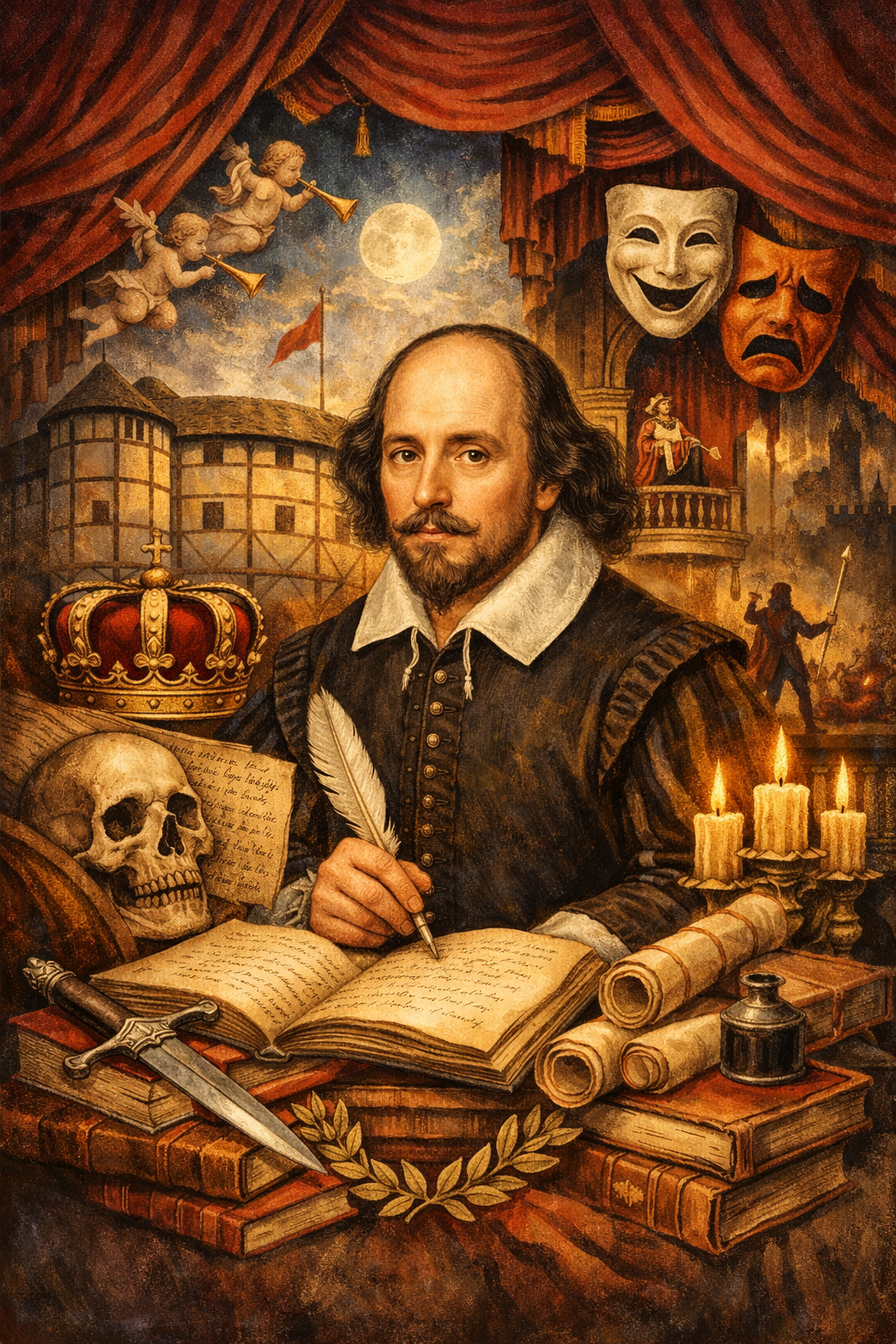
The wider early modern literary field remains crucial here, but mainly because it clarifies the dramatic world Shakespeare absorbed, transformed, and came to dominate in cultural memory. Marlowe, Jonson, Sidney, Spenser, Donne, Webster, Middleton, Kyd, Beaumont, Fletcher, Ford, and others belong to this pillar as part of the rich theatrical, poetic, rhetorical, religious, and political environment from which Shakespeare emerged. Yet the center remains Shakespeare’s corpus itself and the extraordinary afterlife it generated through performance, editing, printing, criticism, education, translation, adaptation, empire, and global literary authority. Shakespeare matters not only as an early modern writer, but as a writer whose works became one of the chief means by which later centuries thought about politics, subjectivity, tragic blindness, desire, theatricality, and the making of literary greatness.
Shakespeare and Early Modern Literature is therefore central to understanding literature as both historical expression and continuing cultural force. It studies Shakespeare’s works as the core archive through which the early modern age dramatized itself, while also tracing how those works became foundational to later theater, criticism, education, nationalism, empire, and world literature. By linking Shakespeare to performance, rhetoric, legal culture, monarchy, religion, print, adaptation, and the history of authorship, this pillar illuminates not only one of the greatest literary achievements in history, but one of the most consequential afterlives ever attached to a body of writing.
Shakespeare as Cultural Memory
Shakespeare became one of the central literary archives of modern cultural memory because his works preserve early modern crisis in forms that remain dramatically alive. The plays and poems do not simply document the late Tudor and early Stuart world. They transform that world into structures of action, speech, imagination, and theatrical recognition that later cultures continue to inhabit. Kings lose legitimacy; lovers mistake themselves and one another; fathers misread children; subjects become rebels; rulers become actors; law becomes performance; language becomes danger; and the self becomes an unstable theater of motive, conscience, fear, desire, and self-division.
This is why Shakespeare’s cultural power cannot be explained by biography alone. The enduring force lies in the works and in the afterlife of performance, adaptation, criticism, pedagogy, translation, and institutional use that made those works central to literary memory. Shakespeare became not merely an author but a continuing interpretive field. His plays are constantly restaged because they are built to generate conflict under changing historical conditions. They remain open to political, psychological, theological, feminist, postcolonial, performance-based, legal, and philosophical readings because the plays themselves rarely close down interpretation.
To study Shakespeare and Early Modern Literature as cultural memory is therefore to study how a theatrical corpus became a long-duration instrument for thinking about rule, desire, selfhood, mortality, language, violence, and justice. It is to ask how one writer’s works came to carry an age, and why those works continue to serve as a stage on which later cultures test their own crises.
Why This Pillar Matters
This pillar matters because Shakespeare became the principal literary medium through which the English-speaking world, and eventually much of the world beyond it, learned to think dramatically about power, motive, selfhood, desire, betrayal, justice, and mortality. Many writers are central to literary history; few became as structurally central to cultural memory as Shakespeare. His plays and poems moved beyond their moment to become part of education, public performance, national myth, political language, philosophical reflection, artistic adaptation, and global cultural exchange. To study Shakespeare is therefore not only to study an early modern author, but to study one of the great engines of literary afterlife.
It also matters because Shakespeare’s work preserves the early modern age at a rare level of density. Dynastic fragility, monarchical performance, legal language, confessional uncertainty, humanist rhetoric, theatrical experiment, gender anxiety, revenge, festivity, imperial encounter, print culture, and the unstable relation between public role and inner life all enter the corpus in ways that remain unusually legible. Shakespeare’s plays do not simplify the age’s contradictions. They intensify them. They endure in part because they stage human beings acting within worlds whose moral and political foundations are never fully secure.
Finally, the pillar matters because Shakespeare’s influence is itself a historical phenomenon worth studying. His works shaped later drama, lyric language, criticism, psychology, politics, education, adaptation, and the very idea of literary greatness. The pillar therefore treats legacy not as an appendix, but as part of the core story. Shakespeare’s afterlife is one of the central facts of Shakespearean meaning.
Scope and Method
This pillar is Shakespeare-centered by design. It treats the plays as the principal archive, the poems as essential complements, and the wider early modern literary world as the crucial context through which Shakespeare’s achievement and afterlife become clearer. It includes theatrical culture, performance history, rhetoric, monarchy, religion, law, gender, race, empire, authorship, collaboration, adaptation, print, editing, education, and the history of reception. It does not reduce Shakespeare to biography, nor does it isolate him from his age. Instead, it reads the works themselves as the governing center and asks what made them so unusually durable, interpretable, and adaptable.
The method throughout is to read Shakespeare as both early modern writer and long-duration cultural force. That means attending to dramatic form, rhetorical design, theatrical conditions, historical context, linguistic texture, genre, textual transmission, and performance history while also asking larger questions: why these plays became canonical; how they shaped later political and psychological language; why they travel across time and culture; how their interpretive openness works; and what their afterlife reveals about literary authority itself.
The wider early modern field is read in relation to Shakespeare but not erased. Marlowe, Jonson, Sidney, Spenser, Donne, Webster, Middleton, Kyd, Beaumont, Fletcher, and others are essential because they show the density of the theatrical, poetic, religious, political, and rhetorical world in which Shakespeare worked. Shakespeare’s magnitude is clearest when he is placed inside a strong literary ecology rather than treated as a solitary miracle.
Reading Architecture for a Humanities Pillar
This literature pillar does not require a GitHub repository. Its research infrastructure is textual, bibliographic, theatrical, archival, historical, editorial, and interpretive rather than code-based. The appropriate scholarly architecture consists of reliable editions, performance records, early printed texts, facsimiles, theater history, source studies, critical companions, textual scholarship, early modern historical scholarship, reception studies, and carefully ordered reading pathways.
A strong Shakespeare and Early Modern Literature pillar should therefore foreground:
- primary Shakespeare texts in reliable editions and open scholarly resources;
- the full play corpus across histories, tragedies, comedies, romances, Roman plays, problem plays, and collaborations;
- the poems, including the sonnets, Venus and Adonis, The Rape of Lucrece, and shorter poetic works;
- the early modern theater industry, including playhouses, acting companies, repertory practice, collaboration, censorship, publication, quartos, and the First Folio;
- historical contexts including monarchy, succession, Reformation, rhetoric, humanism, law, household order, gender, race, empire, and print culture;
- performance and reception history, including stage afterlives, editing, adaptation, film, education, empire, translation, and global Shakespeare;
- critical attention to canon formation, authorship, collaboration, class, gender, racial representation, colonial uses of Shakespeare, and the institutional making of literary authority.
Why Shakespeare Stands at the Center
Shakespeare stands at the center of this pillar not merely because he is the most famous writer of the period, but because his corpus gathers the widest range of early modern pressures into the most flexible and enduring dramatic forms. The histories turn England into political memory. The tragedies make action, blindness, conscience, ambition, and catastrophe central to later literary imagination. The comedies reinvent social and erotic instability through wit, disguise, and festive intelligence. The romances open extraordinary space for wonder, rupture, recognition, and repair. The sonnets and narrative poems intensify self-address, erotic instability, mutability, and poetic immortality. No other early modern writer combines such range with such afterlife.
To recenter the pillar on Shakespeare therefore does not narrow the field. It clarifies its core. The wider early modern archive remains vital, but chiefly because it helps illuminate what Shakespeare inherited, transformed, and eventually came to dominate in cultural memory. Shakespeare’s centrality is not a refusal of literary context. It is the reason that context matters so much.
The Canonical Spine of the Shakespearean Corpus
The canonical spine of this pillar is the Shakespearean corpus itself: histories, tragedies, comedies, romances, Roman plays, poems, and collaboratively shaped works. The English histories preserve monarchy, rebellion, legitimacy, inheritance, and the theatrical making of national memory. The major tragedies—Hamlet, Othello, King Lear, Macbeth, Julius Caesar, Antony and Cleopatra, Coriolanus, and others—create one of the great archives of action under unstable moral and political conditions. The comedies turn desire, misrecognition, language, disguise, and social reintegration into dramatic structures of extraordinary flexibility. The romances imagine belated repair after irreversible harm, making time, wonder, recognition, and forgiveness central to late Shakespearean form.
The poems complete this spine. The sonnets deepen Shakespeare’s place in the history of lyric self-address, time, beauty, mutability, desire, betrayal, and poetic immortality. Venus and Adonis and The Rape of Lucrece show Shakespeare’s relation to narrative poetry, classical materials, erotic pursuit, violence, rhetoric, and poetic reputation. The corpus is therefore not only theatrical. It is dramatic, poetic, rhetorical, political, philosophical, and material.
Around this spine gather the conditions of early modern theatrical production: company life, collaboration, performance practice, censorship, print transmission, quartos, folio publication, and the later editorial and institutional processes through which Shakespeare became “Shakespeare.” A serious pillar must therefore treat the works, the theater, the printed archive, and the afterlife as mutually reinforcing dimensions of literary memory.
Foundational Questions
- Why do Shakespeare’s plays remain the core archive of early modern literary memory?
- How did Shakespeare transform the tensions of his age into forms of enduring dramatic power?
- What do the histories preserve about monarchy, rebellion, legitimacy, dynastic memory, and national myth?
- What do the tragedies reveal about action, blindness, ambition, conscience, rhetoric, and ruin?
- How do the comedies and romances test social fracture, forgiveness, recognition, and repair?
- How do rhetoric, soliloquy, and theatrical speech make inward life newly visible?
- How do Shakespeare’s works negotiate law, justice, religion, gender, race, empire, and the ethics of interpretation?
- Why did Shakespeare become central to later theater, criticism, education, empire, adaptation, translation, and world literature?
- What does the authorship question reveal about archives, class, genius, documentary evidence, and canon formation?
- How should Shakespeare be taught and read without flattening his works into timeless universality or reducing them to historical artifacts alone?
I. Shakespeare’s Plays as the Core Archive of Early Modern Literature
A fully developed pillar should begin by stating plainly that Shakespeare’s plays form the core archive of the category. They are not merely representative works within a larger period; they are the chief dramatic system through which the age has been remembered. Across the plays, Shakespeare turns monarchy, rebellion, jealousy, revenge, kinship, eros, law, sovereignty, festivity, disguise, betrayal, mercy, and mortality into structures of lasting cultural intelligibility. The corpus offers not one stable worldview, but an unparalleled set of forms through which human beings confront unstable worlds.
This matters because Shakespeare’s centrality lies not in prestige alone, but in formal and interpretive range. The works repeatedly generate new readings because they preserve conflict without resolving it too quickly. They remain living texts because they are constructed to withstand changing frameworks of performance, politics, psychology, theology, law, philosophy, education, and criticism.
- Why Shakespeare’s Plays Form the Core Archive of Early Modern Literature (planned) — A foundational article on the dramatic corpus as the central memory-system of the period.
- The Shakespearean Stage as a Laboratory of Power, Desire, and Conscience (planned) — A study of how the plays test action, motive, rhetoric, law, gender, kingship, and moral instability.
- Genre, Experiment, and the Unmatched Range of Shakespeare’s Dramatic World (planned) — An article on how Shakespeare transforms history, tragedy, comedy, romance, and political drama.
- Why the Plays, More Than the Biography, Explain Shakespeare’s Endurance (planned) — A critical article on the limits of biography and the interpretive power of the works themselves.
- Reading Shakespeare as Dramatic System Rather Than Quotation Archive (planned) — A study of Shakespeare’s works as whole theatrical structures rather than isolated famous lines.
II. The Early Modern World Shakespeare Inherited and Transformed
Shakespeare wrote within a world shaped by Tudor and Stuart monarchy, Reformation fracture, public theater, humanist schooling, print growth, urban expansion, legal complexity, imperial curiosity, plague, censorship, and the symbolic persistence of older medieval orders. These pressures do not remain background conditions. They become dramatically active within the plays. Shakespeare’s genius lies partly in his ability to absorb these materials into language, character, plot, and theatrical event without reducing them to thesis or allegory.
This matters because the plays become clearer when read not as timeless abstractions but as works that intensify the contradictions of their own age. Yet the age itself becomes clearer because Shakespeare dramatized it so powerfully.
- The Early Modern World Shakespeare Inherited and Transformed (planned) — A broad introduction to monarchy, Reformation, theater, rhetoric, law, print, plague, and imperial encounter.
- Dynasty, Religion, and Urban Theater in Shakespeare’s England (planned) — A study of the political, religious, and urban conditions that shaped Shakespeare’s theatrical world.
- Why Shakespeare’s Historical Moment Was Structurally Unstable (planned) — An article on succession anxiety, confessional fracture, economic change, and the theatricality of power.
- What Shakespeare Took from His Age and Made Larger Than It (planned) — A study of Shakespeare’s transformation of historical pressures into durable dramatic structures.
- Humanism, Grammar School, and the Rhetorical Education of Shakespearean Drama (planned) — An article on rhetorical training, classical inheritance, imitation, argument, and verbal power.
III. Theater, Performance, and the Shakespearean Stage
Shakespeare’s works are inseparable from performance. The public stage made it possible for monarchy, law, rumor, erotic confusion, grief, rebellion, and philosophical uncertainty to circulate as shared spectacle. Character in Shakespeare is partly an effect of theatrical embodiment; rhetoric becomes event through performance; silence, gesture, timing, and staging shape meaning as much as text. The Shakespearean archive therefore exists not only in pages, but in centuries of theatrical reanimation.
This matters because Shakespeare’s endurance is inseparable from his performability. The plays remain central not only because they are read, but because they continue to live through actors, directors, publics, and changing stagings. Shakespeare survives as text, but also as event.
- The Shakespearean Stage and the Public Life of Drama (planned) — A study of the public theater as a social, political, commercial, and imaginative institution.
- Performance as Interpretation in Shakespeare (planned) — An article on staging, acting, timing, gesture, voice, and directorial interpretation.
- Theater, Audience, and the Social Energy of the Plays (planned) — A study of audience participation, playhouse conditions, shared spectacle, and public meaning.
- Why Shakespeare Survives as Event as Well as Text (planned) — A synthetic article on the continuing theatrical life of the plays.
- Actors, Companies, Repertory, and the Early Modern Theater Industry (planned) — An article on Shakespeare’s professional world as writer, actor, shareholder, and company man.
- The Globe, Blackfriars, and the Spatial Imagination of Shakespearean Drama (planned) — A study of performance spaces and how theatrical architecture shaped dramatic possibility.
IV. The Histories: Kingship, Legitimacy, Rebellion, and the Memory of England
The history plays are central because they turn the English past into dramatic argument. They stage deposition, rebellion, charisma, political inheritance, national myth, and the uncertain moral language of rule. These works do not merely retell chronicle materials. They transform political memory into theater, asking how power is narrated, justified, challenged, and mourned. The histories are among the main reasons Shakespeare became central to English cultural memory in the first place.
This matters because they show literature acting directly on the memory of the polity. They preserve the instability of sovereignty rather than masking it. The English past becomes not a stable inheritance but a stage of competing claims, performed legitimacy, and remembered violence.
- Shakespeare’s Histories and the Political Memory of England (planned) — A foundational article on the histories as dramatic reconstruction of national memory and sovereign instability.
- Richard II, Kingship, and the Crisis of Sacral Rule (planned) — A study of deposition, sacred monarchy, rhetoric, theatrical kingship, and political vulnerability.
- Henry IV, Falstaff, and the Politics of Disorder (planned) — An article on rebellion, tavern life, succession, charisma, education, and disorder.
- Henry V and the Performance of National Sovereignty (planned) — A study of kingship, war, rhetoric, national myth, and the ambiguity of heroic authority.
- Richard III and the Theater of Usurpation (planned) — An article on performance, villainy, charisma, deformity, legitimacy, and theatrical power.
- The Henry VI Plays and the Memory of Civil Disorder (planned) — A study of civil war, faction, collaboration, and the theatrical prehistory of Shakespearean political memory.
- Chronicle Sources and the Dramatic Making of English History (planned) — An article on Holinshed, source transformation, political selection, and theatrical compression.
V. The Tragedies: Conscience, Blindness, Ambition, and Ruin
If Shakespeare stands at the center of literary memory, the tragedies are one of the main reasons why. They stage action under conditions of moral and political instability so intensely that later literary cultures repeatedly return to them as paradigms of catastrophe, inward division, and interpretive difficulty. Hamlet, Macbeth, King Lear, Othello, Julius Caesar, Antony and Cleopatra, and Coriolanus each preserve a distinct dramatic logic of collapse, but together they create a world in which ambition, rhetoric, vulnerability, loyalty, and self-misunderstanding become tragically inseparable.
This matters because Shakespearean tragedy is not just a record of fall. It is an archive of how human beings act when no stable order is capable of removing ambiguity from action, motive, or consequence. Tragedy becomes Shakespeare’s deepest form for staging knowledge that arrives too late.
- Shakespearean Tragedy and the Literature of Unstable Action (planned) — A major article on tragic action, delayed knowledge, blindness, rhetoric, conscience, and irreversible consequence.
- Hamlet and the Burden of Consciousness (planned) — A study of inwardness, revenge, delay, theater, grief, thought, and the instability of action.
- Macbeth and the Logic of Desecrated Ambition (planned) — An article on prophecy, murder, imagination, kingship, guilt, and the sacrilege of power.
- King Lear and the Catastrophe of Authority, Kinship, and Vision (planned) — A study of paternal blindness, divided sovereignty, cruelty, recognition, and apocalyptic suffering.
- Othello and the Tragedy of Trust, Race, and Persuasion (planned) — An article on intimacy, jealousy, racialized vulnerability, rhetoric, and catastrophic interpretation.
- Julius Caesar and the Theater of Political Justification (planned) — A study of republican rhetoric, assassination, public speech, honor, and political self-deception.
- Antony and Cleopatra and the Conflict Between Empire and Desire (planned) — An article on Rome, Egypt, erotic sovereignty, empire, performance, and world-historical scale.
- Coriolanus and the Tragedy of Pride, Citizenship, and Political Speech (planned) — A study of aristocratic contempt, civic performance, mother-son power, and political language.
- Romeo and Juliet and the Tragedy of Youth, Violence, and Social Inheritance (planned) — An article on love, feud, speed, language, generational violence, and social failure.
- Titus Andronicus and the Violence of Revenge Tragedy (planned) — A study of revenge form, mutilation, classical inheritance, and the early extremity of Shakespearean violence.
VI. The Comedies: Desire, Misrecognition, Wit, and Social Reintegration
The comedies are essential to a Shakespeare-centered pillar because they test whether broken or unstable worlds can be reassembled through wit, festivity, disguise, improvisation, and recognition. They preserve social intelligence as much as tragic depth. In these plays, desire disrupts hierarchy, gender role becomes theatrical, wit becomes power, and social order is restored only through a process of misrecognition, confusion, and verbal dexterity. Comedy is therefore not lighter in significance, only different in structure.
This matters because Shakespeare’s total achievement cannot be measured only by tragic magnitude. The comedies show his extraordinary ability to make instability productive rather than only destructive. Comedy becomes a laboratory for social repair, erotic risk, and the performative nature of identity.
- The Comedies and the Instability of Social Recognition (planned) — A major article on disguise, wit, desire, festive disorder, and reintegration.
- Twelfth Night and the Theater of Desire and Misrecognition (planned) — A study of gender performance, mourning, erotic confusion, class desire, and comic melancholy.
- As You Like It and the Reinvention of Social Life Through Performance (planned) — An article on exile, forest comedy, gender disguise, pastoral play, and social renewal.
- Much Ado About Nothing and the Fragility of Reputation and Trust (planned) — A study of slander, gendered honor, wit, surveillance, and comic repair.
- A Midsummer Night’s Dream and the Theater of Desire, Dream, and Transformation (planned) — An article on imagination, erotic disorder, theater, dream logic, and festive reconciliation.
- The Merchant of Venice and the Uneasy Comedy of Law, Mercy, and Exclusion (planned) — A study of contract, mercy, money, religion, antisemitism, gender disguise, and troubling comic settlement.
- Festivity, Wit, and the Comic Exposure of Social Form (planned) — A synthetic article on comedy as a form of social analysis and theatrical intelligence.
VII. The Romances: Loss, Wonder, Forgiveness, and Belated Repair
The late romances deserve special prominence because they stage one of the most distinctive developments in Shakespeare’s career: the movement toward shipwreck, exile, broken families, recognition, repentance, wonder, and symbolic restoration. These plays do not deny suffering, but they ask whether catastrophe may be followed by forms of repair unavailable to tragedy. Their temporal structure matters deeply: they are plays of delay, return, and the persistence of what seemed lost.
This matters because the romances contribute powerfully to Shakespeare’s afterlife as a writer not only of tragic knowledge but of extraordinary imaginative recovery. In the romances, theatrical wonder becomes a way of thinking about time, survival, and restoration after damage that cannot simply be undone.
- The Romances and the Literature of Loss, Wonder, and Belated Repair (planned) — A foundational article on late Shakespearean form, recognition, restoration, and time.
- The Winter’s Tale and the Drama of Time, Jealousy, and Restoration (planned) — A study of jealousy, tyranny, loss, pastoral renewal, statue scene, and belated repair.
- The Tempest and the Politics of Rule, Art, and Renunciation (planned) — An article on power, magic, island rule, colonial reading, theatrical art, and letting go.
- Pericles, Cymbeline, and the Logic of Late Shakespearean Recognition (planned) — A study of separation, return, family restoration, romance geography, and improbable survival.
- Wonder as Dramatic Knowledge in Late Shakespeare (planned) — A synthetic article on how wonder becomes a theatrical form of recognition and repair.
VIII. The Problem Plays: Justice, Desire, Governance, and Moral Unease
The so-called problem plays occupy a crucial space between comedy, tragedy, satire, and moral discomfort. Measure for Measure, All’s Well That Ends Well, and Troilus and Cressida resist clean generic settlement. They stage law, sexuality, exchange, war, reputation, political authority, and moral compromise in forms that leave readers and audiences uneasy. Their power lies precisely in their refusal of emotional closure.
This matters because the problem plays show Shakespeare at his most analytically uncomfortable. They are central to modern Shakespeare because they anticipate later concerns with institutional hypocrisy, sexual coercion, ideological fatigue, gendered bargaining, and the limits of justice.
- The Problem Plays and the Refusal of Comic Certainty (planned) — A foundational article on genre discomfort, moral unease, and unresolved settlement.
- Measure for Measure and the Crisis of Law, Desire, and Mercy (planned) — A study of sexual governance, authority, mercy, hypocrisy, and coercive judgment.
- All’s Well That Ends Well and the Uneasy Logic of Desire and Obligation (planned) — An article on marriage, rank, sexual bargaining, agency, and problematic resolution.
- Troilus and Cressida and the Collapse of Heroic Meaning (planned) — A study of war, value, desire, cynicism, rhetoric, and the exhausted language of honor.
- Why Shakespeare’s Most Uneasy Plays Matter Now (planned) — A synthetic article on modernity, ambiguity, institutions, gender, and uncomfortable dramatic knowledge.
IX. Rome, Republic, Empire, and the Political Imagination
The Roman plays deserve distinct treatment because they expand Shakespeare’s political imagination beyond English dynastic memory into republic, empire, civic virtue, military identity, and classical models of action. Here Shakespeare explores public rhetoric, honor, ambition, crowd politics, imperial desire, and the instability of political ideals with unusual sharpness. Rome becomes one of the chief symbolic worlds through which later readers learned to think about politics theatrically.
This matters because Shakespeare’s influence on political language and imagination depends as much on the Roman plays as on the English histories. Rome gives Shakespeare a theater of civic speech, republican anxiety, imperial expansion, and public self-fashioning.
- Rome in Shakespeare and the Early Modern Political Imagination (planned) — A major article on Rome as symbolic theater of republic, empire, honor, and political rhetoric.
- Republic, Crowd, and Civic Speech in Julius Caesar and Coriolanus (planned) — A study of public address, popular power, aristocracy, assassination, and civic instability.
- Empire, Desire, and World-Historical Scale in Antony and Cleopatra (planned) — An article on Roman power, Egyptian theatricality, erotic sovereignty, and imperial imagination.
- Why Shakespeare’s Rome Became a Modern Political Theater (planned) — A synthetic article on the afterlife of Roman Shakespeare in political thought and performance.
- Classical Sources and Shakespeare’s Roman Imagination (planned) — A study of Plutarch, classical education, source transformation, and early modern classicism.
X. Language, Rhetoric, and the Dangerous Power of Speech
Shakespeare’s plays are built from speech acts: persuasion, deflection, oath, seduction, flattery, confession, denunciation, self-justification, wit, prophecy, command, curse, accusation, and verbal sabotage. Rhetoric in Shakespeare is never merely ornamental. It is one of the main engines of action. Language creates worlds, misleads judgment, reveals desire, conceals motive, and destabilizes reality. This is one reason the plays remain inexhaustible to readers and performers.
This matters because Shakespeare’s dramatic intelligence is inseparable from a literary culture shaped by rhetoric, but it exceeds that culture by turning speech into a force of extraordinary dramatic volatility. In Shakespeare, words do things, but they rarely do only what speakers intend.
- Speech as Action in Shakespeare (planned) — A foundational article on vows, curses, persuasion, command, confession, accusation, and theatrical speech acts.
- Rhetoric, Persuasion, and the Crisis of Truth (planned) — A study of eloquence, manipulation, public argument, and the danger of persuasive speech.
- Wit, Evasion, and the Social Intelligence of Shakespearean Language (planned) — An article on comic verbal play, social survival, double meaning, and strategic speech.
- Why Shakespeare’s Verbal Power Is Central to His Legacy (planned) — A synthetic article on language as dramatic energy and cultural afterlife.
- Oaths, Curses, Prophecies, and the Binding Force of Words (planned) — A study of speech that binds action, memory, destiny, and theatrical consequence.
XI. Soliloquy, Selfhood, and the Making of Inward Life
One of Shakespeare’s most consequential contributions to literary history lies in the dramatic staging of inwardness. Soliloquy, self-division, hesitation, self-theatricalization, and rhetorical self-address make characters newly legible as beings divided against themselves. Yet this inwardness is not transparent essence. It is performed, unstable, and often unreliable. The self in Shakespeare becomes a problem rather than a guarantee.
This matters because Shakespeare helped shape later literary expectations about subjectivity, interior conflict, and psychological depth. The pillar should make that contribution central rather than peripheral. Shakespeare’s inwardness is not simply the discovery of the modern self; it is the dramatization of selfhood as unstable, rhetorical, embodied, and theatrical.
- Soliloquy and the Making of Shakespearean Inwardness (planned) — A major article on self-address, theatrical privacy, divided consciousness, and performed interiority.
- Role, Reflection, and the Fractured Self in Shakespeare (planned) — A study of how characters become divided by the roles they perform and the thoughts they speak.
- Why Shakespeare Matters to the Literary History of Subjectivity (planned) — An article on Shakespeare’s long influence on ideas of psychological depth and literary interiority.
- Self-Theatricalization and the Problem of Inner Truth (planned) — A study of characters who perform themselves into uncertainty.
- Hamlet, Iago, Richard III, and the Dark Arts of Self-Address (planned) — A comparative article on soliloquy, manipulation, motive, and rhetorical self-making.
XII. Law, Justice, Mercy, and Judgment in Shakespeare
Law is one of the deep structuring languages of Shakespeare’s world. Contract, accusation, testimony, oath, punishment, pardon, sovereignty, equity, vengeance, inheritance, legitimacy, and mercy all appear across the plays in ways that test the adequacy of legal order to moral complexity. Shakespeare repeatedly asks whether justice can be administered without violence, whether mercy corrects law or depends upon power, and whether judgment is ever free from theater.
This matters because the works preserve the relation between literary form and legal imagination at one of the founding moments of the modern West. Courtrooms, trials, public accusations, forced bargains, and sovereign pardons reveal how law becomes theater and how theater exposes the fragility of legal truth.
- Law and the Literary Imagination in Shakespeare (planned) — A foundational article on contract, judgment, testimony, sovereignty, punishment, and legal theatricality.
- Justice, Mercy, and the Crisis of Judgment (planned) — A study of mercy as virtue, power, performance, and legal exception.
- Contract, Equity, and Obligation on the Shakespearean Stage (planned) — An article on bonds, bargains, debt, inheritance, and enforceable speech.
- Courts, Oaths, and the Performance of Legal Truth (planned) — A study of legal language, witness, ceremony, and public judgment.
- The Merchant of Venice, Measure for Measure, and the Limits of Legal Settlement (planned) — A comparative article on law, mercy, coercion, and unresolved justice.
XIII. Gender, Desire, Marriage, and the Anxiety of Social Order
Shakespeare’s plays repeatedly turn gender, erotic desire, marriage, inheritance, chastity, reputation, domestic authority, and bodily vulnerability into sites where broader social instability becomes visible. Female wit and agency can reorder scenes; male anxiety about honor and humiliation can turn catastrophic; desire crosses social, legal, and symbolic boundaries. Marriage may appear as comic settlement, tragic trap, political alliance, or site of distrust.
This matters because Shakespeare does not simply reproduce early modern gender norms. He stages their instability with unusual dramatic force. Gender in Shakespeare is theatrical, social, legal, erotic, and rhetorical all at once.
- Gender and the Instability of Social Order in Shakespeare (planned) — A foundational article on gender roles, theatricality, patriarchy, agency, and social anxiety.
- Marriage, Inheritance, and Domestic Anxiety (planned) — A study of household order, property, legitimacy, sexual regulation, and family power.
- Female Speech, Wit, and Authority in Shakespeare’s Plays (planned) — An article on verbal intelligence, agency, disguise, persuasion, and resistance.
- Desire, Shame, and the Performance of Masculinity (planned) — A study of male honor, jealousy, humiliation, friendship, and violence.
- Cross-Dressing, Disguise, and the Theater of Gender (planned) — An article on theatrical convention, gender fluidity, social recognition, and comic form.
- Reputation, Chastity, and the Violence of Social Judgment (planned) — A study of gendered reputation, accusation, surveillance, and public shame.
XIV. Religion, Conscience, and Unsettled Belief
Shakespeare’s world remains deeply marked by religion, yet rarely in the form of unbroken confessional certainty. Providence, sin, conscience, sacramental memory, afterlife, prayer, ghostliness, repentance, judgment, and spiritual unease shape the plays even when doctrinal positions remain unstable or indirect. Religious language often survives as a powerful residue within worlds of political violence, skepticism, or moral uncertainty.
This matters because Shakespeare preserves a civilization in which sacred language still matters, but no longer secures stable interpretation. That tension gives many of the plays their peculiar depth. The works are neither secular in a simple modern sense nor confessional in a straightforward doctrinal sense. They preserve spiritual pressure under conditions of interpretive fracture.
- Religion, Conscience, and the Shakespearean Imagination (planned) — A major article on religious language, inward conflict, sin, repentance, providence, and judgment.
- Providence, Ghosts, and Sacred Residue in the Plays (planned) — A study of supernatural pressure, theological uncertainty, memory, and moral unease.
- Repentance, Sin, and the Problem of Moral Clarity (planned) — An article on confession, guilt, pardon, contrition, and unresolved ethical knowledge.
- Shakespeare After the Fracture of Religious Unity (planned) — A study of Reformation pressure, doctrinal instability, and theatrical ambiguity.
- Hamlet’s Ghost and the Theater of Unsettled Belief (planned) — A focused article on ghostliness, purgatorial memory, revenge, and religious uncertainty.
XV. Race, Empire, Encounter, and the Problem of Otherness
Shakespeare’s plays and poems also participate in the early modern making of racial and imperial imagination. They register foreignness, commerce, religion, conquest, servitude, desire, and the unstable representation of otherness in ways that later critics and traditions have had to reckon with repeatedly. These works do not belong to a fully modern imperial system, but they are part of the literary horizon through which empire, race, and encounter became newly dramatized.
This matters because Shakespeare’s global afterlife is inseparable from the uses and contestations of his work in colonial and postcolonial settings. The pillar should therefore include not only race and empire in the plays, but race and empire in the history of Shakespeare’s reception. A responsible Shakespeare pillar must treat universality as a historical claim, not an unquestioned fact.
- Race, Foreignness, and Otherness in Shakespeare (planned) — A foundational article on racialization, religious difference, foreignness, commerce, and representation.
- Empire and the Early Modern Literary Horizon (planned) — A study of travel, trade, colonial imagination, island settings, and global encounter.
- Othello, The Tempest, and the Problem of Colonial Reading (planned) — A comparative article on race, service, power, colonial interpretation, and theatrical reception.
- Shakespeare in Colonial and Postcolonial Interpretation (planned) — An article on Shakespeare’s uses within empire, education, resistance, adaptation, and decolonial critique.
- Caliban, Shylock, Othello, and the Ethics of Reading Otherness (planned) — A study of characters whose afterlives reveal the ethical stakes of interpretation.
XVI. The Sonnets and Narrative Poems
A fully Shakespeare-centered pillar must give the poems independent weight. The sonnets and narrative poems are not minor appendices to the dramas. They deepen the archive of desire, betrayal, mutability, beauty, poetic immortality, social dependence, and self-address. They show Shakespeare experimenting with voice, temporality, erotic instability, and lyric pressure in ways that complement the plays while also creating a distinct literary field of their own.
This matters because the Shakespearean corpus is larger than the stage. The poems are central to the making of Shakespeare’s literary reputation and to later traditions of reading him as a poet of time, beauty, self-division, and verbal intensity.
- Shakespeare’s Sonnets and the Drama of Self-Address (planned) — A major article on lyric voice, sequence, self-division, erotic ambiguity, and poetic argument.
- Time, Beauty, and Poetic Immortality in the Sonnets (planned) — A study of mutability, aging, preservation, reproduction, and the poem as monument.
- Venus and Adonis, Lucrece, and the Narrative Poems (planned) — An article on erotic pursuit, violence, classical narrative, rhetoric, and poetic reputation.
- Why Shakespeare’s Poems Matter to His Literary Legacy (planned) — A synthetic article on Shakespeare as poet, not only dramatist.
- Desire, Betrayal, and the Instability of Address in the Sonnets (planned) — A focused article on intimacy, uncertainty, shame, beauty, and divided address.
XVII. Print, Text, Editing, and the Material Shakespeare
Shakespeare’s afterlife depends profoundly on material transmission. Quartos, the First Folio, printing practices, theatrical manuscripts, editorial intervention, modernization, emendation, facsimile, performance texts, and digital editions all shape what readers and performers encounter as “Shakespeare.” The plays did not descend into modernity as pure works untouched by mediation. They were printed, collected, edited, argued over, adapted, regularized, annotated, and institutionalized.
This matters because textual Shakespeare is not separate from theatrical Shakespeare. The history of editing and print transmission is one of the means by which Shakespeare became canon. To study Shakespeare seriously is to study the material life of the texts as well as their meanings.
- Quartos, Folios, and the Material Life of Shakespeare’s Texts (planned) — A foundational article on early printing, textual variation, and the making of the Shakespearean archive.
- The First Folio and the Canonization of Shakespeare (planned) — A study of the 1623 Folio, collecting, preservation, and posthumous literary authority.
- Editing Shakespeare: Textual Authority, Emendation, and Modern Reading (planned) — An article on editorial practice, variants, modernization, and interpretive responsibility.
- Digital Shakespeare and the Future of the Textual Archive (planned) — A study of open editions, facsimiles, metadata, and digital access.
- How Print Helped Make Shakespeare a Literary Author (planned) — A synthetic article on performance texts, publication, and the transformation of theater into literature.
XVIII. Authorship, Collaboration, and the Early Modern Theater Industry
A fully current Shakespeare pillar should distinguish between the evidence-based study of collaboration and the speculative authorship question. Early modern theater was a collaborative industry. Playwrights revised, borrowed, co-wrote, adapted sources, worked with actors, and produced scripts for companies rather than for solitary literary prestige alone. Shakespeare’s authorship is historically grounded, but Shakespearean authorship was not modern solitary authorship in every respect.
This matters because collaboration does not diminish Shakespeare. It clarifies the theatrical conditions in which he worked. A responsible pillar should treat collaboration as part of the early modern theater industry and authorship conspiracy as a separate reception-history phenomenon.
- Authorship, Collaboration, and the Early Modern Theater Industry (planned) — A foundational article on company authorship, revision, collaboration, and playhouse production.
- Shakespeare, Marlowe, and the Question of Collaborative Henry VI (planned) — A study of attribution, collaboration, evidence, and early Shakespearean history plays.
- Actors, Scribes, Printers, and the Making of Shakespearean Texts (planned) — An article on the many hands involved in theatrical and print transmission.
- Why Collaboration Does Not Undermine Shakespeare’s Authorship (planned) — A critical article distinguishing collaborative theater from anti-Stratfordian speculation.
- Attribution Studies and the Evidence of Early Modern Drama (planned) — A study of linguistic evidence, textual scholarship, and responsible attribution method.
XIX. Shakespeare’s Legacy, Influence, and Global Afterlife
Shakespeare’s legacy is not external to his importance. It is one of the main reasons he matters so much. His works became central to stage tradition, criticism, education, nation-making, imperial pedagogy, translation, adaptation, film, modern theater, political rhetoric, and the wider category of world literature. Shakespeare’s afterlife is therefore a history of reuse, contestation, appropriation, reverence, resistance, and continual reinvention.
This matters because Shakespeare is not only an author of the early modern past. He is a continuing site of argument over authority, universality, canonicity, empire, art, and interpretation. A serious pillar must foreground that continuing life.
- How Shakespeare Became Central to Literary Memory in the English-Speaking World (planned) — A major article on canon, education, performance, criticism, and literary authority.
- Stage Afterlives: Shakespeare in Performance Across Centuries (planned) — A study of actors, productions, staging traditions, adaptation, and changing publics.
- Translation, Adaptation, and the Global Shakespeare Archive (planned) — An article on Shakespeare across languages, cultures, media, and political contexts.
- Shakespeare, Education, and the Making of Cultural Authority (planned) — A study of schools, curricula, exams, institutions, and cultural prestige.
- Empire, Canon, and the Uses of Shakespeare in Colonial and Postcolonial Contexts (planned) — A critical article on imperial pedagogy, adaptation, resistance, and decolonial reading.
- Why Shakespeare Became a World Author Rather Than Only an English Dramatist (planned) — A synthetic article on portability, adaptation, translation, performance, and institutional power.
- Shakespeare on Film and Screen as Modern Performance Memory (planned) — An article on cinema, television, recorded performance, and new forms of Shakespearean afterlife.
XX. The Shakespeare Authorship Question and Its Cultural Stakes
A serious Shakespeare-centered pillar may include the authorship question, but it should do so with discipline. The issue is not only whether Shakespeare wrote the plays. It is also why this question persists, what evidence is relevant, what standards of proof are used, and what cultural desires underlie suspicion toward the documentary record. Properly handled, the authorship question becomes part of Shakespeare’s reception history and the modern politics of genius, class, archive, education, and literary prestige.
This matters because the debate often reveals more about modern expectations of authorship than about the plays themselves. It should neither dominate the pillar nor be ignored. Instead, it should be treated as one part of Shakespeare’s afterlife: a problem of evidence, canon, cultural desire, and interpretive authority.
- Did Shakespeare Write the Plays? Evidence, Attribution, and the Historical Record (planned) — A careful article on documentary evidence, attribution, archives, and historical method.
- Why the Shakespeare Authorship Question Persists (planned) — A study of suspicion, genius, education, class, and the desire for alternative authors.
- Authorship, Genius, and Class Anxiety in Shakespeare Reception (planned) — An article on social status, education, elite authorship expectations, and literary prestige.
- What the Authorship Debate Reveals About Canon Formation (planned) — A study of Shakespeare’s afterlife as a problem of authority and cultural desire.
- Historical Method, Documentary Evidence, and the Limits of Speculation (planned) — A critical article on evidence standards and responsible literary history.
- The Plays, the Archive, and the Cultural Need for Alternative Authors (planned) — A study of why some readers want a life that seems “large enough” for the works.
- What Would Follow If Shakespeare’s Authorship Were Reframed? (planned) — A hypothetical article on canon, attribution, institutions, and interpretive consequences.
- Biography, Textual Authority, and the Problem of Literary Greatness (planned) — A study of the relation between life, works, evidence, and literary authority.
XXI. Beyond Shakespeare: The Early Modern Literary World Around Him
This pillar remains centered on Shakespeare, but it still requires the wider literary world that clarifies his singularity. Marlowe intensifies overreaching ambition and theatrical will. Jonson sharpens satire, urban performance, classical discipline, and social type. Sidney helps define poetic self-consciousness and aristocratic literary intelligence. Spenser gives the period a vast allegorical and symbolic project. Donne intensifies sacred-profane tension, wit, and self-division. Webster, Middleton, Kyd, Ford, Beaumont, and Fletcher deepen revenge, corruption, tragicomedy, city comedy, and theatrical darkness. These writers are essential not because they rival Shakespeare’s centrality in the pillar, but because they reveal the density of the field in which Shakespeare wrote and against which he became preeminent.
This matters because Shakespeare’s magnitude becomes clearer when set against a strong literary ecology rather than treated as solitary exception. The age was crowded with formal innovation, theatrical competition, religious anxiety, political pressure, and rhetorical brilliance.
- Marlowe and the Literature of Overreaching Ambition (planned) — A study of theatrical will, Tamburlaine, Doctor Faustus, desire, power, and early modern overreach.
- Jonson, Satire, and the Discipline of Social Exposure (planned) — An article on city comedy, classical form, social type, satire, and authorial self-fashioning.
- Sidney and the Courtly Defense of Poetic Intelligence (planned) — A study of poetic theory, aristocratic authorship, romance, rhetoric, and literary self-consciousness.
- Spenser, Allegory, and the Symbolic World of Protestant Order (planned) — An article on epic allegory, moral formation, Protestant imagination, and national poetics.
- Donne and the Metaphysical Pressure of Early Modern Selfhood (planned) — A study of wit, erotic intensity, sacred crisis, body, soul, and self-division.
- Webster, Middleton, and the Dark Theater of Corruption (planned) — An article on revenge tragedy, city corruption, moral darkness, and post-Shakespearean drama.
- Kyd, Revenge Tragedy, and the Theater of Blood (planned) — A study of revenge conventions, spectacle, justice, and the dramatic inheritance Shakespeare transformed.
- Beaumont, Fletcher, Ford, and the Later Jacobean Stage (planned) — An article on tragicomedy, courtly drama, affective extremity, and the theater after Shakespeare.
XXII. Major Genres Across Shakespeare and Early Modern Literature
A comprehensive pillar should also organize the archive by genre. History play preserves national memory, succession anxiety, and political legitimacy. Tragedy stages irreversible action, catastrophic knowledge, and moral blindness. Comedy turns social instability into theatrical reintegration. Romance imagines recognition and repair after loss. Roman drama makes classical politics available to early modern and modern political imagination. Sonnets and narrative poems preserve lyric self-address, time, beauty, desire, and poetic immortality. Revenge tragedy, city comedy, masque, satire, pastoral, and devotional poetry widen the early modern field around Shakespeare.
- History Play as National Memory and Political Theater (planned) — A genre article on chronicle, monarchy, succession, rebellion, and staged national memory.
- Tragedy as Catastrophic Knowledge in Shakespeare (planned) — A study of action, blindness, recognition, conscience, and irreversible consequence.
- Comedy as Social Experiment and Theatrical Repair (planned) — An article on desire, disguise, festivity, misrecognition, and reintegration.
- Romance as Late Drama of Recognition and Restoration (planned) — A study of late Shakespearean form, time, forgiveness, wonder, and symbolic repair.
- Roman Drama as Political Thought in Theatrical Form (planned) — An article on republic, empire, rhetoric, citizenship, and public action.
- Lyric and Narrative Poetry in Shakespeare’s Literary Career (planned) — A study of sonnets, narrative poems, poetic reputation, and the drama of lyric address.
- Revenge Tragedy, City Comedy, and the Wider Early Modern Stage (planned) — An article on the genres around Shakespeare and the theatrical ecology of the period.
XXIII. Recurring Themes and Dramatic Structures
Across Shakespeare and the early modern literary field, certain structures recur with extraordinary force: sovereignty and theatrical rule; speech and action; desire and misrecognition; jealousy and persuasion; legitimacy and rebellion; law and mercy; gender and performance; religion and unsettled belief; race and encounter; family and inheritance; ambition and desecration; exile and return; revenge and delayed knowledge; beauty and mortality; time and poetic survival; theater and selfhood. These themes help explain why Shakespeare remains central. His works do not merely contain subjects. They create durable forms for thinking through unresolved human and political conditions.
- Power, Performance, and the Theatricality of Rule (planned) — A thematic article on kingship, public authority, legitimacy, and staged sovereignty.
- Ambition, Desecration, and the Violence of Self-Making (planned) — A study of ambition as political, psychological, and spiritual disorder.
- Desire, Misrecognition, and the Instability of Social Knowledge (planned) — An article on erotic error, mistaken identity, gender performance, and social interpretation.
- Speech, Persuasion, and the Crisis of Truth (planned) — A study of rhetoric, manipulation, public speech, and verbal action.
- Conscience, Guilt, and the Burden of Acting (planned) — An article on moral knowledge, delayed recognition, guilt, and tragic consequence.
- Mortality, Time, and the Poetics of Survival (planned) — A study of death, mutability, memory, and poetic permanence.
- Theater, Selfhood, and the Problem of Inner Truth (planned) — A synthetic article on role, performance, self-address, and interiority.
Expanded Article Architecture
The following long-range architecture recenters the category around Shakespeare’s dramatic corpus, poetic works, theatrical afterlife, textual transmission, authorship history, and cultural authority while retaining the wider early modern field as explanatory context rather than a rival center.
Shakespeare as Core Archive
- Why Shakespeare’s Plays Form the Core Archive of Early Modern Literature (planned)
- The Shakespearean Stage as a Laboratory of Power, Desire, and Conscience (planned)
- Genre, Experiment, and the Unmatched Range of Shakespeare’s Dramatic World (planned)
- Why the Plays, More Than the Biography, Explain Shakespeare’s Endurance (planned)
- Reading Shakespeare as Dramatic System Rather Than Quotation Archive (planned)
The Historical and Theatrical World
- The Early Modern World Shakespeare Inherited and Transformed (planned)
- Dynasty, Religion, and Urban Theater in Shakespeare’s England (planned)
- Why Shakespeare’s Historical Moment Was Structurally Unstable (planned)
- Humanism, Grammar School, and the Rhetorical Education of Shakespearean Drama (planned)
- The Shakespearean Stage and the Public Life of Drama (planned)
- Performance as Interpretation in Shakespeare (planned)
- Theater, Audience, and the Social Energy of the Plays (planned)
- Actors, Companies, Repertory, and the Early Modern Theater Industry (planned)
- The Globe, Blackfriars, and the Spatial Imagination of Shakespearean Drama (planned)
The Histories and National Memory
- Shakespeare’s Histories and the Political Memory of England (planned)
- Richard II, Kingship, and the Crisis of Sacral Rule (planned)
- Henry IV, Falstaff, and the Politics of Disorder (planned)
- Henry V and the Performance of National Sovereignty (planned)
- Richard III and the Theater of Usurpation (planned)
- The Henry VI Plays and the Memory of Civil Disorder (planned)
- Chronicle Sources and the Dramatic Making of English History (planned)
The Major Tragedies
- Shakespearean Tragedy and the Literature of Unstable Action (planned)
- Hamlet and the Burden of Consciousness (planned)
- Macbeth and the Logic of Desecrated Ambition (planned)
- King Lear and the Catastrophe of Authority, Kinship, and Vision (planned)
- Othello and the Tragedy of Trust, Race, and Persuasion (planned)
- Julius Caesar and the Theater of Political Justification (planned)
- Antony and Cleopatra and the Conflict Between Empire and Desire (planned)
- Coriolanus and the Tragedy of Pride, Citizenship, and Political Speech (planned)
- Romeo and Juliet and the Tragedy of Youth, Violence, and Social Inheritance (planned)
- Titus Andronicus and the Violence of Revenge Tragedy (planned)
Comedies, Romances, and Problem Plays
- The Comedies and the Instability of Social Recognition (planned)
- Twelfth Night and the Theater of Desire and Misrecognition (planned)
- As You Like It and the Reinvention of Social Life Through Performance (planned)
- Much Ado About Nothing and the Fragility of Reputation and Trust (planned)
- A Midsummer Night’s Dream and the Theater of Desire, Dream, and Transformation (planned)
- The Merchant of Venice and the Uneasy Comedy of Law, Mercy, and Exclusion (planned)
- The Romances and the Literature of Loss, Wonder, and Belated Repair (planned)
- The Winter’s Tale and the Drama of Time, Jealousy, and Restoration (planned)
- The Tempest and the Politics of Rule, Art, and Renunciation (planned)
- Pericles, Cymbeline, and the Logic of Late Shakespearean Recognition (planned)
- The Problem Plays and the Refusal of Comic Certainty (planned)
- Measure for Measure and the Crisis of Law, Desire, and Mercy (planned)
- Troilus and Cressida and the Collapse of Heroic Meaning (planned)
Rome, Politics, and Classical Inheritance
- Rome in Shakespeare and the Early Modern Political Imagination (planned)
- Republic, Crowd, and Civic Speech in Julius Caesar and Coriolanus (planned)
- Empire, Desire, and World-Historical Scale in Antony and Cleopatra (planned)
- Why Shakespeare’s Rome Became a Modern Political Theater (planned)
- Classical Sources and Shakespeare’s Roman Imagination (planned)
Language, Selfhood, Law, and Belief
- Speech as Action in Shakespeare (planned)
- Rhetoric, Persuasion, and the Crisis of Truth (planned)
- Wit, Evasion, and the Social Intelligence of Shakespearean Language (planned)
- Oaths, Curses, Prophecies, and the Binding Force of Words (planned)
- Soliloquy and the Making of Shakespearean Inwardness (planned)
- Role, Reflection, and the Fractured Self in Shakespeare (planned)
- Law and the Literary Imagination in Shakespeare (planned)
- Justice, Mercy, and the Crisis of Judgment (planned)
- Religion, Conscience, and the Shakespearean Imagination (planned)
- Providence, Ghosts, and Sacred Residue in the Plays (planned)
Gender, Race, Empire, and Social Order
- Gender and the Instability of Social Order in Shakespeare (planned)
- Marriage, Inheritance, and Domestic Anxiety (planned)
- Female Speech, Wit, and Authority in Shakespeare’s Plays (planned)
- Desire, Shame, and the Performance of Masculinity (planned)
- Cross-Dressing, Disguise, and the Theater of Gender (planned)
- Race, Foreignness, and Otherness in Shakespeare (planned)
- Empire and the Early Modern Literary Horizon (planned)
- Othello, The Tempest, and the Problem of Colonial Reading (planned)
- Shakespeare in Colonial and Postcolonial Interpretation (planned)
Poems and Non-Dramatic Shakespeare
- Shakespeare’s Sonnets and the Drama of Self-Address (planned)
- Time, Beauty, and Poetic Immortality in the Sonnets (planned)
- Venus and Adonis, Lucrece, and the Narrative Poems (planned)
- Why Shakespeare’s Poems Matter to His Literary Legacy (planned)
- Desire, Betrayal, and the Instability of Address in the Sonnets (planned)
Print, Text, Editing, and Authorship
- Quartos, Folios, and the Material Life of Shakespeare’s Texts (planned)
- The First Folio and the Canonization of Shakespeare (planned)
- Editing Shakespeare: Textual Authority, Emendation, and Modern Reading (planned)
- Digital Shakespeare and the Future of the Textual Archive (planned)
- How Print Helped Make Shakespeare a Literary Author (planned)
- Authorship, Collaboration, and the Early Modern Theater Industry (planned)
- Shakespeare, Marlowe, and the Question of Collaborative Henry VI (planned)
- Attribution Studies and the Evidence of Early Modern Drama (planned)
Legacy, Influence, and Global Shakespeare
- How Shakespeare Became Central to Literary Memory in the English-Speaking World (planned)
- Stage Afterlives: Shakespeare in Performance Across Centuries (planned)
- Translation, Adaptation, and the Global Shakespeare Archive (planned)
- Shakespeare, Education, and the Making of Cultural Authority (planned)
- Empire, Canon, and the Uses of Shakespeare in Colonial and Postcolonial Contexts (planned)
- Why Shakespeare Became a World Author Rather Than Only an English Dramatist (planned)
- Shakespeare on Film and Screen as Modern Performance Memory (planned)
The Authorship Question and Cultural Stakes
- Did Shakespeare Write the Plays? Evidence, Attribution, and the Historical Record (planned)
- Why the Shakespeare Authorship Question Persists (planned)
- Authorship, Genius, and Class Anxiety in Shakespeare Reception (planned)
- What the Authorship Debate Reveals About Canon Formation (planned)
- Historical Method, Documentary Evidence, and the Limits of Speculation (planned)
- The Plays, the Archive, and the Cultural Need for Alternative Authors (planned)
- What Would Follow If Shakespeare’s Authorship Were Reframed? (planned)
- Biography, Textual Authority, and the Problem of Literary Greatness (planned)
The World Around Shakespeare
- Marlowe and the Literature of Overreaching Ambition (planned)
- Jonson, Satire, and the Discipline of Social Exposure (planned)
- Sidney and the Courtly Defense of Poetic Intelligence (planned)
- Spenser, Allegory, and the Symbolic World of Protestant Order (planned)
- Donne and the Metaphysical Pressure of Early Modern Selfhood (planned)
- Webster, Middleton, and the Dark Theater of Corruption (planned)
- Kyd, Revenge Tragedy, and the Theater of Blood (planned)
- Beaumont, Fletcher, Ford, and the Later Jacobean Stage (planned)
Genres and Themes
- History Play as National Memory and Political Theater (planned)
- Tragedy as Catastrophic Knowledge in Shakespeare (planned)
- Comedy as Social Experiment and Theatrical Repair (planned)
- Romance as Late Drama of Recognition and Restoration (planned)
- Roman Drama as Political Thought in Theatrical Form (planned)
- Lyric and Narrative Poetry in Shakespeare’s Literary Career (planned)
- Power, Performance, and the Theatricality of Rule (planned)
- Ambition, Desecration, and the Violence of Self-Making (planned)
- Desire, Misrecognition, and the Instability of Social Knowledge (planned)
- Conscience, Guilt, and the Burden of Acting (planned)
- Mortality, Time, and the Poetics of Survival (planned)
Closing Perspective
Shakespeare and Early Modern Literature should be understood as a Shakespeare-centered archive of dramatic invention, poetic force, theatrical performance, cultural authority, and civilizational transition rather than as a loose survey of Renaissance literary culture. Its range extends from the plays and poems themselves to their historical setting, performance life, rhetorical power, political and religious tensions, textual transmission, collaborative theater industry, global afterlives, and continuing interpretive disputes. Read in the strongest sense, the pillar shows how Shakespeare became the decisive literary medium through which an age staged its crises and later ages continued to think through their own.
It is therefore central to any serious understanding of literary memory in the modern West. Shakespeare’s works preserve not only the tensions of the early modern world, but the making of forms so durable that they outlived their own age and became part of the imaginative equipment of later centuries. They also show, with unusual force, how literature can become both the record of a historical moment and the continuing stage on which later cultures test power, desire, conscience, justice, mortality, speech, and the unstable question of what it means to act at all.
Related Reading
- Literature & Cultural Memory
- British Literature and Cultural Memory
- Tragedy, Drama, and Collective Memory
- Poetry, Memory, and Imagination
- Classical Literature and Civilizational Memory
- Political Philosophy and Justice
- Religion and Law
- World History
Further Reading
- Dobson, M. and Wells, S. (eds.) (2015). The Oxford Companion to Shakespeare. Oxford: Oxford University Press. https://global.oup.com/academic/product/the-oxford-companion-to-shakespeare-9780198708735
- de Grazia, M. and Wells, S. (eds.) (2011). The New Cambridge Companion to Shakespeare. 2nd edn. Cambridge: Cambridge University Press. https://www.cambridge.org/core/books/new-cambridge-companion-to-shakespeare/95900CAA1B085D13428F2DEBF9573AA2
- Cheney, P. (ed.) (2007). The Cambridge Companion to Shakespeare’s Poetry. Cambridge: Cambridge University Press. https://www.cambridge.org/core/books/cambridge-companion-to-shakespeares-poetry/AAAF4B20005C813DC5A47BE365010D2F
- Braunmuller, A. R. and Hattaway, M. (eds.) (2003). The Cambridge Companion to English Renaissance Drama. 2nd edn. Cambridge: Cambridge University Press. https://www.cambridge.org/ag/universitypress/subjects/literature/renaissance-and-early-modern-literature/cambridge-companion-english-renaissance-drama-2nd-edition?format=PB
- McEachern, C. (ed.) (2013). The Cambridge Companion to Shakespearean Tragedy. 2nd edn. Cambridge: Cambridge University Press. https://www.cambridge.org/core/books/cambridge-companion-to-shakespearean-tragedy/EFEF6A1A08B386667F7D2E2B8A8FFFE8
- Cambridge University Press (n.d.). Cambridge Companions to Shakespeare and Early Modern Drama. Cambridge: Cambridge University Press. https://www.cambridge.org/core/publications/collections/cambridge-shakespeare/cambridge-companions-for-cambridge-shakespeare
- Kastan, D. S. (ed.) (1999). A Companion to Shakespeare. Oxford: Blackwell. https://www.wiley.com/en-us/A+Companion+to+Shakespeare-p-9780631214069
- Dutton, R. and Howard, J. E. (eds.) (2003). A Companion to Shakespeare’s Works. 5 vols. Oxford: Blackwell. https://www.wiley.com/en-us/A+Companion+to+Shakespeare%27s+Works%2C+5+Volume+Set-p-9781405117920
- Erne, L. (2003). Shakespeare as Literary Dramatist. Cambridge: Cambridge University Press. https://www.cambridge.org/core/books/shakespeare-as-literary-dramatist/5485D0E7BC7C8E46A75866B619F5905D
- Burrow, C. (2013). Shakespeare and Classical Antiquity. Oxford: Oxford University Press. https://global.oup.com/academic/product/shakespeare-and-classical-antiquity-9780199684786
- Greenblatt, S. (2004). Will in the World: How Shakespeare Became Shakespeare. New York: W. W. Norton. https://wwnorton.com/books/9780393327373
- Shapiro, J. (2010). Contested Will: Who Wrote Shakespeare?. New York: Simon & Schuster. https://www.simonandschuster.com/books/Contested-Will/James-Shapiro/9781439163290
- Smith, E. (2019). This Is Shakespeare. London: Pelican / Profile Books. https://www.profilebooks.com/work/this-is-shakespeare/
References
- Folger Shakespeare Library (n.d.). Shakespeare’s Works. Washington, DC: Folger Shakespeare Library. https://www.folger.edu/explore/shakespeares-works/
- Folger Shakespeare Library (n.d.). Download Shakespeare’s Plays, Sonnets, and Poems. Washington, DC: Folger Shakespeare Library. https://www.folger.edu/explore/shakespeares-works/download/
- Folger Shakespeare Library (n.d.). Shakespeare’s Sonnets. Washington, DC: Folger Shakespeare Library. https://www.folger.edu/explore/shakespeares-works/shakespeares-sonnets/
- Folger Shakespeare Library (n.d.). Shakespeare Documented. Washington, DC: Folger Shakespeare Library. https://shakespearedocumented.folger.edu/
- Folger Shakespeare Library (n.d.). About Shakespeare Documented. Washington, DC: Folger Shakespeare Library. https://shakespearedocumented.folger.edu/about
- Internet Shakespeare Editions (n.d.). The Plays and Poems. Victoria, BC: University of Victoria. https://internetshakespeare.uvic.ca/Library/plays.html
- Internet Shakespeare Editions (n.d.). Facsimile Viewer. Victoria, BC: University of Victoria. https://internetshakespeare.uvic.ca/Library/facsimile/
- Shakespeare Birthplace Trust (n.d.). Shakespeare’s Works. Stratford-upon-Avon: Shakespeare Birthplace Trust. https://www.shakespeare.org.uk/explore-shakespeare/shakespedia/shakespeares-works/
- British Library (n.d.). William Shakespeare. London: British Library. https://www.bl.uk/people/william-shakespeare
- British Library (2020). Shakespeare’s Only Surviving Playscript Now Online. London: British Library. https://www.bl.uk/stories/blogs/posts/shakespeares-only-surviving-playscript
- Royal Shakespeare Company (n.d.). Shakespeare Learning Zone. Stratford-upon-Avon: Royal Shakespeare Company. https://www.rsc.org.uk/shakespeare-learning-zone
- Royal Shakespeare Company (n.d.). Learn. Stratford-upon-Avon: Royal Shakespeare Company. https://www.rsc.org.uk/learn
- Royal Shakespeare Company (n.d.). Shakespeare Curriculum. Stratford-upon-Avon: Royal Shakespeare Company. https://www.rsc.org.uk/learn/shakespeare-curriculum
- de Grazia, M. and Wells, S. (eds.) (2011). The New Cambridge Companion to Shakespeare. 2nd edn. Cambridge: Cambridge University Press. https://www.cambridge.org/core/books/new-cambridge-companion-to-shakespeare/95900CAA1B085D13428F2DEBF9573AA2
- Cheney, P. (ed.) (2007). The Cambridge Companion to Shakespeare’s Poetry. Cambridge: Cambridge University Press. https://www.cambridge.org/core/books/cambridge-companion-to-shakespeares-poetry/AAAF4B20005C813DC5A47BE365010D2F
- Braunmuller, A. R. and Hattaway, M. (eds.) (2003). The Cambridge Companion to English Renaissance Drama. 2nd edn. Cambridge: Cambridge University Press. https://www.cambridge.org/ag/universitypress/subjects/literature/renaissance-and-early-modern-literature/cambridge-companion-english-renaissance-drama-2nd-edition?format=PB
- McEachern, C. (ed.) (2013). The Cambridge Companion to Shakespearean Tragedy. 2nd edn. Cambridge: Cambridge University Press. https://www.cambridge.org/core/books/cambridge-companion-to-shakespearean-tragedy/EFEF6A1A08B386667F7D2E2B8A8FFFE8
- Dobson, M. and Wells, S. (eds.) (2015). The Oxford Companion to Shakespeare. Oxford: Oxford University Press. https://global.oup.com/academic/product/the-oxford-companion-to-shakespeare-9780198708735
- Erne, L. (2003). Shakespeare as Literary Dramatist. Cambridge: Cambridge University Press. https://www.cambridge.org/core/books/shakespeare-as-literary-dramatist/5485D0E7BC7C8E46A75866B619F5905D
- Burrow, C. (2013). Shakespeare and Classical Antiquity. Oxford: Oxford University Press. https://global.oup.com/academic/product/shakespeare-and-classical-antiquity-9780199684786
- Shapiro, J. (2010). Contested Will: Who Wrote Shakespeare?. New York: Simon & Schuster. https://www.simonandschuster.com/books/Contested-Will/James-Shapiro/9781439163290
- Folger Shakespeare Library (2017). Shakespeare and Marlowe: Attributing Henry VI Authorship. Washington, DC: Folger Shakespeare Library. https://www.folger.edu/podcasts/shakespeare-unlimited/christopher-marlowe-attribution-henry-vi/
- Oxford University Press (2026). Henry VI, Part I: The New Oxford Shakespeare. Oxford: Oxford University Press. https://global.oup.com/academic/product/henry-vi-part-i-9780192873569