
Last Updated May 4, 2026
Arabian and Levantine Thought: Revelation, Language, Memory, and Renewal explores the philosophical, literary, religious, ethical, legal, political, theological, aesthetic, and historical traditions through which thinkers across the Arabian Peninsula, the Levant, and Iraq reflected on revelation, language, justice, memory, community, spiritual life, authority, exile, reform, and the meaning of human existence. As a major category within the Philosophy knowledge series, this pillar studies Arabian and Levantine thought not as a narrow history of formal philosophy alone, but as a civilizational field shaped by pre-Islamic poetry, Qur’anic revelation, Arabic grammar, Islamic scholarship, Christian and Jewish Arabic thought, Shiʿi and Ibāḍī intellectual worlds, urban literary culture, pilgrimage routes, reform movements, print modernity, Palestinian memory, Iraqi ruin, Syrian crisis, Yemeni depth, Omani maritime thought, and the continuing struggle for dignity under historical pressure.
This field includes several overlapping layers of thought: the moral and poetic world of pre-Islamic Arabia; Qur’anic and early Islamic reflection on revelation, prophecy, law, and community; the development of Arabic grammar, philology, balāgha, rhetoric, logic, theology, jurisprudence, and philosophy in the Hijaz, Iraq, Syria, Palestine, Lebanon, Yemen, Oman, and the wider Arab East; Christian and Jewish Arabic thought in the Levant and Mesopotamia; Shiʿi scholarly ecologies in Najaf and Karbala; Ibāḍī theology and political thought in Oman; Zaydi and manuscript traditions in Yemen; and modern literary, reformist, nationalist, socialist, feminist, anti-colonial, postcolonial, prison, exile, and testimonial traditions shaped by the Nahda and its afterlives.
The series proceeds from a central methodological claim: Arabian and Levantine thought cannot be reduced to early Islamic theology, classical falsafa, modern Arab nationalism, Nahda liberalism, or contemporary political crisis alone. Its deepest arguments often appear in scripture, poetry, grammar, commentary, sermons, legal reasoning, theological disputation, chronicles, epistles, adab, maqāma, philosophy, journalism, memoir, prison writing, exile literature, literary criticism, women’s reform writing, seminary reasoning, and political testimony. The field therefore requires a broad understanding of philosophy, one capable of reading revelation, language, law, literature, memory, and political life as mutually connected forms of thought.
The goal of this pillar is not to flatten Arabia, Iraq, Syria, Palestine, Lebanon, Yemen, Oman, and the wider Arab East into a single homogeneous doctrine. Nor is it to reduce the tradition to sacred origins, ideological conflict, sectarian division, colonial injury, or modern catastrophe. It is to show why Arabian and Levantine thought remains philosophically indispensable precisely because it joins revelation, language, law, beauty, memory, reform, exile, justice, human dignity, spiritual authority, political critique, and civilizational renewal into one of the world’s great archives of intellectual life.
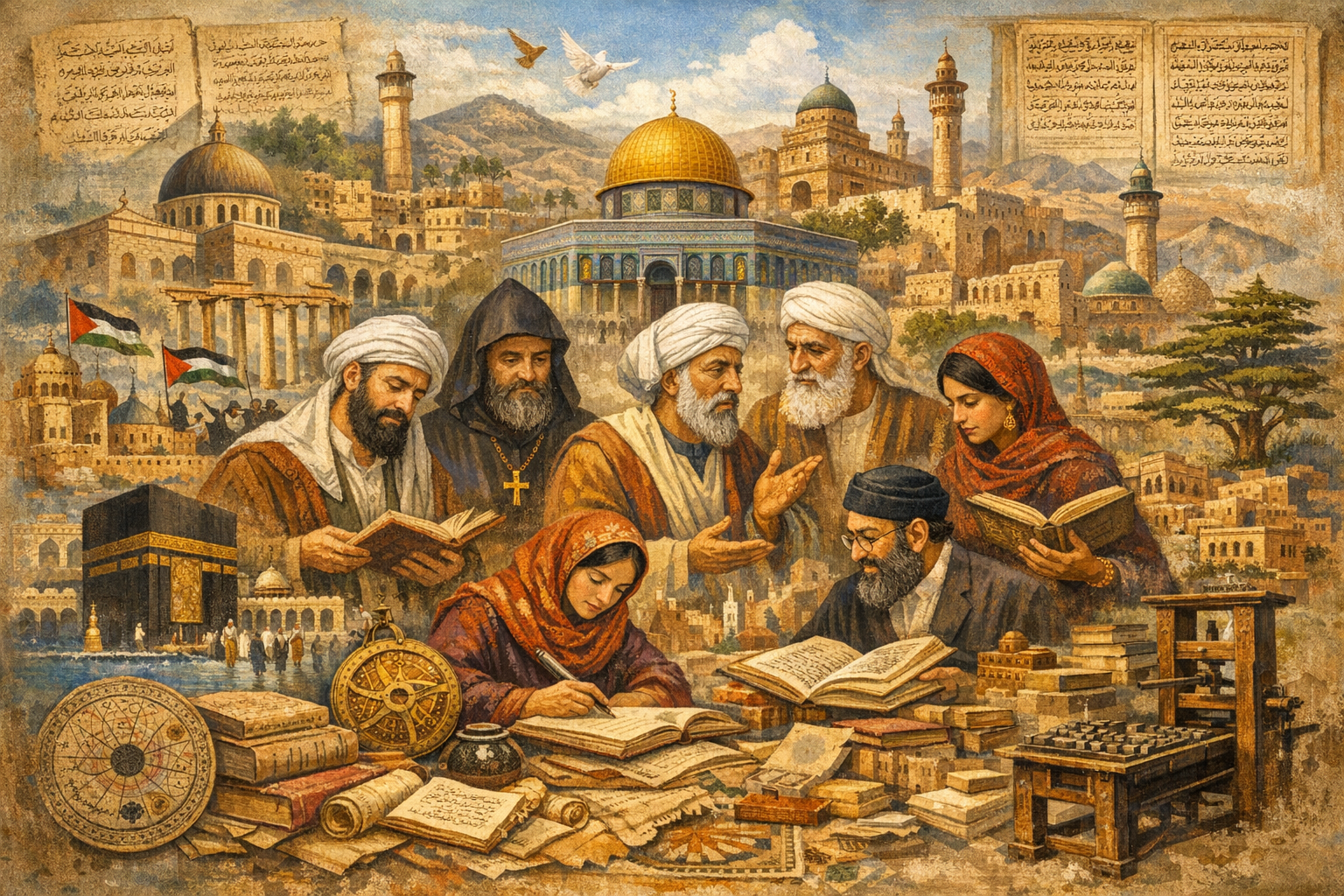
Arabian and Levantine thought is especially important to a broader philosophy architecture because it gathers one of the world’s great traditions of revelation, language, law, literary expression, ethical reasoning, historical memory, and political critique into a single intellectual horizon. In this respect, the category links not only to Islamic and Mystical Thought, Maghrebi and Andalusi Thought, and Ottoman and Turkish Thought, but also to Ethics and Moral Philosophy, Political Philosophy and Justice, Religion and Law, Religion and Society, Arabic Literature and Adab, and Poetry, Memory, and Imagination. Questions of revelation, grammar, justice, prophecy, exile, reform, dignity, sacred geography, literary form, women’s education, sectarian plurality, occupation, state violence, and cultural renewal become sharper when Arabian and Levantine thought is treated as a major intellectual world rather than as a marginal supplement to Islamic studies or modern Middle Eastern history.
A comprehensive treatment must recognize that “Arabian and Levantine” is not a simple geographic label. It names an interconnected intellectual zone extending across the Hijaz, Najd, Yemen, Oman, Iraq, Syria, Lebanon, and Palestine, together with their wider relations to Egypt, Iran, Anatolia, East Africa, the Mediterranean, and the global Arab diaspora. Scholars, poets, jurists, theologians, grammarians, philosophers, merchants, travelers, reformers, teachers, printers, journalists, monks, clergy, seminary authorities, translators, critics, dissidents, and memoirists moved across caravan routes, ports, pilgrimage circuits, mosques, madrasas, churches, monasteries, markets, printing presses, schools, universities, journals, salons, seminaries, prisons, refugee camps, and diasporic networks. The result is not one unified doctrine but a dense field of reflection on revelation, language, law, beauty, moral responsibility, political order, reform, exile, and the terms of living together under conditions of historical change.
Why This Series Matters
Arabian and Levantine thought deserves serious study for several reasons. First, it preserves one of the most consequential intellectual traditions in world history because the Arabic language, the Qur’an, and the formative institutions of Islam emerged in this wider zone and went on to shape legal, theological, literary, mystical, political, and philosophical life across vast regions. Second, it shows how philosophy may develop not only in abstract treatises but in poetry, scripture, grammar, legal reasoning, sermons, chronicles, epistles, journalism, autobiography, memoir, prison writing, literary criticism, and political testimony. Third, it provides indispensable materials for understanding how language, revelation, and communal order became mutually constitutive in Arabic intellectual history.
This field is also central for understanding how Arab intellectual life repeatedly negotiated the relation between sacred inheritance and historical change, especially in times of imperial rule, reform, colonialism, decolonization, authoritarian crisis, occupation, war, displacement, exile, and diasporic reconstruction. The tradition does not remain stable by refusing history. It returns to language, scripture, poetry, law, and memory in order to reinterpret them under new conditions.
It is also indispensable for restoring Palestine, Lebanon, Syria, Iraq, Yemen, Oman, the Hijaz, Najd, and the wider Peninsula to their proper place within Arab intellectual history rather than treating Arab thought as if it were reducible to only a few metropolitan centers. The Arab East is not a single line of descent. It is a polycentric field of sacred geography, urban learning, tribal memory, seminary reasoning, missionary education, journalism, revolutionary critique, women’s reform writing, and literary renewal.
Finally, this series broadens philosophy itself by showing that some of the deepest reflection on justice, beauty, revelation, memory, exile, dignity, grief, sovereignty, and social renewal occurs through literary and religious forms as much as through formal philosophical systems. Arabian and Levantine thought is therefore not adequately understood if treated only as early Islamic theology, only as classical falsafa, only as Nahda liberalism, or only as modern ideological conflict. It belongs at the level of civilizational interpretation.
The Civilizational Frame of Arabian and Levantine Thought
The phrase “Arabian and Levantine thought” is useful because it names a field broader than formal philosophy alone and deeper than modern national intellectual histories. It points to an Arab eastern world formed across the Arabian Peninsula, the Levant, and Iraq among poets, scholars, jurists, theologians, philosophers, monks, clergy, historians, reformers, journalists, critics, and teachers whose work moved across pilgrimage routes, imperial capitals, schools, mosques, churches, monasteries, markets, seminaries, libraries, presses, journals, and exile networks. This is not a claim of uniformity. It is a claim that these worlds participated in overlapping concerns with revelation, language, law, justice, memory, spiritual life, reform, and human dignity.
At its deepest layers, this field includes the linguistic and moral world of pre-Islamic Arabic poetry, the scriptural and rhetorical revolution of the Qur’an, the early formation of Islamic law and theology, and the development of Arabic grammar, philology, logic, rhetoric, and hermeneutics as arts of meaning and truth. The Arabian Peninsula matters here not merely as a point of origin but as an enduring intellectual horizon: the Hijaz through revelation and pilgrimage, Yemen through ancient and Islamic literary and scholarly traditions, Oman through Ibāḍī theology and legal thought, and the wider Peninsula through oral poetics, tribal ethics, genealogical memory, reformist religious traditions, and the long afterlife of Arabic linguistic self-consciousness.
The Levant and Iraq are equally indispensable. Damascus, Jerusalem, Aleppo, Beirut, Baghdad, Basra, Kufa, Najaf, Karbala, Sana’a, Muscat, and other cities became centers of theology, law, translation, grammar, philosophy, literary production, journalism, reform, political debate, devotional transmission, and modern public reason. Syria and Iraq were crucial to the development of Arabic logic, theology, hadith, exegesis, and philosophical transmission. Palestine, Lebanon, and Syria became central to the Nahda, journalism, print culture, educational reform, feminism, literary criticism, anti-colonial argument, and modern Arab political and literary renewal. Iraq remained indispensable from the Abbasid intellectual ecumene through modern poetry, socialism, Shiʿi scholarship, authoritarian crisis, and reflections on violence, ruin, and political failure. Yemen and Oman likewise require direct emphasis because Arabian thought is incomplete without the southern Peninsula’s poetic, theological, linguistic, Zaydi, Ibāḍī, manuscript, and maritime contributions.
Over time, these worlds were reshaped by empire, sectarian differentiation, urbanization, colonial intervention, missionary education, linguistic reform, print capitalism, migration, decolonization, authoritarian state formation, war, occupation, and exile. The result was not one stable canon but a layered intellectual field in which poetry, scripture, law, grammar, theology, philosophy, journalism, fiction, political speech, memoir, and memory repeatedly converged.
The Polycentric Web of Intellectual Life
To understand this tradition in the fullest possible sense, one must move beyond a simple center-periphery model. Arabian and Levantine thought is best understood as a polycentric web. In such a model, the seminaries of Najaf, the manuscript cultures of Yemen, the ports of Muscat, the churches and presses of Beirut, the archives of Jerusalem, the mosques of Damascus, the poetic and political worlds of Baghdad, the sacred geography of the Hijaz, and the intellectual afterlives of exile are not secondary edges of a larger center. They are constitutive nodes in a single but internally differentiated civilizational conversation.
This means that the Arabic tradition cannot be reduced to a line running from revelation to jurisprudence to reform. It is also a web of genres, institutions, and ecologies: oral poetry, exegetical schools, seminary reasoning, philosophical prose, print journalism, prison memoir, revolutionary pamphlet, literary criticism, devotional transmission, women’s education, exile publishing, and diasporic interpretation. The tradition is strongest when understood not as a single stream but as a system of overlapping intellectual environments whose internal tensions generate much of their vitality.
The polycentric model also helps resist political flattening. Iraq is not merely a site of modern violence; it is also a center of grammar, theology, philosophy, Shiʿi learning, poetry, and historical consciousness. Palestine is not merely a crisis; it is a major intellectual horizon of land, memory, testimony, dignity, exile, and return. Lebanon is not merely sectarian complexity; it is a major public sphere of journalism, publishing, education, literary criticism, and civil-war memory. Syria is not only authoritarian catastrophe; it is also Damascus, Aleppo, Ibn Taymiyya, reform, prison writing, exile literature, and modern political critique. Yemen and Oman are not peripheries; they are deep Arabian archives.
In this sense, Arabian and Levantine thought is polycentric in space, plural in confession, layered in genre, and recursive in time. It repeatedly returns to earlier sources—poetry, scripture, grammar, law, memory—not to preserve them unchanged, but to reactivate them under new pressures of power, loss, reform, and displacement.
Method, Scope, and the Ethics of Reading
A serious pillar on Arabian and Levantine thought must proceed with care. The field includes sacred texts, religious sciences, political trauma, living communities, contested histories, colonial archives, nationalist narratives, and ongoing experiences of displacement and war. It therefore requires a method that is scholarly without being extractive, historically precise without being cold, and morally alert without collapsing into polemic.
The first methodological principle is genre breadth. Philosophy here appears through poetry, grammar, scripture, law, theology, logic, adab, commentary, journalistic reform, prison writing, memoir, and literary theory. To restrict the field to formal philosophical treatises would be to miss much of its actual intellectual life.
The second principle is regional specificity. Palestine, Lebanon, Syria, Iraq, Yemen, Oman, the Hijaz, and Najd should not be dissolved into a generic “Arab world.” Each has distinct institutions, historical pressures, religious ecologies, linguistic practices, literary forms, and political crises. Comparison should clarify difference, not erase it.
The third principle is confessional plurality. Muslim, Christian, Jewish, Sunni, Shiʿi, Ibāḍī, Zaydi, secular, reformist, socialist, nationalist, liberal, feminist, and diasporic forms of thought all belong to the field, but they should not be blended into a false unity. The tradition is shared because Arabic language, regional history, and intellectual exchange create overlapping worlds; it is plural because those worlds are not identical.
The fourth principle is historical responsibility. Modern catastrophe must be addressed directly—Palestinian dispossession, authoritarianism, prison, war, exile, sectarian violence, civil war, and state failure—but without allowing catastrophe to become the only frame. The task is to hold injury and intellectual life together: memory without reduction, critique without simplification, and scholarship without erasure.
Major Lines of Inquiry
One major line of inquiry is revelation, prophecy, and divine authority. Arabian and Levantine thought repeatedly confronts the relation between divine speech, human responsibility, law, and the moral structure of communal life.
A second line is language, grammar, rhetoric, and truth. Arabic in these traditions is not merely a medium of expression. It is itself an object of reflection, tied to revelation, rhetoric, philology, logic, interpretation, memory, and identity.
A third line is law, ethics, and communal order. Jurisprudence, legal theory, and scriptural interpretation shape reflection on justice, obligation, authority, social hierarchy, ritual life, and the organization of public and private conduct.
A fourth line is poetry, aesthetics, and moral memory. From the pre-Islamic qaṣīda to modern free verse, poetry remains one of the chief ways the region thinks about honor, loss, longing, exile, beauty, grief, heroism, selfhood, and history.
A fifth line is reform, renewal, and the Nahda. The Nahda and its afterlives turn questions of education, translation, language reform, women’s status, religion, progress, print, journalism, and political renewal into major axes of modern Arab thought.
A sixth line is exile, Palestine, and historical dispossession. Palestinian thought, and wider Levantine reflection on displacement, occupation, memory, archive, land, and return, form one of the central moral and philosophical horizons of modern Arab intellectual life.
A seventh line is Lebanon, Syria, and the modern Arab public sphere. Beirut and Damascus, alongside other Levantine centers, played a formative role in journalism, translation, literary criticism, educational reform, nationalism, feminism, and the making of modern Arab public reason.
An eighth line is Iraq and the problem of language, philosophy, sect, and state. Iraq matters from early Arabic grammar, law, theology, and philosophy through Shiʿi intellectual worlds, literary modernism, socialism, and reflections on violence, authoritarianism, and ruin.
A ninth line is Yemen and Oman beyond the periphery. Yemen and Oman are not marginal to Arabian thought; they preserve essential traditions of poetry, linguistic diversity, Zaydi and Ibāḍī theology, jurisprudence, manuscript culture, and southern Arabian historical memory.
A tenth line is defeat, authoritarianism, and postcolonial crisis. 1948, 1967, civil war, occupation, dictatorship, prison writing, and exile transform the region’s categories of nation, liberation, dignity, critique, and historical hope.
Finally, the field repeatedly returns to the relation between language and dignity. To speak, preserve, interpret, testify, remember, mourn, reform, and write are not merely intellectual acts. They are forms of human continuance under historical pressure.
Pre-Islamic Poetry and the Moral World of Arabic Expression
The earliest stratum of Arabian and Levantine thought lies in pre-Islamic poetry and orality. The qaṣīda preserves not only tribal memory and aesthetic form but a moral world of honor, loss, courage, hospitality, vengeance, longing, boast, elegy, desert time, and the experience of human fragility in a harsh and unstable environment. This poetic world is indispensable because later Arabic thought repeatedly returns to it, contests it, and transforms it.
Pre-Islamic poetry also gives Arabic intellectual history one of its deepest reflections on language as memory. Poetry preserves genealogies, battles, landscapes, virtues, griefs, and rivalries. It orders social reputation and keeps memory alive across generations. In that sense, poetry is not simply ornament. It is archive, judgment, and social intelligence.
The poetic world also matters for later Islamic and post-Islamic thought because it gives Arabic a prestige and density that shaped grammar, philology, rhetoric, and literary criticism. The old poetry became a field through which language was studied, authenticated, and interpreted. In later scholarship, it was not only literature but evidence: evidence of usage, meaning, eloquence, social life, and the moral world that preceded revelation.
A serious pillar must therefore begin with poetry not because poetry precedes philosophy chronologically, but because Arabic thought repeatedly treats poetic language as one of the privileged sites where memory, ethics, beauty, and human dignity become intelligible.
Qur’anic Revelation and the Scriptural Transformation of Thought
The Qur’an reshaped Arabian and Levantine intellectual history by transforming Arabic itself into a privileged medium of revelation, law, rhetoric, and metaphysical reflection. Its emergence reoriented poetry, ethics, law, ritual, communal identity, and historical consciousness, while generating enduring traditions of exegesis, theology, recitation, legal reasoning, spiritual interpretation, and linguistic analysis.
This transformation was not merely doctrinal. It changed the relation between speech and reality. Divine address became the center of a new community’s moral and legal life. Arabic became not only a language of poetry and memory but a language of revelation, obligation, judgment, mercy, law, eschatology, and metaphysical truth.
The Qur’anic transformation also produced a new intellectual infrastructure. Questions of meaning, recitation, grammar, ambiguity, abrogation, command, narrative, divine attributes, prophecy, and legal implication became central to the sciences of interpretation. The text did not end inquiry; it generated it.
For this reason, Arabian and Levantine thought cannot be understood apart from Qur’anic language and its afterlives. The Qur’an stands at the center of a civilizational reorganization of language, law, ethics, theology, memory, and communal formation.
Grammar, Philology, Balāgha, and the Sciences of Meaning
A strongest-sense account must include Arabic grammar, philology, balāgha, rhetoric, and logic as central intellectual disciplines. Grammar in Basra, Kufa, Iraq, Syria, and the wider Arab East became a major site where language, logic, scriptural interpretation, and the conditions of truth were negotiated. Arabian and Levantine thought is therefore inseparable from the disciplines that made Arabic a language of revelation, law, philosophy, and literature.
Grammar is not merely correctness. It is a theory of relation: relation between word and meaning, sound and structure, revelation and interpretation, inherited usage and analytical rule. The early grammar debates show how deeply Arabic intellectual life understood language as both living speech and formal system.
Balāgha likewise is not merely decorative rhetoric. It is a theory of force, beauty, persuasion, clarity, allusion, compression, and meaning in context. It asks how language moves the hearer, discloses truth, intensifies memory, and carries authority.
Philology and rhetoric therefore belong to philosophy because they ask how meaning becomes intelligible. In this tradition, one cannot cleanly separate language theory from theology, law, poetry, exegesis, or ethics. Arabic thought becomes philosophical precisely through its attention to words.
Law, Jurisprudence, and the Ordering of Community
Islamic law in the Arabian and Levantine worlds is not merely a technical apparatus. It is one of the primary media through which moral life, public order, ritual obligation, social hierarchy, property, family, justice, and communal discipline were conceived. The relation between revealed norm and lived social reality made jurisprudence one of the region’s deepest forms of practical philosophy.
Mecca, Medina, Iraq, Syria, Yemen, and Oman each contributed differently to this legal and ethical ecology. The Hijaz preserves the memory of revelation, prophetic practice, and early communal formation. Iraq becomes a major site of legal reasoning, theological debate, and juristic elaboration. Syria and the Levant develop legal cultures shaped by urban institutions, imperial history, and religious plurality. Yemen and Oman preserve distinct legal-theological worlds through Zaydi and Ibāḍī traditions.
Al-Shāfiʿī and Aḥmad ibn Ḥanbal also belong to this wider story because scriptural authority, legal method, hadith, normativity, and communal order are inseparable from Arabian intellectual formation in the broadest sense. Their legacies demonstrate that law is not only rule application. It is a theory of authority, evidence, obligation, and moral life.
A pillar on Arabian and Levantine thought should therefore treat jurisprudence as philosophy in practice. Law asks what human beings owe to God, to one another, to family, to community, and to the social order that makes moral life possible.
Scriptural Sciences: Tafsīr, Hadith, Qirāʾāt, and Hermeneutics
A fully comprehensive account must include the scriptural sciences through which revelation became interpretable and normatively binding. Tafsīr, hadith, qirāʾāt, hermeneutics, and uṣūl al-fiqh are not secondary supports to thought in this region. They are among its central engines. Arabian and Levantine intellectual history cannot be understood apart from the disciplines that asked how divine speech is heard, transmitted, interpreted, recited, and lived.
Hadith scholarship preserves prophetic memory and transforms memory into a disciplined science of transmission, evaluation, and legal-moral reasoning. Tafsīr opens the Qur’an into grammar, law, theology, narrative, ethics, history, and spiritual interpretation. Qirāʾāt preserve recitational plurality and remind readers that revelation is heard, voiced, embodied, and transmitted.
These sciences matter because they show that interpretation is not optional in a scriptural civilization. It is one of the primary forms of intellectual life. The community must ask what a text means, how authority is transmitted, how disagreement is handled, and how meaning becomes binding without becoming simplistic.
The scriptural sciences therefore belong near the center of the pillar. They reveal a tradition in which revelation does not abolish thought; it calls forth interpretive disciplines of extraordinary precision.
Theology, Kalām, and the Intelligibility of Revelation
The Arabian and Levantine zone produced decisive traditions of theological reasoning. Debates over divine attributes, free will, prophecy, scripture, causality, createdness, moral accountability, and the limits of reason made kalām a major mode of reflection on both God and the human condition. These traditions shaped not only doctrinal thought but also legal, political, ethical, and philosophical reasoning.
Iraq and Syria were particularly central to the formation and contestation of these theological worlds, including Muʿtazili, Ashʿari, Maturidi-adjacent, Hanbali, and later reformist lines of argument. Theology in this field is not simply the defense of inherited belief. It is a disciplined effort to understand what divine revelation implies about reality, causality, moral agency, justice, and human responsibility.
Kalām also provides a bridge between law and metaphysics. Jurists require assumptions about obligation, intention, divine command, and responsibility. Philosophers must confront theological claims about creation, prophecy, causality, and intellect. Reformers return to theology when asking how inherited authority should be interpreted under conditions of modern crisis.
A serious pillar should therefore treat theology as one of the central philosophical forms of Arabian and Levantine thought. It asks not only what should be believed, but how belief becomes intelligible.
Philosophy, Logic, and the Baghdad–Damascus Axis
Iraq and Syria are indispensable to the philosophical history of the Arab East. Baghdad became one of the major centers of translation, logic, medicine, mathematics, metaphysics, and philosophical synthesis in Arabic. Figures associated with Iraq and Syria, including al-Kindī, al-Fārābī, and ʿAbd al-Laṭīf al-Baghdādī, show how the region became a major site for reflection on logic, metaphysics, ethics, medicine, natural inquiry, and political order.
The Baghdad–Damascus axis is therefore central to Arabian and Levantine thought in the fullest sense. It shows that the Arab East did not merely receive Greek philosophy; it translated, organized, contested, and rearticulated it in Arabic. Logic became a discipline of inquiry. Philosophy became a way of thinking about being, soul, intellect, causality, political association, and the relation between reason and revelation.
Al-Kindī clarifies the Iraqi-Arab philosophical genealogy by establishing an early vocabulary for metaphysical and scientific inquiry in Arabic. Al-Fārābī gives the tradition one of its major accounts of logic, political order, virtue, and the philosophical city. ʿAbd al-Laṭīf al-Baghdādī shows the polymathic range of Arabic intellectual life, joining medicine, observation, philosophy, and learned travel.
A pillar on Arabian and Levantine thought should therefore treat philosophy and logic not as external imports but as integral parts of Arabic intellectual formation.
Arabic Prose, Adab, and the Social Intelligence of Thought
A truly expansive account must give direct place to figures who thicken the prose and philosophical middle of the tradition. Al-Jāḥiẓ turns adab into anthropology, ethics, linguistic self-consciousness, satire, social observation, and prose experiment. Abū Ḥayyān al-Tawḥīdī brings literary prose and philosophical introspection into direct contact, making prose itself a medium for ethical anxiety, social critique, and the loneliness of the intellectual.
This matters because Arabian and Levantine thought is not exhausted by jurisprudence, theology, or system-building philosophy. It is also carried by style, wit, social observation, irony, anecdote, complaint, self-reflection, and literary intelligence. Adab forms the cultivated person through language, memory, judgment, and social perception.
Al-Jāḥiẓ is especially important because he demonstrates the breadth of Arabic prose: animal writing, social critique, ethnographic observation, linguistic analysis, theology, satire, and literary brilliance all enter one intellectual world. His prose does not merely communicate thought. It performs thought.
Al-Tawḥīdī gives the tradition one of its most powerful voices of intellectual interiority. He reveals the tension between knowledge and patronage, brilliance and marginality, prose and loneliness, philosophical longing and social frustration. Through him, Arabic prose becomes a site of existential reflection.
Poetry, Selfhood, Power, and Moral Severity
No maximal pass should omit al-Mutanabbī or al-Maʿarrī. In al-Mutanabbī, Arabic poetry becomes a site of reflection on ambition, selfhood, patronage, glory, language, pride, danger, and the unstable relation between moral worth and political power. His poetry shows how aesthetics and political selfhood are inseparable in the region’s literary-intellectual history.
Al-Mutanabbī matters because he gives Arabic poetic subjectivity a scale and intensity that later generations could not ignore. His verse repeatedly stages the self before power: seeking patronage, resisting humiliation, magnifying language, and measuring human worth against fortune, violence, and political instability.
Al-Maʿarrī represents another mode: poetic and philosophical severity. His work places language, asceticism, skepticism, ethics, suffering, and moral critique in volatile relation. He helps prevent the tradition from being reduced to harmony or orthodoxy alone. His presence is essential because Arabian and Levantine thought includes radical, unsettling, and difficult voices.
Together, al-Mutanabbī and al-Maʿarrī show that poetry can become philosophy by other means. It reflects on power, selfhood, mortality, moral judgment, and the difficult dignity of human speech.
Ibn Taymiyya, Normativity, and the Ethics of Religious Life
Syria’s intellectual history cannot be understood without Ibn Taymiyya and related currents. His thought places revelation, law, worship, moral virtue, social obligation, and critique of theological overreach into a powerful and enduring relation. Whether one treats him as jurist, theologian, reformer, controversialist, or moral critic, he remains one of the decisive figures in the later formation of Arabian and Levantine religious thought, including its modern afterlives.
Ibn Taymiyya matters because he asks how religious life should be normatively ordered. He is concerned not only with doctrine but with worship, intention, community, law, and the correction of practices he regarded as deviations from revealed guidance. His influence therefore extends into theology, jurisprudence, ethics, reform, and political thought.
His work is also a reminder that intellectual traditions are not always irenic. They include critique, controversy, boundary-making, and internal struggle over legitimate authority. A scholarly treatment must neither romanticize nor caricature him. His significance lies in the durable force of his questions: What is authoritative? How should revelation discipline reason? How should worship shape moral life? How should a community correct itself?
Within the pillar, Ibn Taymiyya belongs as a major figure in the Syrian and wider Arabian-Levantine debate over normativity, reform, and religious authority.
Confessional and Sectarian Plurality
A complete treatment must include Christian intellectual life in the Levant and Iraq not as an external supplement but as an internal strand of Arabic thought. Christian Arabic theology, biblical translation, apologetics, philosophy, monastic learning, journalism, educational reform, and later modern Christian Arab political thought helped shape the Arabic intellectual world from within. A fuller architecture distinguishes early theology, biblical commentary, monastic scholarship, Christian participation in the Nahda, Lebanese and Palestinian Christian political thought, and the role of Christian writers and translators in modern prose reform.
Jewish thinkers in Arabic likewise participated in the same linguistic and philosophical ecumene. Their work belongs not only to Jewish intellectual history but to the wider Arabic world of law, commentary, translation, theology, and philosophy. Arabian and Levantine thought is therefore irreducibly plural in its confessional composition.
Iraqi Shiʿi traditions require much more than passing acknowledgment. Najaf and Karbala are distinct scholarly ecologies shaped by jurisprudence, theology, devotional practice, clerical authority, seminary reasoning, and historical memory. Shiʿi legal thought, marjaʿiyya, ritual memory, and modern political debate form an essential part of Iraqi and wider Arab intellectual history. A fully comprehensive account treats these not as sectarian side notes but as major structures of thought.
Oman is indispensable through Ibāḍī theology, legal reasoning, political thought on imamate and communal order, and its cosmopolitan maritime connections. Ibāḍī intellectual life broadens Arabian thought beyond Sunni-Shiʿi binaries and reveals another mode of political theology, legal method, and moral order anchored in the Peninsula yet linked to East Africa and the Indian Ocean.
This plurality should not be reduced to a celebration of diversity alone. Confessional life includes hierarchy, disagreement, political vulnerability, polemic, and legal difference. But it also produced translation, shared language, philosophical exchange, educational institutions, journalism, and forms of public reason that shaped the Arab East profoundly.
The Peninsular Depths: Hijaz, Najd, Yemen, and Oman
The Hijaz is not merely a sacred origin point. It is a continuing intellectual horizon where revelation, pilgrimage, transmission, legal authority, ritual order, and sacred geography converge. Mecca and Medina became sites where scripture, jurisprudence, hadith, ritual practice, and communal authority acquired enduring form. Pilgrimage also turned the Hijaz into a transregional node where knowledge, memory, law, and devotion circulated across the Islamic world.
Najd deserves fuller attention as a zone of central Arabian religious and genealogical consciousness. Tribal memory, lineage, reformist and revivalist traditions, religious authority, later state formation, and the relation between central Arabian social worlds and modern political power all belong to the Najdi intellectual landscape. In the broadest sense, Arabian thought cannot be complete without accounting for central Arabia’s role in mediating between tribal moral worlds, religious normativity, and modern state power.
Yemen preserves exceptionally rich poetic, religious, historical, and manuscript traditions, along with strong Zaydi intellectual currents and links between Arabia, the Red Sea, East Africa, and the wider Indian Ocean. A fuller account of Yemen includes Zaydi legal-theological traditions, Yemeni historiography, regional diversity, manuscript culture, poetry, social hierarchy, and modern Yemeni political and intellectual thought. Yemen is not merely a southern appendage of Arabian history. It is one of its deepest archives.
Oman requires direct internal differentiation. Ibāḍī imamate theory, legal methodology, political theology, maritime mobility, manuscript culture, and East African connections all shaped an Omani intellectual world that was both peninsular and oceanic. Muscat, trade, mobility, and legal thought together form an intellectual structure that broadens the map of Arabian philosophy beyond land-based centers alone.
Iraq and the Eastern Arab Intellectual Horizon
Iraq requires explicit density. From the classical world of grammar, theology, philosophy, medicine, law, adab, and historiography to the modern worlds of poetry, socialism, Arab nationalism, Shiʿi scholarship, authoritarianism, war, sanctions, invasion, sectarianism, and ruin, Iraqi thought remains central to Arab intellectual history. Baghdad, Basra, Kufa, Najaf, and Karbala are not merely places on a map; they are intellectual worlds in which law, piety, state power, sectarian memory, modernism, and devastation repeatedly meet.
Iraq’s role in translation, grammar, theology, adab, philosophy, and historical writing makes it one of the principal engines of Arab intellectual history. Baghdad in particular became one of the great centers of world scholarship, translation, science, philosophy, statecraft, theology, and literary production. Basra and Kufa shaped grammar and early Islamic intellectual formation. Najaf and Karbala became enduring centers of Shiʿi jurisprudence, theology, memory, and devotional life.
At the same time, the modern Iraqi experience of dictatorship, war, sanctions, invasion, sectarianism, displacement, and fragmentation forces later thought to grapple with ruin, violence, memory, and the failure of political forms. Modern Iraqi literature and criticism often ask what remains of language when the state destroys trust, when war becomes generational, and when public life is repeatedly broken.
Iraq therefore unites classical centrality with modern catastrophe in a uniquely concentrated way. A strong pillar should read Iraq through both dimensions: not only as the memory of Abbasid brilliance, and not only as contemporary ruin, but as a continuous field of intellectual intensity.
The Levantine Public Sphere: Palestine, Lebanon, and Syria
No fully comprehensive pillar can understate the importance of Palestine. Palestinian intellectual life has made exile, dispossession, return, historical injustice, memory, land, archive, testimony, dignity, and world conscience central categories of modern Arab thought. In this field, philosophy is inseparable from literature, testimony, political writing, criticism, and the struggle to preserve human and national meaning under occupation and displacement. Palestine is not a subtheme of modern Arab thought. It is one of its central moral and interpretive horizons.
A fuller Palestinian architecture includes Jerusalem as sacred, legal, and political city; Palestinian Christian thought; Gaza as an intellectual and ethical site of siege, survival, and witness; Mandate-era political thought; land, archive, testimony, and return as distinct conceptual categories; and Palestinian literary criticism and theory as major forms of philosophical reflection. Edward Said and Mahmoud Darwish belong within this wider field, but they should not be allowed to stand for the whole of it.
Lebanon deserves more than a Nahda footnote. Beirut became a publishing capital, a translation hub, a critical metropolis, and a site where political theology, confessional constitutionalism, literary criticism, missionary education, journalism, feminism, and modern Arab prose took distinctive form. Lebanese intellectual life also cannot be separated from civil war memory, sectarian critique, diaspora, and the repeated problem of how pluralism, power, and historical trauma coexist in one political order.
Syria likewise requires direct structural weight. Damascus is not only a historical capital but a legal-theological city with deep continuities in governance, piety, and religious learning. Modern Syrian thought encompasses reform, Arab nationalism, Baʿthism as doctrine, dissidence, prison writing, revolution, exile, and literary-political critique after 2011. Syrian intellectual life must therefore be understood both through its classical depth and through the long crisis of modern political imagination.
Language, Revelation, Law, and the Scriptural Sciences
No serious treatment of Arabian and Levantine thought can isolate philosophy from its neighboring disciplines. In this region, revelation, language, law, theology, poetry, rhetoric, and logic develop in relation to one another, sometimes as allies, sometimes as rivals, and often as overlapping forms of inquiry into truth, obligation, and the structure of the human good.
Language asks how meaning is formed, preserved, and authorized. Revelation asks how God addresses human beings and binds them to law and truth. Law asks how life should be ordered in light of divine norm and human need. Theology asks how revelation, prophecy, divine power, and moral accountability are to be understood. Logic and philosophy ask what can be known, how argument works, and how truth is distinguished from persuasion. Poetry asks how memory, beauty, dignity, loss, and selfhood become speakable.
The Arab East is one of the most important places where these questions meet intensely, and where no one of them can be understood fully without the others. This is also why the region matters for comparative philosophy. It shows that language theory, scriptural interpretation, legal reasoning, and metaphysical reflection are not separate compartments but mutually shaping modes of thought.
In Arabian and Levantine traditions, intellectual life is at once philological, theological, juridical, literary, and philosophical. The tradition asks not only what truth is, but what forms of language make truth receivable.
Aesthetics, Literary Theory, and the Philosophy of Form
A fully expansive account must treat aesthetics and literary theory as first-order philosophical concerns. Balāgha is not merely ornamented rhetoric. It is a theory of how language produces force, beauty, persuasion, clarity, ambiguity, and reality. Adab is not merely belles-lettres. It is an ethical-aesthetic formation of the self through style, memory, judgment, and social intelligence. Maqāma and other prose forms expose urban hierarchy, wit, fraud, performance, and the instability of cultivated identity.
Literary criticism in the Arab East likewise functions as philosophy by other means. The break with inherited form, the defense of poetic innovation, the critique of cliché, the representation of catastrophe, the authority of testimony, and the status of memoir all become sites where ontology, ethics, and history are argued through literary means. In this tradition, form is not secondary to thought. It is one of the places where thought happens.
Modern Arabic literature intensifies this issue. Free verse, the novel, prison memoir, exile writing, Palestinian poetry, Lebanese civil war literature, Syrian dissident writing, Iraqi ruin literature, and Yemeni testimony all ask whether inherited forms can speak modern catastrophe. When reality breaks, form itself becomes an ethical question.
This is why Arabian and Levantine thought requires literary architecture. To understand the region’s philosophy, one must understand its poetics.
Nahda, Reform, Print, and the Recasting of Arab Public Reason
The Nahda and its afterlives transformed Arabian and Levantine thought by reorganizing the relation between language, education, religion, journalism, translation, women’s status, science, political reform, and public debate. Beirut, Damascus, Cairo, Jerusalem, Baghdad, and other centers became linked through presses, schools, journals, literary societies, missionary institutions, translation projects, and expanding reading publics.
This transformation matters because modern Arab public reason was not produced by ideas alone. It depended on institutions: newspapers, printing houses, schools, journals, libraries, salons, associations, and educational reform. The modern Arab intellectual was often a journalist, teacher, translator, polemicist, editor, novelist, cleric, reformer, or critic as much as a philosopher in the narrow sense.
Butrus al-Bustani, Francis Marrash, Jurji Zaydan, and other Levantine reformers help show how language, history, science, education, and public culture became central to modern Arab renewal. The Nahda was not one ideology. It was a field of argument over how Arabic-speaking societies should relate to heritage, religion, Europe, empire, science, women’s education, and political transformation.
The Nahda also carried contradictions. Reform could be emancipatory, elitist, secularizing, religiously renewed, national, imperial, missionary, colonial, or anti-colonial depending on context. A serious pillar should therefore treat it not as simple awakening, but as a contested reorganization of Arab intellectual life.
Defeat, Authoritarianism, Exile, and the Modern Crisis
A strongest-sense account must include the late-modern crisis layer as a structural rather than incidental dimension of the tradition. The catastrophe of 1948, the defeat of 1967, Lebanese civil war, Syrian authoritarianism, Iraqi dictatorship and war, the devastation of Yemen, the ongoing dispossession of Palestine, prison systems, censorship, surveillance, and exile transformed the region’s philosophical vocabulary. Defeat, imprisonment, displacement, disillusionment, revolutionary hope, and critique of nation-state failure became decisive modes of reflection in the later twentieth century and beyond.
This layer also requires sharper ideological mapping. Liberalism, Arab nationalism, Syrian nationalism, Baʿthism, Marxism and socialism, Islamism, anti-colonial humanism, post-1967 disillusionment, and postcolonial critique all shaped the region’s modern intellectual conflicts. The modern Arab East cannot be reduced to a single ideological project. Its crisis is also a debate about authority, emancipation, secularism, religion, social justice, liberation, and historical agency.
Prison writing is especially important because it reveals the confrontation between the human person and the modern authoritarian state. In such writing, philosophy appears through testimony, memory, endurance, bodily vulnerability, and the demand that suffering be made speakable.
Exile is equally central. The displaced intellectual, the refugee poet, the diasporic critic, and the journalist abroad all become figures of modern Arab thought. Exile is not merely a condition of absence. It is an interpretive standpoint from which homeland, language, dignity, and political failure are reimagined.
Women, Transmission, and Gendered Intellectual Life
A fully comprehensive account should not leave household and gendered moral life at the margins. Arabian and Levantine thought repeatedly addresses family order, education, marriage, modesty, domestic authority, inheritance, public speech, reform, and the place of women in communal and political life. These are not peripheral topics. They are among the places where law, ethics, religion, reform, and public culture become concrete.
But a maximal account must go further. Women are not only subjects of discourse; they are also transmitters of knowledge, participants in devotional culture, authors of essays and memoirs, poets of grief and nation, journalists of reform, educators, critics of law, and interpreters of patriarchy, colonial order, and national struggle. A stronger historical frame includes women in hadith transmission, women in devotional and household intellectual life, women in Nahda journalism, and Palestinian, Lebanese, Syrian, Iraqi, Yemeni, and Omani women’s intellectual traditions as distinct though interconnected strands.
Women’s education was one of the major questions of modern Arab reform. It brought together family, religion, public virtue, national renewal, colonial comparison, class, and social transformation. Debates over women’s education were never only about schooling. They were debates over the future of society.
A serious pillar should therefore integrate women structurally, not as a later add-on. Gendered intellectual life is one of the central places where revelation, law, reform, family, nation, and modernity meet.
Institutions of Transmission and the Hardware of Thought
No serious treatment of Arabian and Levantine thought is complete without the institutions and infrastructures through which knowledge moved. Pilgrimage routes, study circles, mosques, churches, monasteries, libraries, schools, presses, salons, journals, universities, seminaries, newspapers, literary journals, radio, exile publishing, prison notebooks, and political organizations all shaped the life of ideas. Intellectual history in the Arab East was not only a matter of individual genius. It was built through institutions of transmission, debate, commentary, pedagogy, and public circulation.
The modern period especially requires attention to the hardware of thought: the university and the madrasa, the newspaper network, the literary journal, the publishing house, the exile press, the radio sphere, the prison manuscript, the refugee archive, and the diaspora intellectual institution. Cairo, Beirut, Baghdad, Damascus, Jerusalem, Najaf, Sana’a, Muscat, and the diaspora do not merely host ideas. They organize their circulation, hierarchy, legitimacy, and survival.
This institutional perspective also prevents intellectual history from becoming only a history of famous names. Ideas become durable when they are taught, printed, memorized, transmitted, debated, censored, translated, archived, smuggled, or recited. The life of thought depends on its material conditions.
A comprehensive pillar should therefore treat institutions as part of philosophy. They shape what can be said, preserved, forgotten, publicized, or punished.
Expanded Article Architecture
The following structure gathers the Arabian and Levantine Thought pillar into a long-range article architecture. It preserves the planned article list from the source draft while adding short descriptions under every planned article and expanding the architecture with related articles that strengthen the pillar’s coverage of revelation, language, Iraq, Palestine, Yemen, Oman, women’s transmission, institutions, exile, and modern political thought.
Foundations of Arabian and Levantine Thought
- What Is Arabian and Levantine Thought? (planned)
Introduces the field as a polycentric intellectual world shaped by revelation, language, poetry, law, theology, philosophy, literature, reform, exile, and moral memory. - Pre-Islamic Poetry and the Moral World of Early Arabic Expression (planned)
Studies the qaṣīda, oral memory, honor, loss, hospitality, courage, vengeance, longing, and the moral imagination of early Arabic poetic culture. - Qur’anic Revelation and the Transformation of Language, Law, and Community (planned)
Examines how Qur’anic revelation reoriented Arabic language, ethics, law, communal identity, rhetoric, theology, and metaphysical reflection. - Grammar, Philology, Balāgha, and the Sciences of Meaning in the Arab East (planned)
Studies grammar, philology, rhetoric, logic, and language theory as central disciplines for revelation, law, poetry, and truth. - Basra, Kufa, Baghdad, Damascus, Jerusalem, Beirut, Sana’a, and Muscat as Intellectual Worlds (planned)
Treats major Arabian and Levantine cities as distinct but connected intellectual environments with their own institutions, genres, and historical pressures. - The Polycentric Arab East: Sacred Geography, Cities, Ports, Seminaries, and Exile Networks (planned)
Expands the field beyond center-periphery models by studying the Arab East as a network of sacred, urban, maritime, scholarly, print, and diasporic nodes.
Law, Scriptural Sciences, Theology, and Philosophy
- Law, Jurisprudence, and the Ordering of Community in the Arabian and Levantine World (planned)
Examines Islamic law as a practical philosophy of obligation, justice, ritual order, social hierarchy, family, property, and communal life. - Al-Shāfiʿī, Aḥmad ibn Ḥanbal, and the Normative Formation of Scriptural Authority (planned)
Studies legal method, hadith authority, textual normativity, and the formation of scriptural reasoning through two major figures of Islamic jurisprudence. - Tafsīr, Hadith, Qirāʾāt, and the Scriptural Sciences of the Arab East (planned)
Examines the sciences through which revelation is recited, transmitted, interpreted, authenticated, and made normatively active. - Theology, Kalām, and the Intelligibility of Revelation (planned)
Studies theological debates over divine attributes, free will, prophecy, causality, moral accountability, scripture, and reason. - Al-Kindī and the Iraqi-Arab Philosophical Genealogy (planned)
Examines al-Kindī as a foundational figure in the Arabic philosophical vocabulary of metaphysics, science, reason, and translation. - Al-Fārābī, Logic, and the Baghdad–Damascus Philosophical Horizon (planned)
Studies al-Fārābī’s logic, metaphysics, political philosophy, virtue theory, and role within the Baghdad–Damascus intellectual axis. - ʿAbd al-Laṭīf al-Baghdādī and the Polymathic Life of Arabic Philosophy (planned)
Examines medicine, observation, philosophy, travel, and encyclopedic learning through one of the great polymathic figures of the Arab East. - Reason, Revelation, and the Limits of Demonstration in the Arab East (planned)
Explores the relation between rational proof, scriptural authority, legal reasoning, theology, and philosophical inquiry across classical Arabic thought.
Adab, Prose, Poetry, and Literary Thought
- Al-Jāḥiẓ, Adab, and the Social Intelligence of Arabic Prose (planned)
Studies al-Jāḥiẓ as a thinker of prose, satire, social observation, language, ethics, animal writing, and literary intelligence. - Abū Ḥayyān al-Tawḥīdī and the Ethical Loneliness of the Intellectual (planned)
Examines al-Tawḥīdī’s prose as a site of philosophical introspection, social critique, intellectual loneliness, and ethical anxiety. - Al-Ṭabarī, Chronicle, Exegesis, and Historical Reason (planned)
Studies al-Ṭabarī through chronicle, tafsīr, communal origins, authority, memory, and the philosophical structure of historical narration. - Al-Mutanabbī, Poetic Selfhood, and the Politics of Glory (planned)
Examines al-Mutanabbī’s poetry as a reflection on ambition, selfhood, patronage, language, glory, and the instability of political power. - Al-Maʿarrī, Skepticism, and Moral Severity in the Levantine Imagination (planned)
Studies al-Maʿarrī through skepticism, asceticism, language, moral critique, suffering, and the unsettling edge of Arabic philosophical poetry. - Balāgha, Adab, and the Philosophy of Form in Arabic Thought (planned)
Examines rhetoric, literary form, eloquence, persuasion, aesthetic force, and the ethical formation of the cultivated self. - The Maqāma, Urban Wit, and the Instability of Cultivated Identity (planned)
Studies the maqāma as a literary-philosophical form concerned with performance, fraud, eloquence, urban life, and social instability.
Normativity, Confessional Plurality, and Sectarian Intellectual Worlds
- Ibn Taymiyya, Normativity, and Religious Life in Syria (planned)
Examines Ibn Taymiyya as a major Syrian figure of law, theology, worship, moral reform, religious authority, and critique. - Christian Arabic Thought in Syria, Palestine, and Iraq (planned)
Studies Christian Arabic theology, biblical translation, apologetics, monastic learning, journalism, reform, and participation in modern Arab intellectual life. - Jewish Arabic Thought and the Shared Intellectual Ecumene of the Arab East (planned)
Examines Jewish Arabic law, commentary, philosophy, translation, and participation in wider Arabic intellectual worlds. - Najaf, Karbala, and the Shiʿi Ecologies of Knowledge (planned)
Studies Shiʿi seminaries, jurisprudence, theology, devotional practice, marjaʿiyya, historical memory, and Iraqi political thought. - Ibāḍī Theology, Law, and Political Thought in Oman (planned)
Examines Ibāḍī legal reasoning, theology, imamate theory, communal order, manuscript culture, and Omani maritime connections. - Zaydi Thought, Manuscripts, and Legal-Theological Life in Yemen (planned)
Studies Zaydi theology, jurisprudence, textual transmission, political authority, and manuscript culture in Yemen. - Confessional Plurality and Arabic Public Reason in the Levant (planned)
Examines how Muslim, Christian, Jewish, secular, and reformist intellectuals participated in shared but unequal Arabic public worlds.
The Arabian Peninsula: Hijaz, Najd, Yemen, Oman, and Sacred Geography
- Yemen, Poetry, Zaydi Thought, and the Intellectual Worlds of Southern Arabia (planned)
Studies Yemen’s poetic, manuscript, Zaydi, historical, and regional traditions as one of the deepest archives of Arabian thought. - Najd, Tribal Memory, and Religious Authority in Central Arabia (planned)
Examines Najd through tribal memory, lineage, reformist religious authority, central Arabian social worlds, and modern state formation. - Arabian Pilgrimage, Sacred Geography, and the Formation of Knowledge Networks (planned)
Studies pilgrimage, Mecca, Medina, sacred geography, scholarly travel, and the circulation of knowledge through the Hijaz. - Mecca and Medina as Intellectual Horizons of Revelation and Transmission (planned)
Examines the Hijaz as a continuing site of scriptural memory, legal authority, hadith transmission, ritual order, and communal formation. - Muscat, Maritime Mobility, and the Oceanic Dimensions of Omani Thought (planned)
Studies Oman’s Indian Ocean and East African connections as part of its political, legal, commercial, and intellectual history. - Southern Arabian Memory: Poetry, Manuscripts, Highlands, Ports, and Historical Continuity (planned)
Explores Yemen and southern Arabia as layered intellectual worlds of poetry, manuscript culture, regional diversity, trade, and historical endurance.
Nahda, Print, Reform, and the Levantine Public Sphere
- The Nahda and the Recasting of Arab Intellectual Life (planned)
Introduces the Nahda as a contested field of education, reform, translation, journalism, women’s education, language renewal, and public reason. - Butrus al-Bustani, Francis Marrash, Jurji Zaydan, and the Levantine Culture of Reform (planned)
Studies major Levantine reformers through encyclopedic learning, prose reform, secular education, journalism, history, and modern Arab public culture. - Beirut, Damascus, and the Levantine Public Sphere of Print, Journalism, and Reform (planned)
Examines Beirut and Damascus as centers of publishing, translation, journalism, education, literary criticism, and political debate. - Language, Reform, and the Philosophy of Cultural Renewal in the Arab East (planned)
Studies language reform, translation, prose modernization, education, public debate, and the philosophical meaning of cultural renewal. - Missionary Schools, Printing Presses, and the Institutional Making of Modern Arab Thought (planned)
Examines educational, religious, and print institutions that reshaped literacy, translation, journalism, reform, and public argument. - Women, Education, Journalism, and Reform in the Nahda (planned)
Studies women’s education, women’s journalism, reform writing, domesticity, public virtue, and gendered debates over social renewal.
Palestine, Exile, Archive, and the Ethics of Historical Loss
- Palestinian Thought, Exile, and the Ethics of Historical Loss (planned)
Examines Palestinian thought through dispossession, exile, land, memory, dignity, return, testimony, political writing, and literary criticism. - Jerusalem, Archive, and the Intellectual Life of Palestine (planned)
Studies Jerusalem as a sacred, legal, political, archival, and intellectual city central to Palestinian and wider Arab thought. - Edward Said, Mahmoud Darwish, and the Philosophy of Exile (planned)
Examines Said and Darwish through exile, language, representation, memory, worldliness, homeland, and the ethics of literary witness. - Gaza, Witness, Survival, and the Ethics of Endurance (planned)
Studies Gaza as an intellectual and ethical site of siege, survival, testimony, grief, public memory, and human endurance. - Land, Return, and the Moral Vocabulary of Palestinian Thought (planned)
Examines land, return, loss, attachment, archive, and historical justice as central concepts in Palestinian intellectual life. - Palestinian Christian Thought, Arab Identity, and the Ethics of Coexistence (planned)
Studies Palestinian Christian intellectual traditions within Arab identity, religious plurality, anti-colonial thought, and the moral history of Palestine.
Lebanon, Syria, Iraq, and the Crisis of Modern Arab Political Imagination
- Lebanese Intellectual Life Between Sect, Modernity, and Literary Renewal (planned)
Examines Lebanese thought through journalism, publishing, confessional order, civil war memory, literary criticism, diaspora, and plural political life. - Syrian Thought, Revolution, Prison Writing, and the Long Crisis of Arab Political Imagination (planned)
Studies Syrian intellectual life through Damascus, reform, Baʿthism, authoritarianism, prison writing, revolution, exile, and political critique. - Iraqi Thought, Shiʿi Worlds, Poetry, State Violence, and the Ruins of Modernity (planned)
Examines Iraq through classical centrality, Shiʿi scholarship, modern poetry, socialism, authoritarianism, war, sanctions, invasion, and ruin. - Arab Socialism, Nationalism, and the Critique of Power in Syria, Lebanon, and Iraq (planned)
Studies Arab nationalism, socialism, Baʿthism, Marxism, anti-colonial politics, state power, and intellectual critique across the Arab East. - Baʿthism, State Ideology, and the Intellectual Failure of Authoritarian Modernity (planned)
Examines Baʿthism as doctrine, state ideology, modernization project, and authoritarian political form in Syria and Iraq. - Prison Writing, Testimony, and the Ethics of Speaking Under State Violence (planned)
Studies prison memoir, testimony, censorship, bodily vulnerability, and the philosophical force of writing under authoritarian domination. - Lebanese Civil War Memory and the Philosophy of Plural Political Life (planned)
Examines civil war memory, sectarian order, public history, mourning, accountability, and the difficulty of shared life after internal violence.
Women, Transmission, Modern Crisis, Diaspora, and Continuing Significance
- Women, Transmission, Education, and Feminist Thought in the Arab East (planned)
Studies women as transmitters, educators, journalists, poets, reformers, memoirists, and critics of law, patriarchy, colonial order, and political violence. - 1948, 1967, and the Transformation of Modern Arab Intellectual Life (planned)
Examines how the Nakba, 1967 defeat, and post-defeat critique transformed Arab categories of nation, liberation, dignity, statehood, and historical agency. - Exile, Diaspora, and Arab Intellectual Life Beyond the Homeland (planned)
Studies exile, diaspora publishing, refugee memory, translation, world literature, public criticism, and the reconstruction of Arab thought beyond homeland. - Occupation, War, and the Ethics of Witness in Modern Arab Thought (planned)
Examines testimony, documentary memory, literature, journalism, legal claim, and moral witness under occupation, war, and displacement. - The Arabic Novel, Catastrophe, and the Modern Crisis of Meaning (planned)
Studies the Arabic novel as a form for thinking colonialism, authoritarianism, gender, memory, defeat, exile, and social fragmentation. - Why Arabian and Levantine Thought Still Matters (planned)
Concludes the series by explaining why Arabian and Levantine thought remains vital for philosophy, religious studies, literary history, political theory, gender studies, and postcolonial thought.
The Wider Significance of the Series
This series treats Arabian and Levantine thought as a major archive whose significance extends far beyond regional intellectual history. It helps explain how communities reflected on revelation, language, law, justice, literary form, exile, reform, and the preservation of collective dignity. It also contributes to comparative work in philosophy, religious studies, legal theory, literary history, intellectual history, gender studies, postcolonial studies, and political theory by presenting a field in which scripture, grammar, theology, poetry, journalism, reform, testimony, and political critique all meet.
More broadly, the series argues that Arabian and Levantine thought is indispensable for understanding the Arab East as a zone of serious and sustained reflection rather than as a passive recipient of external ideas. It reveals how thinkers in Palestine, Lebanon, Syria, Iraq, Yemen, Oman, the Hijaz, Najd, and the wider Peninsula engaged revelation and language, law and ethics, beauty and justice, reform and memory, exile and historical survival. It shows how thought develops not only in philosophical treatises but in scripture, poetry, grammar, legal reasoning, journalism, novels, criticism, testimony, and acts of remembrance.
The strongest reason to study this field is that its central questions remain alive. How does language preserve dignity? How does revelation shape public life? How does law become moral order rather than mere rule? How does literature bear witness after defeat? How do communities remember dispossession without surrendering future life? How do women, prisoners, refugees, poets, jurists, scholars, and journalists carry thought when institutions fail? These are not only Arabian and Levantine questions. They are enduring questions of human history, and this tradition is one of the major ways they can be studied with depth.
Related Reading
- Islamic and Mystical Thought — for Sufism, spiritual authority, divine names, inward transformation, ethical discipline, and the metaphysics of religious life.
- Maghrebi and Andalusi Thought — for comparison with the western Islamic world of law, philosophy, Sufism, adab, Jewish-Arabic exchange, and civilizational memory.
- Ottoman and Turkish Thought — for Ottoman, Arab provincial, legal, reformist, and imperial contexts connected to the Arab East.
- Religion and Law — for jurisprudence, scriptural authority, sacred normativity, legal reasoning, and public order.
- Religion and Society — for pluralism, confession, social authority, public piety, education, reform, and communal life.
- Arabic Literature and Adab — for poetry, prose, rhetoric, literary criticism, cultivated speech, and the ethical-aesthetic formation of the self.
- Poetry, Memory, and Imagination — for poetic memory, exile, grief, selfhood, witness, and the literary preservation of historical experience.
- Political Philosophy and Justice — for sovereignty, law, state power, liberation, authority, justice, dignity, and political responsibility.
Primary Sources and Archives
- Qur’an. Multiple Arabic editions and translations. For a research-facing reference portal, see Corpus Coranicum. Available at: https://corpuscoranicum.de/.
- Library of Arabic Literature (n.d.) New York University Press. Available at: https://www.libraryofarabicliterature.org/.
- Qatar Digital Library (n.d.) Arabic Manuscripts, Gulf History, and Regional Archives. Available at: https://www.qdl.qa/.
- British Library (n.d.) Arabic Manuscripts. Available at: https://www.bl.uk/subjects/arabic-manuscripts.
- Bibliotheca Alexandrina (n.d.) Digital Assets Repository. Available at: https://dar.bibalex.org/.
- Institute for Palestine Studies (n.d.) Palestine Studies Portal. Available at: https://www.palestine-studies.org/.
- Palestinian Museum Digital Archive (n.d.) Digital Archive. Available at: https://palarchive.org/.
- Al-Furqan Islamic Heritage Foundation (n.d.) Islamic Manuscript Heritage. Available at: https://www.al-furqan.com/.
- World Digital Library / Library of Congress collections relevant to Arabic manuscripts, Islamic scholarship, and Middle Eastern archives. Available at: https://www.loc.gov/collections/.
Further Reading
- Allen, R. (ed.) (2000) An Introduction to Arabic Literature. Cambridge: Cambridge University Press.
- Asad, T. (2003) Formations of the Secular: Christianity, Islam, Modernity. Stanford, CA: Stanford University Press.
- Beinin, J. and Lockman, Z. (eds.) (1987) Workers on the Nile: Nationalism, Communism, Islam, and the Egyptian Working Class, 1882–1954. Princeton, NJ: Princeton University Press.
- Bennison, A.K. (2009) The Great Caliphs: The Golden Age of the Abbasid Empire. New Haven, CT: Yale University Press.
- Brustad, K. (2000) The Syntax of Spoken Arabic: A Comparative Study of Moroccan, Egyptian, Syrian, and Kuwaiti Dialects. Washington, DC: Georgetown University Press.
- Cooke, M. (2007) Dissident Syria: Making Oppositional Arts Official. Durham, NC: Duke University Press.
- Fakhry, M. (2004) A History of Islamic Philosophy. 3rd edn. New York: Columbia University Press.
- Gutas, D. (1998) Greek Thought, Arabic Culture: The Graeco-Arabic Translation Movement in Baghdad and Early ʿAbbāsid Society. London: Routledge.
- Hallaq, W.B. (2005) The Origins and Evolution of Islamic Law. Cambridge: Cambridge University Press.
- Hanssen, J. and Weiss, M. (eds.) (2016) Arabic Thought beyond the Liberal Age: Towards an Intellectual History of the Nahda. Cambridge: Cambridge University Press.
- Hanssen, J. and Weiss, M. (eds.) (2018) Arabic Thought against the Authoritarian Age: Towards an Intellectual History of the Present. Cambridge: Cambridge University Press.
- Hourani, A. (1983) Arabic Thought in the Liberal Age, 1798–1939. Cambridge: Cambridge University Press.
- Kassab, E.S. (2010) Contemporary Arab Thought: Cultural Critique in Comparative Perspective. New York: Columbia University Press.
- Makdisi, U. (2000) The Culture of Sectarianism: Community, History, and Violence in Nineteenth-Century Ottoman Lebanon. Berkeley, CA: University of California Press.
- Makdisi, U. (2019) Age of Coexistence: The Ecumenical Frame and the Making of the Modern Arab World. Oakland, CA: University of California Press.
- Massad, J.A. (2006) The Persistence of the Palestinian Question: Essays on Zionism and the Palestinians. London: Routledge.
- Musawi, M.J. al- (2006) Arabic Poetry: Trajectories of Modernity and Tradition. London: Routledge.
- Reynolds, D.F. (ed.) (2001) Interpreting the Self: Autobiography in the Arabic Literary Tradition. Berkeley, CA: University of California Press.
- Said, E.W. (1978) Orientalism. New York: Pantheon Books.
- Said, E.W. (1994) Culture and Imperialism. New York: Vintage.
- Saliba, G. (2007) Islamic Science and the Making of the European Renaissance. Cambridge, MA: MIT Press.
- Sells, M. (1996) Early Islamic Mysticism. New York: Paulist Press.
- Stetkevych, S.P. (1993) The Mute Immortals Speak: Pre-Islamic Poetry and the Poetics of Ritual. Ithaca, NY: Cornell University Press.
- The Cambridge Companion to Modern Arab Culture (2015). Cambridge: Cambridge University Press.
- van Gelder, G.J.H. (ed.) (2013) Classical Arabic Literature: A Library of Arabic Literature Anthology. New York: New York University Press.
- Wensinck, A.J. and others (various editions) Concordance et indices de la tradition musulmane. Leiden: Brill.
References
- Allen, R. (ed.) (2000) An Introduction to Arabic Literature. Cambridge: Cambridge University Press.
- Asad, T. (2003) Formations of the Secular: Christianity, Islam, Modernity. Stanford, CA: Stanford University Press.
- Bennison, A.K. (2009) The Great Caliphs: The Golden Age of the Abbasid Empire. New Haven, CT: Yale University Press.
- Cooke, M. (2007) Dissident Syria: Making Oppositional Arts Official. Durham, NC: Duke University Press.
- Fakhry, M. (2004) A History of Islamic Philosophy. 3rd edn. New York: Columbia University Press.
- Gutas, D. (1998) Greek Thought, Arabic Culture: The Graeco-Arabic Translation Movement in Baghdad and Early ʿAbbāsid Society. London: Routledge.
- Hallaq, W.B. (2005) The Origins and Evolution of Islamic Law. Cambridge: Cambridge University Press.
- Hanssen, J. and Weiss, M. (eds.) (2016) Arabic Thought beyond the Liberal Age: Towards an Intellectual History of the Nahda. Cambridge: Cambridge University Press.
- Hanssen, J. and Weiss, M. (eds.) (2018) Arabic Thought against the Authoritarian Age: Towards an Intellectual History of the Present. Cambridge: Cambridge University Press.
- Hourani, A. (1983) Arabic Thought in the Liberal Age, 1798–1939. Cambridge: Cambridge University Press.
- Kassab, E.S. (2010) Contemporary Arab Thought: Cultural Critique in Comparative Perspective. New York: Columbia University Press.
- Makdisi, U. (2000) The Culture of Sectarianism: Community, History, and Violence in Nineteenth-Century Ottoman Lebanon. Berkeley, CA: University of California Press.
- Makdisi, U. (2019) Age of Coexistence: The Ecumenical Frame and the Making of the Modern Arab World. Oakland, CA: University of California Press.
- Massad, J.A. (2006) The Persistence of the Palestinian Question: Essays on Zionism and the Palestinians. London: Routledge.
- Musawi, M.J. al- (2006) Arabic Poetry: Trajectories of Modernity and Tradition. London: Routledge.
- Reynolds, D.F. (ed.) (2001) Interpreting the Self: Autobiography in the Arabic Literary Tradition. Berkeley, CA: University of California Press.
- Said, E.W. (1978) Orientalism. New York: Pantheon Books.
- Said, E.W. (1994) Culture and Imperialism. New York: Vintage.
- Saliba, G. (2007) Islamic Science and the Making of the European Renaissance. Cambridge, MA: MIT Press.
- Stetkevych, S.P. (1993) The Mute Immortals Speak: Pre-Islamic Poetry and the Poetics of Ritual. Ithaca, NY: Cornell University Press.
- The Cambridge Companion to Modern Arab Culture (2015). Cambridge: Cambridge University Press.
- van Gelder, G.J.H. (ed.) (2013) Classical Arabic Literature: A Library of Arabic Literature Anthology. New York: New York University Press.