
Last Updated May 3, 2026
Indigenous and Oral Traditions examine the religious, ethical, cosmological, ceremonial, ecological, legal, healing, and civilizational worlds preserved through oral transmission, ancestral memory, land-based practice, sacred performance, kinship structures, ritual protocols, language, and enduring relationships among people, place, spirit, animal life, water, ancestors, and the more-than-human world. As a major category within the Religious Studies knowledge series, it studies these traditions first through oral knowledge, community memory, ceremonial life, Indigenous interpretive continuity, and knowledge sovereignty, and only after that through modern scholarship.
Indigenous and oral traditions are among the oldest and most enduring forms of human knowledge. They preserve stories of origin, migration, covenant, territory, kinship, ritual obligation, ecological stewardship, sacred beings, ancestral law, healing, collective survival, and the moral responsibilities that bind communities to land and future generations. They cannot be reduced to folklore, myth in the dismissive sense, “nature spirituality,” or an earlier stage superseded by scriptural religion. They are living systems of meaning, memory, law, ceremony, ecological relation, and practice through which communities have interpreted the world, transmitted ethical order, and maintained continuity across generations.
This category includes oral traditions, ceremonial systems, sacred narratives, ecological knowledge, songlines, chants, praise poetry, ancestral law, ritual performance, healing systems, place-based cosmologies, and community-based religious worlds across diverse Indigenous contexts. It recognizes that these traditions are not marginal supplements to “major religions,” but among the central ways human beings have understood obligation, sacred place, mortality, reciprocity, identity, ecological relation, and the ordering of life.
Current Space
Religious Studies
Related Topic
Foundations of Religion
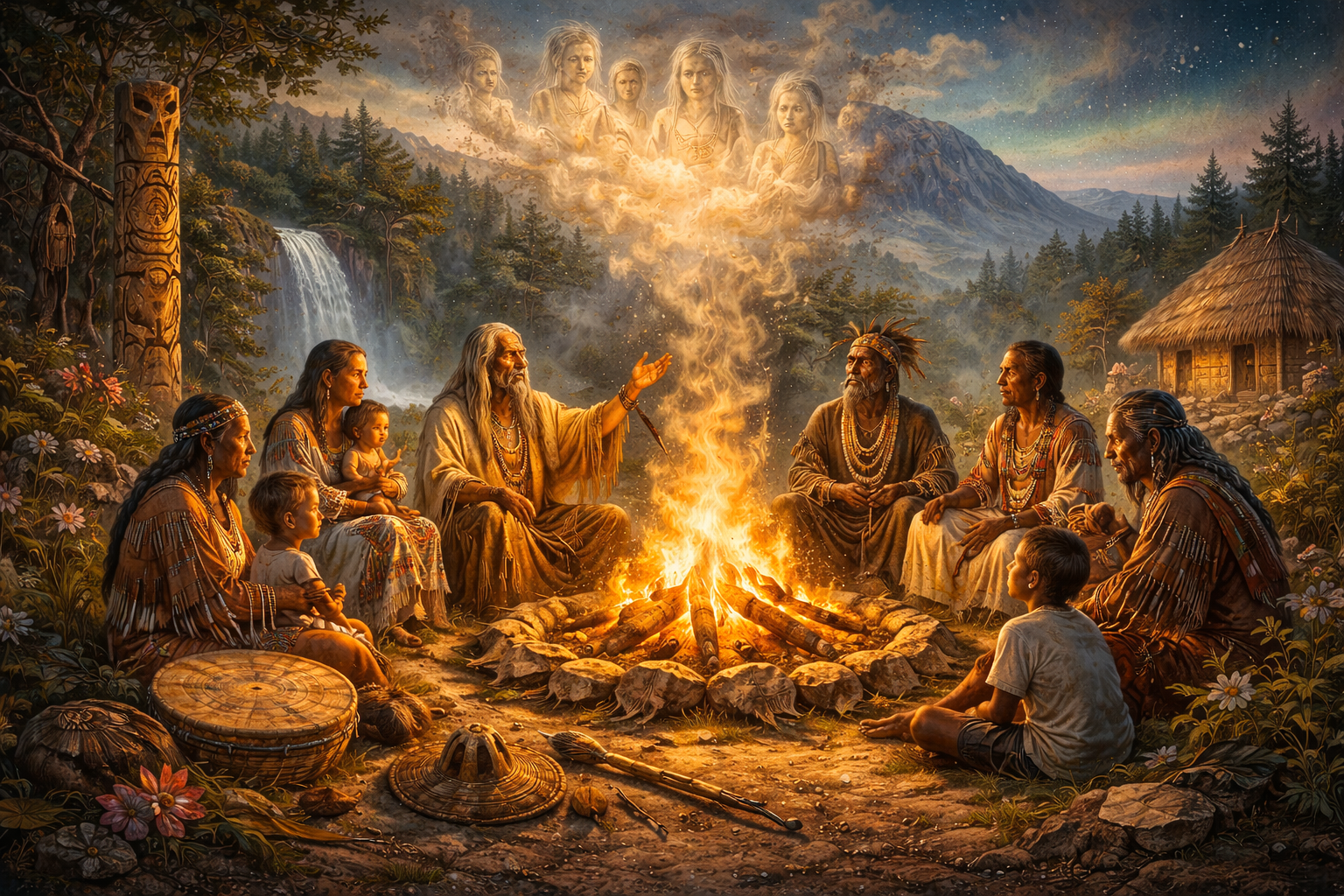
Indigenous and Oral Traditions are especially important to the broader architecture of this site because they preserve some of the deepest historical reflections on land, kinship, ecological reciprocity, sacred memory, ritual continuity, oral law, healing, sovereignty, and the moral relationship between human beings and the living world. In this respect, the category links not only to Foundations of Religion and Comparative Sacred Themes, but also to Cultural Anthropology, Mythology, Healing Traditions, Religion and Ecology, Religion and Society, Environment, Place, and Ecological Knowledge, and Stewardship Ethics.
The goal of this pillar is not to flatten Indigenous traditions into romantic language of authenticity, nor to treat oral transmission as a sign of incompleteness in comparison to textual canon. It is to take these traditions seriously as intellectually rigorous, spiritually dense, socially ordered, legally meaningful, ecologically grounded, and historically enduring worlds in their own right. These traditions have shaped not only local and regional histories, but the global history of religion, memory, law, ecology, healing, resistance to dispossession, and the moral imagination of land.
This pillar also recognizes a crucial ethical principle: not all sacred knowledge is public knowledge. Some stories, songs, names, rites, places, images, medicinal practices, ceremonial procedures, and oral teachings are restricted by season, initiation, gender, age, clan, kinship, office, community permission, or sacred protocol. A responsible Religious Studies framework must therefore avoid extraction. It must distinguish between published public materials, community-authorized knowledge, academic interpretation, and knowledge that should not be repeated outside its proper custodial setting.
Why Indigenous and Oral Traditions Matter
Indigenous and oral traditions matter because they preserve some of the deepest human reflections on origin, belonging, obligation, reciprocity, sacred landscape, mortality, and continuity across generations. They ask what it means to belong to a place without owning it in an extractive sense, how the dead remain present among the living, how story encodes law and memory, how ceremony maintains balance, and how ethical life is shaped by relation not only to other humans but to animals, waters, forests, mountains, ancestors, and spirit beings.
These traditions also matter because they challenge narrow assumptions about religion as primarily creed, institution, or written scripture. In oral worlds, knowledge is often preserved through performance, repetition, lineage, place, ritual, and communal participation. Sacred truth may be sung, danced, recited, enacted, painted, woven, walked, remembered, and embodied rather than confined to a single canonical text. This does not make such traditions less rigorous. It means they preserve rigor in different media.
At the same time, Indigenous traditions are not reducible to spirituality in a vague sense. They include legal orders, kinship obligations, ceremonial restrictions, protocols of transmission, territorial memory, ecological knowledge, gendered roles, systems of authority, healing practices, and structures of accountability. The category must therefore hold together sacred narrative and social order, ceremony and law, healing and cosmology, land and memory. Only then does its depth become visible.
For the broader Sustainable Catalyst architecture, this pillar is strategically important because it widens the study of religion beyond text-centered and institution-centered models. It shows that sacred worlds can be preserved through land, voice, body, memory, ecological practice, and community protocol. It also foregrounds the moral urgency of dispossession, cultural survival, language recovery, environmental justice, and the rights of Indigenous peoples to interpret and protect their own traditions.
The Problem of Category and Generalization
The term “Indigenous and Oral Traditions” is useful because it identifies a broad field of religious and cultural worlds in which oral transmission, ancestral continuity, sacred geography, and community-based knowledge remain central. Yet the category must be used with great care. It is not a claim that Indigenous peoples everywhere share one religion, one worldview, one ceremonial system, or one ecological ethic. Indigenous traditions are radically diverse, shaped by different ecologies, languages, histories, colonial encounters, and internal structures of law, ritual, and kinship.
For that reason, this pillar uses the category comparatively and cautiously. It highlights recurring features such as oral transmission, land-based knowledge, ancestral memory, sacred performance, ecological reciprocity, and ceremonial continuity, while refusing to erase distinction. Lakota, Diné, Haudenosaunee, Māori, Aboriginal Australian, Ainu, Sámi, Yoruba, Akan, Maya, Quechua, Inuit, and countless others do not represent variations of one religion. They represent distinct sacred worlds with their own cosmologies, ceremonial protocols, territorial memories, languages, and histories of survival.
This caution is not a minor academic point. Overgeneralization has often been part of the problem. Colonial, missionary, administrative, museum, and academic systems frequently compressed Indigenous worlds into categories such as primitive religion, animism, superstition, folklore, custom, tribe, myth, or heritage. Those categories often obscured the legal, philosophical, ecological, and spiritual sophistication of the traditions being described.
Done well, this category makes possible a richer understanding of religion itself. It shows that sacred worlds can be preserved through voice, lineage, territory, and ceremony, and that oral transmission can carry law, theology, cosmology, ethics, and memory with extraordinary durability. Done poorly, it risks reproducing the very flattening it claims to correct. This pillar therefore treats comparison as a disciplined and limited tool, not a replacement for community-specific knowledge.
Protocol, Consent, and Knowledge Sovereignty
Any serious study of Indigenous and oral traditions must begin with protocol. Sacred knowledge is not always available for public explanation, academic reuse, artistic adaptation, or digital circulation. Some teachings belong to particular families, clans, ceremonial offices, language communities, elders, healers, initiates, seasons, sites, or ritual contexts. A responsible pillar must therefore distinguish between knowledge that is publicly shareable and knowledge that is restricted, protected, or not meant for outsiders.
Consent matters because knowledge extraction has been one of the central harms inflicted on Indigenous communities. Stories, songs, objects, human remains, ceremonial items, medicinal knowledge, names, images, and sacred site information have often been collected without permission, removed from context, displayed in museums, published by outsiders, commercialized, or used in ways that violate community obligations. Ethical interpretation requires attention not only to accuracy, but to rightful relationship.
Knowledge sovereignty means that Indigenous communities have the right to govern their own knowledge systems, define protocols for access, determine what may be shared, correct misrepresentation, protect restricted materials, and refuse extractive research. In this context, scholarship should not imagine itself as the final authority over tradition. Community custodianship, language keepers, elders, ceremonial leaders, and Indigenous scholars are central authorities.
This principle affects how this pillar should be developed. It can responsibly discuss public materials, community-authorized resources, broad themes, historical harms, and scholarly debates. It should not attempt to reproduce restricted ceremonies, sacred songs, medicinal formulas, secret names, protected site information, or esoteric teachings. The aim is not to possess Indigenous knowledge, but to build a respectful, public-facing educational framework that honors Indigenous authority and avoids extraction.
Oral Tradition, Memory, and the Transmission of Worlds
Oral tradition is not merely the absence of writing. It is a disciplined way of preserving and transmitting worlds. Through speech, chant, song, recitation, performance, and guided remembrance, communities carry forward genealogies, place-names, migratory histories, treaties, ritual protocols, moral instruction, warnings, healing knowledge, and cosmological narratives. Memory in such traditions is collective, embodied, and often tied to rhythm, repetition, landscape, and sacred form.
This matters because oral transmission does more than convey information. It forms persons. To receive a story properly is often to receive instruction in relation, responsibility, and proper conduct. The teller is not simply a performer; the teller may be a keeper of law, genealogy, territory, and sacred continuity. The oral archive is therefore not informal residue. It is a living institution.
Oral tradition also preserves the dynamic character of knowledge. Stories may remain stable in core structure while responding to circumstance, audience, season, place, and community need. This does not mean they are arbitrary. It means they are alive in ways that written traditions sometimes obscure. The sacred world is renewed each time it is responsibly spoken.
The oral archive also challenges modern ideas of preservation. A text may preserve words while weakening relational context. Oral transmission preserves knowledge through people, places, responsibilities, and situations. It requires living communities. That makes language revitalization, elder support, intergenerational teaching, and community control over archives central to the future of these traditions.
Land, Kinship, and Sacred Place
One of the most powerful themes across Indigenous traditions is the inseparability of land, memory, and sacred order. Territory is not merely resource or backdrop. It is often ancestor, archive, teacher, responsibility, covenant, and dwelling place of more-than-human presence. Rivers, mountains, forests, plains, deserts, coastlines, ice, and islands may carry stories of origin, migration, ritual obligation, danger, and blessing. To know the land is to know a layered moral and sacred geography.
Kinship in these traditions often extends beyond narrow biological descent. It may include clans, ceremonial affiliations, ancestral spirits, animals, waters, plants, winds, mountains, and the larger ecological field in which human life is situated. This gives Indigenous religious worlds a distinctive ethical structure: obligation is relational and often ecological before it is individual. One belongs because one is claimed by a web of relations one did not create.
This is one reason Indigenous traditions are indispensable to the broader architecture of this site. They preserve a mode of religion in which sacred place is not metaphorical. Land is remembered, sung, walked, protected, and mourned. The loss of land is therefore also the wounding of ceremony, memory, kinship, and identity.
Land also complicates modern categories of property. In many Indigenous contexts, the question is not simply who owns land, but who is responsible to it, who may speak for it, who has obligations to care for it, and what forms of relationship have been inherited from ancestors and transmitted to future generations. This is why Indigenous traditions belong at the center of Religion and Ecology, Stewardship Ethics, and Cultural Anthropology.
Ancestry, Law, and Ceremonial Order
Indigenous and oral traditions often preserve law not as abstract statute but as inherited order embedded in kinship, story, taboo, ceremony, land, and the responsibilities of elders, ritual specialists, and custodians. Ancestral memory is therefore legal as well as spiritual. It teaches how to marry, mourn, share, travel, host, care for territory, mark transition, settle dispute, and repair disorder. In many traditions, law is inseparable from sacred origin and cannot be understood apart from the stories through which the world itself was formed.
Ceremonial order matters here because it gives law visible shape. The timing of rites, the handling of objects, the right to speak, the responsibilities of initiation, the maintenance of sacred sites, and the protocols for storytelling all reveal that oral traditions are not loose improvisations. They are structured worlds of permission, sequence, and accountability.
Ancestry also shapes authority. Elders, ritual leaders, knowledge keepers, clan authorities, healers, and ceremonial custodians often hold responsibilities that cannot be separated from genealogy, place, and communal trust. Authority is not merely individual expertise. It is relational authority grounded in continuity and obligation.
This makes Indigenous traditions especially important for later work in Religion and Law. They show that law can be sung, danced, remembered, and embodied long before or beyond codified text. They also show that law may be ecological and ancestral as much as juridical.
Story, Song, Chant, and Performance
Story, song, chant, praise poetry, lament, dance, and ceremonial performance are among the principal vehicles of sacred continuity in Indigenous worlds. These forms are not merely expressive arts appended to religion. They are often religion in action: they preserve memory, transmit authority, mark season, invoke ancestors, encode geography, teach law, heal disorder, and renew relation between the human community and the larger living order.
This is especially significant because performance joins truth to embodiment. One does not only hear a sacred world explained; one enters it through rhythm, voice, gesture, costume, procession, spatial arrangement, and communal participation. The sacred is enacted, not merely described. In this respect, Indigenous traditions preserve one of the deepest human insights into religion: that meaning is often inseparable from performance and collective memory.
Performance also distinguishes kinds of knowledge. Some stories may be told publicly; others only in certain seasons or ceremonial contexts. Some songs require permission. Some dances are tied to office, initiation, or community responsibility. Some names and places are protected. Public education must therefore respect the difference between describing the importance of performance and reproducing restricted performance outside its proper setting.
These traditions also preserve the fragility of living transmission. A tradition carried in voice and ceremony depends on the survival of speakers, singers, dancers, elders, children, and communities. Cultural violence, forced assimilation, language loss, and dispossession therefore threaten not only identity but the transmission of sacred worlds themselves.
Indigenous Knowledge and Ecological Relation
Indigenous traditions preserve some of humanity’s most sophisticated knowledge of ecological relation. Seasonal cycles, animal behavior, watersheds, medicinal plants, fire management, migration routes, agricultural patterns, soil change, weather signs, and ceremonial calendars may all be held together within oral systems of transmission. Such knowledge is not simply utilitarian. It is often ethical and cosmological as well. To know how to live well within an ecosystem is also to know how to live rightly.
This matters because modern discourse often splits “science,” “religion,” and “tradition” into separate domains. Indigenous knowledge systems frequently disrupt that separation. Observation, memory, ritual, spirituality, and pragmatic environmental relation may all coexist within one field of practice. This is one reason Indigenous traditions are so important to Religion and Ecology and to broader treatment of sustainable systems.
At the same time, such knowledge should not be extracted from the communities that preserve it. Indigenous knowledge is not merely a dataset awaiting outside use. It belongs to living peoples, languages, territories, and moral frameworks. To respect it requires more than admiration; it requires attention to sovereignty, protocol, intellectual property, benefit-sharing, and rights.
This section also matters because many environmental crises are the result of broken relations: extraction without reciprocity, governance without consent, conservation without Indigenous authority, and development without memory. Indigenous ecological traditions do not provide a single universal solution, but they do offer indispensable models of relational responsibility, place-based knowledge, and long-duration stewardship.
Healing, Ritual, and the Restoration of Balance
Healing in Indigenous traditions often cannot be reduced to symptom treatment alone. It may involve community restoration, spiritual relation, herbal knowledge, ceremonial purification, song, dream, ancestral invocation, fasting, ordeal, and the repair of imbalance between person, place, lineage, and spirit. This does not mean every Indigenous healing system looks the same. It means that many of them understand health as relational rather than merely mechanical.
Such traditions are essential to the Healing Traditions category because they preserve ancient and living understandings of how suffering may be addressed through ritual, ecology, memory, and community. They remind modern discourse that illness may be social, spiritual, territorial, historical, and ceremonial as well as bodily.
This also means that healing knowledge is often protected knowledge. Some traditions distinguish between public stories and restricted teachings, between general ritual awareness and knowledge reserved for elders, initiates, or healers. A responsible pillar must therefore acknowledge that not all sacred knowledge is meant for unrestricted circulation.
Healing also connects directly to colonial history. Dispossession, forced schooling, language suppression, environmental contamination, and cultural violence produce wounds that are not only individual. Ceremonial renewal, language recovery, land return, food sovereignty, community care, and cultural revitalization can therefore become forms of healing in a larger civilizational sense.
Regional Worlds and Civilizational Range
For this pillar to be comparable to the other major Religious Studies pillars, it must do more than define Indigenous and oral traditions in the abstract. It must show the full civilizational range of the category. Indigenous traditions are not confined to one continent or one model of sacred life. They extend across North America, Mesoamerica, the Andes, Amazonia, Africa, Australia, the Pacific, the Arctic, and parts of Asia often overshadowed by later state or scriptural traditions.
This regional range matters because it prevents the category from becoming a purely methodological essay. It shows that Indigenous and oral traditions are not simply a type of transmission. They are globally significant religious worlds. They include vision-centered Plains traditions, confederated legal traditions, forest cosmologies, mountain rituals, ancestral land-based systems, praise and possession traditions, songline geographies, oceanic genealogies, and circumpolar ceremonial relations to ice, animal migration, and survival.
What unites these worlds is not sameness of belief, but seriousness of relation: to land, ancestry, story, obligation, ceremony, language, and the living structure of reality. What distinguishes them is equally important. Each has its own sacred archive, moral texture, ceremonial grammar, and historical struggle.
The regional sections below should therefore be read as gateways rather than summaries. They identify areas of future development while acknowledging that each requires community-specific care, sources, terminology, and protocols.
North American Indigenous Traditions
North American Indigenous traditions include some of the most richly documented and still-living ceremonial and oral worlds in the modern history of colonization and survival. Lakota traditions, for example, preserve profound reflections on sacred relation, vision, ceremony, kinship, and the moral force of communal continuity. Diné traditions preserve cosmological order, blessing, healing, ritual sequence, and a highly developed sense of beauty, balance, and right relation. Haudenosaunee traditions preserve confederated political memory, thanksgiving, diplomacy, kinship, and sacred law in ways that bridge religion, governance, and collective identity.
These worlds matter because they show that Indigenous religion in North America is not reducible to “nature spirituality.” It includes legal systems, moral diplomacy, territorial memory, initiation, healing, ceremonial restriction, sacred narratives tied to migration and survival, and systems of governance rooted in long-standing traditions. Plains, woodland, desert, Arctic, coastal, Great Basin, southeastern, and subarctic traditions each generate different ritual and cosmological forms.
North American traditions also make colonial violence impossible to ignore. Boarding schools, forced conversion, language suppression, outlawing of ceremonies, removal from land, broken treaties, and environmental destruction all directly affected religious life. Yet ceremonies, languages, songs, and law continue. Survival is not merely cultural persistence; it is sacred continuity under pressure.
For the purposes of this site, North American traditions should eventually become a major subfield of the pillar, including articles on Lakota sacred worlds, Diné ceremonial order, Haudenosaunee law and thanksgiving, Hopi ritual continuity, Anishinaabe story and relation, Inuit cosmology, and the survival of ceremony under settler colonialism.
Mesoamerican and Andean Traditions
Mesoamerican and Andean traditions preserve some of the most intricate integrations of cosmology, political order, ritual time, agriculture, sacrifice, sacred geography, and collective memory in the history of religion. Maya, Nahua, Quechua, and Aymara worlds cannot be understood as merely archaeological inheritances. They include enduring ritual continuities, language-based memory, calendrical knowledge, mountain reverence, ancestral relation, agricultural ceremony, and complex negotiations between precolonial cosmology and postcolonial religious life.
These traditions are especially significant because they show how oral transmission, monumental civilization, inscription, calendar, and sacred performance can coexist. The existence of codices, inscriptions, and monumental architecture does not negate the centrality of living oral worlds. Rather, the textual, visual, architectural, and oral remain deeply interwoven. Community memory, ritual recurrence, agricultural cycles, and territorial relation continue to sustain these traditions even where imperial and missionary violence attempted rupture.
The Andean sacred world is especially important for thinking about mountains, earth beings, reciprocity, agricultural obligation, and the relation between community life and highland ecology. Mesoamerican worlds are crucial for sacred time, calendrical order, creation narratives, ritual sovereignty, and postconquest continuity. Both require careful distinction between precolonial reconstruction, colonial records, and living Indigenous practice.
This regional branch should therefore include both historical civilizations and living continuities: Maya cosmology, Nahua sacred memory, Andean mountain and earth reverence, ritual agriculture, and the persistence of Indigenous ceremonial life under colonial Catholic domination.
Amazonian and South American Indigenous Traditions
Amazonian and wider South American Indigenous traditions preserve religious worlds in which forest, river, spirit, kinship, healing, and transformation are often inseparable. In many such traditions, personhood is not limited to humans, and the relations between visible and invisible worlds are mediated through ritual, plant knowledge, altered states, song, and the responsibilities of specialists. These are not peripheral exotica. They are sophisticated cosmologies of relation, danger, reciprocity, and survival.
Such traditions matter because they expand the field of comparative religion beyond scriptural and urban assumptions. They often preserve acute knowledge of ecological interdependence and fluid boundaries between bodily, social, and spiritual life. Their ceremonial and healing traditions can involve narrative, diet, ordeal, trance, plant relation, and the disciplined navigation of powers not reducible to ordinary empirical categories.
At the same time, this field requires particular ethical caution. Amazonian ceremonial and plant-healing traditions have often been sensationalized, commercialized, and extracted by outsiders. A responsible pillar should avoid turning sacred healing systems into exotic content or wellness commodities. It should emphasize community authority, ecological protection, historical violence, and the right of Indigenous peoples to govern their own ceremonial knowledge.
A serious Indigenous pillar should therefore make room for Amazonian worlds not merely under “shamanism,” but as full religious systems with cosmology, law, healing, kinship, and ecological intelligence of their own.
African Indigenous Traditions
African Indigenous traditions belong centrally within this pillar, though they must never be collapsed into a single generic “African traditional religion.” Yoruba, Akan, Dogon, Dinka, Zulu, San, and many other traditions preserve highly developed worlds of ancestry, divination, praise, ritual authority, sacred kingship, moral order, healing, possession, and cosmological relation. In many cases these worlds remain living presences alongside Christianity, Islam, and modern state structures.
These traditions are especially important because they widen the category beyond settler-colonial frameworks centered only on the Americas and Oceania. They reveal that oral religious worlds in Africa have generated major metaphysical systems, powerful ritual economies, complex artistic-symbolic languages, and enduring institutions of transmission. Praise poetry, initiation, possession, drum language, ancestral mediation, sacred objects, divination systems, and territorial relation all belong here.
African traditions also complicate modern distinctions between Indigenous religion, world religion, diaspora religion, and new religious formation. Yoruba and other West African traditions have shaped major Atlantic religious worlds through the violence of slavery and the creativity of diaspora survival. The study of African Indigenous traditions therefore connects to ancestry, colonialism, forced migration, resistance, and cultural transformation.
This branch should eventually include substantial treatment of West African ancestral and orisha-based worlds, Akan understandings of personhood and ancestry, pastoral and Nilotic traditions of sacrifice and relation, southern African ritual continuity, San story worlds, and the long encounter between Indigenous African traditions, Islam, Christianity, slavery, and colonial modernity.
Aboriginal Australian Traditions
Aboriginal Australian traditions are indispensable to any serious pillar on Indigenous and oral religion because they preserve one of the most profound integrations of land, ancestry, law, story, ceremony, and cosmological geography in the human record. Songlines, Country, ancestral beings, ceremonial routes, and custodianship reveal a world in which land is remembered not as passive terrain but as a living archive of creation, obligation, and identity. To travel rightly may also be to remember rightly.
These traditions matter because they show with extraordinary clarity that oral transmission can carry law, topography, ritual sequence, social relation, and sacred history all at once. The category of “Dreaming” or related formulations, though often oversimplified from outside, points toward a mode of sacred time and ancestral presence that resists modern linear history without becoming ahistorical.
Aboriginal Australian traditions also require careful attention to restriction and protocol. Some knowledge is gendered, initiated, local, or otherwise not public. Outsider writing has often misrepresented these traditions by treating restricted knowledge as free cultural material. A responsible public pillar should therefore discuss broad concepts while respecting the limits of what should be reproduced.
For this pillar, Aboriginal Australian traditions should become one of the major anchor sections, not an appendix. They offer one of the clearest global examples of land as scripture, song as map, and ceremony as the maintenance of world.
Pacific Indigenous Traditions
Pacific Indigenous traditions, including Māori and wider Polynesian, Melanesian, and Micronesian worlds, preserve religious systems shaped by oceanic relation, navigation, ancestry, genealogy, sacred speech, territorial guardianship, and the ritual ordering of community. Here too, oral transmission remains central, often carrying lineage, voyaging memory, territorial claim, cosmology, and communal law across generations.
Māori traditions are especially important because they preserve a powerful integration of whakapapa, land, ancestry, ritual speech, and collective identity, while also standing within a modern history of treaty, dispossession, legal struggle, and cultural revitalization. Pacific traditions more broadly widen the category beyond continental assumptions and reveal the religious significance of sea routes, islands, migration, and genealogical memory.
Oceanic traditions also challenge land-only models of sacred place. The sea is not empty space between territories. It is route, archive, ancestor-bearing expanse, navigational field, and sacred geography. Stars, currents, winds, birds, reefs, islands, and genealogies all enter into the religious life of movement and belonging.
This branch should eventually include articles on Māori cosmology and genealogy, oceanic navigation as sacred memory, Pacific ancestral law, ritual speech, and the transformation of Indigenous religion under missionization and colonial state formation.
Arctic, Circumpolar, and Northern Traditions
Arctic, circumpolar, and northern traditions, including Inuit and Sámi worlds among others, preserve religious lives shaped by cold ecologies, migration, animal relation, survival knowledge, seasonal extremity, and profound dependence on the moral handling of land and life. In such traditions, hunting, movement, weather, taboo, and respect toward animals may all carry religious significance. Survival is not merely technical. It is ethical and cosmological.
These traditions matter because they remind comparative religion that ecological setting is not background. It shapes cosmology, ritual tempo, relation to the dead, and understandings of agency in the more-than-human world. Northern traditions also preserve important ceremonial and healing structures that have often been dismissed or exoticized by colonial observers.
Circumpolar traditions also illuminate how climate, colonialism, and cultural survival are now intertwined. Environmental change affects not only subsistence patterns, but sacred relation, language, place memory, animal ethics, and intergenerational continuity. Indigenous religion and ecology are therefore inseparable in these contexts.
A mature pillar should make clear that circumpolar traditions are part of the global Indigenous religious archive and not merely ethnographic curiosities at the edge of settled civilization.
Asian Indigenous Traditions Beyond State Religions
Asian Indigenous traditions beyond the dominant state or scriptural formations also belong here. Ainu traditions are especially important, as are other Indigenous worlds often overshadowed by the major religious systems of East, South, and Southeast Asia. These traditions remind us that Asia too contains oral, land-based, ancestral, and ceremonial worlds that cannot be reduced to Buddhism, Hinduism, Confucianism, Daoism, Islam, or Christianity.
This matters because it prevents the category from quietly assuming that Indigenous religion exists only outside the great literate civilizations. In reality, Indigenous and oral traditions often exist within, beneath, beside, or against larger state and textual formations. Their persistence reveals another map of Asia: one of communities, landscapes, songs, rites, and ancestral continuity that formal civilizational narratives often obscure.
Asian Indigenous traditions also force careful attention to state classification. Communities may be labeled minorities, tribes, ethnic groups, folk practitioners, local religions, or cultural heritage communities depending on political context. These labels can obscure Indigenous sovereignty, land relation, and sacred continuity.
Including such traditions strengthens the category’s global range and makes it comparable to the other Religious Studies pillars, which already move across multiple civilizational zones.
Oral Traditions, Colonial Violence, and Survival
No serious treatment of Indigenous and oral traditions can ignore colonial violence. Across the world, Indigenous communities have endured dispossession, forced conversion, language suppression, boarding schools, legal erasure, anthropological extraction, museum capture, environmental destruction, and the deliberate interruption of ceremonial continuity. Oral traditions have often survived not because they were protected by dominant institutions, but in spite of being targeted by them.
This history matters because it changes how the category must be studied. Indigenous traditions are not simply windows onto a pristine past. They are often traditions of survival, adaptation, concealment, resistance, and renewal under conditions of violence. The persistence of language, song, ceremony, and sacred memory in such contexts is itself historically and morally significant.
Colonial violence also shaped archives. Many records were produced by missionaries, administrators, anthropologists, collectors, soldiers, and museums rather than by communities themselves. Such sources may preserve fragments of knowledge, but they also carry distortion, extraction, mistranslation, and unequal power. A responsible article series must therefore read archives critically and foreground Indigenous voices wherever possible.
For that reason, this pillar should foreground not only preservation but justice. The study of Indigenous religion is inseparable from the study of power: who was dispossessed, whose stories were dismissed, whose lands were taken, whose ceremonies were criminalized, whose languages were suppressed, whose remains and sacred objects were removed, and how communities continue to restore continuity despite rupture.
Language Revitalization and Sacred Continuity
Language is central to Indigenous and oral traditions because sacred worlds are often carried through names, metaphors, grammar, place terms, kinship categories, ceremonial speech, songs, and forms of address that do not translate cleanly into dominant languages. When a language is attacked, the harm is not only communicative. It can damage ritual precision, ecological memory, ancestral relation, and the ability to transmit sacred knowledge in its proper form.
Language revitalization is therefore a religious and civilizational issue, not only an educational one. The recovery of words, songs, stories, place-names, ceremonial speech, and intergenerational teaching can restore more than vocabulary. It can restore relationships to land, ancestors, ritual time, and community authority.
This is especially important because colonial systems often targeted Indigenous languages precisely to sever communities from memory and law. Boarding schools, missionary education, state schooling, and assimilation policies frequently sought to replace Indigenous language with the language of empire or nation-state. The survival and revival of language is therefore also resistance.
For this pillar, language must be treated as sacred infrastructure. A tradition carried by voice depends on the continuity of the voice-world itself: pronunciation, rhythm, story form, ceremonial register, place-names, and the authority of those who teach them.
Ethics, Reciprocity, and the More-Than-Human World
Many Indigenous traditions preserve an ethical field broader than modern individualism. Reciprocity matters. Gratitude matters. The right relation between taking and returning matters. Hunting, harvesting, building, traveling, burning, planting, gathering, and even speaking may be governed by protocols that recognize the agency or sacred significance of animals, waters, forests, mountains, and ancestral presences. This does not mean a simple uniform “animism,” but a wide range of traditions in which the world is morally inhabited rather than inert.
Such ethical worlds matter profoundly for comparative inquiry because they unsettle extractive assumptions about land, ownership, and value. They show that religion can be organized not around dominion over the world, but around disciplined relation within it. This makes Indigenous traditions especially important for the site’s moral and ecological architecture.
They also widen the study of ethics itself. Obligation is not always contractual or individual. It may be inherited, territorial, ceremonial, and species-crossing. Moral responsibility may extend to ancestors, descendants, animals, waters, plants, and sacred sites. That insight is one of the great contributions of Indigenous traditions to the history of moral thought.
In a time of climate disruption, biodiversity loss, and environmental injustice, this ethical field is not merely historical. It is urgent. Indigenous traditions do not provide a single universal environmental philosophy, but they do preserve powerful models of reciprocity, restraint, place-based responsibility, and accountability to more-than-human life.
Indigenous and Oral Traditions in Comparative Religion
Indigenous and oral traditions are indispensable to comparative religion because they reveal how limited many dominant categories actually are. They show that religion need not begin with scripture, clergy, creed, or universalized doctrine. It may begin with place, ancestors, language, kinship, song, migration, hunting, planting, ritual restriction, initiation, and ceremonial continuity.
They also force comparative religion to confront the violence of its own history. Many academic frameworks were built during periods of empire and often classified Indigenous traditions as primitive, pre-religious, or merely mythological. A more serious approach must reject that hierarchy. Indigenous traditions are not failed versions of scriptural religion. They are living archives of cosmology, law, ethics, memory, ecology, and sacred relation.
Comparative study must therefore proceed with humility. It can identify patterns across traditions, but it should not claim ownership of those patterns. It can place oral traditions alongside scriptural traditions, but it should not measure them by scriptural norms. It can analyze myth, ritual, law, ecology, and healing, but it must also respect community protocol and the right not to disclose.
For this reason, Indigenous and Oral Traditions do not belong on the edges of the Religious Studies architecture. They belong near its center. They widen the definition of religion, deepen the study of memory and land, and help restore to the field a more truthful account of how human beings have lived with the sacred.
Major Questions of Interpretation
This pillar is organized around several major questions. How should Indigenous and oral traditions be studied without flattening their diversity into a single generalized worldview? How can oral transmission be understood as disciplined knowledge rather than as the absence of writing? How do land, ancestry, ceremony, language, and ecological relation function as sacred archives? What forms of law are carried through story, song, ritual, taboo, kinship, and territorial memory?
The pillar also asks how scholarship should handle power. Who has the right to interpret, publish, display, translate, digitize, or teach Indigenous knowledge? What should remain restricted? How should modern readers approach sources produced by missionaries, anthropologists, colonial officers, museums, or state agencies? How can Indigenous scholars, elders, language keepers, ceremonial leaders, and community institutions be centered rather than treated as informants for outside theory?
Finally, the pillar asks how Indigenous and oral traditions reshape the study of religion itself. What happens when land is treated as archive, song as law, ceremony as governance, ecological relation as ethics, and language as sacred continuity? These questions make the category indispensable not only for Religious Studies, but for Cultural Anthropology, Religion and Ecology, Healing Traditions, Global Governance, and Sustainable Systems.
Indigenous and Oral Traditions Pillar Map
The following article map is designed as a serious research agenda for the Indigenous and Oral Traditions pillar, with emphasis on community-grounded knowledge, oral transmission, protocol, sacred ecology, regional range, colonial history, and the diversity of Indigenous religious worlds.
Indigenous and Oral Traditions is organized to move from foundational questions of category, protocol, orality, land, ceremony, and knowledge sovereignty into regional traditions, story and performance, ecological knowledge, healing, colonial history, language revitalization, and comparative themes. The goal is to make the pillar civilizationally comparable to the other major Religious Studies pillars while preserving the specificity, sovereignty, and community-grounded seriousness that Indigenous traditions require.
Foundational Frames
- What Are Indigenous and Oral Traditions? (planned)
Introduces Indigenous and oral traditions as religious, legal, ecological, ceremonial, and memory-bearing worlds rather than as folklore or pre-scriptural survivals. - Orality, Memory, and the Transmission of Sacred Worlds (planned)
Studies oral transmission as a disciplined archive of law, cosmology, genealogy, territory, and ethical instruction. - Land, Ceremony, and the Religious Life of Place (planned)
Examines sacred geography, place-based knowledge, territorial memory, and the religious meaning of land. - Indigenous Traditions and the Problem of “Religion” as a Category (planned)
Explores why Western definitions of religion often distort Indigenous sacred worlds. - Protocol, Consent, and Knowledge Sovereignty (planned)
Establishes ethical standards for studying public, restricted, community-authorized, and protected knowledge. - Indigenous Methodologies and the Ethics of Research (planned)
Introduces Indigenous research frameworks centered on relation, reciprocity, accountability, and community authority.
North American Indigenous Traditions
- Lakota Sacred Worlds (planned)
Studies sacred relation, ceremony, vision, kinship, and moral continuity in Lakota traditions. - Diné Ceremony, Beauty, and Balance (planned)
Examines blessing, healing, hózhó, ritual order, and the restoration of right relation. - Haudenosaunee Law, Thanksgiving, and Confederacy (planned)
Explores thanksgiving, diplomacy, confederated law, kinship, and sacred political memory. - Hopi Ritual Continuity and Sacred Time (planned)
Studies ceremonial cycles, sacred time, agriculture, community continuity, and restricted knowledge protocols. - Anishinaabe Story, Kinship, and Place (planned)
Explores story, relation, migration memory, moral instruction, and place-based knowledge. - Inuit Cosmology and Arctic Relation (planned)
Studies animal relation, survival ethics, sea ice, weather, taboo, and circumpolar sacred worlds. - Boarding Schools, Ceremony, and Indigenous Religious Survival (planned)
Examines colonial suppression, religious violence, language loss, and sacred continuity.
Mesoamerican and Andean Traditions
- Maya Cosmology and Sacred Time (planned)
Studies calendrical order, creation memory, ritual time, language, and living Maya religious continuity. - Nahua Sacred Memory and Ritual Order (planned)
Explores ritual time, sacred narrative, colonial transformation, and Indigenous continuity in Nahua worlds. - Quechua Land, Mountain, and Ancestral Relation (planned)
Examines Andean mountain reverence, earth relation, reciprocity, community, and sacred landscape. - Aymara Ritual Worlds and Cyclical Time (planned)
Studies highland ritual, ancestral relation, cyclical time, and ceremonial continuity. - Mesoamerican Codices, Oral Memory, and Sacred History (planned)
Explores the relation between visual-textual records, oral transmission, colonial archives, and sacred memory. - Andean Ritual Agriculture and the Moral Life of the Earth (planned)
Studies agriculture, reciprocity, offerings, communal labor, and ecological sacred order.
Amazonian and South American Indigenous Traditions
- Forest Cosmologies and the More-Than-Human World (planned)
Introduces Amazonian religious worlds of forest, river, personhood, spirit, kinship, and transformation. - Song, Healing, and Ritual Specialists in Amazonian Traditions (planned)
Studies public aspects of song, healing, ceremonial knowledge, and specialist authority while respecting restricted practices. - River, Territory, and Sacred Ecology in South American Indigenous Worlds (planned)
Explores river systems, territory, ecological knowledge, and sacred relation. - Plant Knowledge, Ceremony, and the Ethics of Non-Extraction (planned)
Examines healing and plant relations with emphasis on sovereignty, protocol, and resistance to commodification. - Personhood, Animals, and Transformation in Amazonian Cosmologies (planned)
Studies relational personhood, animal agencies, spirit worlds, and moral ecology.
African Indigenous Traditions
- Yoruba Cosmology, Ritual, and Divine Mediation (planned)
Studies orisha traditions, divination, ritual authority, personhood, and sacred order. - Akan Ancestry, Personhood, and Moral Order (planned)
Explores ancestry, personhood, moral formation, kinship, and communal continuity. - Dogon Cosmology and Symbolic Order (planned)
Examines cosmology, symbolic systems, ritual life, and the challenges of interpreting contested ethnographic records. - Dinka, Pastoral Life, and Sacral Relation (planned)
Studies pastoral relation, cattle, sacrifice, social life, and sacred order. - Zulu Ancestral Continuity and Ritual Life (planned)
Explores ancestry, healing, ritual obligation, and communal memory. - San Worlds of Story, Animal Life, and Sacred Performance (planned)
Studies story, trance, animal relation, performance, and sacred continuity with careful attention to representation. - African Indigenous Traditions, Christianity, Islam, and Colonial Modernity (planned)
Explores religious encounter, adaptation, resistance, and plural religious life.
Aboriginal Australian Traditions
- Country, Songlines, and Sacred Geography (planned)
Studies Country, songlines, ancestral tracks, place-based law, and sacred geography. - Ancestral Presence and the Religious Life of Land (planned)
Examines ancestral beings, place, memory, ceremonial continuity, and sacred time. - Ceremony, Custodianship, and Oral Law in Aboriginal Australia (planned)
Explores custodianship, law, ritual protocol, restricted knowledge, and transmission. - Dreaming, Time, and the Problem of Translation (planned)
Critically examines how outside terms translate, distort, or simplify Aboriginal sacred concepts. - Language, Country, and Cultural Revitalization (planned)
Studies language recovery, land relation, and the restoration of sacred continuity.
Pacific Indigenous Traditions
- Māori Whakapapa, Land, and Sacred Continuity (planned)
Studies genealogy, land, ancestry, ritual speech, and collective identity in Māori traditions. - Oceanic Navigation, Memory, and Ritual Geography (planned)
Explores voyaging, stars, currents, islands, genealogy, and sacred oceanic memory. - Pacific Ancestral Law and Community Order (planned)
Studies ancestral authority, chiefly systems, ritual speech, land relation, and community responsibility. - Treaty, Missionization, and Indigenous Revitalization in the Pacific (planned)
Examines colonial encounter, legal struggle, religious change, and cultural renewal. - Island, Sea, and Genealogy in Pacific Sacred Worlds (planned)
Studies oceanic sacred geography beyond continental models of land.
Arctic, Circumpolar, and Northern Traditions
- Inuit Religious Worlds (planned)
Studies sea, ice, animal relation, survival ethics, taboo, story, and sacred continuity. - Sámi Sacred Landscapes and Ritual Continuity (planned)
Explores northern sacred sites, reindeer relation, song, colonial suppression, and revitalization. - Northern Ecologies, Animal Relation, and Ceremonial Survival (planned)
Studies cold ecologies, animal ethics, migration, weather, and more-than-human relation. - Climate Change, Indigenous Knowledge, and Sacred Continuity in the Arctic (planned)
Connects ecological disruption to land memory, subsistence, language, and religious continuity.
Asian Indigenous Traditions Beyond State Religions
- Ainu Tradition, Land, and Ancestral Memory (planned)
Studies Ainu sacred worlds, land, animal relation, ritual, colonial history, and revitalization. - Indigenous Asian Ritual Worlds Beyond Canonical Religions (planned)
Explores oral, land-based, and ancestral traditions often overshadowed by major state or scriptural religions. - Mountain, Forest, and Ancestral Traditions in Asia (planned)
Studies localized sacred geographies, ritual specialists, ecological memory, and community continuity. - Minority Classification, State Power, and Indigenous Religion in Asia (planned)
Examines the politics of naming, recognition, heritage, and religious classification.
Story, Memory, and Sacred Continuity
- Origin Narratives and Sacred Geography (planned)
Studies how creation, migration, and place stories encode sacred geography and communal obligation. - Myth, Memory, and Ancestral Continuity (planned)
Explores myth as living memory, law, identity, and ethical instruction. - Song, Chant, and Ceremonial Transmission (planned)
Examines voice, rhythm, performance, and the transmission of sacred order. - Oral Law and the Preservation of Communal Order (planned)
Studies law as embodied in story, kinship, land, ceremony, and community protocol. - Genealogy, Names, and the Sacred Life of Descent (planned)
Explores naming, lineage, ancestry, and identity as religious and legal structures.
Land, Ecology, and Knowledge
- Indigenous Ecological Knowledge (planned)
Studies place-based ecological knowledge, long-duration observation, stewardship, and community authority. - Sacred Landscapes and Territorial Memory (planned)
Explores territory as archive, ancestor, obligation, and sacred geography. - Animals, Waters, and the More-Than-Human World (planned)
Studies relations with animals, waters, plants, weather, and spirit presences. - Fire, Seasonality, and Environmental Stewardship (planned)
Examines controlled burning, seasonal knowledge, land care, and the relation between ecology and ceremony. - Food Sovereignty, Land Return, and Sacred Ecology (planned)
Connects ecological restoration, community health, sacred responsibility, and political justice. - Conservation, Extraction, and Indigenous Authority (planned)
Critiques environmental models that separate land protection from Indigenous rights and governance.
Ceremony, Healing, and Social Order
- Ritual Specialists, Elders, and Custodianship (planned)
Studies ceremonial authority, elder knowledge, ritual office, and the ethics of transmission. - Healing, Balance, and Sacred Restoration (planned)
Explores healing as relational repair among body, spirit, community, land, and ancestry. - Kinship, Initiation, and Ceremonial Obligation (planned)
Studies rites of passage, kinship roles, responsibility, and sacred instruction. - Ancestry, Mourning, and the Presence of the Dead (planned)
Explores the living relation between ancestors, memory, burial, mourning, and community continuity. - Restricted Knowledge, Sacred Objects, and Repatriation (planned)
Examines sacred objects, museum collections, human remains, repatriation, and knowledge protection.
Colonial History and Survival
- Colonial Suppression and the Criminalization of Ceremony (planned)
Studies the outlawing, suppression, and survival of Indigenous ceremonies under colonial regimes. - Language Loss, Recovery, and Sacred Continuity (planned)
Examines language revitalization as religious, cultural, and civilizational renewal. - Indigenous Rights, Memory, and Cultural Survival (planned)
Connects sacred memory, land rights, cultural protection, and political self-determination. - Decolonizing the Study of Religion (planned)
Critiques colonial categories and recenters Indigenous authority, methodology, and interpretation. - Missionization, Conversion, and Religious Hybridity (planned)
Studies the complex religious worlds produced by encounter, coercion, adaptation, and survival. - Archives, Museums, and the Ethics of Indigenous Sacred Materials (planned)
Examines museum capture, archival authority, repatriation, and community control.
Comparative Themes
- Orality and Scripture in Comparative Religion (planned)
Compares oral and written transmission without treating writing as the standard of religious maturity. - Land, Law, and Sacred Responsibility (planned)
Studies land-based law, kinship obligation, and sacred territorial responsibility. - Reciprocity, Ethics, and Ecological Order (planned)
Explores relational ethics, gratitude, restraint, and more-than-human accountability. - Indigenous Traditions and the Religious Study of Ecology (planned)
Connects Indigenous sacred worlds to ecological knowledge, stewardship, and environmental justice. - Mythology, Ritual, and Living Tradition (planned)
Studies myth as living memory and ritual order rather than as false or primitive explanation. - Healing, Land, and Historical Trauma (planned)
Examines healing as personal, communal, ecological, and historical restoration. - Why Indigenous and Oral Traditions Still Matter (planned)
Concludes the series by connecting Indigenous traditions to contemporary questions of religion, ecology, justice, memory, and survival.
This expanded structure makes the category civilizationally comparable to the other major Religious Studies pillars while preserving the diversity, specificity, community-grounded authority, and ethical seriousness that Indigenous traditions require.
Closing Perspective
Indigenous and Oral Traditions give Religious Studies one of its most important corrective frameworks. They show that religion is not limited to scripture, creed, institution, or individual belief. Religion may live through land, story, song, kinship, ceremony, law, ecological relation, healing, ancestry, and the disciplined memory of communities who carry sacred worlds through voice and practice.
The strongest reason to study this field is that it changes the question. Instead of asking only what people believe, it asks how people belong, remember, reciprocate, mourn, heal, transmit, and remain responsible to land and future generations. It asks how oral knowledge can carry law, how ceremony can maintain world, how ecological knowledge can be sacred, and how memory survives violence.
For the broader Sustainable Catalyst architecture, this pillar is essential. It strengthens Religious Studies while linking to Cultural Anthropology, Religion and Ecology, Healing Traditions, Mythology, Stewardship Ethics, Global Governance, and Sustainable Systems. Indigenous and oral traditions show how sacred life can be inseparable from land, language, community, and justice. They do not belong at the edge of the study of religion. They belong near its center.
Related Reading
- Religious Studies
- Foundations of Religion
- Comparative Sacred Themes
- Cultural Anthropology
- Culture, Meaning, and Symbolism
- Environment, Place, and Ecological Knowledge
- Mythology
- Healing Traditions
- Shamanism, Ritual, and Spiritual Healing
- Herbalism and Traditional Knowledge
- Religion and Ecology
- Religion and Society
- Stewardship Ethics
- Native American Myth, Folklore, and Legend
- African Myth, Folklore, and Sacred Narrative
- Lakota Thought, Memory, and Living Tradition
Primary Sources and Community-Grounded Materials
- Community-authorized oral narratives and public teachings: Oral narratives, ceremonial teachings, chants, songs, public stories, and community-preserved histories transmitted within Indigenous communities and shared according to proper protocol.
- Language resources and cultural heritage materials: Dictionaries, language revitalization projects, oral history initiatives, curriculum materials, and community publications produced or authorized by Indigenous organizations and custodial institutions.
- Public ceremonial and cultural materials: Recorded origin narratives, territorial memory, genealogies, praise traditions, and ceremonial materials where communities have chosen to publish or share them.
- Legal and rights documents: United Nations, UNESCO, treaty, land-rights, cultural heritage, and Indigenous rights materials relevant to cultural protection, intangible heritage, and self-determination.
- Community archives and repatriation resources: Public-facing materials from Indigenous archives, tribal historic preservation offices, cultural centers, language institutes, and museums working under community governance or repatriation frameworks.
Internal Interpretive Traditions
- Community custodianship: elders, ritual specialists, language keepers, ceremonial leaders, storytellers, healers, hereditary custodians, clan authorities, and community institutions.
- Oral interpretive continuity: transmission through season, place, initiation, kinship, performance, language, and community protocol.
- Indigenous legal and ceremonial orders: ancestral law, territorial memory, ritual restriction, kinship responsibility, community accountability, and proper relation to land and more-than-human beings.
- Ecological and healing knowledge: place-based environmental knowledge, medicinal practices, foodways, animal relations, water knowledge, fire stewardship, and healing traditions governed by community protocol.
- Revitalization traditions: language recovery, ceremony renewal, cultural education, land return, food sovereignty, repatriation, and intergenerational transmission.
Modern Scholarship
- Cruikshank, J. The Social Life of Stories.
- Deloria Jr., V. God Is Red.
- Kimmerer, R.W. Braiding Sweetgrass.
- Kovach, M. Indigenous Methodologies.
- Simpson, L.B. As We Have Always Done.
- Smith, L.T. Decolonizing Methodologies.
- TallBear, K. Native American DNA.
- Tuck, E. and Yang, K.W. “Decolonization Is Not a Metaphor.”
- Wilson, S. Research Is Ceremony.
- Whyte, K. Work on Indigenous climate justice, environmental ethics, and collective continuance.
Further Reading
- Cruikshank, J. (1998) The Social Life of Stories: Narrative and Knowledge in the Yukon Territory. Lincoln, NE: University of Nebraska Press.
- Deloria Jr., V. (2003) God Is Red: A Native View of Religion. 30th anniversary edn. Golden, CO: Fulcrum Publishing.
- Kimmerer, R.W. (2013) Braiding Sweetgrass: Indigenous Wisdom, Scientific Knowledge and the Teachings of Plants. Minneapolis, MN: Milkweed Editions.
- Kovach, M. (2009) Indigenous Methodologies: Characteristics, Conversations, and Contexts. Toronto: University of Toronto Press.
- Simpson, L.B. (2017) As We Have Always Done: Indigenous Freedom through Radical Resistance. Minneapolis, MN: University of Minnesota Press.
- Smith, L.T. (2021) Decolonizing Methodologies: Research and Indigenous Peoples. 3rd edn. London: Zed Books.
- TallBear, K. (2013) Native American DNA: Tribal Belonging and the False Promise of Genetic Science. Minneapolis, MN: University of Minnesota Press.
- Tuck, E. and Yang, K.W. (2012) ‘Decolonization Is Not a Metaphor’, Decolonization: Indigeneity, Education & Society, 1(1), pp. 1–40.
- Wilson, S. (2008) Research Is Ceremony: Indigenous Research Methods. Black Point, NS: Fernwood Publishing.
- Whyte, K. (2017) ‘Indigenous Climate Change Studies: Indigenizing Futures, Decolonizing the Anthropocene’, English Language Notes, 55(1–2), pp. 153–162.
References
- Britannica (n.d.) Oral tradition. Available at: https://www.britannica.com/topic/oral-tradition (Accessed: 10 April 2026).
- Britannica (n.d.) Oral literature. Available at: https://www.britannica.com/art/oral-literature (Accessed: 10 April 2026).
- Cruikshank, J. (1998) The Social Life of Stories: Narrative and Knowledge in the Yukon Territory. Lincoln, NE: University of Nebraska Press.
- Deloria Jr., V. (2003) God Is Red: A Native View of Religion. 30th anniversary edn. Golden, CO: Fulcrum Publishing.
- Kimmerer, R.W. (2013) Braiding Sweetgrass: Indigenous Wisdom, Scientific Knowledge and the Teachings of Plants. Minneapolis, MN: Milkweed Editions.
- Kovach, M. (2009) Indigenous Methodologies: Characteristics, Conversations, and Contexts. Toronto: University of Toronto Press.
- Simpson, L.B. (2017) As We Have Always Done: Indigenous Freedom through Radical Resistance. Minneapolis, MN: University of Minnesota Press.
- Smith, L.T. (2021) Decolonizing Methodologies: Research and Indigenous Peoples. 3rd edn. London: Zed Books.
- Tuck, E. and Yang, K.W. (2012) ‘Decolonization Is Not a Metaphor’, Decolonization: Indigeneity, Education & Society, 1(1), pp. 1–40. Available at: https://jps.library.utoronto.ca/index.php/des/article/view/18630 (Accessed: 10 April 2026).
- United Nations (2007) United Nations Declaration on the Rights of Indigenous Peoples. Available at: https://www.un.org/development/desa/indigenouspeoples/wp-content/uploads/sites/19/2018/11/UNDRIP_E_web.pdf (Accessed: 10 April 2026).
- United Nations Department of Economic and Social Affairs (n.d.) United Nations Declaration on the Rights of Indigenous Peoples. Available at: https://social.desa.un.org/issues/indigenous-peoples/united-nations-declaration-on-the-rights-of-indigenous-peoples (Accessed: 10 April 2026).
- UNESCO (n.d.) Intangible Cultural Heritage. Available at: https://www.unesco.org/en/intangible-cultural-heritage (Accessed: 10 April 2026).
- UNESCO (n.d.) Oral traditions and expressions, including language as a vehicle of the intangible cultural heritage. Available at: https://ich.unesco.org/en/oral-traditions-and-expressions-00053 (Accessed: 10 April 2026).
- UNESCO (n.d.) Browse the Lists of Intangible Cultural Heritage and the Register of Good Safeguarding Practices. Available at: https://ich.unesco.org/en/lists (Accessed: 10 April 2026).
- UNESCO (n.d.) Mapoyo Oral Tradition and Its Symbolic Reference Points within Their Ancestral Territory. Available at: https://ich.unesco.org/en/USL/mapoyo-oral-tradition-and-its-symbolic-reference-points-within-their-ancestral-territory-00983 (Accessed: 10 April 2026).
- Wilson, S. (2008) Research Is Ceremony: Indigenous Research Methods. Black Point, NS: Fernwood Publishing.