
Last Updated May 5, 2026
Chinese myth often survived not by remaining fixed in a single sacred or literary canon, but by moving restlessly between oral tale, written narrative, staged performance, visual memory, ritual setting, and popular public culture. It did not remain confined to early classical sources, nor did it endure only as temple ritual or local folktale. Over the centuries, legendary material circulated through vernacular fiction, dramatic performance, operatic adaptation, professional storytelling, local festival culture, shadow puppetry, popular print, illustrated editions, temple fairs, and later film, television, animation, and digital media. In this system, novels absorbed oral tales, operas restaged novels, storytellers reshaped both, and audiences often came to know mythic figures less through direct reading than through repeated theatrical encounter.
Opera and vernacular fiction therefore belong at the center of Chinese mythic transmission. They did not merely decorate inherited stories. They helped give dispersed mythic materials narrative continuity, memorable characters, emotional density, public recognizability, and durable afterlives. When a figure such as Sun Wukong, Nezha, Jiang Ziya, Zhuge Liang, Bai Suzhen, Du Liniang, or a loyal minister from historical romance moves from page to stage, the figure becomes more than a literary character. It becomes a public image, a voice, a role type, a gesture, a costume, a melody, a combat sequence, and a shared cultural memory.
Series context: This article is part of the Chinese Myth, Folklore & Legend knowledge series. For the broader category structure, return to the Mythology category.
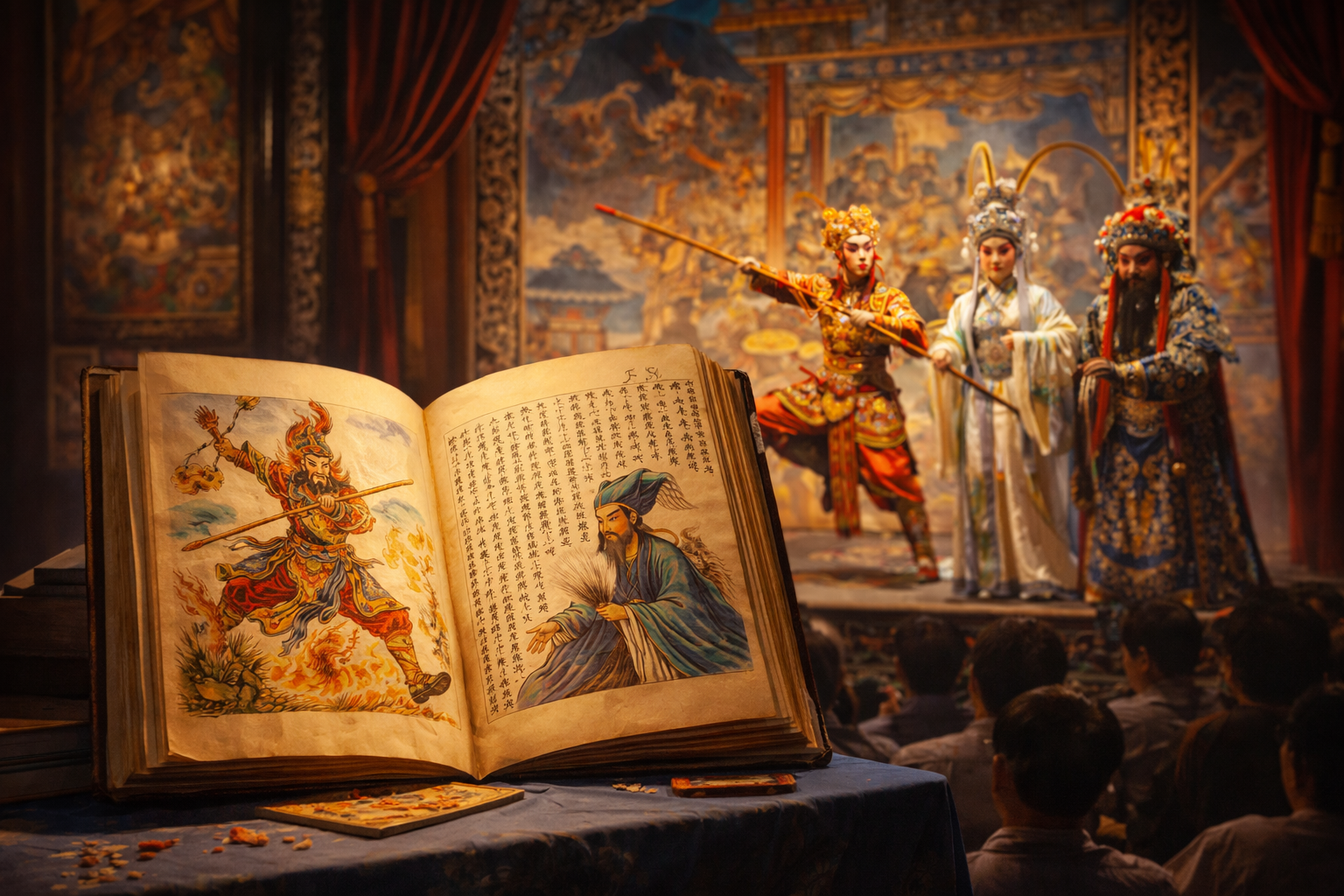
This article examines opera and vernacular fiction as a shared media ecology of mythic survival. Chinese mythic culture was not simply preserved. It was transmitted through a moving system in which page and stage repeatedly reanimated one another. Vernacular fiction expanded scattered traditions into story worlds. Opera condensed those worlds into iconic scenes. Storytelling made episodes memorable before and beyond print. Popular audiences returned to characters through festivals, teahouses, temple fairs, commercial theaters, printed editions, illustrated books, and later mass media. The result was not a single fixed mythology, but a living archive of versions.
This is especially important because early Chinese literature does not preserve a single mythological canon comparable to the great epic archives of some other civilizations. Mythic materials instead survive in dispersed, fragmentary, and continually reworked forms. Opera and vernacular fiction became two of the principal vehicles through which that dispersed archive acquired continuity. They did not merely repeat inherited tradition; they made it socially legible at scale.
Why Opera and Vernacular Fiction Matter
Opera and vernacular fiction matter because they helped solve one of the central problems of Chinese mythic survival. Early Chinese mythic material is powerful, but it is often scattered across cosmological texts, historical works, philosophical compilations, ritual fragments, poetic allusions, anomaly collections, and local traditions. Unlike cultures where myth was gathered into a few dominant epic monuments, Chinese mythic memory often remained distributed. Later narrative and performance media gave that distributed archive new forms of continuity.
Vernacular fiction did this by expanding motifs, characters, and episodes into long narrative worlds. A stone-born monkey could become the protagonist of a vast pilgrimage romance. A dynastic transition could become divine warfare. A historical period of disunion could become a legendary-political drama of loyalty, strategy, betrayal, and fate. A strange tale could become a love legend, opera scene, or popular adaptation. Fiction gave dispersed material architecture.
Opera did this differently. It condensed narrative into repeatable public scenes. It made characters visible as roles, voices, costumes, gestures, arias, and stylized bodies. A reader may know Sun Wukong from chapters, but an audience may know him from leaps, staff combat, painted face, comic defiance, and kinetic stage presence. Opera turns narrative into public memory through repetition and sensation.
Together, opera and vernacular fiction show that Chinese mythic culture is not a simple movement from “original myth” to “later entertainment.” It is a history of media transformation. The late novel, the opera stage, the puppet screen, the temple fair, and the printed illustration are not peripheral. They are among the main places where myth survived.
From Fragment to Narrative World
One of the central problems in Chinese mythology is that the oldest mythic materials survive in scattered, layered, and often indirect form. They appear in cosmological texts, poetic allusions, philosophical compilations, ritual traditions, legendary histories, geographical compendia, and collections of anomalies rather than in a single authoritative mythological book. This fragmentation helps explain why later narrative forms became so important. Opera and vernacular fiction did not merely embellish an already complete mythology; they helped create coherent narrative worlds from dispersed cultural material.
Once mythic fragments entered longer narrative forms, they could attach themselves to memorable plots, repeated scenes, recognizable characters, and dramatic speech. This process did not eliminate older textual strata, but it did make legendary material easier to carry into popular consciousness. A figure such as Sun Wukong became culturally central not because he appears in early cosmological classics, but because later narrative and performance traditions gave him a vivid public life. In that sense, late literary and theatrical culture did not stand outside mythology. It became one of the chief means through which mythology acquired durable social presence.
This point matters methodologically. If one approaches Chinese myth only through the earliest textual witnesses, the archive can seem dispersed almost to the point of incompletion. If one approaches it through later media of consolidation, however, a different picture emerges: myth appears as a distributed but resilient field that repeatedly gathers itself into narrative wholes. Opera and fiction are therefore not secondary embellishments. They are principal mechanisms of cultural memory.
The movement from fragment to narrative world also changes how myth is experienced. A mythic being mentioned briefly in an early source may later acquire biography, motivation, companions, enemies, settings, weapons, iconography, and emotional life. This expansion is not simply distortion. It is cultural work. It allows older symbolic materials to become socially usable, performable, teachable, and memorable across generations.
Storytelling, Oral Performance, and the Missing Middle
Between early fragmentary myth and the great vernacular novels lies an essential intermediate layer: oral performance and narrative recitation. This “missing middle” is crucial because it helps explain how sketchy or scattered materials became socially memorable before, during, and alongside their literary consolidation. Professional storytellers, temple performers, market narrators, musicians, puppeteers, and performers of mixed prose-and-verse forms helped turn inherited material into episodic, audible, audience-facing narrative.
Chinese literary history repeatedly points to this intermediary world. The movement from short tale or historical anecdote to popular narrative world was rarely a simple jump from manuscript to novel. It typically involved recitation, adaptation, compression, expansion, and audience feedback. Narrative had to become performable before it could become broadly memorable. Even when surviving evidence is uneven, it is clear that Chinese mythic and legendary materials were shaped in environments where listeners, not only readers, mattered.
This performative middle layer also helps explain why later fiction often feels scene-based, episodic, and theatrically vivid. Long before a story was canonized in print, it was often being circulated as something recitable, dramatizable, and emotionally punctuated. In this sense, storytelling and operatic culture do not merely follow literature. They prepare the ground for it and continue to interact with it afterward.
The storyteller is therefore a crucial figure in the history of Chinese mythic transmission. A storyteller can turn a scattered episode into suspense, a historical anecdote into moral drama, a supernatural event into public wonder, and a familiar figure into a shared emotional possession. Storytelling gives narrative rhythm before print fixes chapters. It helps produce the audience that fiction and opera later inherit.
Vernacular Fiction and the Expansion of Mythic Memory
Vernacular fiction was crucial because it widened access to narrative culture beyond the most rarefied literary registers. As Chinese literature moved more fully into forms shaped by speech, episode, dialogue, and public narratability, mythic and legendary materials acquired a new social range. Vernacular fiction gave Chinese mythic culture a broad narrative vehicle capable of absorbing history, marvel, religion, folklore, comedy, courtly intrigue, demonology, pilgrimage, battle, and moral instruction into extended plots with recurring characters and cumulative emotional power.
In the Ming and Qing worlds especially, fiction became one of the great engines of cultural memory. Printed novels could travel farther than local performance alone, while performance traditions could keep novelistic episodes alive among people who never read the full text. The page and stage reinforced one another. A printed chapter might supply a scene for performance; a famous performance might send audiences back to a printed story; an illustration might stabilize how a figure was imagined.
Vernacular fiction also made room for hybrid worlds. A novel could be historical and supernatural, comic and religious, moral and violent, didactic and entertaining. This hybridity is central to Chinese mythic survival. Mythic meaning did not need to remain inside a clearly marked genre called “myth.” It could live inside pilgrimage fiction, gods-and-demons fiction, historical romance, strange tales, courtroom stories, romantic drama, and martial legend.
This is one reason fiction matters so much in the study of Chinese myth. It demonstrates that mythic memory is not restricted to stories officially classified as myth. Heroic history, travel narrative, supernatural tale, and moral romance can all become vehicles of mythic amplification once they are narratively intensified and socially repeated.
Journey to the West and the Making of a Mythic World
Journey to the West is one of the clearest examples of vernacular fiction transforming dispersed religious, historical, folkloric, and performative material into a durable mythic world. At one level, the novel is linked to the historical pilgrimage of Xuanzang. At another, it becomes a comic, supernatural, Buddhist-Daoist, demon-filled adventure centered on Tripitaka, Sun Wukong, Zhu Bajie, Sha Wujing, Guanyin, the Buddha, celestial bureaucracies, monsters, mountain spirits, and a long geography of trial.
The novel’s importance lies not only in its literary brilliance, but in the way it created a synthesis strong enough to dominate later cultural memory. Sun Wukong’s afterlife in opera, storytelling, television, animation, games, film, schoolbooks, children’s literature, public sculpture, and global popular culture is inseparable from the narrative consolidation achieved in the novel. The Monkey King became mythic because the novel made him dramatically inexhaustible.
Primary Source
內育仙胞,一日迸裂,產一石卵,似圓毬樣大。因見風,化作一個石猴,五官俱備,四肢皆全。Within it an immortal embryo was nourished. One day it burst open and produced a stone egg, round as a ball. When it met the wind, it transformed into a stone monkey, complete in its five senses and whole in its four limbs.Xiyouji 西遊記, chapter 1. Available at: https://ctext.org/xiyouji/ch1
The stone birth is a perfect example of vernacular fiction turning cosmological imagery, wonder, and narrative charisma into a durable mythic origin scene.
Once the Monkey King becomes a figure of stone birth, Daoist training, celestial rebellion, Buddhist discipline, and pilgrimage protection, he can travel across media. Opera emphasizes his movement, staff work, and comic force. Animation emphasizes spectacle. Children’s versions emphasize adventure. Religious readings emphasize discipline and transformation. Political readings emphasize rebellion. The novel’s power lies in giving all these later media enough symbolic material to adapt.
Journey to the West therefore demonstrates how vernacular fiction can generate mythology rather than simply preserve it. The novel gathers earlier materials, but its own literary formation becomes the source of later mythic life. It is not merely downstream from folklore. It becomes a new upstream source for performance and popular culture.
Investiture of the Gods and the Theater of Divine War
Investiture of the Gods, or Fengshen yanyi, offers a different model of mythic consolidation. Instead of transforming a pilgrimage into supernatural adventure, it transforms the Shang-Zhou dynastic transition into cosmic war and divine administration. Kings, ministers, goddesses, fox spirits, immortals, sectarian lineages, magic weapons, warrior children, and battlefield deaths all become part of one vast explanation for the fall of Shang and rise of Zhou.
This matters because the novel shows how history can become myth through vernacular fiction. The old doctrine of the Mandate of Heaven becomes more than a political idea. It becomes spectacle: Nüwa offended, Daji seducing and corrupting, loyal ministers dying, Jiang Ziya guiding transition, Nezha and Yang Jian fighting, magical arrays forming, and the dead being assigned divine offices. Dynastic change becomes a theater of cosmic reordering.
The novel’s structure is intensely performable. It offers dramatic entrances, magical weapons, battles, confrontations, punishments, transformations, speeches, villains, child warriors, goddesses, and final investiture. These elements move naturally into opera, puppetry, visual art, children’s retellings, television, animation, and fantasy media. The text already feels staged because its mythic world is built from scenes of display.
Investiture of the Gods also reveals how vernacular fiction can organize a pantheon. Many later popular images of gods and warriors are shaped by its narrative logic. Like Journey to the West, it became a reservoir for performance culture. Its characters are not confined to the book; they become roles, icons, festival figures, and media archetypes.
Romance of the Three Kingdoms and the Mythologizing of History
Romance of the Three Kingdoms demonstrates that mythic transmission does not require gods, demons, or immortals at every turn. Historical fiction can become mythic when political memory is intensified into exemplary characters, moral dilemmas, strategic genius, loyalty, betrayal, and the patterned rise and fall of states. The novel transforms the end of the Han and the Three Kingdoms period into a vast legendary-political world.
The famous opening formula frames history itself as cyclical movement: unity and division, division and unity. This is not simply chronicle. It is historical time made almost cosmological. The novel’s world becomes a theater of destiny, strategy, ambition, and moral judgment.
Primary Source
話說天下大勢,分久必合,合久必分。It is said that the great affairs of the world must unite after long division, and divide after long union.Sanguo yanyi 三國演義 / Romance of the Three Kingdoms, chapter 1. Available at: https://ctext.org/sanguo-yanyi
The opening line shows how vernacular historical fiction turns political history into a patterned, memorable, almost mythic vision of time.
Figures such as Zhuge Liang, Guan Yu, Liu Bei, Cao Cao, Zhang Fei, and Zhao Yun became culturally powerful not only because of historical memory, but because fiction and performance stabilized them as legendary personalities. Zhuge Liang becomes not merely a strategist but an image of near-superhuman intelligence. Guan Yu becomes loyalty, martial righteousness, and eventually divine status. Cao Cao becomes political brilliance and suspicion. The novel gives history a cast of archetypes.
Opera then intensifies this process. Painted faces, role types, vocal styles, costume, and repeated scenes make historical-romance figures publicly recognizable. A person may know Guan Yu by red face and long beard before knowing the historical record. This is mythologizing through performance: history becomes legible as image, sound, and ritualized repetition.
Opera as a Medium of Cultural Transmission
If vernacular fiction helped consolidate long narrative worlds, opera helped distribute them through voice, gesture, music, movement, costume, role type, and spectacle. Chinese opera is not simply spoken drama with songs added. It is a highly formalized performance system in which narrative becomes inseparable from vocal style, bodily discipline, rhythmic structure, codified movement, symbolic props, facial design, and role conventions. Myth and legend are not merely described; they are embodied.
This performative density matters for transmission. A story encountered in opera becomes memorable through sonic pattern, visual repetition, emblematic gesture, entrance and exit structure, sleeve movement, combat choreography, arias, painted faces, and role-specific performance conventions. Audiences may remember a melody, a costume, a gesture, or a stylized lament as strongly as any plot point. Opera therefore preserves narrative not only semantically but sensorily. It is a mnemonic machine.
Opera also changes what matters in a story. Material that is diffuse in prose may be compressed into iconic scenes on stage. A passing supernatural event may become a climactic visual sequence. A morally ambiguous figure may be stabilized through casting and role convention. A long campaign may become one battle scene. A novelistic relationship may become a duet, confrontation, or aria. In this sense, opera is not only a carrier of narrative memory. It is an interpretive technology that reorganizes the archive for performance.
The social reach of opera matters as well. Many audiences encountered legendary figures through stage performance before or instead of reading long novels. Opera made narrative public, repeatable, and sensorially memorable. It transformed literature into shared occasion.
Zaju, Chuanqi, and the Dramatic Formation of Public Memory
The history of Chinese drama includes several major forms that shaped how stories became public. Zaju, associated especially with Yuan drama, developed into a mature dramatic form in which songs and dialogue shaped compact, powerful stage narratives. Later southern forms, including chuanqi, allowed longer, more elaborate dramatic structures. These forms matter because they provided theatrical architecture for transmitting history, romance, supernatural encounter, injustice, and moral conflict.
Drama changed narrative by requiring concentration. A play cannot carry every detail of a long story. It must select scenes, heighten confrontation, and make emotional movement audible. This selection process helps create iconic moments. A story that is complex in prose may become remembered through one courtroom scene, one dream, one reunion, one execution, one ghostly return, or one battle.
Drama also made moral emotion public. Injustice, loyalty, desire, betrayal, filial devotion, divine intervention, and karmic or cosmic retribution could all be staged before an audience. The theater made ethical conflict visible and shared. This public emotional form helped legendary material become durable.
The movement from zaju and chuanqi into later opera worlds also shows that Chinese mythic transmission was cumulative. Later performance forms did not emerge from nowhere. They inherited, adapted, and transformed earlier dramatic structures. The stage became a long memory system in which stories could be reworked across centuries.
Kunqu: Refinement, Dream, and the Supernatural Stage
Kunqu is especially important because it demonstrates how elite literary refinement and performative transmission could overlap in one powerful medium. UNESCO describes Kun Qu as one of the oldest forms of Chinese opera still performed today, with dynamic structure and melodic sophistication. Its repertoire and performance style show that opera could sustain dream, desire, death, memory, longing, ghostly return, and the porous boundary between visible and invisible worlds with extraordinary formal grace.
The Peony Pavilion, or Mudan ting, is central to this discussion because it shows how drama can turn inner life into mythic event. Du Liniang dreams of love, dies of longing, and returns through desire, memory, and recognition. The work is not mythology in the narrow sense of gods and creation, but it belongs to a broader mythic imagination of dream, death, spirit, and the power of feeling to cross boundaries.
Primary Source
情不知所起,一往而深。生者可以死,死可以生。Love arises from no known source, yet it goes ever deeper. The living may die for it; the dead may live again.Tang Xianzu 湯顯祖, Mudan ting 牡丹亭 / The Peony Pavilion. Project Gutenberg edition available at: https://www.gutenberg.org/ebooks/23849
The famous formulation shows how dramatic literature can make emotion itself a supernatural force, allowing love, dream, death, and return to become stageable mythic experience.
Kunqu’s significance for mythic transmission lies in this refinement of emotional and supernatural possibility. It shows that mythic culture does not always require monsters or cosmic battles. Sometimes it appears through dream, garden, memory, longing, and the return of the dead. The opera stage can make interior experience feel cosmological.
Kunqu also shows how literary prestige and performance memory reinforce one another. A play survives not only because it is written beautifully, but because it is performed, studied, sung, transmitted, and embodied. The text and stage sustain each other. Mythic feeling becomes repertory.
Peking Opera, Role Types, and the Iconic Body
Peking opera represents a different but equally important synthesis. UNESCO describes Peking opera as a performance art incorporating singing, recitation, acting, and martial arts. Its stories range across history, politics, morality, social life, supernatural encounter, domestic conflict, and stylized martial spectacle. The breadth of its repertoire shows that operatic transmission did not confine itself to one generic lane. A single performance system could carry dynastic history, popular legend, revenge plots, divine encounters, military campaigns, and comic episodes.
Role types are central to this power. The sheng, dan, jing, and chou categories, along with more specific subtypes, help make characters immediately legible. A painted face, voice, posture, gait, costume, beard, sleeve, weapon, or comic movement can signal moral and social identity before extensive exposition is needed. Opera turns character into a system of signs.
This is especially important for the mythologizing of history. A figure such as Guan Yu becomes not merely a person in a narrative but an iconic body. His visual and performative signs carry loyalty, martial authority, and moral gravity. Zhuge Liang’s robe, fan, and calm stage presence can convey wisdom before he speaks. A general’s entrance, a warrior’s combat sequence, or a clown’s interruption can make the story-world readable through performance convention.
Peking opera also shows how martial performance can preserve legendary memory. Battles in fiction may be long and complex, but opera condenses them into stylized movement. The stage does not need realism. It needs recognizability, rhythm, and symbolic intensity. Through this process, legendary violence becomes choreography, and historical memory becomes embodied art.
Yueju, Cantonese Opera, and Regional Performance Worlds
Regional operas deepen the picture further. Yueju, commonly known in English as Cantonese opera, is recognized by UNESCO as a major performance tradition of Cantonese communities in Guangdong, Guangxi, Hong Kong, and Macao. It combines music, costume, face painting, and theatrical convention with a repertoire ranging from historical epics to more everyday stories. Its existence reminds us that Chinese narrative transmission was never centralized in one stage form alone.
This regional dimension matters because mythic and legendary transmission often depends on language, locality, music, and community. A story performed in a regional opera is not merely the same story translated into another dialect. It enters another sound world, another set of gestures, another audience history, another ritual or festival context, and another geography of memory. Regional style gives legend a local body.
Yueju and other regional forms also show how opera can be integrated with ceremonial and communal life. In some contexts, opera appears at temple fairs, deity birthdays, public festivals, clan events, thanksgiving rituals, and community celebrations. The stage may serve human audiences and divine spectators at once. This layered audience is crucial for understanding opera’s religious and social significance.
Regional performance worlds also complicate any simple national story of “Chinese opera.” Kunqu, Peking opera, Yueju, and numerous local forms each preserve different relationships among music, language, ritual, literature, and audience. Chinese mythic transmission depends on this plurality. Legend survives because it can be localized without becoming unrecognizable.
Opera, Temple Festivals, and Ritual Publics
Opera has often been embedded in temple-festival life. In many communities, performances were not only entertainment but offerings to deities, fulfillments of vows, expressions of gratitude, or public acts of ritual sponsorship. A stage facing a temple may make the deity the principal spectator, even while human crowds gather. The performance becomes devotional, social, and theatrical at once.
This setting matters for mythic transmission because it places stories inside a ritual public. A legend performed during a temple festival is encountered amid incense, deity processions, food stalls, firecrackers, offerings, crowds, banners, and communal obligation. The story is not isolated from social life. It becomes part of a larger ceremonial atmosphere in which sacred presence, market exchange, entertainment, and local memory converge.
Opera also helps temple festivals narrate the moral world. Stories of loyal ministers, divine rescue, filial children, goddess intervention, demon exposure, martial virtue, and karmic justice can be staged before the deity and community. The play becomes a mirror of values, dangers, and hoped-for order. It gives the festival narrative density.
This is why opera belongs beside shadow puppetry and temple processions in the study of Chinese folklore. All three are performative media through which legend becomes public. The page may preserve a plot, but the festival stage gives it social occasion. The story lives because people gather to see and hear it together.
Performance, Adaptation, and the Remaking of Legend
Transmission is never simple repetition. When stories move from oral tale to printed fiction, or from novel to opera, they are reshaped by the demands of medium. A sprawling episodic narrative may be condensed into a few emblematic scenes. Secondary characters may disappear. A supernatural episode may be heightened because it performs well visually. A figure may be morally clarified, rhythmically stylized, or vocally differentiated in order to make the story legible on stage.
The result is a culture of adaptation in which no single version exhausts the story. A mythic figure may exist simultaneously in oral memory, printed chapters, operatic excerpts, temple paintings, puppet repertoires, film, and digital media. Chinese legendary culture is therefore best understood not as a set of fixed originals and weaker copies, but as a dynamic archive of versions. Fiction and opera matter because they provide some of the strongest pathways through which stories can move between media without losing recognizability.
Adaptation also reveals what a culture finds performatively essential. If one episode is staged again and again, it may become more culturally central than its proportion in the original text would suggest. A battle, dream, judgment, reunion, transformation, or comic confrontation can become the public face of a much larger story. Performance creates emphasis.
This helps explain why Chinese myth has remained so adaptable into modernity. Once a tradition has already learned to move between page, voice, music, image, temple, and stage, the later move into film, television, animation, and gaming is not a total rupture. It is an extension of an older remediating logic.
Print, Illustration, and the Visual Life of Fiction
Vernacular fiction also circulated through print culture, and print culture was often visual as well as textual. Illustrated editions, woodblock prints, title pages, character images, theatrical prints, temple-fair materials, and popular images helped stabilize how readers and viewers imagined legendary figures. A character’s visual life could become almost as important as the words attached to that character.
This visual culture matters because mythic memory depends heavily on recognizability. A monkey with staff, a warrior with a specific face and weapon, a goddess in a recognizable posture, a strategist with fan and robe, a fox spirit in courtly form, or a monk with pilgrim attributes can evoke an entire narrative world. Print and performance reinforce one another by creating repeated visual codes.
Illustration also allowed fiction to become more accessible. A reader might be drawn into a story through images; a viewer might recognize a stage character from printed depiction; a temple visitor might see a figure whose story was known from novel or opera. The same legendary archive moved among books, stages, temples, prints, and memory.
Popular print therefore helped create a visual commons for Chinese mythic culture. It did not simply record stories. It circulated images that made stories portable. In this sense, print belongs beside opera as a vehicle of transmission. One gives legend a repeated body on the page; the other gives legend a repeated body on the stage.
Audiences, Memory, and the Social Life of Story
Opera and vernacular fiction matter because they imply audiences. Narrative expansion was tied to social worlds of listeners, readers, viewers, patrons, performers, printers, book sellers, temple communities, theatergoers, and city-based cultural consumption. Myth endured not only because authors wrote it, but because publics gathered around it. Theater districts, temple fairs, market culture, reading publics, storytelling circuits, teahouses, household recitation, and festival stages all helped turn narrative into shared memory.
Those publics were not uniform. Some encountered stories through professional storytellers. Others met them in books, opera houses, pleasure districts, temple courtyards, seasonal festivals, family reading, amateur performance, or later radio, television, and film. This diversity of reception is one reason Chinese mythic memory remained so resilient. A story did not depend on one channel of access. It could survive in elite print and in popular stage adaptation at once.
This social life of story matters for folklore studies because it reveals that narrative does not endure by literary preservation alone. It endures when it becomes woven into repeated acts of hearing, seeing, reciting, quoting, singing, staging, teaching, imitating, and adapting. Opera and vernacular fiction helped make mythic material socially sticky. They gave it recurring public situations in which to live.
Audience memory is also selective. People may remember a famous scene rather than an entire novel, a stage gesture rather than a chapter, a song rather than a plot, a character type rather than a complex textual history. This selectivity is not failure. It is one of the ways folklore works. Cultural memory preserves what can be repeated, recognized, and emotionally renewed.
Modern Afterlives: Film, Television, Animation, and Games
The modern afterlives of Chinese mythic figures are often discussed as products of cinema, television, animation, comics, and video games. Yet those media did not invent adaptation. They inherit a much older Chinese habit of moving stories across forms. A figure that moved from oral tale to novel to opera could later move from opera to film, from illustrated edition to animation, from temple image to television costume, or from gods-and-demons fiction to fantasy game.
This continuity matters because it prevents modern media from being treated as purely external to tradition. Modern retellings can simplify, commercialize, or distort older materials, but they also continue the remediating logic that has long defined Chinese mythic culture. Stories survive because they can be re-formed.
Sun Wukong is again the clearest case. His movement across stage, film, animation, television, games, and global popular culture is extraordinary, but it is not accidental. The character was already built as a media-ready figure: visual, mobile, comic, martial, magical, rebellious, and transformable. Nezha, the White Snake, Daji, Jiang Ziya, Guan Yu, Zhuge Liang, and many others likewise continue to move because earlier fiction and performance made them portable.
The challenge for modern interpretation is to avoid treating all adaptations as equivalent. A video game, film, opera excerpt, children’s book, and Ming novel may all participate in the same afterlife, but they do not carry the same historical weight or interpretive responsibility. The task is to understand the chain of transmission without flattening its differences.
Source History and Interpretive Caution
A careful reading of opera and vernacular fiction as vehicles of mythic transmission must distinguish among several layers: early mythic fragments, oral storytelling, professional recitation, printed vernacular fiction, zaju, chuanqi, Kunqu, Peking opera, Yueju and other regional operas, temple-festival performance, puppet theater, illustrated editions, modern heritage documentation, and contemporary mass-media adaptation. These layers interact, but they are not interchangeable.
Early Chinese mythic sources should not be dismissed as incomplete simply because they do not resemble epic canons elsewhere. Their dispersed form is historically significant. At the same time, later fiction and opera should not be treated as merely derivative or inauthentic because they are later. In many cases, they are the very media through which mythic material became socially powerful. A late novel can become a primary source for later mythic life.
UNESCO materials on opera are useful for contemporary heritage framing, transmission, and performance description, but they are not substitutes for the primary texts, performance scripts, regional histories, fieldwork, and Chinese-language scholarship needed for detailed study. Britannica’s summaries are useful for orientation, especially on the fragmentation of early mythic material and the development of vernacular literature and drama, but they should be supplemented with more specialized sources.
Finally, one should avoid a rigid hierarchy in which text is always original and performance is always secondary. Chinese mythic culture often works through circulation. A story may be shaped by performance before it enters print, reshaped by print before it returns to stage, visualized in illustration, ritualized in temple culture, and transformed again in modern media. The archive is not a line. It is a network.
Why This Media Ecology Still Matters
Opera and vernacular fiction still matter because they show that myth is not preserved only by fidelity to a hypothetical original. It survives through adaptation, stylization, repetition, social pleasure, formal intensity, and public return. Audiences return to stories because they are moving, entertaining, morally charged, musically compelling, visually unforgettable, ritually meaningful, or theatrically thrilling. In Chinese culture, opera and vernacular fiction became two of the great engines through which that return was organized.
They also matter because they reveal the dignity of popular and performative transmission. Mythic memory was not preserved only by elite commentators or classical texts. It was also sustained by storytellers, actors, singers, puppeteers, printers, carvers, musicians, temple communities, book sellers, spectators, festival sponsors, regional troupes, and ordinary audiences. The social archive of myth is broader than the literary archive.
Most of all, opera and vernacular fiction matter because they reveal that Chinese myth has always been a multi-media tradition. Long before cinema or streaming, stories already moved between page and stage, elite text and popular performance, literary refinement and communal enactment, sacred ritual and commercial entertainment. Opera and vernacular fiction are not incidental chapters in that history. They are among the principal reasons the mythic archive remained alive.
For the study of Chinese Myth, Folklore & Legend, this means that the most important question is not always “where is the original version?” Often the better question is: through what media did this story become memorable? Opera and vernacular fiction answer that question with unusual force. They show myth becoming public, repeatable, embodied, and endlessly renewable.
Related Reading
- Chinese Myth, Folklore & Legend
- Chinese Shadow Puppetry and the Performance of Legend
- Temple Festivals, Popular Religion, and the Social Life of Legend
- Sun Wukong and the Mythic Afterlives of Journey to the West
- Investiture of the Gods and the Mythologizing of Dynastic Change
- Strange Tales and the Rise of Supernatural Literature
- From Classical Text to Folkloric Archive: How Chinese Myth Survived
Primary Sources
- Wu Cheng’en 吳承恩, attributed (n.d.) Xiyouji 西遊記 / Journey to the West. Useful as a primary vernacular-fiction source for the transformation of pilgrimage history, Buddhist-Daoist cosmology, demon lore, and oral/performance materials into a durable mythic world. Chinese Text Project edition available at: https://ctext.org/xiyouji
- Wu Cheng’en 吳承恩, attributed (n.d.) Xiyouji 西遊記, chapter 1. Useful for Sun Wukong’s stone birth and the novel’s conversion of cosmological wonder into narrative origin. Available at: https://ctext.org/xiyouji/ch1
- Xu Zhonglin 許仲琳, attributed (n.d.) Fengshen yanyi 封神演義 / Investiture of the Gods. Useful as a primary vernacular-fiction source for gods-and-demons fiction, dynastic mythologization, divine warfare, Nezha, Jiang Ziya, Daji, and the narrative creation of a postwar pantheon. Chinese Text Project edition available at: https://ctext.org/fengshen-yanyi/ens
- Luo Guanzhong 羅貫中, attributed (n.d.) Sanguo yanyi 三國演義 / Romance of the Three Kingdoms. Useful as a primary vernacular-fiction source for the mythologizing of history, political legitimacy, loyalty, strategy, and the later legendary afterlives of figures such as Zhuge Liang and Guan Yu. Chinese Text Project edition available at: https://ctext.org/sanguo-yanyi
- Tang Xianzu 湯顯祖 (n.d.) Mudan ting 牡丹亭 / The Peony Pavilion. Useful as a primary dramatic source for Kunqu, dream, desire, death, spirit return, and the theatrical transformation of inner emotion into supernatural stage experience. Project Gutenberg edition available at: https://www.gutenberg.org/ebooks/23849
- UNESCO Intangible Cultural Heritage (2001/2008) “Kun Qu opera.” Useful as an official contemporary heritage source for Kunqu’s history, repertory, melodic structure, performance refinement, and safeguarding context. Available at: https://ich.unesco.org/en/RL/kun-qu-opera-00004
- UNESCO Intangible Cultural Heritage (2010) “Peking opera.” Useful as an official contemporary heritage source for Peking opera’s combination of singing, recitation, acting, martial arts, role conventions, and national performance significance. Available at: https://ich.unesco.org/en/RL/peking-opera-00418
- UNESCO Intangible Cultural Heritage (2009) “Yueju opera.” Useful as an official contemporary heritage source for Cantonese opera, regional performance culture, costume, music, martial display, and repertoire. Available at: https://ich.unesco.org/en/RL/yueju-opera-00203
- UNESCO Intangible Cultural Heritage (2011) “Chinese shadow puppetry.” Useful for understanding a related performance medium through which mythic and legendary materials moved between craft, voice, screen, music, and public memory. Available at: https://ich.unesco.org/en/RL/chinese-shadow-puppetry-00421
Further Reading
- UNESCO Intangible Cultural Heritage (2001/2008) “Kun Qu opera.” Available at: https://ich.unesco.org/en/RL/kun-qu-opera-00004
- UNESCO Intangible Cultural Heritage (2010) “Peking opera.” Available at: https://ich.unesco.org/en/RL/peking-opera-00418
- UNESCO Intangible Cultural Heritage (2009) “Yueju opera.” Available at: https://ich.unesco.org/en/RL/yueju-opera-00203
- UNESCO Archives (2009) “Yueju Opera.” Available at: https://www.unesco.org/archives/multimedia/document-349
- UNESCO Archives (2005) “An Orchid in Bloom: China Kun Qu Opera.” Available at: https://www.unesco.org/archives/multimedia/document-10
- Encyclopaedia Britannica (n.d.) “Chinese literature.” Available at: https://www.britannica.com/art/Chinese-literature
- Encyclopaedia Britannica (n.d.) “Chinese literature: Literary use of myths.” Available at: https://www.britannica.com/art/Chinese-literature/Literary-use-of-myths
- Encyclopaedia Britannica (n.d.) “Chinese literature: Ming dynasty.” Available at: https://www.britannica.com/art/Chinese-literature/Ming-dynasty-1368-1644
- Encyclopaedia Britannica (n.d.) “Chinese literature: Yuan dynasty.” Available at: https://www.britannica.com/art/Chinese-literature/Yuan-dynasty-1206-1368
- Encyclopaedia Britannica (n.d.) “Zaju.” Available at: https://www.britannica.com/art/zaju
- Encyclopaedia Britannica (n.d.) “Journey to the West.” Available at: https://www.britannica.com/topic/Journey-to-the-West
- Encyclopaedia Britannica (2026) “Romance of the Three Kingdoms.” Available at: https://www.britannica.com/topic/Romance-of-the-Three-Kingdoms
- Encyclopaedia Britannica (n.d.) “Zhuge Liang.” Available at: https://www.britannica.com/biography/Zhuge-Liang
- Chinese Text Project (n.d.) Xiyouji 西遊記. Available at: https://ctext.org/xiyouji
- Chinese Text Project (n.d.) Fengshen yanyi 封神演義. Available at: https://ctext.org/fengshen-yanyi/ens
- Chinese Text Project (n.d.) Sanguo yanyi 三國演義. Available at: https://ctext.org/sanguo-yanyi
- Tang, X. (n.d.) Mudan ting 牡丹亭. Project Gutenberg edition. Available at: https://www.gutenberg.org/ebooks/23849
- Plaks, A.H. (1987) The Four Masterworks of the Ming Novel. Princeton: Princeton University Press.
- Hanan, P. (1981) The Chinese Vernacular Story. Cambridge, MA: Harvard University Press.
- Idema, W.L. and Haft, L. (1997) A Guide to Chinese Literature. Ann Arbor: Center for Chinese Studies, University of Michigan.
- Mackerras, C. (1983) Chinese Theater: From Its Origins to the Present Day. Honolulu: University of Hawai‘i Press.
- West, S.H. and Idema, W.L. (2010) Monks, Bandits, Lovers, and Immortals: Eleven Early Chinese Plays. Indianapolis: Hackett.
- Yu, A.C. (2012) The Journey to the West. Revised edition. Chicago: University of Chicago Press.
References
- Chinese Text Project (n.d.) Fengshen yanyi 封神演義. Available at: https://ctext.org/fengshen-yanyi/ens
- Chinese Text Project (n.d.) Sanguo yanyi 三國演義 / Romance of the Three Kingdoms. Available at: https://ctext.org/sanguo-yanyi
- Chinese Text Project (n.d.) Xiyouji 西遊記 / Journey to the West. Available at: https://ctext.org/xiyouji
- Chinese Text Project (n.d.) Xiyouji 西遊記, chapter 1. Available at: https://ctext.org/xiyouji/ch1
- Encyclopaedia Britannica (n.d.) “Chinese literature.” Available at: https://www.britannica.com/art/Chinese-literature
- Encyclopaedia Britannica (n.d.) “Chinese literature: Literary use of myths.” Available at: https://www.britannica.com/art/Chinese-literature/Literary-use-of-myths
- Encyclopaedia Britannica (n.d.) “Chinese literature: Ming dynasty (1368–1644).” Available at: https://www.britannica.com/art/Chinese-literature/Ming-dynasty-1368-1644
- Encyclopaedia Britannica (n.d.) “Chinese literature: Yuan dynasty (1206–1368).” Available at: https://www.britannica.com/art/Chinese-literature/Yuan-dynasty-1206-1368
- Encyclopaedia Britannica (n.d.) “Chinese performing arts: The Yuan period.” Available at: https://www.britannica.com/art/Chinese-performing-arts/The-Yuan-period
- Encyclopaedia Britannica (n.d.) “Journey to the West.” Available at: https://www.britannica.com/topic/Journey-to-the-West
- Encyclopaedia Britannica (2026) “Romance of the Three Kingdoms.” Available at: https://www.britannica.com/topic/Romance-of-the-Three-Kingdoms
- Encyclopaedia Britannica (n.d.) “Zaju.” Available at: https://www.britannica.com/art/zaju
- Encyclopaedia Britannica (n.d.) “Zhuge Liang.” Available at: https://www.britannica.com/biography/Zhuge-Liang
- Hanan, P. (1981) The Chinese Vernacular Story. Cambridge, MA: Harvard University Press.
- Idema, W.L. and Haft, L. (1997) A Guide to Chinese Literature. Ann Arbor: Center for Chinese Studies, University of Michigan.
- Mackerras, C. (1983) Chinese Theater: From Its Origins to the Present Day. Honolulu: University of Hawai‘i Press.
- Plaks, A.H. (1987) The Four Masterworks of the Ming Novel. Princeton: Princeton University Press.
- Tang, X. 湯顯祖 (n.d.) Mudan ting 牡丹亭 / The Peony Pavilion. Project Gutenberg. Available at: https://www.gutenberg.org/ebooks/23849
- UNESCO Archives (2005) “An Orchid in Bloom: China Kun Qu Opera.” Available at: https://www.unesco.org/archives/multimedia/document-10
- UNESCO Archives (2009) “Yueju Opera.” Available at: https://www.unesco.org/archives/multimedia/document-349
- UNESCO Intangible Cultural Heritage (2001/2008) “Kun Qu opera.” Available at: https://ich.unesco.org/en/RL/kun-qu-opera-00004
- UNESCO Intangible Cultural Heritage (2009) “Yueju opera.” Available at: https://ich.unesco.org/en/RL/yueju-opera-00203
- UNESCO Intangible Cultural Heritage (2010) “Peking opera.” Available at: https://ich.unesco.org/en/RL/peking-opera-00418
- UNESCO Intangible Cultural Heritage (2011) “Chinese shadow puppetry.” Available at: https://ich.unesco.org/en/RL/chinese-shadow-puppetry-00421
- West, S.H. and Idema, W.L. (2010) Monks, Bandits, Lovers, and Immortals: Eleven Early Chinese Plays. Indianapolis: Hackett.
- Yu, A.C. (2012) The Journey to the West. Revised edition. Chicago: University of Chicago Press.