
Last Updated May 5, 2026
Strange tales occupy a foundational place in Chinese literary history because they transformed the supernatural from a dispersed field of omen, anecdote, rumor, religious fear, and local report into one of the most durable forms of imaginative prose. Ghosts, fox spirits, revenants, dream journeys, karmic judgments, uncanny encounters, mountain beings, animal transformations, spirit officials, and bureaucratic underworlds had long circulated through Chinese religious culture, but strange-tale literature gave these materials narrative shape, tonal range, literary polish, and enduring cultural memory. It did not invent the supernatural world from nothing. It created one of the principal written forms through which that world could be explored, preserved, refined, and reimagined.
Chinese strange tales are important because they stand at the threshold between belief and art. They may preserve reports of marvels, but they also transform those reports into literary scenes. They may record apparitions, but they also ask what apparition means: what has been left unresolved, what the dead remember, what desire conceals, what justice fails to see, and what kinds of truth become visible only when ordinary reality cracks. The strange is therefore not merely decorative. It is a method of perception. It allows Chinese prose to think through social disorder, moral debt, erotic longing, spiritual fear, metaphysical uncertainty, and the unstable relation between the human and the more-than-human.
Series context: This article is part of the Chinese Myth, Folklore & Legend knowledge series. For the broader category structure, return to the Mythology category.
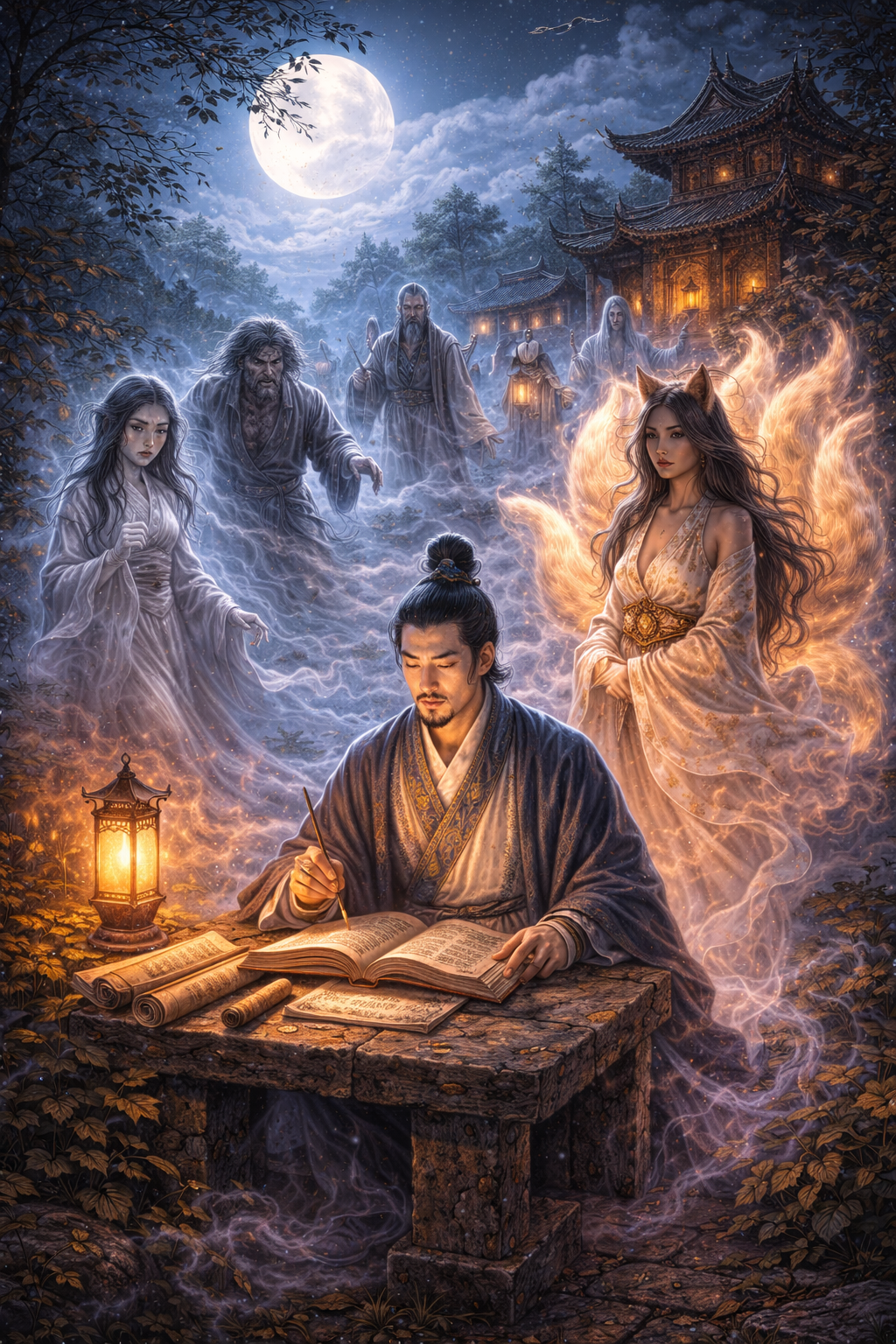
The rise of supernatural literature in China did not occur through a single abrupt beginning. It emerged through layered developments across genres. Early anecdotes and historical notices preserved reports of ghosts, omens, dreams, prodigies, and anomalous beings. Collections such as the Soushen ji gave these materials deliberate shape by gathering the strange into compilations of marvels, apparitions, transformations, and religious encounters. Later anthologies such as the Taiping guangji preserved and reorganized vast amounts of earlier supernatural narrative. Tang chuanqi expanded the literary sophistication of the marvelous through more elaborate plotting, deeper characterization, and heightened emotional texture. By the early modern period, works such as Liaozhai zhiyi transformed the strange tale into one of the most refined vehicles for irony, pathos, desire, social criticism, and metaphysical unease.
The history of Chinese supernatural literature is therefore the history of a form becoming increasingly self-aware. A ghost story could begin as a brief report and become a moral drama. A fox anecdote could become a study in gender, desire, and recognition. An underworld episode could become a critique of earthly justice. A dream tale could test the boundary between illusion and truth. The strange was not merely recorded. It was narrated, interpreted, stylized, and made memorable.
What Is a Strange Tale?
A strange tale is not simply any story containing a supernatural element. In the Chinese context, the strange tale belongs to a literary tradition that treats anomaly, marvel, apparition, transformation, dream, omen, spirit encounter, and uncanny event as worthy of deliberate recording and narration. The strange may involve ghosts, fox spirits, underworld officials, prophetic dreams, karmic reversals, miraculous interventions, mountain beings, transformed animals, or figures that move between human and nonhuman form. Yet what makes the tradition distinctive is not only its subject matter. It is the seriousness with which such materials are preserved, framed, and interpreted.
The strange tale occupies an important position between chronicle, anecdote, folklore, moral reflection, religious record, and imaginative literature. Some tales are brief and reportorial, almost case-like in tone. Others are highly crafted and emotionally intricate. Across this range, however, the strange tale assumes that the world is not exhausted by ordinary appearances and that encounters with the unseen are narratable events rather than mere impossibilities.
This is one reason the strange tale became such a powerful form. It does not demand that the supernatural be separated absolutely from the everyday. The ghost may appear in a house. The fox may enter a scholar’s room. A dream may reveal official destiny. A dead person may expose a crime. An underworld court may resemble earthly administration. The strange tale depends on proximity: the marvelous matters because it presses against ordinary life.
The word “strange” therefore should not be understood as meaning merely bizarre or fantastical. In Chinese supernatural prose, the strange is often a sign that reality has more layers than the visible world admits. It may reveal hidden justice, karmic consequence, suppressed desire, social hypocrisy, ancestral unrest, or a boundary between worlds that has become porous. The strange tale records such crossings and asks what they mean.
Why the Supernatural Became Literary
The supernatural became literary in China because it already possessed social, religious, and emotional density before it became a refined prose genre. Ghosts mattered because families feared unsettled dead. Fox spirits mattered because transformation, seduction, and ambiguity were already culturally charged. Underworld judges mattered because moral bureaucracy had become part of religious imagination. Mountains, dreams, omens, immortals, and revenants all carried explanatory, ritual, and symbolic force. Literature inherited a world already crowded with meaningful presences.
What prose narrative added was form. Once the strange could be written down, arranged, and circulated, it no longer remained only local rumor, ritual warning, or episodic report. It became portable memory. It became something that could be compared, stylized, anthologized, criticized, imitated, and transformed. Literature did not merely preserve belief. It created new ways of inhabiting the supernatural through narration itself.
This process matters because writing changes the strange. An apparition in local memory may serve one immediate function: to warn, explain, accuse, frighten, or console. Once written, however, it can enter a larger archive. It can be read beside other apparitions. It can become part of a pattern. It can be used by later writers to craft more elaborate stories. The supernatural event becomes literary material, and literary material becomes cultural memory.
The strange tale also gave writers a flexible mode for saying things that ordinary realist discourse could not easily say. Through spirits and anomalies, a writer could expose injustice, satirize officials, criticize false learning, explore erotic longing, sympathize with marginalized figures, or question the adequacy of human reason. The supernatural was not an escape from reality. It was one of the most powerful ways Chinese prose could see reality from an altered angle.
Zhiguai and the Recording of Anomaly
The earliest major foundation of Chinese supernatural literature lies in zhiguai 志怪, often understood as “records of anomalies” or “accounts of the strange.” These materials tend to be concise. They frequently present themselves as reports rather than extended fictions. A ghost appears, a fox transforms, a dream comes true, a corpse moves, an omen is fulfilled, or a strange being is encountered, and the narrative records the event with relative economy. The literary posture is often one of preservation rather than overt invention.
This mode is crucial because it reveals that early supernatural writing in China often sought credibility through restraint. The strange was not always embellished into ornate fantasy. It was recorded as something remarkable but narratively presentable, sometimes almost as evidence. This gave the tradition a distinctive tone. The uncanny did not need to be separated from reality in order to be meaningful. It could be recorded as part of reality’s fuller range.
Zhiguai also belongs to a wider culture of collecting and classifying exceptional events. The strange was not merely experienced; it was gathered. This act of gathering is important. It implies that anomalies are not random noise but data of another order. The world contains events that do not fit ordinary explanation, and those events deserve preservation because they reveal something about spirits, fate, morality, death, transformation, or hidden causation.
Yet the documentary posture of zhiguai should not be mistaken for modern factual reporting. These texts work in a different epistemic world. Their authority comes from transmitted memory, cited witnesses, inherited records, official or quasi-official tone, and the plausibility of the supernatural within a religiously dense culture. They occupy the space between report and story, and that ambiguity is part of their power.
The Soushen ji and the Consolidation of the Strange
The Soushen ji 搜神記, conventionally associated with Gan Bao, is one of the great landmarks in the rise of Chinese supernatural literature because it gathers ghost stories, transformations, marvels, and spirit encounters into a more deliberate collection. In it, the strange becomes an archive. Foxes transform into beautiful women. Ghosts return to demand redress. Spirits appear in domestic and political settings. Religious and folkloric motifs are brought together within a prose form that is brief but culturally expansive.
The importance of the Soushen ji lies not only in individual stories, but in what the compilation does as a whole. It asserts that the strange deserves collection. It creates continuity among otherwise scattered events. It also strengthens the impression that the unseen world is not random. It has recurrent forms. Once gathered together, anomalies begin to look like a system of narrative possibility.
Primary Source
虽考先志于载籍,收遗逸于当时,盖非一耳一目之所亲闻睹也,又安敢谓无失实者哉。Though earlier records are examined and neglected accounts gathered from the age, these are certainly not all things personally heard and seen by one pair of ears and eyes. How could one dare to say that none has lost contact with the real?Soushen ji 搜神記, “Preface.” Available at: https://ctext.org/wiki.pl?chapter=631805&if=en&remap=gb
The preface is important because it presents the strange as a problem of transmission. The compiler acknowledges uncertainty while still defending the value of preserving what has been heard, seen, inherited, and gathered.
This source-critical posture matters. The Soushen ji does not simply say: believe everything. It acknowledges difficulty, distance, report, inheritance, and possible error. Yet it still insists that preservation matters. The strange is worth recording even when the record is imperfect because what is preserved may be larger than what is lost. This attitude gives Chinese supernatural literature one of its most important early principles: uncertainty does not cancel memory.
The Soushen ji also helps explain why later strange tales could move so easily between religious seriousness and literary play. The collection treats the supernatural as culturally meaningful, but its very form leaves room for interpretation. Is a story evidence, warning, marvel, moral lesson, inherited rumor, or literary seed? Often it is several at once. That multivalence became one of the central strengths of the strange-tale tradition.
The Taiping guangji and the Archival Ordering of the Strange
The Taiping guangji 太平廣記 marks another major stage in the development of Chinese supernatural literature. Compiled in the Song period, it preserves a massive body of earlier tales, anecdotes, marvels, spirit records, Buddhist and Daoist stories, ghost narratives, immortal traditions, animal transformations, dreams, karmic episodes, and Tang chuanqi. Its importance lies not only in size, but in archival function. It preserved material that might otherwise have been lost and reorganized the strange as a vast classified literary field.
This work shows how the supernatural became part of learned culture’s memory infrastructure. The strange was no longer merely local anecdote or scattered compilation. It was arranged in a large-scale encyclopedia of narrative materials. Such ordering changes the status of the strange. It becomes something that can be searched, compared, excerpted, transmitted, and reused. The archive itself becomes a machine for future storytelling.
The Taiping guangji is especially important for the survival of Tang and earlier materials. Later readers and writers could encounter ghosts, foxes, deities, monks, Daoist adepts, dream visions, and marvels in one monumental collection. This helped stabilize the strange as a literary inheritance. The supernatural was not only believed or doubted; it was curated.
That curatorial function is crucial for later works such as Liaozhai zhiyi. Pu Songling did not write in a vacuum. He inherited centuries of strange-tale motifs, structures, and narrative expectations. The Taiping guangji helped keep that inheritance available. It made the strange not merely an event but a tradition.
Religion, Ghosts, and the Expansion of Narrative Worlds
Chinese supernatural literature expanded as Buddhist and Daoist religious worlds became increasingly elaborate. Buddhist ideas of karmic retribution, hells, hungry ghosts, merit, ritual rescue, and rebirth gave writers new structures of postmortem consequence. Daoist traditions contributed immortals, celestial offices, spirit travel, talismanic control, inner cultivation, and sacred geography. Indigenous traditions of ancestors, revenants, omens, local spirits, and territorial gods remained active. The strange tale inherited all of this.
This inheritance matters because it gave the supernatural world depth. A ghost was no longer only a frightening apparition. It might belong to a larger karmic or ritual logic. An immortal might no longer be only a marvelous figure in a mountain. He or she might stand within an articulated world of cultivation and transcendence. An underworld episode might not merely terrify; it might stage moral bureaucracy. Strange tales became one of the major literary media through which expanded Chinese religious cosmologies entered prose narrative.
Religion also supplied the strange tale with causality. A ghost returns because rites were neglected or justice failed. A sinner suffers because karma ripens. A dream reveals fate because the unseen world is administratively active. A fox transforms because age and cultivation have altered its nature. A monk or Daoist priest intervenes because ritual practice has real efficacy. The supernatural tale therefore does not simply present random marvels. It often places marvel within a religiously meaningful order.
At the same time, the strange tale could play with that order. It could question whether ritual specialists are sincere, whether officials are just, whether monks and Daoist adepts truly possess power, whether moral causation is legible, and whether humans understand the beings they fear. Religious cosmology gave strange tales structure, but literature gave that structure irony, sympathy, and critique.
From Brief Record to Crafted Story
Over time, the strange tale moved from brief notices toward more fully crafted stories. Characters became more complex. Scenes lengthened. Motivation deepened. Emotional texture became more prominent. Dialogue expanded. The supernatural encounter no longer needed to remain a compact report. It could unfold as narrative experience. This development did not eliminate the older reportorial mode, but it enlarged the possibilities of the genre.
This transition marks the moment when the strange tale becomes not only documentary or anecdotal, but literary in a more self-conscious sense. A ghost story can now explore longing. A fox tale can now sustain irony. A dream story can now shape fate and character. Narrative form becomes supple enough to hold the supernatural as more than event. It becomes relation, atmosphere, and moral drama.
The shift also changes the role of the reader. In a brief anomaly record, the reader receives an event. In a crafted strange tale, the reader interprets a world. The question is no longer only “Did this happen?” but “What does this reveal?” Why does the ghost speak now? Why does the fox choose this scholar? Why does an underworld court resemble earthly office? Why is the supernatural woman more morally intelligent than the men around her? The strange tale teaches interpretive suspicion.
This literary deepening is one reason supernatural prose endured. The form could absorb more psychological and social complexity than a simple marvel report. It could adapt to changing literary tastes while preserving older motifs. The ghost, fox, dream, and underworld court remained recognizable, but their narrative uses became increasingly sophisticated.
Tang Chuanqi and the Deepening of the Marvelous
Tang chuanqi 傳奇 is especially important because it deepens the marvelous into more sophisticated narrative art. These tales often present extended plots, stronger characterization, and more elaborate emotional or social situations than earlier anomaly records. The supernatural may still appear, but it now does so within a more developed literary architecture. Dreams, encounters with spirits, uncanny women, enchanted spaces, underworld journeys, and strange reversals become occasions for narrative design rather than brief notation alone.
This deepening shows that Chinese supernatural literature did not remain confined to catalogues of wonder. It became a site where literary craft and the marvelous could enrich one another. The strange tale was now capable of beauty, pacing, suspense, sentiment, irony, and social observation at a higher level. The supernatural had become a medium of art.
The Tang period is also important because it gave prose narrative greater room to explore individual experience. Love, ambition, failure, examination culture, official life, travel, and encounters with extraordinary women all became richer subjects for narrative elaboration. The strange was no longer simply an interruption of ordinary life. It could become the very structure through which ordinary life was revealed as fragile, illusory, or morally compromised.
In this sense, chuanqi helps bridge earlier zhiguai and later literary masterpieces such as Liaozhai zhiyi. It preserves the old fascination with anomaly, but moves toward crafted fiction. It prepares the way for a literary world in which the supernatural can carry psychological density, narrative suspense, and social critique at once.
Liaozhai and the Literary Perfection of Strangeness
Pu Songling’s Liaozhai zhiyi 聊齋志異, often known in English as Strange Tales from a Chinese Studio, represents one of the highest achievements in the history of Chinese supernatural literature because it inherits earlier traditions while transforming them into something more psychologically and stylistically refined. Fox spirits are no longer merely dangerous seductresses. Ghosts are no longer only objects of dread. The supernatural becomes a way of exploring loneliness, desire, corruption, scholarship, failed officialdom, gendered vulnerability, emotional intelligence, and human folly. The strange is not a decorative addition to the real. It is one of the most incisive ways of seeing the real.
This is why Liaozhai feels like both culmination and reinvention. It preserves the older archive of ghosts, foxes, revenants, dream visions, and uncanny visits, but gives them new tonal range. The strange tale becomes tender, satirical, tragic, erotic, melancholic, comic, and morally unsettling all at once. Supernatural literature reaches a degree of human depth that earlier materials only intermittently suggested.
In Liaozhai, the supernatural often exposes the inadequacy of social categories. A fox woman may be more loyal than a human wife. A ghost may be more emotionally alive than the living. A scholar may possess literary talent but lack moral courage. A corrupt official may appear respectable while spirit beings carry a deeper sense of justice. The strange does not merely violate reality; it judges reality.
Pu Songling’s achievement lies partly in his ability to hold belief, irony, sympathy, and aesthetic control together. His stories do not always ask the reader to settle whether the strange is literal, allegorical, satirical, or emotionally true. They often work because they remain suspended across those registers. The supernatural becomes literature’s way of refusing premature simplification.
Foxes, Ghosts, Scholars, and the Human Shape of the Supernatural
One of the most striking tendencies in Chinese supernatural literature is the human shape of the strange. Fox spirits become women, scholars, companions, or refined strangers. Ghosts return as wives, lovers, victims, monks, officials, and neighbors. Underworlds resemble courts. Immortals travel like eccentrics or sages. The strange is often most compelling when it approaches human social life rather than departing from it entirely.
This matters because Chinese supernatural literature frequently works through proximity rather than radical alienness. The supernatural does not always arrive as a monstrous outside. It often arrives as a near-human presence whose familiarity intensifies unease. A beautiful woman may be a fox. A courteous visitor may be dead. A scholar may be less cultivated than the spirit beside him. The literature of the strange repeatedly turns the familiar into an unstable category.
The scholar is especially important in this world. Many strange tales revolve around scholars, students, failed examination candidates, lonely readers, and men of literary ambition. This is not accidental. The scholar’s study is a privileged site of imagination, desire, failure, and textuality. It is where books are read, poems are written, ambitions are frustrated, and the boundary between literary imagination and supernatural visitation becomes thin. The strange tale often turns the scholar’s room into a threshold.
Foxes and ghosts also test the scholar’s claims to refinement. Does learning produce virtue, or only vanity? Does literary talent make one wise, or merely self-deceiving? Can a fox or ghost be more emotionally intelligent than a human man educated in the classics? Such questions make Chinese supernatural literature one of the great traditions for examining the limits of elite male culture.
Strange Tales as Moral and Social Critique
Strange tales endure not only because they delight. They also criticize. A ghost may expose injustice. A fox may reveal scholarly vanity. An underworld court may expose failures in earthly administration. A dream journey may reveal the hollowness of ambition. A revenant may force a family to remember what it buried too quickly. The supernatural provides narrative distance from which social and moral reality can be judged more sharply than ordinary realism sometimes allows.
This critical function is central to the rise of supernatural literature. The strange tale is not escapism in any simple sense. It is one of the ways Chinese writers could think about corruption, failed justice, false orthodoxy, erotic hypocrisy, ritual neglect, gendered vulnerability, class resentment, and the mismatch between official ideals and lived reality. The supernatural becomes legible as critique because it illuminates the moral fractures of the ordinary world.
In many stories, the supernatural being is not the true problem. The human world is. Ghosts return because law fails. Foxes deceive men who are already self-deceived. Underworld judges appear because earthly judges are corrupt or limited. Dreams reveal the instability of ambition because waking life is built on illusion. In this way, the strange tale often reverses expectations: the strange world may be morally clearer than the normal one.
This is why supernatural literature could carry social criticism without reducing itself to direct political argument. The ghost, fox, dream, and underworld court give critique a narrative body. They allow writers to show rather than lecture. A corrupt order can be exposed by a revenant; hollow scholarship can be exposed by a fox; moral debt can be exposed by a dream. The strange makes judgment visible.
Women, Spirits, and the Literary Politics of Voice
Women spirits are central to Chinese strange-tale literature. Ghost women, fox women, flower spirits, snake women, revenant wives, abandoned lovers, wronged daughters, and supernatural companions appear again and again. These figures often reflect male anxieties about beauty, sexuality, deception, and social disorder. Yet they also open narrative space for voices that ordinary society often constrained. A dead woman may accuse. A fox woman may judge. A ghost lover may speak more honestly than the living. A supernatural wife may reveal both the desire for intimacy and the violence of social control.
This ambiguity is one of the most important dimensions of the genre. Women spirits can be demonized, romanticized, pitied, feared, or ethically elevated. They may be dangerous, but they may also expose male weakness or official hypocrisy. They may be imagined through desire, but they may also become the clearest moral intelligence in the story. Strange tales therefore preserve both the constraints of patriarchal imagination and the possibility of speaking from its margins.
In later literary works especially, the woman spirit often becomes a figure through whom suppressed memory returns. She may return from death because she was wronged, or cross from animal to human form because human society itself is morally unstable. Her supernatural status gives her narrative mobility. She can enter spaces closed to ordinary women; she can speak in ways ordinary women could not; she can unsettle the categories used to control her.
This does not make every such story liberating. Many reproduce suspicion toward female desire or frame women’s agency as threat. But the genre’s power lies in its tension. The same figure who embodies anxiety may also become a vehicle for sympathy, critique, and moral revelation. Chinese strange tales are indispensable for reading how gender, voice, desire, and the supernatural became intertwined.
Underworlds, Dreams, and Bureaucratic Imagination
Chinese supernatural literature repeatedly turns to underworlds, dream courts, and bureaucratic afterlife scenes because bureaucracy was one of the most powerful symbolic languages available for imagining moral order. The dead may be judged in courts. Dreams may reveal official appointments in unseen realms. Underworld documents may determine lifespan, punishment, rebirth, or fate. The unseen world often resembles government not because the imagination is narrow, but because administration provides a concrete form for cosmic accountability.
This bureaucratic imagination allowed strange tales to make morality visible. If deeds are recorded, then hidden acts are not lost. If the dead are judged, then earthly injustice does not have the last word. If dreams reveal hidden offices, then worldly status is only one layer of a larger administrative cosmos. Such tales make the universe legible through offices, ledgers, messengers, seals, trials, and appeals.
Dreams are especially important because they allow passage without full death. A character may enter another realm, receive a warning, glimpse judgment, encounter the dead, or learn the hidden structure of fate while still belonging to the living world. The dream tale therefore functions as a controlled breach between worlds. It lets the narrative explore supernatural order without permanently removing the protagonist from ordinary life.
Underworld and dream stories also sharpen social critique. If infernal courts are more accurate than earthly courts, earthly justice is exposed as inadequate. If unseen officials know the truth, human officials are shown to be limited or corrupt. If karmic judgment is precise, social prestige becomes morally unreliable. The bureaucratic supernatural becomes a mirror held up to earthly bureaucracy.
Skepticism, Belief, and the Status of the Strange
Chinese supernatural literature thrives in the space between belief and skepticism. Some writers present the marvelous with archival seriousness. Others are ironic, ambivalent, playful, or openly literary in posture. Readers, too, need not accept every apparition literally for the stories to matter. The strange tale has cultural force precisely because it can operate as rumor, belief, entertainment, speculation, allegory, social critique, and emotional truth all at once.
This ambiguity in status is one of the genre’s greatest strengths. The strange need not be stabilized as either fact or fiction in a modern sense to be effective. It can remain suspended between report and invention. That suspension allows the genre to hold both metaphysical possibility and literary freedom. The rise of supernatural literature in China is inseparable from this productive uncertainty.
Skepticism itself belongs to the tradition. Some texts question ghost claims, criticize credulity, or ask whether fear and rumor have distorted perception. Yet such skepticism does not cancel the strange. It becomes part of its literary ecology. A culture that debates ghosts, omens, foxes, and marvels is still a culture in which such beings matter. Doubt becomes another way of engaging the unseen.
For modern readers, this means the most useful question is often not “Did people literally believe this?” but “What does the story do?” Does it preserve memory? Expose injustice? Entertain? Criticize officials? Explore desire? Explain illness? Give shape to grief? Test the boundaries of reason? The strange tale can perform all of these functions whether read as belief, fiction, or something in between.
Strange Tales and Literary Memory
Strange tales endured because they became one of the great vehicles of Chinese literary memory. They preserved older religious fears, local rumors, transformation motifs, ghostly grievances, and moral anxieties, but they also allowed later writers to revise and refine them. A fox-spirit motif could appear in a brief medieval anecdote, a Tang tale, a Song encyclopedia, a Qing masterpiece, and a modern adaptation, each time carrying earlier meanings while acquiring new ones.
This cumulative memory is central to the tradition. The strange tale is not a single genre frozen in one period. It is a long conversation across texts. Later writers knew earlier conventions and could repeat, invert, parody, intensify, or moralize them. A reader familiar with fox tales expects seduction or deception; a skilled writer can then make the fox more ethical than the human. A reader familiar with ghostly revenge expects terror; a skilled writer can make the ghost pitiable or legally necessary. Tradition creates expectation, and expectation enables art.
Anthologies and collections were especially important in preserving this memory. The Soushen ji collected early marvels. The Taiping guangji preserved and classified immense bodies of earlier narrative. Later collections and print culture continued the circulation. The strange became durable because it was continually archived.
Literary memory also made the strange available beyond narrow religious contexts. A ghost story might begin as ritual anxiety, but later become literature. A fox might begin as spirit fear, but later become a sophisticated figure of emotional and social ambiguity. The archive allowed supernatural materials to survive even as their functions changed. The strange became one of Chinese literature’s most adaptable inheritances.
Source History and Interpretive Caution
A careful reading of Chinese strange tales must distinguish among several related but different bodies of material: early anomaly records, medieval zhiguai, Tang chuanqi, Song encyclopedic compilations, Buddhist miracle stories, Daoist immortal accounts, underworld narratives, ghost anecdotes, fox-spirit tales, and late-imperial literary collections such as Liaozhai zhiyi. These traditions overlap, but they are not identical. A brief report of an apparition, an elaborate Tang romance, and a Qing literary tale may share motifs while operating by different literary rules.
The sources themselves also require caution. The extant Soushen ji has a complicated textual history, and its surviving form should not be treated as a transparent copy of one original authorial collection. The Taiping guangji preserves earlier materials but reorganizes them through Song encyclopedic classification. Liaozhai zhiyi draws from older traditions but is also a highly crafted literary work by a particular Qing author with distinctive irony, sympathy, and style. Source history matters because the strange changes as it is transmitted.
It is also important not to flatten “the supernatural” into one category. A ghost, fox spirit, immortal, underworld judge, Buddhist monk, Daoist adept, dream official, omen, and transformed animal all belong to the strange, but they do not mean the same thing. Each carries different religious, social, and literary associations. The best interpretation asks what kind of strange being appears, in what genre, for what narrative function, and with what moral effect.
Finally, strange tales should not be dismissed as superstition or romanticized as pure folk wisdom. They are literary forms shaped by class, gender, religion, textual transmission, elite authorship, popular belief, and changing reading practices. Many preserve marginalized voices and anxieties, but they often do so through elite literary mediation. Their power lies in that tension: they are both records of supernatural imagination and crafted works of prose art.
Why Supernatural Literature Endured
Supernatural literature endured in China because it served too many important functions to disappear. It preserved folklore. It entertained. It moralized. It criticized. It carried religious cosmologies into accessible prose. It gave narrative shape to grief, longing, fear, memory, desire, injustice, and wonder. It also provided writers with one of the most flexible formal spaces available for joining the socially recognizable to the metaphysically unstable.
Its endurance also reflects a deeper cultural condition: the Chinese world was repeatedly imagined as permeable. Dreams matter. Ghosts may return. Foxes may transform. Mountains conceal more than geology. Bureaucracy does not end at death. Officials exist in unseen realms. The dead remember. Strange tales endured because they were narratively equal to a civilization that often imagined reality as more layered than ordinary daylight admits.
They endured, too, because they could adapt. The early report could become the crafted story. The religious anecdote could become social satire. The ghost of fear could become the ghost of justice. The fox of danger could become the fox of sympathy. The underworld of terror could become a critique of administration. The strange tale survived by changing its literary uses without abandoning its core fascination with the unseen.
Finally, Chinese supernatural literature endures because it gives form to one of the oldest human intuitions: that unresolved experience does not vanish simply because ordinary explanation fails. The strange tale records what returns, transforms, appears, warns, seduces, judges, remembers, and refuses silence. It remains one of the great literary achievements of Chinese civilization because it made the unseen narratively present.
Related Reading
- Chinese Myth, Folklore & Legend
- Ghosts, Revenants, and the Moral Logic of the Unsettled Dead
- Fox Spirits, Transformation, and Ambiguity in Chinese Folklore
- Underworlds, Judges, and the Bureaucracy of the Afterlife
- Daoism, Immortality, and the Supernatural Imagination
- Buddhism, Daoism, and the Recasting of Chinese Mythic Worlds
- Animals, Omens, and Symbolic Creatures in Chinese Folk Imagination
Primary Sources
- Chinese Text Project (n.d.) Soushen ji 搜神記 / Record of Searching for the Divine. Available at: https://ctext.org/wiki.pl?if=en&res=839038
- Chinese Text Project (n.d.) Soushen ji: Preface 搜神記:序. Available at: https://ctext.org/wiki.pl?chapter=631805&if=en&remap=gb
- Chinese Text Project (n.d.) Soushen ji: Volume 12 搜神記:第十二卷. Useful for fox-transformation traditions and early anomaly materials. Available at: https://ctext.org/wiki.pl?chapter=533261&if=en&remap=gb
- Chinese Text Project (n.d.) Taiping guangji 太平廣記. Available at: https://ctext.org/taiping-guangji
- Chinese Text Project (n.d.) Taiping guangji 太平廣記, data wiki overview. Available at: https://ctext.org/datawiki.pl?if=en&remap=gb&res=924013
- Chinese Text Project (n.d.) Taiping guangji: Ghosts and Gods Descend 太平廣記:鬼神下. Available at: https://ctext.org/taiping-guangji/281/guishenxia/ens
- Chinese Text Project (n.d.) Taiping guangji: New Ghost 太平廣記:新鬼. Available at: https://ctext.org/taiping-guangji/321/xingui
- Chinese Text Project (n.d.) Liaozhai zhiyi 聊齋志異 / Strange Tales from a Chinese Studio. Available at: https://ctext.org/liao-zhai-zhi-yi
- Project Gutenberg (2016; updated 2024) Pu Songling, Liaozhai zhiyi 聊齋志異. Chinese public-domain text. Available at: https://www.gutenberg.org/ebooks/51828
- Chinese Text Project (n.d.) Lunheng: Ding gui 論衡:訂鬼 / Correcting Ghosts. Useful for skepticism and debates over spirits, ghosts, and extraordinary claims. Available at: https://ctext.org/lunheng/ding-gui/ens
- Chinese Text Project (n.d.) Lunheng: Ji yao 論衡:紀妖 / Record of Omens and Portents. Useful for the critical interpretation of portents and anomalies. Available at: https://ctext.org/lunheng/ji-yao
Further Reading
- Chinese Text Project (n.d.) Soushen ji. Available at: https://ctext.org/wiki.pl?if=en&res=839038
- Chinese Text Project (n.d.) Soushen ji: Preface. Available at: https://ctext.org/wiki.pl?chapter=631805&if=en&remap=gb
- Chinese Text Project (n.d.) Taiping guangji. Available at: https://ctext.org/taiping-guangji
- Chinese Text Project (n.d.) Liaozhai zhiyi. Available at: https://ctext.org/liao-zhai-zhi-yi
- Project Gutenberg (2016; updated 2024) Pu Songling, Liaozhai zhiyi. Available at: https://www.gutenberg.org/ebooks/51828
- University of Chicago Center for East Asian Studies (n.d.) “Liaozhai Zhiyi Complete Annotated English Version.” Available at: https://ceas.uchicago.edu/liaozhai-zhiyi-complete-annotated-english-version
- Library of Congress (2018) “The Strange Tales from Liaozhai.” Available at: https://blogs.loc.gov/international-collections/2018/10/the-strange-tales-from-liaozhai/
- UBC Library Open Collections (2022) Soushen ji 搜神記. Available at: https://open.library.ubc.ca/cIRcle/collections/ubccommunityandpartnerspublicati/52387/items/1.0422104
- Ditter, A., Choo, J. and Allen, S. (eds and trans.) (2017) Tales from Tang Dynasty China: Selections from the Taiping Guangji. Indianapolis: Hackett.
- Campany, R.F. (1996) Strange Writing: Anomaly Accounts in Early Medieval China. Albany: State University of New York Press.
- Campany, R.F. (1996) Strange Writing: Anomaly Accounts in Early Medieval China. Google Books record. Available at: https://books.google.com/books?id=moU6DwAAQBAJ
- Zeitlin, J.T. (1993) Historian of the Strange: Pu Songling and the Chinese Classical Tale. Stanford: Stanford University Press.
- Huntington, R. (2003) Alien Kind: Foxes and Late Imperial Chinese Narrative. Cambridge, MA: Harvard University Asia Center.
- Pu, S. (2006) Strange Tales from a Chinese Studio. Translated by J. Minford. London: Penguin Classics.
- Pu, S. (2010) Strange Tales from Liaozhai. Translated by S. Sondergard. Fremont: Jain Publishing.
- Kang, X. (2006) The Cult of the Fox: Power, Gender, and Popular Religion in Late Imperial and Modern China. New York: Columbia University Press.
References
- Campany, R.F. (1996) Strange Writing: Anomaly Accounts in Early Medieval China. Albany: State University of New York Press.
- Chinese Text Project (n.d.) Liaozhai zhiyi. Available at: https://ctext.org/liao-zhai-zhi-yi
- Chinese Text Project (n.d.) Lunheng: Ding gui. Available at: https://ctext.org/lunheng/ding-gui/ens
- Chinese Text Project (n.d.) Lunheng: Ji yao. Available at: https://ctext.org/lunheng/ji-yao
- Chinese Text Project (n.d.) Soushen ji. Available at: https://ctext.org/wiki.pl?if=en&res=839038
- Chinese Text Project (n.d.) Soushen ji: Preface. Available at: https://ctext.org/wiki.pl?chapter=631805&if=en&remap=gb
- Chinese Text Project (n.d.) Soushen ji: Volume 12. Available at: https://ctext.org/wiki.pl?chapter=533261&if=en&remap=gb
- Chinese Text Project (n.d.) Taiping guangji. Available at: https://ctext.org/taiping-guangji
- Chinese Text Project (n.d.) Taiping guangji, data wiki overview. Available at: https://ctext.org/datawiki.pl?if=en&remap=gb&res=924013
- Chinese Text Project (n.d.) Taiping guangji: Ghosts and Gods Descend. Available at: https://ctext.org/taiping-guangji/281/guishenxia/ens
- Ditter, A., Choo, J. and Allen, S. (eds and trans.) (2017) Tales from Tang Dynasty China: Selections from the Taiping Guangji. Indianapolis: Hackett.
- Huntington, R. (2003) Alien Kind: Foxes and Late Imperial Chinese Narrative. Cambridge, MA: Harvard University Asia Center.
- Kang, X. (2006) The Cult of the Fox: Power, Gender, and Popular Religion in Late Imperial and Modern China. New York: Columbia University Press.
- Library of Congress (2018) “The Strange Tales from Liaozhai.” Available at: https://blogs.loc.gov/international-collections/2018/10/the-strange-tales-from-liaozhai/
- Project Gutenberg (2016; updated 2024) Pu Songling, Liaozhai zhiyi. Available at: https://www.gutenberg.org/ebooks/51828
- Pu, S. (2006) Strange Tales from a Chinese Studio. Translated by J. Minford. London: Penguin Classics.
- Pu, S. (2010) Strange Tales from Liaozhai. Translated by S. Sondergard. Fremont: Jain Publishing.
- UBC Library Open Collections (2022) Soushen ji 搜神記. Available at: https://open.library.ubc.ca/cIRcle/collections/ubccommunityandpartnerspublicati/52387/items/1.0422104
- University of Chicago Center for East Asian Studies (n.d.) “Liaozhai Zhiyi Complete Annotated English Version.” Available at: https://ceas.uchicago.edu/liaozhai-zhiyi-complete-annotated-english-version
- Zeitlin, J.T. (1993) Historian of the Strange: Pu Songling and the Chinese Classical Tale. Stanford: Stanford University Press.