
Last Updated May 5, 2026
Kunlun occupies a singular place in Chinese myth because it is at once mountain, axis, threshold, courtly destination, imaginal west, and sacred geography of divine remoteness. It is not merely a geographic reference in the modern sense, nor merely a decorative background for divine encounter. In the transmitted archive, Kunlun functions as a privileged site where sacred topography, political aspiration, immortality, divine sovereignty, and the limits of ordinary human access converge. To write about Kunlun is therefore to write about one of the great organizing spaces of Chinese mythic thought: a western height, or complex of heights, where the human world approaches the edge of the more-than-human.
Kunlun is powerful because it gathers multiple symbolic worlds into one sacred landscape. It belongs to mythic geography, but also to the imagination of paradise. It is associated with Xiwangmu, the Queen Mother of the West, but also with mountain thresholds, divine courts, royal journeys, difficult access, heavenly sovereignty, marvels, immortality, and the far western limit of ordinary space. Across the sources, Kunlun is not one fixed place described once and for all. It is a sacred topographical field: a mountain-world that changes as Chinese mythic, Daoist, courtly, visual, and popular traditions reinterpret the west.
Article Map
Chinese Myth, Folklore & Legend
Related Topic
Shanhaijing & Sacred Space
Series context: This article is part of the Chinese Myth, Folklore & Legend knowledge series. It should be read alongside What Is Chinese Myth, Folklore & Legend?, The Problem of Sources in Chinese Mythology, Reading the Shanhaijing: Mythic Geography, Strange Beings, and Sacred Space, Mythic Allusion and Cosmology in the Chu ci, The Huainanzi and the Philosophical Ordering of Myth, and From Classical Text to Folkloric Archive: How Chinese Myth Survived. Within that sequence, Kunlun matters because it gives Chinese mythology one of its grandest sacred landscapes: the western mountain world in which paradise, sovereignty, peril, immortality, and distance are brought into one symbolic frame.
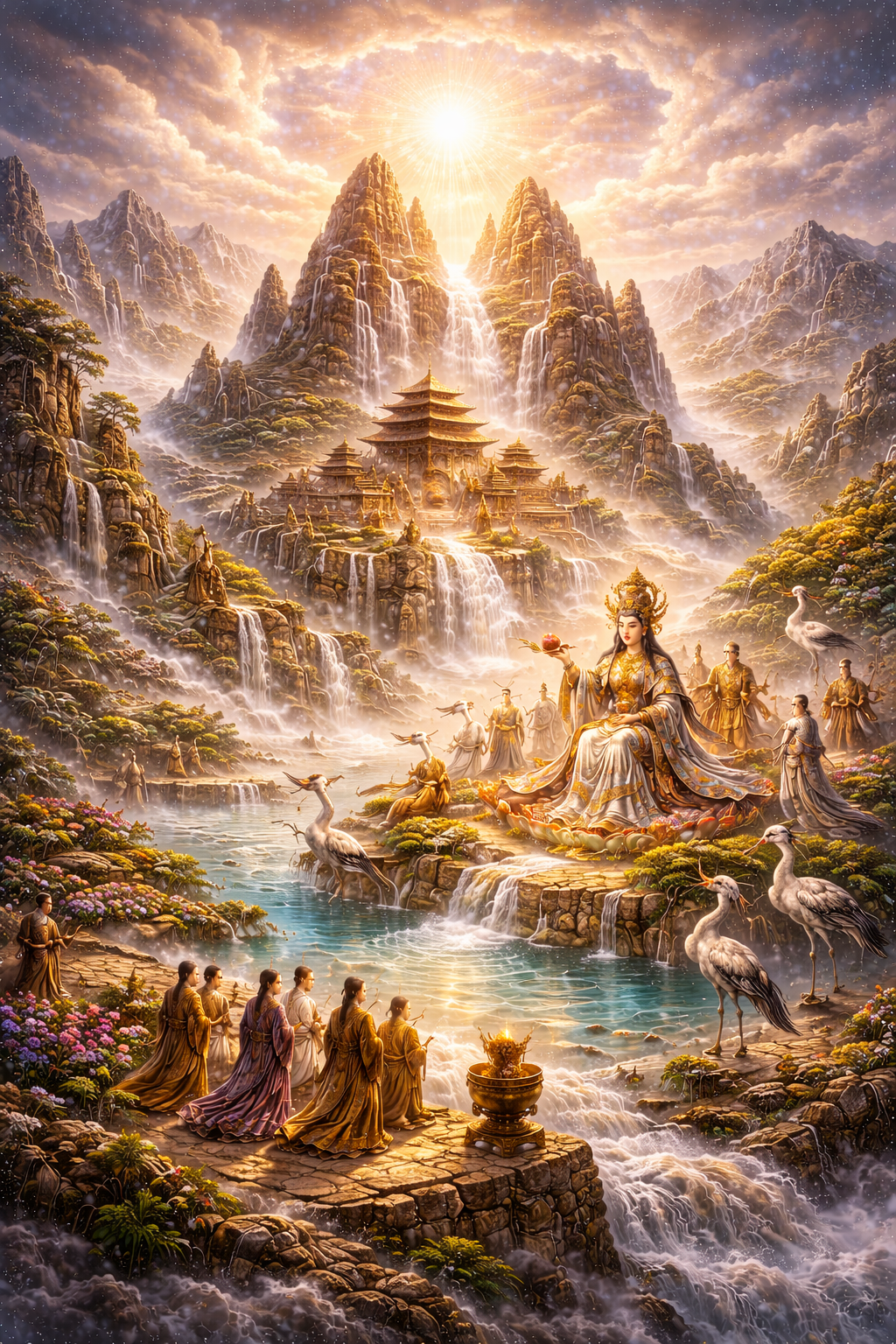
The primary sources do not present Kunlun in one single, fixed, exhaustive description. Rather, they preserve a field of associations. The Shanhaijing gives the western mountains a charged mythic density and places the Queen Mother of the West within that world. Other passages imagine Kunlun as a vast elevated domain, with gates, wells, guardians, extraordinary trees, and divine administration. The Mutianzi zhuan turns the far west into a destination of royal travel and encounter. The Liezi preserves Kunlun within a world of marvel, travel, illusion, and transformation. Later visual, Daoist, and popular traditions intensify these associations, so that Kunlun becomes not only a place in the archive, but one of the great sacred geographies of Chinese civilization.
For this reason, Kunlun must be interpreted source-critically. It is not only a mountain “located” somewhere. It is a mythic geography that shifts across textual layers. Sometimes it is wild, severe, and awe-filled. Sometimes it is courtly and paradisal. Sometimes it is an axis of divine administration. Sometimes it is a destination imagined through royal desire. Sometimes it is the western realm of immortality associated with Xiwangmu. Its importance lies precisely in this ability to hold archaic mountain numinosity, political aspiration, paradise, and transcendence in one continuing field of meaning.
What Is Kunlun?
Kunlun is one of the most important sacred mountains in the Chinese mythic imagination. Yet it is best understood not as a single neatly mappable summit, but as a mythic complex: a western height, range, elevated sacred domain, divine court, and symbolic geography associated with remoteness, wonder, immortality, and access to forms of life beyond ordinary mortality. In the transmitted record, Kunlun is less a simple mountain name than a concentrated symbol of distance and elevation.
This is what gives Kunlun its power. It does not function merely as scenery. It organizes a relation between worlds. To move toward Kunlun is to move toward the edge of the ordinary human realm and toward a zone where kings may seek audience, divine beings may dwell, guardians may stand watch, marvels may appear, and the structure of the world seems to rise toward another order of reality.
Kunlun is therefore a sacred landscape rather than a mere location. In mythic terms, it is a place where geography becomes metaphysics. Height suggests nearness to Heaven. Distance suggests separation from ordinary human life. Westernness suggests remoteness, mystery, and the border of the known. Courtly imagery suggests divine sovereignty. Paradise imagery suggests escape from decay. The mountain becomes meaningful because all these symbolic registers converge upon it.
The best way to read Kunlun is therefore not to ask only “Where is it?” but also “What does it do?” It marks a threshold. It gives the west sacred density. It gives Xiwangmu a world. It gives royal travel a cosmic horizon. It gives immortality a landscape. It gives Chinese mythology one of its most durable images of a world beyond ordinary access.
Kunlun and the Sacred Geography of the West
The west has a special intensity in Chinese mythic geography. It is often a direction of distance, mystery, difficult travel, strange beings, and sacred encounter. Kunlun belongs to that western symbolic field. The farther west one moves in the transmitted imagination, the more likely one is to encounter marvel, divine authority, or transformed space. Kunlun therefore does not stand alone. It belongs to a broader western imaginary in which sacred distance and political aspiration are bound together.
This is important because the west in Chinese myth is not simply emptiness beyond the center. It is charged territory. It may contain dangerous thresholds, paradise courts, extraordinary mountains, divine beings, difficult waters, strange creatures, or the dwelling of powers whose relation to the human world is not immediate. Kunlun becomes one of the supreme signs of that charged geography.
In this sense, Kunlun belongs to the same broad field as other sacred geographies in Chinese myth: mountains that mediate between realms, seas that conceal paradises, caves that open into hidden worlds, rivers that divide ordinary from extraordinary space, and wilderness zones populated by beings who do not fit the settled human order. The west is not merely far away. It is different in kind.
Kunlun’s westernness also gives it political and emotional power. A ruler who reaches toward the west symbolically extends beyond the ordinary center. A seeker who imagines Kunlun imagines a place beyond common limits. A tradition that places Xiwangmu in the west gives divine feminine sovereignty a remote and elevated seat. In each case, distance becomes value.
The Shanhaijing and the Mythic West
The Shanhaijing is indispensable for understanding the mythic west because it preserves a dense western mountain world in which sacred topography and extraordinary beings are inseparable. One of the most important passages places the Queen Mother of Heaven, commonly read in relation to the Queen Mother of the West, at Yushan in the western mountains. There she appears in archaic form, with a human-like appearance but also with leopard tail, tiger teeth, disheveled hair, a headdress, and a relation to heavenly calamities and the Five Disasters. This passage is crucial because it shows that the western sacred world was not originally only gentle paradise. It was also a zone of awe, danger, and divine severity.
Primary Source
又西三百五十里,曰玉山,是西王母所居也。西王母其狀如人,豹尾虎齒而善嘯,蓬髮戴勝,是司天之厲及五殘。A further three hundred fifty li to the west is called Yushan, where the Queen Mother of the West dwells. Her form is like a human’s, but with a leopard’s tail and tiger’s teeth, and she is skilled at howling. With disheveled hair and a headdress, she presides over Heaven’s calamities and the Five Disasters.Shanhaijing, “Western Mountains Classic” 西山經.
This early image of Xiwangmu is not yet the serene paradise queen of later tradition. The western sacred mountain world is fearsome, numinous, and bound to calamity as well as divine presence.
The value of the Shanhaijing lies partly in precisely this complexity. It preserves a west that is not simply beautified transcendence. It is charged, uncanny, and morally potent. Sacred western geography is therefore not reducible to later courtly elegance alone. It begins in a far more archaic register of mountain power and wild divinity.
This early layer is essential for understanding Kunlun because it prevents sentimental simplification. Paradise is not the original or only meaning of the western sacred world. Before Xiwangmu becomes queen of immortals in later Daoist and visual traditions, she appears as a dangerous and awe-inspiring mountain being. The west is not merely pleasant distance. It is holy distance, and holiness here includes terror, severity, and power.
Kunlun as a Vast Sacred Domain
Other Shanhaijing-related passages describe Kunlun not merely as a mountain, but as a vast sacred domain. It has extraordinary scale, gates, wells, trees, guardians, and divine associations. These descriptions matter because they make Kunlun architectural as well as topographical. The mountain becomes a structured realm. It is not simply high; it is organized. It has thresholds, entrances, protectors, and inner powers.
Primary Source
海內崑崙之虛,在西北,帝之下都。崑崙之虛,方八百里,高萬仞。上有木禾,長五尋,大五圍。面有九井,以玉為檻。面有九門,門有開明獸守之,百神之所在。Within the seas lies the waste of Kunlun, in the northwest, the lower capital of the emperor. The waste of Kunlun is eight hundred li square and ten thousand ren high. Upon it grows the grain-tree, five xun tall and five arm-spans around. Around it are nine wells with jade railings. Around it are nine gates, guarded by the enlightened beast. It is the place where the hundred spirits dwell.Shanhaijing, “Classic of Regions Within the Seas: West” 海內西經.
This passage presents Kunlun as a cosmic-political domain: enormous, gated, guarded, cultivated by marvel, and associated with divine administration.
The phrase “lower capital of the emperor” is especially important. It gives Kunlun a political-cosmic function. The mountain is not only a natural height. It is a seat of divine order. It has the structure of a court or capital, but one displaced into sacred geography. The result is a mountain that is also a palace, axis, and administrative center of the more-than-human world.
The nine gates and nine wells also matter symbolically. They make Kunlun a place of ordered access rather than open availability. Gates imply entry, but also restriction. Wells imply sources, depth, and precious enclosure. Jade railings imply sacred refinement. Guardians imply that approach requires permission. The mountain is therefore imagined as a realm with thresholds, not as an open landscape anyone may casually enter.
This is one of the great features of Chinese sacred geography: the sacred place is often both natural and institutional. Kunlun is mountain, but also court; wilderness, but also capital; remote, but also central to another order. Its power lies in this paradox.
Xiwangmu and the Western Paradise
No figure is more important to the sacred west than Xiwangmu, the Queen Mother of the West. In later tradition, her image changes dramatically from the fierce western mountain being of early texts into a sovereign of paradise, immortality, celestial court, and auspicious reception. That later transformation matters because it shows how Kunlun became not only a remote mountain world but a paradise world.
Under Xiwangmu’s sign, the west becomes a place not merely of dread or distance, but of reception, banquet, immortality, and cosmic prestige. The mountain court becomes a realm where selected humans, immortals, or divine beings may encounter an order beyond ordinary mortality. Paradise is not simply natural beauty. It is ordered sacred hospitality: a court, a banquet, attendants, music, precious substances, and the possibility of life transformed beyond common limits.
The association of Xiwangmu with immortality gives Kunlun one of its most enduring meanings. The mountain becomes a geography of longing. It is the place toward which rulers, seekers, poets, painters, and later popular imagination project the desire to overcome decay. The west becomes not simply where the sun descends, but where another mode of existence may be imagined.
This transformation does not erase the earlier Xiwangmu. It overlays her. The leopard-tailed, tiger-toothed being of the Shanhaijing and the later queen of immortals belong to the same long symbolic history. The sacred west is severe before it is serene, dangerous before it is courtly, wild before it becomes paradise. That layered transformation is part of Xiwangmu’s power and part of Kunlun’s depth.
From Fearsome Mountain Being to Queen of Immortals
The transformation of Xiwangmu is one of the clearest examples of how Chinese mythic figures change across time without losing continuity. In early textual contexts, she is awe-inspiring, severe, hybrid, and associated with calamity. In later Daoist and popular religious contexts, she becomes queen of immortals, ruler of a western fairyland, dispenser or guardian of longevity, and sovereign presence in an increasingly elaborate paradise court.
This transformation matters for Kunlun because the mountain’s meaning changes with her. If Xiwangmu is a fearsome mountain being, Kunlun is a wild sacred threshold. If Xiwangmu is queen of immortals, Kunlun becomes a paradise court. If Xiwangmu is represented in mirrors, paintings, rubbings, and ritual imagery, Kunlun becomes a visual and devotional world. The mountain is not static; it is reinterpreted through the changing image of its divine sovereign.
Later summaries of Xiwangmu often emphasize her Daoist mythological role as queen of immortals and her association with a western fairyland. Museum objects from the Han and later periods also show her visual importance: she may appear enthroned, attended, paired with the Lord of the East, and surrounded by mythical creatures. These later images help confirm that her myth was not confined to literature. It entered material culture and visual religious imagination.
The shift from severity to paradisal sovereignty also reveals something important about Chinese mythic development. A figure associated with danger and heavenly punishment can become a figure of longevity and spiritual aspiration. The sacred does not always move in a straight line from fear to comfort, but in Xiwangmu’s case, the west becomes increasingly available as an image of immortality and auspicious transcendence.
Mountain Thresholds and Limits of Access
Kunlun is important not only because it is sacred, but because it is difficult to reach. In descriptions of the western sacred domain, access is repeatedly marked by waters, heights, distances, gates, guardians, and barriers that ordinary movement cannot easily overcome. Even where the details differ across texts, the structural point remains constant: paradise is not locally available. It is set apart.
This separation is crucial to the meaning of sacred geography. A paradise mountain that can be reached casually would not organize longing, prestige, or spiritual difference in the same way. Kunlun’s remoteness is therefore part of its sanctity. The mountain is holy partly because it is not immediately open to ordinary life.
Threshold imagery does important cultural work. Gates imply that approach is possible, but not guaranteed. Guardians imply that access is regulated. Waters imply purification, danger, or separation. Height implies ascent. Distance implies discipline, privilege, or exceptional destiny. Kunlun becomes sacred not simply because beings live there, but because reaching it requires crossing the boundaries that normally hold human beings within the ordinary world.
The same logic helps explain why royal journeys toward Kunlun matter so much. When a king attempts to reach the western sacred realm, the journey dramatizes more than curiosity. It becomes a test of reach: political reach, ritual reach, symbolic reach, and perhaps spiritual reach. The mountain’s difficulty makes arrival meaningful.
King Mu of Zhou and the Desire to Reach Kunlun
The Mutianzi zhuan is one of the most important texts for the political imagination of the sacred west. It narrates the westward expedition of King Mu of Zhou and preserves the king’s journey toward Kunlun and his encounter with the Queen Mother of the West. This material matters because it turns Kunlun into an object of royal desire. The sacred mountain is not only a divine place. It is a place to which kings aspire to travel.
The political implications are substantial. A ruler who reaches the western paradise approaches not merely marvel, but cosmic prestige. The journey becomes a test of reach, legitimacy, and symbolic ambition. King Mu’s travel westward suggests that political sovereignty seeks confirmation beyond the ordinary center. The king desires an audience at the edge of the world because the sacred west holds a form of recognition unavailable within ordinary rule alone.
Primary Source
天子觴西王母于瑤池之上。西王母為天子謠。The Son of Heaven held a banquet with the Queen Mother of the West beside the Jade Pond. The Queen Mother of the West sang for the Son of Heaven.Mutianzi zhuan 穆天子傳.
The King Mu tradition makes the sacred west a site of royal encounter. Kunlun and its associated paradise become politically charged through audience, banquet, and song.
The banquet scene is especially revealing. It is not a battle, conquest, or extraction of tribute. It is an encounter structured by courtly exchange. The king reaches a divine world and is received by its sovereign. The result is a political theology of travel: the ruler’s journey expands sovereignty toward the sacred horizon, but the sacred horizon remains under the authority of another power.
The later Liezi preserves the westward motion of King Mu as well, linking the royal journey to Kunlun with a broader world of marvel and transformation. This helps confirm how durable the association became between western travel, sacred mountain space, royal imagination, and the instability of ordinary perception at the edge of the world.
Kunlun as Axis, Court, and Otherworld
Kunlun gathers together several symbolic functions at once. It is a mountain, but also a courtly domain. It is remote, but also a center of another order. It is western and marginal relative to ordinary political space, yet it may function as a cosmic axis of ascent and meeting. This is one reason the mountain becomes so generative in later tradition. It is capable of holding topography, theology, court ritual, and transcendence in one image.
Such symbolic concentration makes Kunlun more than a simple setting. It becomes a model of how sacred space works in Chinese myth. The highest mountain is also a palace. The farthest west is also a center. The border of the>Such symbolic concentration makes Kunlun more than a simple setting. It becomes a model of how sacred space works in Chinese myth. The highest mountain is also a palace. The farthest west known world is also the place where another, more ultimate order is encountered.
This paradox gives Kunlun its enduring power. Ordinary geography measures importance from the political center outward. Sacred geography can invert that logic. The margin becomes a center because it is closer to divine presence. Distance becomes authority. Remoteness becomes prestige. A place beyond ordinary access becomes a place of intensified meaning.
The courtly dimension is equally important. Kunlun is not merely wild transcendence. It can be imagined as ordered, guarded, and administratively structured. This distinguishes it from a simple wilderness paradise. It is not only nature beyond society; it is a higher or stranger form of order, complete with gates, guardians, divine residents, and ceremonial encounter.
Paradise, Immortality, and the Western Imaginary
The later western paradise associated with Xiwangmu turns Kunlun into one of the great landscapes of immortality. Once the Queen Mother of the West becomes a sovereign of immortals, the western mountain domain becomes linked to long life, banquet imagery, celestial attendants, peaches of immortality, and the suspension of ordinary human limits. The paradise mountain is thus not merely politically prestigious. It becomes existentially charged. It is a place where mortality itself is reimagined.
This helps explain the longevity of Kunlun in Chinese tradition. The mountain is powerful because it speaks to multiple desires at once: the desire for access to divine authority, the desire for a world beyond decay, the desire for an audience beyond ordinary history, the desire for sacred orientation in space, and the desire for a realm in which human limits may be overcome.
Kunlun also gives immortality a geography. Longevity is not only an abstract condition. It is imagined as spatially located: in gardens, courts, mountains, ponds, banquets, fruits, attendants, and divine landscapes. This spatialization matters because it makes transcendence visible. The longing for immortality becomes a journey, a view, a court, a mountain, a place.
The western imaginary therefore moves between distance and intimacy. Kunlun is far away, but its images entered art, ritual, literature, and popular imagination. The more unreachable it became in mythic terms, the more available it became as a symbolic resource. It could be painted, carved, recited, dreamed, invoked, and reinterpreted.
Kunlun, Water, and the Geography of Impossible Access
Kunlun is often imagined not only through height and distance, but through difficult waters. Later textual memory connects the western sacred world with Weak Water, flowing sands, Jade Pond, and other barriers or thresholds that ordinary human movement cannot easily cross. These water motifs deepen Kunlun’s meaning because they make access not merely far but structurally difficult. One must cross not just space, but the boundary between kinds of existence.
Weak Water is especially revealing. Traditions describe it as a water so insubstantial or strange that ordinary buoyancy fails. Whether read literally, symbolically, or as inherited marvel geography, the motif expresses a crucial idea: the approach to Kunlun is governed by different rules. The ordinary technologies of travel do not suffice. The sacred west resists normal navigation.
The Jade Pond, by contrast, gives western water a courtly and paradisal meaning. It is not only a barrier but a place of encounter. In the King Mu tradition, banquet beside the Jade Pond transforms western water into ceremonial space. Water separates, but it also receives. It marks the edge of access and the possibility of audience.
These water motifs link Kunlun to a broader Chinese mythic geography in which rivers, seas, floodwaters, underworld streams, dragon palaces, and island paradises organize the boundary between ordinary and extraordinary worlds. Sacred water is rarely just water. It is route, obstacle, mirror, threshold, danger, and promise.
Kunlun in Later Daoist and Visual Tradition
Later Daoist and visual traditions greatly deepen Kunlun’s prestige. Museum materials on Xiwangmu and on depictions of King Mu’s visit show that the Queen Mother of the West became a major subject of visual culture, courtly imagination, and religious symbolism. By the Han period and later, mirrors, paintings, rubbings, and other objects could present her in a western paradise setting, often paired with the Lord of the East or associated with an immortal court.
This later visual life matters because it confirms that Kunlun was never only textual. It became image, icon, and ritual-symbolic landscape. The mountain paradise moved from archive into art. That movement is one of the clearest signs that Kunlun belongs to the durable sacred geography of Chinese civilization rather than to a marginal literary curiosity.
The visual tradition also organizes Kunlun’s meanings in ways that prose alone cannot. A seated queen, attendants, mythical creatures, courtly arrangement, mountain setting, and symbolic objects make divine sovereignty visible. The viewer does not merely read that Xiwangmu rules a western paradise; the image stages that rule. Kunlun becomes a compositional world.
Daoist and visual traditions also amplify the theme of cosmic pairing. The Queen Mother of the West may be paired with the Lord of the East, creating a larger symbolic order of western and eastern powers, female and male celestial sovereignty, immortality, and cosmic balance. Kunlun thus belongs not only to geography but to the ordered imagination of the universe.
Kunlun and the Politics of Sacred Distance
Kunlun’s sacred distance also has political meaning. The mountain is not merely where immortals dwell; it is where rulers imagine contact with an authority beyond ordinary court life. King Mu’s westward journey makes this explicit, but the logic extends more broadly. The political center looks westward because the center is not self-sufficient. It seeks recognition from the sacred edge.
This reverses ordinary political geography. Normally the ruler sits at the center and others come to him. In the Kunlun tradition, the ruler travels outward toward a sacred court that exceeds him. This movement is revealing. It suggests that kingship, however powerful, remains incomplete before the more-than-human. A ruler may command armies and govern territory, but he must still approach the divine realm as guest, seeker, or petitioner.
Kunlun therefore helps define the limits of political power. The sacred west is alluring to rulers precisely because it is not simply subject to them. It confers prestige, but it cannot be reduced to possession. It may receive the king, but it remains its own world. In this sense, Kunlun preserves a boundary that politics cannot fully absorb.
This is one reason the mountain remains so important for mythic thought. It provides a space where sovereignty encounters something higher, stranger, or more enduring than itself. Kunlun is the place where political ambition meets sacred remoteness.
Source History and Interpretive Caution
A careful reading of Kunlun must distinguish among different historical layers and symbolic registers. The Shanhaijing preserves an archaic western divine geography in which the Queen Mother appears in a more fearsome form and Kunlun appears as a vast sacred domain. The Mutianzi zhuan introduces the political and courtly west through the royal journey. The Liezi transmits further western travel associations and marvels. Later Daoist and visual traditions elevate Xiwangmu into the queen of immortals and intensify the paradisal meaning of the west.
These layers are not contradictions to be eliminated. They are the history of the symbol. Kunlun remains important precisely because it can hold archaic mountain numinosity, royal aspiration, divine administration, paradise, and immortality in one continuing field of meaning. The west changes, but it does not cease to be sacred.
It is also important not to force Kunlun into a single geographic referent. Modern mountain ranges named Kunlun may invite comparison, and some traditions may reflect memories of western ranges, trade routes, or distant landscapes. But mythic Kunlun is not exhausted by topographic identification. Its function in the archive is symbolic, religious, political, and literary as well as geographic.
Kunlun should therefore be read as sacred geography: a cultural landscape that may draw on real spatial knowledge while exceeding it through mythic elaboration. Its truth lies not only in where it might be placed on a map, but in how it organizes longing, sovereignty, danger, immortality, and the imagination of another order beyond ordinary reach.
Why Kunlun Still Matters
Kunlun still matters because it preserves one of the grandest spatial ideas in Chinese myth: that the world contains a sacred height beyond ordinary access where divine sovereignty, immortality, and the longing for another order are concentrated. It is one of the places where geography is most fully transformed into symbolic form.
It also matters because it reveals how Chinese myth imagines distance. The far west is not void but value. The remote mountain is not absence but presence. Under the sign of Kunlun, remoteness becomes sacred possibility. That is why the mountain continues to matter not only as a mythic landmark, but as one of the deepest figures of paradise and western transcendence in the Chinese tradition.
Kunlun also matters because it shows how mythic geography can preserve multiple histories at once. It holds the fearsome Xiwangmu of early mountain literature, the paradise queen of later Daoist tradition, the royal journey of King Mu, the divine court of immortal imagination, and the visual culture of mirrors, paintings, rubbings, and sacred scenes. Few mythic landscapes are so capacious.
Finally, Kunlun matters because it teaches that sacred place is not always near, familiar, or domesticated. Sometimes the holy appears as distance, height, danger, barrier, court, and longing. Kunlun is the mountain of that longing: the sacred west where ordinary geography opens toward paradise, sovereignty, and the more-than-human.
Related Reading
- Chinese Myth, Folklore & Legend
- What Is Chinese Myth, Folklore & Legend?
- The Problem of Sources in Chinese Mythology
- Reading the Shanhaijing: Mythic Geography, Strange Beings, and Sacred Space
- Mythic Allusion and Cosmology in the Chu ci
- The Huainanzi and the Philosophical Ordering of Myth
- The Queen Mother of the West and the Imagery of Immortality
- Daoism, Immortality, and the Supernatural Imagination
Primary Sources
- Chinese Text Project (n.d.) Shanhaijing: Xishan jing 山海經:西山經 / Western Mountains Classic. Available at: https://ctext.org/shan-hai-jing/xi-shan-jing
- Chinese Text Project (n.d.) Shanhaijing: Hainei xi jing 山海經:海內西經 / Classic of Regions Within the Seas: West. Available at: https://ctext.org/shan-hai-jing/hai-nei-xi-jing
- Chinese Text Project (n.d.) Mutianzi zhuan 穆天子傳 / Transmission of the Son of Heaven Mu. Available at: https://ctext.org/mutianzi-zhuan/ens
- Chinese Text Project (n.d.) Liezi: Zhou Mu Wang 列子:周穆王. Available at: https://ctext.org/liezi/zhou-mu-wang
- Chinese Text Project (n.d.) Liezi: Tang Wen 列子:湯問. Available at: https://ctext.org/liezi/tang-wen
- Chinese Text Project (n.d.) dictionary entry preserving parallel notices on Kunlun, Weak Water, Yushan, and the Queen Mother of the West. Available at: https://ctext.org/dictionary.pl?chapter=135156&if=en&sid=1970&trid=4078450
Further Reading
- Chinese Text Project (n.d.) Shanhaijing: Xishan jing. Available at: https://ctext.org/shan-hai-jing/xi-shan-jing
- Chinese Text Project (n.d.) Shanhaijing: Hainei xi jing. Available at: https://ctext.org/shan-hai-jing/hai-nei-xi-jing
- Chinese Text Project (n.d.) Mutianzi zhuan. Available at: https://ctext.org/mutianzi-zhuan/ens
- Chinese Text Project (n.d.) Liezi: Zhou Mu Wang. Available at: https://ctext.org/liezi/zhou-mu-wang
- Chinese Text Project (n.d.) Liezi: Tang Wen. Available at: https://ctext.org/liezi/tang-wen
- Encyclopaedia Britannica (n.d.) “Xiwangmu.” Available at: https://www.britannica.com/topic/Xiwangmu
- The Metropolitan Museum of Art (n.d.) “Visit of Mu Wang to Xi Wang Mu, the Western Queen Mother.” Available at: https://www.metmuseum.org/art/collection/search/61496
- The Metropolitan Museum of Art (n.d.) “Mirror with Queen Mother of the West, Lord of the East, and mythical creatures.” Available at: https://www.metmuseum.org/art/collection/search/49527
- Cahill, S.E. (1993) Transcendence and Divine Passion: The Queen Mother of the West in Medieval China. Stanford: Stanford University Press.
- Birrell, A. (1993) Chinese Mythology: An Introduction. Baltimore: Johns Hopkins University Press. Available at: https://archive.org/details/chinesemythology0000birr
- Yang, L. and An, D. (2005) Handbook of Chinese Mythology. Santa Barbara: ABC-CLIO. Available at: https://archive.org/details/handbookofchines0000yang
References
- Birrell, A. (1993) Chinese Mythology: An Introduction. Baltimore: Johns Hopkins University Press. Available at: https://archive.org/details/chinesemythology0000birr
- Cahill, S.E. (1993) Transcendence and Divine Passion: The Queen Mother of the West in Medieval China. Stanford: Stanford University Press.
- Chinese Text Project (n.d.) Liezi: Tang Wen. Available at: https://ctext.org/liezi/tang-wen
- Chinese Text Project (n.d.) Liezi: Zhou Mu Wang. Available at: https://ctext.org/liezi/zhou-mu-wang
- Chinese Text Project (n.d.) Mutianzi zhuan. Available at: https://ctext.org/mutianzi-zhuan/ens
- Chinese Text Project (n.d.) Shanhaijing: Hainei xi jing. Available at: https://ctext.org/shan-hai-jing/hai-nei-xi-jing
- Chinese Text Project (n.d.) Shanhaijing: Xishan jing. Available at: https://ctext.org/shan-hai-jing/xi-shan-jing
- Chinese Text Project (n.d.) dictionary entry preserving parallel notices on Kunlun, Weak Water, Yushan, and the Queen Mother of the West. Available at: https://ctext.org/dictionary.pl?chapter=135156&if=en&sid=1970&trid=4078450
- Encyclopaedia Britannica (n.d.) “Xiwangmu.” Available at: https://www.britannica.com/topic/Xiwangmu
- The Metropolitan Museum of Art (n.d.) “Mirror with Queen Mother of the West, Lord of the East, and mythical creatures.” Available at: https://www.metmuseum.org/art/collection/search/49527
- The Metropolitan Museum of Art (n.d.) “Visit of Mu Wang to Xi Wang Mu, the Western Queen Mother.” Available at: https://www.metmuseum.org/art/collection/search/61496
- Yang, L. and An, D. (2005) Handbook of Chinese Mythology. Santa Barbara: ABC-CLIO. Available at: https://archive.org/details/handbookofchines0000yang