
Last Updated May 5, 2026
Shennong occupies a decisive place in Chinese myth because he stands at the point where the human world becomes materially sustainable. In the transmitted tradition, his significance lies not in cosmic separation, as with Pangu, nor in cosmic repair, as with Nüwa, nor in the first structuring of marriage and symbolic order, as with Fuxi, but in the establishment of those practices by which communities may endure through time: cultivation, nourishment, herbological discernment, exchange, and the stewardship of settled life. He is a figure of subsistence, and therefore a figure of civilization in one of its most concrete forms.
Within the broader sequence of Chinese cosmogonic and civilizational figures, Shennong marks the passage from ordered existence to cultivated existence. The world becomes not only structured and symbolically legible, but provisioned. A cosmos separated by Pangu, repaired by Nüwa, and patterned by Fuxi remains incomplete unless people can eat, heal, store, exchange, and survive across seasons. Shennong’s mythic domain is therefore not secondary to civilization. It is foundational. Food, medicine, agriculture, plant knowledge, and the political economy of sustenance are the conditions under which human order can persist.
Article Map
Chinese Myth, Folklore & Legend
Related Topic
Fuxi & Cultural Order
Series context: This article is part of the Chinese Myth, Folklore & Legend knowledge series. It should be read alongside Pangu and the Separation of Heaven and Earth, Nüwa: Creation, Repair, and the Human World, and Fuxi and the Myth of Cultural Order. Within that sequence, Shennong represents the emergence of agriculture, plant knowledge, food security, medicinal discernment, and the material foundations of communal life.
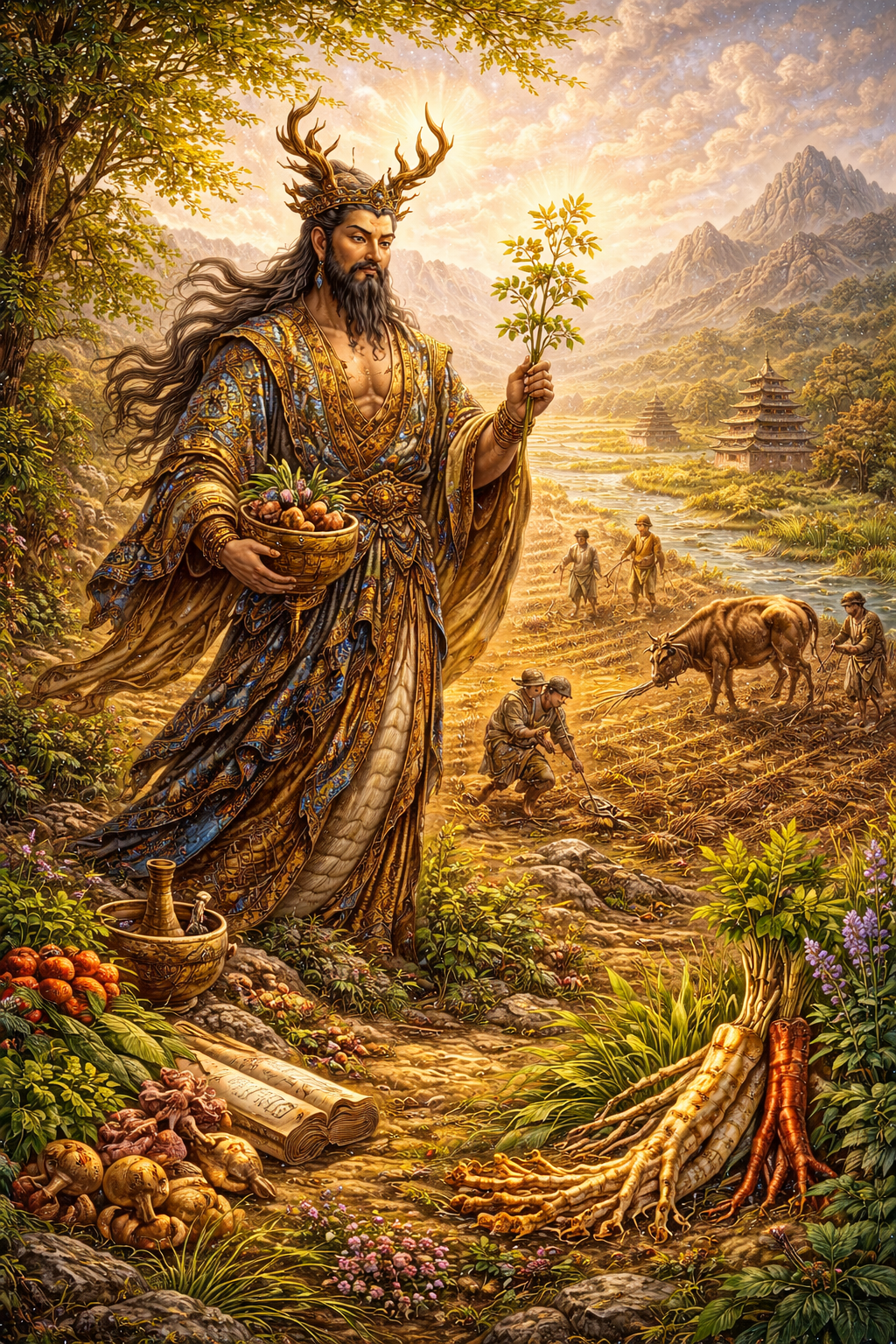
The most important point of departure is the classical record itself. In the Han shu, the “Shihuo zhi shang” identifies food and goods as the foundations of the people’s life and states that these begin in the age of Shennong. The text then cites the familiar formulation that wood was cut to make the si and bent to make the lei, and that the benefit of plowing was thereby taught to the world. The same passage links these beginnings to adequate food, the circulation of goods, the substantiality of the state, the prosperity of the people, and the completion of instruction. Shennong’s significance, then, is not simply that later tradition remembered him as an agricultural founder. A transmitted classical history already places him at the beginning of the material arts on which ordered life depends.
Shennong is also one of the great figures through whom Chinese tradition imagines the moral seriousness of practical knowledge. To cultivate is not merely to exploit the earth. To test herbs is not merely to gather useful substances. To feed and heal a people requires observation, discipline, embodied risk, seasonal intelligence, and a willingness to read the living world closely. Shennong’s myth therefore joins agriculture, medicine, governance, and care into a single civilizational problem: how can human beings live well within the generative but dangerous powers of the earth?
Who Is Shennong?
Shennong, the Divine Farmer, is one of the great early rulers or primordial culture heroes of Chinese tradition. In later summaries of the myth, he is presented as an agricultural founder and as a figure associated with medicinal plants, but his deeper importance lies in the way these domains are joined. Cultivation and healing belong together because both concern the relation between human beings and the vegetal world. One secures nourishment; the other secures restoration. Under Shennong’s name, the earth is rendered not merely fertile but intelligible.
That conjunction should be taken seriously. Chinese myth does not treat subsistence as a merely technical matter beneath the dignity of cosmology. On the contrary, the securing of food and health is among the highest tasks of ordered life. Shennong matters because he gives mythic form to the proposition that civilization depends upon sustained and knowledgeable intercourse with the material conditions of existence.
Shennong’s mythic identity is therefore double. He is an agricultural teacher who makes settled life possible through cultivation, tools, and seasonal labor. He is also a medicinal ancestor whose name legitimates the careful study of plants, roots, minerals, flavors, toxicities, and healing properties. These are not disconnected roles. They belong to the same larger vision: the human community survives by learning how to read the earth.
The name “Divine Farmer” captures this unity. Shennong is divine not because farming is lowly and needs elevation, but because farming itself is sacredly foundational. To cultivate is to enter a disciplined relation with soil, season, plant life, weather, storage, hunger, vulnerability, and future time. Agriculture is a way of binding human life to recurrence and care.
The Classical Basis for Shennong’s Significance
The strongest classical anchor for Shennong’s agrarian significance is the “Shihuo zhi shang” of the Han shu. There the text states that the two foundations of the people’s life are food and goods, and that these arose from the age of Shennong. The cited lines on cutting wood to make the plow and bending wood to make the spade do not appear as antiquarian decoration. They are embedded in a larger argument about the material basis of governance, the enrichment of the people, and the formation of social order. Agriculture is thus placed at the beginning of political economy itself.
Primary Source
食貨者,生民之本,興自神農之世。斲木為耜,揉木為耒,耒耨之利,以教天下,而食足;日中為市,致天下之民,聚天下之貨,交易而退,各得其所,而貨通。Food and goods are the foundation of the people’s life, and they arose from the age of Shennong. Wood was cut to make the si; wood was bent to make the lei. The benefit of plowing and weeding was taught to all under heaven, and food became sufficient. At midday markets were held, bringing together the people under heaven and gathering goods from all under heaven; they exchanged and withdrew, each obtaining what was fitting, and goods circulated.Han shu, “Shihuo zhi shang” 食貨志上.
The passage makes Shennong central not only to farming, but to the wider order of food, goods, exchange, social sufficiency, and governance.
This context is essential. Shennong in the classical record is not merely a picturesque inventor of rustic tools. He is a figure through whom the moral and political centrality of food production is articulated. Once food is secure and exchange becomes possible, the text says, the state becomes substantial, the people become prosperous, and instruction can be accomplished. The agrarian act is therefore already a civilizational act.
The Yijing tradition preserves a closely related formulation, placing Shennong after the age of Baoxi or Fuxi and linking him to plowing, markets, exchange, and the ordering of economic life. This situates Shennong not in isolation, but within a sequence of culture-making figures whose inventions deepen the capacity of human beings to inhabit the world.
Primary Source
包犧氏沒,神農氏作。斲木為耜,揉木為耒,耒耨之利,以教天下,蓋取諸益。日中為市,致天下之民,聚天下之貨,交易而退,各得其所,蓋取諸噬嗑。When Baoxi had passed, Shennong arose. He cut wood to make the si and bent wood to make the lei. The benefit of plowing and weeding was taught to all under heaven; this was likely taken from the pattern of Yi. At midday he made markets, bringing together the people under heaven and gathering goods from all under heaven; they exchanged and withdrew, each obtaining what was fitting; this was likely taken from the pattern of Shike.Yijing, “Xici xia” 繫辭下.
The passage places Shennong after Fuxi/Baoxi and presents agriculture and exchange as civilizational inventions grounded in symbolic pattern.
These classical anchors show why Shennong deserves careful treatment. His mythic significance is not limited to a later romantic image of a divine herbalist. He belongs to a deep tradition in which subsistence, tools, exchange, and governance are all traced to a culture hero whose work makes collective survival possible.
Agriculture and the Ordering of Subsistence
To associate Shennong with the plow is to say more than that he improved efficiency. Agriculture marks a transformation in humanity’s relation to earth, season, and time. Cultivation requires repeated labor, attentiveness to cycles, knowledge of soils, and dependence upon order beyond the instant of consumption. Hunting may sustain; agriculture stabilizes. The field binds human life to recurrence and foresight.
Shennong’s mythic role therefore concerns the ordering of subsistence. He stands at the point where human communities cease merely to endure from moment to moment and begin to inhabit a patterned regime of sowing, tending, harvesting, storing, and surviving across seasons. In this sense, Shennong is not simply a patron of farming. He is the founder of temporal discipline in relation to the land.
That is also why agriculture is inseparable from the broader structure of mythic civilization. A people may possess marriage order and symbolic forms, but without grain they remain precarious. Shennong’s contribution is the conversion of a habitable world into a sustaining one. He gives human society a rhythm of provision.
Agriculture also changes the meaning of place. A landscape is no longer merely traversed, hunted, or feared. It is cultivated. Soil becomes a medium of memory because work returns to it season after season. The field becomes a social institution, not only a physical location. Under Shennong’s sign, the earth becomes a partner in civilizational time.
The myth therefore preserves an agrarian understanding of knowledge. To farm is to observe differences: wet and dry, early and late, fertile and exhausted, edible and inedible, seed and weed, weather and season. This same discriminating attention prepares the way for Shennong’s medicinal role. Farming and herbology share a single epistemology of careful relation to plants.
Food, Goods, and Political Economy
The Han shu passage is especially striking because it joins food and goods. It does not treat agriculture as a private household matter, nor does it treat exchange as a later, separate economic development. Food production and the circulation of goods are presented together as the foundation of social life. Shennong’s age becomes the mythic beginning not only of farming, but of material circulation.
This gives Shennong a place in the mythic prehistory of political economy. Food must be grown; goods must move; exchange must allow people to obtain what they lack; markets must gather dispersed resources into social circulation. The result is not merely abundance, but order. A society that can feed itself and exchange goods can stabilize households, governance, teaching, ritual, and public life.
In this respect, Shennong’s mythic importance extends far beyond the image of a farmer with tools. He represents the emergence of a material system. The plow, the market, the exchange of goods, and the enrichment of the people are all part of one civilizational sequence. Agriculture makes surplus possible; exchange makes distribution possible; governance becomes answerable to both.
This is why the classical passage deserves to be read slowly. It does not say only that Shennong taught farming. It says that food and goods are the roots of the people’s life. The mythic founder of agriculture is therefore also a founder of social durability. Without sustenance and circulation, there can be no stable civilization.
Shennong and the Political Meaning of Food
The Han shu passage does not isolate agricultural technique from governance. Food abundance, circulation of goods, state solidity, popular prosperity, and the completion of teaching are placed in a continuous sequence. The implication is unmistakable: rule is answerable to subsistence. Political order cannot be abstracted from the means of life.
Shennong’s significance thus extends beyond agronomy into political thought. He is remembered as a ruler because the provision of food is one of the first obligations of rule. In this respect, Chinese myth preserves a conception of sovereignty rooted not primarily in domination or command, but in the securing of the material basis of communal survival. The ruler’s greatness lies in making endurance possible.
This theme gives Shennong a distinctive place among early civilizational figures. Fuxi orders kinship and symbol; Shennong orders nourishment. The former gives form to society; the latter gives it continuity. Together they show that civilization is not made by one invention, but by a series of patterned supports: relation, symbol, food, exchange, healing, and governance.
The political meaning of food also foregrounds vulnerability. Hunger is not simply a biological problem. It destabilizes families, communities, ritual obligations, moral education, and political authority. To secure food is therefore to secure the conditions under which other forms of culture can exist. Shennong’s myth insists that the most material needs are also among the most morally significant.
That insight remains central. A society that celebrates law, ritual, literature, and philosophy while neglecting the conditions of nourishment is incomplete. Shennong’s myth pushes civilization back toward its foundations: soil, grain, labor, exchange, and the bodies of the people.
The Divine Farmer and the Knowledge of Plants
The agrarian significance of Shennong opens naturally into the medicinal one. A figure remembered for teaching cultivation is also well placed to become the primordial knower of plants. The same earth that yields grain yields remedies and poisons. The same attention to growth, season, and differentiation that underlies agriculture also underlies pharmacological discernment. Shennong’s dual identity as cultivator and herbological authority is therefore internally coherent.
Later tradition makes this point forcefully by connecting his name to a corpus of medicinal substances and to the classification of their properties. Whether the specific traditions attached to him are early or late in textual form, their mythic logic is clear: the vegetal world becomes a field of knowledge under Shennong’s sign. He is the figure who first reads the earth as a pharmacopeia.
This matters because plant knowledge is ambiguous. Plants nourish, cure, intoxicate, poison, strengthen, weaken, and transform the body. The world of vegetation is not simply benevolent. It must be interpreted. Shennong’s medicinal role therefore depends on discrimination. He knows not merely that plants are useful, but that they differ in potency, effect, danger, and relation to the body.
The Divine Farmer is thus a figure of ecological literacy. He does not stand apart from the living world as a detached ruler. He enters into relation with plants through cultivation, testing, classification, and use. His authority comes from intimate knowledge of life’s material supports.
This connection between food and medicine also reveals a major theme in Chinese healing traditions: nourishment and restoration are continuous. The boundary between diet, medicine, cultivation, and health is porous. Shennong’s mythic role anticipates this continuity by placing agricultural and medicinal knowledge under one civilizational name.
The Shennong bencaojing and Herbological Authority
The medicinal dimension of Shennong’s myth is best treated through the received Shennong bencaojing tradition. The title, often translated as the Divine Farmer’s Classic of Materia Medica, places herbological authority under Shennong’s name. A scholarly reading must distinguish between mythic attribution and textual history. The text should not be cited as if it were the direct autograph of a primordial emperor. It should be read as a primary witness to the authority later Chinese tradition vested in the name Shennong.
That distinction strengthens rather than weakens the interpretation. The attribution itself is historically meaningful. To organize materia medica under Shennong’s name is to claim that medicinal knowledge belongs at the foundation of civilization and that its legitimacy is primordial. The herbological archive does not merely borrow a mythic name ornamentally. It inscribes its knowledge within a genealogy of civilizational origin.
For that reason, the Shennong bencaojing matters on two levels at once: as a transmitted text in the history of Chinese medicine, and as evidence for the enduring mythic force of Shennong as guarantor of plant knowledge. Its authority lies not only in individual entries, but in the broader cultural decision to imagine pharmacological order as a legacy of the Divine Farmer.
The work’s classification of substances also extends the logic of discernment associated with Shennong. Herbs and substances are not simply gathered in an undifferentiated list. They are sorted, valued, and understood in relation to bodily effects. This is precisely the movement from raw encounter to organized knowledge that defines Shennong’s mythic role.
In this sense, the Shennong bencaojing is not merely a medical title. It is a monument to a civilizational claim: the knowledge of plants is foundational enough to be remembered under the name of a culture hero.
Testing Herbs, Risk, and the Ethics of Knowledge
Later tradition strongly associates Shennong with the testing of herbs. Even when this motif is preserved in received medical memory rather than early classical narrative, its conceptual importance is substantial. The image is one of direct bodily encounter with the plant world, where remedy and poison must be distinguished through exposure, discernment, and repeated trial. Knowledge is not passively inherited. It is won through risk.
This is a significant mythic epistemology. Shennong becomes not merely a transmitter of revealed wisdom but an exemplar of inquiry. His authority rests upon encounter with the material world. In this respect, the myth preserves an ideal in which knowledge worthy of preserving is knowledge tested against consequences.
The figure of the Divine Farmer thus contains an ethics of responsibility. To feed and to heal require more than invention; they require discrimination. Plants are not simply given as gifts. They must be understood in their specific properties, and such understanding may exact a bodily cost. Shennong’s greatness lies partly in assuming that cost on behalf of the human community.
This motif also makes Shennong different from culture heroes whose gifts are purely technical. The net, plow, or trigram may be invented or revealed, but herbological knowledge requires bodily vulnerability. The knower must risk misreading the world. A poisonous plant teaches through danger. A medicinal root teaches through effect. Shennong’s body becomes the testing ground through which the community learns.
That image is ethically powerful because it imagines knowledge as service. The culture hero does not merely command others to labor. He exposes himself to uncertainty so that others may live. This is one of the reasons Shennong remains such a compelling figure: he joins authority to sacrifice, knowledge to care, and discovery to bodily risk.
Poison, Remedy, and Discernment
The Shennong tradition also teaches that the same world that nourishes can harm. This is one of the deepest insights of herbological mythology. Plants are not automatically gifts. They are powers. A root may heal or poison; a leaf may strengthen or weaken; a substance may be safe in one context and dangerous in another. The world must therefore be read with care.
This gives Shennong a place in the mythic history of discernment. He is not only a gatherer or farmer, but a classifier of effects. The practical question is never simply “What is this plant?” but “What does this plant do, to which body, in what amount, under what conditions?” Myth turns this difficulty into a story of heroic testing.
Discernment is also a moral matter. A society that cannot distinguish remedy from poison is vulnerable. A healer who cannot distinguish effect from appearance may harm those who seek help. Shennong’s authority therefore rests not on possession of secret knowledge alone, but on the disciplined capacity to differentiate. His myth transforms the vegetal world from an undifferentiated field into an ordered domain of consequences.
This has wider implications for Chinese myth. Fuxi reads heaven and earth into symbols; Shennong reads plants into nourishment and medicine. Both figures are culture heroes of pattern recognition. One gives humanity a symbolic grammar of change. The other gives humanity a practical grammar of survival.
In a world where poison and remedy can arise from the same earth, civilization depends on the ethics of interpretation. Shennong’s myth reminds readers that knowledge is not abstraction. It is a form of care applied to danger.
Shennong in the Sequence of Civilizational Figures
Within the larger architecture of Chinese myth, Shennong belongs to a sequence rather than to an isolated origin. Pangu gives distinction to the cosmos. Nüwa restores a broken world and protects the human condition. Fuxi brings pattern to social and symbolic order. Shennong deepens that order by securing the means of subsistence and the beginnings of medicinal knowledge. Civilization, in this archive, is cumulative.
That sequence is intellectually important. It shows that Chinese myth does not reduce origin to a single first moment. Human life becomes durable through successive forms of order: cosmic, reparative, social, agrarian, medicinal, and political. Shennong’s role is indispensable because food and healing are conditions without which all earlier order remains fragile.
He therefore marks a stage at which myth becomes materially intimate. The greatness of the founder is measured by his relation to plowed earth, edible grain, remedial roots, and the bodies of the people. Shennong’s myth brings civilization down from cosmic heights into soil, hunger, medicine, and seasonal work.
This is not a demotion from the mythic to the practical. It is a recognition that the practical is mythically foundational. If Pangu opens the world and Nüwa repairs it, Shennong teaches people how to live from it. His myth insists that the highest questions of order cannot be separated from the question of whether people can eat and heal.
In this sequence, Shennong also prepares the way for later legendary rulers and sage-kings. Once food, medicine, tools, exchange, and social forms exist, the human world becomes capable of political memory. Shennong is therefore not only a founder of agriculture. He is a bridge between cosmogonic myth and legendary history.
Source History and Attribution
A properly scholarly treatment of Shennong must distinguish between the classical agrarian references and the later textual crystallization of his medical authority. The Han shu provides a transmitted historical witness to the association of Shennong with the beginning of agrarian technique and with the foundational relation between food and governance. The Yijing tradition similarly places Shennong in a sequence of civilizational inventions, linking plowing, markets, and exchange to patterned order. The Shennong bencaojing provides a received herbological tradition organized under his name, but in a bibliographic and edited form that belongs to later textual history.
This distinction is not an obstacle to interpretation. It is the condition of accurate interpretation. Shennong is not a single textual figure frozen in one document. He is a civilizational name under which different domains of foundational knowledge were gathered: cultivation, plant use, healing, exchange, and the stewardship of life. The history of attribution is itself part of the myth’s significance.
One should therefore avoid two equal errors: treating later medical texts as direct records of primordial antiquity, and dismissing them as if late transmission rendered them irrelevant. Their value lies in showing how Chinese civilization chose to remember the origins of herbological authority. The attribution to Shennong is a claim about cultural foundations, even when the received text belongs to later editorial history.
Source history also reveals how myth survives by extension. A figure associated with agriculture becomes associated with medicine because both belong to the same field of plant knowledge. A culture hero associated with feeding the people becomes a guarantor of healing because both food and medicine answer bodily vulnerability. The name Shennong gathers these meanings across time.
For Chinese myth studies, Shennong is therefore a major example of how civilizational memory works. Mythic authority does not remain confined to one story. It expands across domains where a society needs foundational legitimacy: agriculture, medicine, economy, governance, and the ethics of care.
Modern Afterlives of Shennong
Shennong remains visible in modern accounts of Chinese mythology, traditional medicine, herbal knowledge, agriculture, cultural heritage, and popular retellings. He is often summarized as the Divine Farmer who taught agriculture and tasted hundreds of herbs. Those summaries are useful, but they can also flatten him. His deeper significance lies in the unity of subsistence and discernment: feeding the body, healing the body, and organizing society around the material conditions of life.
Modern interest in Shennong often appears in discussions of traditional Chinese medicine, herbalism, agriculture, food culture, and ecological memory. His myth can speak to contemporary concerns because it joins domains that modern institutions often separate: farming, medicine, governance, risk, and care for the vulnerable body. In Shennong’s world, the field and the pharmacy are not distant from each other. Both are ways of learning how life depends on the earth.
At the same time, modern readers should avoid romanticizing Shennong as a simple emblem of natural purity. His myth is not about naïve trust in nature. It is about disciplined testing. The plant world contains nourishment and danger. The human task is not to idealize it, but to know it carefully. That is why the motif of tasting herbs remains so powerful: it makes knowledge bodily, risky, and accountable.
Shennong’s modern relevance also extends to food security. His myth reminds readers that civilization depends on systems of cultivation, distribution, and care. These systems are often invisible when they work and catastrophic when they fail. By placing agriculture at the foundation of culture, the Shennong tradition offers a corrective to any vision of civilization that forgets soil, seed, water, labor, and hunger.
He remains compelling because he asks a basic question in mythic form: what kind of knowledge allows a people to continue?
Why Shennong Still Matters
Shennong still matters because he embodies a civilizational truth too easily obscured by more dramatic myths of battle or cosmic rupture: life endures only where food, remedy, and stewardship are secured. His myth recalls that civilization is not sustained by symbol or law alone. It requires cultivation, discrimination, and care for the conditions of bodily continuity.
He also matters because his figure unites domains often separated in modern thought. Agriculture, medicine, and governance appear together because each concerns the ordering of life in relation to earth, season, and vulnerability. Under Shennong’s name, the field and the pharmacy are not remote from one another. They are aspects of the same civilizational labor.
Shennong also expands the meaning of mythic greatness. His power is not conquest, sky-repair, or cosmic separation. It is provision. He teaches, tests, cultivates, observes, and endures risk so that the human community can survive. This is a quieter form of mythic heroism, but it is no less foundational. Without food and medicine, civilization cannot remain civilization.
In that sense, Shennong is one of the most materially serious figures in Chinese mythology. He does not merely explain where things came from. He explains how a people continues. He places the question of survival at the center of culture and asks readers to remember that the life of a civilization begins in soil, plant, body, labor, and care.
Related Reading
- Chinese Myth, Folklore & Legend
- What Is Chinese Myth, Folklore & Legend?
- The Problem of Sources in Chinese Mythology
- Chaos, Cosmos, and the Origins of the World in Chinese Myth
- Pangu and the Separation of Heaven and Earth
- Nüwa: Creation, Repair, and the Human World
- Fuxi and the Myth of Cultural Order
- Herbalism and Traditional Knowledge
- Chinese Medicine
Primary Sources
- Chinese Text Project (n.d.) Han shu: Shihuo zhi shang 漢書:食貨志上. Available at: https://ctext.org/han-shu/shi-huo-zhi-shang/ens
- Chinese Text Project (n.d.) Yijing: Xici xia 易經:繫辭下. Available at: https://ctext.org/book-of-changes/xi-ci-xia
- Chinese Text Project (n.d.) Yijing 易經 / Book of Changes. Available at: https://ctext.org/book-of-changes
- Chinese Text Project (n.d.) Shennong Bencao Jing 神農本草經. Available at: https://ctext.org/dictionary.pl?chapter=193026&if=en&sid=12050&trid=781444
- Chinese Text Project (n.d.) Fengsu tongyi: San Huang 風俗通義:三皇. Available at: https://ctext.org/fengsutongyi/huang-ba/san-huang/ens
Further Reading
- Birrell, A. (1993) Chinese Mythology: An Introduction. Baltimore: Johns Hopkins University Press. Available at: https://archive.org/details/chinesemythology0000birr
- Yang, L. and An, D. (2005) Handbook of Chinese Mythology. Santa Barbara: ABC-CLIO. Available at: https://archive.org/details/handbookofchines0000yang
- Chinese Text Project (n.d.) Han shu: Shihuo zhi shang. Available at: https://ctext.org/han-shu/shi-huo-zhi-shang/ens
- Chinese Text Project (n.d.) Yijing: Xici xia. Available at: https://ctext.org/book-of-changes/xi-ci-xia
- Chinese Text Project (n.d.) Shennong Bencao Jing. Available at: https://ctext.org/dictionary.pl?chapter=193026&if=en&sid=12050&trid=781444
- Encyclopaedia Britannica (n.d.) “Shennong.” Available at: https://www.britannica.com/topic/Shennong
- Encyclopaedia Britannica (n.d.) “Traditional Chinese medicine.” Available at: https://www.britannica.com/science/traditional-Chinese-medicine
- Unschuld, P.U. (1986) Medicine in China: A History of Pharmaceutics. Berkeley: University of California Press.
- Hsu, E. (ed.) (2001) Innovation in Chinese Medicine. Cambridge: Cambridge University Press.
References
- Birrell, A. (1993) Chinese Mythology: An Introduction. Baltimore: Johns Hopkins University Press. Available at: https://archive.org/details/chinesemythology0000birr
- Chinese Text Project (n.d.) Fengsu tongyi: San Huang. Available at: https://ctext.org/fengsutongyi/huang-ba/san-huang/ens
- Chinese Text Project (n.d.) Han shu: Shihuo zhi shang. Available at: https://ctext.org/han-shu/shi-huo-zhi-shang/ens
- Chinese Text Project (n.d.) Shennong Bencao Jing. Available at: https://ctext.org/dictionary.pl?chapter=193026&if=en&sid=12050&trid=781444
- Chinese Text Project (n.d.) Yijing. Available at: https://ctext.org/book-of-changes
- Chinese Text Project (n.d.) Yijing: Xici xia. Available at: https://ctext.org/book-of-changes/xi-ci-xia
- Encyclopaedia Britannica (n.d.) “Shennong.” Available at: https://www.britannica.com/topic/Shennong
- Encyclopaedia Britannica (n.d.) “Traditional Chinese medicine.” Available at: https://www.britannica.com/science/traditional-Chinese-medicine
- Hsu, E. (ed.) (2001) Innovation in Chinese Medicine. Cambridge: Cambridge University Press.
- Unschuld, P.U. (1986) Medicine in China: A History of Pharmaceutics. Berkeley: University of California Press.
- Yang, L. and An, D. (2005) Handbook of Chinese Mythology. Santa Barbara: ABC-CLIO. Available at: https://archive.org/details/handbookofchines0000yang