
Last Updated May 5, 2026
Chinese myth does not preserve a single universally authoritative creation story in the manner of some epic traditions. Instead, the origins of the world survive across layered and partly overlapping accounts of primal chaos, cosmic differentiation, world-repair, flood, celestial disorder, and the emergence of patterned order. This is one of the most important starting points for understanding Chinese cosmogony. The question is not simply how the world began, but how disorder became order, how heaven and earth were separated or stabilized, how cosmic rupture was repaired, and how the human world came to inhabit a universe already charged with moral, political, ritual, and natural significance.
Chinese origin myth is therefore less a single doctrine of creation than a family of symbolic attempts to think emergence, rupture, differentiation, restoration, and inhabitation. Some traditions emphasize primordial undifferentiation, often rendered through the language of chaos, hundun, or unformed unity. Some focus on separation, as heaven and earth move apart or are forced into distinction. Others emphasize repair, especially where world-order is imagined as threatened by collapse, flood, fire, predation, or the breaking of cosmic supports. Still others link origin to the emergence of human culture, social order, marriage, agriculture, medicine, rulership, and ritual pattern.
Series context: This article is part of the Chinese Myth, Folklore & Legend knowledge series. It examines Chinese origin myth as a plural archive of chaos, differentiation, Pangu, Nüwa, flood, repair, qi, yin and yang, and the making of a habitable world.
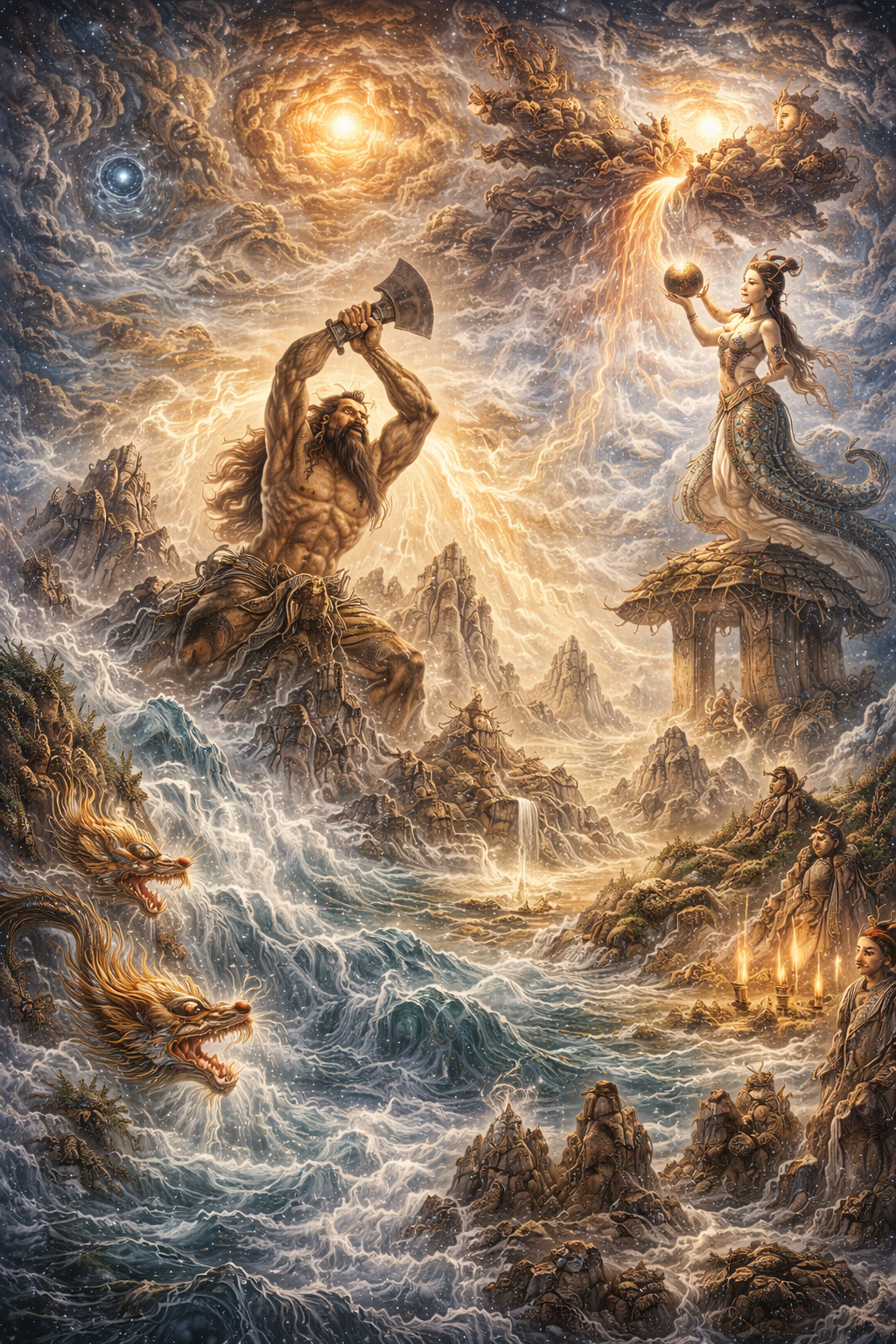
That plurality matters. Chinese creation traditions should not be reduced to a simple “first event.” They are better understood as cosmogonic and cosmological reflections on how order is generated, endangered, restored, and inhabited. The world is not merely made; it is differentiated, stabilized, repaired, morally oriented, and made fit for life. In many Chinese sources, creation is less about absolute beginning than about the transformation of indistinction into pattern, or catastrophe into renewed order.
This gives Chinese cosmogony a distinctive intellectual depth. It can be mythic, philosophical, skeptical, ritual, and political at once. The same origin problem may appear as a poetic question in the Chu ci, a philosophical sequence in the Huainanzi, a symbolic parable in the Zhuangzi, a repair myth in the Nüwa tradition, a later embodied creation story in the Pangu cycle, or an object of rational critique in Wang Chong’s Lunheng. Chinese world-origin myth survives precisely because it was repeatedly reinterpreted.
Why Chinese Cosmogony Is Plural
One of the defining features of Chinese mythology is that it does not offer a single closed cosmogony. The origins of the world appear across different texts, traditions, and historical layers, often with different symbolic emphases. Some accounts begin with primal undifferentiation. Others begin with a broken or unstable world in need of repair. Others move quickly from cosmic emergence to the conditions of human settlement, rule, ritual, and culture. As a result, Chinese creation myth is best understood as a plural archive of beginnings rather than a single dogmatic account of first things.
This plurality should not be mistaken for incoherence. It reflects the fact that Chinese thought preserved cosmogonic materials across poetry, philosophy, historiography, religious writing, local legend, and later folklore. Different texts were interested in different dimensions of origin. Some wanted to imagine the relation between unity and differentiation. Some wanted to explain why the world is structured as it is. Some wanted to show how disorder threatened the cosmos and how sacred or exemplary beings restored it. Some used creation motifs to reflect on rulership, morality, ritual order, and pattern in nature. The archive is multiple because the questions asked of it were multiple.
For readers accustomed to a single creation narrative, this can be disorienting. Chinese cosmogony often refuses to give one final beginning. Instead, it preserves several kinds of beginning: the beginning before form, the beginning of differentiation, the beginning after catastrophe, the beginning of human order, and the beginning that must be continually renewed through repair and proper alignment. Origin is not a single point. It is a recurring problem.
Primary Source
曰:遂古之初,誰傳道之?
上下未形,何由考之?It asks: at the beginning of ancient time, who handed down the way? Before above and below had taken form, how could it be examined?Chu ci, “Tianwen” 天問.
The opening of “Tianwen” is central to Chinese cosmogonic thought because it preserves origins as a problem of inquiry. Before above and below had taken form, the source of knowledge itself becomes uncertain.
The question form is important. It shows that Chinese mythic tradition can preserve origins not only as answers, but as questions. The beginning is difficult to know because it precedes the categories through which knowledge usually works: above and below, form and boundary, heaven and earth, observer and observed.
Chaos, Hundun, and the Undifferentiated Beginning
At the deepest level of Chinese cosmogonic imagination lies the idea of primal undifferentiation. Hundun is often translated as chaos, but the term should be handled carefully. It does not always mean random disorder in the modern sense. In important Daoist-associated contexts, it can signify an uncarved, undivided, prior condition before ordinary distinctions have been imposed. It is not yet the world of eyes, ears, openings, functions, names, and boundaries. It is a state before the sharp articulation of form.
This makes Chinese cosmogony philosophically rich. Origin is not always imagined as a creator making something from nothing. It is often imagined as the emergence of ordered relation from indistinction. Heaven and earth must become distinct. Forces must be articulated. Spatial and temporal patterns must emerge. In this sense, chaos is not simply the opposite of cosmos. It is the precondition from which cosmos unfolds, and sometimes the lost wholeness that excessive differentiation destroys.
Primary Source
南海之帝為儵,北海之帝為忽,中央之帝為渾沌。儵與忽時相與遇於渾沌之地,渾沌待之甚善……日鑿一竅,七日而渾沌死。The ruler of the Southern Sea was Shu; the ruler of the Northern Sea was Hu; the ruler of the center was Hundun. Shu and Hu often met in Hundun’s land, and Hundun treated them very well. They bored one opening in him each day; on the seventh day, Hundun died.Zhuangzi, “Yingdiwang” 應帝王.
The story of Hundun warns that imposing ordinary openings and functions onto primordial wholeness can destroy it. It is not a simple creation story, but a parable of differentiation, violence, and the loss of undivided unity.
The Hundun story is crucial because it complicates the assumption that differentiation is always good. In some cosmogonic traditions, the emergence of distinctions makes the world habitable. In the Zhuangzi, however, the forced production of openings destroys the central figure of undifferentiated wholeness. The story therefore preserves a counter-cosmogonic insight: to make something legible by cutting it into functions may also be to kill it.
That tension runs through Chinese origin thought. The world needs differentiation, but differentiation can also become violence when it is imposed too aggressively. Creation and mutilation stand close together. A cosmos must emerge from indistinction, but the memory of undivided unity remains ethically and philosophically charged.
Separation, Differentiation, and the Making of the World
A recurring theme in Chinese origin myth is the differentiation of the world into stable relations: above and below, heaven and earth, light and dark, dry and wet, season and cycle, center and periphery. This emphasis is one reason Chinese creation traditions are often less concerned with creation ex nihilo than with ordering, separating, stabilizing, and making relation possible. The world becomes habitable when distinctions hold.
This concern with differentiation links cosmogony to the broader Chinese intellectual world of correlation and pattern. Origin is not only an event in the distant past. It is the template for how reality is structured. The separation of heaven and earth, the ordering of directions, the balancing of seasons, and the stabilization of cosmic supports all imply that existence depends on relational structure. The making of the world is therefore inseparable from the making of intelligibility.
In this respect, Chinese origin myth is less concerned with explaining matter’s absolute beginning than with explaining the conditions under which life can be oriented. A habitable world requires more than existence. It requires space, timing, distinction, rhythm, and reliable relations among heaven, earth, waters, seasons, bodies, and social life. The cosmos must become readable before human beings can live within it.
Primary Source
昔者聖人因陰陽以統天地。夫有形者生於無形,則天地安從生?In the past, sages relied on yin and yang to bring heaven and earth into unity. What has form is born from what has no form; from what, then, were heaven and earth born?Liezi, “Tianrui” 天瑞.
This passage frames cosmogony as a problem of emergence: form arises from the formless, while heaven and earth themselves become objects of inquiry.
The importance of such passages lies in their conceptual character. They do not simply tell a story about a creator. They ask how form emerges from the formless and how the structured cosmos can arise from what precedes structure. Chinese cosmogony therefore moves fluidly between mythic narrative and philosophical reflection.
Pangu and the Body of the Cosmos
The figure most commonly associated with the separation of heaven and earth in later Chinese creation myth is Pangu. In the widely known version, Pangu emerges from primal chaos or a cosmic egg-like state, separates heaven and earth, grows as the two realms move apart, and finally becomes the world through the transformation of his body. Breath, voice, eyes, limbs, blood, hair, and bodily substances become winds, thunder, sun, moon, mountains, rivers, plants, and features of the inhabited cosmos.
Pangu’s importance, however, must be handled historically. The Pangu myth is not the single original core of all Chinese creation thought. Rather, it is one major and influential strand within a larger and more layered cosmogonic archive. Its power lies in symbolic condensation. Separation, growth, embodiment, and world-formation are concentrated in a single figure. The world emerges not as abstract geometry but as living transformation. Mountains, waters, heavenly bodies, and winds become legible as the distributed remains of primordial life.
This makes the Pangu tradition especially resonant within Chinese myth, folklore, and legend. It shows how Chinese myth can personify cosmic differentiation without collapsing creation into a simple act of command. The world is formed through embodied labor, expansion, exhaustion, death, and transformation. Cosmos here is organic and material at once.
The body-of-the-cosmos motif also gives origin myth a powerful ecological and anthropocosmic dimension. The world is not a neutral container external to life. It is made of life, or at least imagined through the transformed body of a primordial being. This does not make Pangu identical to every other Chinese cosmogonic pattern, but it gives later tradition one of its most memorable images of world-formation: the cosmos as the afterlife of a body.
Pangu’s story also shows how later folklore can reshape earlier cosmological questions into more vivid narrative form. The problem of how heaven and earth separated becomes a story of effort. The problem of how the world’s features arose becomes a story of bodily transformation. The abstract becomes memorable because it becomes embodied.
Nüwa and the Repair of a Broken World
If Pangu is associated with separation and world-formation, Nüwa is one of the great figures of cosmic repair. The Huainanzi, in the “Lanming xun,” preserves the famous account in which the four limits collapse, the provinces crack, heaven fails to cover fully, earth fails to support completely, fire rages, floodwaters rise, fierce beasts attack the people, and Nüwa repairs the sky with five-colored stones, cuts off the legs of the great turtle to re-establish the poles, kills the black dragon, and uses reeds’ ashes to stop the inundation. This is one of the most important passages in Chinese cosmological mythology because it frames origin not simply as first emergence but as restoration after catastrophic disorder.
Nüwa’s significance is therefore profound. She is not merely a creator in a narrow sense, but a world-repairing figure who restores the conditions of habitable order. The cosmos in this tradition is not assumed to be permanently stable. It can break. Supports can fail. Waters can exceed bounds. Human life can be threatened by cosmic and monstrous violence. Creation is thus inseparable from repair. A world fit for life is not only brought forth; it is mended.
Primary Source
往古之時,四極廢,九州裂,天不兼覆,地不周載,火爁炎而不滅,水浩洋而不息……於是女媧煉五色石以補蒼天,斷鼇足以立四極。In ancient times, the four limits collapsed and the nine provinces split; heaven could not fully cover, and earth could not fully bear; fire blazed without ceasing and waters surged without rest. Then Nüwa smelted five-colored stones to repair the blue heaven and cut the turtle’s legs to set up the four limits.Huainanzi, “Lanming xun” 覽冥訓.
The Nüwa passage presents creation as restoration. A broken world becomes habitable again through repair, stabilization, flood control, and the reestablishment of cosmic supports.
This theme is crucial because it distinguishes Chinese cosmogony from models that imagine the world as completed once and for all in a single inaugural act. In the Nüwa tradition, creation and maintenance blur. The world requires intervention, restoration, and renewed alignment. Cosmos is fragile, and sacred labor is reparative.
Nüwa also matters because her myth places a female divine figure at the center of cosmic survival. She repairs heaven, stabilizes earth, saves human beings from predatory violence, and restores the basic conditions under which life can continue. In a tradition where many later political and philosophical texts are male-centered, the Nüwa myth preserves a powerful memory of world-saving female agency.
Flood, Fire, and Cosmic Instability
Chinese origin myth frequently imagines the early world as unstable. Flood, fire, predatory beasts, broken supports, and disordered elements recur as signs that the cosmos has not yet fully settled into right proportion. This is especially evident in the Nüwa material preserved in the Huainanzi and echoed in later texts. The primordial condition is not always peaceful undifferentiation. It may also be catastrophic imbalance.
These motifs matter because they connect cosmogony to environmental and political thought. Excess water, uncontrolled fire, broken pillars, and violent creatures are not only narrative decorations. They symbolize a world in which proper limits and relations have failed. The restoration of cosmic order therefore prefigures later Chinese concerns with flood control, rule, territorial stability, calendrical regularity, and the moral task of harmonization. Origin myth becomes a template for how disorder must be answered.
Flood is especially important in Chinese sacred history because it links cosmic instability to the problem of civilization. A world overwhelmed by water cannot sustain settled life. Flood control is therefore not merely technical engineering; it becomes a sign of legitimate order, disciplined labor, and the ability to transform destructive excess into livable pattern. Later traditions surrounding figures such as Gun and Yu continue this theme, moving from cosmic repair toward civilizational stabilization.
Fire likewise functions as more than an element. Uncontrolled fire marks a breakdown of proportion. In the Nüwa account, fire and flood together signify an environment in which the basic balancing structures of the world have failed. Repair requires not only patching heaven, but restoring the relations among elements, supports, waters, creatures, and people.
Cosmogony and the Language of Qi, Yin, and Yang
Chinese creation thought also became increasingly legible through the language of qi, yin and yang, and correlated emergence. This is important because it shows how cosmogony in China could be articulated not only through mythic figures and narrative episodes, but also through a more systematic language of process, breath, polarity, and unfolding differentiation. The world begins to be understood as transformation rather than as inert matter acted upon from outside.
Such language does not abolish myth. It philosophically re-expresses it. Chaos becomes undivided breath. Separation becomes differentiation of complementary tendencies. Cosmic stability becomes patterned relation. World origin thus moves between symbolic narrative and conceptual cosmology. This is one reason the Huainanzi is so important: it helps bridge mythic and philosophical accounts of emergence without severing one from the other.
Primary Source
所謂有始者,繁憤未發,萌兆牙櫱,未有形埒垠無無蠕蠕,將欲生興而未成物類。What is called “having a beginning” is when the dense and turbulent has not yet issued forth, when sprouts and signs are only beginning, when there are not yet forms, boundaries, or limits, and things stir as if about to arise but have not yet become kinds of beings.Huainanzi, “Chu Zhen Xun” 俶真訓.
This passage presents origin as emergence before fixed form. The beginning is a threshold where signs and tendencies stir before distinct beings have fully appeared.
The result is a particularly rich cosmogonic field. Chinese mythology does not force a choice between story and structure. It allows world-origin to be imagined through figures such as Pangu and Nüwa, through symbolic questions such as those in “Tianwen,” and through more abstract ideas of breath, polarity, and ordered transformation.
The language of qi, yin, and yang also changes how creation is imagined. Instead of a world made once from outside, reality appears as an ongoing process of condensation, dispersal, alternation, transformation, and patterned relation. This makes cosmogony continuous with natural philosophy, medicine, ritual timing, political order, and moral cultivation. The world’s beginning becomes a key to the world’s ongoing behavior.
World Origin and the Human Order
Chinese creation myths rarely stop at the cosmos as mere physical setting. They move quickly toward the conditions of human inhabitation. Once heaven and earth are separated or repaired, the question becomes how life can persist within the restored world. Human settlement, social order, culture heroes, marriage norms, agriculture, medicine, ritual, music, writing, and rulership all emerge as part of the broader story of how the world becomes livable.
This is why cosmogony in China is inseparable from civilization. The origin of the world is not only the beginning of nature. It is the beginning of a morally and politically meaningful order. A habitable cosmos must support human life, and human life must learn to live in accordance with the patterns that structure the world. In this sense, origin myth in China is always close to anthropology, ethics, and political imagination.
Nüwa’s myth again shows this clearly. She repairs the physical structure of the world, but the purpose of that repair is human survival. Pangu’s body becomes the world, but that world becomes the environment of human habitation. Flood narratives move toward the conditions of settlement, field, boundary, and rule. Cosmogony becomes civilization because human beings require stable relations in order to live.
This also means that Chinese origin myth is often less interested in a dramatic first human than in the conditions that make human life possible. A world must have supports, seasons, waters within bounds, social practices, and moral order. Creation is fulfilled not simply when things exist, but when life can be sustained within pattern.
Classical Sources and Later Reframings
The archive of Chinese world-origin myth survives across many layers. The chaos motif appears in early Daoist-associated traditions and later interpretation. Nüwa’s world-repair is classically preserved in the Huainanzi and discussed in later texts such as the Liezi. Wang Chong’s Lunheng is especially valuable because it shows early critical reflection on sky-repair and cosmic-support narratives. That skeptical engagement is itself historically important. It demonstrates that Chinese myth was not simply passively inherited; it was argued with, rationalized, and reinterpreted.
This layered survival reinforces a broader point: Chinese cosmogony endured not because one text closed the canon, but because multiple texts and traditions kept reactivating the problem of origins. Mythic accounts, philosophical syntheses, ritual traditions, later folklore, and skeptical critiques together formed the long afterlife of world-beginning in Chinese civilization.
Later Pangu traditions are especially important in this respect. They show how an origin myth can become more narratively vivid over time. Where earlier sources may preserve abstract cosmogony, symbolic rupture, or repair, later tradition can give the world’s making a memorable protagonist. This does not make later material less significant. It shows how creation myth continues to develop in response to the need for images that can be told, remembered, painted, dramatized, and taught.
Chinese cosmogony therefore requires a source-critical reading practice. One should not flatten all origin accounts into a single story, nor should one dismiss later traditions because they are later. The more useful question is what each source is doing: questioning origins, narrating repair, explaining differentiation, embodying the cosmos, criticizing mythic plausibility, or linking origin to human order.
Skepticism and Interpretive Debate
One of the most valuable features of the Chinese cosmogonic archive is that it includes not only mythic narration, but also critique. Wang Chong’s Lunheng is especially important because it subjects inherited claims to rational pressure. Rather than accepting every mythic account at face value, Wang Chong asks whether the physical implications of such stories are plausible. His discussion of Gonggong striking Mount Buzhou and breaking the heavenly pillars shows that early Chinese intellectual culture could preserve myths while also debating their credibility.
Primary Source
與人爭為天子,不勝,怒觸不周之山,使天柱折,地維絕,有力如此,天下無敵。He fought with another to become Son of Heaven, failed to prevail, and in anger struck Mount Buzhou, causing the heavenly pillar to break and the cords of earth to snap. If his strength was like this, he would have been unmatched under heaven.Lunheng, “Tan Tian” 談天.
Wang Chong uses inherited cosmic-support myth as an object of critique. The passage shows that Chinese mythic tradition included skeptical and rationalizing engagement, not only preservation.
This skeptical layer matters because it prevents us from imagining Chinese mythology as a static body of unquestioned belief. Mythic stories were retold, but they were also interpreted, challenged, moralized, philosophized, and rationalized. The Chinese tradition preserved myths and thought about how myths should be understood.
For modern readers, this is especially useful. It means that source criticism is not an external method imposed on Chinese mythology from outside. Interpretive debate already belongs to the history of the tradition. The archive contains myth and reflection on myth. It preserves wonder and argument together.
Why These Origin Myths Still Matter
Chinese origin myths still matter because they preserve fundamental reflections on emergence, fragility, repair, and the patterned structure of reality. They show that the world is not merely “there.” It must be separated, stabilized, repaired, and inhabited. They also remind readers that cosmos is not the simple negation of chaos but its transformation. Ordered life depends on the successful differentiation and maintenance of relations.
These myths also remain important because they resist reductive definitions of creation. Some traditions imagine the world as arising from undifferentiated unity. Some imagine it formed through the labor or body of a primordial being. Some imagine it saved from collapse through reparative sacred action. Some translate origin into the language of qi, yin, yang, and patterned emergence. Some question whether inherited cosmic stories can be literally true. Together they offer a more expansive understanding of origin: not just first beginning, but the ongoing making of a world fit for life.
The theme of repair is especially powerful. In a time when ecological, political, and social systems often feel unstable, Nüwa’s myth continues to resonate because it imagines sacred agency as restoration. A broken world is not abandoned. It is mended. The task is not only to begin, but to repair what has collapsed and reestablish the conditions of life.
Chinese cosmogony therefore remains one of the most philosophically rich areas of world mythology. It asks how order arises, how form emerges, how catastrophe is repaired, how human life becomes possible, and how later generations should remember a beginning that was never preserved in only one form. Its plurality is not a weakness. It is the source of its depth.
Related Reading
- Chinese Myth, Folklore & Legend
- What Is Chinese Myth, Folklore & Legend?
- The Problem of Sources in Chinese Mythology
- Reading the Shanhaijing: Mythic Geography, Strange Beings, and Sacred Space
- Mythic Allusion and Cosmology in the Chu Ci
- The Huainanzi and the Philosophical Ordering of Myth
- From Classical Text to Folkloric Archive: How Chinese Myth Survived
- Chinese Thought
Primary Sources
- Chinese Text Project (n.d.) Chu ci: Tianwen 楚辭:天問. Available at: https://ctext.org/chu-ci/tian-wen/zh
- Chinese Text Project (n.d.) Zhuangzi: Yingdiwang 莊子:應帝王. Available at: https://ctext.org/zhuangzi/normal-course-for-rulers-and-kings
- Chinese Text Project (n.d.) Liezi: Tianrui 列子:天瑞. Available at: https://ctext.org/liezi/tian-rui
- Chinese Text Project (n.d.) Liezi: Tang Wen 列子:湯問. Available at: https://ctext.org/liezi/tang-wen
- Chinese Text Project (n.d.) Huainanzi: Chu Zhen Xun 淮南子:俶真訓. Available at: https://ctext.org/huainanzi/chu-zhen-xun/zhs
- Chinese Text Project (n.d.) Huainanzi: Lanming xun 淮南子:覽冥訓. Available at: https://ctext.org/huainanzi/lan-ming-xun/zh
- Chinese Text Project (n.d.) Lunheng: Tan Tian 論衡:談天. Available at: https://ctext.org/lunheng/tan-tian
- Wikisource (n.d.) Huainanzi: Lanming xun 淮南子:覽冥訓. Available at: https://zh.wikisource.org/wiki/%E6%B7%AE%E5%8D%97%E5%AD%90/%E8%A6%BD%E5%86%A5%E8%A8%93
Further Reading
- Birrell, A. (1993) Chinese Mythology: An Introduction. Baltimore: Johns Hopkins University Press. Available at: https://archive.org/details/chinesemythology0000birr
- Yang, L. and An, D. (2005) Handbook of Chinese Mythology. Santa Barbara: ABC-CLIO. Available at: https://archive.org/details/handbookofchines0000yang
- Major, J.S., Queen, S.A., Meyer, A.S. and Roth, H.D. (2010) The Huainanzi: A Guide to the Theory and Practice of Government in Early Han China. New York: Columbia University Press. Available at: https://cup.columbia.edu/book/the-huainanzi/9780231142045
- Chinese Text Project (n.d.) Huainanzi: Lanming xun. Available at: https://ctext.org/huainanzi/lan-ming-xun/zh
- Chinese Text Project (n.d.) Lunheng: Tan Tian. Available at: https://ctext.org/lunheng/tan-tian
- Chinese Text Project (n.d.) Liezi: Tianrui. Available at: https://ctext.org/liezi/tian-rui
- Chinese Text Project (n.d.) Zhuangzi: Yingdiwang. Available at: https://ctext.org/zhuangzi/normal-course-for-rulers-and-kings
- Encyclopaedia Britannica (n.d.) “Chinese mythology.” Available at: https://www.britannica.com/topic/Chinese-mythology
- Encyclopaedia Britannica (n.d.) “Pan Gu.” Available at: https://www.britannica.com/topic/Pan-Gu
- Encyclopaedia Britannica (n.d.) “Nu Gua.” Available at: https://www.britannica.com/topic/Nu-Gua
- Encyclopaedia Britannica (n.d.) “Taoism: Symbolism and mythology.” Available at: https://www.britannica.com/topic/Taoism/Symbolism-and-mythology
References
- Birrell, A. (1993) Chinese Mythology: An Introduction. Baltimore: Johns Hopkins University Press. Available at: https://archive.org/details/chinesemythology0000birr
- Chinese Text Project (n.d.) Chu ci: Tianwen. Available at: https://ctext.org/chu-ci/tian-wen/zh
- Chinese Text Project (n.d.) Huainanzi: Chu Zhen Xun. Available at: https://ctext.org/huainanzi/chu-zhen-xun/zhs
- Chinese Text Project (n.d.) Huainanzi: Lanming xun. Available at: https://ctext.org/huainanzi/lan-ming-xun/zh
- Chinese Text Project (n.d.) Liezi: Tang Wen. Available at: https://ctext.org/liezi/tang-wen
- Chinese Text Project (n.d.) Liezi: Tianrui. Available at: https://ctext.org/liezi/tian-rui
- Chinese Text Project (n.d.) Lunheng: Tan Tian. Available at: https://ctext.org/lunheng/tan-tian
- Chinese Text Project (n.d.) Zhuangzi: Yingdiwang. Available at: https://ctext.org/zhuangzi/normal-course-for-rulers-and-kings
- Encyclopaedia Britannica (n.d.) “Chinese mythology.” Available at: https://www.britannica.com/topic/Chinese-mythology
- Encyclopaedia Britannica (n.d.) “Nu Gua.” Available at: https://www.britannica.com/topic/Nu-Gua
- Encyclopaedia Britannica (n.d.) “Pan Gu.” Available at: https://www.britannica.com/topic/Pan-Gu
- Encyclopaedia Britannica (n.d.) “Taoism: Symbolism and mythology.” Available at: https://www.britannica.com/topic/Taoism/Symbolism-and-mythology
- Major, J.S., Queen, S.A., Meyer, A.S. and Roth, H.D. (2010) The Huainanzi: A Guide to the Theory and Practice of Government in Early Han China. New York: Columbia University Press. Available at: https://cup.columbia.edu/book/the-huainanzi/9780231142045
- Wikisource (n.d.) Huainanzi: Lanming xun. Available at: https://zh.wikisource.org/wiki/%E6%B7%AE%E5%8D%97%E5%AD%90/%E8%A6%BD%E5%86%A5%E8%A8%93
- Yang, L. and An, D. (2005) Handbook of Chinese Mythology. Santa Barbara: ABC-CLIO. Available at: https://archive.org/details/handbookofchines0000yang