
Last Updated May 5, 2026
The Shanhaijing, often translated as the Classic of Mountains and Seas, is one of the most important and methodologically challenging sources in the study of Chinese mythology. It preserves a dense archive of sacred mountains, marvelous creatures, divine traces, strange peoples, ritual locations, medicinal substances, cosmographic boundaries, environmental omens, and mythic journeys. Yet it does not present those materials as a single continuous mythological narrative. Instead, it organizes myth through places, zones, routes, mountains, rivers, seas, creatures, substances, and the charged edges of the known world.
To read the Shanhaijing well is therefore to shift from a purely narrative model of myth toward a spatial one. Myth here is not only what happens. It is where power, danger, wonder, disorder, fertility, healing, and sacred presence are located. Mountains are not passive landforms. Seas are not merely bodies of water. Distant regions are not empty margins. The landscape is charged with beings, materials, deities, omens, and powers. Geography becomes ontology.
Series context: This article is part of the Chinese Myth, Folklore & Legend knowledge series. It focuses on the Shanhaijing as a source for mythic geography, sacred mountains, strange beings, ritual substances, environmental omens, and the spatial preservation of myth.
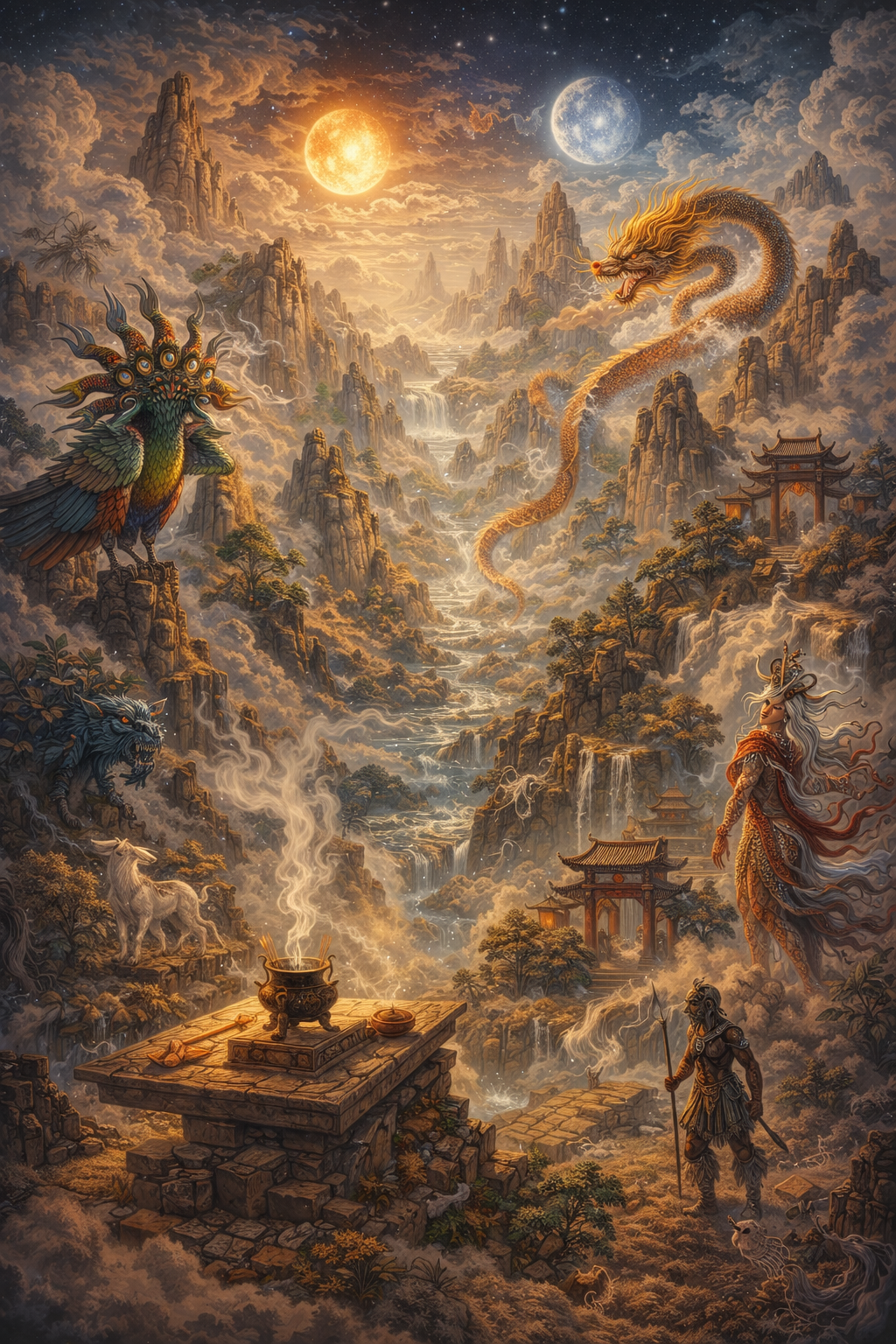
This spatiality is what makes the text foundational for the study of Chinese mythic geography. The Shanhaijing offers a different kind of archive from traditions centered primarily on divine genealogy, court chronicle, heroic epic, or theological doctrine. Its world is distributed, regionalized, catalogic, topographic, and strange. It asks the reader to move across terrain rather than follow one linear plot. Myth survives as a map of the extraordinary.
The interpretive stakes are high. If the Shanhaijing is read only as a collection of monsters or marvels, its deeper structure disappears. What the text preserves is not simply strangeness for its own sake, but a patterned imagination of sacred space, liminality, environmental force, civilizational boundary, and more-than-human presence. It records a world in which mountains may concentrate numinous power, the edges of the known world may disclose extraordinary forms of life, and spatial orientation itself becomes a way of thinking about order, threat, fertility, healing, and the relation between the human and nonhuman realms.
What Kind of Text Is the Shanhaijing?
The first task is to resist reading the Shanhaijing as though it were a conventional narrative mythology. It is not structured like an epic of origins, a continuous sequence of divine actions, or a stable pantheon arranged by genealogy. Rather, it is a composite classical work associated with mountains, seas, regions, beings, products, ritual materials, marvels, and cosmographic zones.
The text is also a transmitted archive rather than a transparent record of one untouched archaic worldview. What modern readers encounter has passed through historical preservation, commentary, edition, interpretation, illustration, translation, and reception. This does not diminish its value. It clarifies what kind of value it has. The Shanhaijing preserves mythic materials through accumulation, arrangement, and localization. Its world is not unfolded through one plot. It is distributed across named places.
This makes the text methodologically difficult but intellectually powerful. It asks the reader to treat geography as a form of mythic storage. A mountain may contain plants that prevent hunger, trees that prevent disorientation, animals that grant speed, minerals, waters, and beings whose forms violate ordinary categories. Such descriptions may look like catalogue, but the catalogue is itself the mythic form.
Primary Source
南山經之首曰䧿山。其首曰招搖之山,臨于西海之上,多桂,多金玉。有草焉,其狀如韭而青華,其名曰祝餘,食之不飢。The first range of the Southern Mountain Classic is called the Fei Mountains. Its first peak is Mount Zhaoyao, overlooking the Western Sea. It has many cassia trees and much gold and jade. There is an herb there, shaped like chives with blue flowers, called Zhuyu; whoever eats it does not hunger.Shanhaijing, “Nanshan jing” 南山經.
This passage shows the text’s method at work: a mountain is named, located, and filled with trees, metals, plants, powers, and effects. Myth is preserved as topographic description.
The Shanhaijing is therefore best understood as a layered archive in which geography, taxonomy, cosmography, ritual imagination, and marvel literature converge. Its form suggests compilation and mapping rather than single authorship or dramatic plot. It is a text to be read spatially, comparatively, and symbolically.
Mythic Geography as a Mode of Preservation
One of the most important contributions of the Shanhaijing is that it shows how myth can survive geographically. In many traditions, myth is preserved primarily through narrative sequence: creation, conflict, descent, flood, exile, return, conquest, divine succession, or heroic ordeal. In the Shanhaijing, by contrast, sacred knowledge is often embedded in the distribution of places.
Mountains host deities, medicinal plants, ores, portentous beasts, strange waters, ritual substances, and supernatural traces. Regions are defined by extraordinary forms of life. Seas and borderlands open onto alterity, distance, danger, and wonder. Geography itself becomes a repository of the mythic.
This is one reason the text remains central to the study of Chinese mythology. It preserves a world in which space is never neutral. The location of a being matters. The mountain where a substance is found matters. The direction in which a region lies matters. The route between one place and another matters. Spatial relation becomes symbolic relation.
The text therefore records more than ancient curiosity about remote places. It preserves a cosmologically textured landscape in which topography, value, power, danger, healing, and sacred concentration interlock. A mountain may be known by what grows there, what sounds there, what lives there, what cures there, what threatens there, and what omen appears there.
This spatial logic makes the Shanhaijing especially important for a broader study of Chinese myth, folklore, and legend. It demonstrates that mythic knowledge may be stored in landscape, not only in stories about named gods and heroes.
Mountains, Seas, and the Structure of Sacred Space
The title itself foregrounds the central media of the work’s world: mountains and seas. Mountains in Chinese religious and artistic traditions long functioned as sites of ascent, withdrawal, purification, divine encounter, immortality, retreat, cultivation, and sacred concentration. Seas and distant regions, by contrast, often mark thresholds where the known world opens onto alterity, danger, and extraordinary life.
In the Shanhaijing, mountains are already dense with beings, powers, materials, waters, and ritual associations. They are not scenery. They are active structures of meaning. Their slopes, summits, waters, minerals, plants, and animals together form a mythic ecology.
The seas and borderlands play a complementary role. They mark margins where ordinary categories loosen. Strange peoples, hybrid beings, divine traces, distant countries, and cosmological irregularities appear at the edges. The world of the Shanhaijing is ordered, but not domesticated. It is mapped, yet still full of radical difference.
Primary Source
海內崑崙之墟,在西北,帝之下都。崑崙之墟,方八百里,高萬仞。Within the realm, the ruins of Kunlun lie in the northwest, the lower capital of the Thearch. The ruins of Kunlun measure eight hundred li on each side and rise ten thousand ren high.Shanhaijing, “Hainei xi jing” 海內西經.
Kunlun shows why sacred geography must be treated as source material in its own right. The text preserves cosmology through place, scale, direction, divine residence, and impossible landscape.
Sacred space emerges through concentration and distance alike: in mountains where power gathers, and in far zones where otherness becomes visible. The text does not simply oppose center and chaos. It gives chaos a location, names it, describes it, and makes it part of a larger cosmographic imagination.
Strange Beings and the Taxonomy of the Extraordinary
The strange beings of the Shanhaijing are among its most famous features, but they should not be read as decorative fantasy alone. These beings function as markers of environmental power, moral portent, cosmological irregularity, regional identity, and symbolic classification. They inhabit a world in which categories are permeable and hybrid forms may signify sacred intensity, danger, omen, or charged difference.
The text’s creatures are not merely “monsters” in the modern entertainment sense. They belong to a taxonomy of the extraordinary that registers how the world exceeds ordinary human ordering. Some beings appear as omens. Some are threats. Some are auspicious. Some heal. Some prevent illness. Some indicate drought, fire, war, fertility, disorder, or transformation. Form, place, and meaning are mutually reinforcing.
Primary Source
又西六十里,曰太華之山,削成而四方,其高五千仞,其廣十里,鳥獸莫居。有蛇焉,名曰肥𧔥,六足四翼,見則天下大旱。Sixty li farther west is Mount Taihua, sheer-cut and square. It is five thousand ren high and ten li broad; no birds or beasts dwell there. There is a serpent there called Feiyu. It has six feet and four wings. When it appears, there is great drought under heaven.Shanhaijing, “Xishan jing” 西山經.
This passage shows how the text joins form, mountain, creature, and omen. The being is not simply strange; its appearance signals environmental crisis at a cosmic scale.
This suggests that the text is not a random catalogue of curiosities. It is a patterned archive in which the extraordinary becomes legible through place. A creature’s body, location, sound, behavior, and effect all matter. The Shanhaijing therefore gives Chinese mythology one of its richest early vocabularies for thinking about hybrid beings, environmental signs, and the instability of ordinary categories.
Such beings also complicate the line between monster and messenger. Many of them appear frightening because they reveal forces larger than human settlement: drought, disease, ecological instability, directional power, seasonal disruption, or the strangeness of distant regions. In this sense, the strange being is a way of thinking about relation. It marks where human order meets a world it cannot fully command.
Ritual Substances, Omens, and Power
The Shanhaijing is also concerned with substances, minerals, plants, waters, and materials found in specific places. These are not incidental details. They are part of the text’s larger logic of localization. Power is situated. What matters is not just that an extraordinary substance exists, but where it is found and what that location implies.
A landscape may be marked as dangerous, healing, fertile, sacred, ritually potent, or cosmologically unstable through the substances associated with it. An herb may prevent hunger. A tree may prevent disorientation. A mineral may mark a mountain as charged. A watercourse may carry strange creatures or protective force. The geography of the text is therefore also a geography of resources, signs, and possible transformations.
This linkage between space and efficacy helps explain why the text sits at the intersection of mythology, proto-natural inquiry, cosmography, medicine, ritual imagination, and marvel literature. The extraordinary is not isolated from the material world. It inheres in it. Mountains and regions yield not only beings, but powers.
Modern readers should therefore avoid treating the text’s substances as merely primitive science or fanciful listing. They belong to a world in which environment, body, ritual, illness, orientation, and cosmic order remain closely entangled. The material world is meaningful because it is saturated with effects.
The Shanhaijing repeatedly teaches that knowledge is place-specific. To know a mountain is to know its animals, plants, minerals, waters, dangers, cures, omens, and powers. This form of knowledge does not separate myth from ecology. It presents the world as an inhabited field of signs.
Cosmic Beings and Environmental Power
Some of the Shanhaijing’s most powerful beings are not merely regional creatures, but cosmic or environmental figures whose bodies regulate time, season, light, darkness, wind, and direction. Such passages show that the text does not only catalogue marvels; it imagines the cosmos through embodied forces.
Zhu Yin, the deity of Zhongshan, is one of the clearest examples. He is described as a human-faced, serpent-bodied being whose opening and closing of the eyes produce day and night, and whose breath is associated with winter, summer, and wind. The cosmos is not presented as abstract mechanism. It is personified, embodied, and located.
Primary Source
鍾山之神,名曰燭陰,視為晝,暝為夜,吹為冬,呼為夏,不飲,不食,不息,息為風,身長千里。The deity of Zhongshan is named Zhu Yin. When he looks, it is day; when he closes his eyes, it is night. His blowing makes winter, his calling makes summer. He does not drink, eat, or breathe, yet when he breathes it becomes wind. His body is a thousand li long.Shanhaijing, “Haiwai beijing” 海外北經.
Zhu Yin shows the text’s cosmological imagination: time, season, light, darkness, and wind are imagined through an embodied being placed in mythic geography.
This kind of passage challenges modern separations between geography, mythology, natural philosophy, and religion. The being is at once a deity, a creature, a cosmological function, and a located presence. The world is intelligible not because it has been stripped of wonder, but because wonder has been placed in a describable structure.
Environmental power in the Shanhaijing is therefore not inert. Wind, drought, light, season, mountain, river, sea, and creature form a single symbolic field. To study the text is to study a mythic ecology of forces.
Kuafu and Mythic Narrative Inside Spatial Catalogue
Although the Shanhaijing is not a continuous epic, it does contain compact mythic narratives embedded inside its geographic structure. The story of Kuafu pursuing the sun is one of the most famous examples. It is brief, but it carries extraordinary symbolic force: pursuit, cosmic scale, thirst, rivers, death, transformation, and the conversion of a body’s remnant into landscape.
Kuafu’s story is important because it shows that narrative has not disappeared from the text. Rather, narrative appears inside spatial catalogue. The myth is told in relation to places, waters, distance, direction, and transformation. Even heroic action becomes geographical.
Primary Source
夸父與日逐走,入日。渴,欲得飲,飲於河渭;河渭不足,北飲大澤。未至,道渴而死。棄其杖,化為鄧林。Kuafu raced with the sun and pursued it to the place of the sun. Thirsting, he wished to drink, and drank from the Yellow River and the Wei; but the rivers were not enough, so he went north to drink from the Great Marsh. Before he arrived, he died of thirst on the road. He cast away his staff, and it transformed into Denglin.Shanhaijing, “Haiwai beijing” 海外北經.
Kuafu’s myth turns cosmic pursuit into geography. Rivers, marsh, road, death, staff, and forest become the spatial remains of a mythic act.
The Kuafu episode also reveals the text’s concern with scale. Human or heroic desire extends toward the sun, but bodily thirst anchors the figure back in water, route, and death. The myth is neither simple triumph nor simple failure. It preserves the grandeur and danger of striving beyond ordinary bounds.
The transformation of the staff into Denglin is especially important. It shows how myth becomes landscape. A heroic remnant becomes a place. The story is preserved not only as an event, but as a geographic trace. This is precisely the Shanhaijing’s larger method: myth survives through location.
Boundaries, Centers, and Civilizational Imagination
The Shanhaijing also helps reveal how early Chinese culture imagined the relation between center and margin. The farther one moves from familiar space, the more likely one is to encounter extraordinary beings, unusual customs, strange bodies, charged substances, or radical environmental difference. This should not be reduced to simple geographic naiveté. It is better understood as a symbolic mapping of civilizational imagination.
The edges of the world become places where order is tested, where categories loosen, and where the human world meets forms of alterity that expose its own assumptions. Strange countries, strange bodies, distant mountains, divine traces, and foreign zones all participate in a larger imagination of boundary.
Yet the text does not simply oppose center and chaos. It constructs a patterned world in which margins are still legible. Distance is not meaninglessness. It is structured otherness. The Shanhaijing gives names, locations, features, effects, and relations to the strange. It maps alterity rather than leaving it formless.
That combination of order and wonder is one of the text’s enduring strengths. The world it imagines is neither fully domesticated nor wholly chaotic. It is traversable, classifiable, threatening, marvelous, and charged. The known world depends on its edges because the edges reveal what ordinary order cannot contain.
Such boundary-making should also be read critically. Texts that describe distant peoples and strange bodies may preserve cosmological imagination, but they may also encode the perspectives of centers looking outward. The Shanhaijing is valuable not because it gives an unmediated account of all peoples and places, but because it shows how cultural imagination mapped difference, distance, and power.
How to Read the Shanhaijing Critically
A critical reading of the Shanhaijing begins by refusing false alternatives. It is neither a transparent factual geography nor a meaningless fantasy compendium. It is a transmitted classical text whose significance lies in how it preserves mythic, spatial, symbolic, environmental, and taxonomic materials through compilation and description.
Readers should therefore attend to genre, transmission, and reception. The text has been preserved through editions, commentaries, citations, interpretations, translations, illustrations, and modern digital tools. Each layer shapes how the text is encountered. The Shanhaijing is ancient, but it is not available to modern readers without mediation.
It is also important to read the Shanhaijing comparatively within the larger Chinese archive. Its sacred mountains, paradisal regions, extraordinary beings, charged landscapes, and cosmic creatures resonate with later religious, artistic, Daoist, Buddhist, literary, and popular traditions. The text should therefore be read not as an isolated oddity, but as one deep stratum in a much longer history of Chinese sacred spatial imagination.
Critical reading also requires caution around modern categories. “Mythology,” “geography,” “natural history,” “religion,” “folklore,” and “fantasy” are useful terms, but none maps perfectly onto the ancient text. The Shanhaijing crosses those categories before they are separated. Its difficulty is precisely what makes it valuable.
A strong interpretation therefore asks several questions at once. What place is being described? What beings or substances are associated with it? What effects or omens are attached to them? What does the passage reveal about boundaries, power, danger, healing, or sacred presence? How might later traditions have reinterpreted the same motif? The text rewards readers who move slowly across its geography.
Modern Afterlives and Ecological Readings
The Shanhaijing has continued to generate new cultural life because its strange geography lends itself to visual adaptation, fantasy, illustration, game worlds, animation, museum interpretation, and digital humanities projects. Its creatures and landscapes are flexible enough to be reimagined in modern media while still carrying the aura of ancient mythic depth.
Yet modern adaptation also carries risks. The text can be flattened into a monster manual or treated as a decorative sourcebook for fantasy design. Such uses may be creatively productive, but they can obscure the work’s deeper structure as sacred geography, symbolic taxonomy, and environmental imagination. To read the Shanhaijing seriously is to see that its beings are not isolated fantasy creatures. They belong to places, routes, omens, substances, and cosmological patterns.
The text also speaks powerfully to ecological interpretation, not because it is “environmental” in a modern policy sense, but because it refuses to imagine landscape as empty background. Mountains, rivers, seas, creatures, plants, minerals, bodies, and omens all belong to an interconnected field. Place is alive with consequence. The world is not inert matter waiting for human use. It is charged, inhabited, dangerous, nourishing, and meaningful.
This does not mean the Shanhaijing should be romanticized as ecological wisdom without historical context. It means that the text preserves an older way of imagining the environment as morally and cosmologically significant. Its landscapes are not neutral surfaces. They are fields of relationship.
Why the Shanhaijing Still Matters
The Shanhaijing still matters because it preserves a mode of thought in which geography, ontology, and sacred power remain inseparable. It teaches modern readers that myth need not always take the form of a unified story. It can survive in routes, lists, locations, creatures, substances, mountains, waters, and boundary zones. It can be stored in landscape.
It also matters because its afterlives continue. The text remains central to scholarship, visual adaptation, fantasy, illustration, museum culture, mythology publishing, digital humanities, games, animation, and broader discussions of Chinese mythic worlds. Ancient spatial imagination continues to shape modern image-making.
The text matters for comparative mythology because it expands what myth can be. It shows that mythology is not only a pantheon or a narrative sequence. It may also be a system of places, thresholds, forms, substances, omens, creatures, and environmental powers. The Shanhaijing therefore offers a major alternative to epic-centered models of myth.
Finally, the Shanhaijing matters because modern ecological and spatial thinking can recognize new relevance in its world. It imagines no sharp separation between landscape and life, environment and meaning, creature and omen, mountain and power. Its categories are ancient, but its central insight remains compelling: the world is not empty space. It is inhabited, patterned, dangerous, healing, and full of signs.
Related Reading
- Chinese Myth, Folklore & Legend
- What Is Chinese Myth, Folklore & Legend?
- The Problem of Sources in Chinese Mythology
- Mythic Allusion and Cosmology in the Chu Ci
- The Huainanzi and the Philosophical Ordering of Myth
- From Classical Text to Folkloric Archive: How Chinese Myth Survived
- Japanese Myth, Folklore & Legend
- East Asian Traditions
- Comparative Sacred Themes
Primary Sources
- Chinese Text Project (n.d.) Shanhaijing 山海經 / Classic of Mountains and Seas. Available at: https://ctext.org/shan-hai-jing
- Chinese Text Project (n.d.) Shanhaijing: Nanshan jing 山海經:南山經. Available at: https://ctext.org/shan-hai-jing/nan-shan-jing/zh
- Chinese Text Project (n.d.) Shanhaijing: Xishan jing 山海經:西山經. Available at: https://ctext.org/shan-hai-jing/xi-shan-jing/zh
- Chinese Text Project (n.d.) Shanhaijing: Haiwai beijing 山海經:海外北經. Available at: https://ctext.org/shan-hai-jing/hai-wai-bei-jing/zh
- Chinese Text Project (n.d.) Shanhaijing: Hainei xi jing 山海經:海內西經. Available at: https://ctext.org/shan-hai-jing/hai-nei-xi-jing/zh
Further Reading
- Birrell, A. (1999) The Classic of Mountains and Seas. London: Penguin Classics.
- Strassberg, R.E. (2002) A Chinese Bestiary: Strange Creatures from the Guideways Through Mountains and Seas. Berkeley: University of California Press. Available at: https://www.ucpress.edu/book/9780520298514/a-chinese-bestiary
- Encyclopaedia Britannica (n.d.) “Shanhaijing.” Available at: https://www.britannica.com/topic/Shanhaijing
- The Metropolitan Museum of Art (2004) “Nature in Chinese Culture.” Available at: https://www.metmuseum.org/essays/nature-in-chinese-culture
- The Metropolitan Museum of Art (2011) “Daoism and Daoist Art.” Available at: https://www.metmuseum.org/essays/daoism-and-daoist-art
- Stanford Encyclopedia of Philosophy (2015) “Science and Chinese Philosophy.” Available at: https://plato.stanford.edu/entries/chinese-phil-science/
References
- Birrell, A. (1999) The Classic of Mountains and Seas. London: Penguin Classics.
- Chinese Text Project (n.d.) Shanhaijing. Available at: https://ctext.org/shan-hai-jing
- Chinese Text Project (n.d.) Shanhaijing: Nanshan jing. Available at: https://ctext.org/shan-hai-jing/nan-shan-jing/zh
- Chinese Text Project (n.d.) Shanhaijing: Xishan jing. Available at: https://ctext.org/shan-hai-jing/xi-shan-jing/zh
- Chinese Text Project (n.d.) Shanhaijing: Haiwai beijing. Available at: https://ctext.org/shan-hai-jing/hai-wai-bei-jing/zh
- Chinese Text Project (n.d.) Shanhaijing: Hainei xi jing. Available at: https://ctext.org/shan-hai-jing/hai-nei-xi-jing/zh
- Encyclopaedia Britannica (n.d.) “Shanhaijing.” Available at: https://www.britannica.com/topic/Shanhaijing
- Metropolitan Museum of Art (2004) “Nature in Chinese Culture.” Available at: https://www.metmuseum.org/essays/nature-in-chinese-culture
- Metropolitan Museum of Art (2011) “Daoism and Daoist Art.” Available at: https://www.metmuseum.org/essays/daoism-and-daoist-art
- Stanford Encyclopedia of Philosophy (2015) “Science and Chinese Philosophy.” Available at: https://plato.stanford.edu/entries/chinese-phil-science/
- Strassberg, R.E. (2002) A Chinese Bestiary: Strange Creatures from the Guideways Through Mountains and Seas. Berkeley: University of California Press. Available at: https://www.ucpress.edu/book/9780520298514/a-chinese-bestiary