
Last Updated May 3, 2026
Indus Region myth, folklore, and sacred narrative preserve one of the most layered and internally diverse narrative worlds in Asia, bringing together river civilization, sacred geography, vernacular romance, shrine devotion, oral song, heroic memory, women’s witness, ecological symbolism, and long histories of religious and cultural encounter. This field should not be treated as a single mythological canon, nor as a narrowly modern political category. The Indus region is better understood as a civilizational and narrative formation shaped by river systems, deserts, mountains, valleys, pilgrimage routes, pastoral worlds, imperial contact, vernacular literary cultures, and overlapping Hindu, Buddhist, Jain, Sikh, Islamicate, Sufi, Persianate, tribal, and local sacred inheritances.
The archive is plural. It includes the undeciphered symbolic remains of the ancient Indus civilization; Punjabi qissa and love epic; Sindhi Sufi poetic worlds; Baluchi oral epic and tribal memory; Pashtun lyric, origin, and honor traditions; Kashmiri sacred geography; Sikh janam-sakhi and martyr memory; Hindu, Buddhist, Jain, and local sacred worlds; shrine legends, miracle stories, saintly memory, women’s songs, wedding songs, lullabies, laments, seasonal narratives, folk tales, proverbs, ritual objects, healing practices, and oral forms preserved in Punjabi, Sindhi, Seraiki, Baluchi, Pashto, Kashmiri, Hindko, Sanskritic, Prakritic, Persianate, and other regional archives. To approach this field seriously is to enter a world in which narrative is not merely entertainment. It is social memory, moral education, metaphysical inquiry, ecological imagination, and cultural survival.
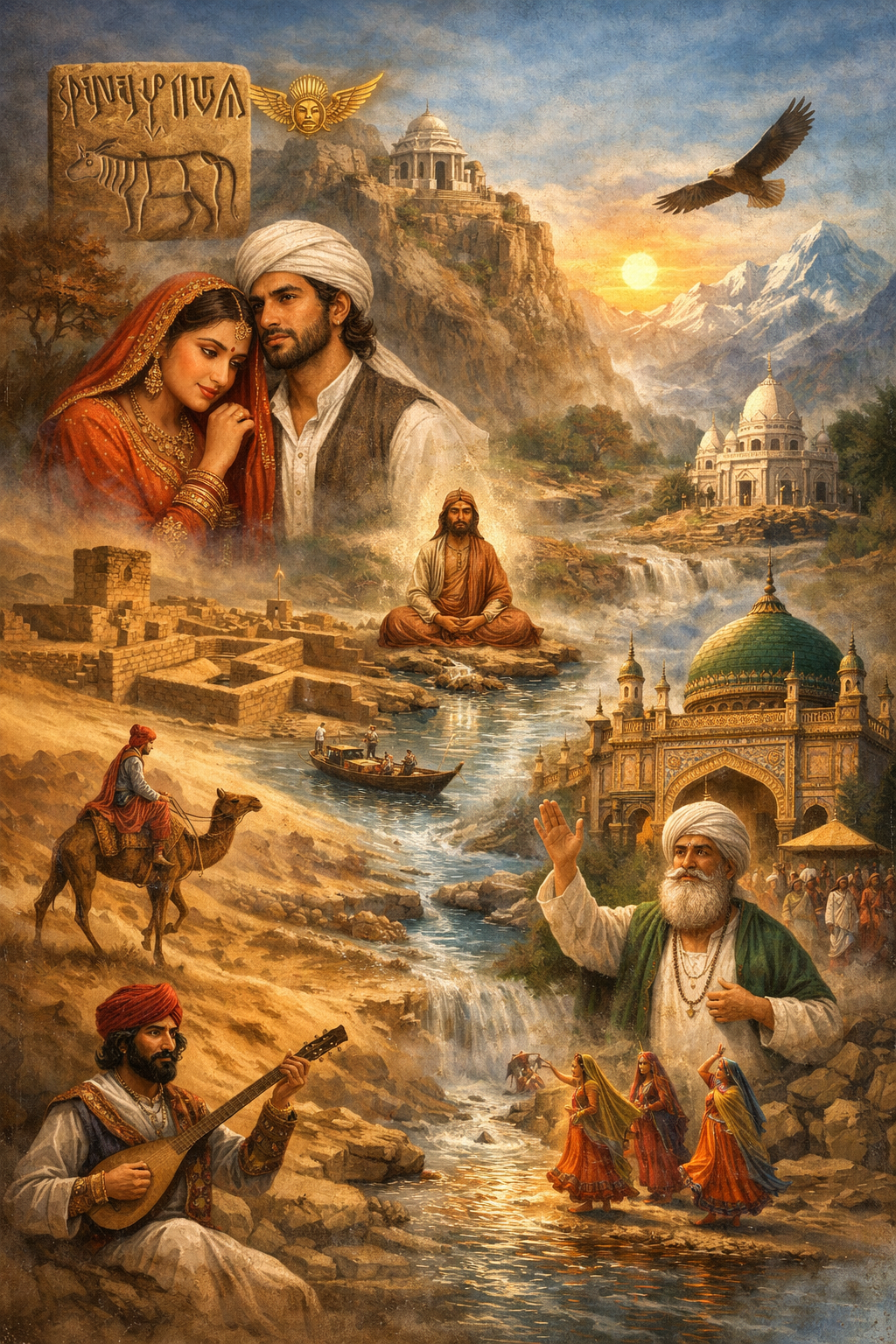
This knowledge series treats the Indus region as a civilizational and narrative formation rather than as a narrowly modern political category. The basin of the Indus and its adjoining worlds have generated stories of origins, sacred place, longing, exile, sanctity, sacrifice, hospitality, moral testing, tribal memory, female witness, heroic endurance, communal belonging, and metaphysical desire. Rivers become more than waterways; they become symbolic lines of fertility, danger, separation, purification, passage, and return. Deserts become landscapes of ordeal, fidelity, wandering, and homeland attachment. Mountains become thresholds between the ordinary and the sacred. Shrines become institutions of memory in which poetry, music, pilgrimage, miracle, healing, and ethical imagination converge.
The category includes several overlapping layers of tradition. One concerns the ancient Indus civilization, whose archaeological remains invite careful reflection on ritual, iconography, animal symbolism, water, fertility, urban order, and the relation between ecology and sacred imagination. Another concerns the vernacular folkloric worlds of Punjab, Sindh, Balochistan, Kashmir, the frontier, and adjoining cultural zones, where oral transmission preserved romances, legends, genealogies, laments, proverb worlds, spirit tales, seasonal memory, and heroic poetry. A third concerns sacred narrative in the broad sense: hagiography, miracle stories, shrine traditions, devotional song, mystical allegory, pilgrimage memory, local theology, ritual storytelling, and sacred topography.
What gives the Indus region particular importance is the intimacy with which narrative joins the local and the civilizational. A village romance may become a meditation on honor, homeland, and desire. A shrine legend may preserve a moral understanding of hospitality, suffering, healing, and sanctity. A desert heroine may stand for fidelity to place and resistance to coercion. A tale of impossible love may become an allegory of mystical longing. A river crossing may become a test of love, truth, and destiny. A valley origin story may bind sacred geography to collective memory. A tribal genealogy may function as both history and moral cosmology. Such materials are best read not as isolated “folklore” in the thin sense, but as parts of a larger narrative ecology linking land, memory, ethics, devotion, performance, and social imagination.
Why This Field Matters
Indus Region myth, folklore, and sacred narrative deserve serious study because they preserve forms of memory that formal political and dynastic histories often marginalize. Oral traditions hold emotional, symbolic, and ethical histories: fears, ideals, loyalties, losses, cosmologies, ecological understandings, and structures of meaning that do not always survive in administrative, courtly, colonial, or nationalist archives. The region’s story-worlds are therefore indispensable for understanding how communities imagine themselves through land, language, ritual, poetry, devotion, and memory.
The field also matters because the Indus world is narrated through landscapes as much as through texts. Rivers, deserts, forts, valleys, caravan routes, shrines, grazing lands, orchards, mountain passes, sacred groves, springs, and holy sites are active narrative forces. The river may nourish, divide, flood, purify, or prevent union. The desert may test fidelity, expose character, and bind a person to homeland. The shrine may transfigure suffering into song and miracle. The valley may become a sacred inheritance. The region’s geography is not merely setting; it is a moral and symbolic actor.
Indus-region sacred narrative is also important because it reveals deep plurality. Its story worlds arise from interaction among ancient urban cultures, Indic traditions, Persianate literary formations, Islamicate and Sufi devotional worlds, Sikh memory, vernacular oral performance, and local tribal or pastoral cosmologies. The region cannot be reduced to a single religious or linguistic tradition. Its richness lies in contact, translation, reinterpretation, and layered coexistence.
Finally, the field matters because it preserves gendered, domestic, and sub-elite forms of knowledge often overlooked in standard literary history. Wedding songs, lullabies, laments, household ritual sayings, women’s narrative performances, spirit lore, and intimate oral poetry transmit ethical and cosmological worlds that do not appear fully in elite texts. To study this field seriously is to take vernacular memory as intellectual history.
The Problem of the Archive
A research-grade account must begin with the archive itself. Indus-region myth, folklore, and sacred narrative do not survive in a single canonical book, mythographic handbook, or closed religious corpus. They are dispersed across archaeology, oral tradition, folk romance, devotional poetry, saintly hagiography, shrine ritual, regional ballads, oral epics, women’s songs, proverbs, miracle stories, pilgrimage memory, inscriptions, courtly manuscripts, colonial collections, modern printed editions, musical performance, and living community practice.
The archive also crosses languages. Sanskrit, Prakrit, Persian, Punjabi, Sindhi, Seraiki, Baluchi, Pashto, Kashmiri, Hindko, Urdu, and other vernaculars have all carried narrative worlds in different periods and settings. Translation is therefore not a secondary issue. It is part of the history of the traditions themselves. A tale may move from oral performance to written qissa, from folk romance to Sufi allegory, from shrine song to printed anthology, from local legend to national literature, or from women’s domestic memory to public cultural heritage.
Much of the archive is mediated. Ancient Indus materials remain archaeologically visible but textually opaque because the script is undeciphered. Folk traditions were often collected by colonial officials, missionaries, ethnographers, regional scholars, or nationalist literary projects. Sacred narratives may have been reframed through reformist, sectarian, colonial, or modern heritage categories. These sources can be valuable, but they must be read critically.
Interpretation must therefore ask not only what a story says, but how it was transmitted, who preserved it, what language carried it, what community used it, what ritual or performance setting sustained it, and what forms of power shaped its recording. The archive is not simply a pile of tales. It is a layered field of memory, mediation, and living transmission.
Myth Without a Single Canon
Indus-region myth, folklore, and sacred narrative are best approached as a plural and historically adaptive field rather than as a single mythology. There is no one “Indus mythology” in the same sense that one might speak of a tightly bounded classical pantheon or a single epic-centered tradition. The region’s narrative life is a palimpsest: ancient urban symbolism, Indic sacred geography, Sufi shrine devotion, Sikh moral memory, Persianate romance, Punjabi and Sindhi folk epic, Baluchi tribal poetry, Pashtun oral lyric, Kashmiri sacred legend, women’s domestic performance, and local healing traditions coexist in layered relation.
This absence of a single canon is not a weakness. It is the structure of the field. Narrative in the Indus region is carried by places, songs, shrines, lovers, rivers, saints, heroines, ancestors, martyrs, poets, oral performers, households, and landscapes. Its authority is not always textual. It may be local, performative, devotional, genealogical, ecological, or affective.
The field therefore resists reduction. To describe the region only as “South Asian” may obscure the specific importance of the Indus river system, Persianate transmission, frontier memory, and river-basin formation. To describe it only as “Islamicate” may obscure older Indic, Sikh, Buddhist, Jain, tribal, and local sacred worlds. To describe it only as “folklore” may underestimate its ethical, metaphysical, and civilizational depth.
This pillar treats mythology in a broad scholarly sense: a field of powerful stories, symbols, places, beings, practices, and narrative forms through which communities imagine origin, belonging, moral order, sacred presence, danger, longing, sacrifice, and memory.
The Civilizational Frame of the Indus Region
The phrase “Indus region” is useful because it names a cultural and geographic field deeper than the modern state and broader than any one linguistic or confessional community. It evokes a zone oriented around the Indus river system and its adjoining landscapes: Punjab’s riverine plains, Sindh’s lower Indus world, Balochistan’s arid and epic horizons, Kashmir’s sacred valleys, frontier regions whose oral cultures mediate between plateau, mountain, and basin, and neighboring zones connected by trade, pilgrimage, migration, pastoralism, and literary circulation.
This is not a claim of uniformity. It is a claim of overlapping circuits. The Indus region has been shaped by river ecologies, seasonal cycles, pastoral movement, caravan routes, shrine networks, courts, monasteries, markets, forts, deserts, mountains, and imperial roads. Stories moved with singers, pilgrims, soldiers, saints, traders, refugees, brides, herders, scribes, and families. Narrative became one of the region’s principal ways of holding together plural worlds without making them identical.
The civilizational frame also makes it possible to read the region beyond modern national borders. Punjab, Sindh, Balochistan, Kashmir, Pashtun frontier worlds, Seraiki-speaking zones, and adjoining cultural formations have all contributed to a shared but internally differentiated narrative ecology. A story may be local in language and civilizational in resonance. A shrine may be regional in location and transregional in devotion. A romance may belong to a village landscape and still become a major literary symbol.
The Indus region is therefore best understood as a narrative basin: a field where stories flow, branch, sediment, flood, and return.
Ancient Indus Civilization and Sacred Interpretation
The earliest layer is also the most difficult to reconstruct because it survives archaeologically rather than through a deciphered literary corpus. Seals, figurines, urban planning, water systems, recurring motifs, animal imagery, craft objects, and settlement forms suggest a highly organized symbolic world, but they do not permit simple mythological decoding. Responsible interpretation requires restraint.
Because the Indus script remains undeciphered, later traditions should not be naively projected backward onto the Bronze Age. It is methodologically unsafe to identify ancient figures, rituals, or symbols too confidently with later Hindu, Buddhist, Jain, Sufi, or regional traditions. Yet the ancient layer cannot be excluded from the region’s long symbolic horizon. Water, fertility, animal presence, purification, civic order, and ecological management were clearly important to the ancient urban world, even if their precise mythic meanings remain contested.
This ancient opacity has itself become part of the region’s mythic afterlife. The Harappan and Mohenjo-daro worlds invite later imagination: lost cities, undeciphered signs, deep ancestry, urban sophistication, riverine order, and the mystery of civilizational disappearance. These are not ancient myths in the strict sense, but they are part of how the ancient Indus continues to live in modern cultural memory.
A serious pillar must therefore hold two commitments together: symbolic seriousness and interpretive caution. The ancient Indus world matters deeply, but it should be approached through archaeology, material culture, environmental history, and restrained comparative analysis rather than speculative certainty.
River, Desert, Mountain, and Valley as Narrative Forces
Landscape in Indus-region narrative is never mere background. The river nourishes, witnesses, divides, purifies, floods, carries, and sometimes renders union impossible. The desert becomes a place of fidelity, ordeal, wandering, deprivation, and attachment to homeland. The mountain functions as retreat, danger, revelation, or sacred threshold. The valley becomes a remembered sanctuary, a place of origin, or a contested inheritance.
The river is especially central. In love epics, it may become a line between desire and death. In shrine worlds, it may mark blessing, passage, purification, or the geography of saintly movement. In agricultural life, it sustains fertility and settlement. In ecological memory, it carries flood, erosion, seasonal uncertainty, and the fragility of human plans. The river is life, but it is not gentle symbolism. It can also separate, test, and destroy.
The desert carries a different grammar. In Sindhi and Baluchi worlds, desert landscapes often become spaces of loyalty, wandering, hunger, moral endurance, and longing for homeland. A heroine crossing or refusing the desert may become a figure of fidelity and resistance. A tribe moving across arid terrain may turn genealogy into memory of survival.
Kashmir’s valleys, springs, lakes, caves, and mountains offer yet another sacred geography, shaped by origin legends, pilgrimage memory, and layered religious inheritance. Across the region, space itself becomes morally charged. Geography enters narrative as an active force in human destiny.
Plurality, Layering, and Narrative Contact Zones
No fullest account of Indus-region myth, folklore, and sacred narrative can proceed as though the region were governed by one civilizational logic alone. The Indus world has long been a zone of contact in which religious traditions, vernacular ecologies, poetic forms, and regional identities have met, overlapped, and reshaped one another. Stories move across boundaries of language, class, caste, tribe, sect, and doctrine.
A love romance may become Sufi allegory. A local heroine may become a moral exemplar for multiple communities. A shrine may gather visitors across sectarian lines. A saint’s legend may absorb older place memory. A river may belong at once to ecology, livelihood, devotion, song, and cosmology. A folk tale may carry philosophical meaning without presenting itself as philosophy. A women’s lament may preserve a sharper social critique than courtly literature.
This layered condition is especially important for avoiding reduction. To read the field only through elite literature misses the force of oral performance, household ritual, shrine visitation, festival circulation, and women’s transmission of story. To read it only through formal religion misses the vernacular, affective, and ecological dimensions of sacred life. To read it only through modern identity categories risks flattening a much older and more entangled narrative terrain.
The Indus region is therefore not merely a place where stories are told. It is a place where narrative becomes one of the principal means through which plural worlds remain intelligible to one another.
Punjabi Qissa and Love Epic
Among the region’s most distinctive narrative forms is the Punjabi qissa: an extended narrative poem centered on lovers, heroes, ordeal, family conflict, social constraint, and moral testing. These are not merely romances in a trivial sense. They are cultural meditations on longing, loyalty, resistance, caste and clan pressure, gendered vulnerability, spiritual desire, and the tragic cost of love under unjust conditions.
Punjabi qissa stands at the intersection of oral tradition, literary refinement, agrarian social worlds, Sufi reinterpretation, and vernacular ethics. Stories such as Heer-Ranjha, Sohni-Mahiwal, Sassi-Punnhun, and Mirza-Sahiban are remembered not only as love stories but as ways of thinking desire, refusal, family coercion, social hierarchy, honor, spiritual longing, and the relationship between earthly attachment and metaphysical truth.
The qissa form is powerful because it gives village, field, river, pastoral life, and household authority literary gravity. It does not separate high metaphysics from vernacular life. The beloved, the riverbank, the clay pot, the camel journey, the parental prohibition, the desert crossing, the broken promise, and the impossible union all become charged symbols.
Punjabi love epic therefore belongs at the center of this pillar. It reveals how regional folklore can become a sophisticated moral and mystical archive.
Heer-Ranjha, Sohni, Sassi, and the Metaphysics of Longing
Many of the region’s most powerful stories center on longing rather than possession. Love is obstructed, deferred, exiled, sacrificed, or transformed into ethical and mystical endurance. Yet impossibility intensifies rather than weakens the narrative. The beloved becomes a center around which questions of honor, fidelity, grief, social constraint, homeland, and transcendence revolve.
Heer-Ranjha is especially important because it turns love into a critique of social control and a vehicle of mystical desire. The lovers’ suffering becomes more than romantic tragedy. It reveals the violence of coercive kinship, the fragility of truth under social pressure, and the possibility that human love may point toward a deeper form of longing.
Sohni-Mahiwal gives the river a devastating symbolic force. Sohni’s crossing is an act of desire, courage, danger, and fate. The river is not simply a setting; it is the medium through which love is tested and destroyed. The broken vessel becomes one of the region’s most powerful images of vulnerability.
Sassi-Punnhun and related Sindhi and Punjabi cycles make wandering, desert trial, and impossible pursuit central to the metaphysics of longing. Love becomes movement through suffering, and suffering becomes a form of witness. These stories endure because they make longing morally and spiritually serious.
Sindhi Folklore and Sufi Poetic Worlds
Sindh offers one of the most powerful examples of how folklore, sacred poetry, and regional identity can become inseparable. In Sindhi narrative culture, local heroines, travelers, deserts, rivers, wandering ascetics, and remembered landscapes are woven into meditations on exile, fidelity, humility, yearning, and spiritual realization.
The poetic universe of Shah Abdul Latif Bhittai is central here, not because it displaces folklore with literary authorship, but because it absorbs and elevates regional tale cycles into an extraordinary vernacular metaphysics of place, suffering, and longing. The Risalo turns folk heroines and regional stories into spiritual figures without erasing their local texture.
Sindhi story worlds also reveal the importance of song, shrine culture, women’s presence in legend, and the riverine ecology of the lower Indus. Heroines such as Marui, Sassui, Sohni, and others are not merely tragic lovers. They become witnesses to homeland, fidelity, truth, suffering, and the refusal to surrender moral identity under coercion.
Sindhi folklore and Sufi poetry therefore belong together. The sacred is not imposed from above onto folk narrative; it arises through the intensification of local story into metaphysical song.
Baluchi Oral Epic and Tribal Memory
Baluchi oral literature preserves a narrative world in which genealogy, migration, feud, battle, lament, hospitality, romance, honor, and collective memory remain central. Epic cycles and ballad traditions do more than recount deeds. They sustain an account of peoplehood. In them, remembered action is inseparable from remembered lineage and remembered land.
Oral performance becomes historical consciousness in poetic form. A battle may preserve a moral code; a genealogy may explain belonging; a lament may carry social criticism; a romance may reveal the limits of honor; a migration story may transform movement into identity. Baluchi narrative worlds are therefore not reducible to heroic violence. They carry affective, domestic, ritual, and ethical layers.
Women’s lament and memory are especially important. Mourning traditions, songs of loss, and domestic oral forms preserve grief and moral witness in ways that formal heroic accounts often understate. The voice of lament may carry the human cost of feud, migration, and honor more fully than the public language of victory.
Baluchi oral epic therefore expands the pillar’s frontier dimension. It reveals how tribal memory, oral poetry, land, and ethics form a single narrative system.
Pashtun Narrative Worlds
Pashtun traditions bring into focus the relation between story, code, descent, sainthood, poetry, and honor. Oral poetry, landay, stories of origin, tribal memory, hagiographical materials, and local sacred associations all contribute to a narrative culture in which ethics and identity are closely connected.
Pashtun narrative worlds should not be reduced to martial honor alone. They include women’s lyric expression, household emotion, saintly mediation, migration memory, spiritual authority, hospitality, grief, and moral courage. The landay, especially, reveals the intensity of brief poetic speech. In two lines, a voice may carry love, war, irony, protest, longing, loss, and social critique.
Stories of descent and homeland also matter. They do not need to be treated as simple historical reportage in order to be taken seriously. Their importance lies in how they authorize identity, encode values, explain kinship, and place a people within a moral universe.
Pashtun narrative worlds therefore contribute a crucial frontier dimension to the Indus-region archive: a world of poetry, honor, homeland, sanctity, and speech under pressure.
Kashmiri Sacred Legend and Valley Imagination
Within the wider regional frame, Kashmir contributes a distinctive sacred topography shaped by legends of origin, tirtha traditions, sanctified landscapes, mystical memory, and layered religious worlds. In Kashmiri narrative imagination, the land itself often appears as storied inheritance. Origin legends, sacred lakes and springs, caves, mountains, pilgrimage sites, and textual traditions such as the Nilamata Purana reveal how myth and sacred geography can become mutually constitutive.
Kashmir’s traditions show with particular clarity how place remembers through ritual narrative. A spring may carry origin memory. A lake may hold cosmological force. A mountain may become pilgrimage. A valley may be imagined as sacred enclosure, beloved homeland, contested inheritance, and spiritual landscape at once.
Kashmiri sacred legend also preserves the layering of Hindu, Buddhist, Islamic, Sufi, and local forms. The region’s traditions cannot be interpreted through one religious category alone. They require attention to sedimented memory, pilgrimage, poetic imagination, and historical rupture.
Kashmir therefore belongs centrally to this pillar because it shows how sacred landscape can become one of the deepest forms of cultural memory.
Sikh Narrative Memory and Moral Heroism
A fullest account of the Indus region must include Sikh narrative memory, especially in Punjab. Janam-sakhi traditions, martyr stories, accounts of moral courage, communal sacrifice, sanctified landscape, and the ethical imagination of resistance all belong to the wider narrative ecology of the region. These traditions do not merely record community history. They shape moral identity through exemplary action, sacred memory, pilgrimage geography, and the narrative transmission of justice, service, endurance, and dignity.
Sikh narrative memory is especially important because it binds sacred biography to ethical action. The lives of the Gurus, stories of teaching and travel, martyr narratives, and memories of struggle become forms of moral instruction. The sacred is remembered through speech, song, pilgrimage, community, and conduct.
Punjab’s narrative ecology therefore cannot be understood through romance alone. Sikh memory brings into the field a powerful tradition of moral heroism: courage without domination, sacrifice without erasure, and resistance grounded in spiritual responsibility.
This layer broadens the pillar from folk romance and Sufi poetics into a wider regional account of sacred ethics and communal memory.
Hindu, Buddhist, Jain, and Local Sacred Worlds
Across the wider Indus sphere, older Hindu, Buddhist, Jain, and local sacred traditions survive in textual memory, ritual practice, place legend, and layered cosmological symbolism. Sacred rivers, serpent lore, goddess associations, pilgrimage circuits, monastic memory, cave sanctity, mountain reverence, local deities, and regional cults all contribute to a broader archive of sacred narrative.
These traditions are not uniformly preserved across the region, but their traces remain crucial for any account that seeks genuine comprehensiveness. Kashmir, Punjab, Sindh, Balochistan, and frontier zones each preserve different layers of Indic and local sacred memory, sometimes visible in texts, sometimes in place-names, pilgrimage routes, ruined sites, oral traces, shrine practices, or shared local reverence.
Buddhist and Jain histories also matter because they remind readers that the Indus and adjoining regions were not always organized around the religious formations most visible today. Monastic routes, pilgrimage landscapes, narrative cycles, ethical traditions, and material remains all contribute to the region’s deep sacred plurality.
A comprehensive pillar must therefore resist presentist simplification. The Indus region’s narrative archive is layered across many religious and philosophical worlds, not reducible to one tradition or one historical period.
Women, Oral Tradition, and Domestic Worlds
No fullest treatment of Indus-region folklore is adequate without giving central place to women as tellers, singers, ritual actors, mourners, transmitters of household memory, and interpreters of danger, longing, and belonging. Women’s traditions preserve emotional and cosmological textures that elite literary archives often mute. Wedding songs carry reflections on separation, kinship, vulnerability, and the cost of social transition. Lullabies encode hopes, fears, blessings, and social ideals. Laments preserve grief, protest, honor, memory, and moral witness.
Domestic tales transmit warnings about strangers, thresholds, spirits, illness, fate, marriage, social danger, and the vulnerability of children. These are not peripheral materials. They are among the principal forms through which narrative survives in lived social worlds. The home is one of the region’s most important archives.
Women also stand at the center of some of the region’s most enduring story forms. Heroines in Punjabi and Sindhi romance are often not passive objects of desire but moral and symbolic agents whose fidelity, refusal, endurance, suffering, and truth-telling become culturally decisive. Female figures may embody homeland, conscience, resistance to imposed power, or the impossible demand of love under unjust conditions.
In shrine worlds and devotional settings, women’s vows, songs, petitions, and ritual practices reveal a theology of care and vulnerability often carried through performance rather than formal doctrine. The field cannot be complete without this domestic and gendered archive.
Sacred Geography, Shrines, and the Landscape of Memory
No serious treatment of Indus-region sacred narrative can ignore the role of shrines and sacred geography. Across the region, shrines are not merely burial places or ritual centers. They are narrative institutions. Around them gather miracle stories, devotional songs, annual commemorations, healing memories, moral reputations, stories of conversion or protection, lineages of discipleship, and performances of belonging that bind communities across time.
This is especially important in traditions shaped by Sufi devotion, though not limited to them. In many parts of the Indus world, saintly memory is carried not only in formal hagiography but in sung poetry, pilgrimage routes, local anecdotes, communal recitation, remembered acts of intercession, and reputations for justice, generosity, or care. The saint becomes a point of convergence between ethical imagination, vernacular language, social healing, and sacred presence.
Sacred geography extends beyond shrines in a narrow sense. Rivers, wells, forts, tombs, deserts, hilltops, valleys, caves, springs, orchards, caravan routes, and remembered crossings all acquire narrative density. In some traditions, the beloved’s resting place becomes a site of witness. In others, an ascetic’s retreat or a spring of origin becomes part of a larger theology of place.
The region is therefore not merely the setting of stories. It is itself a narrated landscape in which place becomes a bearer of memory and moral meaning.
Ritual, Material Culture, and the Embodied Life of Story
Stories in the Indus region do not survive only in texts or recitations. They also survive in ritual and material form. Offerings at shrines, votive cloths, lamps, relics, amulets, protective recitations, commemorative objects, seasonal festival practices, songs attached to specific rites, and embodied routes of pilgrimage all carry narrative meaning. Communities do not merely remember stories; they inhabit them through movement, repetition, touch, sound, and exchange.
This material dimension is crucial because it reveals how folklore and sacred narrative enter everyday negotiations with illness, danger, fertility, uncertainty, weather, loss, and hope. Protective practices, healing rites, ritual visits, vows, and the circulation of blessed objects all belong to the lived cosmology of the region.
Material practice can also preserve older symbolic patterns even when interpretation changes. A spring may be visited under one religious vocabulary in one period and another in a later period. A protective object may move between household practice, shrine devotion, and folk medicine. A festival may gather multiple layers of seasonal, devotional, and communal meaning.
A fullest treatment of the field must therefore attend not only to stories as verbal artifacts, but to story as embodied social life.
Honor, Hospitality, Oath, and Social Obligation
Many tales from the Indus region are structured by codes of loyalty, kinship, oath, reputation, reciprocity, generosity, and communal obligation. In pastoral romance, tribal epic, shrine legend, and saint narrative alike, characters are judged by steadfastness, truthfulness, courage, self-restraint, hospitality, and the capacity to endure suffering without betrayal or disgrace.
Hospitality is especially important in frontier, pastoral, and shrine worlds. To host a stranger, protect a guest, feed a traveler, keep a vow, or betray a trust may carry moral consequences that extend beyond ordinary social courtesy. Hospitality becomes a way of measuring the ethical condition of a person or community.
Honor narratives must be read carefully. They can preserve dignity, courage, and moral obligation, but they can also expose coercion, gendered vulnerability, vengeance, and social violence. The strongest stories often reveal the tension between social code and moral truth. Love may violate clan expectation; conscience may resist family command; fidelity may become rebellion; hospitality may expose hypocrisy.
Indus-region narrative therefore uses social obligation as a dramatic field where moral life becomes visible under pressure.
Folk Tale, Proverb, Ballad, and Everyday Moral Intelligence
The narrative life of the Indus region exceeds epic and romance. Folktales, animal stories, trickster motifs, proverbs, riddles, seasonal songs, ritual chants, harvest narratives, and stories attached to weddings, births, mourning, weather, and pastoral movement all form part of the region’s moral and symbolic archive.
These shorter and more localized genres are often where communities most clearly transmit practical ethics, cosmological fear, humor, social criticism, and everyday cultural intelligence. A proverb may carry a whole philosophy of caution. A riddle may train perception. A ballad may preserve local memory better than formal history. A seasonal song may encode ecological knowledge. A wedding song may speak openly about separation and vulnerability in ways ordinary speech cannot.
Folk tale and proverb worlds also connect children, elders, women, performers, and households across generations. They are not minor forms. They are transmission systems. Their brevity often makes them more durable, mobile, and adaptable than elite literary genres.
A comprehensive pillar must therefore give ordinary forms of speech their proper intellectual weight. The everyday is one of the major locations of moral imagination.
Loss, Rupture, and Cultural Survival
Many Indus narratives bear the marks of conquest, displacement, partition, exile, ecological change, migration, and social rupture. Story becomes one of the means by which communities preserve continuity under altered conditions. Love epics, shrine legends, laments, women’s songs, migration stories, and memories of place often carry more historical feeling than formal chronicles.
The region’s narratives repeatedly return to separation: lovers separated by clan, caste, river, desert, death, or social command; communities separated from homeland; families separated by marriage or migration; religious communities separated by political rupture; landscapes separated by borders. Separation becomes both historical experience and metaphysical form.
Shrines and songs often become portable memory. When people move, they may carry verses, saint names, recipes, ritual habits, family stories, genealogies, and place-memory. Narrative becomes a way of remaining connected to lost or altered worlds.
This makes the field especially important for thinking cultural survival. Indus-region sacred narrative shows how communities endure rupture not only through law, politics, or formal history, but through story, song, longing, and ritual return.
Ethics, Symbolism, and the Moral Imagination
The narrative traditions of the Indus region repeatedly ask what it means to live faithfully under conditions of fragility, desire, hierarchy, conflict, coercion, ecological exposure, and change. Their symbols are morally dense. The journey may represent exile, seeking, trial, or transformation. The river may signify both life and unbridgeable distance. The desert may test loyalty and reveal character. The shrine may transfigure suffering into memory. The beloved may stand for a human person, a homeland, truth itself, justice, or the divine.
These narratives also contain political intelligence, though usually not in overt programmatic form. They reflect on kinship control, local authority, coercion, honor, reputation, exile, gendered vulnerability, communal obligation, and the preservation of dignity under pressure. They stage conflict between love and clan, conscience and force, fidelity and domination, memory and empire.
The strongest narratives are often tragic not because they are nihilistic, but because they are serious about the cost of meaning. The hero may triumph only through loss. The beloved may become more powerful in absence than in possession. A saint may remain present through death. A landscape may become sacred because it bears suffering. A woman’s refusal may become a region’s moral memory.
At their highest level, these traditions reveal how a region thinks through story. They disclose a moral psychology of loyalty and grief, a metaphysics of longing, an ecology of sacred place, a poetics of women’s witness, and a civilizational capacity to hold plurality without dissolving into fragmentation.
Major Questions of Interpretation
This pillar is organized around several major questions. How should Indus-region myth, folklore, and sacred narrative be studied when its archive includes archaeology, oral romance, devotional poetry, saintly hagiography, shrine practice, women’s song, tribal genealogy, sacred geography, ritual objects, and multiple linguistic traditions? How can the ancient Indus be interpreted seriously without projecting later traditions backward onto undeciphered material? How can regional narrative be studied beyond modern national categories?
The pillar also asks how landscape becomes narrative. Why do rivers, deserts, mountains, valleys, shrines, forts, wells, caves, and crossings carry such symbolic force? How do love epics become ethical and mystical texts? How do women’s songs preserve domestic cosmology? How do shrines function as institutions of memory? How do Baluchi, Pashtun, Sindhi, Punjabi, Kashmiri, Sikh, Hindu, Buddhist, Jain, and local traditions interact without becoming one undifferentiated archive?
These questions keep the category from becoming a simple inventory of tales. They open Indus-region myth, folklore, and sacred narrative as a field of archaeological, oral, literary, devotional, ecological, gendered, performative, and comparative inquiry. The tradition is not only a collection of stories. It is a civilizational narrative ecology through which communities have imagined longing, honor, sanctity, homeland, loss, and the moral meaning of place.
Expanded Article Architecture
The following structure gathers the pillar into a long-range architecture suitable for a major mythology knowledge series. It is designed to support ancient Indus interpretation, riverine sacred geography, Punjabi qissa, Sindhi Sufi folklore, Baluchi oral epic, Pashtun lyric and honor traditions, Kashmiri sacred landscape, Sikh moral memory, Hindu, Buddhist, Jain, and local sacred worlds, women’s oral transmission, shrine devotion, ritual material culture, ecological symbolism, and modern cultural survival. All entries below should be treated as planned unless already completed elsewhere on the site.
Foundations and Source Problems
- What Is Indus Region Myth, Folklore & Sacred Narrative? (planned)
- The Problem of Sources in Indus-Region Mythology and Sacred Narrative (planned)
- Indus Region Narrative Without a Single Canon (planned)
- How to Read Indus-Region Story Worlds Across Languages and Communities (planned)
- Myth, Folklore, Devotion, and the Social Life of Story in the Indus Region (planned)
- Oral Tradition, Shrine Memory, and Vernacular Sacred Knowledge (planned)
- Colonial Archives, Regional Scholarship, and the Problem of Translation (planned)
Ancient Indus Civilization and Sacred Interpretation
- The Ancient Indus Civilization and the Problem of Sacred Interpretation (planned)
- From Archaeology to Myth: How to Read the Ancient Indus Carefully (planned)
- River, Flood, and Fertility in the Symbolic World of the Indus (planned)
- Animals, Seals, and Sacred Imagery in the Ancient Indus World (planned)
- Water, Purification, and Urban Order in Harappan Imagination (planned)
- Indus Script, Opacity, and the Ethics of Interpretation (planned)
- Ancient Urbanism and the Long Memory of Lost Civilizations (planned)
Landscape, Ecology, and Sacred Geography
- The River as Memory: Ecology, Place, and Story in the Indus World (planned)
- Desert, Homeland, and the Symbolism of Trial (planned)
- Mountains, Valleys, Springs, and Sacred Thresholds (planned)
- Forts, Wells, Crossings, and the Geography of Moral Testing (planned)
- Flood, Drought, Fertility, and the Ecological Imagination of the Indus (planned)
- Landscape as Witness in Indus-Region Narrative (planned)
Punjabi Qissa and Love Epic
- What Is Qissa? Love Epic and Narrative Tradition in Punjab (planned)
- Heer and Ranjha: Love, Longing, and the Moral Imagination of Punjab (planned)
- Waris Shah and the Literary Transformation of Folk Narrative (planned)
- Sohni, Sassi, and the Tragic Grammar of Punjabi and Sindhi Romance (planned)
- Mirza-Sahiban and the Violence of Social Constraint (planned)
- Love, Clan, Caste, and the Ethics of Refusal in Punjabi Romance (planned)
- Punjabi Folklore Beyond Romance: Village, Field, and Sacred Memory (planned)
Sindhi Folklore and Sufi Poetic Worlds
- Shah Abdul Latif Bhittai and the Sacred Poetics of Sindh (planned)
- The Risalo and the Vernacular Metaphysics of Longing (planned)
- The Heroines of Sindh: Folklore, Devotion, and Female Moral Witness (planned)
- Marui, the Desert, and the Ethics of Homeland (planned)
- Sassui and Punnhun: Wandering, Trial, and Mystical Love (planned)
- Sohni and the River Crossing as Sacred Risk (planned)
- Shrine Networks, River Memory, and Sacred Place in Sindh (planned)
Baluchi Oral Epic and Tribal Memory
- Baluchi Oral Epic and the Preservation of Tribal Memory (planned)
- Honor, Genealogy, and Heroic Consciousness in Baluchi Narrative (planned)
- Migration, Feud, and the Poetics of Peoplehood in Baluchi Tradition (planned)
- Women’s Lament and Memory in Baluchi Oral Tradition (planned)
- Hospitality, Desert Travel, and the Moral Geography of Balochistan (planned)
- Ballad, Lament, and Tribal History in Baluchi Performance (planned)
Pashtun Narrative Worlds
- Pashtun Origins, Oral Tradition, and the Narrative of Peoplehood (planned)
- Pashtunwali and the Ethics of Story (planned)
- Women’s Landay and the Intimate Voice of Pashtun Oral Culture (planned)
- Saints, Hagiography, and Sacred Mediation in Pashtun Narrative (planned)
- Hospitality, Honor, and Homeland in Pashtun Story Worlds (planned)
- Frontier Memory, Lyric Speech, and Moral Courage (planned)
Kashmiri Sacred Legend and Valley Imagination
- Kashmir as Sacred Landscape: Origin Legends, Valleys, and Holy Places (planned)
- The Nilamata Purana and the Sacred Imagination of Kashmir (planned)
- Springs, Lakes, and Pilgrimage Memory in Kashmiri Tradition (planned)
- Mountains, Caves, and Valley Origin Stories (planned)
- Kashmiri Sacred Geography Across Hindu, Buddhist, Islamic, and Local Worlds (planned)
- Landscape, Loss, and Memory in Kashmiri Narrative (planned)
Sikh Narrative Memory and Moral Heroism
- Sikh Janam-Sakhi, Martyr Memory, and Moral Heroism (planned)
- Guru Nanak’s Travels and the Narrative Geography of Teaching (planned)
- Martyrdom, Justice, and the Ethical Imagination of Sikh Memory (planned)
- Sacred Song, Community, and the Transmission of Moral Courage (planned)
- Punjab as Sacred Landscape in Sikh Narrative Tradition (planned)
- Service, Sacrifice, and the Narrative Life of Dignity (planned)
Hindu, Buddhist, Jain, and Local Sacred Worlds
- Hindu Sacred Geography and Local Deity Traditions in the Indus Region (planned)
- Serpent Lore, Springs, and Goddess Memory in Regional Tradition (planned)
- Buddhist Memory, Monastic Routes, and Sacred Landscape in the Northwest (planned)
- Jain and Mercantile Sacred Memory in Indus-Connected Worlds (planned)
- Local Deities, Village Guardians, and Vernacular Cosmology (planned)
- Indic Sacred Worlds and Their Regional Afterlives (planned)
Shrines, Saints, and Vernacular Sacred Practice
- Shrines, Saints, and Sacred Geography in the Indus Region (planned)
- Sufi Devotion, Local Legend, and the Vernacular Sacred (planned)
- Miracle, Intercession, and the Social Life of the Saint (planned)
- Pirs, Faqirs, Ascetics, and Holy Persons in Regional Memory (planned)
- Annual Commemoration, Pilgrimage, and the Ritual Calendar of Shrines (planned)
- Music, Poetry, and Healing at Indus-Region Shrines (planned)
- Shared Sacred Spaces and the Plural Life of Devotion (planned)
Women, Domestic Worlds, and Oral Transmission
- Women, Desire, and Moral Resistance in Indus-Region Narrative (planned)
- Wedding Song, Lullaby, and Lament in the Domestic Story World (planned)
- Women’s Witness in Punjabi and Sindhi Romance (planned)
- Women’s Lament and the Ethics of Grief in Frontier Traditions (planned)
- Household Ritual, Protection, and Domestic Cosmology (planned)
- Female Voice, Homeland, and Moral Refusal in Vernacular Tradition (planned)
Ethics, Honor, Hospitality, and Social Obligation
- Honor, Hospitality, Oath, and Social Obligation in Indus-Region Story Worlds (planned)
- Love and Clan: Social Constraint in Folk Romance (planned)
- Hospitality, Strangerhood, and Moral Testing in Frontier Narrative (planned)
- Oath, Promise, Curse, and the Binding Power of Speech (planned)
- Reputation, Shame, and the Ethics of Communal Life (planned)
- Justice, Coercion, and Moral Courage in Vernacular Narrative (planned)
Folk Tale, Proverb, Ballad, and Seasonal Narrative
- Folk Tale, Proverb, and Everyday Moral Intelligence in the Indus Region (planned)
- Animal Tales, Trickster Motifs, and Social Critique (planned)
- Riddles, Proverbs, and the Training of Perception (planned)
- Harvest Songs, Seasonal Memory, and Agrarian Narrative Worlds (planned)
- Birth, Marriage, Mourning, and the Ritual Life of Story (planned)
- Short Oral Forms and the Survival of Cultural Intelligence (planned)
Ritual Objects, Healing, and Material Practice
- Ritual Objects, Healing, and Protective Practice (planned)
- Amulets, Vows, Cloths, Lamps, and the Material Life of Devotion (planned)
- Illness, Spirit Danger, and Vernacular Healing Traditions (planned)
- Protective Recitation and the Sacred Power of Words (planned)
- Offerings, Pilgrimage Routes, and Embodied Storytelling (planned)
- Material Culture and the Lived Cosmology of the Indus Region (planned)
Loss, Partition, Memory, and Modern Afterlives
- Loss, Rupture, and Cultural Survival in Indus-Region Narrative (planned)
- Partition, Displacement, and the Story of Lost Homes (planned)
- Folk Romance in Modern Literature, Music, Film, and Theater (planned)
- Shrine Traditions Under Modern Reform, State Power, and Heritage Culture (planned)
- Myth, Folklore, and Civilizational Identity in the Indus Region (planned)
- Indus Region Myth, Folklore & Sacred Narrative in Comparative Perspective (planned)
- Why Indus Region Narrative Matters Today (planned)
Closing Perspective
Indus Region myth, folklore, and sacred narrative reveal one of the great layered narrative ecologies of Asia. They preserve ancient urban opacity, river symbolism, desert trial, mountain sanctity, love epic, shrine devotion, Sufi poetics, Sikh moral memory, Baluchi and Pashtun oral traditions, Kashmiri sacred geography, women’s songs, household ritual, heroic memory, and the long life of vernacular moral intelligence. Their power lies not in a single canon, but in a civilizational plurality of languages, landscapes, rituals, and living forms.
This is what makes the category so important within Mythology. Indus-region sacred narrative shows how mythology can be archaeological and oral, romantic and devotional, domestic and public, local and civilizational, tragic and metaphysical, ancient and continually reinterpreted. It also shows why mythology must be studied through river, desert, shrine, song, gender, language, ritual, ecology, and historical rupture, not only through story summary.
The strongest reason to study this field is that it clarifies how communities remember through landscape and longing. The river carries more than water; the shrine preserves more than a saint; the romance tells more than love; the lament carries more than grief; the desert tests more than endurance; the valley holds more than place. Indus-region narrative belongs close to the center of intellectual history because it shows how story can bind the ancient and the living, the local and the civilizational, the domestic and the sacred, the human and the more-than-human.
Related Reading
- Mythology
- South Asian Traditions
- South Asian Literature and Sacred Memory
- Persian Myth, Folklore, and Epic Tradition
- Arabian and Levantine Myth, Folklore, and Sacred Narrative
- Turkic and Ottoman Myth, Epic, and Folklore
- Indigenous and Oral Traditions
- Comparative Sacred Themes
- Mysticism and Contemplative Traditions
- Environment, Place, and Ecological Knowledge
Primary Sources
Ancient Indus and Archaeological Materials
- Archaeological materials from Harappa, Mohenjo-daro, and other Indus civilization sites, including seals, figurines, urban layouts, water systems, animal imagery, and material culture relevant to ritual, ecology, and symbolic interpretation.
- Cambridge University Press materials on the Indus civilization, useful for cautious framing of ancient religion and archaeology in the Greater Indus world: https://www.cambridge.org/core/books/handbook-of-ancient-religions/indus-civilization/A3E1EA4B993C27BB55BBF908DA89972F
- Published archaeological syntheses by Gregory L. Possehl and Rita P. Wright, especially for urbanism, economy, society, ecology, and the interpretive limits of ancient Indus religion.
Punjabi, Sindhi, and Vernacular Romance Traditions
- Waris Shah, Heer. A major Punjabi qissa text central to love, longing, social constraint, and vernacular moral imagination. Public-domain English translation available through Internet Archive: https://archive.org/details/the-love-of-hir-and-ranjha-waris-shah
- Shah Abdul Latif Bhittai, Risalo. Essential for Sindhi Sufi poetics, folk heroines, longing, desert symbolism, river memory, and spiritual allegory. English translation available through Internet Archive: https://archive.org/details/the-risalo-of-shah-abdul-latif-bhitai-amena-khamisani-2012-cs
- Punjabi and Sindhi oral and written traditions surrounding Heer-Ranjha, Sohni-Mahiwal, Sassi-Punnhun, Mirza-Sahiban, Marui, Moomal, Noori, and other regional narrative cycles.
Baluchi, Pashtun, and Frontier Narrative Materials
- Baluchi oral epic, ballad, and tribal memory traditions, including narratives of genealogy, migration, feud, hospitality, romance, and heroic consciousness.
- Encyclopaedia Iranica entries on Baluchi language, literature, oral poetry, and wider oral literature traditions. Useful for the relation between epic memory, genealogy, and performance: https://www.iranicaonline.org/articles/baluchistan-iii/
- Encyclopaedia Iranica, “Baluchistan IIIa. Baluchi Poetry”: https://www.iranicaonline.org/articles/baluchistan-iiia/
- Pashtun oral poetry, landay, origin narratives, hagiographical materials, and frontier story worlds. Britannica overview of landay: https://www.britannica.com/art/landay
Kashmiri, Sikh, and Sacred-Geography Traditions
- Nilamata Purana. A major source for Kashmiri sacred geography, origin legend, place memory, pilgrimage, and ritual landscape. English translation available through Internet Archive: https://archive.org/details/vUJH_the-nilamata-purana-vol.-1-text-with-english-trans.-by-dr.-ved-kumari-1968-srina
- Sikh janam-sakhi traditions, martyr narratives, sacred biography, pilgrimage memory, and moral-heroic traditions in Punjab.
- Regional sacred-geography traditions concerning rivers, springs, shrines, caves, valleys, holy places, and pilgrimage circuits across the wider Indus region.
Oral Tradition, Heritage, and Living Transmission
- UNESCO, “Oral traditions and expressions, including language as a vehicle of the intangible cultural heritage.” Useful for understanding oral tradition as living cultural memory: https://ich.unesco.org/en/oral-traditions-and-expressions-00053
- UNESCO, “Intangible cultural heritage.” Useful as a broad framework for living heritage, performance, oral transmission, and community practice: https://www.unesco.org/en/intangible-cultural-heritage
- Women’s oral traditions, including wedding songs, lullabies, laments, domestic tales, protective practices, and intimate poetic expression in Punjabi, Sindhi, Pashtun, Baluchi, Kashmiri, and related contexts.
Further Reading
- Britannica (2026) ‘Qissa’. Useful for a concise overview of the romance-poem genre central to Punjabi and related narrative worlds. https://www.britannica.com/art/qissa
- Britannica (2026) ‘Lanḍay’. Useful for Pashtun women’s brief oral verse and the intimate voice of frontier poetic culture. https://www.britannica.com/art/landay
- Britannica (2026) ‘Risalo’. Useful for context on Shah Abdul Latif Bhittai’s poetic corpus. https://www.britannica.com/topic/Risalo
- Britannica (2026) ‘Shāh ʿAbd-ul-Laṭīf’. Useful for Sindhi Sufi poetics and regional sacred literary memory. https://www.britannica.com/biography/Shah-Abd-ul-Latif
- Britannica (2026) ‘Sindhi literature’. Useful for vernacular literary and folkloric contexts in Sindh. https://www.britannica.com/art/Sindhi-literature
- Gregory L. Possehl on the Indus civilization and the interpretive challenge of ancient religion in the Greater Indus world.
- Rita P. Wright on the ancient Indus as a complex urban civilization embedded in wider ecological and social systems.
- Christopher Shackle on Punjabi literary culture, qissa, and vernacular religious and romantic traditions.
- Annemarie Schimmel on Sufi poetics, sacred longing, and the vernacular transformation of love into metaphysical desire.
- Nabi Bakhsh Baloch and related Sindhi folklore scholarship on oral tradition, local tale cycles, and the literary preservation of vernacular memory.
- Encyclopaedia Iranica entries on Baluchi language, literature, oral poetry, and oral literature for the relation between epic memory, genealogy, and performance. https://www.iranicaonline.org/
- Studies of Kashmiri sacred geography, especially the Nilamata Purana, for the relation between place, ritual, and civilizational memory.
- Scholarship on Sikh janam-sakhi traditions, martyr memory, and sacred geography in Punjab.
- Research on women’s oral traditions, including song, lament, household ritual, and intimate poetic expression in Punjabi, Sindhi, Pashtun, Baluchi, and Kashmiri contexts.
- UNESCO materials on oral traditions and intangible cultural heritage for understanding the wider cultural stakes of preserving vernacular narrative worlds. https://ich.unesco.org/en/oral-traditions-and-expressions-00053
References
- Britannica (2026) ‘Qissa’. Available at: https://www.britannica.com/art/qissa
- Britannica (2026) ‘Lanḍay’. Available at: https://www.britannica.com/art/landay
- Britannica (2026) ‘Risalo’. Available at: https://www.britannica.com/topic/Risalo
- Britannica (2026) ‘Shāh ʿAbd-ul-Laṭīf’. Available at: https://www.britannica.com/biography/Shah-Abd-ul-Latif
- Britannica (2026) ‘Sindhi literature’. Available at: https://www.britannica.com/art/Sindhi-literature
- Cambridge University Press (2012) ‘The Indus Civilization’, in Hinnells, J.R. (ed.) A Handbook of Ancient Religions. Cambridge: Cambridge University Press. Available at: https://www.cambridge.org/core/books/handbook-of-ancient-religions/indus-civilization/A3E1EA4B993C27BB55BBF908DA89972F
- Dames, M. Longworth (1904) The Baloch Race: A Historical and Ethnological Sketch. London: Royal Asiatic Society. Available at: https://archive.org/download/balochracehistor00damerich/balochracehistor00damerich.pdf
- Encyclopaedia Iranica (1988) ‘Baluchistan III. Baluchi Language and Literature’. Available at: https://www.iranicaonline.org/articles/baluchistan-iii/
- Encyclopaedia Iranica (1988) ‘Baluchistan IIIa. Baluchi Poetry’. Available at: https://www.iranicaonline.org/articles/baluchistan-iiia/
- Encyclopaedia Iranica (2008) ‘Oral Literature in Iran’. Available at: https://www.iranicaonline.org/articles/oral-literature-in-iran/
- Kumari, V. (trans.) (1968) The Nilamata Purana. Vol. 1: Text with English Translation. Srinagar: Jammu and Kashmir Academy of Art, Culture and Languages. Available at: https://archive.org/details/vUJH_the-nilamata-purana-vol.-1-text-with-english-trans.-by-dr.-ved-kumari-1968-srina
- Pelevin, M. (2023) ‘Pashtun homelands in an Indo-Afghan hagiographical collection’, Modern Asian Studies. Available at: https://www.cambridge.org/core/journals/modern-asian-studies/article/pashtun-homelands-in-an-indoafghan-hagiographical-collection/735D8F4C9AB84DB63DB39483E502F927
- Possehl, G.L. (2002) The Indus Civilization: A Contemporary Perspective. Walnut Creek, CA: AltaMira Press.
- Sekhon, S.S. (trans.) (1978) The Love of Hir and Ranjha: Waris Shah. Available at: https://archive.org/details/the-love-of-hir-and-ranjha-waris-shah
- Shackle, C. (1978) Siraiki: A Language Movement in Pakistan. London: SOAS.
- Shah Abdul Latif Bhittai (2012) The Risalo of Shah Abdul Latif Bhittai. Available at: https://archive.org/details/the-risalo-of-shah-abdul-latif-bhitai-amena-khamisani-2012-cs
- Schimmel, A. (1975) Mystical Dimensions of Islam. Chapel Hill: University of North Carolina Press.
- UNESCO (n.d.) ‘Oral traditions and expressions, including language as a vehicle of the intangible cultural heritage’. Available at: https://ich.unesco.org/en/oral-traditions-and-expressions-00053
- UNESCO (n.d.) ‘Intangible cultural heritage’. Available at: https://www.unesco.org/en/intangible-cultural-heritage
- Wright, R.P. (2010) The Ancient Indus: Urbanism, Economy, and Society. Cambridge: Cambridge University Press.