
Last Updated May 3, 2026
African myth, folklore, and sacred narrative constitute a vast and internally diverse field of cultural, historical, religious, ecological, artistic, and performative inquiry in which creation, ancestry, kingship, spirit worlds, trickster intelligence, moral instruction, sacred performance, oral memory, ritual authority, and living heritage converge. Any serious treatment of the field must begin by rejecting the idea of a single unified “African mythology.” The African continent contains an immense diversity of peoples, languages, ritual systems, narrative forms, historical experiences, ecological zones, sacred geographies, and intellectual traditions, each with its own ways of preserving cosmology, moral order, historical memory, and relations among human, animal, ancestral, divine, and spirit worlds.
The archive is primarily oral, performative, embodied, and material rather than scriptural in the narrow sense. Myths, legends, praise poetry, epics, folktales, proverbs, ritual speech, invocations, sacred songs, divination narratives, masquerade performances, royal histories, initiation teachings, and healing traditions have historically been transmitted through storytelling, ceremony, music, dance, sculpture, masks, textiles, royal courts, age-grade systems, women’s performance traditions, ancestral rites, shrine practice, and community instruction. African sacred narrative therefore cannot be separated from performance, ecology, social authority, ethical formation, memory, and the living institutions that carry stories across generations.
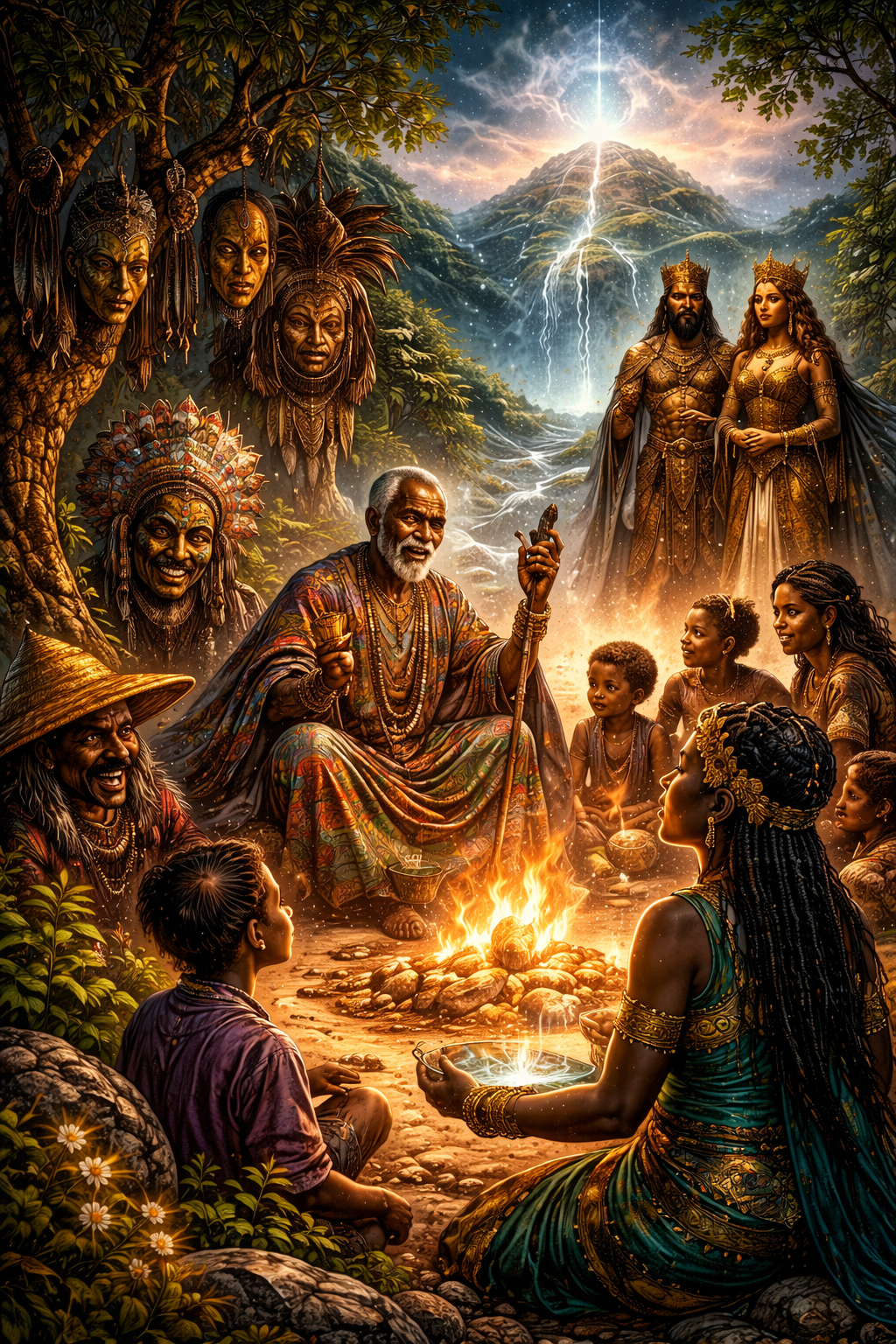
African myth, folklore, and sacred narrative require careful regional and historical differentiation. Yoruba sacred narratives, Akan and Ananse traditions, Fon and Vodun-related worlds, Mande epic traditions, Dogon cosmological accounts, Dinka and other Nilotic creation stories, Ethiopian royal-sacred narratives, Swahili coastal storytelling, San and southern African rock-art-linked traditions, Kongo cosmological systems, Great Lakes kingship narratives, central African forest traditions, and many other archives cannot be reduced to one mythic system. Comparison can be illuminating, but only if it preserves the integrity of local languages, ritual contexts, ecological settings, and historical worlds.
The field also demands source criticism. Much of what modern readers encounter in print was shaped by colonial-era collection, missionary transcription, ethnographic translation, museum acquisition, folkloric anthologizing, nationalist recovery, academic interpretation, or later literary adaptation. Those records can be valuable, but they are not neutral. Research-grade work must distinguish between living oral performance, community-specific sacred narrative, restricted ritual knowledge, archival recording, outsider transcription, and modern reinterpretation. Some traditions remain ceremonial, lineage-specific, gendered, initiated, or only partially available in public-facing sources.
This pillar approaches African myth, folklore, and sacred narrative as a living and regionally differentiated field rather than as a single canon. It asks how creation stories order worlds, how ancestors sustain moral continuity, how trickster figures teach social intelligence, how kingship becomes sacred, how epics preserve political memory, how masquerade makes spirit presence visible, how rivers and forests carry sacred meaning, how women transmit song and ritual knowledge, how colonial archives distorted what they preserved, and how African sacred narrative continues to shape literature, art, performance, spirituality, and diaspora memory today.
Why This Field Matters
African myth, folklore, and sacred narrative matter because they preserve some of the world’s richest living archives of creation, ancestry, spirit mediation, trickster intelligence, kingship, moral education, ecological relation, healing, initiation, performance, and oral memory. These traditions are not simply old stories about remote gods or ancient beliefs. They are systems of knowledge through which communities have interpreted origins, death, social obligation, political authority, gender, land, water, animals, illness, fertility, conflict, and continuity across generations.
The field also matters because it expands the very meaning of mythology. In many African contexts, sacred narrative is not arranged into a single canonical book or a fixed literary mythology. It is embedded in performance, ritual, praise speech, masquerade, divination, shrine practice, royal ceremony, oral epic, healing, initiation, and everyday moral instruction. A myth may be sung, danced, carved, masked, invoked, recited, enacted, or remembered through lineage. Its meaning is often inseparable from the occasion of performance.
African sacred narrative also matters because it challenges the false boundary between folklore and philosophy. Proverbs, trickster tales, praise poems, divination verses, creation narratives, animal stories, and epics often carry sophisticated reflections on power, obligation, speech, deceit, generosity, hierarchy, justice, reciprocity, vulnerability, and the limits of human control. They are not primitive explanations. They are intellectual traditions in narrative form.
Finally, this field matters because African sacred narratives remain active in contemporary life. They inform literature, music, dance, visual art, theater, film, public festivals, religious practice, diaspora traditions, political symbolism, ecological imagination, and heritage work. They do not belong only to the past. They continue to shape how communities remember, create, protest, heal, and imagine futures.
The Problem of the Archive
A research-grade account must begin with the archive itself. African myth, folklore, and sacred narrative do not survive in one unified corpus. They are preserved across oral tradition, ritual performance, praise poetry, sacred songs, epic recitation, masquerade, divination systems, initiation teachings, royal histories, healing practices, proverbs, folktales, shrine traditions, visual arts, rock art, museum collections, ethnographic records, missionary documents, colonial archives, literary adaptations, and contemporary community practice.
This archive is therefore not only textual. It is embodied, sonic, visual, material, and social. A story may be preserved in a drum pattern, a praise name, a carved mask, a divination verse, a royal stool, a shrine object, a ritual costume, a women’s song, a mourning performance, a market tale, a festival, or a sacred grove. Interpretation must ask not only what the narrative says, but what it does, who performs it, who may hear it, what ritual setting activates it, what language carries it, and what community authorizes it.
Modern access to the archive is uneven. Some materials are widely published; others are restricted, initiated, gendered, lineage-specific, or sacred in ways that require restraint. Some traditions have been preserved through community continuity; others are known primarily through colonial or missionary records. These records may contain valuable data, but they often translated African categories into European religious, racial, or evolutionary frameworks that distorted what they documented.
The archive is therefore both rich and mediated. Responsible study must combine respect for living traditions, caution about outsider collection, attention to language, and awareness that not all sacred knowledge is meant to be extracted into public summary.
Myth Without a Single Canon
African myth, folklore, and sacred narrative should be approached as a plural field rather than as a single canon. There is no one “African creation story,” one African pantheon, one African trickster, one African underworld, or one African theory of ancestors. There are many traditions, each shaped by language, region, ecology, history, ritual practice, social structure, and transmission.
This plurality does not make comparison impossible. It makes careful comparison necessary. Themes recur across many traditions: creation, distance between humans and divine beings, ancestral authority, spirit mediation, trickster wit, sacred kingship, ritual transformation, animal intelligence, water powers, fertility, initiation, divination, and moral instruction. But these themes must be studied through local forms rather than imposed as a universal system.
For example, Anansi in Akan and broader West African and diasporic traditions is not identical to hare or tortoise figures elsewhere. Yoruba òrìṣà worlds are not identical to Fon Vodun worlds, even where historical contact and Atlantic afterlives connect them. Mande epic performance cannot be reduced to a generic heroic tale. Dogon cosmological accounts require special caution because the modern scholarly record is heavily shaped by interpretation, translation, and debate. San rock-art-linked traditions require attention to trance, hunting, landscape, and image.
The absence of a single canon is therefore a strength. It allows African sacred narrative to be understood as a constellation of living intellectual worlds rather than as a simplified continental mythology.
Oral Tradition, Performance, and the Life of Sacred Knowledge
Oral tradition is central to African sacred narrative, but “oral” should not be mistaken for informal, unstable, or intellectually simple. Oral traditions often involve disciplined memory, trained specialists, ritual authority, poetic form, musical structure, communal correction, lineage knowledge, and performance rules. In many contexts, oral transmission is a highly developed institution of cultural continuity.
Performance gives sacred narrative its social life. A story may change meaning depending on whether it is told at night, recited before a king, performed at initiation, sung by women, enacted in masquerade, used in divination, narrated for children, or remembered in a funeral context. The same motif may educate, entertain, authorize, heal, warn, praise, criticize, or protect depending on its setting.
Performance also preserves voice, gesture, rhythm, improvisation, audience response, and embodied knowledge. These are not decorative additions to story. They are part of what story is. A praise poet’s delivery, a griot’s genealogy, a masquerader’s movement, a drummer’s pattern, or a diviner’s chant may carry meanings unavailable in bare summary.
African sacred narrative therefore requires a performance-centered method. The question is not only “What is the myth?” but “How is the myth carried, enacted, authorized, remembered, and transformed?”
Region, Language, and the Ethics of Comparison
A responsible pillar must preserve regional and linguistic specificity. Africa contains thousands of languages and many historical regions whose sacred traditions developed through different ecological, political, religious, and artistic worlds. West African coastal and forest traditions differ from Sahelian worlds; Great Lakes kingship traditions differ from Swahili coastal storytelling; Nilotic cattle-centered traditions differ from Kongo cosmology, Ethiopian royal-sacred memory, or San trance-linked visual worlds.
Comparison can be illuminating when it is used to ask careful questions: how do different traditions imagine creation, ancestry, trickster intelligence, spirit mediation, kingship, healing, or sacred ecology? But comparison becomes harmful when it flattens local traditions into vague continental generalizations. The field should resist both exoticism and homogenization.
Language matters because sacred concepts rarely translate perfectly. Terms for ancestors, spirits, divinities, life-force, moral order, destiny, speech, blessing, and power carry local philosophical weight. Translating them simply as “gods,” “spirits,” “magic,” or “religion” can obscure the structure of the tradition. A research-grade approach must preserve key indigenous terms where appropriate and explain them with care.
The ethics of comparison also require attention to power. Many African traditions were recorded by outsiders under colonial conditions. Comparative study must therefore avoid repeating older habits of extraction, classification, or racial hierarchy. It should read African sacred narrative as intellectual work produced by communities, specialists, artists, and ritual authorities—not as raw material for external theory alone.
Creation, First Beings, and the Ordering of the World
Creation narratives across African traditions often concern the ordering of the world, the relation between sky and earth, the emergence of human society, the role of animals, the origin of death, the separation of human beings from divine nearness, the establishment of moral obligations, and the beginning of ritual practice. These stories differ sharply by region and should not be treated as interchangeable.
Some traditions emphasize a creator who becomes distant from human beings after an early rupture. Others emphasize emergence from water, clay, earth, sky, or subterranean worlds. Some connect creation to speech, craft, sacrifice, divination, or the ordering of social roles. Others focus on the origin of death, the loss of immortality, the beginning of work, or the moral consequences of disobedience.
Creation stories are often also social theories. They explain why people marry, farm, hunt, govern, bury the dead, honor ancestors, make offerings, respect taboos, or live under particular obligations. Creation is not only cosmic beginning. It is the foundation of moral and communal life.
This makes creation narratives central to the field. They reveal how different African societies have understood the relationship between world-order, human vulnerability, ecological dependency, and sacred responsibility.
Ancestors, Spirits, and Sacred Continuity
Ancestors and spirit presences occupy central roles in many African sacred narratives. Ancestors are not simply dead relatives remembered sentimentally. In many traditions, they are active moral presences, custodians of lineage, witnesses to conduct, protectors of land, recipients of offerings, and mediators between living communities and deeper sacred orders.
Ancestral traditions help structure continuity. The living are not isolated individuals. They stand within chains of descent, obligation, memory, land, and ritual care. Story links the living to those who came before, and ritual keeps that relationship active. To neglect ancestors may be to neglect the foundations of community itself.
Spirit worlds are equally diverse. Spirits may inhabit rivers, forests, mountains, shrines, masks, winds, animals, crossroads, or particular lineages. They may heal, warn, punish, protect, possess, guide, or demand ritual attention. Their presence makes the world morally and spiritually inhabited.
These traditions challenge modern assumptions that the visible world is self-contained. African sacred narrative often presents reality as relational, layered, and populated by powers whose presence must be respected through proper speech, ritual, conduct, and memory.
Tricksters, Wit, and the Moral Intelligence of Narrative
Trickster figures are among the best-known African narrative forms, but they are often misunderstood when reduced to comic mischief. Figures such as Anansi, hare, tortoise, spider, jackal, and other cunning beings reveal the moral intelligence of storytelling. Tricksters expose arrogance, redistribute power, invert hierarchy, test social rules, mock authority, and dramatize the instability of order.
The trickster is often morally ambiguous. He may be clever and selfish, liberating and destructive, hilarious and dangerous. This ambiguity is precisely what gives the figure philosophical depth. Trickster tales do not simply teach obedience. They teach listeners how power works, how speech can deceive, how weakness can become strategy, and how intelligence can survive where force fails.
Trickster narratives are also socially portable. They travel across regions, languages, and diasporas because they adapt easily to new conditions of inequality, danger, and survival. In the Atlantic world, Anansi and related figures became especially important as narrative resources for enslaved and diasporic communities negotiating domination, secrecy, and resilience.
Trickster intelligence therefore belongs at the center of African folklore. It is one of the great narrative forms through which communities think about power from below.
Yoruba Sacred Narrative and Òrìṣà Worlds
Yoruba sacred narratives offer one of the most influential and richly documented African religious and mythic systems. Òrìṣà traditions preserve divine mediation, creation, destiny, moral character, ritual obligation, sacred kingship, divination, water powers, iron, thunder, crossroads, fertility, healing, and the relationship between human beings and sacred forces. These traditions are textualized in scholarship, but they remain living in ritual, song, praise poetry, festival, divination, and diaspora religions.
Figures such as Ọbatálá, Odùduwà, Èṣù, Ògún, Ṣàngó, Ọ̀ṣun, Yemọja, Ọya, Ifá, and others cannot be understood simply as “gods” in a classical pantheon sense. They are sacred powers, personalities, ritual centers, philosophical principles, narrative figures, and living presences in devotional worlds. Each carries stories, praise names, taboos, colors, offerings, songs, and ritual associations.
Ifá divination is especially important because it preserves sacred narrative through verses, interpretive performance, ethical instruction, and ritual diagnosis. Story is not only remembered; it is consulted. Narrative becomes a means of understanding destiny, misfortune, character, and action.
Yoruba sacred narrative also has profound global afterlives through the Atlantic diaspora, including Candomblé, Santería/Lukumí, Trinidad Orisha, and other traditions. These afterlives are not simply survivals but creative transformations under conditions of enslavement, displacement, and cultural resilience.
Akan, Anansi, and the Social Life of Story
Akan and related West African storytelling traditions preserve one of the world’s great trickster archives through Anansi, the spider. Anansi stories are not merely children’s entertainment. They carry lessons about cleverness, greed, hunger, status, speech, survival, and the moral instability of social life. They are often comic, but their humor contains critique.
Anansi’s power lies in smallness and wit. He defeats stronger beings, manipulates language, exposes hypocrisy, and survives through intelligence rather than force. Yet he is not simply heroic. He may be selfish, foolish, cruel, or undone by his own schemes. The tale teaches through ambiguity.
Akan narrative worlds also extend beyond Anansi. They include royal traditions, stool symbolism, ancestral authority, matrilineal memory, moral proverbs, funeral performance, praise forms, and sacred relations between community, land, and the dead. Story participates in a larger social and ethical order.
The Atlantic afterlife of Anansi makes this tradition especially important. In the Caribbean and broader African diaspora, Anansi became a figure of survival, coded resistance, and narrative continuity under conditions of enslavement and colonial domination.
Fon, Vodun, and Spirit Worlds
Fon and Vodun-related traditions belong centrally to the study of African sacred narrative because they reveal complex relations among spirit powers, royal authority, divination, healing, ritual embodiment, moral order, and Atlantic transformation. Vodun should not be flattened into sensationalized stereotypes. It is a deeply structured religious and narrative world with its own histories, lineages, rituals, and philosophical concepts.
Spirit powers in Vodun-related worlds may be associated with thunder, water, earth, serpents, ancestors, twins, healing, protection, royal legitimacy, or dangerous force. Their stories are not detachable from ritual practice. They are transmitted through song, dance, possession, shrine care, offering, divination, and initiation.
Fon and Dahomean royal traditions also show the relation between sacred narrative and political authority. Kingship, war, ancestry, ritual power, and state formation are deeply entangled. Sacred narrative helps authorize rule, remember dynastic history, and structure relations between the living, the dead, and powerful spirits.
Vodun’s Atlantic afterlives, especially in Haiti and other parts of the diaspora, also demonstrate the transformation of African sacred systems under colonial violence, enslavement, and resistance. These traditions require respect, specificity, and resistance to exoticizing distortion.
Mande Epic, Griots, and Heroic Memory
Mande epic traditions are among the great oral epic systems of the world. The epic of Sunjata, transmitted by jeliw or griots, preserves heroic memory, political foundation, genealogy, disability, exile, prophecy, magical power, warfare, alliance, and the formation of the Mali Empire. It is not only a story of one hero. It is a historical and moral architecture of political becoming.
Griots are not merely entertainers. They are custodians of memory, praise specialists, genealogists, musicians, political commentators, and interpreters of the past. Their performance gives epic its authority. The story lives through voice, instrument, lineage, audience, and occasion.
Sunjata’s narrative is especially powerful because it joins vulnerability to destiny. The future founder begins in weakness, exile, and difficulty. His rise depends on prophecy, maternal strength, alliance, magical conflict, and political struggle. Heroic power emerges through social relation, not solitary action alone.
Mande epic traditions show why African sacred narrative cannot be studied only as myth in the narrow sense. Epic carries history, law, political memory, moral instruction, and sacred force together.
Dogon Cosmology and the Problem of Interpretation
Dogon cosmological accounts have been highly influential in scholarship and popular imagination, but they require special methodological caution. Much of what is widely known outside Dogon communities comes through particular ethnographic interpretations that have been debated, reexamined, and sometimes challenged. This makes Dogon material important not only for cosmology, but also for source criticism.
Dogon traditions include rich symbolic worlds involving creation, speech, twins, ancestors, masks, agriculture, social order, and ritual performance. But no responsible account should treat all published material as transparent access to an unchanged ancient cosmology. The question of who recorded, translated, organized, and interpreted the material is central.
This does not diminish the importance of Dogon traditions. It strengthens the need for careful interpretation. Dogon sacred narrative should be studied through language, ritual context, community authority, performance, art, and the history of scholarship rather than through sensationalized or decontextualized claims.
Dogon material therefore belongs in this pillar as both a major sacred narrative world and a case study in the ethics of interpreting African cosmology through mediated archives.
Nilotic, East African, and Horn of Africa Narrative Worlds
Nilotic, East African, and Horn of Africa narrative worlds add crucial breadth to the field. Dinka, Nuer, Shilluk, Luo, Maasai, Oromo, Somali, Ethiopian, Eritrean, Swahili, and other traditions preserve distinctive accounts of creation, cattle, rain, ancestors, divine distance, royal authority, migration, praise, poetry, sacred kingship, Islamic and Christian memory, and coastal exchange.
Nilotic traditions often center cattle, sky, rain, lineage, age-set structures, and the relation between human society and divine or spiritual powers. These worlds cannot be understood through West African categories alone. Their sacred narratives are tied to pastoral life, social order, ecological uncertainty, and relations among people, cattle, land, and ancestors.
The Horn of Africa adds further complexity through Ethiopian Christian royal-sacred narrative, Solomonic traditions, Islamic storytelling, local saints, monastic memory, oral poetry, and multilingual traditions. Ethiopian sacred kingship and scriptural imagination belong to a distinctive historical world that deserves its own interpretive frame.
Swahili coastal storytelling, shaped by African, Islamic, Indian Ocean, Arabic, Persian, and local coastal histories, reveals another major narrative zone. It links sacred story to trade, sea travel, poetry, urban culture, spirit worlds, and the Indian Ocean imagination.
Central, Southern, and Forest Worlds
Central and southern African traditions are equally essential. Kongo cosmological systems, Luba and Kuba royal memory, forest spirit traditions, initiation societies, healing narratives, San and Khoisan storytelling, rock-art-linked trance traditions, and southern African praise poetry all expand the field beyond the regions most often represented in introductory mythology texts.
Kongo cosmology, for example, offers powerful models of the relation between the living and the dead, the visible and invisible worlds, water as threshold, circular movement, and spiritual continuity. These ideas had major Atlantic afterlives and continue to inform diaspora religious and artistic traditions.
San rock art and associated interpretive traditions reveal the importance of trance, animal power, hunting, transformation, and image as sacred memory. Rock art is not simply prehistoric decoration. It can belong to ritual, visionary, and narrative worlds that require close attention to landscape, embodiment, and visual practice.
Forest worlds also preserve narrative relations with animals, spirits, medicines, ancestors, and ecological knowledge. Sacred narrative here may be carried through hunting traditions, initiation, healing, secrecy, and relations with nonhuman life.
Kingship, Sovereignty, and Royal-Sacred Memory
In many African traditions, sacred narrative helps authorize kingship, territorial legitimacy, dynastic memory, court ritual, and the moral responsibilities of rule. Kingship may be linked to founding ancestors, divine sanction, sacred objects, royal regalia, origin stories, conquest, migration, sacrifice, rainmaking, fertility, or the protection of the land.
Royal-sacred memory is not one pattern. Yoruba, Benin, Asante, Kongo, Luba, Buganda, Ethiopia, Shilluk, Zulu, and many other traditions articulate kingship differently. Some emphasize divine descent; others emphasize sacred stools, regalia, royal graves, praise poetry, spirit mediation, or ritual renewal. In many cases, rulership is both political and cosmological.
Royal traditions also contain critique. A king may be sacred, but he is not always morally secure. Stories can preserve warnings about arrogance, injustice, broken taboo, failed generosity, or the ruler who forgets the obligations that sustain legitimacy. Praise poetry may honor power while also remembering the terms under which power is judged.
These traditions show that African sacred narrative is deeply political. It imagines authority not as mere domination, but as a burden tied to ancestry, land, fertility, ritual, justice, and memory.
Masquerade, Transformation, and the Embodied Life of Myth
Masquerade is one of the central ways African sacred narrative becomes visible, embodied, and socially active. Masks and masquerade performances may represent spirits, ancestors, social critique, gendered power, initiation knowledge, moral correction, political authority, fertility, death, renewal, or the presence of forces beyond ordinary human visibility.
Masquerade should not be treated as costume or theatrical decoration alone. In many traditions, the masquerader does not merely represent a spirit; performance creates a controlled encounter with presence, transformation, or ancestral authority. Movement, music, costume, concealment, audience response, and ritual context all matter.
Gèlèdè is an important example because it links masquerade, satire, poetry, gendered power, public performance, and community well-being. It shows how sacred performance can praise, correct, entertain, warn, and negotiate power at once.
Masquerade traditions therefore demonstrate why African mythology cannot be reduced to written narrative. Myth lives in bodies, fabrics, masks, songs, rhythms, gestures, and public events.
Women, Mothers, Initiation, and Social Continuity
Women occupy central roles across African myth, folklore, and sacred narrative, though their importance has often been diminished in outsider accounts focused on male priests, kings, or heroic figures. Mothers, grandmothers, queens, priestesses, healers, diviners, singers, initiators, market women, water-spirit devotees, and women’s ritual associations all preserve sacred memory and social continuity.
Stories of sacred mothers, founding women, river powers, fertility figures, and women’s ritual authority show that social life is not maintained by kingship and ancestorhood alone. Birth, nurture, sexuality, fertility, household instruction, mourning, market networks, and women’s song traditions are equally central to the sacred imagination of many communities.
Initiation systems also transmit sacred knowledge through gendered and age-structured forms. Stories may be told differently to children, initiates, elders, women, men, ritual specialists, or outsiders. Some knowledge is public; some is restricted. A respectful account must recognize that sacred narrative is often structured by access.
Women’s performance traditions, lullabies, funeral songs, praise, satire, and healing knowledge are therefore not peripheral. They are foundational to how African sacred worlds reproduce memory, morality, and belonging.
Water, Forests, Animals, and Sacred Ecology
African sacred narrative is deeply ecological. Rivers, rain, drought, forests, mountains, animals, agricultural cycles, cattle, hunting grounds, oceans, lakes, and sacred groves often structure mythic imagination. Environmental life is not a backdrop. It is a participant in sacred relation.
Water is especially important. Rivers and water spirits may be associated with fertility, healing, danger, wealth, crossing, femininity, purification, or ancestral passage. Òṣun, Mami Wata, river spirits, rain powers, lake beings, and water-linked ancestors all reveal how water becomes sacred presence, not merely natural resource.
Animals also carry narrative intelligence. Spider, hare, tortoise, leopard, snake, crocodile, elephant, hyena, jackal, bird, cattle, and many other animals appear as tricksters, ancestors, powers, companions, warnings, or symbolic forms. Animal stories often teach social ethics by displacing human behavior into nonhuman form.
Forest and wilderness traditions reveal another dimension: places of danger, medicine, initiation, spirit encounter, and hidden knowledge. Sacred ecology therefore links myth to conservation, land ethics, ritual territory, and the moral consequences of environmental rupture.
Rock Art, Material Culture, and Visual Transmission
African sacred narrative is also preserved through material and visual culture. Rock art, masks, carved figures, bronzes, terracottas, textiles, stools, staffs, shrine objects, regalia, mural traditions, beadwork, pottery, and ritual instruments all participate in the transmission of memory. They are not simply illustrations of stories. They are forms of sacred and social knowledge.
Rock art in central, eastern, and southern Africa is especially important because it opens deep narrative time. It may preserve relations among hunting, trance, animal power, ritual experience, and landscape. Interpretation requires caution, but the material demonstrates that African sacred imagination has visual histories far deeper than many written records.
Court arts such as Benin bronzes, Ife heads, Akan regalia, Kongo minkisi, Luba memory objects, and other material traditions preserve sacred authority, ancestry, kingship, transformation, and cosmology in visual form. Museum settings can make these objects visible to global audiences, but they can also detach them from ritual, political, and colonial histories.
A research-grade pillar must therefore treat objects as narrative participants while also acknowledging questions of extraction, restitution, display, and the violence of colonial collecting.
Divination, Healing, and Effective Speech
Divination and healing traditions reveal how sacred narrative becomes diagnostic and practical. In many African contexts, divination is not fortune-telling in a shallow sense. It is a structured interpretive practice that connects misfortune, ancestry, spirit agency, moral imbalance, social conflict, destiny, and ritual response.
Divination systems often preserve bodies of narrative, proverb, praise, sign interpretation, and ethical instruction. Ifá is one major example, but many other systems across the continent link signs, specialists, spirits, ancestors, and stories. The diviner interprets not only events but relations among visible and invisible worlds.
Healing traditions likewise carry narrative knowledge. Illness may be understood through physical, social, spiritual, ancestral, environmental, or moral frameworks at once. Healing may involve herbs, ritual speech, sacrifice, song, possession, confession, community reconciliation, shrine visitation, or spirit negotiation. Sacred narrative gives suffering a language.
Effective speech is central. Blessings, curses, praise names, proverbs, invocations, oaths, songs, and divination verses are not merely descriptive. They can be socially and ritually active. Language itself becomes part of sacred power.
Diaspora Afterlives and Atlantic Memory
African sacred narratives did not remain confined to the continent. Through the violence of the Atlantic slave trade, forced displacement, colonialism, migration, and cultural survival, African story-worlds entered the Caribbean, the Americas, Europe, and other global contexts. These afterlives are not secondary. They are part of the modern history of African sacred narrative.
Yoruba, Kongo, Fon, Akan, Mande, and other traditions contributed to African diaspora religions, folklore, music, language, ritual, and resistance cultures. Òrìṣà traditions, Vodun/Vodou, Candomblé, Santería/Lukumí, Kumina, Obeah, Palo, Anansi stories, ring shout traditions, spirituals, and other forms preserve transformed African memory under conditions of violence and creativity.
Diaspora traditions should not be treated as simple survivals of “African originals.” They are creative, historically specific, and often shaped by multiple African sources, Indigenous American contexts, European colonial pressure, Christianity, Islam, plantation violence, maroon resistance, and modern revival. Continuity and transformation must be read together.
Atlantic memory reveals one of the field’s most powerful truths: sacred narrative can survive rupture by becoming portable, coded, musical, embodied, and adaptive.
Colonial Mediation, Archives, and Source Criticism
Colonial mediation is one of the most important methodological problems in the study of African myth, folklore, and sacred narrative. Missionaries, colonial officers, anthropologists, folklorists, collectors, and museum agents often recorded traditions under unequal conditions. Their writings sometimes preserved valuable narratives, but they also imposed categories such as fetishism, superstition, paganism, tribe, primitive religion, or folklore in ways that distorted African intellectual worlds.
Translation also shaped the archive. Sacred terms were often rendered into European religious language that did not fit local concepts. Ritual specialists were described as priests, sorcerers, witch doctors, magicians, or shamans in ways that flattened distinct roles. Complex systems of ethics, divination, healing, and ancestry were often reduced to belief or custom.
Museum collections raise related issues. Masks, bronzes, figures, regalia, and shrine objects were often removed from living contexts through colonial violence, purchase under unequal conditions, punitive expeditions, or extraction. Their display can educate, but it can also separate objects from the communities, rituals, and histories that made them meaningful.
A serious pillar must therefore make source criticism part of the content itself. The question is not only what African myths say, but how they have been recorded, translated, displayed, contested, and reclaimed.
Living Heritage, Modern Literature, and Cultural Continuity
African sacred narrative remains vital in living heritage, modern literature, performance, film, visual art, public festivals, community revival, and diaspora practice. Writers such as Chinua Achebe, Wole Soyinka, Amos Tutuola, Ngũgĩ wa Thiong’o, Ben Okri, Nnedi Okorafor, and many others have drawn from oral narrative, trickster intelligence, spirit worlds, cosmology, ancestral memory, and sacred language to create modern literary forms.
Performance traditions also remain active. Masquerades, praise poetry, epic recitation, festivals, healing ceremonies, ritual music, and storytelling continue to adapt under urbanization, migration, tourism, religious change, state heritage policy, and global media. Some traditions are endangered; others are being revitalized.
Heritage frameworks such as UNESCO’s recognition of oral traditions and specific performance forms are useful, but they should not replace community authority. Living heritage is not only what institutions list. It is what communities continue to practice, transmit, revise, protect, and debate.
African myth, folklore, and sacred narrative therefore remain dynamic. They are not remnants of a premodern past. They are active systems of memory and imagination that continue to shape cultural futures.
Major Questions of Interpretation
This pillar is organized around several major questions. How should African myth, folklore, and sacred narrative be studied without reducing the continent to a single mythology? How do oral tradition, performance, ritual, material culture, language, and community authority change what myth means? How should scholars use written archives produced under colonial, missionary, or ethnographic conditions without reproducing their distortions?
The pillar also asks how African sacred narratives imagine creation, ancestors, spirits, tricksters, kingship, gender, water, animals, forests, illness, healing, and moral instruction. How do epics preserve political memory? How do masquerades make invisible powers visible? How do divination systems turn narrative into diagnosis? How do women’s songs and domestic traditions carry knowledge? How do diaspora traditions transform African sacred memory under conditions of displacement?
These questions keep the category from becoming a general inventory of myths. They open African myth, folklore, and sacred narrative as a field of oral, ritual, ecological, philosophical, political, performative, visual, gendered, and diasporic inquiry. The tradition is not one collection of stories. It is a vast constellation of living knowledge systems through which communities have imagined world-order, moral life, sacred presence, and collective memory.
Expanded Article Architecture
The following structure gathers the pillar into a long-range architecture suitable for a major mythology knowledge series. It is designed to support regional differentiation, oral tradition, creation narratives, ancestors and spirits, trickster traditions, Yoruba òrìṣà worlds, Akan and Anansi storytelling, Fon and Vodun-related traditions, Mande epic, Dogon interpretation, Nilotic and East African sacred narratives, central and southern African worlds, masquerade, sacred ecology, material culture, healing, diaspora afterlives, colonial source criticism, and living heritage. All entries below should be treated as planned unless already completed elsewhere on the site.
Foundations and Source Problems
- What Is African Myth, Folklore & Sacred Narrative? (planned)
- The Problem of Sources in African Mythology and Sacred Narrative (planned)
- African Myth Without a Single Canon (planned)
- Oral Tradition, Performance, and the Preservation of Sacred Knowledge in Africa (planned)
- Myth, Ritual, and the Social Life of Story in African Religions (planned)
- Colonial Archives, Ethnographic Mediation, and the Problem of Translation (planned)
- How to Read African Sacred Narrative Across Regions and Languages (planned)
Oral Tradition, Performance, and Speech
- Oral Tradition as Living Archive in African Sacred Worlds (planned)
- Proverb, Praise Poetry, and the Ethics of Speech (planned)
- Ritual Speech, Invocation, and the Power of the Spoken Word (planned)
- Storytelling, Audience, and the Social Life of Performance (planned)
- Women’s Songs, Lullabies, Laments, and Domestic Transmission (planned)
- Language, Translation, and the Sacred Meaning of Indigenous Terms (planned)
Creation, First Beings, and World-Order
- Creation Narratives and the Ordering of the World in African Tradition (planned)
- Sky, Earth, Water, and Emergence Across African Sacred Narrative (planned)
- Creator Beings, Remote Gods, and the Structure of Sacred Distance (planned)
- The Origin of Death in African Sacred Narrative (planned)
- First Humans, First Animals, and the Beginning of Social Order (planned)
- Creation Stories as Moral and Communal Philosophy (planned)
Ancestors, Spirits, and Invisible Worlds
- Ancestors, Spirits, and the Invisible Order of Community (planned)
- Lineage, Land, and Ancestral Continuity (planned)
- Offerings, Memory, and the Ritual Care of the Dead (planned)
- Spirit Worlds, Shrines, and Sacred Presence in African Traditions (planned)
- Possession, Mediation, and the Social Life of Spirit Encounter (planned)
- The Visible and Invisible Worlds in African Sacred Thought (planned)
Tricksters and Animal Intelligence
- Anansi and the Trickster Intelligence of West African Storytelling (planned)
- Hare, Tortoise, Spider, and the Animal Worlds of African Folklore (planned)
- Tricksters, Moral Ambiguity, and the Politics of Wit (planned)
- Humor, Hunger, Deception, and Survival in Trickster Tales (planned)
- Trickster Figures in African Diaspora Memory (planned)
- Animal Storytelling and the Critique of Power (planned)
Yoruba Sacred Narrative and Òrìṣà Worlds
- Yoruba Sacred Narrative, Òrìṣà Worlds, and Divine Mediation (planned)
- Òṣun, Rivers, Fertility, and the Sacred Power of Water (planned)
- Èṣù, Crossroads, Speech, and Moral Ambiguity (planned)
- Ògún, Iron, War, Labor, and Civilizational Power (planned)
- Ṣàngó, Thunder, Kingship, and Sacred Authority (planned)
- Ifá Divination, Sacred Verses, and the Narrative Structure of Destiny (planned)
- Yoruba Sacred Narrative in Atlantic Diaspora Traditions (planned)
Akan, Anansi, and West African Story Worlds
- Akan Tradition, Ancestry, and the Moral Work of Story (planned)
- Anansi, Story Ownership, and the Social Life of Trickster Narrative (planned)
- Stools, Ancestors, and Sacred Authority in Akan Memory (planned)
- Matrilineal Memory, Royal Power, and Oral Tradition (planned)
- Ashanti Folktales and the Archive of Social Intelligence (planned)
- Anansi in the Caribbean and the Atlantic World (planned)
Fon, Vodun, and Spirit Mediation
- Fon, Vodun, and the Narrative Worlds of Spirits and Kingship (planned)
- Vodun Beyond Stereotype: Spirit Worlds, Ritual, and History (planned)
- Dahomean Royal Memory and Sacred Authority (planned)
- Serpent Powers, Thunder Powers, and the Ecology of Spirit Presence (planned)
- Divination, Healing, and Initiation in Vodun-Related Worlds (planned)
- Vodun, Vodou, and Atlantic Transformation (planned)
Mande Epic, Griots, and Political Memory
- Epic, Heroism, and the Memory of Political Formation in Africa (planned)
- Mande Epic Traditions and the Work of Heroic Memory (planned)
- Sunjata, Exile, Prophecy, and the Founding of Mali (planned)
- Griots, Genealogy, and the Spoken Architecture of Authority (planned)
- Music, Memory, and Political Counsel in Mande Performance (planned)
- Heroic Vulnerability and the Ethics of Foundation (planned)
Dogon, Sahelian, and Interpretive Questions
- Dogon Cosmology and the Problem of Interpretation (planned)
- Twins, Speech, Masks, and Social Order in Dogon Sacred Narrative (planned)
- Ethnography, Debate, and the Limits of Outsider Interpretation (planned)
- Sahelian Story Worlds Between Islam, Epic, and Local Cosmology (planned)
- Desert, Savanna, and the Sacred Geography of the Sahel (planned)
- Mythic Knowledge and Source Criticism in Sahelian Traditions (planned)
Nilotic, East African, and Horn Traditions
- Dinka, Nuer, and Nilotic Creation Narratives (planned)
- Cattle, Rain, Lineage, and Sacred Order in Nilotic Traditions (planned)
- Maasai, Age-Sets, Cattle, and the Narrative Worlds of Pastoral Life (planned)
- Ethiopian Royal-Sacred Narrative and Solomonic Memory (planned)
- Somali Oral Poetry, Sacred Memory, and Pastoral Imagination (planned)
- Swahili Coastal Storytelling and the Indian Ocean Imagination (planned)
Central, Kongo, and Southern African Worlds
- Kongo Cosmology, Water, and the Boundary Between Worlds (planned)
- Luba, Kuba, and Central African Royal Memory (planned)
- Forest Spirits, Medicines, and Sacred Ecology in Central Africa (planned)
- San Rock Art, Trance, and Deep Narrative Time (planned)
- Southern African Praise Poetry and the Memory of Power (planned)
- Animals, Transformation, and Visionary Experience in Southern African Traditions (planned)
Kingship, Sovereignty, and Courtly Power
- Kingship, Dynastic Memory, and Royal-Sacred Narrative in African Tradition (planned)
- Benin, Ife, and the Sacred Worlds of Courtly Power (planned)
- Sacred Stools, Royal Graves, and the Material Memory of Rule (planned)
- Rainmaking, Fertility, and the Moral Burden of Kingship (planned)
- Praise Poetry, Genealogy, and the Spoken Architecture of Authority (planned)
- Rulers, Ancestors, and the Sacred Legitimacy of Land (planned)
Masquerade, Initiation, and Embodied Myth
- Masquerade, Transformation, and the Performance of Sacred Narrative (planned)
- Gèlèdè, Satire, Power, and the Public Life of Sacred Performance (planned)
- Masks, Spirits, and the Embodied Transmission of Myth (planned)
- Initiation, Secrecy, and Restricted Sacred Knowledge (planned)
- Dance, Costume, Sound, and the Making of Spirit Presence (planned)
- Masquerade, Gender, and Social Correction (planned)
Women, Mothers, and Social Continuity
- Women, Mothers, and the Sacred Ground of Social Continuity (planned)
- Women’s Ritual Associations and Sacred Authority (planned)
- Queens, Priestesses, Mothers, and Founding Women in African Sacred Narrative (planned)
- Women’s Songs, Mourning, and the Oral Transmission of Memory (planned)
- Fertility, Birth, and Household Sacred Knowledge (planned)
- Gender, Initiation, and Access to Sacred Narrative (planned)
Sacred Ecology, Water, Forests, and Animals
- Rivers, Forests, Animals, and the Ecology of African Sacred Imagination (planned)
- Water Spirits, Fertility, and the Symbolism of Crossing (planned)
- Mami Wata and the Modern Atlantic Life of Water-Spirit Imagery (planned)
- Sacred Groves, Forest Spirits, and Environmental Memory (planned)
- Animal Ancestors, Totems, and the Moral Life of Nonhuman Beings (planned)
- Drought, Rain, Agriculture, and the Sacred Politics of Survival (planned)
Material Culture, Rock Art, and Visual Transmission
- Rock Art, Memory, and Deep Narrative Time in Africa (planned)
- Bronze, Terracotta, Wood, Textile, and the Material Life of Sacred Narrative (planned)
- Benin Bronzes, Ife Heads, and the Memory of Courtly Sacred Power (planned)
- Kongo Minkisi and the Material Force of Spirit Mediation (planned)
- Museum Collections, Colonial Extraction, and the Afterlife of Sacred Objects (planned)
- Visual Culture as Mythic Archive in African Traditions (planned)
Divination, Healing, and Ritual Knowledge
- Divination, Healing, and Effective Speech in African Sacred Worlds (planned)
- Ifá and the Narrative Logic of Divination (planned)
- Illness, Misfortune, and the Interpretation of Hidden Causes (planned)
- Healing Songs, Spirit Mediation, and Ritual Diagnosis (planned)
- Medicines, Shrines, and the Sacred Ecology of Cure (planned)
- Blessing, Curse, Oath, and the Power of Words (planned)
Diaspora, Atlantic Memory, and Modern Afterlives
- African Sacred Narrative in the Atlantic Diaspora (planned)
- Òrìṣà Traditions from West Africa to the Americas (planned)
- Anansi, Trickster Survival, and Diasporic Storytelling (planned)
- Vodun, Vodou, Candomblé, and the Transformation of Spirit Worlds (planned)
- Kongo Cosmology and Diaspora Religious Imagination (planned)
- African Sacred Narrative in Literature, Performance, and Modern Cultural Life (planned)
- African Myth, Folklore & Sacred Narrative in Comparative Perspective (planned)
- Why African Myth, Folklore & Sacred Narrative Still Matter (planned)
Closing Perspective
African myth, folklore, and sacred narrative reveal one of the world’s great constellations of living knowledge. They preserve creation and first beings, ancestors and spirits, tricksters and kings, epics and proverbs, masquerades and divination verses, water powers and forest beings, women’s songs and initiation systems, healing practices and royal memories, rock art and modern literature, continental traditions and diaspora transformations. Their power lies not in a single canon, but in a vast plurality of oral, ritual, visual, ecological, and performative worlds.
This is what makes the category so important within Mythology. African sacred narrative shows how mythology can be spoken, danced, sung, masked, carved, invoked, healed through, argued over, and carried across rupture. It also shows why mythology must be studied through language, land, ritual, gender, performance, material culture, colonial history, and living community, not only through story summary.
The strongest reason to study this field is that it clarifies how human communities preserve moral intelligence through narrative. Creation stories order worlds; ancestors sustain memory; tricksters expose power; epics preserve political formation; masquerades embody spirit presence; water stories teach ecological relation; divination makes suffering interpretable; diaspora traditions carry sacred memory across violent displacement. These traditions do not belong only to the past. They continue to shape the living future of African and African-descended cultural worlds.
Related Reading
- Mythology
- Indigenous and Oral Traditions
- African and Diasporic Literature and Cultural Memory
- African Healing Traditions
- Culture, Meaning, and Symbolism
- Environment, Place, and Ecological Knowledge
- Religion and Ecology
- Comparative Sacred Themes
- Maghrebi and Andalusi Legend, Folklore, and Sacred Imagination
- African Healing Traditions
Primary Sources
Oral Tradition and Heritage Frameworks
- UNESCO, “Oral traditions and expressions.” Useful as a formal heritage framework recognizing myths, legends, epic songs, prayers, chants, and related spoken forms as vehicles of collective memory and cultural continuity: https://ich.unesco.org/en/oral-traditions-and-expressions-00053
- UNESCO, “Working towards an African renaissance through Culture and History.” Useful for framing oral tradition and knowledge of history as active cultural resources across Africa: https://www.unesco.org/en/working-towards-african-renaissance-through-culture-and-history
- UNESCO, “Oral heritage of Gèlèdè.” Useful for understanding a sacred performance tradition that blends epic and lyric verse, satire, symbolism, and masquerade: https://ich.unesco.org/en/RL/oral-heritage-of-gelede-00002
Regional and Thematic Institutional Materials
- Smithsonian National Museum of African Art, “Currents: Water in African Art.” Useful for regionally grounded myths and sacred narratives concerning water spirits, primordial ancestors, and sacred ecology, including Yoruba and Dogon examples: https://africa.si.edu/exhibitions/currents-water-african-art
- Smithsonian Folkways, “Ashanti: Folk Tales from Ghana.” Useful for recorded Anansi-centered folktales as archival witnesses of trickster narrative transmission: https://folkways.si.edu/harold-courlander/ashanti-folk-tales-from-ghana/childrens-prose/album/smithsonian
- British Museum, “Africa Galleries.” Useful for the material and artistic diversity of African traditions, including themes of religion, power, transformation, and masquerade: https://www.britishmuseum.org/collection/galleries/africa
- British Museum, “Introduction to rock art in central and eastern Africa.” Useful for linking oral tradition, rock art, and deep narrative memory in African contexts: https://africanrockart.britishmuseum.org/regional_introduction/rock-art-in-central-and-east-africa/
Reference and Comparative Gateways
- Encyclopaedia Britannica, “African religions: Mythology.” Useful for the important clarification that African myths are often embedded in ritual practice rather than preserved as a single narrative corpus: https://www.britannica.com/topic/African-religions/Mythology
- Encyclopaedia Britannica, “African religions.” Useful for broader context on traditional beliefs, spirits, ancestors, ritual, and diversity across African religions: https://www.britannica.com/topic/African-religions
- Encyclopaedia Britannica, “Orisha.” Useful for Yoruba sacred narrative traditions linking primordial divinities to towns, rulership, and metamorphosis: https://www.britannica.com/topic/orisha
Oral, Epic, and Community-Based Sources
- Published and recorded versions of the Sunjata epic and other Mande epic traditions, especially those preserving performer context, griot lineage, musical form, and oral-performance setting.
- Akan and Ashanti folktale collections, especially Anansi narratives preserved in oral recordings, community storytelling, and diaspora adaptations.
- Yoruba Ifá verses, praise poetry, and òrìṣà narratives, especially editions that preserve indigenous terminology, performance context, and ritual meaning.
- Fon, Ewe, Vodun-related, and Dahomean narrative materials concerning spirits, kingship, divination, and ritual practice.
- Kongo, Luba, Kuba, San, Nilotic, Ethiopian, Swahili, and other regional oral and material traditions, used with attention to language, community authority, and source mediation.
Further Reading
- UNESCO, “Oral traditions and expressions.” A strong framework for treating myths, legends, epic songs, and prayers as living heritage. https://ich.unesco.org/en/oral-traditions-and-expressions-00053
- Encyclopaedia Britannica, “African religions: Mythology.” Useful for a concise comparative overview and for the key distinction between mythology as ritual-embedded and mythology as a canonized narrative corpus. https://www.britannica.com/topic/African-religions/Mythology
- Smithsonian National Museum of African Art, “Currents: Water in African Art.” Valuable for connecting sacred narrative to ecology, water symbolism, and visual culture. https://africa.si.edu/exhibitions/currents-water-african-art
- Smithsonian Folkways, “Ashanti: Folk Tales from Ghana.” Useful for archival access to Anansi-centered storytelling. https://folkways.si.edu/harold-courlander/ashanti-folk-tales-from-ghana/childrens-prose/album/smithsonian
- UNESCO, “Oral heritage of Gèlèdè.” Valuable for the link between sacred performance, satire, poetry, masks, and living community transmission. https://ich.unesco.org/en/RL/oral-heritage-of-gelede-00002
- Abimbola, W. (1976) Ifá: An Exposition of Ifá Literary Corpus. Ibadan: Oxford University Press Nigeria.
- Barber, K. (1991) I Could Speak Until Tomorrow: Oriki, Women, and the Past in a Yoruba Town. Edinburgh: Edinburgh University Press.
- Bascom, W. (1969) Ifa Divination: Communication Between Gods and Men in West Africa. Bloomington: Indiana University Press.
- Belcher, S. (1999) Epic Traditions of Africa. Bloomington: Indiana University Press.
- Courlander, H. (1975) A Treasury of African Folklore. New York: Crown.
- Drewal, H.J. and Drewal, M.T. (1983) Gelede: Art and Female Power among the Yoruba. Bloomington: Indiana University Press.
- Finnegan, R. (2012) Oral Literature in Africa. Cambridge: Open Book Publishers.
- Gleason, J. (1987) Oya: In Praise of an African Goddess. Boston: Shambhala.
- Herskovits, M.J. (1938) Dahomey: An Ancient West African Kingdom. New York: J.J. Augustin.
- Mbiti, J.S. (1969) African Religions and Philosophy. London: Heinemann.
- Okpewho, I. (1992) African Oral Literature: Backgrounds, Character, and Continuity. Bloomington: Indiana University Press.
- Peek, P.M. (ed.) (1991) African Divination Systems: Ways of Knowing. Bloomington: Indiana University Press.
- Thompson, R.F. (1983) Flash of the Spirit: African and Afro-American Art and Philosophy. New York: Vintage.
- Vansina, J. (1985) Oral Tradition as History. Madison: University of Wisconsin Press.
References
- Abimbola, W. (1976) Ifá: An Exposition of Ifá Literary Corpus. Ibadan: Oxford University Press Nigeria.
- Barber, K. (1991) I Could Speak Until Tomorrow: Oriki, Women, and the Past in a Yoruba Town. Edinburgh: Edinburgh University Press.
- Bascom, W. (1969) Ifa Divination: Communication Between Gods and Men in West Africa. Bloomington: Indiana University Press.
- Belcher, S. (1999) Epic Traditions of Africa. Bloomington: Indiana University Press.
- British Museum (n.d.) ‘Africa’. Available at: https://www.britishmuseum.org/collection/galleries/africa
- British Museum (n.d.) ‘Introduction to rock art in central and eastern Africa’. Available at: https://africanrockart.britishmuseum.org/regional_introduction/rock-art-in-central-and-east-africa/
- Courlander, H. (1975) A Treasury of African Folklore. New York: Crown.
- Drewal, H.J. and Drewal, M.T. (1983) Gelede: Art and Female Power among the Yoruba. Bloomington: Indiana University Press.
- Encyclopaedia Britannica (2026) ‘African religions: Mythology’. Available at: https://www.britannica.com/topic/African-religions/Mythology
- Encyclopaedia Britannica (n.d.) ‘African religions’. Available at: https://www.britannica.com/topic/African-religions
- Encyclopaedia Britannica (2026) ‘Orisha’. Available at: https://www.britannica.com/topic/orisha
- Finnegan, R. (2012) Oral Literature in Africa. Cambridge: Open Book Publishers.
- Gleason, J. (1987) Oya: In Praise of an African Goddess. Boston: Shambhala.
- Herskovits, M.J. (1938) Dahomey: An Ancient West African Kingdom. New York: J.J. Augustin.
- Mbiti, J.S. (1969) African Religions and Philosophy. London: Heinemann.
- Okpewho, I. (1992) African Oral Literature: Backgrounds, Character, and Continuity. Bloomington: Indiana University Press.
- Peek, P.M. (ed.) (1991) African Divination Systems: Ways of Knowing. Bloomington: Indiana University Press.
- Smithsonian Folkways (n.d.) ‘Ashanti: Folk Tales from Ghana’. Available at: https://folkways.si.edu/harold-courlander/ashanti-folk-tales-from-ghana/childrens-prose/album/smithsonian
- Smithsonian National Museum of African Art (n.d.) ‘Currents: Water in African Art’. Available at: https://africa.si.edu/exhibitions/currents-water-african-art
- Thompson, R.F. (1983) Flash of the Spirit: African and Afro-American Art and Philosophy. New York: Vintage.
- UNESCO (n.d.) ‘Oral traditions and expressions’. Available at: https://ich.unesco.org/en/oral-traditions-and-expressions-00053
- UNESCO (n.d.) ‘Working towards an African renaissance through Culture and History’. Available at: https://www.unesco.org/en/working-towards-african-renaissance-through-culture-and-history
- UNESCO (n.d.) ‘Oral heritage of Gèlèdè’. Available at: https://ich.unesco.org/en/RL/oral-heritage-of-gelede-00002
- Vansina, J. (1985) Oral Tradition as History. Madison: University of Wisconsin Press.