
Last Updated May 7, 2026
Infrastructure matters for development because it provides the material systems through which social life, economic activity, public services, and public institutions become operational. Water networks, transport systems, sanitation, electricity, digital connectivity, logistics corridors, drainage, schools, clinics, housing-related services, and public buildings are not secondary supports to development. They are part of its physical basis.
Sustainable development depends not only on policy ambition, legal rights, institutional capacity, or economic growth, but on whether societies possess the material systems that make collective life workable at scale. Infrastructure connects people to opportunity, enables public services to function, shapes territorial development, mediates climate risk, and determines whether basic capabilities can be exercised in everyday life.
Main Library
Publications
Article Map
Sustainable Development
Related Topic
Infrastructure Systems
Related Article
Local Governance
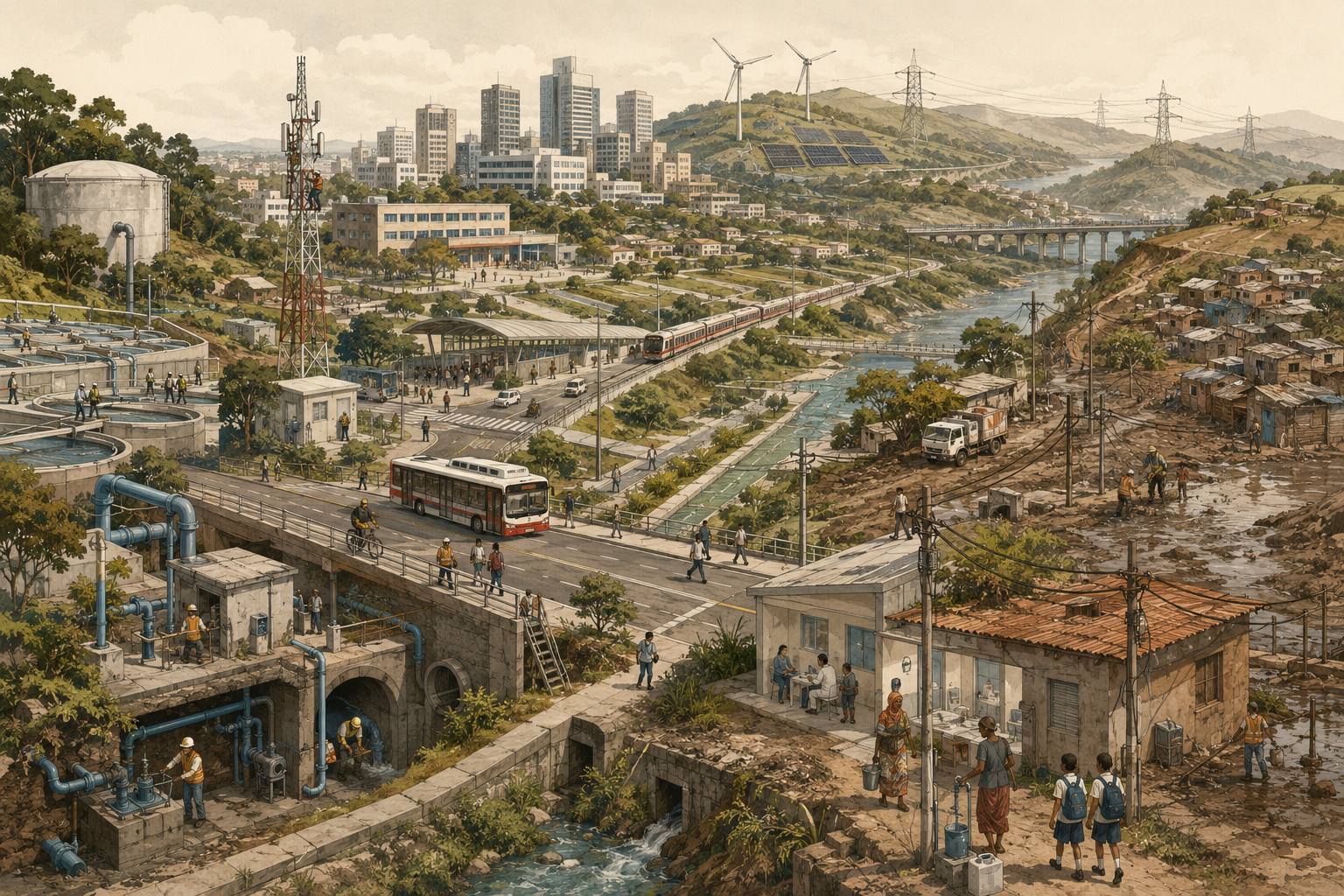
The deeper reason infrastructure matters is that development is not only a question of intention. It is also a question of material possibility. A health system cannot function without buildings, water, energy, transport access, cold chains, communications, and supply logistics. A school system cannot deliver learning if students cannot reach classrooms safely, if electricity is unreliable, if sanitation is absent, or if digital connectivity is unavailable. A social-protection system cannot reach people effectively without registries, payment systems, local offices, communications networks, and reliable territorial access.
This means infrastructure should not be understood narrowly as construction or capital stock. Infrastructure is better understood as the material organization of possibility. It structures access, shapes territory, conditions public services, mediates inequality, and determines how societies experience risk, opportunity, and institutional presence. Roads, grids, pipes, drains, ports, broadband networks, clinics, schools, and public facilities are not neutral objects. They are development systems that organize movement, care, production, safety, participation, and public authority.
At the same time, infrastructure is never neutral. It distributes access unevenly, locks in patterns of land use and energy dependence, creates ecological burdens, and can reinforce territorial inequality or unsustainable development trajectories when badly designed. Decisions about infrastructure systems and spatial expansion can widen capability or deepen vulnerability depending on how they are planned, governed, financed, maintained, and made accountable to public purpose.
What Infrastructure Means in Development
Infrastructure, in development terms, is more than roads, bridges, ports, railways, and power plants in the narrow engineering sense. It includes the physical and networked systems that enable mobility, exchange, service delivery, environmental management, public administration, communication, and institutional reach. Transport networks, water systems, sanitation, energy grids, drainage, waste systems, schools, clinics, digital networks, logistics corridors, public buildings, and housing-related services all form part of the material basis of development.
This matters because infrastructure is often misdescribed as a backdrop to development rather than one of its central conditions. In reality, infrastructure is what allows modern societies to organize time, distance, service access, production, public health, education, territorial integration, and administrative presence at scale. Infrastructure is not external to development outcomes. It is deeply constitutive of them.
Infrastructure also has a systems character. A road matters not only as pavement, but as part of a wider arrangement of land use, mobility, public services, markets, safety, maintenance, and emissions. A power grid matters not only as wires, but as a system of generation, reliability, affordability, regulation, resilience, and access. A water system matters not only as pipes, but as a connection among watersheds, treatment, distribution, household access, governance, and public health. Infrastructure becomes developmental when its systems actually support human capability.
This is why infrastructure cannot be evaluated only by asset count or capital expenditure. A bridge that fails to connect people to opportunity is not developmentally equivalent to one that reduces isolation. A digital network that bypasses poor households is not equivalent to one that expands access. A water system that exists but fails intermittently may leave households in continuing insecurity. Infrastructure must be judged by access, reliability, equity, resilience, ecological effects, and the capabilities it makes possible.
To ask what infrastructure means is therefore to ask what material systems make collective life workable. Sustainable development depends on those systems not only existing, but functioning reliably and equitably enough to support human wellbeing across territories and generations.
Why Infrastructure Matters for Development
Infrastructure matters because development depends on the capacity of societies to connect people to water, energy, mobility, services, markets, information, safety, and institutional protection. Without such systems, even strong policies remain weakly materialized. A social program cannot reach households reliably without roads, payment systems, communications infrastructure, and administrative access. A clinic cannot function well without buildings, utilities, supply chains, refrigeration, staff mobility, and safe routes. A school cannot fulfill its purpose if transport, electricity, connectivity, sanitation, and safe physical conditions are absent or unstable.
This matters because infrastructure shapes not only productivity, but the ordinary terms of life. It affects how far people travel for work, whether children can study after dark, whether storms become disasters, whether food spoils in transit, whether waste accumulates near homes, whether digital services are accessible, and whether rural or peripheral communities remain disconnected from opportunity. Infrastructure is therefore part of the material architecture of everyday dignity, not just a macroeconomic input.
Infrastructure also determines whether public institutions can reach people. A state may declare rights, create programs, and allocate budgets, but the practical reach of those commitments depends partly on roads, buildings, electricity, communications systems, records, water, sanitation, logistics, and digital infrastructure. Where these systems are weak, state capacity is weakened materially. Where they are reliable and inclusive, public institutions can function more credibly.
Infrastructure also affects time. Poor transport can turn short distances into hours of travel. Unreliable water can force households to spend time securing basic needs. Weak electricity can interrupt study, work, medical care, and digital access. Poor drainage can convert rainfall into repeated disruptions. Infrastructure therefore shapes the distribution of time burdens across society, often placing heavier burdens on women, low-income households, rural communities, informal settlements, and people already facing exclusion.
Infrastructure matters not simply because it supports growth, but because it structures everyday access to health, time, mobility, safety, and participation. Development becomes more unequal when infrastructure is distributed unevenly or maintained poorly, and more resilient when material systems are reliable enough to support social life under both ordinary and stressed conditions.
From Physical Assets to Material Systems
A deeper understanding of infrastructure requires moving beyond the view of it as a collection of assets. Roads do not matter in isolation from land use, transport services, maintenance, safety, affordability, and spatial planning. Electricity networks do not matter in isolation from generation mix, affordability, grid resilience, demand management, and institutional reliability. Water infrastructure does not matter in isolation from watershed conditions, treatment, governance, household access, and ecological limits. Digital infrastructure does not matter in isolation from affordability, literacy, device access, security, and service design.
This matters because asset-focused development can confuse construction with capability. A society may build extensively while still producing fragmentation, underuse, breakdown, or exclusion if the underlying system is poorly coordinated. Infrastructure becomes developmental not simply when assets are present, but when systems are integrated enough to work as intended over time.
Infrastructure systems also interact. Transport networks shape settlement patterns, land prices, emissions, labor access, and public-service reach. Drainage systems affect health, housing security, and flood risk. Digital systems affect access to benefits, education, banking, employment, emergency warnings, and public participation. Water and energy systems are tightly connected, as energy is often required for pumping, treatment, and distribution, while water can be required for energy production and cooling. Infrastructure systems rarely operate as isolated engineering categories.
This systems view also highlights vulnerability. A failure in one infrastructure domain can propagate into others. Power outages can disrupt water supply, communications, health facilities, refrigeration, payment systems, transport signaling, and public administration. Flooding can damage roads, schools, clinics, homes, sanitation systems, and local economies at once. Infrastructure failure is often cascading because infrastructure systems are interdependent.
Infrastructure is therefore better understood as a material system of provision, circulation, connection, and support. Sustainable development depends on the quality of these systems, not only on the quantity of projects completed. The development question is not simply what has been built, but whether the built system enables capability, reliability, resilience, and equitable access over time.
Infrastructure and Human Capability
Infrastructure matters because it widens or narrows what people are practically able to do. Reliable transport can reduce isolation and improve access to work, education, healthcare, markets, and civic life. Safe water and sanitation reduce disease burden and time spent securing basic necessities. Electricity supports study, communication, health services, refrigeration, lighting, and productive activity. Mobile and broadband networks widen access to information, services, learning, finance, and economic participation.
This matters because development is not only about aggregate growth. It is also about whether people can live with dignity, safety, mobility, and manageable daily effort. Poor infrastructure often converts routine life into continual friction: longer travel, unsafe water, unreliable power, missed services, higher household burdens, and greater exposure to environmental harm. Infrastructure therefore shapes capability directly, not just indirectly through macroeconomic effects.
Infrastructure also affects the distribution of opportunity. A household connected to safe transport, reliable electricity, clean water, sanitation, broadband, schools, clinics, and markets operates within a materially different capability environment than a household without those systems. These differences shape education, health, employment, safety, political participation, and resilience. Infrastructure is one of the ways inequality becomes embodied in everyday life.
Human capability is also affected by the reliability of infrastructure, not merely access at one point in time. An unreliable grid can interrupt work and study. Intermittent water supply can preserve insecurity. A road that becomes impassable during rains can isolate communities seasonally. A clinic with a building but unreliable power or water may fail at critical moments. Capability depends on systems that work predictably enough for people to plan their lives.
To treat infrastructure seriously in development theory is therefore to recognize that physical systems are part of the substantive freedoms people can exercise. Material access is a core dimension of human development, and failures of infrastructure are often failures in the conditions of capability itself. This section also aligns naturally with From Economic Growth to Human Development and Health, Education, and Human Capability Expansion.
Connectivity, Mobility, and Economic Coordination
Infrastructure is foundational to economic coordination. Markets do not function abstractly; they depend on roads, ports, power, logistics, communications networks, storage systems, settlement patterns, and institutional systems that allow production, exchange, labor mobility, and service delivery to occur. Infrastructure expands markets, creates job opportunities, lowers coordination costs, and widens the territorial reach of economic life when systems function reliably.
This matters because weak infrastructure does not merely slow output. It changes which sectors can develop, where investment goes, how firms organize production, whether regions remain peripheral or integrated, and whether households can access opportunity. Infrastructure affects the geography of development. A region disconnected from transport, electricity, digital networks, and logistics systems faces a different development frontier than a region embedded in reliable networks.
Mobility is especially important because it connects people to work, education, healthcare, markets, social life, and public institutions. Transport infrastructure that is affordable, safe, accessible, and reliable can widen capability. Transport systems that are expensive, unsafe, inaccessible, or poorly connected can reproduce exclusion even where economic activity exists nearby. Mobility determines whether opportunity is practically reachable.
Connectivity also shapes resilience in economic systems. Reliable logistics can reduce vulnerability to food shortages, supply disruptions, and local production bottlenecks. Digital connectivity can support remote work, public communication, education, financial inclusion, emergency warnings, and access to public services. Energy systems support production, cold chains, healthcare, communications, and everyday household activity. Economic coordination depends on infrastructure networks working together.
Infrastructure therefore underpins economic development not because it is separate from the economy, but because it is part of the material organization of economic life itself. When transport, energy, digital, water, and logistics systems function reliably, coordination costs fall; when they fail, entire development pathways narrow.
Public Services and the Infrastructure of Everyday Life
Infrastructure matters because public services depend on it materially. Health, education, emergency response, sanitation, social protection delivery, justice systems, local governance, environmental monitoring, and public administration all rely on infrastructures that are often overlooked when services are discussed only in institutional or budgetary terms. Buildings, transport access, digital networks, utilities, cold chains, communications systems, and administrative facilities all condition whether public institutions can function reliably.
This matters because service weakness is often infrastructural weakness expressed administratively. A school may be understaffed partly because transport is poor. A clinic may underperform because power is unstable, water is unsafe, or supply logistics are weak. A public office may be inaccessible because roads are inadequate or digital systems fail. A social-protection program may exclude people because payment systems, registries, identification infrastructure, or communications channels are weak. Infrastructure is part of the lived experience of the state, not merely an engineering layer beneath it.
Public services also require infrastructure maintenance. A clinic building without maintenance can become unsafe. A school without sanitation undermines attendance and dignity. A drainage system that is not cleared can turn routine rainfall into health risk. A road that is not maintained can isolate communities. A digital system that is not secured or updated can fail the people who depend on it. Service quality depends on infrastructure lifecycle governance.
Infrastructure also shapes institutional trust. People judge public systems through tangible experience: whether the water runs, the road holds, the clinic opens, the school is safe, the bus arrives, the lights stay on, the drainage works, and public facilities are maintained. When infrastructure fails repeatedly, institutional credibility weakens. When infrastructure works reliably and fairly, public institutions become more visible as sources of collective capacity.
Sustainable development depends on understanding that services are not delivered through policy alone. They are delivered through material systems that make institutional reach possible in practice. This section also aligns with State Capacity, Public Administration, and Delivery Systems.
Territory, Access, and Uneven Development
Infrastructure is unevenly distributed across space, and this territorial unevenness shapes development profoundly. Some neighborhoods, regions, and rural areas enjoy reliable transport, safe water, resilient housing, digital access, drainage, sanitation, and strong service connectivity. Others remain underprovided, poorly maintained, environmentally burdened, or disconnected from opportunity. This means infrastructure is one of the primary ways development becomes spatially unequal.
This matters because infrastructure is one of the main ways inequality becomes materialized. Peripheral communities may face longer travel times, higher costs, weaker services, greater hazard exposure, poorer digital access, and reduced economic opportunity because material systems do not connect them adequately to the wider development process. Territorial inequality is not only a difference in income. It is a difference in the networks through which everyday life is made possible.
Infrastructure access also affects citizenship. People who live in neighborhoods without safe water, sanitation, reliable transport, drainage, electricity, digital connectivity, or public facilities often experience public systems as distant or incomplete. Their exclusion is not only economic; it is infrastructural. They are made to bear more risk, spend more time, and navigate more uncertainty simply because material systems do not serve them equally.
Urban and rural infrastructure inequalities can also reinforce one another. Rural communities may lack roads, digital access, health infrastructure, or reliable energy, limiting economic options and service access. Urban informal settlements may be physically close to opportunity while lacking secure connections to water, sanitation, drainage, transport, and legal recognition. Different territories can be excluded in different ways, but the development problem is similar: material systems do not distribute capability fairly.
Sustainable development therefore requires not only more infrastructure, but more equitable infrastructural geographies. Access matters as much as asset count, and territorial justice depends partly on whether material systems connect historically marginalized places to capability and security. This section also complements Local Governance, Cities, and Territorial Development.
Resilience, Maintenance, and Infrastructural Reliability
Infrastructure matters not only when it is built, but when it is maintained. Maintenance is often politically less visible than new construction, yet it is central to whether infrastructure remains reliable, safe, and affordable over time. A lifecycle perspective matters more developmentally than a one-time construction logic. Roads, pipes, drains, grids, public buildings, digital systems, and facilities require recurring care if they are to remain useful.
This matters because sustainable development is frequently undermined by the gap between infrastructural expansion and infrastructural reliability. Roads deteriorate, drainage clogs, power systems fail, public buildings decay, and water systems become unsafe if maintenance is neglected. A development model focused on visible expansion without lifecycle care can therefore become materially impressive but operationally fragile.
Reliability is especially important because people organize life around expected service. A household plans work, school, caregiving, healthcare, travel, and communication around the assumption that systems will function. When infrastructure is unreliable, people must build coping strategies around uncertainty: storing water, using generators, missing appointments, avoiding travel, paying informal providers, or reducing productive activity. Reliability is therefore a development good.
Maintenance is also a governance issue. It requires budget systems, procurement, asset management, technical capacity, local accountability, monitoring, and political willingness to fund less visible work. New projects often receive more attention than maintenance because they are easier to announce. But sustainable development depends on whether existing systems continue to serve people after the opening ceremony ends.
Resilience begins partly with maintenance because long-run functionality depends less on ribbon-cutting than on whether systems can keep working under ordinary stress and extraordinary shock alike. Reliability is developmental because people live inside the intervals between breakdowns. Infrastructure is most valuable when it can be trusted.
Infrastructure, Risk, and Climate Vulnerability
Infrastructure is central to risk because climate and environmental stress act through material systems. Flooding, heat, storm damage, water scarcity, coastal exposure, wildfire smoke, disease risk, and supply disruption all affect infrastructure directly and indirectly. Climate risk does not remain in the atmosphere or the ecosystem alone. It enters roads, bridges, drains, schools, clinics, grids, homes, water systems, communications networks, and public facilities.
This matters because infrastructure is not only an input to development. It is also a pathway through which vulnerability is produced or reduced. Poorly located, weakly designed, or under-maintained infrastructure can intensify risk. Conversely, resilient and adaptive infrastructure can reduce exposure, support response capacity, and preserve continuity of services under stress.
Infrastructure risk is often cascading. A flood may damage roads, power systems, water treatment, sanitation, homes, schools, clinics, and local businesses at once. Heat can strain energy systems, transport, public health, labor productivity, and cooling access. Drought can affect water supply, food systems, energy generation, sanitation, and household wellbeing. Because infrastructure systems are interdependent, resilience requires attention to whole systems rather than isolated assets.
Climate vulnerability also has a justice dimension. Poorer neighborhoods, informal settlements, rural communities, and marginalized territories often face weaker infrastructure and greater exposure. They may live in areas with poor drainage, heat exposure, unreliable services, limited evacuation options, or weak public facilities. Infrastructure resilience must therefore be tied to equity. A resilient city or region is not one where only advantaged districts are protected.
Sustainable development depends on infrastructure that is not only extensive, but risk-informed and climate-aware. The material basis of development must also be the material basis of resilience. This section also aligns naturally with Climate Change as a Development Constraint.
Infrastructure Lock-In and Development Pathways
Infrastructure creates path dependence. Once transport systems, energy systems, settlement patterns, logistics networks, and water systems are built, they shape future choices. Roads influence land use. Fossil-based grids influence industrial structure. Housing location shapes travel demand and service cost. Ports, railways, highways, pipelines, and digital networks organize economic geography. Infrastructure can therefore lock societies into particular development pathways for decades.
This matters because bad infrastructure choices are not easily reversed. Systems built around sprawl, high emissions, weak public transport, poor maintenance cultures, ecological disruption, or exclusionary access may become politically and economically entrenched. Spatial and infrastructural choices can increase long-run risk rather than merely meeting short-run demand.
Infrastructure lock-in also shapes emissions. A car-dependent settlement pattern can make later decarbonization harder. Fossil-fuel infrastructure can create economic interests that resist transition. Poorly insulated buildings can raise long-term energy demand. Water systems that ignore watershed limits can create chronic scarcity. Development pathways are partly built into material systems, and once built, those systems influence behavior, budgets, and political coalitions.
Lock-in also affects public finance. Infrastructure choices create future maintenance obligations, service costs, debt burdens, and operating expenses. A poorly planned expansion can leave governments responsible for systems that are expensive to maintain and difficult to adapt. Sustainable development requires infrastructure decisions that account for lifecycle costs, not only initial capital expenditure.
Sustainable development therefore requires infrastructural foresight. The issue is not only whether infrastructure solves a present need, but what kind of future it makes easier or harder to achieve. This section also connects clearly to Land-System Change and Development Pathways.
Governance, Finance, and Coordination
Infrastructure is never only an engineering problem. It is also a governance, finance, and coordination problem. Large systems require planning, regulation, procurement, budgeting, maintenance regimes, territorial alignment, environmental assessment, public participation, and institutional cooperation across sectors and scales. Engineering can design assets, but governance determines which assets are built, who receives access, how systems are maintained, and whose risks are recognized.
This matters because building infrastructure well requires more than capital. It requires institutions capable of choosing priorities, balancing access and affordability, coordinating land use with transport and services, governing lifecycle performance, preventing corruption, managing environmental effects, and maintaining public accountability. Finance matters, but finance without institutional capacity can produce misallocation, delay, capture, poor-quality construction, and under-maintained assets.
Infrastructure finance also raises questions of justice. Tariff systems, user fees, debt structures, public-private partnerships, subsidies, and fiscal transfers determine who pays, who benefits, and who is excluded. An infrastructure system can expand physically while remaining unaffordable to those who need it. Sustainable development requires finance models that preserve access, maintenance, resilience, and long-run public purpose rather than shifting costs onto already vulnerable communities.
Coordination is especially important because infrastructure systems cross sectors. Transport planning must align with housing, land use, employment, emissions, and public health. Water systems must align with ecosystems, agriculture, cities, sanitation, and energy. Digital systems must align with public services, education, finance, privacy, and inclusion. Infrastructure failure often arises not from one bad asset, but from poor coordination among systems.
Infrastructure therefore belongs inside governance analysis. Sustainable development depends on whether material systems are embedded in public institutions capable of coordinating them intelligently over time. This section also aligns with Policy Coordination Across Complex Systems.
Path Dependence, Inequality, and the Politics of Access
Infrastructure is political because it allocates access. Decisions about where roads go, which neighborhoods receive drainage, how tariffs are structured, what level of service is considered acceptable, where transit lines are built, which territories are connected or bypassed, and which systems are maintained are never merely technical. They distribute time, safety, opportunity, public health, ecological burden, and exposure across populations.
This matters because infrastructures often inherit older social hierarchies and territorial biases. Once inequality is built into service networks, settlement form, or maintenance priorities, later development efforts must struggle against materialized exclusion rather than abstract unfairness. Peripheral settlements, informal neighborhoods, Indigenous territories, rural communities, post-industrial regions, and marginalized urban districts can remain disadvantaged because infrastructure systems were never designed around their inclusion in the first place.
Infrastructure can also create environmental injustice. Polluting facilities, unsafe roads, weak drainage, poor waste systems, heat exposure, and climate-vulnerable infrastructure are often concentrated in communities with less political power. When infrastructure decisions ignore these patterns, they reproduce unequal vulnerability. When they confront them directly, infrastructure can become a tool of repair.
The politics of access also includes recognition. Informal settlements may be denied services because they lack formal legal status. Rural communities may be considered too costly to serve. Disabled people may face infrastructure designed without accessibility. Low-income households may be connected physically but excluded by price. Infrastructure access is therefore shaped by legal, social, economic, and political recognition as well as engineering feasibility.
To take infrastructure seriously is therefore to take the politics of access seriously. Sustainable development is not achieved simply by adding assets, but by reshaping material systems so that capability, safety, connectivity, and resilience are not reserved for the already advantaged.
Why Building More Is Not Enough
It is not enough simply to build more infrastructure. Expansion alone can preserve exclusion, deepen ecological pressure, intensify emissions, create stranded assets, or produce systems that are impressive in scale but weak in function. Infrastructure can be plentiful in aggregate while remaining inaccessible, unaffordable, poorly maintained, territorially unequal, or environmentally unsustainable.
This matters because development is sometimes narrated as if infrastructure quantity were self-evidently beneficial. But sustainable development requires asking harder questions: who gains access, who bears costs, whether systems are resilient, whether maintenance is funded, whether ecological burdens are minimized, whether services are affordable, and whether infrastructure supports just and viable long-term pathways rather than locking in fragility.
More infrastructure can even worsen vulnerability if it is built in risky locations, designed without climate projections, disconnected from local needs, or financed in ways that undermine long-term public capacity. A road can open opportunity or deepen sprawl. A dam can support water and energy systems or displace communities and alter ecosystems. A digital system can widen access or create new forms of exclusion. Infrastructure is not automatically developmental. It becomes developmental through governance, design, access, maintenance, and public accountability.
Building more is also insufficient because existing systems often require repair, upgrading, and adaptation. Sustainable development may require maintaining what already exists, retrofitting for climate resilience, connecting underserved communities, improving safety, decarbonizing systems, reducing leakage, expanding affordability, and integrating fragmented networks. New construction is only one part of infrastructure policy.
The deeper goal is therefore not infrastructure as visible construction alone, but infrastructure as reliable, equitable, resilient, and publicly enabling material systems. Sustainable development depends on that broader standard.
Why This Matters for Sustainable Development
Infrastructure is the material basis of development because it shapes whether social life, economic coordination, public services, and institutional reach can function at all. Roads, grids, water systems, sanitation, digital networks, drainage, housing-related services, public buildings, and logistics corridors are not background conditions to development. They are part of the means through which development becomes real.
This is why infrastructure matters so much for sustainable development. It reveals a central truth that purely policy-centered or growth-centered accounts can miss: development depends not only on what societies intend, but on whether they possess the material systems that make those intentions practicable, equitable, and durable. Infrastructure widens capability when it is reliable and inclusive; it reproduces vulnerability when it is absent, fragile, unequal, or locked into unsustainable pathways.
The issue is also one of justice. Infrastructure determines whose homes are connected, whose neighborhoods are protected, whose commutes are bearable, whose water is safe, whose schools and clinics can function, whose communities are digitally reachable, and whose risks are reduced. Sustainable development cannot be credible if infrastructure investments improve aggregate indicators while leaving marginalized places underconnected, overexposed, or excluded from reliable service.
To take infrastructure seriously is therefore to take sustainable development seriously. It is to recognize that long-run human progress depends not only on institutions, rights, and policy, but on the material systems through which those institutions, rights, and policies are carried into everyday life.
Development becomes credible when infrastructure is accessible enough to widen capability, reliable enough to support everyday life, resilient enough to endure stress, and just enough to connect historically marginalized communities to the material conditions of dignity and opportunity.
Mathematical Lens
Infrastructure capacity can be clarified by thinking in terms of access, capability, and resilience rather than construction volume alone. Let \(D_i\) represent development-enabling infrastructure capacity, \(A\) access, \(C\) service capability, \(R\) resilience, and \(L\) lock-in risk:
D_i = \alpha A + \beta C + \gamma R – \delta L
\]
Interpretation: Development-enabling infrastructure capacity rises when access, service capability, and resilience improve, and falls when lock-in risk increases.
This captures a central point in the article: infrastructure becomes developmentally meaningful not simply when assets are built, but when systems are accessible, reliable, resilient, and able to avoid unsustainable lock-in.
We can also express access as a weighted function of core service domains:
A_i = w_1 T + w_2 W + w_3 S + w_4 E + w_5 N
\]
Interpretation: Infrastructure access improves when transport, water, sanitation, electricity, and digital-network access widen together.
Here, \(T\) is transport access, \(W\) is water access, \(S\) is sanitation access, \(E\) is electricity access, and \(N\) is digital network access. Higher \(A_i\) means material systems are widening everyday reach rather than leaving people disconnected from basic capability.
Finally, resilience can be treated as a function of maintenance, reliability, and climate preparedness:
R_i = \lambda M + \mu Q + \nu K
\]
Interpretation: Infrastructure resilience rises when maintenance capacity, reliability, and climate-readiness reinforce one another.
Here, \(M\) is maintenance capacity, \(Q\) is reliability, and \(K\) is climate resilience or adaptation readiness. This helps show why infrastructure expansion without maintenance and resilience remains developmentally thin.
| Term | Meaning | Interpretive role |
|---|---|---|
| \(D_i\) | Development-enabling infrastructure capacity | Represents infrastructure’s usable contribution to development through access, capability, resilience, and reduced lock-in. |
| \(A\) | Access | Represents whether people and territories can actually use core infrastructure systems. |
| \(C\) | Service capability | Represents infrastructure’s ability to support public services, mobility, economic coordination, and everyday life. |
| \(R\) | Resilience | Represents the ability of infrastructure systems to keep functioning under stress and recover from disruption. |
| \(L\) | Lock-in risk | Represents the danger that infrastructure choices entrench unsustainable land use, emissions, inequality, or fiscal burdens. |
| \(A_i\) | Infrastructure access index | Represents access across transport, water, sanitation, electricity, and digital networks. |
| \(R_i\) | Infrastructure resilience index | Represents resilience through maintenance, reliability, and climate-readiness. |
The equations are conceptual rather than predictive. Their value is to make visible the structure of the problem: infrastructure contributes to sustainable development only when access, capability, reliability, maintenance, resilience, affordability, and avoidance of harmful lock-in work together.
Advanced Python Workflow: Infrastructure Access and Capability Scoring
This Python workflow translates the article’s core argument into a structured infrastructure model. Rather than treating infrastructure as simple asset stock, it scores countries, regions, or territories across transport access, water access, sanitation access, electricity access, digital connectivity, public-service reach, reliability, maintenance capacity, territorial equity, climate resilience, affordability, governance capacity, and lock-in risk. That makes it possible to compare not only where infrastructure exists, but where it is actually supporting development capability.
from __future__ import annotations

import pandas as pd
import numpy as np

INPUT_FILE = "infrastructure_access_capability_panel.csv"
OUTPUT_FILE = "infrastructure_access_and_capability_scores.csv"


def load_data(path: str) -> pd.DataFrame:
    """
    Load infrastructure access and service-capability data.

    All *_index columns should be normalized to [0, 1].
    Higher values should mean more of the named property.

    Examples:
      - transport_access_index: higher = stronger transport access
      - reliability_index: higher = more reliable infrastructure service
      - territorial_equity_index: higher = more equitable territorial distribution
      - lock_in_risk_index: higher = greater risk of unsustainable pathway lock-in
    """
    df = pd.read_csv(path)

    required_columns = [
        "country_or_region",
        "region",
        "territory_type",
        "transport_access_index",
        "water_access_index",
        "sanitation_access_index",
        "electricity_access_index",
        "digital_connectivity_index",
        "public_service_reach_index",
        "reliability_index",
        "maintenance_capacity_index",
        "territorial_equity_index",
        "climate_resilience_index",
        "affordability_index",
        "governance_capacity_index",
        "lock_in_risk_index",
    ]

    missing = [col for col in required_columns if col not in df.columns]

    if missing:
        raise ValueError(f"Missing required columns: {missing}")

    return df


def validate_indices(df: pd.DataFrame) -> pd.DataFrame:
    """Validate that all *_index fields are complete and normalized to [0, 1]."""
    index_columns = [col for col in df.columns if col.endswith("_index")]

    for col in index_columns:
        if df[col].isna().any():
            raise ValueError(f"Column '{col}' contains missing values.")

        if ((df[col] < 0) | (df[col] > 1)).any():
            raise ValueError(f"Column '{col}' contains values outside [0, 1].")

    return df


def compute_scores(df: pd.DataFrame) -> pd.DataFrame:
    """
    Compute infrastructure access, capability, resilience,
    equity-adjusted infrastructure, and constrained infrastructure capacity.

    Infrastructure access rises with transport, water, sanitation,
    electricity, digital connectivity, affordability, and territorial equity.

    Infrastructure capability rises with public-service reach, reliability,
    maintenance capacity, access, affordability, and governance capacity.

    Infrastructure resilience rises with climate resilience, reliability,
    maintenance capacity, governance capacity, and reduced lock-in risk.
    """
    df = df.copy()

    df["infrastructure_access_score"] = (
        0.15 * df["transport_access_index"] +
        0.15 * df["water_access_index"] +
        0.12 * df["sanitation_access_index"] +
        0.15 * df["electricity_access_index"] +
        0.12 * df["digital_connectivity_index"] +
        0.16 * df["territorial_equity_index"] +
        0.15 * df["affordability_index"]
    ).clip(lower=0, upper=1)

    df["infrastructure_capability_score"] = (
        0.24 * df["public_service_reach_index"] +
        0.20 * df["reliability_index"] +
        0.18 * df["maintenance_capacity_index"] +
        0.16 * df["infrastructure_access_score"] +
        0.12 * df["governance_capacity_index"] +
        0.10 * df["affordability_index"]
    ).clip(lower=0, upper=1)

    df["resilience_score"] = (
        0.32 * df["climate_resilience_index"] +
        0.24 * df["reliability_index"] +
        0.22 * df["maintenance_capacity_index"] +
        0.12 * df["governance_capacity_index"] +
        0.10 * (1 - df["lock_in_risk_index"])
    ).clip(lower=0, upper=1)

    df["equity_adjusted_infrastructure_score"] = (
        0.34 * df["infrastructure_access_score"] +
        0.26 * df["territorial_equity_index"] +
        0.20 * df["affordability_index"] +
        0.12 * df["public_service_reach_index"] +
        0.08 * (1 - df["lock_in_risk_index"])
    ).clip(lower=0, upper=1)

    df["constrained_development_enabling_infrastructure_score"] = (
        0.30 * df["infrastructure_access_score"] +
        0.26 * df["infrastructure_capability_score"] +
        0.22 * df["resilience_score"] +
        0.14 * df["equity_adjusted_infrastructure_score"] +
        0.08 * (1 - df["lock_in_risk_index"])
    ).clip(lower=0, upper=1)

    df["access_reliability_gap"] = (
        df["infrastructure_access_score"] -
        df["reliability_index"]
    )

    df["infrastructure_band"] = np.select(
        [
            df["constrained_development_enabling_infrastructure_score"] >= 0.80,
            df["constrained_development_enabling_infrastructure_score"] >= 0.60,
            df["constrained_development_enabling_infrastructure_score"] >= 0.40,
        ],
        [
            "High infrastructure capacity",
            "Strong infrastructure capacity",
            "Moderate infrastructure capacity",
        ],
        default="Constrained infrastructure capacity",
    )

    df["infrastructure_warning"] = np.select(
        [
            df["lock_in_risk_index"] >= 0.75,
            df["maintenance_capacity_index"] <= 0.30,
            df["territorial_equity_index"] <= 0.30,
            df["climate_resilience_index"] <= 0.30,
        ],
        [
            "Severe infrastructure lock-in risk",
            "Low maintenance capacity",
            "Low territorial equity",
            "Low climate resilience",
        ],
        default="Lower infrastructure fragility warning",
    )

    return df


def build_summary(df: pd.DataFrame) -> pd.DataFrame:
    """Return a ranked summary table for review or reporting."""
    columns = [
        "country_or_region",
        "region",
        "territory_type",
        "infrastructure_access_score",
        "infrastructure_capability_score",
        "resilience_score",
        "equity_adjusted_infrastructure_score",
        "constrained_development_enabling_infrastructure_score",
        "infrastructure_band",
        "infrastructure_warning",
    ]

    summary = df[columns].copy()

    summary = summary.sort_values(
        by=[
            "constrained_development_enabling_infrastructure_score",
            "infrastructure_access_score",
            "infrastructure_capability_score",
            "resilience_score",
        ],
        ascending=[False, False, False, False],
    ).reset_index(drop=True)

    return summary


def main() -> None:
    df = load_data(INPUT_FILE)
    df = validate_indices(df)
    scored = compute_scores(df)
    summary = build_summary(scored)

    summary.to_csv(OUTPUT_FILE, index=False)

    print("Infrastructure access and capability scoring complete.")
    print(summary.to_string(index=False))


if __name__ == "__main__":
    main()
This workflow is intentionally transparent. It does not claim that infrastructure capacity can be reduced to one objective score. Instead, it makes assumptions visible: transport access, water access, sanitation access, electricity access, digital connectivity, service reach, reliability, maintenance capacity, territorial equity, climate resilience, affordability, governance capacity, and lock-in risk are treated as distinct components. The value of the model is diagnostic. It helps identify where systems are widening everyday possibility, where maintenance weaknesses are undermining reliability, and where infrastructure is still reproducing territorial exclusion.
Advanced R Workflow: Infrastructure Inequality and Service Reach Analysis
This R workflow is designed for the part of the article that emphasizes territorial inequality and uneven service reach. It compares countries, regions, and territory types across transport, water, sanitation, electricity, digital connectivity, public-service reach, reliability, maintenance capacity, territorial equity, affordability, climate resilience, and lock-in risk. It then builds grouped summaries that help show where infrastructure is genuinely widening access and where it remains developmentally thin.
library(readr)
library(dplyr)

input_file <- "infrastructure_country_panel.csv"
country_output_file <- "cross_country_infrastructure_summary.csv"
region_output_file <- "regional_infrastructure_summary.csv"
territory_output_file <- "territory_type_infrastructure_summary.csv"

infra_df <- read_csv(input_file, show_col_types = FALSE)

required_cols <- c(
  "country_or_region",
  "region",
  "territory_type",
  "year",
  "transport_access_index",
  "water_access_index",
  "sanitation_access_index",
  "electricity_access_index",
  "digital_connectivity_index",
  "public_service_reach_index",
  "reliability_index",
  "maintenance_capacity_index",
  "territorial_equity_index",
  "affordability_index",
  "climate_resilience_index",
  "lock_in_risk_index"
)

missing_cols <- setdiff(required_cols, names(infra_df))

if (length(missing_cols) > 0) {
  stop(paste("Missing required columns:", paste(missing_cols, collapse = ", ")))
}

index_cols <- names(infra_df)[grepl("_index$", names(infra_df))]

invalid_index_cols <- index_cols[
  vapply(
    infra_df[index_cols],
    function(x) any(is.na(x) | x < 0 | x > 1),
    logical(1)
  )
]

if (length(invalid_index_cols) > 0) {
  stop(
    paste(
      "Index columns must be complete and normalized to [0, 1]:",
      paste(invalid_index_cols, collapse = ", ")
    )
  )
}

infra_df <- infra_df %>%
  mutate(
    access_proxy = (
      transport_access_index +
      water_access_index +
      sanitation_access_index +
      electricity_access_index +
      digital_connectivity_index +
      territorial_equity_index +
      affordability_index
    ) / 7,
    capability_proxy = (
      access_proxy +
      public_service_reach_index +
      reliability_index +
      maintenance_capacity_index
    ) / 4,
    resilience_proxy = (
      climate_resilience_index +
      reliability_index +
      maintenance_capacity_index +
      (1 - lock_in_risk_index)
    ) / 4,
    constrained_infrastructure_proxy = (
      access_proxy +
      capability_proxy +
      resilience_proxy +
      territorial_equity_index +
      affordability_index
    ) / 5,
    infrastructure_band = case_when(
      constrained_infrastructure_proxy >= 0.75 ~ "High infrastructure capacity",
      constrained_infrastructure_proxy >= 0.55 ~ "Strong infrastructure capacity",
      constrained_infrastructure_proxy >= 0.35 ~ "Moderate infrastructure capacity",
      TRUE ~ "Constrained infrastructure capacity"
    )
  )

country_summary <- infra_df %>%
  group_by(country_or_region) %>%
  summarise(
    avg_access_proxy = mean(access_proxy, na.rm = TRUE),
    avg_capability_proxy = mean(capability_proxy, na.rm = TRUE),
    avg_resilience_proxy = mean(resilience_proxy, na.rm = TRUE),
    avg_constrained_infrastructure = mean(constrained_infrastructure_proxy, na.rm = TRUE),
    avg_transport_access = mean(transport_access_index, na.rm = TRUE),
    avg_water_access = mean(water_access_index, na.rm = TRUE),
    avg_sanitation_access = mean(sanitation_access_index, na.rm = TRUE),
    avg_electricity_access = mean(electricity_access_index, na.rm = TRUE),
    avg_digital_connectivity = mean(digital_connectivity_index, na.rm = TRUE),
    avg_public_service_reach = mean(public_service_reach_index, na.rm = TRUE),
    avg_reliability = mean(reliability_index, na.rm = TRUE),
    avg_maintenance_capacity = mean(maintenance_capacity_index, na.rm = TRUE),
    avg_territorial_equity = mean(territorial_equity_index, na.rm = TRUE),
    avg_affordability = mean(affordability_index, na.rm = TRUE),
    avg_climate_resilience = mean(climate_resilience_index, na.rm = TRUE),
    avg_lock_in_risk = mean(lock_in_risk_index, na.rm = TRUE),
    observations = n(),
    .groups = "drop"
  ) %>%
  mutate(
    infrastructure_band = case_when(
      avg_constrained_infrastructure >= 0.75 ~ "High infrastructure capacity",
      avg_constrained_infrastructure >= 0.55 ~ "Strong infrastructure capacity",
      avg_constrained_infrastructure >= 0.35 ~ "Moderate infrastructure capacity",
      TRUE ~ "Constrained infrastructure capacity"
    )
  ) %>%
  arrange(desc(avg_constrained_infrastructure))

region_summary <- infra_df %>%
  group_by(region) %>%
  summarise(
    avg_access_proxy = mean(access_proxy, na.rm = TRUE),
    avg_capability_proxy = mean(capability_proxy, na.rm = TRUE),
    avg_resilience_proxy = mean(resilience_proxy, na.rm = TRUE),
    avg_constrained_infrastructure = mean(constrained_infrastructure_proxy, na.rm = TRUE),
    avg_territorial_equity = mean(territorial_equity_index, na.rm = TRUE),
    avg_reliability = mean(reliability_index, na.rm = TRUE),
    avg_lock_in_risk = mean(lock_in_risk_index, na.rm = TRUE),
    observations = n(),
    .groups = "drop"
  ) %>%
  arrange(desc(avg_constrained_infrastructure))

territory_summary <- infra_df %>%
  group_by(territory_type) %>%
  summarise(
    avg_access_proxy = mean(access_proxy, na.rm = TRUE),
    avg_capability_proxy = mean(capability_proxy, na.rm = TRUE),
    avg_resilience_proxy = mean(resilience_proxy, na.rm = TRUE),
    avg_constrained_infrastructure = mean(constrained_infrastructure_proxy, na.rm = TRUE),
    avg_public_service_reach = mean(public_service_reach_index, na.rm = TRUE),
    avg_territorial_equity = mean(territorial_equity_index, na.rm = TRUE),
    avg_affordability = mean(affordability_index, na.rm = TRUE),
    avg_climate_resilience = mean(climate_resilience_index, na.rm = TRUE),
    observations = n(),
    .groups = "drop"
  ) %>%
  arrange(desc(avg_constrained_infrastructure))

write_csv(country_summary, country_output_file)
write_csv(region_summary, region_output_file)
write_csv(territory_summary, territory_output_file)

cat("Cross-country infrastructure summary exported to:", country_output_file, "\n")
print(country_summary)

cat("\nRegional infrastructure summary exported to:", region_output_file, "\n")
print(region_summary)

cat("\nTerritory-type infrastructure summary exported to:", territory_output_file, "\n")
print(territory_summary)
This workflow helps distinguish formal infrastructure presence from developmentally consequential infrastructure capacity. A country, region, or territory may have built assets but weak reliability, poor maintenance, low affordability, climate vulnerability, or highly unequal territorial distribution. Another may have fewer assets but stronger reliability, service reach, equity, resilience, and lifecycle governance. The workflow therefore treats infrastructure as a development condition, not as a simple count of projects completed.
GitHub Repository
Complete Code Repository
The full code distribution for this article, including infrastructure access scoring workflows, resilience and maintenance diagnostics, SQL materials, optional infrastructure-monitoring support tooling, supporting documentation, and repository structure, is available on GitHub.
Related Articles
- Transport, Mobility, and Spatial Inclusion
- Digital Infrastructure and Development Capacity
- Water, Sanitation, and Public Infrastructure Systems
- Energy Access, Electrification, and Development
- Climate Change as a Development Constraint
- Local Governance, Cities, and Territorial Development
- Policy Coordination Across Complex Systems
- State Capacity, Public Administration, and Delivery Systems
- Urbanization, Housing, and Basic Services
- Risk, Shock, and Fragility in Development Systems
Further Reading
- United Nations Department of Economic and Social Affairs (n.d.) Goal 9: Build resilient infrastructure, promote inclusive and sustainable industrialization and foster innovation. New York: United Nations. Available at: https://sdgs.un.org/goals/goal9
- World Bank Group (n.d.) Infrastructure Overview. Washington, DC: World Bank Group. Available at: https://www.worldbank.org/en/topic/infrastructure/overview
- World Bank Group (n.d.) Infrastructure. Washington, DC: World Bank Group. Available at: https://www.worldbank.org/en/topic/infrastructure
- Intergovernmental Panel on Climate Change (2022) Chapter 6: Cities, Settlements and Key Infrastructure. In: Climate Change 2022: Impacts, Adaptation and Vulnerability. Geneva: IPCC. Available at: https://www.ipcc.ch/report/ar6/wg2/chapter/chapter-6/
- Intergovernmental Panel on Climate Change (2022) Chapter 18: Climate Resilient Development Pathways. In: Climate Change 2022: Impacts, Adaptation and Vulnerability. Geneva: IPCC. Available at: https://www.ipcc.ch/report/ar6/wg2/chapter/chapter-18/
- UN-Habitat (n.d.) Environmentally sound basic urban infrastructure and services. Nairobi: UN-Habitat. Available at: https://mirror.unhabitat.org/content.asp?catid=577&cid=7969&subMenuId=0&typeid=24
References
- United Nations Department of Economic and Social Affairs (n.d.) Goal 9: Build resilient infrastructure, promote inclusive and sustainable industrialization and foster innovation. New York: United Nations. Available at: https://sdgs.un.org/goals/goal9
- World Bank Group (2025) Infrastructure Overview. Washington, DC: World Bank Group. Available at: https://www.worldbank.org/en/topic/infrastructure/overview
- World Bank Group (n.d.) Infrastructure. Washington, DC: World Bank Group. Available at: https://www.worldbank.org/en/topic/infrastructure
- Intergovernmental Panel on Climate Change (2022) Chapter 6: Cities, Settlements and Key Infrastructure. In: Climate Change 2022: Impacts, Adaptation and Vulnerability. Geneva: IPCC. Available at: https://www.ipcc.ch/report/ar6/wg2/chapter/chapter-6/
- Intergovernmental Panel on Climate Change (2022) Chapter 18: Climate Resilient Development Pathways. In: Climate Change 2022: Impacts, Adaptation and Vulnerability. Geneva: IPCC. Available at: https://www.ipcc.ch/report/ar6/wg2/chapter/chapter-18/
- Intergovernmental Panel on Climate Change (2022) Climate Change 2022: Impacts, Adaptation and Vulnerability. Geneva: IPCC. Citation materials available at: https://www.ipcc.ch/report/ar6/wg2/downloads/report/IPCC_AR6_WGII_Citation.bib
- UN-Habitat (n.d.) Environmentally sound basic urban infrastructure and services. Nairobi: UN-Habitat. Available at: https://mirror.unhabitat.org/content.asp?catid=577&cid=7969&subMenuId=0&typeid=24