
Last Updated May 7, 2026
Ecological thresholds matter for sustainable development because environmental systems do not always respond to pressure in smooth, proportional, or reversible ways. Forests, reefs, rivers, soils, cryospheric systems, ocean circulation, freshwater systems, and climate-linked ecological processes can absorb stress for a time and then reorganize abruptly once critical thresholds are crossed. These shifts are often nonlinear: small additional pressures can produce disproportionately large effects, while recovery may be delayed, partial, or impossible on socially relevant timescales.
For sustainable development, this matters profoundly. Development risk is not always cumulative in a gradual sense. It can also be abrupt, systemic, cascading, and self-amplifying. Sustainable development must therefore ask not only whether societies are improving present indicators of wellbeing, infrastructure, income, services, or production, but whether those achievements are being built within ecological conditions that remain stable enough to sustain human capability over time.
Main Library
Publications
Article Map
Sustainable Development
Related Topic
Planetary Boundaries
Related Topic
Risk & Resilience
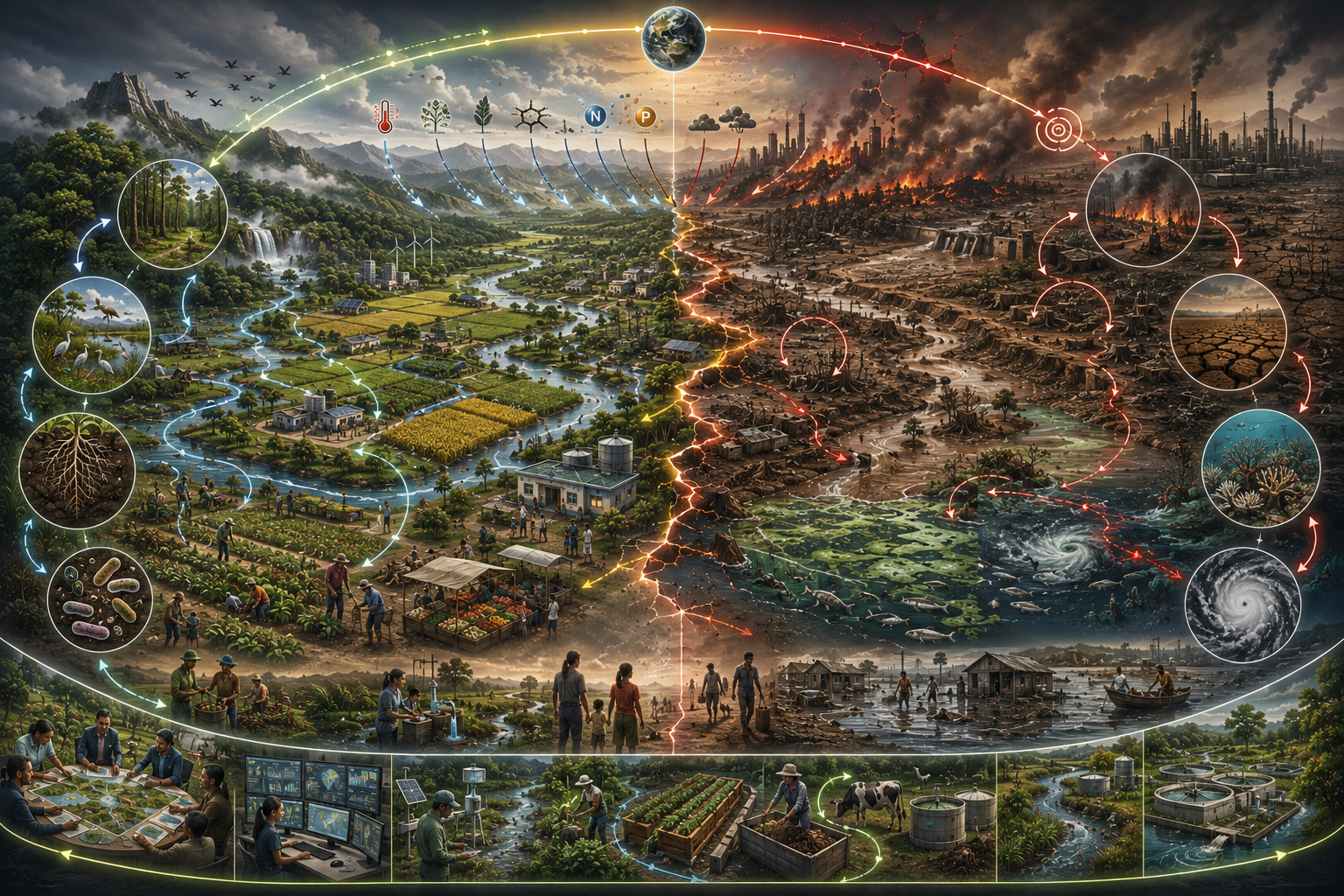
The 2030 Agenda is built around the premise that social, economic, and ecological objectives must be pursued together. Ecological thresholds make that integration more demanding. If ecosystems and Earth-system processes can shift rapidly after apparently incremental pressure, then development cannot be judged only by present gains in income, infrastructure, production, or service delivery. It must also be judged by whether those gains are being pursued within conditions that avoid destabilizing change in the systems that support life, livelihoods, health, settlement, and long-run institutional continuity.
This is one reason threshold thinking matters so much. It changes the meaning of environmental degradation. The central problem is not only that systems may get steadily worse. It is that they may remain apparently manageable for long periods and then become qualitatively different. A wetland may cease to regulate floods in the same way. A coral reef may no longer function as a biodiverse habitat or coastal buffer. A forest may no longer maintain the moisture, fire, and species dynamics that previously sustained it. A climate-linked process may move from variability within a range to reorganization beyond it.
The development significance of this is immense. Societies plan through institutions, budgets, engineering standards, insurance systems, supply chains, public-health systems, and social protections that usually assume continuity. Threshold dynamics imply that continuity itself can become unstable. Environmental change then becomes more than a background challenge. It becomes a source of systemic risk that can outrun incremental adaptation and expose the limits of linear policy thinking.
What Ecological Thresholds Mean
Ecological thresholds are points, zones, or conditions at which additional pressure on a system can trigger a qualitative change in its structure, function, or dynamics. Below such thresholds, systems may appear relatively stable, resilient, or capable of absorbing disturbance. Beyond them, the same systems may reorganize into new states with different feedbacks, different capacities, and different developmental consequences.
This matters because threshold thinking is fundamentally different from the assumption of smooth decline. A system does not merely become a weaker version of what it once was. It may become something else. A clear-water lake may shift into a persistently turbid and algae-dominated state. A coral-dominated reef may become rubble-dominated or algae-dominated. A humid forest may become a more fire-prone and drought-stressed landscape. A glacier-fed hydrological system may no longer deliver water in historically familiar ways. The essential feature is reorganization, not simply greater damage.
Thresholds therefore force a deeper understanding of environmental change. They reveal that resilience is not the same as invulnerability. A system may absorb considerable stress and still retain its basic structure, but once relevant stabilizing processes weaken past a critical point, even modest additional pressure can provoke abrupt transition. Development becomes more precarious when such transitions affect the ecological systems that support food, water, settlement, mobility, health, and long-run institutional order.
Thresholds also matter because they are often known only imperfectly. Societies may understand that a system is under stress without knowing the exact point at which it will reorganize. This means that policy cannot wait for perfect certainty before acting. In many ecological systems, the safest point of intervention is well before the threshold is reached, when prevention is still easier than reversal.
Ecological thresholds therefore transform environmental management into long-run development risk analysis. They ask whether development pathways are moving systems closer to states from which recovery may be difficult, slow, expensive, or impossible.
Why Nonlinearity Matters for Development
Nonlinearity matters because the relationship between pressure and consequence is often not proportional. In a linear system, added pressure produces added harm in relatively predictable increments. In a nonlinear system, the same additional unit of pressure may have modest effects at one moment and extremely large effects at another. This means that past experience can become a poor guide to future behavior precisely when risk is intensifying.
This is developmentally significant because many institutions are built around linear expectations. Planning often assumes that risks accumulate gradually, that adaptation can be scaled incrementally, and that systems under stress will continue to behave in familiar ways. But nonlinear systems violate these assumptions. They compress time. What looks manageable in one period may become politically, fiscally, and operationally overwhelming in the next.
Nonlinearity also changes the meaning of warning. A system may show relatively limited visible deterioration for long stretches and then change rapidly once certain internal conditions have shifted. Development becomes fragile under such conditions because visible present stability can conceal underlying structural vulnerability. This is why nonlinearity belongs at the center of sustainable-development thinking rather than at its margins.
Linear policy thinking is especially dangerous when it encourages societies to delay action until harm becomes obvious. If a system is nonlinear, obvious harm may arrive late. The absence of dramatic present collapse does not mean the absence of accumulating risk. It may mean that slow variables are shifting beneath the surface while the system still appears to function.
For sustainable development, nonlinearity means that prudence requires attention to buffers, early warning, redundancy, monitoring, and ecological resilience before systems enter dangerous ranges. It also means that development indicators should not focus only on current output or current service delivery. They should ask whether the underlying systems that support those outputs remain stable, resilient, and recoverable.
From Gradual Pressure to Abrupt Shift
One of the most important lessons of threshold thinking is that slow pressure and fast consequence often belong together. Environmental systems can accumulate stress gradually through warming, drying, fragmentation, pollution, nutrient loading, biodiversity loss, freshwater disruption, land-system change, or ocean chemistry change. For a time, the resulting effects may appear moderate, diffuse, or locally manageable. But once a threshold is crossed, the visible shift can be rapid.
This matters because policy systems are often attentive to immediate crises but less capable of governing slow variables. Slow variables are the background processes whose cumulative change gradually alters the stability of a system: soil organic matter, groundwater recharge, ocean chemistry, forest-cover connectivity, species composition, cryospheric mass, or heat accumulation. These variables may not dominate public attention until the system they support behaves differently. By then, the room for low-cost prevention may be sharply reduced.
The developmental lesson is not simply that environmental change can accelerate. It is that apparent delay in visible crisis does not imply safety. Gradual pressure can prepare the ground for abrupt transition. Societies that govern only what is immediately legible may miss the structural build-up of risk until reorganization is already underway.
This is especially relevant for infrastructure, finance, and public systems. A city may expand into flood-prone areas while wetlands decline slowly. A food system may become more dependent on a narrow set of ecological conditions while soil and water systems degrade gradually. A coastal economy may rely on reefs, fisheries, or beaches that are losing resilience long before collapse becomes visible. In each case, gradual pressure creates the possibility of abrupt social consequence.
Threshold-aware development must therefore monitor the slow variables that keep systems stable. It must ask not only whether a system is functioning now, but whether the conditions that allow it to function are being eroded.
Tipping Points, Feedbacks, and Regime Change
Tipping points matter because they identify moments when feedbacks begin to reinforce a new trajectory. A stressed system may still be held within a familiar range by stabilizing processes. Once tipped, however, reinforcing feedbacks can help lock in a different state. Fire can reinforce dryness. Species loss can reinforce further ecological instability. Warming can reduce ice, which can increase absorption of heat. Degraded reefs can lose the biological structure that once supported recovery.
This is why regime change is not only about magnitude. It is about structure. A system reorganizes into another operating mode with different internal relationships. Once reinforcing feedbacks intensify, reversing the change may require far more than simply removing the original driver. The system may have become organized around a new set of conditions.
For sustainable development, tipping points transform environmental concern into systemic concern. The issue is not only preventing somewhat worse outcomes. It is preventing transitions into states that are materially less supportive of food systems, urban life, livelihoods, infrastructure, public health, and institutional stability. Thresholds therefore change the developmental meaning of risk from incremental loss to structural transformation.
Feedbacks also create political difficulty. Harm may become self-reinforcing just as institutions begin to respond. Once a system shifts, policy may have to address not only the original pressure but the new feedback structure. For example, restoring a degraded landscape may require rebuilding soil, vegetation, hydrology, species interactions, and local governance together. Restoring a reef may require addressing warming, acidification, pollution, overuse, and habitat disruption simultaneously.
Regime change therefore demands prevention-oriented development. It is often easier to keep systems from tipping than to rebuild the conditions that existed before they reorganized.
Thresholds, Hysteresis, and Irreversibility
Threshold risk becomes even more serious when recovery does not mirror decline. In many ecological systems, the path back is not the same as the path down. This is the problem of hysteresis. A system may require much larger reductions in pressure to recover than were required to destabilize it in the first place. In some cases, recovery may be very slow, only partial, or effectively impossible on socially relevant timescales.
This matters because development planning often assumes reversibility. The common intuition is that if pressure is reduced later, the system can simply be restored to its previous condition. But threshold behavior often contradicts this assumption. A degraded fishery may not quickly return. A deforested or fragmented ecosystem may not recover its former moisture regime or biodiversity structure. A chemically altered ocean may not restore prior biological conditions within meaningful planning horizons.
Irreversibility is therefore not merely a scientific concern. It is a developmental concern because it changes the value of prevention. When reversal is costly, delayed, or impossible, early precaution becomes more rational than waiting for certainty. Threshold-aware development must therefore think not only about damage, but about whether some losses close off future pathways altogether.
Hysteresis also complicates restoration policy. Restoration may be necessary, but restoration should not be used as an excuse for avoidable degradation. A society cannot assume that every ecological loss can be repaired later through finance, technology, or institutional will. Some living systems require time, continuity, complexity, and interdependence that cannot be recreated quickly once destroyed.
The development lesson is clear: where thresholds and hysteresis are plausible, prevention has unusually high value. The cost of avoiding destabilization may be far lower than the cost of attempting recovery after reorganization has occurred.
Ecological Thresholds and Human Capability
Thresholds matter for human development because human capability depends on ecological conditions that often appear stable until they are not. Food production, water reliability, livable temperatures, storm buffering, disease regulation, and biodiversity-linked ecosystem services all rest on systems that may have nonlinear response patterns. If those systems reorganize abruptly, the substantive freedoms people can exercise may narrow quickly as well.
From a capability perspective, the issue is not only whether ecological change occurs, but whether it alters the practical field within which people can secure health, shelter, livelihood, mobility, education, and planning security. A threshold crossed in a reef system, watershed, cryosphere-linked water system, agricultural region, forest biome, or climate-sensitive settlement zone can become a threshold crossed in food affordability, rural security, insurance availability, coastal safety, labour stability, or household resilience.
Ecological thresholds therefore become social thresholds once they feed through the systems people depend on. This is why nonlinear ecological change belongs inside development analysis rather than alongside it. Human capability is often mediated through ecological conditions whose abrupt change can make social gains far more fragile than they appear in ordinary developmental metrics.
This also means that development success can be overstated when ecological threshold risk is ignored. A region may report gains in income, infrastructure, or service access while becoming more dependent on a watershed, coast, food system, or climate condition approaching nonlinear change. Those gains are real, but they are more fragile than they appear if the ecological systems supporting them are near transition.
Sustainable development must therefore treat ecological stability as part of capability. People are more capable when the ecological systems around them remain reliable enough to support planning, livelihood, health, and intergenerational security. Capability narrows when ecological systems become unstable, even if formal rights and services remain in place.
Systemic Risk, Cascades, and Interdependence
Thresholds become especially dangerous when systems are interdependent. Ecological, climatic, infrastructural, financial, and social systems do not operate in isolation. A threshold crossed in one domain can create cascading stress in others. A marine shift can affect fisheries and livelihoods, which can affect regional economies and migration pressures. A hydrological shift can affect energy supply, agriculture, health, and urban water systems simultaneously. A climate-linked tipping element can alter multiple regions and sectors at once.
This matters because development systems are highly coupled. Supply chains, fiscal systems, food markets, water systems, health systems, insurance regimes, transport networks, energy systems, and ecological supports interact continuously. Once interdependence is recognized, ecological thresholds are no longer only environmental events. They are potential triggers for systemic risk that propagates across sectors, territories, and institutions.
Systemic risk is therefore not simply bigger risk. It is risk that travels. It moves through coupled systems in ways that make narrow policy responses inadequate. This is one reason resilience thinking and complex-systems thinking are so important to sustainable development: they foreground the pathways through which disturbance becomes wider instability.
Cascading risk also exposes the limits of sectoral governance. A ministry responsible for agriculture may not control water systems, energy systems, climate adaptation, trade, or social protection, yet agricultural risk may cascade through all of them. A city planning department may not control regional watersheds, insurance markets, national infrastructure, or global emissions, yet urban exposure may depend on all of them. Threshold risk therefore requires governance that can see across systems.
The practical implication is that sustainable development must invest in buffers, diversification, redundancy, early warning, adaptive institutions, and cross-sector coordination. A system optimized only for efficiency under normal conditions may become fragile under threshold-driven disruption.
Earth-System Thresholds and Planetary Boundaries
The planetary-boundaries framework matters because it explicitly incorporates the role of thresholds related to large-scale Earth-system processes, the crossing of which may trigger nonlinear and abrupt change. This is a crucial conceptual move. It shifts the focus away from simple resource accounting and toward the dynamic stability of the Earth system itself.
This matters for development because planetary boundaries are not merely about how much humanity consumes. They are about whether humanity is pressing major Earth-system processes toward states that alter the planet’s self-regulating capacity. Once development is understood in that light, the central question changes. The issue is no longer only whether present needs can be met, but whether present pathways are destabilizing the conditions under which future needs could still be met safely and equitably.
Earth-system thresholds therefore push development analysis from static scarcity to dynamic instability. They require societies to think not only about limits in quantity, but about the risk of systemic reorganization in the very processes that support climate stability, hydrology, biosphere resilience, nutrient cycles, ocean chemistry, land systems, and long-run habitability.
This also changes the meaning of planetary boundaries as policy concepts. They are not simply red lines on a global dashboard. They are warnings that development pathways must remain within conditions where Earth-system processes are less likely to reorganize in dangerous ways. The purpose is not to freeze human activity, but to guide development away from ranges where ecological change becomes harder to predict, harder to reverse, and more likely to cascade.
Planetary boundaries and threshold thinking therefore belong together. Boundaries help frame the safe operating space; thresholds explain why moving outside that space can generate nonlinear and systemic risk. This section connects directly to Planetary Boundaries and Sustainable Development and Safe Operating Space and the Conditions of Long-Run Development.
Uncertainty, Precaution, and Governance
Thresholds create a distinctive governance problem because they are often difficult to locate precisely before they are crossed. Systems may exhibit warning signs, but the exact point of abrupt transition can remain uncertain. Waiting for precise certainty can therefore increase risk rather than reduce it. Where nonlinear change is possible and consequences may be large, governance cannot rely only on correction after the fact.
This is developmentally significant because institutions are often rewarded for short-run optimization rather than precaution under uncertainty. Yet threshold risk demands a different posture: one that values buffers, redundancy, early warning, adaptive capacity, and slower movement toward potentially dangerous states. Governance under nonlinearity must be capable of acting before irreversible or hard-to-reverse transitions become obvious.
Precaution here should not be misunderstood as paralysis. It is a recognition that when systems can reorganize abruptly, prudent development planning must take uncertainty itself seriously as part of the risk structure. Under threshold conditions, not knowing exactly where the line lies is itself a reason for caution, not a justification for delay.
Threshold governance also requires monitoring systems that pay attention to slow variables and early warning signals. These may include soil degradation, groundwater depletion, biodiversity decline, forest fragmentation, water-temperature changes, glacier mass loss, coral stress, ocean chemistry, fire regime shifts, or changes in species composition. Monitoring must be paired with institutions capable of acting on what is found.
Governance under nonlinear risk therefore requires humility. Development institutions must accept that some ecological systems are complex, partially knowable, and capable of surprise. The appropriate response is not fatalism. It is stronger public capacity, better science, more inclusive decision-making, and a willingness to protect resilience before collapse becomes visible.
Justice, Uneven Exposure, and Threshold Risk
Threshold risk is also a justice issue because exposure to ecological disruption is not evenly distributed. Communities that rely directly on fisheries, rain-fed agriculture, forest ecosystems, glacier-fed water systems, coastal buffers, or climate-sensitive settlement zones may face severe consequences from thresholds crossed in systems they did little to destabilize. Small producers, coastal communities, Indigenous peoples, rural households, informal settlements, and lower-income states are often more directly dependent on ecological stability and less protected when abrupt change occurs.
This matters because inequality shapes both vulnerability and adaptive capacity. Wealthier societies or groups may be better able to buffer abrupt change through infrastructure, insurance, relocation, diversification, savings, technology, or political influence, while poorer or marginalized communities face the same nonlinear shifts with fewer protections. Development therefore becomes unjust not only when benefits are uneven, but when threshold risks are externalized onto those least able to manage abrupt disruption.
Thresholds can also intensify historical injustice. Communities already dispossessed of land, resources, political power, or ecological security may be pushed into deeper vulnerability when ecosystems reorganize. If a fishery collapses, a watershed shifts, or a coastal buffer fails, those with fewer legal rights, weaker public services, or less financial capacity often experience the sharpest losses. The threshold may be ecological, but the burden is social.
Justice also matters in decision-making before thresholds are crossed. Communities closest to ecological systems often possess local knowledge about change, warning signs, historical baselines, and lived vulnerability. Excluding them from governance weakens both justice and effectiveness. Threshold-aware development must therefore include Indigenous peoples, local communities, small producers, workers, and exposed populations in planning rather than treating them only as beneficiaries or victims.
To treat thresholds seriously in development analysis is therefore to ask not only whether ecological change is possible, but who will bear the costs when systems tip and which institutions are capable of protecting those most exposed. Threshold-aware development must be justice-aware development.
Planning Under Nonlinear Risk
Planning under nonlinear risk requires a different development logic from the one implied by gradualism. It requires institutions to consider abrupt change, cascading effects, deep uncertainty, and the possibility that some shifts are hard to reverse. Infrastructure, food systems, coastal settlements, health systems, financial systems, and water systems are often planned under assumptions of continuity. Threshold-aware planning instead asks how much stress can be absorbed before systems reorganize, what feedbacks might amplify disruption, how interdependence could propagate failure, and what buffers are needed to avoid catastrophic lock-in.
This matters because conventional planning often privileges optimization over resilience. It seeks efficiency under expected conditions rather than durability under unstable ones. But where thresholds are plausible, resilience becomes a developmental asset, not a luxury. Redundancy, ecological restoration, diversified food systems, flexible infrastructure, adaptive governance, and monitoring of slow variables all become forms of developmental prudence.
Planning under nonlinear risk also requires scenario thinking. A single forecast may be inadequate when systems can shift suddenly. Scenarios help institutions consider multiple plausible futures, including high-impact disruptions that may be difficult to predict precisely. The goal is not to know the future perfectly, but to avoid plans that fail catastrophically when conditions depart from the expected path.
Infrastructure standards must also change. Systems designed only for historical averages may fail under nonlinear change. Flood defenses, water systems, agriculture, transport, insurance, public health, and coastal planning all need stress testing against abrupt shifts, compound hazards, and cascading failures. Development planning must ask not only whether infrastructure performs under normal conditions, but whether it remains useful when ecological systems behave differently.
Sustainable development in this sense is not only about improving current outcomes. It is about keeping social and ecological systems away from conditions in which improvement becomes far more difficult because the system itself has shifted. Planning under nonlinear risk therefore requires not only better forecasting, but a fundamentally different philosophy of development: one oriented toward staying within conditions of continued possibility.
Why This Matters for Sustainable Development
Ecological thresholds, nonlinearity, and systemic risk belong together because development increasingly unfolds within stressed ecological systems that do not always change smoothly. Forests, reefs, oceans, cryosphere-linked water systems, freshwater systems, soils, climate-linked processes, and coupled social-ecological systems can absorb pressure for long periods and then reorganize abruptly once critical thresholds are crossed. A serious development framework must therefore ask not only how much pressure systems can bear on average, but whether present pathways are pushing them toward states that are materially less supportive of human flourishing.
This is why thresholds matter so much for sustainable development. They reveal a central truth that incremental policy thinking often misses: gradual pressure can produce abrupt consequence, and apparently stable systems can become sources of sudden instability. Systemic risk emerges not only from the scale of harm, but from the way ecological change can cascade across interdependent human systems.
The issue is also one of justice. Thresholds do not affect all people equally. Those who depend most directly on fragile ecological systems and have the fewest buffers may face the greatest consequences when systems reorganize. Sustainable development cannot be credible if it improves present indicators while pushing ecological risks onto communities, workers, regions, and future generations least able to absorb abrupt change.
To take ecological thresholds seriously is therefore to take long-run development seriously. It is to recognize that sustainable development depends not only on present achievement, but on avoiding the nonlinear shifts that can make future achievement far more difficult, unequal, and fragile. Development that ignores thresholds may continue to expand for a time, but it does so under conditions that can quickly turn success into instability.
Development becomes credible when it protects the ecological conditions of continued possibility before those conditions cross into states that are harder, slower, or impossible to repair.
Mathematical Lens
Threshold-driven ecological risk can be clarified by thinking in terms of pressure, resilience, feedback, and cascade potential rather than smooth decline alone. Let \(S_t\) represent systemic ecological threshold risk, \(P\) cumulative pressure, \(F\) feedback intensity, \(C\) cascade coupling, and \(R\) resilience buffering:
S_t = \alpha P + \beta F + \gamma C – \delta R
\]
Interpretation: Systemic ecological threshold risk rises when cumulative pressure, reinforcing feedbacks, and cascade coupling intensify, and falls when resilience buffering improves.
This captures the article’s central claim: risk is shaped not only by the amount of pressure, but by whether feedbacks and interdependence amplify that pressure beyond manageable thresholds.
We can also express threshold sensitivity as a weighted function of slow-variable deterioration, ecological coupling, and recovery weakness:
T_s = w_1 V + w_2 K + w_3 H
\]
Interpretation: Threshold sensitivity rises when slow-variable deterioration, system coupling, and hysteresis or recovery difficulty reinforce one another.
Here, \(V\) is slow-variable change, \(K\) is coupling or connectivity, and \(H\) is hysteresis or recovery difficulty. Higher \(T_s\) means a system is more vulnerable to abrupt qualitative shift rather than gradual decline.
Finally, planning fragility can be represented as a function of linear-policy dependence, monitoring weakness, and low precautionary capacity:
G_f = \lambda L + \mu M + \nu Q
\]
Interpretation: Planning fragility rises when institutions rely on linear assumptions, monitor slow variables poorly, and lack precautionary capacity.
Here, \(L\) is linear planning dependence, \(M\) is weak monitoring of slow variables, and \(Q\) is weak precaution capacity. This helps show why development systems can remain institutionally underprepared even when ecological stress is already accumulating.
| Term | Meaning | Interpretive role |
|---|---|---|
| \(S_t\) | Systemic ecological threshold risk | Represents development risk created by cumulative pressure, feedbacks, cascade coupling, and weak resilience buffering. |
| \(P\) | Cumulative pressure | Represents stress from warming, pollution, fragmentation, freshwater disruption, biodiversity loss, land change, or other drivers. |
| \(F\) | Feedback intensity | Represents reinforcing processes that amplify change once destabilization begins. |
| \(C\) | Cascade coupling | Represents interdependence among ecological, infrastructural, economic, and social systems. |
| \(R\) | Resilience buffering | Represents ecological redundancy, institutional capacity, adaptive governance, and buffers that absorb disturbance. |
| \(T_s\) | Threshold sensitivity | Represents the likelihood that gradual pressure could become abrupt qualitative change. |
| \(G_f\) | Planning fragility | Represents institutional underpreparedness caused by linear assumptions, weak monitoring, and low precautionary capacity. |
The equations are conceptual rather than predictive. Their value is to make visible the structure of the problem: threshold risk depends on cumulative pressure, slow variables, feedbacks, cascading interdependence, recovery difficulty, resilience buffering, monitoring, and governance capacity working together.
Advanced Python Workflow: Ecological Threshold and Systemic-Risk Scoring
This Python workflow translates the article’s core argument into a structured threshold-risk model. Rather than treating environmental degradation as smooth decline, it scores countries, basins, ecosystems, or territorial systems across cumulative ecological pressure, slow-variable deterioration, feedback intensity, cascade exposure, resilience buffering, recovery difficulty, monitoring readiness, precaution capacity, justice exposure, governance capacity, and adaptive planning readiness. That makes it possible to compare not only where ecosystems are stressed, but where nonlinear transition risk is developmentally significant.
from __future__ import annotations

import pandas as pd
import numpy as np

INPUT_FILE = "ecological_thresholds_panel.csv"
OUTPUT_FILE = "ecological_thresholds_systemic_risk_scores.csv"


def load_data(path: str) -> pd.DataFrame:
    """
    Load a system-level ecological threshold and systemic-risk dataset.

    All *_index columns should be normalized to [0, 1].
    Higher values should mean more of the named property.

    Examples:
      - cumulative_pressure_index: higher = stronger cumulative ecological pressure
      - feedback_intensity_index: higher = stronger reinforcing feedback potential
      - resilience_buffer_index: higher = stronger resilience buffering
      - precaution_capacity_index: higher = stronger precautionary governance capacity
    """
    df = pd.read_csv(path)

    required_columns = [
        "system_name",
        "country_or_region",
        "ecosystem_type",
        "cumulative_pressure_index",
        "slow_variable_deterioration_index",
        "feedback_intensity_index",
        "cascade_exposure_index",
        "resilience_buffer_index",
        "recovery_difficulty_index",
        "monitoring_readiness_index",
        "precaution_capacity_index",
        "justice_exposure_index",
        "governance_capacity_index",
        "adaptive_planning_readiness_index",
    ]

    missing = [col for col in required_columns if col not in df.columns]

    if missing:
        raise ValueError(f"Missing required columns: {missing}")

    return df


def validate_indices(df: pd.DataFrame) -> pd.DataFrame:
    """Validate that all *_index fields are complete and normalized to [0, 1]."""
    index_columns = [col for col in df.columns if col.endswith("_index")]

    for col in index_columns:
        if df[col].isna().any():
            raise ValueError(f"Column '{col}' contains missing values.")

        if ((df[col] < 0) | (df[col] > 1)).any():
            raise ValueError(f"Column '{col}' contains values outside [0, 1].")

    return df


def compute_scores(df: pd.DataFrame) -> pd.DataFrame:
    """
    Compute threshold sensitivity, systemic cascade exposure,
    governance readiness, and constrained threshold risk.

    Threshold sensitivity rises with cumulative pressure, slow-variable
    deterioration, feedback intensity, recovery difficulty, and weak
    resilience buffering.

    Governance readiness rises with monitoring readiness, precaution capacity,
    governance capacity, adaptive planning readiness, and resilience buffering.
    """
    df = df.copy()

    df["threshold_sensitivity_score"] = (
        0.22 * df["cumulative_pressure_index"] +
        0.20 * df["slow_variable_deterioration_index"] +
        0.20 * df["feedback_intensity_index"] +
        0.18 * df["recovery_difficulty_index"] +
        0.20 * (1 - df["resilience_buffer_index"])
    ).clip(lower=0, upper=1)

    df["systemic_cascade_score"] = (
        0.34 * df["cascade_exposure_index"] +
        0.22 * df["feedback_intensity_index"] +
        0.20 * df["justice_exposure_index"] +
        0.14 * df["cumulative_pressure_index"] +
        0.10 * (1 - df["adaptive_planning_readiness_index"])
    ).clip(lower=0, upper=1)

    df["governance_readiness_score"] = (
        0.24 * df["monitoring_readiness_index"] +
        0.23 * df["precaution_capacity_index"] +
        0.20 * df["governance_capacity_index"] +
        0.18 * df["adaptive_planning_readiness_index"] +
        0.15 * df["resilience_buffer_index"]
    ).clip(lower=0, upper=1)

    df["constrained_threshold_risk_score"] = (
        0.43 * df["threshold_sensitivity_score"] +
        0.29 * df["systemic_cascade_score"] +
        0.14 * df["justice_exposure_index"] +
        0.08 * (1 - df["governance_readiness_score"]) +
        0.06 * (1 - df["precaution_capacity_index"])
    ).clip(lower=0, upper=1)

    df["threshold_governance_gap"] = (
        df["threshold_sensitivity_score"] -
        df["governance_readiness_score"]
    )

    df["threshold_band"] = np.select(
        [
            df["constrained_threshold_risk_score"] >= 0.80,
            df["constrained_threshold_risk_score"] >= 0.60,
            df["constrained_threshold_risk_score"] >= 0.40,
        ],
        [
            "Extreme threshold-systemic risk",
            "High threshold-systemic risk",
            "Moderate threshold-systemic risk",
        ],
        default="Lower threshold-systemic risk",
    )

    df["threshold_warning"] = np.select(
        [
            df["threshold_governance_gap"] >= 0.35,
            df["threshold_governance_gap"] >= 0.20,
            df["threshold_governance_gap"] >= 0.05,
        ],
        [
            "Severe threshold governance gap",
            "High threshold governance gap",
            "Moderate threshold governance gap",
        ],
        default="Lower governance gap or stronger threshold readiness",
    )

    return df


def build_summary(df: pd.DataFrame) -> pd.DataFrame:
    """Return a ranked summary table for review or reporting."""
    columns = [
        "system_name",
        "country_or_region",
        "ecosystem_type",
        "threshold_sensitivity_score",
        "systemic_cascade_score",
        "governance_readiness_score",
        "constrained_threshold_risk_score",
        "threshold_governance_gap",
        "threshold_band",
        "threshold_warning",
    ]

    summary = df[columns].copy()

    summary = summary.sort_values(
        by=[
            "constrained_threshold_risk_score",
            "threshold_sensitivity_score",
            "systemic_cascade_score",
        ],
        ascending=[False, False, False],
    ).reset_index(drop=True)

    return summary


def main() -> None:
    df = load_data(INPUT_FILE)
    df = validate_indices(df)
    scored = compute_scores(df)
    summary = build_summary(scored)

    summary.to_csv(OUTPUT_FILE, index=False)

    print("Ecological threshold and systemic-risk scoring complete.")
    print(summary.to_string(index=False))


if __name__ == "__main__":
    main()
This workflow is intentionally transparent. It does not claim that threshold risk can be reduced to one objective score. Instead, it makes assumptions visible: cumulative pressure, slow-variable deterioration, feedback intensity, cascade exposure, resilience buffering, recovery difficulty, monitoring readiness, precaution capacity, justice exposure, governance capacity, and adaptive planning readiness are treated as distinct components. The value of the model is diagnostic. It helps identify where ecological systems are closer to qualitative transition, where social systems are more exposed to cascading consequences, and where precaution and resilience capacity remain weakest.
Advanced R Workflow: Threshold Exposure, Cascades, and Resilience Analysis
This R workflow is designed for the part of the article that emphasizes variation across ecosystems, territories, and exposed groups. It compares settings across cumulative pressure, slow-variable deterioration, feedback intensity, cascade exposure, resilience buffering, recovery difficulty, monitoring readiness, precaution capacity, justice exposure, governance capacity, and adaptive planning readiness. It then builds grouped summaries that help show where nonlinear ecological risk is stronger and where social vulnerability to abrupt ecological change remains developmentally costly.
library(readr)
library(dplyr)

input_file <- "ecological_thresholds_country_panel.csv"
region_output_file <- "cross_region_threshold_summary.csv"
ecosystem_output_file <- "cross_ecosystem_threshold_summary.csv"

thr_df <- read_csv(input_file, show_col_types = FALSE)

required_cols <- c(
  "system_name",
  "country_or_region",
  "ecosystem_type",
  "cumulative_pressure_index",
  "slow_variable_deterioration_index",
  "feedback_intensity_index",
  "cascade_exposure_index",
  "resilience_buffer_index",
  "recovery_difficulty_index",
  "monitoring_readiness_index",
  "precaution_capacity_index",
  "justice_exposure_index",
  "governance_capacity_index",
  "adaptive_planning_readiness_index"
)

missing_cols <- setdiff(required_cols, names(thr_df))

if (length(missing_cols) > 0) {
  stop(paste("Missing required columns:", paste(missing_cols, collapse = ", ")))
}

index_cols <- names(thr_df)[grepl("_index$", names(thr_df))]

invalid_index_cols <- index_cols[
  vapply(
    thr_df[index_cols],
    function(x) any(is.na(x) | x < 0 | x > 1),
    logical(1)
  )
]

if (length(invalid_index_cols) > 0) {
  stop(
    paste(
      "Index columns must be complete and normalized to [0, 1]:",
      paste(invalid_index_cols, collapse = ", ")
    )
  )
}

thr_df <- thr_df %>%
  mutate(
    threshold_sensitivity_proxy = (
      cumulative_pressure_index +
      slow_variable_deterioration_index +
      feedback_intensity_index +
      recovery_difficulty_index +
      (1 - resilience_buffer_index)
    ) / 5,
    systemic_cascade_proxy = (
      cascade_exposure_index +
      feedback_intensity_index +
      justice_exposure_index +
      cumulative_pressure_index +
      (1 - adaptive_planning_readiness_index)
    ) / 5,
    governance_readiness_proxy = (
      monitoring_readiness_index +
      precaution_capacity_index +
      governance_capacity_index +
      adaptive_planning_readiness_index +
      resilience_buffer_index
    ) / 5,
    threshold_development_risk_proxy = (
      threshold_sensitivity_proxy +
      systemic_cascade_proxy +
      justice_exposure_index +
      recovery_difficulty_index +
      (1 - governance_readiness_proxy)
    ) / 5,
    threshold_governance_gap = threshold_sensitivity_proxy - governance_readiness_proxy,
    threshold_band = case_when(
      threshold_development_risk_proxy >= 0.75 ~ "Extreme threshold-systemic risk",
      threshold_development_risk_proxy >= 0.55 ~ "High threshold-systemic risk",
      threshold_development_risk_proxy >= 0.35 ~ "Moderate threshold-systemic risk",
      TRUE ~ "Lower threshold-systemic risk"
    )
  )

region_summary <- thr_df %>%
  group_by(country_or_region) %>%
  summarise(
    avg_threshold_development_risk_proxy = mean(threshold_development_risk_proxy, na.rm = TRUE),
    avg_threshold_sensitivity_proxy = mean(threshold_sensitivity_proxy, na.rm = TRUE),
    avg_systemic_cascade_proxy = mean(systemic_cascade_proxy, na.rm = TRUE),
    avg_governance_readiness_proxy = mean(governance_readiness_proxy, na.rm = TRUE),
    avg_cumulative_pressure = mean(cumulative_pressure_index, na.rm = TRUE),
    avg_slow_variable_deterioration = mean(slow_variable_deterioration_index, na.rm = TRUE),
    avg_feedback_intensity = mean(feedback_intensity_index, na.rm = TRUE),
    avg_cascade_exposure = mean(cascade_exposure_index, na.rm = TRUE),
    avg_resilience_buffer = mean(resilience_buffer_index, na.rm = TRUE),
    avg_recovery_difficulty = mean(recovery_difficulty_index, na.rm = TRUE),
    avg_monitoring_readiness = mean(monitoring_readiness_index, na.rm = TRUE),
    avg_precaution_capacity = mean(precaution_capacity_index, na.rm = TRUE),
    avg_justice_exposure = mean(justice_exposure_index, na.rm = TRUE),
    avg_governance_capacity = mean(governance_capacity_index, na.rm = TRUE),
    avg_adaptive_planning_readiness = mean(adaptive_planning_readiness_index, na.rm = TRUE),
    avg_threshold_governance_gap = mean(threshold_governance_gap, na.rm = TRUE),
    observations = n(),
    .groups = "drop"
  ) %>%
  mutate(
    regional_threshold_band = case_when(
      avg_threshold_development_risk_proxy >= 0.75 ~ "Extreme threshold-systemic risk",
      avg_threshold_development_risk_proxy >= 0.55 ~ "High threshold-systemic risk",
      avg_threshold_development_risk_proxy >= 0.35 ~ "Moderate threshold-systemic risk",
      TRUE ~ "Lower threshold-systemic risk"
    )
  ) %>%
  arrange(desc(avg_threshold_development_risk_proxy))

ecosystem_summary <- thr_df %>%
  group_by(ecosystem_type) %>%
  summarise(
    avg_threshold_development_risk_proxy = mean(threshold_development_risk_proxy, na.rm = TRUE),
    avg_threshold_sensitivity_proxy = mean(threshold_sensitivity_proxy, na.rm = TRUE),
    avg_systemic_cascade_proxy = mean(systemic_cascade_proxy, na.rm = TRUE),
    avg_governance_readiness_proxy = mean(governance_readiness_proxy, na.rm = TRUE),
    avg_cumulative_pressure = mean(cumulative_pressure_index, na.rm = TRUE),
    avg_slow_variable_deterioration = mean(slow_variable_deterioration_index, na.rm = TRUE),
    avg_feedback_intensity = mean(feedback_intensity_index, na.rm = TRUE),
    avg_cascade_exposure = mean(cascade_exposure_index, na.rm = TRUE),
    avg_resilience_buffer = mean(resilience_buffer_index, na.rm = TRUE),
    avg_recovery_difficulty = mean(recovery_difficulty_index, na.rm = TRUE),
    avg_monitoring_readiness = mean(monitoring_readiness_index, na.rm = TRUE),
    avg_precaution_capacity = mean(precaution_capacity_index, na.rm = TRUE),
    avg_justice_exposure = mean(justice_exposure_index, na.rm = TRUE),
    avg_governance_capacity = mean(governance_capacity_index, na.rm = TRUE),
    avg_adaptive_planning_readiness = mean(adaptive_planning_readiness_index, na.rm = TRUE),
    avg_threshold_governance_gap = mean(threshold_governance_gap, na.rm = TRUE),
    observations = n(),
    .groups = "drop"
  ) %>%
  arrange(desc(avg_threshold_development_risk_proxy))

write_csv(region_summary, region_output_file)
write_csv(ecosystem_summary, ecosystem_output_file)

cat("Cross-region threshold summary exported to:", region_output_file, "\n")
print(region_summary)

cat("\nCross-ecosystem threshold summary exported to:", ecosystem_output_file, "\n")
print(ecosystem_summary)
This workflow helps distinguish ordinary ecological stress from developmentally consequential threshold risk. A system may face high cumulative pressure but stronger resilience buffering, monitoring, precaution, and adaptive planning. Another may face moderate pressure but severe cascade exposure, high recovery difficulty, weak governance, and high justice exposure. The workflow therefore treats ecological thresholds as development conditions, not as isolated environmental events.
GitHub Repository
Complete Code Repository
The full code distribution for this article, including ecological-threshold scoring workflows, cascade and resilience diagnostics, SQL materials, optional environmental-risk support tooling, supporting documentation, and repository structure, is available on GitHub.
Related Articles
- Planetary Boundaries and Sustainable Development
- Development Under Deep Uncertainty
- Scenario Planning for Sustainable Futures
- Climate Change as a Development Constraint
- Safe Operating Space and the Conditions of Long-Run Development
- Inequality and Inclusive Development
- From Economic Growth to Human Development
- Systems Modeling and Nonlinear Change
- Risk, Shock, and Fragility in Development Systems
- Trade-Offs, Synergies, and Policy Coherence
Further Reading
- United Nations Department of Economic and Social Affairs (n.d.) Goal 15: Protect, restore and promote sustainable use of terrestrial ecosystems, sustainably manage forests, combat desertification, and halt and reverse land degradation and halt biodiversity loss. New York: United Nations. Available at: https://sdgs.un.org/goals/goal15
- United Nations Department of Economic and Social Affairs (n.d.) Biodiversity and ecosystems. New York: United Nations. Available at: https://sdgs.un.org/topics/biodiversity-and-ecosystems
- Stockholm Resilience Centre (n.d.) Planetary boundaries. Stockholm: Stockholm Resilience Centre. Available at: https://www.stockholmresilience.org/research/planetary-boundaries.html
- Intergovernmental Panel on Climate Change (2019) Special Report on the Ocean and Cryosphere in a Changing Climate, Chapter 6: Extremes, Abrupt Changes and Managing Risk. Geneva: IPCC. Available at: https://www.ipcc.ch/srocc/chapter/chapter-6/
- Intergovernmental Panel on Climate Change (2022) Chapter 18: Climate Resilient Development Pathways. In: Climate Change 2022: Impacts, Adaptation and Vulnerability. Geneva: IPCC. Available at: https://www.ipcc.ch/report/ar6/wg2/chapter/chapter-18/
- IPBES (2019) The Global Assessment Report on Biodiversity and Ecosystem Services. Bonn: IPBES. Available at: https://www.ipbes.net/global-assessment
- Rockström, J. et al. (2009) A safe operating space for humanity. Nature, 461, pp. 472–475. Available at: https://www.nature.com/articles/461472a
- Steffen, W. et al. (2015) Planetary Boundaries: Guiding Human Development on a Changing Planet. Science, 347(6223). Available at: https://www.science.org/doi/10.1126/science.1259855
References
- United Nations Department of Economic and Social Affairs (n.d.) Goal 15: Protect, restore and promote sustainable use of terrestrial ecosystems, sustainably manage forests, combat desertification, and halt and reverse land degradation and halt biodiversity loss. New York: United Nations. Available at: https://sdgs.un.org/goals/goal15
- United Nations Department of Economic and Social Affairs (n.d.) Biodiversity and ecosystems. New York: United Nations. Available at: https://sdgs.un.org/topics/biodiversity-and-ecosystems
- Stockholm Resilience Centre (n.d.) Planetary boundaries. Stockholm: Stockholm Resilience Centre. Available at: https://www.stockholmresilience.org/research/planetary-boundaries.html
- Stockholm Resilience Centre (n.d.) Glossary: Planetary Boundaries. Stockholm: Stockholm Resilience Centre. Available at: https://www.stockholmresilience.org/news–events/doing-business-within-planetary-boundaries/glossary.html
- Intergovernmental Panel on Climate Change (2019) Special Report on the Ocean and Cryosphere in a Changing Climate, Chapter 6: Extremes, Abrupt Changes and Managing Risk. Geneva: IPCC. Available at: https://www.ipcc.ch/srocc/chapter/chapter-6/
- Intergovernmental Panel on Climate Change (2022) Chapter 18: Climate Resilient Development Pathways. In: Climate Change 2022: Impacts, Adaptation and Vulnerability. Geneva: IPCC. Available at: https://www.ipcc.ch/report/ar6/wg2/chapter/chapter-18/
- IPBES (2019) The Global Assessment Report on Biodiversity and Ecosystem Services. Bonn: IPBES. Available at: https://www.ipbes.net/global-assessment
- IPBES (n.d.) Global Assessment Report on Biodiversity and Ecosystem Services. Bonn: IPBES. Available at: https://www.ipbes.net/node/35327
- Rockström, J., Steffen, W., Noone, K., Persson, Å., Chapin, F.S. III, Lambin, E.F., Lenton, T.M., Scheffer, M., Folke, C., Schellnhuber, H.J., Nykvist, B., de Wit, C.A., Hughes, T., van der Leeuw, S., Rodhe, H., Sörlin, S., Snyder, P.K., Costanza, R., Svedin, U., Falkenmark, M., Karlberg, L., Corell, R.W., Fabry, V.J., Hansen, J., Walker, B., Liverman, D., Richardson, K., Crutzen, P. and Foley, J.A. (2009) A safe operating space for humanity. Nature, 461, pp. 472–475. Available at: https://www.nature.com/articles/461472a
- Rockström, J., Steffen, W., Noone, K., Persson, Å., Chapin, F.S. III, Lambin, E.F., Lenton, T.M., Scheffer, M., Folke, C., Schellnhuber, H.J., Nykvist, B., de Wit, C.A., Hughes, T., van der Leeuw, S., Rodhe, H., Sörlin, S., Snyder, P.K., Costanza, R., Svedin, U., Falkenmark, M., Karlberg, L., Corell, R.W., Fabry, V.J., Hansen, J., Walker, B., Liverman, D., Richardson, K., Crutzen, P. and Foley, J.A. (2009) Planetary Boundaries: Exploring the Safe Operating Space for Humanity. Ecology and Society, 14(2). Available at: https://www.ecologyandsociety.org/vol14/iss2/art32/
- Steffen, W., Richardson, K., Rockström, J., Cornell, S.E., Fetzer, I., Bennett, E.M., Biggs, R., Carpenter, S.R., de Vries, W., de Wit, C.A., Folke, C., Gerten, D., Heinke, J., Mace, G.M., Persson, L.M., Ramanathan, V., Reyers, B. and Sörlin, S. (2015) Planetary Boundaries: Guiding Human Development on a Changing Planet. Science, 347(6223). Available at: https://www.science.org/doi/10.1126/science.1259855