
Last Updated June 2, 2026
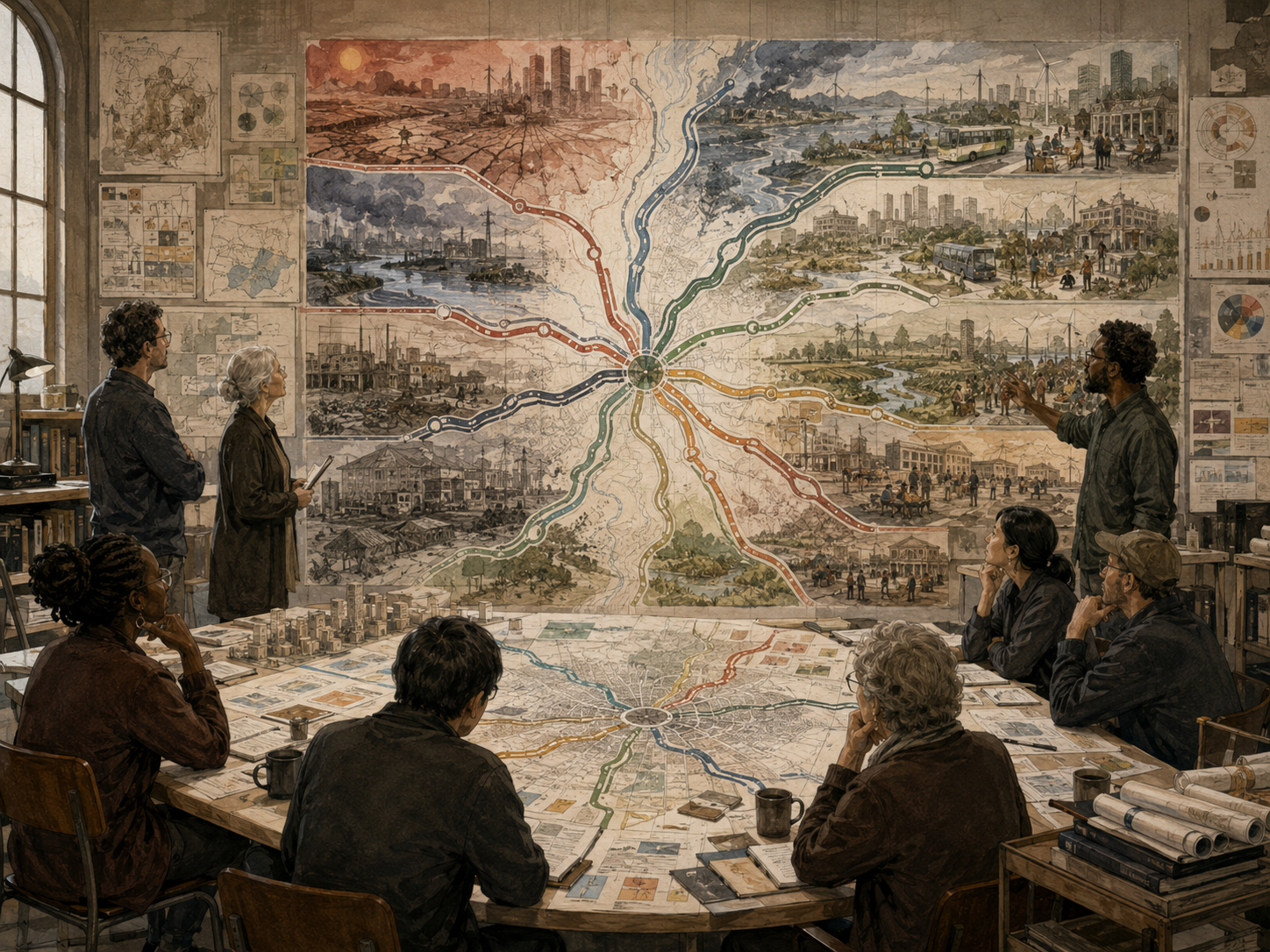
Scenario planning is a structured method for exploring multiple plausible futures in order to improve strategic decision-making under uncertainty. Rather than attempting to predict a single outcome, scenario planning develops alternative narratives that describe how different combinations of trends, uncertainties, and drivers of change may shape future conditions. Its purpose is not to determine which future will occur, but to help institutions think more clearly, strategically, and adaptively when certainty is unavailable.
In complex systems, the future rarely unfolds along a single predictable path. Technological disruption, geopolitical realignment, environmental change, demographic pressure, ecological stress, infrastructure fragility, public-health risk, financial volatility, and institutional dynamics interact in ways that produce uncertainty, feedback, and nonlinearity. Scenario planning provides a disciplined way to engage with this complexity by mapping structured alternatives rather than relying on one forecast or a narrow extension of current conditions.
More fundamentally, scenario planning is not just a planning tool. It is an epistemological framework for reasoning under uncertainty. It changes how decision-makers think about the future: from prediction to structured exploration, from assumed continuity to conditional plurality, from optimization around one expected path to robustness across multiple plausible futures, and from passive reaction to active anticipatory learning.
Scenario planning is therefore one of the central practices of futures thinking. It helps institutions, communities, public agencies, businesses, universities, infrastructure planners, environmental organizations, and civic coalitions ask a different kind of question: not simply “What will happen?” but “What could plausibly happen, what would it mean, what assumptions would fail, and what should we do now?”
Main Library
Publications
Article Map
Futures Thinking
Related Topic
Systems Modeling
Related Topic
Resilience Thinking
Related Topic
Sustainable Development
What Is Scenario Planning?
Scenario planning is the systematic construction of alternative future scenarios based on key drivers of change and critical uncertainties. Each scenario represents a coherent and plausible future environment rather than a prediction. The point is not to identify “the” future, but to make the structure of uncertainty more visible and more usable for strategy, policy, investment, institutional design, and public judgment.
Scenarios are usually built around a focal question. A city may ask what forms of climate, housing, mobility, and infrastructure stress could shape the next twenty years. A public agency may ask how demographic change, public trust, fiscal pressure, and technology could affect service delivery. A business may ask how regulation, supply chains, labor markets, energy systems, and consumer expectations could change. A university may ask what knowledge, credentials, research capacities, and civic responsibilities will matter under different futures.
Scenario planning does not aim to determine which scenario will occur. Instead, it helps decision-makers prepare for a range of possibilities. In this sense, it transforms uncertainty from a vague source of anxiety into a structured domain of analysis. Rather than asking how to eliminate uncertainty, it asks how to think well within it.
Scenarios are most useful when the future is neither predictable enough for a single forecast nor completely unknowable. They work in the middle ground: where there are visible drivers, real uncertainties, contested values, and multiple credible pathways. A good scenario is not a fantasy, a wish list, or a trend report. It is a disciplined account of how a future context could plausibly unfold.
| Scenario Planning Is | Scenario Planning Is Not |
|---|---|
| A structured method for exploring multiple plausible futures. | A prediction of which future will occur. |
| A way to test strategy under uncertainty. | A guarantee that uncertainty can be eliminated. |
| A process for surfacing assumptions and blind spots. | A decorative storytelling exercise disconnected from decisions. |
| A tool for robustness, learning, and preparedness. | A replacement for evidence, forecasting, judgment, or implementation. |
| A way to connect imagination with strategy. | A license for speculative drift without discipline. |
The best scenario planning does not merely produce a set of stories. It changes the way people think. It helps participants see their current assumptions, recognize alternative pathways, detect strategic fragility, and identify actions that remain useful across uncertain conditions.
Scenario Planning as an Epistemology of Uncertainty
Traditional decision-making often assumes that the future can be predicted with sufficient accuracy to support optimization. Scenario planning rejects this assumption when uncertainty is too deep, systems are too complex, or the consequences of being wrong are too serious. It treats the future as plural, contingent, and shaped by interactions among forces that may not be fully knowable in advance.
This makes scenario planning an epistemology of uncertainty: a way of knowing, reasoning, and acting when knowledge is incomplete. It does not abandon evidence. It uses evidence differently. Instead of forcing evidence into one expected path, it asks how different combinations of evidence, uncertainty, and assumption could produce different future contexts.
From an epistemological perspective, scenario planning does several important things. It recognizes the limits of prediction in complex systems. It accepts multiple plausible futures rather than insisting on one forecast. It uses structured narratives to organize uncertainty without pretending uncertainty has been solved. It makes assumptions visible. It uses contrast to reveal blind spots. It shifts decision-making from narrow optimization to adaptive preparedness.
This is especially valuable under deep uncertainty, where probabilities cannot be assigned reliably, model structures are contested, values differ, or the system may change as actors respond to emerging conditions. Climate adaptation, technology governance, infrastructure resilience, public health, international conflict, food-water-energy systems, and democratic institutions all involve uncertainties of this kind.
Scenario planning therefore changes the question from “What will happen?” to “What could plausibly happen, and how should we prepare?”
| Forecasting-Oriented Question | Scenario-Oriented Question |
|---|---|
| What is the most likely outcome? | What distinct plausible futures could emerge? |
| What number should we plan around? | What assumptions make this number fragile? |
| How do we optimize for the expected path? | What remains robust across multiple paths? |
| What trend should we extrapolate? | Which trends, shocks, and uncertainties may interact? |
| What will happen if current conditions continue? | What if current conditions do not continue? |
Scenario planning is therefore not anti-forecasting. Forecasts can be useful inside scenario work. But scenario planning places forecasts inside a wider discipline of uncertainty, interpretation, and strategic learning.
Why Scenario Planning Matters
Scenario planning matters because many of the most consequential decisions must be made before certainty is available. Infrastructure, energy systems, education, public health, urban development, climate adaptation, technology governance, defense, supply chains, research priorities, and institutional reform all involve long time horizons. Waiting for certainty often means waiting until options have narrowed or costs have increased.
Traditional forecasting methods often assume continuity and stability. Those assumptions may be useful for short-term operations, but they can fail when systems are exposed to structural change. Scenario planning helps decision-makers avoid the trap of treating the baseline future as the only future. It helps them ask what else could happen, what would matter if it did, and what decisions are robust enough to remain valuable across multiple plausible futures.
Scenario planning also matters because institutions are vulnerable to cognitive and organizational bias. Leaders may overvalue continuity, ignore weak signals, dismiss uncomfortable futures, or protect existing plans. Teams may mistake consensus for evidence. Organizations may prepare for the future they prefer or the future that preserves their existing strategy. Scenario planning disrupts this by forcing structured contrast.
Its deeper value lies in the shift it creates in strategic reasoning: from optimization under assumed conditions to robustness across uncertain conditions. This shift is especially important when the cost of being wrong is high.
| Scenario Planning Benefit | Strategic Value |
|---|---|
| Surfaces hidden assumptions | Makes fragile beliefs visible before they fail. |
| Broadens strategic imagination | Prevents one expected future from dominating planning. |
| Improves preparedness | Helps institutions recognize signals and response options earlier. |
| Tests robustness | Shows which strategies work across multiple futures. |
| Reveals strategic vulnerabilities | Identifies where a plan depends on narrow conditions. |
| Supports public deliberation | Creates a structured way to discuss uncertainty, values, and tradeoffs. |
| Strengthens learning | Builds habits of monitoring, revision, and adaptive action. |
Scenario planning’s power lies not in telling decision-makers what will happen, but in preventing them from confusing one narrow expectation with the full structure of possibility.
Core Components of Scenario Planning
Effective scenario planning involves several components that together transform abstract uncertainty into a usable analytical system. These components are not isolated steps. They reinforce one another. Weak drivers produce weak scenarios. Poorly chosen uncertainties produce shallow scenario contrast. Narratives without strategic implications become storytelling. Strategic implications without monitoring become static reports.
1. Drivers of Change
Drivers of change are broad forces shaping the future. They may include technological innovation, demographic shifts, economic restructuring, climate stress, ecological change, political realignment, regulatory change, cultural transformation, public trust, security risk, migration, labor markets, infrastructure, and scientific development. Drivers are not necessarily uncertain. Some are highly visible. The analytical task is to understand their direction, interaction, and possible consequences.
2. Critical Uncertainties
Critical uncertainties are factors that are both highly uncertain and highly consequential. They often determine the structure of the scenario set. A weak scenario process may list many uncertainties but fail to identify which ones truly shape the future context. Good scenario planning asks which uncertainties would materially change strategy if they unfolded differently.
3. Scenario Framework
The scenario framework organizes uncertainty into a coherent structure. Many scenario processes use a two-axis matrix based on two major uncertainties, producing four contrasting future environments. Other approaches use archetypes, morphological analysis, systems maps, pathways, or narrative clusters. The framework should create meaningful contrast without becoming arbitrary.
4. Scenario Narratives
Each scenario is developed into a coherent narrative that explains how the future unfolds under particular assumptions and interactions. A strong scenario narrative is not fiction for its own sake. It is a causal story about drivers, uncertainties, actors, constraints, feedback loops, and turning points. It should be vivid enough to change perception and disciplined enough to remain credible.
5. Strategic Implications
Scenarios become useful when they are used to evaluate policies, strategies, investments, vulnerabilities, institutional capacities, and adaptive options. This stage asks what each future would mean. Which plans fail? Which assumptions become dangerous? Which strategies remain useful? What capabilities should be built now?
6. Signals and Indicators
Scenario planning should not end with a workshop or report. Each scenario should be linked to indicators that help teams monitor which futures may be becoming more or less plausible. These indicators may include policy changes, market shifts, ecological signals, public sentiment, technology adoption, demographic patterns, institutional stress, or infrastructure performance.
7. Learning Cycle
Scenario planning is strongest when scenarios are revisited. Assumptions change, signals accumulate, decisions alter the environment, and new uncertainties emerge. A learning cycle turns scenarios into an ongoing practice rather than a one-time document. It asks when scenarios should be updated, who reviews them, and how learning enters decisions.
| Component | Purpose | Failure If Weak |
|---|---|---|
| Drivers of change | Identify forces shaping the future. | Scenarios lack grounding in real system pressures. |
| Critical uncertainties | Focus on factors that are both uncertain and consequential. | Scenario differences are superficial. |
| Scenario framework | Organize alternatives into a coherent structure. | The scenario set feels arbitrary or confusing. |
| Scenario narratives | Make plausible futures understandable and memorable. | Scenarios become abstract checklists. |
| Strategic implications | Connect futures to decisions. | Scenario work becomes decorative. |
| Signals and indicators | Track how futures may be evolving. | Scenarios become static and outdated. |
| Learning cycle | Revise assumptions and strategy over time. | Foresight does not influence institutional memory. |
These components matter because scenario planning is not merely storytelling. It is structured synthesis. The credibility of each scenario depends on the coherence of the system behind it.
The Scenario Planning Process
Although approaches vary, scenario planning generally follows a structured process. The process should be rigorous enough to produce credible scenarios but flexible enough to adapt to the decision context. A public agency, community organization, multinational firm, university, climate adaptation team, or infrastructure authority may each need a different process design.
| Stage | Purpose | Key Questions | Outputs |
|---|---|---|---|
| 1. Define the focal question | Clarify what decision, system, or strategic issue the scenarios will address. | What are we trying to understand? What time horizon matters? | Focal question, scope, time horizon, stakeholder map. |
| 2. Map drivers of change | Identify the major forces shaping the future context. | What social, technological, economic, ecological, political, and institutional forces matter? | Driver inventory, trend notes, systems map. |
| 3. Identify critical uncertainties | Distinguish uncertainty that matters from background noise. | Which uncertainties are both highly uncertain and highly consequential? | Uncertainty ranking, impact/uncertainty matrix. |
| 4. Build the scenario framework | Create structured contrast among plausible futures. | Which uncertainties define the most useful scenario space? | Scenario matrix, archetype set, or pathway framework. |
| 5. Develop scenario narratives | Describe how each future unfolds coherently. | What happens, why, to whom, and through what sequence? | Scenario narratives, timelines, actor maps. |
| 6. Analyze implications | Test strategies, policies, assumptions, and vulnerabilities. | What succeeds or fails under each scenario? | Implications matrix, strategy stress test, vulnerability map. |
| 7. Identify robust options | Select actions useful across multiple futures. | Which actions remain valuable even if the future differs from expectations? | Robust actions, adaptive options, no-regret moves. |
| 8. Monitor signals | Track how the future is unfolding over time. | What indicators suggest movement toward one scenario or another? | Signal register, review cycle, trigger points. |
In advanced practice, this process is iterative rather than strictly linear. Scenarios may be revised as new information emerges, assumptions shift, public priorities change, or institutional capacity develops. This iterative character is one reason scenario planning remains useful over time: it can evolve as the environment evolves.
The quality of the process depends not only on analytical skill, but on the willingness to revisit assumptions before reality does it by force.
Types of Scenarios
Scenario planning can take different forms depending on the purpose. Not all scenarios do the same work. Some are exploratory, some normative, some policy-oriented, some strategic, some participatory, and some designed to stress-test risk. Confusing these types can weaken the process.
| Scenario Type | Primary Purpose | Typical Question | Common Use |
|---|---|---|---|
| Exploratory scenarios | Explore what could plausibly happen. | What different futures could emerge from drivers and uncertainties? | Strategic foresight, uncertainty mapping, public policy. |
| Normative scenarios | Explore desired or preferred futures. | What future should we pursue? | Visioning, sustainability, institutional transformation. |
| Policy scenarios | Evaluate effects of policy choices. | How might different interventions change outcomes? | Public policy, climate adaptation, infrastructure planning. |
| Stress-test scenarios | Test resilience under adverse conditions. | What breaks under severe but plausible conditions? | Risk management, continuity planning, financial resilience. |
| Participatory scenarios | Include affected communities in future-making. | How do different groups imagine risk, possibility, and preference? | Public deliberation, community planning, democratic foresight. |
| Transformational scenarios | Explore structural change beyond current systems. | What would have to change for a preferred future to become plausible? | Backcasting, just transition, institutional redesign. |
Exploratory scenarios are often used when the main problem is uncertainty. Normative scenarios are used when the main problem is direction. Policy scenarios are used when the main problem is intervention. Participatory scenarios are used when the main problem is legitimacy, plural knowledge, and public responsibility. These types can be combined, but they should not be blurred.
A climate adaptation process, for example, might use exploratory scenarios to understand possible climate-governance futures, stress-test scenarios to examine infrastructure fragility, participatory scenarios to gather community knowledge, and normative scenarios to define a just and resilient preferred future. The strength of scenario planning lies in choosing the right scenario type for the problem at hand.
Scenario Planning and Complex Systems
Scenario planning is especially well suited to complex systems because it accounts for interaction, uncertainty, and nonlinear dynamics. Complex systems exhibit feedback loops, threshold effects, emergent behavior, path dependency, cascading consequences, and nonlinear response. In such systems, a single forecast can become brittle because the system itself may change as actors respond to signals, incentives, shocks, or policies.
Scenario planning allows these dynamics to be explored qualitatively, even when they cannot be modeled precisely. A technological shift may interact with regulation and public behavior. Climate stress may combine with infrastructure fragility, insurance markets, housing affordability, migration pressure, and political legitimacy. Financial disruption may interact with public distrust and institutional weakness. Public-health risk may interact with labor conditions, information systems, housing, transportation, and care infrastructure.
Scenario planning does not simplify away complexity. It structures complexity into alternative worlds that can be reasoned about more clearly. It helps participants explore how different drivers interact, how assumptions can fail, and how strategies may perform under changing conditions.
| Complex Systems Feature | Scenario Planning Response |
|---|---|
| Feedback loops | Scenarios explore reinforcing and balancing dynamics over time. |
| Thresholds | Scenarios identify conditions where gradual change may become abrupt. |
| Emergence | Scenarios examine outcomes not reducible to individual drivers. |
| Path dependency | Scenarios show how early choices shape later possibilities. |
| Cascading risk | Scenarios connect failures across infrastructure, finance, ecology, governance, and social systems. |
| Adaptive actors | Scenarios account for how people, institutions, and markets respond to changing conditions. |
Complex systems also require humility. Scenario planning cannot fully master complexity. It can, however, help institutions avoid linear thinking, static assumptions, and overconfidence in one expected pathway.
Strategic Robustness vs Optimization
One of the most important contributions of scenario planning is its emphasis on robustness rather than optimization. Traditional strategy often seeks the best outcome under expected conditions. Scenario planning instead asks which strategies remain viable across multiple futures, including futures that differ sharply from baseline expectations.
This shift is essential in environments characterized by deep uncertainty. An optimal strategy under one assumed future may fail badly under another. A robust strategy may not maximize short-term gains in every scenario, but it reduces fragility and preserves optionality across a broader range of possibilities.
Optimization is not inherently wrong. It is useful when conditions are stable, data are strong, and uncertainty is bounded. But optimization becomes dangerous when the assumed future is fragile. A strategy optimized for continuous growth may fail under climate disruption. A supply-chain strategy optimized for efficiency may fail under geopolitical fragmentation. A technology strategy optimized for rapid deployment may fail under public backlash, regulation, or legitimacy crisis. A public policy optimized for average conditions may fail vulnerable communities under extreme stress.
| Optimization Logic | Robustness Logic |
|---|---|
| Assumes one expected future. | Tests performance across multiple plausible futures. |
| Maximizes efficiency under known conditions. | Preserves viability under uncertain conditions. |
| Often rewards narrow precision. | Rewards flexibility, resilience, and optionality. |
| Can create fragility when assumptions fail. | Reduces downside exposure across scenarios. |
| Best for stable, bounded, short-term contexts. | Best for complex, uncertain, long-horizon contexts. |
In uncertain environments, robustness is often more strategically valuable than narrow optimization. Scenario planning gives institutions a way to identify which strategies are robust, which are brittle, and which should be adapted before uncertainty becomes crisis.
Historical Development of Scenario Planning
Scenario planning gained prominence in the mid-twentieth century, especially through military strategy, long-range planning, systems analysis, and later corporate use. Its history is closely connected to the broader history of futures thinking: the shift from confidence in prediction toward more explicit engagement with uncertainty, plurality, strategic imagination, and institutional learning.
In defense and strategic planning contexts, scenario methods helped institutions consider adversarial behavior, technological change, geopolitical uncertainty, and low-probability high-impact events. This tradition contributed discipline, but it also carried ethical risks: secrecy, militarization, expert control, and abstraction from human consequences.
Scenario planning later became influential in corporate strategy. Royal Dutch Shell’s use of scenarios in the 1970s is often cited as a landmark because it demonstrated how scenario thinking could help organizations prepare for energy shocks and structural uncertainty. The deeper lesson was not simply that Shell anticipated specific events better than competitors. It was that scenario planning helped leaders think differently before crisis forced them to.
In public policy, scenario planning expanded into climate adaptation, transportation planning, national foresight, public health, infrastructure, urban development, and sustainability strategy. In civic and participatory settings, scenario planning also became a way to include public values, community knowledge, and contested visions of the future.
| Historical Context | Contribution to Scenario Planning | Risk or Limitation |
|---|---|---|
| Military and defense planning | Structured thinking about uncertainty, adversaries, and high-impact futures. | Secrecy, abstraction, and elite control. |
| Systems analysis | Attention to interdependence, feedback, and consequences. | Overconfidence in expert models. |
| Corporate foresight | Strategic use of scenarios for uncertainty and organizational learning. | Narrowing futures to market advantage. |
| Public-sector foresight | Use of scenarios for policy preparedness and resilience. | Scenario work may not influence actual policy. |
| Participatory futures | Inclusion of community knowledge and public values. | Tokenism if participation does not affect decisions. |
| Sustainability and climate planning | Integration of long-term ecological, social, and institutional uncertainty. | Technical pathways may understate justice and power. |
The historical significance of scenario planning lies in its intellectual shift: useful strategic reasoning does not require one-point certainty. It requires disciplined exploration of multiple plausible conditions. That shift remains foundational today.
Participation, Power, and Scenario Legitimacy
Scenario planning is often described as an analytical method, but it is also a political and institutional practice. Scenarios frame what futures are considered plausible, what risks are taken seriously, what values are visible, and what strategies are legitimate. This means scenario planning must ask who participates in defining the future.
If scenarios are built only by senior executives, experts, consultants, or government officials, they may reproduce the assumptions of those already powerful enough to define strategy. They may exclude frontline workers, local communities, youth, disabled people, Indigenous knowledge holders, migrants, caregivers, public servants, or groups most exposed to risk. The result can be technically polished but socially narrow.
Participation improves scenario planning because different groups notice different signals. Communities may see climate, housing, policing, health, labor, infrastructure, or digital exclusion risks before official systems recognize them. Workers may understand automation futures differently than executives. Youth may recognize long-term harms that short political cycles ignore. Indigenous and local knowledge may reveal ecological relationships missing from conventional planning.
Participatory scenario planning is not merely consultation. It should influence the scenario set, the assumptions, the criteria for preference, the interpretation of risk, and the decisions that follow. Otherwise, participation becomes symbolic.
| Participation Question | Why It Matters |
|---|---|
| Who defines the focal question? | The question shapes the entire scenario space. |
| Who identifies drivers and uncertainties? | Different groups see different signals and risks. |
| Whose knowledge counts as evidence? | Lived experience may reveal risks formal data miss. |
| Who judges plausibility? | Plausibility can reflect institutional bias. |
| Who defines preferred futures? | Preference is ethical and political, not neutral. |
| Who benefits from resulting strategy? | Scenario planning can redistribute risk or reinforce power. |
| How does participation affect decisions? | Legitimacy requires influence, not symbolic inclusion. |
Scenario legitimacy depends not only on analytical coherence, but on whose futures are allowed to become part of the analysis.
Failure Modes and Misuse
Scenario planning can fail in predictable ways. It can become too narrow, too shallow, too comfortable, too detached from decisions, or too dominated by existing institutional assumptions. Scenario planning is not inherently effective. Its value depends on diversity of imagination, rigor of construction, and real integration into strategy.
One common failure occurs when scenarios are treated as predictions. A scenario is not a forecast. It is a plausible future context used for learning and testing. If participants ask which scenario will “come true,” they may miss the real purpose: understanding uncertainty, assumptions, and strategic robustness.
Another failure occurs when scenarios become decorative narratives. They may be beautifully written, visually polished, and rhetorically impressive, yet disconnected from budgets, policies, investments, governance, monitoring, or institutional change. In that case, scenario planning becomes performance rather than practice.
A third failure occurs when scenario sets are too safe. Organizations may exclude futures that are politically uncomfortable, morally troubling, or disruptive to existing strategy. A scenario set that never challenges power is unlikely to prepare an institution for surprise.
| Failure Mode | Description | Corrective Practice |
|---|---|---|
| Scenario prediction | Scenarios are treated as forecasts. | Reframe scenarios as learning tools and stress tests. |
| Scenario theater | Scenarios are polished but disconnected from decisions. | Link scenario outputs to strategy, budgets, indicators, and review cycles. |
| Safe scenarios | Scenario set avoids uncomfortable futures. | Include disruptive, adverse, and justice-centered scenarios. |
| Bias reproduction | Scenarios reflect dominant institutional assumptions. | Include diverse knowledge holders and assumption audits. |
| Weak plausibility | Scenarios lack coherent pathways. | Document drivers, uncertainties, causal logic, and turning points. |
| No monitoring | Scenarios are not revisited after publication. | Create signal registers and review schedules. |
| No implementation | Insights do not change action. | Translate implications into decisions, ownership, and milestones. |
Scenario planning fails when it widens imagination but does not change judgment, strategy, or institutional learning.
Scenario Planning in Practice
Scenario planning is used across many domains, including business strategy, public policy, climate adaptation, sustainability planning, infrastructure strategy, urban development, technology assessment, education, public health, food systems, energy transition, and institutional resilience.
In business, it helps firms think through competitive shifts, technology disruption, market volatility, regulatory change, supply-chain risk, and changing social expectations. In public policy, it helps governments reason about long-term risks, transition pressures, fiscal stress, social vulnerability, public trust, and institutional preparedness. In sustainability work, it helps integrate environmental uncertainty with development, infrastructure, adaptation strategy, and justice. In community settings, it helps residents articulate futures that official planning may overlook.
| Domain | Scenario Planning Use | Example Question |
|---|---|---|
| Business strategy | Prepare for market, technology, supply-chain, and regulatory uncertainty. | What strategies remain viable under disruption or fragmentation? |
| Public policy | Stress-test policy under social, economic, environmental, and institutional uncertainty. | How would different governance futures affect service delivery? |
| Climate adaptation | Explore climate, infrastructure, finance, and vulnerability pathways. | What adaptation choices remain robust under multiple climate futures? |
| Urban planning | Test housing, transit, heat, migration, and land-use futures. | How should cities plan under uncertainty about growth and climate stress? |
| Technology governance | Explore regulatory, ethical, labor, and public trust futures. | What AI futures require governance before harms become locked in? |
| Public health | Prepare for disease, workforce, climate, misinformation, and care-system uncertainty. | What health system capacities are robust across plausible futures? |
| Education | Explore knowledge, credential, technology, labor, and civic futures. | What should students learn for futures that cannot be predicted? |
| Community resilience | Include local knowledge in planning for disruption and transformation. | What futures do affected communities see that institutions miss? |
Scenario planning’s practical role is to make institutions less brittle by broadening the range of futures for which they are mentally, strategically, and operationally prepared.
A Practical Scenario Planning Workflow
A practical scenario planning workflow should connect uncertainty exploration to decision-making. The workflow below can be adapted for public agencies, businesses, universities, research teams, civic organizations, climate adaptation planning, infrastructure strategy, and institutional foresight.
| Phase | Action | Output |
|---|---|---|
| Frame | Define the focal issue, decision context, stakeholders, and time horizon. | Scenario brief. |
| Scan | Identify drivers, trends, weak signals, shocks, and uncertainties. | Driver and signal map. |
| Prioritize | Rank uncertainties by impact and uncertainty. | Critical uncertainty matrix. |
| Structure | Create a scenario framework using key uncertainties or archetypes. | Scenario architecture. |
| Narrate | Develop coherent future narratives with actors, pathways, tensions, and consequences. | Scenario narratives. |
| Stress-test | Evaluate strategies, policies, assumptions, and capacities against each scenario. | Strategy robustness matrix. |
| Choose | Identify robust actions, adaptive options, hedges, signposts, and trigger points. | Strategic action portfolio. |
| Monitor | Track signals and update scenarios periodically. | Learning dashboard and review cycle. |
The most important test of this workflow is whether it changes decisions. A scenario process that produces documents but does not influence plans, investments, policies, or institutional learning has not completed its work.
Mathematical Lens: Plausibility, Robustness, and Cross-Scenario Strategy
A stylized way to represent scenario planning is to evaluate a strategy across multiple plausible futures:
\Pi_k = \{V_{k1}, V_{k2}, \dots, V_{kn}\}
\]
Interpretation: \(\Pi_k\) is the performance profile of strategy \(k\) across scenarios, and \(V_{ks}\) is its value under scenario \(s\). This captures a core insight of scenario planning: a strategy should be judged not only by how it performs under one assumed future, but by how it performs across multiple plausible futures.
A simple robustness criterion can be written as:
R_k = \min_{s \in S} V_{ks}
\]
Interpretation: \(R_k\) is the worst-case performance of strategy \(k\) across the scenario set \(S\). This is useful because scenario planning often privileges survivability and robustness over narrow optimization.
Scenario structure can also be conceptualized as the interaction of major drivers and uncertainties:
S_i = f(D, U)
\]
Interpretation: \(S_i\) is scenario \(i\), \(D\) represents relatively stable drivers of change, and \(U\) represents critical uncertainties. Scenarios emerge from different combinations of patterned direction and unresolved uncertainty.
Strategy regret across scenarios can be represented as:
G_{ks} = \max_j(V_{js}) – V_{ks}
\]
Interpretation: \(G_{ks}\) is the regret of strategy \(k\) in scenario \(s\). It compares the performance of a chosen strategy to the best-performing strategy in that same scenario. High regret indicates brittleness.
A weighted robustness score can combine average performance, worst-case performance, adaptability, and volatility:
WR_k = \alpha \bar{V}_k + \beta \min(V_k) + \gamma A_k – \delta \sigma_k
\]
Interpretation: \(WR_k\) is a weighted robustness score. \(\bar{V}_k\) is average performance, \(\min(V_k)\) is worst-case performance, \(A_k\) is adaptability, and \(\sigma_k\) is volatility across scenarios. The weights reflect the decision context.
These formulas are not meant to replace judgment. They make the logic of scenario planning more explicit: strategies should be evaluated across plausible futures, not only under the most comfortable assumption.
Computational Modeling for Scenario Planning
Computational modeling can support scenario planning when it clarifies assumptions, compares strategy performance, documents drivers, and generates reusable outputs. It should not replace the participatory, narrative, and interpretive dimensions of scenario work. The purpose is to support disciplined judgment, not automate imagination.
A useful computational scenario planning workflow may include:
- Driver datasets: structured records of social, technological, economic, ecological, political, and institutional drivers.
- Uncertainty scoring: ranking variables by impact, uncertainty, and decision relevance.
- Scenario matrices: structured representation of scenario frameworks and scenario narratives.
- Strategy-performance tables: comparison of strategies across plausible futures.
- Regret analysis: identification of strategies that fail badly in specific scenarios.
- Robustness scoring: evaluation of average, worst-case, volatility, and adaptability metrics.
- Signal registers: indicators that help teams monitor which futures may be becoming more plausible.
- Learning reports: generated summaries that translate scenario analysis into decisions.
The best computational workflows make scenario planning auditable. They document how scores were produced, what assumptions were used, how scenarios differ, and where uncertainty remains. This is especially important when scenario planning informs public policy, infrastructure, climate adaptation, technology governance, or decisions affecting vulnerable communities.
Advanced R Workflow: Comparing Scenario Strategy Profiles
The R workflow below compares several stylized strategies across multiple scenario dimensions using resilience, upside potential, downside risk, adaptability, policy fit, and equity sensitivity. It is designed as an evergreen illustration of how scenario planning can be used to compare strategy profiles across uncertain futures.
# ------------------------------------------------------------
# R Workflow: Comparing Scenario Strategy Profiles
# Purpose:
#   Build stylized strategy profiles across scenarios using
#   resilience, upside potential, downside risk, adaptability,
#   policy fit, and equity sensitivity.
#
# Optional dependency:
#   install.packages(c("tidyverse"))
# ------------------------------------------------------------

library(tidyverse)

strategies <- tibble(
  strategy = c(
    "Efficiency-Optimized Strategy",
    "Robust Adaptive Strategy",
    "Innovation-Bet Strategy",
    "Resilience-First Strategy",
    "Participatory Futures Strategy"
  ),
  resilience = c(0.38, 0.82, 0.56, 0.88, 0.76),
  upside_potential = c(0.72, 0.66, 0.84, 0.58, 0.64),
  downside_risk = c(0.74, 0.36, 0.68, 0.29, 0.42),
  adaptability = c(0.31, 0.84, 0.62, 0.79, 0.82),
  policy_fit = c(0.52, 0.74, 0.49, 0.68, 0.78),
  equity_sensitivity = c(0.34, 0.68, 0.44, 0.72, 0.90)
)

strategies <- strategies %>%
  mutate(
    scenario_profile =
      0.22 * resilience +
      0.15 * upside_potential -
      0.18 * downside_risk +
      0.20 * adaptability +
      0.15 * policy_fit +
      0.10 * equity_sensitivity
  ) %>%
  arrange(desc(scenario_profile))

print(strategies)

strategies_long <- strategies %>%
  pivot_longer(
    cols = c(
      resilience,
      upside_potential,
      downside_risk,
      adaptability,
      policy_fit,
      equity_sensitivity
    ),
    names_to = "dimension",
    values_to = "value"
  )

ggplot(strategies_long, aes(x = dimension, y = value, fill = strategy)) +
  geom_col(position = "dodge") +
  labs(
    title = "Stylized Scenario Strategy Dimensions",
    x = "Dimension",
    y = "Value",
    fill = "Strategy"
  ) +
  theme_minimal(base_size = 12) +
  coord_flip()

ggplot(strategies, aes(x = reorder(strategy, scenario_profile), y = scenario_profile)) +
  geom_col() +
  coord_flip() +
  labs(
    title = "Stylized Scenario Strategy Profile",
    x = "Strategy",
    y = "Profile Score"
  ) +
  theme_minimal(base_size = 12)

dir.create("outputs", showWarnings = FALSE)

write_csv(strategies, "outputs/scenario_strategy_profiles.csv")
write_csv(strategies_long, "outputs/scenario_strategy_profiles_long.csv")
This workflow is not a substitute for scenario deliberation. It shows how scenario planning can become more transparent by making strategy dimensions explicit and comparable.
Advanced Python Workflow: Simulating Strategy Performance Across Multiple Futures
The Python workflow below simulates stylized strategy performance across several futures. It illustrates why strategies that appear strong under one expected future may become fragile when uncertainty broadens.
# ------------------------------------------------------------
# Python Workflow: Simulating Strategy Across Multiple Futures
# Purpose:
#   Compare stylized strategies across multiple scenario
#   environments under uncertainty.
#
# Optional dependencies:
#   pip install pandas numpy matplotlib
# ------------------------------------------------------------

from pathlib import Path

import numpy as np
import pandas as pd
import matplotlib.pyplot as plt

OUTPUT_DIR = Path("outputs")
OUTPUT_DIR.mkdir(exist_ok=True)

scenarios = [
    "Stable Growth",
    "Disruptive Technology Shift",
    "Climate Stress",
    "Fragmented Governance",
    "Public Trust Shock"
]

strategies = {
    "Efficiency-Optimized": [0.82, 0.42, 0.36, 0.39, 0.34],
    "Robust Adaptive": [0.72, 0.74, 0.71, 0.69, 0.68],
    "Innovation-Bet": [0.64, 0.81, 0.44, 0.48, 0.46],
    "Resilience-First": [0.66, 0.68, 0.79, 0.75, 0.73],
    "Participatory Futures": [0.61, 0.70, 0.76, 0.82, 0.80]
}

rows = []

for strategy_name, values in strategies.items():
    for scenario, value in zip(scenarios, values):
        rows.append({
            "strategy": strategy_name,
            "scenario": scenario,
            "performance": value
        })

df = pd.DataFrame(rows)

summary = (
    df.groupby("strategy")["performance"]
    .agg(
        mean_performance="mean",
        worst_case="min",
        best_case="max",
        volatility="std"
    )
    .reset_index()
)

summary["volatility"] = summary["volatility"].fillna(0)

best_by_scenario = (
    df.groupby("scenario")["performance"]
    .max()
    .reset_index()
    .rename(columns={"performance": "best_scenario_performance"})
)

regret_df = df.merge(best_by_scenario, on="scenario")
regret_df["regret"] = regret_df["best_scenario_performance"] - regret_df["performance"]

regret_summary = (
    regret_df.groupby("strategy")["regret"]
    .agg(mean_regret="mean", max_regret="max")
    .reset_index()
)

summary = summary.merge(regret_summary, on="strategy")

summary["robustness_score"] = (
    0.45 * summary["worst_case"] +
    0.35 * summary["mean_performance"] -
    0.20 * summary["volatility"] -
    0.10 * summary["max_regret"]
)

summary = summary.sort_values("robustness_score", ascending=False)

print("\nScenario strategy performance:")
print(df)

print("\nStrategy robustness summary:")
print(summary)

df.to_csv(OUTPUT_DIR / "scenario_strategy_performance.csv", index=False)
summary.to_csv(OUTPUT_DIR / "scenario_strategy_summary.csv", index=False)
regret_df.to_csv(OUTPUT_DIR / "scenario_strategy_regret.csv", index=False)

plt.figure(figsize=(10, 6))
for strategy_name in df["strategy"].unique():
    subset = df[df["strategy"] == strategy_name]
    plt.plot(
        subset["scenario"],
        subset["performance"],
        marker="o",
        label=strategy_name
    )

plt.xticks(rotation=25, ha="right")
plt.ylabel("Performance")
plt.title("Strategy Performance Across Multiple Futures")
plt.legend()
plt.tight_layout()
plt.savefig(OUTPUT_DIR / "scenario_strategy_performance.png", dpi=150)
plt.close()

plt.figure(figsize=(10, 6))
plt.barh(summary["strategy"], summary["robustness_score"])
plt.xlabel("Robustness score")
plt.title("Scenario Strategy Robustness")
plt.tight_layout()
plt.savefig(OUTPUT_DIR / "scenario_strategy_robustness.png", dpi=150)
plt.close()
This workflow demonstrates a central scenario planning lesson: the best strategy under one future is not necessarily the best strategy under uncertainty. Robustness, regret, worst-case performance, and adaptability all matter.
GitHub Repository
The companion repository for this article contains computational examples for scenario planning, strategy robustness, scenario performance, regret analysis, signal tracking, and cross-scenario decision support.
Complete Code Repository
The companion code includes Python, R, Julia, SQL, Rust, Go, C++, Fortran, C, documentation, synthetic datasets, outputs, and notebook placeholders for applied scenario planning workflows.
Why This Matters
Scenario planning is one of the most powerful methods in futures thinking because it transforms uncertainty into a structured domain of analysis. It allows decision-makers to move beyond narrow prediction and engage directly with complexity, plurality, contingency, and strategic choice.
In uncertain environments, the ability to think across multiple futures is a critical capability. Scenario planning provides the framework for doing so. Its highest value lies not in forecasting the future, but in helping institutions make better present decisions before uncertain futures become harder to influence.
Scenario planning also has a democratic and ethical dimension. Futures are not only technical possibilities. They are lived conditions that affect communities differently. A scenario process that ignores vulnerable groups, future generations, ecological systems, workers, local knowledge, or public legitimacy is not merely incomplete. It may help powerful institutions prepare while leaving others exposed.
The central promise of scenario planning is disciplined plurality: the ability to explore multiple plausible futures seriously enough to improve action in the present.
Related Articles
- Futures Thinking
- What Is Futures Thinking?
- Forecasting, Foresight, and Futures Studies
- Futures Literacy and Anticipatory Capacity
- Possible, Plausible, Probable, and Preferable Futures
- The History of Futures Thinking
- Strategic Foresight Methods
- Backcasting and Strategic Planning
- Systems Modeling
- Resilience Thinking
Further Reading
- Amer, M., Daim, T.U. and Jetter, A. (2013) ‘A review of scenario planning’, Futures, 46, pp. 23–40. Available at: ScienceDirect.
- Chermack, T.J. (2011) Scenario Planning in Organizations: How to Create, Use, and Assess Scenarios. San Francisco: Berrett-Koehler.
- Derbyshire, J. and Wright, G. (2017) ‘Augmenting the intuitive logics scenario planning method for a more comprehensive analysis of causation’, International Journal of Forecasting, 33(1), pp. 254–266. Available at: ScienceDirect.
- Ramírez, R. and Wilkinson, A. (2016) Strategic Reframing: The Oxford Scenario Planning Approach. Oxford: Oxford University Press.
- Schwartz, P. (1991) The Art of the Long View. New York: Currency Doubleday.
- van der Heijden, K. (1996) Scenarios: The Art of Strategic Conversation. Chichester: Wiley.
- Wack, P. (1985a) ‘Scenarios: Uncharted waters ahead’, Harvard Business Review, 63(5), pp. 72–89.
- Wack, P. (1985b) ‘Scenarios: Shooting the rapids’, Harvard Business Review, 63(6), pp. 139–150.
- Wilkinson, A. and Kupers, R. (2013) ‘Living in the Futures’, Harvard Business Review. Available at: Harvard Business Review.
References
- Amer, M., Daim, T.U. and Jetter, A. (2013) ‘A review of scenario planning’, Futures, 46, pp. 23–40. Available at: ScienceDirect.
- Chermack, T.J. (2011) Scenario Planning in Organizations: How to Create, Use, and Assess Scenarios. San Francisco: Berrett-Koehler.
- Derbyshire, J. and Wright, G. (2017) ‘Augmenting the intuitive logics scenario planning method for a more comprehensive analysis of causation’, International Journal of Forecasting, 33(1), pp. 254–266. Available at: ScienceDirect.
- Organisation for Economic Co-operation and Development (OECD) (no date) Strategic Foresight. Available at: OECD.
- Organisation for Economic Co-operation and Development Observatory of Public Sector Innovation (OECD OPSI) (no date) Futures & Foresight. Available at: OECD OPSI.
- Ramírez, R. and Wilkinson, A. (2016) Strategic Reframing: The Oxford Scenario Planning Approach. Oxford: Oxford University Press.
- Schwartz, P. (1991) The Art of the Long View. New York: Currency Doubleday.
- Shell (no date) Scenarios. Available at: Shell.
- Shell (2013) 40 Years of Shell Scenarios. Available at: Shell.
- United Nations Educational, Scientific and Cultural Organization (UNESCO) (no date) Futures Literacy & Foresight. Available at: UNESCO.
- UK Government Office for Science (2024) The Futures Toolkit. London: Government Office for Science. Available at: UK Government.
- UK Government Office for Science (2025) A Brief Guide to Futures Thinking and Foresight. London: Government Office for Science. Available at: UK Government.
- van der Heijden, K. (1996) Scenarios: The Art of Strategic Conversation. Chichester: Wiley.
- Wack, P. (1985a) ‘Scenarios: Uncharted waters ahead’, Harvard Business Review, 63(5), pp. 72–89.
- Wack, P. (1985b) ‘Scenarios: Shooting the rapids’, Harvard Business Review, 63(6), pp. 139–150.
- Wilkinson, A. and Kupers, R. (2013) ‘Living in the Futures’, Harvard Business Review. Available at: Harvard Business Review.