
Last Updated June 3, 2026
Uncertainty matrices and driver mapping are core foresight methods for identifying the forces that shape possible futures, distinguishing what is relatively knowable from what remains deeply uncertain, and translating complexity into strategic scenarios, monitoring systems, and decision priorities. They help practitioners move beyond vague statements about uncertainty by asking which drivers matter most, which uncertainties are most consequential, how drivers interact, and which combinations of change could reshape a system’s future trajectory.
In futures thinking, a driver is a force that influences change over time. Drivers may be social, technological, economic, environmental, political, cultural, legal, institutional, demographic, ecological, or geopolitical. Some drivers have relatively clear direction, such as population aging in many societies, rising climate exposure, digital infrastructure dependence, or long-term urbanization. Others are uncertain in direction, speed, intensity, legitimacy, distribution, or interaction. These uncertainties are not analytical inconveniences. They are central to strategy.
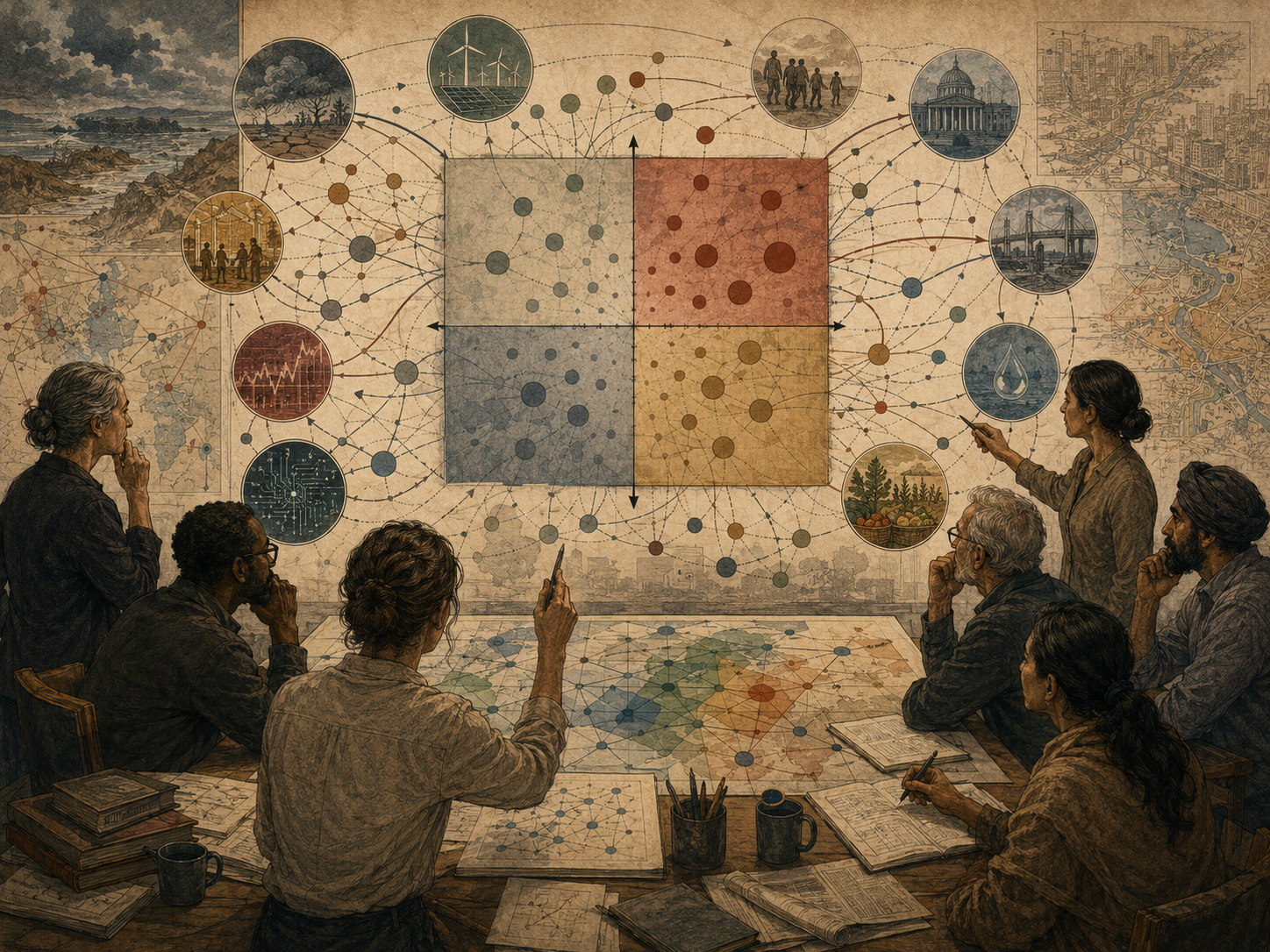
Uncertainty matrices help organize this complexity. A common matrix compares the impact of a driver with the uncertainty surrounding it. Drivers with high impact and low uncertainty often become planning assumptions. Drivers with high impact and high uncertainty often become scenario axes, strategic stress tests, or monitoring priorities. Low-impact or low-relevance factors may be tracked but should not dominate strategy. Driver mapping then extends this work by examining relationships among drivers, including reinforcement, conflict, dependency, cascade risk, and cross-system interaction.
This article examines how uncertainty matrices and driver mapping support strategic foresight, scenario planning, systems foresight, risk analysis, public policy, sustainability transitions, technology governance, climate adaptation, infrastructure strategy, and institutional learning. It treats uncertainty not as a reason for paralysis, but as a reason for disciplined mapping, plural scenarios, robust strategy, and adaptive governance.
Main Library
Publications
Article Map
Futures Thinking
Related Topic
Systems Modeling
Related Topic
Resilience Thinking
Related Topic
Risk Analysis
What Are Uncertainty Matrices?
An uncertainty matrix is a structured tool for comparing drivers, risks, signals, or assumptions according to their importance and uncertainty. In futures thinking, the most common version compares impact with uncertainty. Impact asks how consequential a driver may be for the system, organization, policy area, or strategic question. Uncertainty asks how unclear the driver’s future direction, timing, intensity, interaction, or social meaning remains.
This simple structure is powerful because it helps practitioners avoid two common mistakes. The first mistake is treating all drivers as equally important. The second is treating all uncertainty as equally strategic. Some uncertainties are interesting but not decision-relevant. Some drivers are important but not especially uncertain. Others are both highly consequential and highly uncertain. These are the uncertainties that often deserve scenario attention.
Uncertainty matrices also help clarify the difference between assumptions, watchlist items, scenario axes, and monitoring triggers. A high-impact low-uncertainty driver may become a baseline assumption. A high-impact high-uncertainty driver may become a scenario axis. A lower-impact but emerging issue may become a signal to monitor. A high-uncertainty factor with unclear impact may require more research before it is elevated to strategy.
| Matrix Area | Meaning | Strategic Use |
|---|---|---|
| High impact / high uncertainty | Critical uncertainty with major future significance. | Use for scenario axes, stress tests, and monitoring priorities. |
| High impact / low uncertainty | Important driver with relatively clear direction. | Use as baseline planning assumption or common condition across scenarios. |
| Low impact / high uncertainty | Unclear but currently less strategically consequential. | Monitor lightly, research further, or revisit later. |
| Low impact / low uncertainty | Limited relevance for the current strategic question. | Deprioritize unless context changes. |
The purpose of an uncertainty matrix is not to eliminate uncertainty. It is to organize uncertainty so decision-makers can reason about it more clearly.
What Is Driver Mapping?
Driver mapping is the process of identifying, categorizing, prioritizing, and connecting the forces that shape future change. A driver may be a demographic trend, technology shift, ecological pressure, institutional rule, economic constraint, cultural value, geopolitical tension, public trust pattern, legal development, infrastructure condition, or social movement. Driver mapping asks not only which drivers matter, but how they interact.
Driver mapping begins with scanning and evidence gathering. Practitioners collect signals, trends, disruptions, structural pressures, weak signals, expert judgments, public concerns, institutional constraints, and emerging developments. These are then grouped into drivers. For example, separate signals such as rising energy bills, grid congestion, electrification demand, heat waves, and utility debt may be grouped into the broader driver of energy system stress.
Good driver mapping does not stop at lists. Lists are useful, but they can hide relationships. Driver mapping asks whether one driver reinforces another, conflicts with another, depends on another, accelerates another, delays another, or transforms another’s meaning. Climate exposure, housing vulnerability, insurance withdrawal, public-health burden, and migration pressure may look like separate drivers until their interactions are mapped.
| Driver Mapping Task | Purpose | Example |
|---|---|---|
| Identify drivers | Name forces shaping change. | Climate exposure, public trust, AI adoption, demographic aging. |
| Categorize drivers | Group drivers by domain or system function. | Social, technological, economic, environmental, political, legal. |
| Score drivers | Compare impact, uncertainty, urgency, and evidence. | High-impact uncertainty around public AI regulation. |
| Map interactions | Show how drivers influence one another. | Housing vulnerability increases climate-health risk. |
| Identify critical uncertainties | Select drivers that shape scenario divergence. | Public cooperation versus institutional fragmentation. |
| Translate into strategy | Connect drivers to scenarios, monitoring, and decisions. | Use energy affordability as a stress-test condition. |
Driver mapping turns scattered signals into structured foresight intelligence.
Why These Methods Matter
Uncertainty matrices and driver mapping matter because institutions often confuse complexity with vagueness. They know that the future is uncertain, but they do not always identify which uncertainties matter, how those uncertainties interact, or how strategy should respond. This creates weak foresight. Strategic plans become lists of aspirations rather than disciplined responses to changing conditions.
These methods also matter because scenarios depend on driver logic. A scenario is not simply a creative story about the future. It is a structured pathway shaped by drivers, uncertainties, assumptions, interactions, and choices. If the driver mapping is weak, the scenario architecture will be weak. If uncertainty selection is shallow, the scenarios may be dramatic but strategically unhelpful.
Uncertainty matrices and driver mapping also help institutions distinguish between noise and signal. In fast-changing environments, organizations are flooded with information: news, datasets, expert claims, emerging technologies, public anxiety, political events, climate shocks, market signals, legal changes, and social movements. Not every development deserves the same strategic weight. Driver mapping helps separate durable forces from temporary events, while uncertainty matrices help decide which forces should shape scenarios and strategy.
| Strategic Problem | How Uncertainty Matrices Help | How Driver Mapping Helps |
|---|---|---|
| Too many possible issues | Prioritizes by impact and uncertainty. | Groups signals into meaningful drivers. |
| Weak scenario design | Identifies critical uncertainties for scenario axes. | Explains the causal logic behind scenarios. |
| Unclear assumptions | Distinguishes assumptions from uncertainties. | Documents how drivers are interpreted. |
| Linear planning | Shows where uncertainty may change strategy. | Reveals cross-driver interactions and cascades. |
| Information overload | Filters strategic relevance. | Connects signals, trends, and system pressures. |
| Fragile strategy | Highlights conditions requiring stress testing. | Links drivers to monitoring and adaptive response. |
These methods matter because future-oriented strategy begins with knowing which forces deserve strategic attention.
Drivers of Change
Drivers of change are forces that influence future conditions. They are not necessarily new. Some are long-running structural forces. Others are emerging, unstable, or disruptive. A driver may be visible through many signals, but it is broader than a single event. A new law is an event. Regulatory transformation may be a driver. A heat wave is an event. Climate exposure is a driver. A product launch is an event. Platform dependence may be a driver.
Foresight practitioners often categorize drivers using frameworks such as STEEP, STEEPLE, PESTLE, or related domain groupings. These categories can help ensure breadth, but they should not become rigid boxes. Many important drivers cut across categories. Climate change is environmental, economic, political, infrastructural, health-related, legal, and social. Artificial intelligence is technological, economic, cultural, legal, institutional, and labor-related. Public trust is political, cultural, institutional, informational, and ethical.
Drivers should be described clearly enough to support analysis. A weak driver statement says “technology.” A stronger driver statement says “public-sector adoption of automated decision systems under uneven accountability capacity.” A weak driver statement says “climate change.” A stronger statement says “rising compound climate exposure interacting with housing vulnerability, infrastructure stress, insurance withdrawal, and public-health burden.”
| Driver Category | Examples | Foresight Question |
|---|---|---|
| Social | Demographics, inequality, migration, public trust, social norms. | How are people, communities, expectations, and vulnerabilities changing? |
| Technological | AI, digital infrastructure, automation, biotechnology, energy storage. | How might technology alter capability, control, labor, accountability, or dependency? |
| Economic | Inflation, debt, labor markets, supply chains, productivity, investment flows. | How are incentives, costs, and material constraints shifting? |
| Environmental | Climate change, biodiversity loss, water stress, extreme events, land-use pressure. | How are ecological conditions changing the possibility space? |
| Political and legal | Regulation, legitimacy, conflict, rights, public finance, governance capacity. | How might authority, rules, and institutional stability change? |
| Cultural and ethical | Values, narratives, identity, legitimacy, responsibility, intergenerational norms. | How are meanings, expectations, and moral claims changing? |
A driver is not just something happening. It is a force that can shape what becomes possible, probable, contested, or strategically necessary.
Types of Uncertainty
Uncertainty is not one thing. Different types of uncertainty require different analytical responses. Some uncertainty is parametric: the direction is known but the scale or timing is unclear. Some is structural: the causal relationships themselves are uncertain. Some is behavioral: actors may respond in unexpected ways. Some is value-based: stakeholders disagree about what outcomes matter. Some is deep uncertainty: decision-makers may not agree on the model, probabilities, outcomes, or values.
Uncertainty matrices work best when practitioners are explicit about what kind of uncertainty they are scoring. A driver may have low uncertainty in direction but high uncertainty in social response. For example, climate exposure may be increasing in many places, but public willingness to fund adaptation may remain uncertain. AI adoption may continue, but the legal and institutional response may be highly uncertain. Demographic aging may be predictable, but care-system resilience may not be.
This distinction matters because scenario design depends on the uncertainty type. If uncertainty is mainly about scale, sensitivity analysis may be appropriate. If uncertainty is about structure, alternative model logics may be needed. If uncertainty is about values and legitimacy, participatory foresight may be necessary. If uncertainty is deep, robust and adaptive strategies may be more appropriate than optimized plans.
| Uncertainty Type | Description | Methodological Response |
|---|---|---|
| Parametric uncertainty | Magnitude, timing, or rate is uncertain. | Use ranges, sensitivity analysis, and monitoring. |
| Directional uncertainty | The future direction of change is unclear. | Use scenario axes and alternative pathways. |
| Structural uncertainty | System relationships or causal mechanisms are uncertain. | Use driver mapping, systems modeling, and competing model structures. |
| Behavioral uncertainty | Actors may adapt, resist, exploit, or reinterpret change. | Use actor mapping, incentives analysis, and participatory interpretation. |
| Value uncertainty | People disagree about what matters or what should be prioritized. | Use plural criteria, deliberation, and transparent tradeoff analysis. |
| Deep uncertainty | Models, probabilities, outcomes, and values may all be contested. | Use scenarios, robustness, adaptive pathways, and stress testing. |
Before ranking uncertainty, practitioners should ask what kind of uncertainty they are actually facing.
The Impact-Uncertainty Matrix
The impact-uncertainty matrix is one of the most widely used foresight tools because it provides a simple structure for prioritizing drivers. Each driver is scored according to its likely impact on the focal question and the uncertainty surrounding its future development. The result is a matrix that separates baseline assumptions, critical uncertainties, watchlist issues, and lower-priority factors.
This matrix is especially useful during scenario planning. High-impact high-uncertainty drivers often form the basis of scenario axes. A 2×2 scenario matrix, for example, may be built around two critical uncertainties. Each uncertainty is expressed as a continuum with two contrasting poles. The interaction of the two axes produces four scenario spaces.
However, the matrix should not be used mechanically. A high score does not automatically make a driver a good scenario axis. Scenario axes should also be independent enough to produce meaningful contrast, coherent enough to support narrative logic, and relevant enough to inform decisions. Some high-impact uncertainties may be better treated as stress-test variables, monitoring indicators, or assumptions that vary across all scenarios rather than as axes.
| Matrix Quadrant | Driver Type | Recommended Use | Example |
|---|---|---|---|
| High impact / high uncertainty | Critical uncertainty | Scenario axis, stress test, monitoring priority. | Public trust recovery versus institutional fragmentation. |
| High impact / low uncertainty | Structural driver | Baseline assumption across scenarios. | Long-term climate exposure increasing. |
| Low impact / high uncertainty | Peripheral uncertainty | Watchlist or research item. | Early niche technology with unclear relevance. |
| Low impact / low uncertainty | Low-priority factor | Deprioritize for current analysis. | Minor administrative trend outside the decision scope. |
The matrix can also be extended with additional dimensions, such as urgency, evidence strength, controllability, distributional burden, reversibility, ethical significance, or monitoring feasibility. Public-interest foresight often requires these additions because impact and uncertainty alone may obscure who bears risk and who has the power to respond.
The impact-uncertainty matrix is not a substitute for judgment. It is a disciplined starting point for judgment.
Driver Mapping Framework
A driver mapping framework should connect drivers to evidence, uncertainty, interaction, affected groups, and strategic use. This prevents driver mapping from becoming a list-making exercise. The goal is to produce a structured map that can inform scenarios, strategy, monitoring, and institutional learning.
A strong driver map typically includes a driver name, domain, evidence base, direction of change, impact score, uncertainty score, urgency, interaction strength, affected groups, responsible monitoring owner, and strategic implication. It may also include causal links to other drivers, reinforcing or balancing relationships, and assumptions about how the driver could evolve.
Driver mapping should be iterative. Early maps are often incomplete. As new signals appear, as stakeholder knowledge is added, and as scenarios are tested, the driver map should be revised. This is especially important in systems characterized by rapid technological change, ecological stress, political volatility, social fragmentation, and institutional uncertainty.
| Driver Map Field | Purpose | Example |
|---|---|---|
| Driver name | Names the force shaping change. | Energy affordability stress. |
| Domain | Categorizes the driver. | Economic / energy / social. |
| Evidence base | Connects the driver to data, signals, or expert interpretation. | Rising utility arrears, rate pressure, heat-driven cooling demand. |
| Impact | Assesses consequence for the focal question. | High impact for climate adaptation and public trust. |
| Uncertainty | Assesses uncertainty in future direction, timing, scale, or response. | Uncertain policy response and household adaptation capacity. |
| Interactions | Identifies links to other drivers. | Grid reliability, housing quality, heat exposure, public-health burden. |
| Strategic use | Clarifies how the driver informs action. | Stress-test adaptation strategy under high energy burden. |
A driver map is a living knowledge structure: part evidence register, part systems map, part scenario input, and part monitoring tool.
Core Process of Uncertainty Matrices and Driver Mapping
Uncertainty matrices and driver mapping work best as a sequence. Practitioners begin with a focal question, gather signals and trends, cluster them into drivers, score impact and uncertainty, map driver interactions, identify critical uncertainties, translate them into scenario logic, and create monitoring routines that keep the map alive over time.
1. Define the Focal Question
Begin with a clear decision or foresight question. The focal question determines which drivers matter. A question about public AI governance will prioritize different drivers than a question about climate migration, energy transition, care systems, or food-water resilience.
2. Scan Signals, Trends, and Structural Pressures
Collect signals from data, research, expert judgment, public concerns, institutional experience, weak signals, horizon scanning, and lived knowledge. Signals are raw observations. They must be interpreted before they become drivers.
3. Cluster Signals into Drivers
Group related signals into broader drivers of change. This prevents analysis from being overwhelmed by disconnected observations. A driver should be specific enough to support strategy and broad enough to capture a force shaping the future.
4. Score Impact and Uncertainty
Assess each driver for strategic impact and uncertainty. Scoring can be qualitative, quantitative, participatory, or hybrid. The purpose is not mathematical precision, but disciplined comparison.
5. Map Driver Interactions
Identify how drivers reinforce, constrain, accelerate, delay, or transform one another. Driver interaction is often where strategic insight emerges, because complex futures are shaped by combinations of forces rather than single drivers.
6. Select Critical Uncertainties
Identify the high-impact high-uncertainty drivers that should shape scenarios, stress tests, or adaptive pathways. Select uncertainties that are strategically relevant, coherent, and capable of producing meaningful scenario contrast.
7. Translate Drivers into Scenarios and Strategy
Use critical uncertainties to build scenario axes, narrative logics, stress tests, or strategy portfolios. Use high-impact low-uncertainty drivers as baseline assumptions across scenarios.
8. Monitor, Revise, and Learn
Create indicators and triggers for important drivers. Revise the matrix and driver map as evidence changes. A driver map should be updated as part of institutional learning rather than treated as a one-time workshop artifact.
| Process Step | Guiding Question | Output |
|---|---|---|
| Define focal question | What future-facing decision or system are we examining? | Foresight question and scope. |
| Scan signals | What is changing or emerging? | Signal and trend register. |
| Cluster drivers | What larger forces do these signals indicate? | Driver register. |
| Score drivers | Which drivers are most impactful and uncertain? | Impact-uncertainty matrix. |
| Map interactions | How do drivers affect one another? | Driver interaction map. |
| Select critical uncertainties | Which uncertainties should shape scenarios or stress tests? | Scenario-axis shortlist. |
| Translate into strategy | How should the organization act under different driver conditions? | Scenario logic, strategy tests, and assumptions. |
| Monitor and revise | What signals show that assumptions are changing? | Monitoring indicators and review triggers. |
The process is strongest when it connects evidence, systems thinking, uncertainty, participation, scenario design, and adaptive strategy.
From Critical Uncertainties to Scenario Axes
Critical uncertainties are often used to create scenario axes. A scenario axis is a continuum between two plausible but contrasting future states of an uncertainty. For example, public trust may range from broad institutional cooperation to deep fragmentation. Climate adaptation finance may range from sustained public investment to chronic underfunding. AI governance may range from accountable public oversight to fragmented private-sector acceleration.
The strongest scenario axes are high-impact, high-uncertainty, strategically relevant, and distinct from each other. They should not simply be opposites in mood, such as good versus bad. They should represent real uncertainty about the future development of a driver. Each pole should be plausible and analytically meaningful.
A common scenario design uses two axes to create four scenario spaces. This can be useful, but it should not be treated as the only approach. Some foresight work uses more than two uncertainties, morphological analysis, scenario archetypes, driver bundles, stress-test conditions, or exploratory modeling. The method should fit the decision, not the other way around.
| Weak Scenario Axis | Stronger Scenario Axis | Why It Is Stronger |
|---|---|---|
| Good future versus bad future. | High public cooperation versus institutional fragmentation. | Defines a specific uncertainty that shapes system behavior. |
| Technology succeeds versus technology fails. | Accountable digital governance versus rapid deployment without oversight. | Links technology to institutions, rights, and governance capacity. |
| Climate improves versus climate worsens. | Coordinated adaptation investment versus chronic underfunding and crisis response. | Focuses on social and institutional response, not only hazard conditions. |
| Economy strong versus economy weak. | Inclusive resilience investment versus austerity and deferred maintenance. | Connects economic conditions to strategy and structural consequences. |
Critical uncertainties become useful scenario axes when they reveal different plausible structures of the future, not merely different emotional tones.
Driver Interactions, Cascades, and Cross-Impacts
Driver mapping becomes more powerful when it examines interaction. In complex systems, drivers rarely operate alone. Climate exposure interacts with housing vulnerability. AI adoption interacts with labor markets, public trust, law, and institutional capacity. Demographic aging interacts with care systems, public finance, migration, health infrastructure, and family structure. Energy transition interacts with grid reliability, land use, affordability, critical minerals, geopolitics, and industrial policy.
Cross-impact analysis asks how one driver affects another. Does it amplify, weaken, delay, depend on, or transform the other driver? Does one driver create conditions for another? Does a driver become dangerous only when combined with another? Does one uncertainty make another more consequential?
This matters because strategic risks often emerge from combinations. A heat wave, by itself, is serious. A heat wave combined with grid stress, poor housing, high energy burden, weak public-health capacity, and low public trust becomes a systemic risk. A new AI system, by itself, may be manageable. A new AI system combined with weak procurement, no appeal rights, workforce strain, and political pressure for automation becomes a governance risk.
| Driver Interaction | Meaning | Example |
|---|---|---|
| Reinforcing interaction | One driver strengthens another. | Climate stress increases energy demand, which increases affordability stress. |
| Constraining interaction | One driver limits another. | Public finance constraints limit adaptation investment. |
| Dependency | One driver’s impact depends on another. | AI accountability depends on institutional audit capacity. |
| Cascade | One driver transmits consequences across systems. | Infrastructure failure affects health, mobility, housing, and trust. |
| Threshold interaction | Drivers combine until a system changes state. | Insurance withdrawal, housing stress, and climate exposure reshape migration. |
| Compensating interaction | One driver reduces the effect of another. | Strong social protection reduces household vulnerability to energy shocks. |
Driver interaction is where many futures actually emerge. The future is shaped by combinations, not isolated trends.
Systems Foresight and Structural Drivers
Driver mapping is closely connected to systems foresight because some drivers are structural. Structural drivers are forces embedded in the organization of the system itself: rules, incentives, infrastructure, institutions, feedback loops, knowledge systems, power relations, legal frameworks, economic dependencies, and cultural assumptions.
Surface drivers may be visible in news, data, or public discourse. Structural drivers explain why those surface developments continue to recur. For example, recurring public-health emergencies may be driven by deeper structures such as housing vulnerability, care workforce underinvestment, fragmented governance, climate exposure, and weak prevention systems. Recurring AI accountability failures may be driven by procurement incentives, institutional capacity gaps, opaque vendor systems, weak appeal rights, and political pressure for efficiency.
Systems foresight uses driver mapping to distinguish symptoms from structural forces. This is essential for strategy. A symptom may require immediate response, but a structural driver requires intervention at the level of rules, capacity, feedback, infrastructure, or purpose.
| Surface Development | Possible Structural Driver | Strategic Implication |
|---|---|---|
| Repeated heat emergencies. | Housing vulnerability, infrastructure stress, public-health fragmentation. | Link climate adaptation to housing, energy, labor, and health governance. |
| Automated decision harms. | Procurement outpacing accountability capacity. | Require auditability, appeal rights, and governance standards before deployment. |
| Care workforce shortages. | Care labor undervaluation and prevention underinvestment. | Treat care as public infrastructure and resilience capacity. |
| Infrastructure breakdowns. | Deferred maintenance and short-term budget incentives. | Create long-term stewardship finance and maintenance mandates. |
| Public distrust. | Accountability failure, exclusion, and weak public voice. | Design legitimacy repair and participatory governance. |
Structural drivers are the forces that keep producing the future even when institutions claim they want something different.
Risk, Resilience, and Robust Strategy
Uncertainty matrices and driver mapping are essential for risk and resilience work because they identify where strategy may be fragile. A strategy may perform well under one set of driver assumptions but fail under another. A public infrastructure plan may work if climate disruption is moderate, public finance remains stable, and trust remains high. It may fail if compound shocks, fiscal stress, political fragmentation, and inequality intensify together.
Driver mapping helps identify these stress conditions. It shows which drivers could undermine a strategy, which drivers could reinforce resilience, and which uncertainties should be monitored. Uncertainty matrices then prioritize which of these uncertainties deserve scenario testing or robust strategy design.
Robust strategy does not depend on one future being correct. It performs acceptably across several plausible futures. Resilient strategy goes further by building capacity to adapt, learn, and reorganize as conditions change. Driver mapping supports both because it clarifies what must be watched, what could fail, and what combinations of drivers could change the strategic environment.
| Driver Condition | Risk Question | Resilience Question |
|---|---|---|
| High uncertainty | What happens if this driver evolves differently than expected? | Can the strategy adapt when assumptions fail? |
| High interdependence | Could this driver trigger cascading effects? | Does the system have redundancy and modularity? |
| High distributional burden | Who bears the cost if the driver worsens? | Are vulnerable groups protected and included? |
| Low controllability | What external forces could overwhelm the strategy? | Can monitoring provide early warning? |
| High strategic impact | Could this driver change the decision context? | Does the strategy remain viable across scenarios? |
Driver mapping connects uncertainty to robustness: it shows where strategy must be tested before the future tests it under worse conditions.
Monitoring Drivers, Signals, and Assumption Failure
Driver mapping should lead to monitoring. A driver map that is not revisited becomes stale. Futures thinking must therefore connect drivers to indicators, triggers, and review cycles. Monitoring asks whether important drivers are strengthening, weakening, changing direction, interacting differently, or invalidating prior assumptions.
Assumption failure is one of the most important things to monitor. A strategy may assume stable public finance, moderate climate impacts, gradual technology adoption, institutional cooperation, or public trust. If those assumptions fail, strategy should be reviewed. A monitoring system should make these assumptions visible and define what evidence would require revision.
Monitoring should include both quantitative and qualitative indicators. Quantitative indicators may track costs, exposure, adoption, complaints, failure rates, service delays, emissions, migration, workforce capacity, or infrastructure stress. Qualitative indicators may include public narratives, frontline worker reports, community concerns, expert interpretation, legal challenges, institutional behavior, or emerging coalitions.
| Monitoring Element | Purpose | Example |
|---|---|---|
| Driver indicator | Tracks the state of an important driver. | Energy burden, heat exposure, public AI appeal rates. |
| Signal register | Collects weak signals and emerging developments. | New litigation, informal adaptation, local protest, pilot failures. |
| Assumption tracker | Documents what a strategy assumes about the future. | Assumption that adaptation funding will remain stable. |
| Trigger threshold | Defines when review is required. | Grid stress exceeds resilience threshold. |
| Review cycle | Defines how often the driver map is updated. | Quarterly, semiannual, annual, or event-driven. |
| Learning owner | Assigns responsibility for interpretation and revision. | Foresight team, policy unit, public agency, community advisory body. |
A driver map becomes strategic only when it is connected to monitoring, decision triggers, and institutional learning.
Power, Framing, and Whose Uncertainties Count
Uncertainty is never framed neutrally. Institutions decide which uncertainties matter, whose knowledge counts, which risks are visible, which futures are plausible, which harms are tolerable, and which assumptions are treated as common sense. These decisions are shaped by power.
For example, a government may treat market confidence as a critical uncertainty while treating housing insecurity as background context. A technology company may treat regulation as uncertainty while treating public rights as implementation detail. An infrastructure agency may treat capital cost as uncertainty while ignoring the uncertainty experienced by communities exposed to service failure. A climate model may track physical hazards while underrepresenting labor exposure, displacement, insurance stress, and local capacity.
Driver mapping must therefore include affected knowledge. Communities, workers, care providers, public servants, Indigenous knowledge holders, disabled people, youth, low-income households, migrants, and frontline practitioners often perceive drivers that official systems overlook. They may already be living with future conditions that dominant institutions treat as hypothetical.
This does not mean every driver map must include every possible voice. It means the knowledge ecology should match the stakes. The higher the public consequence, the stronger the obligation to include people who bear risk, hold local knowledge, or can challenge elite assumptions.
| Power Question | Why It Matters | Driver Mapping Practice |
|---|---|---|
| Who defines the focal question? | Framing determines which drivers are considered relevant. | Include scoping input from affected and responsible actors. |
| Whose evidence counts? | Official datasets may miss lived, informal, or emerging realities. | Combine quantitative data with local and frontline knowledge. |
| Which uncertainties are normalized? | Some groups are expected to absorb uncertainty as background risk. | Score distributional burden and adaptive capacity. |
| Who benefits from uncertainty? | Ambiguity can protect incumbent interests. | Identify interests, incentives, and delay dynamics. |
| Who can act on the driver? | Drivers differ in controllability and authority. | Map decision rights, institutional capacity, and accountability. |
A serious uncertainty matrix asks not only what is uncertain, but uncertain for whom, dangerous for whom, and actionable by whom.
Applications in Strategy, Policy, and Research
Uncertainty matrices and driver mapping can be used across many futures domains. They are useful wherever strategic decisions depend on forces that are complex, interacting, and uncertain. Their value is especially strong when decisions involve long time horizons, public consequences, infrastructure lock-in, ecological risk, technology governance, or institutional transformation.
| Domain | Driver Mapping Use | Uncertainty Matrix Use |
|---|---|---|
| Climate adaptation | Map climate hazards, housing vulnerability, energy burden, public health, insurance, and migration. | Identify critical uncertainties around adaptation finance, public trust, and compound shocks. |
| AI governance | Map AI adoption, procurement, civil rights, labor, data governance, public trust, and legal response. | Prioritize uncertainties around regulation, accountability capacity, and institutional legitimacy. |
| Energy transition | Map grid capacity, storage, affordability, permitting, critical minerals, public support, and geopolitics. | Select uncertainties around policy coordination, supply chains, and affordability pressure. |
| Public health | Map workforce capacity, prevention, housing, climate-health stress, misinformation, and trust. | Identify uncertainties around care capacity, disease shocks, and public compliance. |
| Infrastructure futures | Map maintenance backlogs, finance, climate stress, service equity, technology, and governance. | Stress-test strategies against fiscal constraint, extreme events, and political delay. |
| Food-water-energy systems | Map ecological stress, water availability, agriculture, energy cost, trade, labor, and biodiversity. | Identify uncertainties around regional scarcity, conflict, adaptation, and governance coordination. |
| Institutional strategy | Map public trust, workforce capacity, regulation, technology, budgets, and legitimacy. | Test strategy under trust recovery, fragmentation, austerity, or reform scenarios. |
The method travels well because every long-term strategy depends on understanding which forces are shaping the future and which uncertainties could change the rules of action.
Limitations and Misuse
Uncertainty matrices and driver maps are useful, but they can be misused. The most common misuse is false precision. Impact and uncertainty scores may look mathematical, but they often reflect judgment, evidence quality, and stakeholder interpretation. Scores should therefore be treated as structured prompts for discussion, not objective facts.
A second limitation is workshop bias. The drivers selected may reflect the knowledge, assumptions, interests, and blind spots of the people in the room. If affected communities, frontline workers, technical experts, local practitioners, or marginalized groups are absent, the driver map may miss crucial forces.
A third limitation is static thinking. Driver maps can quickly become outdated if they are not connected to monitoring and revision. Futures work should treat driver maps as living structures that evolve as new evidence emerges.
A fourth risk is overly simple scenario construction. A 2×2 matrix can be useful, but it can also oversimplify complexity if practitioners force every uncertainty into two axes. Some systems require richer scenario architectures, cross-impact analysis, morphological mapping, exploratory modeling, or adaptive pathways.
| Risk | Description | Corrective Practice |
|---|---|---|
| False precision | Scores appear more objective than they are. | Document evidence, assumptions, scoring logic, and disagreement. |
| Workshop bias | Drivers reflect only the people present. | Include diverse expertise and affected knowledge. |
| Static driver maps | Maps become obsolete after conditions change. | Create monitoring indicators and review cycles. |
| Axis overuse | Every issue is forced into a 2×2 matrix. | Use axes only when they produce meaningful scenario contrast. |
| Ignoring interaction | Drivers are treated as independent. | Map cross-impacts, dependencies, and cascades. |
| Power blindness | Uncertainties are framed from an elite institutional perspective. | Ask uncertain for whom, harmful to whom, and actionable by whom. |
Uncertainty matrices and driver maps are not neutral machines. They are structured judgment tools, and their quality depends on the evidence, participation, and interpretation behind them.
Mathematical Lens: Ranking Drivers Under Uncertainty
A basic driver priority score can combine impact and uncertainty:
P_i = I_i \times U_i
\]
Interpretation: \(P_i\) is the priority score for driver \(i\), \(I_i\) is impact, and \(U_i\) is uncertainty. This simple formula highlights drivers that are both consequential and uncertain.
A richer driver score may include urgency, interaction strength, distributional burden, and monitoring feasibility:
D_i = w_I I_i + w_U U_i + w_R R_i + w_X X_i + w_B B_i + w_M M_i
\]
Interpretation: \(D_i\) is the driver priority score. \(I_i\) is impact, \(U_i\) is uncertainty, \(R_i\) is urgency, \(X_i\) is interaction strength, \(B_i\) is distributional burden, and \(M_i\) is monitoring feasibility. The weights should reflect the decision context.
Driver interactions can be represented as a weighted directed graph:
G = (V, E, W)
\]
Interpretation: \(V\) is the set of drivers, \(E\) is the set of relationships among drivers, and \(W\) is the set of interaction weights. A high-weight edge means one driver strongly influences another.
A cross-impact score for a driver can be estimated by summing its influence on other drivers:
C_i = \sum_{j=1}^{n} |w_{ij}|
\]
Interpretation: \(C_i\) is the cross-impact score for driver \(i\), and \(w_{ij}\) is the influence of driver \(i\) on driver \(j\). Drivers with high cross-impact may deserve attention even if their direct impact score is moderate.
A scenario-axis suitability score can combine impact, uncertainty, independence, and interpretability:
A_i = I_i \times U_i \times S_i \times H_i
\]
Interpretation: \(A_i\) is axis suitability. \(I_i\) is impact, \(U_i\) is uncertainty, \(S_i\) is strategic relevance, and \(H_i\) is interpretability. A high-scoring driver may still be unsuitable if it is redundant with another axis or too vague to support scenario logic.
These equations should not be treated as objective forecasts. They are transparent scoring structures that help practitioners compare drivers, document assumptions, and invite challenge.
Computational Modeling for Driver Mapping
Computational tools can support uncertainty matrices and driver mapping by organizing driver registers, scoring impact and uncertainty, mapping interactions, identifying candidate scenario axes, and tracking monitoring indicators. The goal is not to automate foresight. The goal is to make reasoning traceable, reproducible, and easier to revise.
A practical computational workflow may include:
- Driver register: structured list of drivers, domains, evidence notes, impact, uncertainty, urgency, and affected groups.
- Interaction matrix: relationship table showing how drivers influence one another.
- Priority scoring: driver scores based on impact, uncertainty, urgency, interaction, distributional burden, and monitoring feasibility.
- Scenario-axis selection: shortlist of high-impact, high-uncertainty, interpretable drivers.
- Monitoring register: indicators, thresholds, review cycles, and assumption-failure triggers.
- Output tables and figures: exported driver rankings, uncertainty quadrants, interaction maps, and monitoring priorities.
Computational driver mapping should always include qualitative notes. Numbers without interpretation can hide assumptions. Driver scores should include evidence quality, uncertainty type, distributional relevance, and stakeholder disagreement. A driver that scores moderately in aggregate may be highly consequential for a marginalized group or a critical system function.
Computational foresight is most useful when it makes assumptions visible, not when it pretends that scoring can replace judgment.
Advanced R Workflow: Driver Priority and Scenario Axis Selection
The R workflow below creates a stylized driver register, scores drivers by impact, uncertainty, urgency, interaction strength, distributional burden, and monitoring feasibility, then classifies each driver for strategic use. It is designed as a transparent, adaptable demonstration of how uncertainty matrices can support scenario selection.
# ------------------------------------------------------------
# R Workflow: Driver Priority and Scenario Axis Selection
# Purpose:
#   Score futures drivers and classify them for scenario
#   design, baseline assumptions, watchlists, or monitoring.
#
# Optional dependency:
#   install.packages(c("tidyverse"))
# ------------------------------------------------------------

library(tidyverse)

drivers <- tibble(
  driver_id = c("D1", "D2", "D3", "D4", "D5", "D6", "D7", "D8"),
  driver = c(
    "Climate exposure and compound hazards",
    "Public trust and institutional legitimacy",
    "Public-sector AI accountability capacity",
    "Energy affordability and grid resilience",
    "Care workforce capacity",
    "Regional food-water-ecology stress",
    "Infrastructure maintenance backlog",
    "Futures literacy and civic capability"
  ),
  domain = c(
    "environmental",
    "political_institutional",
    "technology_governance",
    "energy_infrastructure",
    "health_labor",
    "ecological_systems",
    "infrastructure",
    "education_civic_capacity"
  ),
  impact = c(0.92, 0.88, 0.84, 0.86, 0.82, 0.88, 0.84, 0.74),
  uncertainty = c(0.62, 0.82, 0.78, 0.70, 0.66, 0.74, 0.58, 0.70),
  urgency = c(0.88, 0.80, 0.78, 0.82, 0.76, 0.80, 0.84, 0.66),
  interaction_strength = c(0.90, 0.84, 0.76, 0.86, 0.78, 0.88, 0.82, 0.72),
  distributional_burden = c(0.92, 0.84, 0.88, 0.86, 0.90, 0.88, 0.82, 0.76),
  monitoring_feasibility = c(0.78, 0.70, 0.74, 0.82, 0.76, 0.68, 0.80, 0.62)
)

drivers <- drivers %>%
  mutate(
    driver_priority =
      0.24 * impact +
      0.22 * uncertainty +
      0.16 * urgency +
      0.16 * interaction_strength +
      0.14 * distributional_burden +
      0.08 * monitoring_feasibility,
    quadrant = case_when(
      impact >= 0.80 & uncertainty >= 0.72 ~ "Critical uncertainty",
      impact >= 0.80 & uncertainty < 0.72 ~ "Baseline structural driver",
      impact < 0.80 & uncertainty >= 0.72 ~ "Watchlist uncertainty",
      TRUE ~ "Lower-priority factor"
    ),
    axis_suitability =
      impact * uncertainty * interaction_strength * monitoring_feasibility
  ) %>%
  arrange(desc(driver_priority))

axis_candidates <- drivers %>%
  filter(quadrant == "Critical uncertainty") %>%
  arrange(desc(axis_suitability))

print(drivers)
print(axis_candidates)

ggplot(drivers, aes(x = uncertainty, y = impact, label = driver)) +
  geom_point(size = 3) +
  geom_text(nudge_y = 0.015, size = 3, check_overlap = TRUE) +
  geom_vline(xintercept = 0.72, linetype = "dashed") +
  geom_hline(yintercept = 0.80, linetype = "dashed") +
  labs(
    title = "Impact-Uncertainty Matrix for Futures Drivers",
    x = "Uncertainty",
    y = "Impact"
  ) +
  theme_minimal(base_size = 12)

ggplot(drivers, aes(x = reorder(driver, driver_priority), y = driver_priority)) +
  geom_col() +
  coord_flip() +
  labs(
    title = "Driver Priority Scores",
    x = "Driver",
    y = "Priority Score"
  ) +
  theme_minimal(base_size = 12)

dir.create("outputs", showWarnings = FALSE)

write_csv(drivers, "outputs/driver_priority_scores.csv")
write_csv(axis_candidates, "outputs/scenario_axis_candidates.csv")
This workflow demonstrates how a simple matrix can be extended into a more robust driver prioritization system. It includes uncertainty, but also urgency, interaction, distributional burden, and monitoring feasibility.
Advanced Python Workflow: Mapping Drivers, Interactions, and Monitoring Priorities
The Python workflow below builds a driver register, scores drivers, classifies them into uncertainty quadrants, maps interactions, calculates cross-impact scores, and identifies monitoring priorities. It is designed for transparent, reproducible foresight analysis rather than automated prediction.
# ------------------------------------------------------------
# Python Workflow: Driver Mapping and Uncertainty Matrices
# Purpose:
#   Score futures drivers, classify uncertainty quadrants,
#   map interactions, and identify monitoring priorities.
#
# Optional dependencies:
#   pip install pandas matplotlib
# ------------------------------------------------------------

from pathlib import Path

import pandas as pd
import matplotlib.pyplot as plt

OUTPUT_DIR = Path("outputs")
OUTPUT_DIR.mkdir(exist_ok=True)

drivers = pd.DataFrame([
    {
        "driver_id": "D1",
        "driver": "Climate exposure and compound hazards",
        "domain": "environmental",
        "impact": 0.92,
        "uncertainty": 0.62,
        "urgency": 0.88,
        "interaction_strength": 0.90,
        "distributional_burden": 0.92,
        "monitoring_feasibility": 0.78
    },
    {
        "driver_id": "D2",
        "driver": "Public trust and institutional legitimacy",
        "domain": "political_institutional",
        "impact": 0.88,
        "uncertainty": 0.82,
        "urgency": 0.80,
        "interaction_strength": 0.84,
        "distributional_burden": 0.84,
        "monitoring_feasibility": 0.70
    },
    {
        "driver_id": "D3",
        "driver": "Public-sector AI accountability capacity",
        "domain": "technology_governance",
        "impact": 0.84,
        "uncertainty": 0.78,
        "urgency": 0.78,
        "interaction_strength": 0.76,
        "distributional_burden": 0.88,
        "monitoring_feasibility": 0.74
    },
    {
        "driver_id": "D4",
        "driver": "Energy affordability and grid resilience",
        "domain": "energy_infrastructure",
        "impact": 0.86,
        "uncertainty": 0.70,
        "urgency": 0.82,
        "interaction_strength": 0.86,
        "distributional_burden": 0.86,
        "monitoring_feasibility": 0.82
    },
    {
        "driver_id": "D5",
        "driver": "Care workforce capacity",
        "domain": "health_labor",
        "impact": 0.82,
        "uncertainty": 0.66,
        "urgency": 0.76,
        "interaction_strength": 0.78,
        "distributional_burden": 0.90,
        "monitoring_feasibility": 0.76
    },
    {
        "driver_id": "D6",
        "driver": "Regional food-water-ecology stress",
        "domain": "ecological_systems",
        "impact": 0.88,
        "uncertainty": 0.74,
        "urgency": 0.80,
        "interaction_strength": 0.88,
        "distributional_burden": 0.88,
        "monitoring_feasibility": 0.68
    },
    {
        "driver_id": "D7",
        "driver": "Infrastructure maintenance backlog",
        "domain": "infrastructure",
        "impact": 0.84,
        "uncertainty": 0.58,
        "urgency": 0.84,
        "interaction_strength": 0.82,
        "distributional_burden": 0.82,
        "monitoring_feasibility": 0.80
    },
    {
        "driver_id": "D8",
        "driver": "Futures literacy and civic capability",
        "domain": "education_civic_capacity",
        "impact": 0.74,
        "uncertainty": 0.70,
        "urgency": 0.66,
        "interaction_strength": 0.72,
        "distributional_burden": 0.76,
        "monitoring_feasibility": 0.62
    }
])

drivers["driver_priority"] = (
    0.24 * drivers["impact"]
    + 0.22 * drivers["uncertainty"]
    + 0.16 * drivers["urgency"]
    + 0.16 * drivers["interaction_strength"]
    + 0.14 * drivers["distributional_burden"]
    + 0.08 * drivers["monitoring_feasibility"]
)

def classify_quadrant(row):
    if row["impact"] >= 0.80 and row["uncertainty"] >= 0.72:
        return "Critical uncertainty"
    if row["impact"] >= 0.80 and row["uncertainty"] < 0.72:
        return "Baseline structural driver"
    if row["impact"] < 0.80 and row["uncertainty"] >= 0.72:
        return "Watchlist uncertainty"
    return "Lower-priority factor"

drivers["quadrant"] = drivers.apply(classify_quadrant, axis=1)
drivers["axis_suitability"] = (
    drivers["impact"]
    * drivers["uncertainty"]
    * drivers["interaction_strength"]
    * drivers["monitoring_feasibility"]
)

interactions = pd.DataFrame([
    {"source": "D1", "target": "D4", "relationship": "reinforces", "weight": 0.86},
    {"source": "D1", "target": "D5", "relationship": "reinforces", "weight": 0.78},
    {"source": "D1", "target": "D6", "relationship": "reinforces", "weight": 0.82},
    {"source": "D2", "target": "D3", "relationship": "conditions", "weight": 0.76},
    {"source": "D2", "target": "D7", "relationship": "conditions", "weight": 0.70},
    {"source": "D3", "target": "D2", "relationship": "reinforces_or_weakens", "weight": 0.74},
    {"source": "D4", "target": "D2", "relationship": "affects_legitimacy", "weight": 0.72},
    {"source": "D5", "target": "D2", "relationship": "affects_trust", "weight": 0.68},
    {"source": "D6", "target": "D1", "relationship": "amplifies_vulnerability", "weight": 0.80},
    {"source": "D7", "target": "D4", "relationship": "reinforces", "weight": 0.78}
])

cross_impact = (
    interactions
    .groupby("source", as_index=False)
    .agg(
        outgoing_influence=("weight", "sum"),
        interaction_count=("target", "count")
    )
    .rename(columns={"source": "driver_id"})
)

drivers = drivers.merge(cross_impact, on="driver_id", how="left")
drivers["outgoing_influence"] = drivers["outgoing_influence"].fillna(0)
drivers["interaction_count"] = drivers["interaction_count"].fillna(0)
drivers["combined_priority"] = (
    0.75 * drivers["driver_priority"]
    + 0.25 * drivers["outgoing_influence"] / drivers["outgoing_influence"].max()
)

axis_candidates = (
    drivers[drivers["quadrant"] == "Critical uncertainty"]
    .sort_values("axis_suitability", ascending=False)
)

monitoring_priorities = (
    drivers
    .assign(
        monitoring_priority=lambda df:
            0.40 * df["driver_priority"]
            + 0.30 * df["uncertainty"]
            + 0.30 * df["monitoring_feasibility"]
    )
    .sort_values("monitoring_priority", ascending=False)
)

print("\nDriver priorities:")
print(drivers[["driver", "domain", "driver_priority", "quadrant", "combined_priority"]])

print("\nScenario-axis candidates:")
print(axis_candidates[["driver", "axis_suitability"]])

print("\nMonitoring priorities:")
print(monitoring_priorities[["driver", "monitoring_priority"]])

drivers.to_csv(OUTPUT_DIR / "driver_priority_scores.csv", index=False)
interactions.to_csv(OUTPUT_DIR / "driver_interactions.csv", index=False)
axis_candidates.to_csv(OUTPUT_DIR / "scenario_axis_candidates.csv", index=False)
monitoring_priorities.to_csv(OUTPUT_DIR / "monitoring_priorities.csv", index=False)

plt.figure(figsize=(9, 6))
plt.scatter(drivers["uncertainty"], drivers["impact"])
for _, row in drivers.iterrows():
    plt.annotate(row["driver_id"], (row["uncertainty"], row["impact"]))
plt.axvline(0.72, linestyle="--")
plt.axhline(0.80, linestyle="--")
plt.xlabel("Uncertainty")
plt.ylabel("Impact")
plt.title("Impact-Uncertainty Matrix")
plt.tight_layout()
plt.savefig(OUTPUT_DIR / "impact_uncertainty_matrix.png", dpi=150)
plt.close()

plt.figure(figsize=(10, 6))
ranked = drivers.sort_values("driver_priority")
plt.barh(ranked["driver"], ranked["driver_priority"])
plt.xlabel("Driver Priority")
plt.title("Driver Priority Scores")
plt.tight_layout()
plt.savefig(OUTPUT_DIR / "driver_priority_scores.png", dpi=150)
plt.close()
This workflow demonstrates how driver mapping can combine impact, uncertainty, interaction, monitoring, and strategic classification in a reproducible way. It also shows why driver maps should be treated as living tools: every score and relationship can be revised as evidence changes.
GitHub Repository
The companion repository for this article contains computational examples for uncertainty matrices, driver mapping, impact-uncertainty scoring, driver interaction analysis, scenario-axis selection, monitoring priorities, and reproducible foresight workflows.
Complete Code Repository
The companion code includes Python, R, Julia, SQL, Rust, Go, C++, Fortran, C, documentation, synthetic datasets, outputs, and notebook placeholders for applied uncertainty matrix and driver mapping workflows.
Conclusion
Uncertainty matrices and driver mapping help futures thinking become disciplined without becoming narrow. They give practitioners a way to identify what is changing, which drivers matter, which uncertainties are most consequential, how forces interact, and where strategy must remain adaptive.
Their value lies in structure. They transform scattered signals into drivers, drivers into uncertainty rankings, uncertainty rankings into scenarios, scenarios into strategy tests, and strategy tests into monitoring systems. Used well, they prevent foresight from becoming either vague speculation or rigid prediction.
They also remind institutions that uncertainty is not evenly distributed. Some people and systems experience uncertainty as daily vulnerability, while others experience it as strategic abstraction. A serious driver map must therefore include distributional burden, public legitimacy, affected knowledge, and power.
The future is uncertain, but not unintelligible. Uncertainty matrices and driver mapping make future-shaping forces visible enough to debate, monitor, challenge, and act upon.
Related Articles
- Futures Thinking
- What Is Futures Thinking?
- Forecasting, Foresight, and Futures Studies
- Futures Literacy and Anticipatory Capacity
- Scenario Planning
- Strategic Foresight Methods
- Horizon Scanning
- Weak Signals and Early Indicators
- Scenario Modeling for Complex Systems
- Systems Foresight and Structural Change
- Futures Thinking and Risk Analysis
- Systems Modeling
Further Reading
- Amer, M., Daim, T.U. and Jetter, A. (2013) ‘A review of scenario planning’, Futures, 46, pp. 23–40.
- Bishop, P., Hines, A. and Collins, T. (2007) ‘The current state of scenario development: an overview of techniques’, Foresight, 9(1), pp. 5–25.
- Government Office for Science (2024) The Futures Toolkit: Tools for Futures Thinking and Foresight Across UK Government. London: Government Office for Science. Available at: https://www.gov.uk/government/publications/futures-toolkit-for-policy-makers-and-analysts/the-futures-toolkit-html.
- Hines, A. and Bishop, P. (2015) Thinking About the Future: Guidelines for Strategic Foresight. 2nd edn. Houston: Hinesight.
- Lempert, R.J., Popper, S.W. and Bankes, S.C. (2003) Shaping the Next One Hundred Years: New Methods for Quantitative, Long-Term Policy Analysis. Santa Monica, CA: RAND Corporation. Available at: https://www.rand.org/pubs/monograph_reports/MR1626.html.
- Organisation for Economic Co-operation and Development (OECD) (2025) Strategic Foresight Toolkit for Resilient Public Policy. Paris: OECD Publishing. Available at: https://www.oecd.org/en/publications/foresight-toolkit-for-resilient-public-policy_bcdd9304-en.html.
- Schwartz, P. (1991) The Art of the Long View. New York: Doubleday.
- United Nations Development Programme (UNDP) (2018) Foresight Manual: Empowered Futures for the 2030 Agenda. New York: UNDP. Available at: https://www.undp.org/publications/foresight-manual-empowered-futures.
- van der Heijden, K. (2005) Scenarios: The Art of Strategic Conversation. 2nd edn. Chichester: Wiley.
- Voros, J. (2003) ‘A generic foresight process framework’, Foresight, 5(3), pp. 10–21. Available at: https://www.emerald.com/insight/content/doi/10.1108/14636680310698379/full/html.
References
- Amer, M., Daim, T.U. and Jetter, A. (2013) ‘A review of scenario planning’, Futures, 46, pp. 23–40.
- Bishop, P., Hines, A. and Collins, T. (2007) ‘The current state of scenario development: an overview of techniques’, Foresight, 9(1), pp. 5–25.
- Government Office for Science (2024) The Futures Toolkit: Tools for Futures Thinking and Foresight Across UK Government. London: Government Office for Science. Available at: https://www.gov.uk/government/publications/futures-toolkit-for-policy-makers-and-analysts/the-futures-toolkit-html.
- Government Office for Science (2025) A Brief Guide to Futures Thinking and Foresight. London: Government Office for Science. Available at: https://www.gov.uk/government/publications/futures-thinking-and-foresight-a-brief-guide/a-brief-guide-to-futures-thinking-and-foresight.
- Hines, A. and Bishop, P. (2015) Thinking About the Future: Guidelines for Strategic Foresight. 2nd edn. Houston: Hinesight.
- Lempert, R.J., Popper, S.W. and Bankes, S.C. (2003) Shaping the Next One Hundred Years: New Methods for Quantitative, Long-Term Policy Analysis. Santa Monica, CA: RAND Corporation. Available at: https://www.rand.org/pubs/monograph_reports/MR1626.html.
- Organisation for Economic Co-operation and Development (OECD) (no date) Strategic Foresight. Available at: https://www.oecd.org/en/about/programmes/strategic-foresight.html.
- Organisation for Economic Co-operation and Development Observatory of Public Sector Innovation (OECD OPSI) (no date) Futures & Foresight. Available at: https://oecd-opsi.org/guide/futures-and-foresight/.
- Organisation for Economic Co-operation and Development (OECD) (2025) Strategic Foresight Toolkit for Resilient Public Policy. Paris: OECD Publishing. Available at: https://www.oecd.org/en/publications/foresight-toolkit-for-resilient-public-policy_bcdd9304-en.html.
- Schwartz, P. (1991) The Art of the Long View. New York: Doubleday.
- United Nations Development Programme (UNDP) (2018) Foresight Manual: Empowered Futures for the 2030 Agenda. New York: UNDP. Available at: https://www.undp.org/publications/foresight-manual-empowered-futures.
- van der Heijden, K. (2005) Scenarios: The Art of Strategic Conversation. 2nd edn. Chichester: Wiley.
- Voros, J. (2003) ‘A generic foresight process framework’, Foresight, 5(3), pp. 10–21. Available at: https://www.emerald.com/insight/content/doi/10.1108/14636680310698379/full/html.
- Wilkinson, A. and Kupers, R. (2013) ‘Living in the futures’, Harvard Business Review, 91(5), pp. 118–127.