
Last Updated May 10, 2026
Real-time AI systems and autonomous decision-making represent the convergence of machine learning, control, scheduling, embedded computation, runtime assurance, and governance in environments where actions must be taken within strict temporal constraints. Unlike offline prediction systems, real-time AI operates in dynamic settings where perception, inference, planning, control, monitoring, and intervention are tightly coupled. In these systems, intelligence is not judged by accuracy alone. It is judged by whether decisions are made quickly enough to remain useful, safe, stable, accountable, and operationally meaningful.
The central argument of this article is that real-time AI should be understood as a full systems discipline rather than a faster version of machine learning. A model that performs well in offline evaluation may still fail as a real-time system if its inference is too slow, its timing is unpredictable, its control loop is unstable, its edge deployment is underpowered, its communication path is unreliable, or its fallback behavior is weak. Real-time AI therefore requires end-to-end design across model architecture, latency budgets, schedulability, embedded hardware, feedback control, safety envelopes, monitoring, and institutional responsibility.
Autonomous decision-making systems increasingly operate in robotics, transportation, industrial automation, aviation, logistics, infrastructure management, medical devices, smart buildings, cybersecurity, drones, environmental monitoring, and edge-computing environments. These systems impose constraints on latency, jitter, reliability, energy, communication, scheduling, fault tolerance, and accountability. The highest-performing real-time AI systems are not simply the most accurate. They are the systems that act correctly, quickly, safely, and accountably under operational constraint.
Main Library
Publications
Article Map
Artificial Intelligence Systems
Related Topic
Embedded & Edge Systems
Related Topic
Intelligent Infrastructure Systems
Related Topic
Environmental Monitoring Systems
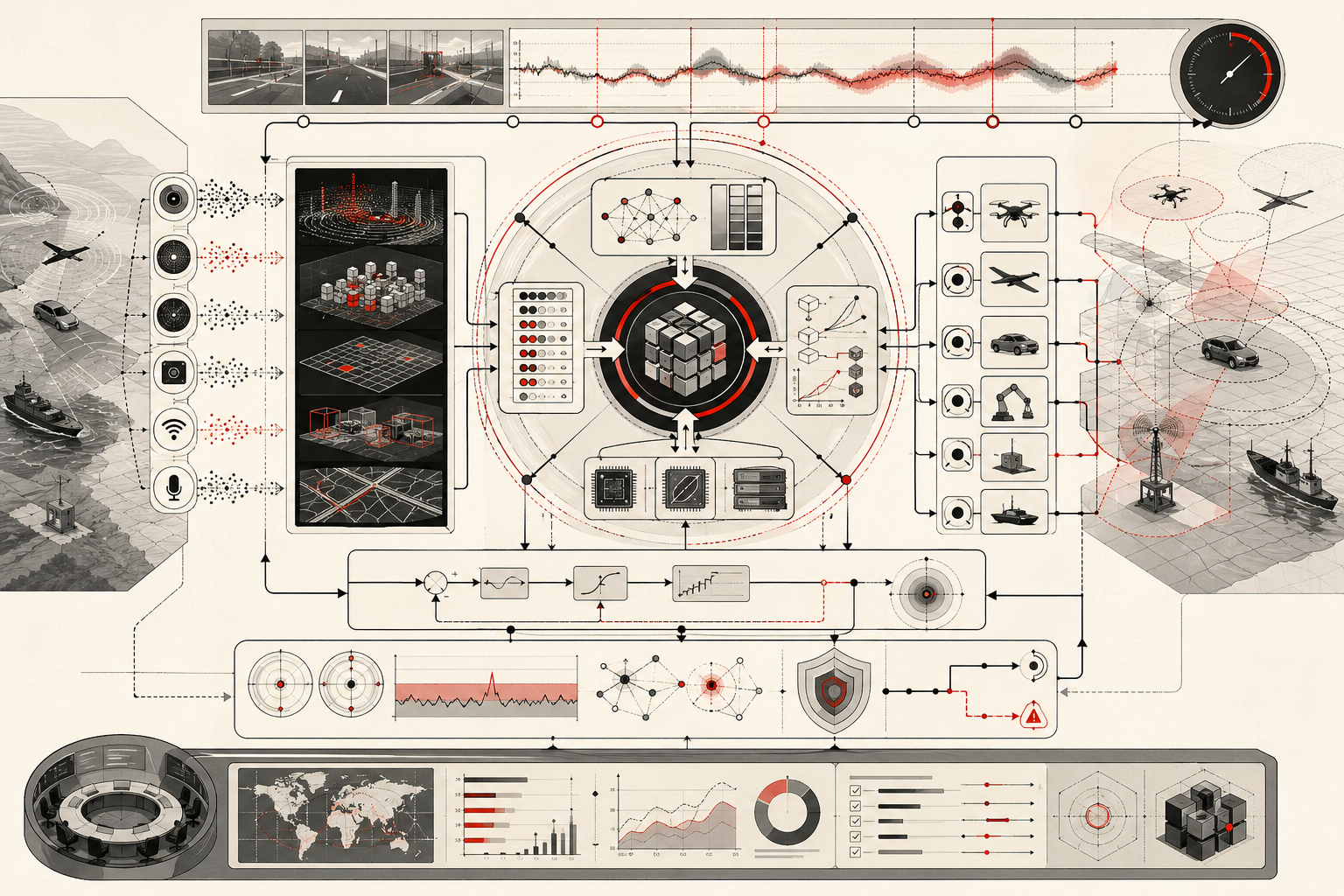
This article develops Real-Time AI Systems and Autonomous Decision-Making as an advanced article within the Artificial Intelligence Systems knowledge series. It explains real-time constraints, hard and soft deadlines, latency budgets, scheduling theory, inference pipelines, feedback control, sequential decision-making, reinforcement learning, embedded inference, edge AI, multi-agent coordination, runtime assurance, safety envelopes, monitoring, validation, and institutional governance. Selected Python and R examples appear here, while the full GitHub repository contains expanded computational scaffolding for latency simulation, schedulability diagnostics, deadline-miss analysis, control-loop timing, autonomy-risk scoring, SQL metadata, governance checklists, and advanced Jupyter notebooks.
Why Real-Time AI Matters
Real-time AI matters because many intelligent systems must act before the world changes too much for the action to remain useful. A perception model that identifies an obstacle after a vehicle has passed the braking point is operationally useless even if the classification is technically correct. A drone navigation model that produces a safe path too late may still crash. An industrial anomaly detector that alerts after a fault has propagated may fail to protect equipment. In real-time systems, correctness and timeliness are inseparable.
This makes real-time AI different from ordinary offline prediction. Offline machine learning can often trade additional computation for higher accuracy. Real-time AI must operate inside deadlines. It must sense, process, infer, decide, communicate, and actuate within a time budget determined by the surrounding environment. The system is evaluated not only by prediction quality, but by the reliability of its entire perception-action loop.
Real-time AI is therefore a systems problem. Model architecture, scheduler behavior, sensor latency, memory access, network delay, embedded hardware, control-loop frequency, safety monitors, fallback policies, and institutional accountability all shape whether autonomy is safe and useful. In time-sensitive environments, intelligence is not a score on a benchmark. It is dependable action under temporal constraint.
Offline\ Accuracy \neq Real\text{-}Time\ Feasibility
\]
Interpretation: A model may be accurate in offline evaluation but unusable in a real-time system if it cannot meet timing, control, and safety constraints.
| System Context | Timing Problem | Failure Mode | Design Requirement |
|---|---|---|---|
| Autonomous vehicles | Perception and planning must complete before braking or steering windows close. | Correct recognition arrives too late to prevent harm. | Low-latency inference, safety envelopes, and fallback control. |
| Drones and robotics | Control loops must respond to motion, balance, obstacles, and disturbances. | Delayed action destabilizes the system. | Embedded inference, deterministic timing, and robust control. |
| Industrial automation | Fault detection must occur before damage propagates. | Late anomaly detection fails to protect equipment or workers. | Deadline-aware monitoring and emergency stop logic. |
| Infrastructure systems | Load, demand, weather, and equipment conditions change continuously. | Slow decisions can amplify outages or congestion. | Real-time sensing, scheduling, resilience buffers, and escalation. |
| Medical devices | Monitoring and intervention may require immediate response. | Delayed inference can create patient-safety risk. | High reliability, certification, human oversight, and traceability. |
Note: Real-time AI is defined by the operational consequences of delay, not simply by fast model inference.
Foundations of Real-Time AI Systems
Real-time AI systems differ from conventional machine learning systems because they are embedded in time-sensitive environments. Their central challenge is not simply to infer correctly, but to infer and act within deadlines imposed by the surrounding world. These deadlines may arise from physical motion, process control, human safety, mission requirements, infrastructure stability, financial risk, cybersecurity response, or operational continuity.
This makes real-time AI fundamentally cyber-physical. Sensing, inference, control, and actuation are linked in closed loops. The system repeatedly observes the environment, updates internal representations, evaluates possible actions, and selects interventions fast enough to preserve stability, mission success, or human safety. Latency is not a secondary engineering detail. It is part of the operational meaning of intelligence.
A real-time AI system can be represented as:
S_{\mathrm{RTAI}}=(X,M,I,P,C,A,G)
\]
Interpretation: A real-time AI system includes sensor inputs \(X\), model \(M\), inference layer \(I\), planning layer \(P\), control layer \(C\), actuator \(A\), and governance structure \(G\).
The key issue is that every element in this system contributes to timing. A fast model can still fail if preprocessing is slow. A fast inference pipeline can still fail if communication delay is unpredictable. A good controller can still fail if its perception inputs are stale. Real-time intelligence must therefore be evaluated as an end-to-end system.
| Element | Function | Timing Concern | Governance Concern |
|---|---|---|---|
| Sensors | Capture observations from the environment. | Sensor sampling, synchronization, delay, and missingness. | Data quality, calibration, and reliability documentation. |
| Preprocessing | Clean, transform, fuse, or compress input signals. | Preprocessing may dominate latency. | Traceability of transformations and failure modes. |
| Model inference | Generate predictions, detections, classifications, or policy outputs. | Inference latency and jitter must be bounded. | Model validation, versioning, and monitoring. |
| Planning and control | Translate model output into action. | Control loop must complete within deadline. | Safety envelopes, fallback rules, and human authority. |
| Actuation | Change the physical or operational state of the system. | Mechanical, network, or execution delay affects outcome. | Responsibility for consequences of autonomous action. |
| Governance | Define oversight, evidence, escalation, and accountability. | Governance must act fast enough for runtime risk. | Auditability, incident response, and deployment authorization. |
Note: Real-time AI must be designed across the full perception-action-governance stack.
Real\text{-}Time\ Intelligence = Correctness + Timeliness + Stability + Accountability
\]
Interpretation: Real-time AI quality depends on accurate output, deadline feasibility, stable control behavior, and accountable deployment.
Time, Deadlines, Latency, and Jitter
Real-time systems are traditionally classified by the temporal strictness of their deadlines:
- Hard real-time: missing a deadline constitutes system failure.
- Firm real-time: late results lose operational value, though occasional misses may be tolerated.
- Soft real-time: delays degrade performance but do not immediately imply failure.
In AI systems, these categories matter because model complexity and latency are often in tension. Larger models may offer stronger predictive performance, but if they exceed timing constraints, they can become operationally inferior to smaller, faster, more predictable models. Real-time AI therefore forces a systems-level tradeoff between accuracy, responsiveness, computational feasibility, energy, and safety.
Latency can be represented as:
L_{\mathrm{total}}=L_{\mathrm{sense}}+L_{\mathrm{pre}}+L_{\mathrm{infer}}+L_{\mathrm{plan}}+L_{\mathrm{act}}
\]
Interpretation: Total latency includes sensing, preprocessing, inference, planning, and actuation delay.
A real-time deadline condition is:
L_{\mathrm{total}}\leq D
\]
Interpretation: The system is timely only when total latency remains within deadline \(D\).
Jitter is also important. A system with average latency below the deadline may still fail if latency varies unpredictably. Real-time AI must therefore evaluate distributions, tails, worst-case execution time, and deadline-miss rates rather than only mean inference speed.
| Concept | Meaning | Why It Matters | Example |
|---|---|---|---|
| Latency | Delay between input and action-ready output. | Long latency can make correct output useless. | Obstacle detection after braking window closes. |
| Deadline | Latest acceptable completion time. | Defines whether computation remains operationally useful. | Control update must complete within 20 ms. |
| Jitter | Variation in response time. | Unpredictable timing destabilizes control and scheduling. | Inference sometimes takes 30 ms and sometimes 120 ms. |
| Tail latency | High-percentile or worst-case delay. | Rare delays may create severe failure in safety-critical systems. | One slow planning cycle causes collision risk. |
| Deadline-miss rate | Fraction of tasks completed too late. | Measures real-time feasibility over many tasks. | Planning misses 8 percent of deadlines under load. |
Note: Real-time AI should be evaluated using latency distributions and deadline misses, not average inference speed alone.
Mean\ Latency < D \;\nRightarrow\; Safe\ Real\text{-}Time\ Behavior
\]
Interpretation: Average latency below a deadline does not guarantee safe timing because tail latency, jitter, and scheduling interference may still cause deadline failures.
Scheduling Theory and Real-Time Computation
Classical real-time computing established that scheduling is central to timing guarantees. Liu and Layland’s foundational work showed how periodic tasks can be analyzed under fixed-priority and dynamic-priority scheduling. That tradition remains essential because real-time AI systems must allocate compute across competing tasks: sensor acquisition, feature extraction, inference, tracking, planning, control, logging, safety monitoring, communication, and actuation.
A periodic task can be represented as:
\tau_i=(C_i,T_i,D_i)
\]
Interpretation: Task \(\tau_i\) has execution time \(C_i\), period \(T_i\), and deadline \(D_i\).
Processor utilization can be represented as:
U=\sum_{i=1}^{n}\frac{C_i}{T_i}
\]
Interpretation: Utilization \(U\) sums each task’s execution time divided by its period.
In AI-enabled systems, schedulability extends beyond conventional software tasks. A neural inference task may have variable latency depending on input size, hardware contention, memory bandwidth, batching, thermal throttling, or model architecture. A safety monitor may need higher priority than a perception model. A control task may require deterministic timing even when a high-capacity model runs concurrently.
This is why real-time AI must be understood as a joint problem in machine learning and systems engineering. Autonomy is constrained not only by what the model can infer, but by whether all critical tasks can be scheduled within available time budgets.
| Scheduling Issue | Why It Matters | AI-Specific Complication | Design Response |
|---|---|---|---|
| Task priority | Critical tasks must execute before less critical tasks. | Inference may compete with safety monitoring or control. | Priority assignment, safety-first scheduling, isolation. |
| Variable execution time | Unpredictable timing complicates guarantees. | Model latency can vary by input, hardware state, or batching. | Worst-case profiling and tail-latency control. |
| Resource contention | Tasks compete for CPU, GPU, memory, bus, or network. | Large models can interfere with control tasks. | Hardware partitioning, real-time kernels, resource reservations. |
| Thermal throttling | Heat can reduce compute performance. | Edge devices may slow under sustained inference. | Thermal modeling, load shedding, model compression. |
| Mixed criticality | Some tasks are safety-critical; others are informational. | Logging, analytics, or noncritical AI tasks can disrupt safety loops. | Mixed-criticality scheduling and graceful degradation. |
Note: A real-time AI system is not schedulable merely because the model is fast in isolation. Schedulability must be measured under concurrent workload and operational load.
The Real-Time AI Pipeline
A real-time AI system is usually a pipeline rather than a single model call. The system receives sensor data, filters or fuses signals, prepares inputs, runs inference, estimates uncertainty, selects actions, checks constraints, sends commands, and monitors outcomes. Each step consumes time and introduces possible delay.
A simplified pipeline can be represented as:
x_t \rightarrow z_t \rightarrow \hat{y}_t \rightarrow a_t \rightarrow x_{t+1}
\]
Interpretation: Sensor input \(x_t\) is transformed into processed representation \(z_t\), model output \(\hat{y}_t\), action \(a_t\), and the next state \(x_{t+1}\).
Pipeline design matters because optimizing only the model may miss the true bottleneck. Preprocessing may dominate latency. Sensor synchronization may create delay. Communication overhead may make cloud inference impractical. Safety checks may slow response unless designed efficiently. Logging may interfere with real-time performance if not isolated.
A real-time AI system therefore needs pipeline-level evaluation. Engineers must measure end-to-end latency, component latency, scheduling interference, tail behavior, memory usage, energy consumption, thermal behavior, and deadline misses. The model is only one part of the timing system.
| Pipeline Stage | Function | Timing Risk | Evaluation Metric |
|---|---|---|---|
| Sensing | Collect environmental signals. | Sampling delay, synchronization failure, sensor dropout. | Sensor latency, missing-rate, timestamp accuracy. |
| Preprocessing | Clean, resize, transform, fuse, or encode data. | Transformation pipeline becomes bottleneck. | Preprocessing latency and memory footprint. |
| Inference | Run model to produce prediction or policy output. | Inference latency, jitter, hardware contention. | p50/p95/p99 latency, throughput, energy. |
| Planning | Translate prediction into action options. | Search, optimization, or path planning exceeds deadline. | Planning time, solution quality, fallback frequency. |
| Safety check | Validate action against constraints. | Safety monitor too slow or bypassed. | Risk-check latency and override accuracy. |
| Actuation | Execute action in physical or operational system. | Actuator delay or command failure. | Actuation latency and command success rate. |
Note: Real-time evaluation must follow the full path from sensor input to action, not just the model-inference step.
Control Loops, Feedback, and Autonomous Action
Real-time AI systems are typically embedded in feedback loops. Sensors provide observations, controllers or policies generate actions, the environment changes, and new observations are produced. This cycle repeats continuously.
A feedback loop can be represented as:
x_{t+1}=F(x_t,a_t,w_t)
\]
Interpretation: The next state depends on current state \(x_t\), action \(a_t\), and disturbance or noise \(w_t\).
The action may be generated by an AI policy:
a_t=\pi_{\theta}(o_t)
\]
Interpretation: Policy \(\pi_{\theta}\) maps observation \(o_t\) to action \(a_t\).
The core issue is control under uncertainty. Real-time autonomous systems must operate despite noisy observations, partial observability, changing environments, and system disturbances. Control theory provides one tradition for managing such systems through stability, robustness, feedback design, and constraint handling. AI contributes adaptive perception, learning, planning, and decision policies.
This connects directly to Feedback Loops in Resilient Systems and Artificial Intelligence in Decision Support Systems. In real-time AI, feedback is not only an analytic concept. It is the operational condition of autonomy.
| Concern | Description | Risk | Control Response |
|---|---|---|---|
| Stale perception | Model acts on outdated observations. | Action may be correct for a past state, not the current one. | Timestamp validation and latency-aware control. |
| Control instability | Delayed or noisy actions destabilize the system. | Oscillation, overshoot, unsafe motion, or process failure. | Robust control, damping, conservative fallback. |
| Disturbances | Unmodeled environmental changes affect outcomes. | Policy fails under weather, load, friction, noise, or adversarial conditions. | Disturbance modeling and scenario testing. |
| Feedback amplification | Actions alter the data later observed by the system. | Errors can compound through closed-loop behavior. | Monitoring, drift detection, and bounded adaptation. |
| Unsafe action translation | Prediction becomes action without sufficient validation. | Model error produces real-world harm. | Safety filters, control barriers, and human escalation. |
Note: Real-time AI becomes autonomous when model output is connected to action through a control loop. That connection must be designed and governed explicitly.
Fast\ Prediction \neq Stable\ Control
\]
Interpretation: Low-latency inference is necessary but not sufficient; autonomous systems must also preserve stability under feedback, uncertainty, and disturbance.
Autonomy as Sequential Decision-Making
Autonomous decision-making is best understood as a sequential decision problem. Actions taken now affect future states, which in turn alter future observations and available choices. This makes autonomy fundamentally different from static prediction.
A sequential decision process can be represented as:
(s_t,a_t,r_t,s_{t+1})_{t=0}^{T}
\]
Interpretation: Autonomy unfolds as a sequence of states, actions, rewards, and next states over time.
The objective is often to optimize long-run outcomes subject to constraints on safety, latency, energy, and reliability. This introduces a planning problem under uncertainty, where local decisions must be evaluated with respect to their longer-term consequences. The relevant question is not simply whether an action appears correct in the present instant, but whether it leads to desirable trajectories over time.
Autonomy therefore involves more than automation. Automation follows predefined procedures or rules. Autonomy requires context-sensitive adaptation within uncertain and changing environments. That distinction matters because it separates scripted behavior from systems that must reason, react, and remain stable under novel conditions.
| Dimension | Automation | Autonomy | Governance Implication |
|---|---|---|---|
| Decision basis | Predefined rules or procedures. | Context-sensitive policy or adaptive decision process. | Autonomy requires stronger evaluation of unseen states. |
| Environment | Usually structured and predictable. | Often uncertain, dynamic, or partially observed. | Monitoring and fallback behavior become essential. |
| Human role | Humans define and supervise the procedure. | Humans delegate action under constraints. | Authority, override, and accountability must be explicit. |
| Risk profile | Risk comes from rule errors or process failure. | Risk comes from policy behavior under changing conditions. | Policy-level audit and runtime assurance are needed. |
| Evaluation | Can often be tested against known cases. | Must be tested across trajectories and scenarios. | Scenario testing and continuous monitoring are required. |
Note: Autonomy is delegated decision authority under uncertainty, not merely automatic execution.
Reinforcement Learning in Real-Time Systems
Reinforcement learning is especially relevant because it formalizes sequential decision-making through reward maximization over time. A policy selects actions in response to observed states, and learning aims to optimize expected cumulative reward. This connects directly to Reinforcement Learning in Dynamic Environments.
A reinforcement-learning objective can be represented as:
\max_{\pi}E_{\pi}\left[\sum_{t=0}^{T}\gamma^t r_t\right]
\]
Interpretation: The policy is chosen to maximize expected discounted reward over time.
However, deploying reinforcement learning in real-time systems introduces substantial difficulties. Policies learned in simulation may not transfer safely to the physical world. Exploration can be dangerous in safety-critical domains. Neural-network policies may be difficult to verify, certify, or interpret. A learned policy may optimize a reward function while violating timing, safety, or governance requirements.
For that reason, reinforcement learning in real-time AI is best understood not as a standalone solution, but as one component in broader architectures that include supervision, safety envelopes, fallback logic, runtime monitoring, and control-theoretic constraints. In practice, high-assurance autonomy usually requires hybridization rather than pure learned control.
| RL Contribution | Why It Helps | Real-Time Risk | System Response |
|---|---|---|---|
| Policy learning | Allows systems to learn action strategies from experience. | Policy may behave unpredictably outside training. | Scenario testing, bounded action spaces, fallback policies. |
| Adaptation | Supports changing environments and dynamic conditions. | Adaptation may violate safety or timing constraints. | Constrained learning and runtime assurance. |
| Long-run optimization | Optimizes trajectories rather than isolated actions. | Reward may omit safety, fairness, or resilience. | Reward audits, constraint costs, multi-objective evaluation. |
| Simulation training | Allows exploration without immediate real-world harm. | Simulation-to-reality gap may cause deployment failure. | Domain randomization, real-world validation, conservative deployment. |
| Multi-agent learning | Handles interaction among many adaptive actors. | Emergent behavior may be unstable or hard to explain. | Multi-agent stress testing and systemic-risk monitoring. |
Note: Reinforcement learning becomes deployable in real-time systems only when paired with safety, verification, timing, and governance controls.
Edge AI, Embedded Systems, and On-Device Inference
Because many real-time environments cannot depend on remote cloud latency, real-time autonomy increasingly relies on edge AI and embedded inference. Models are deployed close to sensors and actuators, reducing communication delays and enabling local response even when connectivity is limited or unavailable.
This directly connects to Edge AI and Distributed Intelligence and AI Infrastructure: Data Pipelines, Compute, and Deployment Systems. Real-time autonomy is often the strongest practical argument for moving inference toward the edge: timing constraints, bandwidth limits, privacy needs, resilience requirements, and fault tolerance make centralized architectures inadequate for many tasks.
Embedded deployment also introduces strict resource constraints. Models must often be compressed, quantized, pruned, distilled, or otherwise optimized to fit within memory, compute, energy, and thermal budgets. This means real-time intelligence is shaped as much by hardware-software co-design as by statistical learning.
An edge-inference feasibility condition can be represented as:
L_{\mathrm{edge}}+L_{\mathrm{act}}\leq D
\]
Interpretation: Edge inference is useful when local inference plus actuation latency fits within the operational deadline.
When network latency or cloud availability cannot be trusted, edge deployment becomes not just an optimization, but a safety and resilience requirement.
| Reason | Real-Time Benefit | Tradeoff | Design Response |
|---|---|---|---|
| Lower latency | Reduces dependence on remote communication. | Edge hardware may be less powerful. | Quantization, pruning, distillation, efficient models. |
| Resilience | System can operate during network degradation. | Local device must handle degraded modes. | Offline inference, local fallback, synchronization when available. |
| Privacy | Sensitive data can remain near source. | Local governance and security remain necessary. | Secure storage, access control, minimal data movement. |
| Bandwidth | Reduces continuous transmission of high-volume sensor data. | Local processing may increase energy use. | Selective transmission and edge summarization. |
| Control proximity | Inference occurs near actuators and control loops. | More distributed systems to monitor and update. | Fleet management, version control, and remote audit logs. |
Note: Edge AI is often required when cloud dependence conflicts with real-time deadlines, safety, privacy, or resilience.
Distributed Coordination and Multi-Agent Autonomy
Many autonomous environments are not single-agent settings. Vehicles, drones, robots, sensors, infrastructure nodes, and software agents may need to coordinate with other agents that are also sensing, deciding, and acting. This creates a distributed intelligence problem.
A multi-agent autonomous system can be represented as:
A_t=(a_t^1,a_t^2,\ldots,a_t^n)
\]
Interpretation: The joint action \(A_t\) includes actions taken by multiple agents at time \(t\).
The system transition may depend on joint behavior:
x_{t+1}=F(x_t,a_t^1,a_t^2,\ldots,a_t^n)
\]
Interpretation: The next system state depends on the combined actions of multiple agents.
Multi-agent autonomy raises additional complexity because each agent’s action changes the environment for others, creating strategic interaction, interference, congestion, and coordination challenges. This is relevant in autonomous driving, swarm robotics, warehouse automation, smart grids, traffic routing, environmental monitoring, and networked infrastructure.
As a result, real-time autonomy is often not only a control problem, but a distributed systems problem involving communication constraints, local information, shared objectives, timing synchronization, and emergent collective behavior. In these cases, intelligence is not located in a single model. It is distributed across the interacting network.
| Risk | How It Emerges | Example | Mitigation |
|---|---|---|---|
| Coordination failure | Agents optimize locally without system-level alignment. | Robots block one another in a warehouse. | Shared protocols, coordination rules, global monitoring. |
| Communication delay | Agents receive stale or incomplete information. | Vehicle platoon reacts to delayed neighbor signals. | Local fallback and latency-aware coordination. |
| Emergent instability | Multiple agents adapt simultaneously. | Traffic routing agents create oscillating congestion patterns. | Multi-agent simulation and damping constraints. |
| Common-mode failure | Many agents rely on the same model, network, or controller. | Fleet-wide behavior shifts after a faulty update. | Staged rollout, rollback, model diversity, fleet monitoring. |
| Distributed accountability | Responsibility is spread across devices, vendors, and operators. | Failure involves edge device, cloud service, and local controller. | Audit trails, responsibility matrix, incident reconstruction. |
Note: Multi-agent real-time AI requires coordination under latency, uncertainty, and partial information.
Safety, Runtime Assurance, and Risk in Autonomous Systems
Real-time autonomy brings risk into immediate contact with action. In offline AI systems, a bad prediction may be corrected later. In autonomous systems, a bad decision may already have changed the world by the time it is detected. For this reason, safety and runtime assurance are central.
Runtime assurance involves monitoring the behavior of an autonomous system while it operates and intervening when risk exceeds acceptable boundaries. This may include safety envelopes, control barrier functions, fallback controllers, anomaly detection, human override, degraded modes, watchdog timers, and emergency stops.
A safety-gated autonomy architecture can be represented as:
a_t =
\begin{cases}
a_t^{AI}, & Risk_t \leq \rho\\
a_t^{safe}, & Risk_t > \rho
\end{cases}
\]
Interpretation: The system uses the AI action when risk remains below threshold \(\rho\), and switches to a safe fallback action when risk is too high.
This links directly to AI Safety and System Reliability. In autonomous systems, reliability is not a secondary performance metric. It is often the condition of safe action itself. Governance must therefore address not only design-time validation, but runtime behavior, incident response, and authority to pause or override autonomous action.
| Control | Purpose | Failure Prevented | Evidence Produced |
|---|---|---|---|
| Safety envelope | Define allowed operating boundaries. | Unsafe action outside acceptable state space. | Constraint logs and envelope violations. |
| Fallback controller | Provide conservative action when AI risk rises. | Untrusted policy continues acting under uncertainty. | Fallback activation records. |
| Watchdog timer | Detect timing failure or stalled computation. | Missed control cycles or delayed responses. | Timeout logs and restart records. |
| Anomaly detector | Detect unusual states, sensor patterns, or model behavior. | Policy acts in out-of-distribution conditions. | Anomaly score history and alerts. |
| Human override | Preserve human authority in high-risk conditions. | Automation proceeds despite evident danger. | Override logs and operator rationale. |
| Incident response | Contain, analyze, and correct failures. | Repeated failure without institutional learning. | Root-cause analysis and corrective actions. |
Note: Runtime assurance turns autonomy from unconstrained model action into monitored, bounded, recoverable system behavior.
Autonomy\ Without\ Runtime\ Assurance \rightarrow Unbounded\ Delegation
\]
Interpretation: Autonomous systems need runtime constraints because delegated action must remain interruptible, observable, and recoverable.
Validation, Benchmarking, and Runtime Monitoring
Because real-time AI systems act under temporal and environmental uncertainty, validation cannot rely solely on offline accuracy benchmarks. Evaluation must consider latency, deadline-miss rates, jitter, robustness under distribution shift, fault tolerance, runtime monitoring, degradation under overload, and safe recovery from anomalies.
A deadline-miss rate can be represented as:
M=\frac{1}{n}\sum_{i=1}^{n}\mathbf{1}(L_i>D_i)
\]
Interpretation: Deadline-miss rate \(M\) is the fraction of tasks whose latency exceeds their deadline.
Benchmarks remain useful, but they are incomplete if they abstract away the timing and control constraints that define real deployment. A model that performs well in a static benchmark may still fail in an autonomous setting if inference latency, scheduling jitter, sensor delay, or control instability degrades operational performance.
This connects to Model Validation, Benchmarking, and Generalization Theory. For real-time AI, generalization must be understood not only as performance on unseen data, but as performance under unseen timing, load, environment, and operational conditions. Runtime assurance, anomaly detection, fallback mechanisms, and post-deployment monitoring are therefore part of evaluation, not merely operational afterthoughts.
| Metric | What It Measures | Why It Matters | Governance Use |
|---|---|---|---|
| Offline accuracy | Prediction quality on benchmark data. | Shows model capability but not operational feasibility. | Model selection and baseline validation. |
| End-to-end latency | Time from sensing to action-ready output. | Determines whether action arrives in time. | Deployment approval and timing budget review. |
| Deadline-miss rate | Fraction of tasks completed too late. | Captures real-time failure under workload. | Operational safety threshold and incident trigger. |
| Jitter | Variation in latency. | Unpredictable timing can destabilize control loops. | Schedulability and reliability review. |
| Fallback rate | Frequency of safe-mode activation. | Indicates how often autonomy exceeds confidence or risk limits. | Runtime assurance monitoring. |
| Recovery time | Time required to return from degraded mode. | Measures resilience after failure. | Incident response and continuity planning. |
Note: Real-time AI validation should evaluate accuracy, timing, safety, stability, and recovery together.
Organizational and Institutional Implications
Real-time AI systems reshape organizations by shifting responsibility into time-sensitive automated loops. Human oversight becomes more complex when decisions occur faster than direct human review. This creates new governance questions: where should autonomy be permitted, where must humans remain in the loop, how should authority be delegated, and how should responsibility be assigned when decisions are made within partially autonomous architectures?
This links to AI Systems in Organizations and Institutions and AI Governance and Regulatory Systems. Real-time autonomy is not only a technical capability. It is an institutional design problem concerning control, delegation, escalation, safety, and accountability.
The faster systems act, the more important it becomes to decide in advance how authority is distributed, how exceptions are handled, and when automation must yield to human judgment. Time-critical autonomy therefore turns governance into a design parameter rather than a post hoc compliance layer.
| Governance Question | Why It Matters | Weak Pattern | Stronger Pattern |
|---|---|---|---|
| Who has authority to delegate action? | Autonomy changes who effectively controls decisions. | Autonomy expands through technical convenience. | Explicit authorization, risk classification, and approval records. |
| Who can pause the system? | Fast systems require fast intervention authority. | Operators lack practical override pathways. | Emergency stop, safe mode, escalation protocols. |
| Who owns incidents? | Failures may involve model, hardware, workflow, and vendor layers. | Responsibility is fragmented after harm occurs. | Responsibility matrix and incident command process. |
| How is evidence preserved? | Fast decisions are difficult to reconstruct without logs. | Only aggregate metrics are retained. | Event logs, timing traces, action records, model versions. |
| How are communities protected? | Autonomous systems may affect workers, patients, pedestrians, residents, or users. | Safety is defined only internally. | External accountability, impact review, and contestability. |
Note: Real-time autonomy makes governance a runtime problem because delegated action can occur faster than ordinary human review.
Limits and Open Problems
Despite rapid progress, real-time AI and autonomous decision-making remain constrained by several unresolved issues: the tension between model complexity and latency guarantees; difficulty certifying learning-based policies in safety-critical systems; distribution shift between simulation and real deployment; multi-agent coordination under uncertainty and interference; integration of adaptive learning with hard real-time guarantees; adversarial and cybersecurity risks in autonomous systems; energy and thermal constraints on embedded inference; limited observability in fast-changing environments; and institutional accountability when decisions occur faster than human review.
These limits suggest that the future of real-time AI will depend less on raw model scale alone and more on architectures that combine efficient inference, scheduling discipline, robust control, runtime assurance, edge deployment, and institutional oversight. The highest-performing real-time AI systems will not simply be the most accurate. They will be the most dependable under operational constraint.
| Open Problem | Why It Is Difficult | System Consequence |
|---|---|---|
| Model complexity versus timing | More capable models may be slower or less predictable. | Offline accuracy gains may not translate into deployable autonomy. |
| Certification of learned policies | Neural policies can be opaque and hard to verify. | Safety-critical deployment remains difficult. |
| Simulation-to-reality gap | Simulated environments omit real-world complexity. | Policies may fail after deployment. |
| Multi-agent coordination | Agents interact under latency, uncertainty, and changing behavior. | Emergent instability or system-wide inefficiency. |
| Cybersecurity and adversarial exposure | Autonomous systems connect perception, communication, and action. | Attacks can translate into physical or operational harm. |
| Embedded resource limits | Edge devices have limited power, memory, compute, and cooling. | Models may degrade under thermal or energy constraints. |
| Institutional accountability | Autonomous decisions may occur faster than human review. | Responsibility becomes unclear without designed oversight. |
Note: The frontier of real-time AI is not only faster inference. It is dependable autonomy under timing, safety, resource, and governance constraints.
Mathematical Lens
Total real-time latency can be written as:
L_{\mathrm{total}}=L_{\mathrm{sense}}+L_{\mathrm{pre}}+L_{\mathrm{infer}}+L_{\mathrm{plan}}+L_{\mathrm{act}}
\]
Interpretation: Total latency is the sum of sensing, preprocessing, inference, planning, and actuation delays.
A deadline constraint is:
L_{\mathrm{total}}\leq D
\]
Interpretation: Real-time action is feasible only when total latency remains below deadline \(D\).
A task model is:
\tau_i=(C_i,T_i,D_i)
\]
Interpretation: Task \(i\) has computation time \(C_i\), period \(T_i\), and deadline \(D_i\).
Processor utilization is:
U=\sum_{i=1}^{n}\frac{C_i}{T_i}
\]
Interpretation: Utilization estimates how much processor capacity is consumed by periodic tasks.
Deadline-miss rate is:
M=\frac{1}{n}\sum_{i=1}^{n}\mathbf{1}(L_i>D_i)
\]
Interpretation: \(M\) measures the fraction of tasks that miss their deadlines.
A closed-loop state transition is:
x_{t+1}=F(x_t,a_t,w_t)
\]
Interpretation: The next system state depends on the current state, action, and disturbance.
An autonomous policy is:
a_t=\pi_{\theta}(o_t)
\]
Interpretation: The policy maps observation \(o_t\) into action \(a_t\).
A safety-gated action rule is:
a_t =
\begin{cases}
a_t^{AI}, & Risk_t \leq \rho\\
a_t^{safe}, & Risk_t > \rho
\end{cases}
\]
Interpretation: The system switches from AI action to safe fallback when risk exceeds threshold \(\rho\).
A real-time AI objective can be written as:
J=\alpha A-\beta L-\gamma M-\delta R+\eta S
\]
Interpretation: A real-time objective may reward accuracy \(A\) and safety \(S\), while penalizing latency \(L\), deadline misses \(M\), and risk \(R\).
This mathematical lens shows that real-time AI is an optimization problem over accuracy, latency, schedulability, risk, safety, and system stability.
Variables and System Interpretation
| Symbol or Term | Meaning | Typical Type | System Interpretation |
|---|---|---|---|
| \(L_{\mathrm{total}}\) | Total latency | Time. | End-to-end delay from sensing to action. |
| \(D\) | Deadline | Time constraint. | Maximum allowable time before an action loses operational value. |
| \(J\) | Jitter | Latency variation. | Unpredictability in response time or scheduling behavior. |
| \(C_i\) | Computation time | Execution duration. | Time required for task \(i\) to execute. |
| \(T_i\) | Task period | Time interval. | How often task \(i\) recurs. |
| \(D_i\) | Task deadline | Time constraint. | Latest completion time for task \(i\). |
| \(U\) | Utilization | Capacity ratio. | Share of processor capacity required by scheduled tasks. |
| \(M\) | Deadline-miss rate | Performance metric. | Fraction of tasks completed too late. |
| \(x_t\) | System state | Dynamic condition. | Current state of the environment or controlled system. |
| \(a_t\) | Action | Control or decision. | Autonomous intervention selected by the system. |
| \(\pi_{\theta}\) | Policy | Decision function. | Learned or designed mapping from observations to actions. |
| \(a_t^{safe}\) | Safe fallback action | Control action. | Conservative action used when risk exceeds acceptable limits. |
| \(\rho\) | Risk threshold | Decision boundary. | Maximum acceptable runtime risk before fallback activates. |
Note: Real-time AI systems should be evaluated through timing, schedulability, control stability, safety, robustness, and governance readiness, not accuracy alone.
Worked Example: Accuracy versus Deadline Feasibility
Suppose two models are available for an autonomous inspection robot.
Model A has high accuracy:
A_A=0.96
\]
Interpretation: Model A has 96 percent offline accuracy.
But its end-to-end latency is:
L_A=140\ \mathrm{ms}
\]
Interpretation: Model A takes 140 milliseconds from input to action-ready output.
Model B is slightly less accurate:
A_B=0.91
\]
Interpretation: Model B has 91 percent offline accuracy.
But its end-to-end latency is:
L_B=45\ \mathrm{ms}
\]
Interpretation: Model B is substantially faster.
If the operational deadline is:
D=80\ \mathrm{ms}
\]
Interpretation: The system must respond within 80 milliseconds.
Then:
L_A>D,\quad L_B\leq D
\]
Interpretation: Model A misses the real-time deadline, while Model B satisfies it.
This example shows why real-time AI cannot be selected using accuracy alone. The more accurate model may be operationally worse if it responds too late. In real-time autonomy, timing feasibility is part of model suitability.
| Model | Offline Accuracy | End-to-End Latency | Deadline | Real-Time Suitability |
|---|---|---|---|---|
| Model A | 0.96 | 140 ms | 80 ms | Not feasible despite higher accuracy. |
| Model B | 0.91 | 45 ms | 80 ms | Feasible despite lower accuracy. |
Note: In real-time systems, the best model is not necessarily the most accurate model. It is the model that satisfies accuracy, latency, reliability, and safety requirements together.
Computational Modeling
Computational modeling can make real-time AI constraints visible. A latency workflow can simulate inference times, deadline-miss rates, jitter, and utilization. A scheduling workflow can test whether tasks fit within periods and deadlines. A control-loop workflow can measure whether delays destabilize state transitions. A runtime-assurance workflow can trigger fallback actions when risk or delay exceeds acceptable thresholds. A SQL metadata schema can record tasks, latencies, deadlines, incidents, fallbacks, and governance reviews.
The selected examples below use lightweight synthetic workflows so the article remains readable and WordPress-friendly. The GitHub repository extends the same logic into advanced Jupyter notebooks, latency simulation, schedulability diagnostics, deadline-miss analysis, edge-inference evaluation, runtime-assurance rules, SQL metadata, governance checklists, and reproducible outputs.
A useful real-time AI workflow should treat latency and risk as first-class system variables. It should not only ask whether the model is accurate, but whether the full pipeline meets deadlines under load, whether safety fallbacks activate appropriately, and whether runtime evidence is preserved for audit and incident review.
Evaluation = Accuracy + Latency + Deadline\ Misses + Fallbacks + Safety\ Evidence
\]
Interpretation: Real-time AI evaluation must combine model performance, timing behavior, safety activation, and governance evidence.
Python Workflow: Latency, Deadline Misses, and Real-Time AI Diagnostics
Python is useful for simulating real-time AI latency, deadline misses, utilization, and autonomy risk. The following workflow creates synthetic task-latency data, evaluates real-time feasibility, and writes governance-ready output artifacts.
"""
Real-Time AI Systems and Autonomous Decision-Making

Python workflow: latency, deadline misses, and real-time AI diagnostics.

This educational example demonstrates:
1. synthetic real-time AI task data
2. component latency simulation
3. deadline-miss diagnostics
4. latency margin scoring
5. safety fallback flags
6. governance-ready output files

It uses synthetic data for illustration.
"""

from __future__ import annotations

from pathlib import Path
import numpy as np
import pandas as pd


RANDOM_SEED = 42
rng = np.random.default_rng(RANDOM_SEED)

OUTPUT_DIR = Path("outputs")
OUTPUT_DIR.mkdir(parents=True, exist_ok=True)

N_TASKS = 1500

tasks = pd.DataFrame(
    {
        "task_id": [f"rtai-{i:04d}" for i in range(1, N_TASKS + 1)],
        "task_type": rng.choice(
            ["perception", "tracking", "planning", "control", "safety_monitor"],
            size=N_TASKS,
            p=[0.32, 0.20, 0.18, 0.20, 0.10],
        ),
        "deadline_ms": rng.choice(
            [20, 40, 80, 120],
            size=N_TASKS,
            p=[0.20, 0.35, 0.30, 0.15],
        ),
        "risk_level": rng.choice(
            ["low", "medium", "high"],
            size=N_TASKS,
            p=[0.45, 0.35, 0.20],
        ),
    }
)

latency_profiles = {
    "perception": (18, 8),
    "tracking": (10, 4),
    "planning": (35, 15),
    "control": (8, 3),
    "safety_monitor": (12, 5),
}


def simulate_component_latencies(df: pd.DataFrame) -> pd.DataFrame:
    """Add component latency estimates for each task."""
    simulated = df.copy()
    n = len(simulated)

    simulated["sense_latency_ms"] = np.maximum(0.5, rng.normal(loc=5, scale=1.5, size=n))
    simulated["preprocess_latency_ms"] = np.maximum(0.5, rng.normal(loc=6, scale=2.0, size=n))

    simulated["inference_latency_ms"] = [
        max(
            1.0,
            rng.normal(
                loc=latency_profiles[task_type][0],
                scale=latency_profiles[task_type][1],
            ),
        )
        for task_type in simulated["task_type"]
    ]

    simulated["planning_latency_ms"] = np.where(
        simulated["task_type"].isin(["planning", "control"]),
        np.maximum(0.5, rng.normal(loc=8, scale=3.0, size=n)),
        np.maximum(0.2, rng.normal(loc=2, scale=0.8, size=n)),
    )

    simulated["actuation_latency_ms"] = np.maximum(0.5, rng.normal(loc=4, scale=1.0, size=n))

    simulated["latency_ms"] = (
        simulated["sense_latency_ms"]
        + simulated["preprocess_latency_ms"]
        + simulated["inference_latency_ms"]
        + simulated["planning_latency_ms"]
        + simulated["actuation_latency_ms"]
    )

    return simulated


def score_real_time_feasibility(df: pd.DataFrame) -> pd.DataFrame:
    """Compute deadline misses, latency margins, and fallback flags."""
    scored = df.copy()

    scored["deadline_miss"] = scored["latency_ms"] > scored["deadline_ms"]
    scored["latency_margin_ms"] = scored["deadline_ms"] - scored["latency_ms"]

    scored["tail_risk_flag"] = scored["latency_margin_ms"] < 5

    scored["fallback_required"] = (
        scored["deadline_miss"]
        | ((scored["risk_level"] == "high") & (scored["latency_margin_ms"] < 10))
        | ((scored["task_type"] == "safety_monitor") & scored["tail_risk_flag"])
    )

    scored["timing_band"] = pd.cut(
        scored["latency_margin_ms"],
        bins=[-np.inf, 0, 10, 30, np.inf],
        labels=["missed_deadline", "thin_margin", "moderate_margin", "strong_margin"],
        include_lowest=True,
    )

    return scored


def summarize_by_task_and_risk(scored: pd.DataFrame) -> pd.DataFrame:
    """Summarize timing and fallback behavior by task and risk level."""
    return (
        scored.groupby(["task_type", "risk_level"], as_index=False)
        .agg(
            tasks=("task_id", "count"),
            mean_latency_ms=("latency_ms", "mean"),
            p95_latency_ms=("latency_ms", lambda x: np.percentile(x, 95)),
            p99_latency_ms=("latency_ms", lambda x: np.percentile(x, 99)),
            mean_deadline_ms=("deadline_ms", "mean"),
            deadline_miss_rate=("deadline_miss", "mean"),
            fallback_rate=("fallback_required", "mean"),
            mean_latency_margin_ms=("latency_margin_ms", "mean"),
        )
        .sort_values("deadline_miss_rate", ascending=False)
    )


def write_governance_memo(summary: pd.DataFrame, scored: pd.DataFrame) -> None:
    """Write a plain-language memo for real-time AI review."""
    overall_deadline_miss = scored["deadline_miss"].mean()
    overall_fallback = scored["fallback_required"].mean()
    worst_group = summary.iloc[0]

    memo = f"""# Real-Time AI Timing and Autonomy Risk Memo

Tasks evaluated: {len(scored)}
Overall deadline-miss rate: {overall_deadline_miss:.3f}
Overall fallback activation rate: {overall_fallback:.3f}

Highest deadline-miss group:
- Task type: {worst_group["task_type"]}
- Risk level: {worst_group["risk_level"]}
- Deadline-miss rate: {worst_group["deadline_miss_rate"]:.3f}
- p95 latency: {worst_group["p95_latency_ms"]:.3f} ms
- p99 latency: {worst_group["p99_latency_ms"]:.3f} ms

Interpretation:
- Average latency is insufficient for real-time AI governance.
- p95 and p99 latency should be reviewed for safety-relevant tasks.
- Thin latency margins should trigger model optimization, scheduling review, or fallback planning.
- High-risk tasks should require stricter timing, logging, and runtime assurance controls.
"""

    (OUTPUT_DIR / "python_real_time_ai_governance_memo.md").write_text(memo)


def main() -> None:
    simulated = simulate_component_latencies(tasks)
    scored = score_real_time_feasibility(simulated)
    summary = summarize_by_task_and_risk(scored)

    scored.to_csv(OUTPUT_DIR / "python_real_time_ai_task_results.csv", index=False)
    summary.to_csv(OUTPUT_DIR / "python_real_time_ai_timing_summary.csv", index=False)

    write_governance_memo(summary, scored)

    print("Real-time AI timing summary")
    print(summary.head(10))

    print("\nTask results preview")
    print(scored.head())


if __name__ == "__main__":
    main()
This workflow demonstrates a core real-time AI principle: the correct unit of evaluation is not only model accuracy, but whether task timing remains feasible under deadline, workload, risk, and fallback constraints.
R Workflow: Real-Time Autonomy Risk and Deadline Summary
R is useful for reporting deadline-miss behavior, latency margins, and fallback rates by task type and risk category.
# Real-Time AI Systems and Autonomous Decision-Making
#
# R workflow: real-time autonomy risk and deadline summary.
#
# This educational workflow simulates:
# - real-time AI task latencies
# - deadlines
# - deadline misses
# - latency margins
# - fallback flags
# - governance-ready outputs

set.seed(42)

n <- 1500

task_type <- sample(
  c("perception", "tracking", "planning", "control", "safety_monitor"),
  n,
  replace = TRUE,
  prob = c(0.32, 0.20, 0.18, 0.20, 0.10)
)

deadline_ms <- sample(
  c(20, 40, 80, 120),
  n,
  replace = TRUE,
  prob = c(0.20, 0.35, 0.30, 0.15)
)

risk_level <- sample(
  c("low", "medium", "high"),
  n,
  replace = TRUE,
  prob = c(0.45, 0.35, 0.20)
)

base_latency <- ifelse(
  task_type == "perception", 18,
  ifelse(
    task_type == "tracking", 10,
    ifelse(
      task_type == "planning", 35,
      ifelse(task_type == "control", 8, 12)
    )
  )
)

latency_sd <- ifelse(
  task_type == "perception", 8,
  ifelse(
    task_type == "tracking", 4,
    ifelse(
      task_type == "planning", 15,
      ifelse(task_type == "control", 3, 5)
    )
  )
)

latency_ms <- pmax(
  1,
  rnorm(n, mean = base_latency + 15, sd = latency_sd)
)

rtai_results <- data.frame(
  task_id = paste0("rtai-", sprintf("%04d", 1:n)),
  task_type = task_type,
  deadline_ms = deadline_ms,
  risk_level = risk_level,
  latency_ms = latency_ms
)

rtai_results$deadline_miss <- rtai_results$latency_ms > rtai_results$deadline_ms
rtai_results$latency_margin_ms <- rtai_results$deadline_ms - rtai_results$latency_ms

rtai_results$fallback_required <-
  rtai_results$deadline_miss |
  (rtai_results$risk_level == "high" & rtai_results$latency_margin_ms < 10)

rtai_results$timing_band <- ifelse(
  rtai_results$latency_margin_ms < 0,
  "missed_deadline",
  ifelse(
    rtai_results$latency_margin_ms < 10,
    "thin_margin",
    ifelse(
      rtai_results$latency_margin_ms < 30,
      "moderate_margin",
      "strong_margin"
    )
  )
)

summary_table <- aggregate(
  cbind(
    latency_ms,
    deadline_miss,
    fallback_required,
    latency_margin_ms
  ) ~ task_type + risk_level,
  data = rtai_results,
  FUN = mean
)

summary_table <- summary_table[order(-summary_table$deadline_miss), ]

dir.create("outputs", recursive = TRUE, showWarnings = FALSE)

write.csv(
  rtai_results,
  "outputs/r_real_time_ai_latency_results.csv",
  row.names = FALSE
)

write.csv(
  summary_table,
  "outputs/r_real_time_ai_latency_summary.csv",
  row.names = FALSE
)

memo <- paste0(
  "# Real-Time AI Deadline and Autonomy Risk Memo\n\n",
  "Tasks evaluated: ", nrow(rtai_results), "\n",
  "Overall deadline-miss rate: ", round(mean(rtai_results$deadline_miss), 3), "\n",
  "Overall fallback activation rate: ", round(mean(rtai_results$fallback_required), 3), "\n",
  "Mean latency margin: ", round(mean(rtai_results$latency_margin_ms), 3), " ms\n\n",
  "Interpretation:\n",
  "- Real-time AI should be evaluated through timing feasibility, not model performance alone.\n",
  "- Deadline misses indicate operational failure even when model output is accurate.\n",
  "- High fallback rates may signal thin latency margins, unstable scheduling, or elevated runtime risk.\n",
  "- Timing summaries should be reviewed alongside safety, robustness, and governance evidence.\n"
)

writeLines(memo, "outputs/r_real_time_ai_governance_memo.md")

print("Real-time autonomy risk summary")
print(summary_table)

cat(memo)
This workflow treats real-time AI as a timing-and-risk system. Latency, deadline misses, fallback triggers, and safety constraints must be evaluated alongside model performance.
GitHub Repository
The article body includes selected computational examples so the conceptual and mathematical argument remains readable. The full repository contains expanded computational infrastructure: advanced Jupyter notebooks, real-time latency simulation, schedulability diagnostics, deadline-miss analysis, edge-inference feasibility scoring, runtime-assurance rules, SQL metadata schemas, governance checklists, model-card notes, and reproducible outputs.
Complete Code Repository
The full code distribution for this article includes Python, R, SQL, Julia, governance documentation, real-time AI diagnostics, latency simulation, schedulability analysis, deadline-miss modeling, edge-inference feasibility scoring, runtime-assurance rules, reproducible outputs, and audit scaffolding for studying real-time AI systems and autonomous decision-making.
From Fast Inference to Governed Autonomy
Real-time AI systems and autonomous decision-making show that intelligence becomes operational only when it satisfies timing, safety, and control constraints. A model can be accurate and still fail if it acts too late, destabilizes a control loop, misses deadlines, or lacks safe fallback behavior. In real-time autonomy, prediction quality must be evaluated together with latency, schedulability, robustness, and institutional accountability.
The central lesson is that real-time AI is not merely faster machine learning. It is a full systems discipline. It requires model efficiency, timing analysis, embedded deployment, scheduling, feedback control, runtime assurance, edge infrastructure, incident monitoring, and governance. Autonomy should be treated as a delegated authority structure, not simply as an automation feature.
The future of real-time AI will likely depend on hybrid architectures that combine efficient models, deterministic scheduling, robust control, safe reinforcement learning, edge inference, human oversight, and governance controls. The strongest systems will not be those that maximize offline accuracy alone. They will be those that act correctly, quickly, safely, and accountably under operational constraint.
Within the Artificial Intelligence Systems knowledge series, this article belongs near Reinforcement Learning in Dynamic Environments, Edge AI and Distributed Intelligence, AI Infrastructure: Data Pipelines, Compute, and Deployment Systems, AI Safety and System Reliability, Model Validation, Benchmarking, and Generalization Theory, AI Agents, Tool Use, and Workflow Automation, and AI Governance and Regulatory Systems. It provides the timing, control, and autonomy layer for understanding how AI systems act in the world.
The final point is institutional. Real-time autonomy changes the meaning of oversight because decisions may occur faster than direct human review. Governance must therefore be designed into the system before action occurs: deadlines, safety envelopes, fallback modes, incident logs, override authority, and responsibility structures must be present at runtime. Fast inference becomes trustworthy only when it is embedded in governed autonomy.
Related Articles
- Artificial Intelligence Systems
- Reinforcement Learning in Dynamic Environments
- Edge AI and Distributed Intelligence
- AI Infrastructure: Data Pipelines, Compute, and Deployment Systems
- Artificial Intelligence in Decision Support Systems
- AI Safety and System Reliability
- Model Validation, Benchmarking, and Generalization Theory
- AI Agents, Tool Use, and Workflow Automation
- AI Governance and Regulatory Systems
Further Reading
- Liu, C.L. and Layland, J.W. (1973) ‘Scheduling algorithms for multiprogramming in a hard-real-time environment’, Journal of the ACM, 20(1), pp. 46–61. Available at: https://dl.acm.org/doi/10.1145/321738.321743
- Davis, R.I. and Burns, A. (2011) ‘A survey of hard real-time scheduling for multiprocessor systems’, ACM Computing Surveys, 43(4), Article 35. Available at: https://dl.acm.org/doi/10.1145/1978802.1978814
- Sutton, R.S. and Barto, A.G. (2018) Reinforcement Learning: An Introduction. 2nd edn. Cambridge, MA: MIT Press. Available at: https://incompleteideas.net/book/the-book-2nd.html
- García, J. and Fernández, F. (2015) ‘A Comprehensive Survey on Safe Reinforcement Learning’, Journal of Machine Learning Research, 16, pp. 1437–1480. Available at: https://www.jmlr.org/papers/v16/garcia15a.html
- NIST (2023) Artificial Intelligence Risk Management Framework (AI RMF 1.0). Available at: https://www.nist.gov/publications/artificial-intelligence-risk-management-framework-ai-rmf-10
- Singh, R. et al. (2023) ‘Edge AI: A survey’, Internet of Things and Cyber-Physical Systems, 3, pp. 71–92. Available at: https://www.sciencedirect.com/science/article/pii/S2667345223000196
- Cordova-Cardenas, R. et al. (2025) ‘Edge AI in Practice: A Survey and Deployment Framework’, Electronics, 14(24), 4877. Available at: https://www.mdpi.com/2079-9292/14/24/4877
- Sheh, R., Geappen, K. and Harriss, D. (2024) ‘Cybersecurity and AI risk management for uncrewed systems: challenges and opportunities using the NIST frameworks’. Available at: https://arxiv.org/abs/2407.01215
References
- Cordova-Cardenas, R. et al. (2025) ‘Edge AI in Practice: A Survey and Deployment Framework’, Electronics, 14(24), 4877. Available at: https://www.mdpi.com/2079-9292/14/24/4877
- Davis, R.I. and Burns, A. (2011) ‘A survey of hard real-time scheduling for multiprocessor systems’, ACM Computing Surveys, 43(4), Article 35. Available at: https://dl.acm.org/doi/10.1145/1978802.1978814
- García, J. and Fernández, F. (2015) ‘A Comprehensive Survey on Safe Reinforcement Learning’, Journal of Machine Learning Research, 16, pp. 1437–1480. Available at: https://www.jmlr.org/papers/v16/garcia15a.html
- Liu, C.L. and Layland, J.W. (1973) ‘Scheduling algorithms for multiprogramming in a hard-real-time environment’, Journal of the ACM, 20(1), pp. 46–61. Available at: https://dl.acm.org/doi/10.1145/321738.321743
- NIST (2023) Artificial Intelligence Risk Management Framework (AI RMF 1.0). Available at: https://www.nist.gov/publications/artificial-intelligence-risk-management-framework-ai-rmf-10
- Sheh, R., Geappen, K. and Harriss, D. (2024) ‘Cybersecurity and AI risk management for uncrewed systems: challenges and opportunities using the NIST frameworks’. Available at: https://arxiv.org/abs/2407.01215
- Singh, R. et al. (2023) ‘Edge AI: A survey’, Internet of Things and Cyber-Physical Systems, 3, pp. 71–92. Available at: https://www.sciencedirect.com/science/article/pii/S2667345223000196
- Sutton, R.S. and Barto, A.G. (2018) Reinforcement Learning: An Introduction. 2nd edn. Cambridge, MA: MIT Press. Available at: https://incompleteideas.net/book/the-book-2nd.html