
Last Updated May 28, 2026
Neurobiology and the organization of living response examine how nervous systems detect signals, transform physical and chemical stimuli into biological information, integrate internal and external conditions, coordinate action, regulate bodily states, support learning and memory, and organize the rapid adaptive responses through which organisms engage changing environments. Neurobiology is central to biology because living systems do not merely persist through metabolism, development, reproduction, and homeostasis. They must also sense, select, communicate, remember, move, orient, avoid danger, pursue opportunity, and respond to uncertainty. Nervous systems make this possible by linking receptors, neurons, glia, synapses, circuits, muscles, glands, organs, and whole-body states into organized patterns of response across time.
Neurobiology is therefore one of biology’s great integrative sciences. It connects cell biology to signaling, electrophysiology to behavior, development to circuit formation, physiology to autonomic control, ecology to sensory adaptation, evolution to nervous-system diversity, disease biology to the fragility of coordination, and computational biology to models of signal, threshold, feedback, network dynamics, and adaptive response. A nervous system is not merely a communication cable. It is an organized living architecture for turning information into coordinated action.
Main Library
Publications
Article Map
Biology
Related Topic
Physiology
Related Topic
Animal Biology
Related Topic
Behavioral Biology
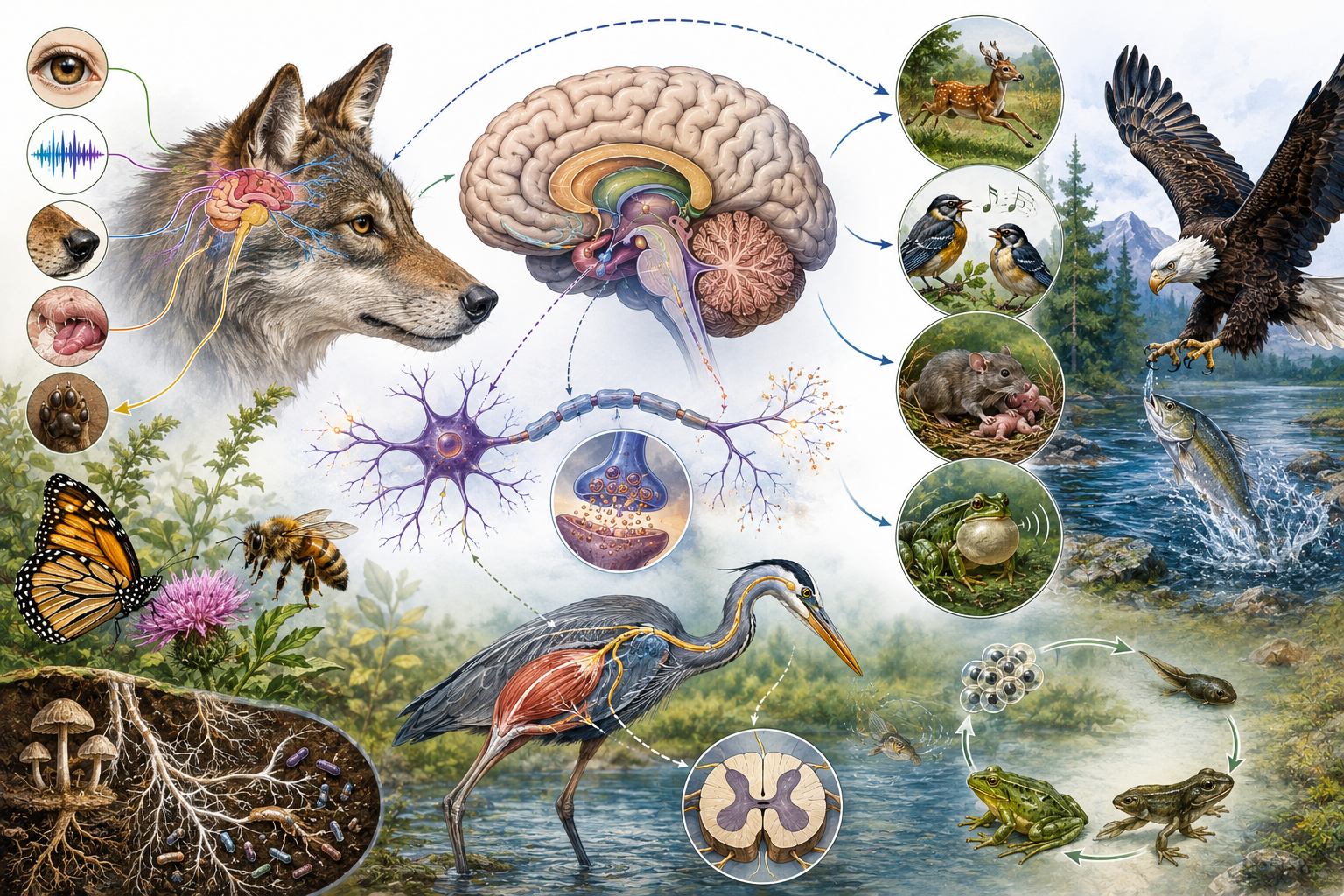
This article develops neurobiology as a scale-spanning framework for understanding living response. It examines neurons, glia, membranes, action potentials, synapses, neurotransmitters, central and peripheral organization, sensory systems, motor output, reflexes, autonomic control, developmental neurobiology, plasticity, learning, memory, behavior, neuroethology, disease, injury, environmental disruption, systems neuroscience, computational modeling, and ecological adaptation.
The article is written for neurobiologists, ecologists, marine biologists, freshwater scientists, medical and environmental-health readers, computational biology readers, biotech readers, biodiversity experts, conservation planners, animal biologists, systems biologists, and research biologists who need a rigorous account of how neural organization links cellular signaling to organismal coordination, behavior, and survival in the world.
The article also extends neurobiology into quantitative and computational biology through membrane-potential dynamics, leaky integration, pulse-response modeling, threshold activation, recurrent network response, feedback control, neural-condition screening, R workflows, Python workflows, SQL provenance structures, and a linked full-stack GitHub repository containing Python, R, Julia, Fortran, Rust, Go, C, C++, SQL, notebooks, data files, and reproducibility documentation.
What neurobiology studies
Neurobiology is the study of nervous systems as living systems of signaling, integration, coordination, and response. It asks how organisms detect stimuli, transmit information, generate perception, produce coordinated outputs, regulate internal states, and organize behavior across changing internal and external conditions. The nervous system can therefore be understood as a specialized biological architecture through which sensing, conduction, processing, modulation, and response become organized rather than merely reactive.
This matters because life is not only a matter of internal chemistry. Organisms must orient, decide, move, regulate, avoid, pursue, learn, communicate, and coordinate. Neurobiology studies the systems through which that responsiveness becomes structured. It links sensation to action, action to physiology, physiology to behavior, behavior to ecology, and ecology to survival.
Neurobiology also studies the fragility of response. When neurons fail, synapses malfunction, circuits are injured, development is disrupted, glia become dysregulated, toxins interfere with signaling, or autonomic control breaks down, the consequences are not confined to a single tissue. They can alter movement, perception, memory, communication, internal regulation, social behavior, feeding, reproduction, and survival.
For research biologists, neurobiology belongs near the center of biology because it explains how living systems become responsive wholes rather than collections of disconnected parts.
The nervous system as an organizer of living response
The nervous system organizes living response by transforming environmental and internal signals into coordinated patterns of activity. Its organized and coordinated activity ultimately manifests in behavior, but it also manifests in posture, internal regulation, attention, movement, orientation, reflexes, physiological adjustment, endocrine modulation, and state-dependent action. The nervous system is therefore not only a communication device. It is the system through which response becomes structured across the organism.
This matters because organisms encounter a world of gradients, threats, opportunities, signals, uncertainty, and changing internal needs. A nervous system allows multiple inputs to be detected, compared, prioritized, inhibited, amplified, stored, and translated into action. Response is therefore not random output but organized biological judgment expressed through motion, secretion, posture, attention, withdrawal, feeding, mating, vigilance, rest, learning, or physiological adjustment.
The nervous system also solves a problem of timing. Some responses must occur quickly, as with reflexes, escape behavior, prey capture, or balance correction. Other responses unfold more slowly, as with learning, memory consolidation, autonomic regulation, developmental refinement, or behavioral adaptation. Neurobiology is therefore a science of response across time scales.
Neurobiology is thus the study of how response becomes coordinated at speed and at scale. It explains how living systems become behaviorally and physiologically coherent under real conditions of uncertainty.
Neurons, glia, and the cellular basis of signaling
The cellular basis of neurobiology begins with neurons, which are specialized for excitability, conduction, synaptic communication, and circuit formation. Neurons receive inputs through dendrites and cell bodies, integrate signals, and transmit outputs along axons. Their structure makes long-distance and networked communication possible within animal bodies.
But neurons are not the whole story. Glial cells support, insulate, maintain, protect, and regulate neural environments. Schwann cells and oligodendrocytes contribute to myelination. Astrocytes help regulate extracellular ions, neurotransmitter levels, metabolic support, and interactions with blood vessels. Microglia participate in immune surveillance, inflammatory response, development, synaptic remodeling, and injury-related processes. Other glial populations contribute to the structural and functional organization of neural tissue.
This matters because living response depends on specialized cellular division of labor. Neurons conduct signals and form circuits, but glia make those circuits viable through structural support, metabolic assistance, myelination, immune function, ion balance, and environmental regulation. Neurobiology is therefore not simply the study of electrically active cells in isolation. It is the study of cellular systems that make signaling possible.
For research biologists, this point is increasingly important because modern neurobiology no longer treats glia as passive support cells. The neural system is a multicellular ecology of function.
Membranes, action potentials, and electrical excitability
Nervous systems depend on electrical excitability. Neurons maintain differences in ion concentration across membranes, and these electrochemical gradients allow changes in membrane potential to carry information. At rest, many neurons maintain a negative membrane potential relative to the outside of the cell. When inputs alter ion conductance sufficiently, a neuron may generate an action potential: a rapid, regenerative electrical event that travels along the axon and helps transmit information to other cells.
This matters because neurobiology depends on physical chemistry as much as on anatomy. Sodium, potassium, calcium, chloride, membrane capacitance, ion channels, pumps, gradients, conductance, and thresholds all contribute to neural signaling. Electrical response is not a metaphor. It is a measurable physiological process rooted in membrane biophysics.
The Hodgkin-Huxley tradition remains foundational because it showed that nerve excitation could be described quantitatively through membrane currents, conductances, and differential equations. This was not merely a technical achievement. It established a model for how biological response could be studied mathematically without abandoning experimental physiology.
For research biologists and computational readers, electrical excitability remains one of the clearest bridges between molecular mechanism, cell physiology, quantitative modeling, and organismal behavior.
Synapses, signals, and the communication of information
Neural systems depend on communication across synapses, where neurons influence one another through chemical or electrical signaling. Chemical synapses dominate in many nervous systems, allowing neurotransmitter release, receptor binding, excitation, inhibition, modulation, plasticity, and context-dependent response. Electrical synapses allow rapid direct coupling under some conditions. Together, synapses make circuit logic possible.
This matters because neurobiology is not only about impulse conduction down single cells. It is about pattern generation across networks. Synapses allow excitation, inhibition, modulation, timing, feedback, adaptation, learning, and circuit architecture. Through these junctions, sensory signals become interpreted, motor commands become sequenced, autonomic regulation becomes coordinated, and experience becomes biologically embodied.
Synaptic transmission also makes nervous systems chemically diverse. Glutamate, GABA, acetylcholine, dopamine, serotonin, norepinephrine, neuropeptides, and many other signaling molecules do not simply “turn neurons on or off.” They shape timing, gain, probability, mood, motivation, arousal, plasticity, reward, attention, autonomic state, and behavioral readiness.
For research biologists, synapses remain central because they are one of the main scales at which molecular, cellular, systems-level, behavioral, and clinical explanations meet.
Central and peripheral organization
In vertebrates, nervous-system organization is commonly divided into the central nervous system and the peripheral nervous system. The central nervous system comprises the brain and spinal cord, while the peripheral nervous system includes sensory and motor structures outside the CNS. The CNS integrates information and directs voluntary and involuntary responses, while peripheral structures link receptors and effectors to central processing.
This matters because response depends on distributed but coordinated organization. The central nervous system supports integration, comparison, memory, planning, reflex coordination, and higher-order processing. Peripheral structures connect the body to the CNS through sensory pathways, motor pathways, autonomic pathways, ganglia, and nerves. Living response is therefore neither wholly centralized nor wholly diffuse. It depends on interaction between localized sensation, peripheral transmission, central integration, and distributed output.
This distinction is especially important in medical, physiological, and computational contexts. A sensory deficit, spinal-cord injury, peripheral neuropathy, autonomic disorder, brain lesion, neuromuscular disease, or synaptic dysfunction can each disturb response in different ways. The nervous system’s organization creates both capacity and vulnerability.
Neurobiology is strongest when it is understood as a science of organized connectivity rather than a simple inventory of organs or nerves.
Sensory systems and the biological problem of perception
Sensory systems allow organisms to detect features of the world such as light, sound, touch, vibration, pressure, chemical gradients, temperature, electric fields, magnetic cues, body position, pain, and internal bodily state. Receptors transform environmental or internal energies into biological signals that can be propagated through nerves and interpreted by circuits. Perception is therefore not a passive copy of the world, but the biologically structured conversion of selected features into meaningful inputs.
This matters because organisms do not respond to the world in direct, unmediated fashion. They respond to filtered, encoded, and interpreted signals. A bat, fish, bird, insect, octopus, shark, rodent, cephalopod, amphibian, and human inhabit different sensory worlds because their receptors, circuits, environments, and ecological demands differ. Perception is therefore an active biological achievement rather than passive registration.
Sensory systems also reveal why neurobiology must remain ecological. Light behaves differently in water and air. Sound travels differently through forests, oceans, and soil. Chemical signals disperse differently in turbulent water, sediments, and open atmosphere. Temperature gradients matter differently to ectotherms and endotherms. Neural response is always embedded in a physical and ecological world.
For research biologists, sensory neurobiology is one of the clearest places where organism, environment, behavior, and evolution meet.
Motor output, reflexes, and coordinated action
The nervous system does not end with perception. It must also generate output. Motor pathways connect the brain and spinal cord to muscles and effectors, allowing locomotion, grasping, feeding, vocalization, posture, withdrawal, orienting behavior, breathing, swallowing, eye movement, and coordinated action. Reflex actions provide rapid patterned responses without requiring extended deliberative processing, demonstrating that some forms of organization are built directly into circuit architecture.
This matters because living response becomes ecologically meaningful only when it produces action. Behavior is not simply generated “by the brain” in a vague sense. It is produced through organized sensorimotor transformation. Reflexes, central pattern generators, motor programs, posture control, voluntary movement, and skilled coordination all show that neurobiology is a science of embodied output as much as internal processing.
Motor systems also reveal hierarchy and feedback. A movement may depend on spinal circuits, brainstem coordination, sensory feedback, cerebellar adjustment, cortical planning, basal ganglia selection, muscle physiology, and peripheral nerve integrity. Output is distributed and recursive, not merely commanded from a single location.
For research biologists, motor organization remains one of the clearest places where anatomy, physiology, computation, and ecological function converge.
Autonomic regulation and internal control
Neural organization also governs internal physiological control through the autonomic nervous system. The autonomic nervous system regulates involuntary physiologic processes including heart rate, blood pressure, respiration, digestion, gut motility, pupil size, sweating, thermoregulation, sexual arousal, stress response, and other background functions essential to internal stability. Sympathetic, parasympathetic, and enteric divisions contribute to this regulation in distinct but interacting ways.
This matters because neurobiology is not only about outward behavior. It is also about the internal management of living systems. Neural organization links directly to cardiovascular control, gut function, respiratory adjustment, endocrine interaction, immune modulation, stress response, sleep-wake cycling, and the background regulation of organs. In that sense, neurobiology belongs closely with physiology and homeostasis.
Autonomic regulation also demonstrates that response is not always conscious. Many vital adjustments occur continuously beneath explicit awareness. The body does not wait for deliberate decision before adjusting heart rate, vascular tone, digestion, pupil diameter, or respiratory rhythm. Neural systems sustain the organism as an internal environment while also preparing it for action in the external world.
For research biologists, this is a reminder that living response includes both outward ecological action and inward regulatory coherence.
Developmental neurobiology and the making of neural systems
Nervous systems are built through development. Cytogenesis, differentiation, neuronal migration, axon guidance, synaptogenesis, neurochemical specification, programmed cell death, myelination, activity-dependent refinement, and experience-dependent remodeling all contribute to the making of neural systems. Neural organization is therefore not simply inherited as a finished structure. It is produced through morphogenesis, signaling, adhesion, pathfinding, maturation, and refinement.
This matters because the organization of living response is built before it is expressed. Development determines which cells become neurons or glia, where neurons settle, which targets they contact, which synapses stabilize, which circuits become functional, and how later plasticity becomes possible. Developmental neurobiology therefore connects directly with broader developmental biology, tissue patterning, gene regulation, cellular signaling, and evolutionary constraint.
Development also creates vulnerability. Nutritional deficiency, toxins, infection, hypoxia, stress, genetic disruption, or altered developmental timing can affect neural organization in ways that persist across the life course. Adult neural function carries developmental history within it.
For research biologists, one of the most important lessons here is that nervous systems are not just structures. They are developmental achievements.
Plasticity, learning, memory, and the history of experience
One of neurobiology’s most consequential themes is plasticity: the capacity of nervous systems to change with experience. Learning, habituation, sensitization, memory formation, skill acquisition, injury recovery, developmental refinement, and experience-dependent adaptation all depend on changes in synaptic strength, circuit organization, gene expression, neuromodulation, or large-scale activity patterns. The nervous system is not merely a fixed response machine. Experience alters it.
This matters because living response is historical as well as immediate. Organisms do not only respond now; they respond with the accumulated consequences of prior exposure, practice, injury, development, social interaction, stress, reward, threat, and ecological history. Plasticity is therefore one of the main ways biology makes use of experience.
Plasticity also complicates any simple separation between nature and nurture. Neural systems are built through inherited developmental programs, but they are also revised through activity, interaction, and environmental exposure. Some plasticity is adaptive; some can become maladaptive. Repeated stress, deprivation, injury, addiction, chronic pain, or pathological learning can reorganize response in harmful ways.
For research biologists, plasticity is especially important because it breaks any simple opposition between innate structure and environmental influence. Neural systems are built, but they are also revised.
Neurobiology, behavior, and the ecology of response
Nervous systems are deeply ecological because behavior is one of the principal ways organisms meet environmental challenge. Signaling units are marshaled to direct behavior, but behavior always unfolds in particular worlds of prey, predators, competitors, mates, currents, substrates, shelters, temperature, oxygen, light, salinity, acoustic conditions, chemical gradients, and social cues. A response system that functions in isolation but fails in the world is not biologically sufficient.
This matters because feeding, predator avoidance, navigation, habitat selection, courtship, parental care, migration, communication, learning, social coordination, and escape behavior all depend on nervous-system organization. Neurobiology therefore belongs within ecology as much as within laboratory science. Sensation, motor coordination, learning, and autonomic state all have ecological consequences.
Neuroethology is especially important here because it studies neural mechanisms in relation to natural behavior. Rather than treating nervous systems as abstract processing devices, neuroethology asks how neural circuits produce biologically meaningful behavior in real organisms facing real ecological problems.
For research biologists, this makes neurobiology especially valuable as a bridge discipline. It links cellular mechanism to ecological action.
Marine, freshwater, soil, and terrestrial neurobiology
Neural organization unfolds under very different environmental constraints across habitats. Aquatic organisms process chemical plumes, flow, pressure, vibration, salinity, electrical fields, and light differently from terrestrial organisms. Soil organisms navigate dark, particulate, chemically dense environments. Freshwater and marine systems impose distinct osmotic, sensory, acoustic, and movement demands. Terrestrial systems often emphasize different combinations of odor, sound, vision, touch, proprioception, and social spacing.
This matters because neurobiology is always situated. A fish, insect, bird, cephalopod, amphibian, annelid, crustacean, nematode, mammal, or reptile solves the problem of living response differently because its world differs. Neural organization is shaped by the environment in which it must operate.
Marine neurobiology may involve pressure, current, acoustic communication, lateral-line sensing, chemical gradients, schooling, and navigation across large spatial scales. Freshwater neurobiology may involve flow, turbidity, conductivity, seasonal change, oxygen variation, and hydrological fragmentation. Soil and sediment neurobiology may involve chemical gradients, vibration, moisture, and constrained movement. Terrestrial neurobiology may involve vision, hearing, olfaction, balance, thermoregulation, and complex social signals under air-based transmission.
For research biologists, this is a reminder that no neurobiology is abstract. Nervous systems are always embodied in habitat.
Neurobiology, disease, injury, and the fragility of coordination
Nervous systems make complex response possible, but they are also vulnerable. Injury, developmental disruption, degeneration, inflammation, ischemia, infection, hypoxia, toxic exposure, metabolic dysfunction, genetic disorders, demyelination, synaptic failure, and neurochemical imbalance can impair perception, coordination, memory, movement, autonomic control, behavior, and survival. Disturbances in nervous-system development can alter later function profoundly, and damage to neural communication can destabilize the organism as a whole.
This matters because response systems are both powerful and fragile. The greater the integration, the greater the potential for systemic dysfunction when signaling fails or structure is damaged. A small disruption at one level may propagate across circuits, behavior, physiological regulation, and ecological performance. A sensory impairment can alter predator detection. A motor impairment can alter feeding. An autonomic impairment can alter internal stability. A developmental disruption can alter behavior across the lifespan.
Neurobiology therefore provides one of biology’s strongest bridges between normal function and pathology. It also connects directly to environmental health, toxicology, disease ecology, developmental biology, and medicine.
For research biologists, fragility is not an exception to nervous-system function. It is part of what reveals how coordination is built.
Conservation, systems thinking, and the neural limits of life
Neurobiology matters for conservation because organisms under environmental stress must still orient, communicate, forage, migrate, evade, reproduce, thermoregulate, and learn. When changing environments disrupt sensory cues, stress regulation, oxygen availability, temperature tolerance, neurochemical signaling, circadian timing, or behavioral coordination, the consequences can cascade into survival and population persistence.
This matters because environmental problems are not only about habitat quantity. They are also about the continued usability of environments by organisms whose nervous systems evolved under particular signal conditions. Noise pollution can mask communication. Light pollution can disrupt navigation and circadian rhythms. Chemical pollutants can interfere with sensory processing or neural development. Thermal stress can alter performance and behavior. Ocean acidification, hypoxia, turbidity, or altered hydrology can disrupt sensory and motor systems. Fragmented habitats can break learned migration pathways or reduce cue reliability.
A habitat may remain physically present while becoming neurologically or behaviorally unusable. This is one reason conservation biology increasingly benefits from behavioral and neurobiological perspectives. Organisms need not only space, food, and mates, but also interpretable environments.
For research biologists, neurobiology provides one of the strongest organism-level windows into how ecological disruption becomes altered response, impaired behavior, and physiological strain.
Systems neuroscience, genomics, and computational relevance
Modern neurobiology increasingly depends on systems neuroscience, developmental genomics, electrophysiology, imaging, connectomics, network analysis, dynamical systems, machine learning, and computational modeling. Molecular, cellular, anatomical, physiological, behavioral, and ecological levels are now commonly studied together. Genes influence development, development shapes circuits, circuits shape behavior, behavior feeds back into experience, and experience alters neural organization.
This matters because nervous systems are multiscale systems. No single level is sufficient on its own. Synapses matter, but so do circuits. Circuits matter, but so do bodies. Bodies matter, but so do environments. Genes matter, but so do activity, history, and context. Computational approaches are essential for making this layered organization legible, whether through differential equations, network models, signal processing, spike-train analysis, connectomic graphs, imaging workflows, or statistical inference.
Computational neurobiology does not replace biological interpretation. It formalizes parts of the problem. A model can represent membrane dynamics, recurrent activity, thresholds, feedback, noise, learning rules, network connectivity, or sensorimotor transformation. But the model must remain connected to measurement, physiology, behavior, and ecological meaning.
For research biologists, this makes neurobiology one of the most integrative fields in modern biology.
Quantitative neurobiology: mathematics, R, and Python
Neurobiology is deeply quantitative because signaling, integration, and response can often be represented through rates, thresholds, adaptation, feedback, and network dynamics. A simple first-pass model of a neural variable relaxing toward a target state can be written as:
\frac{dV}{dt}=-k(V-V^*)
\]
Interpretation: \(V\) is the current state, \(V^*\) is the target or resting state, and \(k\) is the rate of return. Many neural and physiological variables recover toward baseline after perturbation, making this a useful starting point.
A more explicitly neural membrane-integration form can be written as:
\tau\frac{dV}{dt}=-(V-V_{rest})+RI(t)
\]
Interpretation: \(\tau\) is a time constant, \(V_{rest}\) is resting potential, \(R\) is resistance-like scaling, and \(I(t)\) is time-varying input. Neural response depends on integration over time, not only instantaneous state.
At the network level, one can write a compact population-response system as:
\frac{dx_i}{dt}=-x_i+f\left(\sum_j w_{ij}x_j+I_i\right)
\]
Interpretation: \(x_i\) is the activity of unit \(i\), \(w_{ij}\) is the influence of unit \(j\) on unit \(i\), \(I_i\) is external input, and \(f(\cdot)\) is a nonlinear response function. This helps formalize how neural systems generate pattern from connectivity, not just from single-cell properties.
A threshold-spiking simplification can be expressed as:
\text{spike}(t)=
\begin{cases}
1, & V(t)\geq \theta \\
0, & V(t)<\theta
\end{cases}
\]
Interpretation: \(\theta\) is a response threshold. This compact expression is not a full action-potential model, but it captures one of neural computation’s most important concepts: a continuous state can trigger a discrete event when a threshold is crossed.
Worked example: recovery toward baseline
Suppose a neural variable begins at \(V_0=10\), resting value is \(V^*=4\), and \(k=0.3\). Then the state through time can be written as:
V(t)=V^*+(V_0-V^*)e^{-kt}
\]
Interpretation: This expression describes exponential recovery from an initial disturbance toward a resting or target value.
At \(t=5\):
V(5)=4+(10-4)e^{-0.3\cdot5}\approx4+6(0.2231)\approx5.34
\]
Interpretation: The disturbed variable has moved substantially back toward baseline under the simplified model. Neurobiology often goes further by comparing different response rates, repeated perturbations, nonlinear thresholds, adaptation, noise, and interacting network units.
R and Python workflows
The following examples are compact article-level workflows. The full GitHub repository expands them into richer multi-language implementations with SQL provenance, validation notes, membrane-potential integration, pulse-response modeling, threshold-event detection, recurrent network response, neural-condition scoring, feedback control, and reproducible computational neurobiology scaffolding.
R example: leaky neural integration with repeated inputs
# Leaky integrator model in R
#
# This example:
# - models a membrane-like state variable moving toward rest
# - applies repeated input pulses
# - shows transient deviation, decay, and recovery
# - records threshold events as simplified response markers
#
# It is a compact neurobiology scaffold, not a calibrated neuron model.

dt <- 0.1
time <- seq(0, 40, by = dt)

tau <- 3
V_rest <- -65
R <- 1
threshold <- -60

# Input pulses.
I <- rep(0, length(time))
I[time >= 5 & time < 8] <- 8
I[time >= 15 & time < 17] <- 5
I[time >= 28 & time < 31] <- 10

V <- numeric(length(time))
V[1] <- V_rest

for (t in 2:length(time)) {
  dV <- (-(V[t - 1] - V_rest) + R * I[t - 1]) / tau
  V[t] <- V[t - 1] + dV * dt
}

events <- ifelse(V >= threshold, 1, 0)

results <- data.frame(
  time = time,
  input = I,
  voltage_state = V,
  threshold_event = events
)

print(head(round(results, 3), 20))
print(
  data.frame(
    max_voltage = max(V),
    event_count = sum(events),
    final_voltage = tail(V, 1)
  )
)

plot(
  time,
  V,
  type = "l",
  lwd = 2,
  xlab = "Time",
  ylab = "Membrane-like state variable",
  main = "Leaky Neural Integration with Repeated Inputs"
)

abline(h = V_rest, lty = 2)
abline(h = threshold, lty = 3)
This R workflow is more useful than a single recovery curve because it shows time-dependent integration, repeated perturbation, return toward baseline, and threshold-like response events under changing input rather than one isolated disturbance. A research biologist could adapt it for sensory response, stress signaling, repeated stimulation, compact systems-neuroscience teaching models, or simplified neurophysiological response screening.
Python example: small neural network response and threshold activation
import numpy as np
import pandas as pd

# Small 3-unit recurrent network.
# Positive values represent excitatory influence;
# negative values represent inhibitory influence.
weights = np.array([
    [0.0,  0.8, -0.4],
    [0.6,  0.0,  0.5],
    [-0.3, 0.7,  0.0]
])

def sigmoid(x):
    """Nonlinear activation function."""
    return 1 / (1 + np.exp(-x))

time_steps = 30
activity = np.zeros((time_steps, 3))
inputs = np.zeros((time_steps, 3))

# External inputs applied at different times.
inputs[5:12, 0] = 1.5
inputs[10:18, 1] = 1.0
inputs[20:26, 2] = 1.8

for t in range(1, time_steps):
    recurrent_drive = weights @ activity[t - 1]
    activity[t] = (
        0.85 * activity[t - 1] +
        sigmoid(recurrent_drive + inputs[t - 1])
    )

activity_df = pd.DataFrame(
    activity,
    columns=["unit_1", "unit_2", "unit_3"]
)

activity_df["time"] = np.arange(time_steps)

# Threshold crossings as simplified response events.
threshold = 1.2
events = (
    activity_df[["unit_1", "unit_2", "unit_3"]] > threshold
).astype(int)

event_summary = events.sum().rename("event_count").to_frame()

print("Network activity:")
print(activity_df.round(3))

print("\nThreshold events:")
print(events)

print("\nEvent summary:")
print(event_summary)
This Python workflow is more useful because it moves from a single regulated variable to a small interacting network. It includes recurrent weights, time-varying inputs, nonlinear activation, and threshold events, making it closer to the logic of systems neuroscience than a one-parameter decay model alone. A research biologist could adapt it for neural population activity, simplified circuit motifs, sensory integration, behavioral-state screening, or comparative response architectures.
Python example: feedback-control screening for neural response stability
import numpy as np
import pandas as pd

def simulate_feedback_response(
    steps=80,
    dt=0.1,
    initial_state=1.5,
    target_state=0.0,
    recovery_rate=0.35,
    feedback_gain=0.20,
    noise_sd=0.03,
    perturbation_step=25,
    perturbation_size=1.0,
    seed=42
):
    """Compact neural-response feedback model."""
    rng = np.random.default_rng(seed)
    state = initial_state
    rows = []

    for t in range(steps):
        if t == perturbation_step:
            state += perturbation_size

        error = state - target_state
        feedback = -feedback_gain * error
        recovery = -recovery_rate * error
        noise = rng.normal(0, noise_sd)

        state = state + dt * (recovery + feedback) + noise

        rows.append({
            "time": t * dt,
            "state": state,
            "error": error,
            "feedback": feedback
        })

    return pd.DataFrame(rows)

scenarios = {
    "low_feedback": 0.05,
    "moderate_feedback": 0.20,
    "high_feedback": 0.45
}

summary_rows = []

for label, gain in scenarios.items():
    trajectory = simulate_feedback_response(feedback_gain=gain)
    summary_rows.append({
        "scenario": label,
        "max_abs_state": trajectory["state"].abs().max(),
        "final_abs_error": abs(trajectory["state"].iloc[-1]),
        "mean_abs_error": trajectory["state"].abs().mean()
    })

summary = pd.DataFrame(summary_rows)

print(summary.round(3).to_string(index=False))
This feedback-control scaffold shows how neural or physiological response stability can be compared across regulatory assumptions. A production workflow could extend it with nonlinear feedback, multiple interacting circuits, sensory input, autonomic variables, electrophysiological data, experimental perturbations, or uncertainty intervals.
These examples remain compact enough for an article, but they point toward the kinds of workflows scientists actually use: dynamical integration, repeated perturbation, threshold behavior, nonlinear activation, recurrent connectivity, feedback stability, and interacting networks rather than single illustrative curves alone.
GitHub repository
The article body includes compact R and Python examples so the biological and scientific argument remains readable. The full repository expands those examples into a broader computational neurobiology workflow, including membrane-potential integration, pulse-response modeling, threshold-event detection, recurrent network response, neural-condition scoring, feedback control, SQL provenance structures, reproducible data files, and full-stack scientific-computing examples across Python, R, Julia, Fortran, Rust, Go, C, C++, SQL, and notebooks.
Limits, complexity, and modern neurobiological thinking
Neurobiology is foundational, but it should not be oversimplified into a mechanical picture of wires and outputs. Nervous systems are developmental, embodied, plastic, ecological, metabolically dependent, historically evolved, and dynamically regulated. Neural organization emerges over long trajectories, and function is distributed across molecular, cellular, anatomical, physiological, behavioral, and ecological levels.
This matters because no single level is sufficient. Synapses matter, but so do tissues and behaviors. Genes matter, but so do circuits and experience. Central and peripheral divisions matter, but so does the ecological world in which the system operates. Models matter, but so do experiments, imaging, electrophysiology, anatomy, observation, natural history, and clinical evidence.
Computational models can clarify organization, identify mechanisms, expose assumptions, and make response dynamics testable. But a leaky integrator is not a full neuron, a recurrent matrix is not a nervous system, and a threshold event is not the whole of action-potential physiology. Models are most useful when they are treated as structured biological hypotheses rather than replacements for the living systems they approximate.
For research biologists, this means neurobiology is strongest when it preserves layered complexity rather than flattening it into one favored mechanism.
Why this matters for scientific work
Neurobiology matters across neuroscience, medicine, physiology, animal biology, developmental biology, behavior, ecology, conservation biology, restoration ecology, disease ecology, environmental health, marine biology, freshwater biology, toxicology, biotechnology, and computational biology because nervous systems organize response. For neurobiologists, the value is direct: nervous systems reveal how signaling, integration, and action become coordinated. For physiologists, neurobiology explains how internal regulation is controlled. For developmental biologists, it shows how circuit architecture emerges. For behavioral ecologists, it links perception and action to survival and reproduction.
For conservation and environmental-health readers, neurobiology helps explain how pollutants, noise, heat, hypoxia, light, habitat disruption, and altered sensory landscapes can impair organisms before population decline becomes obvious. A species may remain present while its ability to navigate, communicate, forage, reproduce, avoid predators, or regulate stress is already compromised. For marine and freshwater scientists, sensory and neural systems are especially important because sound, light, pressure, flow, conductivity, oxygen, and chemistry shape living response.
For computational readers, neurobiology provides one of biology’s richest domains for dynamical systems, differential equations, network models, feedback control, signal processing, time-series analysis, threshold modeling, machine learning, and reproducible simulation. But its computational treatment remains strongest when tied to physiology, experiment, organismal biology, and ecological meaning.
Neurobiology is therefore more than the study of the nervous system. It is the study of how life becomes organized response.
Conclusion
Neurobiology and the organization of living response show that life persists not only through energy, structure, development, reproduction, and regulation, but through the capacity to sense, integrate, communicate, remember, adjust, and act. Nervous systems organize perception, motor output, autonomic control, behavior, learning, and adaptation across changing internal and external conditions.
To understand neurobiology is therefore to understand one of biology’s deepest organizing achievements: the transformation of signal into coordinated living response. Nervous systems make organisms into responsive wholes. They connect bodies to environments, internal states to external action, experience to future behavior, and cellular signaling to ecological survival.
Neurobiology is thus more than the study of the nervous system in isolation. It is one of the principal ways biology explains how life becomes responsive at all.
Related articles
- Biology
- Physiology and the Regulation of Living Systems
- Animal Biology and the Organization of Complex Life
- Development, Differentiation, and the Making of Organisms
- Behavior, Communication, and Biological Strategy
- Immunology and Biological Defense
- Ecology and the Interdependence of Life
- Reproduction, Life Cycles, and Biological Continuity
- Population Dynamics and Ecological Modeling
- Natural Selection, Adaptation, and Fitness
Further reading
- Purves, D. et al. (2001) Neuroscience. 2nd edn. Sunderland, MA: Sinauer Associates. Available at: https://www.ncbi.nlm.nih.gov/books/NBK10799/
- Purves, D. et al. (2001) ‘The Organization of the Nervous System’, in Neuroscience. 2nd edn. Sunderland, MA: Sinauer Associates. Available at: https://www.ncbi.nlm.nih.gov/books/NBK10915/
- Purves, D. et al. (2001) ‘Neural Systems’, in Neuroscience. 2nd edn. Sunderland, MA: Sinauer Associates. Available at: https://www.ncbi.nlm.nih.gov/books/NBK11061/
- National Research Council (1989) ‘The Nervous System and Behavior’, in Opportunities in Biology. Washington, DC: National Academies Press. Available at: https://www.ncbi.nlm.nih.gov/books/NBK217810/
- Hodgkin, A.L. and Huxley, A.F. (1952) ‘A quantitative description of membrane current and its application to conduction and excitation in nerve’, The Journal of Physiology, 117(4), pp. 500–544. Available at: https://pmc.ncbi.nlm.nih.gov/articles/PMC1392413/
- Kandel, E.R., Koester, J.D., Mack, S.H. and Siegelbaum, S.A. (2021) Principles of Neural Science. 6th edn. New York: McGraw Hill. Publisher information available at: https://www.mheducation.com/highered/mhp/product/principles-neural-science-sixth-edition.html
- Waxenbaum, J.A., Reddy, V. and Varacallo, M. (2023) ‘Anatomy, Autonomic Nervous System’, StatPearls. Treasure Island, FL: StatPearls Publishing. Available at: https://www.ncbi.nlm.nih.gov/books/NBK539845/
- Chen, I. and Lui, F. (2023) ‘Neuroanatomy, Neuron Action Potential’, StatPearls. Treasure Island, FL: StatPearls Publishing. Available at: https://www.ncbi.nlm.nih.gov/books/NBK546639/
- Sheffler, Z.M., Reddy, V. and Pillarisetty, L.S. (2023) ‘Physiology, Neurotransmitters’, StatPearls. Treasure Island, FL: StatPearls Publishing. Available at: https://www.ncbi.nlm.nih.gov/books/NBK539894/
- National Research Council and Institute of Medicine (2000) ‘The Developing Brain’, in From Neurons to Neighborhoods: The Science of Early Childhood Development. Washington, DC: National Academies Press. Available at: https://www.ncbi.nlm.nih.gov/books/NBK225562/
- National Research Council (1997) Developmental Neurobiology of the Central Nervous System. Washington, DC: National Academies Press. Available at: https://www.ncbi.nlm.nih.gov/books/NBK218958/
- Nature Education (n.d.) Behavioral Genomics. Available at: https://www.nature.com/scitable/topicpage/behavioral-genomics-29093/
References
- Britannica (2026) Nervous System. Available at: https://www.britannica.com/science/nervous-system
- Britannica (2026) Central Nervous System. Available at: https://www.britannica.com/science/central-nervous-system
- Chen, I. and Lui, F. (2023) ‘Neuroanatomy, Neuron Action Potential’, StatPearls. Treasure Island, FL: StatPearls Publishing. Available at: https://www.ncbi.nlm.nih.gov/books/NBK546639/
- Hodgkin, A.L. and Huxley, A.F. (1952) ‘A quantitative description of membrane current and its application to conduction and excitation in nerve’, The Journal of Physiology, 117(4), pp. 500–544. Available at: https://pmc.ncbi.nlm.nih.gov/articles/PMC1392413/
- Kandel, E.R., Koester, J.D., Mack, S.H. and Siegelbaum, S.A. (2021) Principles of Neural Science. 6th edn. New York: McGraw Hill. Publisher information available at: https://www.mheducation.com/highered/mhp/product/principles-neural-science-sixth-edition.html
- National Research Council (1989) ‘The Nervous System and Behavior’, in Opportunities in Biology. Washington, DC: National Academies Press. Available at: https://www.ncbi.nlm.nih.gov/books/NBK217810/
- National Research Council (1997) Developmental Neurobiology of the Central Nervous System. Washington, DC: National Academies Press. Available at: https://www.ncbi.nlm.nih.gov/books/NBK218958/
- National Research Council and Institute of Medicine (2000) ‘The Developing Brain’, in From Neurons to Neighborhoods: The Science of Early Childhood Development. Washington, DC: National Academies Press. Available at: https://www.ncbi.nlm.nih.gov/books/NBK225562/
- Nature Education (n.d.) Behavioral Genomics. Available at: https://www.nature.com/scitable/topicpage/behavioral-genomics-29093/
- Nature Education (n.d.) Ephs, Ephrins, and Bidirectional Signaling. Available at: https://www.nature.com/scitable/topicpage/ephs-ephrins-and-bidirectional-signaling-14403965/
- Purves, D., Augustine, G.J., Fitzpatrick, D., Katz, L.C., LaMantia, A.S., McNamara, J.O. and Williams, S.M. (2001) Neuroscience. 2nd edn. Sunderland, MA: Sinauer Associates. Available at: https://www.ncbi.nlm.nih.gov/books/NBK10799/
- Purves, D. et al. (2001) ‘The Organization of the Nervous System’, in Neuroscience. 2nd edn. Sunderland, MA: Sinauer Associates. Available at: https://www.ncbi.nlm.nih.gov/books/NBK10915/
- Purves, D. et al. (2001) ‘Neural Systems’, in Neuroscience. 2nd edn. Sunderland, MA: Sinauer Associates. Available at: https://www.ncbi.nlm.nih.gov/books/NBK11061/
- Sheffler, Z.M., Reddy, V. and Pillarisetty, L.S. (2023) ‘Physiology, Neurotransmitters’, StatPearls. Treasure Island, FL: StatPearls Publishing. Available at: https://www.ncbi.nlm.nih.gov/books/NBK539894/
- Waxenbaum, J.A., Reddy, V. and Varacallo, M. (2023) ‘Anatomy, Autonomic Nervous System’, StatPearls. Treasure Island, FL: StatPearls Publishing. Available at: https://www.ncbi.nlm.nih.gov/books/NBK539845/