
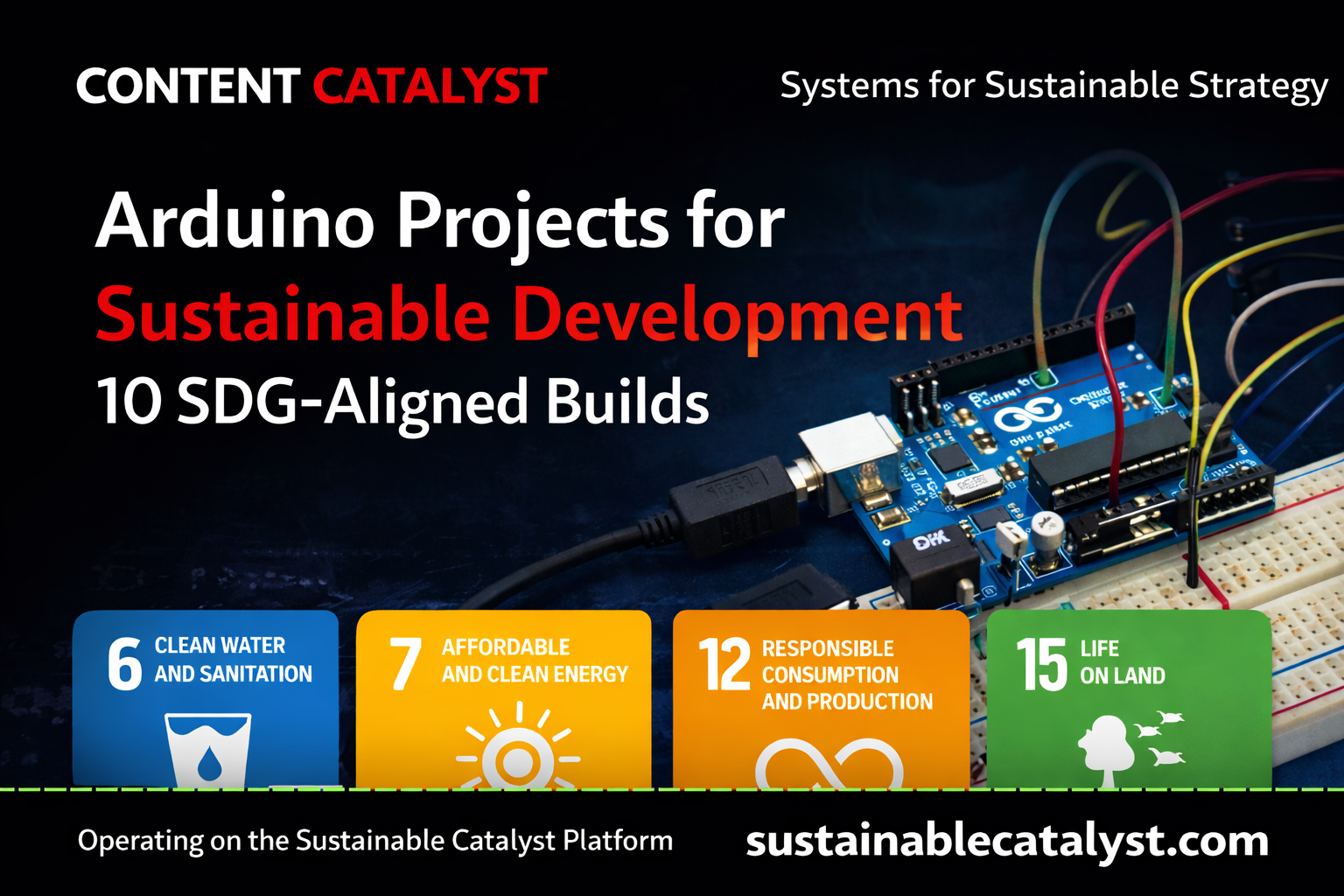
One of the most accessible platforms for experimenting with these ideas is Arduino. Arduino boards combine simple hardware with a beginner-friendly programming environment based on C and C++, making them ideal for prototyping distributed sensing systems.
The projects below explore how low-cost electronics can support the goals of the United Nations Sustainable Development Goals (SDGs). Each project connects to one or more policy objectives, including water conservation, renewable energy, responsible consumption, and biodiversity monitoring.
These builds are educational prototypes rather than certified environmental instruments. However, they illustrate an important idea: sustainable development ultimately depends on the systems we build to measure and respond to environmental conditions.
Arduino and the Rise of Distributed Environmental Monitoring
Environmental governance increasingly depends on distributed data. From watershed monitoring and air quality sensing to wildlife tracking and decentralized energy systems, many sustainability challenges require observations that are local, continuous, and affordable.
Arduino platforms help make that possible. Although they do not replace laboratory-grade instruments or official monitoring networks, they provide an accessible foundation for field experimentation, community sensing, and early-stage environmental instrumentation. In that sense, Arduino projects for sustainable development serve not only as educational exercises, but also as prototypes for broader systems of measurement and response.
Table of Contents
- 1. Smart Irrigation Controller
- 2. Solar-Powered Arduino Charging System
- 3. Air Quality Monitor
- 4. Automated Compost Monitor
- 5. Litter-Collecting Robot
- 6. Home Energy Usage Tracker
- 7. Smart Recycling Sorter
- 8. Wildlife Tracker Collar
- 9. Water Pollution Detector
- 10. Beehive Health Monitor
1. Smart Irrigation Controller
SDG alignment: SDG 6 — Clean Water and Sanitation
Water scarcity is one of the defining sustainability challenges of the 21st century. Agriculture accounts for a significant share of global freshwater withdrawals, and inefficient irrigation practices can lead to substantial water waste.
A smart irrigation controller uses a soil moisture sensor connected to an Arduino to determine when watering is actually necessary. When soil moisture falls below a defined threshold, a relay activates a pump or irrigation valve.
Typical components
- Arduino Uno or Nano
- Capacitive soil moisture sensor
- Relay module
- Water pump or solenoid valve
- Optional temperature and humidity sensor
Why it matters
Improving irrigation efficiency supports water conservation efforts and aligns directly with SDG 6 targets related to sustainable water management.
Tutorial: Building an Arduino Smart Irrigation Controller (SDG 6: Clean Water and Sanitation)
2. Solar-Powered Arduino Charging System
SDG alignment: SDG 7 — Affordable and Clean Energy
Access to reliable electricity remains uneven across the world. Renewable micro-power systems can provide small but meaningful sources of energy in off-grid or emergency contexts.
This project combines a solar panel, lithium battery, charge controller, and voltage regulation circuit to create a small off-grid power system capable of charging embedded devices. An Arduino can optionally monitor battery voltage and display charge levels.
Typical components
- Arduino Nano
- Small solar panel
- Lithium battery
- Charging module
- Boost converter
Why it matters
Projects like this illustrate how decentralized renewable energy systems can expand access to electricity and reduce reliance on fossil-fuel power sources.
Tutorial: Building a Solar-Powered Arduino Charging System (SDG 7: Affordable and Clean Energy)
3. Air Quality Monitor
SDG alignment: SDG 11 — Sustainable Cities and Communities
Air pollution remains one of the most significant environmental health risks globally. Monitoring air quality is essential for understanding pollution patterns and informing urban environmental policy.
An Arduino or ESP32 can connect to particulate matter sensors and gas sensors to measure pollutants such as PM2.5 and volatile organic compounds.
Typical components
- ESP32 or Arduino board
- PM2.5 particulate sensor
- Gas sensor for VOCs or CO₂
- OLED display
Why it matters
Distributed monitoring systems can complement official air quality networks by providing localized data and supporting community awareness of environmental health risks.
Tutorial: Building an Arduino Air Quality Monitoring Station (SDG 11: Sustainable Cities and Communities)
4. Automated Compost Monitor
SDG alignment: SDG 12 — Responsible Consumption and Production
Food waste is a major contributor to landfill methane emissions. Composting converts organic waste into valuable soil nutrients, but successful composting depends on maintaining proper environmental conditions.
An Arduino can monitor temperature and humidity inside a compost system and provide feedback about decomposition conditions. A motorized tumbler can periodically rotate the compost to improve aeration.
Typical components
- Arduino Uno
- Temperature sensor
- Humidity sensor
- Servo motor
Why it matters
Better compost management supports waste diversion strategies and circular economy principles emphasized in SDG 12.
Tutorial: Building an Arduino Compost Monitoring System (SDG 12: Responsible Consumption and Production)
5. Litter-Collecting Robot
SDG alignment: SDG 14 — Life Below Water
Plastic pollution in oceans and waterways has become a major environmental concern. While large-scale cleanup efforts require industrial infrastructure, robotics experiments can illustrate how automation may assist environmental maintenance.
This project uses ultrasonic sensors and a robotic chassis to detect objects and collect lightweight litter using a claw mechanism.
Typical components
- Arduino Uno
- Ultrasonic distance sensors
- Servo motors
- Motor driver module
Why it matters
Projects like this help explore how robotics and automation could support environmental cleanup strategies.
Tutorial: Building an Arduino Litter-Collecting Robot (SDG 14: Life Below Water)
6. Home Energy Usage Tracker
SDG alignment: SDG 7 — Affordable and Clean Energy
Reducing energy demand is a central component of climate mitigation strategies. However, households often lack visibility into how much electricity individual appliances consume.
An Arduino-based monitoring system can measure current draw using a sensor and log energy consumption over time.
Typical components
- Arduino Uno
- Current sensor module
- Real-time clock module
- SD card module
Why it matters
Energy monitoring helps identify inefficient devices and supports more informed household energy management.
Tutorial: Building an Arduino Home Energy Monitoring System (SDG 7: Affordable and Clean Energy)
7. Smart Recycling Sorter
SDG alignment: SDG 12 — Responsible Consumption and Production
Recycling systems rely heavily on accurate waste sorting. Contamination in recycling streams can significantly reduce the efficiency of recycling facilities.
A prototype recycling sorter uses color sensors and weight sensors to classify materials and direct them into separate bins.
Typical components
- Arduino Uno
- Color sensor
- Load cell sensor
- Servo motors
Why it matters
Automation can help improve recycling processes and reinforce circular economy principles.
Tutorial: Building an Arduino Smart Recycling Sorter (SDG 12: Responsible Consumption and Production)
8. Wildlife Tracker Collar
SDG alignment: SDG 15 — Life on Land
Understanding animal movement patterns is critical for wildlife conservation and habitat protection.
A low-power Arduino device equipped with GPS and long-range radio communication can record location data and transmit it periodically.
Typical components
- Arduino Nano
- GPS module
- LoRa communication module
- Battery system
Why it matters
Tracking data helps researchers understand migration patterns and habitat usage, which can inform conservation policy and land management strategies.
Tutorial: Building a Low-Power Arduino Wildlife Tracking Device (SDG 15: Life on Land)
9. Water Pollution Detector
SDG alignment: SDG 6 — Clean Water and Sanitation
Water quality monitoring is essential for protecting ecosystems and ensuring safe drinking water supplies.
An Arduino-based monitoring station can measure pH, turbidity, and temperature to identify potential water contamination.
Typical components
- Arduino Uno
- pH sensor
- Turbidity sensor
- Temperature sensor
- Wireless module
Why it matters
Low-cost monitoring systems can support citizen science initiatives and expand environmental observation networks.
Tutorial: Building an Arduino Water Quality Monitoring Station (SDG 6: Clean Water and Sanitation)
10. Beehive Health Monitor
SDG alignment: SDG 15 — Life on Land
Pollinators play a crucial role in global food systems and biodiversity. Monitoring hive conditions can help identify early signs of colony stress or disease.
An Arduino-based system can track temperature, humidity, and hive weight to monitor colony health over time.
Typical components
- Arduino board
- Temperature and humidity sensors
- Load cell weight sensor
- Optional acoustic sensor
Why it matters
Monitoring pollinator health contributes to broader efforts to protect biodiversity and maintain resilient agricultural ecosystems.
Tutorial: Building an Arduino Beehive Monitoring System (SDG 15: Life on Land)
Why Arduino Projects for Sustainable Development Matter
The Sustainable Development Goals emphasize global policy coordination, but they also depend on data and measurement systems.
From water management and air pollution monitoring to energy use and biodiversity tracking, effective sustainability policy requires reliable environmental information.
Low-cost embedded systems cannot replace large scientific instruments or government monitoring networks. However, they can complement them by enabling distributed sensing, citizen science, and rapid experimentation.
Platforms like Arduino demonstrate how accessible technology can expand the tools available for sustainability research, education, and innovation.
These Arduino projects for sustainable development illustrate how low-cost embedded systems can support environmental monitoring, citizen science, and sustainability experimentation.
Ultimately, sustainable development is not only about policy frameworks. It is also about the systems we build to observe, measure, and respond to the environmental challenges around us.
Explore the Full Arduino Sustainability Series
This article serves as the central index for the Sustainable Catalyst series on Arduino projects for sustainable development. Each project explores how low-cost embedded systems can support environmental monitoring, infrastructure experimentation, and sustainability research aligned with the United Nations Sustainable Development Goals.
The tutorials linked above provide more detailed engineering guides, including system architecture, sensor design, wiring logic, and Arduino code implementations.