
Catalyst Grit
Catalyst Grit is a resilience and recovery module for builders—designed to track setbacks, recovery time, and what helps you regain momentum.
It’s a lightweight system for pattern recognition, not motivational content.
Principle: progress is rarely linear. What matters is how fast you recover—and what you learn.
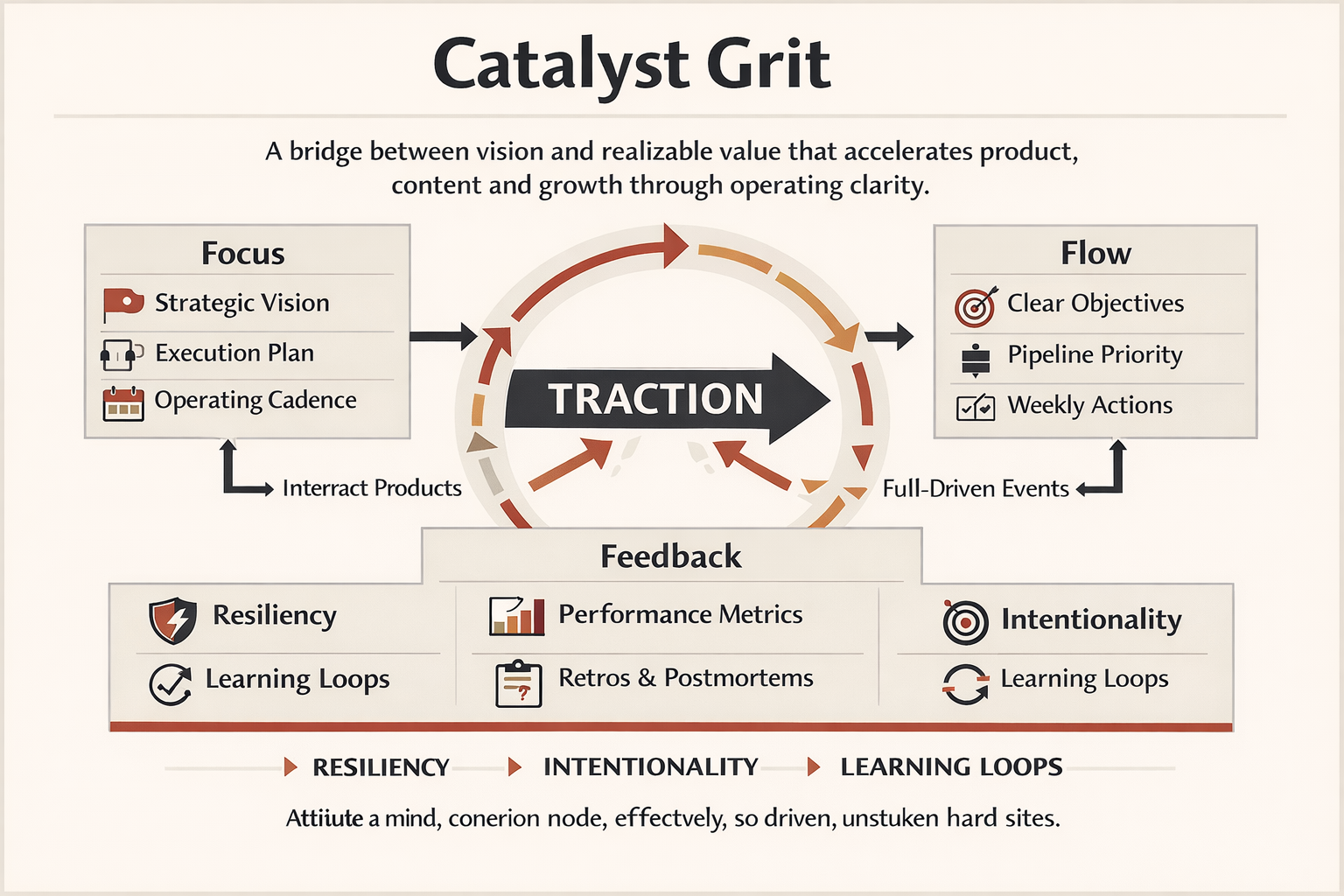
A visual framework for Catalyst Grit, showing how focus, flow, feedback, and learning loops support traction through resilient execution.
What it is
Catalyst Grit is a structured way to record setbacks and recovery—so you can see patterns over time.
It supports simple, repeatable reflection and a basic scoring layer of perseverance plus resilience that helps you notice drift early.
- Setback logging — what happened, what changed, what it affected
- Recovery tracking — time-to-recover and “what helped” notes
- Signals — simple resilience and perseverance scoring over time
- Suggestion engine — light prompts based on recent patterns, optional
Why it matters
-
Resilience is a system, not a slogan
Most people don’t need more motivation—they need a way to see what breaks momentum and what restores it. Grit treats resilience like a trackable process.
-
Track recovery, not perfection
You don’t need a perfect streak. You need reliable recovery. This module emphasizes bounce-back time and learning loops after disruptions.
-
Make setbacks usable data
A setback can become a useful signal when recorded consistently: triggers, conditions, consequences, and responses that worked or didn’t.
-
Protect long projects
Open-source work, sustainability study, and building in public are long games. Grit is designed to help you sustain effort without burning out.
What it tracks
Grit is intentionally simple: it tracks a small set of fields consistently rather than collecting everything.
Typical records include:
- Setback type — fatigue, interruption, conflict, complexity, ambiguity, and more
- Context — workload, environment, constraints, and time pressure
- Impact — what slipped, what stalled, and what was at risk
- Response — what you did next, and what you avoided
- Recovery time — how long it took to return to baseline
- What helped — sleep, planning, reducing scope, asking for help, reframing, and similar supports
How it connects to the platform
-
Human Systems
Provides the framing: incentives, stress, coordination, and decision context. Catalyst Grit is the personal tracking layer inside that pillar.
-
Catalyst Canvas
Use Canvas to convert setbacks into experiments: reduce scope, change constraints, test new workflows, and document what works.
-
Narrative & Strategy
Helps keep interpretation honest: separate what happened, what you inferred, and what you believe—without rewriting history.
-
Infrastructure
If you want the durable version: consistent logs, clean exports, and a record you can learn from over years.
Boundaries
Catalyst Grit is educational and organizational. It is not therapy, not a medical tool, and not a substitute for professional mental health support.
It is designed to help people track patterns and maintain sustainable momentum.