
Last Updated May 28, 2026
Circular chemistry examines how molecules, materials, products, and waste streams can be redesigned so that useful matter remains useful for longer, moves safely through multiple cycles, and does not become an unmanaged burden for ecosystems, workers, communities, or future generations. It begins with a simple but difficult question: what would chemistry look like if materials were designed not only for performance and price, but also for durability, repair, reuse, separability, recovery, recycling, degradation, traceability, and lower toxicity?
The central thesis of circular chemistry is that waste is not merely the end of a product’s life. Waste is often the visible result of design decisions made much earlier: molecular architecture, additive choice, polymer blend, catalyst system, solvent system, product format, joining method, packaging design, recovery infrastructure, contamination tolerance, collection economics, and regulatory responsibility. A circular material future cannot be built by recycling symbols alone. It requires chemistry that anticipates the next use before the first use begins.
Circular chemistry therefore shifts the purpose of chemical design. A molecule or material should not be judged only by what it does during its first use. It should also be judged by what happens after that use: whether it can be repaired, reused, separated, depolymerized, purified, recovered, safely degraded, or kept out of harmful exposure pathways. Chemistry becomes circular when it treats end-of-life not as disposal, but as an upstream design constraint.
Main Library
Publications
Article Map
Chemistry
Related Topic
Environmental Science
Related Topic
Risk & Resilience
Related Topic
Economic Systems
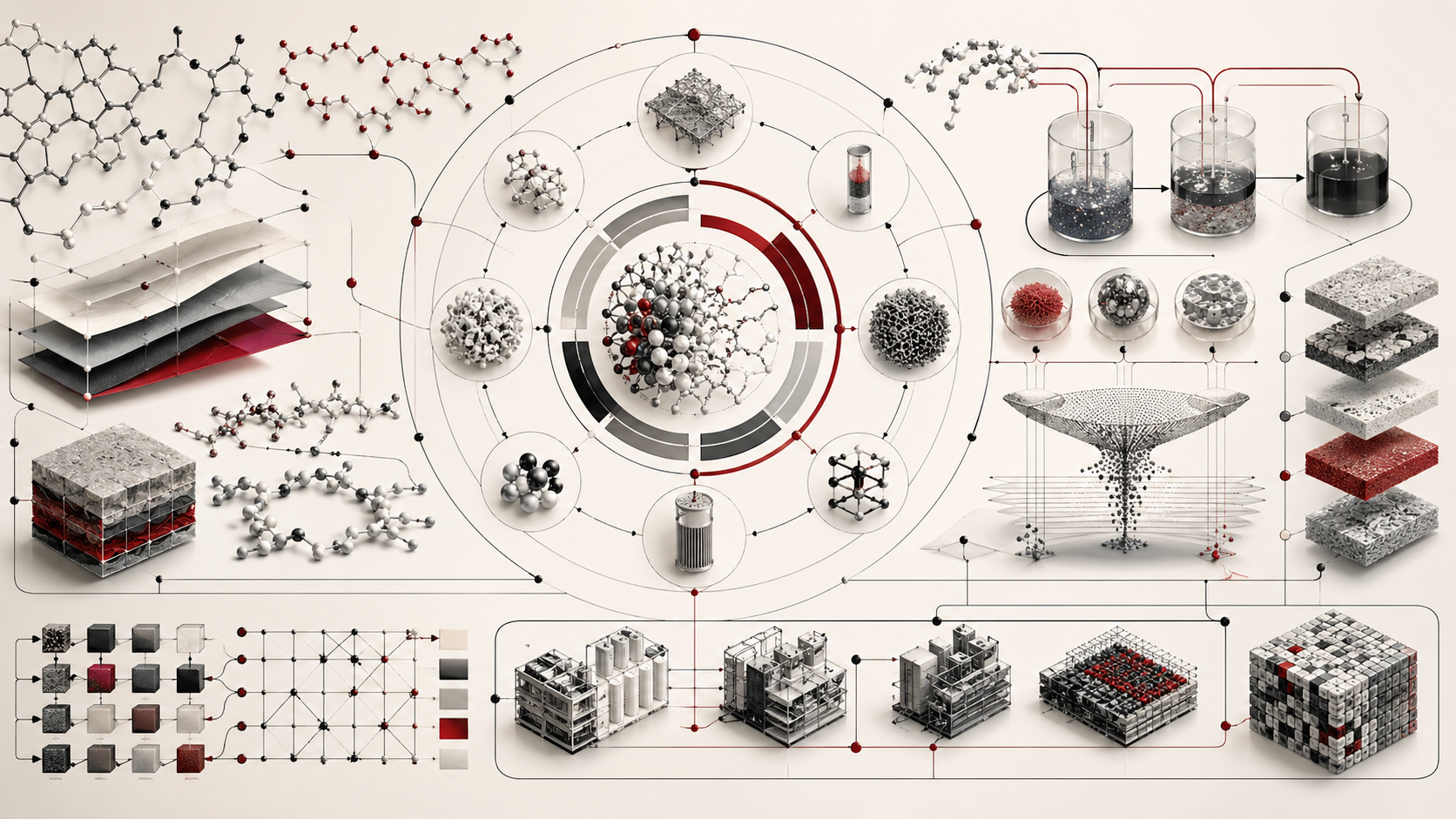
What Circular Chemistry Studies
Circular chemistry studies how chemical products and materials can be designed, used, recovered, transformed, and reused with lower waste, lower hazard, and higher retained value. It is concerned with polymer architecture, monomer recovery, solvent recycling, catalyst recovery, additive chemistry, materials compatibility, separation chemistry, contamination, durability, degradation, product stewardship, waste characterization, industrial symbiosis, life-cycle assessment, and circular business models.
At its strongest, circular chemistry is not merely recycling chemistry. It is design chemistry. It asks whether a polymer can be depolymerized into useful monomers, whether a material blend can be separated, whether additives create toxic recycling loops, whether a solvent can be recovered repeatedly, whether a catalyst can be reused, whether metals can be selectively leached and recovered, whether a product can be repaired rather than discarded, and whether the next material cycle is safer than the last.
Circular chemistry therefore overlaps with green chemistry, industrial ecology, materials science, environmental chemistry, toxicology, chemical engineering, analytical chemistry, public policy, economics, and waste governance. Its object is not a single molecule in isolation, but a molecule moving through time.
For researchers and scientists, circular chemistry requires a shift from static composition to dynamic material fate. A compound, polymer, alloy, solvent, battery material, catalyst, coating, or composite should be studied not only as a substance with properties, but as a participant in a system of extraction, production, use, degradation, recovery, loss, exposure, and reuse.
The Linear Material Problem
The dominant industrial material model has long been linear: extract resources, manufacture products, distribute them, use them, discard them, and manage the waste. This model creates enormous material throughput. It also hides chemical complexity at the point of disposal. A discarded product may contain polymers, pigments, flame retardants, plasticizers, stabilizers, adhesives, metals, coatings, fillers, composites, electronic components, batteries, residues, contaminants, and unknown additives.
Waste is rarely chemically simple. A waste stream can be heterogeneous, degraded, contaminated, mixed, weathered, hazardous, valuable, or impossible to separate economically. Circular chemistry begins by recognizing that end-of-life complexity is often produced by upstream design. Materials that are bonded, blended, coated, filled, laminated, dyed, and chemically stabilized for performance may become difficult to recover later.
The linear model also externalizes harm. Landfills, incinerators, informal recycling yards, polluted waterways, export waste streams, abandoned industrial sites, contaminated communities, and occupational exposure are not accidents outside the material economy. They are part of the material economy. Circular chemistry asks how chemistry can reduce the creation of those burdens at the source.
The linear model also loses information. Once a material enters waste systems without a reliable record of composition, additives, processing history, contamination, and use conditions, recovery becomes uncertain. Circular chemistry must therefore treat information as part of material value. Without chemical identity and traceability, useful matter becomes difficult to trust.
Designing Out Waste Before It Exists
The most powerful circular strategy is to design waste out of the system before it is generated. This means designing products and materials that require less virgin input, last longer, use safer additives, avoid unnecessary complexity, support repair, permit disassembly, and remain recoverable at end of use. It also means avoiding products that are technically recyclable but practically unrecoverable.
Designing out waste requires chemistry to work with product design, logistics, manufacturing, consumer behavior, and policy. A material that can be recycled only in a laboratory is not automatically circular. A polymer that can be depolymerized only with high energy, pure feedstock, expensive catalysts, and narrow conditions may still be useful, but its circularity depends on infrastructure and economics. Circularity is a system property, not a label.
For chemistry, this changes the design target. The goal is not simply a material that performs once. The goal is a material whose future can be managed responsibly. This includes avoiding inseparable multilayer structures when they are unnecessary, selecting additives that do not poison recycling streams, designing reversible bonds where appropriate, and building products that can be disassembled without destroying material value.
Designing out waste also means asking whether a material should exist in its current format. Some waste problems are not solved by better recycling but by redesigning the product-service system itself: refillable formats, durable components, modular assemblies, reduced material diversity, lower packaging intensity, safer coatings, reusable containers, or dematerialized services.
Reuse, Repair, and Long-Life Materials
Reuse and repair often preserve more value than recycling because they keep the product or component closer to its original function. Chemistry supports reuse through durability, cleanability, corrosion resistance, surface renewal, reversible adhesives, repairable coatings, modular materials, and safe long-term performance. A reusable system can fail, however, if it requires excessive washing, transport, energy, or replacement components.
Long-life materials are not automatically circular. A durable material that becomes persistent waste after one use can be a problem. But durability is essential when products are reused many times, repaired, refurbished, or remanufactured. Circular chemistry must therefore distinguish between useful durability and harmful persistence.
The design question is context-specific: should a material be long-lived, recoverable, compostable, depolymerizable, refillable, repairable, or safely degradable? The answer depends on function, exposure, infrastructure, and end-of-life pathway.
For researchers, this means that material lifetime should be studied together with use intensity. A reusable container that survives one hundred cycles may have a different profile than a single-use container only if collection, cleaning, breakage, transport, and contamination are managed well. Circular chemistry must therefore connect molecular durability to actual system performance.
Mechanical Recycling and Material Quality
Mechanical recycling usually preserves polymer identity while processing collected material through sorting, cleaning, shredding, melting, extrusion, and remanufacturing. It can be effective when waste streams are clean, well-sorted, and compatible. Its limitations often come from contamination, polymer mixing, additive differences, degradation, color, odor, food residues, multilayer materials, and repeated thermal history.
Material quality matters. A recycled polymer may have lower molecular weight, altered melt flow, residual odor, mixed additives, degraded stabilizers, or weaker mechanical properties. Downcycling occurs when the recovered material can be used only in lower-value applications. Circular chemistry seeks to reduce downcycling by designing materials for easier sorting, cleaner recovery, stabilizer management, compatibilization, and quality retention.
Mechanical recycling is not inferior simply because it is mechanical. In many cases, it may be lower-energy and more practical than chemical recycling. The appropriate strategy depends on material type, contamination, recovery pathway, energy demand, yield, safety, and end market.
Research-grade evaluation of mechanical recycling should track not only mass recovery, but molecular-weight distribution, additive carryover, volatile residues, color, odor, thermal degradation, mechanical performance, processing stability, and product suitability. A high recovery rate is not meaningful if the recovered material cannot safely or reliably displace virgin material.
Chemical Recycling, Depolymerization, and Molecular Recovery
Chemical recycling refers to processes that convert materials into monomers, oligomers, feedstocks, fuels, or other chemical intermediates. Depolymerization, solvolysis, glycolysis, methanolysis, hydrolysis, pyrolysis, gasification, catalytic cracking, and selective dissolution are often discussed under this umbrella. These technologies differ greatly in selectivity, energy demand, product quality, emissions, and circular value.
The strongest circular case for chemical recycling occurs when it returns material to high-value chemical building blocks with good yield, manageable energy demand, low emissions, and safe handling. Depolymerizing a polymer back to monomer may preserve more value than converting it into low-grade fuel. However, chemical recycling can also become a form of waste-to-fuel disposal if the recovered carbon is burned rather than circulated as material.
Circular chemistry must therefore evaluate chemical recycling carefully. The question is not whether a process is called chemical recycling, but what it recovers, at what quality, with what losses, using what energy and reagents, creating what emissions, and displacing what virgin material.
Researchers should distinguish between circular carbon recovery and energy recovery. A process that converts mixed plastic waste into fuel may reduce landfill disposal but still releases carbon after combustion. A process that recovers monomers, purification-grade intermediates, or reusable polymer feedstocks may preserve material value more directly. These distinctions matter for scientific integrity and public claims.
Solvent, Catalyst, and Reagent Recovery
Circular chemistry is not limited to consumer waste. Industrial chemistry depends on solvents, catalysts, reagents, acids, bases, salts, separation media, ligands, water, and process auxiliaries. Recovering and reusing these materials can reduce waste, cost, exposure, and resource demand. Solvent recovery, catalyst recycling, metal recovery, membrane separation, distillation, adsorption, crystallization, and closed-loop processing are central strategies.
Recovery is not automatically sustainable. Distillation can be energy-intensive. Catalyst recovery can require complex separation. Solvent reuse can accumulate impurities. Metal recycling can involve hazardous leaching. A closed loop can become unsafe if contaminants accumulate without monitoring. Circular systems need analytical chemistry and process control.
The goal is not to reuse everything blindly. The goal is to recover useful material safely, efficiently, and transparently. Recovery decisions should consider purity requirements, impurity buildup, worker exposure, energy demand, waste treatment, degradation, reuse limits, and process safety.
For researchers, solvent and catalyst recovery should be reported with enough detail to support reproducibility. Recovery percentage alone is insufficient. A useful report should include number of cycles, performance retention, impurity analysis, regeneration method, mass balance, energy use, waste generated during recovery, and any change in selectivity or product quality.
Toxicity, Additives, and Safe Circularity
Circularity without toxicity control can create harmful loops. Persistent additives, flame retardants, plasticizers, pigments, stabilizers, heavy metals, per- and polyfluoroalkyl substances, restricted substances, residual monomers, and contaminated feedstocks can circulate into new products if waste streams are not characterized and controlled. A circular economy that recycles hazards into consumer goods is not a sustainable material future.
This is one of circular chemistry’s most important contributions. It insists that circularity must be safe circularity. Material recovery must include chemical identity, hazard screening, exposure assessment, and product-specific suitability. A recovered material appropriate for infrastructure may be inappropriate for food contact. A recycled plastic acceptable for one use may be unsafe in another. A recovered solvent may require purity verification before reuse.
Safe circularity depends on design. If materials are designed with safer additives, clearer composition, traceability, and separability, circular recovery becomes easier and safer. Conversely, if products contain unknown additives or complex mixtures, recovery can become a pathway for contaminant redistribution.
Researchers should therefore include additive chemistry in circularity assessments. Polymer identity alone does not determine safety. The additives, fillers, pigments, stabilizers, coatings, residual monomers, degradation products, and contamination history may determine whether a recovered material is suitable for reuse.
Biodegradation, Compostability, and Degradation Design
Biodegradation and compostability are not universal solutions. A biodegradable material may degrade only under industrial composting conditions, not in the ocean, soil, landfill, or home compost. A compostable material may contaminate recycling streams. A degradable material may fragment before fully mineralizing. Degradation products may still require toxicity assessment.
Design for degradation must match real environments. Agricultural films, controlled-release materials, surfactants, and some packaging applications may benefit from safe degradation pathways. Durable goods, electronics, infrastructure, medical devices, and long-life materials may require stability and recovery rather than degradation. Circular chemistry asks chemists to choose degradation intentionally.
The key question is not “Does it degrade?” but “Under what conditions, into what products, at what rate, with what ecological and toxicological consequences?” Degradation claims should specify environment, time scale, test conditions, extent of mineralization, residue profile, and possible exposure to organisms.
Degradation design also requires humility. Materials do not enter ideal test environments by default. They enter soils, waterways, compost facilities, recycling streams, landfills, wastewater systems, and informal disposal contexts. A responsible claim must fit the real pathway, not only the laboratory protocol.
Critical Materials, Electronics, and Battery Futures
Electronics, batteries, magnets, photovoltaics, catalysts, sensors, and digital infrastructure depend on metals and critical materials. Circular chemistry is essential for recovering lithium, cobalt, nickel, manganese, rare earth elements, copper, gold, silver, palladium, platinum, indium, gallium, and other valuable or strategically important materials. Recovery requires selective leaching, precipitation, solvent extraction, electrochemical methods, pyrometallurgy, hydrometallurgy, bioleaching, and separation science.
Critical-material circularity is not only a technical question. Mining, refining, informal recycling, geopolitical concentration, labor exploitation, toxic exposure, tailings, water use, and land disturbance all shape material futures. Recovering critical materials can reduce pressure on primary extraction, but recovery systems must also protect workers and communities.
The circular future of advanced technology depends on chemistry that can separate complexity without reproducing harm. Battery packs, printed circuit boards, photovoltaic modules, magnets, sensors, and electronic devices often combine valuable materials with hazardous constituents, adhesives, coatings, laminates, and complex assemblies. Recovery must therefore be designed into the product as well as engineered at the end of life.
For researchers, critical-material recovery should be evaluated through selectivity, yield, purity, reagent use, energy demand, emissions, worker safety, secondary waste, and displacement of primary extraction. A recovery process that produces a valuable concentrate while leaving a toxic residue unmanaged has not solved the circularity problem.
Industrial Symbiosis and Waste as Feedstock
Industrial symbiosis occurs when the byproduct, heat, water, solvent, gas, or waste stream from one process becomes useful input for another. Chemistry can support this by characterizing waste streams, identifying recoverable molecules, stabilizing secondary feedstocks, removing contaminants, and designing processes that accept variable inputs.
Waste-as-feedstock systems require careful boundaries. A waste stream may be chemically useful but contaminated, inconsistent, hazardous, or logistically difficult. Its circular value depends on quality, transport distance, energy demand, substitution value, regulatory status, worker exposure, and environmental burden.
Circular chemistry helps determine when a waste stream is a resource, when it is a liability, and when redesign upstream would be better than recovery downstream. This distinction matters because not every byproduct should be circulated. Some substances should be eliminated, destroyed, isolated, or prevented rather than reused.
Industrial symbiosis also depends on trust and data. A receiving facility must know the composition, variability, impurities, hazards, and performance characteristics of the stream it accepts. Analytical chemistry, contracts, standards, and monitoring systems become part of the circular material infrastructure.
Traceability, Analytical Chemistry, and Material Passports
Circular materials need information. Without composition, additives, contaminants, processing history, and performance data, recovery becomes uncertain. Analytical chemistry supports circularity through spectroscopy, chromatography, mass spectrometry, elemental analysis, thermal analysis, microscopy, sensor systems, and rapid screening methods. Material passports and digital product records can help connect physical materials to chemical information.
Traceability is especially important for plastics, electronics, construction materials, textiles, batteries, medical materials, and food-contact systems. If a material’s composition is unknown, recovery may be unsafe or uneconomic. If additives are not disclosed, recyclers may unknowingly circulate hazardous substances. If contamination is not measured, circularity can become dilution.
Circular chemistry therefore depends on evidence. A material future without chemical traceability is a guess. Material passports, digital identifiers, batch records, additive disclosures, repair histories, and recovery data can improve the ability to route materials into appropriate next uses.
Traceability must also be governed carefully. Digital material records should support safety, recovery, and accountability without becoming inaccessible proprietary systems. A circular economy that depends on hidden data will reproduce many of the same trust problems that already affect chemical governance.
Waste, Workers, Communities, and Environmental Justice
Waste burdens are unequal. Landfills, incinerators, transfer stations, scrap yards, informal recycling operations, e-waste processing sites, chemical plants, ports, refineries, and contaminated industrial corridors often affect communities with less political and economic power. Workers in waste sorting, recycling, sanitation, demolition, electronics recovery, and chemical processing can face exposure to dust, fumes, solvents, metals, sharp materials, biological hazards, and unknown chemicals.
Circular chemistry must not romanticize recycling while ignoring labor and exposure. A material system is not circular in a morally meaningful sense if it depends on unsafe work, toxic informal processing, waste export, or environmental sacrifice zones. Safe recovery, worker protection, community accountability, and transparent material governance are part of circular design.
Circularity should reduce extraction and disposal burdens, not simply move them. A recovered material that lowers virgin resource demand but exposes waste workers to hazardous dust, fumes, solvents, or residues has only shifted harm within the material system.
For researchers, this means circularity assessment should include occupational and community exposure. Material-flow models should not stop at mass balance. They should ask where recovery occurs, who handles the waste, what controls exist, what exposures are plausible, and whether benefits and burdens are distributed justly.
Circular Claims, Standards, and Governance
Circular chemistry also requires governance of claims. Terms such as “recyclable,” “recycled,” “compostable,” “biodegradable,” “renewable,” “closed loop,” “net zero,” “waste free,” and “circular” can mislead when they are not tied to evidence, conditions, infrastructure, and boundaries. A product may be technically recyclable but rarely collected. A material may be compostable only in industrial facilities that are unavailable to most users. A recycled-content product may contain contaminants or displace little virgin material.
Responsible circular claims should be specific. They should state what material is recovered, through what pathway, at what yield, into what quality, under what conditions, with what certification or evidence, and with what limitations. Broad circularity language can become circularity theater when it hides losses, energy demand, toxicity, export, downcycling, or lack of actual infrastructure.
Governance includes standards, labeling, procurement rules, extended producer responsibility, waste regulations, chemical restrictions, product design requirements, reporting systems, and public accountability. But governance also includes professional norms within chemistry: honest reporting, reproducible methods, transparent assumptions, and refusal to overstate circular value.
For scientists, the ethical standard is clear: circularity claims should be evidence-based, bounded, and testable. A claim that cannot be verified should not be presented as a material achievement.
Mathematical Lens: Circularity, Recovery Yield, Material Loss, and Hazard-Weighted Flow
Mathematical models can clarify circularity, but they must be used carefully. A high recovery number can hide low quality, high energy demand, toxic additives, poor substitution, or unsafe labor conditions. Circular metrics are most useful when they make assumptions visible rather than pretending to settle the question of sustainability.
A simple material recovery yield can be expressed as:
Y_r = \frac{m_{\text{recovered useful material}}}{m_{\text{input waste stream}}}
\]
Interpretation: \(Y_r\) is the useful recovery yield. This metric is necessary but incomplete because it does not capture material quality, toxicity, energy demand, or substitution value.
A circular retention score can be represented as:
C_r = Y_r \times Q_r \times S_r
\]
Interpretation: \(C_r\) is circular retention, \(Y_r\) is recovery yield, \(Q_r\) is recovered material quality, and \(S_r\) is the substitution factor for avoided virgin material. A low-quality recovered material that does not displace virgin production has limited circular value.
Material loss over repeated cycles can be approximated by:
M_n = M_0(1 – L)^n
\]
Interpretation: \(M_n\) is material remaining after \(n\) cycles, \(M_0\) is starting material mass, and \(L\) is fractional loss per cycle. Even small losses accumulate over repeated cycles.
A hazard-weighted circular flow can be represented conceptually as:
HCF = m_r \times H \times E
\]
Interpretation: \(HCF\) is hazard-weighted circular flow, \(m_r\) is recovered material mass, \(H\) is hazard score, and \(E\) is exposure relevance. Circularity is not only about mass recovered; it is also about what kind of mass is circulated and where exposure may occur.
These simplified metrics should be treated as screening tools. Research-grade circular chemistry also requires uncertainty analysis, sensitivity analysis, system-boundary definition, life-cycle evidence, quality specifications, toxicity assessment, and documentation of what virgin production is actually displaced.
Computational Workflows for Circular Chemistry
Computational circular chemistry can make material futures more transparent. A reproducible workflow can track material input, product lifetime, repairability, reuse rate, collection rate, sorting efficiency, contamination, mechanical recycling yield, chemical recycling yield, depolymerization selectivity, solvent recovery, catalyst recovery, recovered material quality, substitution factor, energy demand, hazard score, additive risk, traceability, and circular retention across multiple cycles.
Useful workflows include material-flow analysis, waste-stream characterization, recycling pathway comparison, depolymerization scenario modeling, hazard-weighted circularity scoring, additive-risk screening, solvent recovery analysis, critical-material recovery analysis, and product-stewardship tracking. Advanced workflows can integrate life-cycle assessment, process simulation, digital product passports, sensor data, geospatial waste infrastructure, and uncertainty propagation.
For researchers, computational circularity should be auditable. Each calculation should state its mass boundary, energy boundary, quality assumptions, substitution assumptions, hazard inputs, exposure assumptions, and data provenance. Otherwise, a circularity score can become a polished number with weak scientific meaning.
The code examples below are designed for education, reproducibility, and transparent reasoning. They are not regulatory, life-cycle assessment, recycling-certification, waste-management, or product-claim tools.
Python Example: Circular Material Screening
This Python example calculates simplified circularity indicators for a synthetic material stream. It demonstrates recovery yield, circular retention, material remaining across repeated cycles, and hazard-weighted recovered flow.
from dataclasses import dataclass
from typing import Dict


@dataclass
class CircularMaterialRecord:
    """Synthetic educational record for circular material screening.

    This example does not certify recyclability, validate product claims,
    determine regulatory compliance, or replace life-cycle assessment.
    """

    material_class: str
    input_waste_kg: float
    recovered_kg: float
    quality_factor: float
    substitution_factor: float
    loss_fraction_per_cycle: float
    hazard_score: float
    exposure_relevance: float
    traceability_score: float


def clamp(value: float) -> float:
    """Constrain a value to the interval [0, 1]."""
    return max(0.0, min(1.0, value))


def recovery_yield(recovered_mass_kg: float, input_waste_mass_kg: float) -> float:
    """Return useful material recovery yield."""
    if input_waste_mass_kg <= 0:
        return 0.0
    return recovered_mass_kg / input_waste_mass_kg


def circular_retention(
    recovery_yield_value: float,
    quality_factor: float,
    substitution_factor: float
) -> float:
    """Estimate retained circular value."""
    return recovery_yield_value * clamp(quality_factor) * clamp(substitution_factor)


def material_remaining_after_cycles(
    initial_mass_kg: float,
    loss_fraction: float,
    cycles: int
) -> float:
    """Estimate remaining material after repeated cycles."""
    loss = clamp(loss_fraction)
    return initial_mass_kg * ((1 - loss) ** cycles)


def hazard_weighted_flow(
    recovered_mass_kg: float,
    hazard_score: float,
    exposure_relevance: float
) -> float:
    """Estimate hazard-weighted recovered material flow."""
    return recovered_mass_kg * clamp(hazard_score) * clamp(exposure_relevance)


def screen_material(record: CircularMaterialRecord, cycles: int = 5) -> Dict[str, float]:
    """Compute transparent circular material indicators."""

    yr = recovery_yield(record.recovered_kg, record.input_waste_kg)
    cr = circular_retention(yr, record.quality_factor, record.substitution_factor)
    remaining = material_remaining_after_cycles(
        record.input_waste_kg,
        record.loss_fraction_per_cycle,
        cycles
    )
    hcf = hazard_weighted_flow(
        record.recovered_kg,
        record.hazard_score,
        record.exposure_relevance
    )

    return {
        "recovery_yield": round(yr, 4),
        "circular_retention": round(cr, 4),
        "remaining_after_cycles_kg": round(remaining, 2),
        "hazard_weighted_flow": round(hcf, 2),
        "traceability_score": round(clamp(record.traceability_score), 4),
    }


record = CircularMaterialRecord(
    material_class="polymer",
    input_waste_kg=1000,
    recovered_kg=720,
    quality_factor=0.82,
    substitution_factor=0.75,
    loss_fraction_per_cycle=0.12,
    hazard_score=0.22,
    exposure_relevance=0.35,
    traceability_score=0.68,
)

print(screen_material(record, cycles=5))
The model shows why circularity must be more than recovery yield. A material stream may recover substantial mass while losing value through low quality, poor substitution, hazard concerns, traceability gaps, or repeated-cycle losses.
R Example: Circularity Summary by Material Class
This R example summarizes circularity indicators across synthetic material classes. It can be adapted for teaching, scenario comparison, or exploratory analysis when paired with validated data and transparent assumptions.
material_class <- c("polymer", "polymer", "metal", "battery", "solvent", "electronics")
input_waste_kg <- c(1000, 800, 500, 300, 1200, 250)
recovered_kg <- c(720, 430, 460, 210, 1050, 140)
quality_factor <- c(0.82, 0.55, 0.95, 0.80, 0.90, 0.70)
substitution_factor <- c(0.75, 0.40, 0.92, 0.70, 0.88, 0.62)
hazard_score <- c(0.22, 0.35, 0.18, 0.45, 0.30, 0.50)
exposure_relevance <- c(0.35, 0.42, 0.25, 0.55, 0.40, 0.60)
traceability_score <- c(0.68, 0.44, 0.82, 0.70, 0.77, 0.52)

data <- data.frame(
  material_class,
  input_waste_kg,
  recovered_kg,
  quality_factor,
  substitution_factor,
  hazard_score,
  exposure_relevance,
  traceability_score
)

data$recovery_yield <- data$recovered_kg / data$input_waste_kg

data$circular_retention <- with(
  data,
  recovery_yield * quality_factor * substitution_factor
)

data$hazard_weighted_recovered_flow <- with(
  data,
  recovered_kg * hazard_score * exposure_relevance
)

summary <- aggregate(
  cbind(
    recovery_yield,
    circular_retention,
    hazard_weighted_recovered_flow,
    traceability_score
  ) ~ material_class,
  data = data,
  FUN = mean
)

summary <- summary[order(summary$circular_retention, decreasing = TRUE), ]

print(summary)
A useful circularity summary should never be interpreted without context. The same recovery yield may have very different meaning depending on material quality, traceability, exposure, energy demand, reuse pathway, and whether recovered material actually displaces virgin production.
SQL Example: Circular Material Evidence Register
Circular chemistry benefits from evidence registers that connect material-flow claims to data. A simple database can track material streams, recovery pathways, quality assumptions, hazard concerns, and evidence sources.
CREATE TABLE circular_material_stream (
    stream_id INTEGER PRIMARY KEY,
    material_class TEXT NOT NULL,
    source_description TEXT,
    input_waste_kg REAL CHECK (input_waste_kg >= 0),
    recovered_kg REAL CHECK (recovered_kg >= 0),
    recovery_pathway TEXT,
    quality_factor REAL CHECK (quality_factor BETWEEN 0 AND 1),
    substitution_factor REAL CHECK (substitution_factor BETWEEN 0 AND 1),
    hazard_score REAL CHECK (hazard_score BETWEEN 0 AND 1),
    exposure_relevance REAL CHECK (exposure_relevance BETWEEN 0 AND 1),
    traceability_score REAL CHECK (traceability_score BETWEEN 0 AND 1),
    uncertainty_notes TEXT
);

CREATE TABLE circularity_evidence (
    evidence_id INTEGER PRIMARY KEY,
    stream_id INTEGER NOT NULL,
    evidence_type TEXT NOT NULL,
    citation_or_source TEXT NOT NULL,
    evidence_summary TEXT,
    confidence_score REAL CHECK (confidence_score BETWEEN 0 AND 1),
    FOREIGN KEY (stream_id) REFERENCES circular_material_stream(stream_id)
);

SELECT
    stream_id,
    material_class,
    recovery_pathway,
    ROUND(recovered_kg / NULLIF(input_waste_kg, 0), 3) AS recovery_yield,
    ROUND(
        (recovered_kg / NULLIF(input_waste_kg, 0))
        * quality_factor
        * substitution_factor,
        3
    ) AS circular_retention,
    ROUND(
        recovered_kg * hazard_score * exposure_relevance,
        3
    ) AS hazard_weighted_flow
FROM circular_material_stream
ORDER BY circular_retention DESC;
The purpose of this register is not to turn circular chemistry into bookkeeping. It is to prevent circularity claims from becoming detached from material evidence. Every claim about recovery, quality, substitution, toxicity, traceability, and uncertainty should be linked to data.
GitHub Repository
The companion repository for this article can support reproducible workflows for circularity scoring, recovery-yield modeling, material-loss scenarios, hazard-weighted flow, recycling pathway comparison, solvent recovery, critical-material recovery, SQL provenance, and full-stack computational examples.
Complete Code Repository
The full code distribution for this article, including circularity scoring, recovery-yield modeling, material-loss scenarios, hazard-weighted flow, recycling pathway comparison, solvent recovery, critical-material recovery, SQL provenance, and full-stack computational examples, is available on GitHub.
Limits, Ethics, and Responsible Use
Circularity metrics are useful, but they can mislead. A high recycling rate does not guarantee high material quality. A high recovery yield does not guarantee low toxicity. A chemical recycling process does not guarantee circular value. A biodegradable material does not guarantee safe environmental degradation. A recycled material does not automatically belong in every product category. Circular chemistry requires transparent assumptions, material identity, hazard evaluation, exposure context, life-cycle analysis, and real infrastructure.
The computational examples associated with this article are synthetic and educational. They do not certify recyclability, determine regulatory compliance, validate chemical recycling, approve waste handling, replace life-cycle assessment, authorize product claims, evaluate real toxicology, determine food-contact suitability, or substitute for professional engineering, waste-management, legal, regulatory, toxicological, or environmental review.
Responsible circular chemistry should avoid circularity theater. Claims should be specific, bounded, evidence-based, and honest about losses, contamination, energy demand, substitution value, and toxicological constraints. A material can be more circular without being fully sustainable. Scientific integrity is part of material stewardship.
The ethical test of circular chemistry is not whether material moves in a loop. It is whether the loop preserves value, reduces extraction, prevents hazardous circulation, protects workers, respects communities, and remains accountable across time. A circular system that moves harm around is not a responsible system.
Conclusion
Circular chemistry shifts the purpose of material design. It asks chemists to imagine not only the first function of a molecule or material, but its second, third, and fourth lives. It asks whether useful matter can be preserved, whether hazards can be removed from circular loops, whether waste can be prevented upstream, and whether recovery can be made safer, cleaner, and more valuable.
The future of materials will not be circular by default. It will require molecular design, product design, infrastructure, policy, worker protection, transparent data, and public accountability. Chemistry is central because the circular economy ultimately depends on chemical realities: bonds, additives, degradation pathways, separations, solvents, catalysts, metals, polymers, contamination, and exposure.
Circular chemistry is therefore a science of material memory. It asks what materials remember from their past use, what they carry into their next use, and whether chemistry can help build systems where matter remains valuable without becoming a burden.
Related articles
- Green Chemistry, Responsibility, and Sustainable Transformation
- Environmental Chemistry and the Chemical Conditions of Habitability
- Toxicology, Exposure, and Chemical Risk
- Industrial Chemistry and Chemical Production
- Materials Chemistry: Structure, Function, and Design
- Polymer Chemistry, Macromolecules, and Materials
- Analytical Chemistry and the Identification of Matter
- Chemistry Ethics, Governance, and Molecular Power
Further reading
- Anastas, P.T. and Warner, J.C. (1998) Green Chemistry: Theory and Practice. Oxford: Oxford University Press.
- Braungart, M. and McDonough, W. (2002) Cradle to Cradle: Remaking the Way We Make Things. New York: North Point Press.
- Clark, J.H. and Macquarrie, D.J. (eds.) (2002) Handbook of Green Chemistry and Technology. Oxford: Blackwell Science.
- Stahel, W.R. (2019) The Circular Economy: A User’s Guide. London: Routledge.
- Webster, K. (2017) The Circular Economy: A Wealth of Flows. 2nd edn. Cowes: Ellen MacArthur Foundation Publishing.
- United Nations Environment Programme (2023) Turning off the Tap: How the World Can End Plastic Pollution and Create a Circular Economy. Available at: https://www.unep.org/resources/turning-off-tap-end-plastic-pollution-create-circular-economy
References
- Ellen MacArthur Foundation (n.d.) The Circular Economy: Definition and Model Explained. Available at: https://www.ellenmacarthurfoundation.org/topics/circular-economy-introduction/overview
- Ellen MacArthur Foundation (n.d.) Circular Design. Available at: https://www.ellenmacarthurfoundation.org/topics/circular-design/overview
- International Resource Panel (2019) Global Resources Outlook 2019: Natural Resources for the Future We Want. United Nations Environment Programme. Available at: https://www.resourcepanel.org/reports/global-resources-outlook
- Organisation for Economic Co-operation and Development (n.d.) Resource Productivity and Waste. Available at: https://www.oecd.org/environment/waste/
- U.S. Environmental Protection Agency (n.d.) What is a Circular Economy? Available at: https://www.epa.gov/circulareconomy/what-circular-economy
- U.S. Environmental Protection Agency (n.d.) Sustainable Materials Management. Available at: https://www.epa.gov/smm
- U.S. Environmental Protection Agency (n.d.) Circular Economy. Available at: https://www.epa.gov/circulareconomy
- U.S. Environmental Protection Agency (n.d.) Pollution Prevention and Green Chemistry. Available at: https://www.epa.gov/greenchemistry
- United Nations Environment Programme (n.d.) Green and Sustainable Chemistry. Available at: https://www.unep.org/topics/chemicals-and-pollution-action/circularity-sectors/green-and-sustainable-chemistry
- United Nations Environment Programme (2023) Turning off the Tap: How the World Can End Plastic Pollution and Create a Circular Economy. Available at: https://www.unep.org/resources/turning-off-tap-end-plastic-pollution-create-circular-economy
- United Nations Environment Programme (2024) Global Waste Management Outlook 2024. Available at: https://www.unep.org/resources/global-waste-management-outlook-2024