
Last Updated May 28, 2026
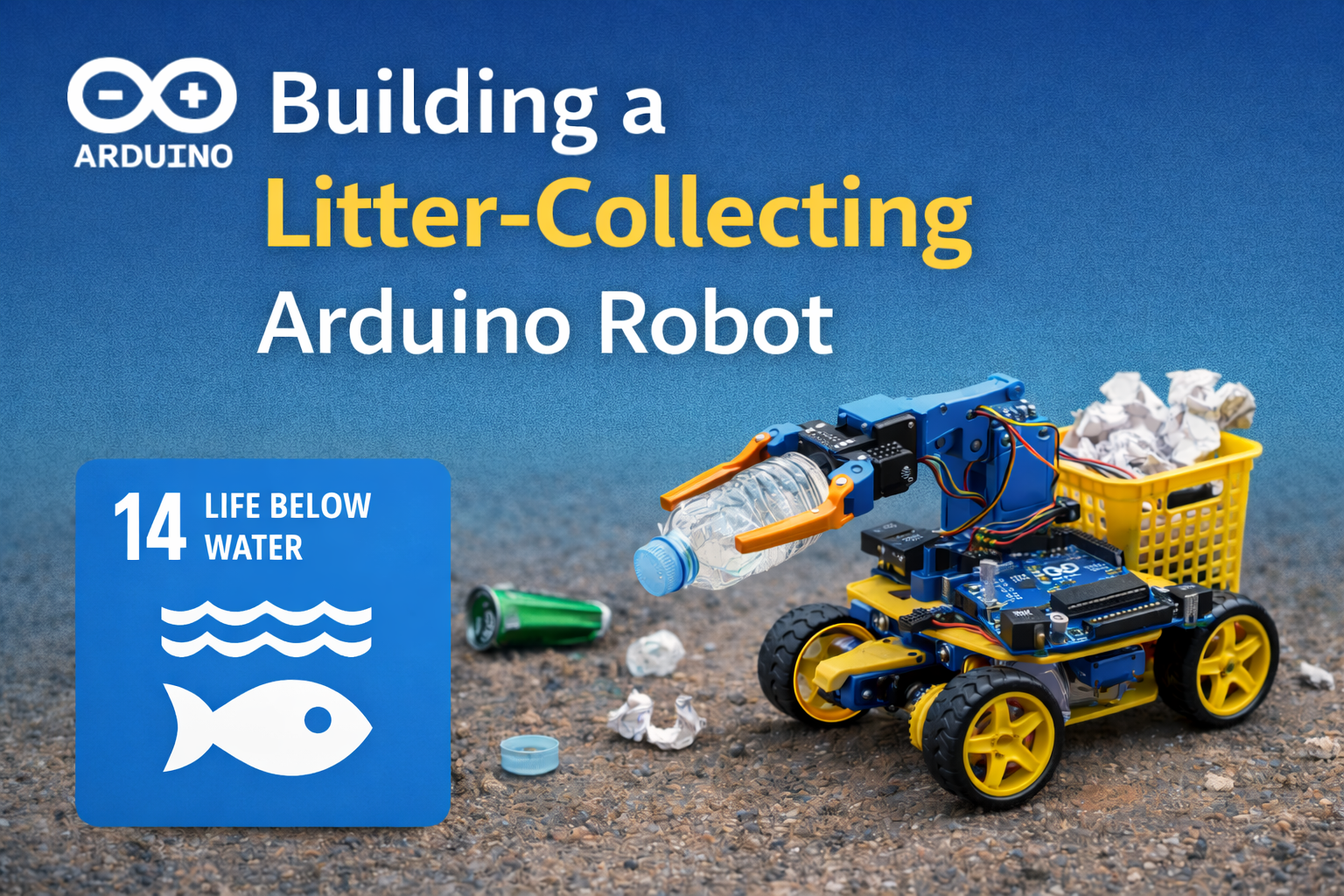
An Arduino litter-collecting robot demonstrates how low-cost robotics can support environmental cleanup and pollution prevention before waste reaches vulnerable ecosystems. Plastic pollution has become one of the defining environmental challenges of the twenty-first century. Much of the waste that eventually enters rivers, lakes, wetlands, and oceans begins as litter on streets, beaches, parks, storm drains, sidewalks, riverbanks, and waterways.
Preventing that waste from reaching aquatic ecosystems is one of the most practical intervention points available for protecting marine life. This project demonstrates how to build an Arduino litter-collecting robot capable of navigating a small controlled area, identifying nearby objects through proximity sensing, and using a mechanical gripper to attempt collection of lightweight debris such as small bottles, wrappers, or model waste items.
The system combines embedded electronics, robotics, sensing, mobility, actuation, power management, and environmental engineering principles. While the platform presented here is a prototype, it illustrates how low-cost robotic systems can support environmental cleanup experiments aligned with SDG 14: Life Below Water while also revealing the practical limits of robotics as a pollution solution.
Main Library
Publications
Project Series
Arduino SDG Projects
Related Topic
Infrastructure Systems
Related Topic
Environmental Monitoring
Related Topic
Novel Entities
This project also connects to broader site areas, including Intelligent Infrastructure Systems, Environmental Monitoring Systems, Novel Entities and the Problem of Synthetic Overload, Freshwater Change and Earth System Risk, Ocean Acidification and the Chemistry of Planetary Change, and Sustainable Development Goals Within Planetary Boundaries. In that wider context, this robot is not only a maker project. It is a small prototype of the sensing, mobility, manipulation, and cleanup infrastructure needed to reduce waste leakage into freshwater and marine systems.
Abstract
This project presents a prototype Arduino litter-collecting robot built around a microcontroller, ultrasonic proximity sensing, a motor-driver-based mobility system, and a servo-actuated gripper. The robot moves through a small controlled environment, detects nearby objects, stops when an object enters a defined collection range, and attempts lightweight collection behavior based on a simple distance threshold.
From an engineering perspective, the platform demonstrates a basic environmental robotics system with sensing, navigation, mobility, actuation, and object-handling subsystems. From a sustainability perspective, it illustrates how low-cost embedded robotics can support pollution-prevention education by intercepting debris before it reaches storm drains, rivers, coastlines, or marine ecosystems.
The prototype is intentionally modest. It does not classify litter, map terrain, guarantee collection, or operate as a field-ready autonomous cleanup machine. Its value is that it turns environmental cleanup into an engineering problem that can be measured, tested, improved, and discussed responsibly.
SDG Alignment: Marine Protection, Waste Prevention, Infrastructure, and Circular Systems
This project aligns most directly with SDG 14: Life Below Water, especially the effort to reduce marine pollution from land-based activities. Many marine pollutants originate far from the ocean. Litter discarded on streets, parks, riverbanks, beaches, and stormwater corridors can move through drains, streams, rivers, and coastal systems before entering marine environments.
The project is not a marine-cleanup solution at scale, and it should not be treated as one. Its value is educational and methodological. It shows how a small embedded system can combine sensing, movement, and actuation to demonstrate one intervention point in the waste pathway: intercepting lightweight debris before it travels downstream.
| Sustainable Development Goal | How the Project Relates | Project-Level Mechanism |
|---|---|---|
| SDG 14: Life Below Water | Supports marine protection by demonstrating waste interception before debris reaches aquatic ecosystems. | Small robotic platform for detecting nearby objects and attempting lightweight debris collection in controlled environments. |
| SDG 11: Sustainable Cities and Communities | Relates to cleaner public spaces, stormwater corridors, parks, campuses, streets, and community cleanup infrastructure. | Controlled-area robotics experiments that connect urban cleanliness with downstream water protection. |
| SDG 12: Responsible Consumption and Production | Connects to waste prevention, material recovery, and the need to reduce leakage from consumer material systems. | Debris detection, collection behavior, material-awareness education, and discussion of upstream waste reduction. |
| SDG 9: Industry, Innovation and Infrastructure | Demonstrates low-cost robotics, sensing, actuation, and prototype infrastructure for environmental applications. | Arduino control, ultrasonic sensing, motor-driver mobility, servo manipulation, and reproducible robotics documentation. |
| SDG 6: Clean Water and Sanitation | Relates indirectly to protecting freshwater systems from litter that travels through storm drains, streams, and rivers. | Land-based cleanup logic that can be connected to freshwater stewardship and watershed protection education. |
The strongest SDG connection is SDG 14. Ocean plastic pollution is often visible at the coastline, but much of the problem begins upstream. A robot that collects lightweight debris in a controlled environment demonstrates a simple idea: pollution prevention can begin before waste reaches waterways. The project therefore supports an educational understanding of marine protection as a land-to-water systems problem.
The connection to SDG 11 comes through urban and community environments. Cleaner cities are not only aesthetic goals. Streets, parks, campuses, transit corridors, and storm drains are part of the physical pathway through which waste can move into waterways. Small cleanup robots can help students and communities think about how public spaces, waste infrastructure, and watershed protection are connected.
The connection to SDG 12 must be framed carefully. Cleanup robotics is not a substitute for upstream waste reduction, product redesign, reuse systems, packaging policy, or better waste infrastructure. A robot that collects bottles and wrappers does not solve the material economy that produced them. It does, however, make the leakage problem visible and creates a concrete platform for discussing responsible production, consumption, and recovery systems.
The connection to SDG 9 comes through environmental innovation and infrastructure. The robot combines sensors, motors, firmware, mechanical design, and manipulation into a reproducible prototype. That matters because environmental infrastructure is increasingly not only pipes, bins, vehicles, and treatment systems. It also includes sensing, automation, robotics, telemetry, and adaptive field tools.
Because the Sustainable Development Goals are broad public frameworks, it is important not to overclaim. This robot is not a certified cleanup machine, not an autonomous beach-cleaning platform, and not a replacement for human cleanup efforts, waste management agencies, or environmental policy. Its contribution is narrower and still useful: it teaches the perception-action logic behind environmental robotics and shows how engineering systems can support pollution-prevention learning.
In that sense, the project works best as a bridge between sustainability language and robotics practice. It turns a broad goal — reduce pollution before it harms aquatic life — into a practical sequence: detect an object, estimate distance, stop safely, actuate a gripper, attempt collection, measure success, identify failure modes, and improve the design.
Connections to Other Site Areas
This litter-collecting robot belongs to a wider body of work on environmental robotics, sensing, and sustainable infrastructure. It connects directly to Intelligent Infrastructure Systems because cleanup systems increasingly depend on machines that can sense surroundings, interpret signals, move safely, and act on physical environments.
It also connects to Environmental Monitoring Systems. Although this project focuses on collection rather than measurement alone, the robot uses proximity sensing and navigation feedback in the same broad logic as environmental monitoring: sensors convert environmental conditions into data that can guide action.
At the planetary-boundary level, the project relates to Novel Entities and the Problem of Synthetic Overload. Plastics, synthetic materials, additives, and persistent waste streams are part of a wider synthetic overload problem. Litter collection does not solve that problem at its source, but it demonstrates one practical intervention for reducing leakage into ecosystems.
The project also links to Freshwater Change and Earth System Risk and Ocean Acidification and the Chemistry of Planetary Change because land-based pollution can affect downstream aquatic systems. Cleaner streets, drains, riverbanks, wetlands, and beaches are part of the wider infrastructure needed to protect freshwater and marine systems.
System Architecture
The litter-collecting robot can be understood as a compact environmental robotics system with four functional layers:
- Sensing layer: ultrasonic proximity sensing detects nearby objects and obstacles.
- Control layer: the Arduino reads sensor input and applies simple threshold-based navigation and collection logic.
- Mobility layer: a motor driver controls the left and right drive motors for forward motion and stopping behavior.
- Manipulation layer: a servo-actuated gripper attempts object capture when debris is detected within range.
The resulting perception-action loop can be summarized as:
Ultrasonic Sensor → Arduino → Navigation Logic → Motor Driver / Servo → Robot Motion and Gripper ActionThis architecture demonstrates a minimal autonomous cleanup concept in which sensing informs immediate actuation. It does not perform true object classification, but it provides a transparent foundation for future environmental robotics experiments.
System Requirements
A litter-collecting robot becomes more useful when the engineering requirements are explicit. The robot must not only move; it must detect, stop, attempt collection, avoid obvious hazards, and remain safe enough for controlled educational use.
| Requirement | Design Target | Reason |
|---|---|---|
| Object proximity sensing | Detect nearby objects within a defined collection range | Supports the perception stage of the cleanup behavior |
| Mobility control | Move forward and stop reliably | Allows the robot to approach targets without uncontrolled motion |
| Gripper actuation | Open and close a lightweight claw or gripper | Provides a physical collection attempt after detection |
| Power stability | Support motors, servo, and logic without severe voltage drop | Prevents resets, weak actuation, and erratic behavior |
| Mechanical alignment | Align gripper position with likely target location | Collection success depends heavily on geometry |
| Debug telemetry | Print distance and state information to the Serial Monitor | Supports validation, tuning, and troubleshooting |
| Controlled deployment | Operate only in small supervised test areas | Reduces safety risks and environmental disturbance |
These requirements can be reused across the Arduino sustainability project series. Each article should identify what the prototype must do, how success can be evaluated, and what boundaries should prevent overclaiming.
Why an Arduino Litter-Collecting Robot Matters
Environmental cleanup is often treated as a purely manual activity. Human cleanup remains essential, but robotics introduces the possibility of supplementing cleanup efforts with systems that can navigate, detect, and act in small or constrained environments.
Even a modest prototype like this demonstrates several important ideas:
- pollution prevention can begin before waste reaches waterways
- robotics can be applied to environmental stewardship, not only industrial automation
- simple embedded systems can demonstrate useful cleanup logic without requiring complex artificial intelligence
- prototype systems can clarify what more advanced environmental robots would need in the future
The value of the build is not that it solves litter pollution at scale. Its value is that it translates an environmental challenge into an engineering system that can be tested, evaluated, and improved. It gives students, makers, educators, and engineers a practical way to explore how sensing, mobility, manipulation, and sustainability can work together.
It also teaches humility. Waste pollution is not only a cleanup problem. It is a production, consumption, packaging, policy, infrastructure, and behavior problem. Robotics can help with interception and education, but the strongest solutions still require upstream prevention.
What This Project Does
This Arduino litter-collecting robot:
- moves through a small area using a differential-drive chassis
- detects nearby objects using an ultrasonic sensor
- stops when an object enters a defined collection range
- activates a servo-based gripper to attempt collection
- provides a simple perception-action control loop for environmental robotics experimentation
- prints distance and behavior information for debugging
- can be extended with line tracking, vision, wireless communication, mapping, or smarter navigation
In practical terms, the platform functions as a small environmental cleanup robot prototype suitable for education, robotics experimentation, and sustainability-oriented design work.
Bill of Materials
- Arduino Uno or Arduino Nano
- L298N motor driver module
- 2 DC gear motors
- robot chassis with wheels
- ultrasonic distance sensor, such as HC-SR04
- servo motor for gripper
- robotic gripper or claw
- rechargeable battery pack, with 7.4V Li-ion recommended for many small robot chassis
- breadboard or compact wiring arrangement
- jumper wires
- small test objects representing lightweight debris
Optional enhancements include:
- line tracking sensors
- camera module
- Bluetooth or Wi-Fi module
- small collection bin or debris tray
- bumper switch for physical collision detection
- emergency stop switch
For a prototype cleanup robot, mechanical fit matters as much as electronics. The gripper must be positioned so that the robot can actually reach the objects it detects. A working circuit with poor mechanical alignment will still fail to collect debris.
Engineering Specifications
| Parameter | Reference Design |
|---|---|
| Microcontroller | Arduino Uno, Arduino Nano, or equivalent ATmega328P-compatible board |
| Drive system | Two-wheel differential drive |
| Motor control | L298N dual H-bridge motor driver |
| Object sensing | HC-SR04 ultrasonic distance sensor or equivalent |
| Manipulator | Single-servo gripper or claw |
| Power source | 7.4V Li-ion battery pack recommended for the drive system, with regulated logic power as needed |
| Collection threshold | Approximately 15 cm in the reference code |
| Control model | Threshold-based perception-action loop |
| Deployment scope | Small-scale educational and prototype cleanup environments |
The specifications describe an educational reference platform, not a field robot. Outdoor cleanup systems require far more robust navigation, weather protection, environmental safety review, battery protection, and mechanical validation.
Measurement Principle: Proximity Sensing and Object Presence
The ultrasonic distance sensor estimates object distance by sending a short sound pulse and measuring how long it takes for the echo to return. The Arduino converts the echo time into an approximate distance using the speed of sound.
That measurement is useful, but limited. The sensor does not know whether the object is litter. It only detects that something reflective enough is within range. Soft materials, angled surfaces, transparent items, very small objects, or irregular shapes may produce unreliable echoes.
For this reason, the sensor should be interpreted as a proximity detector rather than a litter classifier. The robot’s current behavior is therefore: “if something is close enough, attempt collection.” More advanced robots would need additional sensing, vision, classification, mapping, and safety logic before operating in real-world environments.
Mathematical Lens: From Distance Thresholds to Collection Decisions
The litter-collecting robot can be understood as a simple threshold-based perception-action system. The robot measures distance, compares that measurement with a collection threshold, and selects either movement or collection behavior.
d=\frac{v_{\mathrm{sound}} \times t}{2}
\]
Interpretation: Ultrasonic distance is estimated by multiplying echo travel time \(t\) by the speed of sound and dividing by two because the pulse travels to the object and back.
Here, \(d\) is the estimated distance between the sensor and the object. The division by two matters because the measured echo time includes the outbound and return path.
C =
\begin{cases}
1, & 0 < d < T_c \\ 0, & d \geq T_c \ \text{or no valid echo is received} \end{cases} \]
Interpretation: The robot attempts collection only when a valid distance is less than the collection threshold \(T_c\).
In this formulation, \(C=1\) means the robot stops and activates the gripper, while \(C=0\) means it continues moving forward.
S=\frac{N_{\mathrm{collected}}}{N_{\mathrm{attempts}}}
\]
Interpretation: Collection success rate compares successful captures with total collection attempts.
This metric is useful because the robot may detect objects more often than it actually captures them. A low success rate may indicate gripper misalignment, poor object shape, excessive chassis speed, weak servo torque, or unsuitable test objects.
F=\frac{N_{\mathrm{false}}}{N_{\mathrm{attempts}}}
\]
Interpretation: False-trigger rate measures how often the robot attempts collection on objects or obstacles that are not intended litter targets.
The mathematical lens shows why environmental robotics is not only about movement. It is about perception quality, decision thresholds, mechanical success, false triggers, and the relationship between sensing and action.
Mobility System
The robot uses a differential-drive configuration in which two motors independently control the left and right wheels. This allows the robot to move forward, reverse, and rotate without requiring a steering linkage.
The L298N motor driver provides current handling for small DC motors and allows the Arduino to control motor direction and, when desired, motor speed through digital logic and PWM signals.
This configuration is common in educational robotics because it is mechanically simple, easy to wire, and flexible enough for navigation experiments. It also makes the project easier to adapt for future behaviors such as obstacle avoidance, turning routines, search patterns, or return-to-base logic.
In cleanup robotics, mobility is not only about movement. It determines whether the robot can approach debris from the correct angle, stop with enough clearance for the gripper, and recover after failed collection attempts.
Object Detection
The ultrasonic sensor measures the distance between the robot and nearby objects. When the robot approaches debris within a predefined threshold, the system stops and activates the gripper mechanism.
This approach is simple but effective for prototype systems. It uses proximity as a proxy for object presence, not true object classification. In its current form, the robot does not distinguish litter from non-litter. That limitation is important, but it also keeps the system transparent and easier to build and evaluate.
More advanced systems could incorporate:
- camera-based object recognition
- machine learning models
- multi-sensor navigation
- line tracking or waypoint navigation
- debris classification based on shape, color, or material
- mapping and coverage planning
For a first environmental robotics prototype, the goal is not perfect classification. The goal is to understand the link between environmental sensing, movement, manipulation, and responsible cleanup behavior.
Circuit Logic, Motor Power, and Actuation
The circuit has three distinct jobs: sensing, mobility, and manipulation. The Arduino reads the ultrasonic sensor, sends direction and speed signals to the motor driver, and controls the servo gripper. The motor driver handles the higher-current drive motors, while the servo requires stable power for reliable gripper movement.
This separation matters because motors and servos draw more current than sensors and logic circuits. If the drive motors, gripper, and Arduino are powered poorly, the system may reset, stall, chatter, or behave unpredictably. A robot that works while connected to USB may fail under battery power if the power system is not sized correctly.
All control circuits should share a common ground when using separate power rails. Without a common reference, motor and servo control signals may not be interpreted correctly. Wiring should also be secured so that movement does not pull loose jumper wires from the breadboard.
The core circuit lesson is that environmental robotics is not only software. The behavior depends on power, torque, traction, wiring, mechanical geometry, and the physical alignment between sensor, chassis, gripper, and target object.
How the Litter-Collecting Robot Works
The robot begins in a stopped state, opens the gripper, and then enters a repeated control loop. During each loop, the ultrasonic sensor estimates the distance to the nearest object in front of the robot.
If no valid object is within the collection threshold, the robot moves forward. If an object is detected within range, the robot stops, closes the gripper, waits briefly, reopens the gripper, and then resumes movement.
This creates a simple perception-action cycle:
Measure distance → Decide motion or collection → Move or actuate gripper → RepeatThe current version is intentionally transparent. It does not use mapping, object recognition, path planning, or AI. That simplicity makes it valuable for education because every behavior can be traced back to a sensor reading, a threshold, and a motor or servo command.
Design Assumptions and Constraints
This prototype assumes:
- a small controlled test environment
- lightweight debris or mock debris
- flat or gently uneven surfaces
- direct line-of-sight object detection
- simple forward motion rather than full navigation
- human supervision during testing
- educational and prototype use rather than unsupervised cleanup deployment
The robot also assumes that proximity is sufficient to trigger collection. In real environments, that assumption breaks down quickly. The object may be a rock, stick, curb, animal, plant, person, or non-target obstacle. A field-ready cleanup robot must classify objects and avoid harm; this prototype only demonstrates the first layer of the problem.
Wiring Overview
Motor Driver: L298N
- IN1 → Arduino pin 8
- IN2 → Arduino pin 9
- IN3 → Arduino pin 10
- IN4 → Arduino pin 11
- ENA → Arduino PWM pin 5, optional speed control
- ENB → Arduino PWM pin 6, optional speed control
Ultrasonic Sensor
- VCC → Arduino 5V
- GND → Arduino GND
- Trig → Arduino pin 12
- Echo → Arduino pin 13
Servo Gripper
- Signal → Arduino pin 3
- Power → stable 5V supply
- Ground → common GND
Use a stable power supply and ensure the battery pack can support simultaneous motor and servo load without excessive voltage drop. If the motor driver, servo, and Arduino use separate supply rails, connect their grounds together so the control signals share a common reference.
Electrical, Mechanical, and Deployment Considerations
Robots fail in physical ways. A prototype that works on a table may fail on pavement, grass, sand, tile, or outdoor paths because traction, vibration, object alignment, and battery load change the system behavior.
For better reliability:
- secure all wiring so movement does not disconnect sensors or motors
- test motor direction before mounting the robot in a confined area
- verify servo range before attaching the gripper to avoid mechanical binding
- keep batteries protected from impact and short circuits
- avoid wet environments unless the electronics are properly enclosed
- test only with lightweight objects that cannot jam or damage the gripper
- operate the robot under supervision in a controlled area
Mechanical design should be treated as part of the system, not an afterthought. Wheel traction, chassis height, gripper reach, center of mass, sensor angle, and battery placement all affect whether the robot can collect anything successfully.
Firmware Design Goals
The firmware in this project is designed to do more than simply move forward until an object appears. It incorporates basic robotics control ideas such as:
- explicit distance measurement
- motor state separation
- servo-based collection behavior
- clear operational branching between navigation and manipulation
- serial output for debugging
- basic timeout handling for ultrasonic sensing
- startup positioning for the gripper
These design choices make the build easier to test, easier to extend, and better suited for future upgrades such as obstacle avoidance, route planning, search behavior, or sensor fusion.
Basic vs. Advanced Firmware
A minimal litter-collecting robot could move forward, read one distance value, and close the gripper whenever the value is below a threshold. That simple version is useful for demonstration, but it can hang on invalid ultrasonic readings, behave unpredictably after startup, and provide little information for debugging.
The advanced version used here adds timeout handling, explicit motor helper functions, startup gripper positioning, clear state messages, and adjustable parameters for speed, threshold, and gripper geometry. These additions make the prototype more reliable and easier to test while still remaining understandable for students and makers.
This distinction should guide the rest of the Arduino sustainability project series: each article should provide code that is simple enough to learn from but structured enough to support validation, debugging, and responsible extension.
Advanced Arduino Code
The firmware below improves on the simplest possible collector design by adding timeout handling for ultrasonic sensing, explicit startup positioning for the gripper, clear motor helper functions, and readable serial output for operational review.
/*
  Arduino Litter-Collecting Robot

  Functions:
  - Moves forward using a two-motor differential-drive chassis
  - Measures distance with an HC-SR04 ultrasonic sensor
  - Stops when an object is detected within the collection threshold
  - Activates a servo gripper to attempt lightweight debris collection

  Notes:
  - This is a prototype for education and environmental robotics experiments.
  - It does not classify objects as litter or non-litter.
  - Field-ready cleanup robots require stronger navigation, safety,
    object recognition, weather protection, and mechanical validation.
*/

#include <Servo.h>

// Ultrasonic sensor pins.
const int trigPin = 12;
const int echoPin = 13;

// L298N motor driver pins.
const int motorLeft1 = 8;
const int motorLeft2 = 9;
const int motorRight1 = 10;
const int motorRight2 = 11;

// Optional speed control pins.
const int motorLeftEnable = 5;
const int motorRightEnable = 6;

// Servo gripper pin.
const int gripperPin = 3;

// Distance threshold for attempting collection.
const long collectionThresholdCm = 15;

// Motor speed for PWM-enabled motor channels.
// Adjust for the chassis, motors, battery, and surface.
const int motorSpeed = 160;

// Servo positions.
// Adjust these after testing the physical gripper geometry.
const int gripperOpenPosition = 90;
const int gripperClosedPosition = 30;

// Create servo object.
Servo gripper;

long measureDistanceCm() {
  // Ensure trigger pin starts low.
  digitalWrite(trigPin, LOW);
  delayMicroseconds(2);

  // Send a 10 microsecond trigger pulse.
  digitalWrite(trigPin, HIGH);
  delayMicroseconds(10);
  digitalWrite(trigPin, LOW);

  /*
    Read echo pulse duration.

    The timeout prevents the robot from hanging if no echo is detected.
    30000 microseconds corresponds roughly to a maximum range near 5 meters.
  */
  long duration = pulseIn(echoPin, HIGH, 30000);

  if (duration == 0) {
    // Return -1 when the sensor times out.
    return -1;
  }

  // Convert sound travel time to distance in centimeters.
  long distanceCm = duration * 0.034 / 2;
  return distanceCm;
}

void moveForward() {
  // Enable motors at the selected speed.
  analogWrite(motorLeftEnable, motorSpeed);
  analogWrite(motorRightEnable, motorSpeed);

  // Set both motors to forward motion.
  digitalWrite(motorLeft1, HIGH);
  digitalWrite(motorLeft2, LOW);
  digitalWrite(motorRight1, HIGH);
  digitalWrite(motorRight2, LOW);
}

void stopRobot() {
  // Disable motor motion by setting both direction pins low.
  digitalWrite(motorLeft1, LOW);
  digitalWrite(motorLeft2, LOW);
  digitalWrite(motorRight1, LOW);
  digitalWrite(motorRight2, LOW);

  // Optional: remove PWM drive from motor channels.
  analogWrite(motorLeftEnable, 0);
  analogWrite(motorRightEnable, 0);
}

void collectObject() {
  // Stop before attempting collection.
  stopRobot();

  Serial.println("Stopping robot.");
  Serial.println("Closing gripper to attempt collection.");

  // Close gripper around lightweight debris.
  gripper.write(gripperClosedPosition);
  delay(1500);

  Serial.println("Opening gripper / returning to neutral.");

  // Reopen gripper for continued operation.
  gripper.write(gripperOpenPosition);
  delay(500);
}

void setup() {
  // Start serial monitor for debugging.
  Serial.begin(9600);

  // Configure ultrasonic sensor pins.
  pinMode(trigPin, OUTPUT);
  pinMode(echoPin, INPUT);

  // Configure motor driver pins.
  pinMode(motorLeft1, OUTPUT);
  pinMode(motorLeft2, OUTPUT);
  pinMode(motorRight1, OUTPUT);
  pinMode(motorRight2, OUTPUT);
  pinMode(motorLeftEnable, OUTPUT);
  pinMode(motorRightEnable, OUTPUT);

  // Attach and initialize gripper.
  gripper.attach(gripperPin);
  gripper.write(gripperOpenPosition);

  // Make sure the robot starts in a stopped state.
  stopRobot();

  Serial.println("Arduino Litter-Collecting Robot Starting");
  Serial.println("Prototype cleanup behavior initialized.");
  Serial.println("----------------------------------------");
}

void loop() {
  // Measure the distance to the nearest object in front of the robot.
  long distanceCm = measureDistanceCm();

  Serial.print("Distance: ");
  Serial.print(distanceCm);
  Serial.println(" cm");

  if (distanceCm > 0 && distanceCm < collectionThresholdCm) {
    Serial.println("Object detected within collection range.");
    collectObject();
  } else {
    Serial.println("No collection target in range. Moving forward.");
    moveForward();
  }

  // Short control delay for readability and stability.
  delay(100);
}GitHub Repository
The article body includes the core firmware and design explanation so the build remains readable. The full repository expands the project into a reproducible prototype package, including Arduino control firmware, setup documentation, calibration notes, deployment guidance, bill of materials, example navigation readings, and wiring materials.
Complete Code Repository
The full code distribution for this project, including Arduino control firmware, setup documentation, calibration notes, deployment guidance, bill of materials, and example navigation readings, is available on GitHub.
The repository contains the complete prototype build materials:
- Arduino control firmware
- bill of materials
- setup guide
- calibration notes
- deployment notes
- example navigation readings
Repository Structure
arduino-litter-collecting-robot/

README.md
LICENSE

BOM.csv

firmware/
  litter_collecting_robot.ino

docs/
  setup_guide.md
  calibration.md
  deployment_notes.md

data/
  example_navigation_readings.csv

hardware/
Engineers can clone the repository, fork the design, or download the complete project using GitHub’s Download ZIP feature. All materials are released under the MIT License to support reuse in research, education, and prototype engineering work.
Operational Logic
The control logic follows a simple loop:
- robot moves forward
- ultrasonic sensor scans for nearby objects
- if an object is detected within range, the robot stops
- the gripper closes to attempt collection
- the gripper returns to its nominal position
- the robot resumes navigation
This control model is intentionally transparent and easy to modify. It provides a foundation that can later be extended into more sophisticated behaviors such as obstacle avoidance, binning logic, mapping, route planning, or computer-vision-based target recognition.
The most important design question is whether the perception-action timing matches the physical robot. If the robot moves too fast, stops too late, or positions the gripper poorly, the code may behave correctly while the collection attempt fails mechanically.
Engineering Considerations
Environmental robotics projects must account for several practical factors:
- Terrain variability: outdoor surfaces may include sand, grass, gravel, pavement, slopes, wet areas, or uneven paths.
- Battery life: motors and servos draw significantly more current than sensors and logic circuits.
- Debris size and weight: small grippers can only handle lightweight objects.
- Navigation accuracy: simple threshold logic does not provide mapping or route coverage.
- Gripper geometry and reach: collection success depends heavily on alignment between robot, object, and claw.
- Mechanical stability: the chassis may shift, stall, or tip during collection attempts if the object is too heavy or poorly positioned.
Prototypes like this help test ideas before deploying more sophisticated systems. The purpose is not to claim full autonomy, but to illustrate how sensing, mobility, and manipulation subsystems can be combined into a functional cleanup concept.
Failure Modes and Practical Risks
A useful robotics prototype should explain not only how the robot works, but also how it can fail. Environmental cleanup is physically messy, and small robots face predictable limitations.
- False detection: the ultrasonic sensor may detect a wall, curb, rock, plant, or person instead of litter.
- Missed detection: thin, soft, angled, or irregular objects may reflect sound poorly.
- Gripper misalignment: the robot may stop at the correct distance but fail because the claw is not aligned with the object.
- Insufficient grip force: the servo may not provide enough torque to hold the object.
- Motor stall: wheels may lose traction or stall on rough surfaces.
- Power sag: motors and servos may draw enough current to reset the Arduino or weaken actuation.
- Mechanical jamming: debris can jam the gripper or wheels.
- Environmental harm: an unsupervised robot could disturb wildlife, damage plants, or leave parts behind.
- False confidence: a successful classroom demo may appear more field-ready than the system really is.
These risks do not make the project unusable. They define the appropriate scope of interpretation. The prototype should be tested as a supervised educational platform, not as an autonomous field cleanup machine.
Robotics Safety and Scope
This prototype is intended for small-scale educational and experimental environments. It should be tested in controlled areas away from people, pets, traffic, water hazards, steep terrain, and fragile ecosystems.
The robot should not be treated as a field-ready autonomous cleanup machine. Any real-world deployment would require stronger mechanical safety, weather protection, obstacle detection, emergency stop behavior, battery protection, waterproofing, environmental impact review, and human supervision.
For outdoor use, the robot should be designed to avoid disturbing wildlife, damaging habitats, or creating additional waste through lost parts or battery failure. Environmental robotics must be evaluated not only by whether it collects objects, but also by whether it avoids causing new harm.
Validation and Testing
To bring this project closer to engineering-grade documentation, validation should include:
- verify that the motors rotate in the intended directions
- confirm that ultrasonic distance readings remain stable across repeated measurements
- test the object-detection threshold against different object sizes, shapes, and distances
- verify that the gripper opens and closes consistently
- observe whether the robot stops early enough to make collection physically possible
- measure battery performance under simultaneous motor and servo load
- test operation on the intended indoor or controlled outdoor surface
- record collection attempts and failures rather than relying only on anecdotal success
If the robot fails to collect objects consistently, the problem may be mechanical rather than algorithmic. Common causes include gripper geometry, target size, chassis speed, sensor placement, wheel traction, surface friction, and motor power limits.
Example Collection Test Record
| Test Object | Distance Threshold | Attempts | Successful Collections | Likely Failure Cause |
|---|---|---|---|---|
| Empty plastic bottle | 15 cm | 10 | 6 | Gripper alignment inconsistent |
| Small paper cup | 15 cm | 10 | 8 | Generally collectable |
| Flat wrapper | 15 cm | 10 | 2 | Too flat for simple gripper geometry |
| Foam block | 15 cm | 10 | 7 | Lightweight target; moderate alignment sensitivity |
A test table like this helps transform the project from a demonstration into a design process. The robot can then be improved by changing gripper geometry, threshold distance, approach speed, or target-detection logic.
Suggested Performance Metrics
For a more rigorous evaluation, the platform can be assessed using several simple metrics:
- Detection reliability: whether nearby objects are consistently detected within the intended range.
- Collection success rate: how often the gripper captures the target object successfully.
- Navigation stability: whether the robot maintains controlled forward motion without erratic behavior.
- Battery endurance: how long the system can operate under realistic load.
- False trigger rate: how often the robot attempts collection on non-target obstacles.
- Mechanical recovery: whether the robot can resume motion after a failed collection attempt.
- Environmental safety: whether the robot avoids damaging test surfaces, plants, or surrounding objects.
Even informal measurement of these metrics improves the engineering credibility of the prototype. A robot that “kind of works” becomes much more useful when its detection, collection, and failure patterns are documented.
Data Logging Extension
The robot becomes more useful when distance readings, object detections, collection attempts, battery status, and success or failure outcomes are logged over time. Even a simple CSV file can help evaluate whether the robot fails because of sensing, mechanical alignment, motor behavior, gripper limitations, or environmental conditions.
| Field | Example | Purpose |
|---|---|---|
| timestamp | 2026-05-28 09:15:00 | Records when the test event occurred |
| distance_cm | 12 | Distance measured before collection attempt |
| threshold_cm | 15 | Collection threshold used in firmware |
| object_type | paper cup | Documents target material and shape |
| attempt_result | success | Records whether collection succeeded |
| battery_voltage | 7.4 | Helps identify power-related failures |
| notes | slight left gripper misalignment | Preserves qualitative engineering observations |
Data logging is especially useful in robotics because failures are often mechanical, not purely computational. A log helps identify whether changing the code is actually the right response or whether the chassis, gripper, sensor angle, or power system needs improvement.
Applications
Small litter-collecting robots could support several educational, experimental, and environmental use cases:
- beach cleanup robotics demonstrations
- urban litter removal experiments
- storm drain debris monitoring prototypes
- educational robotics programs
- environmental engineering labs
- sustainability-focused maker projects
- robotics competitions centered on cleanup tasks
- community science discussions about waste pathways
Even when deployed only as prototypes, these systems help translate sustainability goals into engineering experiments that can be tested, observed, and improved.
Future Improvements
Several upgrades could significantly enhance this prototype:
- computer vision for litter recognition
- autonomous path planning
- line following or waypoint-based navigation
- GPS-based environmental mapping
- solar charging systems
- mesh networks for coordinated robot fleets
- collection-bin weight sensing
- wireless telemetry for mission status and battery monitoring
- emergency stop and obstacle avoidance
- improved gripper geometry for flat or flexible objects
Moving from a simple proximity-based collector to a more intelligent system would require advances in sensing, classification, mobility control, energy management, safety behavior, and mission planning.
Responsible Deployment
This prototype is appropriate for classrooms, robotics labs, makerspaces, controlled demonstrations, sustainability education, and supervised cleanup simulations. It should not be used as an unsupervised field robot, autonomous public-space machine, beach-cleaning platform, or aquatic cleanup device without major redesign and safety validation.
Responsible deployment means matching the system to the consequence of error. In a classroom, a missed paper cup is harmless. In a park, beach, wetland, or public walkway, an unreliable robot could disturb people, wildlife, plants, or infrastructure. Cleanup robotics must therefore be evaluated for environmental impact as well as technical performance.
A responsible version should include an emergency stop, protective enclosure, secure battery mounting, obstacle detection, weather protection, supervised operation, mechanical guards where needed, and a clear plan for what happens when the robot stalls, tips, loses parts, or misidentifies an object.
Supporting SDG 14: Life Below Water
SDG 14 focuses on conserving and sustainably using oceans, seas, and marine resources. One of the most practical ways to support that goal is to reduce the volume of land-based waste that reaches aquatic ecosystems.
Litter collection is not a substitute for reducing plastic production, improving packaging policy, redesigning material systems, expanding reuse, strengthening waste infrastructure, or regulating harmful pollutants. But it is an important intervention point, especially in places where waste is likely to enter stormwater systems, river corridors, beaches, wetlands, or coastal environments.
Embedded robotics projects like this Arduino litter-collecting robot demonstrate how accessible technologies can support environmental stewardship. They also show how sustainable development can move from abstract commitments into practical sensing, mobility, actuation, measurement, and pollution-prevention design.
The deeper lesson is that cleanup should be treated as one layer of a larger system. Pollution prevention begins upstream with material design and consumption choices; it continues through waste management infrastructure; and it includes downstream interception where waste has already escaped. This robot belongs to that last layer, and it should be understood in relation to the whole system.
Reproducibility
All firmware, documentation, and supporting build materials necessary to reproduce the prototype are included in the project repository. The design intentionally relies on widely available educational robotics hardware so that it can be rebuilt in classrooms, labs, makerspaces, and independent engineering environments.
The platform is intended as a reference implementation rather than a field-ready cleanup robot. Engineers adapting it for extended use should validate battery runtime, drivetrain durability, outdoor conditions, gripper reliability, navigation consistency, enclosure design, and safety behavior under real operating conditions.
For the rest of this project series, reproducibility should mean more than making code available. Each article should include a clear bill of materials, wiring logic, calibration notes, failure modes, test procedure, data interpretation guidance, and a realistic statement of appropriate use.
Conclusion
Environmental robotics represents an important frontier where embedded systems, automation, and sustainability intersect. This Arduino litter-collecting robot demonstrates how relatively simple hardware can illustrate the core principles of autonomous environmental cleanup systems.
By combining ultrasonic sensing, motor-driven mobility, servo actuation, threshold-based decision logic, and basic debugging telemetry, the project gives students and builders a practical introduction to cleanup robotics. It also shows why robotic environmental work must be evaluated carefully: detection, collection, safety, power, mechanics, and ecological context all matter.
While this prototype is intentionally modest, the broader concept reflects an important idea: engineering tools can play a meaningful role in protecting ecosystems and reducing pollution before it reaches vulnerable environments such as rivers, wetlands, coastlines, and oceans.
The deeper lesson is not simply that an Arduino can drive motors and close a gripper. The deeper lesson is that environmental cleanup systems require feedback, judgment, and responsible design. When cleanup decisions are tied to sensing, measurement, mechanical validation, and ecological caution, even a small robot can demonstrate the logic of more intelligent pollution-prevention infrastructure.
Related Articles
- Arduino Projects for Sustainable Development: 10 SDG-Aligned Builds
- Intelligent Infrastructure Systems
- Environmental Monitoring Systems
- Novel Entities and the Problem of Synthetic Overload
- Freshwater Change and Earth System Risk
- Ocean Acidification and the Chemistry of Planetary Change
- Sustainable Development Goals Within Planetary Boundaries
- Planetary Boundaries
Further Reading
- Arduino (n.d.) analogWrite(). Available at: https://docs.arduino.cc/language-reference/en/functions/analog-io/analogWrite/
- Arduino (n.d.) Servo Library. Available at: https://docs.arduino.cc/libraries/servo/
- NOAA Marine Debris Program (n.d.) Marine Debris Program. Available at: https://marinedebris.noaa.gov/
- Ocean Conservancy (n.d.) International Coastal Cleanup. Available at: https://oceanconservancy.org/trash-free-seas/international-coastal-cleanup/
- United Nations (n.d.) Sustainable Development Goal 14: Life Below Water. Available at: https://sdgs.un.org/goals/goal14
- United Nations Environment Programme (2021) From Pollution to Solution: A Global Assessment of Marine Litter and Plastic Pollution. Available at: https://www.unep.org/resources/pollution-solution-global-assessment-marine-litter-and-plastic-pollution
- U.S. Environmental Protection Agency (n.d.) Trash Free Waters. Available at: https://www.epa.gov/trash-free-waters
- World Bank (2022) Where Is the Value in the Chain? Pathways out of Plastic Pollution. Available at: https://openknowledge.worldbank.org/entities/publication/bfab3184-b32e-57c2-83b1-3d402f397ef3
References
- Arduino (n.d.) analogWrite(). Available at: https://docs.arduino.cc/language-reference/en/functions/analog-io/analogWrite/
- Arduino (n.d.) Servo Library. Available at: https://docs.arduino.cc/libraries/servo/
- NOAA Marine Debris Program (n.d.) Marine Debris Program. Available at: https://marinedebris.noaa.gov/
- Ocean Conservancy (n.d.) International Coastal Cleanup. Available at: https://oceanconservancy.org/trash-free-seas/international-coastal-cleanup/
- United Nations (n.d.) The 17 Sustainable Development Goals. Available at: https://sdgs.un.org/goals
- United Nations (n.d.) Sustainable Development Goal 6: Clean Water and Sanitation. Available at: https://sdgs.un.org/goals/goal6
- United Nations (n.d.) Sustainable Development Goal 9: Industry, Innovation and Infrastructure. Available at: https://sdgs.un.org/goals/goal9
- United Nations (n.d.) Sustainable Development Goal 11: Sustainable Cities and Communities. Available at: https://sdgs.un.org/goals/goal11
- United Nations (n.d.) Sustainable Development Goal 12: Responsible Consumption and Production. Available at: https://sdgs.un.org/goals/goal12
- United Nations (n.d.) Sustainable Development Goal 14: Life Below Water. Available at: https://sdgs.un.org/goals/goal14
- United Nations Environment Programme (2021) From Pollution to Solution: A Global Assessment of Marine Litter and Plastic Pollution. Available at: https://www.unep.org/resources/pollution-solution-global-assessment-marine-litter-and-plastic-pollution
- U.S. Environmental Protection Agency (n.d.) Trash Free Waters. Available at: https://www.epa.gov/trash-free-waters
- World Bank (2022) Where Is the Value in the Chain? Pathways out of Plastic Pollution. Available at: https://openknowledge.worldbank.org/entities/publication/bfab3184-b32e-57c2-83b1-3d402f397ef3