
Last Updated May 28, 2026
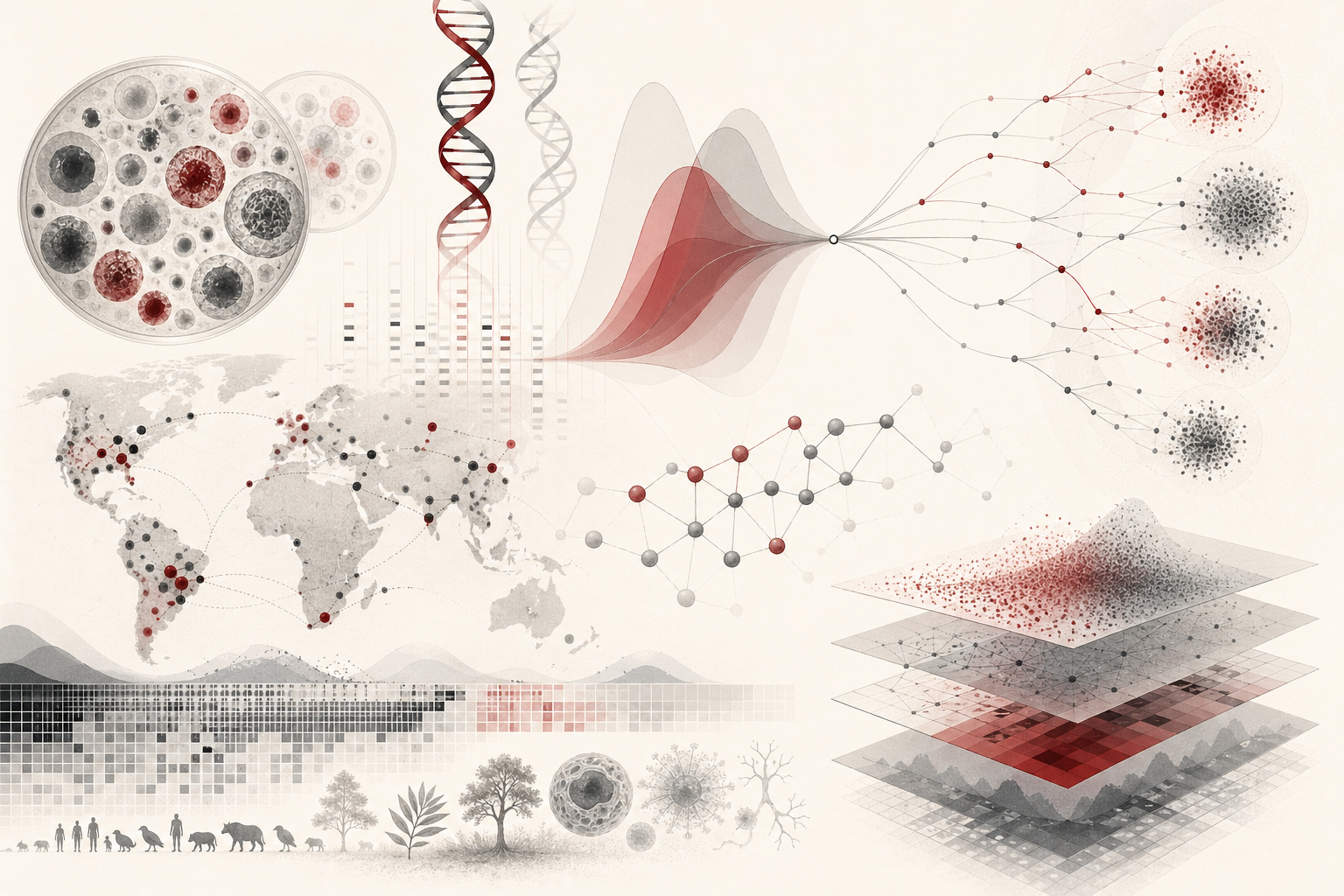
Probability, variation, and biological inference examine how scientists reason about living systems when observations are variable, samples are incomplete, experiments are uncertain, and biological processes unfold through chance, distribution, selection, noise, and context. Biology is not a science of identical units. Organisms vary. Cells vary. Genes vary. Populations vary. Ecosystems vary. Measurements vary. Even well-designed experiments produce data shaped by sampling, measurement error, environmental heterogeneity, stochastic biological processes, and uncertainty about mechanism.
This article introduces probability as one of the central languages of modern biology. It explains why biological inference requires more than observation alone: it requires models of variation, sampling, likelihood, uncertainty, evidence, replication, experimental design, statistical power, Bayesian updating, confidence intervals, population reasoning, and reproducible computation. Probability helps biologists distinguish signal from noise, estimate unknown quantities, compare hypotheses, quantify uncertainty, and decide how much confidence a biological claim deserves.
Main Library
Publications
Article Map
Biology
Related Topic
Mathematical Modeling
Related Topic
Environmental Science
Related Topic
Chemistry
The article is written for biologists, ecologists, marine biologists, biomedical researchers, computational biologists, epidemiologists, evolutionary biologists, biotechnology researchers, environmental scientists, engineers, statisticians, and scientific readers who need a rigorous account of how probability makes biological inference possible. It treats probability not as an abstract mathematical accessory, but as a practical foundation for experimental biology, field ecology, genomics, medicine, conservation science, and systems biology.
The article also extends probability into reproducible computational practice through binomial models, normal variation, sampling distributions, confidence intervals, Bayesian beta-binomial updating, bootstrapping, permutation testing, power analysis, false-positive risk, stochastic simulation, likelihood comparison, R workflows, Python workflows, SQL provenance structures, and a linked full-stack GitHub repository containing Python, R, Julia, Fortran, Rust, Go, C, C++, SQL, notebooks, data files, validation notes, and reproducibility documentation.
Why probability belongs at the center of biology
Probability belongs at the center of biology because living systems are variable. No two organisms are perfectly identical. No two cells behave exactly alike. No ecosystem presents the same conditions twice. No experimental measurement is free from error. Biological processes are shaped by heredity, environment, stochastic molecular events, developmental history, sampling, selection, drift, disturbance, and interaction. Biology therefore requires methods that can reason under uncertainty.
This does not mean biology is vague or weakly scientific. It means biology must express regularity differently from a science of perfectly repeatable mechanical units. Biological regularity often appears through distributions rather than exact sameness. A drug may reduce average tumor growth while individuals vary in response. A genotype may increase risk without guaranteeing disease. A population may have an expected growth trajectory while individual births and deaths remain stochastic. A species may occupy a predicted range while local presence depends on dispersal, microhabitat, and detection probability.
Probability gives biology a language for this kind of evidence. It allows researchers to estimate population parameters from samples, infer unseen processes from observed data, quantify uncertainty, compare alternative hypotheses, and evaluate whether observed patterns are likely under a proposed model. Without probability, biological variation can look like noise. With probability, variation becomes analyzable.
This is why probability matters across biology: inheritance, evolution, ecology, epidemiology, neuroscience, immunology, medicine, genomics, environmental monitoring, conservation, and biotechnology all depend on reasoning about uncertain evidence. Biology does not become less rigorous by using probability. It becomes more honest about the kind of systems it studies.
Variation as a biological fact
Variation is not a nuisance added to biology from outside. It is part of life. Evolution depends on variation. Development produces variation. Environments generate variation. Measurement reveals variation. Populations preserve, lose, and transform variation across generations. Cells differ in gene expression, organisms differ in phenotype, communities differ in composition, and ecosystems differ in resilience.
Some variation is genetic. Individuals inherit different alleles, mutations, chromosomal structures, and regulatory variants. Some variation is developmental, emerging from growth, differentiation, plasticity, nutrition, stress, and timing. Some variation is ecological, produced by habitat heterogeneity, competition, predation, disturbance, climate, disease, and resource availability. Some variation is stochastic, arising from random molecular events, demographic chance, dispersal, mutation, or sampling.
Biological inference begins by asking what kind of variation is being observed. Is it biological variation, measurement error, sampling error, environmental heterogeneity, experimental noise, or evidence of a mechanism? These distinctions matter. Treating all variation as error can erase biology. Treating all variation as meaningful can create false pattern. Probability helps separate these possibilities.
For example, variation in gene expression across cells may reflect noise, cell-cycle stage, differentiation state, treatment response, or hidden population structure. Variation in field counts may reflect real abundance differences, observer error, detection probability, weather, seasonality, or spatial clustering. Variation in clinical outcomes may reflect treatment effect, baseline risk, adherence, comorbidity, genetics, immune status, or chance. Probability does not answer these questions by itself, but it provides the structure for asking them rigorously.
Samples, populations, and the problem of inference
Biological research usually studies samples in order to learn about populations. A laboratory experiment uses a set of cells, animals, cultures, tissue samples, or assay measurements. A field survey samples plots, transects, sites, individuals, water samples, or sequence reads. A clinical study observes participants. A genomic study analyzes reads drawn from molecules and organisms. In each case, the researcher observes part of a larger reality.
The problem of inference is how to move from sample to population responsibly. A sample mean estimates a population mean. A sample proportion estimates a population proportion. A regression coefficient estimates a relationship. A phylogenetic tree estimates a historical structure. A model parameter estimates a biological process. Each estimate is uncertain because the sample is incomplete and the data are shaped by variation.
Probability makes this movement possible. Sampling distributions describe how estimates vary across repeated samples. Confidence intervals express uncertainty around estimates. Bayesian posteriors express uncertainty after combining prior assumptions with data. P-values, when properly interpreted, describe how surprising data are under a specified null model. Likelihood functions compare how well different parameter values or models explain observed data.
This is also why experimental design matters. Bad sampling cannot be rescued fully by sophisticated statistics. If samples are biased, replicates are not independent, measurements are poorly calibrated, or confounding variables dominate, inference weakens. Probability clarifies uncertainty, but it does not magically remove design problems. Strong biological inference begins before analysis, in how data are collected.
Probability models as biological assumptions
A probability model is not just mathematics. It is a biological assumption made explicit. If a researcher uses a binomial model, they are assuming a fixed number of trials, two outcome categories, and a constant probability under the model. If they use a Poisson model, they are assuming events occur with a certain rate structure. If they use a normal model, they are assuming variation is symmetric and continuous around a mean. If they use a beta-binomial model, they may be allowing probabilities themselves to vary.
These assumptions can be useful, but they must be biologically examined. Are observations independent? Are rates constant? Is variation symmetric? Are there hidden clusters? Is overdispersion present? Does spatial structure matter? Are repeated measures being treated as independent when they are not? Is detection probability less than one? Does the measurement scale support the chosen model?
For biological systems, model mismatch is common. Count data may be overdispersed. Field observations may be spatially autocorrelated. Survival data may be censored. Gene-expression data may be zero-inflated. Microbiome data may be compositional. Ecological detection may be imperfect. Clinical data may be confounded. A probability model can clarify inference only if its assumptions are visible and tested.
This does not mean every model must be maximally complex. Simpler models often teach more clearly and can be appropriate for early reasoning. The key is transparency. A model should state what it assumes, what it ignores, what biological process it represents, and what would make it fail.
Replication, randomization, and experimental design
Probability is inseparable from experimental design. Replication allows researchers to estimate variation rather than relying on a single observation. Randomization helps reduce systematic bias. Control groups help distinguish treatment effects from background processes. Blinding can reduce observer bias. Blocking can account for known sources of variation. Power analysis helps determine whether a study is likely to detect an effect of biologically meaningful size.
Biological replication must be interpreted carefully. Technical replicates measure variation in a procedure or instrument. Biological replicates represent independent biological units. Treating technical replicates as if they were biological replicates can inflate confidence and produce misleading inference. Similarly, repeated measurements from the same organism, plate, tank, plot, cage, reef, or site are not automatically independent.
Independence is one of the central assumptions of many statistical methods. But biology often violates independence because organisms share environments, cells share lineages, species share ancestry, and samples share spatial or experimental context. Good design anticipates this. It defines the experimental unit, separates technical from biological replication, accounts for nested structure, and records metadata that make analysis interpretable.
The logic is simple but demanding: if the design does not match the inference, the conclusion may not hold. Probability supports biological knowledge only when sampling, replication, measurement, and analysis are aligned.
Likelihood, evidence, and biological hypotheses
Likelihood is one of the most important ideas in biological inference. It asks: given a model and parameter values, how probable are the observed data? This is useful because biological hypotheses often imply different probability structures. A treatment may imply a different response probability. A population genetic model may imply different allele frequencies. A disease model may imply different transmission rates. An ecological model may imply different abundance patterns.
Likelihood provides a way to compare these possibilities. A parameter value that makes the observed data more probable has higher likelihood. A model that better explains observed variation has stronger support, though not necessarily truth. Likelihood-based inference appears in phylogenetics, population genetics, epidemiology, ecology, genomics, systems biology, pharmacology, and many forms of statistical modeling.
The strength of likelihood is that it connects data to explicit models. But its weakness is that it can only compare what has been specified. If all candidate models are biologically poor, the best likelihood may still be misleading. This is why model criticism, residual analysis, validation, and biological judgment remain essential.
Biological inference is not simply choosing the model with the highest numerical score. It is evaluating whether a model captures the relevant biology, explains the data, generalizes beyond the sample, and remains credible under scrutiny.
Bayesian inference and biological learning
Bayesian inference provides a formal way to update uncertainty. A prior distribution represents assumptions or existing knowledge before the current data. The likelihood represents how probable the data are under different parameter values. The posterior distribution represents updated uncertainty after the data are observed.
This structure is especially useful in biology because researchers often have partial prior knowledge. Previous experiments, known physiological ranges, earlier field studies, evolutionary constraints, assay validation, or mechanistic understanding may inform plausible parameter values. Bayesian methods can incorporate this knowledge transparently rather than pretending every analysis begins from nothing.
Bayesian inference is also valuable because it produces distributions rather than only point estimates. A posterior distribution can show not only the most plausible parameter value, but also uncertainty, asymmetry, credible intervals, and probability that a parameter exceeds a biologically meaningful threshold. This is useful in conservation risk, clinical decision-making, environmental monitoring, adaptive management, and systems biology.
But Bayesian inference also requires responsibility. Priors must be justified. Likelihoods must be appropriate. Sensitivity to prior assumptions should be checked. Posterior certainty should not exceed data quality. Bayesian methods are powerful not because they eliminate subjectivity, but because they can make assumptions explicit and testable.
Genetics, evolution, and probabilistic thinking
Genetics and evolution are deeply probabilistic. Mendelian inheritance is expressed through probabilities of allele transmission. Population genetics studies allele-frequency change through selection, mutation, migration, recombination, and genetic drift. Genetic drift is explicitly stochastic: allele frequencies change partly because reproduction samples genes imperfectly from one generation to the next.
Hardy-Weinberg expectations provide a baseline for genotype frequencies under simplifying assumptions. Deviations from that baseline can suggest nonrandom mating, selection, migration, mutation, drift, population structure, or sampling error. The inference is probabilistic because real data rarely match expectation perfectly. Scientists must ask whether observed deviations are larger than expected under sampling variation alone.
Evolutionary biology also uses probabilistic inference in phylogenetics, molecular evolution, coalescent theory, quantitative genetics, comparative methods, and adaptation studies. Sequence evolution is modeled probabilistically. Tree topologies are inferred under uncertainty. Selection coefficients are estimated from data. Trait evolution is reconstructed from incomplete historical evidence.
This is one of the reasons probability is not optional in biology. The theory of evolution itself depends on variation, inheritance, sampling, and differential survival. Probability is part of the mathematical structure through which evolutionary change becomes scientifically analyzable.
Ecological, marine, and environmental inference
Ecology and marine biology are full of uncertainty because field systems are heterogeneous, open, spatially structured, and difficult to observe completely. A species may be present but undetected. A population estimate may depend on weather, season, sampling method, observer skill, and spatial distribution. A marine survey may be shaped by currents, depth, visibility, time of day, or sensor calibration. Environmental DNA may detect organisms indirectly while also raising questions about transport, degradation, contamination, and amplification bias.
Probability helps ecologists and marine scientists reason through these difficulties. Occupancy models account for imperfect detection. Abundance models estimate population size from samples. Species distribution models connect observations to environmental predictors. Bayesian hierarchical models can combine data across sites and scales. Time-series models can track change. Monte Carlo simulations can evaluate uncertainty in management scenarios.
Environmental inference also depends on distinguishing signal from variability. A coral reef may show year-to-year fluctuation. A plankton bloom may appear episodically. A fish stock may vary with recruitment. A wetland restoration project may improve some indicators before others. A species range may shift gradually, unevenly, or abruptly. Probability allows scientists to estimate trends without pretending ecosystems are perfectly stable.
In conservation biology, probabilistic inference is especially important because decisions often must be made under uncertainty. Extinction risk, habitat suitability, population viability, restoration success, invasive species spread, and climate vulnerability all involve uncertain futures. Responsible inference does not remove uncertainty; it makes uncertainty visible enough to guide decisions.
Medical, biomedical, and biotechnology inference
Medicine and biotechnology depend heavily on probabilistic inference. A diagnostic test has sensitivity, specificity, positive predictive value, and negative predictive value. A clinical trial estimates treatment effects under variation among patients. A biomarker may shift risk without determining outcome. A cell assay may produce noisy readouts. A sequencing pipeline may assign variants with quality scores and uncertainty. A biosensor may have false positives and false negatives.
Biomedical inference must account for both biological variation and measurement uncertainty. Patients differ in genetics, age, immune status, microbiome composition, comorbidities, treatment history, exposure, and environment. Cells differ in state and lineage. Tumors evolve. Pathogens mutate. Drug response varies. Probability provides the language for estimating effects in the presence of this complexity.
Biotechnology faces similar challenges. Fermentation yields vary by batch. Enzyme assays vary by temperature, substrate concentration, and measurement conditions. Environmental sensors vary by calibration and context. Synthetic biology circuits may behave differently across strains or conditions. Reproducible pipelines require not only code, but also uncertainty estimates, metadata, validation, and quality control.
This is why probability is central to translational science. It helps distinguish promising signal from chance fluctuation, quantify confidence before deployment, and identify where more evidence is needed.
Computational biology and uncertainty quantification
Computational biology has expanded the scale of biological inference. Genomics, transcriptomics, proteomics, imaging, single-cell analysis, ecological sensors, epidemiological surveillance, and environmental monitoring produce data at enormous scale. But scale does not remove uncertainty. It often multiplies it.
Large datasets can contain batch effects, missing data, sampling bias, measurement noise, hidden confounding, false discovery problems, annotation errors, and model overfitting. Machine-learning models may predict well in one dataset and fail in another. Genomic pipelines may produce confident calls that depend on reference quality, alignment assumptions, filtering thresholds, and sequencing depth.
Uncertainty quantification is therefore part of responsible computational biology. Confidence intervals, credible intervals, posterior predictive checks, cross-validation, permutation testing, bootstrapping, sensitivity analysis, calibration curves, false discovery rates, and external validation all help evaluate whether computational results are trustworthy.
The same principle applies to reproducible science. Code should be versioned. Data sources should be documented. Random seeds should be controlled where appropriate. Parameters should be recorded. SQL schemas and metadata should preserve provenance. A biological result is stronger when another researcher can understand how the data became the conclusion.
Mathematical lens: core probability models
Several probability models appear repeatedly in biological inference. These expressions do not replace biological interpretation, experimental design, measurement quality, or domain expertise. They help clarify how uncertainty, sampling, variation, likelihood, and updating can be represented formally.
Bernoulli model
X \in \{0,1\}
\]
Interpretation: A Bernoulli random variable represents a binary biological outcome, such as survival/failure, infected/not infected, germinated/not germinated, mutation detected/not detected, or assay positive/negative.
P(X=1)=p
\]
Interpretation: The parameter \(p\) represents the probability of success or occurrence under the assumptions of the model.
Binomial model
P(X = k) = \frac{n!}{k!(n-k)!}p^k(1-p)^{n-k}
\]
Interpretation: The binomial model gives the probability of observing \(k\) successes in \(n\) independent trials with success probability \(p\). It is useful for survival, infection, germination, mutation detection, assay response, and genotype counts under simplified assumptions.
Expected value
E[X]=\sum_x xP(X=x)
\]
Interpretation: Expected value describes the long-run average or central tendency of a random variable under a probability model.
Variance
Var(X)=E[(X-E[X])^2]
\]
Interpretation: Variance describes dispersion around the expected value. Biology needs both average effects and variation because averages can hide meaningful heterogeneity.
Sample mean
\bar{x}=\frac{1}{n}\sum_{i=1}^{n}x_i
\]
Interpretation: The sample mean estimates central tendency from observed biological data, but its interpretation depends on sampling design, independence, measurement quality, and biological context.
Standard error
SE=\frac{s}{\sqrt{n}}
\]
Interpretation: Standard error describes uncertainty in the estimated mean, not biological variation among individuals.
Confidence interval
\bar{x}\pm t_{\alpha/2,n-1}\frac{s}{\sqrt{n}}
\]
Interpretation: A confidence interval expresses uncertainty in an estimate under the assumptions of the method. It is not a guarantee that every individual observation lies within the interval.
Bayes’ rule
P(H|D)=\frac{P(D|H)P(H)}{P(D)}
\]
Interpretation: Bayesian inference updates the probability of hypothesis \(H\) after observing data \(D\). In biology, this framework supports diagnostic reasoning, parameter estimation, conservation risk, model comparison, and adaptive learning.
Beta-binomial updating
p \sim Beta(\alpha,\beta)
\]
Interpretation: A beta prior represents uncertainty about an unknown probability \(p\), such as infection risk, germination probability, survival probability, mutation detection rate, or assay response rate.
k \sim Binomial(n,p)
\]
Interpretation: Observed successes \(k\) arise from \(n\) binomial trials under success probability \(p\).
p|k,n \sim Beta(\alpha+k,\beta+n-k)
\]
Interpretation: The posterior distribution updates prior uncertainty after observing binomial data. This creates a transparent probability distribution for the unknown biological probability.
Multiple testing risk
E[V]=m\alpha
\]
Interpretation: If \(m\) independent tests are performed at false-positive threshold \(\alpha\), the expected number of false positives under idealized assumptions is \(m\alpha\). High-dimensional biology therefore requires false-discovery reasoning and multiple-testing correction.
R and Python workflows
The following examples are compact article-level workflows. The full GitHub repository expands them into richer multi-language implementations with SQL provenance, validation notes, simulations, probability-model comparisons, uncertainty workflows, and reproducible scaffolding.
R example: binomial confidence interval for biological response
# Estimate a biological response probability from binomial data.
#
# Example: 68 successful germinations out of 100 seeds,
# 68 infected hosts out of 100 exposed hosts, or
# 68 positive assay responses out of 100 independent samples.

successes <- 68
trials <- 100

estimate <- successes / trials
standard_error <- sqrt(estimate * (1 - estimate) / trials)

normal_ci <- c(
  estimate - 1.96 * standard_error,
  estimate + 1.96 * standard_error
)

exact_ci <- binom.test(successes, trials)$conf.int

summary_df <- data.frame(
  successes = successes,
  trials = trials,
  estimate = estimate,
  normal_ci_lower = normal_ci[1],
  normal_ci_upper = normal_ci[2],
  exact_ci_lower = exact_ci[1],
  exact_ci_upper = exact_ci[2]
)

print(round(summary_df, 4))
R example: bootstrap a biological mean
# Bootstrap uncertainty for a biological measurement.
#
# Example: cell size, enzyme activity, organism mass,
# leaf area, microbial colony diameter, or biomarker level.

set.seed(42)

measurements <- c(
  10.2, 11.4, 9.8, 10.9, 12.1,
  11.7, 10.5, 9.9, 12.4, 11.1,
  10.8, 11.9, 12.0, 10.6, 9.7
)

n_boot <- 5000

boot_means <- replicate(
  n_boot,
  mean(sample(measurements, replace = TRUE))
)

bootstrap_summary <- data.frame(
  observed_mean = mean(measurements),
  bootstrap_mean = mean(boot_means),
  ci_lower = quantile(boot_means, 0.025),
  ci_upper = quantile(boot_means, 0.975)
)

print(round(bootstrap_summary, 4))
Python example: Bayesian beta-binomial updating
import pandas as pd

def beta_binomial_update(alpha_prior, beta_prior, successes, trials):
    """Return beta posterior parameters after binomial observations."""
    failures = trials - successes

    if failures < 0:
        raise ValueError("successes cannot exceed trials.")

    return {
        "alpha_prior": alpha_prior,
        "beta_prior": beta_prior,
        "successes": successes,
        "trials": trials,
        "alpha_posterior": alpha_prior + successes,
        "beta_posterior": beta_prior + failures,
        "posterior_mean": (alpha_prior + successes)
        / (alpha_prior + beta_prior + trials),
    }

scenarios = [
    {"name": "uninformative_prior", "alpha": 1, "beta": 1},
    {"name": "skeptical_prior", "alpha": 2, "beta": 8},
    {"name": "optimistic_prior", "alpha": 8, "beta": 2},
]

rows = []

for scenario in scenarios:
    result = beta_binomial_update(
        alpha_prior=scenario["alpha"],
        beta_prior=scenario["beta"],
        successes=68,
        trials=100,
    )
    result["scenario"] = scenario["name"]
    rows.append(result)

posterior_df = pd.DataFrame(rows)

print(posterior_df.round(4).to_string(index=False))
Python example: permutation test for treatment difference
import numpy as np
import pandas as pd

rng = np.random.default_rng(42)

control = np.array([10.2, 11.1, 9.8, 10.5, 10.9, 11.0, 9.9, 10.4])
treated = np.array([12.1, 11.7, 12.4, 11.9, 12.0, 12.6, 11.8, 12.3])

observed_difference = treated.mean() - control.mean()

combined = np.concatenate([control, treated])
n_control = len(control)

n_permutations = 10000
permuted_differences = np.empty(n_permutations)

for i in range(n_permutations):
    shuffled = rng.permutation(combined)
    perm_control = shuffled[:n_control]
    perm_treated = shuffled[n_control:]
    permuted_differences[i] = perm_treated.mean() - perm_control.mean()

p_value = np.mean(np.abs(permuted_differences) >= abs(observed_difference))

result = pd.DataFrame(
    {
        "observed_difference": [observed_difference],
        "permutation_p_value": [p_value],
        "null_mean": [permuted_differences.mean()],
        "null_sd": [permuted_differences.std(ddof=1)],
    }
)

print(result.round(5).to_string(index=False))
Python example: power simulation for a biological experiment
import numpy as np
import pandas as pd

rng = np.random.default_rng(123)

def simulate_power(sample_size, effect_size, sigma, alpha=0.05, n_sim=5000):
    """Approximate power using a normal-approximation z test."""
    significant = 0

    for _ in range(n_sim):
        control = rng.normal(loc=0.0, scale=sigma, size=sample_size)
        treated = rng.normal(loc=effect_size, scale=sigma, size=sample_size)

        difference = treated.mean() - control.mean()
        standard_error = np.sqrt(control.var(ddof=1) / sample_size + treated.var(ddof=1) / sample_size)

        z = difference / standard_error

        if abs(z) > 1.96:
            significant += 1

    return significant / n_sim

rows = []

for n in [5, 10, 20, 40, 80]:
    rows.append(
        {
            "sample_size_per_group": n,
            "estimated_power": simulate_power(
                sample_size=n,
                effect_size=1.0,
                sigma=1.5,
            ),
        }
    )

power_df = pd.DataFrame(rows)

print(power_df.round(4).to_string(index=False))GitHub repository
The article body includes compact R and Python examples so the scientific argument remains readable. The full repository expands those examples into a rigorous probability-and-biological-inference workflow, including binomial models, beta-binomial Bayesian updating, bootstrap uncertainty, permutation testing, power simulation, likelihood comparison, false-discovery scaffolds, stochastic sampling, measurement-error examples, SQL provenance structures, validation notes, reproducible data files, and full-stack scientific-computing examples across Python, R, Julia, Fortran, Rust, Go, C, C++, SQL, and notebooks.
The full code distribution for this article, including selected article examples, expanded computational workflows, reproducible data structures, provenance documentation, validation notes, and full-stack scientific-computing scaffolding, is available on GitHub.
Limits, misuse, and responsible inference
Probability can strengthen biology, but it can also be misused. A small p-value does not automatically prove a biologically meaningful effect. A large p-value does not prove no effect exists. A confidence interval does not describe individual variation. A model with many parameters may overfit. A Bayesian posterior may be sensitive to priors. A machine-learning classifier may fail outside the data used to train it. A significant result may be irreproducible if design, independence, measurement, or reporting is weak.
Responsible inference requires attention to design, assumptions, effect size, uncertainty, replication, and biological meaning. Statistical significance is not the same as scientific importance. A tiny effect can be statistically significant in a large dataset while being biologically trivial. A meaningful effect can be missed in an underpowered study. Multiple testing can produce false positives. Selective reporting can exaggerate evidence.
Biological inference also has ethical implications. Probability estimates can shape conservation decisions, clinical treatment, public health policy, environmental regulation, biotechnology deployment, and risk communication. Overconfidence can cause harm. Uncertainty should not be hidden, but neither should it be used as an excuse for inaction when risks are serious. The goal is not certainty; it is disciplined judgment under uncertainty.
Why probabilistic biology matters
Probabilistic biology matters because living systems are complex and evidence is rarely complete. Biology must make inferences from samples, experiments, field observations, sequences, images, sensors, patients, populations, and models. Probability gives scientists tools for estimating what is not directly observed, quantifying uncertainty, and deciding which claims are supported by evidence.
It also matters because variation is biologically meaningful. Evolution depends on variation. Medicine depends on individual variation. Ecology depends on spatial and temporal variation. Biotechnology depends on process variation. Conservation depends on uncertain futures. Probability makes these forms of variation scientifically interpretable.
Finally, probabilistic biology matters because modern biological data are increasingly large, computational, and consequential. Genomics, epidemiology, environmental monitoring, clinical research, and machine learning all require rigorous inference. Without probability, biological data can become a flood of measurements without disciplined interpretation. With probability, biological evidence can become structured knowledge.
Conclusion
Probability, variation, and biological inference belong together because biology is a science of living systems under uncertainty. Cells, organisms, populations, ecosystems, diseases, and evolutionary lineages vary across time and context. Samples are incomplete. Measurements are imperfect. Experiments are finite. Models are simplified. Biological knowledge therefore requires a framework for reasoning from uncertain evidence.
Probability provides that framework. It allows biologists to model variation, estimate parameters, compare hypotheses, quantify uncertainty, design experiments, evaluate replication, and make responsible claims. It supports genetics, ecology, medicine, biotechnology, conservation, genomics, epidemiology, and systems biology. It also reminds scientists that evidence is strongest when uncertainty is not ignored but explicitly represented.
To understand biology today is to understand not only life, but inference about life. Probability helps make that inference disciplined, transparent, reproducible, and accountable.
Related articles
- Biology
- What Is Biology? Life, Evolution, and Living Systems
- Mathematical Biology and the Logic of Living Systems
- Observation, Experiment, and the Methods of Biological Inquiry
- Population Genetics and the Mathematics of Inheritance
- Population Dynamics and Ecological Modeling
- Systems Biology and the Logic of Biological Integration
- Evolution and the History of Life
- Genomics and the Expansion of Biological Knowledge
- Ecology and the Interdependence of Life
- Conservation Biology and the Protection of Life
Further reading
- National Academies of Sciences, Engineering, and Medicine (2019) Reproducibility and Replicability in Science. Washington, DC: National Academies Press. Available at: https://nap.nationalacademies.org/catalog/25303/reproducibility-and-replicability-in-science
- National Research Council (1993) Issues in Risk Assessment. Washington, DC: National Academies Press. Available at: https://www.ncbi.nlm.nih.gov/books/NBK236162/
- OpenStax (2018) ‘Population evolution’, in Biology 2e. Available at: https://openstax.org/books/biology-2e/pages/19-1-population-evolution
- Wagner, M.R. et al. (2025) ‘How thoughtful experimental design can empower biological discovery’, Nature Communications. Available at: https://www.nature.com/articles/s41467-025-62616-x
- Huber, W. et al. (2015) ‘Orchestrating high-throughput genomic analysis with Bioconductor’, Nature Methods, 12, pp. 115–121. Available at: https://www.nature.com/articles/nmeth.3252
- Holmes, S. and Huber, W. (2019) Modern Statistics for Modern Biology. Cambridge: Cambridge University Press. Available at: https://www.huber.embl.de/msmb/
- Gotelli, N.J. and Ellison, A.M. (2013) A Primer of Ecological Statistics. 2nd edn. Sunderland, MA: Sinauer Associates.
- Gelman, A. et al. (2013) Bayesian Data Analysis. 3rd edn. Boca Raton: CRC Press.
- Wickham, H., Çetinkaya-Rundel, M. and Grolemund, G. (2023) R for Data Science. 2nd edn. Available at: https://r4ds.hadley.nz/
- VanderPlas, J. (2016) Python Data Science Handbook. Sebastopol: O’Reilly. Available at: https://jakevdp.github.io/PythonDataScienceHandbook/
References
- Gelman, A. et al. (2013) Bayesian Data Analysis. 3rd edn. Boca Raton: CRC Press.
- Gotelli, N.J. and Ellison, A.M. (2013) A Primer of Ecological Statistics. 2nd edn. Sunderland, MA: Sinauer Associates.
- Holmes, S. and Huber, W. (2019) Modern Statistics for Modern Biology. Cambridge: Cambridge University Press. Available at: https://www.huber.embl.de/msmb/
- Huber, W. et al. (2015) ‘Orchestrating high-throughput genomic analysis with Bioconductor’, Nature Methods, 12, pp. 115–121. Available at: https://www.nature.com/articles/nmeth.3252
- National Academies of Sciences, Engineering, and Medicine (2019) Reproducibility and Replicability in Science. Washington, DC: National Academies Press. Available at: https://nap.nationalacademies.org/catalog/25303/reproducibility-and-replicability-in-science
- National Research Council (1993) Issues in Risk Assessment. Washington, DC: National Academies Press. Available at: https://www.ncbi.nlm.nih.gov/books/NBK236162/
- OpenStax (2018) ‘Population evolution’, in Biology 2e. Available at: https://openstax.org/books/biology-2e/pages/19-1-population-evolution
- VanderPlas, J. (2016) Python Data Science Handbook. Sebastopol: O’Reilly. Available at: https://jakevdp.github.io/PythonDataScienceHandbook/
- Wagner, M.R. et al. (2025) ‘How thoughtful experimental design can empower biological discovery’, Nature Communications. Available at: https://www.nature.com/articles/s41467-025-62616-x
- Wickham, H., Çetinkaya-Rundel, M. and Grolemund, G. (2023) R for Data Science. 2nd edn. Available at: https://r4ds.hadley.nz/