
Last Updated May 28, 2026
Group theory and representation theory provide the mathematical language of symmetry in physics: they explain how rotations, translations, particle states, spin, crystals, tensors, conservation laws, selection rules, gauge fields, and quantum numbers are organized. A symmetry is not merely an aesthetic feature of a physical system. It is a transformation that preserves structure. When a system is unchanged under rotations, translations, reflections, permutations, Lorentz transformations, gauge transformations, or internal phase rotations, those invariances constrain what can happen, what quantities are conserved, what transitions are allowed, what degeneracies appear, and how physical states must be classified.
Representation theory is the bridge between abstract symmetry and physical prediction. A group may be defined abstractly by its multiplication law, but physics needs to know how that group acts on vectors, wavefunctions, fields, tensors, spinors, crystal orbitals, particle multiplets, and Hilbert spaces. A representation turns a symmetry operation into a linear transformation. Irreducible representations identify the basic symmetry types from which more complicated physical states are built. Characters, tensor products, Clebsch–Gordan decompositions, and projection operators then become practical tools for classifying spectra, selection rules, scattering amplitudes, phonon modes, molecular vibrations, and particle states.
This article develops Group Theory and Representation Theory in Physics as a research-grade introduction within the Physics knowledge series. It explains groups, subgroups, cosets, conjugacy classes, group actions, representations, irreducible representations, characters, Schur’s lemma, tensor products, direct sums, Lie groups, Lie algebras, generators, commutators, SO(3), SU(2), angular momentum, spinors, Lorentz and Poincaré symmetry, gauge groups, internal symmetries, particle multiplets, point groups, space groups, Bloch theory, tensors, selection rules, and computational representation workflows. Selected R and Python workflows appear in the article body, while the companion GitHub repository contains expanded computational resources for finite groups, Cayley tables, character tables, representation matrices, irreducible decomposition, angular-momentum matrices, Clebsch–Gordan examples, point-group metadata, Lie-algebra commutators, SQL provenance tables, C/C++/Fortran/Rust examples, and reproducible symmetry workflows.
Main Library
Publications
Article Map
Physics
Related Topic
Mathematics
Related Topic
Data Systems & Analytics
Related Topic
Astronomy
Series context: This article is part of the Physics knowledge series. It connects symmetry, conservation laws, quantum mechanics, field theory, condensed matter, particle physics, crystallography, spectroscopy, tensors, gauge theory, and computational physics into one integrated framework.
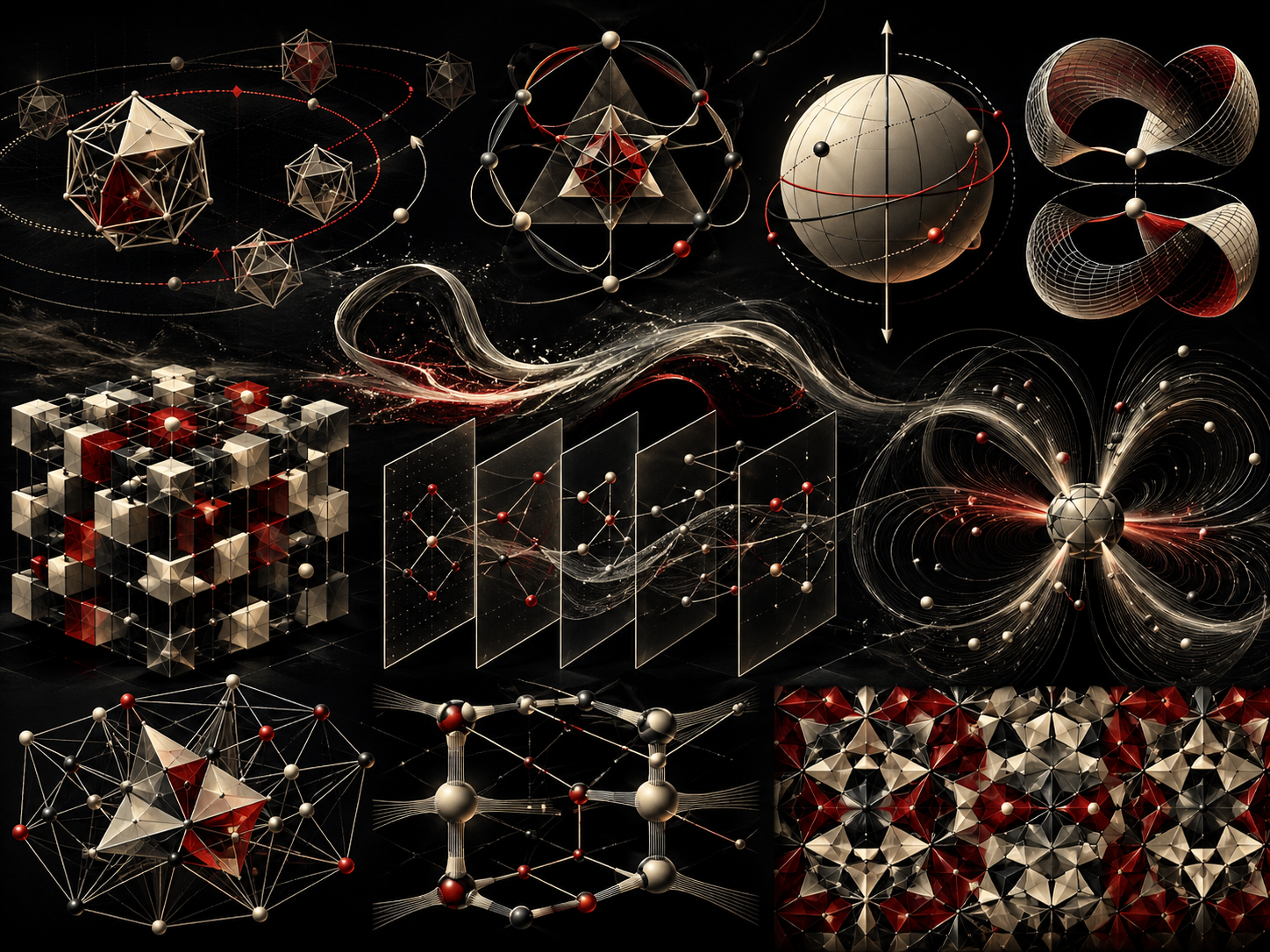
Why Group Theory Matters in Physics
Group theory matters in physics because physical systems are often understood through transformations that preserve structure. A crystal remains invariant under certain rotations, reflections, translations, and screw operations. A rotationally invariant atom has angular-momentum quantum numbers. A relativistic field theory must respect Lorentz symmetry. A gauge theory is organized around local internal symmetries. A molecular vibration may be infrared-active or Raman-active depending on how it transforms under a point group. A particle state is classified by mass, spin, charge, parity, flavor, color, and other symmetry labels.
The central insight is that symmetry reduces complexity. Instead of solving every problem from scratch, one can classify states by irreducible representations, identify conserved quantities, block-diagonalize Hamiltonians, derive selection rules, predict degeneracies, constrain tensors, and organize interactions. Symmetry tells the physicist what is possible before calculation begins.
Representation theory matters because physics takes place in spaces: coordinate space, Hilbert space, spinor space, tensor space, phase space, field space, lattice space, and internal-state space. Symmetry operations must act on these spaces. A representation gives that action a matrix, operator, or linear transformation form. Once symmetry is represented, it becomes calculational.
For the Physics knowledge series, this article belongs near Symmetry, Conservation, and Noether’s Theorem, Quantum Mechanics and the Limits of Classical Intuition, Quantum Field Theory I: Fields, Particles, and Second Quantization, Semiconductor Physics and Electronic Materials, Phase Transitions, Critical Phenomena, and the Renormalization Group, and Many-Body Physics and Emergent Collective Behavior. It supplies the common symmetry grammar underneath much of modern physics.
Symmetry as Structure Preservation
A symmetry is a transformation that preserves relevant structure. The structure may be geometric, algebraic, dynamical, quantum, statistical, or gauge-theoretic. A sphere is symmetric under rotations. A crystal is symmetric under a discrete set of spatial operations. A Hamiltonian is symmetric under a transformation if it commutes with the operator implementing that transformation. A Lagrangian is symmetric if the action remains invariant under a transformation. A gauge theory is symmetric under local transformations in internal space.
In classical mechanics, symmetry is often visible as spatial invariance. Translation symmetry corresponds to invariance under shifts in position. Rotation symmetry corresponds to invariance under orientation changes. Time-translation symmetry corresponds to invariance under shifts in time.
In quantum mechanics, symmetry acts on states and observables. If \(\hat U(g)\) represents a symmetry operation \(g\), then a Hamiltonian symmetry can be written as:
\hat U(g)\hat H\hat U(g)^{-1}=\hat H
\]
Interpretation: A Hamiltonian is invariant when conjugation by the symmetry operator leaves it unchanged.
Equivalently:
[\hat U(g),\hat H]=0
\]
Interpretation: The symmetry operator commutes with the Hamiltonian when the symmetry is preserved.
when the symmetry operator and Hamiltonian are defined on the same Hilbert space. This commutation relation implies that the Hamiltonian can often be block-diagonalized into symmetry sectors. Energy eigenstates can be labeled by symmetry quantum numbers.
Symmetry therefore does three jobs at once. It describes invariance. It constrains dynamics. It organizes states. Group theory is the formal language that makes these jobs precise.
What Is a Group?
A group is a set \(G\) equipped with a binary operation satisfying four axioms: closure, associativity, identity, and inverses. If \(g,h\in G\), then their product \(gh\in G\). For any \(g,h,k\in G\):
(gh)k=g(hk)
\]
Interpretation: Associativity means grouped multiplication order does not change the result.
There is an identity element \(e\) such that:
eg=ge=g
\]
Interpretation: The identity element leaves every group element unchanged.
and every element \(g\) has an inverse \(g^{-1}\) such that:
gg^{-1}=g^{-1}g=e
\]
Interpretation: Each group operation can be undone by its inverse.
Groups may be finite or infinite, discrete or continuous, abelian or nonabelian. An abelian group satisfies:
gh=hg
\]
Interpretation: Abelian group elements commute under multiplication.
for all \(g,h\in G\). Nonabelian groups do not. Noncommutativity is especially important in physics because rotations in three dimensions, Lorentz transformations, gauge transformations, and many operator algebras are noncommutative.
Examples include the cyclic group \(C_n\), the permutation group \(S_n\), the rotation group \(SO(3)\), the special unitary group \(SU(2)\), the Lorentz group, crystallographic point groups, space groups, and gauge groups such as \(U(1)\), \(SU(2)\), and \(SU(3)\).
A subgroup \(H\subseteq G\) is itself a group under the same operation. Subgroups describe restricted symmetries. For example, a crystal has less symmetry than continuous space. Symmetry breaking can often be described as a reduction from a larger group \(G\) to a subgroup \(H\).
Group Actions and Physical Transformations
A group action describes how group elements transform objects. If a group \(G\) acts on a set \(X\), each group element \(g\in G\) maps an object \(x\in X\) to another object \(g\cdot x\in X\), while respecting the group operation:
g\cdot(h\cdot x)=(gh)\cdot x
\]
Interpretation: A group action respects the order of group composition.
and:
e\cdot x=x
\]
Interpretation: The identity transformation leaves the object unchanged.
In physics, \(X\) might be physical space, a lattice, a molecule, a field configuration, a Hilbert space, a spin space, or a set of particle states. A rotation group acts on vectors. A point group acts on molecular orbitals. A translation group acts on lattice sites. A gauge group acts on internal degrees of freedom.
Group actions create orbits. The orbit of \(x\) is the set of all objects reachable by symmetry transformations:
\mathcal{O}_x=\{g\cdot x:g\in G\}
\]
Interpretation: The orbit collects all configurations related to \(x\) by group transformations.
The stabilizer subgroup of \(x\) is the set of transformations that leave \(x\) fixed:
G_x=\{g\in G:g\cdot x=x\}
\]
Interpretation: The stabilizer is the subgroup that preserves a particular object or state.
These ideas appear throughout physics. The orbit of a vector under rotations is a sphere. The stabilizer of a chosen direction in three-dimensional space is the group of rotations about that axis. In symmetry breaking, the vacuum may be invariant only under a subgroup of the full symmetry group, and the set of equivalent vacua is related to the quotient structure \(G/H\).
Representations
A representation maps abstract group elements to linear transformations. A representation \(D\) of a group \(G\) assigns to each \(g\in G\) an invertible matrix or linear operator \(D(g)\) such that:
D(gh)=D(g)D(h)
\]
Interpretation: A representation preserves group multiplication as matrix or operator multiplication.
and:
D(e)=I
\]
Interpretation: The identity group element is represented by the identity transformation.
Representations allow symmetry to act on vector spaces. In physics, those vector spaces may be Hilbert spaces, spin spaces, orbital spaces, field multiplets, tensor spaces, molecular vibrational spaces, or band-state spaces.
For example, a three-dimensional rotation can be represented by a \(3\times 3\) orthogonal matrix acting on ordinary vectors:
\mathbf{x}’=R\mathbf{x}
\]
Interpretation: A rotation matrix maps a vector into a rotated vector.
But the same abstract rotation symmetry can act differently on scalar fields, vector fields, spinors, tensors, spherical harmonics, and quantum states. Representation theory tells us which actions are possible and how they decompose.
A representation is faithful if different group elements are represented by different matrices. It is unitary if the matrices preserve inner products:
D(g)^\dagger D(g)=I
\]
Interpretation: A unitary representation preserves inner products and probabilities.
Unitary representations are especially important in quantum mechanics because probabilities are preserved under symmetry transformations.
Irreducible Representations
An irreducible representation is a representation that cannot be decomposed into smaller invariant subspaces. If a representation space \(V\) has no nontrivial subspace \(W\subset V\) that is preserved by all \(D(g)\), then the representation is irreducible.
Irreducible representations are the building blocks of symmetry analysis. A reducible representation can be decomposed into irreducible components:
\Gamma
=
\Gamma_1\oplus\Gamma_2\oplus\cdots
\]
Interpretation: A reducible representation can be written as a direct sum of irreducible symmetry sectors.
In quantum mechanics, irreducible representations often label physically distinct symmetry sectors. Angular momentum states are organized into irreducible representations of \(SU(2)\) or \(SO(3)\). Molecular vibrations are classified by irreducible representations of point groups. Particle multiplets are classified by representations of internal symmetry groups.
The power of irreducible representations is that they reveal hidden block structure. If a Hamiltonian respects a symmetry, matrix elements connecting incompatible irreducible sectors often vanish. This is the mathematical foundation behind selection rules and degeneracy classification.
Irreducibility also explains why some quantum numbers are robust. If a state belongs to a particular irreducible representation, then symmetry-preserving dynamics cannot arbitrarily mix it with states transforming in inequivalent irreducible representations.
Characters and Conjugacy Classes
The character of a representation is the trace of the representation matrix:
\chi(g)=\mathrm{Tr}\,D(g)
\]
Interpretation: A character compresses a representation matrix into a class-invariant trace.
Characters are powerful because they are invariant under similarity transformations. If:
D'(g)=S^{-1}D(g)S
\]
Interpretation: Similarity transformations change basis without changing the represented symmetry.
then:
\chi'(g)=\chi(g)
\]
Interpretation: Characters are invariant under basis change.
Characters are constant on conjugacy classes. Two elements \(g,h\in G\) are conjugate if there exists \(a\in G\) such that:
h=aga^{-1}
\]
Interpretation: Conjugate group elements are related by an internal change of reference within the group.
Character tables therefore summarize representation theory compactly: rows correspond to irreducible representations, columns correspond to conjugacy classes, and entries are character values.
The inner product of two characters for a finite group is:
\langle \chi_\alpha,\chi_\beta\rangle
=
\frac{1}{|G|}
\sum_{g\in G}
\chi_\alpha(g)^*
\chi_\beta(g)
\]
Interpretation: The character inner product measures overlap between two representations.
Irreducible characters obey orthogonality:
\langle \chi_\alpha,\chi_\beta\rangle=\delta_{\alpha\beta}
\]
Interpretation: Distinct irreducible characters are orthogonal.
If a reducible representation has character \(\chi\), the multiplicity of irreducible representation \(\alpha\) inside it is:
n_\alpha
=
\frac{1}{|G|}
\sum_{g\in G}
\chi_\alpha(g)^*
\chi(g)
\]
Interpretation: Irreducible multiplicity is computed by projecting the reducible character onto an irreducible character.
This formula is one of the most useful computational tools in group-theoretic physics. It turns decomposition into arithmetic.
Direct Sums, Tensor Products, and Decomposition
Representations can be combined. A direct sum represents independent sectors:
D_{\Gamma\oplus\Lambda}(g)
=
D_\Gamma(g)\oplus D_\Lambda(g)
\]
Interpretation: A direct sum combines representations into block-independent sectors.
The character of a direct sum is:
\chi_{\Gamma\oplus\Lambda}(g)
=
\chi_\Gamma(g)+\chi_\Lambda(g)
\]
Interpretation: Direct-sum characters add.
A tensor product represents composite systems:
D_{\Gamma\otimes\Lambda}(g)
=
D_\Gamma(g)\otimes D_\Lambda(g)
\]
Interpretation: A tensor product represents the symmetry action on a composite space.
The character of a tensor product is:
\chi_{\Gamma\otimes\Lambda}(g)
=
\chi_\Gamma(g)\chi_\Lambda(g)
\]
Interpretation: Tensor-product characters multiply.
Tensor products are essential in physics because physical systems combine. Two angular momenta combine. Two particles combine. Two orbitals combine. A field and an operator combine. A transition matrix element combines initial state, operator, and final state transformation properties.
For angular momentum, tensor-product decomposition gives the familiar Clebsch–Gordan series:
j_1\otimes j_2
=
\bigoplus_{j=|j_1-j_2|}^{j_1+j_2}j
\]
Interpretation: Angular-momentum addition decomposes into allowed total-\(j\) representations.
For two spin-\(\frac{1}{2}\) particles:
\frac{1}{2}\otimes\frac{1}{2}
=
0\oplus 1
\]
Interpretation: Two spin-\(\frac{1}{2}\) systems combine into a singlet and triplet.
This means two spin-\(\frac{1}{2}\) systems combine into a singlet and a triplet. Representation decomposition turns composite quantum structure into symmetry classification.
Lie Groups and Lie Algebras
A Lie group is a group that is also a smooth manifold, with multiplication and inversion defined smoothly. Lie groups describe continuous symmetries. Rotations, translations, Lorentz transformations, and gauge transformations are central examples.
A Lie algebra is the linearized structure of a Lie group near the identity. If \(T_a\) are generators, their commutators define structure constants:
[T_a,T_b]=if_{ab}^{\ \ c}T_c
\]
Interpretation: Lie-algebra commutators define the infinitesimal structure of a continuous symmetry group.
For a small transformation parameter \(\theta^a\), a group element near the identity can often be written as:
U(\theta)
=
e^{-i\theta^a T_a}
\]
Interpretation: Exponentiating Lie-algebra generators produces finite transformations near the identity.
The Lie group captures the finite transformations. The Lie algebra captures infinitesimal transformations and their commutation relations. Physics often works with the Lie algebra because generators become observables or conserved charges: angular momentum, momentum, Hamiltonian, boost generators, isospin, color generators, and gauge charges.
Lie theory is one reason symmetry becomes calculational. Instead of studying every continuous transformation separately, one studies the generators and their algebra. The finite transformations can then be recovered by exponentiation, at least locally and under appropriate mathematical conditions.
Generators, Commutators, and Observables
In quantum mechanics, continuous symmetries are generated by Hermitian operators. Spatial translations are generated by momentum. Time translations are generated by the Hamiltonian. Rotations are generated by angular momentum.
A spatial translation by displacement \(\mathbf{a}\) is represented by:
\hat U(\mathbf{a})
=
e^{-i\mathbf{a}\cdot\hat{\mathbf{P}}/\hbar}
\]
Interpretation: Momentum generates spatial translations in quantum mechanics.
A time translation by \(t\) is represented by:
\hat U(t)
=
e^{-i\hat Ht/\hbar}
\]
Interpretation: The Hamiltonian generates time evolution.
A rotation by angle \(\theta\) about axis \(\hat{\mathbf{n}}\) is represented by:
\hat U(R)
=
e^{-i\theta \hat{\mathbf{n}}\cdot\hat{\mathbf{J}}/\hbar}
\]
Interpretation: Angular momentum generates rotations.
The angular momentum operators satisfy:
[\hat J_i,\hat J_j]
=
i\hbar\epsilon_{ijk}\hat J_k
\]
Interpretation: Angular-momentum commutators encode the noncommutativity of rotations.
These commutation relations encode the noncommutativity of rotations. They also determine angular-momentum spectra, ladder operators, spin addition, spherical harmonics, and selection rules.
When a generator commutes with the Hamiltonian, the associated quantity is conserved:
[\hat H,\hat Q]=0
\]
Interpretation: A conserved quantum generator commutes with the Hamiltonian.
Group theory therefore connects symmetry, algebra, dynamics, and observables.
SO(3), SU(2), and Angular Momentum
The group \(SO(3)\) describes rotations in ordinary three-dimensional space. Its elements are real \(3\times 3\) orthogonal matrices with determinant one:
R^TR=I,\qquad \det R=1
\]
Interpretation: \(SO(3)\) matrices preserve lengths and orientations in three-dimensional space.
The group \(SU(2)\) consists of complex \(2\times 2\) unitary matrices with determinant one:
U^\dagger U=I,\qquad \det U=1
\]
Interpretation: \(SU(2)\) matrices preserve complex inner products and have unit determinant.
Although \(SO(3)\) and \(SU(2)\) are not the same group, their Lie algebras are closely related. \(SU(2)\) is the double cover of \(SO(3)\). This means that spinor representations of \(SU(2)\) capture physical behavior not represented by ordinary vector rotations alone.
The generators of \(SU(2)\) can be written using Pauli matrices:
\hat S_i=\frac{\hbar}{2}\sigma_i
\]
Interpretation: Spin-\(\frac{1}{2}\) generators are proportional to Pauli matrices.
where:
[\sigma_i,\sigma_j]=2i\epsilon_{ijk}\sigma_k
\]
Interpretation: Pauli matrices satisfy the \(SU(2)\) commutation structure.
Angular momentum states are labeled by \(j\) and \(m\):
\hat J^2|j,m\rangle
=
\hbar^2 j(j+1)|j,m\rangle
\]
Interpretation: \(\hat J^2\) measures total angular momentum.
\hat J_z|j,m\rangle
=
\hbar m|j,m\rangle
\]
Interpretation: \(\hat J_z\) measures the angular-momentum projection along the \(z\)-axis.
where:
m=-j,-j+1,\ldots,j
\]
Interpretation: The magnetic quantum number runs from \(-j\) to \(j\) in integer steps.
The dimension of the spin-\(j\) representation is:
2j+1
\]
Interpretation: A spin-\(j\) representation contains \(2j+1\) magnetic sublevels.
This is one of the most important representation-theoretic results in quantum physics.
Spinors and Double-Valued Representations
Spinors are objects that transform under \(SU(2)\) in a way that differs from ordinary vectors under \(SO(3)\). A spin-\(\frac{1}{2}\) state changes sign under a \(2\pi\) rotation:
|\psi\rangle \rightarrow -|\psi\rangle
\]
Interpretation: A spinor changes sign under a full \(2\pi\) rotation.
and returns to itself under a \(4\pi\) rotation:
|\psi\rangle \rightarrow |\psi\rangle
\]
Interpretation: A spinor returns to its original state after a \(4\pi\) rotation.
This behavior is not a classical vector property. It is a representation-theoretic property of quantum spin.
Spinors are central to electrons, fermions, Dirac theory, relativistic quantum mechanics, quantum information, magnetic resonance, spintronics, and particle physics. They also appear in condensed matter through spin-orbit coupling, topological insulators, double groups, and band-structure classification.
Double-valued representations are important in crystals with spin. Ordinary point-group representations may not fully capture the behavior of spin-\(\frac{1}{2}\) states. Double groups extend point-group analysis so spinor degrees of freedom can be handled correctly.
This is a major reason representation theory is not optional in quantum physics. The transformation law of a state determines what kind of physical object it is.
Lorentz and Poincaré Symmetry
Special relativity is organized by Lorentz symmetry. Lorentz transformations preserve the spacetime interval:
s^2
=
-c^2t^2+x^2+y^2+z^2
\]
Interpretation: The spacetime interval is invariant under Lorentz transformations, up to sign convention.
depending on sign convention. The Lorentz group includes rotations and boosts. The Poincaré group extends Lorentz symmetry by including spacetime translations.
Relativistic particles are classified by representations of the Poincaré group. Two central invariants are mass and spin. In quantum field theory, fields are assigned transformation laws under Lorentz representations: scalar fields, spinor fields, vector fields, tensor fields, and gauge fields transform differently.
The Lorentz algebra contains rotation generators \(J_i\) and boost generators \(K_i\). Their commutation relations include:
[J_i,J_j]=i\epsilon_{ijk}J_k
\]
Interpretation: Rotation generators close among themselves.
[J_i,K_j]=i\epsilon_{ijk}K_k
\]
Interpretation: Rotations transform boosts as vector-like generators.
[K_i,K_j]=-i\epsilon_{ijk}J_k
\]
Interpretation: Boost commutators produce rotations with a sign reflecting spacetime geometry.
using units and conventions where factors of \(\hbar\) may be absorbed. The negative sign in the boost commutator reflects the geometry of spacetime rather than ordinary Euclidean rotation.
Group theory therefore becomes the architecture of relativistic physics. It determines what counts as a scalar, vector, spinor, tensor, massless particle, massive particle, helicity state, and covariant field equation.
Internal Symmetries and Gauge Groups
Not all symmetries act on spacetime. Internal symmetries act on internal degrees of freedom such as phase, isospin, flavor, weak isospin, color, or field multiplet components. A global phase transformation of a complex quantum field is an example:
\psi \rightarrow e^{i\alpha}\psi
\]
Interpretation: A global phase transformation acts in internal field space.
This is associated with \(U(1)\) symmetry. In quantum electrodynamics, local \(U(1)\) gauge symmetry organizes the coupling between charged fields and the electromagnetic gauge field.
The Standard Model is organized around the gauge group:
SU(3)_C\times SU(2)_L\times U(1)_Y
\]
Interpretation: The Standard Model gauge group organizes color, weak isospin, and hypercharge symmetries.
Here \(SU(3)_C\) is associated with color in quantum chromodynamics, \(SU(2)_L\) with weak isospin, and \(U(1)_Y\) with weak hypercharge. Particle fields transform under representations of these groups.
Gauge symmetry is subtle because it includes descriptive redundancy. Gauge-related configurations may represent the same physical situation. Yet the representation structure of gauge groups determines charges, interactions, gauge bosons, covariant derivatives, field strengths, and allowed terms in the Lagrangian.
A gauge-covariant derivative has the schematic form:
D_\mu
=
\partial_\mu
+
igA_\mu^aT_a
\]
Interpretation: The covariant derivative combines ordinary differentiation with gauge-field and generator structure.
where \(T_a\) are group generators, \(A_\mu^a\) are gauge fields, and \(g\) is a coupling constant. This single expression shows how group representation becomes physical interaction.
Symmetry Breaking and Particle Multiplets
Symmetry breaking occurs when the equations or Lagrangian have a symmetry that the realized state does not fully preserve. If a symmetry group \(G\) is broken to a subgroup \(H\), the remaining symmetry is smaller:
G\rightarrow H
\]
Interpretation: Symmetry breaking reduces the full symmetry group to a preserved subgroup.
This framework appears in magnets, crystals, superconductors, particle physics, cosmology, and phase transitions. In ferromagnetism, rotational symmetry may be broken by a chosen magnetization direction. In crystals, continuous translation and rotation symmetries are reduced to discrete space-group symmetries. In electroweak theory, gauge and scalar-field structure produce the observed pattern of electromagnetic and weak interactions.
Particle multiplets are also representation-theoretic. If a set of particles transforms as a multiplet under a symmetry group, symmetry relates their properties. Exact symmetry would imply degeneracies or exact relations. Approximate or broken symmetry explains why those relations are imperfect.
The representation-theoretic view is especially powerful because it separates structure from dynamics. Symmetry determines allowed forms, quantum numbers, and transformation properties. Dynamics determine masses, couplings, lifetimes, and amplitudes within those constraints.
Point Groups, Space Groups, and Crystals
Crystals are governed by discrete spatial symmetry. A point group contains rotations, reflections, inversions, and improper rotations that leave at least one point fixed. A space group combines point-group operations with translations, glide reflections, and screw axes.
In crystals, continuous rotational and translational symmetries of free space are reduced to discrete symmetries of the lattice. This reduction shapes vibrational modes, electronic bands, degeneracies, optical selection rules, tensor properties, and phase transitions.
Bloch’s theorem follows from discrete translational symmetry. If a potential has lattice periodicity:
V(\mathbf{r}+\mathbf{R})=V(\mathbf{r})
\]
Interpretation: A periodic potential is invariant under lattice translations.
then electronic wavefunctions can be written as:
\psi_{n\mathbf{k}}(\mathbf{r})
=
e^{i\mathbf{k}\cdot\mathbf{r}}
u_{n\mathbf{k}}(\mathbf{r})
\]
Interpretation: Bloch wavefunctions separate a plane-wave phase from a lattice-periodic part.
where:
u_{n\mathbf{k}}(\mathbf{r}+\mathbf{R})=u_{n\mathbf{k}}(\mathbf{r})
\]
Interpretation: The cell-periodic Bloch function has the same periodicity as the lattice.
Group theory then classifies states at high-symmetry points and along high-symmetry lines in the Brillouin zone. It also determines degeneracies and allowed couplings. In modern materials physics, representation theory is central to band topology, symmetry indicators, double groups, magnetic groups, and topological quantum chemistry.
Selection Rules and Spectroscopy
Selection rules determine whether a transition is allowed or forbidden by symmetry. A transition matrix element has the form:
\langle f|\hat O|i\rangle
\]
Interpretation: A transition amplitude connects initial and final states through an operator.
where \(|i\rangle\) is the initial state, \(|f\rangle\) is the final state, and \(\hat O\) is the transition operator. For the matrix element to be nonzero, the product of representations must contain the totally symmetric representation:
\Gamma_f^*\otimes \Gamma_O\otimes \Gamma_i
\supset
\Gamma_{\mathrm{sym}}
\]
Interpretation: A transition is symmetry-allowed when the representation product contains the totally symmetric representation.
This rule appears in molecular spectroscopy, atomic transitions, vibrational modes, Raman scattering, infrared absorption, crystal-field theory, and optical transitions in solids.
In angular momentum language, electric dipole transitions obey rules such as:
\Delta l=\pm 1
\]
Interpretation: Electric dipole transitions change orbital angular momentum by one unit under standard assumptions.
and:
\Delta m=0,\pm 1
\]
Interpretation: Magnetic quantum-number changes are constrained by angular-momentum selection rules.
under appropriate assumptions. These are not arbitrary empirical rules. They follow from the transformation properties of states and operators under rotational symmetry.
Selection rules demonstrate the practical power of representation theory. Without solving full dynamics, symmetry tells which transitions vanish exactly, which may appear only through symmetry breaking, and which are allowed at leading order.
Tensors, Fields, and Covariance
Tensors are objects that transform according to representation rules. A vector transforms differently from a scalar, a second-rank tensor, a spinor, or a gauge field. Physics depends on these transformation laws because equations must preserve meaning under changes of frame or symmetry operations.
For a vector under rotation:
V_i’ = R_{ij}V_j
\]
Interpretation: A vector transforms with one rotation matrix.
For a second-rank tensor:
T_{ij}’=R_{ik}R_{jl}T_{kl}
\]
Interpretation: A rank-two tensor transforms with one rotation matrix for each index.
In relativity, tensors transform under Lorentz transformations:
T’^{\mu\nu}
=
\Lambda^\mu_{\ \alpha}
\Lambda^\nu_{\ \beta}
T^{\alpha\beta}
\]
Interpretation: Relativistic tensors transform with Lorentz matrices on each spacetime index.
Covariance means that equations keep their form under the relevant transformation group. Maxwell’s equations, the Dirac equation, the Einstein field equation, and gauge-field Lagrangians are all built around transformation laws.
Representation theory clarifies what kind of object each physical quantity is. A scalar field, vector field, spinor field, tensor field, gauge connection, curvature tensor, stress-energy tensor, and order parameter each carries a transformation rule. Knowing the representation tells us how the object can appear in invariant equations.
Computational Group Theory in Physics
Computational group theory helps turn symmetry into reproducible workflows. A finite group can be represented by a Cayley table. A representation can be stored as matrices. Characters can be computed as traces. Orthogonality can be checked numerically. Reducible representations can be decomposed by inner products with irreducible characters. Tensor products can be decomposed using character products. Angular-momentum matrices can be generated algorithmically. Point-group metadata can be stored and linked to selection-rule calculations.
Computational symmetry workflows are useful in spectroscopy, condensed matter, quantum mechanics, quantum chemistry, particle physics, crystallography, lattice models, tensor analysis, and educational physics. They also improve reproducibility because they preserve group definitions, representation conventions, basis choices, normalization factors, and source provenance.
There are mature specialized tools for crystallographic groups, Lie algebras, computational algebra, electronic structure, and symmetry analysis. The workflows in this article are not meant to replace them. They are transparent examples for understanding how the representation-theoretic logic works.
Measurement, Units, and SI Interpretation
Group theory is mostly dimensionless, but its physical applications are not. Symmetry operations are mathematical transformations, yet their generators often carry physical units. Momentum generates translations and has units of kilogram meters per second. Angular momentum generates rotations and has units of joule seconds. The Hamiltonian generates time translations and has units of energy.
For rotations:
\hat U(R)
=
e^{-i\theta\hat{\mathbf{n}}\cdot\hat{\mathbf{J}}/\hbar}
\]
Interpretation: A rotation operator must have a dimensionless exponent.
The exponent must be dimensionless. Therefore \(\hat{\mathbf{J}}\) and \(\hbar\) have the same units. Similarly, for time evolution:
e^{-i\hat Ht/\hbar}
\]
Interpretation: Time evolution is generated by energy multiplied by time in units of \(\hbar\).
the product \(\hat Ht\) has units of action, matching \(\hbar\).
Group parameters may be dimensionless angles, spacetime displacements, rapidities, phases, or gauge parameters. Representation matrices are usually dimensionless, but the generators may carry units depending on convention. In natural units, one often sets:
\hbar=c=1
\]
Interpretation: Natural units simplify formulas by making action and relativistic conversion factors dimensionless.
which simplifies expressions but can obscure dimensional interpretation. Computational workflows should document whether generators are dimensionless, measured in units of \(\hbar\), or expressed in SI units.
Mathematical Lens
A mathematics-first view of group theory in physics begins with the group axioms and moves quickly to representation. A representation satisfies:
D(gh)=D(g)D(h)
\]
Interpretation: A representation turns group multiplication into operator multiplication.
The character is:
\chi(g)=\mathrm{Tr}\,D(g)
\]
Interpretation: A character is the trace of the representation matrix.
The finite-group character inner product is:
\langle \chi_\alpha,\chi_\beta\rangle
=
\frac{1}{|G|}
\sum_{g\in G}
\chi_\alpha(g)^*
\chi_\beta(g)
\]
Interpretation: Character inner products test representation overlap.
The multiplicity of irreducible representation \(\alpha\) in a reducible representation \(\Gamma\) is:
n_\alpha
=
\frac{1}{|G|}
\sum_{g\in G}
\chi_\alpha(g)^*
\chi_\Gamma(g)
\]
Interpretation: Character projection computes irreducible multiplicities.
Lie-algebra generators satisfy:
[T_a,T_b]=if_{ab}^{\ \ c}T_c
\]
Interpretation: Structure constants define the Lie-algebra commutator.
For angular momentum:
[\hat J_i,\hat J_j]
=
i\hbar\epsilon_{ijk}\hat J_k
\]
Interpretation: Angular-momentum generators satisfy the \(SU(2)\) Lie algebra.
The Casimir operator \(\hat J^2\) satisfies:
\hat J^2|j,m\rangle
=
\hbar^2j(j+1)|j,m\rangle
\]
Interpretation: The total angular-momentum Casimir labels irreducible \(j\) representations.
and:
\hat J_z|j,m\rangle
=
\hbar m|j,m\rangle
\]
Interpretation: \(m\) labels angular-momentum projection.
Tensor-product decomposition for angular momentum is:
j_1\otimes j_2
=
\bigoplus_{j=|j_1-j_2|}^{j_1+j_2}j
\]
Interpretation: Angular momenta combine into a direct sum of allowed total-\(j\) sectors.
A gauge-covariant derivative is:
D_\mu
=
\partial_\mu+igA_\mu^aT_a
\]
Interpretation: Gauge covariance modifies differentiation using gauge fields and group generators.
This mathematical lens shows that group theory is not external decoration. It is a structural language for transformations, states, operators, fields, and interactions.
Variables, Units, and Physical Interpretation
Group theory uses abstract objects, but in physics those objects acquire physical interpretation. The table below summarizes several central quantities.
| Symbol or Term | Meaning | Typical Unit or Dimension | Physical Interpretation |
|---|---|---|---|
| \(G\) | Group | abstract set | Symmetry transformations with composition law |
| \(g,h\) | Group elements | dimensionless or transformation-dependent | Specific symmetry operations |
| \(D(g)\) | Representation matrix | usually dimensionless | Linear action of symmetry on a vector space |
| \(\chi(g)\) | Character | dimensionless | Trace of representation matrix; class function |
| \(\Gamma\) | Representation label | dimensionless | Symmetry type of a state, field, mode, or operator |
| \(T_a\) | Lie-algebra generator | depends on convention | Infinitesimal generator of continuous symmetry |
| \(f_{ab}^{\ \ c}\) | Structure constants | dimensionless in common conventions | Define Lie-algebra commutation structure |
| \(\hat J_i\) | Angular momentum generator | J·s | Generator of rotations in quantum mechanics |
| \(j,m\) | Angular momentum quantum numbers | dimensionless | Labels for irreducible angular-momentum states |
| \(SU(2)\) | Special unitary group in two dimensions | group | Spin and double-cover structure for rotations |
| \(SO(3)\) | Three-dimensional rotation group | group | Rotational symmetry of ordinary space |
| \(D_\mu\) | Gauge-covariant derivative | inverse length or energy convention | Derivative modified to transform covariantly under gauge symmetry |
Note: Group theory begins abstractly but becomes physically powerful when its objects are represented on states, fields, operators, and measured quantities.
Worked Example: Reducible Representation of \(C_3\)
Consider the cyclic group \(C_3\):
C_3=\{e,r,r^2\}
\]
Interpretation: The cyclic group \(C_3\) contains the identity, one generator, and its square.
with:
r^3=e
\]
Interpretation: Applying the generator three times returns to the identity.
Because \(C_3\) is abelian, each element forms its own conjugacy class. The irreducible complex representations are one-dimensional. Let:
\omega=e^{2\pi i/3}
\]
Interpretation: \(\omega\) is a primitive third root of unity.
The three irreducible characters are:
\chi_0=(1,1,1)
\]
Interpretation: \(\chi_0\) is the trivial character.
\chi_1=(1,\omega,\omega^2)
\]
Interpretation: \(\chi_1\) maps the generator to \(\omega\).
\chi_2=(1,\omega^2,\omega)
\]
Interpretation: \(\chi_2\) maps the generator to \(\omega^2\).
Now suppose a reducible representation has character:
\chi=(3,0,0)
\]
Interpretation: This reducible character can be decomposed into irreducible characters.
The multiplicity of irreducible representation \(k\) is:
n_k
=
\frac{1}{3}
\sum_{g\in C_3}
\chi_k(g)^*\chi(g)
\]
Interpretation: Multiplicity is computed by the character inner product with each irreducible character.
For \(k=0\):
n_0
=
\frac{1}{3}
[(1)^*3+(1)^*0+(1)^*0]
=
1
\]
Interpretation: The trivial representation appears once.
For \(k=1\):
n_1
=
\frac{1}{3}
[(1)^*3+(\omega)^*0+(\omega^2)^*0]
=
1
\]
Interpretation: The first nontrivial one-dimensional representation appears once.
For \(k=2\):
n_2
=
\frac{1}{3}
[(1)^*3+(\omega^2)^*0+(\omega)^*0]
=
1
\]
Interpretation: The second nontrivial one-dimensional representation appears once.
Therefore:
\Gamma
=
\Gamma_0\oplus\Gamma_1\oplus\Gamma_2
\]
Interpretation: The reducible representation decomposes into all three irreducible representations of \(C_3\).
This simple example shows how characters decompose a representation without explicitly changing basis. In physics, the same logic classifies vibrational modes, molecular orbitals, crystal states, angular-momentum products, and symmetry-allowed transitions.
Computational Modeling
Computational modeling helps make group theory operational. A finite-group workflow can construct a Cayley table and verify group axioms. A representation workflow can store matrices and check \(D(gh)=D(g)D(h)\). A character workflow can compute traces and test orthogonality. A decomposition workflow can compute irreducible multiplicities. A Lie-algebra workflow can compute commutators. An angular-momentum workflow can generate \(J_x\), \(J_y\), \(J_z\), ladder operators, and Casimir eigenvalues. A metadata workflow can preserve group conventions, basis choices, normalization, source references, and physical interpretations.
The selected examples below focus on character orthogonality for \(C_3\) and angular-momentum matrices for \(SU(2)\) because they are foundational, readable, and directly reusable. The GitHub repository extends the same logic into richer computational resources: R finite-group character tables, Python angular-momentum generators, representation checks, irreducible decomposition, tensor-product examples, Clebsch–Gordan metadata, point-group examples, Lie-algebra commutators, Julia group calculations, C++ representation sweeps, Fortran character tables, SQL symmetry metadata, Rust command-line utilities, C examples, documentation, and reproducible sample data.
R Workflow: Character Orthogonality for \(C_3\)
R is useful for compact representation tables, reproducible decomposition calculations, and symmetry metadata summaries. The following workflow constructs the complex character table of \(C_3\), checks character orthogonality, and decomposes a reducible representation.
# Character Orthogonality for C3
#
# This workflow constructs the irreducible complex characters of C3:
#
#   C3 = {e, r, r^2}
#
# and checks:
#
#   <chi_a, chi_b> = (1 / |G|) sum_g conjugate(chi_a(g)) chi_b(g)
#
# It also decomposes a reducible representation with character (3, 0, 0).

library(tibble)
library(dplyr)
library(tidyr)
library(purrr)

omega <- exp(2i * pi / 3)

character_table <- tibble(
  irrep = c("Gamma_0", "Gamma_1", "Gamma_2"),
  e = c(1, 1, 1),
  r = c(1, omega, omega^2),
  r2 = c(1, omega^2, omega)
)

group_elements <- c("e", "r", "r2")
group_order <- length(group_elements)

inner_product <- function(row_a, row_b) {
  values_a <- as.complex(unlist(row_a[group_elements]))
  values_b <- as.complex(unlist(row_b[group_elements]))

  sum(Conj(values_a) * values_b) / group_order
}

orthogonality_table <- expand_grid(
  irrep_a = character_table$irrep,
  irrep_b = character_table$irrep
) %>%
  rowwise() %>%
  mutate(
    inner_product = inner_product(
      character_table %>% filter(irrep == irrep_a),
      character_table %>% filter(irrep == irrep_b)
    ),
    inner_product_real = Re(inner_product),
    inner_product_imaginary = Im(inner_product)
  ) %>%
  ungroup()

reducible_character <- c(e = 3, r = 0, r2 = 0)

decomposition_table <- character_table %>%
  rowwise() %>%
  mutate(
    multiplicity = Re(
      sum(
        Conj(as.complex(c(e, r, r2))) *
          as.complex(reducible_character)
      ) / group_order
    )
  ) %>%
  ungroup() %>%
  select(irrep, multiplicity)

print(character_table)
print(orthogonality_table)
print(decomposition_table)
This workflow shows why character tables are practical. Once the irreducible characters are known, orthogonality and decomposition become transparent computations. The same method scales conceptually to point groups, vibrational mode classification, symmetry-adapted basis construction, and selection-rule analysis.
Python Workflow: Angular-Momentum Matrices for SU(2)
Python is useful for constructing generators, checking commutators, and building angular-momentum representations. The following workflow generates \(J_x\), \(J_y\), \(J_z\), \(J_+\), and \(J_-\) for spin \(j\), then verifies the angular-momentum commutation relation.
"""
Angular-Momentum Matrices for SU(2)

This workflow constructs the spin-j representation of angular momentum.

Basis:
    |j, m>, where m = j, j-1, ..., -j

Operators:
    J_z |j, m> = hbar m |j, m>
    J_+ |j, m> = hbar sqrt(j(j+1) - m(m+1)) |j, m+1>
    J_- |j, m> = hbar sqrt(j(j+1) - m(m-1)) |j, m-1>

Then:
    J_x = (J_+ + J_-) / 2
    J_y = (J_+ - J_-) / (2i)

The script checks:
    [J_x, J_y] = i hbar J_z
"""

import numpy as np
import pandas as pd

HBAR = 1.0

def angular_momentum_matrices(j: float, hbar: float = HBAR) -> dict:
    """
    Construct spin-j angular-momentum matrices.

    Parameters
    ----------
    j:
        Angular momentum quantum number. Examples: 0.5, 1, 1.5, 2.
    hbar:
        Reduced Planck constant in chosen units. Default uses hbar = 1.

    Returns
    -------
    Dictionary containing basis m values and J matrices.
    """
    dimension = int(2 * j + 1)
    m_values = np.array([j - index for index in range(dimension)], dtype=float)

    j_plus = np.zeros((dimension, dimension), dtype=complex)
    j_minus = np.zeros((dimension, dimension), dtype=complex)
    j_z = np.diag(hbar * m_values).astype(complex)

    m_to_index = {m: index for index, m in enumerate(m_values)}

    for col_index, m in enumerate(m_values):
        raised_m = m + 1
        lowered_m = m - 1

        if raised_m in m_to_index:
            row_index = m_to_index[raised_m]
            coefficient = hbar * np.sqrt(j * (j + 1) - m * (m + 1))
            j_plus[row_index, col_index] = coefficient

        if lowered_m in m_to_index:
            row_index = m_to_index[lowered_m]
            coefficient = hbar * np.sqrt(j * (j + 1) - m * (m - 1))
            j_minus[row_index, col_index] = coefficient

    j_x = 0.5 * (j_plus + j_minus)
    j_y = (j_plus - j_minus) / (2.0j)

    return {
        "m_values": m_values,
        "J_plus": j_plus,
        "J_minus": j_minus,
        "J_x": j_x,
        "J_y": j_y,
        "J_z": j_z,
    }

def matrix_error_norm(left: np.ndarray, right: np.ndarray) -> float:
    """
    Compute Frobenius norm of the difference between two matrices.
    """
    return float(np.linalg.norm(left - right))

def summarize_spin_representation(j: float) -> dict:
    """
    Construct spin-j matrices and summarize representation diagnostics.
    """
    matrices = angular_momentum_matrices(j)

    j_x = matrices["J_x"]
    j_y = matrices["J_y"]
    j_z = matrices["J_z"]

    commutator_xy = j_x @ j_y - j_y @ j_x
    expected_xy = 1j * HBAR * j_z

    casimir = j_x @ j_x + j_y @ j_y + j_z @ j_z
    expected_casimir = HBAR**2 * j * (j + 1) * np.eye(int(2 * j + 1))

    return {
        "j": j,
        "dimension": int(2 * j + 1),
        "commutator_xy_error_norm": matrix_error_norm(commutator_xy, expected_xy),
        "casimir_error_norm": matrix_error_norm(casimir, expected_casimir),
        "casimir_eigenvalue_expected": HBAR**2 * j * (j + 1),
    }

def main() -> None:
    """
    Run diagnostics for several spin representations.
    """
    spin_values = [0.5, 1.0, 1.5, 2.0, 3.0]

    summary = pd.DataFrame(
        [summarize_spin_representation(j) for j in spin_values]
    )

    print("SU(2) angular-momentum representation diagnostics:")
    print(summary.round(12).to_string(index=False))

if __name__ == "__main__":
    main()
This workflow makes representation theory visible as matrix algebra. The spin-\(j\) representation has dimension \(2j+1\), the commutator reproduces the \(SU(2)\) Lie algebra, and the Casimir operator has eigenvalue \(\hbar^2j(j+1)\). These structures underlie angular momentum, spin addition, spectroscopy, quantum information, and particle classification.
GitHub Repository
The article body includes only selected computational examples so the conceptual and mathematical argument remains readable. The full repository contains the expanded computational infrastructure: R finite-group character tables, Python angular-momentum generators, representation checks, irreducible decomposition, tensor-product examples, Clebsch–Gordan metadata, point-group examples, Lie-algebra commutators, Julia group calculations, C++ representation sweeps, Fortran character tables, SQL symmetry metadata, Rust command-line utilities, C examples, documentation, and reproducible sample data.
The full code distribution for this article, including selected article examples and research-oriented computational resources for group theory, representation theory, finite groups, character tables, irreducible decomposition, angular momentum, Lie algebras, point groups, selection rules, symmetry metadata, reproducibility documentation, and performance-oriented scientific computing, is available on GitHub.
From Symmetry to Physical Law
Group theory and representation theory show that symmetry is not peripheral to physics. It is one of the main ways physical law is structured. Symmetry determines conservation laws, quantum numbers, degeneracies, allowed transitions, tensor forms, gauge interactions, particle multiplets, crystal states, angular momentum, spin, and relativistic covariance.
Within the Physics knowledge series, this article belongs near Symmetry, Conservation, and Noether’s Theorem, Quantum Mechanics and the Limits of Classical Intuition, Quantum Field Theory I: Fields, Particles, and Second Quantization, Semiconductor Physics and Electronic Materials, Many-Body Physics and Emergent Collective Behavior, and Mathematical Methods in Physics. It provides the symmetry grammar required to move from mathematical transformation to physical classification.
The next conceptual steps are natural. Gauge Theory: Symmetry, Fields, and Interaction develops local internal symmetry and gauge fields. The Standard Model: Gauge Structure, Particles, and Symmetry Breaking applies representation theory to particle physics. Topological Matter and Quantum Phases extends symmetry analysis into topology and quantum materials. Crystallography, Space Groups, and Material Symmetry develops the solid-state side in greater depth.
Related Articles
- Physics
- What Is Physics?
- Measurement, Mathematics, and the Structure of Physical Inquiry
- Mathematical Methods in Physics
- Symmetry, Conservation, and Noether’s Theorem
- Quantum Mechanics and the Limits of Classical Intuition
- Lagrangian and Hamiltonian Mechanics
- Quantum Field Theory I: Fields, Particles, and Second Quantization
- Many-Body Physics and Emergent Collective Behavior
- Phase Transitions, Critical Phenomena, and the Renormalization Group
- Semiconductor Physics and Electronic Materials
- Atomic, Molecular, and Optical Physics
- Computational Physics and Scientific Simulation
- Natural Science
Further Reading
- Dresselhaus, M.S. (2002) Applications of Group Theory to the Physics of Solids. MIT 8.510J/6.734J. Available at: https://web.mit.edu/course/6/6.734j/www/group-full02.pdf (Accessed: 25 April 2026).
- Etingof, P. (2020) Lie Groups and Lie Algebras I. MIT OpenCourseWare. Available at: https://ocw.mit.edu/courses/18-745-lie-groups-and-lie-algebras-i-fall-2020/ (Accessed: 25 April 2026).
- Georgi, H. (1999) Lie Algebras in Particle Physics: From Isospin to Unified Theories, 2nd edn. Boca Raton: CRC Press. Publisher information available at: https://www.routledge.com/Lie-Algebras-In-Particle-Physics-from-Isospin-To-Unified-Theories/Georgi/p/book/9780738202334 (Accessed: 25 April 2026).
- Hamermesh, M. (1989) Group Theory and Its Application to Physical Problems. Mineola, NY: Dover. Publisher information available at: https://store.doverpublications.com/products/9780486661810 (Accessed: 25 April 2026).
- MIT Mathematics (2012) 18.395 Group Theory with Applications to Physics. Available at: https://math.mit.edu/classes/18.395/index.php (Accessed: 25 April 2026).
- MIT OpenCourseWare (2023) Representations of Lie Groups. Available at: https://ocw.mit.edu/courses/18-757-representations-of-lie-groups-fall-2023/ (Accessed: 25 April 2026).
- MIT OpenCourseWare (2005) Particle Physics II. Available at: https://ocw.mit.edu/courses/8-811-particle-physics-ii-fall-2005/ (Accessed: 25 April 2026).
- Sternberg, S. (1995) Group Theory and Physics. Cambridge: Cambridge University Press. Publisher information available at: https://www.cambridge.org/highereducation/books/group-theory-and-physics/DA78456E7D73C3F7DF07B9FFEC7FE66B (Accessed: 25 April 2026).
- Tinkham, M. (2003) Group Theory and Quantum Mechanics. Mineola, NY: Dover. Publisher information available at: https://store.doverpublications.com/products/9780486432472 (Accessed: 25 April 2026).
- Tung, W.-K. (1985) Group Theory in Physics. Singapore: World Scientific. Publisher information available at: https://www.worldscientific.com/worldscibooks/10.1142/0097 (Accessed: 25 April 2026).
- Woit, P. (2017) Quantum Theory, Groups and Representations: An Introduction. Available at: https://www.math.columbia.edu/~woit/QM/qmbook.pdf (Accessed: 25 April 2026).
- Zee, A. (2016) Group Theory in a Nutshell for Physicists. Princeton: Princeton University Press. Publisher information available at: https://press.princeton.edu/books/hardcover/9780691162690/group-theory-in-a-nutshell-for-physicists (Accessed: 25 April 2026).
References
- Dresselhaus, M.S. (2002) Applications of Group Theory to the Physics of Solids. MIT 8.510J/6.734J. Available at: https://web.mit.edu/course/6/6.734j/www/group-full02.pdf (Accessed: 25 April 2026).
- Etingof, P. (2020) Lie Groups and Lie Algebras I. MIT OpenCourseWare. Available at: https://ocw.mit.edu/courses/18-745-lie-groups-and-lie-algebras-i-fall-2020/ (Accessed: 25 April 2026).
- MIT Mathematics (2012) 18.395 Group Theory with Applications to Physics. Available at: https://math.mit.edu/classes/18.395/index.php (Accessed: 25 April 2026).
- MIT OpenCourseWare (2023) Representations of Lie Groups. Available at: https://ocw.mit.edu/courses/18-757-representations-of-lie-groups-fall-2023/ (Accessed: 25 April 2026).
- MIT OpenCourseWare (2005) Particle Physics II. Available at: https://ocw.mit.edu/courses/8-811-particle-physics-ii-fall-2005/ (Accessed: 25 April 2026).
- Woit, P. (2017) Quantum Theory, Groups and Representations: An Introduction. Available at: https://www.math.columbia.edu/~woit/QM/qmbook.pdf (Accessed: 25 April 2026).