
Last Updated May 28, 2026
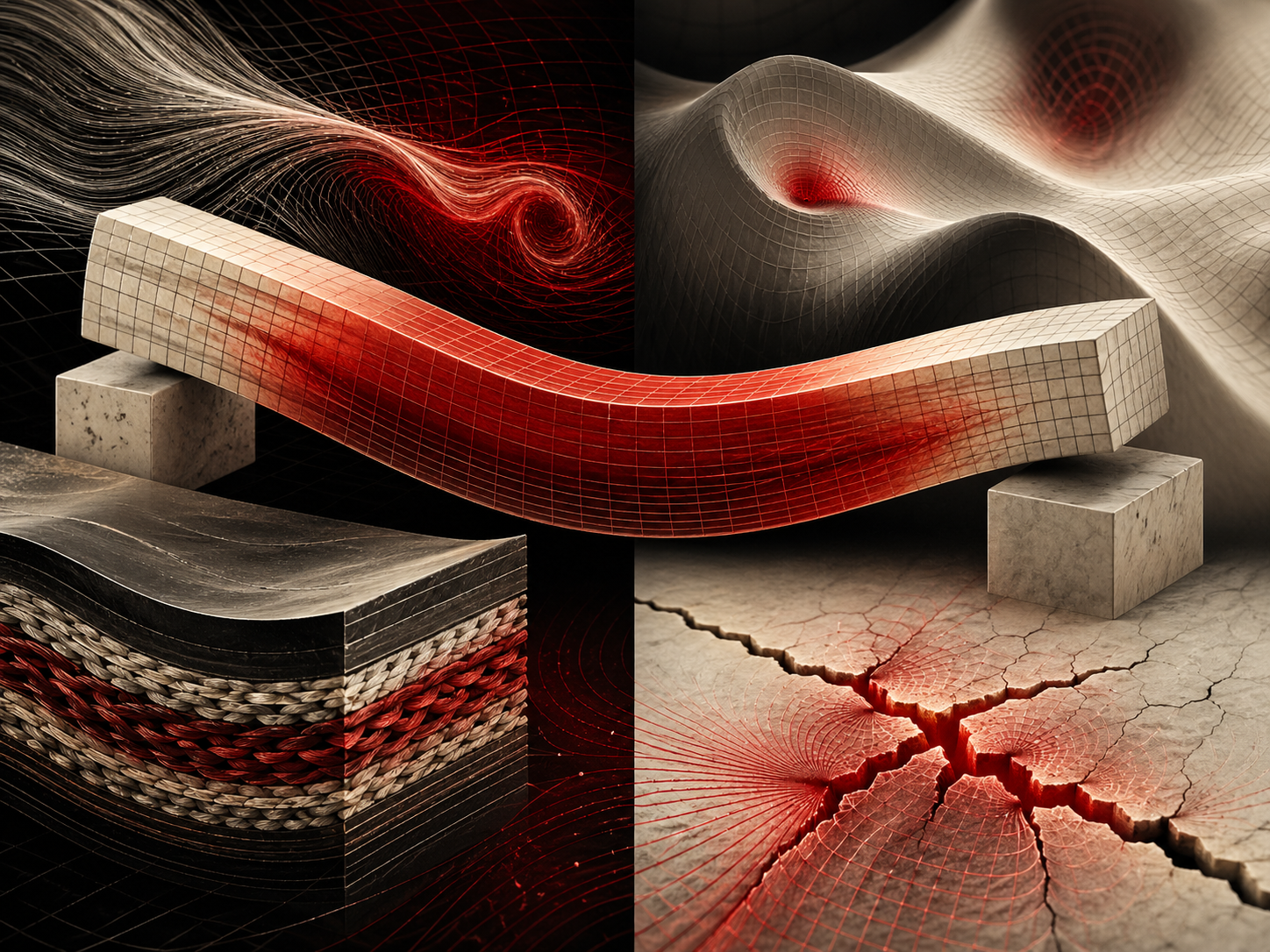
Continuum physics and material behavior explain how extended matter deforms, carries load, stores elastic energy, flows slowly, yields, fractures, relaxes, and responds to force across space and time. Classical mechanics begins with particles and rigid bodies, but real materials are rarely perfectly rigid. Bridges bend. Beams deflect. Metals yield. Polymers creep. Rocks fracture. Tissues stretch. Ceramics crack. Composite structures redistribute stress. Fluids flow continuously under shear, while solids may resist deformation, deform elastically, deform plastically, or fail. Continuum physics provides the field-based framework for understanding these behaviors without tracking every atom individually.
The continuum view treats matter as an extended medium whose physical quantities vary smoothly across space and time. Displacement, strain, stress, density, velocity, temperature, energy, and internal state variables become fields. This approach connects solid mechanics, fluid mechanics, elasticity, plasticity, viscoelasticity, fracture mechanics, geophysics, biomechanics, materials science, civil engineering, aerospace structures, and computational simulation. It is one of the major bridges between microscopic matter and macroscopic behavior.
This article develops Continuum Physics and Material Behavior as a foundational topic within the Physics knowledge series. It explains the continuum hypothesis, displacement fields, deformation gradients, strain, stress, traction, equilibrium, constitutive laws, linear elasticity, isotropic material parameters, elastic energy, plastic deformation, yield criteria, viscoelasticity, fracture, fatigue, anisotropy, composites, multiphysics coupling, and computational modeling. Selected R and Python workflows appear here, while the full GitHub repository extends the article into reproducible computational workflows for stress–strain analysis, tensor diagnostics, beam deflection, Mohr-circle calculations, viscoelastic response, yield criteria, finite-element-style metadata, SQL schemas, C/C++/Fortran/Rust examples, and material-behavior analysis.
Main Library
Publications
Article Map
Physics
Related Topic
Mathematics
Related Topic
Data Systems & Analytics
Related Topic
Astronomy
Why Continuum Physics Matters
Continuum physics matters because the world is full of extended materials whose behavior cannot be reduced to rigid-body motion alone. A rigid body may translate or rotate, but a deformable body changes shape. A bridge deck bends under traffic. A pressure vessel stretches under internal pressure. A polymer relaxes after being strained. A glacier creeps under its own weight. A rock formation accumulates stress until it faults. A biological tissue responds differently depending on loading rate, hydration, direction, and history. These are not merely engineering details. They are central physical phenomena.
The continuum framework gives physics a way to describe matter between microscopic discreteness and macroscopic structure. It does not deny that materials are made of atoms, molecules, grains, fibers, crystals, defects, pores, and microstructures. Instead, it asks when those details can be represented through smooth fields and effective material laws. This makes continuum physics one of the central tools for connecting microscopic matter to observable material behavior.
Continuum physics also provides a shared language for solids and fluids. Fluid dynamics describes materials that deform continuously under shear. Solid mechanics describes materials that can support shear stress, deform elastically, yield plastically, fracture, or creep. Many real materials blur simple categories: gels, biological tissues, mud, foams, polymers, granular media, magma, ice, and soft matter can show both solid-like and fluid-like behavior depending on stress, time scale, and temperature.
For science and technology, continuum physics is indispensable. It underlies structural design, material testing, earthquake mechanics, biomechanics, aerospace engineering, manufacturing, fracture analysis, geomechanics, robotics, civil infrastructure, energy systems, medical devices, and computational simulation. It also shows why material behavior is not simply a property of “substance” in isolation. Behavior depends on loading, geometry, boundary conditions, time scale, temperature, microstructure, and history.
The Continuum Hypothesis
The continuum hypothesis assumes that matter can be treated as continuously distributed over the scale of interest. Instead of tracking atoms or molecules individually, one defines fields such as displacement, density, stress, strain, temperature, and velocity at each point in a body. This approximation works when the characteristic length scale of the problem is large compared with the material’s microstructural scale.
For a solid body, a displacement field may be written as:
\mathbf{u}(\mathbf{x}) = u_1(\mathbf{x})\hat{\mathbf{e}}_1 + u_2(\mathbf{x})\hat{\mathbf{e}}_2 + u_3(\mathbf{x})\hat{\mathbf{e}}_3 \]
Interpretation: The displacement field gives the movement of material points from a reference configuration.
where \(\mathbf{u}\) gives the movement of material points from a reference configuration. For a dynamic continuum, fields may depend on time:
\mathbf{u} = \mathbf{u}(\mathbf{x},t), \qquad \boldsymbol{\sigma} = \boldsymbol{\sigma}(\mathbf{x},t), \qquad \boldsymbol{\varepsilon} = \boldsymbol{\varepsilon}(\mathbf{x},t) \]
Interpretation: Dynamic continuum fields vary across both space and time.
The continuum approach is powerful because it allows field equations to describe extended material behavior. But it is not universally valid. At nanoscale dimensions, near cracks, in highly heterogeneous composites, in granular media, in rarefied gases, or in materials with strong discrete microstructure, continuum assumptions may require modification. Effective continuum models may still work, but their validity must be justified.
As in fluid dynamics, the continuum hypothesis is not a metaphysical claim that matter is truly continuous. It is a modeling decision. It asks whether a material can be described accurately enough by smooth fields for the problem at hand.
Displacement, Deformation, and Strain
Deformation describes how a material body changes shape. The displacement field \(\mathbf{u}\) gives the movement from a reference position to a deformed position. If a material point originally located at \(\mathbf{X}\) moves to \(\mathbf{x}\), then:
\mathbf{x} = \mathbf{X} + \mathbf{u}(\mathbf{X}) \]
Interpretation: The deformed position equals the reference position plus displacement.
Strain measures deformation, not rigid translation. If every point in a body moves by the same amount, the body translates but does not strain. If points move relative to one another, the body deforms. Strain therefore captures changes in length, angle, area, or volume.
For small deformations, the infinitesimal strain tensor is:
\varepsilon_{ij} = \frac{1}{2} \left( \frac{\partial u_i}{\partial x_j} + \frac{\partial u_j}{\partial x_i} \right) \]
Interpretation: The small-strain tensor extracts symmetric deformation from the displacement gradient.
This expression extracts the symmetric part of the displacement gradient. The antisymmetric part corresponds to local rotation rather than strain. This distinction matters because a rigid rotation changes orientation but should not be counted as material deformation.
For large deformations, small-strain theory is insufficient. One must use finite-deformation measures such as the deformation gradient:
\mathbf{F} = \frac{\partial \mathbf{x}}{\partial \mathbf{X}} \]
Interpretation: The deformation gradient maps reference material line elements into deformed line elements.
and strain measures such as the Green–Lagrange strain tensor:
\mathbf{E} = \frac{1}{2} \left( \mathbf{F}^{T}\mathbf{F} – \mathbf{I} \right) \]
Interpretation: Green–Lagrange strain measures finite deformation relative to the reference configuration.
Small-strain theory is often adequate for metals, ceramics, and structures under modest deformation. Large-deformation theory becomes essential for rubber, biological tissue, polymers, soft materials, geomechanics, forming processes, and nonlinear structural analysis.
Stress, Traction, and Internal Force
Stress describes internal force transmission within a material. If a body is cut conceptually by a surface, the surrounding material exerts force across that surface. The traction vector \(\mathbf{t}\) is force per unit area acting on a surface with normal vector \(\mathbf{n}\):
\mathbf{t}(\mathbf{n}) = \boldsymbol{\sigma}\mathbf{n} \]
Interpretation: Cauchy’s stress theorem maps a surface normal to the traction acting on that surface.
This is Cauchy’s stress theorem. The stress tensor \(\boldsymbol{\sigma}\) encodes how traction depends on surface orientation. In three dimensions, it can be represented as:
\boldsymbol{\sigma} = \begin{bmatrix} \sigma_{11} & \sigma_{12} & \sigma_{13} \\ \sigma_{21} & \sigma_{22} & \sigma_{23} \\ \sigma_{31} & \sigma_{32} & \sigma_{33} \end{bmatrix} \]
Interpretation: The Cauchy stress tensor contains normal and shear stress components in three dimensions.
The diagonal components are normal stresses. The off-diagonal components are shear stresses. Under ordinary angular momentum balance without couple stresses, the Cauchy stress tensor is symmetric:
\sigma_{ij} = \sigma_{ji} \]
Interpretation: Stress symmetry follows from angular momentum balance in classical continua without couple stresses.
Stress is measured in pascals:
1\ \mathrm{Pa} = 1\ \mathrm{N\,m^{-2}} \]
Interpretation: The pascal is force per unit area.
In engineering contexts, stress is often expressed in megapascals or gigapascals because ordinary structural stresses are much larger than one pascal.
Stress is not the same as force. Force depends on total load; stress depends on how force is distributed across area and orientation. This distinction explains why a small defect, notch, crack, or geometric discontinuity can cause failure even when the total applied force seems modest. Material behavior is governed by stress fields, not merely by external loads.
Equilibrium and Momentum Balance
Continuum mechanics is built on conservation laws. In static equilibrium, internal stress gradients and body forces balance. The local equilibrium equation is:
\nabla\cdot\boldsymbol{\sigma} + \mathbf{b} = \mathbf{0} \]
Interpretation: Static equilibrium requires stress divergence and body force to balance locally.
where \(\mathbf{b}\) is body force per unit volume. In dynamics, Newton’s second law becomes a field equation:
\nabla\cdot\boldsymbol{\sigma} + \mathbf{b} = \rho \frac{D\mathbf{v}}{Dt} \]
Interpretation: Dynamic momentum balance relates stress divergence and body forces to material acceleration.
where \(\rho\) is density and \(\mathbf{v}\) is material velocity. This equation is the continuum analogue of force equals mass times acceleration. Instead of one body with one acceleration, one has a field of material acceleration balanced by stress divergence and body forces.
Boundary conditions complete the problem. A boundary may have prescribed displacement, prescribed traction, contact constraints, symmetry conditions, or mixed constraints. In continuum mechanics, boundary conditions are not afterthoughts. They determine how loads enter the body, how deformation is constrained, and how stress redistributes.
This is why continuum physics often becomes a boundary-value problem. A material law alone does not determine behavior. Geometry, loading, boundary conditions, initial conditions, and material properties together determine the solution.
Constitutive Laws and Material Models
Conservation laws are not enough by themselves. They must be paired with constitutive laws: material-specific relationships that connect stress, strain, strain rate, temperature, history, and internal variables. Constitutive laws encode how a particular material behaves.
For a linear elastic solid, stress is proportional to strain. For a Newtonian fluid, shear stress is proportional to strain rate. For a viscoelastic material, stress depends on both strain and time-dependent relaxation. For a plastic material, deformation may become permanent after yielding. For a brittle material, fracture may occur with little plastic deformation. For a composite, response may depend strongly on direction.
Constitutive modeling is therefore where physics meets material specificity. The same balance laws apply broadly, but steel, rubber, bone, glass, ice, asphalt, wood, rock, polymer, and biological tissue require different constitutive descriptions.
This is also one of the most important places where empirical measurement enters continuum physics. A constitutive model must be calibrated against experiments: tensile tests, compression tests, shear tests, creep tests, relaxation tests, fracture tests, fatigue tests, indentation, imaging, or field measurements. A material model that is mathematically elegant but experimentally wrong is not useful.
Linear Elasticity and Hooke’s Law
Linear elasticity describes materials that return to their original shape after small deformation and whose stress is proportional to strain. In one dimension, Hooke’s law is:
\sigma = E\varepsilon \]
Interpretation: In one-dimensional linear elasticity, stress is proportional to strain through Young’s modulus.
where \(E\) is Young’s modulus, \(\sigma\) is stress, and \(\varepsilon\) is strain. Strain in uniaxial loading is:
\varepsilon = \frac{\Delta L}{L_0} \]
Interpretation: Engineering strain is extension divided by original length.
and engineering stress is:
\sigma = \frac{F}{A_0} \]
Interpretation: Engineering stress is applied force divided by original cross-sectional area.
where \(F\) is applied force and \(A_0\) is original cross-sectional area. Young’s modulus measures stiffness: the larger \(E\), the more stress is required to produce a given strain.
In three dimensions, linear elasticity relates stress and strain through a fourth-order stiffness tensor:
\sigma_{ij} = C_{ijkl}\varepsilon_{kl} \]
Interpretation: General linear elasticity maps strain to stress through the stiffness tensor.
For isotropic linear elastic materials, the relation can be written using Lamé parameters \(\lambda\) and \(\mu\):
\sigma_{ij} = \lambda \varepsilon_{kk}\delta_{ij} + 2\mu\varepsilon_{ij} \]
Interpretation: Isotropic linear elasticity separates volumetric and shear contributions to stress.
Linear elasticity is powerful because it provides a tractable first model for many materials and structures under small loads. But it has a domain of validity. Large deformation, plastic yielding, damage, cracking, temperature dependence, anisotropy, and rate dependence require more advanced models.
Isotropic Material Parameters
An isotropic material has the same elastic response in all directions. In linear isotropic elasticity, two independent elastic constants are sufficient to describe the material. Common choices include Young’s modulus \(E\), Poisson’s ratio \(\nu\), shear modulus \(G\), bulk modulus \(K\), and Lamé parameters \(\lambda\) and \(\mu\).
Poisson’s ratio describes lateral contraction under axial extension:
\nu = -\frac{\varepsilon_{\mathrm{transverse}}}{\varepsilon_{\mathrm{axial}}} \]
Interpretation: Poisson’s ratio measures transverse contraction relative to axial extension.
The shear modulus relates shear stress to shear strain:
\tau = G\gamma \]
Interpretation: Shear modulus measures resistance to shear deformation.
The bulk modulus relates hydrostatic pressure to volumetric strain:
K = -V\frac{dp}{dV} \]
Interpretation: Bulk modulus measures resistance to volumetric compression.
For isotropic linear elasticity, the elastic constants are related:
G = \frac{E}{2(1+\nu)} \]
Interpretation: Shear modulus can be expressed in terms of Young’s modulus and Poisson’s ratio for isotropic linear elasticity.
K = \frac{E}{3(1-2\nu)} \]
Interpretation: Bulk modulus can be expressed in terms of Young’s modulus and Poisson’s ratio for isotropic linear elasticity.
These relations show that material stiffness has multiple physical meanings: resistance to stretching, resistance to shear, and resistance to volume change. A rubber-like material may resist volume change strongly while deforming easily in shear. A ceramic may resist both stretching and shear but fail brittlely under tensile stress. Material behavior is therefore not captured by stiffness alone.
Elastic Energy and Stability
Elastic deformation stores energy. For a one-dimensional linear elastic material, elastic strain energy density is:
w = \frac{1}{2}\sigma\varepsilon \]
Interpretation: Elastic strain energy density is half the product of stress and strain in linear loading.
Using \(\sigma=E\varepsilon\), this becomes:
w = \frac{1}{2}E\varepsilon^2 \]
Interpretation: Elastic energy density grows quadratically with strain in a linear elastic material.
In three-dimensional linear elasticity, strain energy density is:
w = \frac{1}{2} \sigma_{ij}\varepsilon_{ij} \]
Interpretation: Three-dimensional elastic energy density contracts stress and strain tensors.
Energy methods are central in continuum mechanics because they connect deformation, stability, and failure. A structure may be stable if small perturbations increase energy, and unstable if a perturbation lowers the energy path. Buckling, fracture, snap-through, phase transformation, and material instability can often be understood through energy landscapes.
Elastic energy also connects continuum mechanics to thermodynamics. Real materials may convert mechanical work into stored elastic energy, heat, plastic deformation, fracture surface energy, or dissipated internal motion. Material behavior is therefore not only kinematic and mechanical; it is energetic.
Plasticity, Yield, and Permanent Deformation
Plasticity describes permanent deformation. A material behaves elastically when it returns to its original shape after unloading. It behaves plastically when some deformation remains. Metals often show elastic behavior at small strains and plastic deformation after a yield point. Polymers, soils, rocks, foams, and biological tissues can exhibit more complex forms of permanent deformation.
A yield criterion defines when plastic deformation begins. For ductile metals, the von Mises criterion is widely used. The von Mises equivalent stress is:
\sigma_{\mathrm{vM}} = \sqrt{ \frac{1}{2} \left[ (\sigma_1-\sigma_2)^2 + (\sigma_2-\sigma_3)^2 + (\sigma_3-\sigma_1)^2 \right] } \]
Interpretation: von Mises stress combines principal stress differences into an equivalent distortional stress.
where \(\sigma_1,\sigma_2,\sigma_3\) are principal stresses. Yield is predicted when:
\sigma_{\mathrm{vM}} \geq \sigma_y \]
Interpretation: Yield begins when equivalent stress reaches or exceeds yield strength.
where \(\sigma_y\) is yield strength.
Plasticity is not merely “failure.” In many materials, plastic deformation is useful. Metal forming, rolling, forging, extrusion, crash absorption, and ductile design all depend on controlled plasticity. But plasticity also changes geometry, residual stress, microstructure, and future material response. A plastic material remembers its loading history.
Viscoelasticity, Creep, and Relaxation
Viscoelastic materials show both elastic and viscous behavior. They may deform instantly like a spring and gradually like a fluid. Polymers, biological tissues, asphalt, rubber, gels, foams, and many soft materials are viscoelastic.
Creep occurs when strain increases over time under constant stress. Stress relaxation occurs when stress decreases over time under constant strain. These behaviors show that material response can depend strongly on time scale.
A simple Maxwell model places a spring and dashpot in series. It is useful for stress relaxation. A simple Kelvin–Voigt model places a spring and dashpot in parallel. It is useful for creep-like delayed deformation. These simple models are not universal, but they introduce the idea that material behavior may require differential equations, not just algebraic stress–strain laws.
A generic linear viscoelastic relaxation response may be written as:
\sigma(t) = E(t)\varepsilon_0 \]
Interpretation: Stress relaxation depends on a time-dependent relaxation modulus under fixed strain.
where \(E(t)\) is a time-dependent relaxation modulus. This shows why viscoelastic materials cannot be described by one stiffness number alone. Their apparent stiffness depends on loading duration and frequency.
Fracture, Fatigue, and Failure
Fracture mechanics studies crack initiation, crack growth, and material failure. A structure may fail not because the average stress is high everywhere, but because stress concentrates near a crack tip, notch, defect, inclusion, pore, or interface.
In linear elastic fracture mechanics, a key quantity is the stress intensity factor \(K\). For a simple crack geometry, the near-tip stress field scales like:
\sigma \sim \frac{K}{\sqrt{2\pi r}} \]
Interpretation: Near a crack tip, stress scales inversely with the square root of distance in linear elastic fracture mechanics.
where \(r\) is distance from the crack tip. Fracture occurs when the stress intensity reaches a critical value:
K \geq K_{IC} \]
Interpretation: Fracture is predicted when stress intensity reaches fracture toughness.
where \(K_{IC}\) is fracture toughness. This criterion shows why toughness is distinct from strength. A material may be strong under uniform loading but vulnerable to cracks. Another may have lower strength but greater crack-growth resistance.
Fatigue occurs when repeated loading causes damage accumulation and eventual failure, often below the static strength of the material. Fatigue is central to aircraft, bridges, turbines, vehicles, implants, pipelines, rotating machinery, and infrastructure. It reveals that material failure is not only about one load level; it is also about cycles, defects, environment, stress amplitude, and history.
Anisotropy, Composites, and Material Directionality
Anisotropic materials have direction-dependent behavior. Wood is stronger along the grain than across it. Fiber composites are stiff along fiber directions and weaker transverse to them. Crystals may have direction-dependent elastic, thermal, electrical, or optical properties. Biological tissues often have fiber-reinforced architectures. Layered rocks and engineered laminates also exhibit directional response.
In anisotropic elasticity, the stiffness tensor cannot be reduced to only two independent constants. More material parameters are required, and orientation becomes central. The constitutive law remains:
\sigma_{ij} = C_{ijkl}\varepsilon_{kl} \]
Interpretation: Anisotropic elasticity still maps strain to stress through a stiffness tensor, but with direction-dependent structure.
but the structure of \(C_{ijkl}\) depends on material symmetry. This connects continuum mechanics to tensor properties, crystallography, composite design, and structural optimization.
Composites illustrate the importance of microstructure. Their macroscopic behavior emerges from fiber, matrix, interface, orientation, volume fraction, manufacturing defects, and loading direction. Continuum models may treat them as effective materials, but accurate prediction often requires multiscale thinking.
Measurement, Units, and SI Interpretation
Continuum physics depends on careful unit interpretation. Stress and pressure are both force per unit area and are measured in pascals:
1\ \mathrm{Pa} = 1\ \mathrm{N\,m^{-2}} = 1\ \mathrm{kg\,m^{-1}\,s^{-2}} \]
Interpretation: The pascal expresses stress or pressure as force per area in SI base units.
Strain is dimensionless because it is a ratio of lengths:
\varepsilon = \frac{\Delta L}{L_0} \]
Interpretation: Strain is dimensionless because it compares one length change to another length.
Young’s modulus, shear modulus, bulk modulus, yield strength, and fracture stress are all measured in pascals, though usually reported in MPa or GPa for engineering materials.
Elastic energy density is measured in joules per cubic meter:
1\ \mathrm{J\,m^{-3}} = 1\ \mathrm{Pa} \]
Interpretation: Energy per unit volume is dimensionally equivalent to pressure or stress.
This equivalence is dimensionally correct and physically meaningful: stress multiplied by strain gives energy per unit volume because strain is dimensionless.
Fracture toughness has units:
\mathrm{Pa\,\sqrt{m}} \]
Interpretation: Fracture toughness combines stress scale with square-root crack-length scaling.
or commonly:
\mathrm{MPa\,\sqrt{m}} \]
Interpretation: Engineering fracture toughness is often reported in megapascals times square root meters.
Viscosity, creep, relaxation, and time-dependent material behavior introduce seconds explicitly. Dynamic viscosity is measured in pascal seconds, and relaxation times in seconds. In material behavior, units help separate stiffness, strength, toughness, viscosity, density, and energy storage—quantities that are often confused in ordinary language.
Mathematical Lens
A mathematics-first treatment of continuum physics begins with fields and tensors. Displacement is a vector field:
\mathbf{u}(\mathbf{x},t) \]
Interpretation: Displacement is a vector field assigning material-point movement across space and time.
The small-strain tensor is:
\varepsilon_{ij} = \frac{1}{2} \left( \frac{\partial u_i}{\partial x_j} + \frac{\partial u_j}{\partial x_i} \right) \]
Interpretation: Small strain is the symmetric part of the displacement gradient.
The Cauchy stress tensor maps surface normals to tractions:
\mathbf{t}(\mathbf{n}) = \boldsymbol{\sigma}\mathbf{n} \]
Interpretation: Stress determines traction on any oriented internal surface.
Momentum balance is:
\nabla\cdot\boldsymbol{\sigma} + \mathbf{b} = \rho \mathbf{a} \]
Interpretation: Momentum balance generalizes Newton’s second law to a deformable continuum.
For static equilibrium:
\nabla\cdot\boldsymbol{\sigma} + \mathbf{b} = \mathbf{0} \]
Interpretation: Static equilibrium requires internal stress divergence and body force to sum to zero.
A linear elastic constitutive relation is:
\sigma_{ij} = C_{ijkl}\varepsilon_{kl} \]
Interpretation: The stiffness tensor maps strain components to stress components.
For isotropic linear elasticity:
\sigma_{ij} = \lambda \varepsilon_{kk}\delta_{ij} + 2\mu\varepsilon_{ij} \]
Interpretation: Isotropic elasticity uses Lamé parameters to describe volumetric and shear response.
The von Mises equivalent stress can be expressed through deviatoric stress:
\sigma_{\mathrm{vM}} = \sqrt{ \frac{3}{2}s_{ij}s_{ij} } \]
Interpretation: von Mises stress is based on the magnitude of the deviatoric stress tensor.
where:
s_{ij} = \sigma_{ij} – \frac{1}{3}\sigma_{kk}\delta_{ij} \]
Interpretation: Deviatoric stress removes the hydrostatic part of the stress tensor.
This mathematical structure shows why continuum physics is naturally tensorial. Material behavior depends not only on magnitudes, but on direction, orientation, shear, volumetric change, deviatoric distortion, and boundary geometry.
Variables, Units, and Physical Interpretation
Continuum physics depends on variables that connect deformation, force transmission, material response, energy storage, and failure. The table below summarizes several central quantities.
| Symbol or Term | Meaning | Typical Unit | Physical Interpretation |
|---|---|---|---|
| \(\mathbf{u}\) | Displacement field | m | Movement of material points from a reference configuration |
| \(\boldsymbol{\varepsilon}\) | Small-strain tensor | dimensionless | Local deformation excluding rigid translation and small rotation |
| \(\mathbf{F}\) | Deformation gradient | dimensionless | Maps reference material line elements to deformed line elements |
| \(\boldsymbol{\sigma}\) | Cauchy stress tensor | Pa | Internal force per unit area acting across oriented surfaces |
| \(\mathbf{t}\) | Traction vector | Pa | Stress vector acting on a surface with normal \(\mathbf{n}\) |
| \(E\) | Young’s modulus | Pa | Axial stiffness in linear elastic uniaxial loading |
| \(\nu\) | Poisson’s ratio | dimensionless | Ratio of transverse contraction to axial extension |
| \(G\) | Shear modulus | Pa | Resistance to shear deformation |
| \(K\) | Bulk modulus | Pa | Resistance to volumetric compression |
| \(\sigma_{\mathrm{vM}}\) | von Mises stress | Pa | Equivalent distortional stress used in ductile yield criteria |
Note: Continuum-mechanics variables are often tensorial. Direction, orientation, boundary conditions, and stress state can be as important as scalar magnitude.
The table illustrates why continuum physics is both geometric and material. Displacement and strain describe deformation. Stress and traction describe internal force. Constitutive parameters describe material response. Failure measures describe limits of safe behavior.
Worked Example: Stress, Strain, and Elastic Energy
Consider a metal rod under uniaxial tension. Let the original length be \(L_0\), the extension be \(\Delta L\), the applied force be \(F\), and the cross-sectional area be \(A_0\). Engineering strain is:
\varepsilon = \frac{\Delta L}{L_0} \]
Interpretation: Engineering strain is extension divided by original length.
Engineering stress is:
\sigma = \frac{F}{A_0} \]
Interpretation: Engineering stress is force divided by original area.
If the material is linearly elastic, then:
\sigma = E\varepsilon \]
Interpretation: Hooke’s law connects stress and strain through Young’s modulus.
Solving for extension:
\Delta L = \frac{FL_0}{EA_0} \]
Interpretation: Extension increases with force and length, and decreases with stiffness and area.
The elastic strain energy density is:
w = \frac{1}{2}\sigma\varepsilon \]
Interpretation: Linear elastic strain energy density is the triangular area under a stress–strain curve.
and the total elastic energy stored in a uniform rod of volume \(V=A_0L_0\) is:
U = wV = \frac{1}{2} \sigma\varepsilon A_0L_0 \]
Interpretation: Total elastic energy equals strain energy density multiplied by volume.
This example appears simple, but it contains the essential continuum logic. Geometry determines area and length. Force produces stress. Deformation produces strain. The constitutive law connects stress and strain. Energy storage follows from their product. More advanced continuum mechanics generalizes these ideas from one-dimensional rods to three-dimensional bodies with complex stress states, nonlinear material response, and spatially varying fields.
Computational Modeling
Computational modeling helps make continuum physics operational. Stress–strain curves can be analyzed to estimate Young’s modulus, yield point, strain energy, and hardening behavior. Stress tensors can be decomposed into hydrostatic and deviatoric parts. Principal stresses can be computed from eigenvalues. von Mises stress can be evaluated for yield diagnostics. Beam deflection can be modeled from geometry, loading, modulus, and moment of inertia. Viscoelastic creep and relaxation can be simulated with spring-dashpot models. Metadata can preserve loading conditions, units, specimen geometry, material assumptions, and source references.
The selected examples below focus on stress–strain analysis and stress tensor diagnostics because they are foundational, readable, and directly reusable. The GitHub repository extends the same logic into fuller computational workflows: R modulus-estimation workflows, Python tensor diagnostics and von Mises stress, beam-deflection models, viscoelastic response simulations, Mohr-circle workflows, Julia material-response calculations, C++ yield-criterion tables, Fortran elasticity calculations, SQL continuum-mechanics metadata, Rust command-line utilities, C examples, documentation, and reproducible sample data.
R Workflow: Stress–Strain Curve and Elastic Modulus Estimation
R is especially useful for material-test data, regression, curve summaries, and reproducible reporting. The following workflow estimates Young’s modulus from the linear elastic region of a stress–strain curve and computes approximate strain energy density.
# Stress-Strain Curve and Elastic Modulus Estimation
#
# This workflow estimates Young's modulus from a simple
# uniaxial stress-strain dataset.
#
# Relations:
#   strain = Delta L / L0
#   stress = F / A0
#   sigma = E * epsilon
#   strain energy density = integral sigma d epsilon
#
# The dataset is illustrative and should be replaced with measured
# material-test data for real analysis.

library(tibble)
library(dplyr)

stress_strain_data <- tibble(
  strain = c(
    0.0000, 0.0005, 0.0010, 0.0015, 0.0020,
    0.0025, 0.0030, 0.0040, 0.0060, 0.0080,
    0.0100, 0.0120
  ),
  stress_mpa = c(
    0, 100, 201, 302, 401,
    495, 560, 625, 690, 735,
    760, 775
  )
) %>%
  mutate(
    stress_pa = stress_mpa * 1e6
  )

elastic_region <- stress_strain_data %>%
  filter(strain <= 0.0020)

elastic_fit <- lm(stress_pa ~ strain, data = elastic_region)

youngs_modulus_pa <- coef(elastic_fit)[["strain"]]
youngs_modulus_gpa <- youngs_modulus_pa / 1e9

stress_strain_summary <- stress_strain_data %>%
  arrange(strain) %>%
  mutate(
    previous_strain = lag(strain),
    previous_stress_pa = lag(stress_pa),
    delta_strain = strain - previous_strain,
    trapezoid_energy_density_j_per_m3 =
      0.5 * (stress_pa + previous_stress_pa) * delta_strain
  ) %>%
  summarise(
    estimated_youngs_modulus_gpa = youngs_modulus_gpa,
    max_stress_mpa = max(stress_mpa),
    max_strain = max(strain),
    approximate_strain_energy_density_j_per_m3 =
      sum(trapezoid_energy_density_j_per_m3, na.rm = TRUE)
  )

print(stress_strain_data)
print(stress_strain_summary)
This workflow demonstrates a basic but important material-testing pattern. Experimental stress–strain data become a material estimate only after assumptions are made about the elastic region, units, regression, and energy calculation. In real materials work, those assumptions must be documented carefully.
Python Workflow: Stress Tensor Diagnostics and von Mises Stress
Python is especially useful for tensor operations, eigenvalue analysis, numerical diagnostics, and computational mechanics workflow. The following workflow computes principal stresses, hydrostatic stress, deviatoric stress, and von Mises equivalent stress from a three-dimensional Cauchy stress tensor.
"""
Stress Tensor Diagnostics and von Mises Stress

This workflow analyzes a three-dimensional Cauchy stress tensor.

It computes:
    - principal stresses
    - mean or hydrostatic stress
    - deviatoric stress tensor
    - von Mises equivalent stress

The workflow is a compact template for continuum-mechanics diagnostics.
"""

import numpy as np
import pandas as pd

def von_mises_from_stress_tensor(stress_pa: np.ndarray) -> float:
    """
    Compute von Mises equivalent stress from a 3x3 Cauchy stress tensor.
    """
    identity = np.eye(3)
    mean_stress = np.trace(stress_pa) / 3.0
    deviatoric_stress = stress_pa - mean_stress * identity

    von_mises_pa = np.sqrt(
        1.5 * np.sum(deviatoric_stress * deviatoric_stress)
    )

    return float(von_mises_pa)

def main() -> None:
    """
    Analyze a sample stress tensor.
    """
    stress_mpa = np.array(
        [
            [120.0, 35.0, 10.0],
            [35.0, 80.0, 15.0],
            [10.0, 15.0, 50.0],
        ]
    )

    stress_pa = stress_mpa * 1.0e6

    principal_stresses_pa = np.linalg.eigvalsh(stress_pa)
    principal_stresses_mpa = principal_stresses_pa / 1.0e6

    mean_stress_pa = np.trace(stress_pa) / 3.0
    hydrostatic_stress_mpa = mean_stress_pa / 1.0e6

    identity = np.eye(3)
    deviatoric_stress_pa = stress_pa - mean_stress_pa * identity
    deviatoric_stress_mpa = deviatoric_stress_pa / 1.0e6

    von_mises_pa = von_mises_from_stress_tensor(stress_pa)
    von_mises_mpa = von_mises_pa / 1.0e6

    summary = pd.DataFrame(
        [
            {
                "principal_stress_1_mpa": principal_stresses_mpa[0],
                "principal_stress_2_mpa": principal_stresses_mpa[1],
                "principal_stress_3_mpa": principal_stresses_mpa[2],
                "hydrostatic_stress_mpa": hydrostatic_stress_mpa,
                "von_mises_stress_mpa": von_mises_mpa,
            }
        ]
    )

    deviatoric_table = pd.DataFrame(
        deviatoric_stress_mpa,
        columns=["s11_mpa", "s12_mpa", "s13_mpa"],
        index=["row_1", "row_2", "row_3"],
    )

    print("Stress tensor, MPa:")
    print(pd.DataFrame(stress_mpa).round(4).to_string(index=False))

    print("\nStress diagnostic summary:")
    print(summary.round(6).to_string(index=False))

    print("\nDeviatoric stress tensor, MPa:")
    print(deviatoric_table.round(6).to_string())

if __name__ == "__main__":
    main()
This workflow shows why continuum mechanics is naturally tensorial. A material point does not merely have “a stress.” It has a stress state. Principal stresses, hydrostatic stress, deviatoric stress, and equivalent stress reveal different aspects of that state.
GitHub Repository
The article body includes selected computational examples while keeping the conceptual and mathematical argument readable. The full repository contains the expanded computational infrastructure: R stress–strain and modulus-estimation workflows, Python stress-tensor diagnostics and von Mises calculations, beam-deflection models, viscoelastic response simulations, Mohr-circle workflows, Julia material-response calculations, C++ yield-criterion tables, Fortran elasticity calculations, SQL continuum-mechanics metadata, Rust command-line utilities, C examples, documentation, and reproducible sample data.
Complete Code Repository
The full code distribution for this article includes selected article examples and research-grade computational workflows for stress–strain analysis, tensor diagnostics, beam deflection, constitutive models, viscoelastic response, yield criteria, fracture metrics, continuum-mechanics metadata, reproducibility documentation, and performance-oriented scientific computing.
From Material Behavior to Physical Systems
Continuum physics shows how material behavior becomes a field problem. A material does not simply “have strength” or “have stiffness” in the abstract. It responds through displacement, strain, stress, internal force, boundary conditions, geometry, loading path, temperature, microstructure, damage, and time. This makes continuum mechanics one of the great integrative frameworks of physics.
Within the Physics knowledge series, this article belongs after Fluid Dynamics and the Physics of Flow and before deeper treatments of condensed matter, computational physics, and material technologies. It links mechanics to materials by showing how force and energy are carried through deformable continua.
The next conceptual steps are natural. Condensed Matter and the Physics of Materials connects macroscopic material behavior to microscopic structure. Statistical Physics and the Emergence of Macroscopic Order connects continuum properties to ensembles and microstates. Experiment, Instruments, and the Material Practice of Physics shows how material behavior is measured, calibrated, and made experimentally reliable.
Related Articles
- Physics
- What Is Physics?
- Measurement, Mathematics, and the Structure of Physical Inquiry
- Motion, Force, and the Foundations of Classical Mechanics
- Energy, Work, and Conservation in Physical Systems
- Rotational Dynamics, Torque, and Angular Momentum
- Fluid Dynamics and the Physics of Flow
- Thermodynamics and the Physics of Heat
- Statistical Physics and the Emergence of Macroscopic Order
- Condensed Matter and the Physics of Materials
- Many-Body Physics and Emergent Collective Behavior
- Experimental Physics: Measurement, Noise, Calibration, and Inference
- Experiment, Instruments, and the Material Practice of Physics
- Computational Physics and Scientific Simulation
- Calculus for Systems Modeling
- Linear Algebra for Systems Modeling
- Statistics for Systems Modeling
- Systems Modeling
- Data Systems & Analytics
Further Reading
- Bureau International des Poids et Mesures (2025) The International System of Units: SI Brochure, 9th edition, version 3.02. Available at: https://www.bipm.org/en/si-brochure-9 (Accessed: 25 April 2026).
- Landau, L.D. and Lifshitz, E.M. (1986) Theory of Elasticity, 3rd edn. Oxford: Butterworth-Heinemann. Available at: https://www.elsevier.com/books/theory-of-elasticity/landau/978-0-7506-2633-0 (Accessed: 25 April 2026).
- MIT OpenCourseWare (2003) Mechanics of Material Systems: An Energy Approach — Lecture Notes. Available at: https://ocw.mit.edu/courses/1-033-mechanics-of-material-systems-an-energy-approach-fall-2003/pages/lecture-notes/ (Accessed: 25 April 2026).
- MIT OpenCourseWare (2004) Mechanics and Materials II — Lecture Notes. Available at: https://ocw.mit.edu/courses/2-002-mechanics-and-materials-ii-spring-2004/pages/lecture-notes/ (Accessed: 25 April 2026).
- MIT OpenCourseWare (2006) Applications of Continuum Mechanics to Earth, Atmospheric, and Planetary Sciences — Lecture Notes. Available at: https://ocw.mit.edu/courses/12-005-applications-of-continuum-mechanics-to-earth-atmospheric-and-planetary-sciences-spring-2006/pages/lecture-notes/ (Accessed: 25 April 2026).
- MIT OpenCourseWare (2007) Mechanical Behavior of Materials — Lecture Notes. Available at: https://ocw.mit.edu/courses/3-032-mechanical-behavior-of-materials-fall-2007/pages/lecture-notes/ (Accessed: 25 April 2026).
- MIT OpenCourseWare (2013) Structural Mechanics — The Concept of Strain. Available at: https://ocw.mit.edu/courses/2-080j-structural-mechanics-fall-2013/71034688fba0ff26d25653a4bd236a4a_MIT2_080JF13_Lecture2.pdf (Accessed: 25 April 2026).
- MIT OpenCourseWare (2013) Structural Mechanics — Fundamental Concepts in Structural Plasticity. Available at: https://ocw.mit.edu/courses/2-080j-structural-mechanics-fall-2013/30dc1a0f74debf21fb92a1df56616929_MIT2_080JF13_Lecture12.pdf (Accessed: 25 April 2026).
- National Institute of Standards and Technology (2008) Guide for the Use of the International System of Units (SI), NIST Special Publication 811. Available at: https://physics.nist.gov/cuu/pdf/sp811.pdf (Accessed: 25 April 2026).
- National Institute of Standards and Technology (2019) The International System of Units (SI), NIST Special Publication 330. Available at: https://nvlpubs.nist.gov/nistpubs/SpecialPublications/NIST.SP.330-2019.pdf (Accessed: 25 April 2026).
References
- Bureau International des Poids et Mesures (2025) The International System of Units: SI Brochure, 9th edition, version 3.02. Available at: https://www.bipm.org/en/si-brochure-9 (Accessed: 25 April 2026).
- MIT OpenCourseWare (2003) Mechanics of Material Systems: An Energy Approach — Lecture Notes. Available at: https://ocw.mit.edu/courses/1-033-mechanics-of-material-systems-an-energy-approach-fall-2003/pages/lecture-notes/ (Accessed: 25 April 2026).
- MIT OpenCourseWare (2004) Mechanics and Materials II — Lecture Notes. Available at: https://ocw.mit.edu/courses/2-002-mechanics-and-materials-ii-spring-2004/pages/lecture-notes/ (Accessed: 25 April 2026).
- MIT OpenCourseWare (2006) Applications of Continuum Mechanics to Earth, Atmospheric, and Planetary Sciences — Lecture Notes. Available at: https://ocw.mit.edu/courses/12-005-applications-of-continuum-mechanics-to-earth-atmospheric-and-planetary-sciences-spring-2006/pages/lecture-notes/ (Accessed: 25 April 2026).
- MIT OpenCourseWare (2007) Mechanical Behavior of Materials — Lecture Notes. Available at: https://ocw.mit.edu/courses/3-032-mechanical-behavior-of-materials-fall-2007/pages/lecture-notes/ (Accessed: 25 April 2026).
- MIT OpenCourseWare (2013) Structural Mechanics — The Concept of Strain. Available at: https://ocw.mit.edu/courses/2-080j-structural-mechanics-fall-2013/71034688fba0ff26d25653a4bd236a4a_MIT2_080JF13_Lecture2.pdf (Accessed: 25 April 2026).
- MIT OpenCourseWare (2013) Structural Mechanics — Fundamental Concepts in Structural Plasticity. Available at: https://ocw.mit.edu/courses/2-080j-structural-mechanics-fall-2013/30dc1a0f74debf21fb92a1df56616929_MIT2_080JF13_Lecture12.pdf (Accessed: 25 April 2026).
- National Institute of Standards and Technology (2008) Guide for the Use of the International System of Units (SI), NIST Special Publication 811. Available at: https://physics.nist.gov/cuu/pdf/sp811.pdf (Accessed: 25 April 2026).
- National Institute of Standards and Technology (2019) The International System of Units (SI), NIST Special Publication 330. Available at: https://nvlpubs.nist.gov/nistpubs/SpecialPublications/NIST.SP.330-2019.pdf (Accessed: 25 April 2026).