
Last Updated May 29, 2026
In analytical psychology, dreams are not treated as random mental residue, fixed symbolic codes, or simple disguises waiting to be mechanically decoded. They are meaningful psychic productions that present unconscious material in image form and often compensate for, correct, deepen, or unsettle the standpoint of waking consciousness. Jung regarded dreams as one of the most important avenues through which the psyche reveals its hidden organization. They do not speak in the language of direct concept, but in the language of symbol, mood, drama, displacement, narrative compression, affective intensity, and imaginal form. To interpret a dream is therefore not to translate it into a slogan. It is to ask what psychic situation the dream is addressing, what attitude it is correcting, what pattern it is revealing, and what relation it bears to the conscious life of the dreamer.
This makes Jungian dream interpretation distinct from both popular dream dictionaries and reductive explanatory systems. A snake is not always sexuality, a house is not always the self, and water is not always emotion in any universal one-to-one sense. Jung insisted that dream images are psychologically alive. Their meaning emerges through context, association, symbolic amplification, emotional tone, dream structure, and relation to the dreamer’s actual life. The same image may carry very different meanings depending on the psychic economy in which it appears. What matters is not just the object seen in the dream, but how it functions in the total dream situation.
Jung also believed that dreams are often compensatory. Consciousness becomes one-sided. It clings to an identity, mood, role, belief, moral self-image, or social adaptation that excludes other realities of the psyche. Dreams frequently respond to this one-sidedness by presenting what the waking ego ignores, represses, undervalues, or cannot yet imagine. A person who lives through control may dream chaos. A person inflated by certainty may dream humiliation. A person cut off from feeling may dream water, grief, abandoned rooms, or wounded figures. Dream interpretation, in this view, is not fortune-telling or metaphysical spectacle. It is the careful study of how the psyche attempts to restore balance, reveal conflict, and move the person toward greater relation with what consciousness has left out.
Main Library
Publications
Article Map
Analytical Psychology
Related Topic
Personality Psychology
Related Topic
Cognitive Psychology
Related Topic
Developmental Psychology
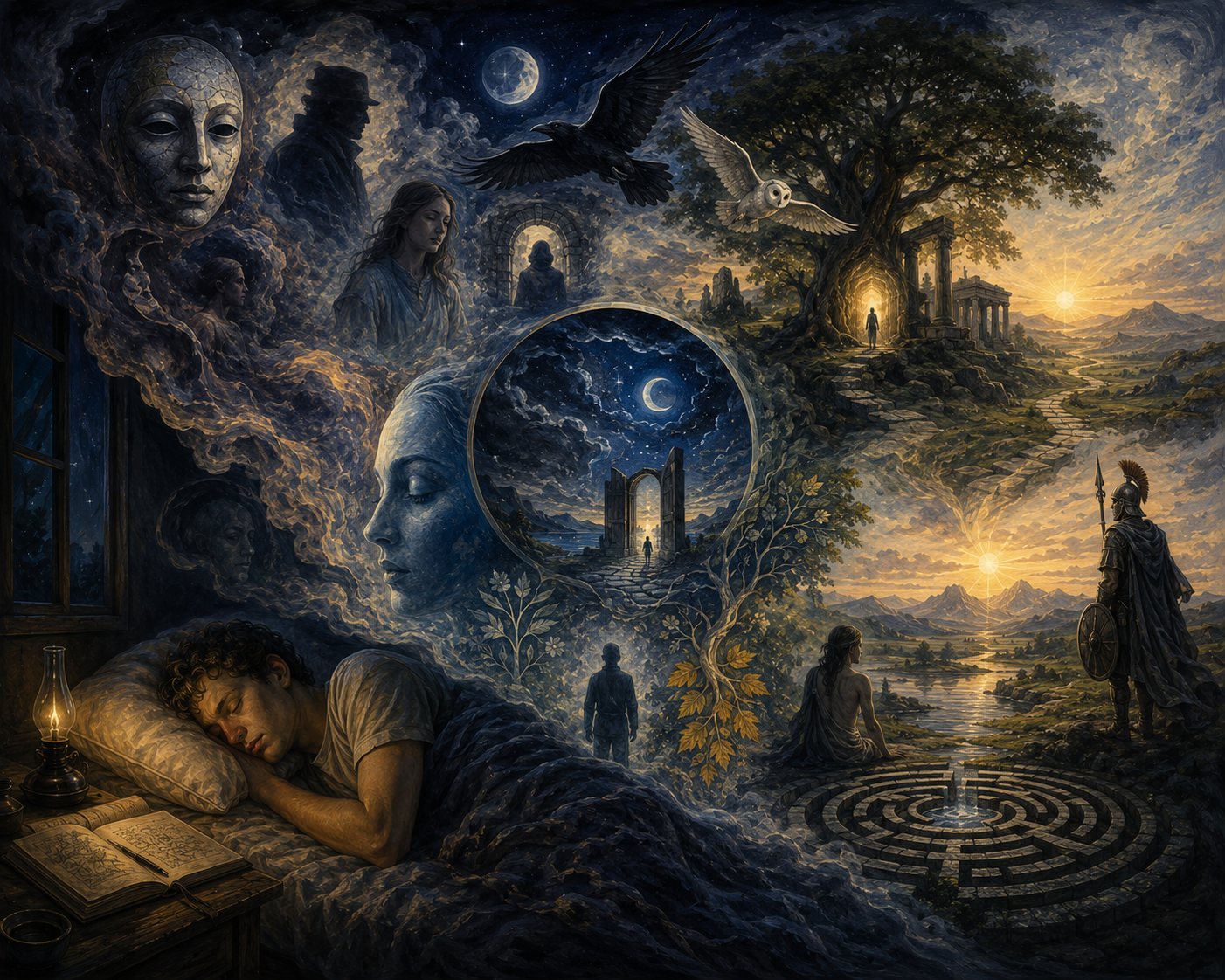
At the same time, Jungian dream interpretation is demanding because it resists formula. It requires attention to the dream’s structure, emotional atmosphere, symbolic motifs, personal associations, archetypal resonances, cultural context, and developmental situation. It also requires restraint. Not every striking image is an archetype, and not every dream is a message of cosmic significance. Some dreams are highly local, tied closely to immediate emotional situations. Others open into broader symbolic fields. The art of interpretation lies in distinguishing these levels without flattening the dream into either trivia or grandeur.
Dream interpretation is also relational. The dream does not belong first to an interpreter, a theory, or a symbolic dictionary. It belongs to the psychic life of the dreamer. A responsible Jungian reading therefore proceeds through dialogue: with the dream image, with the dreamer’s associations, with the dramatic structure of the dream, with the wider symbolic tradition, and with the ethical reality of the dreamer’s life. The goal is not interpretive conquest, but deeper relation to unconscious truth.
This article examines how dream interpretation works in analytical psychology, how Jung understood the compensatory function of dreams, why symbols must be read contextually, how amplification differs from free association, why dream structure matters, how archetypal dreams differ from ordinary dreams, and why dream work remains central to any serious Jungian understanding of psyche, selfhood, symbolic life, and individuation.
Why Dreams Matter in Analytical Psychology
Dreams matter in analytical psychology because they provide one of the clearest ways the psyche speaks beyond the conscious ego’s preferred language. Waking life is governed by practical demands, self-presentation, deliberate narratives, socially stabilized identities, moral justifications, and adaptive roles. Dreaming loosens that regime. In the dream, the psyche presents conflicts, fears, wishes, losses, compensations, projections, complexes, and unrealized developments through imaginal form. This makes dreams invaluable for a psychology that does not reduce the mind to conscious intention alone.
Jung considered dreams especially important because they often reveal what consciousness has neglected. They may expose self-deception, show the activation of a complex, confront the dreamer with shadow material, or present symbolic images of wholeness and reorganization. The dream is not always “deep” in a grand or archetypal sense, but it is rarely meaningless if approached with enough care. It shows the psyche responding to itself.
Dreams also matter because consciousness is limited. The ego must simplify experience in order to act. It must choose an identity, a role, a practical direction, and a narrative of what is happening. But every act of simplification excludes something. Feelings are left out. Bodily signals are ignored. Moral contradictions are hidden. Unwelcome desires are repressed. Unlived capacities remain undeveloped. The dream often brings back what conscious life has left outside the frame.
This does not mean that dreams are always wiser than waking thought. Dreams can be fragmentary, confusing, repetitive, anxiety-driven, traumatic, banal, or heavily shaped by immediate events. But even such dreams may reveal something about the psychic field in which they occur. A repetitive anxiety dream may disclose a pattern of expectation. A banal dream may show the residue of an unresolved affect. A frightening dream may reveal a complex that consciousness cannot yet confront directly. The dream’s value lies in what it reveals when interpreted in context.
Analytical psychology gives dreams a central place because it understands psychic life as symbolic as well as cognitive. Human beings do not only think through propositions. They also think through image, scene, metaphor, narrative, atmosphere, and embodied affect. A dream may say in one image what waking language would need many pages to approach. It may place the dreamer in a scene that reveals the structure of a conflict more clearly than explanation can.
Dreams matter, then, because they are spontaneous symbolic events. They are not consciously authored, yet they are not random. They are not literal messages, yet they are meaningful. They are not always profound, yet they often contain more intelligence than the ego can immediately recognize. For Jung, this made dream work one of the central disciplines of psychological self-knowledge.
What Jung Thought a Dream Is
Jung treated the dream as a spontaneous self-portrait of the psyche in symbolic form. By this he did not mean that the dream transparently explains itself. He meant that the dream expresses the current psychic situation through images, scenes, affects, figures, conflicts, spatial arrangements, and dramatic relations. It is spontaneous because it is not deliberately composed by the conscious ego. It is symbolic because much of what it presents cannot be said directly within ordinary waking language.
This view differs both from crude biological dismissal and from simplistic symbolic decoding. Dreams are neither meaningless noise nor puzzles with one fixed solution. They are patterned psychic events whose meaning must be inferred from their relation to the dreamer’s life, the structure of the dream, the emotional atmosphere, the immediate conscious situation, and the wider symbolic field in which the imagery participates.
For Jung, a dream is not merely a disguised wish. Nor is it simply a transcript of memory. It is a formation of the psyche as a whole. It may include personal memory, bodily sensation, unconscious fantasy, instinctual pressure, cultural material, archetypal motifs, affective residue, and compensatory response. The dream condenses these elements into a symbolic situation. Interpretation asks how that situation functions.
This functional question is crucial. Jungian interpretation does not begin by asking, “What does this object always mean?” It asks, “What is this dream doing?” Is it correcting an inflated attitude? Revealing a complex? Showing a relation to grief? Exposing a neglected body? Compensating a rigid persona? Presenting a symbol of transition? Repeating trauma? Opening a relation to the Self? The dream is interpreted through its role in psychic regulation.
A dream also has autonomy. It often surprises the dreamer. It may present scenes that the dreamer would not consciously choose. It may shame the ego, contradict its self-image, expose fears, or reveal desires that waking life has hidden. This autonomy is one reason Jung took dreams seriously. They are not simply confirmations of what the ego already knows. They are encounters with a broader psychic field.
| Dream view | How it understands the dream | Jungian correction |
|---|---|---|
| Random residue | The dream is meaningless mental debris | Dreams may be fragmentary, but they often show patterned psychic response |
| Fixed code | Every image has a universal translation | Images require context, association, structure, and symbolic function |
| Disguised wish only | The dream hides unacceptable desire | Dreams may express desire, but also compensation, conflict, development, and symbolic orientation |
| Prophecy | The dream predicts future events | Some dreams may be prospective psychologically, but not mechanically predictive |
| Self-portrait of the psyche | The dream presents the current psychic situation in symbolic form | This is the core Jungian approach, interpreted with restraint and context |
What Jung thought a dream is, then, can be stated simply but not simplistically: a dream is a spontaneous symbolic presentation of the psyche’s current situation, often compensating the conscious attitude and sometimes pointing toward future development. To interpret it well is to listen to the psyche in its own language.
Dreams as Compensation
One of Jung’s most important claims is that dreams are frequently compensatory. Compensation does not mean punishment, moral correction, or revenge by the unconscious. It means that the dream often presents what conscious life lacks, denies, excludes, exaggerates, or overbalances. The psyche tends toward correction when waking identity becomes too narrow or too one-sided.
A person who sees themselves as entirely rational may dream irrational forces. Someone overly identified with power may dream weakness, injury, or exposure. Someone trapped in a social role may dream hidden rooms, neglected children, wild animals, or unknown companions. Someone who believes themselves morally pure may dream theft, rage, betrayal, or contamination. Someone who is overwhelmed by chaos may dream maps, houses, rituals, centers, teachers, or ordered patterns. The dream compensates by reintroducing what conscious life has excluded.
This is why dream interpretation must begin with the dreamer’s actual conscious attitude. Without knowing the waking standpoint, one cannot tell what the dream is compensating. The same image may have opposite meanings in different situations. A flood may overwhelm one dreamer who has been avoiding grief, while it may cleanse another who has been rigidly controlled. A child may symbolize regression in one dream and future life in another. A dark animal may represent danger, instinct, vitality, or disowned aggression depending on the conscious situation.
Compensation can be mild or severe. A mild compensation may correct a small imbalance in everyday life. A severe compensation may appear when the ego is deeply one-sided. The more rigid the conscious attitude, the more dramatic the dream’s counter-image may become. This is why dreams can sometimes feel humiliating or frightening. They confront the ego with what it has refused to include.
Dream compensation is also relational. The dream is not necessarily telling the dreamer to become the opposite of their conscious position. It may be trying to restore relation between conscious and unconscious life. A person who dreams of chaos after overcontrolling life does not simply need to become chaotic. They need to recognize what control has excluded. A person who dreams of weakness after identifying with power does not need to collapse. They need to integrate vulnerability and limitation. Compensation seeks balance, not reversal.
| Conscious one-sidedness | Possible compensatory image | Psychological question |
|---|---|---|
| Excessive rational control | Flood, fire, animal, wilderness, bodily image | What affect, instinct, or embodied truth has been excluded? |
| Inflated confidence | Failure, injury, exposure, humiliation | Where has the ego lost humility or contact with limitation? |
| Social overadaptation | Mask, hidden room, neglected child, backstage space | What has the persona concealed from the person’s deeper life? |
| Moral certainty | Shadow figure, crime, contamination, enemy double | What disowned motive or projection is being revealed? |
| Fragmentation | Circle, center, temple, map, house, guide | What ordering image is the psyche trying to constellate? |
| Emotional dryness | Water, grief, wounded figure, broken vessel | What feeling has been neglected or defended against? |
Compensation gives Jungian dream interpretation its dynamic character. The interpreter does not ask only what the image means in isolation. The interpreter asks what the dream is doing in relation to waking consciousness. The dream is read as a correction, counterpoint, expansion, or balancing movement within the whole psyche.
Dream Image, Symbol, and Context
Jungian dream work depends on distinguishing image from symbol. The dream presents images: a house, a road, a flood, a dead relative, a stranger, a child, a serpent, a broken bridge, a mountain, a room that does not exist in waking life. These images may become symbols when they mediate meanings consciousness cannot yet grasp directly. But they do not do so automatically. Symbolic meaning depends on function and context.
This is why dream dictionaries are misleading. The image of a house may refer to the self in one dream, family history in another, psychic structure in a third, inherited memory in a fourth, or an immediate practical concern in a fifth. A snake may be sexual, dangerous, healing, instinctual, shadowy, sacred, poisonous, renewing, or simply connected to a recent encounter with snakes. The question is always: what is this image doing here, in this dream, for this dreamer, under these psychic conditions?
Context includes many layers. There is the personal context of the dreamer’s associations. There is the immediate life context: relationships, illness, work, grief, conflict, transition, anxiety, fatigue, and desire. There is the dream context: where the image appears, what precedes it, what follows it, how the dreamer reacts, and what the emotional atmosphere is. There is also the symbolic context: mythic, religious, literary, cultural, and archetypal parallels that may expand the meaning of an image.
A symbol is alive when it cannot be exhausted by a single interpretation. It opens meaning rather than closing it. A dream of a bridge may involve transition, but the bridge may be broken, guarded, too high, underwater, newly built, crossed successfully, or seen from a distance. Each detail matters. The symbol is not simply “bridge equals transition.” The bridge’s condition, placement, affective charge, and relation to the dreamer determine how transition is being imagined.
Jungian interpretation is therefore closer to close reading than to code-breaking. It asks how images relate to one another, how the dream moves, and how the symbolic field is organized. A house with locked rooms is different from a house with new rooms. A flood that destroys is different from a river that carries. A child abandoned is different from a child guiding. A shadow pursuing is different from a shadow speaking. Context gives the image its psychological force.
| Dream image | Possible symbolic range | Questions that determine meaning |
|---|---|---|
| House | Self, family history, psychic structure, memory, body, shelter | What rooms appear? Is it familiar? Is it intact, hidden, ruined, expanding? |
| Water | Affect, unconscious depth, cleansing, overwhelm, birth, danger | Is it flood, river, rain, sea, lake, drinking water, or drowning water? |
| Child | Future possibility, vulnerability, regression, neglected life, renewal | Is the child cared for, abandoned, luminous, wounded, demanding, silent? |
| Snake | Instinct, fear, sexuality, healing, danger, renewal, ambivalence | Does it attack, guide, shed skin, hide, heal, bite, guard, or transform? |
| Road | Direction, journey, life path, transition, exile, return | Is the road blocked, clear, familiar, unknown, shared, lonely, ascending? |
| Circle | Wholeness, containment, repetition, center, mandala, enclosure | Does it organize the dream or trap the dreamer in repetition? |
Dream image, symbol, and context must therefore be interpreted together. The image is what appears. The symbol is what the image may mediate. Context is what prevents interpretation from becoming arbitrary.
Personal Association and Symbolic Amplification
Jungian interpretation uses both personal association and symbolic amplification, but not in the same way. Personal association asks what an image evokes for the dreamer personally. What memories, feelings, relationships, fears, bodily sensations, conflicts, or situations attach to this figure, place, animal, object, or event? This grounds the dream in biography and present life. Without it, interpretation easily becomes abstract and imposed.
Personal association matters because dreams are never detached from the dreamer’s life. A dog may mean loyalty, fear, childhood, grief, aggression, companionship, or a recent event depending on the dreamer. A church may mean faith, authority, family, guilt, beauty, hypocrisy, mourning, refuge, or social memory. A father figure may relate to the dreamer’s actual father, paternal authority, social power, personal judgment, inherited law, or an inner structure of discipline. The dreamer’s associations are indispensable.
Amplification goes further. It asks how a dream image resonates within wider symbolic traditions: myth, religion, folklore, literature, ritual, alchemy, art, and comparative imagery. If a dream presents a tree, a descent, a serpent, a sacred child, a mandala-like center, a wise old figure, a flood, a cave, a mountain, or an underworld journey, the analyst may explore broader symbolic parallels to clarify the image’s possible range.
Amplification is not free-floating comparison. It should deepen, not replace, the dreamer’s own context. Its purpose is to illuminate the symbolic horizon of the image, not to impose a meaning from outside. A dream serpent may resonate with healing, danger, wisdom, temptation, renewal, or chthonic power, but the dreamer’s actual fear, fascination, cultural background, religious associations, and dream scene still matter. Amplification without personal grounding becomes symbolic display.
Jung used amplification because he believed some dream images exceed the immediate personal context. Archetypal images often carry more than biography. A dream of a world tree, mandala, divine child, underworld descent, or sacred marriage may connect the dreamer’s situation to symbolic patterns that have appeared across cultures and histories. But such comparison must remain disciplined. Similarity does not erase difference. Mythic resonance does not cancel personal meaning. Archetypal breadth does not excuse careless interpretation.
| Method | Primary question | Strength | Risk if misused |
|---|---|---|---|
| Personal association | What does this image evoke for the dreamer? | Grounds interpretation in biography, affect, and present life | May remain too narrow if the dream opens into broader symbolic material |
| Symbolic amplification | What wider symbolic patterns resonate with this image? | Expands interpretation through myth, religion, literature, ritual, and culture | May become abstract, imposed, or culturally careless |
| Dream-structure analysis | How does the dream unfold dramatically? | Prevents isolated image-decoding | May miss deep symbolic motifs if structure alone is considered |
| Series interpretation | How does this image change across dreams? | Reveals development, repetition, and compensation over time | Requires patience and sufficient dream material |
Personal association and amplification work best when they correct one another. Association keeps interpretation close to the dreamer. Amplification keeps interpretation open to symbolic depth. Together, they allow the dream to be read as both personal and potentially transpersonal, local and symbolic, biographical and archetypal.
Dream Structure and Dramatic Sequence
Jung also attended to dream structure. A dream is not just a bag of symbols. It has sequence, shifts of scene, emotional turning points, climaxes, interruptions, repetitions, unresolved tensions, and sometimes a dramatic arc. Who appears first? What changes? Where does the dream lead? What intensifies or collapses? What remains unfinished? These structural features often matter as much as the individual images themselves.
A dream may begin in an ordinary setting, introduce a disturbing figure, descend into darkness, and end before resolution. Another may move from confusion toward a centered image of order. Another may repeat a failed action or show the dreamer unable to enter a house, cross a bridge, speak, call for help, find a child, or escape a room. The dramatic logic of the dream often reveals the psychic logic more clearly than any single image alone.
Structure helps the interpreter avoid premature symbolism. If a dream begins with social performance, moves backstage, reveals a hidden room, and ends with an animal in the dark, the sequence matters. The dream may be moving from persona to hidden psychic interior to instinctual or shadow material. If the interpreter only says “animal equals instinct,” the real movement of the dream is lost.
Dreams often have spatial logic. Upstairs and downstairs, inside and outside, roads and thresholds, hidden rooms and public spaces, water crossings and locked doors may all show relations between parts of the psyche. A basement may not always mean the unconscious, but in a particular dream it may function as depth, storage, repression, ancestry, fear, or neglected foundation. A door may function as access, prohibition, transition, secrecy, or defense depending on the scene.
Dreams also have affective logic. The emotional atmosphere may shift from curiosity to fear, from shame to relief, from paralysis to movement, or from confusion to clarity. These shifts often indicate where the psyche is moving. A frightening figure that becomes less frightening across the dream may suggest the beginning of relation. A beautiful figure that becomes dangerous may reveal projection or inflation. A familiar place that becomes strange may show that the ego’s known world is no longer stable.
| Structural element | Interpretive value | Example question |
|---|---|---|
| Opening scene | Establishes the conscious or psychic situation | Where does the dream begin, and what standpoint is assumed? |
| Intruding figure | Introduces conflict, compensation, shadow, guide, or complex | What interrupts the initial situation? |
| Spatial movement | Shows transition among levels, states, or psychic regions | Does the dream go down, up, inward, outward, across, or around? |
| Emotional turning point | Reveals the dream’s affective center | Where does the feeling change most sharply? |
| Climax or obstruction | Shows the core conflict or developmental task | What cannot be crossed, spoken, opened, repaired, or faced? |
| Ending | Shows resolution, failure, suspension, or unfinished work | Does the dream close, break off, transform, repeat, or remain unresolved? |
Dream structure is essential because the psyche often speaks through arrangement. Meaning lies not only in what appears, but in when it appears, where it appears, what surrounds it, and what changes because of it. To read a dream structurally is to respect it as a symbolic drama rather than a list of symbols.
Archetypal Dreams and Ordinary Dreams
Not all dreams operate at the same level. Some are closely tied to daily life, immediate emotion, and relatively local conflicts. Others feel larger, stranger, more numinous, more mythic in atmosphere and imagery. Jung distinguished between more ordinary dreams and those with strongly archetypal material, though the boundary is not always rigid. Archetypal dreams often carry unusual emotional intensity and present symbols that seem to exceed the dreamer’s immediate circumstances.
An ordinary dream may concern a conflict at work, a family tension, an anxiety about a deadline, a recent conversation, or a familiar relationship pattern. Its imagery may be symbolic, but its meaning remains close to the dreamer’s current life. Such dreams are not inferior. Much psychological work happens through ordinary dreams because most psychic imbalance is lived in ordinary situations.
An archetypal dream may present images of descent, flood, world tree, sacred child, mandala, divine figure, animal guide, underworld, sacrifice, cosmic catastrophe, temple, mountain, stone, ritual, or luminous center. These dreams may feel as though they come from a deeper layer of the psyche. They often appear during major transitions, crises, illnesses, losses, creative breakthroughs, spiritual upheavals, or periods of individuation. Their imagery may connect the dreamer’s personal life to broader symbolic patterns.
This does not mean every vivid dream is archetypal. Analysts must resist inflation. Some dreams are best understood through local association alone. Others seem to open into broader symbolic or collective patterns. The discipline of dream interpretation lies partly in knowing when to remain close to the immediate life situation and when a wider symbolic field is genuinely warranted.
Archetypal interpretation carries a special danger because it can flatter the ego. A dreamer may feel chosen, spiritually advanced, or exempt from ordinary responsibility because they have had a powerful dream. This is precisely the danger of inflation. A dream’s numinosity does not automatically indicate personal importance. The image may belong to the psyche’s larger symbolic life, but the ego must relate to it humbly.
Ordinary and archetypal dreams also interpenetrate. A dream about a workplace hallway may suddenly open into a mythic cavern. A dream about a family home may reveal a hidden temple. A dream of a child may be both about a real child and about future psychic life. A dream of a dead parent may be personal grief and archetypal ancestor at once. Interpretation must therefore remain flexible enough to move among levels without collapsing them.
| Dream level | Typical features | Interpretive emphasis | Main risk |
|---|---|---|---|
| Ordinary or local dream | Daily settings, familiar people, immediate conflicts | Personal association, current life context, affect, conscious attitude | Missing symbolic depth where it is present |
| Complex dream | Repetitive affect, charged figures, distorted relationships | Complex activation, projection, defense, repetition | Reducing the image too quickly to one complex |
| Archetypal dream | Numinous atmosphere, mythic images, ritual scenes, cosmic scale | Amplification, symbolic context, individuation, careful humility | Inflation, overinterpretation, or neglect of personal context |
| Traumatic or repetitive dream | Recurrent threat, helplessness, reenactment, bodily fear | Safety, stabilization, trauma-informed interpretation, clinical caution | Romanticizing suffering as transformation too quickly |
Archetypal dreams and ordinary dreams therefore require different emphases, but both belong to the same larger practice: listening to the psyche in symbolic form while refusing premature certainty.
Dream Figures, Shadow, Anima, Animus, and Self
Dream figures often express major Jungian structures of the psyche. A threatening, shameful, vulgar, violent, wounded, humiliated, or socially unacceptable figure may relate to the shadow. A charged inner guide, seducer, critic, stranger, or uncanny gendered figure may invite reflection on anima or animus, provided the concept is used carefully and not reduced to stereotype. Centered, ordering, or numinous images such as circles, sacred children, wise rulers, stones, temples, trees, cities, mandalas, or luminous centers may point toward the symbolic horizon of the Self.
Yet no figure should be assigned mechanically. A stranger in a dream is not automatically shadow, just as a woman in a man’s dream is not automatically anima and a man in a woman’s dream is not automatically animus. Jung’s inherited gender language must be handled with contemporary caution, because psychic symbolism is more complex than rigid masculine/feminine typologies. Dream figures must be interpreted within the total dream and the psychic situation of the dreamer. Jung’s categories are interpretive aids, not substitute answers.
Shadow figures are especially important because dreams often reveal what the ego refuses to know about itself. The shadow may appear as an enemy, criminal, animal, beggar, rival, monster, sick person, degraded double, or despised outsider. But the shadow is not only negative. It may contain vitality, anger, courage, grief, creativity, sexuality, instinct, or truth that the conscious personality has disowned. The task is not to destroy the shadow figure, but to understand what relation consciousness must establish with it.
Anima and animus figures are more difficult because Jung’s original language often reflects the gender assumptions of his time. In contemporary interpretation, these figures are best approached not as fixed masculine or feminine essences, but as charged images of psychic mediation, relational imagination, affective otherness, inner voice, eros, logos, projection, or symbolic counterpart. A dream figure may carry qualities that the ego has externalized, idealized, feared, or misunderstood. Interpretation should avoid turning these figures into stereotypes.
Self-symbols require special humility. Dreams of mandalas, centers, temples, divine children, stones, trees, circles, wise rulers, or luminous ordering images may indicate that the psyche is constellating an image of wholeness. But an image of wholeness is not the same as achieved wholeness. Such dreams may appear precisely because the dreamer is fragmented and needs orientation. They should not be treated as proof of spiritual achievement.
| Dream figure or image | Possible Jungian relevance | Interpretive caution |
|---|---|---|
| Threatening stranger | Shadow, complex, projection, disowned affect | May also represent real danger, social anxiety, or trauma material |
| Animal | Instinct, body, shadow, vitality, fear, guide | Meaning depends on animal, behavior, setting, and affect |
| Charged gendered figure | Anima/animus, projection, inner relation, symbolic other | Avoid gender essentialism and automatic assignment |
| Child | Emergent life, vulnerability, future self, neglected development | May also involve actual children, childhood memory, or regression |
| Wise figure | Guide, Self-symbol, inner authority, compensatory wisdom | Should not be obeyed blindly or inflated into absolute authority |
| Circle or center | Wholeness tendency, containment, Self-symbol, order | Symbol of integration is not proof of completed integration |
Dream figures matter because they personify psychic relations. They allow the dreamer to see, hear, fear, avoid, follow, resist, or speak with parts of the psyche that waking consciousness may not know how to name. Interpreting them requires courage and restraint: courage to recognize what they may reveal, and restraint not to force them into ready-made categories.
Series Dreams and Development
Jung placed considerable value on dream series. A single dream can be illuminating, but a sequence of dreams often shows movement more clearly than one isolated image. Repeated figures, recurring settings, evolving conflicts, and changing symbolic structures may reveal how the psyche is developing over time. A feared figure may gradually become less frightening. An inaccessible house may eventually open. A chaotic landscape may give way to more centered forms.
Dream series are especially important because individuation is developmental, not instantaneous. The psyche rarely presents its work all at once. It unfolds through repetition, variation, interruption, regression, and gradual symbolic reorganization. To study a series is therefore to see the psyche thinking in time.
A dream series can show whether the dreamer is responding to compensation. If the same dream problem repeats without change, the conscious attitude may not yet be shifting. If the dreamer repeatedly cannot open a door, cross a bridge, speak to a figure, care for a child, or confront an animal, the series may be showing an unresolved task. But if later dreams show altered relation, the series may indicate development. The door opens. The bridge is repaired. The figure speaks. The child is found. The animal walks beside the dreamer. The house becomes more accessible.
Dream series also help prevent overinterpretation. A single dream may be ambiguous. A series can clarify whether an image is central or incidental. If a motif appears repeatedly in evolving form, its significance becomes stronger. If it appears once and disappears, interpretation should remain cautious. Series work gives symbolic interpretation a temporal check.
Series dreams may also reveal compensation and prospect together. Early dreams may show imbalance or conflict. Middle dreams may intensify confrontation. Later dreams may introduce transition images, new rooms, bridges, roads, guides, children, or center-symbols. This does not mean that every dream series moves neatly toward integration. Some repeat, regress, or remain unresolved. But where development occurs, it often appears through changing symbolic relations.
| Series pattern | Possible meaning | Interpretive value |
|---|---|---|
| Same obstacle repeats unchanged | Persistent complex, defense, trauma pattern, or one-sidedness | Shows where consciousness has not yet shifted |
| Threatening figure becomes less hostile | Improved relation to shadow, affect, or disowned material | Suggests reduced projection or increased ego strength |
| House becomes larger or more accessible | Expansion of psychic space or self-knowledge | Shows development within the symbolic structure of the self |
| Roads, bridges, or thresholds appear | Transition, movement, or developmental direction | May indicate emerging prospective function |
| Center-symbols become more coherent | Ordering tendency, containment, Self-symbolism | Suggests orientation, not necessarily completed wholeness |
| Dreams correct earlier dreams | Self-regulating symbolic process | Shows that interpretation should remain open to revision |
Dream series remind us that dream work is patient work. The psyche often repeats until something is understood, varies an image until relation becomes possible, and introduces new symbolic forms when development begins. A dream series is not merely a collection of dreams. It is a record of symbolic movement.
Compensation, Prospection, and Individuation
Although compensation is central to Jungian dream interpretation, Jung also argued that some dreams have a prospective function. This does not mean prophecy. It means that the unconscious may present images of emerging development before consciousness has language for them. A dream may show a bridge before the dreamer knows what transition is needed. A new room may appear before the person has consciously recognized a new psychic capacity. A child may appear before new life has taken outer form. A guide may appear before the ego has accepted the need for orientation.
Compensation and prospection often work together. The dream first corrects a one-sided attitude, then begins to show what might become possible if relation is restored. A person who is trapped in persona may dream first of masks and hidden rooms, then later of new spaces, roads, or children. A person pursued by shadow may later dream of speaking with the pursuer. A person overwhelmed by chaos may dream first of flood, later of a bridge, and later still of a center or shore. The dream does not only reveal imbalance; it may show the symbolic beginning of reorganization.
This is why dream interpretation is so important for individuation. Individuation requires the ego to encounter what it has excluded and to orient itself toward a wider psychic wholeness. Dreams support this process by bringing unconscious material into symbolic relation. They may show shadow, reveal persona limitations, mediate anima or animus projections, present Self-symbols, and indicate where the psyche is moving before waking consciousness understands.
Dreams may also reveal resistance to individuation. A dreamer may avoid a door, flee a figure, lose a map, miss a train, fail to care for a child, or refuse a guide. Such dreams are not failures. They show the actual state of the process. The psyche is honest about resistance, and that honesty is part of the work.
Prospective interpretation requires special caution. A dream of a future-oriented image does not guarantee that development will occur. It indicates possibility, pressure, or symbolic direction. The ego must still live the task. The dream may point toward a road, but the waking person must walk, wait, refuse, repair, or choose. The image is not the achievement.
Dreams, then, support individuation by compensating the conscious attitude, revealing the unconscious situation, and sometimes imaging the direction of future development. They show the person not only what has been excluded, but what may be trying to enter life.
The Ethics of Interpretation
Dream interpretation has an ethical dimension because the analyst or interpreter holds interpretive power. Jungian work can become distorted when interpreters claim too much certainty, impose archetypal meanings too quickly, or treat the dream as proof of a theory rather than as a psychic event requiring dialogue. A dream is not raw material for analyst display. It belongs first to the dreamer’s life.
Ethically serious interpretation therefore requires humility. The analyst should ask, not announce; clarify, not dominate. The dream’s meaning emerges through conversation among image, association, structure, symbolic resonance, and actual life situation. Even then, interpretation remains provisional. The psyche may reveal more over time, especially through subsequent dreams.
Ethics also requires respect for vulnerability. Dreams may expose shame, desire, trauma, grief, aggression, dependency, or spiritual longing. To interpret them carelessly can harm the dreamer. A premature interpretation may shame the person, inflate them, push them toward decisions they are not ready to make, or turn their symbolic material into someone else’s theory. Dream work requires tact because symbolic material is intimate.
Another ethical issue is literalization. Dreams can be powerful, but they should not be used to make factual claims about other people without evidence. A dream of betrayal does not prove betrayal. A dream of danger does not prove external danger. A dream of attraction does not prove destiny. A dream may reveal the psyche’s relation to a person or situation, but that relation must be distinguished from external fact.
Ethical interpretation also avoids cultural extraction. Amplification should not treat religious, Indigenous, mythic, or ritual symbols as raw material stripped from living traditions. If a dream image resonates with a cultural symbol, that resonance must be handled with respect for the tradition, the context, and the limits of the interpreter’s knowledge. Symbolic comparison requires humility.
| Ethical risk | How it appears | Responsible correction |
|---|---|---|
| Interpretive domination | The analyst declares meaning without dialogue | Use questions, associations, structure, and provisional interpretation |
| Archetypal inflation | Every image becomes grand, mythic, or spiritualized | Stay close to personal context unless wider symbolism is warranted |
| Literalization | The dream is treated as factual evidence or instruction | Distinguish symbolic truth from external fact |
| Cultural extraction | Symbols are borrowed without historical or religious care | Use amplification respectfully and acknowledge limits |
| Clinical carelessness | Trauma, crisis, psychosis, or dissociation are romanticized symbolically | Prioritize safety, grounding, stabilization, and appropriate professional care |
The ethics of interpretation can be summarized simply: take the dream seriously, but do not use the dream to overpower the dreamer. Interpretation should deepen relation, responsibility, and consciousness. It should not produce certainty for the interpreter at the expense of the dreamer’s life.
Clinical Value of Dream Work
Clinically, dream work can reveal complexes, defense patterns, emerging shadow material, unconscious attitudes toward relationships, compensatory tendencies, and symbolic developments that are not yet visible in waking narrative. Dreams may also show what treatment itself is constellating: resistance, transference, fear of change, dependence, anger toward the analyst, symbolic growth, or deepening relation to previously disowned parts of the psyche.
This makes dreams valuable not because they bypass all ambiguity, but because they often present psychic truth in a form less censored by waking identity. They can disclose what the patient cannot yet say directly, what the ego cannot yet admit, or what the psyche is trying to develop beyond current consciousness. The dream may reveal not the answer, but the shape of the problem.
Dream work can also support the therapeutic alliance. Discussing dreams often gives patient and clinician a shared symbolic field. The dream provides a third object: not simply the patient’s conscious report and not simply the analyst’s interpretation, but an imaginal event both can examine. This can reduce defensiveness when handled well. The dream may say what neither person could say directly.
Dreams may also reveal shifts in treatment before they are consciously recognized. A patient who once dreamed only of locked rooms may begin dreaming of windows, keys, roads, or guides. A threatening figure may become less persecutory. A child may be found. A house may become more inhabitable. Such changes do not prove therapeutic success by themselves, but they may show symbolic reorganization worth exploring.
Clinical dream work must also be trauma-informed. Repetitive nightmares, dreams of threat, bodily terror, helplessness, or reenactment may require stabilization rather than immediate symbolic amplification. It can be harmful to overinterpret trauma dreams as archetypal transformations before safety is established. The first question may not be “What does this symbol mean?” but “What support does this person need?”
| Clinical use | Possible value | Required caution |
|---|---|---|
| Complex identification | Dreams reveal repeated emotional patterns | Do not reduce every figure to one complex |
| Shadow work | Dreams bring disowned material into symbolic relation | Do not encourage acting out shadow material |
| Transference awareness | Dreams may show attitudes toward analyst, treatment, authority, or dependency | Interpret collaboratively and avoid analyst-centered certainty |
| Developmental tracking | Dream series may show movement or stuckness over time | Use series patterns cautiously, not as proof of progress |
| Trauma work | Dreams may show threat, repetition, or emerging safety | Prioritize stabilization and do not romanticize distress |
| Meaning-making | Dreams may restore symbolic relation where life feels fragmented | Do not impose spiritual or archetypal meaning prematurely |
The clinical value of dream work lies in its ability to open a symbolic conversation with the unconscious. It does not replace diagnosis, treatment planning, crisis care, or ordinary therapeutic judgment. But when practiced responsibly, it can reveal dimensions of the psyche that conscious narrative alone may not reach.
Criticisms and Limits
Jungian dream interpretation faces several criticisms. It can be too subjective, too dependent on symbolic analogy, too vulnerable to analyst projection, and too difficult to verify in strict empirical terms. These criticisms are serious. There is always a danger of reading too much into a dream or of transforming ordinary material into unnecessary profundity.
One criticism is that Jungian interpretation can become unfalsifiable. If any image can be interpreted symbolically, how can one tell whether an interpretation is valid? Jungian work answers this not through mechanical proof, but through convergence: personal association, dream structure, affective tone, waking context, dream series, clinical response, and symbolic coherence. Even so, interpretations remain provisional. They should be tested by whether they illuminate the dreamer’s actual psychic situation, not by whether they sound impressive.
A second criticism is that amplification can become excessive. Interpreters may move too quickly from a dream image to myth, religion, alchemy, or archetype, bypassing the dreamer’s personal life. This creates symbolic spectacle. The dreamer disappears beneath the interpreter’s knowledge. Responsible amplification should deepen the dream, not replace it.
A third criticism concerns cultural and historical context. Jungian interpretation has sometimes treated symbols as universal in ways that understate cultural difference. A serpent, tree, flood, mother, child, or sacred center may recur across traditions, but recurrence does not mean sameness. Dreams may draw on archetypal patterns, but actual symbols are always mediated through language, culture, religion, history, and power.
A fourth criticism concerns clinical risk. Dream interpretation can be destabilizing when used carelessly with people experiencing acute trauma, psychosis, mania, severe dissociation, or unstable reality testing. Not every person benefits from deeper symbolic immersion at every moment. Sometimes grounding, medication, crisis support, behavioral stabilization, or ordinary relational care is more important than dream amplification.
Yet reductive alternatives have their own limits. To treat dreams as meaningless discharge misses their psychological patterning. To reduce them to one explanatory principle ignores their variety. To ignore symbolic life impoverishes the understanding of human experience. The challenge is not to claim certainty where none exists, but to practice interpretation with enough discipline, context, humility, and restraint that symbolic understanding becomes plausible rather than fanciful.
| Criticism | Real risk | Responsible Jungian response |
|---|---|---|
| Subjectivity | Interpretations may reflect the analyst more than the dream | Use associations, structure, context, series, and alternative readings |
| Over-amplification | Mythic parallels may overwhelm personal meaning | Ground amplification in the dreamer’s actual life |
| Universalism | Symbols may be detached from culture and history | Read recurrence through context, language, tradition, and power |
| Inflation | Dreams may be treated as destiny or spiritual proof | Preserve humility and distinguish image from achievement |
| Clinical misuse | Symbolic work may destabilize vulnerable people | Prioritize safety, stabilization, and appropriate professional care |
The limits of Jungian dream interpretation do not invalidate the practice. They define its discipline. Dreams can be meaningful without being mechanically certain. Symbols can be deep without being universally fixed. Interpretation can be powerful without pretending to be final.
Mathematical Lens
Dream interpretation in analytical psychology can be modeled as a dynamic relation between conscious attitude, unconscious compensation, affective intensity, symbolic repertoire, and dream output. Let \(C_t\) represent conscious stance at time \(t\), \(U_t\) latent unconscious configuration, \(A_t\) affective intensity, \(K_t\) available symbolic repertoire, and \(D_t\) dream output. A stylized form is:
D_t = f(C_t, U_t, A_t, K_t)
\]
Interpretation: Dream output is modeled as a symbolic formation shaped by conscious attitude, unconscious configuration, affective intensity, and the symbolic materials available to the psyche.
Compensation can be represented as a discrepancy function:
Comp_t = \phi(U_t – C_t)
\]
Interpretation: The greater the one-sidedness of consciousness relative to the broader psychic configuration, the more likely the dream is to produce compensatory imagery.
A dream series can be modeled recursively:
D_{t+1} = f(C_{t+1}, U_{t+1}, D_t)
\]
Interpretation: Later dreams respond not only to the current psychic state but to the unfinished symbolic work of earlier dreams. This captures Jung’s emphasis on dream series.
One-sidedness can be represented as distance between the ego’s conscious standpoint and a broader unconscious configuration:
O_t = \lVert C_t – U_t \rVert
\]
Interpretation: \(O_t\) is a stylized one-sidedness index. Higher values suggest stronger discrepancy between conscious identity and excluded psychic material.
A symbolic-network view is equally useful. Dream images can be treated as nodes linked by affective, associative, narrative, and symbolic edges. Interpretation then concerns identifying which nodes are local, which are central, which bridge personal and archetypal material, and how the network changes across a series.
G_t = (V_t, E_t), \quad w_{ij,t} = \text{co-occurrence or associative strength between motifs } i \text{ and } j
\]
Interpretation: A dream-symbol network allows motifs such as house, water, child, shadow, road, animal, circle, and guide to be analyzed relationally rather than in isolation.
This mathematical lens does not reduce dreams to equations. It clarifies assumptions. Jungian interpretation is concerned with discrepancy, compensation, affect, symbolic repertoire, recurrence, and development across time. Modeling makes those relationships explicit while leaving actual interpretation in the domain of symbolic, clinical, and contextual judgment.
R Workflow: Modeling Dream Compensation and Symbolic Recurrence
The following R workflow simulates a dream series in which dream output reflects conscious one-sidedness, unconscious pressure, affective intensity, symbolic repertoire, and recurrence across time. The purpose is to formalize compensation and sequence without pretending that dreams are reducible to equations. The data are synthetic and illustrative, not clinical or diagnostic.
# ============================================================
# Dream Interpretation in Analytical Psychology
# R Workflow: Dream compensation and symbolic recurrence
# ============================================================

library(dplyr)
library(ggplot2)
library(lme4)
library(broom.mixed)
library(tidyr)

set.seed(2026)

# ------------------------------------------------------------
# 1. Create synthetic person-period dream data
# ------------------------------------------------------------

n_people <- 240
n_periods <- 16

person_level <- tibble(
  person_id = 1:n_people,
  symbolic_repertoire = rnorm(n_people, 0, 1),
  reflective_capacity = rnorm(n_people, 0, 1),
  dream_series_type = sample(
    c(
      "ordinary_compensation",
      "shadow_repetition",
      "persona_correction",
      "affective_overflow",
      "center_symbol_emergence",
      "developmental_transition"
    ),
    size = n_people,
    replace = TRUE
  )
)

panel <- expand.grid(
  person_id = 1:n_people,
  time = 1:n_periods
) |>
  arrange(person_id, time) |>
  left_join(person_level, by = "person_id") |>
  mutate(
    conscious_onesidedness =
      rnorm(n(), 0, 1) +
      ifelse(dream_series_type == "persona_correction", 0.35, 0) +
      ifelse(dream_series_type == "ordinary_compensation", 0.20, 0),

    unconscious_pressure =
      rnorm(n(), 0, 1) +
      ifelse(dream_series_type == "shadow_repetition", 0.42, 0) +
      ifelse(dream_series_type == "affective_overflow", 0.36, 0),

    affective_intensity =
      rnorm(n(), 0, 1) +
      ifelse(dream_series_type == "affective_overflow", 0.45, 0) +
      ifelse(dream_series_type == "shadow_repetition", 0.24, 0),

    latent_development =
      rnorm(n(), 0, 1) +
      0.04 * time +
      ifelse(dream_series_type == "center_symbol_emergence", 0.36, 0) +
      ifelse(dream_series_type == "developmental_transition", 0.30, 0)
  )

# ------------------------------------------------------------
# 2. Recursive dream-output simulation
# ------------------------------------------------------------

panel$previous_dream_output <- NA_real_
panel$compensatory_signal <- NA_real_
panel$symbolic_recurrence <- NA_real_
panel$dream_output <- NA_real_
panel$integration_signal <- NA_real_

for (i in unique(panel$person_id)) {
  idx <- which(panel$person_id == i)
  previous_dream <- rnorm(1, 0, 0.4)

  for (j in idx) {
    compensatory_signal <- (
      0.72 * (panel$unconscious_pressure[j] - panel$conscious_onesidedness[j]) +
      0.42 * panel$affective_intensity[j] -
      0.20 * panel$reflective_capacity[j] +
      rnorm(1, 0, 0.45)
    )

    symbolic_recurrence <- (
      0.44 * previous_dream +
      0.36 * panel$symbolic_repertoire[j] +
      0.24 * panel$latent_development[j] +
      rnorm(1, 0, 0.35)
    )

    dream_output <- (
      0.52 * compensatory_signal +
      0.48 * symbolic_recurrence +
      0.38 * panel$affective_intensity[j] +
      0.32 * panel$latent_development[j] +
      rnorm(1, 0, 0.50)
    )

    integration_signal <- (
      0.42 * panel$reflective_capacity[j] +
      0.38 * panel$latent_development[j] +
      0.30 * panel$symbolic_repertoire[j] -
      0.24 * abs(compensatory_signal) +
      rnorm(1, 0, 0.35)
    )

    panel$previous_dream_output[j] <- previous_dream
    panel$compensatory_signal[j] <- compensatory_signal
    panel$symbolic_recurrence[j] <- symbolic_recurrence
    panel$dream_output[j] <- dream_output
    panel$integration_signal[j] <- integration_signal

    previous_dream <- dream_output
  }
}

# ------------------------------------------------------------
# 3. Estimate mixed-effects model
# ------------------------------------------------------------

model <- lmer(
  dream_output ~ conscious_onesidedness +
    unconscious_pressure +
    affective_intensity +
    symbolic_repertoire +
    latent_development +
    reflective_capacity +
    previous_dream_output +
    time +
    (1 | person_id),
  data = panel
)

summary(model)
broom.mixed::tidy(model, effects = "fixed")

# ------------------------------------------------------------
# 4. Summarize by dream-series type
# ------------------------------------------------------------

series_summary <- panel |>
  group_by(dream_series_type) |>
  summarize(
    mean_conscious_onesidedness = mean(conscious_onesidedness),
    mean_unconscious_pressure = mean(unconscious_pressure),
    mean_affective_intensity = mean(affective_intensity),
    mean_latent_development = mean(latent_development),
    mean_compensatory_signal = mean(compensatory_signal),
    mean_symbolic_recurrence = mean(symbolic_recurrence),
    mean_dream_output = mean(dream_output),
    mean_integration_signal = mean(integration_signal),
    .groups = "drop"
  ) |>
  arrange(desc(mean_integration_signal))

print(series_summary)

# ------------------------------------------------------------
# 5. Plot dream-series trajectory
# ------------------------------------------------------------

trajectory <- panel |>
  group_by(time) |>
  summarize(
    mean_compensatory_signal = mean(compensatory_signal),
    mean_symbolic_recurrence = mean(symbolic_recurrence),
    mean_dream_output = mean(dream_output),
    mean_integration_signal = mean(integration_signal),
    .groups = "drop"
  ) |>
  pivot_longer(
    cols = c(
      mean_compensatory_signal,
      mean_symbolic_recurrence,
      mean_dream_output,
      mean_integration_signal
    ),
    names_to = "measure",
    values_to = "value"
  )

ggplot(trajectory, aes(x = time, y = value, linetype = measure)) +
  geom_line(linewidth = 1) +
  labs(
    title = "Simulated Dream Compensation Across a Series",
    subtitle = "Dream output reflects compensation, affective intensity, symbolic recurrence, and latent development",
    x = "Dream-series time",
    y = "Mean synthetic score"
  ) +
  theme_minimal()

# ------------------------------------------------------------
# 6. Optional export
# ------------------------------------------------------------

dir.create("outputs/tables", recursive = TRUE, showWarnings = FALSE)
write.csv(panel, "outputs/tables/dream_compensation_panel.csv", row.names = FALSE)
write.csv(series_summary, "outputs/tables/dream_series_summary.csv", row.names = FALSE)
write.csv(trajectory, "outputs/tables/dream_series_trajectory.csv", row.names = FALSE)

# ------------------------------------------------------------
# Extensions
# ------------------------------------------------------------

# 1. Model distinct symbolic motifs instead of one output score.
# 2. Increase motif recurrence after unresolved dream themes.
# 3. Compare local and archetypal dream patterns.
# 4. Add therapeutic interpretation as a moderator.
# 5. Estimate when dream intensity declines after integration.
# 6. Track center-symbol emergence across a dream series.
# 7. Model trauma repetition separately from developmental recurrence.
A richer design could include motif categories such as house, water, animal, child, stranger, road, bridge, shadow, mask, or center image, and then model when those motifs recur under changing conscious conditions. That would make the simulation more faithful to Jung’s view that compensation is imaginally patterned rather than merely quantitative.
Python Workflow: Mapping Dream Symbol Networks Across a Series
The following Python workflow models dream interpretation as the analysis of a symbolic network across a series of dreams. Instead of isolating one dream image at a time, it asks how figures and motifs recur, connect, and shift over time. The workflow is synthetic and conceptual, not a tool for interpreting real dreams automatically.
# ============================================================
# Dream Interpretation in Analytical Psychology
# Python Workflow: Dream symbol networks across a series
# ============================================================
#
# This workflow is a conceptual network demonstration.
# It is not a clinical tool, diagnostic instrument, dream
# interpretation system, treatment recommendation system, or
# proof of Jungian theory.

from pathlib import Path
from collections import Counter
from itertools import combinations
import re

import pandas as pd
import networkx as nx

# ------------------------------------------------------------
# 1. Load a dream series corpus
# ------------------------------------------------------------

# Expected columns:
# dream_id, person_id, time, phase, text
#
# Use synthetic, public-domain, or ethically approved material only.

DATA_PATH = Path("data/raw/synthetic_dream_series.csv")
OUTPUT_DIR = Path("outputs/tables")
OUTPUT_DIR.mkdir(parents=True, exist_ok=True)

df = pd.read_csv(DATA_PATH)

# ------------------------------------------------------------
# 2. Define motif dictionary
# ------------------------------------------------------------

motif_dictionary = {
    "house_structure": {"house", "room", "door", "stairway", "window"},
    "water_affect": {"water", "flood", "sea", "river", "rain"},
    "child_emergence": {"child", "infant", "seed", "birth", "garden"},
    "shadow_encounter": {"shadow", "stranger", "monster", "snake", "animal"},
    "path_transition": {"road", "path", "bridge", "gate", "threshold"},
    "fire_transformation": {"fire", "flame", "ash", "burning"},
    "persona_mask": {"mask", "stage", "curtain", "mirror", "costume"},
    "center_orientation": {"circle", "center", "temple", "tree", "stone"},
    "guidance": {"guide", "teacher", "map", "star", "compass"},
}

term_to_motif = {}
for motif, terms in motif_dictionary.items():
    for term in terms:
        term_to_motif[term] = motif

# ------------------------------------------------------------
# 3. Extract motifs by dream
# ------------------------------------------------------------

records = []

for _, row in df.iterrows():
    words = re.findall(r"[a-zA-Z]+", str(row["text"]).lower())
    motif_counts = Counter(term_to_motif[word] for word in words if word in term_to_motif)

    for motif, count in motif_counts.items():
        records.append(
            {
                "dream_id": row["dream_id"],
                "person_id": row["person_id"],
                "time": row["time"],
                "phase": row.get("phase", "unknown"),
                "motif": motif,
                "count": count,
            }
        )

motif_df = pd.DataFrame(records)

if motif_df.empty:
    raise ValueError("No motifs found. Check the corpus and motif dictionary.")

# ------------------------------------------------------------
# 4. Build co-occurrence graph across dream reports
# ------------------------------------------------------------

G = nx.Graph()

for motif in motif_dictionary:
    G.add_node(motif)

for dream_id, group in motif_df.groupby("dream_id"):
    motifs = sorted(group["motif"].unique())

    for source, target in combinations(motifs, 2):
        if G.has_edge(source, target):
            G[source][target]["weight"] += 1
        else:
            G.add_edge(source, target, weight=1)

active_nodes = [node for node, degree in dict(G.degree()).items() if degree > 0]
G_active = G.subgraph(active_nodes).copy()

# ------------------------------------------------------------
# 5. Compute structural metrics
# ------------------------------------------------------------

degree_centrality = nx.degree_centrality(G_active)
betweenness_centrality = nx.betweenness_centrality(G_active, weight="weight")

metrics_df = pd.DataFrame(
    {
        "motif": list(G_active.nodes()),
        "degree_centrality": [degree_centrality[m] for m in G_active.nodes()],
        "betweenness_centrality": [betweenness_centrality[m] for m in G_active.nodes()],
        "weighted_degree": [G_active.degree(m, weight="weight") for m in G_active.nodes()],
    }
).sort_values(["betweenness_centrality", "weighted_degree"], ascending=False)

# ------------------------------------------------------------
# 6. Global motif frequency
# ------------------------------------------------------------

freq_df = (
    motif_df.groupby("motif", as_index=False)["count"]
    .sum()
    .rename(columns={"count": "frequency"})
    .sort_values("frequency", ascending=False)
)

# ------------------------------------------------------------
# 7. Compare early, middle, and late dreams
# ------------------------------------------------------------

phase_metrics = []

for phase, subset in motif_df.groupby("phase"):
    H = nx.Graph()

    for motif in motif_dictionary:
        H.add_node(motif)

    for dream_id, group in subset.groupby("dream_id"):
        motifs = sorted(group["motif"].unique())

        for source, target in combinations(motifs, 2):
            if H.has_edge(source, target):
                H[source][target]["weight"] += 1
            else:
                H.add_edge(source, target, weight=1)

    active = [node for node, degree in dict(H.degree()).items() if degree > 0]
    H_active = H.subgraph(active).copy()

    if len(H_active.nodes()) > 1:
        phase_degree = nx.degree_centrality(H_active)
        phase_betweenness = nx.betweenness_centrality(H_active, weight="weight")

        for motif in H_active.nodes():
            phase_metrics.append(
                {
                    "phase": phase,
                    "motif": motif,
                    "degree_centrality": phase_degree[motif],
                    "betweenness_centrality": phase_betweenness[motif],
                    "weighted_degree": H_active.degree(motif, weight="weight"),
                }
            )

phase_metrics_df = pd.DataFrame(phase_metrics)

# ------------------------------------------------------------
# 8. Track symbolic development over time
# ------------------------------------------------------------

motif_trajectory = (
    motif_df.groupby(["time", "motif"], as_index=False)["count"]
    .sum()
    .rename(columns={"count": "motif_count"})
)

dream_level = (
    motif_df.groupby(["dream_id", "person_id", "time", "phase"], as_index=False)["count"]
    .sum()
    .rename(columns={"count": "total_motif_count"})
)

# ------------------------------------------------------------
# 9. Export outputs
# ------------------------------------------------------------

motif_df.to_csv(OUTPUT_DIR / "dream_motif_counts.csv", index=False)
metrics_df.to_csv(OUTPUT_DIR / "dream_symbol_network_metrics.csv", index=False)
freq_df.to_csv(OUTPUT_DIR / "dream_motif_frequency.csv", index=False)
phase_metrics_df.to_csv(OUTPUT_DIR / "dream_phase_network_metrics.csv", index=False)
motif_trajectory.to_csv(OUTPUT_DIR / "dream_motif_trajectory.csv", index=False)
dream_level.to_csv(OUTPUT_DIR / "dream_level_motif_counts.csv", index=False)

edge_df = nx.to_pandas_edgelist(G_active)
edge_df.to_csv(OUTPUT_DIR / "dream_symbol_network_edges.csv", index=False)

print("Network metrics")
print(metrics_df)

print("\nMotif frequency")
print(freq_df)

print("\nPhase metrics")
print(phase_metrics_df)

print("\nMotif trajectory")
print(motif_trajectory)

# ------------------------------------------------------------
# Extensions
# ------------------------------------------------------------

# 1. Compare early vs late dreams in the series.
# 2. Detect emerging center-symbol motifs over time.
# 3. Separate local from archetypal clusters.
# 4. Add sentiment or affect coding to each dream.
# 5. Model changes after interpretation or life transition.
# 6. Distinguish trauma repetition from developmental recurrence.
# 7. Pair network outputs with qualitative close reading.
This network approach reflects a core Jungian insight: dreams often make more sense in relation than in isolation. Repetition, motif centrality, symbolic bridging, and the emergence of new clusters can show how the psyche is reorganizing itself across time, even when no single dream provides a complete interpretation on its own.
GitHub Repository
The companion repository extends this article’s argument into reproducible, multi-language research scaffolding. It supports synthetic dream-series data, motif dictionaries, compensation modeling, symbolic recurrence workflows, dream-network analysis, phase-based symbolic comparison, structured documentation, SQL schemas, and reusable methods for examining how conscious one-sidedness, unconscious pressure, affective intensity, symbolic repertoire, dream motifs, and dream-series development interact in analytical psychology.
| Repository area | Purpose | Use in this article context |
|---|---|---|
python |
Dream-series network modeling and motif analysis | Maps symbolic motifs, co-occurrence edges, motif centrality, phase changes, and symbolic development across a dream series |
r |
Simulation, statistical modeling, and visualization | Simulates dream output as a function of conscious one-sidedness, unconscious pressure, affective intensity, symbolic recurrence, and latent development |
sql |
Structured data design and query examples | Stores synthetic dream records, motif dictionaries, symbolic-network edges, compensation variables, and responsible-use notes |
julia |
Numerical simulation and scenario analysis | Can extend dream-series models into nonlinear recurrence, integration, and motif-emergence scenarios |
c, cpp, fortran, go, rust |
Compiled-language examples and computational scaffolds | Provide simple reproducibility and systems-modeling examples for compensation scores, motif recurrence, and dream-series indices |
data, notebooks, outputs, docs |
Inputs, notebooks, generated figures/tables, and documentation | Keep synthetic dream data, exploratory notebooks, outputs, method notes, validation plans, and responsible-use documentation organized |
These materials are for synthetic-data research, methods demonstration, conceptual modeling, symbolic-process analysis, institutional learning, and reproducible workflows. They are not intended for diagnosis, therapy, dream interpretation for real people, psychological assessment, clinical decision-making, treatment recommendation, mental-health evaluation, crisis intervention, employment screening, workplace surveillance, individual performance management, or individual evaluation.
Complete Code Repository
Access the full companion repository for this article, including reproducible analysis materials, synthetic dream-series data, compensation modeling workflows, symbolic recurrence examples, dream-network scripts, and multi-language code scaffolding for analytical psychology research.
Conclusion
Dream interpretation in analytical psychology is a disciplined effort to understand how the psyche speaks in symbols, compensates for conscious one-sidedness, and reveals development through imaginal form. It avoids both reduction and mystification. A dream is not a meaningless residue, but neither is it a codebook message with fixed translations. It is a psychic event whose meaning emerges through context, structure, association, amplification, and relation to the dreamer’s actual life.
Jung’s enduring contribution lies in treating dreams as psychologically serious without treating them mechanically. He saw that dreams often say what consciousness cannot yet say, and that they do so in a language of image rather than proposition. To interpret a dream well is therefore not to conquer it with certainty, but to enter its symbolic world carefully enough that the psyche’s hidden pattern becomes more thinkable.
The compensatory function gives dreams their critical force. They challenge the ego’s preferred story. They reveal the cost of persona, the return of shadow, the neglected body, the unlived feeling, the hidden grief, or the ordering image consciousness needs but cannot yet produce. They remind waking life that the ego is not the whole psyche.
The symbolic structure of dreams gives them their depth. A dream image means nothing apart from its context, yet it may open onto meanings far wider than personal biography. A house may be family memory, psychic structure, body, inheritance, or selfhood. A child may be regression, vulnerability, future life, or neglected development. A circle may be containment, repetition, or a symbol of the Self. Interpretation requires the patience to let images reveal their function rather than forcing them into fixed meanings.
The dream series gives dream interpretation its developmental horizon. Across time, images recur, change, intensify, disappear, or transform. A locked room opens. A pursuing figure speaks. A bridge is repaired. A child is found. A center appears. Or the same obstacle repeats until consciousness finally understands what has not been faced. The psyche thinks in images, and often it thinks across a sequence.
Dream interpretation remains valuable because it teaches humility before symbolic life. The dream is not owned by theory, analyst, ego, or dictionary. It is an encounter with the living psyche. To read it well is to listen for what waking consciousness has excluded, what the unconscious is trying to correct, and what image of future relation may be quietly forming beneath the surface of ordinary life.
Related articles
- Dreams, Compensation, and the Prospective Function
- Active Imagination and the Practice of Symbolic Dialogue
- Myth, Symbol, and the Archetypal Imagination
- What Is Analytical Psychology?
- The Personal Unconscious and the Theory of Complexes
- Complexes, Affect, and Repetition in Analytical Psychology
- The Collective Unconscious: Meaning, Scope, and Controversy
- What Is an Archetype? Pattern, Image, and Psychic Structure
- The Shadow and the Psychology of Disowned Selfhood
- Anima, Animus, and the Problem of Gendered Symbolism
- The Self in Jungian Thought: Totality, Center, and Symbol
- Individuation and the Development of the Depth Self
- Analytical Psychology, Symbolism & the Depth Mind
Further reading
- Jung, C.G. (1974) Dreams, trans. R.F.C. Hull. Princeton, NJ: Princeton University Press. Available via Princeton University Press.
- Jung, C.G. (1960) The Structure and Dynamics of the Psyche, trans. R.F.C. Hull. 2nd edn. Princeton, NJ: Princeton University Press. Available via Princeton University Press.
- Jung, C.G. (1966) Two Essays on Analytical Psychology, trans. R.F.C. Hull. 2nd edn. Princeton, NJ: Princeton University Press. Available via Princeton University Press.
- Jung, C.G. (1968) The Archetypes and the Collective Unconscious, trans. R.F.C. Hull. 2nd edn. Princeton, NJ: Princeton University Press. Available via Princeton University Press.
- Jung, C.G. (1989) The Symbolic Life: Miscellaneous Writings, trans. R.F.C. Hull. Princeton, NJ: Princeton University Press. Available via Princeton University Press.
- Mattoon, M.A. (1978) Understanding Dreams. Dallas, TX: Spring Publications. Available via Spring Publications.
- Whitmont, E.C. and Perera, S.B. (1989) Dreams, a Portal to the Source. London: Routledge. Available via Routledge.
- von Franz, M.-L. (1986) Dreams. Boston, MA: Shambhala. Available via Shambhala.
- Samuels, A., Shorter, B. and Plaut, F. (1986) A Critical Dictionary of Jungian Analysis. London: Routledge. Available via Routledge.
- Stein, M. (1998) Jung’s Map of the Soul: An Introduction. Chicago, IL: Open Court. Available via Open Court.
- Young-Eisendrath, P. and Dawson, T. (eds.) (2008) The Cambridge Companion to Jung. 2nd edn. Cambridge: Cambridge University Press. Available via Cambridge University Press.
References
- Jung, C.G. (1960) The Structure and Dynamics of the Psyche, trans. R.F.C. Hull. 2nd edn. Princeton, NJ: Princeton University Press. Available via Princeton University Press.
- Jung, C.G. (1966) Two Essays on Analytical Psychology, trans. R.F.C. Hull. 2nd edn. Princeton, NJ: Princeton University Press. Available via Princeton University Press.
- Jung, C.G. (1968) The Archetypes and the Collective Unconscious, trans. R.F.C. Hull. 2nd edn. Princeton, NJ: Princeton University Press. Available via Princeton University Press.
- Jung, C.G. (1974) Dreams, trans. R.F.C. Hull. Princeton, NJ: Princeton University Press. Available via Princeton University Press.
- Jung, C.G. (1976) Aion: Researches into the Phenomenology of the Self, trans. R.F.C. Hull. Princeton, NJ: Princeton University Press. Available via Princeton University Press.
- Jung, C.G. (1989) The Symbolic Life: Miscellaneous Writings, trans. R.F.C. Hull. Princeton, NJ: Princeton University Press. Available via Princeton University Press.
- Mattoon, M.A. (1978) Understanding Dreams. Dallas, TX: Spring Publications. Available via Spring Publications.
- Samuels, A., Shorter, B. and Plaut, F. (1986) A Critical Dictionary of Jungian Analysis. London: Routledge. Available via Routledge.
- Stein, M. (1998) Jung’s Map of the Soul: An Introduction. Chicago, IL: Open Court. Available via Open Court.
- Whitmont, E.C. and Perera, S.B. (1989) Dreams, a Portal to the Source. London: Routledge. Available via Routledge.
- von Franz, M.-L. (1986) Dreams. Boston, MA: Shambhala. Available via Shambhala.
- Young-Eisendrath, P. and Hall, J.A. (eds.) (1991) Jung’s Self Psychology: A Constructivist Perspective. New York: Guilford Press. Available via Guilford Press.
- Young-Eisendrath, P. and Dawson, T. (eds.) (2008) The Cambridge Companion to Jung. 2nd edn. Cambridge: Cambridge University Press. Available via Cambridge University Press.