
Last Updated May 29, 2026
In Jungian thought, the Self is not the everyday “self” of ordinary speech, nor is it the ego enlarged and glorified. It is the symbol and psychic principle of totality: the ordering wholeness of the psyche that exceeds conscious identity while also orienting it. If the ego is the center of consciousness, the Self is the wider totality within which consciousness appears as one differentiated center among others. Jung’s concept is among the most ambitious in modern psychology because it tries to describe not merely a trait, function, role, defense, or developmental stage, but the dynamic relation between part and whole in psychic life.
This is why the Self stands at the center of individuation. Human beings do not become whole simply by strengthening the ego, perfecting the persona, overcoming every symptom, or accumulating insight into isolated conflicts. They become more whole, if at all, by entering into a more truthful relation with the total psyche, including what consciousness does not command. Jung used the language of the Self to name that broader order. It is the principle through which the psyche tends toward integration, compensation, symbolic balance, and the reconciliation of opposites without abolishing their tension.
The Self is difficult because it names a reality that cannot be reduced to ordinary subjectivity. It is not “my personality,” “my identity,” “my inner truth,” or “my authentic self” in a shallow expressive sense. It includes conscious identity, but it also includes unconscious contents, complexes, shadow, affective patterns, symbolic images, instinctual life, relational history, collective motifs, and ordering tendencies that the ego can encounter but never fully possess. The Self is therefore both intimate and strange: nearer than any external object, yet never simply identical with what the ego already knows itself to be.
Main Library
Publications
Article Map
Analytical Psychology
Related Topic
Personality Psychology
Related Topic
Cognitive Psychology
Related Topic
Developmental Psychology
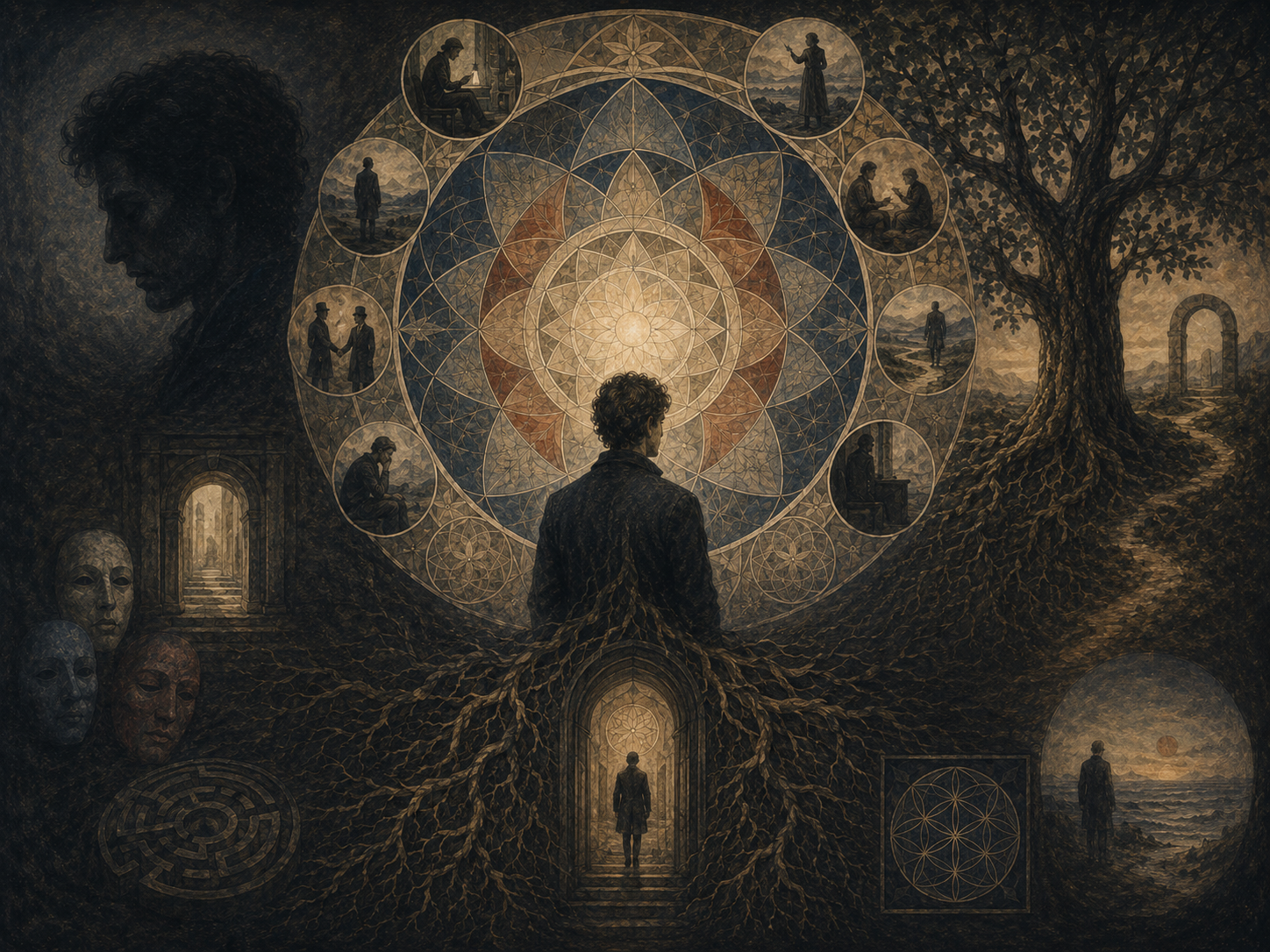
Jung insisted that the Self cannot be directly grasped as an object among objects. It becomes knowable only through symbols: mandalas, quaternities, centers, circles, sacred children, wise rulers, divine-human figures, stones, trees, treasure images, ordered cities, enclosed gardens, temples, luminous centers, and many other forms of psychic totality. The psyche, on this account, cannot present wholeness conceptually in a final way. It approaches wholeness through symbolic images that mediate between what consciousness knows and what exceeds it.
This article examines the Self as Jung understood it: as totality, center, regulator of psychic life, symbolic horizon of individuation, and one of the major forms through which the psyche imagines wholeness. It also considers why the Self cannot be reduced to ego, why it appears through symbolic forms rather than direct cognition, how it relates to conflict and development, why it can be associated with religious and numinous experience, how the concept can be misused, and why it remains one of the most profound and controversial elements of analytical psychology.
Why the Self Matters
The Self matters because psychological life cannot be understood only in terms of conflict fragments, social roles, behavioral patterns, conscious intentions, or adaptive strategies. Human beings repeatedly experience themselves as divided, one-sided, disoriented, or incomplete, yet they also generate symbols of order, center, reconciliation, and inward totality. Jung’s concept of the Self is his attempt to explain why this happens. The psyche does not merely break apart. It also tends, however imperfectly and conflictually, toward forms of integration.
This matters not only clinically but existentially. If the ego were the whole person, psychological development would mean little more than improved control, better adaptation, stronger self-management, and more efficient life planning. Jung thought that was insufficient. He believed that psychic life includes a deeper order not created by conscious will alone. The Self names that order. It gives analytical psychology a way to think about wholeness without pretending that wholeness is simple, final, comfortable, or immediately accessible.
The Self also matters because the ego’s perspective is always partial. Consciousness necessarily selects. It organizes experience around identity, memory, role, language, defense, moral self-image, and practical need. This selectivity makes life possible, but it also excludes. The ego may reject shadow, neglect feeling, overvalue persona, deny vulnerability, overidentify with reason, inflate spiritual certainty, or refuse bodily truth. The Self becomes psychologically significant because it relativizes this narrowness. It represents the broader psychic field that the ego must learn to relate to without being swallowed by it.
Jung’s concept also matters because it gives symbolic form to the human experience of inward center. People may encounter such center in dreams, crisis, religious experience, art, ritual, illness, mourning, midlife transition, active imagination, or moments of sudden reorientation. These experiences often feel larger than ordinary ego choice. They may reorganize values, expose one-sidedness, restore meaning, or demand a different relation to life. The Self is Jung’s language for the psychic principle that such experiences suggest.
Yet the Self should not be romanticized. It does not mean comfort, self-esteem, serenity, or personal greatness. It may appear through crisis, humiliation, shadow encounter, symbolic disorientation, or the collapse of old forms. A person may encounter the Self not as soothing unity but as a demand to become more truthful. Wholeness is not achieved by denying conflict. It emerges through a more honest relation to conflict.
| Why the Self matters | Jungian meaning | Practical implication |
|---|---|---|
| It relativizes the ego | The ego is necessary but partial | Conscious identity must remain open to correction by unconscious life |
| It names psychic totality | The psyche includes conscious and unconscious dimensions | Development requires relation to what the ego does not control |
| It organizes individuation | The Self is the symbolic center and horizon of wholeness | Growth involves differentiation and integration, not simple self-expression |
| It appears symbolically | Totality cannot be grasped directly | Dreams, mandalas, centers, and sacred images require careful interpretation |
| It carries risk | The ego may identify with the Self | Wholeness symbols require humility to avoid inflation |
The Self matters, then, because it prevents psychology from reducing the person to conscious preference or social adaptation. It insists that the psyche has depth, structure, symbolic intelligence, and a demand for wholeness that exceeds the ego’s current story about itself.
What Jung Meant by the Self
Jung used the term Self in a highly specific sense. It refers to the totality of the psyche, conscious and unconscious together, and also to the regulating center of that totality. The apparent paradox is deliberate. The Self is both wholeness and center, both the full psychic field and the principle of order within it. It is not a trait, not a mood, not ordinary subjective self-awareness, and not the same as the personal identity one describes in everyday speech.
For Jung, the Self is an archetype of order and totality. This does not mean that the Self is a fixed image inherited as a ready-made picture. It means that the psyche appears to possess an organizing pattern through which wholeness is symbolized. The Self becomes inferable through dreams, fantasies, rituals, religious images, mandalas, quaternities, and other symbolic forms that suggest center, completion, balance, or the reconciliation of opposites.
The Self cannot be reduced to consciousness because it includes unconscious life. Nor can it be reduced to unconscious life because it also includes consciousness. It is the total configuration within which both appear. This is why Jung’s Self differs from modern usage of “self” as identity, personality, authenticity, or private preference. Those may be ego-level or persona-level realities. The Jungian Self is larger, deeper, and more difficult.
One way to understand the Self is through scale. The ego operates at the scale of conscious orientation: “I think,” “I remember,” “I choose,” “I believe,” “I want.” The Self operates at the scale of psychic totality: what the whole psyche is doing, compensating, resisting, organizing, and symbolizing. The ego may have plans; the Self may present a dream that undermines those plans because they are one-sided. The ego may claim innocence; the Self may present shadow. The ego may feel fragmented; the Self may generate a mandala, center, or ordering image.
The Self is also developmental. It is not merely a static totality already completed in advance. In lived psychological life, the Self is encountered through process. It appears as the orienting center of individuation, drawing the ego into relation with unconscious contents, shadow, complexes, symbolic images, and forms of wholeness that must be gradually integrated. The Self is both what the psyche already is in its totality and what consciousness must learn to relate to across time.
| Common meaning of “self” | Jungian Self | Why the distinction matters |
|---|---|---|
| Personal identity | Total psyche, conscious and unconscious | The Self exceeds what the person consciously thinks they are |
| Authentic preference | Ordering center of psychic totality | Wholeness may contradict immediate preference |
| Self-esteem or confidence | Archetype of order and totality | The Self is not ego-strength inflated into positivity |
| Social individuality | Symbolic horizon of individuation | Individuation is deeper than lifestyle uniqueness |
| Subjective experience | Total relation among ego, unconscious, shadow, complexes, and symbols | The Self includes what the subject may resist or not yet know |
What Jung meant by the Self, then, is neither simple nor vague when handled carefully. It is the psyche’s symbol of totality and the ordering principle through which differentiated parts may enter into more meaningful relation. It is not a thing the ego can own. It is a center the ego can learn to orbit.
The Self Is Not the Ego
One of Jung’s most important distinctions is the distinction between ego and Self. The ego is the center of consciousness. It organizes memory, identity, practical orientation, continuity, decision-making, and deliberate attention. It says “I.” It is indispensable for conscious life. But it is not the whole psyche. The Self includes the ego while exceeding it. It is the larger totality within which the ego is only one center of organization.
This distinction matters because confusion between ego and Self produces inflation. If the ego imagines itself identical with the whole, it becomes grandiose, spiritually overreaching, morally self-certain, or possessed by symbolic images of importance. Jung regarded such inflation as dangerous because it mistakes limited consciousness for total truth. The Self relativizes the ego by showing that conscious identity is necessary but partial.
The ego’s task is not to disappear. Weak ego structure does not produce wholeness. Without ego coherence, the person cannot discriminate, remember, take responsibility, test reality, or mediate unconscious material. Jung did not propose that the ego surrender itself into formless psychic totality. He proposed that the ego become strong enough to enter relation with the Self without claiming to be it. The ego must be relativized, not destroyed.
This distinction is clinically and spiritually important. Some people confuse the Self with personal desire: “my deepest self wants this.” Others confuse the Self with numinous imagery: “the dream figure told me my destiny.” Others confuse it with moral superiority: “I am acting from wholeness.” In each case, the ego may be appropriating the symbolic authority of the Self. This is not individuation. It is inflation.
The Self corrects the ego not by humiliating it into nothingness, but by placing it within a wider order. A healthy ego can say: “This dream challenges my conscious position,” “This image may reveal something I do not yet understand,” “This shadow belongs to me,” “This center-symbol is an orientation, not an achievement,” or “This numinous experience requires humility.” Such statements show ego-Self relation rather than ego-Self identity.
| Dimension | Ego | Self |
|---|---|---|
| Scale | Center of consciousness | Totality and regulating center of the psyche |
| Function | Orientation, memory, identity, decision, adaptation | Integration, compensation, symbolic ordering, relation among psychic parts |
| Speech | “I think,” “I choose,” “I am” | Appears indirectly through dreams, symbols, affects, and ordering images |
| Risk | Rigidity, defensiveness, persona identification | Inflation if the ego identifies with it |
| Developmental task | Become coherent enough to mediate psychic life | Orient the ego toward a wider wholeness |
The Self is not the ego because wholeness is not identical with conscious control. But the Self also does not make the ego irrelevant. Individuation requires a disciplined relation between the two: ego strong enough to remain responsible, Self large enough to relativize ego-centered illusion.
Totality, Center, and Order
The language of totality and center is central to Jung’s idea. Totality means that the psyche includes more than the contents the ego can accept or even recognize. It includes unconscious material, compensatory tendencies, latent possibilities, shadow contents, complexes, symbolic patterning, bodily affect, instinctual life, relational memory, and collective motifs beyond deliberate awareness. Center means that this totality is not mere chaos. The psyche has ordering tendencies. It strives toward forms of relation, compensation, and balance even when consciousness is one-sided.
Jung did not think this order is smooth or peaceful. The Self is not sentimental harmony. It often appears through disturbance because psychic imbalance provokes compensatory response. Dreams, symptoms, symbolic images, fantasies, conflicts, and crises may all become ways the larger psyche attempts to correct conscious one-sidedness. Order, in this framework, is dynamic rather than static. It is not the absence of conflict but the meaningful relation of conflict within a larger pattern.
Totality does not mean that everything becomes conscious. No human being fully integrates the entire psyche. The unconscious remains unconscious in many respects. Jungian wholeness is not total transparency. It is a more truthful relation among conscious and unconscious factors. The ego becomes more aware of its limits, more capable of dialogue with symbolic material, less rigidly identified with persona, and more willing to withdraw projections. This is a movement toward wholeness, not possession of totality.
Center also does not mean domination. The Self is not a psychological monarch that eliminates plurality. Many symbols of the Self—mandalas, quaternities, ordered cities, circular gardens, trees, temples, stones, and sacred centers—show organized differentiation rather than uniform sameness. Wholeness is patterned plurality. The center holds difference in relation without reducing all parts to one voice.
This is why the Self is so often symbolized by circular and fourfold forms. The circle suggests containment and orientation around a center. The quaternity suggests differentiated completeness. The mandala often combines both: a centered structure organized through balanced plurality. Such symbols do not eliminate contradiction. They give contradiction a form in which relation becomes possible.
| Term | Jungian meaning | Misunderstanding to avoid |
|---|---|---|
| Totality | The psyche as conscious and unconscious together | Assuming totality means the ego can know everything |
| Center | An ordering principle within psychic totality | Imagining a controlling inner ruler |
| Order | Dynamic relation among differentiated parts | Confusing wholeness with peace, simplicity, or uniformity |
| Integration | More truthful relation among psychic factors | Assuming integration means erasing conflict |
| Wholeness | Symbolic orientation toward psychic completeness | Treating wholeness as personal perfection |
Totality, center, and order therefore belong together. The Self is totality because it includes the whole psychic field. It is center because the psyche tends to organize itself around symbolic forms of orientation. It is order because wholeness is not chaos, but a living pattern among differentiated parts.
The Self and Symbolic Representation
The Self cannot be directly known in the way one knows an object or a concept with fixed boundaries. It is too large, too inclusive, and too bound to unconscious life for that. This is why Jung insisted that the Self appears symbolically. Wholeness must be represented through image. The psyche approaches what it cannot fully conceptualize by generating symbols that suggest center, completion, orientation, and transformed relation among parts.
This symbolic mediation is not ornamental. It is structurally necessary. The Self belongs to a scale of psychic reality that consciousness cannot simply seize. Symbols do the work of partial disclosure. They give form to what cannot otherwise become thinkable. This is why Jungian psychology places such importance on symbolic interpretation and why it repeatedly returns to images of circles, sacred centers, divine children, wise rulers, stones, trees, temples, enclosed gardens, ordered cities, and mandalas.
A symbol of the Self is not the Self itself. It is a representation, mediation, or psychic image through which the Self becomes partially encounterable. A dream of a circle, stone, tree, temple, child, or luminous center does not automatically prove that the Self has appeared. The image must be interpreted in context. It may be a local image, a memory, a cultural reference, a compensatory symbol, an archetypal motif, or a form of psychic ordering. Interpretation depends on dream structure, affect, personal association, symbolic amplification, and the dreamer’s developmental situation.
Symbols of the Self often appear when consciousness is fragmented, disoriented, inflated, or undergoing transition. The psyche may generate an ordering image because the ego cannot produce orientation from its current standpoint. A mandala may appear during psychic disturbance. A center may appear during disintegration. A child may appear during exhaustion. A stone may appear when durability is needed. A tree may appear when rooted growth is being imagined. Such images do not mean wholeness has been achieved. They may indicate that the psyche is constellating a symbol of order precisely because order is needed.
This distinction is essential. The image of wholeness is not the same as wholeness. The symbol points, gathers, mediates, and orients. It does not automatically complete the process. Jungian interpretation becomes weak when it treats every centered image as proof of achieved integration. It becomes stronger when it asks what psychic need or developmental pressure has produced such a symbol at this moment.
| Self-symbol | Possible meaning | Caution |
|---|---|---|
| Circle or mandala | Containment, order, center, wholeness tendency | May indicate need for order, not completed integration |
| Stone | Durability, center, condensed value, psychic ground | Can also symbolize hardness, inertia, or unconscious weight |
| Tree | Growth, roots, axis, life, relation between depth and height | Meaning depends on condition, setting, and dream action |
| Sacred child | Emergent future, vulnerability, renewal, symbolic beginning | May also indicate regression or neglected development |
| Temple or sacred city | Ordered psychic space, center, ritual containment | May be inaccessible, ruined, authoritarian, or idealized |
| Wise ruler or guide | Inner mediation, symbolic authority, orienting wisdom | Should not be obeyed blindly or inflated into destiny |
The Self and symbolic representation are inseparable because the psyche approaches totality through images. To interpret these images responsibly is to honor their depth without mistaking symbolic appearance for literal possession of wholeness.
Mandalas, Quaternities, and Sacred Centers
Among Jung’s most famous symbolic forms of the Self are mandalas and quaternities. Mandalas are circular or centered images that suggest psychic order, containment, balance, and orientation. Quaternities are fourfold structures that symbolize differentiated wholeness: four directions, four elements, four functions, four seasons, four gates, four rivers, or fourfold sacred arrangements. Jung believed such images recur because the psyche repeatedly imagines totality through ordered plurality rather than undifferentiated fusion.
Mandalas interested Jung because they often appear during moments of psychic disorder, transition, crisis, or reorganization. Their centered structure seems to answer fragmentation. They offer an image of psychic containment when consciousness lacks stable orientation. In dreams, fantasies, art, religious imagery, and active imagination, mandalas may symbolize the psyche’s attempt to form a center around which conflicting elements can be arranged.
The quaternity matters because it suggests that wholeness is not one-sided. Jung often associated psychological differentiation with fourfold patterns, including his typology of thinking, feeling, sensation, and intuition. A psyche dominated by one function may become one-sided; wholeness requires relation to the inferior and neglected functions as well. The quaternity therefore becomes an image of differentiated completeness. It does not erase difference. It arranges difference.
Sacred centers are another major symbolic family. Temples, altars, world trees, mountains, stones, cities, gardens, and enclosed courts can all represent center-symbolism. These images appear across religious, mythic, literary, and dream traditions, though their meaning must always be interpreted in context. A sacred center may symbolize orientation, but it may also symbolize authority, exclusion, repression, longing, or inaccessible order. Jungian interpretation must avoid turning every center image into the same meaning.
These forms matter because they show that wholeness is not sameness. The Self is not the erasure of difference. It is the patterned relation of differentiated parts around a symbolic center. This is why mandala symbolism has such force in Jungian thought. It visualizes the possibility that fragmentation can become ordered without ceasing to be complex.
| Symbolic form | Structure | Possible relation to the Self | Interpretive caution |
|---|---|---|---|
| Mandala | Circular, centered, often symmetrical | Containment, wholeness tendency, psychic ordering | May signal need for order rather than achieved wholeness |
| Quaternity | Fourfold differentiated structure | Completeness through ordered plurality | Do not force fourfold meaning onto every symbolic pattern |
| Sacred center | Temple, altar, mountain, tree, stone, city | Orientation around a symbolic point of meaning | Religious and cultural context must be respected |
| Enclosed garden | Contained living space | Cultivated psychic life, protection, center, renewal | May also suggest enclosure, exclusion, or idealized refuge |
| Ordered city | Collective structure arranged around center | Psychic order, civilization, collective wholeness image | Can also encode authority, hierarchy, or control |
Mandalas, quaternities, and sacred centers remain important because they show the Self as form, not formula. They present wholeness as ordered relation among parts. Their value lies not in proving a metaphysical system, but in showing how the psyche repeatedly imagines center when it must survive fragmentation.
The Self as Regulator of the Psyche
Jung sometimes described the Self as the regulating center of the psyche. By this he did not mean a little ruler hidden inside the mind issuing commands. He meant that psychic life appears to have self-organizing and compensatory tendencies. When consciousness becomes too one-sided, dreams may correct it. When the ego identifies too strongly with persona, shadow material may intensify. When psychic life is fragmented, symbols of center and order may arise. The Self names this regulative dimension.
This view makes the psyche more than a battlefield of accidents. It suggests that psychic life has an intrinsic tendency toward pattern and compensation, even if that tendency is often conflictual and never guarantees peace. The Self is therefore both descriptive and orienting: it describes a principle of psychic organization and orients development toward greater relation with that organization.
The regulative function of the Self is especially visible in dreams. A person who is inflated may dream humiliation. A person who is emotionally dry may dream water or grief. A person who is overadapted to social roles may dream masks, hidden rooms, neglected children, or wild animals. A person who is fragmented may dream circles, houses, centers, temples, or maps. Such images may be understood as compensatory movements of the wider psyche. The ego’s one-sidedness calls forth a symbolic response.
The Self also regulates through tension. It does not simply restore comfort. Sometimes it intensifies conflict because unresolved opposition must become conscious. A person who avoids shadow may dream pursuit. A person avoiding grief may dream the dead. A person refusing responsibility may dream catastrophe. The Self’s regulation is not therapeutic reassurance; it is movement toward psychic truth.
Regulation also happens across time. A dream series may show repeated compensation until the ego responds. If the same locked door, threatening animal, lost child, broken bridge, or flooded house recurs without transformation, the psyche may be repeating a problem that consciousness has not addressed. If later dreams show altered relation, the regulatory process may be moving toward integration. The Self is therefore not a single event, but an unfolding pattern across symbolic life.
| Conscious condition | Possible regulative response | Relation to the Self |
|---|---|---|
| Inflation | Dreams of limitation, exposure, injury, or failure | Relativizes ego dominance |
| Persona identification | Masks, backstage spaces, hidden rooms, neglected figures | Restores relation to what persona excludes |
| Shadow avoidance | Pursuers, animals, strangers, dark doubles | Forces relation to disowned material |
| Fragmentation | Mandala, circle, house, temple, map, center | Constellates ordering symbols |
| Emotional one-sidedness | Water, grief, body, wound, vessel, flood | Reintroduces affective and embodied truth |
The Self as regulator of the psyche is one of Jung’s most important ideas because it turns psychic disturbance into something more than random disruption. Disturbance may be destructive, but it may also be meaningful. The psyche may be trying to reorganize itself around a more adequate relation to the whole.
The Self and the Tension of Opposites
A central feature of the Self in Jungian thought is its relation to opposites. Consciousness tends to polarize: reason against feeling, spirit against body, control against desire, purity against aggression, self against other, order against chaos, masculine against feminine, individual against collective, adaptation against authenticity. The Self does not abolish such oppositions by making them disappear. It holds them within a wider totality. It is therefore associated with symbols of reconciliation, conjunction, sacred marriage, balance, and ordered relation.
This is one reason the Self is psychologically demanding. It calls the ego beyond one-sided identification. The ego often wants certainty: “I am this, not that.” The Self confronts this simplification by revealing that rejected opposites still belong to the psychic field. The rational person must meet irrationality. The moral person must meet shadow. The spiritual person must meet body. The self-sufficient person must meet dependency. The gentle person must meet aggression. The disciplined person must meet chaos. Wholeness requires relation to what the ego has excluded.
The tension of opposites should not be misunderstood as easy compromise. Jung did not simply argue that every conflict should be averaged. Some opposites must remain in tension because premature resolution would falsify the psychic situation. A person may need to endure the discomfort of contradiction before a new symbol emerges. This is one reason Jung was drawn to alchemical imagery, where transformation often occurs through conflict, dissolution, conjunction, and the emergence of a new form.
The Self is linked to the transcendent function because it can generate symbolic forms that mediate opposites without reducing one to the other. A dream image, active imagination figure, mandala, or symbolic event may appear when conscious and unconscious positions are held in living tension. The resulting symbol is not a logical solution but a psychic third: an image through which the opposition becomes bearable, thinkable, and transformable.
This has practical significance. When people identify one-sidedly with a conscious position, they often project the opposite outward. The rejected opposite appears in enemies, partners, groups, institutions, or shadow figures. The Self calls for withdrawal of projection and recognition that the disowned opposite has psychic significance. This does not mean accepting harmful behavior or collapsing moral distinctions. It means recognizing that psychic wholeness requires responsibility for what has been disowned.
| Opposition | One-sided risk | Self-oriented task |
|---|---|---|
| Reason and feeling | Cold abstraction or emotional flooding | Develop relation between judgment and affect |
| Spirit and body | Disembodied idealism or reduction to appetite | Restore symbolic relation between meaning and embodiment |
| Persona and shadow | Social overadaptation or disowned destructiveness | Recognize what the social face excludes |
| Control and surrender | Rigidity or collapse | Learn disciplined openness to unconscious material |
| Individual and collective | Isolation or conformity | Differentiate personally while remaining socially responsible |
The Self and the tension of opposites belong together because wholeness is not achieved by eliminating contradiction. It is approached when opposites become held within a broader symbolic order that neither denies conflict nor remains trapped inside it.
The Self and Individuation
The Self is the central orienting concept of individuation. Individuation does not mean becoming unique in a superficial lifestyle sense. It means becoming more inwardly differentiated and more deeply related to the total psyche. The ego does not become the Self, but comes into relation with it. This relation is never total possession. It is an ongoing reordering of consciousness in light of a wider psychic reality.
Individuation often begins when the ego’s existing structures fail to suffice. Persona may crack, shadow may erupt, dreams may intensify, meaning may collapse, or symbolic material may become more insistent. In such moments, the psyche may begin to generate images of center, order, or transformation. The Self appears not as a completed state but as an orienting principle of development.
The relation between Self and individuation also clarifies why development is not merely ego improvement. A person can become more successful, confident, articulate, productive, or socially admired while remaining profoundly one-sided. Individuation requires confrontation with what success may have excluded. It may require descent rather than ascent, humility rather than mastery, symbolic listening rather than control, and ethical responsibility rather than self-expression alone.
The Self guides individuation through symbols, not commands. Dreams may present a house with hidden rooms, a neglected child, a shadow figure, a bridge, a center, a stone, a tree, or a mandala. These images do not issue simple instructions. They reveal psychic situations and possible directions. The ego must interpret, test, suffer, choose, and integrate. Individuation is not passive obedience to symbolic imagery. It is disciplined relation to the psyche’s larger order.
The Self also prevents individuation from becoming narcissistic. If individuation is misunderstood as “becoming myself” in an ego-centered way, it can become another form of self-enclosure. Jung’s concept is more demanding. To become oneself means becoming answerable to the total psyche, including shadow, body, relationship, history, inherited symbolic forms, and moral responsibility. The Self does not license self-absorption. It widens accountability.
| Individuation element | Relation to the Self | Developmental risk |
|---|---|---|
| Persona differentiation | The ego learns it is more than its social role | Rejecting social responsibility in the name of authenticity |
| Shadow work | Disowned material is brought into relation with consciousness | Acting out shadow instead of integrating it |
| Dream work | Symbols reveal compensatory and prospective movements | Overinterpreting dreams as destiny |
| Symbolic center | Images of wholeness orient psychic development | Confusing an image of wholeness with achieved wholeness |
| Ethical integration | The ego becomes responsible to a wider psychic truth | Using “inner truth” to avoid responsibility to others |
The Self and individuation are inseparable because individuation is the ego’s gradual reorientation toward psychic totality. The Self is not a prize reached at the end. It is the symbolic center that draws the process forward and continually relativizes the ego’s partial claims.
The Self, Religion, and Numinous Experience
Jung repeatedly linked the Self to religious and numinous symbolism, not because he wanted simply to turn psychology into theology, but because many religious traditions preserve symbolic forms of totality, center, mediation, judgment, transformation, and restored wholeness. Divine-human figures, sacred cities, mandalas, crosses, trees of life, philosopher’s stones, cosmic centers, sacred mountains, enclosed gardens, and ritual centers all interested him as symbolic expressions of psychic totality.
This is also one reason the concept remains controversial. For some readers, Jung’s language about the Self comes too close to spiritual ontology. For others, that closeness is precisely what makes the concept powerful. A careful reading recognizes both the psychological value and the risk: the Self can illuminate numinous experience without requiring that psychology make dogmatic metaphysical claims it cannot justify.
The Self is numinous because it often appears with a sense of authority, awe, fascination, fear, or sacred seriousness. A dream of a mandala, divine child, luminous figure, sacred center, temple, stone, or cosmic order may affect the dreamer far more powerfully than an ordinary dream image. The emotional charge suggests that the image arises from a deeper layer of the psyche than ordinary ego fantasy. Jung used religious language because the experience itself often feels religious or quasi-religious.
But psychological interpretation must remain careful. To say that a religious image may symbolize the Self is not to say that religion is “nothing but psychology.” Religious symbols belong to living traditions, doctrines, rituals, communities, languages, histories, and practices. Jungian interpretation can examine psychological function, but it should not reduce theology, devotion, ritual, or sacred history to inner process alone.
The reverse danger is also real. A person may treat a Self-symbol as divine authorization for personal desire, mission, or certainty. The more numinous the image, the greater the need for humility. Jung repeatedly warned against inflation in the presence of archetypal material. Numinous experience can orient the ego, but it can also possess it. The ego must learn to relate to the symbol rather than identify with it.
| Religious or numinous form | Possible psychological relevance | Necessary caution |
|---|---|---|
| Divine child | Emergent psychic life, future possibility, renewal | Should not be used to inflate the ego as chosen or special |
| Sacred city | Ordered psychic totality, communal wholeness, symbolic center | May carry historical, theological, and political meanings beyond psychology |
| Cross or quaternity | Fourfold order, suffering, mediation, reconciliation of opposites | Must be interpreted within Christian and broader historical contexts where relevant |
| Tree of life | Axis, growth, rootedness, relation of levels | Not all tree symbolism has the same cultural or religious meaning |
| Stone or jewel | Condensed value, center, durability, transformed matter | May be symbolic of fixation as well as integration |
The Self, religion, and numinous experience therefore require a double discipline: openness to symbolic depth and restraint before metaphysical overclaim. Jung’s concept is valuable when it helps illuminate how the psyche experiences center and totality. It becomes dangerous when it turns psychological interpretation into personal revelation without humility, context, or ethical testing.
Inflation and the Danger of Identification
No discussion of the Self is complete without addressing inflation. Inflation occurs when the ego identifies with an archetypal power or symbolic image that exceeds it. Instead of relating to the Self, the ego imagines that it is the Self, speaks for the Self, possesses the truth of the Self, or has been uniquely authorized by the Self. This is one of the most serious risks in Jungian psychology because the Self carries symbolic authority. Its images can feel more real, more powerful, and more meaningful than ordinary conscious thought.
Inflation may appear spiritually, intellectually, morally, politically, or therapeutically. A person may believe they have discovered their cosmic mission. A thinker may identify with the role of prophet or revealer. A leader may imagine they embody collective destiny. A patient may treat a dream figure as unquestionable command. An analyst may interpret from a position of archetypal authority rather than disciplined humility. In each case, the ego has appropriated symbolic power that does not belong to it.
Jung’s distinction between ego and Self is designed to prevent this. The ego must learn that images of totality are not personal trophies. A mandala dream does not prove spiritual attainment. A guide figure does not eliminate moral responsibility. A center-symbol does not make the dreamer whole. A numinous experience does not exempt anyone from ordinary life. The Self relativizes the ego; inflation reverses that relation by allowing the ego to claim the Self’s authority.
Inflation can also occur collectively. Nations, movements, institutions, or communities may identify with sacred destiny, purity, chosenness, renewal, or world-historical mission. Such collective inflation can be politically dangerous because archetypal symbols intensify emotion and reduce self-criticism. The group becomes the bearer of wholeness; opponents become shadow. Jungian interpretation is useful here because it reveals how images of totality can become destructive when identified with power.
The antidote to inflation is not cynicism. It is humility, differentiation, and ethical grounding. The ego can take numinous symbols seriously without claiming ownership of them. It can listen to dreams without obeying them literally. It can honor sacred images without reducing them to personal entitlement. It can recognize that wholeness is an orientation, not an achievement to display.
| Inflation pattern | How it appears | Responsible correction |
|---|---|---|
| Spiritual inflation | The ego claims sacred mission or superior insight | Return to humility, ordinary responsibility, and symbolic discernment |
| Dream inflation | A dream image is treated as literal command | Interpret the image contextually and ethically |
| Moral inflation | The ego identifies with purity or wholeness | Recognize shadow and projection |
| Collective inflation | A group identifies with destiny, chosenness, or redemptive violence | Analyze power, projection, and institutional consequences |
| Analyst inflation | The interpreter speaks as if possessing the dream’s final meaning | Use dialogue, humility, and provisional interpretation |
Inflation is dangerous because the Self is powerful. Jungian psychology is not safest when it denies symbolic depth, but when it teaches disciplined relation to symbolic depth. The ego must neither dismiss the Self nor identify with it. It must learn to stand in relation.
Criticisms and Conceptual Risks
The concept of the Self has several obvious risks. First, it can become vague if treated as a catch-all term for anything profound. Second, it can encourage inflation if individuals identify their own conscious wishes with the voice of totality. Third, Jung’s symbolic language sometimes approaches religious metaphysics so closely that it becomes difficult to tell whether the Self is being described psychologically, philosophically, or theologically.
There is also a methodological problem. Because the Self is known through symbols, there is always a danger of overinterpretation. Not every circular image is a mandala of totality. Not every powerful dream announces the Self. Not every center image signals genuine integration. A disciplined Jungian reading must therefore combine symbolic sensitivity with restraint, context, and attention to the difference between suggestive interpretation and final certainty.
Another criticism is that the Self can become too abstract. If it is described only as “totality,” “center,” or “wholeness,” it may lose contact with actual psychic struggle. Jung’s strongest work avoids this by linking the Self to dreams, symbols, shadow, complexes, tension of opposites, and individuation. The Self becomes credible not as an abstract perfection but as a symbolic principle encountered in lived psychic process.
A further risk is spiritual bypassing. People may use language of wholeness to avoid grief, anger, trauma, politics, social responsibility, embodiment, or interpersonal repair. “I am centered” can become a defense. “I am whole” can become a refusal of shadow. “The Self guided me” can become a way to avoid accountability. A responsible Jungian approach insists that relation to the Self deepens responsibility rather than escaping it.
The concept also requires cultural caution. Jung drew widely from religious, mythic, alchemical, and symbolic traditions. Such comparison can illuminate recurring patterns, but it can also flatten difference. Mandalas, crosses, sacred centers, divine children, and cosmic trees do not mean the same thing everywhere. Psychological interpretation must respect history, tradition, ritual, language, and the communities for whom these symbols are sacred.
| Criticism or risk | Why it matters | Responsible Jungian response |
|---|---|---|
| Vagueness | The Self becomes a label for anything profound | Define it precisely as totality, center, and symbolic regulator |
| Inflation | The ego claims archetypal authority | Preserve the ego-Self distinction |
| Overinterpretation | Every centered image becomes a Self-symbol | Use context, association, dream structure, and series evidence |
| Metaphysical ambiguity | Psychology may slide into theology without clarity | Distinguish psychological interpretation from doctrinal claim |
| Cultural flattening | Symbols from living traditions are treated as interchangeable | Respect historical, ritual, religious, and cultural specificity |
| Spiritual bypassing | Wholeness language avoids conflict or responsibility | Keep shadow, ethics, body, relationship, and history in view |
These criticisms do not make the Self useless. They make discipline necessary. The Self remains one of Jung’s richest concepts when it is treated not as an all-purpose spiritual slogan, but as a precise and difficult symbol of psychic totality.
Contemporary Relevance
The Self remains relevant because modern persons still struggle with fragmentation, one-sidedness, overidentification with performance, symbolic disorientation, and the longing for some form of inward order that is not reducible to efficiency. In a culture saturated with surface identity, optimization language, public performance, and algorithmic self-presentation, the Jungian Self offers a counter-idea: personhood is larger than conscious management, and psychic life includes a deeper demand for integration.
This relevance does not require accepting every Jungian claim in its strongest form. Even readers who question archetypal theory or Jung’s religious language may still find value in the concept of the Self as a way of thinking about ego limitation, symbolic center, psychological integration, and the need for relation among divided parts of the psyche. At minimum, the Self remains one of the richest attempts in modern psychology to think the relation between conscious individuality and a wider order of psychic life.
The Self is especially relevant in an age of identity fragmentation. People are pulled among professional roles, online selves, family histories, political identities, consumer profiles, cultural inheritances, and private longings. The ego is asked to manage more images of itself than ever before. Jung’s concept suggests that identity management is not the same as wholeness. The person must relate to the deeper symbolic and affective life beneath the managed surface.
The concept is also relevant to mental life under conditions of crisis. Ecological anxiety, institutional distrust, social fragmentation, economic precarity, technological acceleration, loneliness, and political myth all create psychic disorientation. In such conditions, people often seek center in unhealthy forms: conspiracy, authoritarian certainty, consumer spirituality, ideological purity, or heroic self-invention. Jung’s Self offers a more demanding concept of center: not certainty imposed from above, but symbolic order achieved through relation to shadow, conflict, and complexity.
The Self also speaks to contemporary interest in systems thinking. It represents the psyche not as a single command center but as a complex system of interacting domains: ego, shadow, persona, complexes, functions, body, memory, relational patterning, and symbolic imagination. Wholeness is not the victory of one subsystem. It is higher-order relation among differentiated parts. This makes the Self surprisingly compatible with modern interest in complexity, network thinking, and self-organization, even if Jung’s language remains symbolic rather than computational.
Contemporary relevance therefore depends on careful translation. The Self should not be simplified into wellness language or used as a brand of personal authenticity. Its depth lies in its difficulty. It reminds modern life that integration is not the same as optimization, that center is not the same as control, and that wholeness is not the same as self-display.
Mathematical Lens
The Self can be formalized as an integrative totality toward which differentiated psychic subsystems are dynamically oriented. Let \(E_t\) represent ego coherence, \(U_t\) unconscious activation, \(I_t\) the degree of integration among differentiated psychic domains, and \(D_t\) unresolved disjunction among parts. A stylized totality measure might be written as:
T_t = \alpha + \beta_1 E_t + \beta_2 U_t + \beta_3 I_t – \beta_4 D_t + \varepsilon_t
\]
Interpretation: \(T_t\) represents symbolic totality. The model suggests that wholeness is not identical with ego coherence alone. It depends on ego organization, unconscious activation, integration among differentiated psychic domains, and reduction of unresolved disjunction.
One-sidedness can be modeled as the distance between ego organization and the broader psychic field:
O_t = \lVert E_t – P_t \rVert
\]
Interpretation: \(O_t\) represents one-sidedness, while \(P_t\) represents the broader psychic configuration. Greater distance suggests stronger discrepancy between conscious identity and the total psychic field, increasing the need for compensatory symbolic response.
A center-based model can also be written in network terms. Suppose the psyche is a graph \(G=(V,E)\), where clusters represent ego functions, shadow contents, complexes, symbolic imagery, bodily affect, relational patterns, and typological functions. The Self is not a single observed node but an emergent integrative property of the network: the degree to which multiple clusters can remain differentiated yet coordinated around a stable pattern of centrality, communication, and compensation.
G_t = (V_t, E_t), \quad S_t = F(C_t, Q_t, B_t, R_t)
\]
Interpretation: \(S_t\) represents an emergent Self-integration index. \(C_t\) may represent network connectivity, \(Q_t\) modular differentiation, \(B_t\) balance among clusters, and \(R_t\) the capacity for compensatory reorganization across time.
Wholeness can be represented as ordered differentiation rather than fusion:
W_t = \lambda_1 C_t + \lambda_2 Q_t + \lambda_3 R_t – \lambda_4 H_t
\]
Interpretation: \(W_t\) is a symbolic wholeness index. Connectivity, differentiated modularity, and regulatory capacity increase wholeness; excessive fragmentation or hyper-centralized ego dominance reduces it.
This fits Jung’s symbolic intuition. The Self appears when the psyche becomes less governed by isolated subsystems and more organized around a center that holds plurality without collapse. Mathematical language does not prove the concept, but it clarifies the logic of totality as ordered differentiation rather than uniform sameness. The Self is not the strongest node. It is the emergent pattern by which the network becomes more whole.
R Workflow: Simulating Psychic Integration Around a Symbolic Center
The following R workflow simulates psychic integration as the relation among ego coherence, unconscious activation, symbolic center strength, relational coordination, shadow pressure, and disjunction. It is designed to formalize the idea that wholeness does not mean eliminating difference, but increasing structured relation among parts. The data are synthetic and illustrative, not clinical or diagnostic.
# ============================================================
# The Self in Jungian Thought
# R Workflow: Psychic integration around a symbolic center
# ============================================================

# This workflow uses synthetic data for conceptual demonstration.
# It is not a clinical tool, diagnostic instrument, psychological
# assessment, treatment recommendation system, or empirical validation
# of Jungian theory.

library(dplyr)
library(ggplot2)
library(lme4)
library(broom.mixed)
library(tidyr)

set.seed(2026)

# ------------------------------------------------------------
# 1. Create synthetic person-period data
# ------------------------------------------------------------

n_people <- 280
n_periods <- 20

person_level <- tibble(
  person_id = 1:n_people,
  baseline_ego_coherence = rnorm(n_people, 0, 1),
  baseline_symbolic_literacy = rnorm(n_people, 0, 1),
  baseline_shadow_pressure = rnorm(n_people, 0, 1),
  individuation_pattern = sample(
    c(
      "stable_ego_development",
      "persona_crack",
      "shadow_integration",
      "center_symbol_emergence",
      "inflation_risk",
      "fragmentation_repair"
    ),
    size = n_people,
    replace = TRUE
  )
)

panel <- expand.grid( person_id = 1:n_people, time = 1:n_periods ) |>
  arrange(person_id, time) |>
  left_join(person_level, by = "person_id") |>
  mutate(
    developmental_time = time / max(time),

    ego_coherence =
      baseline_ego_coherence +
      0.03 * time +
      ifelse(individuation_pattern == "stable_ego_development", 0.28, 0) +
      rnorm(n(), 0, 0.35),

    unconscious_activation =
      rnorm(n(), 0, 1) +
      ifelse(individuation_pattern == "shadow_integration", 0.36, 0) +
      ifelse(individuation_pattern == "fragmentation_repair", 0.28, 0),

    symbolic_center_strength =
      baseline_symbolic_literacy +
      0.05 * time +
      ifelse(individuation_pattern == "center_symbol_emergence", 0.42, 0) +
      rnorm(n(), 0, 0.34),

    shadow_pressure =
      baseline_shadow_pressure +
      ifelse(individuation_pattern == "shadow_integration", 0.40, 0) +
      ifelse(individuation_pattern == "persona_crack", 0.30, 0) +
      rnorm(n(), 0, 0.40),

    relational_coordination =
      rnorm(n(), 0, 1) +
      0.04 * time +
      ifelse(individuation_pattern == "fragmentation_repair", 0.26, 0),

    disjunction =
      rnorm(n(), 0, 1) +
      ifelse(individuation_pattern == "inflation_risk", 0.42, 0) +
      ifelse(individuation_pattern == "persona_crack", 0.34, 0) -
      0.03 * time,

    inflation_risk =
      0.48 * ego_coherence +
      0.42 * symbolic_center_strength -
      0.52 * relational_coordination +
      ifelse(individuation_pattern == "inflation_risk", 0.50, 0) +
      rnorm(n(), 0, 0.35)
  )

# ------------------------------------------------------------
# 2. Symbolic totality and integration scores
# ------------------------------------------------------------

panel <- panel |>
  mutate(
    totality_score =
      0.48 * ego_coherence +
      0.36 * unconscious_activation +
      0.58 * symbolic_center_strength +
      0.54 * relational_coordination -
      0.46 * disjunction -
      0.30 * pmax(inflation_risk, 0) +
      rnorm(n(), 0, 0.45),

    differentiation_score =
      0.42 * ego_coherence +
      0.38 * symbolic_center_strength +
      0.36 * relational_coordination -
      0.32 * abs(shadow_pressure) +
      rnorm(n(), 0, 0.36),

    self_relation_index =
      0.40 * totality_score +
      0.34 * differentiation_score +
      0.28 * symbolic_center_strength -
      0.30 * pmax(inflation_risk, 0) +
      rnorm(n(), 0, 0.30)
  )

# ------------------------------------------------------------
# 3. Estimate mixed-effects model
# ------------------------------------------------------------

model <- lmer(
  totality_score ~ ego_coherence +
    unconscious_activation +
    symbolic_center_strength +
    relational_coordination +
    shadow_pressure +
    disjunction +
    inflation_risk +
    time +
    (1 | person_id),
  data = panel
)

summary(model)
fixed_effects <- broom.mixed::tidy(model, effects = "fixed")
print(fixed_effects)

# ------------------------------------------------------------
# 4. Summarize by individuation pattern
# ------------------------------------------------------------

pattern_summary <- panel |>
  group_by(individuation_pattern) |>
  summarize(
    mean_ego_coherence = mean(ego_coherence),
    mean_unconscious_activation = mean(unconscious_activation),
    mean_symbolic_center_strength = mean(symbolic_center_strength),
    mean_shadow_pressure = mean(shadow_pressure),
    mean_relational_coordination = mean(relational_coordination),
    mean_disjunction = mean(disjunction),
    mean_inflation_risk = mean(inflation_risk),
    mean_totality_score = mean(totality_score),
    mean_differentiation_score = mean(differentiation_score),
    mean_self_relation_index = mean(self_relation_index),
    .groups = "drop"
  ) |>
  arrange(desc(mean_self_relation_index))

print(pattern_summary)

# ------------------------------------------------------------
# 5. Developmental trajectory
# ------------------------------------------------------------

trajectory <- panel |>
  group_by(time) |>
  summarize(
    mean_ego_coherence = mean(ego_coherence),
    mean_symbolic_center_strength = mean(symbolic_center_strength),
    mean_relational_coordination = mean(relational_coordination),
    mean_disjunction = mean(disjunction),
    mean_inflation_risk = mean(inflation_risk),
    mean_totality_score = mean(totality_score),
    mean_self_relation_index = mean(self_relation_index),
    .groups = "drop"
  ) |>
  pivot_longer(
    cols = c(
      mean_ego_coherence,
      mean_symbolic_center_strength,
      mean_relational_coordination,
      mean_disjunction,
      mean_inflation_risk,
      mean_totality_score,
      mean_self_relation_index
    ),
    names_to = "measure",
    values_to = "value"
  )

ggplot(trajectory, aes(x = time, y = value, linetype = measure)) +
  geom_line(linewidth = 1) +
  labs(
    title = "Simulated Psychic Integration Around a Symbolic Center",
    subtitle = "Self-relation rises when ego coherence, symbolic center strength, and relational coordination increase without inflation",
    x = "Developmental time",
    y = "Mean synthetic score"
  ) +
  theme_minimal()

# ------------------------------------------------------------
# 6. Compare individuation patterns
# ------------------------------------------------------------

pattern_long <- pattern_summary |>
  pivot_longer(
    cols = c(
      mean_ego_coherence,
      mean_unconscious_activation,
      mean_symbolic_center_strength,
      mean_shadow_pressure,
      mean_relational_coordination,
      mean_disjunction,
      mean_inflation_risk,
      mean_totality_score,
      mean_self_relation_index
    ),
    names_to = "measure",
    values_to = "value"
  )

ggplot(
  pattern_long,
  aes(x = reorder(individuation_pattern, value), y = value, fill = measure)
) +
  geom_col(position = "dodge") +
  coord_flip() +
  labs(
    title = "Synthetic Individuation Pattern Profiles",
    subtitle = "Different paths show different balances of ego coherence, center-symbol strength, shadow pressure, and inflation risk",
    x = "Individuation pattern",
    y = "Mean synthetic score"
  ) +
  theme_minimal()

# ------------------------------------------------------------
# 7. Optional export
# ------------------------------------------------------------

dir.create("outputs/tables", recursive = TRUE, showWarnings = FALSE)
write.csv(panel, "outputs/tables/self_integration_panel.csv", row.names = FALSE)
write.csv(pattern_summary, "outputs/tables/individuation_pattern_summary.csv", row.names = FALSE)
write.csv(trajectory, "outputs/tables/self_integration_trajectory.csv", row.names = FALSE)

# ------------------------------------------------------------
# Extensions
# ------------------------------------------------------------

# 1. Model individuation as rising symbolic center strength over time.
# 2. Add crises that temporarily increase disjunction.
# 3. Simulate dream compensation as response to ego one-sidedness.
# 4. Compare rigid ego coherence with flexible ego-Self relation.
# 5. Add persona inflation as a driver of disjunction.
# 6. Track when shadow pressure becomes integrated rather than projected.
# 7. Add mandala or center-symbol events as time-varying indicators.
A richer version could include typological imbalance, dream compensation, active imagination events, shadow projection, and midlife crisis. That would make the simulation better suited to Jung’s core claim that the psyche tends toward reorganization when conscious life becomes too one-sided or fragmented. The important point is that integration rises not when ego dominates, but when differentiated psychic domains become more coordinated without being flattened into sameness.
Python Workflow: Modeling the Self as an Integrative Network Center
The following Python workflow models the Self as an emergent integrative property of a psychic network. Rather than representing the Self as a literal node, it treats Self-relation as the increasing coordination of differentiated clusters that remain distinct but interconnected. This reflects Jung’s central idea: the Self is not simply the ego made stronger. It is the larger pattern of psychic organization in which ego, shadow, complexes, symbolic imagery, affect, body, and relational life enter into more meaningful relation.
# ============================================================
# The Self in Jungian Thought
# Python Workflow: Integrative network center
# ============================================================
#
# This workflow is a conceptual network demonstration.
# It is not a clinical tool, diagnostic instrument, psychological
# assessment, treatment recommendation system, or proof of Jungian theory.

import networkx as nx
import pandas as pd
import numpy as np
from pathlib import Path

np.random.seed(2026)

OUTPUT_DIR = Path("outputs/tables")
OUTPUT_DIR.mkdir(parents=True, exist_ok=True)

# ------------------------------------------------------------
# 1. Build a simplified psychic network
# ------------------------------------------------------------

G = nx.Graph()

nodes = {
    "ego": {"activation": 1.00, "cluster": "conscious_center"},
    "persona": {"activation": 0.74, "cluster": "adaptation"},
    "shadow": {"activation": 0.42, "cluster": "unconscious"},
    "complexes": {"activation": 0.52, "cluster": "unconscious"},
    "relational_life": {"activation": 0.68, "cluster": "relation"},
    "symbolic_imagery": {"activation": 0.64, "cluster": "symbolic"},
    "body_affect": {"activation": 0.56, "cluster": "embodied"},
    "thinking": {"activation": 0.82, "cluster": "function"},
    "feeling": {"activation": 0.48, "cluster": "function"},
    "sensation": {"activation": 0.58, "cluster": "function"},
    "intuition": {"activation": 0.70, "cluster": "function"},
    "center_symbol": {"activation": 0.34, "cluster": "self_symbol"},
}

for node, attrs in nodes.items():
    G.add_node(node, **attrs)

edges = [
    ("ego", "thinking", 0.55),
    ("ego", "feeling", 0.32),
    ("ego", "sensation", 0.38),
    ("ego", "intuition", 0.40),
    ("ego", "persona", 0.52),
    ("ego", "relational_life", 0.34),

    ("persona", "shadow", -0.24),
    ("persona", "relational_life", 0.30),

    ("shadow", "complexes", 0.68),
    ("shadow", "symbolic_imagery", 0.46),
    ("complexes", "symbolic_imagery", 0.70),
    ("complexes", "body_affect", 0.44),

    ("symbolic_imagery", "center_symbol", 0.76),
    ("body_affect", "symbolic_imagery", 0.42),
    ("body_affect", "feeling", 0.50),

    ("thinking", "feeling", 0.22),
    ("sensation", "intuition", 0.26),
    ("feeling", "relational_life", 0.58),
    ("intuition", "symbolic_imagery", 0.52),

    ("center_symbol", "ego", 0.34),
    ("center_symbol", "shadow", 0.36),
    ("center_symbol", "relational_life", 0.40),
    ("center_symbol", "body_affect", 0.32),
    ("center_symbol", "thinking", 0.28),
    ("center_symbol", "feeling", 0.36),
    ("center_symbol", "sensation", 0.30),
    ("center_symbol", "intuition", 0.34),
]

for source, target, weight in edges:
    G.add_edge(source, target, weight=weight)

# ------------------------------------------------------------
# 2. Simulate integrative development over time
# ------------------------------------------------------------

history = []

for step in range(18):
    integration_pressure = np.random.normal(0.70, 0.18)
    disjunction_pressure = np.random.normal(0.24, 0.10)
    new_activations = {}

    for node in G.nodes():
        neighbor_input = 0.0

        for neighbor in G.neighbors(node):
            neighbor_input += (
                G.nodes[neighbor]["activation"]
                * G[node][neighbor]["weight"]
            )

        base = G.nodes[node]["activation"]
        cluster = G.nodes[node]["cluster"]

        if cluster == "self_symbol":
            updated = base + 0.10 * neighbor_input + 0.08 * integration_pressure
        elif cluster in {"unconscious", "symbolic", "embodied"}:
            updated = base + 0.08 * neighbor_input + 0.05 * integration_pressure
        elif cluster == "conscious_center":
            updated = base + 0.06 * neighbor_input + 0.04 * integration_pressure
        else:
            updated = base + 0.06 * neighbor_input + 0.03 * integration_pressure

        # Disjunction weakens over-reliance on persona without relation.
        if node == "persona":
            updated -= 0.04 * disjunction_pressure

        new_activations[node] = max(0.0, min(updated, 3.0))

    for node in G.nodes():
        G.nodes[node]["activation"] = new_activations[node]

    # Integration indicators
    activations = np.array(list(new_activations.values()))
    mean_activation = activations.mean()
    activation_variance = activations.var()

    ego_dominance = (
        new_activations["ego"]
        / max(mean_activation, 1e-6)
    )

    center_relation = new_activations["center_symbol"]
    shadow_relation = new_activations["shadow"]
    persona_shadow_gap = abs(new_activations["persona"] - new_activations["shadow"])

    self_relation_index = (
        0.36 * mean_activation
        + 0.28 * center_relation
        + 0.18 * shadow_relation
        - 0.20 * activation_variance
        - 0.16 * persona_shadow_gap
        - 0.14 * max(ego_dominance - 1.8, 0)
    )

    history.append(
        {
            "step": step,
            "mean_activation": mean_activation,
            "activation_variance": activation_variance,
            "ego_dominance": ego_dominance,
            "center_relation": center_relation,
            "shadow_relation": shadow_relation,
            "persona_shadow_gap": persona_shadow_gap,
            "self_relation_index": self_relation_index,
            **new_activations,
        }
    )

results_df = pd.DataFrame(history)

# ------------------------------------------------------------
# 3. Centrality metrics
# ------------------------------------------------------------

centrality_df = pd.DataFrame(
    {
        "node": list(G.nodes()),
        "cluster": [G.nodes[n]["cluster"] for n in G.nodes()],
        "betweenness": list(nx.betweenness_centrality(G, weight="weight").values()),
        "degree_centrality": list(nx.degree_centrality(G).values()),
        "weighted_degree": [G.degree(n, weight="weight") for n in G.nodes()],
        "final_activation": [G.nodes[n]["activation"] for n in G.nodes()],
    }
).sort_values(["betweenness", "weighted_degree"], ascending=False)

# ------------------------------------------------------------
# 4. Cluster-level integration
# ------------------------------------------------------------

cluster_rows = []

for cluster in sorted(set(nx.get_node_attributes(G, "cluster").values())):
    cluster_nodes = [
        n for n, attrs in G.nodes(data=True)
        if attrs["cluster"] == cluster
    ]

    cluster_rows.append(
        {
            "cluster": cluster,
            "node_count": len(cluster_nodes),
            "mean_final_activation": np.mean(
                [G.nodes[n]["activation"] for n in cluster_nodes]
            ),
            "nodes": ", ".join(cluster_nodes),
        }
    )

cluster_df = pd.DataFrame(cluster_rows).sort_values(
    "mean_final_activation",
    ascending=False,
)

# ------------------------------------------------------------
# 5. Export outputs
# ------------------------------------------------------------

results_df.to_csv(OUTPUT_DIR / "self_network_activation_history.csv", index=False)
centrality_df.to_csv(OUTPUT_DIR / "self_network_centrality.csv", index=False)
cluster_df.to_csv(OUTPUT_DIR / "self_network_cluster_summary.csv", index=False)

edge_df = nx.to_pandas_edgelist(G)
edge_df.to_csv(OUTPUT_DIR / "self_network_edges.csv", index=False)

print("Activation history")
print(results_df)

print("\nCentrality")
print(centrality_df)

print("\nCluster summary")
print(cluster_df)

# ------------------------------------------------------------
# Extensions
# ------------------------------------------------------------

# 1. Model crises that weaken edges among key clusters.
# 2. Increase symbolic_imagery after dream compensation events.
# 3. Compare balanced and imbalanced function networks.
# 4. Simulate persona inflation as over-centralized ego dominance.
# 5. Estimate integration change during individuation phases.
# 6. Add active imagination as a process increasing center-symbol connectivity.
# 7. Model shadow projection as weak shadow-ego connectivity and high enemy projection.
This model helps visualize Jung’s central point: the Self is not simply the ego made stronger. It is the broader pattern of integration that emerges when psychic domains become more communicative and less isolated, while still remaining differentiated. Wholeness is therefore a network property of ordered relation, not a triumph of any single node.
GitHub Repository
The companion repository extends this article’s argument into reproducible, multi-language research scaffolding. It supports synthetic integration data, symbolic-center modeling, ego-Self relation workflows, network simulations of differentiated psychic domains, inflation-risk examples, structured documentation, SQL schemas, and reusable methods for examining how ego coherence, unconscious activation, symbolic center strength, relational coordination, shadow pressure, disjunction, and integration interact in Jungian theory of the Self.
| Repository area | Purpose | Use in this article context |
|---|---|---|
python |
Network modeling and symbolic-center analysis | Models the Self as emergent integration among ego, shadow, complexes, symbolic imagery, body, functions, and relational life |
r |
Simulation, statistical modeling, and visualization | Simulates totality, disjunction, inflation risk, symbolic center strength, and Self-relation across developmental time |
sql |
Structured data design and query examples | Stores synthetic integration records, symbolic-center variables, network metrics, and responsible-use notes |
julia |
Numerical simulation and scenario analysis | Can extend Self-relation modeling into nonlinear integration, crisis, compensation, and individuation scenarios |
c, cpp, fortran, go, rust |
Compiled-language examples and computational scaffolds | Provide simple reproducibility and systems-modeling examples for totality scores, integration indices, and disjunction measures |
data, notebooks, outputs, docs |
Inputs, notebooks, generated figures/tables, and documentation | Keep synthetic data, exploratory notebooks, outputs, method notes, validation plans, and responsible-use documentation organized |
These materials are for synthetic-data research, methods demonstration, conceptual modeling, symbolic-process analysis, institutional learning, and reproducible workflows. They are not intended for diagnosis, therapy, psychological assessment, clinical decision-making, treatment recommendation, mental-health evaluation, crisis intervention, employment screening, workplace surveillance, individual performance management, spiritual authority claims, or individual evaluation.
Complete Code Repository
Access the full companion repository for this article, including reproducible analysis materials, synthetic integration data, symbolic-center modeling workflows, ego-Self relation simulations, network models of differentiated psychic domains, inflation-risk examples, and multi-language code scaffolding for analytical psychology research.
Conclusion
The Self is one of Jung’s most important and most difficult concepts because it names the psyche at the scale of totality. It is not the ego, not a flattering image of maturity, and not a mystical slogan for personal fulfillment. It is the wider ordering wholeness within which consciousness is only one center. The Self becomes visible through symbols of center, balance, sacred order, and transformed relation among parts. It is the horizon of individuation and the principle that relativizes conscious identity without abolishing it.
Used carefully, the concept remains invaluable. It offers a way to think about psychic integration without denying conflict, about center without domination, and about wholeness without simplification. It explains why dreams may present mandalas, circles, stones, children, temples, trees, and sacred centers at moments of crisis or transition. It explains why the psyche may correct one-sided consciousness through symbolic compensation. It explains why individuation is not ego enhancement but a gradual reorientation of ego life within a wider psychic field.
The concept is also dangerous when misused. The Self can become vague, inflated, metaphysical, or appropriated by the ego. It can be confused with personal desire, spiritual certainty, moral superiority, or symbolic possession. Jung’s own distinction between ego and Self is the safeguard against this. The ego must relate to the Self, not claim to be it. A symbol of wholeness must be interpreted, not owned.
The Self therefore asks for a disciplined form of humility. It asks the ego to become strong enough to know its limits. It asks consciousness to recognize that the psyche is larger than conscious identity. It asks symbolic life to be taken seriously without being literalized. It asks wholeness to be understood not as perfection, fusion, or comfort, but as ordered relation among differentiated parts.
Even where one questions Jung’s strongest metaphysical implications, the Self remains one of the boldest and most enduring efforts in modern psychology to understand how a divided psyche might become less divided through symbol, development, and relation to a center greater than ego alone. Its value lies in the seriousness of its question: what would it mean for the person not merely to function, adapt, or perform, but to come into deeper relation with the whole psychic life from which consciousness itself emerges?
Related articles
- Ego, Consciousness, and Psychic Differentiation
- What Is Analytical Psychology?
- The Shadow and the Psychology of Disowned Selfhood
- Persona and Social Adaptation in Analytical Psychology
- What Is an Archetype? Pattern, Image, and Psychic Structure
- The Collective Unconscious: Meaning, Scope, and Controversy
- Individuation and the Development of the Depth Self
- Dream Interpretation in Analytical Psychology
- Dreams, Compensation, and the Prospective Function
- Myth, Symbol, and the Archetypal Imagination
- Active Imagination and the Practice of Symbolic Dialogue
- Analytical Psychology, Symbolism & the Depth Mind
Further reading
- Jung, C.G. (1968) The Archetypes and the Collective Unconscious, trans. R.F.C. Hull. 2nd edn. Princeton, NJ: Princeton University Press. Available via Princeton University Press.
- Jung, C.G. (1976) Aion: Researches into the Phenomenology of the Self, trans. R.F.C. Hull. Princeton, NJ: Princeton University Press. Available via Princeton University Press.
- Jung, C.G. (1980) Mysterium Coniunctionis, trans. R.F.C. Hull. Princeton, NJ: Princeton University Press. Available via Princeton University Press.
- Edinger, E.F. (1972) Ego and Archetype: Individuation and the Religious Function of the Psyche. Boston, MA: Shambhala. Available via Shambhala.
- Stein, M. (1998) Jung’s Map of the Soul: An Introduction. Chicago, IL: Open Court. Available via Open Court.
- Whitmont, E.C. (1969) The Symbolic Quest: Basic Concepts of Analytical Psychology. Princeton, NJ: Princeton University Press. Available via Princeton University Press.
- Samuels, A., Shorter, B. and Plaut, F. (1986) A Critical Dictionary of Jungian Analysis. London: Routledge. Available via Routledge.
- Young-Eisendrath, P. and Dawson, T. (eds.) (2008) The Cambridge Companion to Jung. 2nd edn. Cambridge: Cambridge University Press. Available via Cambridge University Press.
References
- Edinger, E.F. (1972) Ego and Archetype: Individuation and the Religious Function of the Psyche. Boston, MA: Shambhala. Available via Shambhala.
- Jung, C.G. (1966) Two Essays on Analytical Psychology, trans. R.F.C. Hull. 2nd edn. Princeton, NJ: Princeton University Press. Available via Princeton University Press.
- Jung, C.G. (1968) The Archetypes and the Collective Unconscious, trans. R.F.C. Hull. 2nd edn. Princeton, NJ: Princeton University Press. Available via Princeton University Press.
- Jung, C.G. (1974) Dreams, trans. R.F.C. Hull. Princeton, NJ: Princeton University Press. Available via Princeton University Press.
- Jung, C.G. (1976) Aion: Researches into the Phenomenology of the Self, trans. R.F.C. Hull. Princeton, NJ: Princeton University Press. Available via Princeton University Press.
- Jung, C.G. (1980) Mysterium Coniunctionis, trans. R.F.C. Hull. Princeton, NJ: Princeton University Press. Available via Princeton University Press.
- Jung, C.G. (1981) The Development of Personality, trans. R.F.C. Hull. Princeton, NJ: Princeton University Press. Available via Princeton University Press.
- Jung, C.G. (1989) The Symbolic Life: Miscellaneous Writings, trans. R.F.C. Hull. Princeton, NJ: Princeton University Press. Available via Princeton University Press.
- Samuels, A., Shorter, B. and Plaut, F. (1986) A Critical Dictionary of Jungian Analysis. London: Routledge. Available via Routledge.
- Stein, M. (1998) Jung’s Map of the Soul: An Introduction. Chicago, IL: Open Court. Available via Open Court.
- Whitmont, E.C. (1969) The Symbolic Quest: Basic Concepts of Analytical Psychology. Princeton, NJ: Princeton University Press. Available via Princeton University Press.
- Young-Eisendrath, P. and Hall, J.A. (eds.) (1991) Jung’s Self Psychology: A Constructivist Perspective. New York: Guilford Press. Available via Guilford Press.
- Young-Eisendrath, P. and Dawson, T. (eds.) (2008) The Cambridge Companion to Jung. 2nd edn. Cambridge: Cambridge University Press. Available via Cambridge University Press.