
Last Updated May 28, 2026
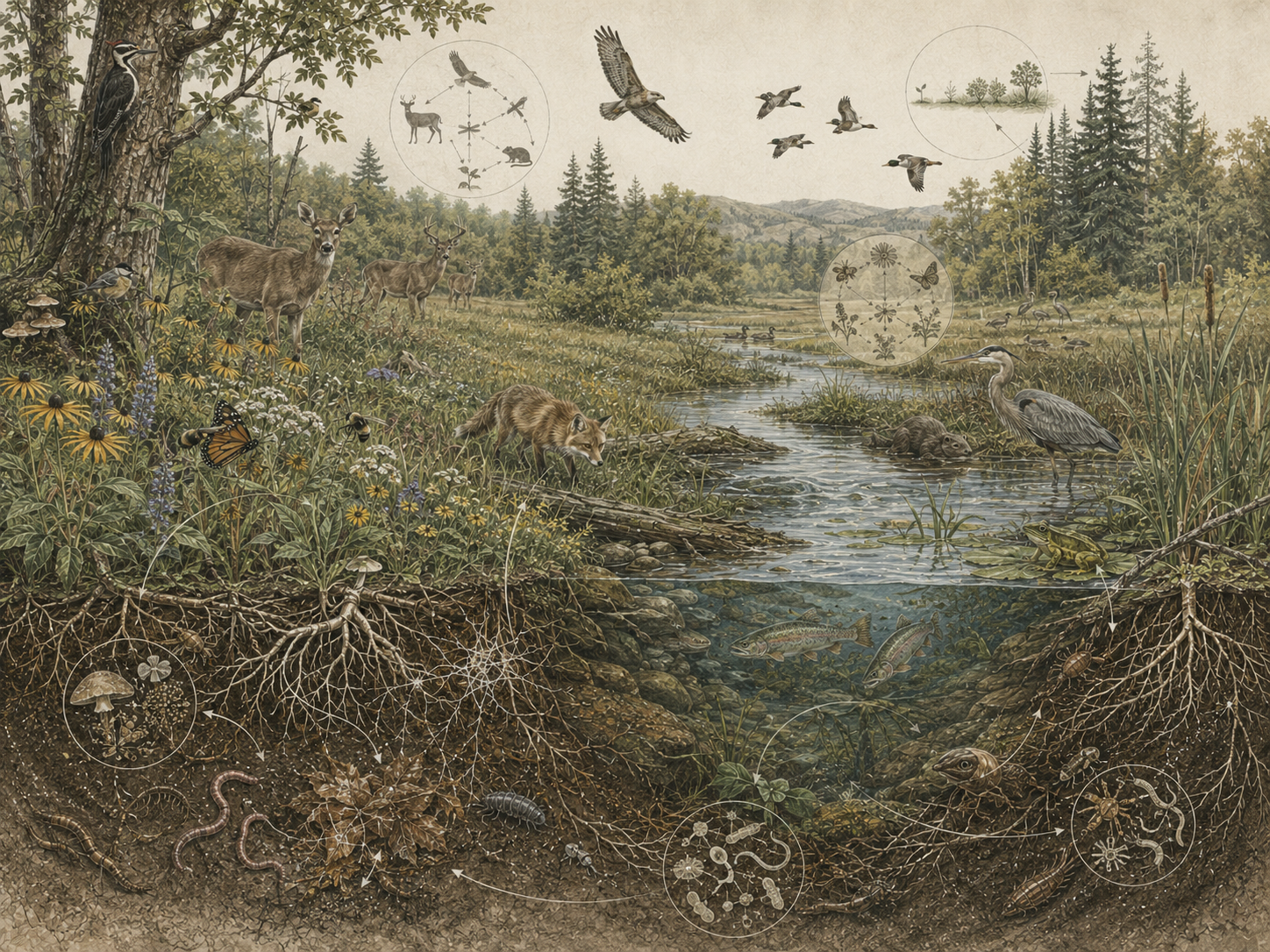
Populations, communities, and ecosystem dynamics examine how living systems are organized across ecological scales, how organisms become populations, how populations become interacting communities, and how communities participate in the flow of energy, cycling of matter, disturbance response, succession, resilience, and long-term ecosystem change. Ecology becomes most powerful when it can move across these levels without collapsing them into one another. Populations concern the dynamics of a single species through time and space. Communities concern the coexistence, interaction, and relative abundance of many species. Ecosystems concern the combined biotic and abiotic processes through which life shapes and is shaped by energy flow, nutrient cycling, productivity, decomposition, hydrology, disturbance, and environmental constraint.
This article develops populations, communities, and ecosystem dynamics as a linked framework for understanding living systems across scale. It examines demographic process, species interaction, community assembly, trophic structure, food webs, succession, disturbance, biodiversity, resilience, spatial context, climate change, ecological reorganization, and quantitative modeling. It also connects these themes to conservation biology, restoration ecology, marine biology, freshwater biology, agroecology, forestry, soil ecology, disease ecology, environmental health, biodiversity science, and computational ecology.
Main Library
Publications
Article Map
Biology
Related Topic
Environmental Science
Related Topic
Earth Science
Related Topic
Mathematical Modeling
The article is written for ecologists, marine biologists, freshwater scientists, medical and environmental-health readers, computational biology readers, biodiversity experts, restoration practitioners, conservation planners, and research biologists who need a rigorous account of how demographic, community, and ecosystem processes connect across scale.
The article also extends ecology into quantitative and computational biology through logistic population models, predator-prey and trophic interaction systems, disturbance simulations, community turnover matrices, ecosystem-risk scoring, multivariate ordination, R workflows, Python workflows, SQL provenance structures, and a linked full-stack GitHub repository containing Python, R, Julia, Fortran, Rust, Go, C, C++, SQL, notebooks, data files, and reproducibility documentation.
Why these three levels matter
Populations, communities, and ecosystems are not interchangeable terms. They mark different but connected levels of ecological organization. A population is a group of individuals of the same species living in a particular place and time with the potential to interact, reproduce, disperse, and respond to shared environmental conditions. A community is the assemblage of populations of different species occupying the same area and participating in networks of ecological relationship. An ecosystem includes that community together with the abiotic environment and the processes that connect organisms to energy flow, material cycling, productivity, decomposition, hydrology, climate, and disturbance.
This conceptual progression matters because ecological explanation changes with scale. At the population level, the central questions concern abundance, reproduction, survival, dispersal, density dependence, and regulation. At the community level, the questions shift toward coexistence, competition, predation, parasitism, mutualism, facilitation, diversity, dominance, and composition. At the ecosystem level, ecology becomes concerned with productivity, nutrient cycling, decomposition, trophic transfer, resilience, disturbance regimes, and system-wide response to change.
None of these levels cancels the others. Each depends on the others while introducing new forms of explanation. Population dynamics shapes community composition. Community composition shapes ecosystem process. Ecosystem conditions constrain population persistence and community assembly in turn. Ecology is therefore not a ladder where one level replaces the previous one. It is a nested and reciprocal system of explanations.
One of the enduring strengths of ecology is that it can move among these levels without assuming that a single scale explains everything. Populations matter because ecosystem change is always mediated through the dynamics of living populations. Communities matter because populations rarely behave independently of one another. Ecosystems matter because communities are embedded in biophysical processes that shape what forms of life are possible, persistent, and productive.
From organisms to populations
Ecological analysis begins with organisms, but organisms become ecologically significant through populations. A single deer, tree, coral colony, bacterium, phytoplankton cell, fungus, or insect is biologically real, yet ecology asks what happens when many such organisms share conditions, reproduce, compete, die, disperse, and respond collectively to variation in environment and interaction. That is the point at which ecology becomes demographic.
Populations are therefore the first truly ecological level of organization. They reveal whether a species is increasing or declining, whether reproduction is replacing mortality, whether local conditions support persistence, and whether movement among habitats is sufficient to maintain continuity. Population size alone is never enough. Age structure, stage structure, sex ratio, fecundity, survivorship, migration, density dependence, stochasticity, and genetic structure all shape what a population is likely to do.
This is why Population Dynamics and Ecological Modeling is so important as a companion article. Population ecology provides the mathematical and demographic foundation on which higher-level ecological understanding rests. Community composition and ecosystem behavior cannot be understood well if the underlying population processes are ignored.
For conservation biology, this is especially important. A community may still contain a species, but the population may be aging, isolated, genetically eroded, or failing to recruit. A fishery may still produce catch while population structure deteriorates. A forest may still contain adult trees while seedling recruitment collapses. Population ecology often detects future ecosystem change before the change is visually obvious.
From populations to communities
Communities emerge when populations of different species encounter one another in shared environments and become linked through predation, competition, parasitism, mutualism, facilitation, commensalism, trophic relationships, indirect effects, and shared environmental constraints. Community ecology is therefore the study of coexistence and interaction under conditions of shared space and limited possibility. It asks why some species occur together while others do not, why some communities are species-rich while others are species-poor, why certain species dominate, and how composition changes through time.
A community is not merely a list of co-occurring species. It is a structured field of interaction. Some species compete for similar resources. Some consume others. Some alter the environment in ways that facilitate or inhibit additional species. Some serve as hosts, pollinators, decomposers, engineers, or keystones. These roles help explain why community composition is patterned rather than random.
Community ecology has long been one of the central ways of explaining biodiversity, structure, and change. Species interactions are not peripheral additions to ecology; they are among the principal reasons that population dynamics become historically and spatially distinctive in real environments. A population’s growth rate may depend not only on resources and climate, but also on predators, competitors, parasites, mutualists, and habitat engineers.
This is why community ecology remains essential to understanding biodiversity loss, invasive species, trophic cascades, succession, ecological restoration, disease ecology, and conservation planning. It explains why a population cannot be interpreted only in terms of its own demography when that demography is embedded in a wider network of ecological relations.
From communities to ecosystems
The ecosystem concept widens the ecological frame again. Once communities are considered in relation to sunlight, climate, water, soils, geochemistry, nutrient cycling, primary production, decomposition, and trophic transfer, ecology becomes ecosystem ecology. Ecosystems are therefore not simply collections of organisms. They are dynamic systems in which living and nonliving components are joined through continuous exchange and transformation.
This broader scale matters because ecological life is not sustained by interaction alone. Organisms depend on the availability and movement of energy and matter. Primary producers capture energy. Consumers transfer it through food webs. Decomposers return nutrients to ecological circulation. Disturbance redistributes structure and resources. Climate and hydrology constrain what is possible. Ecosystem ecology studies these integrative processes.
The ecosystem perspective also makes clear that communities cannot be understood only through species lists or interaction matrices. The same community composition may behave differently under different nutrient regimes, disturbance histories, or hydrological conditions. Conversely, similar ecosystem functions may be carried out by different sets of species under different regional contexts. Ecology therefore needs both taxonomic and process-based understanding.
For marine, freshwater, soil, and forest systems, the ecosystem frame is indispensable. A reef is not only coral, fish, algae, microbes, and invertebrates; it is also carbonate chemistry, light, temperature, nutrient flow, hydrodynamics, grazing, recruitment, storm disturbance, and sediment dynamics. A river is not only fish and macroinvertebrates; it is also flow, sediment, temperature, dissolved oxygen, riparian inputs, flood pulses, and watershed history. Ecosystems make visible the process architecture that communities inhabit.
Population processes as the foundation
Population processes remain foundational even when ecology moves to broader levels. Birth, death, recruitment, immigration, emigration, dispersal, survival, density dependence, and stochastic events are the mechanisms through which populations change. Those changes then alter community composition and ecosystem function. If a predator declines, prey populations may expand. If a dominant tree species fails to regenerate, forest structure changes. If a pollinator population collapses, plant reproductive dynamics may shift. If decomposer populations are altered, nutrient turnover may slow.
This is why ecological scales are nested rather than disconnected. Population dynamics establishes the demographic substrate of ecological systems. Communities are the structured consequences of many populations interacting. Ecosystems are the biophysical and trophic consequences of those interactions taking place under real environmental conditions.
The importance of this nesting also means that ecological crisis can propagate upward and downward across levels. A local population crash can alter community structure. A community shift can alter nutrient cycling. A change in ecosystem process can feed back to influence population persistence. Ecology is full of such reciprocal linkages.
For research biologists, population processes provide the first test of ecological persistence. A system may appear intact at the community level while underlying populations are becoming unstable. Conversely, successful population recovery may become the foundation for community and ecosystem recovery, as in predator reintroduction, wetland restoration, fish passage reconstruction, reef rehabilitation, or pollinator-support planning.
Species interactions and community structure
Species interactions are among the main drivers of community structure. Competition can restrict coexistence, partition niches, or favor species with different strategies. Predation can limit dominance and maintain diversity. Herbivory can alter plant community composition. Mutualisms can expand ecological possibility by linking reproduction, dispersal, nutrition, or defense across species. Parasitism and disease can regulate abundance and restructure communities. Facilitation can make harsh environments more habitable and open pathways for succession.
These interactions matter not only directly but indirectly. A predator may reduce a dominant herbivore, thereby allowing plant diversity to increase. A mutualist may alter competition by enhancing one partner’s establishment. A pathogen may selectively suppress a competitively dominant species. An ecosystem engineer may create habitat for many other organisms. Community ecology therefore depends on networks of causation rather than simple pairwise relationships alone.
The study of keystone species, dominant species, trophic cascades, and interaction strength emerged precisely because ecologists recognized that not all species contribute equally to community organization. Some species exert effects far greater than their abundance would suggest, while others structure the ecological field through sheer biomass, habitat formation, or engineering activity. Keystone effects and trophic cascades have become especially influential concepts in both theoretical and applied ecology.
For environmental-health and disease-ecology readers, interaction structure also matters because changes in community composition can alter vector dynamics, pathogen reservoirs, host competence, predation pressure, and exposure pathways. A community is not just a biodiversity unit. It is a network of potential regulation and amplification.
Food webs, trophic levels, and ecosystem organization
Food webs connect community ecology to ecosystem ecology. They show how species are linked through feeding relationships and how those relationships mediate the movement of energy and materials. Trophic levels are useful simplifications within this larger structure: primary producers, primary consumers, secondary consumers, higher predators, detritivores, and decomposers. Yet real ecosystems are more complicated than simple chains. Most organisms participate in food webs with multiple links, context-dependent roles, omnivory, life-stage shifts, and varying strengths of interaction.
The ecosystem implications of trophic organization are profound. Changes at one trophic level can cascade downward or upward, affecting productivity, vegetation structure, nutrient retention, and habitat conditions. Predators may indirectly protect plant communities by limiting herbivores. Decomposers may regulate nutrient availability and thus primary production. Detrital pathways may dominate in some systems while grazing pathways dominate in others. Marine, freshwater, forest, grassland, and soil ecosystems all depend on the structure of trophic transfer.
One of the foundational moments in ecosystem thinking came with the articulation of trophic-dynamic ecology, which treated energy transfer and trophic structure as system-level ecological facts rather than isolated observations. That insight remains central. Ecosystems are not merely populated; they are metabolically organized.
Food webs also help explain why ecological simplification is dangerous. Removing a predator, decomposer, foundation species, detrital pathway, or herbivore guild can alter system behavior in ways that are not obvious from species counts alone. Food-web structure is one of the bridges between biodiversity and ecosystem functioning.
Succession, disturbance, and ecological change
Ecological systems are historical. They carry traces of past disturbance, colonization, extinction, land use, recovery, and reorganization. Succession is one of the main concepts through which ecology studies directional community change over time. Following disturbance or the creation of new habitat, species establish, persist, compete, facilitate, and are replaced, producing patterned changes in community composition and ecosystem structure.
Succession is not always linear, and it is never purely deterministic. It depends on environmental conditions, dispersal, species interactions, disturbance regime, hydrology, soil development, propagule availability, and historical contingency. Some successions move toward relatively stable canopy systems; others remain disturbance-driven mosaics. In many ecosystems, repeated disturbance is not a disruption of the “real” system but part of how the system operates.
This is why disturbance ecology and resilience theory have become so important. Ecological systems change not only by progressing through orderly stages but also through pulses, thresholds, reorganizations, and state shifts. Fire, flood, drought, storm, insect outbreak, disease, grazing, sediment movement, heat waves, and human land use can all reorganize ecological structure. Some disturbance regimes maintain diversity and function; others overwhelm the system’s capacity to recover.
Succession and resilience are therefore complementary ideas. Succession emphasizes directional change in composition through time. Resilience emphasizes the capacity of a system to absorb disturbance without shifting into a qualitatively different regime. Both are central to modern ecology, especially in restoration biology, conservation planning, climate adaptation, and ecosystem management.
Biodiversity, stability, and resilience
One of ecology’s most enduring questions is how biodiversity relates to system behavior. More specifically, does greater diversity make communities and ecosystems more stable, more productive, more resilient, or more functionally reliable? The answer is complex, but modern ecology has shown repeatedly that biodiversity matters for ecosystem functioning, resistance, recovery, and long-term adaptive capacity.
Different forms of biodiversity matter in different ways. Species richness may increase the likelihood that some organisms can maintain function under environmental stress. Functional diversity may distribute ecological roles across different traits and strategies. Genetic diversity within populations can support adaptation and demographic resilience. Response diversity may allow ecologically similar species to react differently to disturbance, thereby stabilizing aggregate system function.
This is why biodiversity loss is not merely a taxonomic issue. It is a systems issue. As major assessments have emphasized, biodiversity change alters ecosystems, ecosystem functions, and the life-support processes on which human and nonhuman systems depend. The Millennium Ecosystem Assessment and IPBES both frame biodiversity and ecosystem change in these systemic terms.
For ecologists, the important point is not that more diversity automatically solves every stability problem. It is that diversity creates ecological portfolios of function and response. Simplified systems often become less able to absorb disturbance, less capable of recovery, and more vulnerable to regime shifts when environmental conditions change.
Space, scale, and landscape context
Ecological systems are spatially structured. Populations are distributed across patches, gradients, corridors, and barriers. Communities differ across elevation, moisture, substrate, disturbance history, salinity, depth, and regional species pools. Ecosystems are connected across watersheds, coastlines, forests, grasslands, agroecosystems, urban interfaces, and atmospheric processes. Space is therefore not a backdrop for ecology; it is one of ecology’s constitutive dimensions.
Scale matters just as much. A process that appears stabilizing at one scale may appear destabilizing at another. Local competition may reduce coexistence within a patch while regional heterogeneity maintains coexistence across a landscape. Disturbance may destroy one stand while maintaining diversity across a mosaic. Nutrient enrichment may increase short-term productivity while undermining long-term resilience. Connectivity may rescue populations, but it can also spread pathogens or invasive species under some conditions.
Landscape ecology, metapopulation theory, macroecology, and ecosystem science all emerged in part because ecologists recognized that scale and space change the meaning of ecological pattern. Populations, communities, and ecosystems are therefore best understood not as fixed containers but as scale-dependent ecological realities.
For marine and freshwater systems, scale is especially important. Currents, larval dispersal, river networks, floodplains, estuaries, watershed boundaries, and coastal exchange create spatial structures that differ from terrestrial patch mosaics. Ecology must therefore adapt its spatial language to the system being studied rather than treating all environments as interchangeable grids.
Human pressure, climate change, and ecological reorganization
Human activity now shapes population, community, and ecosystem dynamics at nearly every scale. Habitat fragmentation alters dispersal and local persistence. Overexploitation changes population age structure and abundance. Pollution restructures communities and affects physiological performance. Invasive species introduce novel interactions and competitive pressures. Climate change alters phenology, range limits, disturbance regimes, hydrology, and the timing and strength of species interactions.
These pressures matter because they do not act on a single ecological level. A warming climate may alter population survival, which changes community composition, which in turn alters ecosystem productivity, nutrient retention, and fire behavior. Likewise, land-use change may fragment populations, simplify communities, and reduce ecosystem resilience to drought or storm disturbance. Nutrient loading may increase primary production briefly while causing oxygen depletion, algal blooms, food-web disruption, and aquatic habitat loss. Ecology under anthropogenic pressure is therefore not simply “nature plus stress.” It is a reorganization of linked systems across scales.
Major contemporary assessments have repeatedly emphasized that biodiversity loss, land-use change, climate change, pollution, invasive species, and overexploitation interact to reshape ecological systems in systemic and often accelerating ways. These are not isolated pressures but coupled drivers of ecological transformation.
For conservation and restoration science, this means interventions must be multi-level. Protecting a species without restoring habitat process may fail. Restoring vegetation without restoring hydrology may fail. Managing a disease risk without understanding community structure may fail. Effective ecological work requires attention to populations, communities, ecosystems, and the pressures connecting them.
Quantitative ecology across levels: mathematics, R, and Python
Quantitative ecology helps clarify how different ecological levels connect. At the population level, ecologists model abundance, growth, survivorship, recruitment, and dispersal. At the community level, they study diversity, composition, interaction strength, network structure, and assembly dynamics. At the ecosystem level, they quantify productivity, decomposition, nutrient cycling, carbon balance, disturbance thresholds, and resilience.
A simple way to see this nesting is to begin with a population growth expression:
\frac{dN}{dt}=rN
\]
Interpretation: Population abundance \(N\) changes at a rate proportional to current abundance under intrinsic growth rate \(r\). This is a simplified starting point, not a complete ecological model.
Environmental limitation can then be introduced:
\frac{dN}{dt}=rN\left(1-\frac{N}{K}\right)
\]
Interpretation: Logistic growth adds carrying capacity \(K\), making population growth slow as abundance approaches environmental limits.
From there, ecology expands into coupled systems. Predator-prey models, competition models, food-web models, metapopulation models, nutrient-cycling models, and ecosystem-process models each add structure to reflect additional ecological realities. No single model captures the whole of ecology, but the progression from simple to complex models illustrates how ecological explanation broadens from population to community to ecosystem.
A more useful research-facing way to write this nesting is to separate demographic state variables, interaction terms, and ecosystem constraints. For a focal species \(i\), one can write:
\frac{dN_i}{dt}=r_iN_i\left(1-\frac{N_i}{K_i(E)}\right)+\sum_j \alpha_{ij}N_iN_j+I_i-E_i
\]
Interpretation: \(K_i(E)\) is an environment-dependent carrying capacity, \(\alpha_{ij}\) represents interaction coefficients with other species, and \(I_i\) and \(E_i\) represent immigration and emigration. This moves the model from isolated demography toward community and landscape ecology.
At the ecosystem level, a compact productivity-decomposition balance might be written as:
\frac{dB}{dt}=P-C-D+R
\]
Interpretation: \(B\) is a living or detrital biomass pool, \(P\) is primary production, \(C\) is consumer removal, \(D\) is decomposition or loss, and \(R\) is recovery or regrowth. The equation highlights how ecosystem state depends on production, consumption, decomposition, and recovery.
Worked example: population growth under environmental limitation
Suppose a population has initial abundance \(N_0=50\), intrinsic growth rate \(r=0.08\), and carrying capacity \(K=200\). The logistic term is:
rN\left(1-\frac{N}{K}\right)
\]
Interpretation: This term estimates population growth when abundance is limited by carrying capacity.
At \(N=50\), this gives:
0.08(50)\left(1-\frac{50}{200}\right)=3
\]
Interpretation: The population increases by approximately three individuals per unit time under this simplified model. In a real ecosystem, \(K\) may shift with rainfall, temperature, nutrient availability, predation, disease, habitat loss, or disturbance.
That is why ecological modeling quickly moves from single-population equations to coupled systems.
R and Python workflows
The following examples are compact article-level workflows. The full GitHub repository expands them into richer multi-language implementations with SQL provenance, validation notes, coupled population-community-ecosystem simulations, trophic interaction models, disturbance scenarios, community turnover metrics, ecosystem reorganization screening, multivariate ordination, and reproducible computational ecology scaffolding.
R example: coupled population-community-ecosystem simulation
# Coupled ecology workflow in R
#
# This example:
# - simulates producer, herbivore, and predator dynamics
# - includes carrying capacity, predation, and stochastic disturbance
# - tracks a simple ecosystem biomass or detrital pool through time
#
# The model is intentionally compact for article use. It is a scaffold
# for research workflows, not a substitute for system-specific calibration.

set.seed(42)

simulate_ecology <- function(
  time_steps = 200,
  producers_initial = 80,
  herbivores_initial = 20,
  carnivores_initial = 5,
  biomass_pool_initial = 50,
  producer_growth_rate = 0.08,
  producer_carrying_capacity = 200,
  producer_herbivore_attack = 0.003,
  producer_to_herbivore_efficiency = 0.12,
  herbivore_mortality = 0.03,
  herbivore_carnivore_attack = 0.002,
  herbivore_to_carnivore_efficiency = 0.10,
  carnivore_mortality = 0.02,
  biomass_loss_rate = 0.04,
  disturbance_probability = 0.04,
  disturbance_multiplier = 0.70
) {
  output <- data.frame(
    time = seq_len(time_steps),
    producers = NA_real_,
    herbivores = NA_real_,
    carnivores = NA_real_,
    biomass_pool = NA_real_
  )

  producers <- producers_initial
  herbivores <- herbivores_initial
  carnivores <- carnivores_initial
  biomass_pool <- biomass_pool_initial

  for (t in seq_len(time_steps)) {
    # Disturbance event, such as drought, fire, storm, heat stress,
    # disease pulse, or habitat disruption.
    if (runif(1) < disturbance_probability) {
      producers <- producers * disturbance_multiplier
      herbivores <- herbivores * disturbance_multiplier
      biomass_pool <- biomass_pool * disturbance_multiplier
    }

    # Producer, herbivore, and carnivore updates.
    delta_producers <- producer_growth_rate * producers *
      (1 - producers / producer_carrying_capacity) -
      producer_herbivore_attack * producers * herbivores

    delta_herbivores <- producer_to_herbivore_efficiency *
      producer_herbivore_attack * producers * herbivores -
      herbivore_mortality * herbivores -
      herbivore_carnivore_attack * herbivores * carnivores

    delta_carnivores <- herbivore_to_carnivore_efficiency *
      herbivore_carnivore_attack * herbivores * carnivores -
      carnivore_mortality * carnivores

    # Ecosystem biomass or detrital pool proxy.
    delta_biomass_pool <- 0.20 * producers -
      0.08 * herbivores -
      0.05 * carnivores -
      biomass_loss_rate * biomass_pool +
      0.03 * (herbivores + carnivores)

    producers <- max(0, producers + delta_producers)
    herbivores <- max(0, herbivores + delta_herbivores)
    carnivores <- max(0, carnivores + delta_carnivores)
    biomass_pool <- max(0, biomass_pool + delta_biomass_pool)

    output[t, "producers"] <- producers
    output[t, "herbivores"] <- herbivores
    output[t, "carnivores"] <- carnivores
    output[t, "biomass_pool"] <- biomass_pool
  }

  output
}

results <- simulate_ecology()

matplot(
  results$time,
  results[, c("producers", "herbivores", "carnivores", "biomass_pool")],
  type = "l",
  lty = 1,
  lwd = 2,
  xlab = "Time",
  ylab = "State value",
  main = "Coupled Population-Community-Ecosystem Dynamics"
)

legend(
  "topright",
  legend = c("Producers", "Herbivores", "Carnivores", "Biomass pool"),
  lty = 1,
  lwd = 2,
  bty = "n"
)

print(summary(results))
This R workflow is more useful than a single logistic curve because it links population growth, trophic interaction, disturbance, and a simple ecosystem process pool in one reproducible structure. A research biologist could adapt it for grassland herbivory, plankton-zooplankton systems, predator recovery, restoration experiments, marine trophic shifts, or disturbance ecology by changing parameters and state variables.
Python example: community turnover, interaction proxy, and ecosystem risk screening
import numpy as np
import pandas as pd
from scipy.spatial.distance import pdist, squareform
from sklearn.decomposition import PCA
from sklearn.preprocessing import StandardScaler

# Example site-by-species abundance matrix.
community = pd.DataFrame(
    {
        "sp1": [14, 6, 0, 5, 9],
        "sp2": [9, 11, 3, 1, 4],
        "sp3": [0, 5, 10, 4, 2],
        "sp4": [4, 1, 8, 11, 6],
        "sp5": [2, 3, 7, 5, 8],
    },
    index=["site_A", "site_B", "site_C", "site_D", "site_E"],
)

# Relative abundance.
relative_abundance = community.div(community.sum(axis=1), axis=0)

# Diversity measures.
safe_relative_abundance = relative_abundance.replace(0, np.nan)
shannon = -(
    safe_relative_abundance
    * np.log(safe_relative_abundance)
).sum(axis=1).fillna(0)

richness = (community > 0).sum(axis=1)

# Bray-Curtis turnover among sites.
bray_curtis = squareform(pdist(community.values, metric="braycurtis"))
bray_curtis_df = pd.DataFrame(
    bray_curtis,
    index=community.index,
    columns=community.index,
)

# Site-level environmental and ecosystem process variables.
environment = pd.DataFrame(
    {
        "productivity": [0.82, 0.76, 0.61, 0.70, 0.74],
        "nutrient_retention": [0.79, 0.71, 0.55, 0.63, 0.68],
        "disturbance_pressure": [0.20, 0.28, 0.60, 0.45, 0.33],
        "connectivity": [0.85, 0.70, 0.42, 0.58, 0.66],
    },
    index=community.index,
)

# Ecosystem reorganization risk:
# higher turnover + lower connectivity + higher disturbance
# increases risk; productivity and nutrient retention reduce risk.
risk = pd.DataFrame(index=community.index)
risk["richness"] = richness
risk["shannon"] = shannon
risk["mean_turnover"] = bray_curtis_df.mean(axis=1)
risk["productivity"] = environment["productivity"]
risk["nutrient_retention"] = environment["nutrient_retention"]
risk["disturbance_pressure"] = environment["disturbance_pressure"]
risk["connectivity"] = environment["connectivity"]

risk["reorganization_risk"] = (
    0.20 * (risk["mean_turnover"] / risk["mean_turnover"].max())
    + 0.25 * risk["disturbance_pressure"]
    + 0.20 * (1 - risk["connectivity"])
    - 0.15 * (risk["productivity"] / risk["productivity"].max())
    - 0.20 * (risk["nutrient_retention"] / risk["nutrient_retention"].max())
)

# PCA ordination to visualize multivariate ecological structure.
scaled = StandardScaler().fit_transform(
    risk[
        [
            "richness",
            "shannon",
            "mean_turnover",
            "productivity",
            "nutrient_retention",
            "disturbance_pressure",
            "connectivity",
        ]
    ]
)

pca = PCA(n_components=2)
scores = pca.fit_transform(scaled)

ordination = pd.DataFrame(
    scores,
    index=risk.index,
    columns=["PC1", "PC2"],
)

print("Diversity and risk summary:")
print(risk.round(3))

print("\nBray-Curtis turnover matrix:")
print(bray_curtis_df.round(3))

print("\nOrdination scores:")
print(ordination.round(3))
This Python workflow is more useful because it combines diversity, turnover, environmental process variables, and a simple ecological reorganization score in one extensible pipeline. It can be expanded with real monitoring data, eDNA detections, remote-sensing products, trophic data, restoration trajectories, disease ecology observations, or marine community surveys. For computational ecologists and research biologists, that makes it closer to real analytical practice than a demonstration population equation alone.
Python example: disturbance scenario comparison across ecological levels
import numpy as np
import pandas as pd

rng = np.random.default_rng(42)

def simulate_disturbance_response(
    steps=100,
    producer0=80.0,
    herbivore0=20.0,
    predator0=5.0,
    recovery_rate=0.05,
    disturbance_strength=0.35,
    disturbance_step=25,
):
    """Compact disturbance-response model across three trophic levels."""
    rows = []

    producer = producer0
    herbivore = herbivore0
    predator = predator0

    for t in range(steps):
        if t == disturbance_step:
            producer *= 1 - disturbance_strength
            herbivore *= 1 - disturbance_strength * 0.5
            predator *= 1 - disturbance_strength * 0.25

        producer_growth = recovery_rate * producer * (1 - producer / 150.0)
        herbivory = 0.0025 * producer * herbivore
        predation = 0.0015 * herbivore * predator

        producer = max(0.0, producer + producer_growth - herbivory)
        herbivore = max(0.0, herbivore + 0.10 * herbivory - predation - 0.02 * herbivore)
        predator = max(0.0, predator + 0.12 * predation - 0.015 * predator)

        ecosystem_function = (
            0.50 * (producer / 150.0)
            + 0.25 * min(herbivore / 40.0, 1.0)
            + 0.25 * min(predator / 15.0, 1.0)
        )

        rows.append(
            {
                "time": t,
                "producer": producer,
                "herbivore": herbivore,
                "predator": predator,
                "ecosystem_function": ecosystem_function,
            }
        )

    return pd.DataFrame(rows)

scenarios = {
    "mild_disturbance": 0.20,
    "moderate_disturbance": 0.35,
    "severe_disturbance": 0.55,
}

summary_rows = []

for name, strength in scenarios.items():
    trajectory = simulate_disturbance_response(disturbance_strength=strength)

    summary_rows.append(
        {
            "scenario": name,
            "minimum_function": trajectory["ecosystem_function"].min(),
            "final_function": trajectory["ecosystem_function"].iloc[-1],
            "final_producer": trajectory["producer"].iloc[-1],
            "final_herbivore": trajectory["herbivore"].iloc[-1],
            "final_predator": trajectory["predator"].iloc[-1],
        }
    )

summary = pd.DataFrame(summary_rows)

print(summary.round(3).to_string(index=False))
This scenario scaffold gives readers a simple way to compare disturbance intensity across population abundance, trophic structure, and ecosystem function. A production version could add stochastic weather, species-specific sensitivities, spatial patches, empirical calibration, uncertainty intervals, and validation against monitoring data.
GitHub repository
The article body includes compact R and Python examples so the ecological and scientific argument remains readable. The full repository expands those examples into a broader computational ecology workflow, including coupled population-community-ecosystem simulations, trophic interaction models, disturbance scenarios, community turnover metrics, ecosystem reorganization screening, multivariate ordination, SQL provenance structures, reproducible data files, and full-stack scientific-computing examples across Python, R, Julia, Fortran, Rust, Go, C, C++, SQL, and notebooks.
The full code distribution for this article, including selected article examples, expanded computational workflows, reproducible data structures, provenance documentation, and full-stack scientific-computing scaffolding, is available on GitHub.
Why this matters for scientific work
Populations, communities, and ecosystem dynamics are central across conservation biology, restoration ecology, agroecology, forestry, fisheries, freshwater biology, marine biology, soil ecology, disease ecology, environmental health, and climate adaptation because each of these fields depends on whether living systems can persist, regenerate, and remain functionally organized under pressure. For ecologists, the key value is the ability to move among demographic, interaction, and process scales without collapsing them. For marine biologists, the framework clarifies how recruitment, trophic structure, habitat coupling, and system metabolism must be studied together. For freshwater scientists, it shows why flow, oxygen, nutrients, population dynamics, and community turnover are inseparable.
For medical and environmental-health readers, the framework shows how disturbance, biodiversity change, ecological simplification, water quality, vector ecology, and habitat transformation can alter reservoirs, exposure pathways, pathogen dynamics, and environmental risk. For computational and biotechnology-oriented readers, it demonstrates why modern ecology depends on linked monitoring, multivariate analysis, forecasting, reproducible workflows, and explicit model structure rather than static description alone. For research biologists more broadly, it provides a shared framework for connecting field observation, long-term monitoring, organismal biology, and system-level inference.
Ecology at these linked levels therefore supplies one of the most important scientific grammars for thinking about living resilience. It helps explain how biological persistence is built, how it is degraded, and what conditions are necessary for recovery rather than mere survival.
Conclusion
Populations, communities, and ecosystems are among the most important conceptual levels in all of biology because they show how life becomes organized beyond the individual. Populations reveal the demographic logic of persistence and change. Communities reveal the relational structure of coexistence, interaction, and diversity. Ecosystems reveal the energetic, material, and environmental processes through which life becomes systemically possible.
To understand ecology well is therefore to understand the linkages among these levels. Population processes shape communities. Communities influence ecosystem processes. Ecosystem conditions constrain and reorganize populations and communities in turn. Ecology is powerful precisely because it can trace these reciprocal relations across scales and through time.
This makes populations, communities, and ecosystem dynamics not just a chapter in biology, but one of the major frameworks through which living systems are understood as historical, interactive, process-driven, and vulnerable to both disturbance and renewal. It is the scale-spanning grammar of ecology: the way biology explains how life persists, interacts, reorganizes, and continues under changing conditions.
Related articles
- Biology
- Population Dynamics and Ecological Modeling
- Ecology and the Interdependence of Life
- Biodiversity and the Structure of Living Systems
- Biomes, Habitats, and the Geography of Life
- The Biosphere and Planetary Life Support Systems
- Biogeochemical Cycles and the Conditions of Habitability
- Coevolution, Symbiosis, and the Dynamics of Mutual Change
- Behavior, Communication, and Biological Strategy
- Natural Selection, Adaptation, and Fitness
- Evolution and the History of Life
- Extinction, Contingency, and Evolutionary History
- Population Genetics and the Mathematics of Inheritance
Further reading
- Hutchinson, G.E. (1957) ‘Concluding remarks’, Cold Spring Harbor Symposia on Quantitative Biology, 22, pp. 415–427. Available at: https://symposium.cshlp.org/content/22/415
- MacArthur, R. (1955) ‘Fluctuations of animal populations and a measure of community stability’, Ecology, 36(3), pp. 533–536. Available at: https://www.jstor.org/stable/1929601
- Lindeman, R.L. (1942) ‘The trophic-dynamic aspect of ecology’, Ecology, 23(4), pp. 399–417. Available at: https://doi.org/10.2307/1930126
- Odum, E.P. (1969) ‘The strategy of ecosystem development’, Science, 164(3877), pp. 262–270. Available at: https://doi.org/10.1126/science.164.3877.262
- Paine, R.T. (1966) ‘Food web complexity and species diversity’, American Naturalist, 100(910), pp. 65–75. Available at: https://doi.org/10.1086/282400
- Connell, J.H. and Slatyer, R.O. (1977) ‘Mechanisms of succession in natural communities and their role in community stability and organization’, American Naturalist, 111(982), pp. 1119–1144. Available at: https://doi.org/10.1086/283241
- Holling, C.S. (1973) ‘Resilience and stability of ecological systems’, Annual Review of Ecology and Systematics, 4, pp. 1–23. Available at: https://doi.org/10.1146/annurev.es.04.110173.000245
- May, R.M. (1972) ‘Will a large complex system be stable?’, Nature, 238, pp. 413–414. Available at: https://doi.org/10.1038/238413a0
- Tilman, D. and Downing, J.A. (1994) ‘Biodiversity and stability in grasslands’, Nature, 367, pp. 363–365. Available at: https://doi.org/10.1038/367363a0
- Loreau, M. et al. (2001) ‘Biodiversity and ecosystem functioning: Current knowledge and future challenges’, Science, 294(5543), pp. 804–808. Available at: https://doi.org/10.1126/science.1064088
- Hooper, D.U. et al. (2005) ‘Effects of biodiversity on ecosystem functioning: A consensus of current knowledge’, Ecological Monographs, 75(1), pp. 3–35. Available at: https://doi.org/10.1890/04-0922
- Millennium Ecosystem Assessment (2005) Ecosystems and Human Well-being: Synthesis. Washington, DC: Island Press. Available at: https://www.millenniumassessment.org/documents/document.356.aspx.pdf
- IPBES (2019) Global Assessment Report on Biodiversity and Ecosystem Services. Available at: https://www.ipbes.net/global-assessment
References
- Connell, J.H. and Slatyer, R.O. (1977) ‘Mechanisms of succession in natural communities and their role in community stability and organization’, American Naturalist, 111(982), pp. 1119–1144. Available at: https://doi.org/10.1086/283241
- Holling, C.S. (1973) ‘Resilience and stability of ecological systems’, Annual Review of Ecology and Systematics, 4, pp. 1–23. Available at: https://doi.org/10.1146/annurev.es.04.110173.000245
- Hooper, D.U., Chapin, F.S., Ewel, J.J., Hector, A., Inchausti, P., Lavorel, S., Lawton, J.H., Lodge, D.M., Loreau, M., Naeem, S., Schmid, B., Setälä, H., Symstad, A.J., Vandermeer, J. and Wardle, D.A. (2005) ‘Effects of biodiversity on ecosystem functioning: A consensus of current knowledge’, Ecological Monographs, 75(1), pp. 3–35. Available at: https://doi.org/10.1890/04-0922
- Hutchinson, G.E. (1957) ‘Concluding remarks’, Cold Spring Harbor Symposia on Quantitative Biology, 22, pp. 415–427. Available at: https://symposium.cshlp.org/content/22/415
- Intergovernmental Science-Policy Platform on Biodiversity and Ecosystem Services (2019) Global Assessment Report on Biodiversity and Ecosystem Services. Available at: https://www.ipbes.net/global-assessment
- Intergovernmental Science-Policy Platform on Biodiversity and Ecosystem Services (2019) Summary for Policymakers of the Global Assessment Report on Biodiversity and Ecosystem Services. Available at: https://files.ipbes.net/ipbes-web-prod-public-files/inline/files/ipbes_global_assessment_report_summary_for_policymakers.pdf
- Lindeman, R.L. (1942) ‘The trophic-dynamic aspect of ecology’, Ecology, 23(4), pp. 399–417. Available at: https://doi.org/10.2307/1930126
- Loreau, M., Naeem, S., Inchausti, P., Bengtsson, J., Grime, J.P., Hector, A., Hooper, D.U., Huston, M.A., Raffaelli, D., Schmid, B., Tilman, D. and Wardle, D.A. (2001) ‘Biodiversity and ecosystem functioning: Current knowledge and future challenges’, Science, 294(5543), pp. 804–808. Available at: https://doi.org/10.1126/science.1064088
- MacArthur, R. (1955) ‘Fluctuations of animal populations and a measure of community stability’, Ecology, 36(3), pp. 533–536. Available at: https://www.jstor.org/stable/1929601
- May, R.M. (1972) ‘Will a large complex system be stable?’, Nature, 238, pp. 413–414. Available at: https://doi.org/10.1038/238413a0
- Millennium Ecosystem Assessment (2005) Ecosystems and Human Well-being: Synthesis. Washington, DC: Island Press. Available at: https://www.millenniumassessment.org/documents/document.356.aspx.pdf
- Odum, E.P. (1969) ‘The strategy of ecosystem development’, Science, 164(3877), pp. 262–270. Available at: https://doi.org/10.1126/science.164.3877.262
- Paine, R.T. (1966) ‘Food web complexity and species diversity’, American Naturalist, 100(910), pp. 65–75. Available at: https://doi.org/10.1086/282400
- Tilman, D. and Downing, J.A. (1994) ‘Biodiversity and stability in grasslands’, Nature, 367, pp. 363–365. Available at: https://doi.org/10.1038/367363a0
- U.S. Geological Survey (2023) Enhancing the predictability of ecology in a changing world: A call for organism-based approaches. Available at: https://www.usgs.gov/publications/enhancing-predictability-ecology-a-changing-world-a-call-organism-based-approach