
Last Updated May 4, 2026
African Healing Traditions examine the diverse healing systems, ritual practices, ecological knowledges, embodied philosophies, and community-based forms of care through which African societies have understood illness, vitality, protection, restoration, and the maintenance of life. As a major category within the Healing Traditions knowledge series, it studies African healing first through specific regional traditions, healer roles, plant knowledge, ritual practices, oral transmission, material culture, community authority, and historical context, and only after that through comparative scholarship, public-health policy, and modern integration debates.
African healing traditions are not a single doctrine, medical system, or ritual framework. They include many different languages, regions, histories, religious worlds, ecological settings, therapeutic substances, diagnostic methods, and healer roles. Across this diversity, many African healing systems understand suffering not only as a physical disturbance but also as a disruption of relation involving body, ancestry, spirit, kinship, community, morality, ecology, and the unseen dimensions of existence. Healing may therefore seek not only to relieve symptoms, but also to restore relation, identify meaning, protect the vulnerable, repair social bonds, and reestablish balance within a wider field of life.
This category explores herbal medicine, divination, ritual healing, ancestral mediation, spirit possession, protective practices, women’s healing knowledge, childbirth care, household remedies, ecological medicine, community restoration, therapeutic performance, material objects, Islamicate and Christian intersections, colonial suppression, contemporary recognition, public-health debates, and African diaspora healing traditions. It treats African healing as a plural and historically complex field requiring regional specificity, critical care, and scholarly respect rather than generalized romanticism or reductive dismissal.
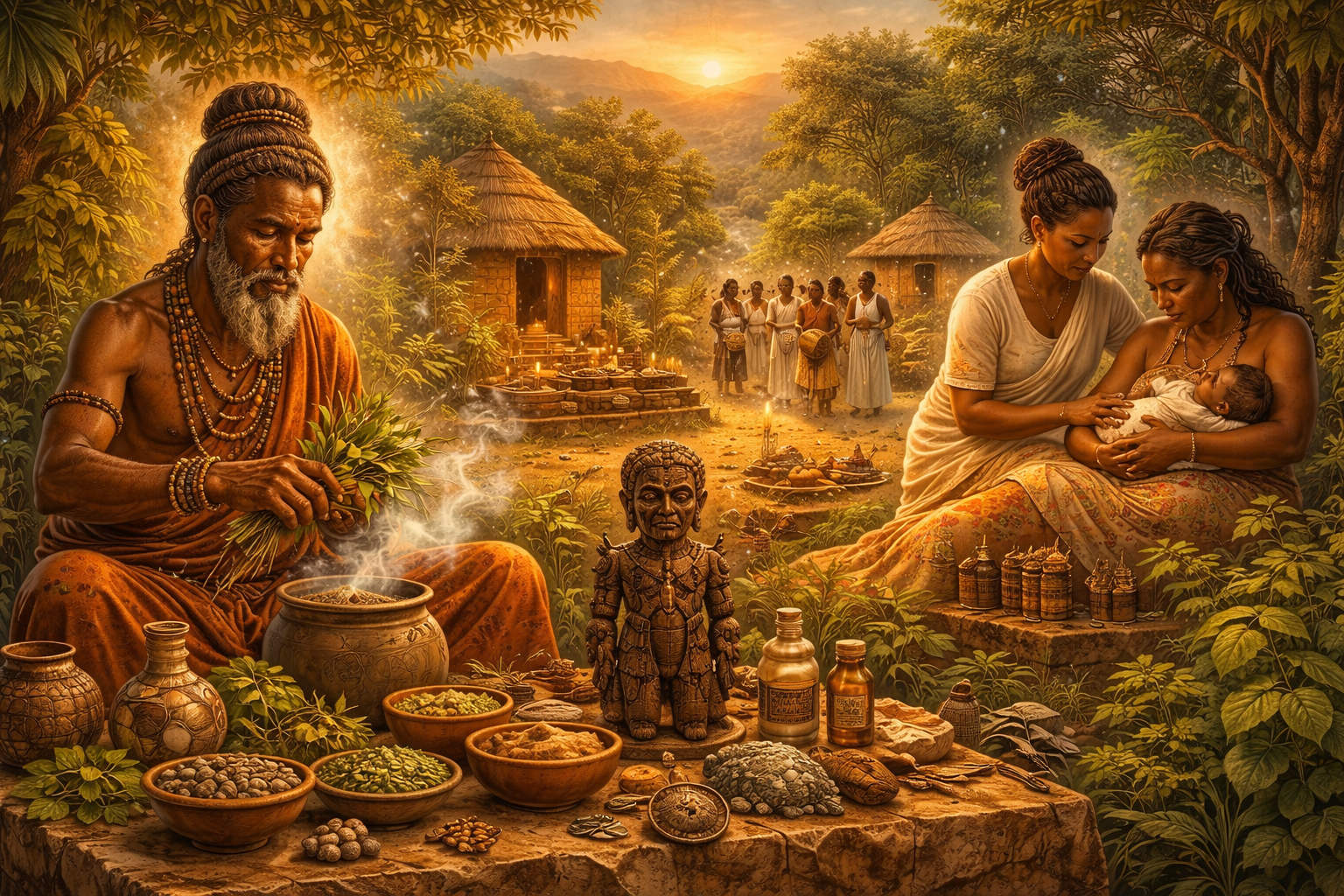
African healing traditions play an important role in comparative inquiry because they reveal sophisticated and diverse understandings of personhood, suffering, embodiment, ecology, social repair, and restoration. They cannot be reduced either to narrowly biomedical categories or to symbolic ritual alone. Many traditions join material therapeutics, plant knowledge, divination, ritual action, moral interpretation, kinship, and community care within a single healing field.
This category is especially important within the wider study of healing traditions because it connects Healing Traditions to Shamanism, Ritual & Spiritual Healing, Herbalism & Traditional Knowledge, Healing Spaces, Baths & Sacred Environments, Diet, Nourishment & Food as Medicine, Islamic Medicine, Indigenous and Oral Traditions, Religion and Ecology, Environment, Place, and Ecological Knowledge, Cultural Anthropology, and Psychology. It shows that healing is often a practical, ecological, ritual, social, and interpretive process rather than a narrowly technical response to disease.
The goal of this pillar is not to generalize “African healing” as though the continent possessed one unified therapeutic model. It is to study African healing traditions as plural, regionally grounded, historically layered, and socially consequential systems of care. A scholarly approach must attend to local languages, specific communities, ecological settings, healer roles, colonial histories, contemporary regulation, intellectual property, safety, and the reasons many people continue to seek traditional healers alongside biomedical services.
Why This Series Matters
African healing traditions matter because they preserve major civilizational understandings of illness, vitality, danger, protection, and restoration that do not fit comfortably inside modern biomedical assumptions, yet remain intellectually coherent and socially consequential. In many African settings, healing is not confined to the treatment of an isolated body. It may involve ancestors, spirits, kinship ties, ecological relations, social conflict, ritual disorder, moral rupture, or the invisible dimensions of life.
This wider frame changes what counts as diagnosis. The healer may ask not only what physical condition is present, but why this suffering has appeared in this person, household, lineage, or community at this time. Illness can become a sign requiring interpretation. Healing can therefore involve medicine, divination, ritual action, social repair, protective intervention, or reconciliation alongside bodily care.
This series also matters because African traditional medicine remains widely used across the continent. It is often sought because it is trusted, accessible, culturally intelligible, geographically available, and embedded in local systems of meaning. In many communities, traditional healers continue to operate alongside clinics, hospitals, churches, mosques, public-health campaigns, pharmacies, and household care networks.
A serious treatment of African healing traditions must therefore avoid two errors. It should not romanticize all traditional practices as inherently benign or automatically effective. It should also not dismiss them as superstition or as relics of a premodern past. African healing traditions are living, contested, adaptive, and regionally diverse systems of care whose historical and contemporary significance requires careful study.
The Civilizational Frame of African Healing Traditions
African healing traditions are best understood as a broad civilizational field rather than a single doctrine. They include plant medicine, divination, ancestral mediation, ritual protection, women’s care practices, household remedies, therapeutic performance, spirit diagnosis, sacred objects, prayer, bodily cleansing, community reconciliation, and ecological knowledge. These practices vary across regions, religions, languages, and historical settings.
What unites many of these traditions is not one fixed theory, but a recurrent understanding that life is relational. Illness may involve physical disturbance, but it may also involve social conflict, ancestral neglect, spirit affliction, ecological imbalance, moral breach, ritual danger, envy, grief, or disrupted belonging. Healing therefore often seeks to restore relation among domains of life that are not treated as separate in the first place.
This civilizational frame also includes historical pressure. African healing traditions developed before, during, and after Islamization, Christianization, slavery, colonial rule, missionary medicine, nationalist state formation, and contemporary public-health reform. They have been suppressed, criminalized, adapted, institutionalized, commercialized, and revived in different contexts.
A careful approach should therefore treat African healing as both historically deep and historically changing. The traditions are not timeless survivals. They are bodies of knowledge that have responded to social rupture, religious transformation, ecological change, legal regulation, and modern health systems.
Plurality, Region, and the Problem of Generalization
The first scholarly obligation in this field is to avoid collapsing Africa into one healing model. The continent contains many languages, ritual systems, religious histories, therapeutic substances, ecological zones, healer roles, and forms of medical authority. Some traditions emphasize divination; others emphasize ancestral calling, plant medicine, possession, protective objects, bones, baths, prayer, Qur’anic writing, Christian healing, shrine practice, or household remedies.
Even within one region, practices can vary sharply across peoples, lineages, ecological settings, and historical periods. A healer’s authority may come from apprenticeship, inherited family knowledge, initiation, spirit calling, shrine affiliation, botanical expertise, religious training, gendered household knowledge, or community recognition. These differences matter.
Generalization becomes especially dangerous when African healing is described only through broad contrasts such as “traditional versus modern,” “spiritual versus biomedical,” or “ritual versus scientific.” Such oppositions oversimplify the actual field. Many healing systems combine empirical plant knowledge, embodied diagnosis, ritual interpretation, social counseling, and moral analysis. The categories are not mutually exclusive.
For this reason, African Healing Traditions should be written as a plural category from the beginning. Its purpose is not to define one essence of African medicine, but to create a careful framework for studying many related yet distinct healing worlds.
Regional Worlds of African Healing
A full account must make regional differentiation visible. West African healing worlds often foreground divination, shrine traditions, medicinal plants, orisha and vodun-related systems, Islamic textual practices, and complex relations between visible and invisible life. Central African traditions give special importance to force, protection, material-spiritual objects, therapeutic substances, and forms such as nkisi.
East African and Horn-of-Africa settings may combine indigenous healing with Islamicate textual practices, Christian prayer, spirit possession, herbal medicine, and local ecological knowledge. Southern African traditions often emphasize diviner-healers, ancestral calling, social diagnosis, dreams, ritual consultation, and the authority of figures such as the sangoma in specific cultural contexts. North African traditions intersect deeply with Islamicate medicine, saint veneration, amuletic practice, regional herbal pharmacologies, and Mediterranean healing histories.
Regional architecture matters because it prevents the category from remaining theoretically persuasive but historically thin. A reader should not leave with the impression that “African healing” means one pattern repeated everywhere. The more accurate view is a constellation of regionally grounded healing systems shaped by ecology, religion, language, colonial history, trade, migration, household practice, and local authority.
Future articles in this series should therefore move between broad comparative themes and specific regional studies. The category should be wide enough to reveal recurring patterns but precise enough to preserve difference.
Body, Spirit, Community, and Environment
African healing traditions often work from an expanded model of personhood in which body, spirit, community, and environment remain deeply interconnected. Illness may be understood as physical affliction, but also as evidence of relational breach, spiritual vulnerability, pollution, social conflict, moral disorder, or imbalance between visible and invisible worlds.
This expanded model does not deny the body. African healing traditions frequently use plant medicines, baths, topical preparations, dietary adjustments, massage, bodily cleansing, and practical care. But the body is not always interpreted as self-contained. It may be vulnerable to lineage, place, conflict, spirit, oath, accusation, ecological disturbance, or moral relation.
Healing therefore aims not merely at symptomatic relief but at restored relation among domains of life. A patient may need medicine, but also protection. A household may need reconciliation. A lineage may need ritual acknowledgment. A person may need to understand why a recurring affliction has appeared. A community may need social repair.
This broader view is one of the major comparative contributions of African healing traditions. It shows that healing can be both material and relational, both bodily and communal, both ecological and spiritual.
Personhood and Relational Life
African healing traditions often assume that persons are formed through relation rather than isolated individuality. Kinship, ancestry, household, land, community, moral conduct, ritual status, and spiritual protection can all shape what it means to be well. The patient is not always understood as a self-enclosed individual but as a node in a wider network of visible and invisible obligations.
This relational understanding of personhood changes the meaning of suffering. A person may suffer because of bodily injury or infection, but also because of unresolved conflict, neglected obligations, social exclusion, jealousy, spirit disturbance, failed rites, or disconnection from lineage. Healing may therefore require interpretive work that extends beyond the body.
This does not mean that every illness is spiritualized or moralized in the same way. African healing systems are diverse, and practitioners may recognize ordinary bodily causes, environmental causes, spiritual causes, or several causes at once. The point is that causation is often plural.
For comparative study, this relational model is important because it challenges modern assumptions that health is primarily an individual condition. In many African healing worlds, wellbeing is also a property of relation: relation to kin, ancestors, community, land, spirit, and moral order.
Healers, Diviners, and Ritual Specialists
African healing traditions require careful attention to specialist roles. The healer may be an herbalist, diviner, ritual expert, spirit medium, birth attendant, bone-caster, prayer specialist, shrine custodian, protective-medicine preparer, or some combination of these. The boundaries between roles are not always fixed, and they vary across traditions.
In some settings, the healer is called through ancestors, dreams, illness, initiation, possession, or other forms of spiritual election. In others, training, apprenticeship, family transmission, botanical knowledge, shrine discipline, or community recognition matter more visibly. Healing authority may be inherited, acquired, revealed, initiated, or demonstrated through effectiveness.
These roles should not be reduced to “folk medicine.” They are often structured positions within coherent therapeutic and religious worlds. A healer may have diagnostic methods, ritual obligations, ethical constraints, plant knowledge, social authority, and responsibilities to both patient and community.
At the same time, scholarly care requires avoiding idealization. Healer authority can be protective, but it can also be contested. Communities may debate efficacy, ethics, cost, gender, accusation, secrecy, or abuse of power. A mature article series should study healer roles as socially powerful, historically specific, and morally complex.
Herbalism, Plant Knowledge, and Ecological Medicine
Plant medicine is one of the strongest and most visible dimensions of African healing traditions. Medicinal plants, roots, bark, resins, oils, leaves, seeds, powders, infusions, smoke, baths, and topical preparations reflect long histories of ecological observation, preparation, dosage, and intergenerational transmission. African healing is therefore not only symbolic or spiritual; it is also profoundly material and environmental.
Plant knowledge depends on place. Healing substances are tied to forests, savannas, wetlands, mountains, farms, markets, seasonal cycles, and local ecological memory. A healer or household practitioner may know when a plant should be harvested, which part should be used, how it should be prepared, and what combinations may alter its effect.
This ecological dimension is especially important under conditions of biodiversity loss, land dispossession, climate stress, deforestation, and commercialization. If plant medicine depends on living habitats, then environmental degradation also threatens healing knowledge. Conservation and cultural continuity are linked.
A responsible treatment must also include safety. Plants can have pharmacological effects, which is why preparation, dosage, identification, contraindication, contamination, and interaction with biomedical drugs matter. Respect for traditional knowledge should be joined to caution about public-health risk and evidence evaluation.
Objects, Medicines, Powders, Baths, and the Material Culture of Cure
African therapeutic worlds often include charged objects, medicinal bundles, amulets, carved figures, protective substances, washes, smoke, powders, baths, cords, vessels, animal materials, herbs, clay, metal, cloth, or other items through which protection, diagnosis, purification, or cure are enacted. These objects should not be treated merely as symbols standing outside the healing process. In many traditions, material forms participate directly in efficacy.
Cure may be worn, carried, washed with, burned, tied, buried, consumed, blown, rubbed, installed, hidden, displayed, or placed in a ritual environment. The material object mediates relation: between healer and patient, visible and invisible worlds, body and protection, danger and containment, illness and repair.
This material culture also reveals the practical intelligence of healing. Objects must be prepared, empowered, combined, handled, stored, activated, and used in the right context. They may include botanical, mineral, animal, crafted, inherited, or ritually charged components. The making of medicine is often a technical and ritual process at once.
For comparative healing studies, African material culture is especially important because it challenges the assumption that medicine must be either pharmacological or symbolic. In many traditions, the effective object is both material and relational.
Ancestry, Spirit, Possession, and Relational Restoration
Many African healing systems interpret suffering through relations with ancestors, spirits, or more-than-human forces. Healing may therefore involve reconnection, appeasement, cleansing, protection, initiation, offering, or restored alignment rather than symptom suppression alone. The aim is often to restore relation between person and lineage, patient and community, living and dead, body and spirit, or household and moral order.
Ancestral mediation is not the same everywhere. In some traditions, ancestors protect, warn, discipline, call, or guide. In others, spirit possession may be diagnostic, therapeutic, dangerous, or socially meaningful depending on context. Spirit presence may be interpreted as affliction, calling, communication, or the beginning of a healer’s vocation.
This field requires careful language. Possession and spirit communication should not be dismissed as irrational, but neither should they be generalized across all African traditions. They belong to specific ritual worlds with specific meanings, authorities, and forms of interpretation.
For this pillar, ancestry and spirit mediation are central because they show healing as relational restoration. The patient’s body is not the only site of disorder; the relationship between visible and invisible life may also require repair.
Diagnosis, Divination, and the Interpretation of Illness
Diagnosis in African healing traditions may involve observation of bodily signs, but it can also include divination, dreams, trance, ritual consultation, possession, bone casting, objects, or the reading of symbolic patterns. This does not make such systems unintelligible. It means that diagnosis is often interpretive in a wider sense.
The healer may seek to determine not only what is physically wrong, but why the disorder has taken hold in this person, household, lineage, or community. Why now? Why this recurrence? Why this pattern of misfortune? Why this relation between bodily suffering and social disturbance? These questions are central to many African healing worlds.
Divination often functions as a disciplined method for locating meaning. It can identify the social, spiritual, ancestral, or moral dimension of suffering. It can also guide the proper treatment: medicine, ritual, reconciliation, cleansing, protective action, confession, offering, or referral.
A scholarly treatment should neither treat divination as medical diagnosis in the biomedical sense nor dismiss it as arbitrary superstition. It should be studied as a culturally structured interpretive practice that belongs to wider systems of causation, responsibility, and repair.
Ritual, Protection, and Therapeutic Performance
African healing traditions frequently include ritual action as therapy: spoken formulas, offerings, cleansing, dance, chant, drumming, protective objects, sacrificial or mediatory rites, washing, smoke, touch, public declaration, secrecy, or symbolic enactment. Ritual performance is not accidental theatre. It is often part of how efficacy is understood and enacted.
Ritual can protect the vulnerable, redirect danger, identify hidden causes, restore relation, cleanse pollution, mark transition, reintegrate the sufferer, or make visible the social meaning of affliction. Performance matters because healing is often embodied, communal, sensory, and relational. Sound, movement, smell, touch, rhythm, speech, and material action may all participate in cure.
Protection is especially important. Many traditions understand healing not only as remedy after harm but as defense against danger: spiritual danger, social danger, envy, witchcraft accusation, ancestral anger, environmental exposure, or moral vulnerability. Protective medicine and ritual action may therefore be preventive as well as therapeutic.
For comparative inquiry, ritual healing shows that care may operate through the whole social body. The patient is not only treated; the community witnesses, interprets, participates, and helps restore meaning.
Women, Birth, Reproduction, and Household Care
Women’s healing knowledge and reproductive care should be structurally central to this pillar. Traditional birth attendants, household remedies, postpartum care, fertility management, infant protection, menstrual knowledge, maternal nutrition, and women’s medicinal expertise have been major parts of African healing systems. Healing traditions are not sustained only by public ritual specialists; they are also sustained by domestic, maternal, and intergenerational systems of care.
Household healing is often where continuity persists most deeply, even when public ritual authority is attacked, regulated, or transformed. Mothers, grandmothers, midwives, aunties, and elder women may preserve knowledge of plants, baths, foods, infant care, protective practices, and postpartum recovery. These forms of knowledge are sometimes less visible in formal archives, but they are central to lived healing.
Birth is especially important because it joins body, lineage, fertility, danger, household continuity, ritual protection, and social reproduction. Childbirth is not only a medical event; it is a threshold where vulnerability and community responsibility meet.
A scholarly treatment must also recognize gendered power. Women may hold important healing authority, but they may also be subject to regulation, accusation, reproductive control, or marginalization. The history of African healing requires attention to women as healers, patients, caregivers, ritual authorities, and knowledge keepers.
Affliction, Grief, Spirit Disturbance, and Social Suffering
African healing traditions can interpret emotional, mental, and social suffering through broader frames than narrowly individualized pathology. Grief, affliction, spirit disturbance, conflict, accusation, envy, failed rites, ancestral unrest, social exclusion, or moral injury may be read together rather than separately. This gives African healing traditions unusual importance for comparative work on mental and emotional suffering.
In such frameworks, distress is not always understood as only internal to the individual. It may be relational, communal, spiritual, historical, or environmental. A person’s suffering may express a broken relation, a hidden conflict, a loss that has not been ritually integrated, or a danger affecting the household or lineage.
This does not mean that African healing traditions should be romanticized as always more holistic or humane than biomedical systems. They may also generate accusations, stigma, fear, or social pressure. But they preserve important ways of thinking about suffering as more than private mental disorder.
For this pillar, affliction and social suffering should be treated as major themes because they connect healing to psychology, ritual, community, morality, and the interpretation of grief.
Community, Morality, and Social Healing
In many African traditions, healing is not only individual but communal. Illness may reflect broken relations, accusation, envy, social disorder, moral imbalance, failed obligation, or unresolved conflict. The healer’s work can therefore include reconciliation, confession, ritual repair, protective action, and restoration of social belonging.
This broader frame helps explain why African healing traditions often treat the person as socially embedded rather than self-enclosed. Community can be part of both diagnosis and cure. The patient may need medicine, but the household may also need to confront conflict, restore respect, acknowledge ancestors, or repair a damaged relation.
Social healing can be powerful because it addresses the context in which suffering is lived. At the same time, community-based healing is not automatically benign. Social pressure, accusation, secrecy, gender hierarchy, or stigma can also operate through communal forms of care. A serious account must study both the restorative and the coercive possibilities of social healing.
This theme gives the series a strong bridge to cultural anthropology, social psychology, religious studies, and ethics. It shows that healing can be a form of social interpretation and repair.
Islamicate, Christian, and Indigenous Intersections in African Healing
African healing traditions do not exist only in a “pre-Islamic,” “pre-Christian,” or “indigenous versus modern” frame. Across the Sahel, North Africa, the Swahili coast, the Horn, Ethiopia, West Africa, Central Africa, and Southern Africa, healing has long developed through intersections among indigenous systems, Islamicate devotional and textual worlds, saint traditions, Qur’anic healing, Christian prayer, church-based therapeutic care, prophetic movements, monastic practices, and biomedical institutions.
These intersections matter because they show African healing as historically adaptive and internally plural. A healer may use plants and prayer; a patient may visit a clinic and a diviner; a community may combine Christian healing services, ancestral interpretation, and herbal remedies; an Islamicate healing setting may involve Qur’anic recitation, amulets, water, breath, herbs, or saintly mediation.
Such combinations should not be described as confusion or impurity. They are part of the historical reality of African religious and medical life. Healing traditions often develop through encounter, adaptation, translation, and layered authority.
This theme also prevents the false idea that African healing is only “traditional” when it is isolated from Islam, Christianity, or modern institutions. In many settings, African healing is precisely the history of their interaction.
Regional Traditions, Figures, and Healing Forms
A comprehensive category should recognize specific regional healing forms without pretending they are universal. The Zulu sangoma is one example of a diviner-healer whose work may involve ancestral calling, diagnosis, ritual consultation, and prescription within a relational world. West-Central African nkisi traditions foreground charged material forms of protection, force, mediation, and therapeutic power. Vodun- and Vodou-related healing worlds in parts of West Africa and the African diaspora link medicine, spirit, justice, ritual, and community survival.
These examples must be handled carefully. A sangoma, an nkisi, and a Vodou healing context do not represent African healing as a whole. They belong to particular linguistic, historical, regional, and religious worlds. Their inclusion is valuable because it gives the category concrete anchors while also reminding readers that no single example can stand for the continent.
Future articles should therefore pair regional specificity with comparative analysis. A strong series might examine the sangoma in Southern African contexts, nkisi in West-Central African religious and material worlds, Vodun and Vodou in West African and diasporic settings, Islamicate healing in the Sahel, Ethiopian Christian healing, and household plant medicine in multiple regions.
The purpose is not to create a catalogue of curiosities. It is to study particular healing worlds as serious systems of meaning, authority, material practice, and social care.
Colonialism, Criminalization, and Reconfiguration
African healing traditions were deeply affected by colonial rule. Colonial administrations and missionary structures often criminalized, marginalized, or delegitimized traditional healers and ritual systems, sometimes through witchcraft laws, licensing regimes, public-order policies, mission medicine, and administrative suppression. Practices that had local authority were often reclassified as superstition, fraud, danger, or criminality.
At the same time, colonial and commercial systems often extracted plant knowledge while denying legitimacy to the healers and communities from which that knowledge came. This produced a double movement: indigenous knowledge could be used, studied, or commodified, while indigenous authorities were stigmatized or legally constrained.
Yet African healing traditions did not disappear. They adapted, coexisted, hybridized, went underground, moved into churches or Islamic contexts, entered urban markets, interacted with biomedical clinics, and reappeared in modern debates about health-system recognition and cultural heritage.
This colonial history is indispensable because it explains why African healing traditions are often simultaneously widespread, undervalued, contested, and institutionally complicated. Their modern position cannot be understood apart from histories of domination, extraction, racial hierarchy, missionary medicine, legal suppression, and resistance.
Modernity, Public Health, and Integration Debates
Contemporary African traditional medicine exists within new public-health, legal, and regulatory settings. Debates now center on recognition, training, safety, documentation, intellectual property, practitioner associations, referral pathways, collaboration with biomedical systems, pharmacological research, conservation, and the reasons patients continue to use traditional healers alongside clinics and hospitals.
In some settings, integration is discussed as a practical health-systems issue because traditional healers remain trusted, geographically accessible, and culturally intelligible. In others, collaboration remains uneven or contested. Biomedical professionals may worry about delayed referral, unsafe preparations, secrecy, dosage, or harmful practices. Traditional healers may worry about marginalization, extraction, disrespect, or loss of authority.
A serious pillar should therefore present African healing traditions as living systems negotiating modern institutions rather than static inheritances. They are part of contemporary health-seeking behavior, public-health planning, regulatory debates, and cultural politics.
Modern integration should not be treated as automatically good or bad. It requires careful attention to safety, evidence, practitioner training, community trust, intellectual property, informed consent, and the social realities that shape access to care.
Evidence, Safety, and Responsible Study
A publication-ready pillar should include clear language on evidence and safety. African healing traditions deserve serious historical, anthropological, ecological, and philosophical study, but contemporary therapeutic claims require appropriate standards of evidence, safety assessment, regulation, and public-health caution.
Medicinal plants and preparations can have biological effects, which is precisely why safety matters. Risks may include incorrect identification, toxicity, contamination, variable dosage, drug interactions, pregnancy-related risks, unsafe procedures, or delayed referral for conditions requiring urgent biomedical treatment. Ritual and social forms of healing may also raise ethical questions when they involve accusation, coercion, secrecy, stigma, or unequal power.
Responsible study does not mean dismissing traditional knowledge. It means distinguishing historical significance, internal coherence, lived trust, therapeutic meaning, pharmacological potential, and modern clinical evidence. These are related but not identical questions.
This section is essential for credibility. It allows the category to respect African healing traditions as major systems of knowledge while maintaining public-facing responsibility about health information, safety, and the limits of generalization.
Intellectual Property and Knowledge Sovereignty
African healing traditions also raise major questions of intellectual property and knowledge sovereignty. Medicinal plant knowledge, ritual expertise, and ecological practice are often collective, inherited, orally transmitted, and embedded in community authority. Modern research, pharmaceutical extraction, commercialization, and global wellness markets can separate that knowledge from the communities that preserved it.
This matters because traditional knowledge is not simply raw data waiting to be extracted. It belongs to social worlds with rules, responsibilities, secrecy, ritual authority, and ecological obligations. A plant remedy may be part of a wider system of land knowledge, preparation, dosage, ritual context, and healer responsibility. Removing it from that context can distort both meaning and ownership.
Knowledge sovereignty requires attention to consent, benefit-sharing, attribution, community authority, conservation, and legal protection. It also requires resisting the assumption that written scientific publication automatically has more legitimacy than oral transmission or practitioner knowledge.
For this series, intellectual property should be treated as a central issue rather than a modern footnote. The history of African healing includes not only care, but also extraction, erasure, and ongoing struggles over who has the right to define, use, profit from, and transmit healing knowledge.
African Diaspora Healing and Afterlives
A strong comparative pillar should treat the diaspora as structurally important rather than secondary. African-derived healing traditions in the Caribbean, Brazil, North America, and other parts of the Atlantic world preserved, transformed, and reassembled ritual, herbal, spiritual, and communal frameworks under slavery, colonialism, racial violence, forced conversion, and displacement.
Healing in the diaspora was often inseparable from survival, memory, resistance, secrecy, and reconstruction. Enslaved and displaced African communities carried plant knowledge, ritual forms, spirit relations, protective practices, midwifery, foodways, music, dance, and sacred memory into new environments where they adapted under extreme pressure.
Traditions such as Vodou, Candomblé, Santería/Lukumí, Obeah, rootwork, and other African-derived healing worlds should be treated with historical specificity rather than grouped carelessly. Each developed under different colonial, religious, linguistic, and ecological conditions. Yet all show that African healing frameworks remained conceptually rich and socially durable beyond the continent.
The diaspora demonstrates that healing can become a form of cultural survival. Under rupture, people rebuilt therapeutic worlds through memory, adaptation, ritual creativity, ecological learning, and communal care.
Core Themes in This Series
One major theme in this field is relationality: the person understood through body, kinship, ancestry, spirit, community, land, and environment. A second is plural causation: illness read through physical, social, spiritual, ecological, and moral frameworks at once. A third is ecological medicine: plant knowledge, habitat, season, biodiversity, and local therapeutic environments.
A fourth theme is ritual efficacy: healing through performance, protection, cleansing, mediation, speech, sound, and material action. A fifth is community: restoration as social as well as bodily. A sixth is historical pressure: colonial disruption, criminalization, survival, hybridization, and modern reconfiguration.
Additional themes include women’s knowledge, especially childbirth, postpartum care, household medicine, and intergenerational transmission; material culture, including objects, powders, baths, amulets, medicines, and therapeutic substances; religious plurality, including indigenous, Islamicate, Christian, and diasporic forms; knowledge sovereignty, including intellectual property, extraction, and benefit-sharing; and diasporic continuity, the survival and transformation of African healing worlds beyond the continent.
African Healing Traditions Pillar Map
The following article map is designed as a research agenda for the African Healing Traditions pillar, with emphasis on regional specificity, healer roles, plant knowledge, divination, ancestry, ritual protection, women’s care, community restoration, colonial history, public health, knowledge sovereignty, and diaspora afterlives.
African Healing Traditions is organized to move from foundational concepts and regional diversity into personhood, ecological medicine, divination, ritual protection, healer authority, women’s knowledge, Islamicate and Christian intersections, colonial history, contemporary public-health debates, intellectual property, and diaspora healing worlds. The goal is to treat African healing as a plural and historically grounded field of care: material, ritual, ecological, communal, spiritual, ethical, and adaptive.
Foundations, Scope, and Method
- What Are African Healing Traditions? (planned)
Introduces African healing traditions as plural systems of care involving body, spirit, community, ancestry, ecology, ritual, and practical medicine. - Why African Healing Traditions Still Matter (planned)
Explains the historical and contemporary significance of African healing for comparative medicine, public health, ecology, and cultural knowledge. - Body, Spirit, Community, and the African Healing Imagination (planned)
Studies the expanded model of illness and restoration that links bodily life to ancestry, society, morality, and environment. - What Makes African Healing Traditions Plural? (planned)
Examines why African healing cannot be reduced to one doctrine, region, healer role, or spiritual framework. - How to Study African Healing Without Generalizing Africa (planned)
Establishes a careful scholarly method rooted in regional specificity, oral traditions, practitioner authority, and historical context. - African Healing in Comparative Medical History (planned)
Situates African healing alongside Ayurveda, Chinese medicine, Islamic medicine, Greek and Roman medicine, and Indigenous healing traditions.
Regional Worlds and Healing Systems
- Regional Worlds of African Healing: West, East, Central, Southern, North, and the Horn (planned)
Maps major regional patterns while preserving local specificity and avoiding continental generalization. - West African Healing Worlds: Divination, Shrines, Plants, and Spirit Relation (planned)
Studies West African therapeutic systems through shrine practice, plant knowledge, divination, and invisible-world relations. - Central African Healing Worlds: Force, Protection, and Material Power (planned)
Examines Central African healing through charged objects, protective medicine, spirit-force, and material-spiritual forms. - Southern African Healing Worlds: Ancestors, Calling, and Diviner-Healers (planned)
Explores diviner-healers, ancestral calling, ritual consultation, and the social diagnosis of affliction. - East African and Horn-of-Africa Healing Worlds (planned)
Studies indigenous, Islamicate, Christian, spirit, herbal, and ecological healing intersections in eastern African contexts. - North African Healing Worlds: Islamicate Medicine, Saints, Amulets, and Herbal Knowledge (planned)
Examines North African healing through Mediterranean, Islamicate, Amazigh, saintly, textual, and plant-based traditions.
Personhood, Causation, and Diagnosis
- Personhood and Relational Life in African Healing (planned)
Studies the person as embedded in kinship, ancestry, community, land, spirit, and moral obligation. - Plural Causation and the Meaning of Illness (planned)
Explores how illness may be interpreted through physical, social, spiritual, ecological, and moral frameworks at once. - Divination, Diagnosis, and the Interpretation of Illness (planned)
Examines divination as a structured practice for locating meaning, cause, responsibility, and therapeutic direction. - Dreams, Trance, Possession, and Therapeutic Knowledge (planned)
Studies nonordinary states as diagnostic, initiatory, or therapeutic within specific African healing worlds. - Affliction, Grief, and Spirit Disturbance (planned)
Explores emotional, social, and spiritual suffering as intertwined forms of affliction and repair. - Witchcraft Accusation, Social Anxiety, and Healing Ethics (planned)
Critically examines accusation, fear, harm, justice, and ethical risks in social diagnosis and ritual interpretation.
Healers, Specialists, and Therapeutic Authority
- Healers, Diviners, and Ritual Specialists in African Traditions (planned)
Introduces the diverse roles of herbalists, diviners, mediums, birth attendants, prayer specialists, and ritual experts. - The Sangoma and the Work of Diagnosis and Cure (planned)
Studies the sangoma in Southern African contexts through ancestral calling, divination, diagnosis, and therapeutic authority. - Herbalists, Plant Specialists, and Ecological Knowledge (planned)
Examines practitioners whose authority centers on medicinal plants, preparation, dosage, and ecological memory. - Spirit Mediums, Possession Specialists, and Ritual Mediation (planned)
Explores specialists who mediate between visible and invisible worlds in therapeutic contexts. - Training, Apprenticeship, Calling, and Initiation (planned)
Studies how healers are formed through lineage, apprenticeship, dreams, illness, initiation, or community recognition. - Ethics, Trust, and Authority in African Healing (planned)
Examines responsibility, patient trust, secrecy, power, accountability, and moral conduct among healers.
Plants, Medicines, and Material Culture
- Herbal Medicine and Ecological Knowledge in African Traditions (planned)
Studies medicinal plants, roots, bark, resins, oils, powders, infusions, and ecological observation. - Medicinal Plants, Biodiversity, and Conservation (planned)
Connects plant medicine to biodiversity loss, habitat protection, climate stress, and ecological continuity. - Objects, Medicines, Powders, Baths, and the Material Culture of Cure (planned)
Explores the therapeutic use of material forms such as amulets, baths, bundles, smoke, powders, and protective substances. - Nkisi, Medicines, and the Material Forms of Protection (planned)
Studies nkisi traditions through Central African material-spiritual forms of mediation, force, protection, and cure. - Protective Objects, Amulets, and the Material Logic of Safety (planned)
Examines how protection is prepared, carried, worn, installed, washed with, or ritually activated. - Markets, Trade, and the Circulation of African Medicines (planned)
Studies how therapeutic substances move through local markets, regional trade, urban economies, and global demand.
Ritual, Ancestry, and Community Restoration
- Ancestors, Spirit Mediation, and Relational Restoration (planned)
Explores healing through ancestral relation, spirit communication, appeasement, calling, and restored alignment. - Ritual, Protection, and Therapeutic Performance in African Healing (planned)
Studies dance, chant, drumming, cleansing, offerings, spoken formulas, and embodied ritual as therapeutic action. - Community, Morality, and Social Repair in African Healing (planned)
Examines reconciliation, confession, conflict resolution, social belonging, and the communal dimensions of cure. - Healing, Music, Rhythm, and Embodied Performance (planned)
Explores the therapeutic role of rhythm, song, dance, sound, breath, and collective participation. - Ritual Cleansing, Bathing, Smoke, and Purification (planned)
Studies cleansing practices as bodily, social, spiritual, and symbolic forms of restoration. - Death, Mourning, Ancestors, and the Healing of Grief (planned)
Examines mourning, burial, ancestral relation, memorial practice, and the therapeutic management of loss.
Women, Birth, Household Care, and Life Stages
- Women, Birth, and Household Care in African Healing Worlds (planned)
Centers women’s healing knowledge, childbirth, postpartum care, fertility, infant protection, and household remedies. - Traditional Birth Attendants and Maternal Care (planned)
Studies birth attendants, maternal risk, local knowledge, referral debates, and the history of reproductive care. - Postpartum Care, Infant Protection, and Family Medicine (planned)
Examines domestic care practices surrounding recovery, infant survival, nourishment, ritual protection, and family continuity. - Women as Healers, Knowledge Keepers, and Ritual Authorities (planned)
Explores women’s medical authority through plant knowledge, midwifery, ritual practice, and intergenerational transmission. - Childhood, Vulnerability, and Protective Healing (planned)
Studies childhood illness, vulnerability, protective medicines, rites, nourishment, and family care. - Aging, Eldership, and Therapeutic Memory (planned)
Examines elder knowledge, continuity, oral transmission, aging, and the social authority of memory.
Religious Intersections and Historical Change
- Islamicate Healing in African Contexts (planned)
Studies Qur’anic healing, amulets, saint traditions, devotional practice, herbal knowledge, and Islamicate therapeutic worlds. - Christian African Healing, Prayer, and Therapeutic Community (planned)
Examines church-based healing, prayer, prophecy, deliverance, monastic care, and Christian therapeutic communities. - Indigenous, Islamicate, and Christian Intersections in African Healing (planned)
Explores layered therapeutic systems in which multiple religious and medical traditions coexist and interact. - Colonialism and the Criminalization of African Healing (planned)
Studies missionary medicine, colonial law, witchcraft legislation, suppression, extraction, and survival. - African Healing Under Urbanization and Migration (planned)
Examines how healing traditions adapt in cities, migrant communities, markets, churches, mosques, and diaspora networks. - African Healing Traditions After Colonial Rule (planned)
Studies postcolonial recognition, regulation, revival, institutionalization, and contested legitimacy.
Public Health, Knowledge Sovereignty, and Contemporary Debates
- African Traditional Medicine in Contemporary Public Health (planned)
Examines recognition, regulation, collaboration, referral pathways, training, safety, and health-system integration debates. - Traditional Healers and Biomedical Collaboration (planned)
Studies collaboration, tension, referral, trust, public-health campaigns, and patient navigation across systems. - Evidence, Safety, and Responsible Study of African Healing (planned)
Explores clinical evidence, toxicity, dosage, contamination, delayed referral, practitioner oversight, and ethical caution. - Intellectual Property, Bioprospecting, and Knowledge Sovereignty (planned)
Examines extraction, benefit-sharing, community authority, oral knowledge, consent, and legal protection. - African Medicinal Plants and Global Research (planned)
Studies pharmacological research, conservation, commercialization, and the ethical responsibilities of scientific study. - Traditional Medicine Policy in African Health Systems (planned)
Examines WHO frameworks, national policy, practitioner associations, regulation, and institutional recognition.
Diaspora, Survival, and Comparative Afterlives
- African Healing Traditions in the Diaspora (planned)
Studies how African-derived healing systems survived and transformed under slavery, colonialism, displacement, and racial violence. - Vodun, Vodou, Medicine, and Ritual Repair (planned)
Examines Vodun- and Vodou-related healing worlds through spirit relation, ritual action, justice, memory, and community care. - Candomblé, Santería/Lukumí, and African-Derived Healing Worlds (planned)
Explores African-derived religious and healing traditions in Brazil, Cuba, and the wider Atlantic world. - Rootwork, Obeah, and Black Atlantic Healing Knowledge (planned)
Studies diasporic herbal, spiritual, protective, and household healing systems in Atlantic contexts. - Healing, Resistance, and Memory in the African Diaspora (planned)
Connects healing to survival, cultural memory, resistance, secrecy, and community reconstruction. - African Healing Traditions in Comparative Perspective (planned)
Concludes the series by comparing African healing with other world healing traditions while preserving specificity and difference.
This structure keeps the category scholarly, regionally sensitive, and non-promotional. It presents African healing traditions as historically complex systems of care shaped by ecology, ritual, community, gender, material culture, colonial history, public health, and diasporic transformation.
Closing Perspective
African Healing Traditions give the Healing Traditions knowledge series one of its most important comparative frameworks. They show that healing can involve body, plant, spirit, ancestor, community, land, ritual, social repair, household care, and historical memory at once. They also show that the meaning of illness may extend beyond isolated pathology into relation, causation, protection, morality, and belonging.
The strongest reason to study this field is that it widens the meaning of care. African healing traditions ask how suffering is interpreted, how danger is identified, how plants and places become therapeutic, how communities participate in restoration, how women preserve household knowledge, how ancestors and spirits structure healing worlds, and how traditions survive under colonial and modern pressures.
As a field of study, African healing traditions are most valuable when approached with specificity. The category should not flatten Africa into a single ritual model or reduce African medicine to a set of plant remedies. It should study particular regions, languages, healer roles, histories, and communities while also tracing broader patterns of relational healing, ecological knowledge, ritual efficacy, and social restoration.
Related Reading
- Healing Traditions
- Shamanism, Ritual & Spiritual Healing
- Herbalism & Traditional Knowledge
- Healing Spaces, Baths & Sacred Environments
- Islamic Medicine
- Diet, Nourishment & Food as Medicine
- Indigenous and Oral Traditions
- Religion and Ecology
- Environment, Place, and Ecological Knowledge
- Cultural Anthropology
- Psychology
- African and Diasporic Literature & Cultural Memory
Primary Sources and Archives
- Oral and community-based sources: African healing traditions are often preserved through oral transmission, practitioner lineages, ritual practice, household knowledge, elder testimony, regional language traditions, and community memory. These sources require attention to consent, context, and knowledge sovereignty.
- Practitioner traditions: Herbalists, diviners, birth attendants, ritual specialists, spirit mediums, shrine custodians, prayer specialists, and family knowledge keepers form important living archives of therapeutic knowledge.
- Material culture: Medicines, amulets, carved figures, vessels, powders, baths, protective bundles, ritual objects, and healing spaces provide material evidence for therapeutic worlds that are not always captured in written records.
- WHO Regional Office for Africa: WHO Regional Office for Africa (n.d.) Traditional Medicine. Available at: https://www.afro.who.int/health-topics/traditional-medicine (Accessed: 4 May 2026).
- African Traditional Medicine Day: WHO Regional Office for Africa (2022) African Traditional Medicine Day 2022. Available at: https://www.afro.who.int/regional-director/speeches-messages/african-traditional-medicine-day-2022 (Accessed: 4 May 2026).
- Institutionalization tools: WHO Regional Office for Africa (2004) Tools for Institutionalizing Traditional Medicine in Health Systems in the WHO African Region. Available at: https://www.afro.who.int/sites/default/files/2017-06/tools-for-institutionalizing-traditional-medicine-in-health-systems-%28final-version%29.pdf (Accessed: 4 May 2026).
Internal Interpretive Traditions
- Herbal and ecological traditions: Medicinal plant knowledge, habitat memory, seasonal harvesting, preparation, dosage, biodiversity, and local environmental practice.
- Divination and diagnostic traditions: Bone casting, dreams, trance, consultation, symbolic interpretation, spirit communication, and the search for the meaning of illness.
- Ancestral and spirit-mediated traditions: Healing practices organized around ancestors, spirits, possession, calling, appeasement, protection, and relational restoration.
- Ritual and protective traditions: Cleansing, offerings, dance, chant, drumming, amulets, powders, baths, smoke, protective substances, and therapeutic performance.
- Women’s and household traditions: Birth attendance, postpartum care, infant protection, fertility management, household remedies, maternal knowledge, and intergenerational transmission.
- Islamicate and Christian African traditions: Qur’anic healing, amuletic practice, saint veneration, church-based healing, prayer, prophecy, deliverance, and therapeutic communities.
- Diasporic traditions: African-derived healing systems in the Caribbean, Brazil, North America, and the wider Atlantic world, including traditions shaped by slavery, displacement, resistance, and cultural reconstruction.
Modern Scholarship
- Abdullahi, A.A. Work on trends and challenges of traditional medicine in Africa.
- Mokgobi, M.G. Work on traditional African healing and cultural understandings of care.
- Mahomoodally, M.F. Work on traditional medicines in Africa and medicinal plant appraisal.
- WHO Regional Office for Africa materials on traditional medicine, policy, recognition, and institutionalization.
- Scholarship on African religions, sangoma traditions, nkisi, Vodou, divination, ritual healing, medicinal plants, and African diaspora healing worlds.
- Anthropological, historical, ethnobotanical, and public-health scholarship on healer roles, colonial suppression, integration debates, and knowledge sovereignty.
Further Reading
- Abdullahi, A.A. (2011) ‘Trends and challenges of traditional medicine in Africa’, African Journal of Traditional, Complementary and Alternative Medicines. Available at: https://pmc.ncbi.nlm.nih.gov/articles/PMC3252714/ (Accessed: 4 May 2026).
- Mahomoodally, M.F. (2013) ‘Traditional medicines in Africa: an appraisal of ten potent African medicinal plants’, Evidence-Based Complementary and Alternative Medicine. Available at: https://pmc.ncbi.nlm.nih.gov/articles/PMC3866779/ (Accessed: 4 May 2026).
- Mokgobi, M.G. (2014) ‘Understanding traditional African healing’, African Journal for Physical, Health Education, Recreation and Dance. Available at: https://pmc.ncbi.nlm.nih.gov/articles/PMC4651463/ (Accessed: 4 May 2026).
- WHO (2013) WHO Traditional Medicine Strategy 2014–2023. Available at: https://www.who.int/publications/i/item/9789241506096 (Accessed: 4 May 2026).
- WHO Regional Office for Africa (2004) Tools for Institutionalizing Traditional Medicine in Health Systems in the WHO African Region. Available at: https://www.afro.who.int/sites/default/files/2017-06/tools-for-institutionalizing-traditional-medicine-in-health-systems-%28final-version%29.pdf (Accessed: 4 May 2026).
- WHO Regional Office for Africa (n.d.) Traditional Medicine. Available at: https://www.afro.who.int/health-topics/traditional-medicine (Accessed: 4 May 2026).
References
- Abdullahi, A.A. (2011) ‘Trends and challenges of traditional medicine in Africa’, African Journal of Traditional, Complementary and Alternative Medicines. Available at: https://pmc.ncbi.nlm.nih.gov/articles/PMC3252714/ (Accessed: 4 May 2026).
- Britannica (n.d.) ‘African religions’. Available at: https://www.britannica.com/topic/African-religions (Accessed: 4 May 2026).
- Britannica (n.d.) ‘Nkisi’. Available at: https://www.britannica.com/art/nkisi (Accessed: 4 May 2026).
- Britannica (n.d.) ‘Sangoma’. Available at: https://www.britannica.com/science/sangoma (Accessed: 4 May 2026).
- Britannica (n.d.) ‘Vodou’. Available at: https://www.britannica.com/topic/Vodou (Accessed: 4 May 2026).
- Mahomoodally, M.F. (2013) ‘Traditional medicines in Africa: an appraisal of ten potent African medicinal plants’, Evidence-Based Complementary and Alternative Medicine. Available at: https://pmc.ncbi.nlm.nih.gov/articles/PMC3866779/ (Accessed: 4 May 2026).
- Mokgobi, M.G. (2014) ‘Understanding traditional African healing’, African Journal for Physical, Health Education, Recreation and Dance. Available at: https://pmc.ncbi.nlm.nih.gov/articles/PMC4651463/ (Accessed: 4 May 2026).
- WHO (2013) WHO Traditional Medicine Strategy 2014–2023. Available at: https://www.who.int/publications/i/item/9789241506096 (Accessed: 4 May 2026).
- WHO Regional Office for Africa (2004) Tools for Institutionalizing Traditional Medicine in Health Systems in the WHO African Region. Available at: https://www.afro.who.int/sites/default/files/2017-06/tools-for-institutionalizing-traditional-medicine-in-health-systems-%28final-version%29.pdf (Accessed: 4 May 2026).
- WHO Regional Office for Africa (2022) African Traditional Medicine Day 2022. Available at: https://www.afro.who.int/regional-director/speeches-messages/african-traditional-medicine-day-2022 (Accessed: 4 May 2026).
- WHO Regional Office for Africa (n.d.) Traditional Medicine. Available at: https://www.afro.who.int/health-topics/traditional-medicine (Accessed: 4 May 2026).