
Last Updated May 4, 2026
South Slavic Thought: Memory, Faith, Empire, and Identity examines the philosophical, literary, religious, ethical, political, legal, and historical traditions through which South Slavic cultures reflected on memory, faith, empire, community, justice, sacrifice, sovereignty, language, law, historical suffering, and the meaning of collective life. As a major category within the Philosophy knowledge series, this pillar studies South Slavic thought not as a narrow regional appendix to European intellectual history, but as a dense and internally plural field of reflection shaped by sacred inheritance, imperial encounter, vernacular language, epic memory, confessional plurality, legal struggle, social transformation, and the moral pressures of history.
This field includes pre-Christian Slavic inheritances, Byzantine and Orthodox Christian thought, Catholic and Adriatic intellectual worlds, Franciscan traditions, Ottoman and Islamicate South Slavic life, Bosnian Muslim intellectual traditions, oral epic culture, monastic and ecclesiastical learning, vernacular literary formation, philology, folklore collection, constitutional thought, agrarian ethics, socialist theory, Yugoslav federalism, post-socialist reflection, and contemporary debates over pluralism, democracy, human rights, memory, and coexistence. It treats the Balkans not as a passive borderland between supposedly greater civilizations, but as a generative intellectual region in which questions of power, belonging, memory, law, faith, and identity have repeatedly been forced into unusually sharp form.
The series proceeds from a central methodological claim: South Slavic thought cannot be understood only through formal philosophical treatises. In the South Slavic world, philosophical reflection has often been carried through theology, hagiography, epic poetry, chronicles, liturgical culture, legal codes, songs, philological projects, political speeches, literary criticism, novels, memoirs, constitutional debates, religious polemics, socialist theory, and postwar memory work. The field therefore requires a wider understanding of philosophy, one capable of reading communal memory, sacred language, law, song, social reform, and historical interpretation as serious modes of thought.
The goal of this pillar is not to flatten Serbian, Croatian, Bosnian, Montenegrin, Bulgarian, Macedonian, and other South Slavic formations into one homogeneous worldview. Nor is it to reduce the region to nationalism, religious conflict, empire, or war. It is to show why South Slavic thought remains philosophically indispensable precisely because it asks how communities think under conditions of imperial pressure, confessional plurality, linguistic contest, social inequality, historical trauma, political aspiration, moral endurance, and the difficult search for shared life after rupture.
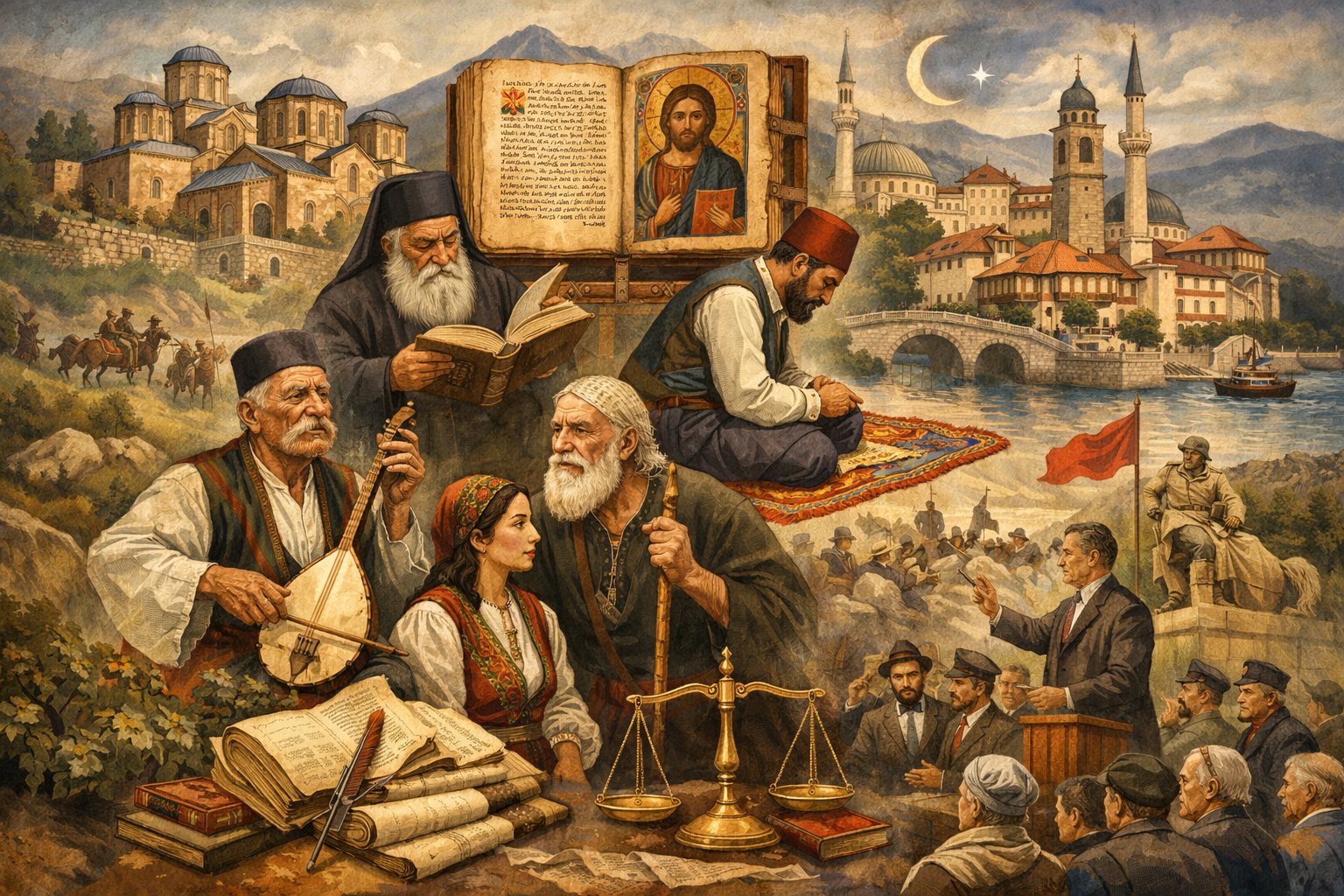
South Slavic thought is especially important to a broader philosophy architecture because it shows how thought develops in regions where faith, language, empire, law, memory, and collective identity are repeatedly entangled. In this respect, the category links not only to Russian Thought, Ottoman and Turkish Thought, and Political Philosophy and Justice, but also to Ethics and Moral Philosophy, Religion and Law, Religion and Society, Classical Literature and Civilizational Memory, and Culture, Meaning, and Symbolism. Questions of martyrdom, sovereignty, communal obligation, plural coexistence, historical suffering, vernacular memory, legal legitimacy, and post-imperial identity become sharper when South Slavic thought is treated as a major intellectual world rather than as a regional footnote.
A fullest account must also recognize that “South Slavic” is neither a single nationality nor a single confession. Serbian, Croatian, Bosnian, Montenegrin, Bulgarian, Macedonian, and other South Slavic-speaking communities developed in relation to different imperial formations, ecclesiastical structures, local environments, literary languages, legal orders, and political pressures. Orthodox, Catholic, Muslim, Jewish, socialist, liberal, nationalist, federalist, feminist, secular, and post-conflict frameworks all shaped the region’s intellectual life. The result is not one unified doctrine, but a layered field of overlapping reflections on sovereignty, memory, law, language, sacrifice, pluralism, justice, class, faith, and the moral conditions of collective life.
Sources and Intellectual Framing
A serious series in South Slavic thought must be built from several kinds of sources. The field includes written texts, but it cannot be limited to them. Chronicles, saints’ lives, liturgical texts, theological writings, legal codes, sermons, epic songs, oral traditions, vernacular literature, philological works, constitutional documents, socialist debates, memoirs, political essays, and postwar memory literature all belong to the source base. South Slavic thought often appears where formal philosophy, sacred history, communal memory, and political argument meet.
This means the series must read across disciplines. Religious studies matters because Orthodox, Catholic, Muslim, Jewish, and secular intellectual worlds all shaped the region’s categories of truth, law, authority, and identity. Literary history matters because South Slavic writing repeatedly carries philosophical reflection through poetry, epic, drama, fiction, and criticism. Political theory matters because sovereignty, federation, nationalism, self-management, socialism, democracy, and post-conflict pluralism all became central philosophical problems. Legal history matters because questions of legitimacy, custom, constitutional order, and treaty-like obligations repeatedly shaped communal self-understanding.
The field also requires careful regional specificity. It is not enough to speak of “the Balkans” as a single symbolic space. Serbia, Croatia, Bosnia and Herzegovina, Montenegro, Bulgaria, North Macedonia, Slovenia, and the wider South Slavic and Balkan worlds developed through different religious, imperial, linguistic, and political pressures. A serious pillar therefore must hold plurality and relation together: not one homogeneous doctrine, but a shared regional field of overlapping intellectual problems.
This source structure also guards against reduction. South Slavic thought should not be treated only as nationalism, only as folklore, only as Orthodox memory, only as Ottoman legacy, only as Yugoslav history, or only as postwar trauma. It is all of these and more: a broad philosophical archive of how communities think about sacred order, empire, language, law, social justice, historical suffering, plural coexistence, and collective future.
Why This Series Matters
South Slavic thought deserves serious study because it preserves one of Europe’s richest regional archives of reflection on faith, empire, historical suffering, memory, language, and identity. It reveals how philosophical and political thought may be carried not only in formal treatises, but also in sermons, chronicles, epic poetry, hagiography, legal codes, literary criticism, constitutional debate, socialist theory, and reflections on historical catastrophe. Its forms are many because its historical pressures were many.
This field is indispensable for understanding how communities reflect on sovereignty and collective life under imperial domination, frontier pressure, confessional plurality, class hierarchy, political fragmentation, and post-imperial transformation. It preserves major traditions of ethical and religious reflection on sacrifice, martyrdom, communal endurance, holiness, justice, law, and the burdens of memory. It also broadens philosophy itself by showing that thought in southeastern Europe often emerges through poetic, sacred, historical, juridical, and political forms that do not map neatly onto narrower academic definitions of philosophy.
South Slavic thought also helps correct the narrowness of standard philosophical canons. It is not adequately understood if treated only as an appendix to Russian thought, only as a branch of Byzantine theology, only as a derivative of German idealism or romantic nationalism, or only as a late arrival to modern political philosophy. It is a layered world in its own right, shaped by local sacred traditions, oral memory, imperial entanglement, linguistic contest, literary formation, legal struggle, social conflict, and political transformation.
Its importance is also comparative. South Slavic thought makes visible the philosophical significance of borderlands, contact zones, and post-imperial spaces. It asks how communities preserve meaning under pressure, how memory becomes moral obligation, how language becomes political destiny, how law becomes a site of legitimacy, and how plural societies can survive the repeated conversion of difference into hostility. These are not merely regional questions. They are enduring questions of political philosophy, ethics, religious studies, cultural memory, and historical life.
The Civilizational Frame of South Slavic Thought
The phrase “South Slavic thought” is useful because it names a field broader than formal philosophy and deeper than modern national intellectual history. It points to worlds formed across the Balkans among South Slavic-speaking communities shaped by monasteries, churches, mosques, synagogues, village cultures, courts, imperial administrations, schools, literary circles, political movements, and legal institutions. This is not a claim of uniformity. It is a claim that these worlds participate in overlapping concerns with sacred authority, communal survival, language, law, empire, historical continuity, and moral order.
At older layers, South Slavic thought includes inherited cosmological assumptions from pre-Christian Slavic life, preserved less in formal doctrine than in ritual patterns, customary worlds, symbolic geographies, household practice, and later refracted folklore. These early assumptions about sacred nature, kinship, fate, protection, fertility, death, and collective continuity remained important even after Christianization, often surviving as underlying moral and symbolic structures beneath later theological and political language.
Over time, the region’s intellectual life was shaped by Byzantine Christianity, Latin Catholic traditions, Ottoman imperial structures, Islamic legal and theological worlds, local monastic culture, oral epic memory, vernacular literacy, and modern ideologies of nation, liberation, socialism, secular reform, and cultural revival. The result was not a single philosophical canon but a layered and often conflictual field in which theology, political thought, literature, jurisprudence, and historical reflection continually overlapped.
South Slavic thought is therefore best understood as a zone of dense historical mediation. It is a field in which sacred inheritance and imperial rule, oral memory and legal order, language reform and political imagination, local belonging and transregional influence all meet. That layered condition is precisely what gives the category its philosophical force.
Plurality, Layering, and Intellectual Formation
No serious account of South Slavic thought can proceed as though these traditions belonged to one homogeneous worldview. The field is internally plural. Serbian, Croatian, Bosnian, Montenegrin, Bulgarian, Macedonian, Slovenian, and other South Slavic formations developed under different confessional, imperial, linguistic, social, and institutional pressures. Orthodox, Catholic, Muslim, Jewish, socialist, liberal, nationalist, federalist, and secular intellectual worlds all contributed to the region’s conceptual vocabulary.
Mountain and frontier societies, coastal and Adriatic settings, Ottoman provincial cities, Habsburg institutions, monasteries, seminaries, literary circles, village cultures, guild life, socialist institutions, and modern universities each produced different forms of reflection on authority, memory, justice, law, labor, language, and belonging. This layered condition is especially important for avoiding reduction. To describe South Slavic thought only as a derivative of Western philosophy misses the region’s theological, poetic, epic, legal, and historical modes of reasoning. To describe it only through nationalism misses older sacred and imperial layers, as well as pluralist, socialist, Yugoslav, and intercultural traditions.
To describe it only through religion misses literary modernity, social critique, constitutional struggle, class thought, gendered social relations, and secular moral reflection. To describe it only through modern nationhood misses the deep significance of empire, confession, local place, oral tradition, and long historical memory. The field is most fully grasped when these layers remain distinct yet connected.
The result is an intellectual archive best understood as a contact zone of sacred inheritance and historical struggle: pre-Christian symbolic residue, Byzantine and Latin Christianity, Ottoman and Islamicate governance, vernacular literary memory, national awakening, Yugoslav experiments, socialist transformation, and post-socialist reflection. South Slavic thought is therefore not merely a collection of regional texts. It is a major field through which Balkan communities made law, faith, identity, power, class, memory, and historical endurance intelligible.
Pre-Christian and Early Sacred Worlds
The earliest layers of South Slavic thought survive indirectly through ritual survivals, symbolic structures, customary life, seasonal practices, kinship patterns, and later folklore rather than through a unified philosophical corpus. Even so, they matter because they preserve assumptions about sacred nature, communal continuity, household order, ritual time, fate, fertility, protection, and the relation between human life and invisible powers.
These early sacred worlds should not be romanticized as pure origins, nor should they be dismissed as superstition. They are part of the symbolic and ethical background through which later South Slavic cultures interpreted Christian, Islamic, imperial, and modern categories. Many later traditions refracted older assumptions into new frameworks, producing layered forms of meaning rather than simple replacement.
This is especially important for understanding the persistence of household, seasonal, and place-based meanings in South Slavic cultures. Sacred order was not only a matter of official doctrine. It was also lived through family, land, village rhythms, ritual obligation, and communal memory. A full account of South Slavic thought must therefore include these older symbolic forms while remaining careful not to reconstruct them with false certainty.
Philosophically, this layer matters because it shows that South Slavic thought begins with questions of order, protection, relation, belonging, and the unseen. These questions do not disappear after Christianization or Islamization. They continue to shape the region’s ways of thinking about sacred place, communal endurance, fate, suffering, and historical continuity.
Orthodox Christian and Monastic Thought
Byzantine Christianity and local Orthodox monastic culture were foundational for much of the region’s intellectual life. Theology, hagiography, liturgy, monastic writing, canon law, ecclesiastical history, sacred kingship, iconography, repentance, and spiritual anthropology shaped how many South Slavic communities understood holiness, authority, suffering, history, and communal order.
Orthodox South Slavic thought cannot be reduced to doctrine alone. It was carried through monasteries, saints’ lives, liturgical memory, sacred images, dynastic narratives, legal codification, and the moral authority of spiritual continuity. Monasteries often functioned as archives of language, manuscript culture, identity, historical memory, and sacred legitimacy. In moments of imperial pressure or political disruption, religious institutions could become guardians of continuity as well as sites of contestation.
This tradition also shaped the philosophy of suffering and endurance. Martyr memory, repentance, sacred history, and the imitation of holiness became ways of interpreting historical catastrophe and communal trial. Such concepts could deepen moral responsibility, but they could also be mobilized politically. A serious account must therefore treat Orthodox memory both as spiritual resource and as a historically powerful language of identity.
Orthodox and monastic traditions matter within the pillar because they show how metaphysics, ethics, politics, and memory can be held together through sacred order. The question is not only what a community believes, but how it preserves itself through liturgy, text, place, discipline, authority, and historical memory.
Catholic, Franciscan, and Adriatic Intellectual Worlds
In Croatian and other Catholic-associated South Slavic contexts, Latin Christianity, Franciscan networks, Adriatic urban life, Marian devotion, scholastic inheritance, humanism, and ecclesiastical writing contributed to distinct but related traditions of ethical, theological, juridical, and political reflection. These worlds are essential, not supplementary, to the category.
The Adriatic and Catholic dimensions of South Slavic thought connect the region to Latin Christendom, Mediterranean exchange, Renaissance humanism, Habsburg political structures, urban legal culture, and transregional ecclesiastical networks. They also show that South Slavic intellectual life was not only inland, Orthodox, Ottoman, or epic. It was also maritime, urban, Latin, Catholic, Franciscan, and cosmopolitan.
Franciscan traditions are especially important in Bosnia and other areas where Catholic intellectual and pastoral life developed under complex imperial and confessional conditions. These traditions often mediated between local communities and broader ecclesiastical structures, preserving language, education, devotion, historical memory, and communal identity.
A comprehensive pillar must therefore treat Catholic South Slavic thought as one of the region’s major intellectual worlds. It brings into view moral theology, social care, education, historical writing, confessional coexistence, legal culture, and the relationship between Adriatic exchange and Balkan interior life.
Ottoman and Islamicate South Slavic Thought
South Slavic intellectual life under Ottoman rule cannot be reduced to domination alone. It also includes Muslim scholarly traditions, legal thought, theological reflection, Sufi influence, vernacular ethics, urban culture, administrative mediation, and forms of coexistence shaped by imperial order. Ottoman rule was a political condition, but it was also a civilizational and intellectual environment within which South Slavic Muslim communities developed rich forms of thought.
This matters because Islamicate South Slavic worlds belong integrally to the category. They are not merely external influences upon Christian South Slavic memory. They are sources of thought in their own right, especially in Bosnia and other contexts where Islamic learning, law, poetry, Sufi practice, and social ethics contributed to the region’s moral and intellectual life.
Ottoman-era South Slavic thought also raises difficult questions about coexistence, hierarchy, conversion, legal pluralism, local mediation, minority vulnerability, and imperial belonging. These questions should not be simplified into either nostalgia for plural coexistence or a one-dimensional narrative of oppression. The intellectual history is more complex: it includes domination and exchange, asymmetry and adaptation, legal order and local identity, religious difference and shared space.
Philosophically, this world matters because it forces a more serious account of pluralism. South Slavic thought develops in a region where communities often lived with difference not as abstract tolerance but as daily, legal, confessional, linguistic, and political reality. That makes Ottoman and Islamicate layers indispensable to the category.
Bosnian Muslim Intellectual Traditions
Bosnian Muslim intellectual traditions deserve focused attention because they represent one of the most important South Slavic Muslim worlds. They developed through Islamic learning, Ottoman institutions, local social structures, Sufi practice, vernacular literature, legal thought, theological reflection, and later modern debates over identity, reform, nationalism, secularization, and European belonging.
This tradition matters because it complicates any attempt to read South Slavic thought only through Christian national histories. Bosnian Muslim intellectual life is South Slavic, Balkan, Islamic, Ottoman-inherited, European, and modern at once. It forces the category to think across multiple frames rather than choosing one civilizational label.
Bosnian Muslim thought also raises major philosophical questions about identity and continuity. What does it mean to belong to a South Slavic linguistic world, an Islamic religious tradition, an Ottoman imperial inheritance, a European political geography, and a modern national or post-national framework? How are law, faith, memory, and identity negotiated when inherited categories are repeatedly reclassified by empires, nation-states, and ideological systems?
These questions make Bosnian Muslim intellectual traditions central to the pillar. They are not merely one community’s history; they are one of the clearest places where South Slavic thought confronts plurality, translation, coexistence, and the difficulty of historical belonging.
Epic Memory as Moral and Political Thought
Oral epic is not merely folklore external to philosophy. In South Slavic culture it often functions as a moral and political vocabulary through which questions of justice, sacrifice, martyrdom, sovereignty, kinship duty, betrayal, communal destiny, honor, and historical suffering are thought. Epic memory is one of the region’s major intellectual forms.
This does not mean epic should be treated uncritically. Epic memory can preserve courage, dignity, and communal endurance, but it can also intensify grievance, simplify history, or become available for nationalist mythmaking. Its philosophical importance lies precisely in this double power. It carries moral imagination, but it also requires interpretation, criticism, and historical care.
The South Slavic epic tradition shows that philosophy may be sung, narrated, and remembered rather than only argued propositionally. It forms moral categories through character, event, repetition, and communal performance. Through epic, communities ask what must be remembered, what counts as loyalty, what sacrifice means, what betrayal does, and how defeat can become historical identity.
A serious pillar should therefore treat epic memory as both intellectual inheritance and moral danger. It is a living archive of values, but also a field in which values can be hardened, politicized, or contested.
Language, Script, and the Philosophy of Identity
No serious treatment of South Slavic thought can ignore the role of language and script. In this region, language has often functioned not only as a medium of expression but as an object of political, ethical, and philosophical reflection. Script, dialect, translation, liturgical language, vernacular standardization, and the relation between oral tradition and literary canon all became sites of intense intellectual struggle.
Language in the South Slavic world carries questions of legitimacy, peoplehood, education, church authority, national formation, regional identity, and political future. Philology was therefore never merely technical. It shaped the conditions under which communities could imagine themselves as historical peoples, literary cultures, political subjects, and bearers of memory.
Script choice also matters. Cyrillic, Latin, Arabic-derived, Glagolitic, and other textual inheritances cannot be reduced to typography. They often carry confessional, imperial, cultural, and political meanings. The philosophy of identity in the South Slavic world is therefore inseparable from the history of writing systems, literacy, translation, and standardization.
This makes language one of the pillar’s core philosophical themes. To ask what a language is, who owns it, how it should be standardized, what script should carry it, and what past it remembers is already to ask about collective being.
Legal Codes, Normative Order, and Constitutional Imagination
A strongest-sense account must include the traditions of law, legitimacy, and normative order through which South Slavic communities imagined justice and governance. Ecclesiastical law, imperial legal systems, customary law, medieval legal codes, constitutional debates, federal projects, socialist institutional thought, and democratic transition all belong to the region’s intellectual history.
Law in this context is not merely administration. It is a philosophical language of order, authority, justice, obligation, and communal legitimacy. Legal codes and constitutional projects reveal how communities attempted to define the relation between sacred authority and political power, custom and state, empire and local autonomy, nation and federation, class and law, pluralism and sovereignty.
This legal dimension is especially important because South Slavic history repeatedly placed communities under overlapping legal orders: ecclesiastical, imperial, customary, Ottoman, Habsburg, national, socialist, federal, and international. The experience of legal plurality forced reflection on legitimacy, belonging, rights, and authority in ways that are philosophically significant.
Constitutional imagination also belongs to the pillar because modern South Slavic political life repeatedly attempted to solve deep historical conflicts through institutional design: national independence, federalism, Yugoslavism, socialism, self-management, democracy, and postwar reconstruction. These are not only political arrangements. They are theories of collective life.
Vernacular Literature, Philology, and Cultural Self-Consciousness
The codification of literary languages, the collection of oral traditions, the translation of sacred and literary texts, and the formation of national canons all became forms of self-reflection. Vernacular literature and philology in the South Slavic world are not merely aesthetic or technical projects. They are tied to questions of peoplehood, continuity, legitimacy, education, and the relation between language and collective being.
Vernacular literary formation is especially important because it brings elite and popular memory into relation. Oral tradition, folk song, epic poetry, religious language, and modern literature all contribute to the formation of South Slavic cultural self-consciousness. Writers, philologists, translators, and collectors did not simply record identity; they helped construct the frameworks through which identity became legible.
This raises a philosophical problem: when does preservation become invention? Folklore collection, philology, and national literary formation often claim to recover the people’s voice, yet they also select, edit, standardize, classify, and interpret. South Slavic thought must therefore examine cultural continuity as both inheritance and construction.
Literature in this pillar is not secondary illustration. It is one of the major ways South Slavic communities thought about memory, justice, suffering, religion, modernization, class, gender, nation, and coexistence. Poetry, song, story, and criticism belong at the center of the intellectual architecture.
Religion, Empire, and Plural Coexistence
South Slavic thought develops in one of Europe’s most historically layered zones of religious and imperial encounter. Orthodox, Catholic, Muslim, Jewish, and secular communities lived across overlapping spaces shaped by Byzantine, Ottoman, Habsburg, Venetian, and local political orders. This means that reflection on faith is rarely separable from questions of law, coercion, coexistence, conversion, hierarchy, minority vulnerability, and survival.
The region’s intellectual history therefore includes not only theology or confessional polemic, but also reflection on how communities preserve themselves under asymmetrical power, how they negotiate difference, and how sacred legitimacy intersects with worldly sovereignty. In some cases this produces pluralist thought and cultural mediation; in others, martyr memory, exclusivist identity, or sharpened antagonism.
Empire in this field is never merely administrative. It is existential and symbolic. South Slavic cultures repeatedly confront how to think under conditions in which authority may be distant, unequal, confessionalized, or violently unstable. This gives the category unusual depth in questions of pluralism, legitimacy, and the political uses of history.
A mature pillar must therefore resist both romantic pluralism and fatalistic conflict narratives. Coexistence was real, but it was not always equal. Conflict was real, but it was not inevitable in every relation. South Slavic thought is strongest when it studies the conditions under which plural life is sustained, distorted, remembered, or destroyed.
Ethics, Politics, and the Problem of Collective Identity
The ethical and political dimensions of South Slavic thought are inseparable from questions of collective identity. What is owed to kin, confession, village, language-community, class, federation, nation, neighbor, or humanity? How should sacrifice be remembered? When does suffering become martyrdom, and when does it become ideology? What makes authority legitimate under occupation, fragmentation, socialism, or postwar reconstruction? These questions recur across sacred writing, oral epic, political speech, literature, legal argument, and cultural criticism.
South Slavic thought is also marked by tension between communal loyalty and broader moral obligation. Epic and historical memory may intensify identities of duty, revenge, and sacred inheritance, while religious traditions may call for humility, repentance, mercy, and transcendence. Modern political thought introduces further tensions among nationalism, Yugoslavism, socialism, federalism, liberalism, feminism, plural coexistence, and post-conflict ethics. The field is therefore not a stable doctrine but an arena of unresolved moral struggle.
Identity here is never merely abstract. It is historical, linguistic, religious, territorial, social, and affective. It is tied to the dead, to sacred places, to remembered wounds, to songs and texts, to institutions, to labor and class, and to the structures that preserve or transform communal life.
This makes South Slavic thought indispensable for understanding how communities think under pressure rather than only in abstraction. It shows that collective identity can be ethical, poetic, legal, sacred, political, and historical at once.
Peasantry, Labor, Class, and Social Philosophy
South Slavic thought is not only elite, ecclesiastical, or national. It includes reflection on village life, agrarian order, class inequality, labor, modernization, social reform, and the place of the peasantry in political life. The peasant household, village community, land relation, seasonal labor, patriarchal authority, inheritance, migration, and rural poverty all shaped the region’s moral and political imagination.
This matters because many South Slavic political projects—national revival, agrarian reform, socialism, federalism, and modernization—depended on competing images of the people. The peasantry could be romanticized as the authentic bearer of national life, treated as a class to be mobilized, described as backward and in need of reform, or remembered as the social foundation of communal endurance. Each image carries philosophical assumptions about history, labor, dignity, authority, and social change.
Class and labor become especially important in modern South Slavic thought. Industrialization, migration, urbanization, socialism, and self-management all transformed older village worlds while generating new forms of social critique. The question of labor was never merely economic. It concerned freedom, dignity, participation, equality, and the structure of collective life.
A comprehensive pillar should therefore include agrarian ethics and class thought as core intellectual materials. Without them, South Slavic thought risks being reduced to religion, epic, and nation, leaving out the lived social worlds through which ordinary people experienced power, work, reform, and historical change.
Modern National, Yugoslav, and Political Thought
Nineteenth- and twentieth-century South Slavic thought includes major reflection on liberation, national unity, statehood, imperial domination, Yugoslavism, federalism, social reform, class struggle, and political violence. National awakening, supra-national South Slavic projects, and later socialist and post-socialist reconfigurations all belong to this history.
Modern national thought developed through language reform, literary canon formation, historical writing, church struggles, anti-imperial movements, education, and political organization. It was not simply a political doctrine; it was a cultural and philosophical effort to define peoplehood under imperial conditions. Yet nationalism also carried dangers: mythic memory, exclusion, rivalry, and the conversion of historical suffering into political absolutism.
Yugoslavism represents another major layer. It attempted to imagine shared South Slavic identity beyond separate national projects, but it also had to confront uneven histories, religious difference, linguistic politics, regional inequality, and competing memories. Federalism became more than institutional design; it became an attempt to solve a philosophical problem of unity and plurality.
Modern South Slavic political thought therefore moves between nation and federation, liberation and domination, reform and violence, unity and difference. Its central question remains difficult: how can historical communities live together without erasing themselves or weaponizing memory against one another?
Marxism, Socialism, and Self-Management
A fully comprehensive account must include socialist and Marxist traditions, labor thought, critiques of capitalism and agrarian backwardness, and Yugoslav experiments in self-management and federal political imagination. These were not merely political programs but major modes of philosophical reflection on freedom, labor, equality, collective organization, social ownership, and the relation between person and institution.
South Slavic socialism developed in dialogue with Marxism, anti-fascist struggle, industrialization, peasant transformation, national questions, and the problem of building a multiethnic federation. Yugoslav self-management is especially important because it attempted to rethink socialist organization through worker participation, decentralization, and a distinctive institutional model. Whether judged as successful, contradictory, or ultimately unstable, it belongs to the intellectual history of democracy, labor, socialism, and collective agency.
This socialist layer matters because it challenges a purely nationalist or confessional reading of the region. Class, labor, production, social equality, anti-fascism, modernization, and institutional experimentation were central to twentieth-century South Slavic thought. They shaped education, culture, political language, social policy, and moral imagination.
The post-socialist period also requires reflection on what happens after socialist institutions collapse. Questions of privatization, memory, inequality, nationalism, democracy, and social dislocation all belong to the afterlife of socialist thought in the region.
Gender, Family, and Social Reproduction
The family, household, marriage, patriarchy, motherhood, inheritance, kinship, and the gendered burdens of communal continuity form an important dimension of South Slavic ethical and political thought. These topics should not be treated as secondary to religion, nation, law, or political ideology. They are among the main sites where communities reproduce themselves, transmit memory, distribute authority, and define moral obligation.
Gender appears in several South Slavic intellectual worlds: epic representations of honor and kinship, religious teachings on family and virtue, village household structures, legal codes, nationalist images of motherhood and sacrifice, socialist debates over women’s labor and emancipation, and post-socialist reconsiderations of family, violence, migration, care, and public life. Each layer raises philosophical questions about personhood, authority, dependency, freedom, dignity, and social reproduction.
A serious pillar should therefore avoid treating gender as a modern add-on. It is structurally present in the region’s moral imagination. Household order, inheritance, marriage, maternal sacrifice, women’s labor, education, and the burden of maintaining cultural continuity all shaped South Slavic thought about community and identity.
This topic also allows the series to ask difficult questions: how have women carried memory while being excluded from authority? How have family and nation been linked? How did socialism transform gender roles, and where did it fail? How do post-conflict and post-socialist conditions reshape the ethics of care, labor, and communal repair?
Post-Yugoslav and Post-Socialist Reflection
Late modern South Slavic thought includes renewed reflection on nationalism after empire, memory after federation, democracy after authoritarianism, pluralism after violence, and the ethical problem of rebuilding shared life after rupture. This is one of the central philosophical horizons of the modern Balkan world.
Post-Yugoslav reflection cannot be reduced to war memory alone, but war, displacement, genocide, ethnic cleansing, transitional justice, and competing victim narratives are unavoidable parts of the intellectual landscape. The philosophical question is how truth, responsibility, memory, law, and coexistence can be rebuilt after catastrophic breakdown. This requires more than moral denunciation. It requires serious reflection on institutions, language, education, public memory, historical interpretation, and shared civic life.
Post-socialist reflection adds another layer. The collapse of socialist institutions, the rise of market transition, privatization, democratic restructuring, corruption, emigration, and European integration all reshaped the meaning of freedom, justice, equality, and citizenship. South Slavic thought after socialism therefore asks what kind of public life remains possible after ideological disillusionment and social fragmentation.
This field remains contemporary because the past is still active. Memory, monuments, textbooks, religious institutions, legal judgments, political rhetoric, and cultural production all continue to shape the moral imagination of the region. The task of thought is not to erase memory, but to prevent memory from becoming fatalistic, exclusionary, or morally closed.
Major Lines of Inquiry
One major line of inquiry is metaphysics, cosmology, and sacred order. South Slavic thought includes reflection on divine reality, sacred hierarchy, providence, evil, suffering, fate, and the relation between visible and invisible orders, whether expressed through theology, cosmological residue, or poetic-symbolic reflection.
A second line is faith, sanctity, and spiritual authority. The region’s traditions repeatedly ask how spiritual authority is recognized, embodied, transmitted, disciplined, and contested in saints, monasteries, bishops, mystics, clerics, scholars, and communities of devotion.
A third line is empire, domination, and collective survival. Byzantine, Ottoman, Venetian, Habsburg, Yugoslav, socialist, and modern state formations all shaped South Slavic reflection on loyalty, subjection, reform, mediation, resistance, coexistence, and the ethics of survival under asymmetrical power.
A fourth line is memory, suffering, and philosophy of history. Epic tradition, religious commemoration, chronicles, memorial practices, and modern literature preserve modes of thinking about defeat, martyrdom, captivity, loss, collective destiny, and the historical burdens communities carry forward.
A fifth line is homeland, sovereignty, and collective belonging. South Slavic intellectual traditions repeatedly confront the meanings of homeland, sacred territory, political self-rule, community, and historical destiny under conditions of fragmentation and imperial contest.
A sixth line is language, script, and philosophy of identity. Vernacular literary formation, script choice, philology, translation, and language standardization all became sites of reflection on peoplehood, legitimacy, memory, and political future.
A seventh line is religion, coexistence, and pluralism. The Balkan world is a space in which Orthodox, Catholic, Muslim, Jewish, and secular populations lived in tension, exchange, overlap, and contestation. South Slavic thought therefore includes major reflection on plural coexistence, conversion, intercommunal ethics, and the moral meaning of difference.
An eighth line is law, legitimacy, and political order. From ecclesiastical canons and legal codes to constitutional projects, federalism, socialist governance, and democratic transition, South Slavic thought repeatedly confronts the problem of just order under unequal and changing conditions.
A ninth line is class, peasantry, labor, and social philosophy. South Slavic thought includes reflection on village life, agrarian order, class inequality, modernization, social reform, and the place of labor in political life.
A tenth line is gender, family, and the ethics of social reproduction. The family, household, marriage, patriarchy, motherhood, inheritance, and gendered burdens of communal continuity form an important dimension of South Slavic ethical and political thought.
Finally, the field returns constantly to modernity, secularization, ideological transformation, and post-conflict life. Nationalism, romanticism, liberalism, socialism, secularism, religious revival, democracy, human rights, and cultural criticism all reshaped the terms in which South Slavic communities understood selfhood, history, and political purpose.
Expanded Article Architecture
The following structure gathers the South Slavic Thought pillar into a long-range article architecture. It preserves the planned article list from the source draft while adding short descriptions under every planned article.
Foundations of South Slavic Thought
- What Is South Slavic Thought? (planned)
Introduces South Slavic thought as a layered intellectual field shaped by memory, faith, empire, language, law, collective identity, and the moral pressures of history. - Pre-Christian Sacred Inheritances and the Moral World of Early South Slavic Life (planned)
Examines early sacred, ritual, household, seasonal, and symbolic inheritances that shaped later South Slavic understandings of order, protection, fate, and communal continuity. - Metaphysics, Providence, and Sacred Order in the South Slavic World (planned)
Studies divine order, providence, fate, suffering, visible and invisible worlds, and the metaphysical imagination across South Slavic religious and poetic traditions.
Christian, Catholic, Ottoman, and Islamicate Worlds
- Byzantine Christianity and the Formation of Orthodox South Slavic Thought (planned)
Examines Byzantine inheritance, Orthodoxy, liturgy, hagiography, monastic life, sacred kingship, canon law, and spiritual anthropology in South Slavic intellectual formation. - Catholic South Slavic Intellectual Worlds, Franciscan Thought, and Adriatic Exchange (planned)
Studies Catholic, Franciscan, Latin, Adriatic, humanist, and ecclesiastical traditions as major sources of South Slavic ethical, theological, literary, and legal reflection. - Ottoman Rule, Islamicate Influence, and the Transformation of South Slavic Thought (planned)
Examines Ottoman imperial order, legal pluralism, Islamicate learning, urban culture, conversion, coexistence, hierarchy, and local adaptation in South Slavic intellectual life. - Bosnian Muslim Intellectual Traditions Between Faith, Empire, and Modernity (planned)
Studies Bosnian Muslim thought through Islamic learning, Ottoman inheritance, vernacular ethics, Sufi influence, modern identity, secularization, and European belonging. - Monasteries, Saints, and Sacred Kingship in South Slavic Historical Consciousness (planned)
Examines monasteries, saints, dynastic memory, sacred rulers, spiritual authority, manuscript culture, and religious institutions as guardians of historical continuity.
Epic Memory, Homeland, Language, and Literature
- Epic Memory as Moral and Political Thought in the Balkans (planned)
Studies oral epic as a philosophical form that carries ideas of justice, sacrifice, martyrdom, kinship duty, betrayal, sovereignty, and historical suffering. - Homeland, Frontier, and Empire in South Slavic Imagination (planned)
Examines homeland and frontier as moral, political, and symbolic categories shaped by empire, migration, defense, memory, and belonging. - Language, Script, and the Philosophy of South Slavic Identity (planned)
Studies language, script, dialect, translation, and standardization as philosophical and political questions about peoplehood, legitimacy, memory, and future. - Philology, Folklore Collection, and the Invention of Cultural Continuity (planned)
Examines philology and folklore collection as practices that preserved, selected, shaped, and sometimes invented cultural continuity. - Vernacular Literature and the Thought of Collective Life (planned)
Studies vernacular literature as a medium for reflecting on community, history, faith, class, gender, identity, suffering, and political obligation. - Martyrdom, Sacrifice, and Historical Suffering in South Slavic Thought (planned)
Examines martyrdom and sacrifice as moral and political categories that can preserve memory, deepen responsibility, or become ideologically dangerous.
Pluralism, Law, and National Intellectual Formations
- Orthodoxy, Catholicism, Islam, and the Problem of Plural Coexistence (planned)
Studies religious plurality, coexistence, conversion, conflict, minority vulnerability, shared space, and the moral difficulty of living with difference. - Law, Legitimacy, and Constitutional Thought in South Slavic History (planned)
Examines ecclesiastical law, imperial law, customary law, constitutional projects, federalism, socialist legality, and democratic transition as theories of order. - Croatian National Thought and the Ethics of Cultural Belonging (planned)
Studies Croatian intellectual traditions through language, Catholic and Adriatic culture, historical rights, national revival, literature, and the ethics of belonging. - Serbian Historical Memory, Sacred Narrative, and Political Identity (planned)
Examines Serbian historical memory through Orthodoxy, epic tradition, sacred narrative, martyrdom, statehood, and the political uses of the past. - Bulgarian Cultural Awakening and the Politics of Language and Church (planned)
Studies Bulgarian revival thought through language, church independence, education, vernacular culture, anti-imperial aspiration, and cultural self-definition. - Macedonian Identity, Language, and Historical Interpretation (planned)
Examines Macedonian identity through language, historical interpretation, regional memory, state formation, cultural recognition, and contested narratives. - Montenegrin Memory, Warrior Ethics, and the Moral Imagination of Survival (planned)
Studies Montenegrin memory through mountain society, warrior ethics, survival, honor, oral tradition, sovereignty, and the moral imagination of endurance.
Social Philosophy, Labor, Nationalism, and Yugoslavism
- Peasantry, Agrarian Ethics, and the Moral World of Village Life (planned)
Examines village life, land, kinship, household authority, inheritance, seasonal labor, rural dignity, and agrarian moral imagination. - Class, Labor, and Social Critique in South Slavic Thought (planned)
Studies class, labor, inequality, industrialization, migration, social reform, and the moral meaning of work in South Slavic intellectual life. - Nationalism, Liberation, and the Burden of Collective Destiny (planned)
Examines nationalism as a language of liberation, memory, sovereignty, sacrifice, exclusion, and historical destiny. - Yugoslavism, Federalism, and the Problem of Shared South Slavic Identity (planned)
Studies Yugoslavism and federalism as attempts to imagine shared South Slavic political life without erasing internal plurality. - Marxism, Socialism, and Self-Management in South Slavic Intellectual Life (planned)
Examines Marxism, socialism, worker self-management, social ownership, federalism, modernization, labor, and the institutional imagination of Yugoslav socialism. - Religion, Secularization, and the Critique of Authority in the Balkans (planned)
Studies secularization, anti-clericalism, religious revival, socialist critique, confessional authority, and the changing relation between faith and public life.
Gender, Literature, Post-Yugoslav Memory, and Contemporary Reflection
- Gender, Family, and the Ethics of Social Reproduction in South Slavic Thought (planned)
Examines family, marriage, patriarchy, motherhood, women’s labor, inheritance, socialist emancipation, and the gendered burdens of communal continuity. - Poetry, Song, and Literature as Philosophy in South Slavic Culture (planned)
Studies poetry, song, drama, fiction, and criticism as philosophical forms that carry memory, suffering, identity, justice, and moral imagination. - Post-Yugoslav Memory, Pluralism, and the Ethics of Coexistence (planned)
Examines post-Yugoslav memory through truth, responsibility, nationalism, coexistence, public history, trauma, and the challenge of rebuilding shared life. - Democracy, Human Rights, and Post-Socialist Reflection in Southeastern Europe (planned)
Studies democracy, human rights, market transition, privatization, civil society, legal reform, emigration, corruption, and post-socialist political thought. - Why South Slavic Thought Still Matters (planned)
Concludes the series by explaining why South Slavic thought remains vital for philosophy, religious studies, political theory, cultural memory, legal thought, and comparative intellectual history.
Closing Perspective
South Slavic thought remains indispensable because it shows how philosophy becomes historical, communal, sacred, literary, juridical, and political under conditions of pressure. It asks how communities remember, how they suffer, how they preserve language, how they justify law, how they negotiate faith and pluralism, how they imagine homeland, how they organize labor, how they endure empire, and how they rebuild moral life after rupture.
This does not mean South Slavic thought should be romanticized. Its power lies in its difficulty. The region’s intellectual life contains sacred beauty and political violence, plural coexistence and exclusion, heroic memory and mythic distortion, socialist aspiration and institutional failure, religious endurance and confessional hardening, cultural preservation and historical invention. A serious pillar must hold those tensions together without flattening them into either celebration or condemnation.
The strongest reason to study South Slavic thought is that its questions remain alive. How can communities remember suffering without becoming trapped by it? How can language sustain identity without becoming a weapon? How can plural societies preserve difference without surrendering common life? How can law become legitimate after empire, socialism, or war? How can collective belonging be morally serious without becoming exclusionary? These are not only South Slavic questions. They are enduring questions of human history, and South Slavic thought is one of the important traditions through which they can be studied with depth.
Related Reading
- Russian Thought — for comparative reflection on literature, conscience, suffering, religious philosophy, socialism, revolution, memory, and moral witness.
- Ottoman and Turkish Thought — for imperial order, Islamicate governance, reform, pluralism, law, modernization, and post-imperial transformation.
- Political Philosophy and Justice — for sovereignty, law, legitimacy, authority, democracy, equality, coercion, and collective life.
- Ethics and Moral Philosophy — for sacrifice, responsibility, duty, virtue, dignity, moral memory, and the good life.
- Religion and Law — for sacred authority, legal pluralism, religious obligation, legitimacy, and the relation between faith and public order.
- Religion and Society — for plural coexistence, confessional identity, religious authority, secularization, and social life.
- Culture, Meaning, and Symbolism — for epic memory, folklore, symbol, ritual, language, and collective meaning.
- Classical Literature and Civilizational Memory — for epic, memory, cultural inheritance, literary formation, and the long life of historical imagination.
Further Reading
- Banac, I. (1984) The National Question in Yugoslavia: Origins, History, Politics. Ithaca, NY: Cornell University Press.
- Beissinger, M.H. (ed.) (2022) The Oxford Handbook of Slavic and East European Folklore. Oxford: Oxford University Press.
- Čolović, I. (2002) The Politics of Symbol in Serbia. London: Hurst.
- Fine, J.V.A. Jr. (2006) When Ethnicity Did Not Matter in the Balkans. Ann Arbor, MI: University of Michigan Press.
- Friedman, V.A. and Joseph, B.D. (2006) The Balkan Languages. Cambridge: Cambridge University Press.
- Lord, A.B. (1960) The Singer of Tales. Cambridge, MA: Harvard University Press.
- Ramet, S.P. (2006) The Three Yugoslavias: State-Building and Legitimation, 1918–2005. Bloomington, IN: Indiana University Press.
- Todorova, M. (2009) Imagining the Balkans. Updated edn. Oxford: Oxford University Press.
References
- Banac, I. (1984) The National Question in Yugoslavia: Origins, History, Politics. Ithaca, NY: Cornell University Press.
- Beissinger, M.H. (ed.) (2022) The Oxford Handbook of Slavic and East European Folklore. Oxford: Oxford University Press.
- Čolović, I. (2002) The Politics of Symbol in Serbia. London: Hurst.
- Fine, J.V.A. Jr. (2006) When Ethnicity Did Not Matter in the Balkans. Ann Arbor, MI: University of Michigan Press.
- Friedman, V.A. and Joseph, B.D. (2006) The Balkan Languages. Cambridge: Cambridge University Press.
- Lord, A.B. (1960) The Singer of Tales. Cambridge, MA: Harvard University Press.
- Ramet, S.P. (2006) The Three Yugoslavias: State-Building and Legitimation, 1918–2005. Bloomington, IN: Indiana University Press.
- Todorova, M. (2009) Imagining the Balkans. Updated edn. Oxford: Oxford University Press.