
Last Updated May 6, 2026
The Gesar tradition matters not only because it is one of the great heroic epics associated with the Tibetan cultural world, but because it reveals with unusual clarity that the mythic archive of China is plural, multiethnic, and unevenly preserved across oral, ritual, visual, and textual forms. It belongs to a civilizational field that cannot be reduced to the classical Han textual archive alone. In Gesar, heroic memory, sacred imagination, bardic performance, communal identity, regional transmission, ritual practice, and artistic afterlife converge in a narrative world whose scale exceeds any simple boundary between literature, folklore, religion, and living heritage.
This is also one of the strongest examples in the Chinese mythic field of a tradition whose authority does not depend on a single fixed canonical text. The epic survives through singers, storytellers, ritual specialists, local lineages of recitation, printed compilations, manuscript culture, institutional archives, thangka painting, opera, oral pedagogy, and multiple regional adaptations. Its textual life matters, but so does its performed life; its literary presence matters, but so do music, gesture, painting, ritual observance, and communal memory. To study Gesar seriously is therefore to study not merely an epic, but a living narrative ecology.
Article Map
Chinese Myth, Folklore & Legend
Related Topic
Opera & Vernacular Fiction
Series context: This article is part of the Chinese Myth, Folklore & Legend knowledge series. For the broader category structure, return to the Mythology category.
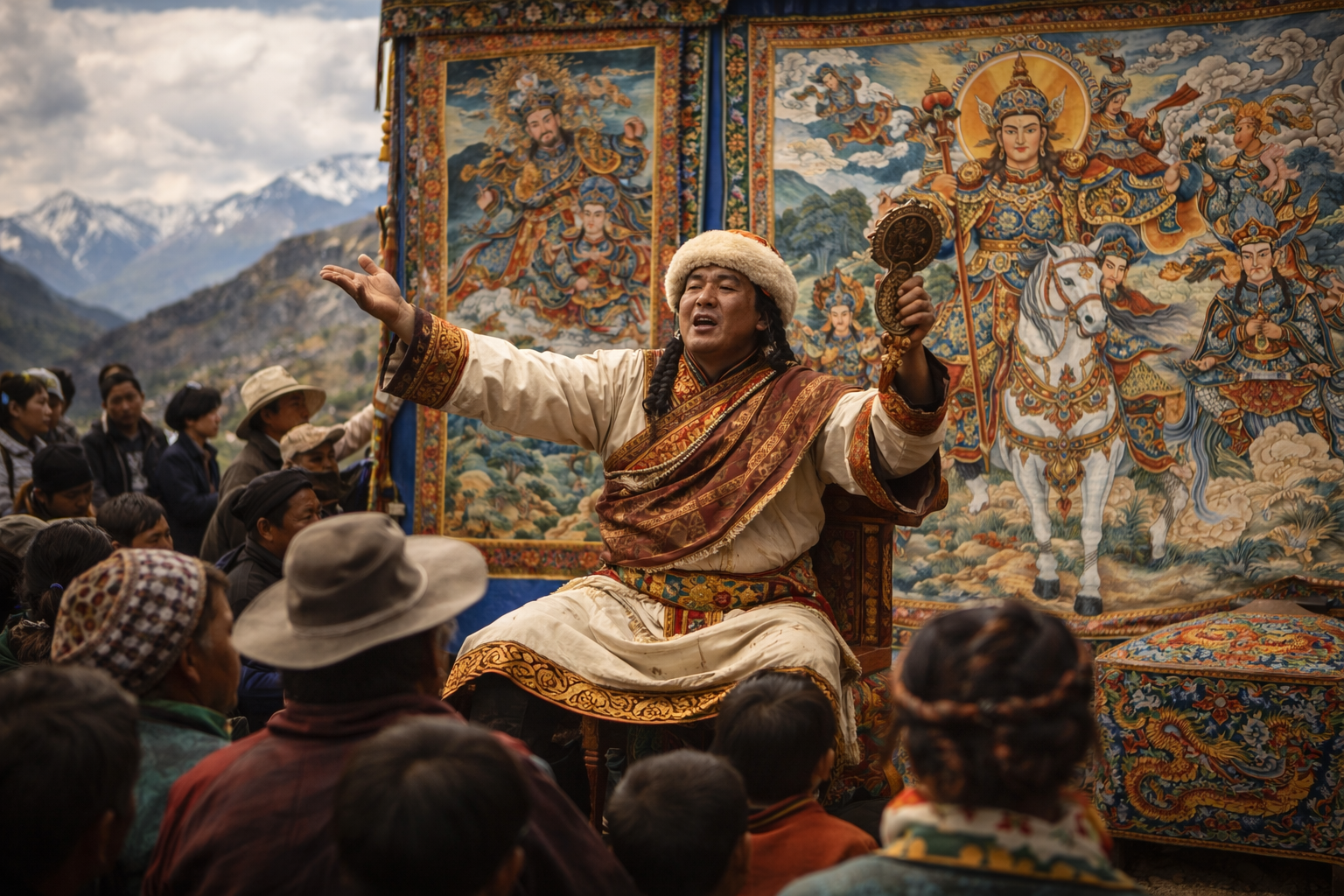
The Gesar epic also matters because it complicates the inherited map of mythology itself. If Chinese myth is understood only through texts such as the Shanhaijing, the Chu Ci, the Huainanzi, dynastic histories, anomaly collections, Daoist hagiographies, Buddhist miracle tales, and later vernacular novels, then a major part of the narrative field disappears from view. Gesar insists that the archive also includes Tibetan, Mongolian, Tu, and Inner Asian traditions whose authority has often been preserved through voice, performance, memory, local transmission, and ritualized social presence.
In that sense, Gesar is not a peripheral addition to the study of Chinese myth, folklore, and legend. It is a corrective. It reminds readers that China’s mythic worlds have always been internally diverse, linguistically plural, regionally layered, and mediated through unequal forms of preservation. Some traditions entered elite textual canon early. Others survived through bardic memory, local ritual, oral performance, or later institutional documentation. The Gesar epic belongs to this second world: not less important because it is orally transmitted, but more revealing because it exposes the limits of a text-only archive.
Gesar and the Problem of the Canon
One of the recurring problems in the study of Chinese myth is the assumption that the field can be adequately represented by the classical textual archive alone: the Shanhaijing, the Chu Ci, the Huainanzi, dynastic histories, anomaly collections, religious scriptures, and later vernacular fiction. Those works are foundational, but they do not define the entire civilizational field. The Gesar tradition is a powerful reminder that some of the most important narrative worlds preserved within and around China survive outside the structures of classical Han literary transmission.
This matters because Gesar forces a wider definition of mythic culture. A mythic archive is not only a shelf of ancient books. It is also a network of sung memory, localized performance, ritual practice, cross-regional adaptation, sacred geography, community identity, and embodied transmission. Gesar belongs to that wider archive and complicates any narrow understanding of what “Chinese mythology” is allowed to include. It makes visible a narrative zone where Tibet, Mongolia, Amdo, Qinghai, Gansu, and other connected cultural worlds overlap rather than remaining neatly segregated.
The epic therefore does conceptual work for the entire field. It demonstrates that “Chinese myth” is not a singular voice but a layered arena whose most important materials may survive through different languages, media, and institutions. Gesar is not an appendix to the archive. It is one of the clearest proofs that the archive was always larger than any one canon.
That point is especially important for a scholarly and ethically responsible approach to myth. Canons are not neutral. They preserve some voices more strongly than others. They favor literate institutions, courtly textuality, dominant languages, and materials that entered libraries or official classification. Gesar belongs to a different pattern of endurance. It survives through bardic bodies, community memory, ritual settings, and later textualization. Its presence makes the archive more honest because it forces the archive to admit its own incompleteness.
An Epic of Heroic and Mythic Action
At the broadest level, the Gesar tradition centers on a culture hero sent from heaven to defeat monsters, humble oppressive powers, defend the weak, and bring order to a fractured world. Even in summary form, the narrative pattern is unmistakably epic: supernatural mission, heroic struggle, moral testing, martial prowess, dangerous enemies, sacred destiny, and world-ordering action. Gesar is not merely a remembered local ruler elevated by legend. He is a hero whose authority is framed in cosmic, ethical, and civilizational terms.
The epic’s imaginative world helps explain its durability. Heroic combat against monsters, shifting enemies, magical capacities, sacred mission, and repeated episodic expansion all make the narrative exceptionally adaptable. Gesar can absorb local landscapes, regional enemies, ritual concerns, social memories, and performance emphasis without ceasing to be recognizably Gesar. This is one of the key strengths of oral epic as a form: it combines continuity of identity with elasticity of episode.
That elasticity also explains why the Gesar tradition belongs naturally in a mythology and folklore series rather than in literary history alone. Its epic scope gives it grandeur, but its accretive life keeps it open. It is heroic narrative, but also mythic world-making. It is not a closed literary monument but a large, expanding narrative environment in which communities have repeatedly found symbolic resources for courage, protection, ethical struggle, regional belonging, and sacred memory.
The epic form also allows Gesar to operate across multiple scales. At one level, he is the hero of Ling. At another, he is the defender of vulnerable communities. At another, he is a cosmic agent sent to restore order. At another, he is a performed figure whose story gives audiences access to a shared past. The hero becomes great because he is able to hold all these levels together.
King Gesar as Culture Hero
Gesar is best understood as a culture hero rather than simply as a warrior. A warrior defeats enemies; a culture hero changes the moral and symbolic order of the world. Gesar’s struggles against oppressive rulers, demonic powers, monsters, and enemies are not only feats of strength. They are acts of world repair. He fights so that vulnerable communities can live, so that disorder can be confronted, and so that the world can be made morally habitable.
This culture-hero dimension helps explain why the epic is so deeply meaningful to communities that preserve it. Gesar is not only admired. He is remembered as a figure through whom justice, courage, sacred mandate, and cultural identity become narratively visible. The hero’s battles are not isolated spectacles. They express a worldview in which violence becomes meaningful only when directed toward the restoration of order and the protection of the weak.
Gesar’s identity also depends on a layered relation between heaven and earth. His mission is not merely political or military. It has sacred authorization. This means his heroism is never simply personal ambition. The epic repeatedly frames action through larger powers: divine mission, ritual responsibility, karmic or cosmic stakes, and the moral obligation to confront disorder. Heroism becomes legitimate when it serves a world beyond the hero’s own glory.
That is why Gesar should not be reduced to a regional equivalent of a generic epic king. His figure belongs to a distinctive Tibetan and Inner Asian heroic imagination in which martial force, sacred destiny, social protection, and oral performance are deeply intertwined. He is heroic because he fights; he is mythic because his fighting becomes world-ordering memory.
Oral Tradition, Performance, and Living Transmission
The Gesar epic is above all a living performance tradition. It survives through singers and storytellers who perform episodes in alternating prose and verse, and its regional variation is not accidental but constitutive. The work lives because it can be performed differently while remaining recognizably part of the same narrative world. In this respect, variation is not decay. It is the tradition’s mode of life.
This performance dimension matters because it means the epic is embodied in technique, not only in verbal content. Voice, cadence, melody, gesture, facial expression, costume element, ceremonial bearing, instrument, memory practice, and local performance context are all part of transmission. In some communities, performers enhance recitation with mirrors, gestures, sound effects, or ritual objects. In others, melodic singing and oral narrative are more strongly fused. The epic’s identity therefore resides not only in “what is told,” but in how telling itself becomes a specialized cultural act.
This places Gesar squarely within folklore studies. It is transmitted person to person, performance to performance, and occasion to occasion. Even where printed versions exist, the epic’s authority does not derive only from the page. It derives from living custodianship within communities that continue to treat the tradition as meaningful inheritance. A text can preserve words, but a singer preserves the relation between words, sound, occasion, audience, and memory.
Oral epic also changes how narrative time works. A performance may focus on one episode rather than the entire epic. It may expand a local battle, compress a familiar sequence, emphasize moral instruction, dramatize a heroic test, or adapt the story to the audience and occasion. The epic is therefore not simply “recited” from a fixed source. It is re-entered, reactivated, and re-situated. The tradition survives because performers make it present again.
Living Heritage Source
Tibetan masters carry bronze mirrors and use facial expressions, sound effects and gestures to enhance their singing.UNESCO Intangible Cultural Heritage, “Gesar epic tradition.” Available at: https://ich.unesco.org/en/RL/gesar-epic-tradition-00204
This heritage description helps document the performed life of the epic: Gesar is preserved not only through words, but through gesture, sound, ritual objects, and embodied bardic technique.
The Bard as Archive
The bardic performer is one of the most important archives of the Gesar tradition. A library can preserve manuscripts, printed compilations, and catalogued texts, but a bard preserves repertoire, cadence, gesture, vocal mode, episode structure, invocation, audience relation, ritual atmosphere, and local emphasis. Such knowledge is difficult to reduce to writing because it lives in performance. The singer’s body becomes a vessel of the epic.
This embodied archive is crucial for understanding oral tradition without condescension. Oral transmission is not a lack of writing. It is a disciplined and socially recognized mode of preservation. A skilled performer may hold vast narrative material and perform it with dramatic, ritual, and musical control. The authority of such performance comes not from improvisation alone, but from mastery: knowing how to summon the story, how to move through episodes, how to sustain attention, and how to connect inherited material to living audiences.
The bard also mediates between tradition and community. A performance is not only an artistic display. It can educate listeners in history, religion, morality, custom, courage, and identity. UNESCO’s heritage framing emphasizes the Gesar epic’s social and educational functions, but those functions are rooted in the older authority of singers who make the epic communal rather than private. The audience does not merely consume a story. It participates in the renewal of shared memory.
This makes safeguarding complicated. Preserving a printed text is not the same as preserving a performance tradition. If singers disappear, local styles, melodic forms, ritualized openings, regional episodes, and embodied knowledge may disappear with them. The bard as archive is powerful, but vulnerable. The living nature of the Gesar tradition is precisely what makes it urgent to preserve.
Primary Sources and Textual Witnesses
A stronger research treatment of Gesar has to emphasize that although the epic is fundamentally oral, it is not textless. The Tibetan title most commonly cited in literary history is Rgyal-po Ge-sar dgra’dul gyi rtogs-pa brjod-pa, often translated along the lines of “The Great Deeds of King Gesar, Destroyer of Enemies.” That title itself is a reminder that Gesar entered literary history not as a single authored book but as a textualized epic tradition with multiple witnesses, recensions, expansions, and scholarly descriptions.
The printed and manuscript record matters because it demonstrates that oral and written transmission were not mutually exclusive. UNESCO documentation notes the preservation of Gesar materials and the role of transmission among Tibetan, Mongolian, and Tu communities, while literary histories of Mongolian tradition note that an orally transmitted Mongol version of Gesar was printed as early as 1716. This is important not only as bibliographic fact, but because it shows how the epic moved between recitation and textual fixation without losing its plural life.
Modern digital repositories make this textual layer more visible. The Buddhist Digital Resource Center preserves catalogued Gesar materials, including works identified with the Gesar epic and related Tibetan textual holdings. These resources do not replace living performance, but they allow the researcher to treat the tradition as a field of witnesses rather than as an abstract oral legend detached from textual history.
That interplay between oral authority and textual witness is one of the most important scholarly features of Gesar. It prevents the false choice between “authentic oral epic” and “secondary literary version.” In practice, the Gesar tradition has always lived across both domains. Texts stabilize. Performances renew. Archives preserve. Communities interpret. None of these layers is sufficient by itself, and the epic’s strength lies in their interaction.
Primary Source / Title Witness
Rgyal-po Ge-sar dgra-’dul gyi rtogs-pa brjod-paThe Great Deeds of King Gesar, Destroyer of EnemiesTraditional Tibetan epic title cited in literary histories of the Gesar tradition. Britannica overview available at: https://www.britannica.com/topic/Rgyal-po-Ge-sar-dgradul-gyi-rtogs-pa-brjod-pa
The title itself frames Gesar as both king and enemy-subduing culture hero, showing how the tradition presents heroic action as moral and world-ordering work rather than ordinary warfare.
Tibetan, Mongolian, and Tu Worlds
One of the most important features of the Gesar tradition is that it reveals China’s narrative field as internally diverse and historically interconnected. The tradition is shared by Tibetan, Mongolian, and Tu communities in western and northern China. This is not a minor point. It means Gesar is not simply “a Tibetan story” situated near China, but a multi-community epic tradition whose forms of transmission cross linguistic, ethnic, and regional boundaries.
The Mongolian evidence is especially important because it confirms that Gesar belongs to a wider Inner Asian field of adaptation and circulation. Mongolian literary history preserves clear testimony that the Tibetan epic of Gesar Khan was embraced and adapted, and that an orally transmitted Mongol version was printed in the early eighteenth century. The tradition is therefore plural not only because it has many episodes, but because it moves through different communities with their own literary and performative worlds.
The Tu dimension also matters because it prevents the tradition from being understood only through the largest or most internationally visible communities. Smaller communities often preserve crucial forms of regional knowledge, performance style, and local adaptation. A multiethnic epic tradition is not simply one story repeated by many groups. It is a shared narrative field in which each community’s performance practice matters.
This makes Gesar a powerful counterweight to simplified center-periphery models. It reveals a China of overlapping narrative zones, where Tibetan, Mongolian, Tu, and related traditions participate in the mythic field without needing to conform to a single literary center. In the context of this series, that is one of its most important contributions. It makes plurality visible not as an abstract value, but as the actual historical condition of the archive.
Inner Asian Landscape and Epic Geography
The Gesar epic is inseparable from landscape. Mountains, grasslands, high plateaus, passes, camps, kingdoms, battlefields, sacred places, and regions of hostile power shape the epic’s imagination. The story does not unfold in an abstract heroic space. It belongs to a world of altitude, mobility, pastoral memory, territorial defense, pilgrimage routes, ritual geography, and Inner Asian political imagination.
This landscape dimension matters because it gives the epic a distinctive environmental and regional identity. Gesar’s world is not the same as the riverine and agricultural worlds foregrounded in many Han Chinese myths, nor is it identical to the temple and urban worlds of late-imperial vernacular fiction. It belongs to the highland and Inner Asian imagination of movement, horses, mountains, martial defense, borderlands, sacred peaks, and dispersed communities bound through performance and memory.
Epic geography also helps explain the tradition’s adaptability. When a story is performed in different regions, local landscapes can enter the epic imagination. Mountains, valleys, rivers, and enemy territories may be remembered or reinterpreted through local knowledge. The epic becomes a way of making place meaningful. It does not simply happen somewhere; it helps communities understand the somewhere in which they live.
For Chinese mythic studies, this is crucial. It shows that geography is not background. Different landscapes generate different narrative forms. The world of Gesar expands the Chinese mythic map beyond classical central plains, imperial capitals, Daoist sacred mountains, Buddhist cave-temples, and southern river traditions. It adds the epic highland and Inner Asian field as a necessary part of the archive.
Ritual, Religion, and Daily Life
The Gesar tradition is not confined to staged entertainment. Performances may be accompanied by offerings, meditation, blessing, invocation, or other ritual acts, and in some communities the epic is embedded in daily, communal, and life-cycle experience. This matters because it shifts Gesar from the category of “literature performed aloud” into a larger symbolic order where epic, religion, pedagogy, protection, and social memory overlap.
When a tradition is sung at birth, invoked in ritualized settings, or treated as part of the moral and pedagogical inheritance of a community, its status changes. Gesar is no longer only a hero in a distant narrative past. He becomes part of the symbolic grammar through which communities interpret protection, courage, continuity, right order, and sacred presence. The epic is therefore artistic and socially operative at once.
This multifunctional character is one reason Gesar belongs so naturally in this pillar. It is mythic, epic, folkloric, pedagogical, ritual, and communal at once. It shows how narrative traditions in China and the surrounding Inner Asian world often refuse the tidy divisions modern scholarship sometimes imposes between literature, religion, and everyday life.
The religious dimension also prevents the epic from being reduced to secular heroism. Gesar’s mission is sacred, his enemies often exceed ordinary political opposition, and his victories can carry cosmic significance. Yet the tradition’s religious life is not limited to doctrine. It is also practical: blessing, protection, remembrance, performance occasion, communal pedagogy, and the ritualized renewal of cultural identity.
Buddhist, Bön, and Local Sacred Layers
The Gesar tradition exists within a complex Tibetan and Inner Asian religious environment shaped by Tibetan Buddhism, Bön, local deity traditions, protective rites, mountain cults, and regional sacred histories. It should not be flattened into any one doctrinal category. Its religious world is layered. Gesar may be read through Buddhist moral and cosmological frameworks, but the epic also carries older and local sacred resonances tied to land, protection, heroic power, and ritual obligation.
This layered sacred world is one reason the epic has been able to travel and endure. Different communities can emphasize different religious dimensions without breaking the continuity of the tradition. A performance may be understood as entertainment, instruction, blessing, heroic memory, religious observance, or all of these at once. The epic is large enough to hold multiple religious readings.
The relation between Gesar and Buddhist thought is especially important because Tibetan literary and religious history is deeply shaped by Buddhist textual culture. Yet Gesar’s epic world cannot be reduced to monastic scholasticism or formal doctrine. It belongs to a broader lived religious field in which protective power, sacred kingship, local spirits, ritual performance, and moral struggle all matter.
Bön and local sacred traditions further complicate the picture in productive ways. They remind readers that Tibetan religious culture is not a single uniform system and that heroic epic often preserves layers of belief that are difficult to separate cleanly by modern categories. Gesar’s mythic force lies partly in this complexity. He belongs not to a narrow doctrinal shelf, but to a dense sacred landscape.
Heroism, Justice, and the Defense of the Vulnerable
At the ethical center of the Gesar tradition is the relation between heroic power and justice. Gesar is sent to confront destructive forces, but his violence is framed by a larger moral mission. He does not simply conquer for conquest’s sake. He defeats oppressive powers, subdues monsters, protects communities, and restores order where the world has become dangerous or unjust.
This heroic pattern matters because it gives the epic its pedagogical force. Listeners do not merely hear of battles; they hear a moral imagination of power. Strength is valuable when it defends the vulnerable. Authority is legitimate when it serves order rather than domination. Combat becomes meaningful when it is directed against beings or rulers who threaten the world’s balance.
The epic therefore participates in a long global pattern of heroic traditions in which a champion mediates between ordinary communities and extraordinary danger. Yet Gesar’s particular form of heroism is rooted in Tibetan and Inner Asian contexts: sacred mission, martial skill, mobility, regional identity, ritual power, and the highland world of contested territories and mythic enemies. His justice is not abstract. It is performed through the forms of his cultural world.
This is one reason Gesar remains powerful as communal memory. The epic preserves the hope that disorder is not final, that oppressive power can be challenged, and that a hero can arise under sacred authorization to defend those who cannot defend themselves. In performance, that hope becomes audible again.
Monsters, Enemies, and the Moral Imagination of Combat
The enemies in the Gesar tradition are not merely obstacles to plot. They reveal the epic’s moral imagination. Monsters, demons, tyrants, hostile kings, and destructive powers embody different forms of disorder. Some threaten communities physically; others threaten moral, cosmic, or sacred balance. Gesar’s battles therefore dramatize the confrontation between ordered life and forces that would deform it.
This does not mean every enemy should be read simplistically. Epic traditions often encode historical conflict, regional memory, political anxiety, religious boundary-making, and local rivalry into the language of monstrous or hostile opposition. The figure of the monster can carry many layers: ecological danger, military threat, moral corruption, foreignness, demonic power, or social disorder. Responsible interpretation should preserve this complexity.
Combat in Gesar is therefore more than spectacle. It is a symbolic language through which communities remember vulnerability and imagine restoration. A monster’s defeat may represent the subduing of chaotic force; an oppressive ruler’s humiliation may represent the restoration of justice; a magical victory may show that ordinary power is insufficient against extraordinary danger. The epic makes danger narratively intelligible.
At the same time, modern readers must be careful with heroic violence. Epic traditions can preserve ethical memory, but they can also encode exclusion, hierarchy, and conflict in mythic language. A scholarly reading should respect the tradition’s internal moral order while remaining alert to how enemies are constructed, how difference is narrated, and how heroic legitimacy is framed. Gesar’s combat is mythic, but mythic combat is never politically or ethically empty.
Women, Queens, and the Social World of the Epic
A full reading of Gesar should not treat the epic as only a world of male martial heroism. Like many long heroic traditions, it also contains women, queens, mothers, wives, ritual figures, adversaries, advisers, and relational networks through which the hero’s world becomes socially meaningful. These figures are sometimes marginalized in summary accounts, but they are essential to understanding the epic as a social universe rather than a sequence of battles alone.
Women in epic traditions often carry memory, alliance, household continuity, mourning, counsel, beauty, danger, sovereignty, or moral testing. In Gesar, as in other heroic cycles, the social world around the hero matters because heroism must be embedded in kinship, polity, community, and obligation. A hero without a social world is only a fighter. Gesar’s world is larger than combat because it includes the relational conditions that make combat meaningful.
This section also matters for the broader ethical framing of the article. Multiethnic and oral traditions should not be represented only through their most militarized or spectacular elements. They are also traditions of song, memory, family, ritual, local pedagogy, and everyday cultural continuity. Women’s roles in preserving, hearing, transmitting, sponsoring, and interpreting epic traditions may be as important as the narrative roles of women inside the epic itself.
A stronger scholarly approach should therefore ask both kinds of questions: how women are represented in the epic, and how women participate in the social life of the epic’s transmission. The answer will differ by region, performer, community, and source base, but the questions are necessary if Gesar is to be treated as a living cultural world rather than a heroic abstraction.
From Performance to Print, Painting, and Opera
The Gesar epic also matters because it did not remain confined to oral recitation. It has inspired painting, especially thangka traditions, as well as opera and other visual and performative forms. This is essential for the logic of Chinese myth, folklore, and legend because it places Gesar squarely within the same transmission ecology explored in articles on shadow puppetry, opera, temple festivals, visual art, and vernacular fiction. Myth survives here not through one medium, but through a network of mutually reinforcing forms.
The existence of printed texts further complicates the picture in productive ways. Print does not cancel oral tradition here; instead, it becomes one more layer in the preservation and study of a living epic. Manuscript or printed textualization may stabilize certain recensions, but performance continues to generate variation, emphasis, and renewed social meaning. A printed Gesar is not the end of the oral Gesar. It is one more witness to a tradition that remains larger than the page.
This interplay of voice, manuscript, print, visual art, and opera is precisely what makes Gesar such a strong bridge article for the series. It gathers together many recurring themes: plural transmission, regional difference, oral performance, religious embedding, textual witness, visual afterlife, and artistic adaptation. The epic is not only a story. It is a narrative world that generates other media.
That generative capacity is one sign of mythic power. A tradition becomes truly durable when it can be sung, written, painted, staged, invoked, taught, archived, and adapted without losing its identity. Gesar has done exactly that. Its movement across media is not a sign of dilution. It is a sign of cultural vitality.
Thangka Painting and the Visual Life of Gesar
Gesar’s visual afterlife is especially important because thangka painting and other visual traditions give the epic a sacred and iconic body. In visual form, Gesar can appear not only as a narrative hero but as a mounted warrior, protector, king, sacred figure, or emblem of regional identity. The image condenses the epic’s vastness into a recognizable visual presence.
Thangka painting is not simply illustration in the modern sense. In Tibetan visual culture, thangkas can function within devotional, pedagogical, ritual, and aesthetic settings. When Gesar appears in such a visual field, the epic’s relationship to sacred imagination becomes more visible. The hero is not merely a literary character. He enters a world of iconography, ritual attention, and visual reverence.
Visual representation also makes Gesar portable. A sung episode exists in time and disappears when the performance ends. A painting remains visible, displayable, and transmissible. It can teach viewers what Gesar looks like, how his horse, armor, weapons, attendants, or sacred surroundings should be imagined. It can stabilize recognition while performance preserves variation.
This visual layer also connects Gesar to the broader argument that Chinese mythic culture survives through object worlds as well as texts. Just as dragons, immortals, door gods, and underworld judges move across painting, print, and decorative art, Gesar moves across thangka, opera, manuscript, print, and performance. His mythic life is distributed. The archive is not one medium but many.
UNESCO, Living Heritage, and Contemporary Safeguarding
The Gesar epic tradition was inscribed by UNESCO on the Representative List of the Intangible Cultural Heritage of Humanity in 2009. That recognition is important because it frames Gesar not only as a literary monument but as a living tradition of performance, transmission, communal identity, ritual embedding, and artistic afterlife. The tradition is not only a text to be read. It is a practice to be sustained.
UNESCO’s description emphasizes that the tradition is shared by ethnic Tibetan, Mongolian, and Tu communities in western and northern China, and that the epic continues to inspire thangka painting, Tibetan opera, and other art forms. This framing is useful because it captures Gesar’s multiethnic and multimedia life. The epic is not merely preserved in archives; it is performed, painted, staged, taught, and remembered.
Living-heritage recognition also clarifies the stakes of safeguarding. A tradition like Gesar cannot be preserved only by collecting manuscripts. Performers must be supported. Repertoires must be transmitted. Regional styles must be documented. Younger audiences must encounter the epic as living culture rather than as distant museum material. Communities must remain central to the process because they are the tradition’s living custodians.
At the same time, heritage recognition should be interpreted carefully. UNESCO inscription does not create Gesar’s value. The epic existed long before modern heritage institutions. The inscription is a contemporary recognition of a much older and more complex tradition. It can help with visibility and safeguarding, but the deeper authority of Gesar remains rooted in communities of performance, devotion, memory, and interpretation.
Source History and Interpretive Caution
A careful reading of Gesar must distinguish among several layers: oral performance, local recitation lineages, ritual contexts, Tibetan textual witnesses, Mongolian printed and oral traditions, Tu transmission, modern translations, institutional catalogues, UNESCO heritage documentation, scholarly literary history, and contemporary cultural presentation. These layers overlap, but they do not do the same work. A bardic performance, a Buddhist Digital Resource Center record, a UNESCO description, a Shambhala translation, and a Britannica entry all illuminate different parts of the tradition.
It is especially important not to treat the Gesar tradition as if it were reducible to a single “book.” The title Rgyal-po Ge-sar dgra’dul gyi rtogs-pa brjod-pa helps identify the great epic in literary history, but the tradition’s life is far larger than any one textual witness. Versions differ. Performances vary. Regional memories shift emphasis. A responsible article should not pretend that there is one stable, authoritative Gesar text behind all living forms.
It is equally important not to use Gesar merely as decorative evidence for “Chinese diversity.” The tradition deserves its own integrity. Its Tibetan, Mongolian, Tu, and Inner Asian dimensions should not be flattened into a generic national frame. The point is not to absorb Gesar into a simplified Chinese canon, but to show that the canon itself must be widened, pluralized, and made more accurate.
Modern sources also require genre awareness. UNESCO provides heritage framing; Britannica provides concise literary orientation; BDRC provides catalogued textual access; modern translations provide readable entry points; scholars provide historical, philological, and ethnographic interpretation. Each source type is valuable, but none should be mistaken for the whole tradition. Gesar is not fully contained by any archive because it remains a living archive.
Why Gesar Matters for Chinese Myth, Folklore, and Legend
The Gesar tradition matters because it forces a more adequate understanding of what counts as part of the Chinese mythic archive. It shows that major narrative worlds within China are not exhausted by classical Han sources or later vernacular novels. Some of the most important traditions are oral, multiethnic, regionally varied, ritually embedded, and historically mobile across Inner Asia. Gesar is one of the strongest examples.
It also matters because it preserves a heroic imagination inseparable from cultural plurality. The tradition gives communities a sense of identity and continuity while also making visible the structural diversity of the archive itself. In the context of this series, that is crucial: Gesar does not merely add one more story to the field. It helps reveal the field’s real scale.
Most of all, Gesar still matters because it remains a living archive of heroic memory, mythic imagination, sacred performance, and communal continuity. It is at once epic, ritual tradition, educational medium, textual tradition, visual source, and artistic inspiration. In a series concerned with how myth survives across texts, performances, images, festivals, and regional traditions, the Gesar epic stands as one of the clearest proofs that the narrative worlds of China have always been larger than any single canon.
That may be the article’s central lesson. A mythic tradition does not need to be centralized in order to be foundational. It does not need to be fixed in one book in order to be authoritative. It does not need to belong to the dominant textual archive in order to belong to the civilizational field. Gesar matters because it teaches readers to recognize plurality not as a supplement to mythology, but as one of mythology’s deepest conditions.
Related Reading
- Chinese Myth, Folklore & Legend
- Opera, Vernacular Fiction, and the Transmission of Myth
- Myth in Painting, Print, and Decorative Art
- Temple Festivals, Popular Religion, and the Social Life of Legend
- From Classical Text to Folkloric Archive: How Chinese Myth Survived
- Buddhism, Daoism, and the Recasting of Chinese Mythic Worlds
- Chinese Shadow Puppetry and the Performance of Legend
Primary Sources
- Rgyal-po Ge-sar dgra’dul gyi rtogs-pa brjod-pa / The Great Deeds of King Gesar, Destroyer of Enemies. Useful as the major Tibetan epic title through which the Gesar tradition is commonly identified in literary history. Britannica overview available at: https://www.britannica.com/topic/Rgyal-po-Ge-sar-dgradul-gyi-rtogs-pa-brjod-pa
- Buddhist Digital Resource Center (n.d.) The Epic of Gesar. Useful for direct engagement with preserved textual witnesses and bibliographic records in a major Tibetan and Buddhist digital archive. Available at: https://library.bdrc.io/show/bdr:MW26078_EFC3E9
- Buddhist Digital Resource Center (n.d.) gling ge sar sgrung gi tshig rgyan nor bu’i bang mdzod. Useful as a catalogued Gesar-related Tibetan textual holding and bibliographic witness. Available at: https://library.bdrc.io/show/bdr:MW20100
- Buddhist Digital Resource Center (n.d.) The Lower Ladakhi Version of the Gesar Epic. Useful for regional textual witness and the broader plurality of Gesar transmission. Available at: https://library.bdrc.io/show/bdr:MW26078_FACC61
- Kornman, R., Khandro, S. and Chonam, L. (trans.) (2012) The Epic of Gesar of Ling: Gesar’s Magical Birth, Early Years, and Coronation as King. Boston: Shambhala. Useful as a major English translation and scholarly entry point into Gesar’s birth, childhood, horse race, and coronation. Internet Archive record available at: https://archive.org/details/epicofgesaroflin0000unse
- UNESCO Intangible Cultural Heritage (2009) “Gesar epic tradition.” Useful as primary institutional documentation of living performance practice, multiethnic transmission, ritual embedding, thangka painting, opera, educational function, and safeguarding context. Available at: https://ich.unesco.org/en/RL/gesar-epic-tradition-00204
- UNESCO Intangible Cultural Heritage (2009) “Decision of the Intergovernmental Committee: 4.COM 13.14.” Useful as the formal inscription decision for the Gesar epic tradition on the Representative List of the Intangible Cultural Heritage of Humanity. Available at: https://ich.unesco.org/en/decisions/4.COM/13.14
- UNESCO Intangible Cultural Heritage (n.d.) “Video: Gesar epic tradition.” Useful audiovisual documentation for performance practice, singerly transmission, and living heritage context. Available at: https://ich.unesco.org/en/video/01748
Further Reading
- UNESCO Intangible Cultural Heritage (2009) “Gesar epic tradition.” Available at: https://ich.unesco.org/en/RL/gesar-epic-tradition-00204
- UNESCO Intangible Cultural Heritage (2009) “Decision of the Intergovernmental Committee: 4.COM 13.14.” Available at: https://ich.unesco.org/en/decisions/4.COM/13.14
- UNESCO Intangible Cultural Heritage (n.d.) “Video: Gesar epic tradition.” Available at: https://ich.unesco.org/en/video/01748
- Encyclopaedia Britannica (n.d.) “Rgyal-po Ge-sar dgra’dul gyi rtogs-pa brjod-pa.” Available at: https://www.britannica.com/topic/Rgyal-po-Ge-sar-dgradul-gyi-rtogs-pa-brjod-pa
- Encyclopaedia Britannica (n.d.) “Tibetan literature.” Available at: https://www.britannica.com/art/Tibetan-literature
- Encyclopaedia Britannica (n.d.) “Mongolian literature.” Available at: https://www.britannica.com/art/Mongolian-literature
- Buddhist Digital Resource Center (n.d.) The Epic of Gesar. Available at: https://library.bdrc.io/show/bdr:MW26078_EFC3E9
- Buddhist Digital Resource Center (n.d.) gling ge sar sgrung gi tshig rgyan nor bu’i bang mdzod. Available at: https://library.bdrc.io/show/bdr:MW20100
- Kornman, R., Khandro, S. and Chonam, L. (trans.) (2012) The Epic of Gesar of Ling: Gesar’s Magical Birth, Early Years, and Coronation as King. Boston: Shambhala. Internet Archive record available at: https://archive.org/details/epicofgesaroflin0000unse
- David-Neel, A. and Yongden, L. (1933) The Superhuman Life of Gesar of Ling. London: Rider.
- FitzHerbert, S.G. and Solomon, H. (eds) (2021) The Many Faces of King Gesar: Tibetan and Central Asian Studies in Homage to Rolf A. Stein. Leiden: Brill.
- Karmay, S.G. (1998) The Arrow and the Spindle: Studies in History, Myths, Rituals and Beliefs in Tibet. Kathmandu: Mandala Book Point.
- Stein, R.A. (1959) Recherches sur l’épopée et le barde au Tibet. Paris: Presses Universitaires de France.
- Samuel, G. (1993) Civilized Shamans: Buddhism in Tibetan Societies. Washington, DC: Smithsonian Institution Press.
- Kapstein, M.T. (2006) The Tibetans. Malden, MA: Blackwell.
References
- Buddhist Digital Resource Center (n.d.) The Epic of Gesar. Available at: https://library.bdrc.io/show/bdr:MW26078_EFC3E9
- Buddhist Digital Resource Center (n.d.) gling ge sar sgrung gi tshig rgyan nor bu’i bang mdzod. Available at: https://library.bdrc.io/show/bdr:MW20100
- Buddhist Digital Resource Center (n.d.) The Lower Ladakhi Version of the Gesar Epic. Available at: https://library.bdrc.io/show/bdr:MW26078_FACC61
- David-Neel, A. and Yongden, L. (1933) The Superhuman Life of Gesar of Ling. London: Rider.
- Encyclopaedia Britannica (n.d.) “Mongolian literature.” Available at: https://www.britannica.com/art/Mongolian-literature
- Encyclopaedia Britannica (n.d.) “Rgyal-po Ge-sar dgra’dul gyi rtogs-pa brjod-pa.” Available at: https://www.britannica.com/topic/Rgyal-po-Ge-sar-dgradul-gyi-rtogs-pa-brjod-pa
- Encyclopaedia Britannica (n.d.) “Tibetan literature.” Available at: https://www.britannica.com/art/Tibetan-literature
- FitzHerbert, S.G. and Solomon, H. (eds) (2021) The Many Faces of King Gesar: Tibetan and Central Asian Studies in Homage to Rolf A. Stein. Leiden: Brill.
- Kapstein, M.T. (2006) The Tibetans. Malden, MA: Blackwell.
- Karmay, S.G. (1998) The Arrow and the Spindle: Studies in History, Myths, Rituals and Beliefs in Tibet. Kathmandu: Mandala Book Point.
- Kornman, R., Khandro, S. and Chonam, L. (trans.) (2012) The Epic of Gesar of Ling: Gesar’s Magical Birth, Early Years, and Coronation as King. Boston: Shambhala. Internet Archive record available at: https://archive.org/details/epicofgesaroflin0000unse
- Samuel, G. (1993) Civilized Shamans: Buddhism in Tibetan Societies. Washington, DC: Smithsonian Institution Press.
- Stein, R.A. (1959) Recherches sur l’épopée et le barde au Tibet. Paris: Presses Universitaires de France.
- UNESCO Intangible Cultural Heritage (2009) “Decision of the Intergovernmental Committee: 4.COM 13.14.” Available at: https://ich.unesco.org/en/decisions/4.COM/13.14
- UNESCO Intangible Cultural Heritage (2009) “Gesar epic tradition.” Available at: https://ich.unesco.org/en/RL/gesar-epic-tradition-00204
- UNESCO Intangible Cultural Heritage (n.d.) “Video: Gesar epic tradition.” Available at: https://ich.unesco.org/en/video/01748