
Last Updated May 6, 2026
Chinese myth often survives most powerfully not as a single story told once, but as a visual field that can be entered again and again. Mythic beings, sacred symbols, and legendary presences do not live only in classical texts, vernacular fiction, oral performance, temple ritual, or seasonal festival. They recur in painted scrolls, temple murals, woodblock prints, porcelain vessels, embroidered garments, lacquered boxes, bronze figures, household shrines, architectural ornament, New Year pictures, and ceremonial objects, where they become part of the visible texture of daily and ritual life.
This visual afterlife matters because Chinese mythic culture has never been contained within a single closed canon. Many of its most durable meanings were carried not through one definitive narrative, but through recurring motifs that could move across media and across centuries: dragons, immortals, phoenixes, sacred mountains, celestial maidens, cloud forms, peaches of longevity, cranes, deer, lingzhi fungus, underworld officials, door gods, Zhenwu, Guanyin, auspicious children, and protective beasts. Chinese visual culture therefore did not merely illustrate myth after the fact. It made myth inhabitable, portable, repeatable, and ritually present in the spaces where people lived, worshipped, celebrated, and remembered.
Article Map
Chinese Myth, Folklore & Legend
Related Topic
Dragons & Water Cosmology
Series context: This article is part of the Chinese Myth, Folklore & Legend knowledge series. For the broader category structure, return to the Mythology category.
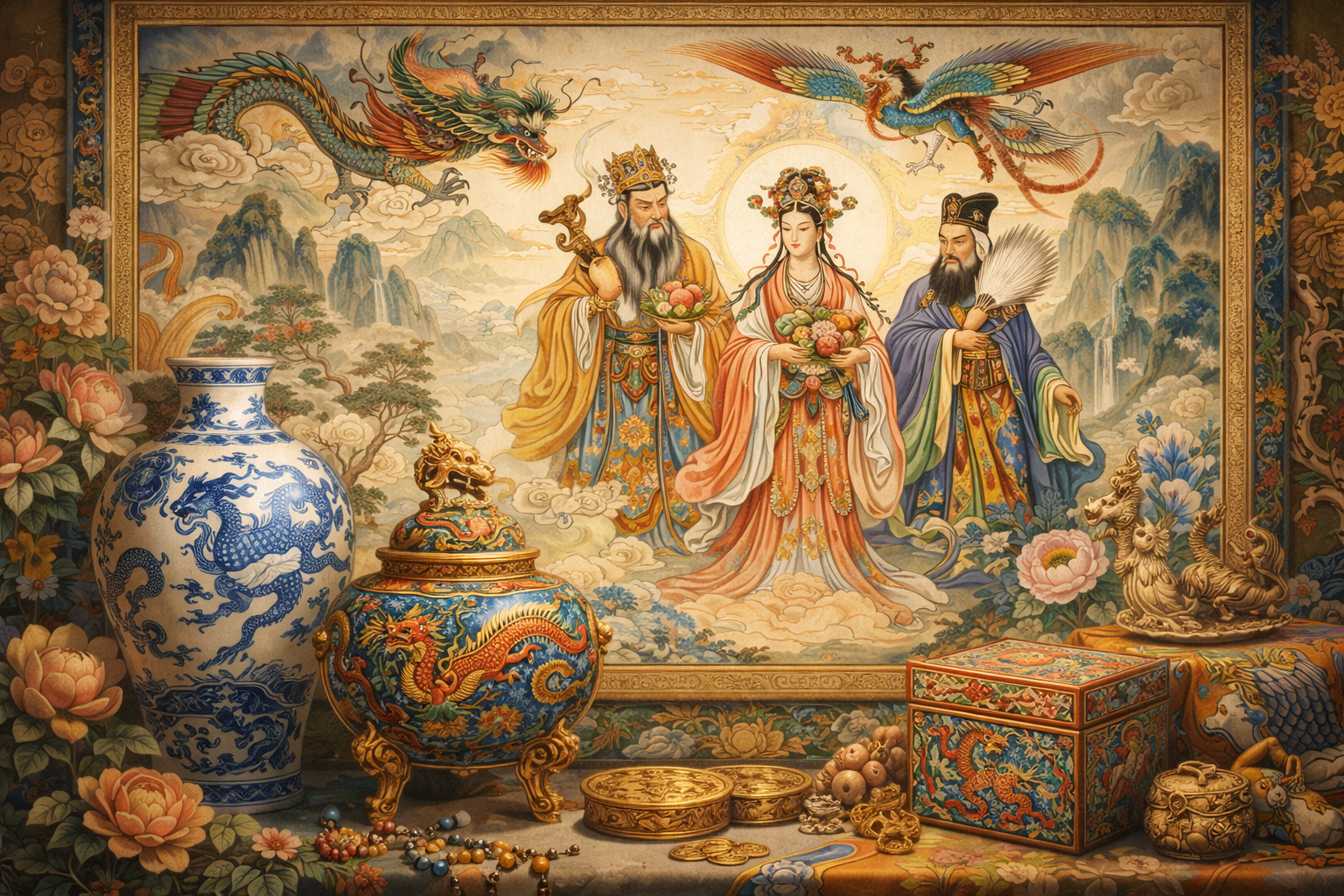
Visual culture is especially important because Chinese myth often survives through motif as much as through plot. A dragon on a cloisonné jar, a peach on a birthday vessel, a crane in a hanging scroll, a Zhenwu bronze, a door-god print, a porcelain shrine in cloud form, or a textile covered with longevity symbols can condense entire worlds of religious, cosmological, social, and auspicious meaning. The image does not always need to retell a story scene by scene. It may carry myth as sign, atmosphere, wish, protection, memory, or sacred presence.
For this reason, painting, print, and decorative art are not secondary evidence for Chinese myth. They are part of the mythic archive itself. They show how narrative became visible, how sacred presence became material, how auspicious wishes entered domestic objects, how religious iconography moved into popular print, and how motifs could survive even when viewers no longer knew every textual source behind them. Chinese mythic visual culture is therefore a vast system of recognition: one learns to see dragons, clouds, cranes, peaches, immortals, mountains, lotus forms, and guardian figures as more than decoration. They are signs of a world in which matter and meaning are never fully separate.
Visual Culture as a Mythic Archive
Chinese mythic culture has always depended on more than textual survival. Even when stories were preserved in literary form, their broader cultural afterlives often depended on visual repetition. Images made myth portable. They allowed symbolic beings and legendary scenes to circulate beyond the page into temples, homes, clothing, gifts, ritual objects, festival settings, shrines, and public spaces.
This is especially important in the Chinese context because mythology often survives in dispersed and layered form rather than as one closed epic corpus. Visual representation helps stabilize and amplify that dispersed archive. A dragon, a Queen Mother of the West figure, an immortal, an auspicious phoenix, a door god, or a sacred mountain can gather meanings from religion, folklore, cosmology, ritual, poetry, and local custom without needing to be anchored to a single definitive narrative.
The breadth of Chinese visual culture across painting, print, jade, bronze, lacquer, ceramics, textiles, enamel, embroidery, and architectural ornament is itself revealing. Mythic imagery in China has long moved fluidly across media rather than remaining attached to a single “fine art” form. This mobility made symbolic forms unusually durable. A motif could pass from court art to popular print, from temple image to domestic object, from ritual context to decorative adaptation, while still retaining layers of accumulated mythic significance.
For that reason, visual culture should be treated not as an accessory to mythology but as one of its principal archives. It preserves the mythic imagination in forms that are immediately legible yet often interpretively deep. A single image can condense narrative, cosmology, wish, protection, and sacred presence all at once. A dragon chasing a pearl among clouds is not simply design. A peach, crane, and lingzhi fungus are not simply nature study. A porcelain shrine in a cloud frame is not simply ceramic skill. Each is a visual doorway into a mythic order.
From Story to Motif
One of the central features of Chinese mythic visual culture is the movement from story to motif. Some images represent recognizable narrative episodes: Sun Wukong causing havoc in Heaven, the Eight Immortals crossing the sea, the Queen Mother’s peach banquet, a dragon boat festival scene, a deity procession, or a legendary battle. Other images do something more compressed. They do not narrate a full scene, but carry mythic meaning through repeated forms: clouds, cranes, peaches, deer, lingzhi, dragons, phoenixes, lotus, rocks, waves, mountains, and celestial robes.
This movement from story to motif matters because it explains how myth can remain present even when narrative memory becomes partial. A viewer may not know every textual tradition associated with Xiwangmu, but a peach of immortality can still signify longevity, blessing, and access to a celestial order. A viewer may not know every dragon myth, but a dragon moving through clouds or waves can still signify water, power, vitality, transformation, and imperial or cosmic force.
Motifs are therefore mnemonic devices. They help a culture remember meaning without requiring constant explanation. They also allow myth to enter environments where full narrative would be impractical: the surface of a vase, the border of a robe, the side of a lacquer box, the tile of a temple roof, the printed sheet on a door, the handle of a vessel, or the embroidered panel of a ceremonial garment.
At the same time, motifs are not simple symbols with one fixed meaning. Their force depends on context. A dragon on an imperial robe does different work from a dragon on a temple tile, a rain-making image, a New Year print, or a domestic vessel. A lotus in Buddhist art carries one set of meanings; a lotus on porcelain or textile may carry related but different auspicious associations. Chinese mythic visual culture is powerful because motifs are stable enough to be recognized and flexible enough to travel.
Painting and the Symbolic World
Painting offered one of the most refined media for the visual elaboration of mythic and religious worlds. Scroll paintings, mural cycles, illustrated narratives, album leaves, and symbolic landscape compositions could embed divine figures, paradisal realms, sacred mountains, strange beings, auspicious animals, or celestial presences within carefully ordered pictorial environments. In such works, myth often appears not only as explicit episode but as symbolic atmosphere.
This is one of the reasons painting matters so much in the Chinese context. A mythic world need not be narrated sequentially to be made intelligible. It can be distributed through arrangement, motif, and setting. Clouds, peaks, cranes, streams, pavilions, celestial courts, and divine beings can establish a world of transcendence or sacred geography without the image needing to function like a textual scene-by-scene retelling.
Painting can also preserve myth indirectly through symbolic convention. Mountains, clouds, cranes, deer, peaches, stars, pine trees, rocks, flowing waters, and distant pavilions may all participate in longer traditions of sacred geography, immortality, auspiciousness, or cosmic order. In this sense, even when no single mythic scene is being narrated, painting can still operate within a mythic register. It teaches viewers how to read the world symbolically.
That symbolic training is one of painting’s deepest contributions to mythic culture. It establishes habits of recognition. It teaches that certain forms belong together, that landscape can be sacred, that animals can be charged with ethical and cosmological meaning, and that visual harmony itself may imply an ordered universe. Painting becomes, in this way, not only representational but interpretive. It does not merely show the world. It shows how the world can be read.
Landscape, Clouds, and Sacred Geography
Chinese painting often makes landscape central, and landscape can carry mythic meaning even when no god or demon is visible. Mountains, streams, mists, clouds, caves, cliffs, pavilions, and paths into distance can evoke more than scenery. They may suggest sacred geography, hermit withdrawal, Daoist transcendence, Buddhist pilgrimage, immortal realms, poetic longing, or the layered relation between human life and cosmic process.
Cloud forms are especially important because they mark movement between worlds. Clouds can frame divine figures, surround immortals, lift mountains into sacred atmosphere, or transform ordinary space into a realm of passage. A cloud is not merely vapor in many visual contexts. It is a sign of transition, auspiciousness, celestial movement, and the permeability of heaven and earth.
Mountains likewise serve as more than background. Sacred peaks such as Kunlun, Penglai, and Wudang belong to mythic and religious geographies where immortals, gods, ascetics, and cosmic forces gather. A mountain in painting may not need to be identified by name to carry such associations. Its form, distance, and atmospheric treatment can imply a world beyond ordinary social life.
This is why visual myth in China often works through setting rather than direct action. A painting of an immortal crossing a bridge, a crane flying through mist, a pavilion hidden among cliffs, or a solitary figure entering a mountain path can create mythic resonance without dramatic event. The myth is not always in the plot. Sometimes it is in the atmosphere of a world where transformation remains possible.
Daoist Art, Immortals, and the Visible Pantheon
Daoist art is one of the major visual fields through which Chinese mythic beings acquired durable form. Daoist deities, immortals, celestial officials, talismanic symbols, sacred mountains, paradise imagery, and ritual diagrams all helped make a complex religious cosmos visible. This visual world is important because Daoism did not transmit myth only through scripture, ritual, or philosophical language. It also transmitted myth through iconography.
Immortals are especially significant. Figures such as the Eight Immortals, Shoulao, Dongfang Shuo, Xiwangmu, and many other legendary or divine beings circulated across paintings, textiles, porcelain, lacquer, prints, and decorative objects. Their attributes became visual shorthand: a gourd, fan, sword, flute, lotus, peach, deer, crane, staff, or cloud could identify a figure or invoke a larger world of longevity and transcendence.
Daoist visual culture also shows how religious art and popular art interact. Immortals might appear in temple settings, but they also appear on birthday gifts, domestic furnishings, textiles, porcelain vases, decorative panels, and popular prints. In those settings, their meaning often expands beyond formal ritual. They become signs of longevity, blessing, festive goodwill, health, honor, and auspicious continuation.
This circulation does not make the imagery less religious. Rather, it shows how religious meaning can become social and domestic. The immortal leaves the scripture and enters the birthday celebration; the celestial figure leaves the temple and appears on a vase; the sacred mountain becomes a decorative landscape. Daoist art makes myth visible in many registers at once.
Buddhist Images and the Transmission of Sacred Forms
Buddhist visual culture also played a major role in the Chinese mythic imagination. Buddhas, bodhisattvas, guardians, arhats, paradisal realms, cave-temple murals, printed images, sutra frontispieces, and devotional icons brought sacred narrative and salvific presence into visual form. The arrival and transformation of Buddhism in China expanded the repertoire of divine and semi-divine imagery available to Chinese religious and artistic culture.
Guanyin is especially important because the bodhisattva’s visual forms became deeply integrated into Chinese devotional and popular life. Guanyin images could appear as temple icons, printed devotional pictures, painted scrolls, porcelain figures, and domestic objects. Through such circulation, Buddhist compassion became a visible and portable presence. The bodhisattva was not only doctrinally known; she was seen, installed, petitioned, and carried into homes and temples.
Print history also intersects strongly with Buddhism. The reproduction of sacred images and texts was connected with merit, transmission, and the preservation of efficacy. Printed Buddhist images helped establish woodblock printing as a religious as well as technological medium. This matters for mythic culture because it shows how reproduction itself could be sacred. A copied image was not only a copy; it could participate in blessing, merit, and devotional circulation.
Buddhist visual culture also shaped Chinese representations of hell, judgment, rebirth, salvation, compassion, and celestial hierarchy. These themes entered temple murals, popular prints, ritual texts, paintings, and later theatrical forms. In this way, Buddhist imagery became part of the broader Chinese visual archive of the unseen world.
Woodblock Prints and Popular Transmission
Print culture was one of the most powerful engines of mythic transmission because it allowed images to circulate widely beyond elite collectors. Woodblock prints brought auspicious images, protective figures, operatic scenes, gods, door guardians, historical figures, Daoist deities, Buddhist images, and legendary subjects into domestic and festive life. Through print, mythic imagery became repeatable, affordable, and socially diffuse.
This is one reason prints occupy such an important place between art history and folklore. They did not merely decorate walls. They participated in ritual timing, household protection, seasonal renewal, and the moral-symbolic ordering of everyday space. A printed image might be purchased for New Year observance, installed to protect a threshold, used to invoke blessing, or displayed to align the household with a larger field of auspicious power.
Print also changed the scale of transmission. What might once have required a painted scroll, temple mural, or sculptural presence could now be reproduced and distributed widely. This did not necessarily flatten mythic meaning. Instead, it helped standardize certain symbols while also making them newly available for local use, reinterpretation, and ritual incorporation.
This makes print one of the clearest bridges between myth and ordinary life. A printed image of a deity, a dragon, a heroic general, an auspicious child, a door guardian, or a Daoist immortal was not always encountered as “art” in the modern museum sense. It might function as blessing, threshold marker, festival object, moral reminder, or ritual presence. In that respect, print belongs centrally to folklore studies because it embeds image traditions within seasonal custom and collective practice.
Nianhua, Door Gods, and Household Protection
Nianhua 年畫, or New Year pictures, are among the clearest examples of visual myth entering domestic time. These prints often include door gods, wealth figures, auspicious children, historical heroes, Daoist deities, scenes from opera or fiction, and images of prosperity, fertility, longevity, and protection. They are not merely seasonal decorations. They help prepare the household to enter the year under auspicious signs.
Door-god prints are especially important because they turn the threshold into a protected visual field. A door is a vulnerable boundary. It marks the passage between inside and outside, family and street, safety and danger, blessing and intrusion. Door gods make that boundary legible as guarded. The image does ritual work by being seen and installed at the proper time.
New Year pictures also show how myth, history, and folklore often blend. A figure may be a historical general, a deified protector, an operatic character, a wealth deity, or a legendary being all at once. The household does not need these categories to remain separate. What matters is that the image conveys protection, fortune, recognition, and seasonal renewal.
Because nianhua are often inexpensive, replaceable, and tied to annual cycles, they also show how visual culture can be powerful without being permanent. A museum may preserve a print for centuries, but in household practice a New Year image may be installed, weathered, replaced, or ritually discarded. Its impermanence is part of its meaning. It belongs to time, not only to collection.
Decorative Art, Auspicious Imagery, and Domestic Myth
Decorative art is equally important because mythic imagery in China has long inhabited objects of everyday and ceremonial use. Ceramics, lacquerware, embroidered caps, clothing, screens, shrines, furniture, cloisonné vessels, jade carvings, bronze figures, roof tiles, and domestic display pieces often carried dragons, cloud scrolls, phoenixes, lotus forms, immortality symbols, protective motifs, or auspicious rebuses. Such images operated at the intersection of beauty, status, ritual efficacy, and symbolic wish.
This is where myth becomes especially intimate. A dragon on a vessel, a phoenix on fabric, a peach on porcelain, or a cloud-scroll shrine is not merely an ornamental flourish. It places the object within a field of meaning that reaches far beyond decoration. Mythic imagery could imply protection, continuity, rank, vitality, abundance, cosmic order, spiritual aspiration, or long life. Decorative art therefore often carried wishes and metaphysical assumptions directly into the material life of the household.
Protective and auspicious imagery is especially significant because it reveals how mythic motifs became active signs in ceremonial and social life. Dragons were not only figures in stories; they were also signs of force, blessing, transformation, and protection. Peaches, cranes, deer, lotuses, lingzhi, bats, and phoenixes similarly operated as compressed symbolic formulas, carrying larger cultural hopes into visible and touchable form.
In this respect, decorative art does not stand below painting or temple imagery as a lesser form. It may in fact preserve myth more durably because it embeds symbolic worlds into the objects people handle, wear, display, gift, and inherit. Myth remains alive when it becomes part of the ordinary material environment.
Ceramics, Lacquer, Textiles, and Metalwork
Different materials carry mythic imagery differently. Ceramics provide durable surfaces for painted dragons, phoenixes, peaches, landscapes, immortals, children, lotuses, waves, and cloud patterns. Lacquer can create depth, sheen, and carved relief that make mythic scenes tactile as well as visual. Textiles bring auspicious imagery onto the body, the bed, the altar, the ceremonial garment, or the gift object. Metalwork and cloisonné can turn mythic motifs into bright, jewel-like surfaces of ritual or decorative authority.
These material differences matter because mythic imagery is not abstract. A dragon painted on porcelain has a different presence from a dragon embroidered in silk or rendered in cloisonné enamel. The surface, color, weight, function, and social use of the object shape how the motif is encountered. Myth is not only what is shown. It is how and where the image lives.
Ceramics are especially important because they could move widely through trade, gifting, court patronage, domestic use, and collecting. A porcelain vessel decorated with dragons, immortal symbols, or auspicious plants could cross social and geographic boundaries. It might serve an altar, decorate a hall, circulate as luxury, or eventually enter a museum. The object’s meaning shifts, but the motif continues to carry its mythic charge.
Textiles show another kind of intimacy. When longevity symbols, dragons, phoenixes, or auspicious flowers are worn or displayed, myth enters bodily and social presentation. A robe, sleeve, rank badge, embroidered hanging, or birthday textile can make auspicious imagery part of status, celebration, ritual, and identity. Myth is not only looked at. It is worn.
Religious Images, Temple Arts, and Sacred Presence
Religious and temple arts occupy a crucial place in the visual transmission of myth because they give material form to divine presence itself. Sculptures, icons, ritual paintings, shrines, banners, murals, and altar furnishings help organize sacred space while also teaching communities how to imagine gods, immortals, bodhisattvas, underworld judges, and protective beings. These forms are not merely illustrative. They are devotional and often liturgical in function.
This is why the distinction between “religious art” and “mythic art” can be misleading in the Chinese context. The same image may function as sacred presence, legendary memory, and auspicious symbol simultaneously. A temple image of an immortal, judge, warrior god, or goddess is not simply a picture of a story. It is part of a ritual environment in which narrative, petition, devotion, and sacred authority converge.
Temple arts also stabilize visual expectations. They help standardize how divine figures are imagined, what attributes they bear, how sacred courts are arranged, and what kinds of visual relationships exist between gods, attendants, animals, weapons, clouds, rocks, and celestial emblems. This iconographic stability then radiates outward into prints, decorative arts, popular paintings, festival banners, and household images.
Religious imagery therefore matters for the broader archive because it often serves as the hinge between theology, folklore, and popular visual life. It is where the sacred becomes visible enough to travel. A deity image may begin as temple presence, but related forms can appear in prints, porcelain, embroidery, calendars, popular posters, and modern media. Visual religion is one of the great engines of mythic continuity.
Dragons and the Circulation of Cosmic Power
Dragons are among the most mobile and powerful motifs in Chinese visual culture. They appear in painting, embroidery, ceramics, cloisonné, architecture, prints, jade, lacquer, bronzes, roof tiles, robes, temple decorations, and festival imagery. Their endurance across so many media suggests that they function less as isolated narrative creatures than as a core symbolic language of the Chinese mythic imagination.
The dragon carries meanings tied to water, rain, clouds, rivers, seas, vitality, transformation, imperial power, auspicious force, and cosmic movement. In decorative art, the dragon often appears among clouds, waves, or flaming pearls, making visible the dynamic relation between watery power and celestial force. The dragon’s body bends, coils, rises, twists, and pursues. It is an image of energy in motion.
This mobility allows the dragon to function across elite, popular, domestic, imperial, and religious contexts. On an imperial robe, the dragon may signify sovereignty and cosmic authority. On a vessel, it may bring auspicious force into ceremonial display. In a temple or festival setting, it may belong to rain, water, or protective power. In a New Year or decorative context, it may signify vitality and blessing. The same motif travels, but its meaning adjusts to setting.
Because dragons are so visually recognizable, they are also one of the strongest examples of myth surviving without full narration. A viewer does not need a dragon story attached to every object. The image itself carries accumulated power. A dragon on porcelain or enamel is already a mythic presence, even before a particular tale is told.
Immortals, Peaches, Cranes, and the Visual Language of Longevity
Longevity imagery is one of the most important visual systems in Chinese art. It brings together Daoist aspiration, popular religion, Confucian respect for age, birthday celebration, domestic blessing, and decorative beauty. Immortals, peaches, cranes, deer, pine, bamboo, lingzhi fungus, mountains, clouds, and the character shou 壽 / 寿 can all participate in this visual language. The result is not simply decoration, but a symbolic economy of long life.
Peaches are especially important because of their association with Xiwangmu, the Queen Mother of the West, and her peaches of immortality. A peach may appear as fruit, vessel form, porcelain decoration, painting motif, textile pattern, or birthday symbol. It can refer directly to mythic immortality or more generally to the wish for long life. The object does not need to narrate the entire peach banquet to carry its force.
Cranes likewise connect earthly image and immortal aspiration. Their whiteness, elegance, long life, and association with immortals make them ideal visual companions to peaches, pine trees, and lingzhi. In painting and decorative art, the crane can suggest longevity, transcendence, and auspicious elevation. When cranes, peaches, and lingzhi appear together, the image becomes a dense visual formula of immortality and blessing.
This longevity system matters because it shows how myth becomes social gift. A birthday textile, vase, scroll, or decorative panel covered with longevity motifs is not merely beautiful. It makes a wish visible. It carries ethical respect, social hope, and mythic association into ceremonial exchange. The immortal world enters human relationships through objects.
Phoenixes, Qilin, Lotus, and Auspicious Beasts
The dragon is not the only mythic form to move widely across Chinese visual culture. Phoenixes, qilin, guardian lions, lotus forms, celestial birds, auspicious bats, and composite beasts also appear across painting, decorative art, textile, temple imagery, architecture, and print. Each carries a different cluster of meanings, and together they form a broad visual vocabulary of auspiciousness, protection, refinement, and cosmic order.
The phoenix often carries associations of beauty, virtue, harmony, renewal, and imperial or feminine symbolism depending on context. It may appear with dragons, among flowers, on textiles, in wedding contexts, or in decorative programs that seek to evoke harmony and auspicious order. Like the dragon, it is flexible enough to travel across social settings while retaining symbolic recognizability.
The qilin is another powerful example. As an auspicious creature associated with sagehood, virtue, and miraculous appearance, it can carry meanings of benevolent rule, exceptional birth, or moral order. Guardian lions, though different in origin and symbolism, also become part of the visual field of protection, especially in architecture and temple contexts. Lotus imagery moves between Buddhist purity, decorative elegance, and auspicious rebirth or continuity.
These motifs matter because they show that Chinese mythic visual culture is not only narrative but heraldic. It builds a world of signs that signal blessing, danger, protection, rank, moral quality, and cosmic alignment. The image system teaches viewers to recognize when a space, object, garment, or ritual setting has been placed under auspicious meaning.
Underworld Officials, Judges, and the Bureaucratic Sacred
Chinese visual culture also gives form to the bureaucratic sacred: underworld judges, city gods, celestial officials, Daoist registers, hell scenes, ritual courts, and divine attendants. These images are crucial because they show how Chinese myth often imagines the unseen world through institutions of administration. The afterlife is not always represented as formless mystery. It may appear as court, office, judgment, file, register, official robe, or ranked hierarchy.
Temple murals and ritual paintings often make this bureaucratic sacred visible. Underworld scenes can depict judges, clerks, punishments, petitions, processions, and ritual intervention. Such images do not merely frighten. They teach moral causation, ritual obligation, ancestral concern, and the social consequences of improper conduct. The invisible moral order becomes visible through institutional imagery.
This visual language also connects with popular religion. A city god is not only a mythic character but a jurisdictional authority; an underworld judge is not only a supernatural being but a figure of moral administration; a ritual painting may not simply represent gods but help organize communication with them. The image makes the unseen system intelligible.
The bureaucratic sacred is important because it complicates modern assumptions about mythology. Chinese mythic visual culture is not only filled with monsters and heroes. It is also filled with officials, courts, ranks, documents, and ordered spaces. The sacred is imagined not only as wonder, but as administration. Visual art makes that administration visible.
Opera, Fiction, Print, and the Visual Commons
Visual art did not operate separately from opera and vernacular fiction. Illustrated novels, opera prints, theatrical costumes, painted faces, New Year pictures, temple images, shadow puppets, and decorative motifs all participated in a shared visual commons. A character might be known from a novel, recognized from an opera stage, printed in a popular image, carved into a puppet, painted on a wall, and eventually adapted into film or animation.
This circulation is especially important for figures such as Sun Wukong, Nezha, Guan Yu, Zhuge Liang, Daji, Bai Suzhen, and the Eight Immortals. Their visual identities were not created by one medium alone. Literature gave them story; opera gave them role, movement, and costume; print gave them repetition; decorative art gave them portability; temple culture could give them sacred presence; modern media gave them new afterlives.
Prints and illustrations often helped stabilize recognition. A viewer who saw a figure repeatedly in printed form could recognize the same figure on stage or on an object. Conversely, theatrical performance could influence how artists depicted characters. This feedback loop helped make mythic figures culturally durable. They were not trapped in one visual code; they were reinforced across many.
This is why Chinese myth should be studied through media ecology rather than text alone. Visual art, opera, fiction, shadow puppetry, temple festivals, and decorative objects formed overlapping systems of memory. Myth survived because it could be seen in many places, at many scales, and in many materials.
Museums, Object Records, and the Study of Mythic Art
Modern museums preserve many objects that once belonged to ritual, domestic, courtly, commercial, or decorative settings. This preservation is valuable because it allows close study of materials, dates, motifs, inscriptions, techniques, and provenance. A museum object record can show that a porcelain shrine was made in cloud form, that a bronze figure represented Zhenwu, that a cloisonné vessel carried five-clawed dragons, or that New Year pictures included door gods, historical figures, and Daoist deities.
At the same time, museum display changes context. An object that once served a temple, household, festival, birthday celebration, altar, or court ceremony may now appear under glass, separated from the smoke, handling, gift exchange, prayer, music, or seasonal use that once gave it social force. The museum helps preserve the object, but it can also make the object seem more purely aesthetic than it once was.
This means object records should be read both carefully and imaginatively. They provide indispensable evidence, but they do not fully reconstruct lived use. A New Year print in a museum collection was once tied to annual replacement, household thresholds, and festive practice. A shrine may have been part of devotional space. A dragon vessel may have carried rank, ritual, display, or auspicious meaning. A painting of cranes and peaches may have functioned within a social world of longevity wishes and gift exchange.
Museums are therefore not outside the mythic archive. They are modern stewards of fragments from older image worlds. Their records help identify motifs and contexts, while interpretation must restore the broader social, ritual, and symbolic life that made those images meaningful before they entered the collection.
Source History and Interpretive Caution
A careful reading of Chinese mythic visual culture must distinguish among several layers: original object use, later collecting history, museum classification, art-historical interpretation, religious meaning, decorative function, popular symbolism, textual reference, and modern heritage framing. A single object may belong to several of these layers at once. A porcelain shrine can be ceramic, devotional architecture, Daoist or Buddhist visual culture, cloud imagery, and museum object. A dragon vessel can be decorative art, courtly display, imperial symbolism, and mythic sign.
It is also important not to assume that every motif has one stable meaning. Symbols change across period, region, material, patron, and use. A dragon on a Ming imperial object, a dragon in a festival print, a dragon on a domestic vessel, and a dragon in a temple mural may share visual ancestry while doing different cultural work. Interpretation must move from motif to context, not from motif to a single fixed definition.
Museum sources are extremely useful, but they represent objects in modern institutional language. They can identify date, medium, collection, classification, and sometimes iconographic meaning, but they may not fully convey ritual use, local memory, domestic handling, or the emotional force of an object in its original setting. Conversely, folkloric interpretation can recover social meaning, but it must be grounded in object evidence where possible.
Finally, visual art should not be treated as merely illustrative of texts. In some cases, images preserve meanings not fully available in surviving writing. In other cases, visual conventions may reshape how a textual story is remembered. Chinese mythic culture is distributed across media. Text, image, object, ritual, and performance must be read together.
Why Visual Art Matters for Chinese Myth, Folklore, and Legend
Painting, print, and decorative art matter because they show how Chinese mythic culture was transmitted through seeing as much as through reading or listening. Images allowed myths to become spatially present: on walls, screens, garments, vessels, festival prints, shrines, temple interiors, household altars, and ceremonial objects. This made legendary and symbolic worlds continuously available within everyday life.
They also matter because they complicate modern distinctions between elite and popular culture. A motif may begin in religious or courtly art and later appear in domestic decoration or festive print; conversely, folk ritual imagery may shape the broader visual vocabulary of a civilization. Chinese mythic art often works through this constant movement between refined and popular, sacred and domestic, aesthetic and protective.
Most of all, visual art matters because it preserves myth without requiring full narration. A dragon, crane, peach, goddess, cloud-framed shrine, Zhenwu figure, door god, or lotus can carry centuries of symbolic sediment in a single form. Painting, print, and decorative art therefore do not stand outside the mythic archive. They are among its most enduring foundations.
To study Chinese Myth, Folklore & Legend seriously, then, one must study not only stories and performances but also image systems and object worlds. Myth survives in what can be seen, touched, worn, installed, gifted, displayed, and ritually encountered. That is one of the central reasons visual culture remains indispensable to the history of Chinese folklore and legend.
Related Reading
- Chinese Myth, Folklore & Legend
- Opera, Vernacular Fiction, and the Transmission of Myth
- Chinese Shadow Puppetry and the Performance of Legend
- Temple Festivals, Popular Religion, and the Social Life of Legend
- Dragons in Chinese Myth, Water Cosmology, and Imperial Symbolism
- The Queen Mother of the West and the Imagery of Immortality
- Daoism, Immortality, and the Supernatural Imagination
Primary Sources
- The Metropolitan Museum of Art (n.d.) “One hundred thirty-five woodblock prints including New Year’s pictures (nianhua), door gods, historical figures and Taoist deities.” Useful as a primary object record for popular print, household protection, New Year imagery, Daoist deities, and the circulation of mythic figures through inexpensive visual media. Available at: https://www.metmuseum.org/art/collection/search/63932
- The Metropolitan Museum of Art (n.d.) “New Year Picture of Door God Zhao Gongming.” Useful as a primary object record for door-god imagery, household thresholds, wealth/protection iconography, and New Year print culture. Available at: https://www.metmuseum.org/art/collection/search/63834
- The Metropolitan Museum of Art (n.d.) “Cranes, peach tree, and China rose.” Useful as a primary object record for longevity imagery, peaches, cranes, lingzhi fungus, and the visual language of immortality in Qing painting. Available at: https://www.metmuseum.org/art/collection/search/36105
- The British Museum (n.d.) “Shrine.” Useful as a primary object record for porcelain shrine form, cloud-scroll framing, Longquan ware, and the materialization of sacred space in ceramic form. Available at: https://www.britishmuseum.org/collection/object/A_1929-0114-1
- The British Museum (n.d.) “Figure.” Useful as a primary object record for the bronze figure of Zhenwu, Ming Daoist sacred imagery, dragons on divine armor, and state as well as popular devotion. Available at: https://www.britishmuseum.org/collection/object/A_1908-0725-2
- The British Museum (n.d.) “Jar; cover.” Useful as a primary object record for Ming cloisonné dragon imagery, five-clawed dragons, cloud motifs, lotus-pod finial, and decorative art as a carrier of mythic power. Available at: https://www.britishmuseum.org/collection/object/A_1957-0501-1
- The British Museum (n.d.) “Bottle.” Useful as a primary object record for porcelain imagery combining dragon, waves, and the Eight Immortals in Qing decorative art. Available at: https://www.britishmuseum.org/collection/object/A_Franks-322
- The British Museum (n.d.) “Tile.” Useful as a primary object record for Ming architectural dragon imagery, three-clawed dragons, flaming pearl motifs, and mythic ornament in built space. Available at: https://www.britishmuseum.org/collection/object/A_2006-0503-1-1-20
- The Metropolitan Museum of Art (n.d.) “Vase with Nine Peaches.” Useful as a primary object record for porcelain, peach symbolism, longevity imagery, and auspicious decorative art. Available through the Met collection search: https://www.metmuseum.org/art/collection/search
Further Reading
- The Metropolitan Museum of Art (n.d.) “Daoism and Daoist Art.” Available at: https://www.metmuseum.org/essays/daoism-and-daoist-art
- The Metropolitan Museum of Art (2010) “Longevity in Chinese Art.” Available at: https://www.metmuseum.org/essays/longevity-in-chinese-art
- The Metropolitan Museum of Art (2012) “The Printed Image in China, 8th–21st Century.” Available at: https://www.metmuseum.org/exhibitions/listings/2012/printed-image-in-china
- The Metropolitan Museum of Art (n.d.) “Noble Virtues: Nature as Symbol in Chinese Art.” Available at: https://www.metmuseum.org/exhibitions/noble-virtues
- The British Museum (n.d.) “China.” Available at: https://www.britishmuseum.org/collection/china
- The British Museum (n.d.) “Chinese Ceramics – Sir Percival David Collection.” Available at: https://www.britishmuseum.org/collection/galleries/chinese-ceramics
- National Palace Museum (n.d.) “Collection.” Available at: https://theme.npm.edu.tw/collection/Index.aspx?l=2
- Chicago, J. (ed.) (2010) The Art of Buddhism: An Introduction to Its History and Meaning. Boston: Shambhala.
- Clunas, C. (2004) Superfluous Things: Material Culture and Social Status in Early Modern China. Honolulu: University of Hawai‘i Press.
- Fong, W.C. (1992) Beyond Representation: Chinese Painting and Calligraphy, Eighth–Fourteenth Century. New York: Metropolitan Museum of Art.
- Little, S. and Eichman, S. (eds) (2000) Taoism and the Arts of China. Chicago: Art Institute of Chicago.
- Rawson, J. (1992) Chinese Ornament: The Lotus and the Dragon. London: British Museum Press.
- Welch, P.B. (2008) Chinese Art: A Guide to Motifs and Visual Imagery. North Clarendon, VT: Tuttle.
References
- British Museum (n.d.) “Bottle.” Available at: https://www.britishmuseum.org/collection/object/A_Franks-322
- British Museum (n.d.) “China.” Available at: https://www.britishmuseum.org/collection/china
- British Museum (n.d.) “Chinese Ceramics – Sir Percival David Collection.” Available at: https://www.britishmuseum.org/collection/galleries/chinese-ceramics
- British Museum (n.d.) “Figure.” Available at: https://www.britishmuseum.org/collection/object/A_1908-0725-2
- British Museum (n.d.) “Jar; cover.” Available at: https://www.britishmuseum.org/collection/object/A_1957-0501-1
- British Museum (n.d.) “Shrine.” Available at: https://www.britishmuseum.org/collection/object/A_1929-0114-1
- British Museum (n.d.) “Tile.” Available at: https://www.britishmuseum.org/collection/object/A_2006-0503-1-1-20
- Chicago, J. (ed.) (2010) The Art of Buddhism: An Introduction to Its History and Meaning. Boston: Shambhala.
- Clunas, C. (2004) Superfluous Things: Material Culture and Social Status in Early Modern China. Honolulu: University of Hawai‘i Press.
- Fong, W.C. (1992) Beyond Representation: Chinese Painting and Calligraphy, Eighth–Fourteenth Century. New York: Metropolitan Museum of Art.
- Little, S. and Eichman, S. (eds) (2000) Taoism and the Arts of China. Chicago: Art Institute of Chicago.
- Metropolitan Museum of Art (n.d.) “Cranes, peach tree, and China rose.” Available at: https://www.metmuseum.org/art/collection/search/36105
- Metropolitan Museum of Art (n.d.) “Daoism and Daoist Art.” Available at: https://www.metmuseum.org/essays/daoism-and-daoist-art
- Metropolitan Museum of Art (n.d.) “New Year Picture of Door God Zhao Gongming.” Available at: https://www.metmuseum.org/art/collection/search/63834
- Metropolitan Museum of Art (n.d.) “One hundred thirty-five woodblock prints including New Year’s pictures (nianhua), door gods, historical figures and Taoist deities.” Available at: https://www.metmuseum.org/art/collection/search/63932
- Metropolitan Museum of Art (2010) “Longevity in Chinese Art.” Available at: https://www.metmuseum.org/essays/longevity-in-chinese-art
- Metropolitan Museum of Art (2012) “The Printed Image in China, 8th–21st Century.” Available at: https://www.metmuseum.org/exhibitions/listings/2012/printed-image-in-china
- Metropolitan Museum of Art (n.d.) “Noble Virtues: Nature as Symbol in Chinese Art.” Available at: https://www.metmuseum.org/exhibitions/noble-virtues
- National Palace Museum (n.d.) “Collection.” Available at: https://theme.npm.edu.tw/collection/Index.aspx?l=2
- Rawson, J. (1992) Chinese Ornament: The Lotus and the Dragon. London: British Museum Press.
- Welch, P.B. (2008) Chinese Art: A Guide to Motifs and Visual Imagery. North Clarendon, VT: Tuttle.