
Last Updated May 5, 2026
The fenghuang and the qilin occupy a distinctive place in Chinese mythology because they belong to a class of beings whose significance lies not in terror, predation, or destructive force, but in auspicious appearance, moral resonance, and symbolic relation to a rightly ordered world. They are not simply fabulous animals added for ornament. In the transmitted tradition, they are beings whose manifestation signifies harmony, sage rule, dynastic legitimacy, cosmic balance, and the visible flourishing of civilization under conditions of virtue. To study the fenghuang and the qilin is therefore to study one of the most revealing dimensions of the Chinese mythic imagination: the world of auspicious beings through which order becomes legible.
The fenghuang is often translated as “phoenix,” and the qilin is sometimes translated as “unicorn,” but both translations are imperfect. The fenghuang is not the same as the fire-reborn phoenix of classical Mediterranean tradition, and the qilin is not simply a horse-like unicorn. Each belongs to a Chinese symbolic world in which animals, omens, ritual order, political virtue, and cosmic harmony are deeply entangled. They are less important as zoological curiosities than as signs: signs of peace, restraint, moral excellence, rulership, rank, auspicious timing, and the hope that the world itself can respond visibly to good order.
Article Map
Chinese Myth, Folklore & Legend
Related Topic
Dragons & Imperial Symbolism
Series context: This article is part of the Chinese Myth, Folklore & Legend knowledge series. It should be read alongside What Is Chinese Myth, Folklore & Legend?, The Problem of Sources in Chinese Mythology, Reading the Shanhaijing: Mythic Geography, Strange Beings, and Sacred Space, Heaven, Mandate, and the Mythic Imagination of Rule, Dragons in Chinese Myth, Water Cosmology, and Imperial Symbolism, Kunlun, Paradise Mountains, and the Sacred Geography of the West, and The Queen Mother of the West and the Imagery of Immortality. Within that sequence, the fenghuang and the qilin matter because they reveal a symbolic register distinct from the storm power of dragons or the remoteness of western paradise. They are creatures of manifestation, omen, auspicious pattern, and the visible nearness of a well-ordered age.
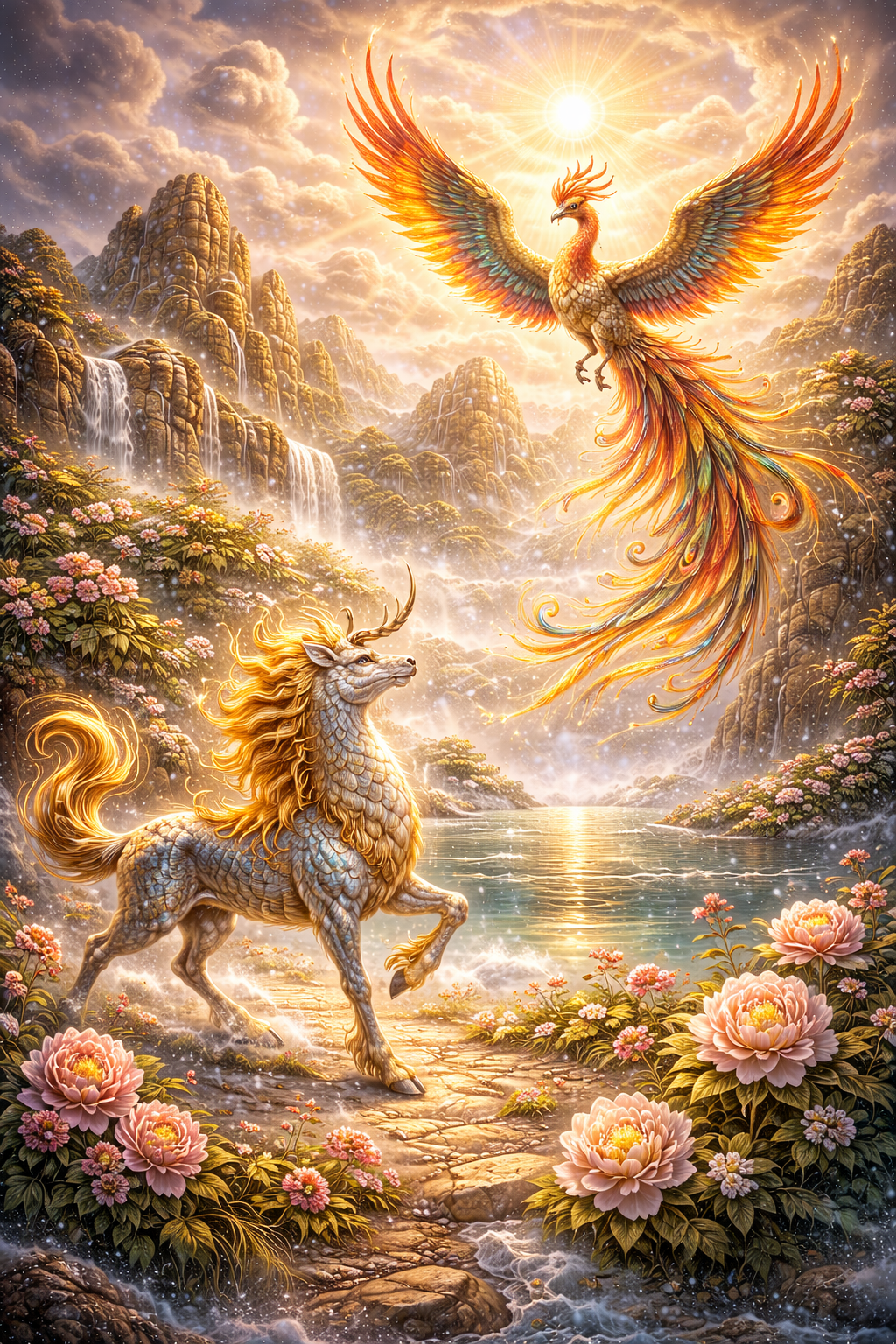
The primary archive preserves these beings in different but related ways. The Shanhaijing describes the fenghuang at Danxue Mountain as a five-colored bird whose patterned body bears the visible signs of virtue, righteousness, ritual propriety, benevolence, and trustworthiness, and whose appearance brings peace to the realm. The Liji groups the qilin and fenghuang with the turtle and dragon as the Four Spirits, placing them within one of the most durable symbolic constellations in Chinese civilization. Later omen literature, encyclopedic compilations, and critical texts such as the Lunheng preserve traditions that associate the fenghuang and qilin with sage kings and prosperous times, even while sometimes subjecting such beliefs to rational critique. In later art and political culture, the fenghuang becomes especially associated with the empress and the refined symbolism of courtly harmony, while the qilin becomes linked to benevolent rulership, rank, and the visual language of auspicious legitimacy.
This article therefore treats the fenghuang and qilin not as isolated marvels, but as signs within a larger mythic and political grammar. They help show how Chinese tradition imagined the world as responsive to moral order. Under proper rule, the realm becomes peaceful; under sage virtue, extraordinary beings may appear; under auspicious conditions, beauty, gentleness, restraint, and cosmic alignment become visible. The fenghuang and qilin are creatures of that visible order.
Why Auspicious Beings Matter
Chinese mythology does not reserve symbolic importance only for beings of danger or overwhelming force. Some of its most meaningful creatures are auspicious beings whose rare appearance signifies right relation between Heaven, Earth, ruler, and people. The fenghuang and the qilin belong to this class. They do not merely inhabit marvel-filled narrative worlds. They appear as signs that the world has become ethically and cosmologically ordered in a particular way.
This is crucial because it reveals a distinctive feature of the Chinese mythic imagination. The marvelous is not always a threat to be subdued. It may instead be a confirmation that virtue has become visible in the fabric of the world. An auspicious being is therefore not simply a decorative wonder. It is a mode by which order announces itself.
In this sense, the fenghuang and qilin occupy a different symbolic register from many monsters, strange beasts, or boundary creatures in the Shanhaijing. They are not primarily warnings of danger, omens of drought, signs of disorder, or inhabitants of frightening borderlands. They are beings whose appearance implies that moral and political conditions have become unusually favorable. Their rarity is part of their significance. They are not ordinary animals of the world; they are signs that the world has reached a condition worthy of them.
This makes auspicious beings politically important as well as mythologically beautiful. If the appearance of the fenghuang or qilin can be read as a sign of sage rule or peace, then mythic creatures become part of the symbolic language of legitimacy. The ruler is judged not only by law, ritual, grain, military success, or administrative order, but by whether the wider cosmos seems to confirm his rule. Auspicious beings make that imagined confirmation visible.
The Fenghuang in Early Textual Tradition
The fenghuang is one of the great auspicious birds of Chinese tradition. The most important early description appears in the Shanhaijing, where Danxue Mountain is said to contain a bird resembling a chicken, with five-colored plumage and patterned markings. The text states that the pattern on its head signifies virtue, the pattern on its wings signifies righteousness, the pattern on its back signifies ritual propriety, the pattern on its breast signifies benevolence, and the pattern on its belly signifies trustworthiness. The bird sings and dances of itself, and when it appears, peace prevails throughout the realm.
Primary Source
又東五百里,曰丹穴之山,其上多金玉。丹水出焉,而南流注于渤海。有鳥焉,其狀如雞,五采而文,名曰鳳皇,首文曰德,翼文曰義,背文曰禮,膺文曰仁,腹文曰信。是鳥也,飲食自然,自歌自舞,見則天下安寧。Five hundred li further east is Danxue Mountain, rich in gold and jade above. The Dan River rises there and flows south into the Bohai. There is a bird whose form is like a chicken, with five-colored patterned plumage. It is called the fenghuang. The pattern on its head is called virtue; the pattern on its wings, righteousness; the pattern on its back, ritual propriety; the pattern on its breast, benevolence; the pattern on its belly, trustworthiness. This bird eats and drinks naturally, sings and dances by itself; when it appears, all under heaven is peaceful and secure.Shanhaijing, “Southern Mountain Classic” 南山經.
This is one of the clearest early examples of a mythic creature whose body is moralized. The fenghuang is not merely beautiful; its visible form is read as virtue, righteousness, propriety, benevolence, and trustworthiness embodied.
This passage is one of the most important in all of Chinese myth for understanding how a creature can be moralized through visible form. The fenghuang does not merely accompany virtue; it embodies it. Its body is itself a text of order. Moral language becomes plumage, and peace becomes ornithological omen. The bird is therefore not only an auspicious sign but a living image of the ethical order by which a civilization claims to stand.
The passage also makes the fenghuang self-sufficient and spontaneous. It eats and drinks naturally; it sings and dances of itself. This matters because the bird’s behavior is not coerced, trained, or domesticated. Its harmony is intrinsic. The fenghuang is not forced into order by rule. It appears when the world itself is ordered enough to receive it. Its song and dance are signs that cosmic, natural, and moral rhythms have come into alignment.
The fenghuang is therefore not merely decorative. It is a creature through which beauty, morality, and public peace are joined. The visible world becomes readable as a moral field, and the auspicious bird becomes one of the signs by which that field announces its harmony.
The Qilin in Early Textual Tradition
The qilin occupies a parallel but distinct place in the world of auspicious beings. Later summaries describe it as a gentle, unicorn-like or composite creature whose rare appearance is associated with the birth or death of a sage, the rise of an illustrious ruler, or the presence of extraordinary moral significance. It is repeatedly treated as a benevolent beast of extraordinary rarity, a creature whose manifestation belongs not to ordinary wilderness but to moments of historical or moral intensity.
The qilin’s gentleness is crucial to its symbolism. Unlike beasts that signify power through predation, the qilin signifies greatness through disciplined harmlessness. In later descriptions, it is said not to trample living grass or harm living things. Whether or not such details belong to the earliest stratum of the tradition, they reveal the symbolic direction of the figure: the qilin is powerful because it does not destroy. It belongs to a vision of civilization in which the highest form of potency is not savage domination but benevolent restraint.
The qilin is also closely tied to sagehood. Traditions connect it with the presence of sages, including the famous story of Confucius responding to the capture of a qilin. In that story-world, the qilin is not simply an animal encountered in the field. It is a being whose fate becomes meaningful for the moral condition of the age. Its appearance and death can be read as commentary on the failure of the world to receive sage virtue.
For this reason, the qilin should not be reduced to a “Chinese unicorn.” The horn may be part of later iconography, but the symbol is broader and deeper. The qilin is a creature of recognition. It appears when the world is worthy—or when the gap between worth and world becomes tragically visible. Its rarity makes it a sign of history’s moral pressure.
The Four Spirits and the Symbolic Order of the World
The Liji places the qilin, fenghuang, turtle, and dragon together as the Four Spirits. This grouping is fundamental because it shows that auspicious beings were not isolated curiosities but part of a larger symbolic order. The dragon brings water, movement, and sovereign potency; the fenghuang brings harmony and peace; the qilin brings benevolent manifestation and sage omen; the turtle brings longevity, depth, and divinatory significance. Together they constitute a compact image of a world in which natural force, moral order, duration, and legitimacy are held in balance.
Primary Source
何謂四靈?麟鳳龜龍,謂之四靈。故龍以為畜,故魚鮪不淰;鳳以為畜,故鳥不獝;麟以為畜,故獸不狘;龜以為畜,故人情不失。What are called the Four Spirits? The qilin, the fenghuang, the turtle, and the dragon are called the Four Spirits. When the dragon is made part of ordered keeping, fish do not scatter in confusion; when the fenghuang is so kept, birds do not become disorderly; when the qilin is so kept, beasts do not run wild; when the turtle is so kept, human dispositions do not lose their proper measure.Liji, “Liyun” 禮記:禮運.
The Four Spirits are not simply a list of marvelous creatures. They form a symbolic system in which animal orders, human feeling, ritual order, and cosmic harmony are brought into relation.
The fourfold grouping helps explain why the fenghuang and qilin became so important in later visual culture. They do not stand alone as decorative motifs. They participate in a broader cosmological grammar. To depict them is to invoke a world of right relation among power, harmony, endurance, and moral auspiciousness.
The grouping also clarifies the difference between auspicious beings and ordinary animals. The dragon, fenghuang, qilin, and turtle are not merely members of the animal world. They are symbolic regulators of categories: fish, birds, beasts, and human feeling. The passage imagines a world in which the right relation to these beings helps stabilize broader orders of life. Mythic animals become figures of classification and harmony.
This is why the Four Spirits became so durable. They provide a small symbolic universe. Each being condenses a different dimension of order, yet together they form a system. The fenghuang and qilin are therefore best read not only individually, but within this wider sacred bestiary of auspicious relation.
Virtue, Omen, and the Appearance of Order
One of the most important dimensions of both the fenghuang and the qilin is their role as omens. Their appearance is repeatedly associated in transmitted texts with sage rule, peaceful ages, or the presence of extraordinary moral worth. Omen literature preserved in later compilations links the fenghuang with Yao and Shun, and critical texts such as the Lunheng discuss the widespread belief that the fenghuang and qilin appear when a sage king arises or when the world is governed properly.
What matters here is not only whether every omen claim is taken literally. The deeper point is that Chinese civilization repeatedly imagined the natural and marvelous worlds as capable of responding to virtue. A just age is not only described in human institutions. It is mirrored in signs. The appearance of auspicious beings makes order visible.
This omen logic belongs to the same symbolic world as the Mandate of Heaven. Heaven grants, withdraws, warns, and judges; the ruler’s conduct becomes visible through public welfare, ritual adequacy, and signs in the world. Auspicious beings extend that logic into animal form. The realm does not merely become peaceful in administrative terms. It becomes the kind of world in which the fenghuang can appear and the qilin can approach.
At the same time, omen traditions are powerful because they are interpretive. A sign must be read. That reading can affirm a ruler, criticize a dynasty, encourage a court, strengthen legitimacy, or invite skepticism. Auspicious beings therefore belong not only to myth but to the politics of interpretation. They are signs around which claims about the moral condition of the age can gather.
The Fenghuang as Bird of Harmony and Rule
The fenghuang gradually becomes one of the great birds of harmony in Chinese tradition. Its five-colored plumage, moralized markings, and rare appearance make it a natural symbol of peace, prosperity, and refined sovereignty. Later summaries present it as an immortal or auspicious bird whose appearance foretells harmony at the accession of a worthy ruler. Because its name and later symbolic history often carry paired male-female dimensions, it also becomes a figure of integrated order rather than unilateral force.
This balancing symbolism helps explain why the fenghuang later becomes strongly associated with the empress and the feminine counterpart to the imperial dragon. In that later political and artistic language, the bird is not subordinate decoration. It is an emblem of courtly complementarity, dynastic elegance, and ordered female sovereignty within the larger cosmos of imperial rule.
The fenghuang’s symbolism differs sharply from the dragon’s, even when the two appear together. The dragon is movement, water, storm, ascent, and imperial potency. The fenghuang is harmony, music, patterned virtue, courtly grace, and peace. The dragon’s power often rises; the fenghuang’s power appears as balanced radiance. Together, they create a visual vocabulary of rule in which force and harmony, emperor and empress, yang and yin, activity and refinement can be brought into symbolic relation.
Yet the fenghuang should not be reduced to courtly femininity alone. Its early Shanhaijing form is a moral bird whose entire body is a sign of ethical order. Later empress imagery develops one branch of that symbolism, but the deeper pattern remains broader: the fenghuang is a creature through which moral harmony becomes visible in the world.
The Qilin as Benevolent Beast and Sage Omen
The qilin, by contrast, is not a bird of harmony but a beast of benevolent manifestation. Its appearance marks the nearness of sagehood, rightful rule, or extraordinary moral significance. Later tradition repeatedly associates it with the presence of a great ruler or sage and with the kind of age in which the world is well-governed enough to attract creatures of unusual purity and gentleness.
The qilin’s symbolism is especially revealing because it joins moral judgment to rarity. It does not simply live among ordinary life unnoticed. It appears when historical conditions have reached a level worthy of its manifestation—or, in some critical traditions, when people wrongly interpret its appearance as proof of such worthiness. This makes the qilin a creature of threshold and recognition. It is the animal form of the claim that the world itself can acknowledge greatness.
The qilin is also important because it imagines power without predation. It is a beast, but not a devouring beast. It has supernatural force, but its idealized form is marked by gentleness. It can become an insignia of rank and authority, yet its authority is not simply violent. The qilin suggests that the most elevated form of power is restrained, auspicious, and morally charged.
This helps explain its association with sagehood. A sage does not merely overpower others. A sage’s authority derives from virtue, recognition, right timing, and the capacity to transform the world without unnecessary harm. The qilin’s symbolic gentleness makes that ideal animal-visible.
Auspicious Beings and the Problem of Political Legitimacy
The fenghuang and the qilin are deeply entangled with the politics of legitimacy. If auspicious beings appear under conditions of proper rule, then their manifestation can be used to interpret, affirm, or contest political authority. This is one reason omen discourse proved so powerful. It offered a way to link rulership not merely to force or inheritance but to signs read in the larger order of things.
This symbolic logic can elevate rulers. A court that claims the appearance of auspicious beings is not merely reporting a marvel; it is claiming cosmic resonance. The world itself appears to approve the age. The ruler’s virtue becomes not only moral rhetoric but visible sign. Such claims can strengthen dynastic legitimacy, especially when paired with language of Heaven, peace, abundance, ritual correctness, and the welfare of the people.
But the same logic can also expose rulers to judgment. If auspicious beings appear only in rightly ordered ages, then their absence, false appearance, misinterpretation, or capture can become politically troubling. The omen system is never politically neutral. It creates a field in which signs matter, but signs must be interpreted—and interpretation is always open to contest.
This is why the fenghuang and qilin belong in close conversation with the Mandate of Heaven. The Mandate says that political authority is conditional and morally judged. Auspicious beings provide one way that such judgment might be imagined as visible. The sign-creature becomes a bridge between mythic zoology and political theology.
Wang Chong and the Critique of Omen Thinking
The Lunheng is especially important because it does not simply repeat omen traditions. It interrogates them. Wang Chong records the belief that the fenghuang and the qilin are sage creatures and that their appearance is connected to sage kings or extraordinary virtue, but he also challenges overly simple interpretations. This makes the Lunheng an essential witness not only to auspicious symbolism but to debates about auspicious symbolism.
Primary Source
鳳皇、麒麟,聖禽也,聖人亦聖也。The fenghuang and the qilin are sage creatures; sages too are sage.Lunheng, “Omen Pointers” 指瑞.
Wang Chong begins from the received association between sage beings and sage humans, but the surrounding argument questions simplistic assumptions about how such creatures appear and what their appearance proves.
This critical voice matters because it shows that auspicious symbolism was never beyond debate. Omen beliefs were culturally powerful enough to require philosophical and rational scrutiny. The issue was not whether the fenghuang and qilin were important symbols; the issue was how their importance should be understood, and whether political claims based on omens could withstand critical reasoning.
Wang Chong’s skepticism is especially valuable because it prevents modern readers from treating Chinese omen discourse as naïve or uniform. The tradition contained its own debates. Some writers preserved and elaborated auspicious claims; others questioned their logic. The fenghuang and qilin therefore belong to a living intellectual world in which signs, evidence, political legitimacy, and cosmological interpretation could be argued over.
This source-critical dimension strengthens the article’s argument. Auspicious beings matter not because every omen claim must be accepted literally, but because the tradition invested them with enough symbolic force that they became sites of political imagination and intellectual critique at once.
Phoenix, Qilin, and the Visual Language of Court Culture
In later Chinese art and court culture, the fenghuang and qilin become major visual signs of rank, authority, and auspicious prestige. The fenghuang appears repeatedly in decorative arts and imperial symbolism, especially in relation to empress imagery and courtly harmony. The qilin likewise becomes part of the iconography of rank and authority, including insignia associated with nobles and later high military officials. Museum collections preserve examples of phoenix and qilin motifs in ceramics, textiles, and badges, showing how thoroughly these auspicious beings entered the material language of political culture.
This later visual life matters because it demonstrates that auspicious beings were not confined to literary imagination. They became part of the visible order of the state. The world of omen and myth entered embroidery, porcelain, badge design, robes, palace decoration, and courtly objects. Symbolic creatures thus helped stage the legitimacy and hierarchy of the social world.
The Met’s Plate with Phoenix and Mythical Qilin, dated to the Kangxi period, is a useful example because it shows the two auspicious creatures together in decorative ceramic form. Such objects do not merely illustrate stories. They preserve a visual vocabulary of auspiciousness, refinement, and cultural memory. The fenghuang and qilin become portable signs of harmony and prestige.
Likewise, the Met’s Rank Badge with Qilin shows how the qilin entered the visual language of hierarchy. The object record notes that after 1662 the qilin became the insignia of first-rank military officials, while earlier it was worn by nobles. This is a major transformation: the mythic beast of sage omen becomes a formal emblem of rank. Its supernatural and benevolent associations are absorbed into state visual order.
Fenghuang, Empress, and Courtly Complementarity
The fenghuang’s later association with the empress is one of the most important developments in its symbolic history. Paired with the dragon, the fenghuang helped structure a visual language of imperial complementarity. The dragon often signified the emperor, active potency, heavenly force, and sovereign command; the fenghuang often signified the empress, harmonious refinement, auspicious beauty, and courtly balance. Together they created an image of imperial order as paired and complementary rather than merely singular.
This courtly use should be read carefully. It can reflect hierarchical gender ideology, but it also preserves a powerful image of feminine sovereignty. The fenghuang is not merely decoration on the margins of dragon power. It carries its own deep symbolism of harmony, virtue, and peace. When attached to the empress, it gives female courtly authority a mythic and auspicious form.
The fenghuang also brings together aesthetic and ethical values. Its beauty is not morally empty. Its patterned body in the Shanhaijing already represents virtue, righteousness, ritual propriety, benevolence, and trustworthiness. Later courtly art extends that logic: beauty becomes a visible sign of ordered relation. The empress-associated fenghuang is therefore a political-aesthetic symbol, not merely a decorative bird.
This is one of the reasons the fenghuang remained so visually durable. It could signify peace, rank, marriage harmony, feminine majesty, dynastic order, and moralized beauty at once. Its symbolic flexibility allowed it to move from mythic mountain text into court costume, ceramics, architectural decoration, and popular auspicious art.
Qilin, Rank Badges, and the Politics of Benevolent Power
The qilin’s later use in rank badges is especially revealing because it turns a sage-associated auspicious beast into a formal sign of social and official hierarchy. A rank badge is not casual decoration. It is a public visual marker of status. To place the qilin on such an object is to incorporate the creature’s mythic associations into the bureaucratic and courtly order of the state.
This development is symbolically complex. The qilin is associated with benevolence, gentleness, sagehood, and auspicious manifestation, yet it becomes the insignia of high military rank. At first glance, that may seem contradictory. But the tension is precisely what makes the symbol interesting. The ideal of military authority in such imagery is not brute violence alone. It is force under moral restraint, power made legitimate through order, rank, and auspicious association.
The flames often shown around qilin figures signal supernatural power, but the creature’s broader symbolic history tempers that power with benevolence. The result is a form of authority that is fierce enough to command respect but auspicious enough to imply moral legitimacy. This makes the qilin especially suitable for a courtly system that wanted rank to appear not merely coercive, but cosmologically and ethically meaningful.
The qilin’s move into rank imagery also shows how mythic beings can be institutionalized. A creature once associated with sage omen becomes part of the visual bureaucracy of empire. The animal of rare manifestation becomes an embroidered sign repeated across official bodies. Myth becomes administrative clothing.
Auspicious Beings and the Ethics of Nonviolence
One of the most striking features of the fenghuang and qilin is that their symbolic power is not primarily violent. The fenghuang sings and dances; the qilin appears with gentleness and restraint. They belong to a mythic vocabulary in which the highest signs of order are not always military, predatory, or coercive. This is an important counterpoint to traditions centered on conquest, monster-slaying, or the domination of chaotic beings.
The fenghuang’s peace is visible in its appearance. The Shanhaijing states that when it appears, all under heaven is peaceful and secure. The qilin’s gentleness is visible in its idealized refusal to harm. Together, they show that the marvelous can signify the absence of violence rather than its triumph. They are signs of a world that does not need to be continually subdued by force.
This does not mean that Chinese mythology lacks martial figures or violent conflict. Huangdi fights Chiyou; Yinglong participates in war; Yu struggles against flood; dragons can be overwhelming; strange beings can be dangerous. But the fenghuang and qilin preserve another register: order as beauty, restraint, harmony, and moral recognition. Their power lies not in conquest, but in appearing when conquest is no longer the defining problem.
This makes them especially important for the ethical imagination of myth. They suggest that the highest form of order may be known by what no longer needs to be harmed. The world becomes auspicious when violence recedes and living beings can occupy their proper places.
Source History and Interpretive Caution
A careful reading of the fenghuang and the qilin must distinguish between early textual descriptions, later omen literature, critical discussions, and still later artistic and political uses. The Shanhaijing gives a powerful early moralized image of the fenghuang. The Liji situates both creatures among the Four Spirits. Omen compilations elaborate their association with sage rule. The Lunheng records and critiques those beliefs. Later art and imperial culture transform them into visual and rank-bearing symbols.
These are not contradictions to be erased. They are the historical development of auspicious symbolism. The fenghuang and qilin remain significant precisely because they can move from mythic description to political omen to artistic emblem without losing their core association with harmony, benevolence, auspicious rarity, and rightly ordered rule.
It is also important not to flatten these beings through translation. “Phoenix” and “unicorn” may be convenient English approximations, but they carry associations from other mythic traditions that can distort the Chinese material. The fenghuang is not primarily a bird that dies and is reborn from flames. The qilin is not merely a one-horned horse. Both are composite symbolic beings rooted in Chinese cosmology, omen thought, court visual culture, and the ethics of sage rule.
Finally, auspicious symbols must be read with political caution. Claims about omens can elevate legitimate virtue, but they can also serve political propaganda. The presence of Lunheng-style critique within the tradition reminds us that Chinese thinkers themselves debated how much should be inferred from signs. A serious reading preserves both the symbolic power of auspicious beings and the critical intelligence that questioned how such signs were used.
Why These Beings Still Matter
The fenghuang and the qilin still matter because they preserve one of the most distinctive possibilities in Chinese myth: that the marvelous may appear not as rupture or menace, but as confirmation that the world is morally and cosmologically aligned. They belong to a vision in which order becomes visible through beauty, gentleness, pattern, and auspicious rarity.
They also matter because they show how deeply Chinese civilization linked political legitimacy to symbolic manifestation. A just world does not simply govern well; it becomes the kind of world in which certain beings may appear. Under the sign of the phoenix and the qilin, peace, virtue, sagehood, and dynastic harmony become visible in the forms of living creatures.
They matter, too, because they offer a counterpoint to power imagined as domination. The dragon’s storm power and imperial symbolism are essential to Chinese myth, but the fenghuang and qilin reveal another dimension of authority: order that sings, dances, appears gently, refuses unnecessary harm, and confirms rather than conquers. Their auspiciousness is not weakness. It is a different kind of power.
Finally, these beings matter because they show how myth moves across media. The fenghuang and qilin begin in textual, omen, and ritual worlds; they become subjects of philosophical critique; they enter ceramics, textiles, rank badges, imperial symbolism, and decorative arts; and they continue to appear in modern visual culture as signs of harmony and good fortune. They endure because they make moral order beautiful.
Related Reading
- Chinese Myth, Folklore & Legend
- What Is Chinese Myth, Folklore & Legend?
- The Problem of Sources in Chinese Mythology
- Reading the Shanhaijing: Mythic Geography, Strange Beings, and Sacred Space
- Heaven, Mandate, and the Mythic Imagination of Rule
- Dragons in Chinese Myth, Water Cosmology, and Imperial Symbolism
- Animals, Omens, and Symbolic Creatures in Chinese Folk Imagination
- Women, Spirits, and Gendered Power in Chinese Legend
Primary Sources
- Chinese Text Project (n.d.) Shanhaijing: Nanshan jing 山海經:南山經 / Southern Mountain Classic. Available at: https://ctext.org/shan-hai-jing/nan-shan-jing
- Chinese Text Project (n.d.) Liji: Liyun 禮記:禮運 / Book of Rites: Conveyance of Rites. Available at: https://ctext.org/liji/li-yun/ens
- Chinese Text Project (n.d.) Liji: Liyun 禮記:禮運, Chinese text and parallel passages on the Four Spirits. Available at: https://ctext.org/text.pl?node=9874&if=gb&remap=gb&show=parallel
- Chinese Text Project (n.d.) Lunheng: Zhi rui 論衡:指瑞 / Omen Pointers. Available at: https://ctext.org/lunheng/zhi-rui
- Chinese Text Project (n.d.) Lunheng: Jiang rui 論衡:講瑞 / Discussion of Omens. Available at: https://ctext.org/lunheng/jiang-rui
- Chinese Text Project (n.d.) Yiwen leiju: Feng 藝文類聚:鳳. Useful for later encyclopedic citations on the fenghuang and the Four Spirits. Available at: https://ctext.org/text.pl?if=en&node=550382
Further Reading
- Chinese Text Project (n.d.) Shanhaijing: Nanshan jing. Available at: https://ctext.org/shan-hai-jing/nan-shan-jing
- Chinese Text Project (n.d.) Liji: Liyun. Available at: https://ctext.org/liji/li-yun/ens
- Chinese Text Project (n.d.) Lunheng: Zhi rui. Available at: https://ctext.org/lunheng/zhi-rui
- Chinese Text Project (n.d.) Lunheng: Jiang rui. Available at: https://ctext.org/lunheng/jiang-rui
- Chinese Text Project (n.d.) Yiwen leiju: Feng. Available at: https://ctext.org/text.pl?if=en&node=550382
- Encyclopaedia Britannica (n.d.) “Fenghuang.” Available at: https://www.britannica.com/topic/fenghuang
- Encyclopaedia Britannica (n.d.) “Qilin.” Available at: https://www.britannica.com/topic/qilin
- The Metropolitan Museum of Art (n.d.) “Plate with Phoenix and Mythical Qilin.” Available at: https://www.metmuseum.org/art/collection/search/42405
- The Metropolitan Museum of Art (n.d.) “Rank Badge with Qilin.” Available at: https://www.metmuseum.org/art/collection/search/69079
- The Metropolitan Museum of Art (n.d.) “Scroll Cover with Mythical Creature.” Available at: https://www.metmuseum.org/art/collection/search/60509
- Birrell, A. (1993) Chinese Mythology: An Introduction. Baltimore: Johns Hopkins University Press. Available at: https://archive.org/details/chinesemythology0000birr
- Yang, L. and An, D. (2005) Handbook of Chinese Mythology. Santa Barbara: ABC-CLIO. Available at: https://archive.org/details/handbookofchines0000yang
References
- Birrell, A. (1993) Chinese Mythology: An Introduction. Baltimore: Johns Hopkins University Press. Available at: https://archive.org/details/chinesemythology0000birr
- Chinese Text Project (n.d.) Liji: Liyun. Available at: https://ctext.org/liji/li-yun/ens
- Chinese Text Project (n.d.) Liji: Liyun, Chinese text and parallel passages on the Four Spirits. Available at: https://ctext.org/text.pl?node=9874&if=gb&remap=gb&show=parallel
- Chinese Text Project (n.d.) Lunheng: Jiang rui. Available at: https://ctext.org/lunheng/jiang-rui
- Chinese Text Project (n.d.) Lunheng: Zhi rui. Available at: https://ctext.org/lunheng/zhi-rui
- Chinese Text Project (n.d.) Shanhaijing: Nanshan jing. Available at: https://ctext.org/shan-hai-jing/nan-shan-jing
- Chinese Text Project (n.d.) Yiwen leiju: Feng. Available at: https://ctext.org/text.pl?if=en&node=550382
- Encyclopaedia Britannica (n.d.) “Fenghuang.” Available at: https://www.britannica.com/topic/fenghuang
- Encyclopaedia Britannica (n.d.) “Qilin.” Available at: https://www.britannica.com/topic/qilin
- The Metropolitan Museum of Art (n.d.) “Plate with Phoenix and Mythical Qilin.” Available at: https://www.metmuseum.org/art/collection/search/42405
- The Metropolitan Museum of Art (n.d.) “Rank Badge with Qilin.” Available at: https://www.metmuseum.org/art/collection/search/69079
- The Metropolitan Museum of Art (n.d.) “Scroll Cover with Mythical Creature.” Available at: https://www.metmuseum.org/art/collection/search/60509
- Yang, L. and An, D. (2005) Handbook of Chinese Mythology. Santa Barbara: ABC-CLIO. Available at: https://archive.org/details/handbookofchines0000yang