
Last Updated May 5, 2026
Few creatures in Chinese mythology are as symbolically dense as the dragon. The dragon is never merely an animal of marvel, nor merely a decorative emblem detached from belief. In Chinese tradition it belongs at once to water, weather, ascent, authority, fertility, ritual imagination, and cosmic potency. It moves through rivers, lakes, seas, clouds, storms, bronze vessels, palace iconography, festival performance, and political symbolism. To write about dragons in Chinese myth is therefore to write about a figure that joins natural force, sacred imagination, and political order in a single form.
The Chinese dragon, long 龍, differs sharply from many later European dragon traditions in which the dragon is often imagined primarily as an adversarial monster to be slain. Chinese dragons can be dangerous, overwhelming, or difficult to approach, but they are more often powers of life-giving force: rain, clouds, rivers, oceans, vitality, imperial authority, auspicious transformation, and the movement between earth and heaven. Their symbolic range is vast because they belong to relations rather than to one fixed role. They are aquatic and celestial, natural and political, wild and ritualized, cosmic and imperial.
Article Map
Chinese Myth, Folklore & Legend
Related Topic
Shanhaijing & Sacred Space
Series context: This article is part of the Chinese Myth, Folklore & Legend knowledge series. It should be read alongside What Is Chinese Myth, Folklore & Legend?, The Problem of Sources in Chinese Mythology, Reading the Shanhaijing: Mythic Geography, Strange Beings, and Sacred Space, Chaos, Cosmos, and the Origins of the World in Chinese Myth, Kunlun, Paradise Mountains, and the Sacred Geography of the West, and The Queen Mother of the West and the Imagery of Immortality. Within that sequence, dragons matter because they reveal how Chinese mythology thinks through water, rain, seasonality, sacred power, ascent, and the relationship between natural force and legitimate order.
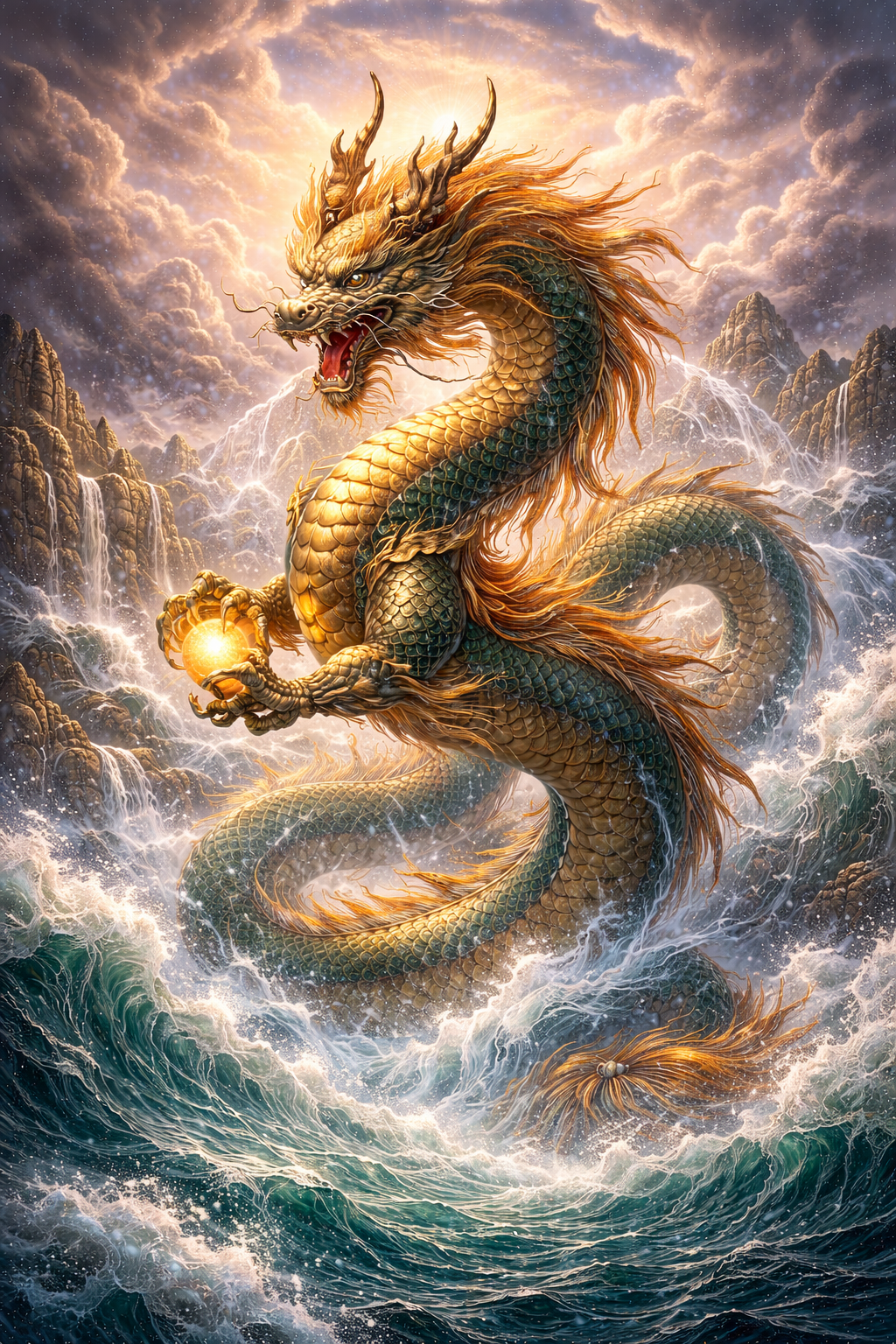
The primary archive does not preserve one single dragon doctrine. It preserves a field of meanings. The Shanhaijing associates the winged dragon Yinglong with warfare, the defeat of Chiyou and Kuafu, the south, rainfall, drought, and water management. The Yijing uses dragon imagery in the Qian hexagram to think through hidden power, emergence, ascent, rulership, timing, and the danger of excess. Later ritual and post-classical materials develop rain-making practices involving dragon images. Reference traditions summarize the broader pattern by describing the Chinese dragon as originally a rain divinity associated with beneficence and fecundity, while museum sources trace dragon imagery from early ritual bronzes into courtly and imperial forms. The result is a long symbolic history in which dragons remain tied to water cosmology even as they become emblems of sovereignty.
This article therefore treats the Chinese dragon as a layered mythic symbol rather than a single creature type. The dragon is water power, storm power, imperial emblem, ritual image, cosmic sign, and visual language. Its durability lies in its capacity to move across domains without losing its core associations: moisture, vitality, ascent, potency, danger, auspiciousness, and ordered force.
Why Dragons Matter in Chinese Myth
The Chinese dragon matters because it is a figure of relation rather than mere monstrosity. It links waters and clouds, hidden depths and heavenly ascent, natural fertility and political authority, ritual petition and imperial iconography. Unlike dragon traditions centered primarily on combat against a monstrous adversary, Chinese dragon traditions often emphasize beneficence, rain, fecundity, auspicious power, and the circulation of vitality between earth and sky.
This symbolic range explains the dragon’s unusual durability. It can signify rain, power, ascent, vigor, imperial prestige, seasonal renewal, ritual efficacy, and the concentrated vitality of nature all at once. It is a creature of movement between domains: water and sky, earth and heaven, ritual object and political emblem, local weather cult and imperial symbol. This capacity to cross symbolic registers made the dragon one of the most enduring figures in Chinese civilization.
The dragon also matters because it reveals how Chinese mythic thought often avoids sharp divisions between nature and culture. Water, rain, grain, river, ruler, ritual, and cosmic order belong to one field of concern. The dragon embodies that field. A creature associated with rain is also associated with prosperity; a creature associated with clouds is also associated with heavenly movement; a creature associated with imperial authority is also associated with the forces that make agriculture and life possible.
For this reason, the dragon is not a marginal fabulous animal. It is one of the symbolic centers of Chinese mythology. Through the dragon, the natural world becomes politically meaningful, and political order becomes cosmologically charged.
Dragons and Water Cosmology
At the deepest mythic level, the Chinese dragon belongs to water. Dragons dwell in rivers, lakes, oceans, wells, and seas, yet they also roam the skies. This dual placement is decisive. The dragon is aquatic and atmospheric at once. It moves from depths to clouds, from river to storm, from hidden water to visible rain. It therefore symbolizes the circulation of life-giving moisture across the world.
This water cosmology matters because it places the dragon inside one of the most fundamental concerns of agrarian civilization: the regulation of rain. Water is never merely natural background in the Chinese mythic imagination. It is bound to fertility, grain, seasonality, flood, drought, travel, fishing, maritime danger, and political responsibility. A creature that governs or embodies rain and waterways is therefore never marginal. The dragon occupies the vital threshold where cosmology and subsistence meet.
The dragon’s watery power is also morally and politically ambivalent. Rain makes crops grow, but too much water can become flood. Drought threatens hunger and disorder, but uncontrolled storm can destroy what it nourishes. Dragon power therefore requires relation, petition, ritual, timing, and regulation. The dragon is not simply “good” in a sentimental sense. It is powerful, and that power must be brought into right relation with human life.
That is why dragons appear so naturally in contexts of weather ritual and hydrological imagination. They are the mythic beings through whom communities could imagine, petition, and symbolically negotiate the conditions of rain, fertility, and survival.
Yinglong and the Mythic Dragon of Rain, War, and Drought
One of the most important dragon figures in the transmitted archive is Yinglong, the winged dragon. In the Shanhaijing, Yinglong appears in association with Chiyou, Kuafu, the south, water, storm, and rainfall. These passages are crucial because they show that dragons were not abstract symbols alone. They were narrative powers whose movement and location shaped climatic consequence.
Primary Source
應龍已殺蚩尤,又殺夸父,乃去南方處之,故南方多雨。Yinglong had already killed Chiyou and also killed Kuafu; then he went to the south and dwelt there. Therefore the southern regions have much rain.Shanhaijing, “Northern Classic of the Great Wilderness” 大荒北經.
This passage links Yinglong to martial power and rainfall. The dragon’s location explains a regional weather pattern, making mythic movement a climatic cause.
The passage matters because it gives dragon mythology a geographic and meteorological logic. Yinglong’s presence in the south helps explain why the south is rainy. The dragon is therefore not only a creature in a story; he is a way of narrating regional climate through mythic agency. Movement, battle, and residence become explanations of weather.
A nearby passage in the Shanhaijing develops the same symbolic field through the war between Huangdi and Chiyou. In this account, Huangdi commands Yinglong to attack Chiyou on the plain of Jizhou. Yinglong stores up water; Chiyou summons the Wind Earl and Rain Master to unleash great wind and rain; Huangdi then sends down the heavenly female power Ba, who stops the rain. The war becomes an atmospheric conflict: dragon water, storm powers, divine drought, and martial victory all converge.
Primary Source
蚩尤作兵伐黃帝,黃帝乃令應龍攻之冀州之野。應龍畜水,蚩尤請風伯、雨師,縱大風雨。黃帝乃下天女曰魃。雨止,遂殺蚩尤。Chiyou raised weapons to attack the Yellow Emperor, and the Yellow Emperor ordered Yinglong to attack him on the plain of Jizhou. Yinglong stored up water, while Chiyou summoned the Wind Earl and Rain Master and released great wind and rain. The Yellow Emperor then sent down from heaven a female deity named Ba. The rain stopped, and they killed Chiyou.Shanhaijing, “Northern Classic of the Great Wilderness” 大荒北經.
Here Yinglong belongs to a larger weather-war complex. Dragon power, wind, rain, drought, warfare, and political consolidation are presented as one mythic field.
Yinglong is especially important because this figure unites several themes that later remain central to dragon symbolism: martial potency, atmospheric control, southern rainfall, water storage, drought, and ritual efficacy. The dragon here is not just a water creature. It is a force whose location and action shape the inhabited world. This is a distinctly Chinese model of dragon mythology in which dragon power participates directly in the ordering or disordering of climate, territory, and rule.
Dragons, Rainmaking, and the Regulation of Weather
The connection between dragons and rain was not limited to narrative myth. Dragon imagery appears in rain rituals and weather petitions because the dragon functions as an intermediary between human communities and atmospheric powers. When drought threatens crops, livestock, households, and public stability, dragon ritual gives the crisis symbolic form. The community appeals to the dragon because the dragon belongs to rain’s imagined agency.
This ritual role matters because it confirms the dragon’s position in Chinese water cosmology as a mediating figure between natural process and human petition. The dragon is invoked when the relation between heaven and earth becomes dangerously unstable. Too little rain threatens life; too much rain threatens order. Dragon ritual is one means by which the human community seeks to realign itself with the atmospheric powers on which it depends.
Rainmaking traditions involving dragon images also reveal how myth becomes practice. A mythic creature becomes an image, an image becomes a ritual participant, and ritual action becomes a way of addressing ecological vulnerability. This movement from story to image to communal action is one of the most important features of Chinese folklore and popular religion.
The dragon’s association with rain also explains why it could become both local and imperial. Villages, towns, ritual specialists, and local communities could appeal to dragons for rain, while rulers could associate themselves with dragon power as a sign of cosmic legitimacy. The dragon could therefore mediate weather at the local level and sovereignty at the imperial level without losing coherence.
Dragons, Rivers, Seas, and the Aquatic Realm
Dragons in Chinese mythology also belong to the riverine and marine world. They dwell in rivers, lakes, oceans, wells, and undersea palaces. This aquatic sovereignty becomes especially important in later popular belief, where spiritually significant weather dragons develop into Dragon Kings associated with the four oceans, rain delivery, and the protection of seafarers. The dragon’s movement from weather creature to water sovereign is one of the clearest signs of its centrality in Chinese religious imagination.
That aquatic sovereignty proved extraordinarily durable. Once dragons become kings of seas and controllers of rain, they no longer function merely as singular beasts of mythic narrative. They become a divine bureaucracy of water, governing domains essential to travel, fishing, agriculture, coastal danger, and regional cult life. The dragon’s palace beneath the sea, familiar from later literature, is not merely fantasy architecture. It is a way of imagining the water world as politically ordered.
This is a crucial difference from traditions in which water monsters represent only chaos. Chinese dragon traditions often treat the aquatic realm as organized by sovereign beings. The sea is dangerous, but it also has a court. Rain is unpredictable, but it has rulers. The underwater world is hidden, but it is not without hierarchy. Dragon Kings bring the bureaucratic imagination of Chinese religion into the waters themselves.
This later development also connects dragons with ordinary human vulnerability. Farmers need rain. Sailors need protection. Coastal communities fear storm. Travelers depend on safe waterways. Dragon Kings and water dragons therefore belong to practical religious life as much as literary imagination. They are powers addressed because water decides survival.
Cosmic Force, Yang, and Heavenly Ascent
The dragon’s meaning is not exhausted by water. In Chinese cosmological interpretation, the dragon also belongs to upward movement, activity, potency, and heavenly ascent. It rises from hidden depths into the sky, from river or sea into cloud, from latent force into visible power. This capacity to move vertically makes the dragon one of the great symbolic figures of transformation.
The dragon therefore binds elemental and cosmological symbolism together. It is watery without being merely low. It is heavenly without ceasing to arise from the depths. It is hidden and manifest, coiled and flying, submerged and ruling. The dragon’s ascent makes visible a pattern central to Chinese thought: power emerges according to timing, relation, and alignment. It must not be forced before its time, and it must not exceed proper limits after reaching height.
This upward potency helps explain why the dragon becomes such a natural emblem of sovereignty. A ruler identified with the dragon is not merely associated with force. He is associated with the principle of active ordering itself. The dragon’s ascent, like its rain-bearing capacity, suggests power that is simultaneously natural, cosmic, and political.
That association does not mean the dragon is only a symbol of domination. It is also a symbol of generative force. Dragon power is legitimate when it nourishes, orders, protects, and aligns heaven and earth. It becomes dangerous when it is excessive, mistimed, or detached from right relation.
The Yijing and the Dragon as Timed Power
The Yijing gives one of the most philosophically important uses of dragon imagery in the Chinese tradition. In the Qian hexagram, the dragon appears in a sequence of positions: hidden, seen in the field, leaping from the deep, flying in the sky, and finally exceeding the proper limit. These images do not present the dragon only as a creature of mythic wonder. They use the dragon to think through timing, virtue, emergence, rulership, and restraint.
Primary Source
九五:飛龍在天,利見大人。Nine in the fifth place: the flying dragon is in the heavens. It is beneficial to see the great person.Yijing, Qian 乾.
In the Qian hexagram, the dragon is not merely an animal. It becomes an image of active power reaching its proper height in relation to rulership and timing.
The commentarial tradition makes the timing explicit. The hidden dragon is not yet to be used; the dragon in the field indicates virtue becoming visible; the dragon in the heavens belongs to high rule; the overreaching dragon brings regret. In this sequence, the dragon becomes a disciplined image of power. Potency must unfold according to time and place. Even the highest ascent can become dangerous if it exceeds proper measure.
Primary Source
「潛龍勿用」,下也;「見龍在田」,時舍也;「終日乾乾」,行事也;「或躍在淵」,自試也;「飛龍在天」,上治也;「亢龍有悔」、窮之災也。“The hidden dragon should not be used”: it is below. “The dragon appears in the field”: the time has not yet fully arrived. “All day active and vigilant”: this is carrying out affairs. “Perhaps leaping in the abyss”: this is self-testing. “The flying dragon is in the heavens”: this is rule from above. “The overreaching dragon has regret”: this is the disaster of reaching extremity.Yijing, Qian commentary 乾文言.
The dragon here becomes a grammar of emergence, testing, rule, and limit. Dragon power must be timed, disciplined, and kept within proper measure.
The Yijing dragon therefore helps explain why the dragon could become so closely associated with rulership. It is not only a powerful being. It is an image of power properly timed. The ruler, like the dragon, must know when to remain hidden, when to appear, when to act, when to test, when to ascend, and when not to overreach. The dragon’s symbolic force is inseparable from restraint.
This philosophical use of dragon imagery deepens the water and weather symbolism. The dragon is not only rain-bearing life force. It is also a model of dynamic order: hidden potency becoming public authority through proper alignment with time.
Dragons in Early Art and Ritual Material Culture
Dragons belong to Chinese visual culture from an early period. Museum sources make clear that real and imagined creatures, including dragons, were endowed with special attributes and represented on ritual bronze vessels from China’s earliest dynastic eras. Shang ritual bronzes included dragon motifs among other powerful animal and geometric forms. These materials are significant because they show that dragon symbolism was embedded in ceremonial material culture, not merely in later legend.
That ritual-material presence matters for interpretation. A dragon on a bronze vessel is not just ornament. It belongs to a world in which ritual, sacrifice, ancestral communication, elite authority, and sacred force are materially staged. The early dragon is therefore already part of a symbolic economy linking power, ritual, and visual intensity.
The bronze vessel also changes how one reads the dragon. In narrative, the dragon may fly, bring rain, fight, or dwell in water. On ritual objects, the dragon becomes patterned surface, sacred ornament, visual force, and ceremonial presence. The symbol does not merely illustrate a story. It participates in a ritual environment.
This early material history helps explain later imperial dragon symbolism. The imperial dragon did not emerge from nothing as a decorative emblem. It drew upon older associations among sacred beasts, ritual vessels, elite authority, and the visual language of power. The dragon was already capable of carrying more than zoological meaning. It had become a sign through which authority could be made visible.
Imperial Symbolism and the Politics of the Dragon
One of the most consequential later developments in the history of the Chinese dragon is its adoption as an imperial emblem. This transition is not accidental. The dragon is fitted for imperial use precisely because it already carries associations of heaven, yang, ascent, rain, beneficence, sacred force, and ordered potency. The emperor as dragon bearer or dragon embodiment appears not merely stronger than ordinary people, but closer to the cosmological principles that sustain order.
The imperial dragon is therefore myth translated into court iconography and political theology. Robes, thrones, screens, palace decoration, regalia, flags, and official imagery could draw upon dragon symbolism to stage the ruler’s relation to Heaven, fertility, and cosmic vitality. In that setting, the dragon becomes less an independent mythic creature than an image of sovereign embodiment.
Yet this political use should be read critically. When the dragon becomes imperial, its generative and natural meanings are not erased, but they are harnessed to hierarchy. A symbol of water, rain, and cosmic vitality becomes a sign of dynastic authority. The power that nourishes crops and fills rivers also legitimates the ruler who claims to stand at the center of the world.
This makes the dragon one of the strongest examples of how Chinese mythic symbols move between natural cosmology and political order. The dragon can rise from water to cloud; it can also move from ritual vessel to imperial robe. In both cases, it makes power visible.
Dragon Kings, Popular Belief, and Later Religious Life
Later religious and literary traditions make the dragon even more socially active. Weather dragons become Dragon Kings, Longwang 龍王, dwelling in the four oceans, delivering rain, protecting seafarers, and participating in the broader sacred bureaucracy of Chinese popular religion. The dragon here becomes both mythic sovereign and divine official. It rules a watery domain, but it also belongs to a larger cosmic administration.
This later development matters because it reveals how dragon symbolism moved between elite, popular, and literary worlds without losing coherence. The dragon can still be imperial emblem, but it can also be rain lord, sea king, ritual object, temple deity, protector of sailors, or character in narrative fiction. Its symbolic flexibility is one of the reasons it remains central to Chinese mythic culture.
The Dragon Kings also show how the aquatic world is moralized and bureaucratized. Seas are not simply natural expanses; they are domains with rulers. Rain is not merely weather; it is administered. Storms and droughts are not only meteorological events; they can become matters of petition, ritual, and divine responsibility. This is a distinctive feature of later Chinese religious imagination: invisible powers are often organized through offices, courts, ranks, and procedures.
Literary traditions such as Journey to the West intensify this image by portraying Sea Dragon Kings as courtly powers with palaces, protocols, treasures, kinship relations, and divine responsibilities. The dragon becomes narrative personality without ceasing to be water sovereignty. The mythic creature becomes a participant in a richly bureaucratic cosmos.
Dragon Dance, Festival Performance, and Living Symbolism
The dragon’s ritual life continues through performance. Dragon dances, festival processions, and public celebrations make the dragon visible as collective movement. In performance, the dragon is not a static emblem. It becomes body, rhythm, coordination, color, sound, and communal energy. Multiple performers animate a single serpentine form, turning dragon power into shared motion.
This matters because performance preserves myth differently from texts. A text describes the dragon; a bronze vessel patterns it; an imperial robe displays it; a dance animates it. In festival space, the dragon’s connection to good fortune, vitality, seasonal renewal, and communal blessing becomes public and embodied. Myth enters the street.
The dragon dance also preserves the dragon’s relational nature. Its body moves through coordinated human labor. It requires timing, strength, attention, and collective discipline. The creature associated with rain, clouds, and cosmic vitality is brought into being through social cooperation. The community does not only watch the dragon; it helps animate it.
This performative life helps explain the dragon’s modern durability. Even where mythic belief changes, the dragon remains culturally active through festivals, public art, dance, diaspora celebrations, New Year observances, and visual identity. The dragon survives because it can be performed as well as believed, displayed, narrated, and ritualized.
Dragon and Phoenix: Courtly Pairing and Auspicious Order
The dragon often appears in relation to other auspicious beings, especially the phoenix. In later courtly and decorative culture, the dragon and phoenix become one of the most powerful pairings of Chinese visual symbolism. The dragon often carries associations of imperial, masculine, active, heavenly, or yang force, while the phoenix carries associations of auspicious beauty, harmony, virtue, feminine sovereignty, and ordered flourishing. Together they form an image of balanced auspicious order.
This pairing should not be reduced to a simplistic gender binary, but its gendered and courtly implications are important. The dragon and phoenix together became especially significant in marriage imagery, imperial imagery, textiles, ceramics, decorative arts, and visual expressions of harmony. They translate cosmological complementarity into visual form.
The pairing also shows that the dragon’s meaning becomes richer when read within a broader bestiary of auspicious beings. The dragon is not alone in Chinese symbolic culture. It belongs alongside phoenix, qilin, tortoise, tiger, crane, deer, carp, and many other creatures that carry moral, cosmic, social, or auspicious meanings. The dragon’s power is distinctive, but it participates in a larger world of symbolic animals.
This is one reason the dragon remained so artistically productive. It could stand alone as imperial or water power, or it could appear within paired and patterned systems of auspicious meaning. It could signify command, but also harmony; potency, but also blessing; sovereignty, but also renewal.
Source History and Interpretive Caution
A careful reading of dragons in Chinese mythology requires distinguishing among several overlapping layers: early mythic texts such as the Shanhaijing; classical symbolic uses such as the dragon imagery in the Yijing; ritual and historiographical citations linking dragons to drought and rainmaking; early material culture in bronze and jade; later religious traditions of Dragon Kings; imperial iconography; and modern festival performance. These layers should not be collapsed too quickly into a single timeless “Chinese dragon.” Their differences are part of the history of the symbol.
At the same time, the continuities are real. Across these layers, the dragon remains attached to water, weather, potency, elevation, transformation, and ordered power. That is why the symbol can travel so successfully from myth to art to empire to festival. It changes context, but it does not lose its core associations.
It is also important to avoid flattening the dragon into either decorative harmlessness or authoritarian symbolism alone. The dragon is auspicious, but not trivial. It becomes imperial, but it is older and wider than imperial power. It belongs to popular rain ritual as well as court display, to rivers and seas as well as palace robes, to the Shanhaijing as well as later literature and festival practice.
The dragon’s significance lies precisely in this layered movement. It is one of the rare mythic figures that can be natural, religious, political, philosophical, artistic, and performative without becoming incoherent. The dragon is a symbol of continuity through transformation.
Why Dragons Still Matter
Dragons still matter in Chinese mythology because they offer one of the clearest symbolic syntheses of nature, cosmology, and power. They join rivers and clouds, rain and kingship, fertility and authority, sacred danger and beneficent order. They are creatures through which life-giving water and legitimating force are imagined together.
They also matter because their history reveals something larger about Chinese myth itself: major symbols endure by moving across domains. The dragon begins in sacred imagination, enters ritual and art, becomes imperial emblem, remains active in popular religion, and survives in modern festival performance and global cultural identity. Its continuity is not static. It is adaptive.
The dragon matters, too, because it resists simple comparison. It is not merely a Chinese version of a universal monster. It is a creature shaped by water cosmology, agrarian vulnerability, weather ritual, imperial symbolism, and the visual language of auspicious power. Comparative mythology can learn from it precisely because it does not fit every external dragon category.
Finally, the dragon matters because it remains one of the great images of ordered vitality. It rises from hidden water into cloud, brings rain, signals power, tests timing, marks sovereignty, and animates public celebration. Under its sign, water cosmology and political symbolism become mutually legible. That is why the dragon remains one of the most powerful figures in the Chinese mythic archive.
Related Reading
- Chinese Myth, Folklore & Legend
- What Is Chinese Myth, Folklore & Legend?
- The Problem of Sources in Chinese Mythology
- Reading the Shanhaijing: Mythic Geography, Strange Beings, and Sacred Space
- The Yellow Emperor and the Mythic Politics of Chinese Origins
- Heaven, Mandate, and the Mythic Imagination of Rule
- Phoenix, Qilin, and the World of Auspicious Beings
- Animals, Omens, and Symbolic Creatures in Chinese Folk Imagination
Primary Sources
- Chinese Text Project (n.d.) Shanhaijing: Da Huang Bei Jing 山海經:大荒北經 / Northern Classic of the Great Wilderness. Available at: https://ctext.org/shan-hai-jing/da-huang-bei-jing
- Chinese Text Project (n.d.) Yijing: Qian 易經:乾. Available at: https://ctext.org/book-of-changes/qian
- Chinese Text Project (n.d.) Yijing: Qian 易經:乾, Chinese text. Available at: https://ctext.org/book-of-changes/qian/zh
- Chinese Text Project (n.d.) Hou Hanshu 後漢書, ritual and disaster citations related to Yinglong and drought response. Available at: https://ctext.org/wiki.pl?chapter=1944829&if=en
- Chinese Text Project (n.d.) Journey to the West 西遊記. Useful for later literary Dragon King traditions and sea-court imagination. Available at: https://ctext.org/xiyouji
Further Reading
- Chinese Text Project (n.d.) Shanhaijing: Da Huang Bei Jing. Available at: https://ctext.org/shan-hai-jing/da-huang-bei-jing
- Chinese Text Project (n.d.) Yijing: Qian. Available at: https://ctext.org/book-of-changes/qian
- Chinese Text Project (n.d.) Hou Hanshu, ritual and disaster citations related to Yinglong and drought response. Available at: https://ctext.org/wiki.pl?chapter=1944829&if=en
- Encyclopaedia Britannica (n.d.) “Long.” Available at: https://www.britannica.com/topic/long
- Encyclopaedia Britannica (n.d.) “Shenlong.” Available at: https://www.britannica.com/topic/Shenlong
- Encyclopaedia Britannica (n.d.) “What does the Chinese dragon represent?” Available at: https://www.britannica.com/question/What-does-the-Chinese-dragon-represent
- The Metropolitan Museum of Art (2004) “Nature in Chinese Culture.” Available at: https://www.metmuseum.org/essays/nature-in-chinese-culture
- The Metropolitan Museum of Art (2004) “Shang and Zhou Dynasties: The Bronze Age of China.” Available at: https://www.metmuseum.org/essays/shang-and-zhou-dynasties-the-bronze-age-of-china
- The Metropolitan Museum of Art (2003) “A New Visual Language Transmitted Across Asia.” Available at: https://www.metmuseum.org/essays/a-new-visual-language-transmitted-across-asia
- Birrell, A. (1993) Chinese Mythology: An Introduction. Baltimore: Johns Hopkins University Press. Available at: https://archive.org/details/chinesemythology0000birr
- Yang, L. and An, D. (2005) Handbook of Chinese Mythology. Santa Barbara: ABC-CLIO. Available at: https://archive.org/details/handbookofchines0000yang
References
- Birrell, A. (1993) Chinese Mythology: An Introduction. Baltimore: Johns Hopkins University Press. Available at: https://archive.org/details/chinesemythology0000birr
- Chinese Text Project (n.d.) Hou Hanshu, ritual and disaster citations related to Yinglong and drought response. Available at: https://ctext.org/wiki.pl?chapter=1944829&if=en
- Chinese Text Project (n.d.) Journey to the West. Available at: https://ctext.org/xiyouji
- Chinese Text Project (n.d.) Shanhaijing: Da Huang Bei Jing. Available at: https://ctext.org/shan-hai-jing/da-huang-bei-jing
- Chinese Text Project (n.d.) Yijing: Qian. Available at: https://ctext.org/book-of-changes/qian
- Chinese Text Project (n.d.) Yijing: Qian, Chinese text. Available at: https://ctext.org/book-of-changes/qian/zh
- Encyclopaedia Britannica (n.d.) “Long.” Available at: https://www.britannica.com/topic/long
- Encyclopaedia Britannica (n.d.) “Shenlong.” Available at: https://www.britannica.com/topic/Shenlong
- Encyclopaedia Britannica (n.d.) “What does the Chinese dragon represent?” Available at: https://www.britannica.com/question/What-does-the-Chinese-dragon-represent
- The Metropolitan Museum of Art (2003) “A New Visual Language Transmitted Across Asia.” Available at: https://www.metmuseum.org/essays/a-new-visual-language-transmitted-across-asia
- The Metropolitan Museum of Art (2004) “Nature in Chinese Culture.” Available at: https://www.metmuseum.org/essays/nature-in-chinese-culture
- The Metropolitan Museum of Art (2004) “Shang and Zhou Dynasties: The Bronze Age of China.” Available at: https://www.metmuseum.org/essays/shang-and-zhou-dynasties-the-bronze-age-of-china
- Yang, L. and An, D. (2005) Handbook of Chinese Mythology. Santa Barbara: ABC-CLIO. Available at: https://archive.org/details/handbookofchines0000yang